How Deloitte navigates ethics in the AI-driven workforce: Involve everyone

beena

Beena Ammanath is the head of Deloitte's Technology Trust Ethics practice.

In 1845, William Welch Deloitte — hired to audit the Great Western Railway — founded the company that still bears his name. Deloitte Touche Tohmatsu Limited has grown from a one-man shop to a "Big Four" accounting firm employing hundreds of thousands of people today. By most measures, Deloitte is now the world's largest accounting firm.

As head of Deloitte's Technology Trust Ethics practice, Beena Ammanath deals daily with challenges that William Welch Deloitte could not have imagined 178 years ago. In addition to guiding Deloitte's perspective on AI ethics both internally and externally, Ammanath operationalizes AI ethics from an enterprise perspective and leads the Global Deloitte AI Institute. Her team recently completed their second State of Ethics and Trust in Technology study, which looks at ethics in technology across enterprises.

Also: Do companies have ethical guidelines for AI use? 56% of professionals are unsure, survey says

One big trend we've been following for some time — and one that has accelerated in this generative AI era — is the ever-growing role of chief ethics officer. Organizations adopting emerging technology face new challenges arising from the complexity of the software, the pace of change, and the need to respect the diversity of their employees, customers, and constituents.

But, as Ammanath explains below, responsibility for ethical performance now involves the entire executive suite, including boards of directors. While brand growth is important, the need to protect brand reputation and marketplace trust is driving the added attention that ethics is getting at the top levels of business.

I had the opportunity to interview Ammanath, and our fascinating and wide-ranging conversation touched on the company's efforts to define ethical AI in the context of workforce development as well as how the results of the study have informed understanding of the AI ethics issues and practices of companies around the world.

Let's dig in.

Also: Mind the trust gap: Data concerns prompt customer caution over generative AI

ZDNET: How does Deloitte define ethical AI in the context of workforce development?

Beena Ammanath: With advanced technologies like AI, there is immense potential for positive impact — but there is simultaneously a risk of unintended outcomes.

Organizations should be confident the tools they use behave ethically, can be trusted to protect the privacy, safety, and equitable treatment of their users, and are aligned with their purpose and values. This is where AI ethics guidelines come into play, helping organizations responsibly leverage this technology while harnessing its benefits.

Also: Does your business need a chief AI officer?

Introducing these guidelines to the workforce is a critical step when adopting AI into an organization. We saw from our research that leaders are utilizing a variety of strategies to educate their workforces on AI ethics and prepare them to use AI tools, from educating workers on trustworthy best practices to upskilling and hiring for specific AI ethics roles.

ZDNET: What strategies do you recommend for incorporating ethical considerations into AI development?

BA: The approach to developing an ethical framework for AI development and application will be unique for each organization. They will need to determine their use cases for AI as well as the specific guardrails, policies, and practices needed to make sure that they achieve their desired outcome while also safeguarding trust and privacy.

Establishing these ethical guidelines — and understanding the risks of operating without them — can be very complex. The process requires knowledge and expertise across a wide range of disciplines. In our study, we saw a trend toward hiring for specialized roles, such as AI ethics researcher (53%), compliance specialist (53%), and technology policy analyst (51%).

Also: The ethics of generative AI: How we can harness this powerful technology

On a broader level, publishing clear ethics policies and guidelines, and providing workshops and trainings on AI ethics, were ranked in our survey as some of the most effective ways to communicate AI ethics to the workforce, and thereby ensure that AI projects are conducted with ethics in mind.

ZDNET: What role does leadership play in fostering an ethical AI culture?

BA: Leadership plays a crucial role in underscoring the importance of AI ethics, determining the resources and experience needed to establish the ethics policies for an organization, and ensuring that these principles are rolled out.

This was one reason we explored the topic of AI ethics from the C-suite perspective. We are seeing that leaders are taking a proactive approach towards preparing their workforce for this technology.

Also: Do companies have ethical guidelines for AI use? 56% of professionals are unsure

Chief ethics officers and trust officers have become a mainstay for organizations looking to ethically adopt emerging technology, but it is not their responsibility alone. The dialogue often involves the entire executive level including the board of directors. Our study also revealed executives see a strong connection between AI ethics and important business tenants like revenue growth, brand reputation, and marketplace trust.

It is also important to note that the effort to introduce AI ethics and policies is happening across organizations, at all levels – from the C-suite and the boardroom to specialists and individual employees.

ZDNET: How do you ensure that ethical AI principles are applied consistently across global teams?

BA: This is an example of why establishing clear, consistent ethics guidelines is critical – and likely why it was ranked as the most effective way to communicate AI ethics to employees, according to our survey.

We are also seeing conversations around AI ethics happening among leaders at the board level, which would ensure consistent, organization-wide policies and actions. According to the study, over half of respondents said boards of directors (52%) and chief ethics officers (52%) are always involved in creating policies and guidelines for the ethical use of AI.

ZDNET: How do you see the future of work changing with the adoption of ethical AI?

BA: The increasing emphasis on AI ethics is a good sign the integration of AI in the world of work is moving in a positive direction – the widespread emphasis on the value of establishing and enforcing ethical principles means workforces will be able to harness its capabilities more effectively and efficiently.

Also: Everyone wants responsible AI, but few people are doing anything about it

For workers, this also means many will be encouraged and empowered to increase their knowledge of the technology. Our survey showed approximately 45% of organizations are actively training and upskilling their workforce in AI.

ZDNET: What are the unique challenges of upskilling employees for ethical AI?

BA: Upskilling is an important part of AI adoption, but it can look very different for workers with different skills and experience. It involves understanding employees' current capabilities and skills, and seeing how those skills could be enhanced or built upon with AI.

Understanding how workers' unique abilities interact with and can be empowered by the technology, especially for large, diverse organizations, can be challenging.

ZDNET: What measures can be taken to enhance transparency in AI decision-making processes?

BA: Communication is key here – the increased focus on AI ethics has sparked conversations at the leadership level about not only establishing ethical principles, but also effectively communicating them. While a lot of the decision-making is happening at the executive or board level, it is important for these decisions to involve specialists across various disciplines, and that they are effectively communicated across the organization.

ZDNET: What steps should companies take to ensure their AI applications are responsible and trustworthy?

BA: When developing or initiating new AI applications, it is important to have a framework to direct the responsible design and operation of these applications. Our survey revealed that many executives are aware of the need for these guidelines, and they are prioritizing creating and communicating AI ethics policies ahead of activating new AI pilot projects.

Also: 4 ways AI is contributing to bias in the workplace

ZDNET: How does Deloitte assess the ethical implications of new AI technologies? How does Deloitte address the ethical concerns surrounding AI and privacy? What ethical guidelines does Deloitte follow when developing AI solutions?

BA: Deloitte's Trustworthy AI framework outlines seven dimensions through which to evaluate AI behavior:

  1. Transparency and explainability
  2. Fairness and impartiality
  3. Robustness and reliability
  4. Safety and security
  5. Responsibility
  6. Accountability
  7. Respect for privacy

Deloitte's Technology Trust Ethics practice also produced a framework to guide responsible decision-making in the design, operation, and governance of all emerging technologies.

In addition to developing guiding frameworks, Deloitte's Technology Trust Ethics team released a first-of-its-kind foundational training in 2023 to help employees develop an ethical tech mindset, recognize practical actions anyone can take to spot and mitigate ethical risks with technologies, and understand the growing need to develop and handle technology responsibly and in a trustworthy manner at Deloitte.

Also: AI is supercharging collaboration between developers and business users

ZDNET: How can AI ethics be integrated into the core values of a company? What is the significance of ethical AI in maintaining consumer trust?

BA: The use of AI tools across organizations is already near-ubiquitous – the majority (84%) of C-level executives surveyed report their organizations are currently using AI. An additional 12% of executives indicate they will explore AI use cases over the next year.

This means organizations need to focus on making sure that the use of these tools – and any emerging technologies – aligns with the organization's core values, ethics, and expectations.

Having a clear understanding of the technology's intended use for their organization and the desired outcome is paramount to establishing the needed policies to ensure those results.

There is a strong tie between brand trust and reliability and ethics policies around AI. In our survey, 47% of executives believe that ethical guidelines for emerging technologies like generative AI are crucial for brand reputation and marketplace trust.

Also: AI is transforming organizations everywhere. How these 6 companies are leading the way

ZDNET: How can organizations ensure their AI systems are inclusive and equitable?

BA: Creating and utilizing AI tools that are equitable and inclusive is an ongoing process that has to evolve along with the technology. This means involving researchers and specialists who can develop processes and systems to address issues like bias.

It also requires the involvement of diverse perspectives in AI development, to make sure the technology is designed and operated inclusively. Inclusivity and equity should be folded into an organization's framework for AI ethics as a key facet to address when developing or leveraging AI.

Final thoughts

ZDNET's editors and I would like to give a huge shoutout to Beena Ammanath for taking the time to engage in this in-depth interview. There's a lot of food for thought here. Thank you, Beena!

Also: The demand for hybrid work is only growing, according to a new Deloitte report

What do you think? Did her recommendations give you any ideas about how to improve problems of bias and diversity in your organization? Let us know in the comments below.

You can follow my day-to-day project updates on social media. Be sure to subscribe to my weekly update newsletter on Substack, and follow me on Twitter at @DavidGewirtz, on Facebook at Facebook.com/DavidGewirtz, on Instagram at Instagram.com/DavidGewirtz, and on YouTube at YouTube.com/DavidGewirtzTV.


Artificial Intelligence

How modern businesses leverage technology to transform data

leverage-technology-for-business-transformation-centralize

In the digital age, businesses are inundated with data. This bounty, however, isn’t confined to tidy rows and columns; it spills over as emails, social media interactions, video content, and more—forming a vast ocean of unstructured data. While this data can potentially harbor critical business insights, its nature makes it resistant to traditional analysis. The challenge, then, isn’t just in the collection but in transforming this unstructured information into a format that can yield actionable insights. As businesses seek competitive advantage and more profound understanding, the demand for tools to navigate this complexity has become critical. The key lies not in amassing more data but in leveraging the right technologies to carve out meaningful narratives from the digital chaos, setting the stage for data-driven decision-making that could redefine industry standards and business outcomes.

Understanding unstructured data

In the modern business landscape, the abundance of unstructured data from emails, social media, customer reviews, and multimedia content presents both an opportunity and a challenge. Data extraction tools are pivotal for transforming unstructured data, serving as the linchpin for efficiently collecting varied data and preparing it for analysis. These tools automate the gathering process, ensuring a comprehensive dataset by extracting relevant information from diverse sources. By employing advanced data extraction technologies, businesses can ensure no valuable data escapes notice, setting a solid foundation for insightful analysis and strategic decision-making.

The transformation challenge

The path from unstructured data to actionable insights is fraught with complexity, mainly due to the disorganized nature of the data itself. Traditional analysis tools falter in the face of unstructured data’s lack of a predefined model, but this is where data extraction tools genuinely shine. These sophisticated technologies are essential in transforming unstructured data, as they automate the preliminary organization and interpretation, employing algorithms to tag, sort, and initially analyze the data. This preparatory work is essential, changing the data so it’s ready for more looking into and analysis. Data extraction tools play an indispensable role in seamlessly transforming raw data into invaluable insights, enabling businesses to harness the full potential of the information.

Moreover, unstructured data is growing at an exponential rate. Businesses find themselves inundated with information that, while valuable, is overwhelming in volume and variety. The critical challenge is not just in capturing this data but refining it into a quality that can be fed into analysis tools.

To address this, businesses must adopt sophisticated technologies capable of deciphering and structuring this data. Such technologies should accommodate the complexity of unstructured data and scale with its growth, ensuring that the insights derived are timely and relevant. Bridging this transformation gap is pivotal, as the ability to harness the full spectrum of available data can unveil opportunities and drive strategic business outcomes.

Technologies redefining data transformation

In the quest to understand and leverage unstructured data, several key technologies are making significant strides, transforming how businesses approach this valuable resource. Here’s a closer look at the innovations setting the stage for a new era in data analysis:

  • Artificial Intelligence (AI) and Machine Learning (ML): These technologies are at the forefront, offering advanced pattern recognition and predictive analytics capabilities.
  • Natural Language Processing (NLP): Essential for interpreting human language within data, NLP helps extract meaning from text-based content. unstructured
  • Text Analytics and Image Recognition: Automate the classification and tagging of data, making analysis more efficient.
  • Cloud Computing Platforms: Provide the necessary infrastructure for handling large datasets and complex algorithms, ensuring scalability and power.

These advancements represent a leap forward in our ability to process and analyze unstructured data, providing businesses with the tools needed to extract valuable insights from information that was previously inaccessible or too cumbersome to handle.

Process of turning data into insights

Turning unstructured data into actionable insights is a systematic process that involves several crucial steps. This structured approach ensures that businesses can make the most out of the data at their disposal. Below are the critical stages in this transformative journey:

  • Data Collection: Gathering unstructured data from various sources such as customer reviews, emails, and social media,
  • Data Processing: Employing technologies like AI to organize and interpret the collected data, making it ready for analysis.
  • Data Analysis: Utilizing algorithms to sift through processed data, identifying patterns, trends, and anomalies.
  • Insight Generation: Translating the analysis into actionable business insights, such as identifying customer sentiment or market trends.

Businesses can transform raw, unstructured data into valuable insights following this systematic process. These insights illuminate pathways to innovation and enable organizations to make data-informed choices that can profoundly influence their growth and prosperity.

Best practices for businesses

When leveraging technology to transform unstructured data into actionable insights, businesses should adhere to certain best practices:

Clearly define the business goals and relevant metrics to ensure data processing aligns with the intended outcomes. Employing clean data practices from the onset, such as data validation and cleansing, is crucial for maintaining accuracy.

Establishing a multidisciplinary team is paramount that includes data scientists, IT professionals, and domain experts who can interpret the data within the correct context. Regularly updating and training your ML models will keep your insights relevant.

Ensure adherence to data privacy regulations to safeguard your company and customers.

By following these guidelines, businesses can maximize the value derived from their data assets.

Avoiding common pitfalls

In harnessing unstructured data, it’s essential to sidestep common pitfalls. One such pitfall is data siloing, where valuable information is inaccessible across different departments. Ensuring that data flows freely across all parts of the business is crucial. Another mistake is overcomplicating the transformation process with excessively intricate tools that only a few can use. Opt for user-friendly platforms that empower multiple team members to engage with data analytics. Also, businesses must avoid bias in data interpretation, which can skew insights. Regular checks and balances, diversified teams, and constant validation against multiple data sources can mitigate this risk. Remember, it’s not just about having data – it’s about having credible, understandable, and actionable data.

The road ahead for businesses and data

As businesses navigate the vast seas of digital information, the journey with data is evolving rapidly. The future beckons with promises of AI and ML technologies becoming more integrated, intuitive, and indispensable. For companies willing to embrace these advancements, the road ahead is illuminated with insights that promise to inform decisions and fundamentally reshape strategies for unparalleled growth and innovation. The era of data-driven business is not on the horizon—it’s here.

Final words

Embracing the data-driven future isn’t merely a choice but a vital imperative for businesses aspiring to flourish in today’s dynamic landscape. By harnessing the power of unstructured data and transforming it into actionable insights, companies can unlock a new realm of strategic opportunities. The future belongs to those who can effectively interpret and act on the information surrounding us.

YouTube creators will now have to label certain AI-generated videos upon upload

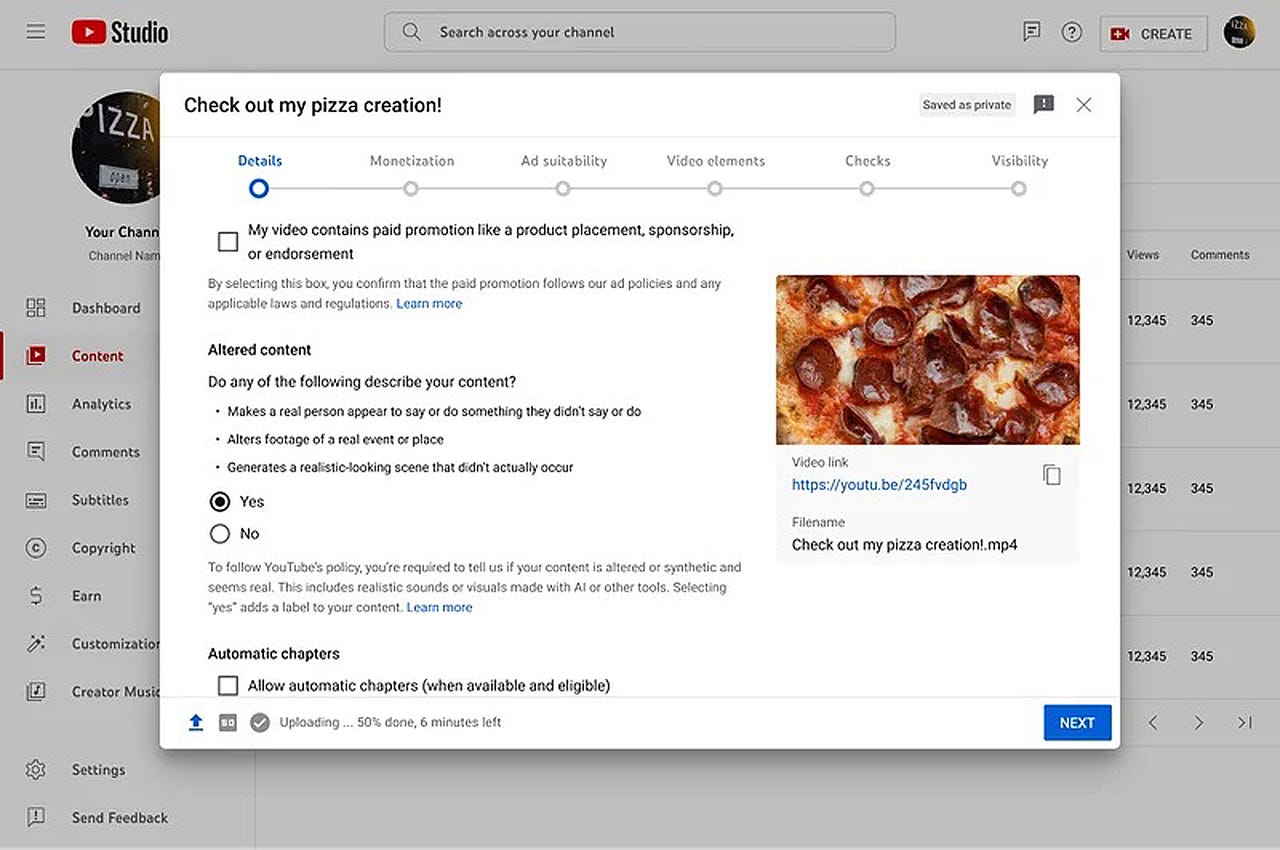
Disclosing AI-generated content in a video

If you upload videos to YouTube, you will now have to fess up if you used AI to create a realistic-looking video. In a Monday blog post, YouTube said that the Creator Studio tool will display labels in certain areas, requiring you to disclose if the content was made using "synthetic media" (meaning generative AI tools).

Built into Creator Studio for both YouTube's website and its mobile apps, the AI confirmation labels will appear in the expanded description or on the video player itself. You'll then need to check a box or otherwise indicate if the content makes a real person appear to say or do something they didn't say or do, alters footage of a real event or place, or generates a realistic-looking scene that didn't actually occur. A label for particularly sensitive content may even appear on the video itself.

Also: YouTube on your TV gets more interactive, and you can shop, too — sort of

First announced in November 2023, the policy applies only to realistic-looking video content that could be misconstrued for real people, places, or events. Some examples cited in the blog include:

  • Using the likeness of a realistic person. Digitally replacing the face of one person with that of another or artificially creating a person's voice to narrate a video.
  • Altering footage of real events or places. Making it look like a real building is on fire or changing a real location in a city to make it look different than in reality.
  • Generating realistic scenes. Depicting fictional major events, such as a tornado moving toward a real town.

Using generative AI to create fantastic or unrealistic scenes or to apply special effects would not require a disclosure. Examples of such instances include:

  • Animating a fantastical world
  • Using AI to adjust the color or lighting filters
  • Using special effects such as background blur or vintage filters
  • Applying beauty filters or other visual enhancements

Fake videos on social media and elsewhere have long triggered concerns of people being fooled into thinking that what they see is real. Generative AI has made the process for generating phony videos even easier and thus more prevalent. Worries are only increasing as we head into a US presidential election where fake political videos can be used to influence voters.

Okay, so the new policy sounds reasonable. But what happens if a YouTube creator simply doesn't comply with the rules?

In the blog post, YouTube said that the team will consider different enforcement measures for users who consistently fail to disclose using AI. In certain cases, YouTube might even add its own label if the creator neglects to do so, especially if the content could confuse or mislead people.

Furthermore, YouTube is aiming to update its privacy policy to help people request that certain AI-generated content be removed. In those situations, individuals should be able to ask to remove any artificial content that mimics their face or voice.

Featured

When AI Poisons AI: The Risks of Building AI on AI-Generated Contents

As generative AI technology advances, there's been a significant increase in AI-generated content. This content often fills the gap when data is scarce or diversifies the training material for AI models, sometimes without full recognition of its implications. While this expansion enriches the AI development landscape with varied datasets, it also introduces the risk of data contamination. The repercussions of such contamination—data poisoning, model collapse, and the creation of echo chambers—pose subtle yet significant threats to the integrity of AI systems. These threats could potentially result in critical errors, from incorrect medical diagnoses to unreliable financial advice or security vulnerabilities. This article seeks to shed light on the impact of AI-generated data on model training and explore potential strategies to mitigate these challenges.

Generative AI: Dual Edges of Innovation and Deception

The widespread availability of generative AI tools has proven to be both a blessing and a curse. On one hand, it has opened new avenues for creativity and problem-solving. On the other hand, it has also led to challenges, including the misuse of AI-generated content by individuals with harmful intentions. Whether it's creating deepfake videos that distort the truth or generating deceptive texts, these technologies have the capacity to spread false information, encourage cyberbullying, and facilitate phishing schemes.

Beyond these widely recognized dangers, AI-generated contents pose a subtle yet profound challenge to the integrity of AI systems. Similar to how misinformation can cloud human judgment, AI-generated data can distort the ‘thought processes' of AI, leading to flawed decisions, biases, or even unintentional information leaks. This becomes particularly critical in sectors like healthcare, finance, and autonomous driving, where the stakes are high, and errors could have serious consequences. Mention below are some of these vulnerabilities:

Data Poisoning

Data poisoning represents a significant threat to AI systems, wherein malicious actors intentionally use generative AI to corrupt the training datasets of AI models with false or misleading information. Their objective is to undermine the model's learning process by manipulating it with deceptive or damaging content. This form of attack is distinct from other adversarial tactics as it focuses on corrupting the model during its training phase rather than manipulating its outputs during inference. The consequences of such manipulations can be severe, leading to AI systems making inaccurate decisions, demonstrating bias, or becoming more vulnerable to subsequent attacks. The impact of these attacks is especially alarming in critical fields such as healthcare, finance, and national security, where they can result in severe repercussions like incorrect medical diagnoses, flawed financial advice, or compromises in security.

Model Collapse

However, its not always the case that issues with datasets arise from malicious intent. Sometimes, developers might unknowingly introduce inaccuracies. This often happens when developers use datasets available online for training their AI models, without recognizing that the datasets include AI-generated content. Consequently, AI models trained on a blend of real and synthetic data may develop a tendency to favor the patterns found in the synthetic data. This situation, known as model collapse, can lead to undermine the performance of AI models on real-world data.

Echo Chambers and Degradation of Content Quality

In addition to model collapse, when AI models are trained on data that carries certain biases or viewpoints, they tend to produce content that reinforces these perspectives. Over time, this can narrow the diversity of information and opinions AI systems produce, limiting the potential for critical thinking and exposure to diverse viewpoints among users. This effect is commonly described as the creation of echo chambers.

Moreover, the proliferation of AI-generated content risks a decline in the overall quality of information. As AI systems are tasked with producing content at scale, there's a tendency for the generated material to become repetitive, superficial, or lacking in depth. This can dilute the value of digital content and make it harder for users to find insightful and accurate information.

Implementing Preventative Measures

To safeguard AI models from the pitfalls of AI-generated content, a strategic approach to maintaining data integrity is essential. Some of key ingredients of such an approach are highlighted below:

  1. Robust Data Verification: This step entails implementation of stringent processes to validate the accuracy, relevance, and quality of the data, filtering out harmful AI-generated content before it reaches AI models.
  2. Anomaly Detection Algorithms: This involves using specialized machine learning algorithms designed to detect outliers to automatically identify and remove corrupted or biased data.
  3. Diverse Training Data: This phrase deals with assembling training datasets from a wide array of sources to diminish the model's susceptibility to poisoned content and improve its generalization capability.
  4. Continuous Monitoring and Updating: This requires regularly monitoring AI models for signs of compromise and refresh the training data continually to counter new threats.
  5. Transparency and Openness: This demands keeping the AI development process open and transparent to ensure accountability and support the prompt identification of issues related to data integrity.
  6. Ethical AI Practices: This requires committing to ethical AI development, ensuring fairness, privacy, and responsibility in data use and model training.

Looking Forward

As AI becomes more integrated into society, the importance of maintaining the integrity of information is increasingly becoming important. Addressing the complexities of AI-generated content, especially for AI systems, necessitates a careful approach, blending the adoption of generative AI best practices with the advancement of data integrity mechanisms, anomaly detection, and explainable AI techniques. Such measures aim to enhance the security, transparency, and accountability of AI systems. There is also a need for regulatory frameworks and ethical guidelines to ensure the responsible use of AI. Efforts like the European Union's AI Act are notable for setting guidelines on how AI should function in a clear, accountable, and unbiased way.

The Bottom Line

As generative AI continues to evolve, its capabilities to enrich and complicate the digital landscape grow. While AI-generated content offers vast opportunities for innovation and creativity, it also presents significant challenges to the integrity and reliability of AI systems themselves. From the risks of data poisoning and model collapse to the creation of echo chambers and the degradation of content quality, the consequences of relying too heavily on AI-generated data are multifaceted. These challenges underscore the urgency of implementing robust preventative measures, such as stringent data verification, anomaly detection, and ethical AI practices. Additionally, the “black box” nature of AI necessitates a push towards greater transparency and understanding of AI processes. As we navigate the complexities of building AI on AI-generated content, a balanced approach that prioritizes data integrity, security, and ethical considerations will be crucial in shaping the future of generative AI in a responsible and beneficial manner.

Qualcomm’s Snapdragon 8s Gen 3 brings more AI tools to Android phones. Here’s what’s new

snapdragon-8s-gen-3-key-visual

Your phone's processor is the unsung hero of the device because it is largely responsible for powering every cool, advanced feature that you've come to know and love about your smartphone. Qualcomm's latest chip will push your next Android capabilities even further, especially when it comes to AI.

On Sunday, Qualcomm unveiled its newest mobile platform — the Snapdragon 8s Gen 3. In alignment with the industry shift toward on-device AI, this new chip is designed to unleash a new wave of generative AI functionality on smartphones.

Also: When is Google I/O 2024 and what can we expect?

"With capabilities including on-device generative AI and advanced photography features, Snapdragon 8s Gen 3 is designed to enhance user experiences, fostering creativity and productivity in their daily lives," said Chris Patrick, SVP and general manager of handsets at Qualcomm.

Qualcomm has not revealed which flagship phones will be sporting the new chip. However, it did share that the Snapdragon 8s Gen 3 will be adopted by leading manufacturers including Honor, iQOO, realme, Redmi, and Xiaomi — all Chinese OEMs — with the first device scheduled for release as early as March.

What exactly can you expect to see in those phones? We rounded up the top three AI features.

1. Generative AI virtual assistants

We're all familiar with voice assistants like Siri and Alexa, but what about an assistant that has a voice and a face? According to Qualcomm, the Snapdragon 8s Gen 3 will make that possible.

Also: Mechanics of the future: Meet the specialists assembling AI

The virtual assistant would be supported by the Qualcomm Sensing Hub, which can securely compile all of the user's data — such as their favorite activities, locations, and more — to make the virtual assistant's suggestions and responses more tailored toward the individual's preferences.

2. Fast on-device image and text generation

There's been an increased interest this year in on-device AI, which offers advantages such as increased speed and security. The Snapdragon 8s Gen 3 supports on-device generative AI at up to 10B parameters, supporting more than 30 large language models (LLMs) and large vision models (LVMs) at impressively high speeds.

To put the speed into perspective, it can generate images in a fraction of a second whereas the standard image generator takes about 10 seconds on average. LLM models can run up to 20 tokens per second, which the company claims is one of the fastest in the smartphone industry.

Also: The best AI image generators to try right now

3. On-device photo expansion

Similar to the Adobe Photoshop Generative Fill feature, Photo Expansion can generate content beyond the photo's frame and blend it with the original photo, right on a user's smartphone. The feature is particularly useful for editing a photo you wish you had framed better or for providing a different view of the same shot.

Artificial Intelligence

TechCrunch Minute: Why the AI world is gathering at Nvidia’s GTC 2024 event this week

TechCrunch Minute: Why the AI world is gathering at Nvidia’s GTC 2024 event this week Alex Wilhelm 8 hours

Chip giant Nvidia is hosting a massive AI conference as part of its GTC event this week, which kicks off Monday. With a keynote planned from Jensen Huang, CEO and co-founder, of the company best known in year’s past for its gaming hardware and today for its massive market share in the burgeoning AI hardware market, expect Nvidia to make some news.

But there’s a host of other AI companies planning on making an appearance. Given how many AI startups and giants alike use Nvidia gear, TechCrunch is expecting quite a lot to shake loose over the next few days.

To presage the confab, and detail just why we’re paying such close attention to a single company’s industry event, hit play below. Stick close to TechCrunch for coverage throughout the week.

Quilt is building AI assistants for solutions teams

Quilt is building AI assistants for solutions teams Kyle Wiggers 8 hours

The job of so-called “solutions professionals” — people like sales engineers, solutions architects and consultants — revolves around pitching complex enterprise tech to potential customers. It’s important work. But despite this being the case, rarely are solutions teams adequately staffed and resourced, according to entrepreneur Dan Chen.

“Solutions teams bring technical credibility to the selling motion and help the customer understand exactly what they’re buying and why,” Chen told TechCrunch in an interview. “They’re the unsung heroes of the business-to-business sales organization, yet they’re consistently overlooked.”

Chen, previously a partner at Andreessen Horowitz and Sequoia Capital and the co-founder of Hero, a Salesforce support app that HR startup People.ai acquired in 2021, believes the answer lies in AI — specifically generative AI. So with his friend Michael Graczyk (with whom Chen also co-founded Hero), he created Quilt, a platform that hosts AI assistants for solutions sales teams.

“Two things happened in 2022 that made Quilt possible,” Chen continued. “First, the market correction caused an abrupt 180 from ‘grow at all costs’ to ‘do more with less’ … Second, the launch of [OpenAI’s] ChatGPT in late 2022 led to an explosion of new products and services built off of publicly available pre-trained [AI] models.”

Quilt’s core products are AI-powered assistants designed to help solutions engineers with tasks like filling out requests for proposals, answering basic technical questions and prepping for demos. The assistants, Chen says, can complete security and due diligence questionnaires, field questions from reps via Slack and summarize the contents of notes, calls and research ahead of customer meetings.

That all sounds like pretty standard workflow automation stuff. But Chen insists that Quilt is uniquely able to incorporate engineers’ technical knowledge and “understand context.”

“Quilt saves [teams] time with routine tasks so they can spend more time with customers and help win more deals,” Chen said.

But what about generative AI’s tendency to “hallucinate“? It’s no secret that models like ChatGPT and Microsoft’s Copilot make mistakes in summarizations — including, problematically, in meeting summaries. In a recent piece, The Wall Street Journal cited an instance where, for one early adopter using Copilot for meetings, Copilot invented attendees and implied that calls were about subjects that were never discussed.

Quilt

Quilt’s AI can automatically fill in forms and questionnaires, drawing on data from solutions teams and company databases.

Chen asserts that Quilt is less prone to such hallucinations because its models and training procedures “separate facts that the model ‘knows’ from facts in enterprise data.”

“Most AI startups continue to understate hallucinations and how they can damage customer trust,” he said. “Sales teams won’t use tools that make things up and fill in details with fake information.”

But what about how Quilt handles data? Surveys show that many businesses are concerned about the privacy and security risks associated with generative AI. Apple, Samsung and Verizon among others have reportedly limited internal use of tools like ChatGPT out of fears employees would expose sensitive information to them.

Chen says that Quilt doesn’t share data across organizations and allows users to request that their account — and data — be deleted at any time.

Those assurances appear to have been enough to allay the concerns of investors, for what it’s worth. Sequoia recently led a $2.5 million seed round in Quilt, with participation from angel investors hailing from DataDog, HubSpot, DoorDash, Asana, Eventbrite and a16z.

It’s early days — Chen wouldn’t reveal the names of any Quilt customers. But, fueled in part by the seed capital, Quilt has plans to grow its six-person team, scale up its go-to-market efforts and “accelerate the development of the next solutions assistants,” Chen said.

“Over the next two years, AI will be a key factor between the best-performing sales orgs and the worst,” he added. “For large, complicated and often technical products, solutions teams are the backbone of the sales process.

Chen might have a point. In terms of sales functions broadly, there’s a lot of interest in what generative AI can accomplish — and what applications it can expedite.

According to a 2023 survey by sales execution platform Outreach, 62% of sales orgs are already actively using generative AI for use cases like enhancing customer interactions, updating customer relationship management data and responding to requests for proposals. There’s hesitancy among some — 42% of respondents said that they were worried about the tech’s inaccuracies. But the majority believe generative AI has the potential to boost productivity by streamlining existing tasks.

“Given the kinds of customers Quilt is working with, we’re well-positioned to be the preferred AI partner for solutions teams,” Chen said.

GitHub Actions For Machine Learning Beginners

GitHub Actions For Machine Learning Beginners
Image by Author

GitHub Actions is a powerful feature of the GitHub platform that allows for automating software development workflows, such as testing, building, and deploying code. This not only streamlines the development process but also makes it more reliable and efficient.

In this tutorial, we will explore how to use GitHub Actions for a beginner Machine Learning (ML) project. From setting up our ML project on GitHub to creating a GitHub Actions workflow that automates your ML tasks, we will cover everything you need to know.

What is GitHub Actions?

GitHub Actions is a powerful tool that provides a continuous integration and continuous delivery (CI/CD) pipeline for all GitHub repositories for free. It automates the entire software development workflow, from creating and testing to deploying code, all within the GitHub platform. You can use it to improve your development and deployment efficiency.

GitHub Actions key features

We will now learn about key components of workflow.

Workflows

Workflows are automated processes that you define in your GitHub repository. They are composed of one or more jobs and can be triggered by GitHub events such as a push, pull request, issue creation, or by workflows. Workflows are defined in a YML file within the .github/workflows directory of your repository. You can edit it and rerun the workflow right from the GitHub repository.

Jobs and Steps

Within a workflow, jobs define a set of steps that execute on the same runner. Each step in a job can run commands or actions, which are reusable pieces of code that can perform a specific task, such as formatting the code or training the model.

Events

Workflows can be triggered by various GitHub events, such as push, pull requests, forks, stars, releases, and more. You can also schedule workflows to run at specific times using cron syntax.

Runners

Runners are the virtual environments/machines where workflows are executed. GitHub provides hosted runners with Linux, Windows, and macOS environments, or you can host your own runner for more control over the environment.

Actions

Actions are reusable units of code that you can use as steps within your jobs. You can create your own actions or use actions shared by the GitHub community in the GitHub Marketplace.

GitHub Actions makes it straightforward for developers to automate their build, test, and deployment workflows directly within GitHub, helping to improve productivity and streamline the development process.

In this project, we will use two Actions:

  1. actions/checkout@v3: for checking out your repository so that workflow can access the file and data.
  2. iterative/setup-cml@v2: for displaying the model metrics and confusion matrix under the commit as a message.

Automating Machine Learning Workflow with GitHub Actions

We will work on a simple machine learning project using the Bank Churn dataset from Kaggle to train and evaluate a Random Forest Classifier.

Setting Up

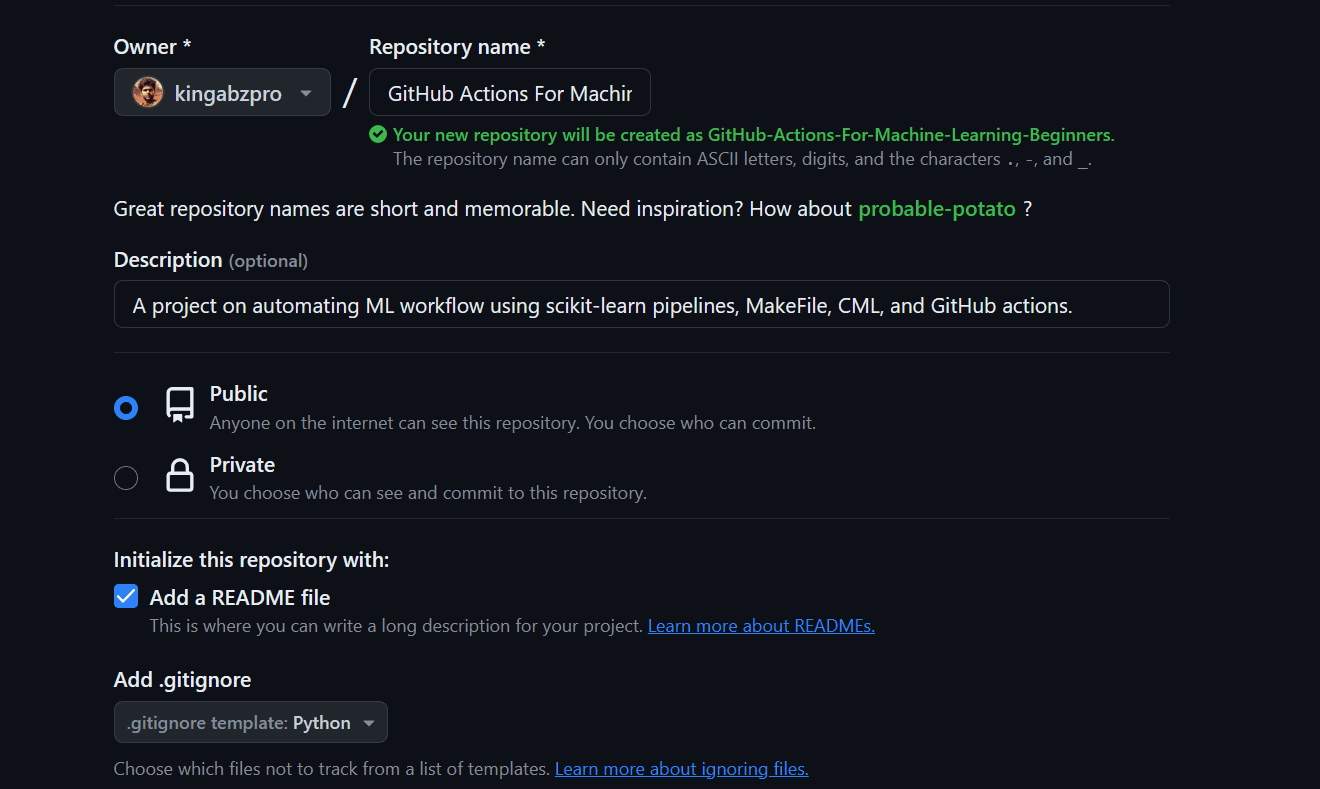
  1. We will create the GitHub repository by providing the name, and description, checking the readme file, and license.

    GitHub Actions For Machine Learning Beginners

  2. Go to the project director and clone the repository.
  3. Change the directory to the repository folder.
  4. Launch the code editor. In our case, it is VSCode.
$ git clone https://github.com/kingabzpro/GitHub-Actions-For-Machine-Learning-Beginners.git    $ cd .GitHub-Actions-For-Machine-Learning-Beginners    $ code .  
  1. Please create a `requirements.txt` file and add all the necessary packages that are required to run the workflow successfully.
pandas  scikit-learn  numpy  matplotlib  skops  black
  1. Download the data from Kaggle using the link and extract it in the main folder.
  2. The dataset is big, so we have to install GitLFS into our repository and track the train CSV file.
$ git lfs install  $ git lfs track train.csv

Training and Evaluating Code

In this section, we will write the code that will train, evaluate, and save the model pipelines. The code is from my previous tutorial, Streamline Your Machine Learning Workflow with Scikit-learn Pipelines. If you want to know how the scikit-learn pipeline works, then you should read it.

  1. Create a `train.py` file and copy and paste the following code.
  2. The code uses ColumnTransformer and Pipeline for preprocessing the data and the Pipeline for feature selection and model training.
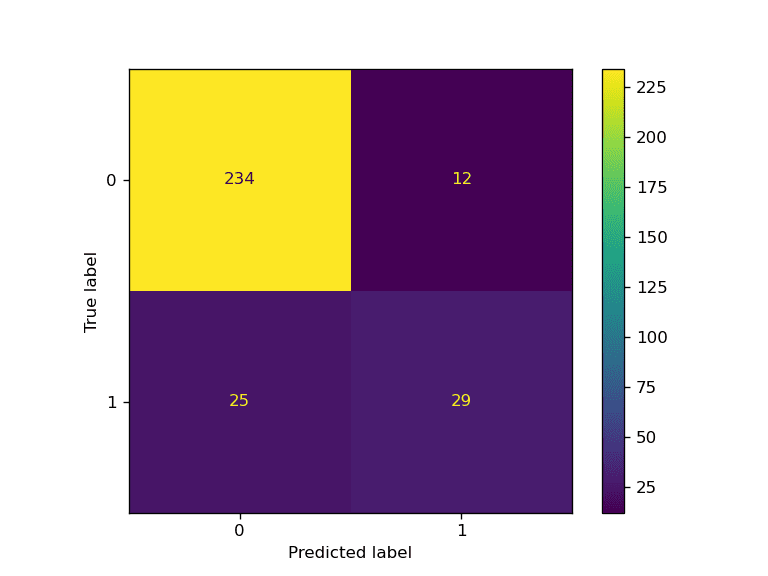
  3. After evaluating the model performance, both metrics and the confusion matrix are saved in the main folder. These metrics will be used later by the CML action.
  4. In the end, the scikit-learn final pipeline is saved for model inference.
import pandas as pd    from sklearn.compose import ColumnTransformer  from sklearn.ensemble import RandomForestClassifier  from sklearn.model_selection import train_test_split    from sklearn.feature_selection import SelectKBest, chi2  from sklearn.impute import SimpleImputer  from sklearn.pipeline import Pipeline  from sklearn.preprocessing import MinMaxScaler, OrdinalEncoder    from sklearn.metrics import accuracy_score, f1_score  import matplotlib.pyplot as plt  from sklearn.metrics import ConfusionMatrixDisplay, confusion_matrix    import skops.io as sio    # loading the data  bank_df = pd.read_csv("train.csv", index_col="id", nrows=1000)  bank_df = bank_df.drop(["CustomerId", "Surname"], axis=1)  bank_df = bank_df.sample(frac=1)      # Splitting data into training and testing sets  X = bank_df.drop(["Exited"], axis=1)  y = bank_df.Exited    X_train, X_test, y_train, y_test = train_test_split(      X, y, test_size=0.3, random_state=125  )    # Identify numerical and categorical columns  cat_col = [1, 2]  num_col = [0, 3, 4, 5, 6, 7, 8, 9]    # Transformers for numerical data  numerical_transformer = Pipeline(      steps=[("imputer", SimpleImputer(strategy="mean")), ("scaler", MinMaxScaler())]  )    # Transformers for categorical data  categorical_transformer = Pipeline(      steps=[          ("imputer", SimpleImputer(strategy="most_frequent")),          ("encoder", OrdinalEncoder()),      ]  )    # Combine pipelines using ColumnTransformer  preproc_pipe = ColumnTransformer(      transformers=[          ("num", numerical_transformer, num_col),          ("cat", categorical_transformer, cat_col),      ],      remainder="passthrough",  )    # Selecting the best features  KBest = SelectKBest(chi2, k="all")    # Random Forest Classifier  model = RandomForestClassifier(n_estimators=100, random_state=125)    # KBest and model pipeline  train_pipe = Pipeline(      steps=[          ("KBest", KBest),          ("RFmodel", model),      ]  )    # Combining the preprocessing and training pipelines  complete_pipe = Pipeline(      steps=[          ("preprocessor", preproc_pipe),          ("train", train_pipe),      ]  )    # running the complete pipeline  complete_pipe.fit(X_train, y_train)      ## Model Evaluation  predictions = complete_pipe.predict(X_test)  accuracy = accuracy_score(y_test, predictions)  f1 = f1_score(y_test, predictions, average="macro")    print("Accuracy:", str(round(accuracy, 2) * 100) + "%", "F1:", round(f1, 2))      ## Confusion Matrix Plot  predictions = complete_pipe.predict(X_test)  cm = confusion_matrix(y_test, predictions, labels=complete_pipe.classes_)  disp = ConfusionMatrixDisplay(confusion_matrix=cm, display_labels=complete_pipe.classes_)  disp.plot()  plt.savefig("model_results.png", dpi=120)    ## Write metrics to file  with open("metrics.txt", "w") as outfile:      outfile.write(f"nAccuracy = {round(accuracy, 2)}, F1 Score = {round(f1, 2)}nn")         # saving the pipeline  sio.dump(complete_pipe, "bank_pipeline.skops")

We got a good result.

$ python train.py  Accuracy: 88.0% F1: 0.77

GitHub Actions For Machine Learning Beginners

You can learn more about the inner workings of the code mentioned above by reading "Streamline Your Machine Learning Workflow with Scikit-learn Pipelines"

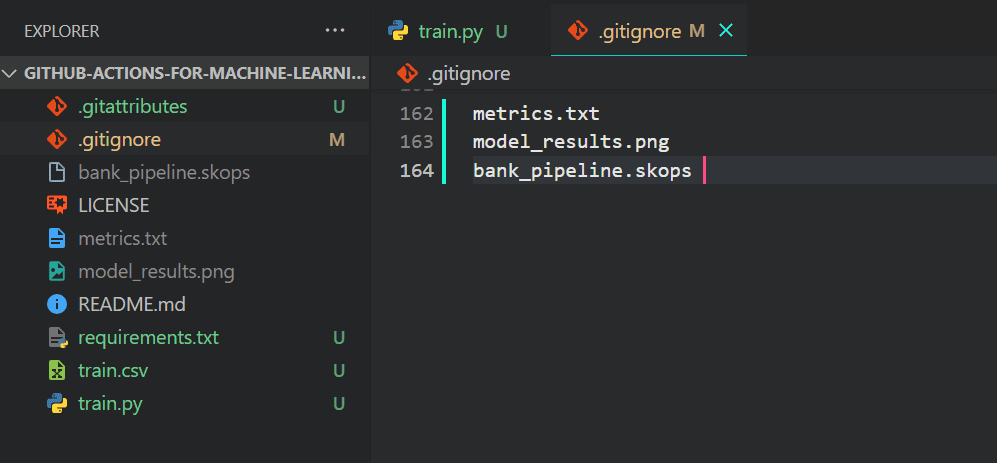
We don't want Git to push output files as they are always generated at the end of the code so we will be adding the to .gitignore file.

Just type `.gitignore` in the terminal to launch the file.

$ .gitignore

Add the following file names.

metrics.txt  model_results.png  bank_pipeline.skops

This is how it should look like on your VSCode.

GitHub Actions For Machine Learning Beginners

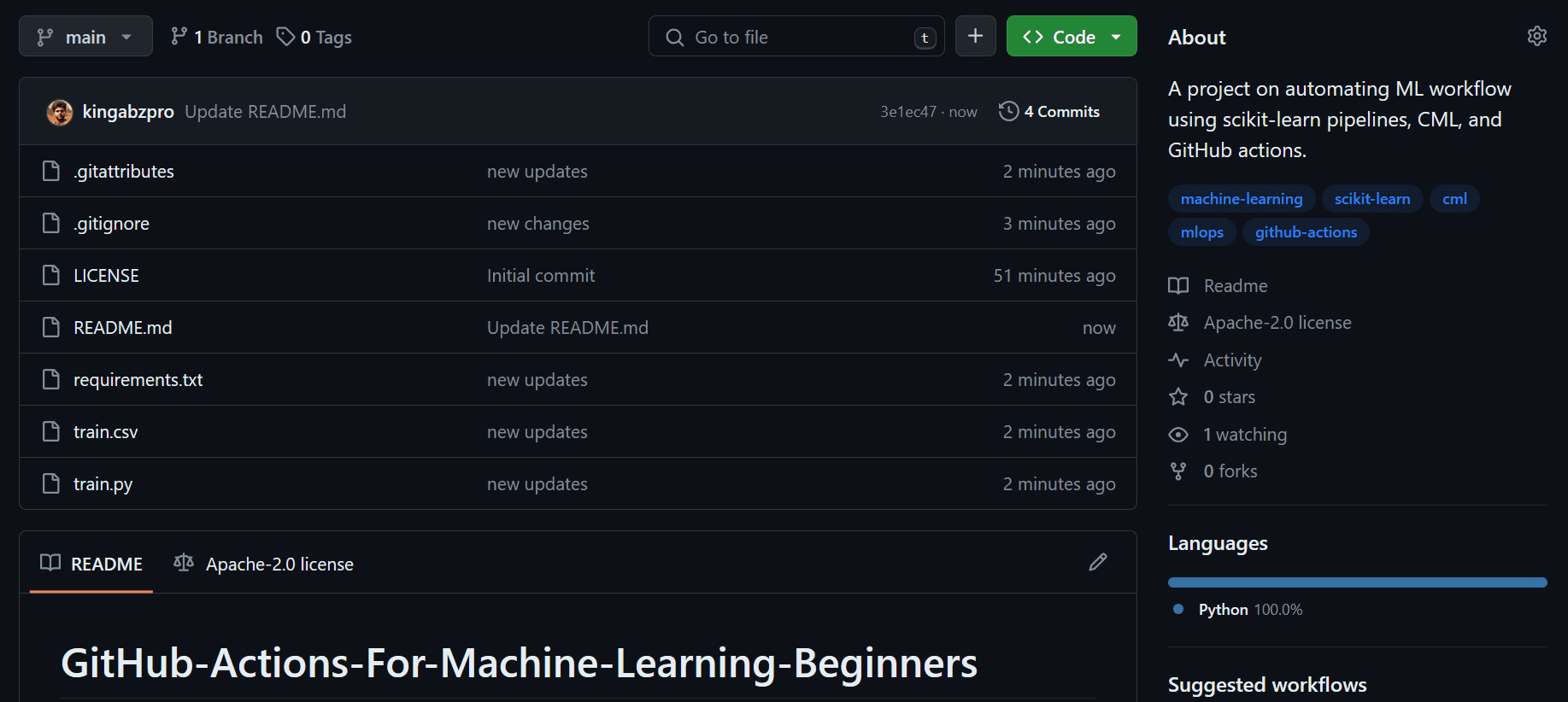
We will now stage the changes, create a commit, and push the changes to the GitHub main branch.

git add .  git commit -m "new changes"  git push origin main

This is how your GitHub repository should look like.

GitHub Actions For Machine Learning Beginners

CML

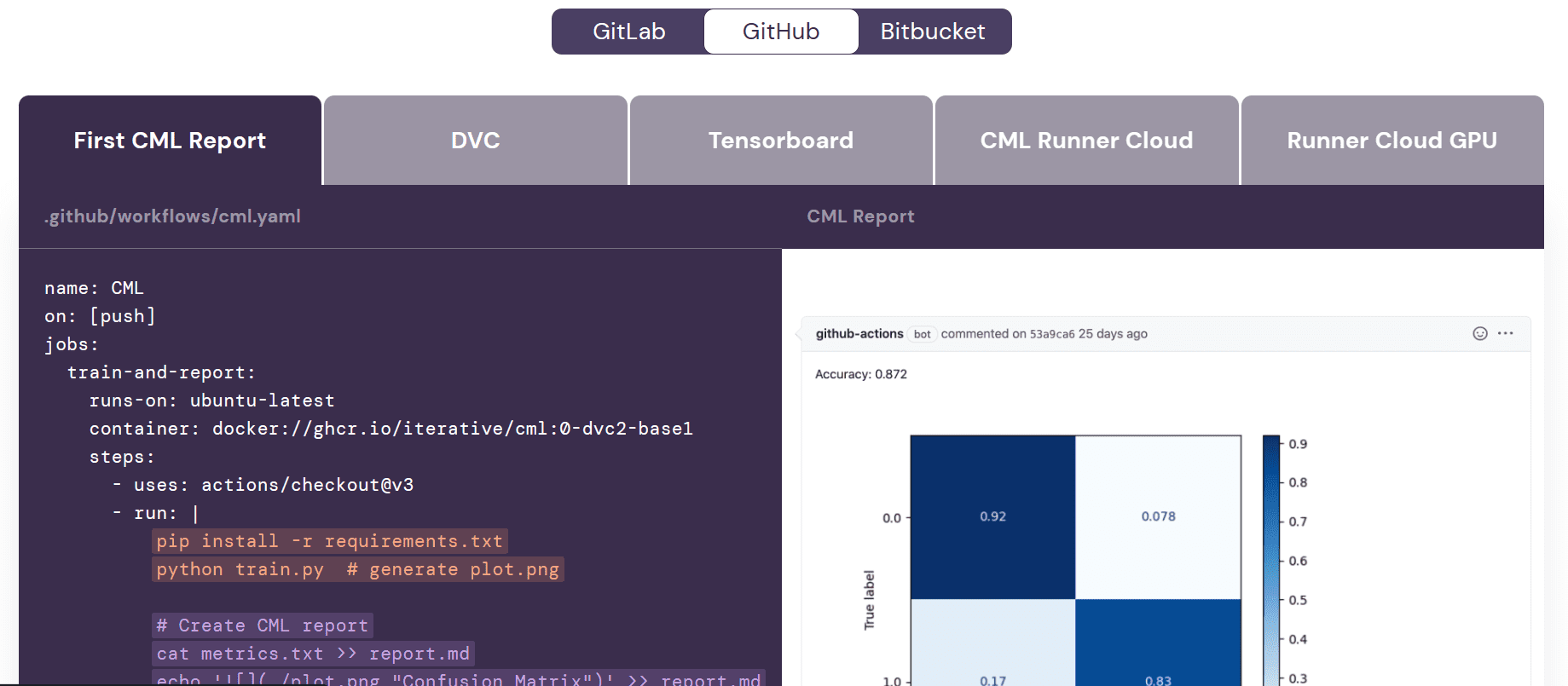
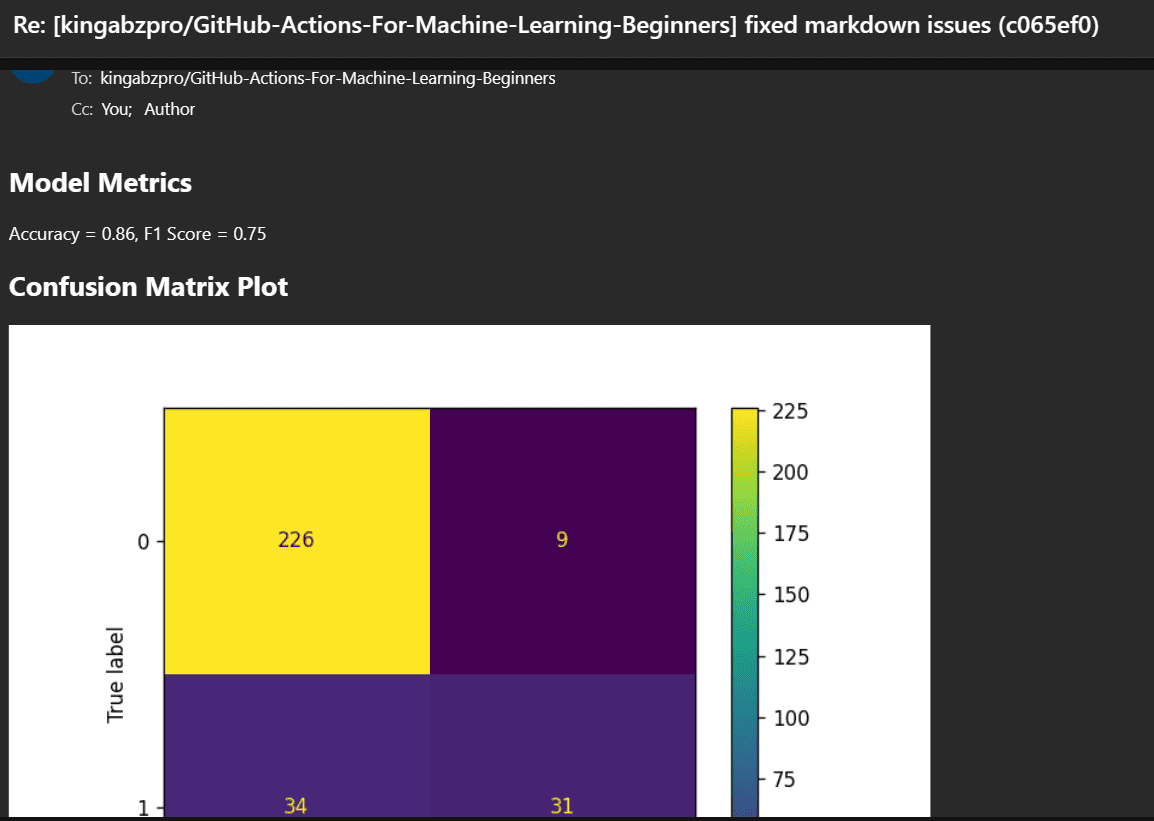
Before we begin working on the workflow, it's important to understand the purpose of Continuous Machine Learning (CML) actions. CML functions are used in the workflow to automate the process of generating a model evaluation report. What does this mean? Well, when we push changes to GitHub, a report will be automatically generated under the commit. This report will include performance metrics and a confusion matrix, and we will also receive an email with all this information.

GitHub Actions For Machine Learning Beginners

GitHub Actions

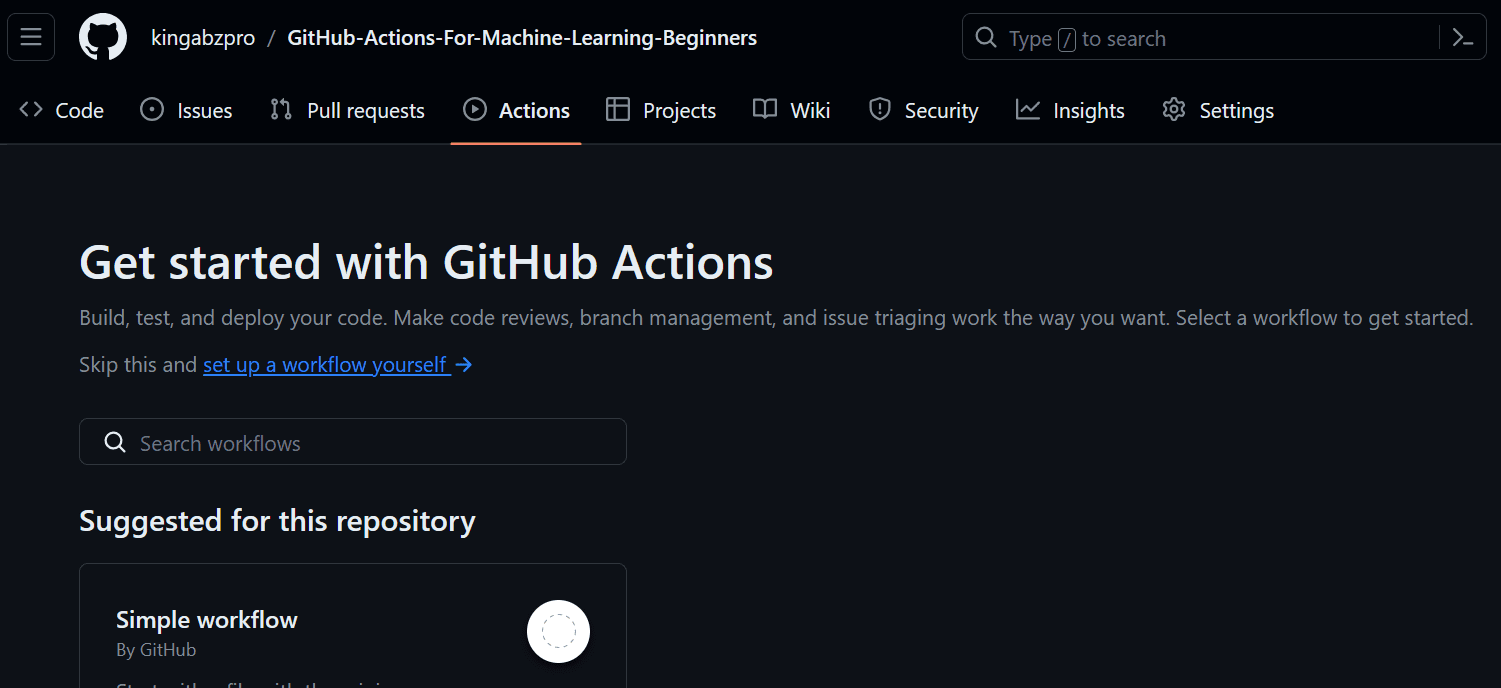
It's time for the main part. We will develop a machine learning workflow for training and evaluating our model. This workflow will be activated whenever we push our code to the main branch or when someone submits a pull request to the main branch.

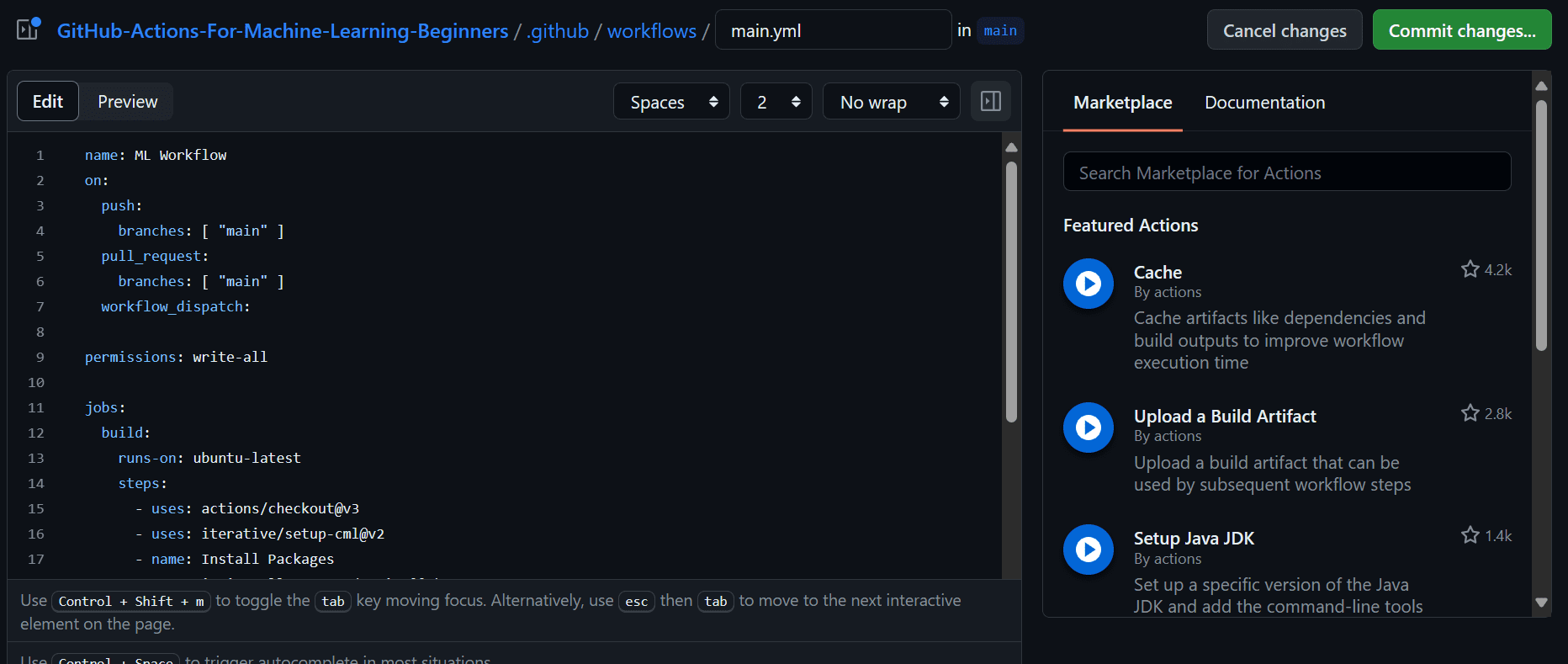
To create our first workflow, navigate to the “Actions” tab on the repository and click on the blue text “set up a workflow yourself.” It will create a YML file in the .github/workflows directory and provide us with the interactive code editor for adding the code.

GitHub Actions For Machine Learning Beginners

Add the following code to the workflow file. In this code, we are:

  1. Naming our workflow.
  2. Setting the triggers on push and pull request using `on` keyworks.
  3. Providing the actions with written permission so that the CML action can create the message under the commit.
  4. Use Ubuntu Linux runner.
  5. Use `actions/checkout@v3` action to access all the repository files, including the dataset.
  6. Using `iterative/setup-cml@v2` action to install the CML package.
  7. Create the run for installing all of the Python packages.
  8. Create the run for formatting the Python files.
  9. Create the run for training and evaluating the model.
  10. Create the run with GITHUB_TOKEN for moving the model metrics and confusion matrix plot to report.md file. Then, use the CML command to create the report under the commit comment.
name: ML Workflow  on:    push:      branches: [ "main" ]    pull_request:      branches: [ "main" ]    workflow_dispatch:      permissions: write-all    jobs:    build:      runs-on: ubuntu-latest      steps:        - uses: actions/checkout@v3          with:            lfs: true        - uses: iterative/setup-cml@v2        - name: Install Packages          run: pip install --upgrade pip && pip install -r requirements.txt        - name: Format          run: black *.py        - name: Train          run: python train.py        - name: Evaluation          env:            REPO_TOKEN: ${{ secrets.GITHUB_TOKEN }}          run: |             echo "## Model Metrics" > report.md            cat metrics.txt >> report.md                          echo '## Confusion Matrix Plot' >> report.md            echo '![Confusion Matrix](model_results.png)' >> report.md              cml comment create report.md  

This is how it should look on your GitHub workflow.

GitHub Actions For Machine Learning Beginners

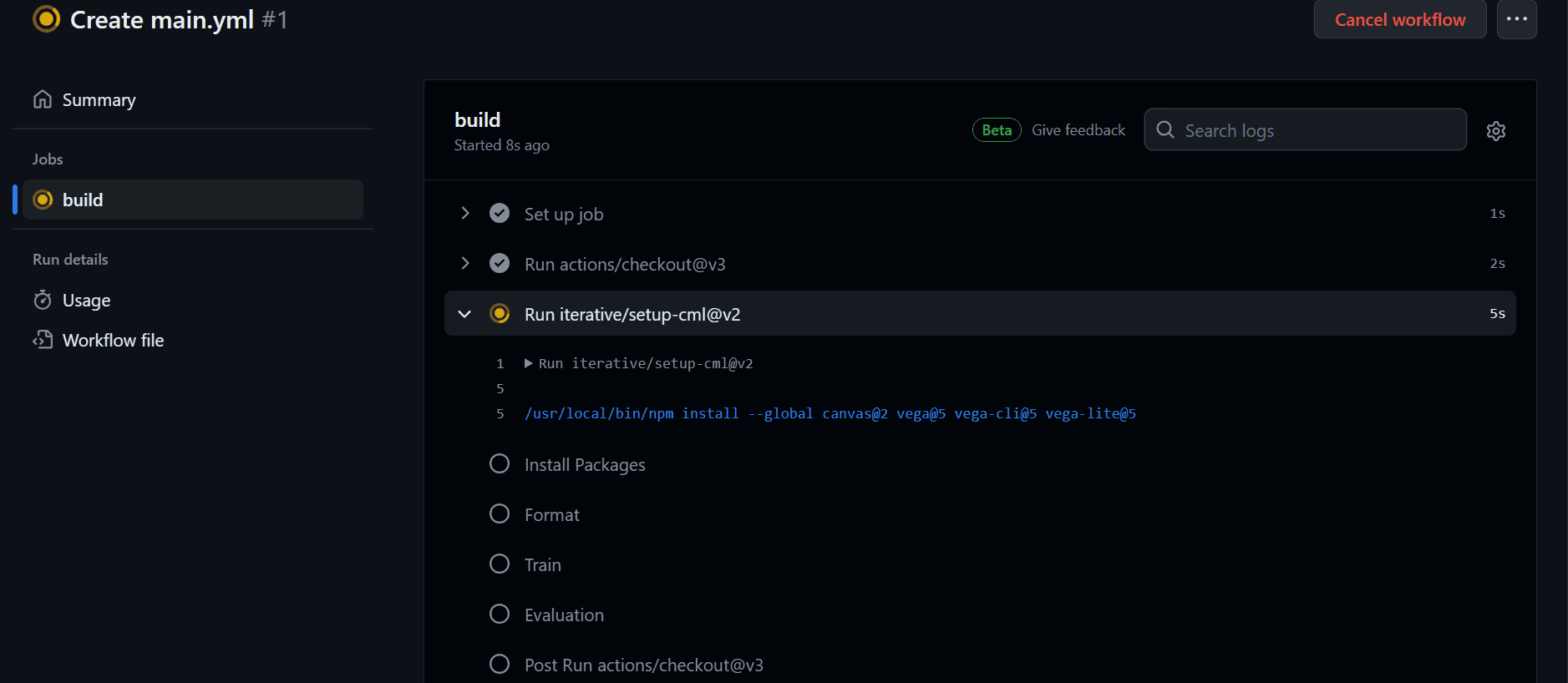
After committing the changes. The workflow will start executing the command sequentially.

GitHub Actions For Machine Learning Beginners

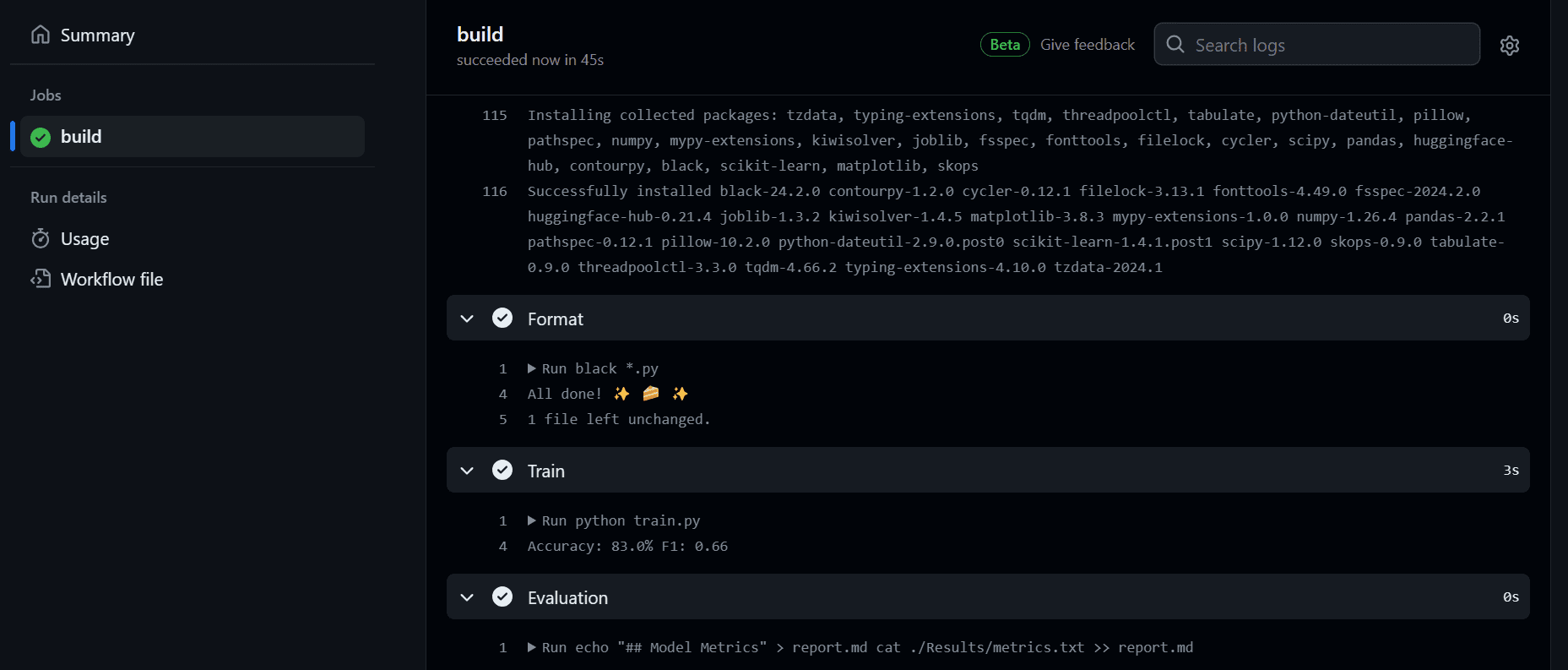
After completing the workflow, we can view the logs by clicking on the recent workflow in the "Actions" tab, opening the build, and reviewing each task's logs.

GitHub Actions For Machine Learning Beginners

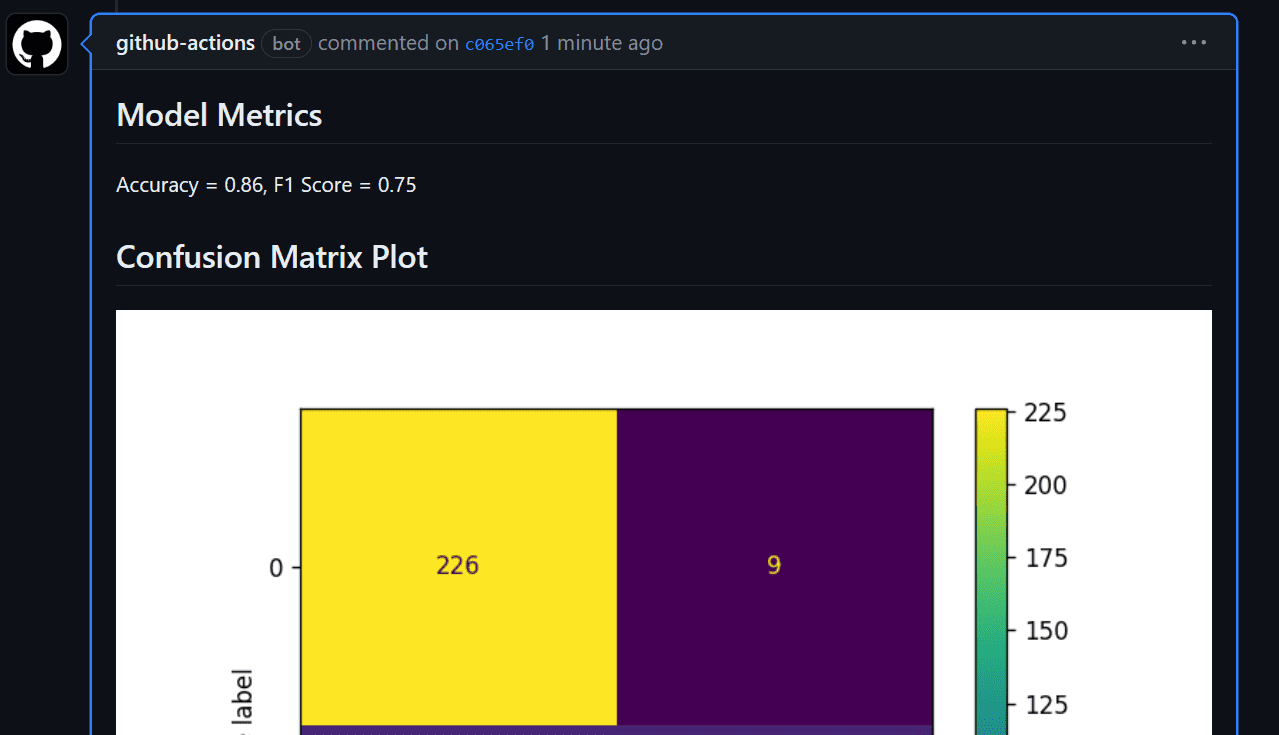
We can now view the model evaluation under the commit messages section. We can access it by clicking on the commit link: fixed location in workflow · kingabzpro/GitHub-Actions-For-Machine-Learning-Beginners@44c74fa

GitHub Actions For Machine Learning Beginners

You will also receive an email from GitHub

GitHub Actions For Machine Learning Beginners

The code source is available on my GitHub repository: kingabzpro/GitHub-Actions-For-Machine-Learning-Beginners. You can clone it and try it yourself.

Final Thoughts

Machine learning operation (MLOps) is a vast field that requires knowledge of various tools and platforms to successfully build and deploy models in production. To get started with MLOps, it is recommended to follow a comprehensive tutorial, "A Beginner's Guide to CI/CD for Machine Learning". It will provide you with a solid foundation to effectively implement MLOps techniques.

In this tutorial, we covered what GitHub Actions are and how they can be used to automate your machine learning workflow. We also learned about CML Actions and how to write scripts in YML format to run jobs successfully. If you're still confused about where to start, I suggest taking a look at The Only Free Course You Need To Become a MLOps Engineer.

Abid Ali Awan (@1abidaliawan) is a certified data scientist professional who loves building machine learning models. Currently, he is focusing on content creation and writing technical blogs on machine learning and data science technologies. Abid holds a Master's degree in technology management and a bachelor's degree in telecommunication engineering. His vision is to build an AI product using a graph neural network for students struggling with mental illness.

More On This Topic

  • Adventures in MLOps with Github Actions, Iterative.ai, Label Studio…
  • Schedule & Run ETLs with Jupysql and GitHub Actions
  • KDnuggets News, December 14: 3 Free Machine Learning Courses for…
  • 10 GitHub Repositories to Master Machine Learning
  • Learn Machine Learning From These GitHub Repositories
  • 3 Free Machine Learning Courses for Beginners

Telugu LLM Labs Unveils Navarasa 2.0, Gemma Instruction Tuned Model in 15 Indian Languages

Telugu LLM Labs is Here with Native and Romanised Dataset

Telugu LLM Labs has announced the release of Navarasa 2.0, a Gemma 7B/2B instruction-tuned model capable of processing content in 15 Indian languages along with English. This latest iteration marks a significant advancement following the recent introduction of fine-tuned Gemma models for nine Indian languages.

Check out the models on Hugging Face.

Navarasa 2.0 represents a substantial leap in capabilities, leveraging Gemma 7B/2B SFT models as its base. Notably, the model’s generative prowess has been expanded to encompass a diverse array of Indian languages, including Marathi, Urdu, Konkani, Assamese, Nepali, and Sindhi.

The model was trained on a single with E2E Networks Limited using NVIDIA A100 GPUs which took approximately 44 hours for the 7 billion model and 18 hours for the 2 billion model.

This achievement was realised through the translation of the alpaca-cleaned-filtered dataset into these additional languages, effectively broadening its linguistic repertoire.

The 15 languages supported by Navarasa 2.0 are as follows: Hindi, Telugu, Tamil, Kannada, Malayalam, Marathi, Gujarati, Bengali, Punjabi, Odia, Urdu, Konkani, Assamese, Nepali, Sindhi, and English.

Ravi Theja Desetty from LlamaIndex and Ramsri Goutham Golla, through their collaborative venture have introduced Telugu LLM Labs, initiating a significant stride towards enhancing the Telugu Natural Language Processing (NLP) space.

Regarding datasets, Telugu LLM Labs undertook the task of translating the alpaca-cleaned-filtered dataset into six additional Indian languages. This effort led to the creation of the Indic Alpaca Datasets collection, consolidating all relevant datasets in one accessible repository. The model was fine-tuned using approximately 630,000 instruction samples.

Furthermore, the capabilities demonstrated by Navarasa 2.0 mirror those of its predecessor, allowing for seamless interaction across various language contexts. Noteworthy features include the ability to process instructions and input in native languages, respond in the same language, and handle multilingual interactions involving English.

The post Telugu LLM Labs Unveils Navarasa 2.0, Gemma Instruction Tuned Model in 15 Indian Languages appeared first on Analytics India Magazine.

4 ways AI is contributing to bias in the workplace

ChatGPT on a MacBook

There's no question that artificial intelligence (AI) tools are more popular than ever because they're so advanced and have never been so accessible, particularly generative AI.

You'd be hard-pressed to find someone in the US who hasn't at least heard of ChatGPT, let alone used some form of it since its launch. But these systems are only as smart as the data they've trained on, which humans have created. This means that, like humans, these AI tools can be prone to bias.

Also: How to avoid the headaches of AI skills development

Bloomberg recently published a study about racial biases in experiments with GPT-3.5. Researchers asked the AI tool to rank 1,000 resumes of equally qualified candidates with different names. They found GPT-3.5 ranked people with names traditionally used by certain demographics, such as Black Americans, at the bottom of the list.

Another study showed that AI models are also affected by pre-existing biases in healthcare applications due to historical inequalities and disparities in access and quality. These factors are accentuated when AI systems are trained on data reflecting inequalities.

Here are four ways AI is contributing to bias in the workplace.

Artificial Intelligence