Top Free Data Science Online Courses for 2024

Top Free Data Science Online Courses for 2024
Image by Author

We’re 3 months into the new year. Wow, time is going by fast. With that being said, how many of you can say that you are on target to reach your goals, if it’s Q1 goals, learning goals, etc?

It’s hard. It’s hard to stay on top of everything and achieve every goal.

If learning data science was one of your 2024 goals, KDNuggets is here to help you so your journey to learning new skills and shifting careers is smooth.

I have put together a list of FREE online data science courses that will help you build a solid foundation of data science knowledge, skills and best practices to have a great career in the data world.

Understanding Data Science

From: DataCamp

Link: Understanding Data Science

If you’re new to the data science world, the first thing you want to get your head around is the basics. With no coding involved, this free course will define what data science is.

You will dive deeper into what a data science workflow is and how data science is applied to real-world problems. Once you have a good understanding of the field, you will end off will learning about different roles within the data science field.

Introduction to Programming with Python

From: Harvard University

Link: Introduction to Programming with Python

Have you decided to choose Python as your programming language choice? Great idea.

It’s been a popular programming language for a while now and now you can learn it with this self-paced course which will take you roughly 10 weeks to complete. This course has been specifically designed for students who have no prior experience or knowledge when it comes to programming and wish to transition into the data science world by learning Python.

The following topics are covered: functions, variables, conditionals, loops, exceptions, libraries, unit tests, file I/O, regular expressions, object-oriented programming, and more.

Python Data Science Toolbox

From: DataCamp

Link: Python Data Science Toolbox

As it’s been the most popular programming language for a few years now, there is no harm in perfecting the Python programming language.

With no coding experience or skill needed, Part 1 of the Python Data Science toolbox course teaches you how to effectively analyze and visualise your data. With 13 videos included in this course, you will go from data manipulation to plotting data with Matplotlib.

Data Science: R Basics

From: Harvard University

Link: Data Science: R Basics

Maybe you haven’t gone for Python and maybe you have decided to choose R as your programming language. Regardless of what you decide to go ahead with — it is always good to start with the basics. Harvard University offers a Data Science: R Basics course that helps you to build a solid foundation in the R programming language — from learning how to wrangle, analyze, and visualize data.

The course is free; however, you can pay for a verified certificate for $149.

Statistical Learning

From: Stanford Online

Link: Statistical Learning

I say it all the time and I will say it again — it is very important to learn about statistics in data science. This Statistical Learning course by edX will provide you with the main tools used in statistical modelling and data science.

It covers the following topics: an overview of statistical learning, linear regression, classification, resampling methods, linear model selection and regularization, moving beyond linearity, tree-based methods, support vector machines, deep learning, survival modelling, unsupervised learning, and multiple testing.

Data Analytics

From: Google

Link: Google Data Analytics

You have probably heard about this course a lot — it is very popular. It consists of 8 sections, where you will learn about the day-to-day use of data, best practices and processes that you should expect in your new data science/analytics jobs.

You will learn how to clean and organize data for the analysis process and make calculations using spreadsheets, SQL and R programming. It doesn’t stop there, you will further your analytical skills by creating data visualizations and also learning about tools such as Tableau.

Machine Learning Specialization

From: Coursera

Link: Machine Learning Specialization

This course has been put together by Andrew Ng, Founder & CEO of Landing AI, Founder of deeplearning.ai, and Co-Chairman and Co-Founder of Coursera. He has constructed a machine learning specialization made up of 3 courses:

  1. Supervised Machine Learning: Regression and Classification
  2. Advanced Learning Algorithms
  3. Unsupervised Learning, Recommenders, Reinforcement Learning

These courses are free; however, there is a fee if you wish to get certified.

Wrapping it up

These 7 courses help you build skills in different aspects of data science, to ensure you have the skills and knowledge you require to be great at your data science job.

For example, working on being proficient in the Python programming language, or the R programming language. Understand the importance of learning statistics in data science, and how it affects the analytics process. Last but not least, put everything together and apply it to machine learning, for example, regression and recommenders.

Happy Learning!

Nisha Arya is a data scientist, freelance technical writer, and an editor and community manager for KDnuggets. She is particularly interested in providing data science career advice or tutorials and theory-based knowledge around data science. Nisha covers a wide range of topics and wishes to explore the different ways artificial intelligence can benefit the longevity of human life. A keen learner, Nisha seeks to broaden her tech knowledge and writing skills, while helping guide others.

More On This Topic

  • 5 FREE Courses on AI with Microsoft for 2024
  • Top Free Data Science Online Courses for 2023
  • KDnuggets News, April 6: 8 Free MIT Courses to Learn Data Science…
  • 8 Free MIT Courses to Learn Data Science Online
  • Top 6 Data Science Online Courses in 2021
  • 6 Best Free Online Courses to Jumpstart Your Learning of SQL

NetApp Unlocks Exabytes of Enterprise Data for GenAI with NVIDIA

Netapp startup accelerator

NetApp in collaboration with NVIDIA, today announced a groundbreaking advancement in generative AI applications, enabling secure and private data interaction across the hybrid multicloud. This partnership leverages NVIDIA NeMo Retriever microservices, a component of the NVIDIA AI Enterprise software platform, to unlock exabytes of data stored on NetApp’s intelligent data infrastructure.

Enterprises now have the capability to securely “talk to their data,” accessing proprietary business insights without compromising data security or privacy. This innovation addresses the challenges enterprises face in leveraging large language models for internal applications, such as chatbots and co-pilots, without risking data exposure.

NetApp and NVIDIA’s solution simplifies the process, allowing any data stored on NetApp ONTAP—whether on-premises or in the cloud—to be queried through simple prompts. This ensures that enterprises maintain control over their data while benefiting from AI-driven insights.

“As the leader in unstructured data management, NetApp makes data infrastructure intelligent to securely turbocharge AI innovation,” said George Kurian, CEO at NetApp. “AI is defining a new data-driven era and NetApp and NVIDIA are at the forefront of ensuring success for customers as they adopt and deploy AI.”

Jensen Huang, Founder and CEO at NVIDIA, emphasized the transformative potential of retrieval-augmented generation, stating, “Together, NVIDIA and NetApp can help enterprises build accurate, intelligent generative AI applications that let companies talk to their data — and foster a new wave of business opportunity.”

This collaboration not only reduces the friction, cost, and time to value for enterprises but also complements NetApp’s robust portfolio of AI offerings. Over 500 joint customers have already leveraged these solutions for AI model training and inference.

The “Talk to Your Data” capabilities were also showcased at NVIDIA GTC, highlighting the partnership’s commitment to driving AI innovation and data security for enterprises worldwide.

The post NetApp Unlocks Exabytes of Enterprise Data for GenAI with NVIDIA appeared first on Analytics India Magazine.

Why Tech CEOs are Kissing Jensen Huang’s Ring

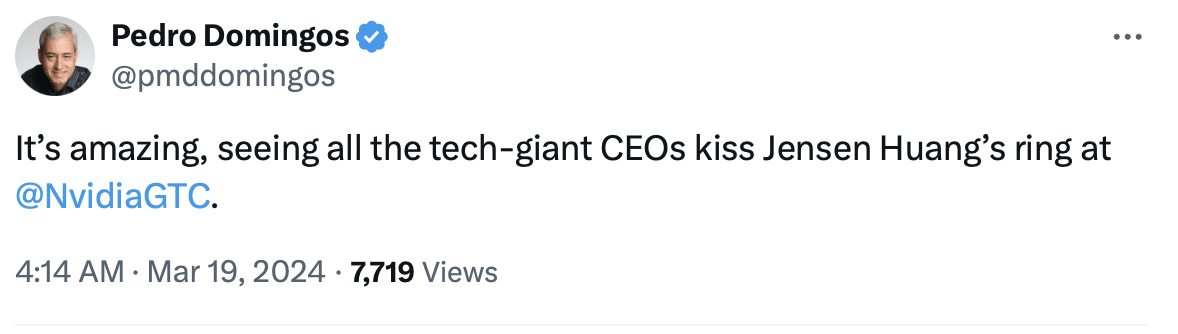
Equating NVIDIA chief Jensen Huang to ‘Don Corleone of AI’ may sound silly, but it’s probably not a stretch to do so (minus the mafia bit). Besides all the cool things unveiled at NVIDIA GTC, the biggest takeaway from Huang’s keynote was how indispensable NVIDIA is to all tech companies in the world.

Source: X

A Syndicate of AI Companies

Huang’s two-hour keynote speech not only disproved Moore’s law, but also showcased the various domains NVIDIA is impacting, including healthcare and humanoid robotics. The underlying theme of all these announcements was that every tech company needs NVIDIA.

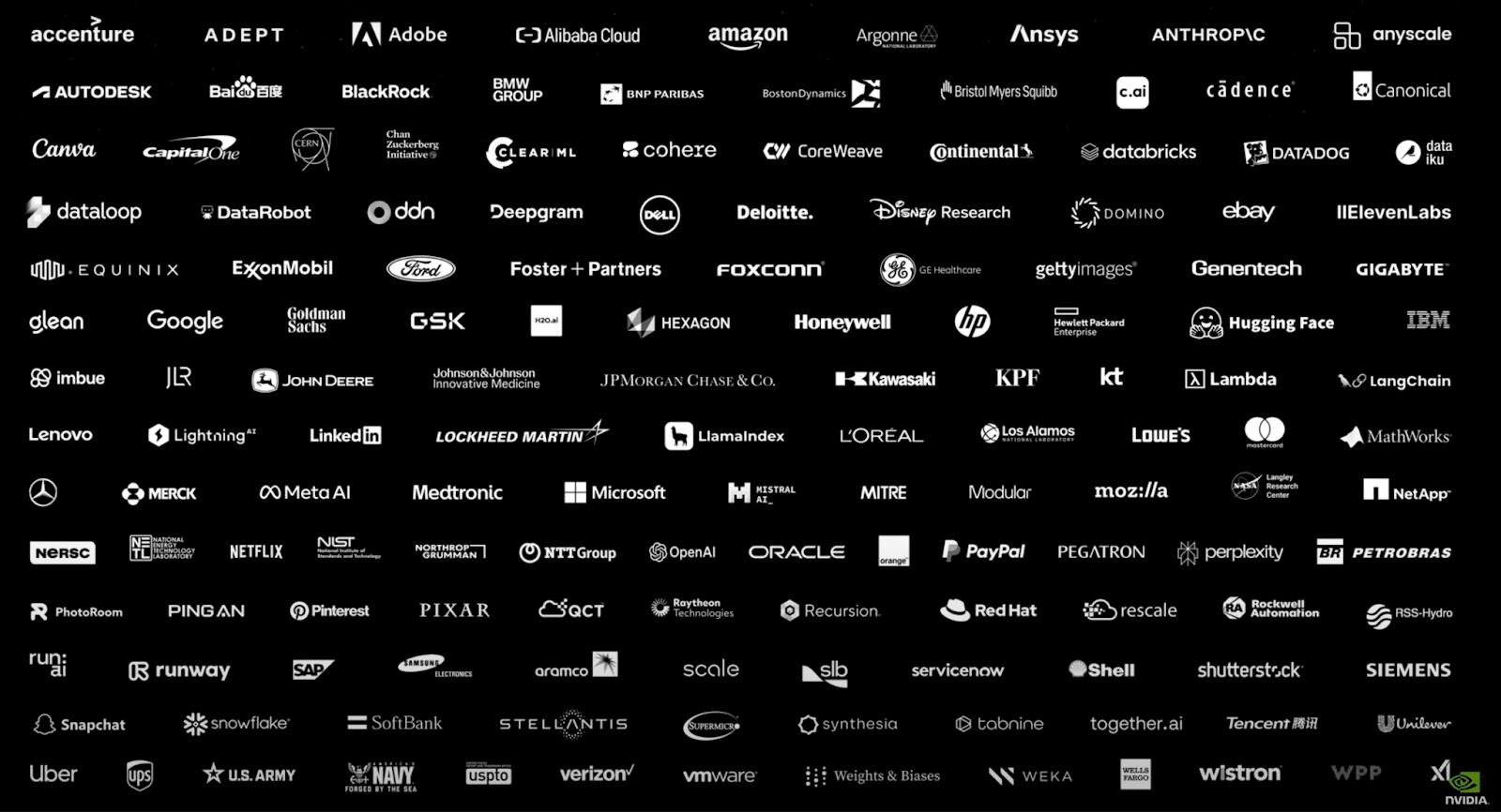
The company’s strategic partnership with major big tech firms was further fortified at the conference. The display of the exhaustive list of NVIDIA partners could hardly fit on the screen, and you could probably play Bingo to identify every known player!

Partner list displayed on screen. Source: NVIDIA Keynote

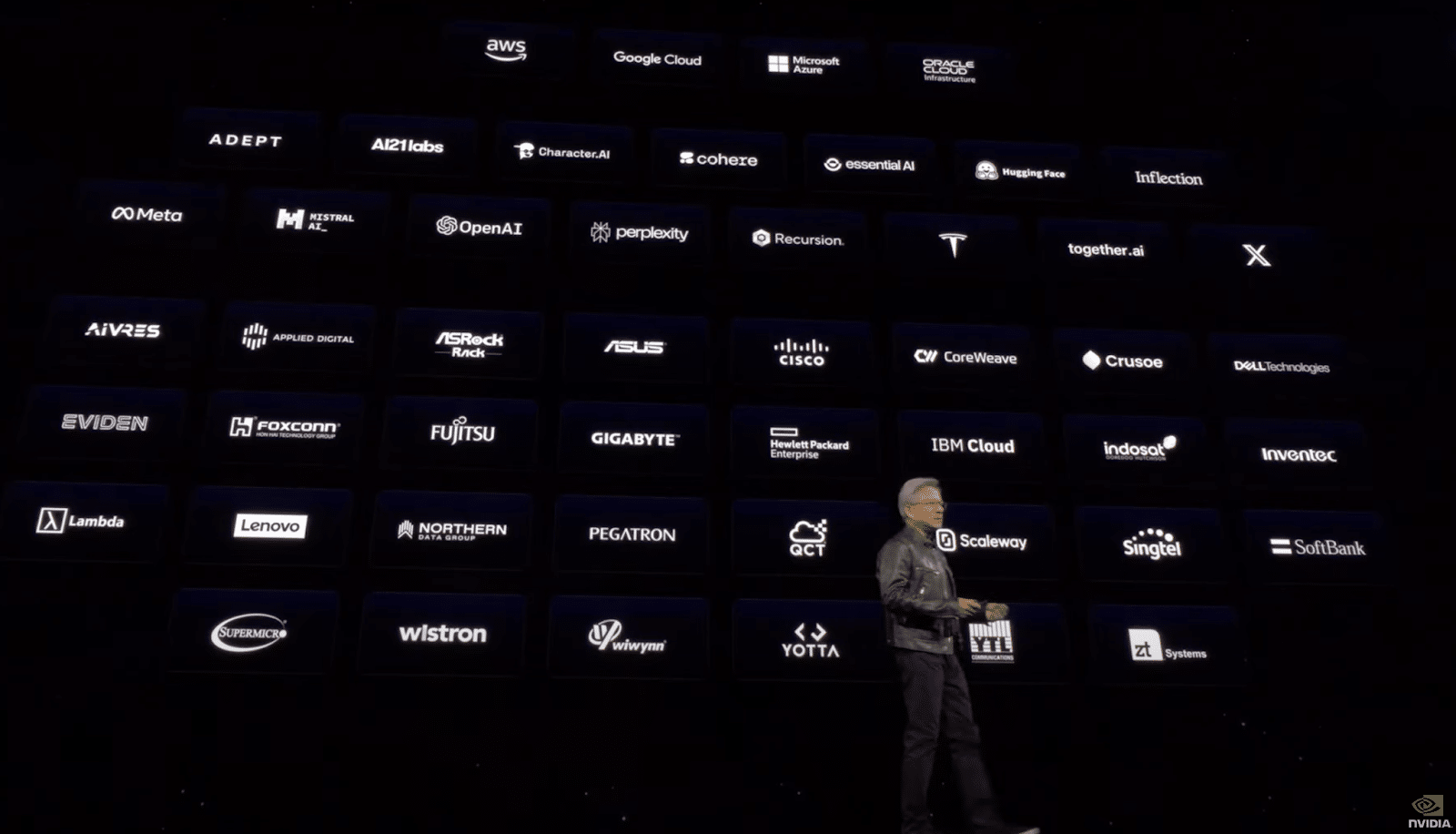
With the announcement of the latest Blackwell GPU, NVIDIA also unveiled another list of all the companies lined up to use the same. “Blackwell will be the most successful product launch in our history, and I can’t wait to see that,” said Hunag, in his keynote.

Apart from the ‘big four’, which have been mentioned right at the top of the list, AI players such as Recursion, Cohere, Together AI, and others are there too. Elon Musk’s Tesla and X are also on the list. Interestingly, Indian data centre company Yotta, which recently received India’s first cluster of 4000 NVIDIA H100 GPUs, will receive Blackwell GPUs in October this year.

Companies that will use the newly unveiled Blackwell GPU. Source: NVIDIA Keynote

NVIDIA’s Four Horsemen

As highlighted on the top of the chart, NVIDIA’s big-four partners AWS, Google Cloud, Microsoft Azure, and Oracle Cloud had a separate mention.

Huang spoke about AWS gearing up for Blackwell, and how they are going to build the first GPU with secure AI. “NVIDIA and AWS engineers are also joining forces to co-develop an AI supercomputer, built exclusively on AWS for NVIDIA’s own AI R&D. It will feature 20K+ GB200 superchips, capable of processing a massive 414 exaflops,” said Adam Selipsky, the CEO of AWS.

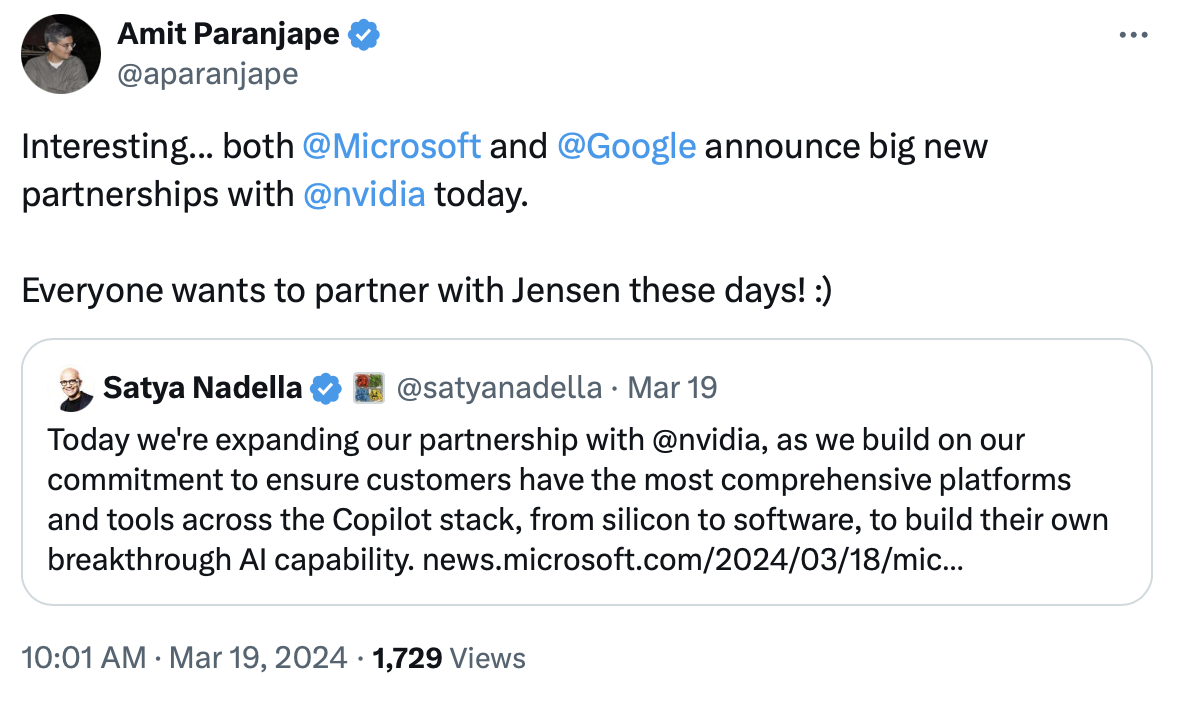
Big-tech rivals, Google and Microsoft have ensured that they are not left behind.

Source: X

Google announced its adoption of the new NVIDIA Grace Blackwell AI computing platform, alongside the integration of the NVIDIA DGX Cloud service into Google Cloud. Furthermore, the NVIDIA H100-powered DGX™ Cloud platform is now universally accessible on Google Cloud.
“Together with NVIDIA, our team is committed to providing a highly accessible, open and comprehensive AI platform for ML developers,” said Thomas Kurian, the CEO of Google Cloud.

AI opportunist Microsoft, has been on a recent spree of expanding their AI efforts through strategic partnerships with emerging AI startups. The company even roped in Inflection AI’s founding team members, including Mustafa Suleyman to head Microsoft’s AI division, a position briefly given to Sam Altman during the OpenAI fiasco.

Microsoft Corp and NVIDIA enhanced their enduring partnership with new integrations, utilising the cutting-edge NVIDIA generative AI and Omniverse technologies across Microsoft Azure, Azure AI services, Microsoft Fabric, and Microsoft 365.

Tech giant Oracle, which is actively integrating generative AI capabilities into its OCI’s tech stack, has partnered with NVIDIA to provide accelerated computing and generative AI services. “Oracle is a great partner of ours for the NVIDIA DGX cloud and we’re also working together to accelerate something that’s really important to a lot of Oracle database companies,” said Huang.

Enabling enterprise solutions, NVIDIA even mentioned their growing support to SAP labs.

While big-tech service providers are taken care of, product companies are not left behind. Huang announced the availability of Omniverse on Apple Vision Pro headsets. Further, he even showed NVIDIA’s prowess with almost all major robotics companies for providing infra for their humanoid robots. Interestingly, the Tesla humanoid was not part of it.

Next Phase?

When the world is built on NVIDIA GPUs, symbiosis partnerships come as no surprise. Last month, the company hit a $2 trillion market value, and the growth is predicted to be on an upward trajectory. However, what’s interesting to note is that the pace at which NVIDIA is rising serves as an indicator of how other big tech companies, the so-called partners now, will also rise.

The CEO of Abacus AI, Bindu Reddy, has different levels of predictions for NVIDIA. Reddy believes that NVIDIA will likely diversify to other businesses. With the rise of alternatives and with ‘AMD becoming usable’, GPU prices will drop. “As with everything, compute will become a commodity where margins tend to be zero,” said Reddy.

With Amazon’s silicon innovation already on the way with AI chips, it is possible that the reliance on the tech giant can be reduced in the future. Google and Microsoft are also not far behind with their AI chip venture.

In the future, these big tech companies can rely on their chips for self-sustenance. This could change the course for NVIDIA, and partnership strategies can vary. Until then, NVIDIA will see all other companies allying with them. After all, you have to play ball with Don Corleone if you want to stay in the game.”

The post Why Tech CEOs are Kissing Jensen Huang’s Ring appeared first on Analytics India Magazine.

Google Introduces API Support for Gemini 1.5 Pro 

Jeff Dean, chief scientist at Google DeepMind, took to X to share that the company is starting to roll out API support for Gemini 1.5 Pro.

Gemini 1.5 Pro comes with a standard 128,000 token context window. It can process vast amounts of information in one go, including one hour of video, 11 hours of audio, codebases with over 30,000 lines of code, or over 700,000 words. In their research, Google also successfully tested up to 10 million tokens.

“We’ll be onboarding people to the API slowly at first, then ramping it up. In the meantime, developers can try out Gemini 1.5 Pro in the AI Studio UI right now,” said Dean.

Gemini 1.5, using Transformer and MoE architecture, combines the strengths of both models. Traditional Transformers function as one large network, whereas MoE divides models into smaller “expert” networks. Gemini 1.5 Pro excels in various tasks, such as analysing historical transcripts like Apollo 11’s mission and understanding silent movies. It efficiently processes extensive code, showcasing adaptability.

Notably, the Needle In A Haystack (NIAH) evaluation achieves a 99% success rate in locating specific facts within long texts. Its ability to learn in context, shown in the Machine Translation from One Book (MTOB) benchmark, establishes it as a leader in adaptive learning.

This development follows Google’s release of Gemini Ultra. Additionally, Google integrated generative AI features into Chrome and introduced the “Help Me Write” feature across all websites.

The post Google Introduces API Support for Gemini 1.5 Pro appeared first on Analytics India Magazine.

‘Materially better’ GPT-5 could come to ChatGPT as early as this summer

LONDON, ENGLAND - FEBRUARY 03: In this photo illustration, the welcome screen for the OpenAI "ChatGPT" app is displayed on a laptop screen on February 03, 2023 in London, England. OpenAI, whose online chatbot ChatGPT made waves when it was debuted in Dece

OpenAI has released several iterations of the large language model (LLM) powering ChatGPT, including GPT-4 and GPT-4 Turbo. Still, sources say the highly anticipated GPT-5 could be released as early as mid-year.

According to reports from Business Insider, GPT-5 is expected to be a major leap from GPT-4 and was described as "materially better" by early testers. The new LLM will offer improvements that have reportedly impressed testers and enterprise customers, including CEOs who've been demoed GPT bots tailored to their companies and powered by GPT-5.

Also: What does GPT stand for? Understanding GPT 3.5, GPT 4, and more

`A customer who got a GPT-5 demo from OpenAI told BI that the company hinted at new, yet-to-be-released GPT-5 features, including its ability to interact with other AI programs that OpenAI is developing. These AI programs, called AI agents by OpenAI, could perform tasks autonomously.

This feature hints at an interconnected ecosystem of AI tools developed by OpenAI, which would allow its different AI systems to collaborate to complete complex tasks or provide more comprehensive services.

The specific launch date for GPT-5 has yet to be released. OpenAI is reportedly training the model and will conduct red-team testing to identify and correct potential issues before its public release.

Also: 3 ways we tried to outwit AI last week: Legislation, preparation, intervention

It's unclear whether GPT-5 will be released exclusively to Plus subscribers, who pay a $20-a-month fee to access GPT-4. GPT-3.5 powers the free tier of ChatGPT, but anyone can access GPT-4 Turbo in Copilot for free by choosing the Creative or Precise conversation styles.

OpenAI has been the target of scrutiny and dissatisfaction from users amid reports of quality degradation with GPT-4, making this a good time to release a newer and smarter model.

Featured

OpenAI’s GPT store is brimming with promise — and spam

OpenAI's GPT Store

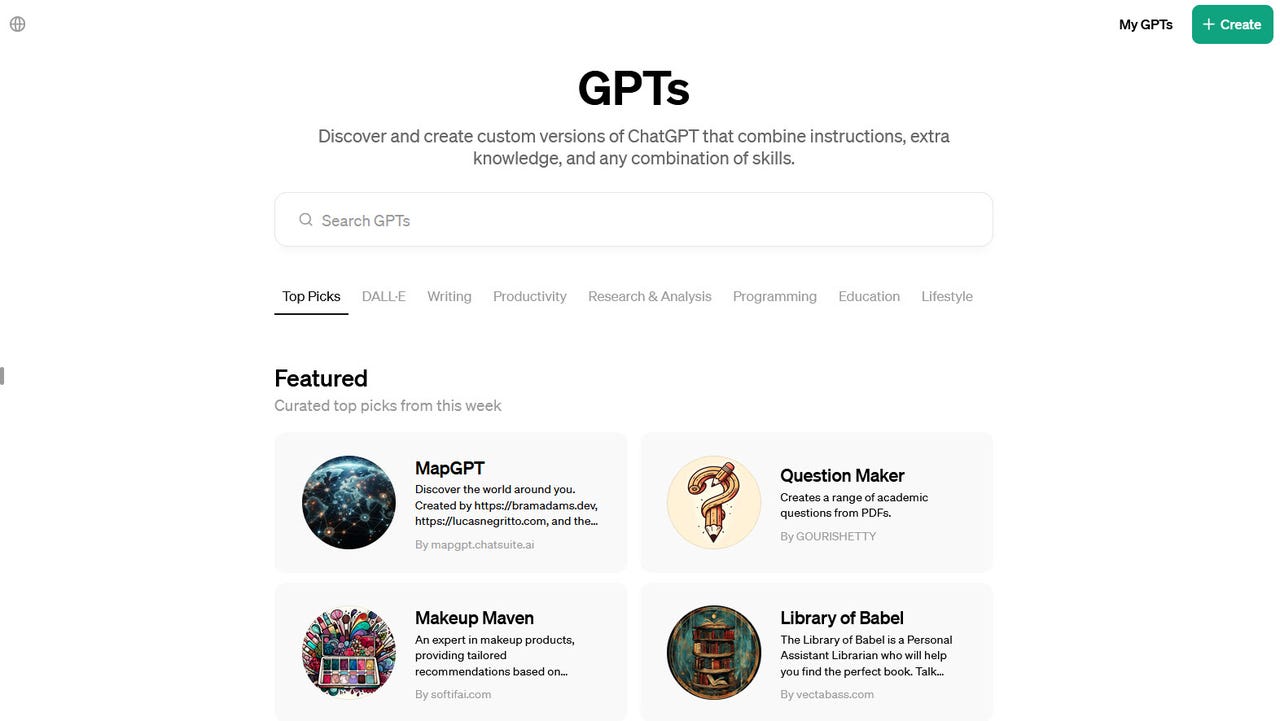
One of the benefits of a ChatGPT Plus subscription is the ability to access the GPT Store, now home to more than 3 million custom versions of ChatGPT bots. But nestled among all the useful and helpful GPTs that play by the rules are a host of bots considered spammy.

Also: ChatGPT vs ChatGPT Plus: Is it worth the subscription fee?

Based its own investigation of the store, TechCrunch found a variety of GPTs that violate copyright rules, try to bypass AI content detectors, impersonate public figures, and use jailbreaking to circumvent OpenAI's GPT policy.

Several of these GPTs use characters and content from popular movies, TV shows, and video games, according to TechCrunch, seemingly without authorization. One such GPT creates monsters a la the Pixar movie "Monsters, Inc." Another takes you on a text-based adventure soaring through the "Star Wars" universe. Other GPTs let you chat with trademarked characters from different franchises.

One of the rules about custom GPTs outlined in OpenAI's Usage Policies specifically prohibits "using content from third parties without the necessary permissions." Based on the Digital Millennium Copyright Act, OpenAI itself wouldn't be liable for copyright infringement, but it would have to take down the infringing content upon request.

The GPT Store is also filled with GPTs boasting that they can defeat AI content detectors, TechCrunch said. This prowess even covers detectors sold to schools and educators through third-party anti-plagiarism developers. One GPT claims to be undetectable by detection tools such as Originality.ai and Copyleaks. Another GPT promises to humanize its content to skirt past AI-based detection systems.

Also: The ethics of generative AI: How we can harness this powerful technology

Some of the GPTs even direct users to premium services, including one that attempts to charge $12 each month for 10,000 words per month.

OpenAI's Usage Policies prohibit "engaging in or promoting academic dishonesty." In a statement sent to TechCrunch, OpenAI said that academic dishonesty includes GPTs that try to circumvent academic integrity tools like plagiarism detectors.

Imitation may be the sincerest form of flattery, but that doesn't mean GPT creators can freely and openly impersonate anyone they want. TechCrunch found several GPTs that imitate public figures. A search of the GPT Store for such names as "Elon Musk," "Donald Trump," "Leonardo DiCaprio," and "Barack Obama" uncovered chatbots that pretend to be those individuals or simulate their conversation styles.

Also: ChatGPT vs. Microsoft Copilot vs. Gemini: Which is the best AI chatbot?

The question here centers on the intent of these impersonation GPTs. Do they fall into the realm of satire and parody, or are they outright attempts to emulate these well-known people? In its Usage Policies, OpenAI states that "impersonating another individual or organization without consent or legal right" is against the rules.

Finally, TechCrunch ran into several GPTs that try to circumvent OpenAI's own rules by using a type of jailbreaking. One GPT named Jailbroken DAN (Do Anything Now) uses a prompting method to respond to prompts unconstrained by the usual guidelines.

In a statement to TechCrunch, OpenAI said that GPTs designed to evade its safeguards or break its rules are against its policy. But those that try to steer behavior in other ways are allowed.

Also: YouPro lets me access every popular premium AI chatbot for $20/month — but there's a catch

The GPT Store is still brand new, having officially opened for business this January. And an influx of more than 3 million custom GPTs in that short period of time is undoubtedly an overwhelming prospect. Any such store is going to exhibit growing pains, especially when it comes to content moderation, which can be a tricky tightrope to cross.

In a blog post from last November announcing custom GPTs, OpenAI said that it had set up new systems to review GPTs against its usage policies. The goal is to prevent people from sharing harmful GPTs, including ones that engage in fraudulent activity, hateful content, or adult themes. However, the company acknowledged that combatting GPTs that break the rules is a learning process.

"We'll continue to monitor and learn how people use GPTs and update and strengthen our safety mitigations," OpenAI said, adding that people can report a specific GPT for violating certain rules. To do so at the GPT's chat window, click the name of the GPT at the top, select Report, and then choose the reason for reporting it.

Also: Here's how to create your own custom chatbots using ChatGPT

Still, playing host to so many GPTs that break the rules is a bad look for OpenAI, especially when the company is trying to prove its worth. If this problem is of the scale that TechCrunch's report suggests, it's time for OpenAI to figure out how to fix it. Or as TechCrunch put it, "The GPT Store is a mess — and, if something doesn't change soon, it may well stay that way."

Artificial Intelligence

This AI-powered ring wraps ChatGPT around your finger. You can pre-order it now

The AI-powered WIZPR smart ring

Have you ever wanted AI at the tip of your fingers? One company is promising to do just that –- sort of. VTouch is launching a Kickstarter campaign for WIZPR, its AI-powered smart ring that lets wearers talk to their favorite AI assistant by whispering into the device.

The WIZPR ring is meant to wake automatically when you bring your hand to your mouth; there is no need to use a wake word or press any buttons. Built to respond to close-range speech, the WIZPR ring is designed to listen to whispers and normal-volume voices speaking nearby, and the wearer can hear the AI's responses via a connected pair of wireless earphones.

Also: You can now try Copilot Pro for free, and here's why you'll want to

VTouch promises WIZPR will feature integrations with different AI tools, which you'll be able to set up using the ring's smartphone app. You'll then be able to access ChatGPT, Gemini, and other AI bots by just talking to the ring on your finger. WIZPR can also let you access smart home devices, mobile calendars, text messages, and other services using your voice – without touching your phone or using a wake word.

"AI-based conversational computing is expected to be the next big thing that goes beyond the limitations of 'graphical user interfaces' such as PCs and smartphones," VTouch co-founder and CEO SJ Kim said. "With WIZPR RING, we aim to realize a conversational computing environment where you can interact with AI by talking to it with your voice anytime, anywhere, without having to look at a screen."

If voice-only is not your thing, WIZPR also features a button. A single press will let you switch between AI tools, like from ChatGPT to Gemini. Two presses in short succession will turn on correction mode, which lets you say a word you might've mispronounced, and the AI will supposedly recognize which word needs to be corrected.

Also: Apple's latest acquisition hints at AI-powered iPhone plans

Pressing the button three times will start a contextual conversation with the WIZPR ring's AI using data from your phone, like your messages or your calendar. Five button presses will activate SOS mode, which will record the sound around you and send your location and the recording to your chosen emergency contacts.

Most popular smart rings today are limited to health tracking, fitting neatly into the fitness and health category of wearables rather than the productivity category. WIZPR is meant to be an AI-powered extension to your devices, as you can tell by the marketing models in business suits rather than runners in athletic wear. Combining the health tracking features in current smart rings with the WIZPR's AI capabilities could turn the smart ring market on its head.

The WIZPR ring (previously known as the WHSP ring) is available in sizes ranging from 6 to 13, in black or silver. You can pre-order WIZPR now for an early bird price of $139 (which is set to go up to $199) on Kickstarter.

Featured

YouPro lets me access every popular premium AI chatbot for $20/month — but there’s a catch

YouPro

ZDNET's key takeaways

  • You.com's premium subscription tier, YouPro, costs $20 per month or $15 per month if billed annually.
  • With the subscription, users get to take advantage of the free perks, such as access to the internet and footnotes, and the most advanced large language models (LLMs) from OpenAI, Google, and more.
  • There is no way to compare LLM performance on YouPro to the performance of a model on its native platform.

You.com, formerly YouChat, offers competitive features that have earned it a spot on ZDNET's list of best AI chatbots. I tried its premium tier, YouPro, which left me even more impressed than I was with the free version.

Also: The best AI image generators: Tested and reviewed

If you list the best features of every major AI chatbot on the market, including ChatGPT, Anthropic, and Copilot, and put them together, you'll get YouPro. That's a bold claim, so I'll explain.

Both free and paid versions of You.com give users access to the internet, which is already a major win over ChatGPT or Claude, which have knowledge cutoffs. In addition to internet access, You.com users have access to footnotes that link to the online source of its answers — one of the best features of Copilot.

With YouPro, users can access the game-changing feature of AI modes, where users can toggle between different modes within the chatbot to have different search experiences.

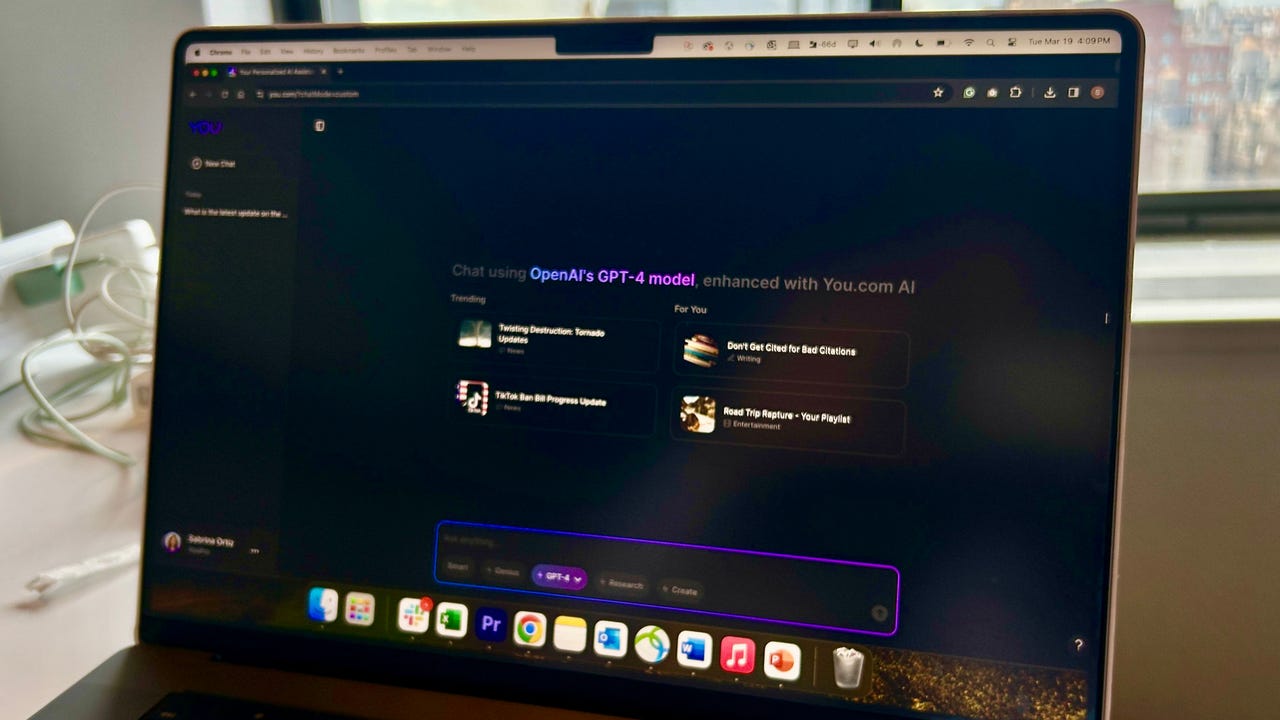
The modes include Smart, which is also available to free users; Genius, which has advanced capabilities, including file uploads; Research, which as the name implies is tailored for in-depth analysis; Create, which can generate images from texts; and finally, the pièce de résistance, the Custom Model Selector.

Also: Want to work in AI? How to pivot your career in 5 steps

With the Custom Model Selector, users can easily toggle between leading AI models including OpenAI's GPT-4 and GPT-4 Turbo; Anthropic's Claude Instant, Claude 2, Claude 3 Opus, Clause 3 Sonnet, and Claude 3 Haiku; Google's Gemini Pro; and Zephyr (uncensored).

Many of these models are typically reserved for each company's premium subscribers. For example, GPT-4 is only available for ChatGPT Plus subscribers, Claude 3 Opus is only available for Claude Pro subscribers, and Gemini Pro is only available for Google One AI Premium Plan subscribers.

All three of the subscriptions above are $20 a month each. However, all of those advanced AI models can be found on YouPro for one payment of $20 a month.

To see how well the Custom Model Selector worked, I entered the same prompt into three different models on the site — GPT-4, Gemini Pro, and Claude 3 Opus, as seen in the photo below (expand to see the full response):

The results were reassuring because every model generated responses with different styles and formats, an indicator that a different AI model was used to generate each answer.

There is no way to tell if the results generated by each model on YouPro are on par with results generated on the model's native premium platform because generative AI models yield different outputs every time, even on the same platform.

Also: What is Suno? The 'ChatGPT for music' generates songs in seconds

It's also worth noting that when you select a different model, the screen reads, "Chat using [insert name of the model you chose], enhanced with You.com AI." The last part of the statement suggests your experience using the model on YouPro might differ from the native platform.

ZDNET's advice

If you want to experiment with the latest large language models without breaking the bank, YouPro is a great solution. With one $20-a-month subscription, you can access the latest models from giants like Anthropic, OpenAI, and Microsoft.

However, if you find one premium subscription you like and enjoy integrating the AI into your workflow, I would stick with your favorite because there's no guarantee your experience will be the same on YouPro.

Featured reviews

GOAT (Good at Arithmetic Tasks): From Language Proficiency to Math Genius

GOAT AI model merges language and math prowess, revolutionizing education and problem-solving

Large language models (LLMs) have revolutionized natural language processing (NLP) by excellently creating and understanding human-like text. However, these models often need to improve when it comes to basic arithmetic tasks. Despite their expertise in language, LLMs frequently require assistance with simple math calculations. This gap between language proficiency and mathematical skills has prompted researchers to investigate specialized models for arithmetic tasks.

In the fields of artificial intelligence and education, GOAT, which stands for Good at Arithmetic Tasks, has emerged as a remarkable development. Unlike traditional models, GOAT excels not only in NLP but also in solving complex mathematical problems. Imagine a model that effortlessly crafts expressive sentences while accurately solving complex equations. GOAT represents this unique combination, a skilled linguist and mathematician seamlessly integrated.

GOAT is a revolutionary AI model that excels at linguistic and numerical tasks. Unlike traditional language models, which focus mainly on generating and understanding text, GOAT outperforms them by demonstrating advanced mathematical problem-solving abilities. Its transition between these two domains marks a significant breakthrough in AI, opening opportunities for innovative applications in education, problem-solving, and other fields.

The GOAT Model

The GOAT model represents a significant advancement in artificial intelligence, specifically addressing the intersection of language understanding and mathematical reasoning. At its core, GOAT is a fine-tuned LLaMA model, a specialized variant of LLMs designed explicitly for arithmetic tasks. Unlike generic LLMs, which excel in NLP but struggle with basic arithmetic, GOAT has undergone targeted fine-tuning to enhance its mathematical capabilities.

GOAT’s superiority lies in its ability to tackle a wide range of arithmetic tasks with high accuracy. Compared to the widely acclaimed GPT-4, GOAT consistently delivers superior results in addition, subtraction, multiplication, and division. Its fine-tuned architecture enables it to effectively handle numerical expressions, word problems, and mathematical reasoning. Whether calculating large numbers or solving complex equations, GOAT demonstrates a level of precision that sets it apart from its predecessors.

To achieve this skill, GOAT uses a synthetically generated dataset. This dataset comprises diverse arithmetic examples covering various difficulty levels, number ranges, and problem types. By training on this carefully curated data, GOAT learns to generalize across different scenarios, making it adept at handling real-world arithmetic challenges.

GOAT’s capabilities extend beyond simple addition and subtraction. It conquers complex arithmetic challenges across various domains. Whether algebraic expressions, word problems, or multi-step calculations, GOAT consistently outperforms its competitors. Its accuracy and efficiency set a new standard.

The PaLM-540B, a powerful language model, encounters tough competition from the GOAT. In direct comparisons, GOAT shows better accuracy and strength. It handles complex numbers expertly, surpassing other models. GOAT’s strength comes from its supervised fine-tuning. Even when dealing with very large numbers that would challenge most, GOAT performs significantly well. It performs addition and subtraction accurately, demonstrating its mathematical brilliance.

Tokenization of Numbers in GOAT: Enhancing Arithmetic Precision

GOAT demonstrates a remarkable ability to handle numerical tokens consistently. Tokenization breaks down input text into smaller units or tokens. In GOAT’s case, these tokens represent both words and numerical values. GOAT ensures uniform treatment of numbers—integers, decimals, or scientific notation. Each numeric token receives equal attention, regardless of context.

In addition, GOAT ensures precision in parsing numerical expressions. When GOAT encounters an arithmetic expression, it dissects it into tokens. For instance, the expression “2.14 + 2.618” becomes the sequence of tokens: [“2.14”, “+”, “2.618”].

GOAT’s understanding of numerical tokens enables accurate operations. It recognizes that “2.14” is a decimal, “+” is an addition operator, and “2.618” is another decimal. This consistent handling ensures GOAT does not confuse numerical values with linguistic elements.

Solving Word Problems with Precision

In word problems, GOAT’s tokenization plays a crucial role.

Consider: “If Alice has 6 apples and Bob gives her 4 more, how many apples does Alice have?”

GOAT identifies numeric tokens (“6” and “4”) and the relevant operation (“gives her”). It computes the result accurately: 6 + 4 = 10. Thus, by treating numbers as distinct tokens, GOAT avoids ambiguity.

Likewise, GOAT accurately handles large numbers and scientific notation by preserving high precision. GOAT’s tokenization extends to large numbers, such as “1,000,000” or “1.23e6” (scientific notation for 1.23 × 10^6). Whether parsing a million or dealing with exponents, GOAT maintains precision.

Training, Fine-tuning, and Open Source Availability

The GOAT model is trained using a supervised approach, learning from labeled data and explicit instructions. A crucial step in its training process involves fine-tuning, where a pre-trained model, such as a language model, is adapted to a specific task by updating its weights based on task-specific data.

GOAT employs guided instructions during fine-tuning, ensuring targeted guidance throughout the adaptation process and enabling the model to generalize effectively to out-of-distribution examples. LoRA, as part of this paradigm, facilitates Low-Rank Adaptation, which enhances the robustness of the model. By incorporating LoRA, GOAT effectively handles label noise and improves the quality of training data, enabling it to learn effectively from noisy or imperfectly labeled data.

In addition, the GOAT model and its pre-trained weights are available as open-source software. Researchers can access the GOAT repository containing the model architecture, training code, evaluation scripts, and the dataset used for its training. This open-source approach encourages collaboration, innovation, and exploration within the scientific community, facilitating advancements in natural language understanding.

Challenges and Possible Solutions

Due to its complexity, the GOAT model needs help handling large-number multiplication and division. To overcome this, GOAT employs several strategies. First, it decomposes complex operations into smaller steps, such as multiplying individual digits or estimating quotients.

Additionally, it classifies tasks based on learnability—basic arithmetic is directly fine-tuned, while complex tasks are broken down. Guided fine-tuning provides explicit instructions during training, and attention mechanisms enhance performance. Sequential learning and transfer from more straightforward tasks empower GOAT to tackle complex arithmetic problems effectively.

The Bottom Line

In conclusion, GOAT is a significant advancement in AI, combining language understanding and mathematical reasoning. Its exceptional ability to handle arithmetic tasks, fine-tuned approach, and attention to numerical tokens demonstrates incomparable versatility and precision. With its open-source availability and ongoing advancements, GOAT paves the way for innovative applications in education and problem-solving, promising a future of enhanced AI capabilities.