This adorable motion-tracking camera is down to $100 during Amazon’s Big Spring Sale

Eufy Security Indoor Cam S350

What's the deal?

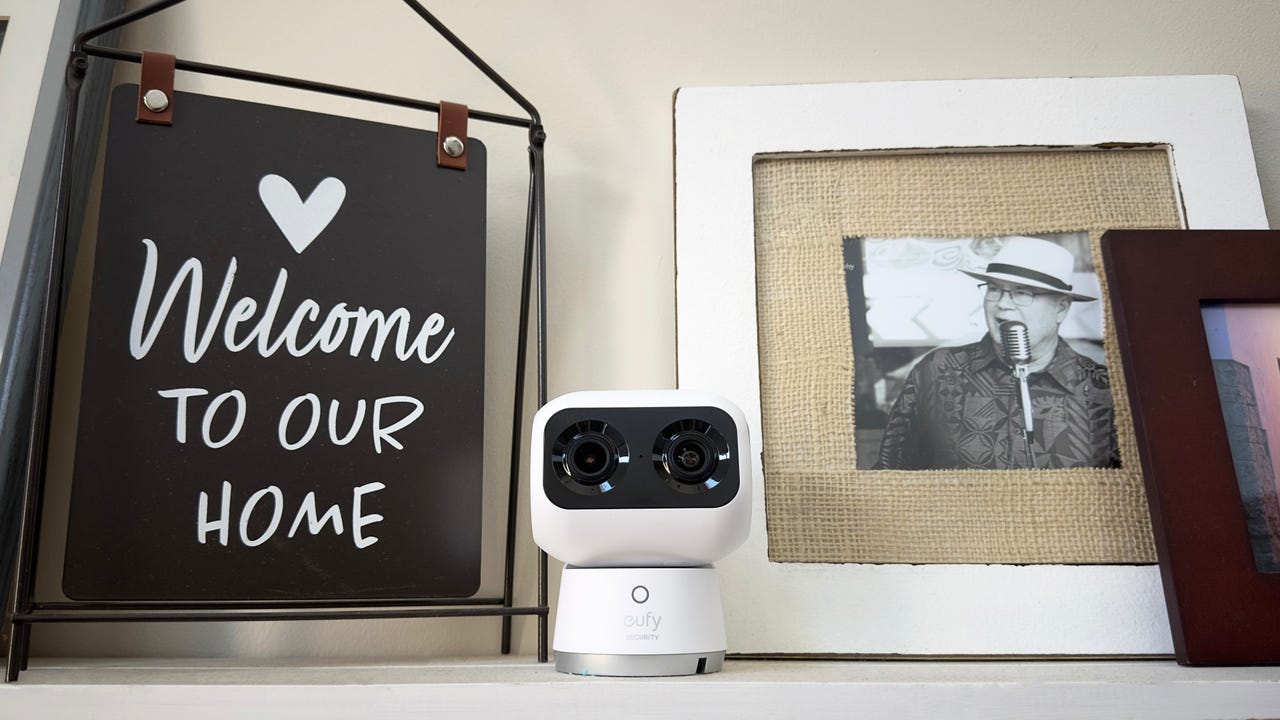
The Eufy Security Indoor Cam S350 is a pan/tilt dual security camera with 360 degrees of coverage. It tracks objects in motion using two cameras, captures footage with 4K resolution, and supports dual-band Wi-Fi 6. It's currently on sale for $99, or 23% off, during Amazon's Big Spring Sale.

Also: Amazon Big Spring Sale: The 80+ deals you can shop now

Why this deal is ZDNET-recommended

I've had my Eufy Security Indoor Cam S350 for over a month and it's proven itself to be indispensable to my home security.

View at Amazon

What truly makes this indoor security device stand out is the fact that it houses two cameras in one body; one with a wide-angle lens and the other with a telephoto lens. The wide-angle lens camera has a 130-degree field of view when static and records in 4K.

The telephoto lens camera records in 2K, features 3x optical zoom, so you can zoom in on people or objects without sacrificing image quality, and an 8x digital zoom. Both cameras have a low aperture, at f/1.6, to better capture lighting and record in low-light conditions.

Also: Eufy's new Floodlight Cam E340 is the hardest working security camera I've tested

And then the device can pan, tilt, and swivel in any direction smoothly, giving you a full view of its surroundings. The Eufy Cam S350 smoothly tracks people in motion, keeping the target in view with no staggering, and the Local AI in the HomeBase 3 can distinguish humans and pets.

We paired this camera with our HomeBase 3, which we had at home and use for the rest of our Eufy security system. The HomeBase 3 retails for $150; it's a hub for Eufy security devices that supports local storage for its cameras, so we can enjoy the full benefit of a security camera without monthly fees. However, you don't need to buy a HomeBase 3 to use this camera.

The Indoor Cam S350 can store footage on the HomeBase 3, but also on an inserted microSD card, which is not included, of up to 128GB. This card would still give you the local storage you need to avoid paying monthly cloud fees and it would support the live notifications of detected motion.

Also: EufyCam 3 and HomeBase 3 review: Why I'm not getting rid of these cameras yet

These pan/tilt indoor cameras are commonly marketed as baby monitors or pet cams because of their ability to track motion in real time and to cover the lens when the privacy mode is turned on. While this is a perfect camera for any of these options, I use it as an indoor security camera in conjunction with our security system.

My home's Eufy security system includes some motion sensors that are spread around downstairs, several outdoor security cameras, a keypad, and the HomeBase 3, which sounds an alarm when the system is triggered.

I don't use indoor cameras in our living room, where I have a motion detector, because I don't like the idea of having a camera looking at my family's every move. If a sensor detects motion and the alarm goes off at three in the morning, I have no way to see what the motion is. So, I do have a smaller pan/tilt Ezviz camera that is always set to privacy mode, just so I can look at it whenever motion is detected. But this process takes time.

Also: These Alexa-enabled smart glasses are $40 off during Amazon's Big Spring Sale

The Eufy Indoor Cam S350 has become a better solution to this problem, as it works with my existing system and gives me a live view within the same app as the rest of my security devices.

ZDNET's buying advice

The Eufy Security Indoor Cam S350 works seamlessly each time motion is detected, it doesn't get distracted by false alerts often, notifications are fast to appear on my mobile device when triggered, and it can quickly hide its lenses when privacy mode is turned on.

However, I'm left wishing for two things. First, I'd love to schedule when the camera goes to privacy mode, so I can set a schedule to have it automatically guard each night at bedtime and stop watching during the day. I also wish it had a button to manually engage privacy mode, so the camera can stop capturing motion when I press it.

These additions to the camera's privacy mode would only be a bonus, as the camera performs and records so well that I don't end up missing them, but they would be nice to have. As it is right now, I'd recommend the Indoor Cam S350 to anyone looking for an indoor security camera, pet cam, or baby monitor camera, as it's proven itself to be capable of performing these tasks with clear, high-resolution images.

Featured reviews

How Will Your Company Prepare for Generative AI?

It’s hard to know how big the hype will get about generative AI, but we do know that it will change the way we work in the near future. Changing roles, new technology capabilities, up-skilling workers, and bringing new hardware in-house are all on the table.

How is your team and your company prepping for the inevitable changes? Are you upgrading to new hardware immediately, or are you taking a wait-and-see approach?

Share your thoughts in this forum discussion, sponsored by Intel Core Ultra. Or read more about how Intel is building the AI future into today’s PCs.

Share Your Thoughts

This no-fee video doorbell can guard your packages and is on sale for $140

Eufy Security E340

ZDNET's key takeaways

  • The Eufy Security Video Doorbell E340 is available now for a limited time at $140 during Amazon's Big Spring Sale.
  • This doorbell features two cameras to give you complete visibility of the person at your door and any packages left on your porch, all with no monthly fees.
  • Although the doorbell comes with 8GB of built-in local storage (enough for up to 60 days of event recordings), you need to add a Eufy Security HomeBase to get the most out of it.

If you're looking for a reliable video doorbell that can help protect your home and packages and comes with the bonus of local storage, let me introduce you to the Eufy Security Video Doorbell E340.

Also: Eufy's new Floodlight Cam E340 is the hardest-working security camera I've tested

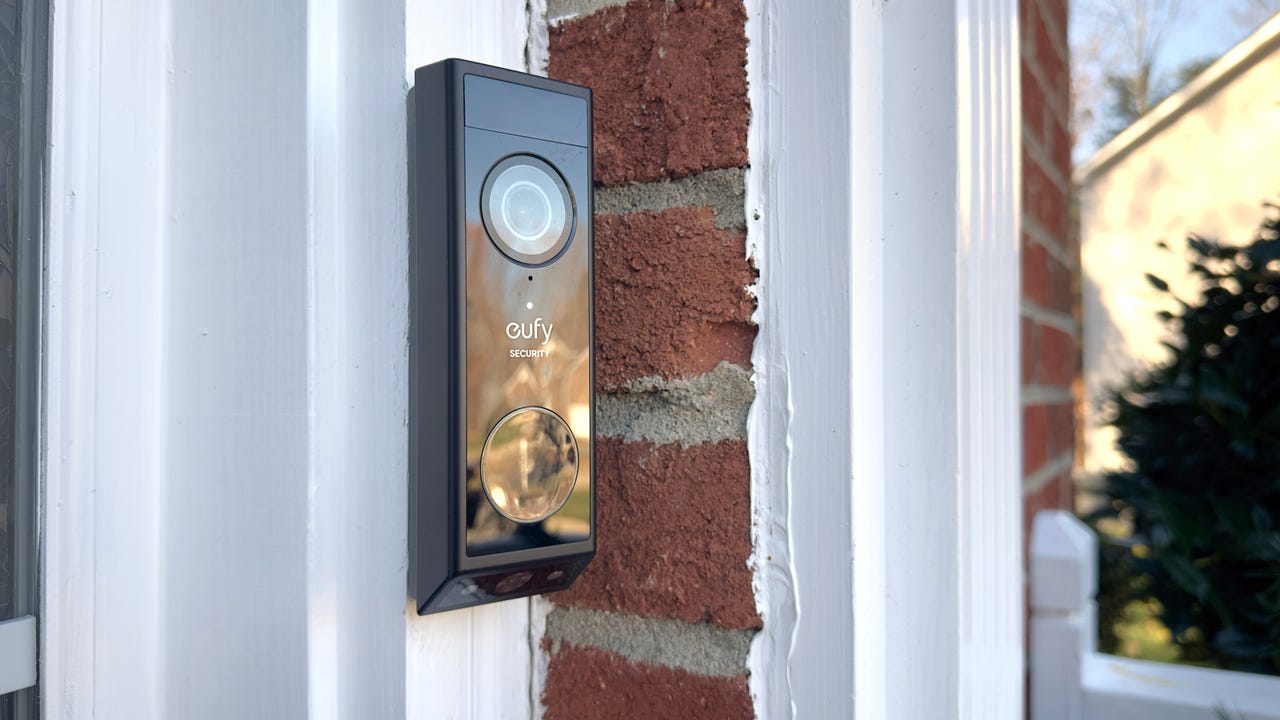
This doorbell has two cameras: One camera gives you the traditional visibility of who's at your front door, and another camera is pointed downwards to let you know when a package has been delivered.

View at Amazon

Eufy Security just launched a new line of dual-camera security devices, which included this doorbell as one of the options. The new E340 video doorbell's two cameras deliver real-time notifications to your mobile device when a person is detected and a package is delivered.

This doorbell camera will also send real-time notifications of motion to your mobile device, and it offers the option to use two-way talk to communicate with whoever is at the door from your mobile phone or use quick replies to automatically respond when they ring the doorbell.

The camera above the doorbell button records events in 2048 x 1536 resolution to deliver 2K footage that is clear and gives you a detailed view of whoever is at the door. The doorbell itself has two motion-activated lights, one at the top and a second one below — where the other camera is — to light the way in the dark, alert visitors or would-be intruders that the camera has been activated, and support the camera's color night vision recording.

The biggest improvement I've seen after replacing my old Eufy Security video doorbell with this dual E340, aside from the package detection, is night vision recordings. The doorbell can correctly determine what motion is a person, animal, vehicle, or just the wind, with very few false alerts. For example, we put pirate skeletons all over the porch for Halloween, and the doorbell only had issues mistaking one for a person a few times.

Add the HomeBase 3 and the E340 dual doorbell can also confidently identify who's at the door by name. This is powered by AI technology within the HomeBase 3 that allows users to name the faces the camera detects to let you know when "Maria" is detected at the front door instead of just "a person."

Eufy's Delivery Guard technology notifies you when packages are delivered and picked up and lets you set up zone restrictions to avoid false alerts. You can also set up the Eufy video doorbell E340 to trigger an alarm- a siren or a voice response- when someone approaches a package at your door, with the option to activate it at custom times. I also have mine set to alert me each night of uncollected packages at the front door, reminding me to bring them in before bedtime.

On the left, both video doorbell cameras show a package was delivered. The activity history is on the right.

The doorbell's local storage means you don't have to pay cloud storage fees and can easily access your video recordings. With the addition of a HomeBase 3, you could expand that storage by 16GB and later add SSDs to expand that to 16TB if that's more your speed.

ZDNET's buying advice

You can get the Eufy Security Video Doorbell E340 for $140 right now. It features 2K-resolution video recording, 8GB of local storage, color night vision with a clear viewing distance of up to 16ft, and, my personal favorite, no monthly fees. The video doorbell E340 is perfect for anyone who wants a doorbell camera to be on the alert when any visitors arrive and one to help protect their packages.

This doorbell has helped alert us when a package arrives so we can bring it inside promptly. Most drivers don't ring the doorbell during delivery, which we appreciate with three young kids and an excitable dog.

Now, I get an alert on my phone or smartwatch when "A package was delivered," which is much better than finding a heavy package when I'm in a hurry out the door. This video doorbell isn't helpful only for my situation but also for anyone living in a place that porch pirates often target, as this can prevent packages from sitting out overnight and can deter strangers from approaching it.

ZDNET Recommends

My favorite robot vacuum and mop combo is only $600 for Amazon’s Big Spring Sale

Eufy Clean X9 Pro CleanerBot

What's the deal?

Amazon dropped the price for the AI-powered Eufy X9 Pro robot vacuum and mop to only $600 as part of its Big Spring Sale happening now.

Why this deal is ZDNET-recommended

The Eufy Clean X9 Pro CleanerBot, a new 2-in-1 robot vacuum, boasts a deep cleaning, hands-free mopping experience, coupled with 5,500pa of suction power. It also uses some AI navigation features to maneuver throughout your house.

Also: Best robot vacuum deals: Get a Roomba or Shark on sale now

Initially, I was less than enthusiastic about trying out yet another robot mop vacuum (I'd tested a similar one recently), but once I watched the Eufy X9 Pro work its way across my home floors, my mind was changed.

View at Amazon

The CleanerBot truly lives up to the name, outperforming my old Roborock and the Yeedi MopStation Pro in vacuum and mop functions. The suction power, 5,500pa at maximum capacity, is outstanding. And the main brush is bristle-less, made of silicone wedges instead that are just as effective at cleaning floors.

In my limited experience (as I've only tested this model for about a week), the primary silicone brush makes it less likely for the X9 Pro to get tangled, as it's easier to scoop debris up than sweep it.

The mopping function on the Eufy X9 Pro CleanerBot is one of the two features that impressed me the most. The X9 Pro has two rotating mop pads — which I love in a robot vac/mop combo — which put 2.2 lbs of downward pressure to break down tough stains, a particularly useful feat for my home of children and pets.

Review: Roborock S8 Pro Ultra: This 2-in-1 vacuum can do just about everything

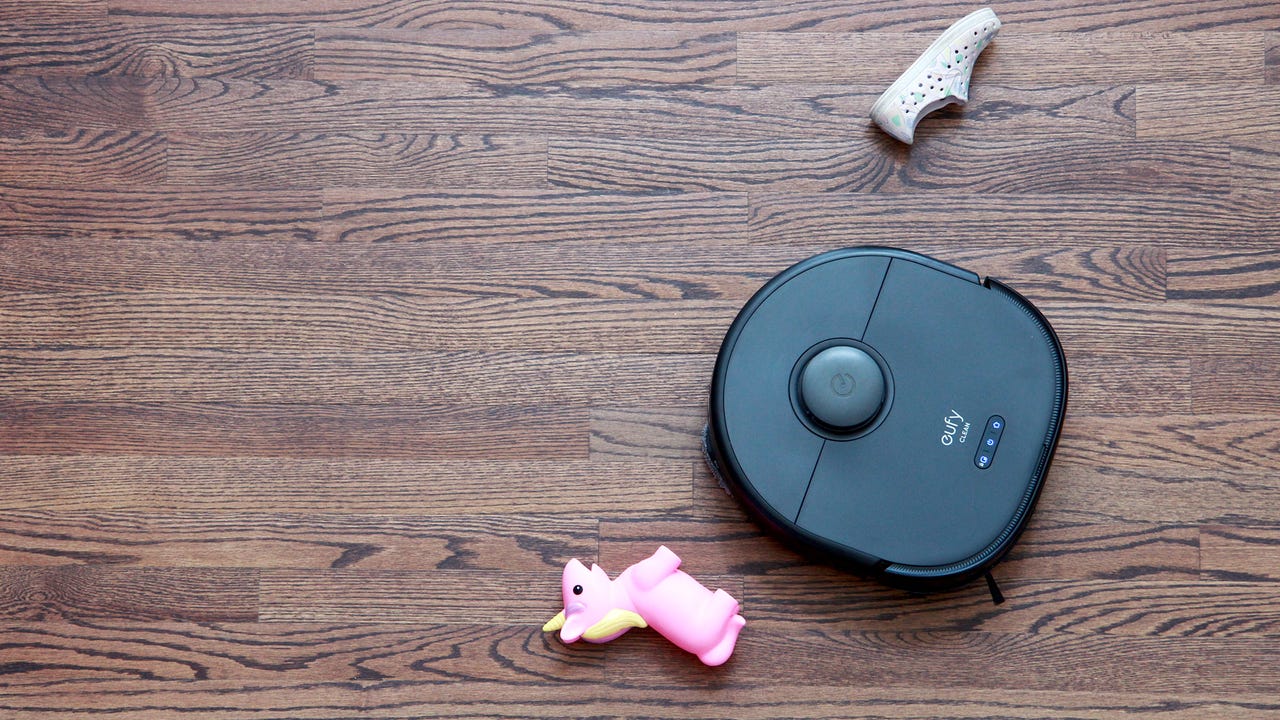
The other outstanding feature, and probably my favorite, is the use of AI for navigation, obstacle avoidance, and mapping. The CleanerBot has time-of-flight sensors and an AI camera system, called AI See, that helps detect and avoid objects so the vacuum doesn't suck up your kids' socks or stuffed animals.

It also uses iPath Laser Navigation to create maps of your home, which separates the rooms by color in the Eufy Clean app and even shows you the obstacles that the robot has found in each room. When you review the map after cleaning, you'll find things like power cords, shoes, and trash cans marked on the map.

Eufy isn't the first to use this technology for obstacle avoidance and mapping, but it is a great feature. I hate having to pick up every last bit of paper my kids dropped before I can start cleaning — only to have the robot vacuum get stuck anyway on a power cord somewhere.

Also: This robot vacuum has a brilliant self-cleaning feature I didn't know I needed

The Eufy Clean app lets you customize settings for charging, cleaning intensity, voice, and more. And it also enables you to choose from the rooms that the robot automatically created on the map so you can send it to clean just that area, like a muddy entryway. You can choose to clean zones as small as 1.6 ft by 1.6 ft on the map in case of spills.

The Eufy Clean X9 Pro CleanerBot easily adjusts to uneven surfaces to cross up to 2 cm barriers.

Beyond the AI See camera set, the CleanerBot has a sensor to detect floor types in case you're running the X9 Pro in vacuum and mopping mode and it reaches a carpet or a rug. Once the robot detects a rug or carpet, it raises the mop pads to keep them off the mat and only vacuums on the soft surface.

Also: Best robot vacuums you can buy right now

Here's another thing I was glad to see: The X9 returns dutifully to its station to wash the mop pads rather than wait until they're overdue for a cleaning. I don't want to see my robot mop dragging dry, dirty mopping pads minutes after it should've returned for a refresh, but I haven't found this to be a problem with the X9.

ZDNET's buying advice

The Eufy Clean X9 Pro CleanerBot is on sale at $600 and is the perfect option for someone looking for a robot vacuum and mop combination for a home with a lot of hard floors, whether that's tile or hardwood, with some carpet or rugs mixed in.

It doesn't have a self-emptying dustbin, and the dustbin itself has to be emptied after each cleaning as it's pretty tiny. Still, the mopping feature and the suction power are impressive, especially as the mop can pick up stains and dirt that my Yeedi MopStation Pro left behind.

Featured reviews

A new web3 network is being built right now that wants to end Big Tech’s control of your data

A new web3 network is being built right now that wants to end Big Tech’s control of your data Jacquelyn Melinek 9 hours

Many of the people building Web3 feel like the traditional web ecosystem has taken advantage of users and their data. While it benefits a number of businesses, data miners and even AI models, some see it as an overreach.

Some of the problems with the web that exists today, which some web3-focused people call web2.0, is it’s centralized, Tegan Kline, CEO and co-founder of Edge and Node said on TechCrunch’s Chain Reaction podcast.

“A handful of large companies own and control everything that we see online, they own our data and our digital footprint and they can de-platform us and so many want to keep our attention and they’re monetizing that attention,” Kline said. “It’s not the internet we had high hopes for back in the early days of the web.”

She and others are trying to change that through web3 – and AI integrations. “We’re trying to realize that decentralized internet and give power back to the users.”

Edge and Node is a company focused on creating and supporting decentralized applications (dApps) and protocols. It’s the initial team supporting The Graph, a decentralized network that indexes, queries and organizes data. It has been called the “Google of web3” and aims to organize open blockchain data and make open data a public good.

The Graph has “subgraphs,” which are like open APIs that serve queries. So anytime a user uses an application that was built on The Graph, the indexers in the background organize the data and serve the information.

“Web3 is still being built, we’re still working on building this decentralized internet that is censorship resistant. So, the innovation is happening today and I believe that this is where the internet will go, this will be the next evolution of the internet. It’s a growing industry as opposed to a shrinking one.”

The Graph launched a roadmap for its “New Era” in November, to plan out how it would use its $50 million raise from last year.

The objectives included expanding its data services to reach a bigger market, supporting developers, boosting network performance and creating tools for data, in simple terms. It also included plans to help enable large language models, or LLMs, which are one of the most popular methods for building AI chat programs, thanks to OpenAI, Kline noted.

“The one thing that’s really important about AI is that it’s all about data,” Kline said. “There’s a saying that who rules the data rules the world and so it really is important that data is not owned and controlled by any one company, especially in the AI space.”

The Graph is working to allow users to take data from its network and other blockchains to train AIs with that content. “Since we started The Graph, the use cases and data needs have exploded,” Kline said. “There are so many different data needs and The Graph network will be there to serve all those needs in a decentralized way for entrepreneurs and builders in the ecosystem and the users of their applications and projects.”

And for AI, it’s important that they’re trained in a fully open source way, Kline thinks. “And if you look at even the open source AIs today, they are open source in some ways, but the data that they are trained with is not open source.”

As it stands today, the majority of AI is not on the blockchain-train, so to speak, yet. “If you go to a traditional AI conference, they do not care,” Kline said. “I think the blockchain space is a little bit more interested in AI than AI is interested in the blockchain space.”

There needs to be a bit more acceptance in the AI community, but over time, Kline thinks that the AI and blockchain relationship will evolve and shift. “Using new business models and new incentive structures that have emerged via tokens and token economies and decentralized infrastructure, that’s where things will get really interesting for AI.”

This story was inspired by an episode of TechCrunch’s podcast Chain Reaction. Subscribe to Chain Reaction on Apple Podcasts, Spotify or your favorite pod platform to hear more stories and tips from the entrepreneurs building today’s most innovative companies.

Connect with us:

  • On X, formerly known as Twitter, here.
  • Via email: chainreaction@techcrunch.com

After India, Microsoft Takes AI to the Schools of Sri Lanka

Microsoft and the Ministry of Education, Sri Lanka recently signed a Memorandum of Understanding (MoU) to integrate AI with the national school curriculum starting grade 8, thereby equipping students with essential skills for the future.

Puneet Chandok, Microsoft’s President of India and South Asia, made his inaugural visit to Sri Lanka. He met with Sri Lankan Hon. President Ranil Wickremesinghe and Hon. Prime Minister Dinesh Gunawardena to discuss the company’s commitment to partner with the country on its digital transformation journey.

“It was truly inspiring to witness the steps Sri Lanka is taking to ensure inclusivity in innovation. As AI continues to be the defining technology of our time, Microsoft is committed to being Sri Lanka’s copilot for economic and societal transformation,” Puneet Chandok, President, Microsoft India and South Asia, said in a press release.

Earlier this year, Microsoft revealed its plans to expand the reach of Microsoft Research India’s initiative, the AI copilot, Shiksha CoPilot, to 100 schools by the end of the academic year.

The tech giant announced Shiksha CoPilot in November last year and was being tested in 10 schools in Bengaluru, India.

Shiksha copilot was built on Microsoft Azure OpenAI Service and harnessed Azure Cognitive Services to ingest the content in textbooks, including how the content is organised.

The project, implemented in collaboration with the Sikshana Foundation, an NGO dedicated to enhancing the quality of public education, has been initially deployed at several public schools in Karnataka.

The post After India, Microsoft Takes AI to the Schools of Sri Lanka appeared first on Analytics India Magazine.

The Ecovacs Deebot X2 Omni robot vacuum and mop is $500 off with this Amazon deal

Ecovacs Deebot X2 Omni

What's the deal?

Amazon's Big Spring Sale is a great time to get spring cleaning supplies and the Ecovacs Deebot X2 Omni is one of them, available now for $999.

Why this deal is ZDNET-recommended

You know that gratifying feeling of coming home to a clean house? With a family of five, that's not a feeling I often get, if at all. Enter the Ecovacs Deebot X2 Omni.

Also: Ecovacs announced a new robot vacuum that squares up to the competition

I've tested a fair share of robot vacuum and mop combinations, so I quite appreciate the experience of having a robot roaming around my home that picks up crumbs, dust, and everything in between. But the Deebot X2 Omni is the best robot vacuum and mop I've tried.

View at Amazon

Ecovacs launched the Deebot X2 Omni today, a new flagship robot vacuum and mop combo with a clear edge. After testing it out for a couple of weeks, I've found room for improvement in some tasks — largely outweighed by its long list of strengths.

The X2 Omni checks all the specs boxes for a high-end robot vacuum and mop. It has 8,000Pa of suction power, higher than the 6,000Pa of the current market leader, the Roborock S8 Pro Ultra. Using artificial intelligence (AI), the robot can detect and avoid objects strewn about the floor, such as socks and charging cables, and has a mopping pad that automatically lifts 15mm when carpets or rugs are detected.

Also: The best robot mops you can buy

The Omni station charges the robot vacuum and mop and works as a base where it empties its dustbin and self-washes and dries its mop pads. This feature means you only have to worry about keeping the base station's clean water tank filled and its dirty water tank empty, which you must complete every few cleaning cycles.

Designed to be a hands-free experience, the base station is also self-cleaning. Running the self-cleaning option in the Ecovacs app will clean the base plate in the station — the spot where your mops are cleaned that typically sees water and dirt accumulation. This feature is a level above competitors like Yeedi, which requires users to periodically clean dirty water at the bottom of the docking station.

The dust bag holds everything the Deebot X2 sweeps from your floors and only needs emptying about once a month, although your mileage may vary.

This closure is supposed to hold four liters of clean water when you carry the clean water tank by the handle.

One of my only gripes is that the clean water tank feels awkward to hold when filled — it almost feels like it's not built to last, although I won't know for certain until I've used it for several months. It's a four-liter water tank with a handle to carry it on the lid, held shut by a plastic clip. I hold the tank from the bottom because I feel like using the handle to carry the full tank around will result in the closure failing and four liters of water going everywhere.

About the square shape

The Deebot X2 Omni has several superpowers, starting with its compact package. The squared edges stood out to me as a feature when I unpacked the device, along with how narrow and short it was. At only 12.6 inches wide, it's about 0.3 inches narrower than the Eufy X9 Pro robot vacuum mop, which had been my super mop until the X2 Omni arrived.

Although 0.3 inches sounds like a small difference in size, it's proven to be considerable when a robot has to navigate through furniture legs. Case in point: the Eufy X9 Pro uses AI to avoid objects, but whenever I sent it to clean the first floor, it'd get stuck between the kitchen barstools legs. The stools are fairly lightweight, so the robot would drag them around instead of signaling it was stuck. I'd see my kitchen barstools gliding around my floor or randomly find one hanging out by the shoe bench.

Also: The best iRobot vacuums

This isn't a big deal and is highly subjective, so it's not something I included in my Eufy review; it's not the robot's fault that it's the exact size as the width of the distance between my barstool's legs. But the narrower Deebot X2 Omni can clean under the barstools and figure its way back out, which means no more 'guess where the barstools are today' games.

The Ecovacs Deebot X2 Omni making its way out of the traveling barstools.

The Deebot X2 is also almost an inch shorter than my Eufy robot vacuum, at 3.7 inches in height. The lower dimensions and narrow build allow the Deebot X2 to clean in places other robots typically can't reach or navigate under.

Some AI-powered features

The Deebot X2 leverages Ecovacs' AIVI 3D 2.0 and combines an AI processor with 3D-structured light sensors with dual-laser LiDAR technology. The result is efficient maps that allow the robot to detect objects during navigation and clean around them intelligently. This feature set means you won't have to ensure your floors are free of charging cables, toys, or shoes before sending out the X2.

The AI-powered navigation and obstacle avoidance, backed by Ecovacs' proprietary AINA Model, uses visual recognition and reinforcement learning based on sensor information.

Also: 6 things to know about robot vacuums before you buy one

The Deebot X2's clever technology also makes for a customized cleaning process if that's your thing. The device's AI-powered visual recognition, ability to detect floor type, and historical cleaning logs let the robot infer which room it's cleaning, such as the kitchen, living room, or bedroom, and adjust its suction power and mopping mode.

A new level of voice control

Voice control makes everything in my home easier. Countless robot vacuums let you use a third-party virtual assistant for voice control, such as Amazon Alexa, Google Assistant, or Siri. Saying, "Alexa, clean the floors" in my house dispatches the Eufy X9 Pro to clean my bedroom and hallway. However, these assistants are limited in the functions they can make the robot perform.

Sure, you can dispatch your robot with Alexa or Google, but have you ever been able to tell it to "turn right, move three meters forward, turn left, and clean there"?

Also: This robot vacuum connects to your home's water supply for full automation

Ecovacs robot vacuums have a built-in voice assistant named YIKO that users can talk with to control the robot directly — and it works swimmingly. Saying "OK, YIKO" wakes up the voice assistant. If your robot is out cleaning, you can ask it to return and clean the dining room again or give it multiple commands in one sentence without pulling up the app.

ZDNET's buying advice

The Ecovacs Deebot X2 Omni is the company's new flagship robot with all the smart features and a price to match, at $1,500, though $500 off right now after Cyber Monday. Over the past few weeks, it's gained a top-dog position in our home, becoming the main robot to clean the downstairs floor — and that's saying a lot.

The great thing about an all-in-one, self-emptying, and self-cleaning robot vacuum and mop is that it's not best suited for some circumstances — it's suited for all. Some mid-range models might be great at mopping but suffer from not having strong or effective suction, making them best suited for homes with hard floors. Others might boast great suction power, okay mopping, and short battery life, making them best for mostly carpeted apartments or small homes.

The Deebot X2 Omni is great at all of these things. The biggest challenge in our home is downstairs because it's mostly hardwood and tile with some area rugs — it's where the dog comes in and out from the yard, where we cook, and where the toddler drops most of the crumbs.

Also: Skip the Dyson: This $150 stick vacuum is just as powerful (and can mop, too)

The X2 Omni's MSRP of $1,500 compares to $1,600 for the Roborock S8 Pro Ultra (also discounted right now at $600 off). Suppose I were looking for a hands-free robot vacuum and mop suitable for my home's complex needs. In that case, I'd have to choose the Deebot X2 Omni over the Roborock's flagship because the extra features, like the self-cleaning station and stronger suction, set it apart.

Why is AI so bad at spelling?

Why is AI so bad at spelling?

AI is seemingly unstoppable, but it can't spell 'burrito'

Amanda Silberling 7 hours

AIs are easily acing the SAT, defeating chess grandmasters and debugging code like it’s nothing. But put an AI up against some middle schoolers at the spelling bee, and it’ll get knocked out faster than you can say diffusion.

For all the advancements we’ve seen in AI, it still can’t spell. If you ask text-to-image generators like DALL-E to create a menu for a Mexican restaurant, you might spot some appetizing items like “taao,” “burto,” and “enchida” amid a sea of other gibberish.

And while ChatGPT might be able to write your papers for you, it’s comically incompetent when you prompt it to come up with a ten-letter word without the letters “A” or “E” (it told me, “balaclava”). Meanwhile, when a friend tried to use Instagram’s AI to generate a sticker that said “new post,” it created a graphic that appeared to say something that we are not allowed to repeat on TechCrunch, a family website.

Image Credits: Microsoft Designer (DALL-E 3)

“Image generators tend to perform much better on artifacts like cars and people’s faces, and less so on smaller things like fingers and handwriting,” said Asmelash Teka Hadgu, co-founder of Lesan and a fellow at the DAIR Institute.

The underlying technology behind image and text generators are different, yet both kinds of models have similar struggles with details like spelling. Image generators generally use diffusion models, which reconstruct an image from noise. When it comes to text generators, large language models (LLMs) might seem like they’re reading and responding to your prompts like a human brain – but they’re actually using complex math to match the prompt’s pattern with one in its latent space, letting it continue the pattern with an answer.

“The diffusion models, the latest kind of algorithms used for image generation, are reconstructing a given input,” Hagdu told TechCrunch. “We can assume writings on an image are a very, very tiny part, so the image generator learns the patterns that cover more of these pixels.”

The algorithms are incentivized to recreate something that looks like what it’s seen in its training data, but it doesn’t natively know the rules that we take for granted – that “hello” is not spelled “heeelllooo,” and that human hands usually have five fingers.

“Even just last year, all these models were really bad at fingers, and that’s exactly the same problem as text,” said Matthew Guzdial, an AI researcher and assistant professor at the University of Alberta. “They’re getting really good at it locally, so if you look at a hand with six or seven fingers on it, you could say, ‘Oh wow, that looks like a finger.’ Similarly, with the generated text, you could say, that looks like an ‘H,’ and that looks like a ‘P,’ but they’re really bad at structuring these whole things together.”

Engineers can ameliorate these issues by augmenting their data sets with training models specifically designed to teach the AI what hands should look like. But experts don’t foresee these spelling issues resolving as quickly.

Image Credits: Adobe Firefly

“You can imagine doing something similar – if we just create a whole bunch of text, they can train a model to try to recognize what is good versus bad, and that might improve things a little bit. But unfortunately, the English language is really complicated,” Guzdial told TechCrunch. And the issue becomes even more complex when you consider how many different languages the AI has to learn to work with.

Some models, like Adobe Firefly, are taught to just not generate text at all. If you input something simple like “menu at a restaurant,” or “billboard with an advertisement,” you’ll get an image of a blank paper on a dinner table, or a white billboard on the highway. But if you put enough detail in your prompt, these guardrails are easy to bypass.

“You can think about it almost like they’re playing Whac-A-Mole, like, ‘Okay a lot of people are complaining about our hands — we’ll add a new thing just addressing hands to the next model,’ and so on and so forth,” Guzdial said. “But text is a lot harder. Because of this, even ChatGPT can’t really spell.”

On Reddit, YouTube and X, a few people have uploaded videos showing how ChatGPT fails at spelling in ACSII art, an early internet art form that uses text characters to create images. In one recent video, which was called a “prompt engineering hero’s journey,” someone painstakingly tries to guide ChatGPT through creating ACSII art that says “Honda.” They succeed in the end, but not without Odyssean trials and tribulations.

oh. my. GOD.
byu/debiEszter inChatGPT

“One hypothesis I have there is that they didn’t have a lot of ACSII art in their training,” said Hagdu. “That’s the simplest explanation.”

But at the core, LLMs just don’t understand what letters are, even if they can write sonnets in seconds.

“LLMs are based on this transformer architecture, which notably is not actually reading text. What happens when you input a prompt is that it’s translated into an encoding,” Guzdial said. “When it sees the word “the,” it has this one encoding of what “the” means, but it does not know about ‘T,’ ‘H,’ ‘E.’”

That’s why when you ask ChatGPT to produce a list of eight-letter words without an “O” or an “S,” it’s incorrect about half of the time. It doesn’t actually know what an “O” or “S” is (although it could probably quote you the Wikipedia history of the letter).

Though these DALL-E images of bad restaurant menus are funny, the AI’s shortcomings are useful when it comes to identifying misinformation. When we’re trying to see if a dubious image is real or AI generated, we can learn a lot by looking at street signs, t-shirts with text, book pages, or anything where a string of random letters might betray an image’s synthetic origins. And before these models got better at making hands, a sixth (or seventh, or eighth) finger could also be a giveaway.

But, Guzdial says, if we look close enough, it’s not just fingers and spelling that AI gets wrong.

“These models are making these small, local issues all of the time – it’s just that we’re particularly well tuned to recognize some of them,” he said.

Image Credits: Adobe Firefly

To an average person, for example, an AI-generated image of a music store could be easily believable. But someone who knows a bit about music might see the same image and notice that some of the guitars have seven strings, or that the black and white keys on a piano are spaced out incorrectly.

Though these AI models are improving at an alarming rate, these tools are still bound to encounter issues like this, which limits the capacity of the technology.

“This is concrete progress, there’s no doubt about it,” Hagdu said. “But the kind of hype that this technology is getting is just insane.”

This Week in AI: Midjourney bets it can beat the copyright police

The Rise of Mixture-of-Experts for Efficient Large Language Models

Mixture of Experts Grok Mistral

In the world of natural language processing (NLP), the pursuit of building larger and more capable language models has been a driving force behind many recent advancements. However, as these models grow in size, the computational requirements for training and inference become increasingly demanding, pushing against the limits of available hardware resources.

Enter Mixture-of-Experts (MoE), a technique that promises to alleviate this computational burden while enabling the training of larger and more powerful language models. In this technical blog, we'll delve into the world of MoE, exploring its origins, inner workings, and its applications in transformer-based language models.

The Origins of Mixture-of-Experts

The concept of Mixture-of-Experts (MoE) can be traced back to the early 1990s when researchers explored the idea of conditional computation, where parts of a neural network are selectively activated based on the input data. One of the pioneering works in this field was the “Adaptive Mixture of Local Experts” paper by Jacobs et al. in 1991, which proposed a supervised learning framework for an ensemble of neural networks, each specializing in a different region of the input space.

The core idea behind MoE is to have multiple “expert” networks, each responsible for processing a subset of the input data. A gating mechanism, typically a neural network itself, determines which expert(s) should process a given input. This approach allows the model to allocate its computational resources more efficiently by activating only the relevant experts for each input, rather than employing the full model capacity for every input.

Over the years, various researchers explored and extended the idea of conditional computation, leading to developments such as hierarchical MoEs, low-rank approximations for conditional computation, and techniques for estimating gradients through stochastic neurons and hard-threshold activation functions.

Mixture-of-Experts in Transformers

Mixture of Experts

Mixture of Experts

While the idea of MoE has been around for decades, its application to transformer-based language models is relatively recent. Transformers, which have become the de facto standard for state-of-the-art language models, are composed of multiple layers, each containing a self-attention mechanism and a feed-forward neural network (FFN).

The key innovation in applying MoE to transformers is to replace the dense FFN layers with sparse MoE layers, each consisting of multiple expert FFNs and a gating mechanism. The gating mechanism determines which expert(s) should process each input token, enabling the model to selectively activate only a subset of experts for a given input sequence.

One of the early works that demonstrated the potential of MoE in transformers was the “Outrageously Large Neural Networks: The Sparsely-Gated Mixture-of-Experts Layer” paper by Shazeer et al. in 2017. This work introduced the concept of a sparsely-gated MoE layer, which employed a gating mechanism that added sparsity and noise to the expert selection process, ensuring that only a subset of experts was activated for each input.

Since then, several other works have further advanced the application of MoE to transformers, addressing challenges such as training instability, load balancing, and efficient inference. Notable examples include the Switch Transformer (Fedus et al., 2021), ST-MoE (Zoph et al., 2022), and GLaM (Du et al., 2022).

Benefits of Mixture-of-Experts for Language Models

The primary benefit of employing MoE in language models is the ability to scale up the model size while maintaining a relatively constant computational cost during inference. By selectively activating only a subset of experts for each input token, MoE models can achieve the expressive power of much larger dense models while requiring significantly less computation.

For example, consider a language model with a dense FFN layer of 7 billion parameters. If we replace this layer with an MoE layer consisting of eight experts, each with 7 billion parameters, the total number of parameters increases to 56 billion. However, during inference, if we only activate two experts per token, the computational cost is equivalent to a 14 billion parameter dense model, as it computes two 7 billion parameter matrix multiplications.

This computational efficiency during inference is particularly valuable in deployment scenarios where resources are limited, such as mobile devices or edge computing environments. Additionally, the reduced computational requirements during training can lead to substantial energy savings and a lower carbon footprint, aligning with the growing emphasis on sustainable AI practices.

Challenges and Considerations

While MoE models offer compelling benefits, their adoption and deployment also come with several challenges and considerations:

  1. Training Instability: MoE models are known to be more prone to training instabilities compared to their dense counterparts. This issue arises from the sparse and conditional nature of the expert activations, which can lead to challenges in gradient propagation and convergence. Techniques such as the router z-loss (Zoph et al., 2022) have been proposed to mitigate these instabilities, but further research is still needed.
  2. Finetuning and Overfitting: MoE models tend to overfit more easily during finetuning, especially when the downstream task has a relatively small dataset. This behavior is attributed to the increased capacity and sparsity of MoE models, which can lead to overspecialization on the training data. Careful regularization and finetuning strategies are required to mitigate this issue.
  3. Memory Requirements: While MoE models can reduce computational costs during inference, they often have higher memory requirements compared to dense models of similar size. This is because all expert weights need to be loaded into memory, even though only a subset is activated for each input. Memory constraints can limit the scalability of MoE models on resource-constrained devices.
  4. Load Balancing: To achieve optimal computational efficiency, it is crucial to balance the load across experts, ensuring that no single expert is overloaded while others remain underutilized. This load balancing is typically achieved through auxiliary losses during training and careful tuning of the capacity factor, which determines the maximum number of tokens that can be assigned to each expert.
  5. Communication Overhead: In distributed training and inference scenarios, MoE models can introduce additional communication overhead due to the need to exchange activation and gradient information across experts residing on different devices or accelerators. Efficient communication strategies and hardware-aware model design are essential to mitigate this overhead.

Despite these challenges, the potential benefits of MoE models in enabling larger and more capable language models have spurred significant research efforts to address and mitigate these issues.

Example: Mixtral 8x7B and GLaM

To illustrate the practical application of MoE in language models, let's consider two notable examples: Mixtral 8x7B and GLaM.

Mixtral 8x7B is an MoE variant of the Mistral language model, developed by Anthropic. It consists of eight experts, each with 7 billion parameters, resulting in a total of 56 billion parameters. However, during inference, only two experts are activated per token, effectively reducing the computational cost to that of a 14 billion parameter dense model.

Mixtral 8x7B has demonstrated impressive performance, outperforming the 70 billion parameter Llama model while offering much faster inference times. An instruction-tuned version of Mixtral 8x7B, called Mixtral-8x7B-Instruct-v0.1, has also been released, further enhancing its capabilities in following natural language instructions.

Another noteworthy example is GLaM (Google Language Model), a large-scale MoE model developed by Google. GLaM employs a decoder-only transformer architecture and was trained on a massive 1.6 trillion token dataset. The model achieves impressive performance on few-shot and one-shot evaluations, matching the quality of GPT-3 while using only one-third of the energy required to train GPT-3.

GLaM's success can be attributed to its efficient MoE architecture, which allowed for the training of a model with a vast number of parameters while maintaining reasonable computational requirements. The model also demonstrated the potential of MoE models to be more energy-efficient and environmentally sustainable compared to their dense counterparts.

The Grok-1 Architecture

GROK MIXTURE OF EXPERT

GROK MIXTURE OF EXPERT

Grok-1 is a transformer-based MoE model with a unique architecture designed to maximize efficiency and performance. Let's dive into the key specifications:

  1. Parameters: With a staggering 314 billion parameters, Grok-1 is the largest open LLM to date. However, thanks to the MoE architecture, only 25% of the weights (approximately 86 billion parameters) are active at any given time, enhancing processing capabilities.
  2. Architecture: Grok-1 employs a Mixture-of-8-Experts architecture, with each token being processed by two experts during inference.
  3. Layers: The model consists of 64 transformer layers, each incorporating multihead attention and dense blocks.
  4. Tokenization: Grok-1 utilizes a SentencePiece tokenizer with a vocabulary size of 131,072 tokens.
  5. Embeddings and Positional Encoding: The model features 6,144-dimensional embeddings and employs rotary positional embeddings, enabling a more dynamic interpretation of data compared to traditional fixed positional encodings.
  6. Attention: Grok-1 uses 48 attention heads for queries and 8 attention heads for keys and values, each with a size of 128.
  7. Context Length: The model can process sequences up to 8,192 tokens in length, utilizing bfloat16 precision for efficient computation.

Performance and Implementation Details

Grok-1 has demonstrated impressive performance, outperforming LLaMa 2 70B and Mixtral 8x7B with a MMLU score of 73%, showcasing its efficiency and accuracy across various tests.

However, it's important to note that Grok-1 requires significant GPU resources due to its sheer size. The current implementation in the open-source release focuses on validating the model's correctness and employs an inefficient MoE layer implementation to avoid the need for custom kernels.

Nonetheless, the model supports activation sharding and 8-bit quantization, which can optimize performance and reduce memory requirements.

In a remarkable move, xAI has released Grok-1 under the Apache 2.0 license, making its weights and architecture accessible to the global community for use and contributions.

The open-source release includes a JAX example code repository that demonstrates how to load and run the Grok-1 model. Users can download the checkpoint weights using a torrent client or directly through the HuggingFace Hub, facilitating easy access to this groundbreaking model.

The Future of Mixture-of-Experts in Language Models

As the demand for larger and more capable language models continues to grow, the adoption of MoE techniques is expected to gain further momentum. Ongoing research efforts are focused on addressing the remaining challenges, such as improving training stability, mitigating overfitting during finetuning, and optimizing memory and communication requirements.

One promising direction is the exploration of hierarchical MoE architectures, where each expert itself is composed of multiple sub-experts. This approach could potentially enable even greater scalability and computational efficiency while maintaining the expressive power of large models.

Additionally, the development of hardware and software systems optimized for MoE models is an active area of research. Specialized accelerators and distributed training frameworks designed to efficiently handle the sparse and conditional computation patterns of MoE models could further enhance their performance and scalability.

Furthermore, the integration of MoE techniques with other advancements in language modeling, such as sparse attention mechanisms, efficient tokenization strategies, and multi-modal representations, could lead to even more powerful and versatile language models capable of tackling a wide range of tasks.

Conclusion

The Mixture-of-Experts technique has emerged as a powerful tool in the quest for larger and more capable language models. By selectively activating experts based on the input data, MoE models offer a promising solution to the computational challenges associated with scaling up dense models. While there are still challenges to overcome, such as training instability, overfitting, and memory requirements, the potential benefits of MoE models in terms of computational efficiency, scalability, and environmental sustainability make them an exciting area of research and development.

As the field of natural language processing continues to push the boundaries of what is possible, the adoption of MoE techniques is likely to play a crucial role in enabling the next generation of language models. By combining MoE with other advancements in model architecture, training techniques, and hardware optimization, we can look forward to even more powerful and versatile language models that can truly understand and communicate with humans in a natural and seamless manner.


1 Developer Who Knows AI is Better Than 5 Who Don’t

1 Developer Who Knows AI is Better Than 5 Who Don’t

It is fascinating that SpaceX rockets are landed back on Earth so they can be reused. Equally fascinating is the fact that the code to bring the rockets back was written by a single software engineer – others were only a little involved. The reason is simple: “Get more people involved and it gets confusing,” said Hans Koenigsmann, the fourth employee at SpaceX.

With generative AI in the picture, the role of a software engineer is changing drastically and the size of a software engineering team is fast decreasing. Now, the help of other engineers is not needed at all, as you have an AI Copilot that can do the job for you, or maybe Devin is all you need.

“If a team requires more than 10 members to function, the team is not right,” said Jyoti Bansal, recalling the words of late Rajeev Motwani, one of the mentors of the Google founders, that earlier, 10 members seemed a lot, now even one software engineer with AI can get a lot more done.

The AI Job Replacement Conundrum

The most-celebrated phrase across 2023 has been, “AI won’t take your job, it’s somebody using AI that will take your job.” It has been increasingly coming true. But the point here is that instead of worrying about the loss of jobs, one should upskill themselves and learn how to use the AI tools.

To make this clearer, Allie K Miller posted on LinkedIn a list of jobs that are paying big amounts of money to people working with AI. She said that AI will not replace jobs but actually enable employees. One of the startups she invested in told her: “We’d rather hire one software engineer who knows how to use AI than five who don’t, even if it’s the same cost.”

Hiring the right talent is most important, explained Hemant Jani. “You don’t need a team of 10 guys to develop an AI startup. A couple of good engineers working fulltime will get the work done,” he added, warning of more job cuts. The average developer now needs to be an AI enabler as well or else he is going to lose the game.

For some software developers and engineers, this might paint a negative picture. But the truth is that people who use AI have been able to perform multiple tasks at the same time, which is what the motivation behind the introduction of ChatGPT was for OpenAI chief Sam Altman. “The best practitioners of the craft will use multiple tools and they’ll do some work in natural language,” said Altman, in the latest Lex Fridman podcast.

“The way I think about it is not what percent of jobs AI will do, but what percent of tasks will AI do,” Altman explained, when asked about the capabilities of GPT-4 and how people fear monger AI replacing jobs. He gave examples of how AI would be able to assist in five-minute tasks to five-days tasks. “Because AI is a tool,” he adds, that people should be able to operate at a higher level of abstraction and become way more efficient at the job they do.

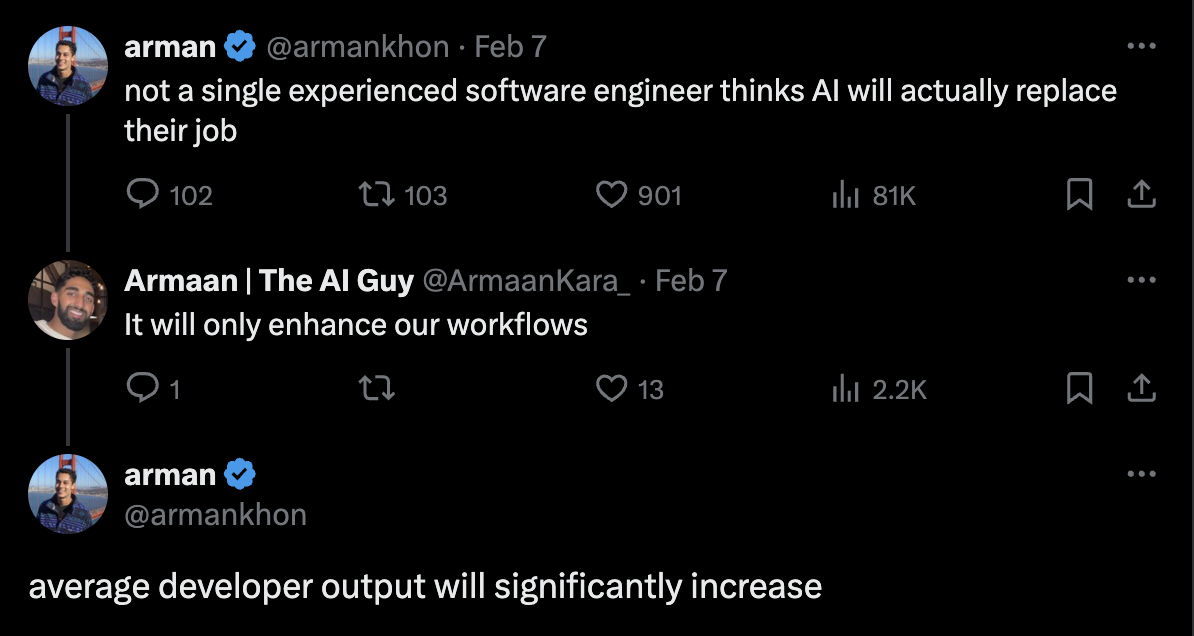
Similar thoughts have been expressed across social media platforms such as Hacker News that AI is going to enhance a developer’s workflow and significantly increase the output and productivity.

There would be more jobs with new roles

The release of every single AI tool brings along the hype of it replacing certain jobs or making them obsolete. But that rarely happens. However, the nature and requirements of being a software developer may undergo change with the advent of natural language programming.

The traditional approach to software engineering often revolved around large teams collaborating to tackle complex projects. However, with the advent of natural language programming and AI-driven solutions, the paradigm is evolving towards leaner, more specialised teams.

Engineers can now express complex ideas and commands more intuitively, streamlining the development process. Tasks that previously required intricate lines of code by a team of five developers can now be accomplished through simple, natural language instructions by a single programmer. While this sounds like cutting jobs, it is actually reducing the barrier to entry for aspiring developers.

“I believe AI will generate more job opportunities than we currently perceive. Humanity has a way to adapt with technological advancements, resulting in the creation of numerous new roles,” said Maheep Gupta, an AI enthusiast. Thus, humans will start solving bigger and more complex problems.

There are predictions that claim there will be 10 million more software engineering jobs in five years, which seem radical since the AI fear-mongering has been pushing us to believe otherwise. The truth is that as the number of AI solutions increase, so do the number of companies looking to hire software developers.

Sure, there can be less coding jobs in a single company, but the number of companies requiring software developers is going to increase a lot more, and most of them in the future would be required to work with AI. Yes, if you are someone who *just* write code, you’ll need to start thinking differently.

The automation of code was never about replacing software engineers, but automating the absolute code monkey work that is what 90% of enterprise development consists of. The future software engineering roles would include managing a team of AI engineers, which would probably increase productivity, and also the number of jobs for those who know AI.

The post 1 Developer Who Knows AI is Better Than 5 Who Don’t appeared first on Analytics India Magazine.