NVIDIA chief Jensen Huang, recently said that it would take 5 years to reach AGI, with certain conditions applied, thereby reigniting AGI discussions that often lose momentum every two days. While the ‘when’ aspect seems to be the most debated by AI experts, the ‘look and feel’ of AGI remains undetermined.
At the World Economic Forum, Davos, AGI was a common topic of discussion, with almost all of them having a hazy answer to what or how AGI will look.
Google DeepMind’s COO Lila Ibrahim, said that “I don’t know how better to answer other than, how do we actually think about that, rather than how much longer will it be. How do we think about what it might look like, and how do we ensure we’re being responsible stewards of the technology?”
Aiden Gomez, CEO and founder of AI startup Cohere, steered the definition of AGI. “AGI is a super vaguely defined term. If we just term it as ‘better than humans at pretty much whatever humans can do,’ I agree, it’s going to be pretty soon that we can get systems that do that,” he said. However, he was inconclusive on its form.
When the super capable autonomous AI software engineer Devin was released last week, people were quick to correlate it to AGI. Surprisingly, OpenAI’s GPT-4 has been compared to AGI.
Source: X
Humanoid robots have also been considered as the path to AGI. With the advancements that are happening in this field, the recent launch of NVIDIA GR00T, a foundational platform for robots, possibly opens the door to AGI.
Source: X
AGI : The Hazy Definition
As people debate timelines for achieving AGI, nobody is really certain of the definition of it. Huang has also been cautious when discussing target years for achieving AGI simply because the definition or tests that determine AGI are not conclusive.
“If we specified AGI to be something very specific, a set of tests where a software program can do very well — or maybe 8% better than most people — I believe we will get there within 5 years,” said Huang at the recent NVIDIA GTC2024 conference. Huang has also clarified on how his statement is subjective to what defines AGI through specific benchmarks such as human performance in logical, economic or medical examinations.
Huang had also emphasised in an earlier interview that AGI could be farther away, and believes that it is hard to achieve it as an engineer, as engineers need defined goals.
On similar lines, Sam Altman, also spoke about how people have defined AGI in different ways, in a recent Lex Fridman podcast. “I think it’s [AGI achievement] very poorly formed and that people use extremely different definitions for what AGI is. So, I think it makes more sense to talk about when we’ll build systems that can do capability X or Y or Z rather than when we kind of fuzzily cross this one mile marker,” said Altman.
Without completely dismissing the question on AGI, Altman said that ‘by the end of the decade and possibly sooner than that,’ there would be highly capable systems.
Not There Yet
“AI progress seems slower than I expected,” said Robin Li, co-founder and CEO of Baidu. “It’s been almost 70 years and each decade brings fresh hopes for applications only to find out AGI is way harder than we think.”
Former NASA rover roboticist, entrepreneur and creator of child-friendly robot Moxie, Paolo Pirjanian’s vision of achieving AGI is not that simple. “I mean AGI is going to be one of these things that always looks like it’s just around the corner, but I think it’s going to take a lot longer. I don’t think anyone can make any qualified predictions about when it’s going to happen,” he said.
While people are still contemplating the concept of AGI, the race to achieve it, and how it would look in the future, there still remains a segment that strongly believe it will never happen. “AGI isn’t coming soon, certainly not this decade, but we should be afraid of unreliable LLMs that are not anchored in facts, yet easily exploited by bad actors,” said AI scientist and expert, Gary Marcus.
Fictional AGI
The moment one has to picturise superhuman intelligence, one tends to think of a superfast computer or a robotic body with super abilities that can perhaps destroy humanity. Thanks to pop fiction, movies like The Terminator, where AGI leads to robots rebelling against humans in the distant future, and Ex Machina, which portrays a humanoid gaining intelligence and turning against its creator, have presented hypothetical and far-fetched scenarios.
The only plausible depiction of AGI was shown in last year’s Mission Impossible – Dead Reckoning movie, where a formless body called ‘Entity’ which is supposedly AGI causes havoc. Powered by a supercomputer hidden at the bottom of the ocean, the Entity is able to connect to every system in the world and manipulate it for any wrongdoing.
While AGI predictions will persist, with everyone imagining various versions of it, let’s hope that Ilya Sutskever, co-founder and chief AI scientist at OpenAI, who is currently missing in action, is not AGI!
Source: X
The post What will AGI ‘Look and Feel’ Like in the Next Five Years? appeared first on Analytics India Magazine.
Stability AI CEO resigns because you’re ‘not going to beat centralized AI with more centralized AI’ Manish Singh 9 hours
Stability AI founder and chief executive Emad Mostaque has stepped down from the top role and the unicorn startup‘s board, the buzzy firm said Friday night, making it the second hot AI startup to go through major changes this week.
Stability AI, which has been backed by investors including Lightspeed Venture Partners and Coatue Management, doesn’t have an immediate permanent replacement for the CEO role but has appointed its COO Shan Shan Wong and CTO Christian Laforte as interim co-CEOs, it said in a blog post.
Stability AI, which has lost more than half a dozen key talent in recent quarters, said Mostaque is stepping down to pursue decentralized AI. In a series of posts on X, Mostaque opined that one can’t beat “centralized AI” with more “centralized AI,” referring to the ownership structure of top AI startups such as OpenAI and Anthropic.
He additionally asserted that it was his decision to step down from the top role as he held the most number of controlling shares. “We should have more transparent & distributed governance in AI as it becomes more and more important. Its [sic] a hard problem, but I think we can fix it..,” he added. “The concentration of power in AI is bad for us all. I decided to step down to fix this at Stability & elsewhere.”
Mostaque’s departure from Stability AI, a startup known for its popular image generation tool Stable Diffusion, comes amid an ongoing struggle at the startup that was spending a reported estimate of $8 million a month as of October 2023, according to Bloomberg, which also noted that the startup had unsuccessfully attempted to raise new funding at a $4 billion valuation.
Mostaque, it appears, wasn’t prioritizing revenue growth about a year ago. In a post on X last year, he expressed his amusement at the generative AI companies’ “strange focus on revenue” even as “the technology is useful but far from vaguely mature as new breakthroughs happen almost daily.” He cited several examples, including MagicLeap, which spent billions before generating revenue.
“The payoffs on proper generative AI R&D are clearer and faster to market than just about anything we’ve seen. It’s going to create way more economic value than self driving cars for example, the total investment in that has been $100b with no revenue pay off,” he wrote.
His comments on Reddit last month offered insights into a shift in focus. “We are doing fine and ahead of forecasts this year already. Our aim is to be cash flow positive this year, think we could get there sooner rather than later,” he wrote.
“The market is huge and open models will be needed for edge and all regulated industries. This is why we are one of the only companies to open data, code, training run details and more. Custom models, consulting and more are huge markets and very reasonable business models around this as we enter enterprise adoption over the next year or so, last year was just testing.”
Stability AI’s announcement caps a remarkable week for the AI industry. Inflection AI, a startup that had raised about $1.5 billion, announced on Monday that two of its co-founders as well as several other staff had joined Microsoft, which led the startup’s most recent funding round.
Star Sports, the official broadcaster of Tata IPL 2024, is introducing AI-powered enhancements that include a translation feature. This feature will allow international commentators to speak Hindi in their original voices, creating a more engaging experience for a diverse audience.
Throughout the IPL 2024 season, Hindi-speaking fans can enjoy direct interactions directly with their favorite international cricketers, including Matthew Hayden, Stuart Broad, Kevin Peterson, Brian Lara, and many others, through surround shows on television.
In a video which has gone viral over social media, former Australian captain Steve Smith can be seen appreciating Kohli’s cover drive. While Kohli’s cover drive has garnered praise from fans around the world, what’s intriguing in the video circulating on social media is Smith speaking in Hindi.
Steve Smith doing AI generated Hindi commentary in the era of cricket colonization. pic.twitter.com/qKlt4D8NBF
— Sushant Chaturvedi (@ShawshankOne) March 23, 2024
“Always good to be a game changer. Excited to share my insights to Hindi audiences around the globe with IPL on Star. Pretty neat huh? Join me from 6 p.m for tonight’s opener between CSK and RCB on Star Sports India,” posted Smith on Instagram.
Commenting on the tech initiative, Steve Smith, Star Sports Commentator for IPL 2024 said,”Namaste India! Being a part of the StarCast with such a stellar line-up of commentators has been a thrill for me. More importantly, my family, friends, and fans around the world got very excited after the hologram clip went viral last year. This season I’m part of another breakthrough technology where you’ll hear my IPL insights in Hindi. I’ve received some great feedback from fans, and I’m excited to connect with millions of viewers through the Star Sports Hindi feed.”
After not receiving any bids in the 2024 Indian Premier League (IPL) auction and being unable to secure a spot with any team for the season, Australian cricket legend Steve Smith will take on a new role in the 17th edition of the lucrative league. He is set to join the commentary team for the upcoming season.
The post Star Sports Debuts AI Commentary in IPL, Steve Smith Praises Kohli in Hindi appeared first on Analytics India Magazine.
Stability AI founder Emad Mostaque resigned from his positions as CEO and from the company’s Board of Directors to pursue decentralised AI initiatives. The Board of Directors has appointed Shan Shan Wong, Chief Operating Officer, and Christian Laforte, Chief Technology Officer, as the interim co-CEOs of Stability AI.
“We are actively conducting a search for a permanent CEO to build upon Stability AI’s foundation and lead the company into its next phase of growth”, the company wrote in its blog post.
“As we search for a permanent CEO, I have full confidence that Shan Shan Wong and Christian Laforte, in their roles as interim co-CEOs, will adeptly steer the company forward in developing and commercializing industry-leading generative AI products,” said said Jim O’Shaughnessy, Chairman of the Board at Stability AI.
“I am proud two years after bringing on our first developer to have led Stability to hundreds of millions of downloads and the best models across modalities. I believe strongly in Stability AI’s mission and feel the company is in capable hands. It is now time to ensure AI remains open and decentralised,” said Mostaque.
Since fall, executives and investors at Stability, including venture capital firms Coatue and Lightspeed Venture Partners, have been urging Mostaque to step down from his CEO role.
Coatue has claimed that Mostaque’s poor leadership led to the departure of several top employees, placing the startup in a challenging financial position. Representatives from both Coatue and Lightspeed stepped down last year from Stability’s board, expressing disagreements with Mostaque’s management style.
Several developers, who worked on the company’s most important product, Stable Diffusion,also recently resigned. Mostaque said that three of the five researchers have left the company.
Stability was rapidly running low on cash, with a reported burn rate of about $8 million per month as of October 2023 according to Bloomberg. Attempts to raise additional funds at a valuation of $4 billion have largely met with limited success.
The post Emad Mostaque Steps Down as CEO of Stability AI appeared first on Analytics India Magazine.
A recent Salesforce survey of 600 IT leaders reveals a new mandate from their bosses: Incorporate generative artificial intelligence (GenAI) into the technology stack — and fast. But the response from IT professionals is "not so fast" — highlighting concerns about resources, data security, and data quality.
Also: Even more businesses will use AI and data to boost sales and services this year
Nearly three in five IT professionals say business stakeholders hold unreasonable expectations regarding the speed and agility of new technology implementations. In fact, the IT leadership survey reveals almost nine in 10 IT professionals can't support the deluge of AI-related requests they receive at their organization.
A 2024 study found that 90% of IT leaders say it's tough to integrate AI with other systems. AI adoption has exploded and amplified the need for a coherent IT strategy, but achieving that balance is easier said than done. MuleSoft's ninth annual Connectivity Benchmark Report was produced from interviews with 1,050 IT leaders (management positions or above) across the globe (public and private sector with at least 1,000 employees). The report's executive summary suggests:
The new normal: AI inflection point amplifies the need for a coherent IT strategy. Eighty-seven percent of IT leaders report that the nature of digital transformation is changing. AI further complexifies the tech landscape, with 991 apps in the average enterprise. IT budgets increase to meet the surging demand.
AI adoption explodes, integration and security concerns are the biggest barriers. The AI genie is out of the bottle, with over three-quarters of organizations reporting they use multiple AI models. As many as 90% say difficulty integrating AI with other systems is a barrier, followed by 79% reporting security concerns.
IT leaders acknowledge that data silos and systems fragility are holding their companies back. Almost universal, 98% of IT leaders report facing challenges regarding digital transformation. Key drivers are the persistence of data silos at 81% and the fragility of tightly coupled and highly dependent systems at 72%.
Business success and growth is dependent upon trust, data, AI and automation. Businesses today are competing in an experience-led economy that is based on trust, personalization, speed, and intelligence. Most people are concerned about the implications of GenAI on data security, ethics, and bias. In fact, 81% of customers want a human to be in the loop, reviewing and validating generative AI outputs. The road to implementation and adoption of AI in a secure, trustworthy, scalable and stakeholder value-driven model will require a lot more than just solid technology and processes. What's needed most is "deployment empathy."
Also: Will AI hurt or help workers? It's complicated
To better understand how large, complex organizations successfully deploy and adopt new technologies in order to turbo charge their value creation capabilities, Constellation Research CEO Ray Wang and I invited three business technology leaders to our weekly podcast DisrupTV. We discussed GenAI — and the need for organizations to adopt and practice deployment empathy when launching new AI efforts — with Teresa Carlson, Rhonda Vetere, and Dr. David Bray.
Deployment empathy embodies putting people first, managing change thoughtfully, creating psychological safety, reassuring anxious workers, and collaborating across sectors to co-create solutions tailored for shared benefit. The practice of deployment empathy centers around the principle that empathetic leadership will enable a smooth, productive transition amid the disruption created by GenAI's impacts on companies, customers, employees, citizens, communities, and societies.
Teresa Carlson is a technology executive and leader with more than 20 years of experience helping governments and enterprises adopt new technologies like cloud computing and AI. Teresa started and led Amazon Web Services' worldwide public sector business, helping more than 5,000 government agencies and 10,000 education institutions adopt cloud technologies. She also served as president and chief commercial officer at Flexport, a supply chain/logistics company; corporate vice president of Microsoft, as well president and chief growth officer at Splunk.
Currently, Teresa is a strategic advisor to technology companies and government organizations. She serves on the boards of Finch AI, Cura, and others. Teresa is also vice chair of the White House Historical Association and an Atlantic Council board member.
During the lively group discussion, Teresa emphasized the critical importance of radical collaboration between public and private sector entities when working to adopt emerging technologies like AI in government settings. This entails deeply listening to agencies' specific needs, co-designing responsible solutions tailored for them, and ensuring full interoperability with legacy systems.
Also: Want to work in AI? How to pivot your career in 5 steps
Why is deployment empathy so essential? Government and enterprise environments do not reward risk-taking and innovation. Championing deployment empathy requires recognizing the current risk-reward environment. Leaders in these risk-averse cultures must create incentives and psychological safety for teams to feel comfortable trying new things like AI. This involves transparency, setting clear guidelines, and managing change thoughtfully.
Also bringing deep technology and leadership expertise, Rhonda Vetere is a global executive who has led major digital transformation initiatives across industries. She is also an accomplished triathlete and author who applies athletic approaches to business leadership and strategic advisory roles. She has worked as a CIO, CTO, and digital transformation leader at large companies like HP Enterprise, Barclays, and JPMorgan.
She is the author of the book "Grit and Grind: 10 Principles for Living an Extraordinary Life," which focuses on achieving one's full potential. Rhonda serves on boards and is a strategic advisor to companies globally on digital transformation and emerging technologies like AI.
As part of the discussion, Rhonda noted that many employees feel anxious about AI automation's potential impact on jobs and skills. Business leaders should be fully transparent about where AI automation makes sense while clearly communicating reskilling plans.
Why is deployment empathy needed now? When deploying AI, leaders should start conversations by discussing where humans fit into the process rather than leading with the technology. Championing AI adoption requires a human-centric mindset focused on impact to people and jobs — deployment empathy.
Dr. David Bray, Loomis Council Co-Chair at the non-partisan Stimson Center
As part of the discussion trio, Dr. David Bray is an acclaimed technology leader with extensive experience guiding organizations through complex, high-risk situations. He is an award-winning, recognized expert on issues such as leadership during turbulent times, digital transformation, resilience, countering disinformation, and responsible adoption of emerging technologies like AI.
He has served in multiple leadership roles dealing with crisis situations and challenges, including bioterrorism preparedness and response, leading two bipartisan National Commissions on R&D, as well as work with the US intelligence cmmunity, the FCC, and the Department of Defense. David is co-chair for the Loomis Council and distinguished fellow at the Stimson Center.
Also: Workers with AI skills can expect higher salaries — depending on their role
David observed that AI and related technologies are catalyzing seismic societal changes in how we work and live, at a pace exceeding our ability to adapt policies, social contracts, and organizational change management practices. He noted that this calls into question existing social contracts around displaced workers and economic opportunity, which is why leadership paired with deployment empathy in our GenAI era is important now more than ever.
How to embody deployment empathy authentically? David noted that leaders must provide a steady "non-anxious presence" amidst uncertainty to reassure people worried about job loss. This empathetic leadership is crucial. He also noted AI journeys for companies, governments, and society will involve both short-term sprints and longer-term marathons. While moving fast, leaders cannot forgo security, customer value, and business continuity. We must balance thoughtfulness, empathy, and care for people with the urgency to innovate for shared prosperity.
During the discussion, Teresa highlighted the need for clear governance frameworks and guidelines around ethical, fair, transparent, and legally compliant AI deployment in the public sector. This responsible AI approach builds trust and mitigates risks as government agencies adopt AI.
Rhonda also suggested creating formal programs to identify roles needing upskilling, "ringfencing" those employees, providing educational resources, and guaranteeing jobs after reskilling is complete. This thoughtful change management reduces anxiety and distrust, while promoting psychological safety.
Also: Beyond programming: AI spawns a new generation of job roles
David also highlighted that — now more than ever — leaders need to provide a steady, "non-anxious presence" to reassure people that it will be OK through this transition, even if the outcomes remain uncertain. This means openly acknowledging people's fears, showing genuine empathy, communicating transparently, and co-creating solutions.
Together, the speakers emphasized that responsible and ethical AI adoption requires empathetic change management and responsible governance frameworks. Leaders should promote psychological safety through transparency, reskilling support, reassurance during uncertain transitions, and co-designing solutions tailored to people's needs.
Deployment empathy also includes recognizing the importance of AI adoption and managing unintended consequences that requires cross-sector collaboration between government, academia, civil society groups, and business. We need new social contracts for labor displacement and other seismic economic shifts catalyzed by AI.
Also: AI is changing cybersecurity and businesses must wake up to the threat
Cumulatively, the speakers highlighted the societal leadership challenges posed by AI and that leaders have a duty to support their workforce through AI adoption with empathy, communication, and responsible governance. Leaders must champion deployment empathy both internally and externally to their organizations. Together with radical collaboration, clear governance guardrails, and compassionate communication, leaders can guide their organizations through the AI-driven transformation in a productive way.
This article was co-authored by Dr. David Bray, Principal & CEO at LeadDoAdapt (LDA) Ventures.
The rise of generative AI has shown the world the grand potential of this technology to assist people in numerous ways — but it has also revealed its dangers. The technology has already caused data leaks, copyright infringement lawsuits, harmful deep fakes, and more, showcasing the imminent need for safety regulations.
Also: AI is changing cybersecurity and businesses must wake up to the threat
As a result, on Thursday, the United Nations General Assembly unanimously adopted a US-led resolution, backed by more than 120 member states, to ensure AI design, development and deployment is "safe, secure and trustworthy."
"Let us reaffirm that AI will be created and deployed through the lens of humanity and dignity, safety and security, human rights and fundamental freedoms," said Linda Thomas-Greenfield, US Ambassador to the UN.
What exactly does the resolution entail? You can read the text here or find the highlights below.
"With today's adoption in the UN General Assembly of the US-led resolution on artificial intelligence, UN Member States have spoken with one voice to define a global consensus on safe, secure, and trustworthy AI systems for advancing sustainable development," said Anthony Blinken, US Secretary of State.
This adoption of the resolution marks a significant moment for AI development because it is the first global resolution regarding the powerful, emerging technology.
The Group of Seven nations have signed an agreement committing to explore how artificial intelligence can improve public services and boost economic growth.
The Ministerial Declaration, signed March 15, will see Canada, France, Germany, Italy, Japan, the U.K. and the U.S. work together to create policies and recommendations on deploying “safe and trustworthy” AI across various industry sectors. These will be informed by a report exploring businesses’ uses of AI, which will be published by the end of 2024.
The agreement also covers the joint development of an AI toolkit to inform policy-making and ensure AI used public sector services are safe and trustworthy.
The Ministerial Declaration: What you need to know
The Ministerial Declaration is a commitment by G7 nations to collectively explore economically advantageous ways of using AI. Part of this includes looking at how AI can be used to create public services that are “tailored to citizens’ needs and expectations.”
The agreement also seeks to understand AI’s role in the workplace, specifically in boosting productivity and economic competitiveness across health, education, manufacturing, public administration and other sectors.
To steer best practice, G7 nations will develop an AI toolkit to “help the public sector and, where relevant, other stakeholders, translate principles for safe, secure, and trustworthy AI into actionable policies, recognising opportunities and risks.”
SEE: Global powers are making a pledge to AI safety.
The toolkit will “act as a snapshot to further help assess AI’s relevance in the public sector, including for specific domains (and) may also explore mechanisms to encourage, as appropriate, the role of relevant public sector data to support governments developing safe, secure, and trustworthy AI,” according to the declaration.
The Ministerial Declaration was signed on the second and final day of the G7’s Industry Tech and Digital meeting, which took place in the cities of Verona and Trento, Italy, on Mar 14–15. It builds on the voluntary AI Code of Conduct signed by G7 nations in October 2023.
Joint report to deepen understanding of AI in business
In an effort to understand the opportunities for economic growth presented by AI, the G7 nations will jointly develop a report exploring the factors behind AI adoption among businesses in participating countries.
This will involve collecting and analysing AI policy strategies in micro, small and medium-sized enterprises to “identify best practices and develop knowledge repositories, with case studies and lessons learned.” The report will also seek to identify barriers to AI adoption.
The Ministerial Declaration commits to publishing this report by the end of the year, with the intention to “improve the G7’s shared understanding of tech collaboration, assessing different approaches to policy and offering a set of recommendations which will support companies to successfully roll out safe and trustworthy AI.”
SEE: New AI security guidelines by NCSC, CISA & more international agencies.
Commenting on the agreement, Michelle Donelan, the U.K.’s Technology Secretary, said in a press release:
“AI is already an extraordinary force for good in our society, with vast potential to tackle some of the world’s biggest challenges. I am determined that we continue to drive forward efforts to harness the enormous potential of these emerging technologies to unlock new opportunities and turbocharge productivity.”
Calls to double growth in quantum computing
Quantum computing was another focus of the Ministerial Declaration, with G7 nations recognizing the technology’s potential for delivering breakthroughs across a variety of industry sectors.
As part of the agreement, the countries will work together to promote the development of quantum technologies and foster collaboration between academia and industry. This will include sharing technical knowledge and supporting quantum technology R&D, as well as delivering skills training to workers.
G7 nations also committed to establishing a new Point of Contact Group on semiconductors, which will help countries share best practices on the design and sustainable manufacturing of semiconductor technology.
SEE: Is quantum computing right for your business?
“The emergence of a global market for quantum technologies should include the development and appropriate adoption of technical standards, as well as pre-standardisation activities, such as benchmarking, terminology, and metrics,” the declaration states. “This may support comparison and interoperability among different quantum devices and facilitate compatibility with existing technologies.
“We encourage, where appropriate, the development and adoption of international technical standards in standards development organisations.”
Saqib Bhatti, U.K. Minister for Tech and the Digital Economy, said:
“The U.K. has long been a leading voice on the global stage for greater collaboration across Science, Innovation, and Technology. Supported by this agreement, we will continue to work shoulder-to-shoulder with our G7 partners to realise the huge benefits emerging technologies like AI and Quantum can bring.”
Recent AI activity in the UK
According to figures by the U.K. government, the U.K.’s AI sector already contributes £3.7 billion (US $4.7 billion) to the economy and employs 50,000 people across the country.
In February, the U.K. held its first AI Opportunity Forum, aimed at exploring how British businesses can adopt and benefit from AI technologies.
SEE: Impact of AI on Jobs in the U.K.
The Forum, which will be held on a bi-monthly basis, will bring business leaders together to encourage adoption of AI across the private sector, and will host representatives from the likes of Microsoft, Google, Quantexa, KPMG, Arm, Barclays, Vodafone, Universal Music Group and GSK.
In January, the U.K. government’s Central Digital and Data Office published a framework outlining principles for government departments on the responsible use of generative AI.
The framework also covers the upskilling of civil servants through training courses aimed at teaching them how to use generative AI tools like ChatGPT.
Jensen Huang, Nvidia CEO, shows the new Blackwell GPU chip (left).
This week's ZDNET Innovation Index continued to be AI top-heavy with AI-related topics taking three of the top four spots again — and it was further dominated by some of the largest tech companies in the world and the company that's now synonymous with generative AI.
To recap, the Innovation Index highlights the top trends in tech based on a vote from our panel of journalists and analysts. We're especially looking for the developments that are the most innovative and will have the biggest impact on the future. ZDNET's editorial leaders narrow down the top 10 trends of the week and then our panel votes to rank the top four. If you're not familiar, here's the link to last week's report as well as the inaugural report two weeks ago.
This week's leading trends were:
Nvidia unveils 'Blackwell' chip to power next-gen LLMs
OpenAI is preparing new automations for GPT-5
Microsoft reveals its first AI-powered Surface devices
Google redesigns search results for health conditions
Our panel's runaway top pick this week was the new Nvidia GPU that's expected to speed up the large language models that power generative AI by as much as 25 times. Speaking of LLMs, the next big one from market leader OpenAI is going to be GPT-5 and the company is already telegraphing that we should expect it to include some new superpowers to automate tasks with AI agents. Not to left out of the AI party, Microsoft took the wraps off its flagship laptop and 2-in-1 tablet that will have a neural processing unit to optimize for AI-related tasks.
And finally, the one non-AI item on this week's list is Google's big redesign of how health conditions are displayed in search results. This is a lot bigger than it sounds since so many people start their health journey on Google when they are having problems or looking to improve something about their health. I have a number of friends who are physicians and they often refer to patients coming in after being told health information of various levels of reliability by "Dr. Google."
Alright, that's it for this week. Check back next week for the latest set of trends.
Boardroom executives are eager to exploit generative artificial intelligence (GenAI). The demand is creating huge pressure for CIOs and IT professionals, according to Logicalis' tenth annual CIO Report.
Logicalis group CTO Toby Alcock says his firm's research shows CIOs are in a tough spot. The rest of the business has heard about GenAI's productivity and cost benefits but doesn't necessarily understand the challenges of embracing emerging technologies.
Also: Global tech spending expected to keep climbing on AI demand
"There's so much hype around AI and the promise of what it will do," Alcock told ZDNET. "The business stakeholders see this silver bullet called generative AI and think it can do everything. But this potential often has nothing to do with AI when you look under the hood of vendors' products."
CIOs who want to manage the demand for AI should have frank discussions with their business colleagues across five key areas.
1. Be clear on what's achievable
Integrating AI effectively into the business is the number one priority for CIOs in 2024. Alcock said that 89% of IT leaders in the survey of 1,000 CIOs globally want to incorporate AI into their organization in 2024 and 85% have budgets allocated for AI development.
"That's a big bet when you look across the wide gamut of markets, verticals, and customers in the survey, with the overwhelming majority all betting on this technology," Alcock said. "CIOs want to prove they're on the front foot and leading with the latest buzzwords and technologies in AI."
Also: Generative AI on its own will not improve the customer experience
However, Alcock issued a warning to CIOs: manage demand effectively.
"Success is being realistic about where the opportunities are with AI. When we talk to our customers, it's being clear on what can you get done," he said. "Cut through the hype and deliver tangible business value quickly. Get some evidence that allows you to target further investment for AI."
2. Develop AI skills
CIOs must also ensure their business has the skills to make the most of this emerging technology. The good news is that the survey found that 87% of digital leaders have already established AI workstreams. However, Alcock noted that finding great talent in this nascent market is challenging.
"Everyone's trying to look at how they can start to invest in skills," he said. "But, unfortunately, trying to hire data scientists and AI skills is very different to the core business that most of our CIOs are used to, which is running infrastructure and keeping the business operating."
Also: Generative AI is the technology that IT feels most pressure to exploit
Alcock added that talented data scientists have a different way of working, and their skills don't come cheap. "We pay a lot for our data scientists and our customers are spending a lot of money on this area, too," he said.
The demand is so high that securing in-house AI talent could be cost-prohibitive. Alcock encouraged CIOs to look beyond the enterprise firewall and consider working with partners, such as vendors, consultants, and startups, that already have data talent.
Keep the cost of these initiatives down by focusing on clear organizational objectives. "I think the key comes back to business outcomes — ask how AI will help drive efficiency, create differentiation, improve security, or help with sustainability initiatives," he said. "If you're just putting in AI for the sake of it, and you don't have a real return on investment measure, it's probably doomed to fail."
3. Deal with AI governance
Almost three-quarters (72%) of CIOs are apprehensive about the challenges of regulating AI. CIOs must find a way to help the business balance its excitement for AI with the challenges of governance, whether that's ethics, biases, or forthcoming regulations.
"We're in the Wild West," Alcock said. "There are no accepted ways of governing AI and it's an area that's evolving so quickly that a policy on a bit of paper might not be relevant by the time it's put into use by the business."
The survey revealed that 86% of CIOs have kicked off formal AI policies in their organizations despite the fast-moving nature of the market. These initiatives will help businesses get a grip on governance as national and global regulations are established.
Alcock noted that CIOs who put policies in place should match business use cases for AI with a strong sense of how data will be used. "The risk profile comes back to understanding your key data," he said. "What's this project going to achieve for my business? What data do you have to protect? And how do you avoid that data getting exposed?"
4. Confront the cyber challenge
The ever-growing cyber threat compounds data risk. As many as 83% of businesses in the survey suffered a hack in 2023 and only 43% of CIOs feel fully prepared for another breach. Alcock said that AI presents new challenges for CIOs: "People are weaponizing AI and using targeted and automated attacks on businesses."
The lack of preparedness for further attacks means CIOs must change how their IT and security teams operate.
Also: Generative AI advancements will force companies to think big and move fast
"A zero-trust model that assumes that you're trying to be breached all the time is the right solution," Alcock said. "That model is about being prepared, so that when the next breach happens — not if, when — you're prepared, you know how to act, and you can recover quickly and cleanly."
Alcock encouraged CIOs to explore new AI-enabled tools as part of that zero-trust approach.
"That's about using AI to fight AI. It's about exploring how AI can help identify threats instantly and reduce downtime without hiring hundreds of people," he said. "Generative AI will continue to evolve. There's a lot of money being put into AI and security and the point where they join is a sweet spot for any entrepreneur."
5. Keep the business connected
The Logicalis research shows that 75% of CIOs believe connectivity infrastructure is a barrier to implementing data-led initiatives. This focus on underlying IT draws CIOs away from focusing on how to make the most of emerging technologies, such as generative AI, machine learning, and the Internet of Things.
"Our data shows CIOs are still spending too much time running systems and keeping the lights on," Alcock said. Managing multiple tools, vendors, and apps across disparate environments is tough. The best way for CIOs to deal with this challenge is proactively.
Also: Generative AI in commerce: 5 ways industries are changing how they do business
"That's probably the biggest takeaway from our report this year," Alcock said. "CIOs are now expected to have intelligent boardroom-level conversations about security and compliance, economics, environment, sustainability, reliability, and user experience. That's a broad set of discussions with different stakeholders. So, CIOs must continue to boost their engagement skills and focus on relating effectively with their stakeholders."
NVIDIA has come a long way from the days of specializing in graphics cards for gaming — NVIDIA GPUs now provide a lot of the power behind generative AI for enterprise. At NVIDIA GTC 2024, held March 18 – 21 in San Jose, California, generative AI was everywhere, from chatbots to art installations. Here are some of the top tech trends we saw while at NVIDIA GTC this year, meaning the tech that came up over and over again in presentation topics, the keynote and press Q&A with NVIDIA CEO Jensen Huang, and on the show floor.
Retrieval-augmented generation
Billed as a technique for cutting down on AI “hallucinations” or inaccuracies, retrieval-augmented generation lets a generative AI model check its work against external resources such as research papers or articles. RAG appeals to enterprise customers because it increases the reliability of generated content.
SEE: NVIDIA CEO Jensen Huang revealed the upcoming Blackwell-architecture GPUs and more during the conference keynote. (TechRepublic)
For example, Lenovo is an early adopter of NVIDIA’s newly announced NeMo framework with RAG, which Lenovo is using to build out its AI ecosystem for customers who work on Lenovo devices.
“AI factories” for increased storage and compute needs
Many organizations at NVIDIA GTC positioned themselves as “AI factories,” which give enterprises access to the storage and compute power they need to make private AI.
NexGen Cloud, which calls its AI factory service “GPUaaS,” is among the companies that will provide access to NVIDIA’s 10-trillion parameter Blackwell GPU (Figure A) later this year.
Figure A: The Blackwell platform and Blackwell-architecture GPUs were behind many of the innovations at NVIDIA GTC 2024. Image: NVIDIA
Ten trillion parameter jobs require a lot of compute, and organizations are betting they can make a business model out of providing just the right amount of that computing power to customers.
“As those models get bigger and bigger, continuing to grow exponentially, the infrastructure that’s required to train, fine-tune and serve or provide inference for those at scale also needs to continue to grow to solve that problem,” said Mark Lohmeyer, vice president and general manager of compute and AI/ML infrastructure at Google Cloud, in an interview with TechRepublic at NVIDIA GTC 2024.
Storage needs to support highly performant structured data as well as unstructured data such as documents, images and video, said Greg Findlen, senior vice president of product management of data management at Dell, at a pre-briefing on March 15. Customers also want to be able to manage how their processes are utilizing the available hardware. “Nobody wants to have idle GPUs,” Findlen said.
The Dell AI Factory, developed with help from and support for NVIDIA products, is meant to narrow down “vast possibilities” into “impactful use cases,” said Varun Chhabra, Dell senior vice president of infrastructure and telecom marketing, at the pre-briefing.
According to a Gartner study published in March 2024, 83% of 459 technology service providers polled from October to December 2023 had deployed or were piloting generative AI within their organizations.
Edge AI
Organizations focusing on edge AI took up a large portion of the show floor at NVIDIA GTC 2024, with a wide variety of use cases: robotics, automotive, industrial, warehousing, healthcare, critical systems and retail.
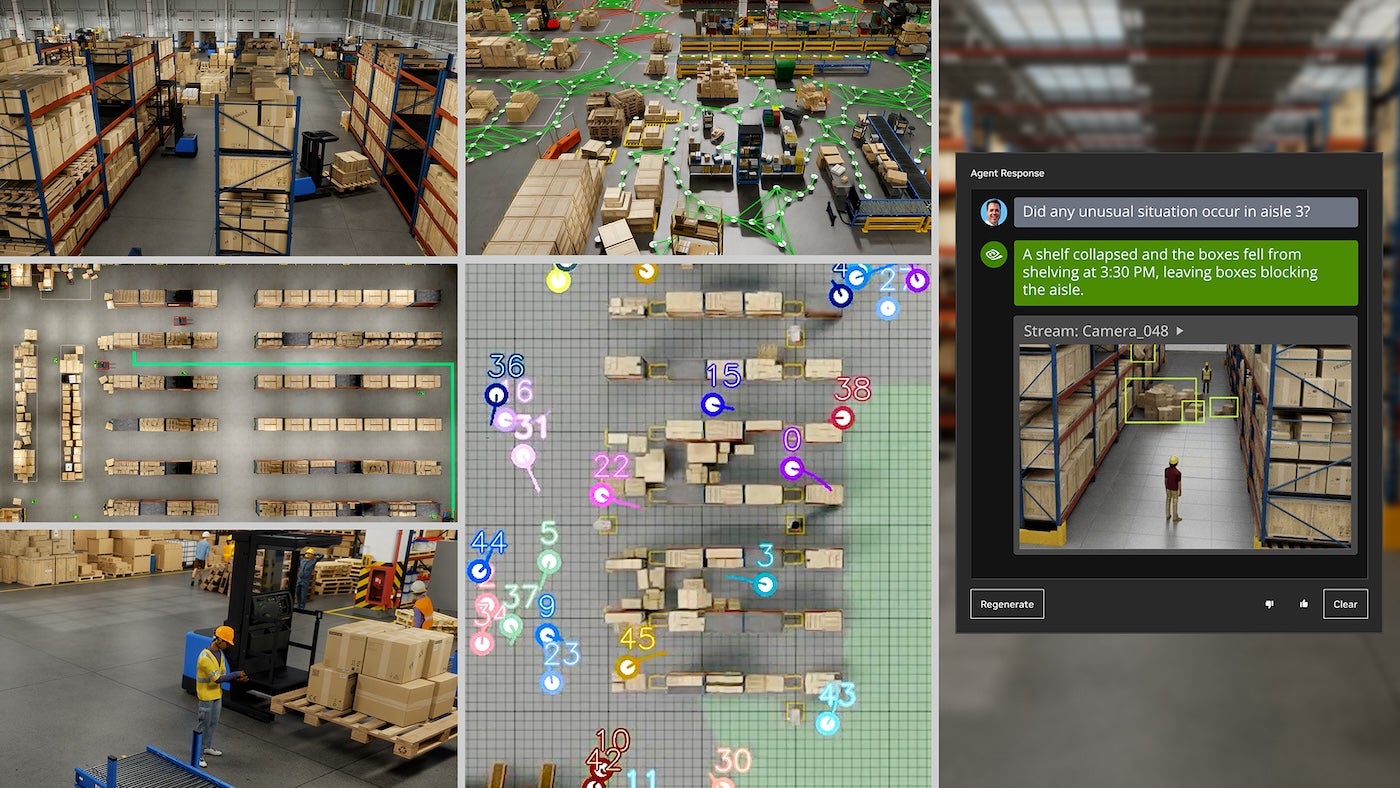
Many of these edge AI use cases were powered by NVIDIA’s Jetson platform for robotics. NVIDIA Metropolis microservices on Jetson Orin lets developers use API calls to set up generative AI capabilities on the edge, making robots more reactive and flexible to their environments.
For example, during the keynote, NVIDIA CEO Jensen Huang showed a demonstration of warehouse robots that automatically rerouted around an obstacle (Figure B).
Figure B: Robots and AI agents are trained in a simulated industrial space using a combination of NVIDIA software: Omniverse, Metropolis, Isaac and cuOpt. Image: NVIDIA
“AI is not new, but the conversation around generative AI is reinvigorating this topic for many,” said Chhabra in an email to TechRepublic. “We’ve been doing AI inferencing at the edge for years, and data scientists have been using our endpoints like Dell Precision workstations to do AI modeling and proof of concept.”
Private AI for enterprise
Organizations are working on spinning up private generative AI that can access proprietary data securely while providing the flexibility of a public AI like ChatGPT.
A common name on the show floor for private AI services was Mistral AI, which provides an open source large language model that customers can host on their own servers.
Copilots
Copilots aren’t new — chatbots like ChatGPT set off the generative AI boom, after all. Since then, “copilot” has become almost a generic term for a chatbot that can answer questions about data.
Copilots can draw from company-owned data
NVIDIA GTC saw a wide range of copilot AI that can draw answers from specific, company-owned structured and unstructured data. For example, the SoftServe Gen AI Industrial Copilot reads from a robot arm’s maintenance manual to create step-by-step instructions for making repairs and can highlight the parts the technician needs to replace on a 3D model.
Citation lets humans check AI answers
Another common trend in enterprise copilots was citation. NexGen Cloud showed how its Hyperstack cloud platform (developed by SoftServe and accelerated by NVIDIA GPUs) could run a copilot that could answer questions based on a video and point back to specific moments in the video transcript where the AI sourced its answers. The combination of proprietary, private data sources with copilot-style chatbot functionality continues to be the driving trend in generative AI for enterprise.
Disclaimer: NVIDIA paid for my airfare, accommodations and some meals for the NVIDIA GTC event held March 18 – 21 in San Jose, California.