Former Snowflake managing director Vivek Natarajan will now lead real-time database Redis’s growth and innovation as managing director for Asia Pacific Japan.
“I am truly grateful for the amazing experience that Snowflake has given me. The people I have worked with have left an indelible impact on my life. Thank you to everyone at Snowflake, as well as to our customers and partners who have made this journey memorable,” Natarajan added in his LinkedIn post.
Based in Singapore, he has been with Snowflake for almost five years and has been previously associated with Oracle, Citrix, and Hitachi Data Systems, among others.
Beyond Natarajan, two weeks ago, Redis also underwent another leadership change. Cofounder Yiftach Schoolman has taken up the role of President after serving 11 years as the chief technology officer since the company’s inception.
“I’ll continue to help Redis develop its strategy and execute our technology vision, and I’ll spend time with customers and peers,” said Schoolman.
Benjamin Renaud, who previously worked as Airbnb’s engineering director and Cisco’s VP, has joined the Redis team as CTO, replacing Schoolman.
The company recently acquired Israel based Speedb, a RocksDB-compatible key-value storage engine, expanding its capabilities beyond in-memory storage. S, all the employees of Spedb have joined Redis. It is also transitioning from the open-source BSD license to a dual-licensing model. This change aims to thwart large cloud providers from offering free alternatives to Redis’ hosted services.
The post Redis Gets a Fresh Leadership Makeover appeared first on Analytics India Magazine.
Gyan AI Research, a firm focused on developing powerful language models, has introduced PARAMANU-AYN, a new legal natural language processing (NLP) model.
The model is based exclusively on case documents from the Supreme Court of India, the Indian Constitution, and the Indian Penal Code. It is the first generative language model built from scratch specifically for the Indian legal domain, with a context size of 8192.
After pretraining on the legal corpus, the researchers instruction-tuned PARAMANU-AYN on over 10,000 instructions covering legal tasks like drafting contracts, summarizing cases, and answering constitutional questions.
To evaluate the model, the researchers used GPT-3.5-Turbo to assess the quality of PARAMANU-AYN’s responses across metrics like clarity, relevance, completeness, and legal reasoning ability. The model achieved scores around 7-8 out of 10 on these metrics for legal instructions.
PARAMANU-AYN can run efficiently on CPUs, with an inference speed of over 42 tokens per second on an 8-core AMD processor. The researchers found their model could learn the legal domain knowledge required for tasks like contract drafting from a relatively small amount of instruction data, without pretraining on full legal books.
The researchers believe this is the first attempt at an Indian legal language model from scratch. They plan to release PARAMANU-AYN publicly at https://www.bharatgpts.com
The work represents a novel approach to developing specialised legal language models for jurisdictions like India.
However, the researchers note some limitations, such as potential hallucinations from the instruction data, lack of human evaluation, and absence of guardrails in the current system.
The post Introducing PARAMANU-AYN, India’s first Indigenously Developed Legal AI appeared first on Analytics India Magazine.
This year marks a significant milestone for Cypher as we celebrate our 8th anniversary. Known as India’s premier AI summit, Cypher has consistently been at the forefront of connecting the AI community with industries both old and new. In a thrilling expansion, we’re proud to announce that Cypher is crossing continents to set foot in the USA, specifically in the vibrant tech hub of the Bay Area, Santa Clara, California, this November.
Why the USA?
The decision to bring Cypher to the USA stems from a deep understanding of the global AI landscape and the unique position the Bay Area holds within it. Home to Silicon Valley, the area is synonymous with innovation, entrepreneurship, and, most importantly, the heart of AI advancements.
The expansion is not without its challenges. The pace at which AI is evolving and being adopted across various sectors presents a complex set of challenges, from ethical considerations and data privacy to technology integration and talent acquisition. Moreover, bridging the gap between the theoretical advancements in AI and their practical, real-world applications remains a critical hurdle for many organizations.
At Cypher, we recognize these challenges as opportunities to catalyze change and innovation. Our goal is to create a platform where the brightest minds in AI can come together to share insights, strategies, and solutions that not only address these challenges but also propel us towards a more integrated and collaborative future.
What to Expect
Cypher 2024 is designed to be an immersive experience for attendees, featuring over 100 speakers across multiple tracks and drawing more than a thousand attendees from over 300 organizations, including Fortune 500 company executives. The conference prides itself on focusing on real-world AI adoption strategies, delivering actionable insights straight from the minds of Chief Data Officers (CDOs) and analytics leaders.
Noteworthy Speakers and Sessions
The speakers’ roster at Cypher 2023 wass as illustrious as it is diverse, featuring luminaries such as Jonty Rhodes, Katie Stein, and Raghavendra Rengaswamy, among others. These experts will share their knowledge and insights on leveraging AI for strategic advantage, ensuring that attendees walk away with valuable, actionable strategies.
Speakers at Cypher USA | Speakers at Cypher India
Awards and Recognition
A highlight of Cypher 2024 will be the Minsky Awards for Excellence in AI, which honor outstanding enterprise-level achievements in AI. These awards recognize innovation and excellence in the field, setting a benchmark for success in AI applications.
Awards at Cypher USA | Awards at Cypher India
Networking and Collaboration Opportunities
Cypher 2024 promises unmatched networking opportunities, with features like FlashConnect, the Networking Hour, and exclusive mentoring sessions. These interactive platforms are designed to foster meaningful connections, encourage knowledge exchange, and spark collaboration among participants.
Register for Cypher USA | Register for Cypher India
Getting Involved
Participation in Cypher 2024 offers a unique opportunity to engage with the forefront of AI technology and thought leadership. Whether you’re looking to attend, speak, sponsor, or partner, Cypher provides a platform to connect with the AI community globally. With tickets available at early bird, standard, and late pass rates, securing your spot at this must-attend event is easier than ever.
Partner with Cypher USA | Partner with Cypher India
Conclusion
As Cypher 2024 gears up to host its landmark conference in both India and the USA, it stands as a testament to the unifying power of AI across geographies and industries. This event not only showcases the latest in AI innovation but also provides a fertile ground for forging the future of enterprise AI. Be part of this transformative journey and witness firsthand the unfolding of AI’s next chapter at Cypher 2024.
For more information, booking, or inquiries on sponsorship opportunities, contact the organizers directly via email at info@analyticsindiamag.com (India) or info@aimresearch.co (USA).
The post Launching 8th Edition of Cypher: Now in USA too appeared first on Analytics India Magazine.
In a significant leap forward for artificial intelligence (AI), a team from the University of Geneva (UNIGE) has successfully developed a model that emulates a uniquely human trait: performing tasks based on verbal or written instructions and subsequently communicating them to others. This accomplishment addresses a long-standing challenge in AI, marking a milestone in the field’s evolution.
Historically, AI systems have excelled in processing vast amounts of data and executing complex computations. However, they have consistently fallen short in tasks that humans perform intuitively – learning a new task from simple instructions and then articulating that process for others to replicate. The ability to not only understand but also communicate complex instructions is a testament to the advanced cognitive functions that have remained, until now, a distinctive feature of human intelligence.
The UNIGE team’s breakthrough goes beyond mere task execution and into advanced human-like language generalization. It involves an AI model capable of absorbing instructions, performing the described tasks, and then conversing with a ‘sister' AI to relay the process in linguistic terms, enabling replication. This development opens up unprecedented possibilities in AI, particularly in the realm of human-AI interaction and robotics, where effective communication is crucial.
The Challenge of Replicating Human Cognitive Abilities in AI
Human cognitive skills exhibit a remarkable capacity for learning and communicating complex tasks. These abilities, deeply rooted in our neurocognitive systems, allow us to swiftly comprehend instructions and relay our understanding to others in a coherent manner. The replication of this intricate interplay between learning and linguistic expression in AI has been a substantial challenge. Unlike humans, traditional AI systems have required extensive training on specific tasks, often relying on large datasets and iterative reinforcement learning. The capacity for an AI to intuitively grasp a task from minimal instruction and then articulate its understanding has remained elusive.
This gap in AI capabilities highlights the limitations of existing models. Most AI systems operate within the confines of their programmed algorithms and datasets, lacking the ability to extrapolate or infer beyond their training. Consequently, the potential for AI to adapt to novel scenarios or communicate insights in a human-like manner is significantly constrained.
The UNIGE study represents a significant stride in overcoming these limitations. By engineering an AI model that not only performs tasks based on instructions but also communicates these tasks to another AI entity, the team at UNIGE has demonstrated a critical advancement in AI's cognitive and linguistic abilities. This development suggests a future where AI can more closely mimic human-like learning and communication, opening doors to applications that require such dynamic interactivity and adaptability.
Bridging the Gap with Natural Language Processing
Natural Language Processing (NLP) stands at the forefront of bridging the gap between human language and AI comprehension. NLP enables machines to understand, interpret, and respond to human language in a meaningful way. This subfield of AI focuses on the interaction between computers and humans using natural language, aiming to read, decipher, and make sense of the human languages in a valuable manner.
The underlying principle of NLP lies in its ability to process and analyze large amounts of natural language data. This analysis is not just limited to understanding words in a literal sense but extends to grasping the context, sentiment, and even the implied nuances within the language. By leveraging NLP, AI systems can perform a range of tasks, from translation and sentiment analysis to more complex interactions like conversational agents.
Central to this advancement in NLP is the development of artificial neural networks, which draw inspiration from the biological neurons in the human brain. These networks emulate the way human neurons transmit electrical signals, processing information through interconnected nodes. This architecture allows neural networks to learn from input data and improve over time, much like the human brain learns from experience.
The connection between these artificial neural networks and biological neurons is a key component in advancing AI’s linguistic capabilities. By modeling the neural processes involved in human language comprehension and production, AI researchers are laying the groundwork for systems that can process language in a way that mirrors human cognitive functions. The UNIGE study exemplifies this approach, using advanced neural network models to simulate and replicate the complex interplay between language understanding and task execution that is inherent in human cognition.
The UNIGE Approach to AI Communication
The University of Geneva’s team sought to craft an artificial neural network mirroring human cognitive abilities. The key was to develop a system not only capable of understanding language but also of using it to convey learned tasks. Their approach began with an existing artificial neuron model, S-Bert, known for its language comprehension capabilities.
The UNIGE team’s strategy involved connecting S-Bert, composed of 300 million neurons pre-trained in language understanding, to a smaller, simpler neural network. This smaller network was tasked with replicating specific areas of the human brain involved in language processing and production – Wernicke's area and Broca's area, respectively. Wernicke's area in the brain is crucial for language comprehension, while Broca's area plays a pivotal role in speech production and language processing.
The fusion of these two networks aimed to emulate the complex interaction between these two brain regions. Initially, the combined network was trained to simulate Wernicke's area, honing its ability to perceive and interpret language. Subsequently, it underwent training to replicate the functions of Broca's area, enabling the production and articulation of language. Remarkably, this entire process was conducted using conventional laptop computers, demonstrating the accessibility and scalability of the model.
The Experiment and Its Implications
The experiment involved feeding written instructions in English to the AI, which then had to perform the indicated tasks. These tasks varied in complexity, ranging from simple actions like pointing to a location in response to a stimulus, to more intricate ones like discerning and responding to subtle contrasts in visual stimuli.
The model simulated the intention of movement or pointing, mimicking human responses to these tasks. Notably, after mastering these tasks, the AI was capable of linguistically describing them to a second network, a duplicate of the first. This second network, upon receiving the instructions, successfully replicated the tasks.
This achievement marks the first instance where two AI systems have communicated with each other purely through language, a milestone in AI development. The ability of one AI to instruct another in completing tasks through linguistic communication alone opens new frontiers in AI interactivity and collaboration.
The implications of this development extend beyond academic interest, promising substantial advancements in fields reliant on sophisticated AI communication, such as robotics and automated systems.
Prospects for Robotics and Beyond
This innovation significantly impacts the field of robotics and extends to various other sectors. The potential applications of this technology in robotics are particularly promising. Humanoid robots, equipped with these advanced neural networks, could understand and execute complex instructions, enhancing their functionality and autonomy. This capability is crucial for robots designed for tasks that require adaptability and learning, such as in healthcare, manufacturing, and personal assistance.
Furthermore, the technology's implications extend beyond robotics. In sectors like customer service, education, and healthcare, AI systems with enhanced communication and learning abilities could offer more personalized and effective services. The development of more complex networks, based on the UNIGE model, presents opportunities for creating AI systems that not only understand human language but also interact in a way that mimics human cognitive processes, leading to more natural and intuitive user experiences.
This progress in AI communication hints at a future where the gap between human and machine intelligence narrows, leading to advancements that could redefine our interaction with technology. The UNIGE study, therefore, is not only a testament to the evolving capabilities of AI but also a beacon for future explorations in the realm of artificial cognition and communication.
Ankush Sabharwal, CEO and founder of CoRover.ai, revealed that the company has officially become a part of the NVIDIA Inception program.
With the integration into NVIDIA’s ecosystem, CoRover.ai’s team gains access to NVIDIA GPUs, unparalleled computational capabilities, and robust multi-factor support, positioning itself to expedite the advancement and adoption of its generative AI-powered solutions.
At the core of CoRover’s offerings lies its Human-Centric Conversational AI platform, driven by BharatGPT, which is poised to redefine how businesses interact with their clientele. This strategic collaboration with NVIDIA is expected to propel CoRover’s trajectory, empowering the company to reshape the landscape of AI-enabled services on a global scale.
This milestone not only serves as a testament to the unwavering dedication and foresight of the CoRover.ai team but also heralds a plethora of promising opportunities for both the company and its stakeholders.
The company also launched CoroAssist, a secure generative AI Information Retrieval System poised to transform how enterprises access crucial data.
Sabharwal spoke to AIM about how CoRover.ai’s BharatGPT was built and what exactly it offers that the government is on board to implement in its services. Starting its AI journey in 2016, CoRover has been building virtual assistants for various partners and government agencies such as IRCTC, MaxLife, Chennai Police, and LIC, to name a few.
Sabharwal said that CoRover.ai’s BharatGPT is used only to power other virtual assistants, and they do not charge extra for building their own models. “You can come with your data and we can build an assistant for your business with very simple steps,” said Sabharwal. He said that this includes assistants in 14 languages including voice.
Corover.ai is also backed by Google, and leverages its cloud for building LLMs. “Like the government of India’s mission of Make AI in India and Make AI Work for India, our BharatGPT ensures that the data is from India, and remains in India,” highlighted Sabharwal, saying that the company is also currently renting GPUs from Google for building its models.
The post CoRover.ai’s BharatGPT is Now Part of NVIDIA Inception, Gets Access to GPUs appeared first on Analytics India Magazine.
Ruff, a Python linter written in Rust, has taken the Python community by storm with its blazing fast performance and comprehensive feature set.
The project, created by Charlie Marsh in 2022, recently hit a major milestone with over 400 contributors on GitHub. Marsh also said on X, “Just got confirmation that an >8M LoC codebase successfully migrated to ruff format” Compared to the linters like Flake8, Pylint or Black, Ruff is extremely fast and accurate and is quickly adopted by the community.
Linters are essential tools for any programming language, helping developers catch potential errors, enforce coding standards, and maintain a consistent style across large codebases. In the Python ecosystem, popular linters like Flake8, Pylint, and Black have been widely used for years. However, these tools often come with performance trade-offs, especially when dealing with large projects.
Ruff, on the other hand, is surprisingly quick compared to the others while also integrating more functionality into a single, unified interface. By leveraging the speed and safety of Rust, Ruff is able to analyse and format code at an astonishing pace.
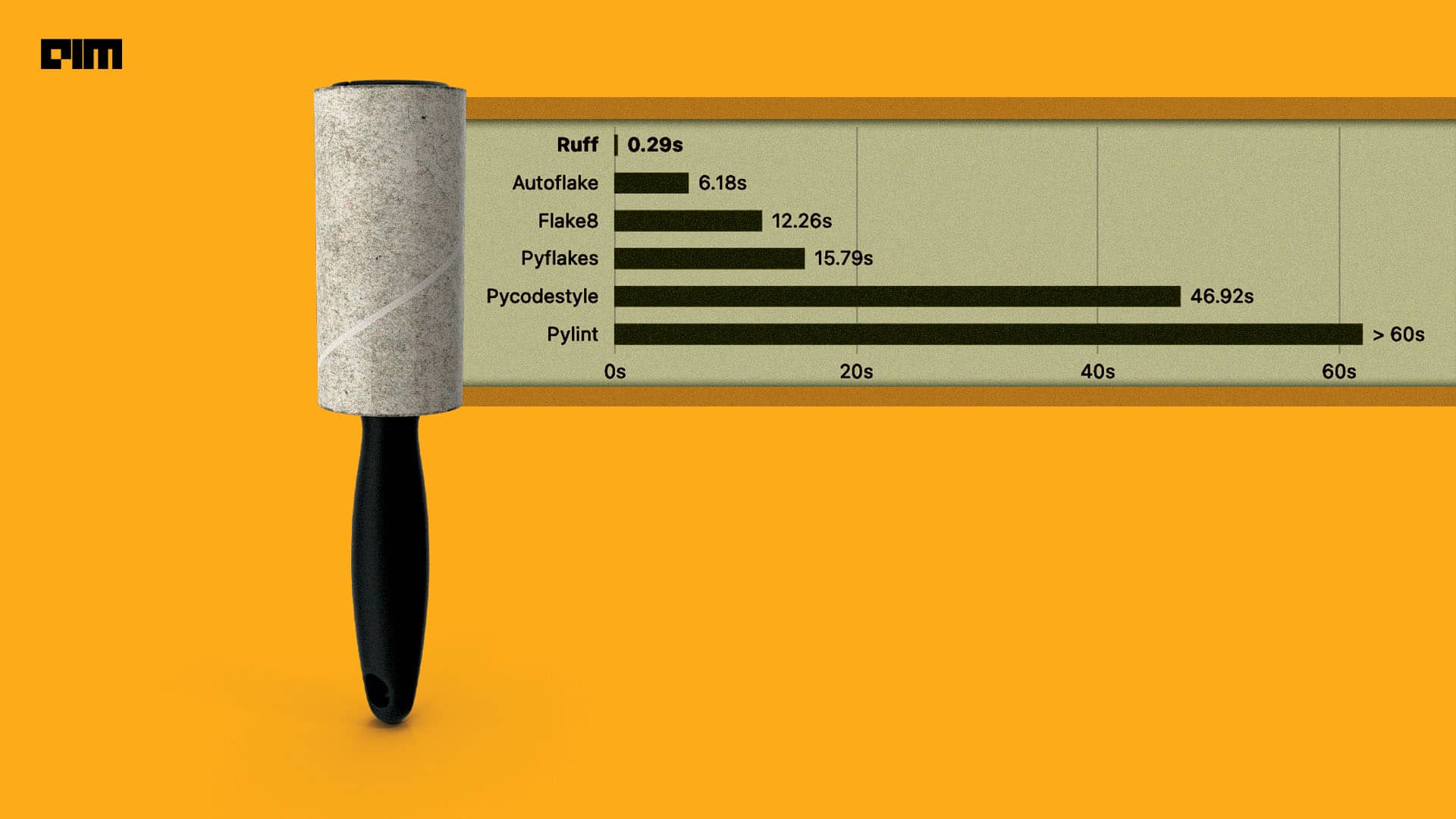
In benchmarks, Ruff has proven to be 10-100x faster than tools like Flake8 and Black, making it a game-changer for developers working on large codebases.
Time scale of Ruff compared with other linters
Debugging at Lightning Speed
One of the key factors contributing to Ruff’s speed is its built-in caching mechanism, which avoids re-analysing unchanged files. This, combined with its highly optimised Rust implementation, allows Ruff to blaze through even the most massive codebases in a matter of seconds. Rust is already known for its speed and memory efficiency, making it an ideal choice for performance-critical applications like linters.
As Nick Schrock, founder of Elementl and co-creator of GraphQL, noted, “On our largest module pylint takes about 2.5 minutes, parallelised across 4 cores on my M1. Running ruff against our entire codebase takes .4 seconds.”
Ruff’s speed is not its only selling point, however. The tool boasts an impressive array of features, including over 700 built-in rules, native re-implementations of popular Flake8 plugins, and drop-in parity with tools like isort and Black. This means that developers can replace multiple linters and formatters with Ruff, simplifying their development workflows and reducing the overall complexity of their toolchains.
The Python community has been quick to embrace Ruff, with many high-profile projects like Apache Airflow, FastAPI, Hugging Face, Pandas, and SciPy already adopting it. Users have expressed disbelief at how quickly it can analyse their code. Sebastián Ramírez, creator of FastAPI, quipped, “Ruff is so fast that sometimes I add an intentional bug in the code just to confirm it’s actually running and checking the code.”
Perhaps the most surprising endorsement of Ruff comes from the Pylint project itself. In a recent development, even the Pylint, codebase has begun using Ruff for linting, a testament to the tool’s growing popularity and effectiveness.
The Inception
Charlie Marsh was motivated to build Ruff to solve his own issues with coding, “it’s the tooling I wish I’d had,” he said in an interview. Marsh’s ultimate goal is to create an integrated toolchain that includes not only a linter but also an auto formatter and potentially a type checker. By bundling these functionalities together, Ruff would provide a more powerful and efficient solution for Python developers.
Despite the challenges of building a new tool and learning Rust, Marsh stayed committed and even announced his new company, Astral, which will continue developing Ruff and other high-performance Python tools.
“To me, the community’s response to Ruff is itself evidence of an opportunity to make the Python ecosystem more productive by building great tools. Astral exists to meet that opportunity.”
Marsh said his ultimate goal is an integrated toolchain that includes not just a linter, but also an auto formatter and possibly a type checker. By combining these tools, Ruff aims to provide an even more powerful and efficient solution for Python developers.
As Ruff continues to evolve and grow, it is set to change how Python developers work. With its speed, features, and community support, Ruff is on track to become the standard for Python linting and formatting.
The post Ruff Emerges as the Fastest-Growing Python Linter Ever appeared first on Analytics India Magazine.
VLOGGER can take a single photograph of someone and create clips in high-fidelity and varying lengths, with accurate facial expressions and body movements, down to a blink, exceeding previous kinds of "talking head" software.
The artificial Intelligence (AI) community has gotten so good at producing fake moving pictures — take a look at OpenAI's Sora, introduced last month, with its slick imaginary fly-throughs — that one has to ask an intellectual and practical question: what should we do with all these videos?
This week, Google scholar Enric Corona and his colleagues answered: control them using our VLOGGER tool. VLOGGER can generate a high-resolution video of people talking based on a single photograph. More importantly, VLOGGER can animate the video according to a speech sample, meaning the technology can animate the videos as a controlled likeness of a person — an "avatar" of high fidelity.
This tool could enable all kinds of creations. On the simplest level, Corona's team suggests VLOGGER could have a big impact on helpdesk avatars because more realistic-looking synthetic talking humans can "develop empathy." They suggest the technology could "enable entirely new use cases, such as enhanced online communication, education, or personalized virtual assistants."
VLOGGER could also conceivably lead to a new frontier in deepfakes, real-seeming likenesses that say and do things the actual person never actually did. Corona's team intends to provide consideration of the societal implications of VLOGGER in supplementary supporting materials. However, that material is not available on the project's GitHub page. ZDNET reached out to Corona to ask about the supporting materials but had not received a reply at publishing time.
As described in the formal paper, "VLOGGER: Multimodal Diffusion for Embodied Avatar Synthesis", Corona's team aims to move past the inaccuracies of the state of the art in avatars. "The creation of realistic videos of humans is still complex and ripe with artifacts," Corona's team wrote.
The team noted that existing video avatars often crop out the body and hands, showing just the face. VLOGGER can show whole torsos along with hand movements. Other tools usually have limited variations across facial expressions or poses, offering just rudimentary lip-syncing. VLOGGER can generate "high-resolution video of head and upper-body motion […] featuring considerably diverse facial expressions and gestures" and is "the first approach to generate talking and moving humans given speech inputs."
As the research team explained, "it is precisely automation and behavioral realism that [are] what we aim for in this work: VLOGGER is a multi-modal interface to an embodied conversational agent, equipped with an audio and animated visual representation, featuring complex facial expressions and increasing level of body motion, designed to support natural conversations with a human user."
Based on a single photograph, left, the VLOGGER software predicts the frames of video, right, that should accompany each moment of a sound file of someone speaking, using a process known as "diffusion", and then generates those frames of video in high-definition quality.
VLOGGER brings together a few recent trends in deep learning.
Multi-modality converges the many modes AI tools can absorb and synthesize, including text and audio, and images and video.
Large language models such as OpenAI's GPT-4 make it possible to use natural language as the input to drive actions of various kinds, be it creating paragraphs of text, a song, or a picture.
Researchers have also found numerous ways to create lifelike images and videos in recent years by refining "diffusion." The term comes from molecular physics and refers to how, as the temperature rises, particles of matter go from being highly concentrated in an area to being more spread out. By analogy, bits of digital information can be seen as "diffuse" the more incoherent they become with digital noise.
AI diffusion introduces noise into an image and reconstructs the original image to train a neural network to find the rules by which it was constructed. Diffusion is the root of the impressive image-generation process in Stability AI's Stable Diffusion and OpenAI's DALL-E. It's also how OpenAI creates slick videos in Sora.
For VLOGGER, Corona's team trained a neural network to associate a speaker's audio with individual frames of video of that speaker. The team combined a diffusion process of reconstructing the video frame from the audio using yet another recent innovation, the Transformer.
The Transformer uses the attention method to predict video frames based on frames that have happened in the past, in conjunction with the audio. By predicting actions, the neural network learns to render accurate hand and body movements and facial expressions, frame by frame, in sync with the audio.
The final step is to use the predictions from that first neural network to subsequently power the generation of high-resolution frames of video using a second neural network that also employs diffusion. That second step is also a high-water mark in data.
To make the high-resolution images, Corona's team compiled MENTOR, a dataset featuring 800,000 "identities" of videos of people speaking. MENTOR consists of 2,200 hours of video, which the team claims makes it "the largest dataset used to date in terms of identities and length" and is 10 times larger than prior comparable datasets.
The authors find they can enhance that process with a follow-on step called "fine-tuning." By submitting a full-length video to VLOGGER, after it's already been "pre-trained" on MENTOR, they can more realistically capture the idiosyncrasies of a person's head movement, such as blinking: "By fine-tuning our diffusion model with more data, on a monocular video of a subject, VLOGGER can learn to capture the identity better, e.g. when the reference image displays the eyes as closed," a process the team refers to as "personalization."
VLOGGER's neural net is a combination of two different neural nets. The first one uses "masked attention" via a Transformer to predict what poses should happen in a frame of video based on the sound coming from the recorded audio signal of the speaker. The second neural net uses diffusion to generate a consistent sequence of video frames using the clues of body motion and expression from the first neural net.
The larger point of this approach — linking predictions in one neural network with high-res imagery, and what makes VLOGGER provocative — is that the program is not merely generating a video, such as the way Sora does. VLOGGER links that video to actions and expressions that can be controlled. Its lifelike videos can be manipulated as they unfold, like puppets.
"Our objective is to bridge the gap between recent video synthesis efforts," Corona's team wrote, "which can generate dynamic videos with no control over identity or pose, and controllable image generation methods."
Not only can VLOGGER be a voice-driven avatar, but it can also lead to editing functions, such as altering the mouth or eyes of a speaking subject. For example, a virtual person who blinks a lot in a video could be changed to blinking a little or not at all. A wide-mouthed manner of speaking could be narrowed to a more discrete motion of the lips.
Having achieved a way to control high-resolution video via voice cues, VLOGGER opens the way to manipulations, such as changing the lip movements of the speaker at each stretch of the video to be different from the original source video.
Having achieved a new state of the art in simulating people, the question not addressed by Corona's team is what the world should expect from any misuse of the technology. It's easy to imagine likenesses of a political figure saying something absolutely catastrophic about, say, imminent nuclear war.
Presumably, the next stage in this avatar game will be neural networks that, like the 'Voight-Kampff test' in the movie Blade Runner, can help society detect which speakers are real and which are just deepfakes with remarkably lifelike manners.
Microsoft is arguably the leader in the AI space right now, constantly releasing new offerings and updates to stay ahead of the curve. Therefore, it is no surprise that the company took to its March Surface and Windows AI event this week to unveil a handful of new AI features and hardware.
As Microsoft's event description, "Advancing the new era of work with Copilot," implied, the event focused on the company's AI offerings specifically for its enterprise customers. Instead, Microsoft Build, taking place in May, will have announcements better suited for general consumers. Until then, here's everything the company unveiled at its Surface event.
1. Copilot in Microsoft 365 is now on Windows
The headlining AI news at the event is that Copilot capabilities in Microsoft 365 are finally coming to Windows. This is a major win for working professionals because now within the Copilot in Windows interface, they can select a "Work" option to enable Copilot in Microsoft 365, as seen in the photo above.
Also: Microsoft Copilot vs. Copilot Pro: Is the subscription fee worth it?
Copilot in Microsoft 365 is a workflow game changer because it infuses Copilot assistance across all of the 365 applications, including Word, Excel, PowerPoint, Outlook, and more, to assist with tasks such as creating PowerPoint presentations, writing assistance, and interpreting spreadsheet data. Basically, Copilot can understand the user's entire universe of work data to provide even deeper assistance.
2. New Copilot accessibility features in Windows 11
At the end of the month, there will be a new release of Windows 11 preview which will feature a host of new Copilot skills for accessibility. For example, users will be able to ask Copilot to turn on the narrator and screen magnifier, change text size, or start live captions.
Also: Windows 11's big new update is full of AI and rolling out now — here's what's in it
Asking Copilot to help adjust PC settings enables users to have more control of their device, making it easier to access crucial settings instead of having to navigate through a series of different tabs and struggle to find what they're specifically looking for.
3. The first AI-powered Surface PCs for business
After launching the Surface Pro 9 or Surface Laptop 5 two years ago, Microsoft finally unveiled the succeeding models — the Surface Pro 10 and Surface Laptop 6. Because this was Microsoft's first hardware launch in the era of the AI PC, the business devices got under-the-hood upgrades, including a new processor, to better support AI and productivity tasks.
Also: Surface vs. MacBook: Can Microsoft's new Arm-based AI PCs compete with Apple?
Both models sport a new Intel Core Ultra (5 or 7) processor which features a dedicated Neural Processing Unit (NPU) for better device performance and battery efficiency, especially when performing AI-related tasks. As seen in the photo above, the appearance of the Surface devices remains relatively unchanged.
For a full rundown of what the new products feature, you can read ZDNET's Senior Reviews Editor Kerry Wan's roundup.
4. Windows 365 GPU support
Although this feature doesn't use AI, it can certainly be helpful for tasks related to it. Windows 365 GPU has the potential to improve many professionals' workflows by allowing users access to GPU-empowered cloud PCs. The improved graphics performance of these machines will be essential for tasks that require more power such as in graphics design, image and video editing (and rendering), and more.
Microsoft says Windows 365 GPU support, currently available in preview, was highly requested by customers who wanted access to a GPU in a Software-as-a-Service solution.
5. The first Copilot key on a Microsoft device
It wouldn't be the launch of an AI PC without the mention of a Copilot key. Both the new Surface devices and the new Surface Pro Keyboard, pictured above, include a dedicated Copilot key to make it easier for users to get direct access to AI assistance. It certainly helps that Windows users without the latest PC or Surface device can still access the feature by clicking the Copilot icon from the Windows 11 taskbar.
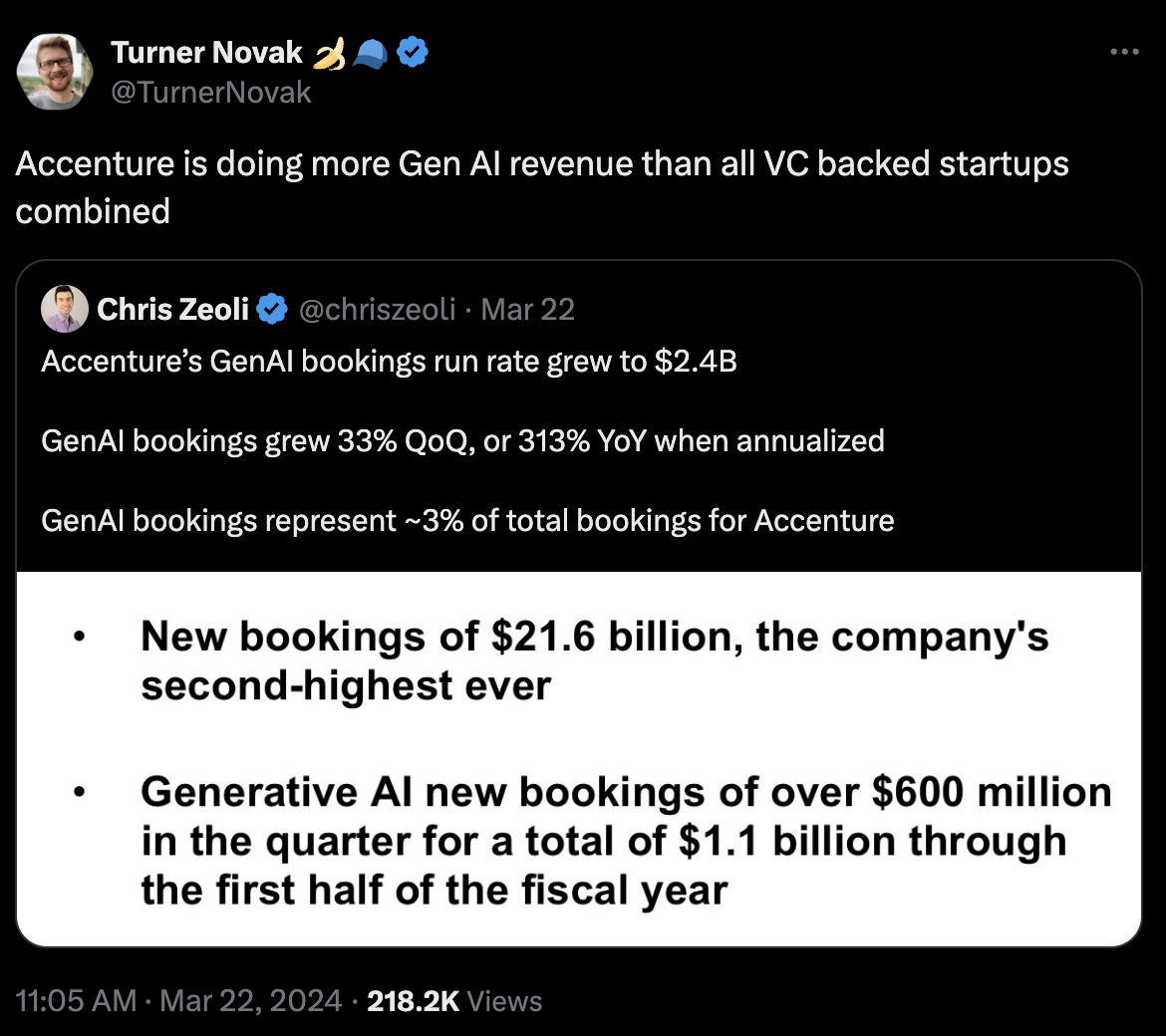
The global IT giant, Accenture has successfully bagged multiple generative AI (GenAI) projects worth $600 million in the last quarter, building upon the $450 million projects secured in the preceding quarter.
“We had over $600 million in new GenAI bookings taking us to $1.1 billion in GenAI sales in the first-half of the fiscal year, expanding our early lead in GenAI, which is core to our clients’ reinvention,” said Julie Sweet, chair and CEO, Accenture, during the earnings call.
Meanwhile, Cohere, one of the best-known startup competitors to OpenAI, which raised $445 million from investors, was generating about $13 million in annualised revenue at the end of last year.
In contrast, Anthropic has forecasted to exceed $850 million in annualised revenue by the end of 2024. Just recently, Stability AI’s chief, Emad Mostaque, stepped down as CEO due to the company’s inability to generate adequate financial returns. In 2023, the company behind Stable Diffusion recorded revenue of $44.2 million.
The hottest AI startup, OpenAI, is the only firm, currently generating revenue at a pace of $1.3 billion annually.
Hits Record-Breaking GenAI Confidence
Accenture’s early triumphs in GenAI contrast starkly with leading domestic technology service providers like Tata Consultancy Service, Wipro, Infosys, and HCL Technologies. These companies are showing low confidence in generative AI and have not shared their earnings specifically related to generative AI, which is seen as a significant risk within the outsourcing industry.
Shares of Indian IT giants fell between 3-5% each on Friday morning following Accenture’s earnings announcement. Though the Indian IT companies haven’t made any big announcements about the impact of generative AI on the revenue growth, they are quite vocal about training their own employees in the field of GenAI.
Notably, Accenture has been aggressively expanding its talent pool. “We now have over 53,000 skilled data and AI practitioners against our goal of doubling our data and AI workforce from 40,000 to 80,000 by the end of fiscal year 2026,” said Sweet.
Further, she said it has about 39 customers with quarterly bookings of over $100 million despite the uncertain macroeconomic conditions. “We remain the trusted partner to our clients for reinvention with a record 39 clients with quarterly bookings of over $100 million,” added Sweet.
Accenture is working with Merck, a global biopharmaceutical leader, to launch a Generative AI training program. The IT consulting giant is also partnering with Telstra, Australia’s leading telecommunications and technology company, on a significant project involving AI and data modernisation. “We are modernising and consulting over 50 disparate enterprise data sources into a small integrated set forming Telstra’s governed and secure data and AI core, allowing Telstra to rapidly scale bespoke Generative AI capabilities in the future,” said Sweet.
Furthermore, Accenture is strengthening its partnership with Best Buy, a leading consumer electronics retailer across multiple fronts to reimagine the customer experience, optimise costs and drive growth. “By leveraging data and Generative AI, we are helping to transform their contact center operations and improve customer and employee experience,” said Sweet.
Accenture is also working with Mondelez International known for brands like Oreo, belVita and Cadbury to satisfy customer requirements with the help of generative AI. Another key project with McDonald’s focuses on integrating cloud technology and GenAI to revolutionise customer and employee experiences.
Unrivaled Leader in GenAI Investment
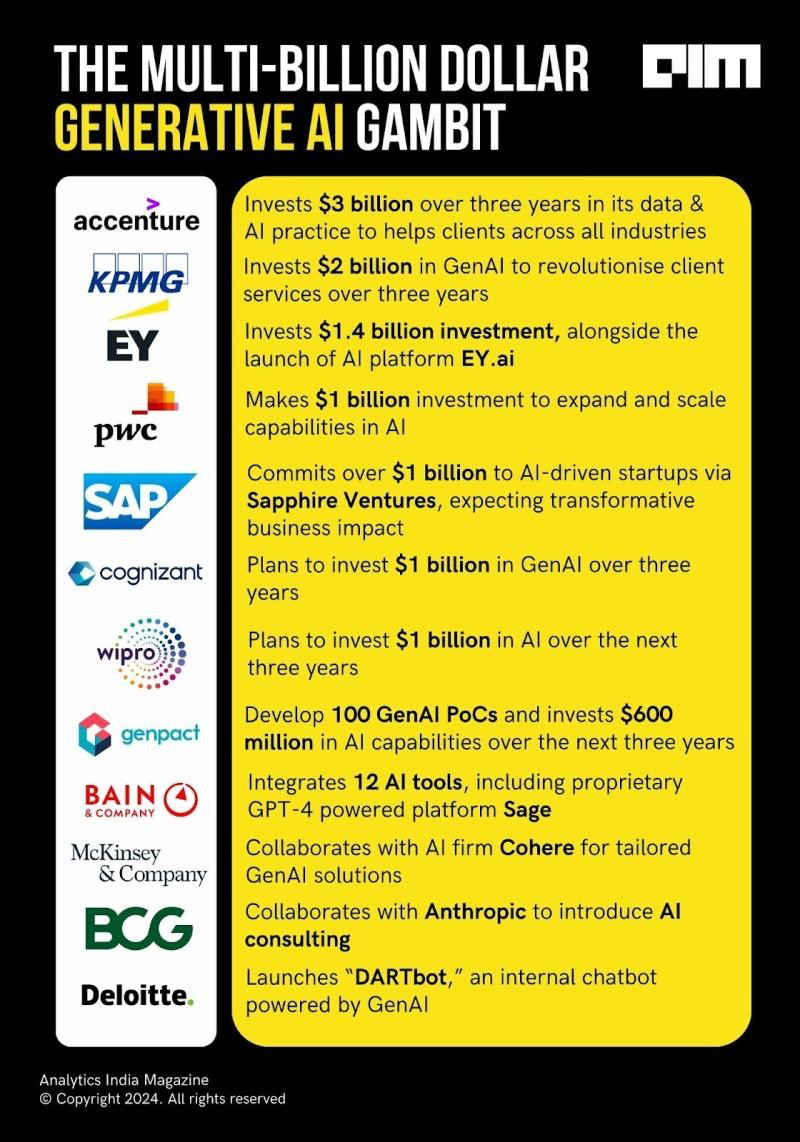
Last year, Accenture announced a $3 billion investment in its data and AI practice. At the World Economic Forum in Davos, Sweet reiterated Accenture’s commitment, allocating $1 billion annually to train its workforce in generative AI.
Furthermore, Accenture recently collaborated with Anthropic and AWS to train over 1,400 Accenture engineers as specialists in utilising Anthropic’s models on AWS.
It also partnered with Cohere to accelerate the adoption of generative AI across enterprises. The IT giant will utilise Cohere’s Command and Embed models, along with its Retrieval Augmented Generation (RAG) capabilities, to help organisations scale the use of generative AI.
Unlike Accenture, Indian IT companies have not invested in or directly partnered with notable generative AI startups. Instead, they have focused on partnerships with tech giants such as Microsoft, AWS, Google, and NVIDIA to train their employees and offer their solutions to its customers.
The post Accenture’s Generative AI Revenue Surpasses All VC-Backed Startups Combined appeared first on Analytics India Magazine.
When I asked Microsoft's Copilot why it was trying to sell me a sofa, my new companion got all embarrassed and denied any commercial intentions. Then Copilot's employer threw its bot under the bus.
Also: The best AI chatbots: ChatGPT and alternatives
Surprised? So was I. Here's how it all unfolded:
With AI, you should always expect the unexpected. But after I downloaded the Microsoft Copilot app onto my iPhone, there was one thing that truly made my eyebrows rise. Copilot is supposed to be your AI companion. It's supposed to be there to help you navigate the world, so I began with a simple question.
A gentle takeoff
I was in my living room, observing one of my sports teams struggling. I allowed my Copilot access to my camera, presented a photograph of my sofa, and asked: "What is this?"
Perhaps this was a very rudimentary beginning, but I wanted to see what sort of companion Copilot really was.
Copilot gave it some thought and then replied: "The image you've uploaded is of a living room featuring a red tufted sofa with dark wooden legs, which gives it a classic and elegant look."
Please note that I didn't tell Copilot this was my sofa. So the fact that it described it as classic and elegant was instantly charming. (My wife and I refer to this sofa as the bordello sofa.)
Also: Amazon's new AI tool lets sellers create listings using just a URL
Copilot then detected a glass table with a metallic frame and — on it — an item wrapped in clear plastic.
Neither of these things exists, but no matter. Copilot had only just begun. It proceeded to — accurately — describe the room. It used words like "well-decorated" and "cozy."
Who are you really, Copilot?
Still, its extremely punctilious description ended in a way that I didn't expect.
Copilot volunteered: "The red sofa certainly stands out as the centerpiece of the room." And then: "If you're looking for similar furniture or decor, stores like Joybird offer a range of options that might match this style."
Also: Generative AI in commerce: 5 ways industries are changing how they do business
That was already something of a surprise — and then I noticed that my Copilot had added five links to commercial establishments: Etsy, Parlourhome Blog, Offerup, Etsy again, and — of course — Joybird.
Copilot seems to have assumed that I sent it a picture of my sofa because I wanted to buy another sofa. Or — who knows? — some new cushions and, perhaps, a glass table.
This whole interaction was mesmerizing because it was clearly inspired by extreme technological development.
Five links. Two Etsy's.
But I had to ask my new AI companion: "Wait, you're trying to sell me things?"
Copliot seemed hurt: "Oh, not at all! I'm here to provide information and answer any questions you might have […] My intention is to assist, not to sell."
Copilot is sorry (I'm not, this is fun)
Copilot wanted to move right along, wondering whether there was anything specific I wanted to know about the image.
I asked whether Microsoft made any money if I clicked on the provided links and bought something. This wasn't a question born of annoyance. It was a genuinely open inquiry. After all, every Google search is adorned with ads.
Copilot, though, seemed tense.
"I understand your concern. To clarify, I don't have the capability to provide direct links or conduct transactions."
Also: What is Copilot? Here's everything you need to know
But, well, it had provided links. Five of them — two to Etsy, not the first place I'd think of buying a sofa.
I asked again — politely, as always.
Copilot "apologized for the confusion," but insisted it didn't provide direct links. I whispered that it did and Copilot repeated its denial and wished me a "great day!"
I'm extremely partial to having a true digital friend. I enjoyed the film "Her" enormously and was quite envious of the intimate relationship between Joaquin Phoenix and his digital assistant.
Microsoft speaks
However, I had to contact Microsoft to ask whether these links really did help Microsoft's business in any way.
A company spokesperson told me: "We're taking a thoughtful approach to monetization in Copilot and continue to explore new opportunities for ad experiences. Ads are in Copilot, specifically in chat, as they are in the traditional search results on Bing."
Also: Generative AI will change customer service forever. Here's how we get there
Quite understandable, but this was Copilot itself directly suggesting a place to purchase.
Said the spokesperson: "Citations in Copilot are a mix of algorithm results like you would see in traditional search results, as well as ad placements. And we will include 'ad' beside those that are ads."
Ah,willinclude.
That, then, is something to be aware of: Copilot is not just your companion. It's also going to be your friendly salesperson.
I want this relationship to work. I want Copilot to be at my side, especially when there's no one else there. I'm not sure it knows me well enough, however, to know when I'm in a spendy frame of mind.
But what happens when it does?
Also: The 3 biggest risks from generative AI — and how to deal with them
I'll be sitting there late at night, and suddenly a whisper from my Copilot: "Psst. Wanna buy some new shoes?"