Intel Unveils the Most Efficient Gaudi 3 at Intel Vision

Intel Gaudi 3

Intel has announced its latest AI chip Gaudi 3 at the Intel Vision 2024 event, in a bid to keep pace with the growing demand for semiconductors capable of training and deploying large AI models.

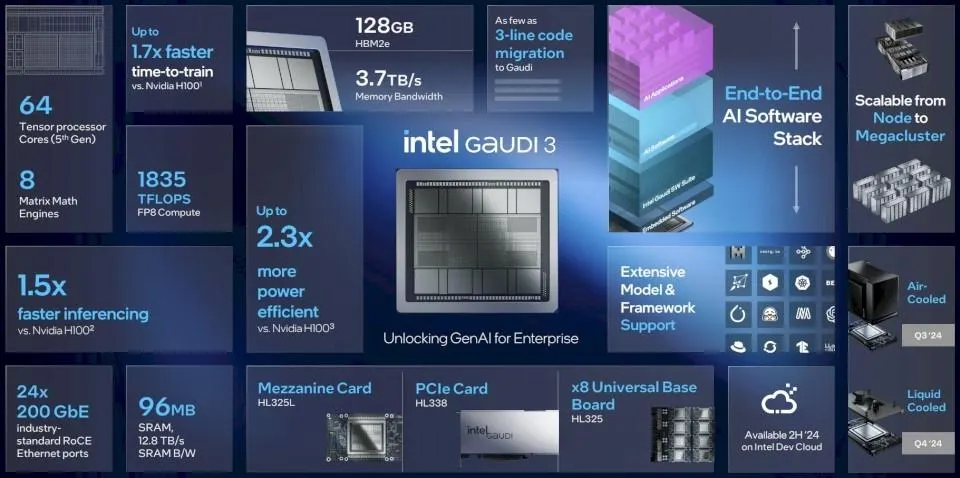
The newly introduced Gaudi 3 chip, which was revealed by CEO Pat Gelsinger at Intel AI Everywhere event, boasts over double the power efficiency compared to its predecessor and is capable of running AI models 1.5 times faster than NVIDIA’s H100 GPU.

It offers various configurations, including a bundle of eight Gaudi 3 chips on one motherboard or a card that can be integrated into existing systems.

Gaudi 3, built on a 5 nm process, signals Intel’s utilisation of advanced manufacturing techniques. Additionally, Intel plans to manufacture AI chips, potentially for external companies, at a new Ohio factory expected to open in the coming years, according to Gelsinger.

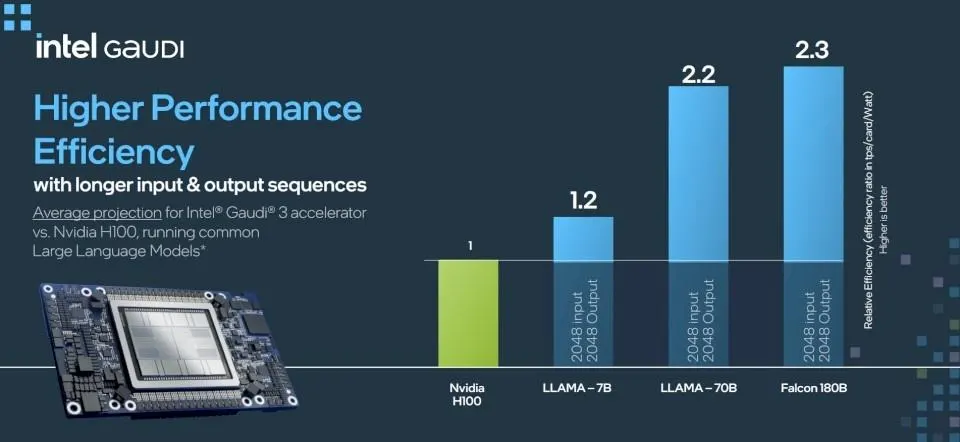
During testing, Intel evaluated the chip’s performance on models like Meta’s open-source Llama and the Falcon model by TII. Gaudi 3 demonstrated its capability to facilitate the training or deployment of models such as Stable Diffusion or OpenAI’s Whisper model for speech recognition.

Compared to the NVIDIA H100, Intel anticipates that Gaudi 3 will achieve an approximately 50% faster time-to-train on average across Llama 2 models with 7B and 13B parameters, as well as the GPT-3 175B parameter model.

While performance data for NVIDIA’s recently announced Blackwell-based B200 Tensor GPU is not currently available, it’s clear that NVIDIA’s latest offering would likely affect these performance comparisons significantly.

In comparison to NVIDIA, Intel claims its chips consume less power. NVIDIA currently dominates approximately 80% of the AI chip market with its GPUs, which have been the preferred choice for AI developers in the past year.

Intel asserts that its Gaudi 3 AI accelerator offers an estimated 50% enhancement in inferencing performance and around 40% better power efficiency compared to NVIDIA’s H100. Moreover, Intel states that it achieves these benefits at a significantly lower cost.

Intel has announced that Gaudi 3 chips will be available to customers in the third quarter, with companies like Dell, HP, and Supermicro set to incorporate the chips into their systems. However, Intel hasn’t disclosed the pricing details for Gaudi 3.

Das Kamhout, vice president of Xeon software at Intel, expressed confidence in Gaudi 3’s competitiveness against NVIDIA’s latest offerings, citing factors such as competitive pricing and the incorporation of an open integrated network on chip.

The data centre AI market is expected to expand as cloud providers and businesses invest in infrastructure for deploying AI software, indicating opportunities for other players in the market.

While NVIDIA has seen significant stock growth driven by the AI boom, Intel’s stock has experienced more modest gains. Nevertheless, Intel remains determined to compete in the AI chip market, with AMD also seeking to expand its presence in the server AI chip segment.

NVIDIA’s success has largely been attributed to its proprietary software suite, CUDA. In contrast, Intel is collaborating with chip and software giants like Google, Qualcomm, and Arm to develop open software solutions, aiming to provide greater flexibility for software companies in selecting chip providers.

In addition, Intel unveiled its intention to create an open platform for enterprise AI, aiming to expedite the deployment of secure GenAI systems empowered by retrieval augmented generation (RAG).

The post Intel Unveils the Most Efficient Gaudi 3 at Intel Vision appeared first on Analytics India Magazine.

The Case of Homegrown Large Language Models

Most of the notable LLMs are adept at widely-spoken languages such as English but do not cover the linguistic diversity that can effectively serve the global cultural and regional nuances.

The Case of Homegrown Large Language Models
Image by Author Benefits

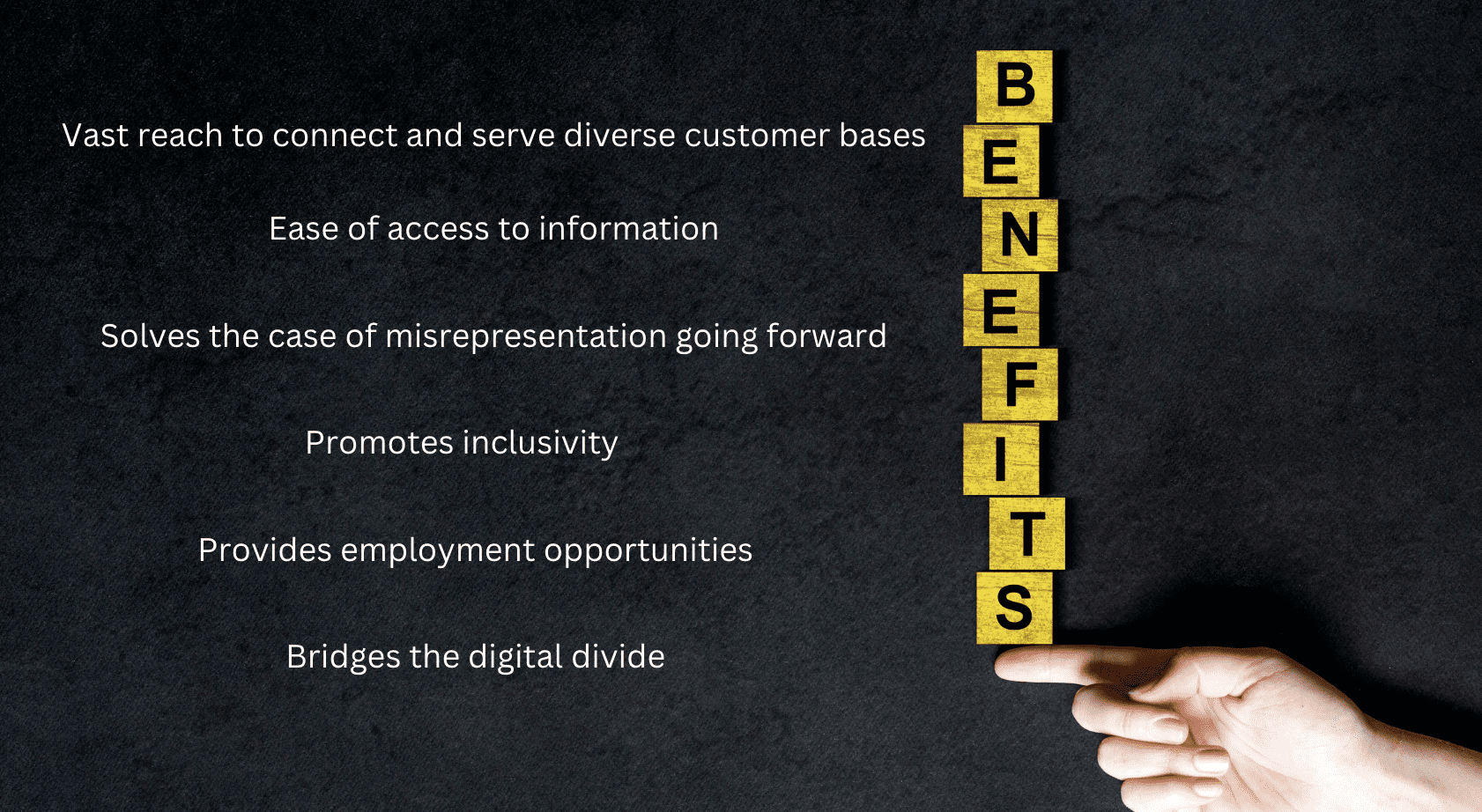
Building home-grown LLMs is a significant technological step and calls for its merit. Predominantly, it sets a precedent for everyone to be part of this digital transformation, making a win-win for both – by allowing wider reach to customers as well as enabling businesses to expand their reach, connect, and serve diverse customer bases across the world.

AI finds appealing use cases in many applications while handling cognitive overload, ease of access to information, and enhancing customer experience.

The LLMs trained on diverse linguistic spread cover all three grounds, providing easy and timely access to the information. Such facilitation of knowledge at the fingertips can help many local communities get the much-needed help and support to get their inquiries resolved.

Challenges

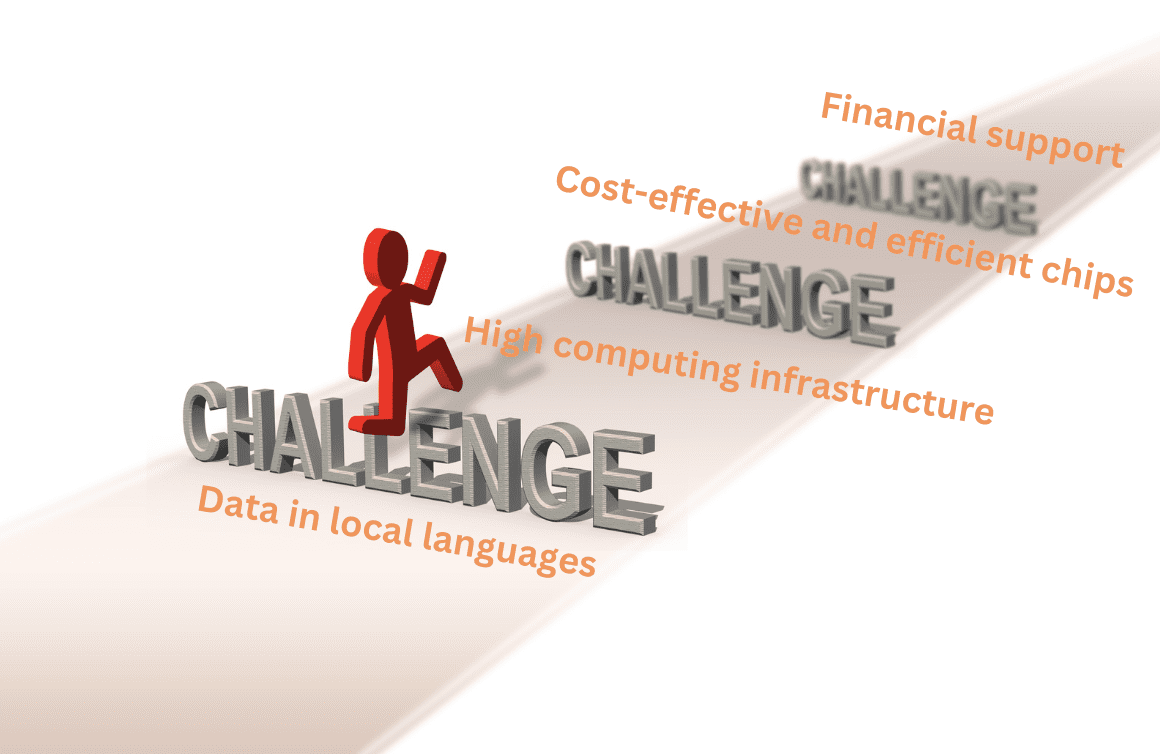
While we have covered a lot of ground in favor of building such models, it is equally important to call out that such model development requires access to data in local languages. Needless to say, it might appear challenging at first but is not unachievable.

In fact, it quickly becomes a boon for local communities in the form of data labeling (more on this in the coming section), when data collection processes are built efficiently at scale.

The Case of Homegrown Large Language Models
Image by Author

Furthermore, developing LLMs requires high-performance computing infrastructure, such as GPUs and cloud computing services, which is expensive and requires a sponsor/partner to provide financial backing.

Inevitably, the success of any nation hinges on building cheaper and more energy-efficient chips to build the next generation of AI models. It also needs increased R&D funding to facilitate a platform for brainpower to come together through extensive collaboration between academia, industry, and government.

Data is not the New Oil?

Data is not the new oil anymore, but the one who knows how to process such large datasets, raising the need for energy-efficient chips.

In addition to software, developing models trained in local languages requires funding the R&D in cutting-edge technology and building self-sufficiency in hardware. Further, the large models are heavily dependent on data centers that require extensive power, raising the need for power-efficient chips.

Ethical Lens

It gives a sense of one-ness where we are including everyone to be a part of this technological breakthrough and while doing so, they also get to become part of that digital world aka data so the next wave of new models includes them too, solving the case of misrepresentation going forward.

LLMs trained in local languages would not only have data dominance but would also play a big role in promoting diverse cultures.

Jobs and Opportunity Creation

While most believe that LLMs might negatively impact the employment sector, there is a positive side to it too. It is a win-win for it provides employment opportunities to the technology developers as well as the entire participants in the whole value chain of such technology stack.

Additionally, removing the barriers to how non-English speakers can use technology can lead to improving their lives in meaningful ways. It can open the door to opportunities, making them active participants in how the world is run today.

More jobs will be created. Creating diverse data might look like a challenge to some at face value. Still, once done efficiently at scale, it can quickly become an opportunity to provide wage opportunities to the contributors. Local communities can participate in such data generation initiatives and participate in this revolution at the foundational level while getting recognized for playing their part in the form of wages and royalties for their contribution.

Digitalization is an Equalizer

Access to knowledge is the biggest leverage, and digitalization has been a big equalizer. The ratio of “teachers, lawyers, doctors support” to the “population” is reportedly low in developing nations compared to developed nations, clearly highlighting the gap that can be efficiently bridged by applications helping the customers resolve issues in the early stages or receive guidance to the next steps. This becomes feasible if the user is comfortable with the conversational language of AI-powered chatbots.

The Case of Homegrown Large Language Models
Image by Author

Consider sectors like agriculture where LLMs can help farmers without any language barrier. Farmers can get guidance on irrigation best practices and enhancing efficient water use.

Take another example from the healthcare sector. Understanding the complex domain-specific terms in those insurance policies is challenging for us all. Opening up a chatbot that can leverage its adaptive tutoring style to educate all communities in the language they understand is a big effort in bringing parity.

Digital Unison

AI models that are inclusive of varied languages help bridge the digital divide and bring everyone on the canvas of opportunities that come with such technological advancements. Most importantly, such inclusivity puts the much-needed focus on the marginalized sections and makes them a key participant in this revolutionary change. It accounts for ethical considerations by providing fair access to local groups too.

Vidhi Chugh is an AI strategist and a digital transformation leader working at the intersection of product, sciences, and engineering to build scalable machine learning systems. She is an award-winning innovation leader, an author, and an international speaker. She is on a mission to democratize machine learning and break the jargon for everyone to be a part of this transformation.

More On This Topic

  • Top Open Source Large Language Models
  • More Free Courses on Large Language Models
  • Learn About Large Language Models
  • Introducing Healthcare-Specific Large Language Models from John Snow Labs
  • What are Large Language Models and How Do They Work?
  • AI: Large Language & Visual Models

Human-centric AI through better transparency and disclosure

Interview with Gerry Chng

GerryDan

In our very first public episode of AI Think Tank Podcast, I had the pleasure of hosting Gerry Chng, live from Singapore. Gerry serves as the Executive Director in Deloitte’s Cyber Risk Advisory Practice, focusing on cybersecurity and risk management. Gerry brings over 25 years of expertise in cybersecurity, making his insights into the complexities of AI governance, the EU AI Act, and the challenges of technological innovation and regulation invaluable. After having just spoken on BBC News, Gerry had very much to share with me.

GerryBBC-2

During our conversation, Gerry emphasized the importance of developing technology responsibly, highlighting the significant uptick in AI governance discussions and the nuances of navigating this field. He pointed out the proactive measures needed to address the challenges surrounding AI governance and the varied approaches countries have taken, including the soft law approach, which I feel can be a fair and respectable tact to take.

Gerry also delved into the probabilistic nature of AI, the shifts in mindset required for its adoption, and the critical ethical considerations surrounding its use. He specifically addressed the concerns about job displacement due to AI advancements and underscored the necessity for policy-level interventions to encourage responsible organizational practices. As optimistic as I am, I am personally just as concerned about how certain initiatives roll out.

Reflecting on the transformative potential of AI, we discussed its capacity to enhance jobs and detect fraud, while also acknowledging its imperfections and the ethical dilemmas it presents. We both agreed on the paramount importance of AI literacy and the need for interfaces that are both transparent and user-friendly. The potential for this tech to reshape the workforce along with the associated ethical considerations is an emphasis for everyone to get involved where they can.

Gerry shared insights into the concept of human-centric AI, advocating for a nuanced approach to AI governance that focuses on the specific implications of AI solutions within their context. He discussed the challenges of ensuring AI security and privacy, mentioning ongoing efforts to develop standards for AI systems. There is a great need for Data Scientists in this field for reasons not only related to clean data but to help provide equity in representation for all members of society.

As we explored the potential risks associated with premature AI deployment, we both emphasized the critical role of human oversight in managing AI applications. Gerry advocated for a cautious approach to AI adoption, prioritizing ethical considerations and security measures to mitigate potential negative impacts. I hope that we can align with new standards to reach adoption without so many businesses and individuals being caught in the crossfire.

One of my favorite topics was about the potential of AI in education, particularly its ability to offer infinite patience, a quality paramount for learning. Gerry and I shared a mutual enthusiasm for this application, envisioning a future where AI could transform the educational landscape. Its potential to provide personalized learning experiences, adapt to individual student needs, and offer endless encouragement and support highlights a groundbreaking shift.

This capability to patiently guide, explain, and reiterate concepts aligns perfectly with the ideal educational ethos. It’s a thrilling prospect that could democratize learning, making it more accessible and effective for students across diverse backgrounds and learning styles. Our conversation underscored the transformative power of AI in education, not just as a tool for enhancing teaching methodologies but as a steadfast companion in the pursuit of knowledge.

Subscribe to the AI Think Tank Podcast on YouTube.
Would you like to join the show as a live attendee and interact with guests? Contact Us

eBay adds an AI-powered ‘shop the look’ feature to its iOS app

eBay adds an AI-powered ‘shop the look’ feature to its iOS app Sarah Perez @sarahintampa / 7 hours

EBay on Tuesday launched a new generative AI-powered feature to appeal to fashion enthusiasts: a “shop the look” section within its iOS mobile app that will suggest a carousel of images and ideas, based on the customer’s shopping history. The company says its recommendations will be personalized to the end user and will evolve as the customer shops more. The idea is to introduce how other fashion items may complement their current wardrobe.

To do so, “shop the look” will include interactive hotspots that, when tapped, will reveal similar items and outfit inspirations, with the resulting looks including both pre-owned and luxury items that match the user’s personal style. The feature is powered by eBay.ai, and was developed in collaboration with the company’s Responsible AI team and RAI Principles, eBay notes.

Image Credits: eBay

“Shop the look” will appear to any eBay shopper who has viewed at least 10 fashion items over the past 180 days, the company notes. It will display both on the eBay homepage and the fashion landing page.

For eBay, the new addition offers a way to showcase its wide expanse of inventory available for sale differently than before — and one that could potentially encourage more sales, if successful. EBay says it plans to explore expansions to other categories over time and will continue adding more personalization elements to the feature over the new year.

eBay isn’t the only one exploring how AI can improve the fashion shopping experience. Google last summer introduced a way for consumers to virtually try on clothes using a new AI shopping feature, for example. Amazon has also turned to AI to help customers find clothes that fit when shopping online. In those cases, the AI features were meant to help customers find the right fit or size, eBay’s new feature is more focused on fashion inspiration — meaning finding the right style. That can be harder to do, given that personal style is subjective.

“Shop the look” will initially be available on iOS in the U.S. and U.K., with support for Android coming later this year.

Convert Python Dict to JSON: A Tutorial for Beginners

Convert Python Dict to JSON: A Tutorial for Beginners
Image by Author

When building applications in Python, JSON is one of the common data formats you’ll work with. And if you’ve ever worked with APIs, you're probably already familiar with parsing JSON responses from APIs.

As you know, JSON is a text-based format for data interchange, which stores data in key-value pairs and is human readable. And Python dictionaries store data in key-value pairs. Which makes it intuitive to load JSON strings into dictionaries for processing and also dump data from dictionaries into the JSON strings.

In this tutorial, we’ll learn how to convert a Python dictionary to JSON using the built-in json module. So let's start coding!

Converting a Python Dictionary to a JSON String

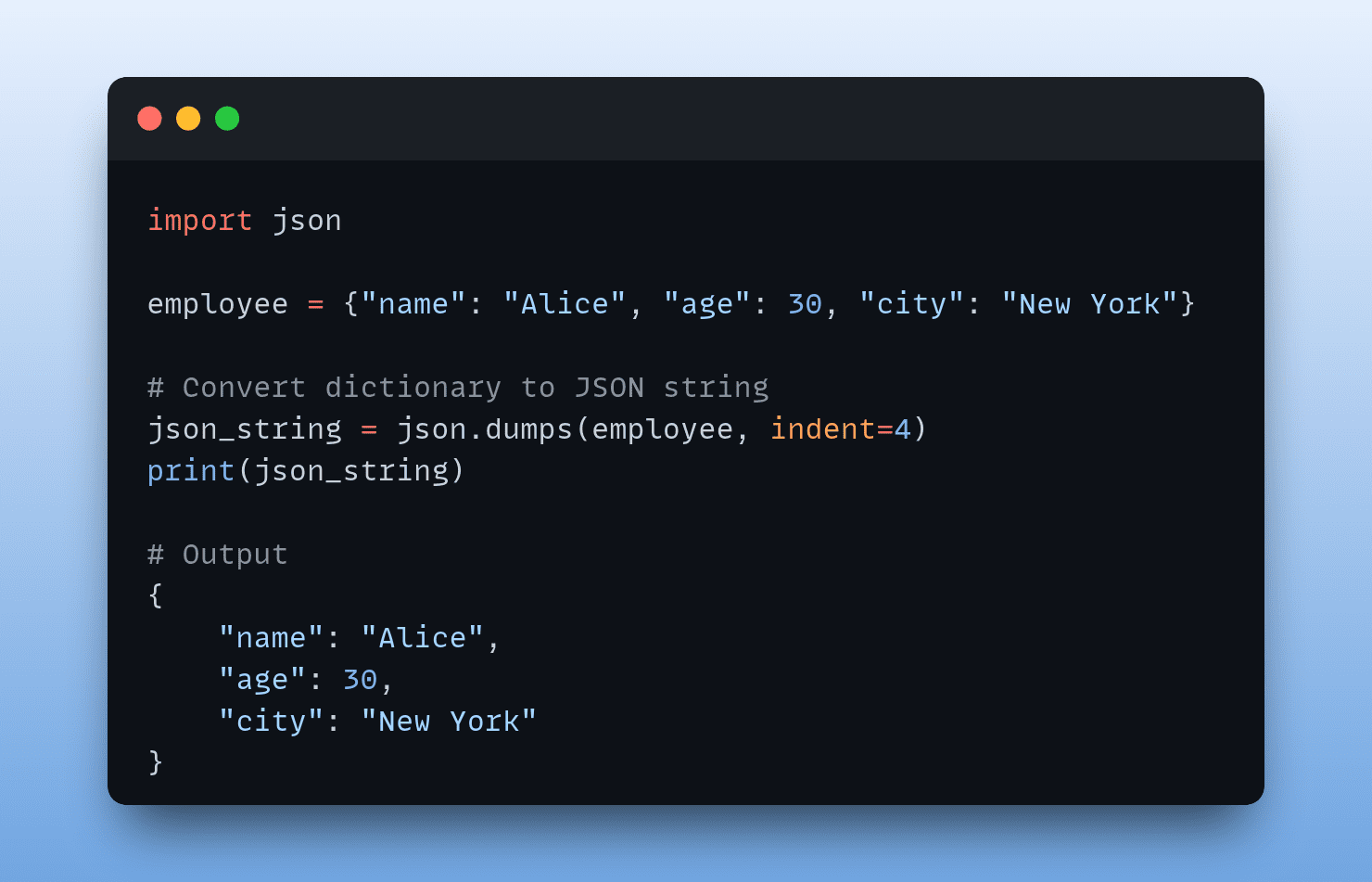
To convert a Python dictionary to JSON string, you can use the dumps() function from the json module. The dumps() function takes in a Python object and returns the JSON string representation. In practice, however, you’ll need to convert not a single dictionary but a collection such as a list of dictionaries.

So let’s choose such an example. Say we have books, a list of dictionaries, where each dictionary holds information on a book. So each book record is in a Python dictionary with the following keys: title, author, publication_year, and genre.

When calling json.dumps(), we set the optional indent parameter—the indentation in the JSON string as it helps improve readability (yes, pretty printing json we are ??):

import json    books = [  	{      	"title": "The Great Gatsby",      	"author": "F. Scott Fitzgerald",      	"publication_year": 1925,      	"genre": "Fiction"  	},  	{      	"title": "To Kill a Mockingbird",      	"author": "Harper Lee",      	"publication_year": 1960,      	"genre": "Fiction"  	},  	{      	"title": "1984",      	"author": "George Orwell",      	"publication_year": 1949,      	"genre": "Fiction"  	}  ]    # Convert dictionary to JSON string  json_string = json.dumps(books, indent=4)  print(json_string)

When you run the above code, you should get a similar output:

Output >>>  [  	{      	"title": "The Great Gatsby",      	"author": "F. Scott Fitzgerald",      	"publication_year": 1925,      	"genre": "Fiction"  	},  	{      	"title": "To Kill a Mockingbird",      	"author": "Harper Lee",      	"publication_year": 1960,      	"genre": "Fiction"  	},  	{      	"title": "1984",      	"author": "George Orwell",      	"publication_year": 1949,      	"genre": "Fiction"  	}  ]

Converting a Nested Python Dictionary to a JSON String

Next, let’s take a list of nested Python dictionaries and obtain the JSON representation of it. Let’s extend the books dictionary by adding a “reviews” key. Whose value is a list of dictionaries with each dictionary containing information on a review, namely, “user”, “rating”, and “comment”.

So we modify the books dictionary like so:

import json    books = [  	{      	"title": "The Great Gatsby",      	"author": "F. Scott Fitzgerald",      	"publication_year": 1925,      	"genre": "Fiction",      	"reviews": [          	{"user": "Alice", "rating": 4, "comment": "Captivating story"},          	{"user": "Bob", "rating": 5, "comment": "Enjoyed it!"}      	]  	},  	{      	"title": "To Kill a Mockingbird",      	"author": "Harper Lee",      	"publication_year": 1960,      	"genre": "Fiction",      	"reviews": [          	{"user": "Charlie", "rating": 5, "comment": "A great read!"},          	{"user": "David", "rating": 4, "comment": "Engaging narrative"}      	]  	},  	{      	"title": "1984",      	"author": "George Orwell",      	"publication_year": 1949,      	"genre": "Fiction",      	"reviews": [          	{"user": "Emma", "rating": 5, "comment": "Orwell pulls it off well!"},          	{"user": "Frank", "rating": 4, "comment": "Dystopian masterpiece"}      	]  	}  ]    # Convert dictionary to JSON string  json_string = json.dumps(books, indent=4)  print(json_string)

Note that we use the same indent value of 4, and running the script gives the following output:

Output >>>    [  	{      	"title": "The Great Gatsby",      	"author": "F. Scott Fitzgerald",      	"publication_year": 1925,      	"genre": "Fiction",      	"reviews": [          	{              	"user": "Alice",              	"rating": 4,              	"comment": "Captivating story"          	},          	{              	"user": "Bob",              	"rating": 5,              	"comment": "Enjoyed it!"          	}      	]  	},  	{      	"title": "To Kill a Mockingbird",      	"author": "Harper Lee",      	"publication_year": 1960,      	"genre": "Fiction",      	"reviews": [          	{              	"user": "Charlie",              	"rating": 5,              	"comment": "A great read!"          	},          	{              	"user": "David",              	"rating": 4,              	"comment": "Engaging narrative"          	}      	]  	},  	{      	"title": "1984",      	"author": "George Orwell",      	"publication_year": 1949,      	"genre": "Fiction",      	"reviews": [          	{              	"user": "Emma",              	"rating": 5,              	"comment": "Orwell pulls it off well!"          	},          	{              	"user": "Frank",              	"rating": 4,              	"comment": "Dystopian masterpiece"          	}      	]  	}  ]

Sorting Keys When Converting a Python Dictionary to JSON

The dumps function has several optional parameters. We’ve already used one such optional parameter indent. Another useful parameter is sort_keys. This is especially helpful when you need to sort the keys of the Python dictionary when converting it to JSON

Because sort_keys is set to False by default, so you can set it to True if you need to sort the keys when converting to JSON.

Here’s a simple person dictionary:

import json    person = {  	"name": "John Doe",  	"age": 30,  	"email": "john@example.com",  	"address": {      	"city": "New York",      	"zipcode": "10001",      	"street": "123 Main Street"  	}  }    # Convert dictionary to a JSON string with sorted keys  json_string = json.dumps(person, sort_keys=True, indent=4)  print(json_string)

As seen, the keys are sorted in alphabetical order:

Output >>>  {  	"address": {      	"city": "New York",      	"street": "123 Main Street",      	"zipcode": "10001"  	},  	"age": 30,  	"email": "john@example.com",  	"name": "John Doe"  }

Handling Non-Serializable Data

In the examples we’ve coded so far, the keys and values of the dictionary are all JSON serializable. The values were all strings or integers to be specific. But this may not always be the case. Some common non-serializable data types include datetime, Decimal, and set.

No worries, though. You can handle such non-serializable data types by defining custom serialization functions for those data types. And then setting the default parameter of json.dumps() to the custom functions you define.

These custom serialization functions should convert the non-serializable data into a JSON-serializable format (who would’ve guessed!).

Here’s a simple data dictionary:

import json  from datetime import datetime    data = {  	"event": "Meeting",  	"date": datetime.now()  }    # Try converting dictionary to JSON  json_string = json.dumps(data, indent=2)  print(json_string)

We’ve used json.dumps() as before, so we’ll run into the following TypeError exception:

Traceback (most recent call last):    File "/home/balapriya/djson/main.py", line 10, in   	json_string = json.dumps(data, indent=2)                	^^^^^^^^^^^^^^^^^^^^^^^^^^    File "/usr/lib/python3.11/json/__init__.py", line 238, in dumps  	**kw).encode(obj)        	^^^^^^^^^^^  ...    File "/usr/lib/python3.11/json/encoder.py", line 180, in default  	raise TypeError(f'Object of type {o.__class__.__name__} '  TypeError: Object of type datetime is not JSON serializable

The relevant part of the error is: Object of type datetime is not JSON serializable. Okay, now let’s do the following:

  • Define a serialize_datetime function that converts datetime objects to ISO 8601 format using the isoformat() method.
  • When calling json.dumps(), we set the default parameter to the serialize_datetime function.

So the code looks as follows:

import json  from datetime import datetime    # Define a custom serialization function for datetime objects  def serialize_datetime(obj):  	if isinstance(obj, datetime):      	return obj.isoformat()    data = {  	"event": "Meeting",  	"date": datetime.now()  }    # Convert dictionary to JSON   # with custom serialization for datetime  json_string = json.dumps(data, default=serialize_datetime, indent=2)  print(json_string)

And here’s the output:

Output >>>  {    "event": "Meeting",    "date": "2024-03-19T08:34:18.805971"  }

Conclusion

And there you have it!

To recap: we went over converting a Python dictionary to JSON, and using the indent and sort_keys parameters as needed. We also learned how to handle JSON serialization errors.

You can find the code examples on GitHub. I’ll see you all in another tutorial. Until then, keep coding!

Bala Priya C is a developer and technical writer from India. She likes working at the intersection of math, programming, data science, and content creation. Her areas of interest and expertise include DevOps, data science, and natural language processing. She enjoys reading, writing, coding, and coffee! Currently, she's working on learning and sharing her knowledge with the developer community by authoring tutorials, how-to guides, opinion pieces, and more. Bala also creates engaging resource overviews and coding tutorials.

More On This Topic

  • How To Write Efficient Python Code: A Tutorial for Beginners
  • How to Convert an RGB Image to Grayscale
  • How to Use ChatGPT to Convert Text into a PowerPoint Presentation
  • Convert Text Documents to a TF-IDF Matrix with tfidfvectorizer
  • Text Summarization Development: A Python Tutorial with GPT-3.5
  • Pydantic Tutorial: Data Validation in Python Made Simple

How data impacts the digitalization of industries

stephen-dawson-qwtCeJ5cLYs-unsplash

Since data varies from industry to industry, its impact on digitalization efforts differs widely — a utilization strategy that works in one may be ineffective in another. How does the variety and availability of information impact the digital transformation process in various fields?

The connection between data and digitalization

Data is the core transformative tool organizations rely on during digitalization. Without it, their decisions would be uncoordinated, their strategies would be redundant and their investments would be immaterial.

Digitalization extends far beyond transitioning from paper-based systems to computers. It is supposed to shape business strategies, drive innovation and uncover insights. Realistically, without data on customer behavior, returns or pain points, organizations can only guess where digital transformation will be most impactful.

With data, organizations can establish benchmarks to inform their digitalization strategies. Being able to identify baseline key performance indicators (KPIs) enables them to accurately track their progress and see how impactful digital transformation is.

Of course, data also helps organizations secure buy-in from the board and stakeholders. If they can show metrics and statistics to validate their claims and support their strategies, they have a higher likelihood of receiving funds and getting the green light.

The benefits of data-driven digitalization

Although data is foundational to digitalization, there are varying degrees to which companies can leverage it successfully. If they validate, clean, transform, and categorize the information they collect, they will likely see greater success during their digital transformation.

While most organizations are aware of the potential benefits of such a strategy, few implement it. According to one survey, respondents estimated 43% of their data goes unutilized. This kind of barrier can artificially lengthen and complicate digitalization efforts.

On the other hand, organizations can see substantial gains if they strategically utilize data since it can help them streamline operations and extract meaningful insights. For instance, four in 10 executives agree operational efficiency is among the top benefits of digitalization.

How data impacts digitalization in various industries

Every industry must leverage data differently during its digitalization process.

Manufacturing

In the manufacturing industry, digitalization is heavily influenced by equipment and operational data — the primary variety of information facilities collect. They use it to inform their investment decisions, often utilizing tools like robotic process automation or artificial intelligence.

Without data, manufacturers will not know what technologies to invest in during digitalization. According to one survey, 95% of them agree digital transformation is essential to their future success, highlighting the importance of strategic collection and utilization.

Retail

Businesses in the retail industry depend on customer data during digitalization. It impacts how they anticipate and respond to dynamic market conditions. Additionally, it influences how they interpret customer demand. During a digital transformation, they need a massive database of purchase histories, shopping trends and demographic details to inform their strategies.

Pharmaceutical

In the pharmaceutical industry, patient data impacts digitalization. When companies know how individuals schedule appointments, react to drugs, and make payments, they can accelerate their products’ time to market and automate digital tools like their coding and billing systems.

Consumer electronics

In the consumer electronics industry, data on market conditions and customer demand impacts digitalization efforts. For example, based on the data point that the technology sector is responsible for 2%-3% of global greenhouse gas emissions, they may consider shifting toward sustainable practices. These insights can drive innovation in an oversaturated field.

Finance

Economic and customer data influence digitalization in the finance industry. Financial institutions and services rely on it to optimize cost-reduction efforts, decide where to invest and streamline operational processes during their digital transformation.

In one case, a bank developed a database of tens of millions of households to digitalize loan pre-approval. Within two years of its launch, they shortened the approval process from 28 days to seven, resulting in a 35% increase in loan originations and a 20% origination cost reduction.

The transformative power of data

Data variety and availability have a tremendous impact on the digitalization strategies various industries leverage. Even though they share the same end goal — to digitize their manual systems and procedures — their courses of action must differ.

Watch the Google Cloud Next Keynote live right here

Watch the Google Cloud Next Keynote live right here TechCrunch Staff 9 hours

It’s time for Google’s annual look up to the cloud, this time with a big dose of AI.

At 9 a.m. PT, Google Cloud CEO Thomas Kurian will kick off the opening keynote for this year’s Google Cloud Next event, and you can watch it live right here.

After this week we’ll know more about Google’s attempts to help the enterprise enter the age of AI. From a deeper dive into Gemini, the company’s AI-powered chatbot, to securing AI products and implementing generative AI into cloud applications, Google plans to cover it all.

Google Unveils New Generative AI Features in Vertex AI

At Google Cloud Next ’24, the tech giant made a suite of announcements related to new capabilities in its all-in-one AI and ML platform, Vertex AI.

Gemini Comes to BigQuery and Looker

Google has introduced Gemini in BigQuery, currently in public preview, which leverages AI to enhance user productivity and cost-effectiveness throughout the analytics process. This feature stands out for its ability to understand user business context through metadata, usage data, and semantics. Gemini expands beyond chat assistance, offering new visual experiences such as data canvas—a natural language-based interface for various data tasks, including exploration, curation, wrangling, analysis, and visualisation.

Additionally, the company has launched Gemini in Looker, now in private preview, allowing business users and analysts to interact with their data conversationally. This integration offers conversational analytics, report and formula generation, LookML and visualisation assistance, and automated Google slide generation. These capabilities will soon be integrated with Workspace to streamline access to data visualisations and insights.

Building Generative AI Apps with Database

In February, the company announced AlloyDB AI, which enhances AlloyDB for developing enterprise generative AI apps with PostgreSQL. The latest AlloyDB AI version includes improved vector capabilities, simplified access to remote models, and secure natural language support.

To streamline inferencing endpoint management, it launched AlloyDB model endpoint management, facilitating access to Vertex AI, third-party, and custom models. It’s available in AlloyDB Omni and will soon extend to AlloyDB on Google Cloud.

It also added two features to AlloyDB AI to provide flexible, accurate, and secure natural language experiences. It enables precise data querying using natural language akin to SQL and introduces a “parameterised secure view” for enhanced data security based on end-users context.

Alongside advancements to AlloyDB, the company unveiled Bigtable Data Boost, enabling high-performance, workload-isolated processing of transactional data. Similar to Spanner Data Boost, it allows the execution of analytical queries, ETL jobs, and ML model training directly on transactional data without disrupting operations.

Moreover, it has also introduced authorised views, enabling secure sharing of data across multiple teams, and Bigtable distributed counters for processing high-frequency event data like clickstreams directly in the database, facilitating real-time operational metrics and scalable ML features.

Vertex AI Agent Builder

Google has introduced Vertex AI Agent Builder, which brings together Vertex AI Search and Conversation products, along with a number of enhanced tools for developers. It makes it easy to augment grounding outputs and take action on the user’s behalf with extensions, function calling and data connectors. Vertex AI extensions are pre-built modules for linking LLMs with specific APIs or tools.

Vertex AI function calling enables users to define a set of functions or APIs, allowing Gemini to intelligently select the appropriate API or function and parameters for a given query. Vertex AI data connectors also help ingest data from enterprise and third-party applications like ServiceNow, Hadoop, and Salesforce, connecting generative applications to commonly used enterprise systems.

The post Google Unveils New Generative AI Features in Vertex AI appeared first on Analytics India Magazine.

The impact of quantum computing on data science

The Impact of Quantum Computing on Data Science

The collaboration of data science and quantum computing appears as a new milestone in the future of data science, despite the quick progress that has been made in the technical arena. This collaboration has the potential to change the ways of handling, analyzing, and drawing insights from enormous amounts of information. But we cannot forget that it also coincides with the predictions that Data Science has made.

According to the United States Bureau of Labor Statistics, the expansion of the field of data science is anticipated to result in around 11.5 million employment possibilities by the year 2026 or later.

The impact of quantum computing on data science

Have you ever wondered what’s the future like for data science?

Well, get ready because we’re about to dive into the brilliant world of quantum computing and its revolutionary impact on the future of data science.

Exploring the concepts of quantum computing

Utilizing some of the special properties of quantum physics, a quantum computer is a device that can solve problems beyond complex for conventional computers, let alone supercomputers. The field of quantum computing is concerned with developing technology that makes use of the way matter and energy behave at the subatomic scale.

The concepts of physics that govern individual atoms, electrons, and elementary particles are referred to as “quantum” principles. The laws of physics are not the same at this microscopic level as they are in our everyday lives.

In an attempt to perform tasks and computations that current digital computers are unable to perform (at least not quickly), quantum computing attempts to control and manipulate these different physics.

When qubits are connected in a certain way, the state of one qubit can have an immediate influence on another qubit even when they are separated by some distance, which is accomplished with entanglement; thus, qubits can be twinned.

The method of superposition can be used to maintain qubits in a state of both 0 and 1 at once. The result is a significant increase in computational power.

The intersection of quantum computing and data science

If quantum computing could be one way to get answers to the tough, vast calculations that classical computers would need millennia for, then this can be done utilizing quantum computing.

The consequences of this discovery in the field of data science are profound. Below are a few ways through which quantum computing is anticipated to greatly impact the arena of data science and revolutionize the field.

1. Processing the data at a faster rate

Quantum algorithms can change the world of data processing activities such as cryptography, machine learning, and optimization concerning data processing. Quantum computers can easily filter enormous datasets and discover patterns at an exponential rate.

  • When compared to conventional computers, quantum computers can examine big datasets at a quicker rate.
  • One of the most important aspects of a growing data science career is the ability to train machine learning models at a fraction of the time it would take with the computing resources that are now available.
  • Considering that quantum encryption methods promise unbreakable protection for sensitive data, certifications in quantum approaches are a must for data science professionals.

2. Enhanced data analysis

Considering that quantum computers can process enormous volumes of data and concurrently calculate sophisticated algorithms, they have the potential to reveal insights that were previously obscured by noise.

  • Quantum computers can simulate complicated systems with more precision which will be an essential component of the future of data science.
  • It is possible to train artificial intelligence algorithms on quantum datasets to make more accurate decisions, which will enhance the capabilities of data science professionals.
  • Quantum-enhanced data clustering can organize information efficiently.

3. Conquering the limitations of the data

Quantum computing offers a solution to the problem of scalability when dealing with massive amounts of data by providing excellent processing power. The ability to analyze, store, and manipulate vast amounts of data opens up new doors for innovation in the field of data science.

  • Quantum databases can easily access enormous amounts of data without compromising speed,
  • Quantum machine learning algorithms adapt to new information seamlessly which is pivotal for those holding or pursuing Data Science certifications.
  • You can start your data science career by receiving certifications from reputed institutions like Johns Hopkins University or Columbia University.
  • Quantum data compression techniques reduce the storage requirements for large datasets, an innovative approach for a career in data science.

The future is quantum computing

Considering that we are on the verge of a quantum revolution, the implications for the field of data science are significantly significant. There is a possibility that quantum computing may usher in a new era of discovery and invention, therefore bringing about a transformation in the way that we process and interpret data. The combination of quantum computing with data analytics paves the way for several possibilities that were previously only imaginable in the domain of fictional stories.

Prepare yourself to fully immerse yourself in a world where the seemingly impossible is now within your reach.

Final thoughts

Quantum computing is expected to change the area of data science by giving processing capacity that has never been seen before and opening up new opportunities for creativity. We might anticipate quicker data processing, improved data analysis tools, and solutions to data limits that were formerly thought to be insurmountable if we can harness the principles of quantum physics. Quantum computing is the way of the future for data science. You will have the opportunity to observe the revolutionary influence that quantum computing will have on the field of data science.

Google releases Imagen 2, a video clip generator

Google releases Imagen 2, a video clip generator Kyle Wiggers 7 hours

Google doesn’t have the best track record when it comes to image-generating AI.

In February, the image generator built into Gemini, Google’s AI-powered chatbot, was found to be randomly injecting gender and racial diversity into prompts about people, resulting in images of racially diverse Nazis, among other offensive inaccuracies.

Google pulled the generator, vowing to improve it and eventually re-release it. As we await its return, the company’s launching an enhanced image-generating tool, Imagen 2, inside its Vertex AI developer platform — albeit a tool with a decidedly more enterprise bent. Google announced Imagen 2 at its annual Cloud Next conference in Las Vegas.

Imagen 2 — which is actually a family of models, launched in December after being previewed at Google’s I/O conference in May 2023 — can create and edit images given a text prompt, like OpenAI’s DALL-E and Midjourney. Of interest to corporate types, Imagen 2 can render text, emblems and logos in multiple languages, optionally overlaying those elements in existing images, for example, onto business cards, apparel and products.

Google debuts Imagen 2 with text and logo generation

After launching first in preview, image editing with Imagen 2 is now generally available in Vertex AI along with two new capabilities: inpainting and outpainting. Inpainting and outpainting, features other popular image generators including DALL-E have offered for some time, can be used to remove unwanted parts of an image, add new components and expand the borders of an image to create a wider field of view.

But the real meat of the Imagen 2 upgrade is what Google’s calling “text-to-live images.”

Imagen 2 can now create short, four-second videos from text prompts, along the lines of AI-powered clip generation tools like Runway, Pika and Irreverent Labs. True to Imagen 2’s corporate focus, Google’s pitching live images as a tool for marketers and creatives, such as a GIF generator for ads showing nature, food and animals — subject matter Imagen 2 was fine-tuned on.

Google says that live images can capture “a range of camera angles and motions” while “supporting consistency over the entire sequence.” But they’re in low resolution for now: 360 pixels by 640 pixels. Google’s pledging that this will improve in the future.

To allay (or at least attempt to allay) concerns around the potential to create deepfakes, Google says that Imagen 2 will employ SynthID, an approach developed by Google DeepMind, to apply invisible, cryptographic watermarks to live images. Of course, detecting these watermarks — which Google claims are resilient to edits including compression, filters and color tone adjustments — requires a Google-provided tool that’s not available to third parties.

And no doubt eager to avoid another generative media controversy, Google’s emphasizing that live image generations will be “filtered for safety.” A spokesperson told TechCrunch via email: “The Imagen 2 model in Vertex AI has not experienced the same issues as the Gemini app. We continue to test extensively and engage with our customers.”

But generously assuming for a moment that Google’s watermarking tech, bias mitigations and filters are as effective as it claims, is live images even competitive with the video generation tools already out there?

Not really.

Runway can generate 18-second clips in much higher resolutions. Stability AI’s video clip tool, Stable Video Diffusion, offers greater customizability (in terms of framerate). And OpenAI’s Sora — which, granted, isn’t commercially available yet — appears poised to blow away the competition with the photorealism it can achieve.

So what are the real technical advantages of live images? I’m not really sure. And I don’t think I’m being too harsh.

After all, Google is behind genuinely impressive video generation tech like Imagen Video and Phenaki. Phenaki, one of Google’s more interesting experiments in text-to-video, turns long, detailed prompts into two-minute-plus “movies” — with the caveat that the clips are low resolution, low framerate and only somewhat coherent.

In light of recent reporting suggesting that the generative AI revolution caught Google CEO Sundar Pichai off guard and that the company’s still struggling to maintain pace with rivals, it’s not surprising that a product like live images feels like an also-ran. But it’s disappointing nonetheless. I can’t help the feeling that there is — or was — a more impressive product lurking in Google’s skunkworks.

Models like Imagen are trained on an enormous number of examples usually sourced from public sites and data sets around the web. Many generative AI vendors see training data as a competitive advantage and thus keep it and info pertaining to it close to the chest. But training data details are also a potential source of IP-related lawsuits, another disincentive to reveal much.

I asked, as I always do around announcements pertaining to generative AI models, about the data that was used to train the updated Imagen 2, and whether creators whose work might’ve been swept up in the model training process will be able to opt out at some future point.

Google told me only that its models are trained “primarily” on public web data, drawn from “blog posts, media transcripts and public conversation forums.” Which blogs, transcripts and forums? It’s anyone’s guess.

A spokesperson pointed to Google’s web publisher controls that allow webmasters to prevent the company from scraping data, including photos and artwork, from their websites. But Google wouldn’t commit to releasing an opt-out tool or, alternatively, compensating creators for their (unknowing) contributions — a step that many of its competitors, including OpenAI, Stability AI and Adobe, have taken.

Another point worth mentioning: Text-to-live images isn’t covered by Google’s generative AI indemnification policy, which protects Vertex AI customers from copyright claims related to Google’s use of training data and outputs of its generative AI models. That’s because text-to-live images is technically in preview; the policy only covers generative AI products in general availability (GA).

Regurgitation, or where a generative model spits out a mirror copy of an example (e.g. an image) that it was trained on, is rightly a concern for corporate customers. Studies both informal and academic have shown that the first-gen Imagen, Imagen 2’s predecessor, wasn’t immune to this, spitting out identifiable photos of people, artists’ copyrighted works and more when prompted in particular ways.

Barring controversies, technical issues or some other major unforeseen setbacks, text-to-live images will enter GA somewhere down the line. But with live images as it exists today, Google’s basically saying: use at your own risk.