Beyond Search Engines: The Rise of LLM-Powered Web Browsing Agents

Discover the evolution of web browsing with LLM-powered agents. Explore personalized digital experiences beyond keyword searches.

In recent years, Natural Language Processing (NLP) has undergone a pivotal shift with the emergence of Large Language Models (LLMs) like OpenAI's GPT-3 and Google’s BERT. These models, characterized by their large number of parameters and training on extensive text corpora, signify an innovative advancement in NLP capabilities. Beyond traditional search engines, these models represent a new era of intelligent Web browsing agents that go beyond simple keyword searches. They engage users in natural language interactions and provide personalized, contextually relevant assistance throughout their online experiences.

Web browsing agents have traditionally been used for information retrieval through keyword searches. However, with the integration of LLMs, these agents are evolving into conversational companions with advanced language understanding and text generation abilities. Using their extensive training data, LLM-based agents deeply understand language patterns, information, and contextual nuances. This allows them to effectively interpret user queries and generate responses that mimic human-like conversation, offering tailored assistance based on individual preferences and context.

Understanding LLM-Based Agents and Their Architecture

LLM-based agents enhance natural language interactions during web searches. For example, users can ask a search engine, “What’s the best hiking trail near me?” LLM-based agents engage in conversational exchanges to clarify preferences like difficulty level, scenic views, or pet-friendly trails, providing personalized recommendations based on location and specific interests.

LLMs, pre-trained on diverse text sources to capture intricate language semantics and world knowledge, play a key role in LLM-based web browsing agents. This extensive pre-training enables LLMs with a broad understanding of language, allowing effective generalization and dynamic adaptation to different tasks and contexts. The architecture of LLM-based web browsing agents is designed to optimize the capabilities of pre-trained language models effectively.

The architecture of LLM-based agents consists of the following modules.

The Brain (LLM Core)

At the core of every LLM-based agent lies its brain, typically represented by a pre-trained language model like GPT-3 or BERT. This component can understand what people say and create relevant responses. It analyses user questions, extracts meaning, and constructs coherent answers.

What makes this brain special is its foundation in transfer learning. During pre-training, it learns much about language from diverse text data, including grammar, facts, and how words fit together. This knowledge is the starting point for fine-tuning the model to handle specific tasks or domains.

The Perception Module

The perception module in an LLM-based agent is like the senses humans have. It helps the agent be aware of its digital environment. This module allows the agent to understand Web content by looking at its structure, pulling out important information, and identifying headings, paragraphs, and images.

Using attention mechanisms, the agent can focus on the most relevant details from the vast online data. Moreover, the perception module is competent at understanding user questions, considering context, intent, and different ways of asking the same thing. It ensures that the agent maintains conversation continuity, adapting to changing contexts as it interacts with users over time.

The Action Module

The action module is central to decision-making within the LLM-based agent. It is responsible for balancing exploration (seeking new information) and exploitation (using existing knowledge to provide accurate answers).

In the exploration phase, the agent navigates through search results, follows hyperlinks, and discovers new content to expand its understanding. In contrast, during exploitation, it draws upon the brain's linguistic comprehension to craft precise and relevant responses tailored to user queries. This module considers various factors, including user satisfaction, relevance, and clarity, when generating responses to ensure an effective interaction experience.

Applications of LLM-Based Agents

LLM-based agents have diverse applications as standalone entities and within collaborative networks.

Single-Agent Scenarios

In single-agent scenarios, LLM-based agents have transformed several aspects of digital interactions:

LLM-based agents transformed Web searches by enabling users to pose complex queries and receive contextually relevant results. Their natural language understanding minimizes the need for keyword-based queries and adapts to user preferences over time, refining and personalizing search results.

These agents also power recommendation systems by analyzing user behaviour, preferences, and historical data to suggest personalized content. Platforms like Netflix employ LLMs to deliver personalized content recommendations. By analyzing viewing history, genre preferences, and contextual cues such as time of day or mood, LLM-based agents curate a seamless viewing experience. This results in increased user engagement and satisfaction, with users seamlessly transitioning from one show to the next based on LLM-powered suggestions.

Moreover, LLM-based chatbots and virtual assistants converse with users in human-like language, handling tasks ranging from setting reminders to providing emotional support. However, maintaining coherence and context during extended conversations remains a challenge.

Multi-Agent Scenarios

In multi-agent scenarios, LLM-based agents collaborate among themselves to enhance digital experiences:

In multi-agent scenarios, LLM-based agents collaborate to enhance digital experiences across different domains. These agents specialize in movies, books, travel, and more. By working together, they improve recommendations through collaborative filtering, exchanging information and insights to benefit from collective wisdom.

LLM-based agents play a key role in information retrieval in decentralized Web environments. They collaborate by crawling websites, indexing content, and sharing their findings. This decentralized approach reduces reliance on central servers, enhancing privacy and efficiency in retrieving information from the web. Moreover, LLM-based agents assist users in various tasks, including drafting emails, scheduling meetings, and offering limited medical advice.

Ethical Considerations

Ethical considerations surrounding LLM-based agents pose significant challenges and require careful attention. A few considerations are briefly highlighted below:

LLMs inherit biases present in their training data, which can increase discrimination and harm marginalized groups. In addition, as LLMs become integral to our digital lives, responsible deployment is essential. Ethical questions must be addressed, including how to prevent malicious use of LLMs, what safeguards should be in place to protect user privacy, and how to ensure that LLMs do not amplify harmful narratives; addressing these ethical considerations is critical to the ethical and trustworthy integration of LLM-based agents into our society while upholding ethical principles and societal values.

Key Challenges and Open Problems

LLM-based agents, while powerful, contend with several challenges and ethical complexities. Here are the critical areas of concern:

Transparency and Explainability

One of the primary challenges with LLM-based agents is the need for more transparency and explainability in their decision-making processes. LLMs operate as black boxes, and understanding why they generate specific responses is challenging. Researchers are actively working on techniques to address this issue by visualizing attention patterns, identifying influential tokens, and revealing hidden biases to demystify LLMs and make their inner workings more interpretable.

Balancing Model Complexity and Interpretability

Balancing the complexity and interpretability of LLMs is another challenge. These neural architectures have millions of parameters, making them intricate systems. Therefore, efforts are needed to simplify LLMs for human understanding without compromising performance.

The Bottom Line

In conclusion, the rise of LLM-based Web browsing agents represents a significant shift in how we interact with digital information. These agents, powered by advanced language models like GPT-3 and BERT, offer personalized and contextually relevant experiences beyond traditional keyword-based searches. LLM-based agents transform Web browsing into intuitive and intelligent tools by leveraging vast pre-existing knowledge and sophisticated cognitive frameworks.

However, challenges such as transparency, model complexity, and ethical considerations must be addressed to ensure responsible deployment and maximize the potential of these transformative technologies.

Google DeepMind Advances in Low-Cost Robots with ALOHA 2 fleet 

Google Deepmind has introduced ALOHA 2, the robotics technology with more dexterity to tasks with low-cost robots and AI. A sequence of videos showcases the robots effortlessly hanging shirts, inserting precise gears, and even tying shoelaces, demonstrating their ability to generalize to untrained objects like sweaters. These videos highlight the robots’ complete autonomy which is shot in one seamless take with no editing.

For the past year we've been working on ALOHA Unleashed 🌋 @GoogleDeepmind – pushing the scale and dexterity of tasks on our ALOHA 2 fleet. Here is a thread with some of the coolest videos!
The first task is hanging a shirt on a hanger (autonomous 1x) pic.twitter.com/PiVoEbOD5d

— Ayzaan Wahid (@ayzwah) April 16, 2024

Robots are being trained to master dexterous tasks, like hanging shirts with precision. They can adeptly handle various shirt colors, unfolding them and placing them neatly on hangers. Even when faced with unexpected challenges, such as trying adult-sized shirts or sweaters, they demonstrate remarkable adaptability.

Tonyzzhao shared insights on robots excelling in precise insertion tasks, like swapping fingers between robots. Moreover, they’re advancing in dexterity by tackling shoelace tying, which demands meticulous handling of shoes and laces before forming a knot.

We also tried pushing the dexterity even further with our shoelace tying task, which requires straightening the shoe and laces, then tying the bunny ears on the shoe.(1x speed): pic.twitter.com/KewgbjojiA

— Ayzaan Wahid (@ayzwah) April 16, 2024

A Reddit conversation, in the endearing clumsiness of robots tackling mundane tasks lies the charm of progress—a glimpse into a sci-fi future where imperfection births innovation. And in their networked unity, they evolve collectively, each stumbling a step towards perfect efficiency.

Robotics Rage Continues

In January of this year, Mobile ALOHA unveiled an ingenious system aimed at mastering bimanual mobile manipulation through affordable whole-body teleoperation. This cutting-edge robotics solution tackles the shortcomings of conventional imitation learning methods, which typically confine themselves to tabletop tasks.

While 2023 witnessed notable advancements in the field of robotics, already this year, companies are speeding up their robotics developments, Boston Dynamics, known for their prominent humanoid ‘Atlas’ has been suspended, as he says, “even though Atlas has been around for over ten years, newer robots are better in some ways”.

Goodbye, legend! 🥲@BostonDynamics has just announced that it is suspending the development of a hydraulically actuated robot, Atlas.

Actually, it all started with this robot. It was because of him that I began to become passionate about robotics, humanoid development, and… pic.twitter.com/Sg4YHK6UvZ

— Lukas Ziegler (@lukas_m_ziegler) April 16, 2024

The post Google DeepMind Advances in Low-Cost Robots with ALOHA 2 fleet appeared first on Analytics India Magazine.

Salesforce-Informatica Deal Could Transform Enterprise GenAI Forever 

Salesforce is in advanced talks to acquire data-management software provider Informatica. If the deal comes to fruition, it will join Salesforce’s previous major acquisitions, including the $6.5 billion purchase of MuleSoft in 2018, the acquisition of Tableau for $15.7 billion in 2019, and the acquisition of Slack for $27 billion in 2021.

According to reports, Salesforce will be paying $11 billion for Informatica.

Based in San Francisco, cloud-based software company Salesforce is best known for its customer relationship management (CRM) platform. However, the company is now aiming to expand beyond CRM and become a comprehensive data journey platform, covering all aspects of data management and utilisation.

Founded in 1993, with a market cap exceeding $11 billion, Informatica is recognised for its ability to integrate data from diverse sources, including databases, cloud storage, applications, and social media platforms.

In 2015, the company was acquired by a consortium that included Permira and CPPIB, for approximately $5.3 billion before going public again in 2021.

Salesforce’s Generative AI Prowess

Salesforce recently announced the public beta availability of Einstein Copilot, a new customisable, conversational, and generative AI assistant for CRM. It can answer questions, summarize content, create fresh content, interpret complex conversations, and dynamically automate tasks on behalf of the users.

Last year, Informatica introduced its generative AI tool Claire GPT. It allows enterprise users to consume, process, manage and analyze data through plain natural language prompts. Claire GPT can automate routine data management tasks like data classification, lineage discovery, and data quality checks.

Nowadays, to use generative AI tools, data availability is important. “It’s clear that enterprises are now focusing attention on data-centric AI. Big data will continue to be the foundation, but contextualized data is king,” wrote James Wu, Partner at M12 – Microsoft’s Venture Fund on LinkedIn.

Many data-driven companies are currently experimenting with generative AI. Last year, Databricks acquired MosaicML, and recently, it released its own open-source model called DBRX.

SnowFlake recently partnered with Mistral AI and released Snowflake Copilot. This tool lets users ask data questions in plain English, and it generates the SQL queries needed, making SQL writing faster and data analysis simpler.

Most recently, the company open-sourced the Snowflake Arctic, embedding a family of models under an Apache 2.0 license.

Informatica Brings Data to Where it Matters

Salesforce’s possible acquisition of Informatica is targeted at greatly enhancing its data capabilities, especially in fields like data integration, quality assurance, and customer insights. “Salesforce potentially acquiring Informatica seems like a push to compete more with Snowflake,” wrote Astasia Myers, partner at Felicis.

“Informatica can help CRM customers get their data ingested, cleaned, and transformed so businesses can analyze their data better. It complements Tableau and could be particularly helpful for Salesforce’s AI cloud workloads, she added.

Informatica’s data integration products, such as Informatica PowerCenter, enable organisations to integrate data from disparate sources, ensuring that it is accurate and available for use across the enterprise.

Salesforce recently introduced Einstein 1 platform which unifies company’s data, AI, CRM, development, and security into a single, comprehensive platform. Moreover, it provides organisations in every industry access to the best of Salesforce technology, including CRM, Einstein Copilot, Data Cloud, Slack, and Tableau in a single offering.

Informatica’s expertise in data integration can significantly improve the quality and accessibility of data used by Einstein 1.

Last year, Salesforce launched Data Cloud, which eliminates data silos, creating a single platform to access and leverage all your enterprise data. It also allows enterprises to bring data into Salesforce with a library of connectors and leverage zero-copy integrations from Snowflake, Redshift, BigQuery, and Databricks.

Informatica’s data cleansing and transformation tools can ensure the data integrated into the Data Cloud is accurate, consistent, and usable for analysis. Moreover, Informatica can play the role as an ETL for Databricks, Snowflake, etc.

Enables Tableau and MuleSoft

Informatica adds to Salesforce’s acquisition of MuleSoft and Tableau. Salesforce’s MuleSoft enables businesses to connect various applications, devices, and data within their cloud computing environment using APIs.

A user on X wrote that if Informatica’s acquisition news is true, “then MuleSoft could dominate the world for a decade”.

MuleSoft is known for its expertise in APIs and data transfers, while Informatica focuses primarily on ETL processes and ensuring data quality within data warehouses and lakes.

According to Bloomberg Intelligence’s Sunil Rajgopal, Informatica competes directly with MuleSoft, which is Salesforce’s third-largest acquisition to date. Rajgopal said that this acquisition may lead to increased consolidation within the software-as-a-service sector and could draw regulatory attention.

Similarly by acquiring Tableau, Salesforce aimed to bolster its analytics and data visualisation capabilities by integrating Tableau’s leading platform.

Tableau is renowned for its user interface and data visualisation tools, as well as its ability to pull data from a wide array of disparate sources, including on-premises databases.

Simply put, if the deal goes through, Salesforce will be poised to elevate AI innovations to the next level, bringing data to where it matters most, alongside giving them an edge over their competitors, including Oracle, SAP, Zoho, ZenDesk and others.

The post Salesforce-Informatica Deal Could Transform Enterprise GenAI Forever appeared first on Analytics India Magazine.

Arlington, VA: Emerging as a New Powerhouse in AI Innovation

Arlington, VA, traditionally known for its strategic importance in government and defense, is rapidly transforming into a thriving hub for artificial intelligence (AI) innovation. This shift is propelled by a unique confluence of federal agencies, industry leaders, and a burgeoning tech ecosystem. The Washington D.C. metro area, including Arlington, now leads the nation in AI-related job postings, underscoring the region's emergence as a critical player in the tech sector.

Arlington's AI and tech scene has experienced explosive growth, fueled by significant venture capital investments totaling $1.9 billion and strategic decisions such as Amazon's selection of Arlington for its second headquarters (HQ2). This move alone is poised to create 25,000 tech jobs by 2030, significantly altering the local economic landscape.

Arlington is home to the Department of Defense’s Chief Digital and Artificial Intelligence Office and other key federal entities like the Defense Advanced Research Projects Agency (DARPA). These institutions lay a solid foundation for AI research and development, attracting a cluster of AI and machine learning companies to the area. This federal and corporate synergy not only enhances Arlington’s stature within the tech community but also fosters a dynamic environment ripe for cutting-edge innovation and collaboration.

Moreover, the presence of leading companies like Amazon and Deloitte, alongside specialized AI firms such as Black Cape and Royce Geo, cements Arlington's status as a burgeoning epicenter of AI activity. The region’s commitment to becoming a national leader in AI is evident in its strategic economic initiatives and its supportive role in the broader technological advancement impacting industries across the board.

Arlington's AI ascendancy is making it a model for other regions aiming to harness the potential of artificial intelligence. As we delve deeper into the facets of Arlington's evolving tech landscape, it becomes clear that this Virginia county is not just participating in the AI revolution—it is leading it.

Federal and Corporate Synergy: Boosting Arlington's AI Ecosystem

The integration of governmental agencies with private sector innovation is a key driver in establishing Arlington as a formidable force in the AI arena.

In particular, DARPA being headquartered in the region provides critical research funding and support, which encourages the development of pioneering AI technologies.

Additionally, the influx of federal and private resources has encouraged a host of AI startups and established companies to establish a presence in Arlington. These firms benefit from proximity to federal agencies, which often serve as both a client and a catalyst for further innovation. The presence of these organizations in Arlington is instrumental in attracting top-tier talent and fostering a competitive, technologically advanced marketplace.

The collaborative efforts are not limited to business and government alone. Educational institutions and non-profit organizations also play critical roles, bridging the gap between research, implementation, and real-world application of AI technologies.

Amazon’s HQ2 and Its Transformative Impact on Arlington

Ryan Touhill, Director of Arlington Economic Development, had this to say about the impact of Amazon's presence in the area:

Ryan Touhill, Director of Arlington Economic Development

“The anticipation of Amazon’s HQ2 and the creation of 25,000 tech jobs by 2030 are significantly shaping Arlington’s economic and urban planning. In fact, this anticipation has transitioned into reality, with over 8,000 Amazon employees already hired and the first phase of HQ2, Metropolitan (Met) Park, delivered in the summer of 2023.

Met Park, designed with a sustainable focus, comprises over 2 million square feet of office space and nearly 70,000 square feet of retail space. It has brought a plethora of restaurant and retail options, along with event programming in the park, fostering a vibrant neighborhood that benefits workers and residents from the greater community.

The second phase of HQ2, PenPlace, is underway, with utility work having already commenced. PenPlace is expected to encompass more than 3 million square feet, spread across four buildings, including three 22-story office buildings with ground-floor retail and a unique biophilic structure called ‘The Helix.' This project also includes open public space, detached retail pavilions, and underground vehicular access, all designed for LEED Platinum certification to align with the county’s sustainability goals.

Infrastructure investments related to Amazon’s HQ2, such as improvements to the Crystal City Metro station entrance, enhancements to U.S. Route 1, and the construction of a pedestrian bridge to Reagan National Airport, are also planned. Additionally, nearly 3,000 new residential units have been delivered in the National Landing area since the HQ2 announcement.

Recognizing the impact on housing affordability, Amazon has also pledged to ensure accessible options for communities in and around Arlington. With commitments exceeding $1 billion in loans and grants since January 2021, Amazon aims to create or preserve 7,000 affordable homes in the region, contributing to Arlington’s overall economic and social well-being.”

Data Centers and AI: Preparing for Future Demands

As Arlington continues to evolve into a major hub for AI innovation, the demand for robust data infrastructure has significantly increased. Recognizing the pivotal role of data centers in supporting AI-driven applications, Arlington is taking proactive steps to accommodate this burgeoning need.

The region's strategy involves a forward-thinking approach to data center development, focusing on sustainability and efficiency. Given the high energy demands of data centers, Arlington is exploring innovative solutions to power these facilities in an environmentally responsible manner. This includes potential investments in renewable energy sources and advanced cooling technologies that reduce the overall carbon footprint.

Ryan Touhill, shared his insights on the future of data centers in the region:

“Arlington is studying various kinds of data centers and how they are set up and regulated. In the future, rules about where data centers can be built might change to make things clearer. For example, the county has already gotten approval for smaller data centers called ‘edge' data centers, which are in buildings and serve a whole area with things like 5G and AI. However, if data centers get bigger, we may need to review and update regulations to ensure they fit with our plans for land use.

Several localities within our region are currently experiencing success with data centers. For Arlington, it is not just about where we house data centers but also about how much energy they use, whether they can be sustained by our power grid and their alignment with Arlington’s response to climate change.”

Cultivating a Diverse and Skilled AI Talent Pool

Arlington is also at the forefront of cultivating a diverse and skilled workforce to support this dynamic sector. The area's strategic educational initiatives are pivotal in preparing a new generation of AI experts who can drive future innovations.

Central to Arlington's talent development strategy is the collaboration with renowned educational institutions that offer specialized AI and machine learning programs. These partnerships are essential for nurturing a workforce that is not only technically proficient but also diverse in terms of skills and perspectives. Programs like Virginia Tech's Innovation Campus and George Mason University's Institute for Digital Innovation are instrumental in this regard, providing cutting-edge training and research opportunities that align closely with industry needs.

Moreover, Arlington's commitment to diversity in the tech sector is exemplified by its efforts to create inclusive educational pathways that attract underrepresented groups in STEM fields. Initiatives aimed at increasing female and minority participation in AI are crucial for fostering innovation that reflects a broad spectrum of experiences and ideas.

Ryan Touhill, shared these key insights on how Arlington is expanding its talent pool in AI and machine learning with the following initiatives:

Tech Talent Investment Program: “In 2019, the Commonwealth of Virginia announced a groundbreaking initiative to produce 31,000 technology graduates over the next 20 years,” Touhill noted. “This program aims to significantly expand Virginia’s tech talent pipeline through partnerships with 11 Virginia universities and an investment exceeding $2 billion from the Commonwealth, donors, and corporate partners.”

George Mason University’s Institute for Digital Innovation (IDIA): “As part of the Tech Talent Investment Program, George Mason University’s Arlington Campus is undergoing a $250 million transformation into the Institute for Digital Innovation (IDIA),” he explained. “This initiative will provide new classrooms, labs, and facilities to increase graduates in computer science, computer engineering, and software engineering. By fall 2024, George Mason projects to have 500 new College of Engineering and Computing graduate students at Mason Square, with a further increase to 750 by 2025.”

Virginia Tech’s Graduate Innovation Campus: “Opening in Spring 2025, Virginia Tech’s $1 billion, one-million-square-foot Graduate Innovation Campus in Alexandria will be a hub for industry, government, and academia collaboration,” Touhill elaborated. “This dynamic project-based learning and research environment will shape the future of the innovation economy in the Washington, D.C. metro region. The campus will initially support approximately 750 master’s and 200 doctoral students, with plans for expansion. Faculty will pursue breakthrough technologies in areas including artificial intelligence, wireless/next-gen technology, quantum software, and intelligent interfaces, enhancing Arlington’s prominence in these fields.”

These statements from Ryan Touhill underscore Arlington's commitment to nurturing a skilled and diverse workforce that can sustain and advance the region's growing reputation as a leader in technology and innovation.

Community and Economic Impacts of AI Growth in Arlington

The expansion of the AI sector in Arlington is making a profound impact on the community and local economy, transforming the region into a vibrant hub of innovation and opportunity. This growth not only enhances the economic landscape but also significantly improves the quality of life for residents.

Ryan Touhill, shared key insights on how the AI sector is financially impacting the region:

“The AI sector is expected to catalyze job creation across various industries within Arlington,” Touhill noted. “As AI technologies find applications in sectors such as supply chain management, FinTech, and others beyond the region’s traditional industries, employment opportunities are bound to increase. This expansion in job opportunities will bolster economic growth and contribute to the diversification of Arlington’s workforce.”

He further explained, “The educational landscape in Arlington is primed to evolve in response to the growth of the AI sector. Higher education institutions are already investing in Arlington campuses specializing in computer science and AI-related disciplines. Examples include the Sanghani Center for AI at Virginia Tech, George Mason University’s substantial investment in a computer science-focused campus, and the recent establishment of a campus by Northeastern University. These educational initiatives will prepare students for careers in AI and foster research and innovation within the field.”

Regarding community impact, Touhill highlighted, “The quality of life in Arlington stands to benefit from the growth of the AI sector. Arlington already boasts high levels of fitness, education, and overall livability. The influx of high-quality jobs generated by AI-focused startups and corporate collaborations will further elevate the standard of living in the community. Additionally, as AI technologies become integrated into various aspects of daily life, residents can expect enhanced convenience, efficiency, and innovation in areas such as transportation, healthcare, and urban planning.”

“Arlington County is actively exploring AI applications across departments, with the Department of Technology Services (DTS) leading discussions and refining use cases,” he added. “Notably, the county’s pilot project integrating AI into the 911 system, in collaboration with Amazon AI, was a success. During a recent Marine Corps Marathon event, the system efficiently handled 55 calls by providing information via text, showcasing the potential for AI to enhance emergency response services. This success underscores Arlington's commitment to leveraging technology for improved service delivery and operational efficiency.”

Touhill concluded, “Overall, the growth of the AI sector in Arlington holds promise for stimulating economic growth, advancing educational opportunities, and enriching the quality of life for residents, positioning the community as a hub for innovation and prosperity in the digital age.”

Summary

Arlington, VA, is undergoing a transformation, establishing itself as a formidable hub for artificial intelligence innovation and development. Spearheaded by the presence of key federal agencies like DARPA and industry giants such as Amazon, Arlington is capitalizing on a mix of federal support, corporate investment, and advanced research facilities to drive growth in the AI sector.

The arrival of Amazon's HQ2 marks a significant milestone, contributing not only to job creation but also to urban and economic development. The project has already brought thousands of jobs and is set to create 25,000 tech positions by 2030, reshaping Arlington's economic landscape. These developments are supported by state-of-the-art facilities, such as Metropolitan Park and the upcoming PenPlace, which promise to enrich community life and set new standards in sustainable urban design.

Moreover, the demand for sophisticated data centers is being met with proactive regional planning and regulation, ensuring that Arlington can support the AI-driven data needs of the future. In tandem, educational initiatives and partnerships with top universities are bolstering a diverse and skilled AI talent pool, essential for sustaining innovation and technological advancement.

The growth of the AI sector is not only enhancing Arlington's economic stature but also improving the quality of life for its residents through better job opportunities, educational resources, and community services. Initiatives like the integration of AI into Arlington’s 911 system exemplify the practical benefits of this technological integration, improving emergency response times and overall community safety.

In conclusion, Arlington’s strategic approach to fostering an AI ecosystem—through collaborative efforts between the government, academia, and private sector—is setting a blueprint for how cities can harness the potential of artificial intelligence to fuel economic growth, educational excellence, and community well-being. As these efforts continue to evolve, Arlington is poised to remain at the forefront of the AI revolution.

Wayve AI Introduces LINGO-2, Making Driving Easy with Natural Language

Wayve AI has released LINGO-2, a new model that links vision, language, and action to explain and determine driving behavior.

LINGO-2 is the first closed-loop vision-language-action driving model (VLAM) tested on public roads. The core functionality of LINGO-2 lies in its ability to generate real-time driving commentary while actively controlling a vehicle.

While LINGO-1 could retrospectively generate commentary on driving scenarios, its commentary was not integrated with the driving model. Therefore, its observations were not informed by actual driving decisions.

However, LINGO-2 can both generate real-time driving commentary and control a car. This integration of language and action allows the model to provide explanations for its driving decisions, such as slowing down for pedestrians or executing overtaking maneuvers.

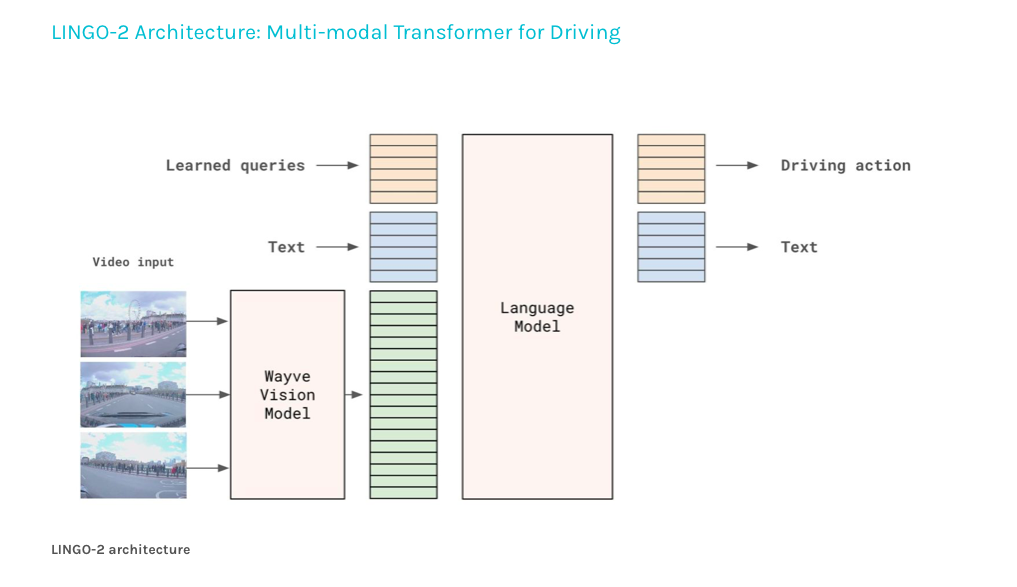
LINGO-2 comprises two modules – the Wayve vision model and an auto-regressive language model. The vision model processes camera images into token sequences, which, along with conditioning variables like route and speed, are fed into the language model.

LINGO-2’s New Capabilities

Adaptive Driving Behavior: LINGO-2 can be directed through language prompts, such as “pull over” or “turn right,” to adjust its driving behavior. This capability not only aids in model training but also enhances the interaction between humans and vehicles.

Real-time Interrogation of AI: LINGO-2 is equipped to predict and respond to queries about the surroundings and its decision-making process while on the road.

Live Driving Commentary: Through the integration of vision, language, and action, LINGO-2 can articulate its actions and reasoning in real time, offering insights into the AI’s decision-making mechanisms.

The post Wayve AI Introduces LINGO-2, Making Driving Easy with Natural Language appeared first on Analytics India Magazine.

Kyndryl opens new office in Bengaluru, third in the city

Global IT infrastructure services provider Kyndryl opened its third office in Bengaluru on Wednesday.

The US-based company now has 12 offices operating out of India, with the latest one spanning over 250,000 square feet. The CEC will include three separate “experience zones”, which will also feature demo areas for customers to make use of interactive demonstrations.

“The new office will provide our customers with an integrated view of our tech skills and capabilities,” said Kyndryl’s Global Head of Delivery James Rutledge. Apart from this, the office will also house a separate security and network operations centres, and a Vital Studio.

The company’s relationship with Bengaluru has grown significantly over the last few years. Kyndryl has forged partnerships with several Bengaluru-based companies and universities.

This includes an ongoing 10-year contract with Bengaluru International Airport Limited (BIAL) in creating an “Airport in a Box” platform. Specifically, this would be to help the airport authority scale-up to operationally handle exponentially increasing passenger traffic.

Similarly, they also collaborated with edtech company USDC in creating a “University in a Box” platform to help streamline management processes within universities.

In more recent developments, the company also expanded its partnership with Google Cloud in using Gemini to help create generative AI solutions for their customers. With the new office’s CEC, these solutions may also be demoed in real-time.

Kyndryl, notably, also beat out IBM in securing an IT modernisation deal with Canara Bank earlier this year.

With the new office significantly larger than the company’s older offices in the city, this will likely further cement Kyndryl’s foothold in the Silicon City. “India is benefiting from a confluence of tech capability and skills, demographic dividend and market opportunity,” said Kyndryl India president Lingraju Sawkar.

The post Kyndryl opens new office in Bengaluru, third in the city appeared first on Analytics India Magazine.

Deloitte Inaugurates 4th Office in Bengaluru

Deloitte has expanded its presence in Bengaluru, India, by opening a new office, its fourth in the city. Located in Yemalur Village, Marathahalli, this office is equipped to house 6,000 professionals and is part of Deloitte’s strategic efforts to grow and expand in the region. This new facility will focus on serving global clients and adds to the existing trio of offices in the city, drawing on Bengaluru’s talent pool and infrastructure.

Members at the new office will work across various domains including artificial intelligence, data analytics, cybersecurity, cloud services, and more. The office, inaugurated by Lara Abrash, Chair of Deloitte US, features technological setups like an XR Studio and Innovation Labs.

In March, the company inaugurated three new workplace hubs in Bengaluru Noida, and Pune. It has offices in 14 locations (cities) in India, including Bhubaneswar, Coimbatore, Kochi, and Jamshedpur.

In January, Deloitte stated that it is training over 120,000 employees through its AI Academy. Additionally, the company is investing over $2 billion in global technology learning initiatives aimed at improving skills in AI and related fields.

It also announced a substantial $2 billion investment in the IndustryAdvantage program to improve industry-specific services by integrating generative AI into Deloitte’s solutions. Additionally, Deloitte is expanding its suite of generative AI-enabled accelerators and enhancing its cloud-native platform, Converge.

.

The post Deloitte Inaugurates 4th Office in Bengaluru appeared first on Analytics India Magazine.

OpenAI Now Eyeing an Office in New York

OpenAI Now Eyeing an Office in New York

OpenAI is planning to establish an office in New York City next year, according to a report citing people familiar with the company’s plans. This would be the company’s fifth office, adding to its headquarters in San Francisco, a recently opened office in Tokyo, and offices established last year in London and Dublin.

OpenAI has not yet finalised a location or signed a lease in New York, according to one source, but they are considering spaces in Manhattan and Brooklyn.

At the start of last year, OpenAI had around 400 employees all based in a single San Francisco office. Now, the company is searching for a second office in San Francisco, as reported by the San Francisco Chronicle, due to its workforce expanding to over 1,000 employees, according to one of the sources familiar with the company.

Recently, OpenAI had announced its entry into the Asian market by opening its first office in Tokyo, Japan. The company is unveiling a GPT-4 custom optimised for the Japanese language. The company also plans to release the custom model more broadly in the API in the coming months.

In December, OpenAI had also announced plans to start an office in India. Rishi Jaitly, who has held executive positions including the position of Vice President at Twitter, will assume the role of a senior advisor at OpenAI to guide the company through India’s AI policy and regulatory environment.

Furthermore, OpenAI executives Anna Adeola Makanju , global head of Public Policy, James Hairston, and Jaitly recently met MoS for Electronics and Information Technology, Rajeev Chandrashekar.

The post OpenAI Now Eyeing an Office in New York appeared first on Analytics India Magazine.

Recruiters are Turning Job Offers into AI Training Grounds on LinkedIn

Recruiters are Turning Job Offers into AI Training Grounds on LinkedIn

During a period when the spectre of the recession took over, LinkedIn introduced several AI-powered features to help recruiters find the right candidates. Since then, there has been an increase in messages from recruiters offering promising opportunities.

LinkedIn Recruiter, a platform for hiring professionals, recently rolled out the AI-generated messages feature to create personalised InMail messages for potential candidates using their LinkedIn profile data. This feature aims to reduce generic, impersonal outreach that often gets flagged as spam.

The platform released this feature with the sole intention of helping recruiters, but it is now starting to look more like an AI training ground.

This has left a majority of the users miffed. Some feel ‘harassed’ or ‘insulted’ by the idea of AI viewing their profiles for data collection and message crafting, particularly when the motive appears to be training of the AI systems.

At the same time, users have also reported receiving messages mentioning interesting job opportunities, but upon opening the link, they encounter a blank attachment. And when they visit the sender’s profile, it becomes evident that it was AI-generated.

In a 2022 update, Renee DiResta and her Stanford Internet Observatory team investigated fake LinkedIn profiles and uncovered over 1,000 of them using AI-created faces. The motive for fake profiles goes beyond hiring; these are also used to attract sales for companies with big and small accounts.

Redefining Job Hiring with AI

The role of an HR has become strategic over the years. They require better data and tools to hire top talent for the organisations. And so, Recruiter 2024 was introduced to help with major tasks of HR professionals.

The AI-assisted Recruiter 2024 empowers talent leaders to express their hiring requirements in natural language, such as stating, “I want to hire a senior content writer”.

By harnessing generative AI with LinkedIn’s data, it provides the ideal candidate profile sought by the recruiter, delivering potential candidate suggestions from a diverse talent pool. This approach moves beyond the big names, broadening the scope of potential candidates significantly.

Hari Srinivasan, vice president of product management at LinkedIn Talent Solutions, said, “By pairing generative AI with our unique insights gained from more than 950 million professionals, 65 million companies, and 40,000 skills on our platform, we’ve reimagined our Recruiter product to help our customers find that short list of qualified candidates — faster.”

AI Empowering Candidates in Job Search

As per HootSuite data, 140 job applications are submitted every second on LinkedIn. That’s 8.72 million job applications sent every day. And so to make the process easier, LinkedIn has rolled out AI-powered job searches to help users assess if a particular job is a good fit for them and identify the best way to position themselves for the same.

A LinkedIn user raised a pertinent question though: “There’s no doubt that AI has been a HUGE support for job seekers, but I question whether applying for more roles faster is a good thing. Could an increased number of applications lead to a surge in less thoughtful applications? Is the quality of applications at risk when AI becomes the norm?”

Recently, the professional networking platform added a new ‘Catch Up’ tab to make conversations with connections easier by adding highlights about them like new job update, work anniversary, or if they are looking to hire someone.

The new feature will notify users about their connections’ new updates and generate opening lines like “Congratulations on the new job.”

Over the next few years, AI-assisted hiring tools will transform how companies recruit talent, making the process easier and more efficient by eliminating the need for extensive profile searches, emails, and follow-up messages.

Clearly, there’s no turning back now, as LinkedIn has become a prime data and AI training ground for numerous companies. But this raises an important question: Is this ethical, and more importantly, is it good for us?

The post Recruiters are Turning Job Offers into AI Training Grounds on LinkedIn appeared first on Analytics India Magazine.

SRK Joins Tiger Analytics to Head AI Innovations

SRK Joins Tiger Analytics

Sudalai Rajkumar, known as SRK, has rejoined Tiger Analytics to spearhead AI innovations. He expressed gratitude to Pradeep Gulipalli for the opportunity and looks forward to collaborating with the talented team to lead transformative AI projects.

Rajkumar’s return aims to drive forward-thinking advancements in AI and create impactful solutions. The 4x Kaggle Grandmaster and AI advisor previously worked at Tiger Analytics from 2014-2016 as a senior data scientist.

After that, Rajkumar went on to work as lead data scientist at Freshworks, and the same role at H20.ai, and Head of AI/ML at Growfin.ai.

SRK has been very vocal and supportive of the Indic AI landscape. He has been promoting the creators of Tamil Llama, Telugu LLM Labs, and CognitiveLabs to foster more innovation in the country.

In June, Rajkumar became the fifth Kaggle Quadruple Grandmaster. He is the third Indian to achieve this title. The other four quadruple grandmasters are Abhishek Thakur, Chris Deotte, Bojan Tunguz and Rohan Rao.

At MLDS 2024, Rajkumar gave a session on data science and coding and the evolving landscape of the job with the title – Data Scientist with extensive experience in solving real world business problems across different domains.

The post SRK Joins Tiger Analytics to Head AI Innovations appeared first on Analytics India Magazine.