Top 10 Talks from AIM Conferences in 2024

AIM organises some of the tech industry’s most impactful conferences to bring together experts and innovators from various fields. These events cover a broad spectrum of topics, from promoting diversity and inclusion in technology to delving into the latest breakthroughs in generative AI.

Whether you’re a data engineer, AI startup founder, developer, or corporate leader, AIM’s conferences provide important opportunities to learn, connect, and stay at the forefront of the advancing tech landscape.

We have cherry-picked the top 10 talks from the 2024 AIM conferences, which offer exclusive insights into the future of AI, the challenges it presents, and how India is positioning itself as a global leader in the field.

1. ‘Is GenAI for Real’ by Zerodha CTO Kailash Nadh

At Cypher 2024, Zerodha CTO Kailash Nadh expressed his scepticism about the timeline for achieving Artificial General Intelligence (AGI), calling claims of its arrival in two to five years “unrealistic”. He attributed the definition of AGI to Western AI companies and pointed out that it has always been “five years away”. He dismissed such predictions as likely motivated by business or valuation reasons.

Nadh also highlighted the vital role of open-source technology in the generative AI boom. He noted that open-source tools and models often outperform proprietary ones and also mentioned that Zerodha is using large language models (LLMs) to automate certain tasks. On the topic of AI and jobs, Nadh reassured that Zerodha would not allow job losses due to AI.

2.‘Lessons in Bravery, Integrity & Leadership for Tech Professionals’ by Kiran Bedi

At Rising 2024, Kiran Bedi, who became India’s first woman Indian Police Service (IPS) officer, shared her journey and insights on women’s success in male-dominated fields. Bedi explained that her first priority was always her career and making herself self-reliant and self-sufficient. Despite the challenges of working in the IPS, where women were underrepresented and faced discrimination, Bedi said she never questioned her abilities and confidently pursued her goals.

Discussing the low representation of women in leadership roles, Bedi pointed out that lack of career prioritisation and family support were key barriers. She recalled how her parents supported her through difficult times.

Bedi highlighted that women need to plan and manage their personal lives effectively and advised that motherhood and family life should be carefully managed to avoid conflicts with career goals.

3. ‘India Proves Sam Altman Wrong!’ by Former Tech Mahindra CEO CP Gurnani

At the MachineCon GCC Summit 2024, CP Gurnani, co-founder of AIonOS and former CEO of Tech Mahindra, challenged OpenAI CEO Sam Altman’s claim that India couldn’t develop its own LLMs.

Gurnani revealed that Tech Mahindra developed an Indian LLM for local languages and over 37 dialects in just five months with a budget of under $5 million.

Gurnani used companies like IndiGo and Airtel as examples of how they have competed with giants like Jio to discuss how India’s success hinges on “frugal innovation.” He also introduced his new venture, AIonOS, which aims to disrupt industries like travel and logistics through AI.

Tech Mahindra also launched Project Indus, an indigenous LLM focused on Indic languages and dialects to improve linguistic inclusivity in AI.

4. ‘Scaling AI for Billions: The Indian Perspective’ by Wadhwani AI CEO Shekar Sivasubramanian

At Cypher 2024, Wadhwani AI CEO Shekar Sivasubramanian discussed the concept of applied AI and the challenges of working in India’s vast and diverse ecosystem.

He pointed out that applied AI lies in bridging the gap between the chaotic, unstructured AI ecosystem and the rigorous, systematic research world. In India, deployment must come before AI development with a focus on solving real-world problems rather than abstract ones.

Sivasubramanian also highlighted the importance of a “market-of-one” approach, where AI solutions are tailored to specific needs, particularly in government and rural settings.

He outlined the differences between designing AI for ‘India’ – the urban, well-connected population – and ‘Bharat’ – where users often have limited experience with technology. He stressed that AI must be simple, intuitive, and practical for everyday users.

5. ‘Navigating Data Chaos: Using Gen AI to Extract Structured Insights from Unstructured Customer Data’ by NoBroker Data Sciences and Engineering Director Zaher Abdul Azeez

At AIM’s Data Engineering Summit 2024, Zaher Abdul Azeez, director of data sciences and engineering at NoBroker, discussed the potential of GenAI in transforming customer-facing services by extracting valuable insights from unstructured customer data, such as conversations.

Azeez pointed out that customer conversations, which tend to be subjective and informal, are extremely valuable for businesses, particularly those centred around customer experience. Traditional methods of analysing these interactions are manual and labour-intensive. However, GenAI, especially LLMs, offers a more efficient solution by understanding and processing unstructured data from these conversations.

6. ‘Generative AI and the Road to Singularity’ by Tech Whisperer Founder Jaspreet Bindra

At MLDS 2024, Jaspreet Bindra, founder of Tech Whisperer and CEO of Ai&Beyond, opened his keynote by exploring the concept of singularity and its implications for AI. He raised the question of whether AI could surpass human intelligence to become self-sufficient and leave humans obsolete.

Bindra delved into the varying predictions of AGI timelines. He cited experts like Sam Altman and Ray Kurzweil, who have different definitions and timelines for AGI’s arrival, ranging from 2026 to 2030.

7. ‘The Next Tech Superpower: How India Can Lead the World in AI Innovation’ by Former Infosys CFO Mohandas Pai

At Cypher 2024, former Infosys CFO and board member Mohandas Pai spoke about the growing technological partnership between India and the United States, positioning them as leading global digital powers. He contrasted this collaboration with China’s isolation due to its restrictive digital firewall, which limits outside influence and internal connectivity with the global tech ecosystem.

Pai drew attention to the close ties between Bengaluru and Silicon Valley, as well as their shared innovation culture and extensive research collaborations. Although Bengaluru boasts the world’s largest talent pool of chip designers, testers, and embedded software professionals, with over 3.50 lakh experts, Pai noted that the city requires more capital and competitive investment to maximise its potential.

Despite political differences, Pai described the US and India as “connected at the hip” in technology, serving as a “force multiplier” for mutual growth. In contrast, he criticised Delhi for its lack of progress on domestic issues like pollution.

8. ‘Powering India’s AI-First Ambitions With Shakti Cloud’ by Yotta CEO Sunil Gupta

Sunil Gupta, co-founder, managing director and CEO of Yotta, spoke at AIM Cypher 2024 and shared key developments regarding the company’s advancements in AI infrastructure.

Yotta, backed by the Hiranandani Group, had made significant progress in acquiring GPUs to support the AI boom in India. Last year, the company announced plans to acquire 32,000 NVIDIA GPUs over the next two years and had already secured 16,000 NVIDIA H100 GPUs.

As an elite NVIDIA partner, Gupta shared that Yotta’s partnership had ensured access to the latest GPUs. This enabled the company to meet a wide range of AI use cases in India, from developing large-scale models to smaller ones.

9. ‘Voice Based AI Agents’ by Sarvam AI Co-Founder Vivek Raghavan

At Cypher 2024, Sarvam AI co-founder Vivek Raghavan discussed the company’s mission to develop voice-based AI solutions tailored to Indian languages and dialects.

He highlighted that India’s culture of conversation drives its focus on voice-led models in local languages. Raghavan demonstrated Sarvam’s voice agents, which operate via telephone and WhatsApp, allowing users to interact in languages like Kannada and Hindi for tasks such as booking appointments and customer support.

10. ‘Impact Investing in AI Merging Profit with Purpose’ by Ronnie Screwvala

At Cypher 2024, upGrad co-founder Ronnie Screwvala talked about how AI can help India achieve its Viksit Bharat vision by 2047 by aiming for a GDP growth from $3.4 trillion to $30 trillion.

He said that AI should be seen as a tool for enhancing capabilities rather than a threat. Screwvala stressed the importance of AI in maximising intellectual property creation and fostering innovation.

Read: 6 Must-Attend Conferences for Developers by AIM in 2025

The post Top 10 Talks from AIM Conferences in 2024 appeared first on Analytics India Magazine.

Gemini is taking over Google TV — but in ways you’ll actually like

Google TV Gemini Integration

Google has been a fierce competitor in the AI space with its Gemini assistant, which powers its chatbot and voice assistant on devices. Now, the company is infusing Gemini into Google TV to level up your home entertainment.

1. Google Assistant replacement

Google's releases at CES 2025 are focused on improving your Google TV experience. One of the biggest updates is the integration of Gemini capabilities on Google TV. This will replace Google Assistant with a much more capable voice assistant, which will help the assistant better understand your requests and provide better assistance.

Also: CES 2025: The 13 most impressive products so far

With the upgrade, you'll now be able to speak to it more seamlessly, using natural language and conversing with Google TV without needing to say "Hey Google," and using conversational queries to find what you are looking for. For example, in the demo below, the user asked to see movies like Jurassic Park, but for kids. Gemini was able to understand what they meant and provide options.

2. Ask more complex queries

Users can also now ask more complex queries you typically wouldn't ask the Google Assistant on Google TV. For example, in a demo, the user asked, "Tell me about the solar system for a third grader," and "Help me plan a vacation spot with great beaches." In both instances, Gemini was able to quickly generate the answer and display it on the TV, presented in the same way as the photo above.

Also: The Google TV Streamer pleasantly surprised me — and I'm an extreme cord cutter

Related YouTube videos will also accompany Gemini answers, since when looking for something on TV, you are likely looking for visual content over standard web text content. You will also be able to use your voice to create AI-generated screensavers and to control your smart home devices more easily.

3. Hardware upgrades

Beyond software, Google also plans to work with partners to upgrade some hardware that further optimizes a user's Google TV experience. For example, upcoming Google TVs will have far-field microphones built in so that you can more easily converse and interact with your TV without needing to speak into a remote.

If you enjoy having your TV on at all times of the day, Google also plans to bring a new ambient experience. Google is developing an on-screen hub that senses when you're approaching the TV to show you personalized and informative widgets, which could include the weather, news stories you are interested in, or information from your calendar, as seen in the image above.

Also: I saw Samsung's 8K TV at CES 2025 — and these 3 new features stole the show

The sensor also helps bring other experiences to life, such as displaying art when a user isn't using the TV but is in its vicinity or turning the TV off entirely when nobody is in the room. All the features seem to be centered around making your interactions with your TV more seamless and incorporating it into your daily life more than just watching content.

Featured

DSC Weekly 7 January 2025

Announcements

  • Ransomware remains an ongoing threat as it continues to evolve. Companies must be vigilant with the rapid expansion of AI and other emerging technology creating even more opportunities for cyber criminals. Tune into the upcoming Tackling Ransomware and Emerging Threats summit for advice to prevent and recover from the latest crop of ransomware attacks. Leading industry thought leaders will discuss innovative platforms, frameworks and employee training techniques as well as detail the AI and social engineering attacks to remain vigilant of in 2026.
  • The continued rise of generative AI is transforming industries across the globe, but staying abreast and ahead of this fast-evolving landscape can be a challenge. Join industry experts for Enterprise Strategy Group: GenAI Summit 2025 as they explore the latest trends, insights, and strategies for harnessing the power of generative AI. The GenAI Summit will uncover best practices and key use cases driving adoption, including buyer preferences and the impact of AI agents. Speakers will go deep into customer service, where generative AI is delivering tangible benefits through advanced automation and personalized interactions.

Top Stories

  • Envisioning the AI Value-creation Maturity Curve – Lessons from the Internet
    January 5, 2025
    by Bill Schmarzo
    2025 will be the year when Artificial Intelligence (AI) must prove itself beyond driving mundane, easily replicated productivity improvements. To be successful, AI must fuel organizations’ imagination and creativity in creating new sources of customer, product, service, operational, environmental, and societal value. I struggle to visualize how Artificial Intelligence (AI) will change the world.
  • LLM 2.0, RAG & Non-Standard Gen AI on GitHub
    December 26, 2024
    by Vincent Granville
    In this article, I share my latest Gen AI and LLM advances, featuring innovative approaches radically different from both standard AI and classical ML/NLP. The focus is on doing better with less, using efficient architectures, new algorithms and evaluation metrics. It originates from research that I started long ago.
  • Moveworks uses AI to grow its employee automation platform
    10 December 2024
    by Esther Ajao and Shaun Sutner
    In September, AI vendor Moveworks revealed that it surpassed $100 million in annual recurring revenue. The AI application startup, which was founded in 2016 and was valued at more than $2.1 billion in 2021, uses a reasoning engine to help employees search for information across the enterprise. Since its inception, a key ingredient in the company’s success has been AI and generative AI technology.

In-Depth

  • Best practices for managing large content libraries
    January 6, 2025
    by Dan Wilson
    Learn practical tips to organize and manage your content library effectively. From content audits to CMS tools, discover strategies for optimizing, updating, and maintaining your content to improve performance and streamline your workflow.
  • Quantum computing’s status and near-term prospects
    January 2, 2025
    by Alan Morrison
    Part I: Background and some indicators of how AI is helping IBM’s Quantum System 2 on display at the Q2B 2024 Silicon Valley conference in December (author’s photo) I had the opportunity to attend the Quantum to Business (Q2B) 2024 Silicon Valley event in December 2024, courtesy of Allie Kuopus, one of the organizers.
  • Infrastructural necessities for building and deploying enterprise-scale AI
    December 30, 2024
    by Jelani Harper
    Whether rendering sensitive datasets anonymous with synthetic data or simply facilitating ad-hoc question answering on a corpus of domain-specific knowledge, enterprise applications of AI are more sophisticated than ever before. What hasn’t changed, however, is the infrastructural necessities upon which these applications are built.
  • Optimizing data center energy consumption with predictive analytics
    December 30, 2024
    by Zachary Amos
    Data centers are consuming a massive amount of power. The easiest solution is to raise temperatures, driving resource utilization down. However, that complicates hardware preservation and building upkeep. What if decision-makers could see into the future? Predictive analytics technology can help them find data-driven solutions among the noise, enabling energy consumption optimization.
  • The role of hypothesis-driven AI in medical research
    December 24, 2024
    by Zachary Amos
    The medical field has some of the greatest potential for artificial intelligence (AI) implementation. The right algorithms and data could identify hard-to-pin illnesses and create new recipes for lifesaving medicines. This urgency led the famous Mayo Clinic to devise a uniquely constructed AI for next-generation medical attention — hypothesis-driven AI.
  • NeuroAI: What would signal legacy, for the NIH’s BRAIN Initiative?
    December 23, 2024
    by David Stephen
    There is a recent article in STAT, Researchers are betting on cockroaches as the cure to elitism in neuroscience, stating that, “..how the brain uses chemical and electrical signals to process and respond to the world.” It also stated that “neurophysiologists work to understand how the nervous system uses chemical and electrical signals to respond to different situations or begin a certain behavior.”
  • Revolutionizing meetings with AI meeting assistants
    December 20, 2024
    by Edward Nick
    AI meeting assistant is an advanced software tool powered by artificial intelligence that streamlines various aspects of meeting management. These virtual helpers handle tasks such as scheduling meetings, taking notes, generating action items, and transcribing discussions in real time.
  • AI and IoT: Transforming how we live and work
    December 19, 2024
    by Pritesh Patel
    Even though IoT has been around for a while, adoption has accelerated thanks to recent technology advancements, including improved connections, cloud computing, machine learning, artificial intelligence and related analytics, and inexpensive sensors. However, as data increases, we are having trouble taking in, analyzing, and coming to wise conclusions.

GCC Enablers Pave the Way for India’s $50 Billion Economic Output Goal

India introduced its first-ever GCC policy at the 2024 Bengaluru Tech Summit with an aim to bring in 1,000 GCCs, generate 3.5 lakh new jobs, and hit $50 billion in economic output by 2029. Karnataka alone already hosts more than 875 GCCs – around 30% of India’s total. The state employs 6 lakh people and contributes $22.2 billion annually.

According to an AIM Research report, third-party companies or GCC enablers play a crucial role in the successful establishment and operation of GCCs. Their expertise simplify the complex process of setting up a GCC, from selecting the right location to navigating regulatory frameworks, ensuring infrastructure readiness, and recruiting talent.

These firms provide specialised knowledge and local insights, which help multinational corporations minimise risks, reduce setup time, and lower operational costs.

Moreover, third-party facilitators bring valuable industry experience and networks, thereby facilitating a smoother integration of the GCC into the global operations of the parent company. By using their expertise, companies can focus on their core business while ensuring their GCC runs efficiently.

According to AIM Research, top PeMa (penetration and maturity) Quadrant GCC service providers in India include ANSR, EY, PWC, HCL, Deloitte and KPMG.

“As of today, GCCs are close to around $34 billion in terms of net economic value…We expect that they have the potential to grow to almost $75 to $80 billion by 2025. More importantly, the economic value that they add to India as a country is far higher – almost three times the direct revenue that comes from the GCCs,” Gaurav Gupta, GCC industry lead of Deloitte India, said in a podcast with ET Now.

Highlighting some policy-related hurdles, he further said, “One is from a policy perspective. While we have had some incentives that were given to the GCC sector almost 10 years ago, over a period of time…they’ve gone away. To try and attract more GCCs to India, we need to look at what other incentives can be provided.”

Talent remains a big focus

“India has been a great talent story, but the talent needs of GCCs are evolving. We need to see what new skill sets are required and ensure we bridge the demand-supply gap there,” Gupta said.

GCC enablers have stepped in to fill these gaps. Deloitte India helps GCCs become innovation centres by offering consulting on digital transformation, nurturing start-up collaborations, and focusing on futuristic tech.

According to Deloitte, focusing on innovation and advanced technology is becoming a necessity for every business.

Meanwhile, when it comes to start-ups, accessing global markets via GCCs using their domain expertise and brand reputation, and accessing the physical and virtual infrastructure of GCCs are among the many perks of such partnerships.

Management consulting firm Zinnov, established in 2002, has been recognised for helping Fortune 500 companies with market entry, product engineering, and scaling operations.

Nilesh Thakker, president of Zinnov, and Karthik Padmanabhan, managing partner of GCCs in Zinnov, stressed, “True ownership in tech means owning the whole process – from strategy to design, building, and updating. It’s a call for GCCs to step up, create more value, and lead in global innovation.”

The firm’s expertise spans automation, AI, and technology consulting. It offers services such as GCC setup and roadmap design, talent strategy, digital transformation, operational optimisation, location analysis, and governance.

Zinnov also provides specialised solutions like the GCC Blueprint Model for launching and expanding global centres, its Talent 360 Platform for workforce planning, and ongoing Zinnov Zones reports for comprehensive service provider evaluations.

EY, on the other hand, was recognised as the leader for GCC/GIC Setup Capabilities in India in Everest Group’s PEAK Matrix® Assessment 2024.

“With a team of 10,000 practitioners, including former GCC CXOs, EY is supporting international organisations set up and evolve their GCCs/GICs by transforming them into innovation-driven centres of strategic value,” Kunal Ghatak, global business services partner at EY India, said.

Meanwhile, ANSR, a global leader in establishing and operating GCCs for enterprises, stated, “ANSR is redefining India’s role on the global stage. By enabling over 135 GCCs and driving $2 billion in investments, ANSR is at the forefront of fostering innovation, nurturing talent, and catalysing growth for global enterprises.”

Digital services company and GCC tech enabler GlobalLogic has also noticed a major shift. “A lot of companies in the last couple of years have started empowering the GCCs,” Piyush Jha managing director of GlobalLogic India and APAC said in an interview with AIM.

“Since we have specialised ourselves in the product development space for the last 22-23 years, it becomes very natural for us to start getting into synergistic motions with these GCCs.”

Emerging Nano GCC Space

Suchita Vishnoi, co-founder and CMO at gatewAI, explained to AIM that starting in 2024, the company – a GCC enabler – decided to “change the way GCCs are coming to India. She added that gatewAI shifted the focus from old-school IT outsourcing to an “AI era” approach.

Instead of competing solely on cost, gatewAI aims to offer “GCC as a service with AI-enabled service offerings” and zeroes in on “nano GCCs”, typically teams with five to 50 employees.

“We say we are born in the AI era. We are not born in the IT outsourcing era…which makes us very nimble, very agile, very new age in the way we are adaptive to the requirements that any GCC brings,” Vishnoi further said.

According to her, NASSCOM has predicted the number of GCCs to reach 2,200 by 2030.

“That’s a huge opportunity for us…We have a strong five-year window to capitalise and help a lot of the nano GCCs, the small and medium-sized businesses (SMBs) that want to set up innovation hubs here in India.”

In short, it’s a new age for GCCs in India. Companies want more than just cheap labour; they’re looking for a place to build products, develop cutting-edge tech, and tap into world-class talent.

“Any company that’s coming to India for the first time will say, ‘I need groundwork research done so that I know that the foundation I’m setting is for success’,” Vishnoi concluded.For policymakers, enablers, and GCCs themselves, the future is about collaboration, creative solutions, and continuous innovation. After all, the path to hitting that ambitious $50 billion mark, and beyond, will rely on how quickly they can adapt to changing tech trends and talent needs, one GCC at a time.

The post GCC Enablers Pave the Way for India’s $50 Billion Economic Output Goal appeared first on Analytics India Magazine.

CES 2025: NVIDIA Unveils GeForce RTX 50-Series Chips, AI Research Supercomputers, and More

NVIDIA made a host of new announcements through a keynote speech from its CEO delivered at CES 2025 in Las Vegas on Monday.

The main event was the GeForce RTX 50-series, the company’s first flagship desktop GPU offering in over two years. The graphics cards are powerful enough to run AI models and can multiply gaming frame rates by up to eight times with DLSS 4 neural rendering technology.

Additionally, Jensen Huang, wearing his signature leather jacket, unveiled a new NVIDIA supercomputer for AI researchers, a modality for humanoid robots that allows them to learn by imitation, a world foundation model platform, and a partnership with Toyota for autonomous vehicles.

GeForce RTX 50-series desktop GPUs

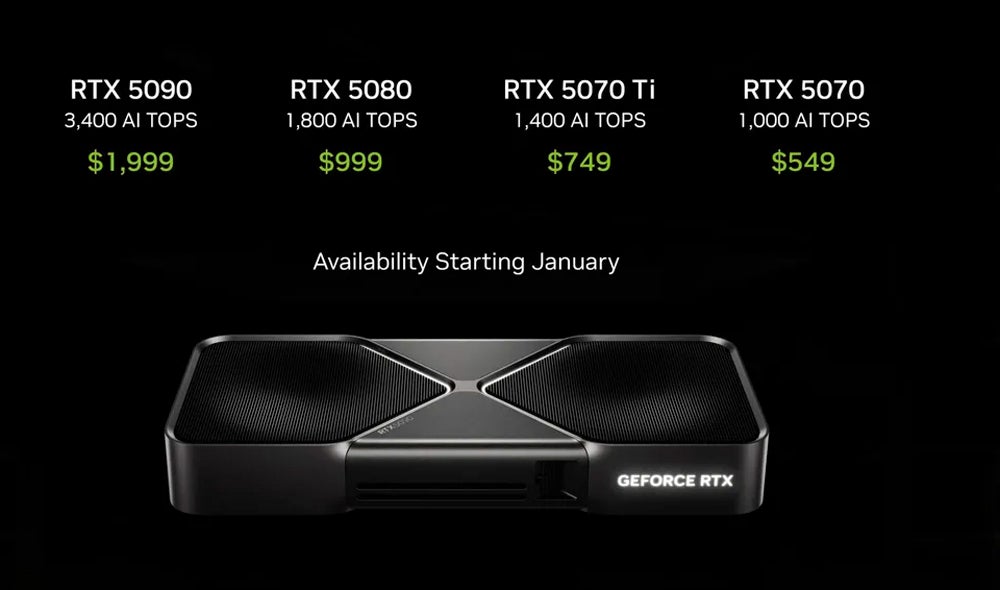
The most advanced of the new GeForce series is the RTX 5090, with 92 billion transistors and delivering 3,352 trillion AI operations per second.

“The GeForce RTX 50 Series delivers breakthroughs in AI-driven rendering, including neural shaders, digital human technologies, geometry and lighting,” NVIDIA claims in a press release.

The RTX 5090 will start at $1,999, marking a $400 increase over its predecessor, the RTX 4090, but it is also twice as fast. The RTX 5080 delivers 1,800 TOPS and will start at $999. Both will be available from Jan. 30.

NVIDIA GeForce RTX 50-Series.
Image: NVIDIA

The RTX 5070 Ti provides 1,400 TOPS, similar to the RTX 4090, and will cost $749. Meanwhile, the RTX 5070 offers 1,000 TOPS at $549. Both will be available in February.

Acer, ASUS, Dell, HP, Lenovo, and Razer have designed laptops that include the new RTX 50-series. Devices featuring all chips will be available in March except for RTX 5070 laptops, which will launch in April.

“Fusing AI-driven neural rendering and ray tracing, Blackwell is the most significant computer graphics innovation since we introduced programmable shading 25 years ago,” Huang said in the speech.

Personal supercomputer for AI researchers

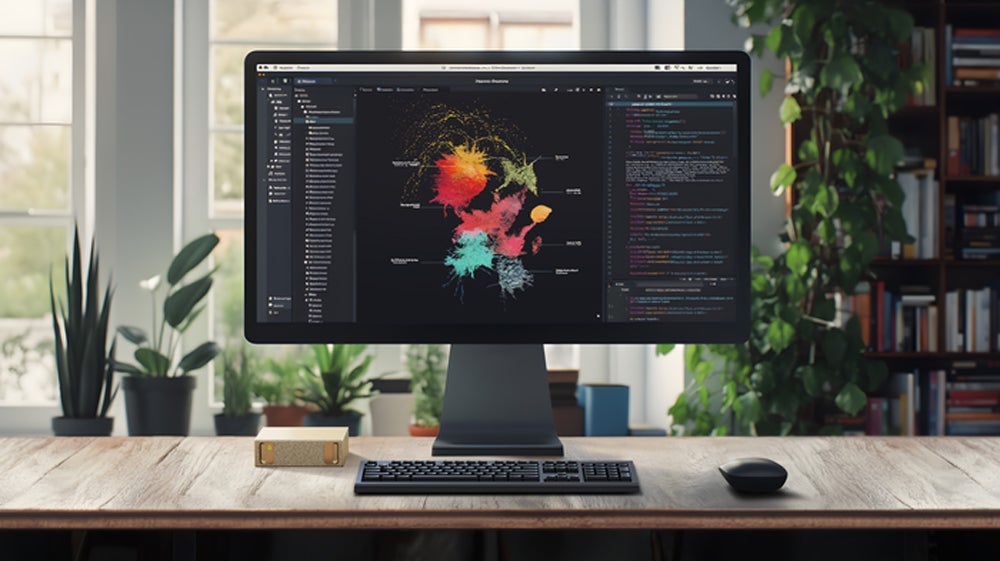
On top of the new chip series, NVIDIA introduced the world to its personal AI supercomputer; Project DIGITS. This is intended to be used by AI researchers, data scientists, and students to “supercharge AI innovation,” according to NVIDIA.

The DIGITS computer contains the GB10 Grace Blackwell superchip, composed of a GPU and 20-core CPU, which delivers up to a petaflop of computational power. It can run large language models of up to 200 billion parameters — the number of parameters is generally proportional to performance capacity.

Complete with 128GB of memory, up to 4TB of flash storage, and NVIDIA’s DGX operating system, the computers will be available in May. It will start at $3,000.

Desktop monitor showing AI research.
Image: NVIDIA

Imitation capability for humanoid robots

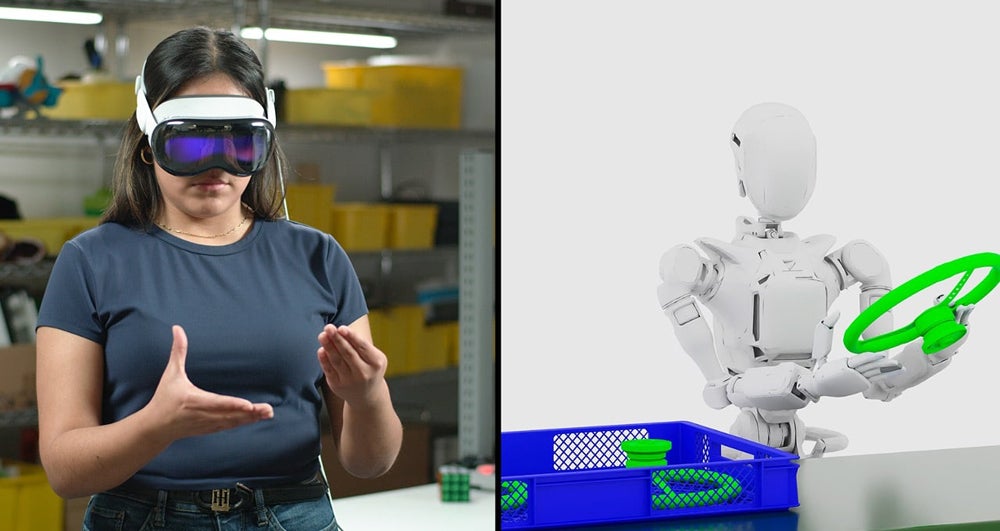
In March 2024, NVIDIA unveiled GR00T — a general-purpose foundation AI model for humanoid robots. At CES 2025, Huang announced a new modality, or blueprint, for GR00T that allows it to learn by imitation.

In other words, individuals will be able to act out movements they want the robot to perform, it will capture them as a digital twin, and then execute them repeatedly. This can all be done using an Apple Vision Pro headset.

The idea is that the technology will make it easier to educate large fleets of robots deployed in manufacturing settings. “Physical AI will revolutionize the $50 trillion manufacturing and logistics industries. Everything that moves — from cars and trucks to factories and warehouses — will be robotic and embodied by AI,” Huang said.

This new blueprint complements the blueprint for Real-Time CAE Digital Twins launched in November, which facilitates the creation of interactive simulations for engineering applications. Both leverage NVIDIA’s Omniverse platform for real-time 3D collaboration.

In addition, Huang unveiled other blueprints that can build custom AI agents for enterprises with NVIDIA NIMs: microservices containing the APIs, domain-specific code, optimized inference engines, and enterprise runtime needed to run generative AI. He also announced the Llama Nemotron family of open large language models to assist with creating and deploying agents. TechRepublic predicted at the end of the year that the use of AI agents will surge in 2025.

Split view of imitation capability of humanoid robots.
Image: NVIDIA

World foundation models for robotics

Huang announced a new platform for “world foundation models.” These AI models are inspired by how humans form their mental models of the world, called Cosmos. The first Cosmos models released are designed specifically for robotics, focusing on “physics-based simulation and synthetic data generation.”

“Cosmos WFMs are purpose-built for physical AI research and development, and can generate physics-based videos from a combination of inputs, like text, image and video, as well as robot sensor or motion data,” according to NVIDIA.

SEE: NVIDIA: Blackwell Architecture Will Accelerate AI Products in Late 2024

They will all be trained on 9,000 trillion tokens, or pieces of video data, including 20 million hours of data from autonomous driving, robotics, human interactions, and other domains. Companies such as Uber and Wayve have already committed to using Cosmos models for use cases including self-driving vehicles.

The Cosmos models will be available publicly through NVIDIA, GitHub, and Hugging Face.

Autonomous driving partnership with Toyota

Finally, Huang announced a new partnership between NVIDIA and Toyota to develop next-generation autonomous vehicles. Toyota’s upcoming models will incorporate NVIDIA’s DRIVE AGX Orin supercomputer and DriveOS operating system.

This news comes shortly after autonomous vehicle companies Aurora and Continental announced a partnership to scale up the deployment of driverless trucks using NVIDIA DRIVE. Huang projected NVIDIA’s automotive revenue to reach $5 billion in his keynote.

“The autonomous vehicle revolution has arrived, and automotive will be one of the largest AI and robotics industries,” he said in a press release.

Turning search into action with Alibaba International’s AI Sourcing Agent

As the world of global sourcing continues to grow, businesses—and small- and medium-sized enterprises (SMEs) in particular—face a variety of challenges in their sourcing operations. Global sourcing is here to stay, and businesses around the world are continuously looking for ways to simplify the process. With that end goal in mind, Alibaba International recently launched Accio, a new AI search engine, aimed to simplify the lives of SMEs around the world through conversation, automation and a wealth of knowledge. Since its launch, Accio boasts over 500,000 SME users, and more than 50,000 SMEs globally actively used Accio to source inspiration for Black Friday and Christmas inventory stocking during the peak e-commerce sales season in November and December 2024.

An active guide, not a passive search engine

One of the most time-consuming elements of a business operation is identifying potential sourcing partners and then narrowing the list down to the best choice for your business. With the new search engine, this process can now be as easy as a game of “20 questions.”

The platform user can start with a broad question or search related to their sourcing needs. Accio will return initial answers, but unlike traditional search engines, its functions do not stop there. After the initial query, users can engage in something of a conversation with the AI by asking questions or adding additional qualifiers to the results to help further narrow down Accio’s outputs. Additionally, the tool may provide additional suggestions along the way.

The conversational nature of Accio allows businesses to narrow down their sourcing options without conducting multiple searches and trying to compile the results into one file. At the end of the day, reducing the number of searches and overall research that a business leader needs to reach a decision about their sourcing operations will benefit businesses of all sizes, but it will be most impactful for SMEs, saving them precious time and resources.

A decision-maker’s own personal industry expert

AI tools are only as good as the information they have access to. With this in mind, Alibaba International developed the pool of knowledge for Accio from more than 1 billion existing product listings and the organization’s 25 years of industry expertise. The search engine indexes millions of suppliers globally, with the goal of connecting SME buyers to the right partners who can help turn their product ideas into thriving businesses. Covering over 7,600 product categories, Accio is extensively trained on more than 200 million industry-specific trade parameters.

Additionally, Alibaba International tapped into a less thought of pool of information to train the AI. The new search engine leverages user-generated content (UGC) such as product reviews and comments from the Alibaba International platform to help users get experience-based insights for a product or potential sourcing partner. This information can be crucial to help decision-makers identify service providers who fit the mold for what their business needs in a sourcing partner.

Not only does Accio provide users with information based on the above sources, but users can also be rest assured that the responses they receive are viable. Alibaba International is leveraging Retrieval-Augmented Generation (RAG) features to ensure that the information provided is substantiated. If Accio doesn’t have substantiated answers, it will acknowledge that rather than offering unsubstantiated guesses. All in all, users will walk away from Accio with what they need to feel confident in their decisions.

Turning answers into action

Being able to source answers and information is one thing, but how can AI make the sourcing process even more simple? Turning that information into actionable steps to help businesses cross the finish line in identifying the right sourcing partners.

Once a user has narrowed the results down to options they deem viable as potential sourcing partners, Accio can create requests for quotations (RFQs) and distribute them to the prospective suppliers. After receiving responses, business decision-makers can then turn back to Accio to compare the offers and see the bigger picture.

Alibaba International’s search engine does not operate in a silo, either. For example, if a buyer wants to meet with a global supplier before committing to a contract but may be facing a potential language barrier, Accio can leverage existing Alibaba International AI features allowing real-time video translation for more than 15 languages.

Making online global sourcing easy and accessible

Accio was designed with the end user in mind. The conversational nature of searches and its ability to provide support and execute on multiple steps of the sourcing process illustrates how it was designed with the purpose of making the lives of business decision-makers easier. The world of online global sourcing can be intimidating, but Accio breaks it down by turning conversation into action and opening up a world of opportunities for SMEs and large businesses alike.

This award-winning AI sleep wearable aims to help you focus better — here’s how

giac-ngu-rem-05

CES 2025 has just started, as have the awards — and they hint that neurotech may be on the rise this year.

On Sunday, the Consumer Technology Association (CTA) gave Earable Neuroscience a CES Innovation Award for its Frenz Brainband, an AI-powered sleep wearable that provides a "personalized audio therapy platform based on real-time brainwave tracking," according to the announcement. The band pairs with various apps to provide support for related health areas like focus, CBT-i therapy, and cognitive function.

Also: How I optimized my fitness routine with this brain-training wearable (and why you should, too)

The award is the product's third in a row — Brainband won the 2023 Wearable Tech award, while its accompanying Frenz Sleep Science app won the 2024 Accessibility and Aging Tech award. The 2025 award is specifically for the Frenz Focus Flow app.

Frenz Brainband tracks EEG brain signals — which implantable neurotech like Synchron and Neuralink also capture — as well as eye and facial movements, heart rate, and more to optimize a wearer's sleep cycle. By collecting more data about your sleep and using AI to personalize interventions, Frenz aims to help you develop better sleep habits. Research shows the product can be clinically accurate for sleep tracking, and that its size and cost make it a more accessible tool for cognitive health testing.

The Focus Flow app is new this year, just unveiled at CES. Expanding the scope of the "clinically validated" Brainband, the app "delivers personalized neurofeedback using real-time brainwave tracking to train the brain for improved concentration during demanding tasks," the announcement states. Using specific frequencies, binaural beats, and "audio cues," the app aims to stimulate activity in the wearer's frontal lobe.

Also: How a new law protects your thoughts from tech companies – and why it matters

The app, reportedly being tested now at CES, can also gauge activity stats like neuroplasticity and generally monitor brainwaves.

"Focus Flow has been in development by our in-house lab team and industry partners for over two years, involving more than 10,000 training sessions and millions of focus epoch samples," said Earable founder Dr. Tam Vu. "With our R&D roadmap, this feature not only delivers a cognitive boost but also advances our understanding of brainwaves as biomarkers for mental health and cognitive performance."

The launch — and the amount of recognition Earable continues to receive for Frenz's constellation of wellness neurotech — speaks to a markedly growing interest in tech wearables as a health tool. Data from smart rings and smartwatches can help detect emergencies, predict sickness, and even diagnose fertility issues.

Also: These are the top wearable tech products of 2024

Of course, with all that new data comes new privacy and security concerns. Consumer wearables that collect medically-sensitive information are operating in a relatively new field.

Alongside the new app, Earable also launched Frenz Brainwaves Labs, a collaboration platform for "universities, pharmaceutical companies, and corporate wellness programs." Organizations involved can access exclusive APIs and data and personalize Frenz's algorithms based on their use cases, setting the stage for Brainband to become more of a cognitive health research tool.

According to Kimi Doan, Earable's chief innovation officer, the product is currently being used to study neurodegenerative disease, epilepsy, stroke recovery, pain management, and more.

CES 2025

NVIDIA Launches GeForce RTX 50 Series with Blackwell Architecture

At CES 2025, NVIDIA unveiled the GeForce RTX 50 Series, the latest GPUs developed for gamers, creators, and developers. Using the Blackwell architecture, the RTX 50 Series delivers improved performance and efficiency through AI-driven innovations like neural shaders and DLSS 4.

The RTX 50 series, revealed during a CES keynote, includes the RTX 5090, 5080, 5070 Ti, and 5070. The GeForce RTX 5090 will be available starting January 30 for $1,999, while the other models are priced between $999 and $549, with launches scheduled for February.

The flagship GeForce RTX 5090 GPU offers a significant leap in power, featuring 92 billion transistors and over 3,352 trillion AI operations per second (TOPS). According to NVIDIA, the RTX 5090 GPU doubles the performance of its predecessor, the RTX 4090.

“Blackwell, the engine of AI, has arrived for PC gamers, developers, and creatives,” said Jensen Huang, founder and CEO of NVIDIA. “Fusing AI-driven neural rendering and ray tracing, Blackwell is the most significant computer graphics innovation since we introduced programmable shading 25 years ago.”

The GPUs are equipped with fifth-generation Tensor Cores and fourth-generation RT Cores, enabling advanced capabilities such as RTX Neural Shaders and DLSS 4. The latter features Multi Frame Generation, which uses AI to generate up to three frames per rendered frame, boosting frame rates by up to 8x over traditional rendering.

NVIDIA announced that the RTX 50 Series is now available for laptops, providing desktop-level performance in a portable form. With NVIDIA Max-Q technology, battery life is extended by up to 40% without compromising on design or performance. Laptops featuring RTX 50 Series GPUs will roll out from March.

To improve realism in game characters and environments, NVIDIA introduced RTX Neural Faces and other AI-driven features. RTX Neural Faces uses generative AI to create high-quality, stable digital faces in real time, while RTX Mega Geometry allows for up to 100x more ray-traced triangles in scenes.

The GPUs also power autonomous game characters through NVIDIA ACE technologies. These characters can perceive, plan, and act, creating dynamic interactions in games such as PUBG: BATTLEGROUNDS and the upcoming InZOI.

RTX 50 Series GPUs support FP4 precision, optimising AI image generation and enabling generative AI models to run efficiently on local hardware. New tools, such as NVIDIA Broadcast’s Studio Voice and Virtual Key Light, further enhance creative workflows.

The post NVIDIA Launches GeForce RTX 50 Series with Blackwell Architecture appeared first on Analytics India Magazine.

Dell Phases Out XPS Branding for New Pro and Pro Max Laptop Tiers

Dell has announced a lineup of new AI PCs, combining cutting-edge generative AI performance with a sleek, streamlined naming convention. Drawing inspiration from Apple’s playbook, Dell’s new tiers — Dell (basic version), Pro, and Pro Max — simplify choices while showcasing the company’s push for innovation and user-friendly design.

In addition to the name changes and new products, Dell solidified its partnership with AMD on Jan. 6 ahead of CES 2025 in Las Vegas.

“To make finding the right AI PC easy for customers, we’ve introduced three simple product categories to focus on core customer needs,” Kevin Terwilliger, VP and GM of the Latitude and Docking business within Dell’s client product group, wrote in a press release.

1 Wrike

Wrike Visit Website Company Size Employees per Company Size Micro (0-49), Small (50-249), Medium (250-999), Large (1,000-4,999), Enterprise (5,000+) Medium (250-999 Employees), Large (1,000-4,999 Employees), Enterprise (5,000+ Employees) Medium, Large, Enterprise Features 24/7 Customer Support, 360 Degree Feedback, Accounting, and more
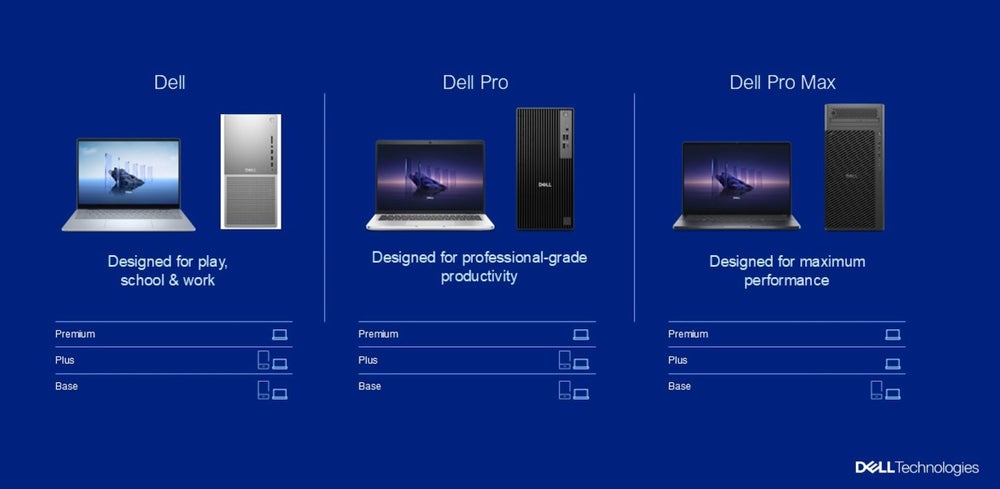
Introducing Dell, Pro, and Pro Max

The new tiers break down further into categories.
The new tiers break down further into categories. Image: Dell

One aspect of Dell’s branding that remains unchanged is how laptop sizes are indicated, with the new lineup including 13, 14, and 16-inch models. However, familiar brand names like XPS and Inspiron have been replaced — or streamlined, depending on perspective — into simplified categories: Dell, Pro, and Pro Max.

  • Dell will include laptops and PCs for student, personal, or entry-level business use.
  • Pro adds more powerful GPUs (from Intel or AMD), and NPUs for generative AI processes.
  • Pro Max is intended for heavy-duty professional use and adds the option of AMD’s Threadripper processor. AI inference and training can run on Pro Max devices.

Time will tell whether these categories — along with the further divisions into base, Premium, and Plus options — make it easier to tell which laptop is right for particular use cases.

The first devices to use the new naming scheme are:

  • The Dell Pro 13/14 Premium Copilot PC.
  • The Dell Pro 13/14/16 Plus.
  • The Dell Pro 14/16.
  • Dell Pro desktops.
  • Dell Pro Max 14/16.
  • Dell 14/16 Plus & Dell 14/16 Plus 2-in-1.
  • Dell Pro Max desktops.

The new laptops will be available throughout the winter, with staggered releases depending on the tier:

  • Dell Pro 13, 14 Premium, Dell Pro 14 Plus, and Dell Pro 16 Plus became available on Jan. 6.
  • Dell Plus will come out on Feb. 18.
  • Dell Pro 13 Plus will be released on Feb. 25.
  • Dell Pro Max and Dell Pro 13, 14, and 16 Plus will become available in March or April.

Two new 4K displays are coming in 2025

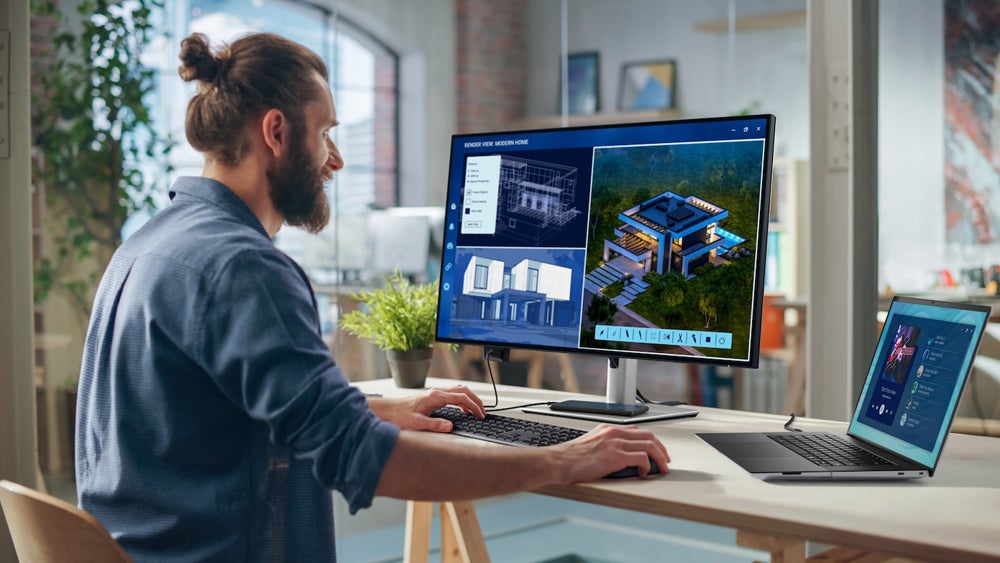
The Dell UltraSharp 32” 4K Hub Monitor is appropriate for professional design work.
The Dell UltraSharp 32” 4K Hub Monitor is appropriate for professional design work. Image: Dell

Dell announced two new displays at CES:

  • Dell UltraSharp 32 and 27 4K Thunderbolt Hub Monitors for professional use, available globally on Feb. 25.
  • Dell 32 Plus 4K QD-OLED Monitor for entertainment, including AI-enhanced sound, available globally on May 22.

SEE: AMD introduced new Ryzen chips for faster AI, plus a novel Radeon line for gaming and content creation, at CES 2025.

AMD and Dell enter commercial partnership

Dell became a commercial partner with AMD for the first time. This means corporate Dell PCs — specifically the Dell Pro tier — will use AMD Ryzen AI PRO processors.

“We’re incredibly proud to collaborate with Dell on the next generation of commercial PCs powered by the AMD Ryzen AI PRO processors,” said Jack Huynh, SVP and GM of the computing and graphics group at AMD, in a press release. “Ryzen AI PRO CPUs are built to handle today’s workflows and tomorrow’s AI demands, and when combined with the power of a Dell PC, they create the perfect combination for the enterprise.”

The partnership potentially comes at the expense of Intel, which has been relegated to Dell’s lower consumer tiers.

TechRepublic is covering CES 2025 remotely.

Bhashini Powers Lok Sabha Speaker’s Real-Time Translation System Ahead of Panchayat to Parliament 2.0

Bhashini Powers Lok Sabha Speaker’s Real-Time Translation System Ahead of Panchayat to Parliament 2.0

Ahead of the Panchayat to Parliament 2.0 event, Lok Sabha Speaker Om Birla conducted a live demonstration of the Sansad-Bhashini Speech-to-Speech translation system. The test, carried out in collaboration with the Bhashini team, included the participation of women representatives from Panchayats.

Birla demonstrated how the Sansad-Bhashini system aims to enable seamless, real-time speech translations during the event, ensuring effective communication across language barriers. The initiative is expected to enhance inclusivity by allowing all participants to engage without linguistic constraints.

In the LinkedIn post, Bhashini powered translation system was able to offer Hindi-to-six regional languages translation in almost real-time with minimal latency. The languages include Telugu, Tamil, Gujarati, Odia, Marathi, and Malayalam.

The government’s AI-powered language translation platform, Bhashini, is also translating the daily agenda papers of the Parliament into 10 regional languages. The team has already translated around 1,000 debates into Hindi and English by digitising 18,000 hours of speech data.

Amitabh Nag, the CEO of Bhashini, said in a post that this is the beginning of a historic co-creation journey with Indian Parliament for Sansad-Bhashini.

Earlier last year, Bhashini also announced that it is powering the Kumbh Sahayak App for Maha Kumbh Mela 2025. The chatbot which would run on WhatsApp would be powered by the Bhashini and Krutrim, offering information in over 10 languages.

In July 2024, Bhashini translated Finance Minister Nirmala Sitharaman’s Union Budget 2024 speech into Hindi in real-time. This initiative aimed to make the budget presentation more accessible to a wider audience across the nation’s diverse linguistic landscape.

Bhashini, which has recently reduced its translation lag from 6 seconds to 1-2 seconds, provided simultaneous captions during the Finance Minister’s budget speech. This technological advancement is expected to enhance understanding and engagement with the budget among non-Hindi-speaking citizens.

The post Bhashini Powers Lok Sabha Speaker’s Real-Time Translation System Ahead of Panchayat to Parliament 2.0 appeared first on Analytics India Magazine.