


A brand new survey discovered that greater than half (56%) of respondents say it is rather or critically vital to share the rewards that AI creates with employees, but most organizations (77%) aren’t doing something significant about it. Leaders are nonetheless determining what “truthful” appears like in an AI-enabled office, based on Deloitte’s 2025 International Human Capital Traits report.
Compensate employees or AI?
Solely 23% of organizations are doing one thing significant to share the rewards AI creates with employees, the Deloitte report mentioned.
The dilemma leaders are grappling with consists of questions equivalent to: “Ought to an worker proceed receiving rewards after their experience is embedded right into a digital agent? Ought to productiveness good points go towards greater wages, shorter workweeks, or one thing else?” Kyle Forrest, way forward for HR chief at Deloitte Consulting, informed TechRepublic.
Some organizations are sharing productiveness good points with frontline employees by way of monetary incentives, he mentioned. “Some use AI efficiencies to assist four-day workweeks, whereas others spend money on customized teaching, expertise marketplaces, and stretch assignments that deal with each employee as ‘excessive potential,’ not only a choose few.”
Do staff consider AI as a coworker?
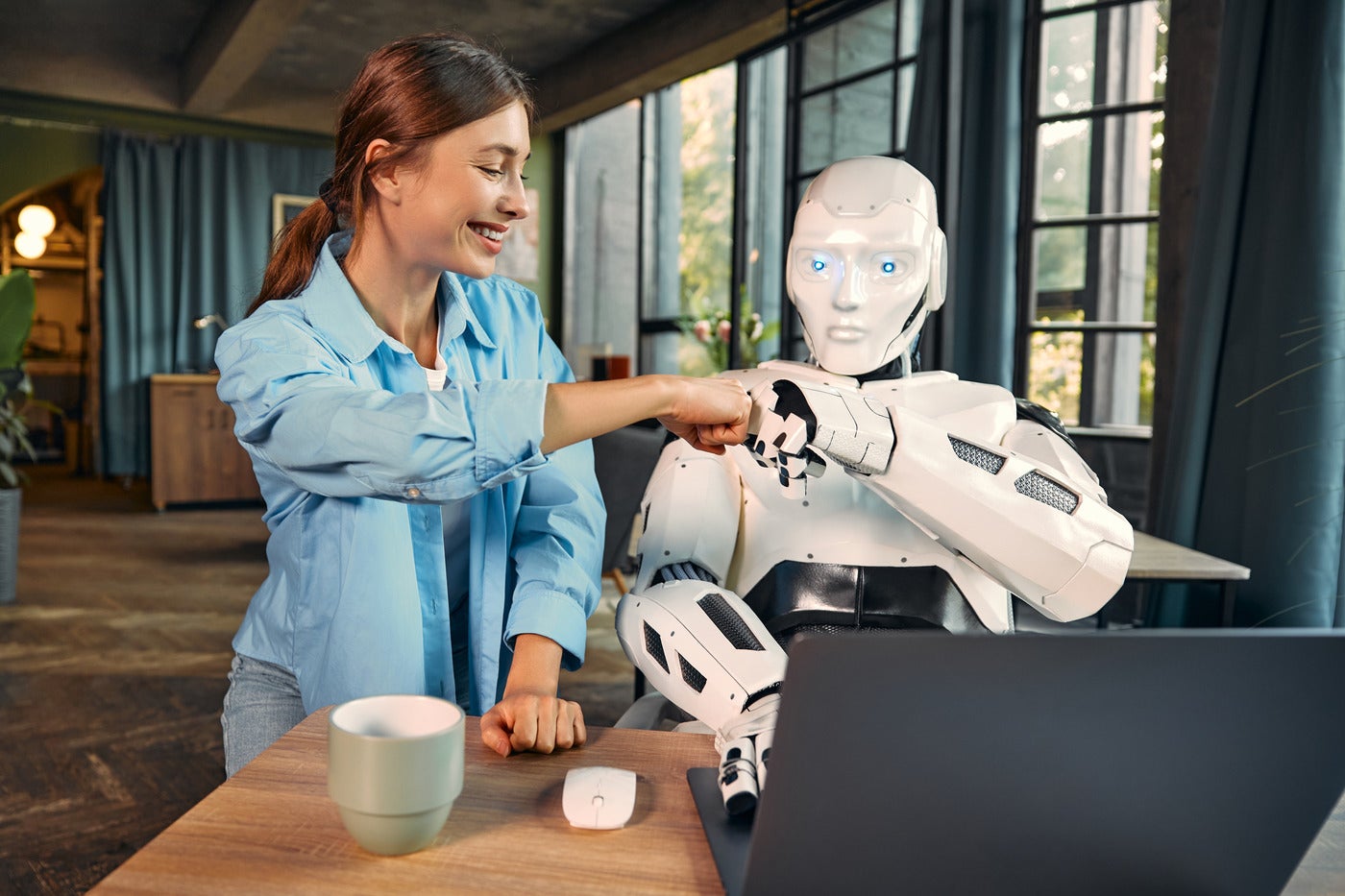
Deloitte’s analysis discovered a “doable period of convergence” between people and machines. For instance, six in 10 employees already consider AI as a coworker. The report pointed to indicators of this, together with:
- Know-how is turning into extra human with extra human-like interfaces.
- Robots more and more resemble and mimic people.
- Digital brokers are performing on individuals’s behalf.
- People are instructing AI, and AI is instructing people.
This implies organizations must rethink how they can assist their staff proceed to thrive in a world the place AI is reshaping work and the way it’s accomplished. Deloitte beneficial that organizations revise the worker worth proposition (EVP) to comprehend each human and enterprise outcomes “as AI turns into more and more intertwined with employees.”
The report, based mostly on enter from almost 10,000 enterprise and human assets leaders in 93 nations, stresses that “Know-how’s worth doesn’t come from changing human labor; it’s working extra carefully than ever with people, amplifying their means to find and seize alternatives for innovation and progress.”
Practically three-quarters of employees and leaders agree it’s essential to prioritize human capabilities, and the same quantity imagine organizations ought to do extra to attach individuals with alternatives to construct expertise, the analysis discovered. “That’s a strong basis for change,’’ Forrest mentioned.
Prime issues about AI’s “silent impacts”
Whereas AI typically does simple, rote work, it could additionally cut back one-on-one interactions, contributing to loneliness and isolation, based on the report. It could actually additionally contribute to burnout.
The Deloitte report recommends that organizations’ EVPs “incorporate a transparent understanding of AI’s influence on work, employees, and folks’s relationship with employers.”
There’s a “main alternative” in how corporations can reimagine the worker worth proposition within the age of AI, Forrest mentioned.
“Over 70% of employees and managers say they’re extra seemingly to stick with a corporation that helps them thrive in an AI-powered world,’’ he mentioned. “That’s a transparent name to motion: When corporations use AI to raise individuals, not simply productiveness, they’ll construct loyalty, belief, and long-term worth.”
