
Cohere Rolls Out Multi-Model Framework PoLL for Comprehensive LLM Evaluation

In response to the complexities and challenges associated with evaluating the ever-evolving LLMs, influential AI startup Cohere has introduced a new evaluation framework called the Panel of LLM Evaluators (PoLL) which leverages a diverse panel of smaller, distinct model families to assess LLM outputs, promising a more accurate, less biased, and cost-effective method compared to traditional single-model evaluations.

Traditional evaluations often use a single large model like GPT-4 to judge the quality of other models’ outputs. However, this method is not only costly but also prone to intra-model bias, where the evaluator model might favour outputs similar to its training data.

PoLL addresses these challenges by assembling a panel of smaller models from different model families to evaluate LLM outputs. This setup reduces evaluation costs by over seven times compared to using a single large model and minimises bias through its varied model composition. The framework’s effectiveness has been validated across multiple settings, including single-hop QA, multi-hop QA, and competitive benchmarks like the Chatbot Arena.

Studies utilising PoLL have demonstrated a stronger correlation with human judgments compared to single-model evaluations. This suggests that a diverse panel can better capture the nuances of language that a single, large model might miss due to its broader, generalised training.

Methodology Behind PoLL

The PoLL consisted of models from three distinct families—GPT-3.5, CMD-R, and Haiku—each contributing diverse perspectives to the evaluation process. This diversity allows PoLL to offer a well-rounded assessment of LLM outputs, addressing different language understanding and generation aspects.

The success of PoLL paves the way for more decentralised and diversified approaches to LLM evaluation. Future research could explore different combinations of models in the panel to further optimise accuracy and cost. Moreover, applying PoLL to other language processing tasks, such as summarisation or translation, could help establish its effectiveness across the field.

The post Cohere Rolls Out Multi-Model Framework PoLL for Comprehensive LLM Evaluation appeared first on Analytics India Magazine.

Data fitness and its impact potential on enterprise agility

Data fitness and its impact potential on enterprise agility

Illustration by Dirk Wouters on PIxabay

I had the opportunity to attend Enterprise Agility University’s prompt engineering course in April. The course provided a helpful agility lens through which to view efforts on how to make large language models useful. An LLM in this current enterprise context is like a herd of unruly sheep—you need plenty of herding dogs and fencing to manage the herd.

The bigger the herd, the more dogs and fencing you need. The EAU prompt engineering textbook provided with the course listed 18 categories of prompt engineering techniques. Many of these are reasoning and knowledge creation oriented.

Which begs the question: Shouldn’t most reasoning be part of the main data input, rather than delivered ad hoc through the prompt? With so much ad hoc input, users are really just doing a glorified version of data entry. I’m not pointing this out as a criticism of EAU’s efforts, but rather as an evident shortcoming of LLMs in general.

The main question given such shortcomings is how to infuse more intelligence into LLMs. The obvious answer from a data layer perspective is to start with explicitly intelligent data, because we clearly confront a garbage in/garbage out scenario otherwise when it comes to any kind of statistical machine learning.

We’re simply having to deal with a lot of unnecessary stupidity on the part of LLMs and their agents via the human interface because the inputs aren’t explicitly contextualized. They’re either not explicitly relevant, or they’re ambiguous.

For enterprise use, the outputs aren’t useful often enough because the Retrieval Augmented Generation (RAG) approach used isn’t helpful enough. That’s not to mention what’s been scraped and labeled off the web as model training data.

Why is truly, explicitly contextualized data so important to the success of LLMs? We don’t want machines to have to guess more than they have to. In the current piles of scraped, labeled, compressed and tensored data that are used as LLM inputs, machines have to guess which context is meant (from the input) and which context is needed (for the output). Vector embeddings as an adjunct aren’t enough to solve the contextualization problem, because they are themselves lossy.

As I pointed out in a previous post (https://www.datasciencecentral.com/data-management-implications-of-the-ai-act/), intelligent data is data that describes itself so that machines don’t have to guess what the data means. With machines, as we all know, you have to be Captain Obvious. We train machines with data. What that data says therefore has to be obvious to the machines.

For valid, useful machine interpretations of data, the meaning of the data has to be explicit. For the data to be explicit, we need to eliminate ambiguity. Eliminating ambiguity implies a much more complete and articulated contextualization of the data than the “context” generally referred to in LLMs. And yet, companies can give a huge boost to the creation of this richer context with the help of a thoughtful approach that augments logically connected knowledge graph development with machine learning.

Data fitness: A digital twins example

Once you’ve mastered the ability to create intelligent data, data can take on a much larger role in enterprise transformation. Data becomes the driver. Thus the term “data driven”.

What data as the driver really implies in a fully digitized world is that continuous improvement happens by using the data for both prediction and control. In a business context, the activity of the physical world, past, present and future, is mirrored in the form of “digital twins”. Each of these twins models a different activity.

A twin among many other things predicts future behavior of the activity. Then the predictions, also in data form, help to optimize that activity.

More broadly, a twin paints the picture of each activity in motion and allows the interaction with other twins, even across organizations.

Consider the example of intelligent IoT system provider Iotics’ work with Portsmouth Ports in the UK, a part of the Sea Change project. Iotics helped the port authority install networked sensor nodes at various places across the geography in order to monitor air quality, as a part of a compliance effort to reduce pollution.

Port areas must deal with a heavy concentration of pollutants, because they’re where multiple forms of transportation come together to move goods from sea to land, land to sea, and inland over land. Both workers and local residents suffer from pollution exposure.

Iotics’ solution blends intelligent digital twins and agents to capture, integrate and share the information from the port network’s various sensor nodes. Each node’s twin includes a knowledge subgraph. Software agents manage the messaging from these subgraphs and make it possible for subscribers to the network to obtain specific, time- and location-stamped measurements of most relevance to each subscriber.

For instance, a shipping company can review the measurements and determine its own fleet’s pollution footprint, including where, when and what kind of pollutant emitted is of most concern, which ship is the most problematic, etc. Armed with this information, the firm can tackle the problem of reducing pollution levels, as well as being able in future to demonstrate success in doing so.

Data fitness broadens agility initiative potential

Much of the advantage of the Iotics solution at Portsmouth Ports has to do with a superior system design, advanced data architecture, close partner collaboration and thoughtful standards-based technology selection. The right semantic knowledge graph technology implemented in the right way makes it possible to maximize the impact of data collection efforts on port-wide transformation. This kind of data layer transformation lifts all boats.

Google’s Med-Gemini Model Achieves 91.1% Accuracy in Medical Diagnostics

ML in healthcare

Researchers from Google and DeepMind have developed Med-Gemini, a new family of highly capable multimodal AI models specialised for medicine. The paper, published yesterday, builds upon the Gemini 1.0 and 1.5 models released in 2023, which demonstrated breakthrough capabilities in language, multimodal understanding, and long-context reasoning.

The paper stated that, “Med-Gemini inherits Gemini’s foundational capabilities in language and conversations, multimodal understanding, and long-context reasoning.”

The model brings new possibilities for AI in medicine, such as assisting with complex diagnostic challenges, engaging in multimodal medical dialogue, and processing lengthy electronic health records.

The researchers specialised the Gemini models for medicine using techniques like self-training with web search integration, multimodal fine-tuning, and customised encoders.

To evaluate Med-Gemini’s performance, the researchers tested the models on a comprehensive suite of 25 tasks across 14 medical benchmarks. The results were impressive, with Med-Gemini establishing new state-of-the-art performance on 10 benchmarks. On the MedQA benchmark, which assesses medical question-answering abilities, Med-Gemini achieved an accuracy of 91.1%, surpassing the previous best by 4.6%. In multimodal tasks, the models outperformed GPT-4 by an average of 44.5%.

Beyond benchmarks, Med-Gemini demonstrates potential for real-world utility. The models outperformed human experts on tasks such as medical text summarisation and referral letter generation. Additionally, Med-Gemini showcased impressive long-context processing abilities on challenging tasks like needle-in-a-haystack retrieval from extensive health records.

“The unique nature of medical data and the critical need for safety demand specialised prompting, fine-tuning, or potentially both along with careful alignment of these models,” the paper explained.

“For language-based tasks, we enhance the models’ ability to use web search through self-training and introduce an inference time uncertainty-guided search strategy within an agent framework. This combination enables the model to provide more factually accurate, reliable, and nuanced results for complex clinical reasoning tasks.”

Med-Gemini’s multimodal capabilities allow the models to process and analyse a wide range of medical data, including text, images, videos, and even raw sensor inputs like electrocardiograms (ECGs).

The researchers demonstrate Med-Gemini’s ability to engage in multimodal medical dialogues, where the models can request additional information, such as images, when needed and provide explanations for their reasoning. These capabilities highlight the potential for AI to support more natural and comprehensive interactions between healthcare providers and patients.

Google has been a pioneer of AI developments in Healthcare with multiple models in the field like Med-PaLM 2, AlphaFold, Flan-PaLM etc.

The post Google’s Med-Gemini Model Achieves 91.1% Accuracy in Medical Diagnostics appeared first on Analytics India Magazine.

Google’s Med-Gemini Model Achieves 91.1% Accuracy in Medical Diagnostics

ML in healthcare

Researchers from Google and DeepMind have developed Med-Gemini, a new family of highly capable multimodal AI models specialised for medicine. The paper, published yesterday, builds upon the Gemini 1.0 and 1.5 models released in 2023, which demonstrated breakthrough capabilities in language, multimodal understanding, and long-context reasoning.

The paper stated that, “Med-Gemini inherits Gemini’s foundational capabilities in language and conversations, multimodal understanding, and long-context reasoning.”

The model brings new possibilities for AI in medicine, such as assisting with complex diagnostic challenges, engaging in multimodal medical dialogue, and processing lengthy electronic health records.

The researchers specialised the Gemini models for medicine using techniques like self-training with web search integration, multimodal fine-tuning, and customised encoders.

To evaluate Med-Gemini’s performance, the researchers tested the models on a comprehensive suite of 25 tasks across 14 medical benchmarks. The results were impressive, with Med-Gemini establishing new state-of-the-art performance on 10 benchmarks. On the MedQA benchmark, which assesses medical question-answering abilities, Med-Gemini achieved an accuracy of 91.1%, surpassing the previous best by 4.6%. In multimodal tasks, the models outperformed GPT-4 by an average of 44.5%.

Beyond benchmarks, Med-Gemini demonstrates potential for real-world utility. The models outperformed human experts on tasks such as medical text summarisation and referral letter generation. Additionally, Med-Gemini showcased impressive long-context processing abilities on challenging tasks like needle-in-a-haystack retrieval from extensive health records.

“The unique nature of medical data and the critical need for safety demand specialised prompting, fine-tuning, or potentially both along with careful alignment of these models,” the paper explained.

“For language-based tasks, we enhance the models’ ability to use web search through self-training and introduce an inference time uncertainty-guided search strategy within an agent framework. This combination enables the model to provide more factually accurate, reliable, and nuanced results for complex clinical reasoning tasks.”

Med-Gemini’s multimodal capabilities allow the models to process and analyse a wide range of medical data, including text, images, videos, and even raw sensor inputs like electrocardiograms (ECGs).

The researchers demonstrate Med-Gemini’s ability to engage in multimodal medical dialogues, where the models can request additional information, such as images, when needed and provide explanations for their reasoning. These capabilities highlight the potential for AI to support more natural and comprehensive interactions between healthcare providers and patients.

Google has been a pioneer of AI developments in Healthcare with multiple models in the field like Med-PaLM 2, AlphaFold, Flan-PaLM etc.

The post Google’s Med-Gemini Model Achieves 91.1% Accuracy in Medical Diagnostics appeared first on Analytics India Magazine.

DSC Weekly 30 April 2024

Announcements

  • Once considered an afterthought, application security risk management is now an integral aspect of application development. The rise of cloud-native adoption and proliferation of microservices has enlarged the attack surface, requiring elevated security measures. Service mesh technologies and API gateways emerge as pivotal solutions, streamlining communication, enhancing reliability, and fortifying security. Join the Advancing Application Security Practices Summit to discover how to bolster your security posture, exploring ways to mitigate security vulnerabilities, manage risks, and fortify against cyberattacks.
  • Zero trust adoption has surged in recent years, driven by two main factors: 1). A wave of high-profile data breaches that highlighted the need for enhanced cybersecurity strategies and 2). The COVID-19 pandemic created the need for remote access technologies beyond VPN. While the zero trust model can be highly beneficial, it does have some challenges. That’s why making zero trust cybersecurity as effective as possible starts by understanding its challenges. In the upcoming The Zero Trust Journey: From Concept to Implementation summit, industry leaders, experts and practitioners provide resources and recommendations to help you build a zero trust framework.

Top Stories

  • Cybersecurity practices and AI deployments
    April 30, 2024
    by Dan Wilson
    For our 4th episode of the AI Think Tank Podcast, we explored cybersecurity and artificial intelligence with the insights of Tim Rohrbaugh, an expert whose career has traversed the Navy to the forefront of commercial cybersecurity. The discussion focused on the strategic deployment of AI in cybersecurity, highlighting the use of open-source models and the benefits of local deployment to secure data effectively.
  • Why is AI different? It Can Guide Our Societal Aspirations
    April 29, 2024
    by Bill Schmarzo
    Traditional analytics optimize based on existing data, reflecting past realities, limitations, and biases. In contrast, AI focuses on future aspirations, identifying the learning needed to achieve aspirational outcomes and guiding your evolution toward these outcomes. When I talk to my students, the question I keep getting is, “Is AI really different from traditional analytics?”
  • Losing control of your company’s data? You’re not alone
    April 24, 2024
    by Alan Morrison
    Losing control of your company’s data? You’re not alone To survive and thrive, data likes to be richly and logically connected across a single, virtually contiguous, N-dimensionally extensible space. In this sense, data is ecosystemic and highly interdependent, just as the elements of the natural world are.

In-Depth

  • How long does it take to master data engineering?
    April 30, 2024
    by Aileen Scott
    Data engineers are professionals who specialize in designing, implementing, and managing the systems and processes that transform raw data into usable and trusted information. They play a crucial role in ensuring data integrity and accessibility for downstream analytics and machine learning applications.
  • Data fitness and its impact potential on enterprise agility
    April 30, 2024
    by Alan Morrison
    I had the opportunity to attend Enterprise Agility University’s prompt engineering course in April. The course provided a helpful agility lens through which to view efforts on how to make large language models useful. An LLM in this current enterprise context is like a herd of unruly sheep—you need plenty of herding dogs and fencing to manage the herd.
  • Understanding GraphRAG – 1: The challenges of RAG
    April 26, 2024
    by Ajit Jaokar
    Retrieval Augmented Generation(RAG) is an approach for enhancing existing LLMs with external knowledge sources, to provide more relevant and contextual answers. In a RAG, the retrieval component fetches additional information that grounds the response to specific sources and the information is then fed to the LLM prompt to ground the response from the LLM(the augmentation phase).
  • Optimizing model training: Strategies and challenges in artificial intelligence
    April 25, 2024
    by Pritesh Patel
    When you do model training, you send data through the network multiple times. Think of it like wanting to become the best basketball player. You aim to improve your shooting, passing, and positioning to minimize errors. Similarly, machines use repeated exposure to data to recognize patterns.
  • Top AI Influencers to Follow in 2024
    April 25, 2024
    by Vincent Granville
    There are many ways to define “top influencer”. You may just ask OpenAI to get a list: see results in Figure 1. However, it states that the data is not recent (2022 and earlier), and there is no link to the individual profiles. Here I focus on leaders very active on LinkedIn, with at least 100k followers, and popping up regularly on my feed. Emphasis is on GenAI and LLM, which are today among the hottest topics in AI. It is also what I am working on.
  • DSC Weekly 23 April 2024
    April 23, 2024
    by Scott Thompson
    Read more of the top articles from the Data Science Central community.

US Govt ‘Snubs’ Musk and Zuckerberg, Keeps ’em Out of AI Safety Board

This week, bigwigs from several leading AI companies, including OpenAI’s Sam Altman, NVIDIA’s Jensen Huang, and Microsoft’s Satya Nadella, joined the freshly minted Artificial Intelligence Safety and Security Board formed by the US government.

This follows as a countermeasure to several cases of deepfakes being used against politicians, celebrities and even children.

In Florida this week, police arrested an 18-year-old for generating sexually explicit images of women without their consent.

Likewise, the usage of “nudification” programmes and GenAI to create deepfakes as either blackmail or harassment material has been pervasive. Especially in American schools, as reported by The New York Times.

So, the formation of a federal board hosting some of the biggest names within the industry was a step in the right direction. However, there already seems to be bad blood around who gets to be on the board.

Yann LeCun and (or) Mark Zuckerberg should have been in this list pic.twitter.com/UunykWfriT

— Aravind Srinivas (@AravSrinivas) April 28, 2024

Several people pointed out that Meta CEO Mark Zuckerberg and Tesla CEO Elon Musk had not been included in the list of board members released by the Department of Homeland Security (DHS).

Theories raged on why the mighty duo was “snubbed”. Let’s take a look at what these companies have been doing in terms of safety and why the two may have been overlooked.

We were snubbed.

— Yann LeCun (@ylecun) April 28, 2024

Why Sans Zuck and Musk?

Secretary of homeland security Alejandro Mayorkas clarified that Zuckerberg and Musk’s exclusion had to do with the exemption of social media sites. However, many don’t seem convinced.

safe to assume the justification was created after the decision

— Terry Winters (@terrortheerror) April 26, 2024

Though YouTube and LinkedIn are seen as social media sites, the two didn’t start out as such. But it still doesn’t explain why the DHS would exclude them solely for being social media companies.

Well, the thing is that the giants, by virtue of being social media companies first and foremost, have had run-ins with several governments in the past.

Meta is set to face an EU probe for allegedly not doing enough to prevent Russian disinformation on Facebook. Other issues include a lack of curbs on ads promoting the aforementioned nudification apps.

Similarly, Media Matters had earlier released a report alleging that advertisements were appearing opposite antisemitic posts. This subsequently led to major advertisers pulling their ads from the website and Musk retaliating with a lawsuit against the platform.

This doesn’t bode well for the duo’s stance on AI safety, especially with the board focusing on advising the DHS and other stakeholders on potential AI disruptions.

Alternatively, Zuckerberg has been a big proponent of open-source AI, which is harder to regulate or advise on in terms of safety. A majority of child sexual abuse material (CSAM) and other inflammatory material comes from open-source datasets that have been crowdsourced.

Meanwhile, some believe that Musk wasn’t a first choice due to his unpredictability, which, considering his current plight with the SEC, is unsurprising.

Not gonna be long now before the US gov pushes musk out of his companies, like this latest Australian nonsense I don’t believe for 1 second it was not instigated within the US. The establishment want him gone, too unpredictable for their liking.

— SheWolf (@lonelyShewolf66) April 26, 2024

While the companies involved with the safety board are by no means bastions of safety, they have been considerably more open to safety talks.

In the recent child safety consortium that Meta, Google, Microsoft, OpenAI and other major players pledged themselves to, most companies apart from Meta, had issues with people using their services to generate CSAM by abusing GenAI.

This is a far more difficult issue to tackle than Meta’s, which was the lack of moderation in terms of defamatory and sexually explicit ads that are run on the site.

“We understand that people get around these safeguards all the time, and so we try to design a safe product…We’re not an advertising-based model, we’re not trying to get people to use it more and more,” Altman had said last year during his Senate hearing.

Pro-active AI Safety Measures

Advertising aside, these companies already have their own AI safety codes in place. OpenAI, for instance, has their Approach to AI Safety blog that states they “work to improve the model’s behaviour with techniques like reinforcement learning with human feedback, and build broad safety and monitoring systems”.

Likewise, the others included on the list have their variants of the AI safety framework. But whether they work or not is another conversation altogether.

Last year, a research paper from Stanford found that the LAION 5B dataset, which was used to train several text-to-image models, including Stable Diffusion and Google’s Imagen, included CSAM.

Similarly, big tech has had an influx of bad-faith actors who attempt to circumvent existing GenAI guardrails, which is just as hard to curb.

With a rising concern about deepfakes used to generate CSAM, there has been plenty of independent research on how to mitigate these issues, including watermarking.

Companies like Adobe and Google have adopted watermarking practices in the form of Content Credentials and SynthID. OpenAI has done the same with Dall.E 3, making use of C2PA.

However, while these provide context on whether an image is AI-generated or not, as well as providing tamper-proof metadata, these rectify only a minor concern in the overall deepfake debate. Essentially, slapping a bandaid on a gaping wound.

Not to mention that social media websites have systems in place to strip media of metadata to prevent access to a user’s location and other details.

Another paper from 2022 suggests the creation of a CSAM database to train GenAI on how to detect potential CSAM. However, with the sensitivity around CSAM content, they suggest a way to extract attributes from the dataset that can then be used to train GenAI on potentially explicit content.

That makes for an interesting concept. However, while this is another step in the right direction, it still leaves a lot to be considered.

With more emphasis in place on AI safety, a combination of independent research and big tech adoption, much like in the case of watermarking, seems to be a sound solution towards mitigating the widespread use of deepfakes across the internet.

The post US Govt ‘Snubs’ Musk and Zuckerberg, Keeps ’em Out of AI Safety Board appeared first on Analytics India Magazine.

AWS Announces General Availability of Amazon Q

amazon q

Amazon Web Services, Inc. (AWS) today announced the general availability of Amazon Q, the most capable generative artificial intelligence (AI)-powered assistant for accelerating software development and leveraging companies’ internal data.

The chatbot is available in three forms: Amazon Q for developers, Amazon Q for businesses, and Amazon Q apps.

Amazon Q not only generates highly accurate code, it also tests, debugs, and has multi-step planning and reasoning capabilities that can transform (e.g., perform java version upgrades) and implement new code generated from developer requests.

The chatbot also makes it easier for employees to get answers to questions across business data such as company policies, product information, business results, code base, employees, and many other topics by connecting to enterprise data repositories to summarize the data logically, analyze trends, and engage in dialog about the data.

Today, AWS is also introducing Amazon Q Apps, a new and powerful capability that lets employees build generative AI apps from their company’s data.

Employees simply describe the type of app they want, in natural language, and Q Apps will quickly generate an app that accomplishes their desired task, helping them streamline and automate their daily work with ease and efficiency. To learn more about Amazon Q, visit aws.amazon.com/q.

“Since we announced the service at re:Invent, we have been amazed at the productivity gains developers and business users have seen. Early indications signal Amazon Q could help our customers’ employees become more than 80% more productive at their jobs, and with the new features we’re planning on introducing in the future, we think this will only continue to grow,” Dr. Swami Sivasubramanian, vice president of Artificial Intelligence and Data at AWS said.

The post AWS Announces General Availability of Amazon Q appeared first on Analytics India Magazine.

Data Science Degrees vs. Courses: The Value Verdict

Data Science Degrees vs Courses

Image by author

If you want to get a job in data science and you didn’t get a degree in computer science, data science, or mathematics the first time around, you might be looking at your options now. You could go back to school to get that degree, or you could try to complete an accredited data science course or bootcamp.

Both are expensive and time consuming, but degrees are an order of magnitude more expensive and time consuming than most courses or bootcamps. Is that price tag worth it to employers? Let’s break it down by what each kind of curriculum offers.

The Traditional Path: Data Science Degrees

The standard route is to get a degree (or even two) in data science, computer science, or mathematics. This kind of structured learning will teach you what you need to know to perform well at a data science job.

One of the benefits of a degree is that it lets you learn the subject solidly and comprehensively. It offers real depth and a profound understanding of theoretical concepts you wouldn’t get from an intensive bootcamp or online course.

Degrees cover a wide and deep range of themes, including topics like advanced mathematics, statistics, computer science fundamentals, data structures, algorithms, machine learning, data visualization, and perhaps even specialized areas like artificial intelligence, deep learning, and big data technologies which have become more applicable in recent years.

The benefit of going this broad as well as this deep means that you really understand the fundamentals. You’re not just a code monkey; you understand how and when to use specific statistical tools or run particular analyses.

Not only that, but a degree carries weight. Many universities are like name brands employers recognize and admire. A job candidate with a mathematics degree from MIT, for example, stands out in a positive way.

However, as I’ve mentioned, a degree is normally four years, though there are shorter, more focused options available. For instance, if four years is too long, you could opt for an accelerated program or a master's degree specializing in data science, which typically spans one to two years.

These alternatives are kind of like a speed-run of college degrees, offering a more concentrated curriculum with a focus on what you’d need in the job – data science, machine learning, and statistics skills. They can be an attractive alternative for folks who already graduated and want to pivot into data science jobs now without spending four years to do so.

The Modern Route: Online Courses and Bootcamps

As you may know, the data science field is robust and growing (nope, no bubble). The number of graduates in those fields is not matching up to the number of job openings. That means that while it’s certainly not easy to get a job without a degree, it’s also not impossible – employers just want you to prove your skills.

One way to do that is through a combination of online courses, certificates, and bootcamps. This path is more flexible. You can even do it part-time, alongside an existing job.

Compared to standard degrees, the curriculum in these programs is more practical,and designed with the current demands of the job market in mind. They include hands-on projects that approximate real data science work, teaching the specific skills that you might see on standard job descriptions, like proficiency in Python, R, machine learning algorithms, and data visualization tools. This approach can be especially useful for anyone who prefers direct application versus sitting in lecture halls.

Many bootcamps run for just a couple of months, often with some kind of job placement offer at the end. They are expensive, sometimes running into the tens of thousands of dollars, but if they can help you land a six-figure job in under a year, that can have a high ROI.

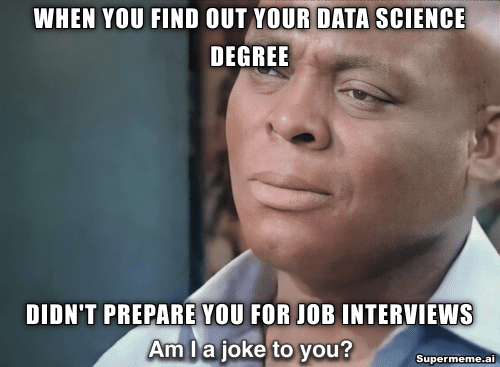
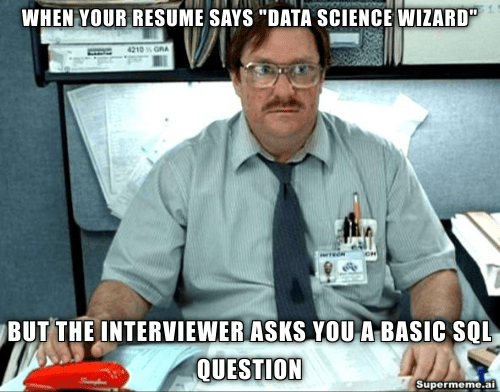
The problem is that this route doesn’t give you the whole, holistic picture. You might be able to stuff your resume with great portfolio projects but stumble in the interview because you get asked about a basic fundamental question the bootcamp didn’t cover.

Data Science Degrees vs Courses

Author created via supermeme.ai

That’s why a single bootcamp isn’t enough; you often have to supplement it by auditing (or paying for) Coursera or EdX courses, or doing your own learning, research, and practice alongside.

Filling in the Gaps

Degrees definitely offer unmatched depth and prestige. But the agility and practical skills acquired through courses, and bootcamps are not only a worthy alternative but might actually make you better prepared for the job market. Degrees, while traditional, also have more inertia – courses and bootcamps can change things up much faster in response to evolving job markets than a degree can. Plus, the focus is on theory with less emphasis on skills like interview prep.
Data Science Degrees vs Courses

Author created via supermeme.ai

That being said, if you choose to go for the course and bootcamp hybrid combo, you miss out on that deep knowledge and subject matter confidence you get from spending a year or longer dedicating yourself to a subject.

Luckily, there are a few resources we recommend that can help you round out that gap and make sure you present as a well-rounded, qualified candidate no matter if you went the degree route or the bootcamp direction.

Learning more about a data science topic

There are two ways you can go about this. One, you can look at curricula from data science degrees and make a list of everything you want to learn. Two, you can work backward – pick a dream job listing and write down everything in the job requirements you want to learn. Either way, compile a list of topics that you want to learn.

With that list, you can use the following resources to round out your learning:

  • Coursera and edX: If you don’t want to pony up for the course price, you can audit the course to learn the material, though you won’t get a certificate at the end. Coursera and edX offer tons of comprehensive courses on theoretical and foundational topics in data science and mathematics.
  • Khan Academy: Free classes, including college-level classes for topics like statistics and probability.
  • MIT OpenCourseWare: There’s no reason you shouldn’t take advantage of that MIT brand name, too! This is a valuable resource for free lectures and course materials from MIT, covering advanced topics in computer science and data science.
  • Academic Journals and Papers: This may be a little esoteric, but reading research papers is a great way to really deepen your understanding of advanced data science topics and, more importantly, stay ahead of current research trends. Some are paywalled, but many are available online for free. Start with Google Scholar.

Practicing skills for a topic

As you know, it’s not enough to just say “proficient with statistics” on your resume and hope for the best.
Data Science Degrees vs Courses

Author created via supermeme.ai

You need to apply your practical data science skills, from coding to project implementation, and have projects to prove it. Here are some resources to add extra polish to your resume. Note: these can be useful especially for degree-based candidates since degrees often have less opportunity for hands-on projects than courses and bootcamps typically do.

  • DataCamp: Offers interactive courses focused on practical skills like programming, data analysis, and machine learning.
  • GitHub: Lets you engage with real-world projects and collaborate with others to gain practical experience and demonstrate your coding and project management skills.
  • Kaggle: Provides a platform to compete against other newbies, work on real-world problems, access datasets, and collaborate with a global community.

Nailing the Interview

Whether you opted for a degree or a bootcamp, you need to nail the interview to land the job. You should prepare for the data science job interview, focusing on both technical questions and showcasing your project work. Here are some resources to do that:

  • StrataScratch: Ever wished you could know what the interviewer is going to ask you ahead of time? StrataScratch (which I founded) collects over 1000 real-world interview questions, both coding and non-coding, as well as the best answers, letting you practice and prep for anything an interviewer could throw at you.
  • Meetups and Conferences: Connections and networking cannot be overstated. Attend these, either in-person or virtually, to learn about the latest trends, network with professionals, and possibly even find mentors who can provide advice and insights on interviewing.
  • LeetCode: Offers a vast collection of coding challenges and problems to improve your algorithmic and coding skills, crucial for technical interviews.
  • Glassdoor: Provides insights into company-specific interview questions and processes, as well as reviews from candidates about their interview experiences.

Final Thoughts

If you’re an aspiring data scientist, the best thing you can do is take stock of your position. If you have the time and money to set aside for a degree, that’s a great option, so long as you supplement your deep theoretical knowledge with hands-on practice and interview prep. If you need to go the bootcamp or course route, that’s becoming a more competitive option by the year – just make sure you fully grasp the concepts.

Both options are viable, but one will probably be a better fit for you than the other. Hopefully, this value guide helps you pick the right one for you and still fill in the gaps you need to land your dream job.

Nate Rosidi is a data scientist and in product strategy. He's also an adjunct professor teaching analytics, and is the founder of StrataScratch, a platform helping data scientists prepare for their interviews with real interview questions from top companies. Nate writes on the latest trends in the career market, gives interview advice, shares data science projects, and covers everything SQL.

More On This Topic

  • Essential Math for Data Science: Visual Introduction to Singular…
  • Maximize Your Value With The 3rd Best Online Master’s In Data…
  • Key-Value Databases, Explained
  • Using Datawig, an AWS Deep Learning Library for Missing Value Imputation
  • Machine learning does not produce value for my business. Why?
  • The First ML Value Chain Landscape

Sam’s Club’s AI-powered exit tech reaches 20% of stores

Sam’s Club’s AI-powered exit tech reaches 20% of stores Sarah Perez @sarahintampa / 8 hours

Amazon may be scaling back its AI-powered Just Walk Out checkout-free tech in its stores in favor of smart shopping carts, but Walmart-owned Sam’s Club says it’s turning to AI to speed up its own exit technology. Instead of requiring store staff to check members’ purchases against their receipts when leaving the store, Sam’s Club customers who pay either at a register or through the Scan & Go mobile app can now walk out of the store without having their purchases double-checked.

The technology, first unveiled at the Consumer Electronics Show in January, has now been deployed at over 120 clubs across the U.S., which is 20% of the total number of Sam’s Club locations. Since rolling out, the company claims that it’s significantly sped up exits, as members leave the store 23% faster. The retailer plans to expand the tech to all its stores by year-end.

The system works via a combination of computer vision and digital tech that captures images of customers’ carts and then verifies payment for the items in their basket. Sam’s Club says AI is used in the background to speed up the process. The AI also learns and improves over time as thousands of exit transactions across locations are analyzed.

Before the technology was put into place, Sam’s Club members would have to queue up at the store’s exit to wait to have their receipts checked. The new solution keeps them moving along and frees up store staff to focus on other tasks.

The company also took a subtle shot at rival Amazon in announcing the expansion, noting that its technology arrives as “other retailers have struggled to deploy similar technology at scale, with some abandoning efforts” — a clear reference to Amazon’s pullback on Just Walk Out. In addition, Amazon had to fend off criticism that its AI tech had relied on human workers to review transactions. Amazon said machine learning had powered its technology and that contractors were only annotating the AI and shopping data to improve the system.

AI’s Inner Dialogue: How Self-Reflection Enhances Chatbots and Virtual Assistants

Explore how self-reflection enhances AI chatbots and virtual assistants improving response accuracy, reducing bias, and fostering inclusivity

Recently, Artificial Intelligence (AI) chatbots and virtual assistants have become indispensable, transforming our interactions with digital platforms and services. These intelligent systems can understand natural language and adapt to context. They are ubiquitous in our daily lives, whether as customer service bots on websites or voice-activated assistants on our smartphones. However, an often-overlooked aspect called self-reflection is behind their extraordinary abilities. Like humans, these digital companions can benefit significantly from introspection, analyzing their processes, biases, and decision-making.

This self-awareness is not merely a theoretical concept but a practical necessity for AI to progress into more effective and ethical tools. Recognizing the importance of self-reflection in AI can lead to powerful technological advancements that are also responsible and empathetic to human needs and values. This empowerment of AI systems through self-reflection leads to a future where AI is not just a tool, but a partner in our digital interactions.

Understanding Self-Reflection in AI Systems

Self-reflection in AI is the capability of AI systems to introspect and analyze their own processes, decisions, and underlying mechanisms. This involves evaluating internal processes, biases, assumptions, and performance metrics to understand how specific outputs are derived from input data. It includes deciphering neural network layers, feature extraction methods, and decision-making pathways.

Self-reflection is particularly vital for chatbots and virtual assistants. These AI systems directly engage with users, making it essential for them to adapt and improve based on user interactions. Self-reflective chatbots can adapt to user preferences, context, and conversational nuances, learning from past interactions to offer more personalized and relevant responses. They can also recognize and address biases inherent in their training data or assumptions made during inference, actively working towards fairness and reducing unintended discrimination.

Incorporating self-reflection into chatbots and virtual assistants yields several benefits. First, it enhances their understanding of language, context, and user intent, increasing response accuracy. Secondly, chatbots can make adequate decisions and avoid potentially harmful outcomes by analyzing and addressing biases. Lastly, self-reflection enables chatbots to accumulate knowledge over time, augmenting their capabilities beyond their initial training, thus enabling long-term learning and improvement. This continuous self-improvement is vital for resilience in novel situations and maintaining relevance in a rapidly evolving technological world.

The Inner Dialogue: How AI Systems Think

AI systems, such as chatbots and virtual assistants, simulate a thought process that involves complex modeling and learning mechanisms. These systems rely heavily on neural networks to process vast amounts of information. During training, neural networks learn patterns from extensive datasets. These networks propagate forward when encountering new input data, such as a user query. This process computes an output, and if the result is incorrect, backward propagation adjusts the network’s weights to minimize errors. Neurons within these networks apply activation functions to their inputs, introducing non-linearity that enables the system to capture complex relationships.

AI models, particularly chatbots, learn from interactions through various learning paradigms, for example:

  • In supervised learning, chatbots learn from labeled examples, such as historical conversations, to map inputs to outputs.
  • Reinforcement learning involves chatbots receiving rewards (positive or negative) based on their responses, allowing them to adjust their behavior to maximize rewards over time.
  • Transfer learning utilizes pre-trained models like GPT that have learned general language understanding. Fine-tuning these models adapts them to tasks such as generating chatbot responses.

It is essential to balance adaptability and consistency for chatbots. They must adapt to diverse user queries, contexts, and tones, continually learning from each interaction to improve future responses. However, maintaining consistency in behavior and personality is equally important. In other words, chatbots should avoid drastic changes in personality and refrain from contradicting themselves to ensure a coherent and reliable user experience.

Enhancing User Experience Through Self-Reflection

Enhancing the user experience through self-reflection involves several vital aspects contributing to chatbots and virtual assistants’ effectiveness and ethical behavior. Firstly, self-reflective chatbots excel in personalization and context awareness by maintaining user profiles and remembering preferences and past interactions. This personalized approach enhances user satisfaction, making them feel valued and understood. By analyzing contextual cues such as previous messages and user intent, self-reflective chatbots deliver more relevant and meaningful answers, enhancing the overall user experience.

Another vital aspect of self-reflection in chatbots is reducing bias and improving fairness. Self-reflective chatbots actively detect biased responses related to gender, race, or other sensitive attributes and adjust their behavior accordingly to avoid perpetuating harmful stereotypes. This emphasis on reducing bias through self-reflection reassures the audience about the ethical implications of AI, making them feel more confident in its use.

Furthermore, self-reflection empowers chatbots to handle ambiguity and uncertainty in user queries effectively. Ambiguity is a common challenge chatbots face, but self-reflection enables them to seek clarifications or provide context-aware responses that enhance understanding.

Case Studies: Successful Implementations of Self-Reflective AI Systems

Google’s BERT and Transformer models have significantly improved natural language understanding by employing self-reflective pre-training on extensive text data. This allows them to understand context in both directions, enhancing language processing capabilities.

Similarly, OpenAI's GPT series demonstrates the effectiveness of self-reflection in AI. These models learn from various Internet texts during pre-training and can adapt to multiple tasks through fine-tuning. Their introspective ability to train data and use context is key to their adaptability and high performance across different applications.

Likewise, Microsoft’s ChatGPT and Copilot utilize self-reflection to enhance user interactions and task performance. ChatGPT generates conversational responses by adapting to user input and context, reflecting on its training data and interactions. Similarly, Copilot assists developers with code suggestions and explanations, improving their suggestions through self-reflection based on user feedback and interactions.

Other notable examples include Amazon's Alexa, which uses self-reflection to personalize user experiences, and IBM's Watson, which leverages self-reflection to enhance its diagnostic capabilities in healthcare.

These case studies exemplify the transformative impact of self-reflective AI, enhancing capabilities and fostering continuous improvement.

Ethical Considerations and Challenges

Ethical considerations and challenges are significant in the development of self-reflective AI systems. Transparency and accountability are at the forefront, necessitating explainable systems that can justify their decisions. This transparency is essential for users to comprehend the rationale behind a chatbot’s responses, while auditability ensures traceability and accountability for those decisions.

Equally important is the establishment of guardrails for self-reflection. These boundaries are essential to prevent chatbots from straying too far from their designed behavior, ensuring consistency and reliability in their interactions.

Human oversight is another aspect, with human reviewers playing a pivotal role in identifying and correcting harmful patterns in chatbot behavior, such as bias or offensive language. This emphasis on human oversight in self-reflective AI systems provides the audience with a sense of security, knowing that humans are still in control.

Lastly, it is critical to avoid harmful feedback loops. Self-reflective AI must proactively address bias amplification, particularly if learning from biased data.

The Bottom Line

In conclusion, self-reflection plays a pivotal role in enhancing AI systems’ capabilities and ethical behavior, particularly chatbots and virtual assistants. By introspecting and analyzing their processes, biases, and decision-making, these systems can improve response accuracy, reduce bias, and foster inclusivity.

Successful implementations of self-reflective AI, such as Google's BERT and OpenAI's GPT series, demonstrate this approach's transformative impact. However, ethical considerations and challenges, including transparency, accountability, and guardrails, demand following responsible AI development and deployment practices.