Stack Overflow Finally Succumbs to OpenAI

OpenAI Introduces Instruction Hierarchy to Protect LLMs from Jailbreaks and Prompt Injections

Stack Overflow and OpenAI today announced a partnership aimed at combining the strengths of Stack Overflow’s knowledge platform for technical content with OpenAI’s models, such as GPT-4. This development follows Stack Overflow’s decision in 2022 to ban all answers generated by ChatGPT, citing a high degree of inaccuracy in the bot’s responses.

Through the OverflowAPI access, OpenAI and Stack Overflow aim to provide developers with reliable and validated data, empowering them to find quick solutions to complex problems. This collaboration will also integrate verified technical knowledge from Stack Overflow directly into ChatGPT, enhancing users’ access to accurate information.

As part of this partnership, OpenAI will leverage Stack Overflow’s OverflowAPI product to enhance model performance and gather feedback from the developer community, ensuring continuous improvement in AI development tools. This collaboration will not only benefit OpenAI but also contribute to Stack Overflow’s efforts in building better products that benefit their user community.

According to Brad Lightcap, COO at OpenAI, the partnership is crucial in ensuring that models can serve a broad audience by learning from diverse sources. “Learning from as many languages, cultures, subjects, and industries as possible ensures that our models can serve everyone,” he said.

Prashanth Chandrasekar, CEO of Stack Overflow, highlighted the significance of the partnership in redefining the developer experience. “Stack Overflow is the world’s largest developer community, with more than 59 million questions and answers. Through this industry-leading partnership with OpenAI, we strive to redefine the developer experience, fostering efficiency and collaboration through the power of community, best-in-class data, and AI experiences,” he said.

The first set of integrations and capabilities resulting from this partnership is expected to be available in the first half of 2024.

In a survey conducted by Stack Overflow in June 2023, it was found that 44% of developers currently integrate AI tools into their development workflow, while 26% have plans to do so in the near future.

This situation has prompted a significant challenge for Stack Overflow. There has been a notable decline in platform traffic following the introduction of advanced generative AI models last year. These models, which often used data sourced from Stack Overflow, have contributed to this decline.

As a response to this trend and to manage costs effectively, Stack Overflow is now exploring licensing agreements with AI providers.

The post Stack Overflow Finally Succumbs to OpenAI appeared first on Analytics India Magazine.

MongoDB and Google Cloud Collaborate to Optimise Gemini Code Assist for Developers

MongoDB has announced a partnership with Google Cloud to optimise Google Code Assist, an AI-powered coding assistant, to enhance the application development and modernisation of MongoDB.

Gemini Code Assist can generate code suggestions, answer queries related to the existing code, and even update the entire codebase with a single prompt.

Through this partnership, Gemini Code Assist will provide developers with enhanced suggestions, answers, and information about MongoDB code and documentation, as well as suggest best practices.

This means developers will be able to prototype new features and accelerate application development on MongoDB’s industry-leading developer data platform.

Here are the key benefits of the optimised Gemini Code Assist for MongoDB include:

  • Get access to highly curated content and code from MongoDB documentation, use cases, and common tasks, followed by industry-standard practices.
  • Ability to quickly write high-quality code for data aggregations, database operations, and migration of applications to MongoDB.
  • Core features of this collaboration include natural language chat, customisation, large-scale codebase changes, smart actions to automate tasks, and streamlined API development.
  • Proper attribution and citations for code suggestions to help enterprises maintain compliance with licensing requirements.

Andrew Davidson, SVP of Product at MongoDB, stated that the collaboration would allow developers to build more quickly and focus on innovating new customer application experiences.

Stephen Orban, VP at Google Cloud, added that extending Gemini Code Assist with MongoDB information would help developers build applications faster and reduce friction in the software development process.

The optimised Gemini Code Assist is expected to significantly reduce developers’ time spent on repetitive tasks and accelerate the building of data-driven applications with MongoDB on Google Cloud.

The new capabilities will be available in the coming months. MongoDB and Google Cloud have partnered closely since 2018 to enable customers to build innovative applications.

This latest collaboration on generative AI-assisted development further strengthens the partnership to help organisations succeed in digital transformations.

Previously, MongoDB had announced Generative AI features for Atlas Vector Search.

The post MongoDB and Google Cloud Collaborate to Optimise Gemini Code Assist for Developers appeared first on Analytics India Magazine.

New Tech Courses That Have Just Landed

New Tech Courses
Image by Author

We know the tech landscape is continuously advancing by the day. With this being said, the demand for tech professionals also increases, and to help this demand, more and more tech courses are being released.

There are so many different avenues that you can go into when it comes to the tech industry. However, it can be difficult to choose which route to go down. Should I take a course, or should I go back to University?

In this blog, I will dive into 3 tech professional certifications and degrees that have recently been dropped.

Front-End Web Development

Link: Front-End Web Development

A fully-funded program offered by edX and Skills for Life, where you can jumpstart your career at no cost.

In this course, you will learn the hard and soft skills of what it takes to be a front-end web developer. You will dive into programming languages such as HTML5, CSS3, Javascript, jQuery, React.js, ES6, and Node.

There are 3 aspects to the course:

  • Front-End Fundamentals
  • Developing with APIs
  • Modern Front-End Frameworks

This provides students with a crash course in application programming interfaces (APIs), user experience design, and building and deploying modern web applications.

On top of getting a result-driven curriculum, you will also be provided with personalized professional resources to support your next career move.

Data Analyst

Link: Meta Data Analyst Professional Certificate.

This course is aimed at beginners who are looking to enter the tech industry from a data analyst approach. You can take this course in your own time and at your own pace. The whole course will take you 5 months to complete if you commit 10 hours a week, but if you can commit more you can get it done faster!

The certification is made up of 5 courses:

  • Introduction to Data Analytics
  • Data Analysis with Spreadsheets and SQL
  • Python Data Analytics
  • Statistics for Marketing
  • Introduction to Data Management

AI Product Manager

Link: AI Product Manager

You might be a product manager or head of product in another industry and you’re probably looking into the tech industry.

This course provided by IBM will teach you how to:

  • Apply key product management skills, tools, and techniques
  • Develop a working knowledge of Agile and other methodologies
  • Learn how to take product solutions to the market
  • Evaluate real-world case studies regarding AI and existing product management systems
  • A proficient understanding of a variety of skills and tools

Wrapping it Up

When people think about getting into the tech industry, they always think they need to be highly skilled software developers to be successful. There are many more aspects in the tech landscape that you can explore!

Nisha Arya is a data scientist, freelance technical writer, and an editor and community manager for KDnuggets. She is particularly interested in providing data science career advice or tutorials and theory-based knowledge around data science. Nisha covers a wide range of topics and wishes to explore the different ways artificial intelligence can benefit the longevity of human life. A keen learner, Nisha seeks to broaden her tech knowledge and writing skills, while helping guide others.

More On This Topic

  • New Poll: What Percentage of Your Machine Learning Models Have Been…
  • Does ChatGPT Have The Potential To Become A New Chess Super Grandmaster?
  • AI for Ukraine is a new educational project from AI HOUSE to…
  • Dot com to Dot AI: The New Tech Bubble?
  • Learn How to Run Alpaca-LoRA on Your Device in Just a Few Steps
  • Getting Started With Claude 3 Opus That Just Destroyed GPT-4 and Gemini

Zebra Brings Generative AI to the Frontlines with Google, Android, and Qualcomm

Zebra Technologies has announced a partnership with Google Cloud, Android, and Qualcomm to bring generative AI capabilities to frontline workers across industries.

The collaboration integrates Zebra’s technological expertise with advanced AI from Google Cloud, hardware from Qualcomm, and software from Android.

The new capabilities are designed to assist front-line employees by easing the cognitive load on these workers and helping them make better decisions in real time by providing a chat experience on their handheld devices.

By harnessing generative AI with domain-specific knowledge, frontline staff will soon have access to a chat experience on their handheld devices. This will allow them to retrieve information and get answers to task-related queries easily.

Tom Bianculli, Chief Technology Officer at Zebra Technologies, emphasised the conversation shift around generative AI, moving from ‘how’ it works to ‘what’ it can achieve.

He envisions a future where planning and execution systems merge seamlessly, accelerated by finely tuned, real-world AI models capable of scheduling tasks, responding to requests, and providing context-based recommendations.

A European supermarket chain has experienced this collaboration firsthand where, feeding the AI model with the company’s entire standard operating procedure (SOP) library, employees can now tap into a vast knowledge base derived from policies, procedures, and product information.

This ‘always-on’ digital assistant has the potential to reduce time to competency, ensure consistent best practices, improve customer interactions, and enhance employee satisfaction.

Rouzbeh Aminpour, Global Retail Solution Engineering Manager at Google Cloud, emphasises the fundamental change generative AI brings to organisations, fueling a new era of customer and employee interactions with businesses and brands.

Apart from this partnership, Zerba also partnered with Qualcomm, showcasing how their phones and tablets could use a large language model (LLM) without needing connectivity to the cloud.

The post Zebra Brings Generative AI to the Frontlines with Google, Android, and Qualcomm appeared first on Analytics India Magazine.

Why NVIDIA GPUs are Still Not Available in India

Recently, NVIDIA chief Jensen Huang personally delivered the first NVIDIA DGX H200 to OpenAI, a gesture similar to the one made in 2016. However, Indian AI companies aren’t receiving the same treatment from the GPU king.

For instance, when Yotta received the first shipment of 4,000 GPUs with much fanfare, the boxes bearing the ASUS logo caught everyone’s attention, but there was barely any NVIDIA soul around. And the energy, alas, was nothing like that in Silicon Valley or the West.

ASUS helped Yotta procure NVIDIA GPUs by providing the ESC N8-E11 server, which is equipped with eight NVIDIA HGX H100 GPUs to enhance Yotta’s Shakti Cloud platform for AI model development and deployment.

NVIDIA’s Love for Yotta is Elite

Yotta plans to scale up its GPU inventory to 32,768 units by the end of 2025. Last year, the company announced that it would import 24,000 GPUs, including NVIDIA H100s and L40S, in a phased manner.

However, acquiring the highly valued NVIDIA GPUs is no mean feat. NVIDIA sells its GPUs through the NVIDIA Partner Program, which includes Registered, Preferred, and Elite categories. According to NVIDIA’s blog post, Elite partners represent the highest level of partnership and the tag is reserved for those demonstrating exceptional commitment.

In a recent interview with Forbes, Yotta chief Sunil Gupta, aka the ‘Data Centre Man of India’, said that the company was part of the NVIDIA Partner Network. “NVIDIA has put its entire weight behind us. We are an Elite partner of the NVIDIA Partner Network. NVIDIA is giving very high-priority allocations to us,” he said.

Gupta added that India could build five GPT-4 models simultaneously using its existing infrastructure. “I have ordered 16,000 [GPUs], so if there are five customers each wanting to make a GPT-4, I can handle their load simultaneously,” said Gupta.

Interestingly, Yotta is India’s sole NVIDIA Partner Network Cloud Partner (NCP) and has ascended to the Elite Partner status on the global NCP list. The company will also receive NVIDIA’s latest GPU Blackwell by October. Other Elite members of NCP include AWS, Microsoft Azure, and Meta.

What about the others?

“If you talk about high-end NVIDIA GPUs like the H100, they’re actually not available in India,” said Vivek Raghavan, founder of Sarvam AI, adding that the situation is expected to change soon.

Similarly, Vishnu Vardhan, SML chief and creator of Hanooman, told AIM that they faced a shortage of NVIDIA GPUs and had to search across multiple places to purchase them when they began training Hanooman.

“NVIDIA GPUs are considered the best in the market due to the extensive software libraries built to support them. This makes it possible for even a fresh out-of-school kid to work with NVIDIA GPUs,” said Vardhan, adding that he currently possesses more than 1,000 GPUs.

Despite the near-absence of NVIDIA GPUs, AI startups in India have remained resilient. India’s AI unicorn Ola Krutrim, for instance, is actively engaged in pre-training Krutrim’s foundational models using the Intel Gaudi 2 cluster.

Much like Yotta’s Shakti, Ola Krutrim has also introduced the Krutrim AI Cloud, offering developers access to a variety of open-source models. However, there is no clarity on whether Bhavish Aggarwal-led startup is using NVIDIA’s GPUs or not.

Zoho is also exploring NVIDIA alternatives. ManageEngine, the enterprise IT management division of Zoho Corporation, recently invested nearly $10 million in procuring GPUs from all three major providers—Intel, AMD, and NVIDIA.

The Indian Union Cabinet recently approved an INR 10,371.92 crore AI program, which includes deploying 10,000 GPUs through public-private partnerships. The government plans to adopt a rent-and-sublet model to provide these GPUs to AI startups in India.

Last year, NVIDIA promised that India would receive tens of thousands of GPUs and partnered with Reliance, Tata, and the government. The government plans to establish a cluster of 25,000 GPUs for startups.

NVIDIA GPUs are anticipated to enter the Indian market post the Lok Sabha elections.

The post Why NVIDIA GPUs are Still Not Available in India appeared first on Analytics India Magazine.

A Comprehensive Guide to Essential Tools for Data Analysts

Tools for Data Analysts

Image by author

When you think of data analysis, what are the four main tasks you always have to do? Forget about those fancy infographics showing the data analysis cycle; let’s keep it very simple: you get the data, you manipulate it, you analyze it, and you visualize it.

Hopefully, you won’t want to do that by using the abacus and shifting through the papyrus scrolls. Nothing against being retro, but let’s at least embrace the electricity. Possibly also some other nice tools that all those tech guys and gals created to earn money. Sorry, help us in our data analysis journey.

My sarcasm aside, there are some really useful tools for data analysts that allow for data to be used and analyzed very elegantly.

I have already written about some of them when I covered the most useful tools for data scientists. Now, it’s time to do the same for data analyst tools.

Data Analyst Tools Overview

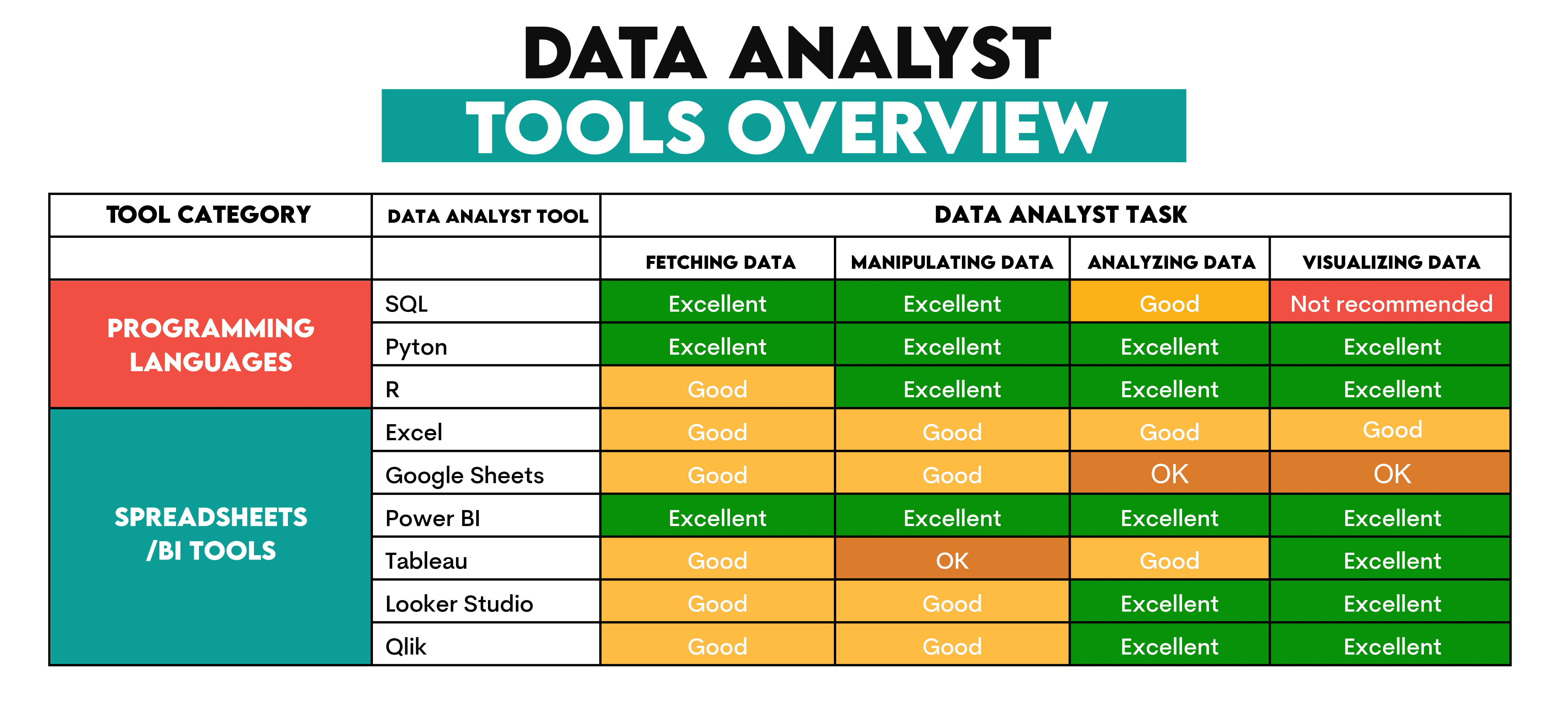
Most tools I’ll discuss can do everything data analysts do, from fetching and manipulating data, to analyzing and visualizing it.

Of course, they’re not equally good at all those tasks. So, I tried to rank their use in the overview below. This should help you understand when to use what tool.
Tools for Data Analysts

In the broadest sense, the data analyst tools can be categorized into programming languages and spreadsheets/BI tools.

Programming Languages

1. SQL

Use: Fetching, manipulating, analyzing data

Description: SQL is the ultimate master in querying data saved in relational databases. It’s specifically designed for extracting and manipulating data and making changes to data (such as inserting, updating, or deleting) directly in the database. It’s designed for precisely that purpose, and it fulfills it brilliantly!

It’s also quite good at analyzing data. However, it can show its limitations compared to the programming languages below.

2. Python

Use: Fetching, manipulating, analyzing, visualizing data

Description: Python is a general-purpose language, a darling of data scientists and data analysts. It’s relatively easy to learn and has plenty of specific-purpose libraries for data analysis tasks.

Data analysts typically write Python code in Jupyter Notebook directly or through the services such as Google Colab or Anaconda. There are also some other similar tools, such as Sage Maker, which is nothing but Amazon’s version of Jupyter Notebook.

Using notebooks means you can code and view your code’s output step-by-step. This is much easier than the traditional coding in IDEs and code editors.

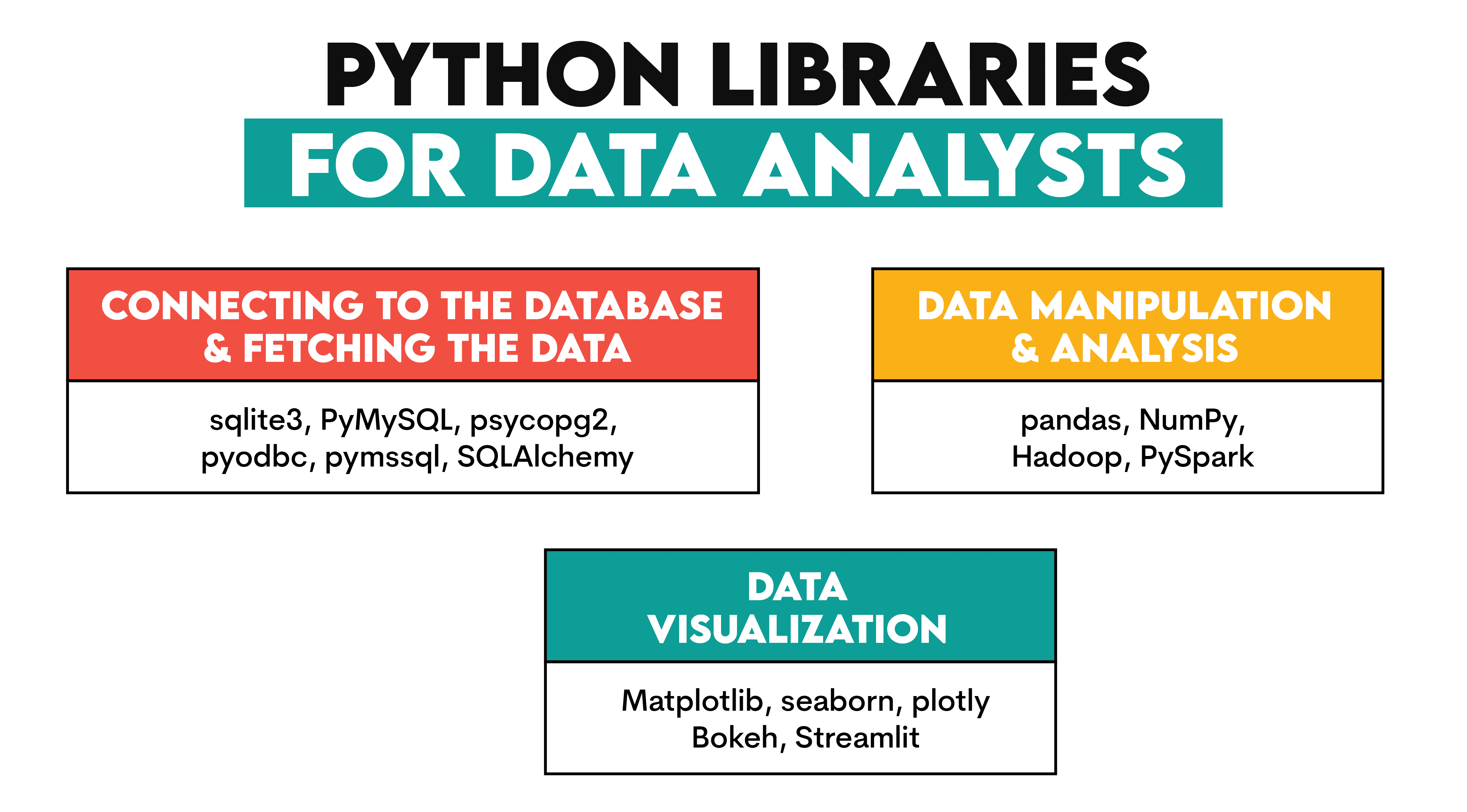
What makes Python so flexible is a wide range of libraries for different purposes.
Tools for Data Analysts

With Python, you can connect to a database and fetch the data via various toolkits:

  • sqlite3 – A built-in Python library for accessing databases.
  • PyMySQL – A Python library for connecting to MySQL.
  • psycopg2 – An adapter for the PostgreSQL database.
  • pyodbc & pymssql — Python driver for SQL Server.
  • SQLAlchemy – The database toolkit for Python and object-relational mapper.

It also has excellent libraries designed specifically for data manipulation and analysis:

  • pandas – For manipulating and analyzing data using data structures such as DataFrames and Series
  • NumPy – For mathematical operations and working with arrays.
  • Hadoop – For faster processing of big data, with data analysis usually done via Apache Pig or Apache Hive
  • PySpark – For big data processing and analysis at enterprises.

Regarding the data visualization, commonly used Python libraries are:

  • Matplotlib – A plotting library offering some basic but not too beautiful 2D visualizations.
  • seaborn – A fancier library for making much sexier visualizations.
  • plotly – For interactive visualizations.
  • Bokeh – For interactive visualizations.
  • Streamlit – For creating interactive web applications.

3. R

Use: Fetching, manipulating, analyzing, visualizing data

Description: R is a programming language designed for statistical analysis and visualization. So, yes, it’s great at those two tasks. But do not worry; it can also fetch and manipulate data.

Data analysts don’t use it that often – SQL and Python are usually enough, especially when combined – so it’s optional for you.

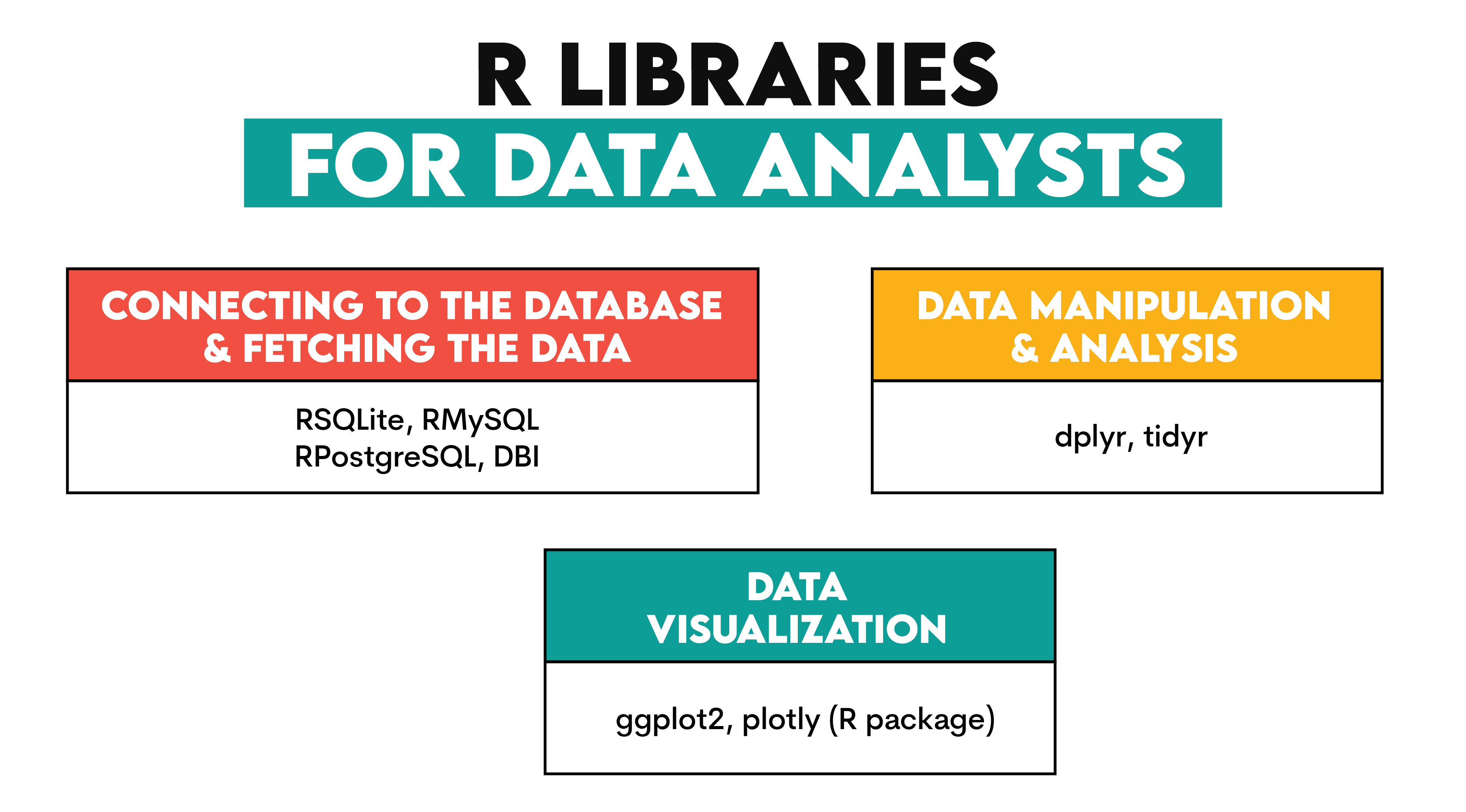
While R's library ecosystem is not as rich as Python’s, it still has some very good libraries for data analyst tasks.
Tools for Data Analysts

To query databases in R, you have these popular tools at your disposal.

  • RSQLite – An R interface for SQLite.
  • RMySQL – For accessing MySQL.
  • RPostgreSQL — For accessing PostgreSQL.
  • DBI — An R interface for connecting to databases.

The two main libraries for data manipulation and analysis in R are:

  • dplyr
  • tidyr

Finally, the standard data visualization features can be extended by:

  • ggplot2
  • plotly (R package)

Spreadsheets & Visualization Tools for Data Analysts

4. Excel/Google Sheets

Use: Fetching, manipulating, analyzing, visualizing data

Description: Be snide all you want, but Microsoft Excel is still one of the most commonly used tools by data analysts, and for a reason. It allows you to import data from external sources, including CSV and databases. Additionally, you can use Power Query to query databases directly from Excel.

Its various features and built-in formulas allow you to manipulate and do quick analysis. Excel also has visualization capabilities, where you can create quite informative graphs.

Google Sheets is a Google version of Excel and it offers similar capabilities.

5. Power BI

Use: Fetching, manipulating, analyzing, visualizing data

Description: It’s quite similar to Excel. You can think of it as Excel on steroids. It does everything Excel does, only on a more sophisticated level. This is especially so when it comes to data manipulation, analysis, and visualization.

Power BI allows you to model, manipulate, and analyze data using drag-and-drop and the DAX and M languages. As a BI tool, it excels at data visualization dashboards.

Since it’s a Microsoft product, Power BI integrates well with other Microsoft products, such as Azure, Office 365, and Excel.

6. Tableau

Use: Visualizing data

Description: Tableau is marketed as a BI and analytics software, so this is what it does. However, I think it especially shines when it comes to data visualization. You can make attractive and interactive visualizations and do so easily by using Tableau’s drag-and-drop interface.

7. Looker Studio

Use: Fetching, manipulating, analyzing, visualizing data

Description: This is (now) a Google tool, part of Google Cloud. It’s particularly well suited for data analysis and visualization. Its unique feature is the use of the LookML language for data modeling. This data analyst tool easily integrates with other Google Cloud services and big data tools in general.

8. Qlik

Use: Fetching, manipulating, analyzing, visualizing data

Description: Qlik is used by data analysts for all their typical tasks. It can connect to various data sources, so you can easily load data in the tool. Manipulating and analyzing data is unique to Qlik, as it uses the Associative Big Data Index, which makes exploring connections across different data sources much easier.

As for data visualization, Qlik is known for its interactive data visualization capabilities.

Conclusion

These eight (nine, if you count Excel and Google Sheets as two) tools are essential for every data analyst. While some are designed for a specific task within data analysis, most can do everything you need: query data, manipulate it, analyze it, and visualize it.

The tools can be conceptually divided into programming languages, and spreadsheets & BI tools. Depending on your technical skills, data at your disposal, and analysis requirements, you’ll use all or some of these tools.

But be sure you’ll need to know at least 2-3 tools, no matter where you work as a data analyst.

Nate Rosidi is a data scientist and in product strategy. He's also an adjunct professor teaching analytics, and is the founder of StrataScratch, a platform helping data scientists prepare for their interviews with real interview questions from top companies. Nate writes on the latest trends in the career market, gives interview advice, shares data science projects, and covers everything SQL.

More On This Topic

  • Using Google's NotebookLM for Data Science: A Comprehensive Guide
  • Comprehensive Guide to the Normal Distribution
  • A Comprehensive Guide to MLOps
  • NLP, NLU, and NLG: What’s The Difference? A Comprehensive Guide
  • A Comprehensive Guide to Convolutional Neural Networks
  • A Comprehensive Guide to Pinecone Vector Databases

Meet the Indian AI Startup Building a Private Perplexity for Enterprise

Meet the Indian AI Startup Building the Private Perplexity for Enterprise

There are essentially two challenges for generative AI in enterprise space. The first is that every company wants a solution based on their private data, and the second is that the data is too sensitive for companies to publish on the web. Subtl.ai started building a solution for this back in 2020.

“Microsoft has a lot of security features on top of its OpenAI offerings. But at the end of the day, it’s still a common endpoint, making it difficult for companies in the banking or sensitive data sector to rely on it,” said Vishnu Ramesh, founder of Subtl.ai, in an interview with AIM.

Ramesh calls Subtl.ai a ‘private Perplexity built on light models for enterprise’. The company started as a for-profit research company out of IIIT Hyderabad and has built a light stack, which can sit on top of the existing cloud of the enterprise customers. It remains disconnected from the internet to protect the privacy of the data.

“The main reason we started this was to check if we can actually build something like Google from India,” said Ramesh, adding that many companies such as FreshWorks have built amazing products, but can something like Google come out of India. “In 2020, the vision was to make Google private, which slowly shifted to giving people a way to talk to their documents,” he added.

“Even with Google, there is a team of 1000 people sitting on the backend and verifying all the information that goes to the users, which is a very hard thing to do for 1000 enterprise customers.” With this in mind, Ramesh went on to acquire several defence contracts to build the product.

Perplexity recently released its Perplexity Pro for Enterprise, which offers similar solutions as Subtl.ai, but customers are worried about using it. Even though it gives real-time information with access to the internet, it is yet to crack the private use case for enterprise with regards to security.

Similarly, Atlassian has released Rovo, which offers similar capabilities for enterprise customers to allow workers to access data and information from external sources along with the data held within the enterprise.

Then, what is the moat?

OpenAI also offers retrieval capabilities through its API, and the same is the case with Google and Anthropic. But the recent Amazon Q case where the information was leaked to the internet has been on the minds of enterprise AI adopters. This has made executives seek solutions that stay off the internet, but still access the private data.

This is where Subtl.ai comes in.

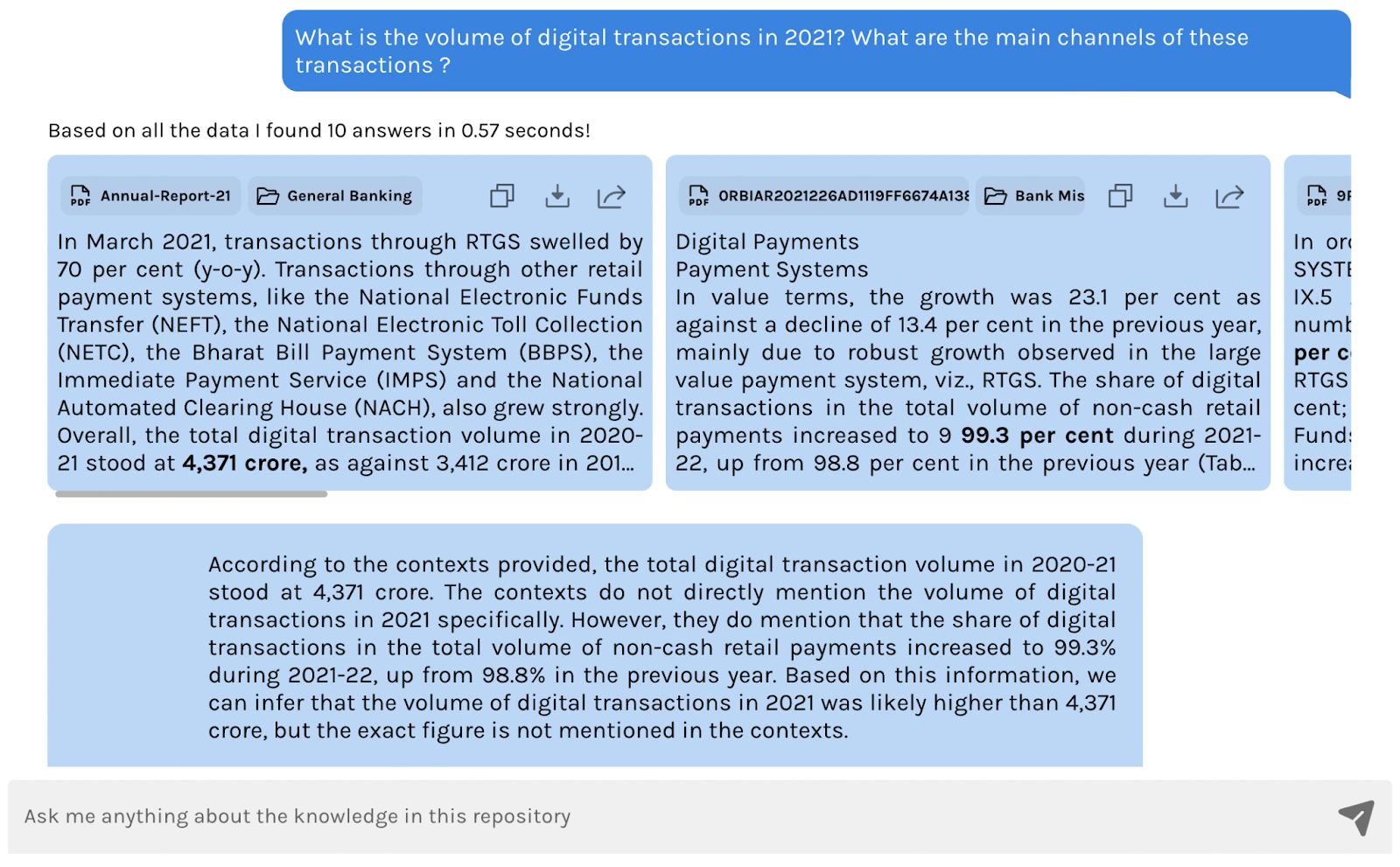
In a demo presentation of the product set to be launched this week, Ramesh showed an example of how the State Bank of India is leveraging this solution. Built on top of Llama 3 8B and Subtl.ai’s proprietary retrieval solutions, the product can access all the information of catalogues and databases that the bank trained on and can reply to simple questions citing the exact source along with a paragraph.

“What would take 3-5 business days for a simple keyword query, our offering does in less than a minute,” quipped Ramesh, about the SBI offering. He also added that most of the data for SBI were the RBI regulations, which were publicly available on the internet. It was around 40% of the solutions that SBI operators required.

“There is value in getting focus paragraphs. It’s a great user experience for the customer.”

“This is what gives us the moat,” said Ramesh, adding that other offerings which are also connected to the internet provide a link and a PDF for private data as the cited source. It makes the task to search for the exact information another added task for the users. Subtl.ai gives a paragraph from a 600-page long PDF, citing the exact source of information for quick verification.

The future and issues

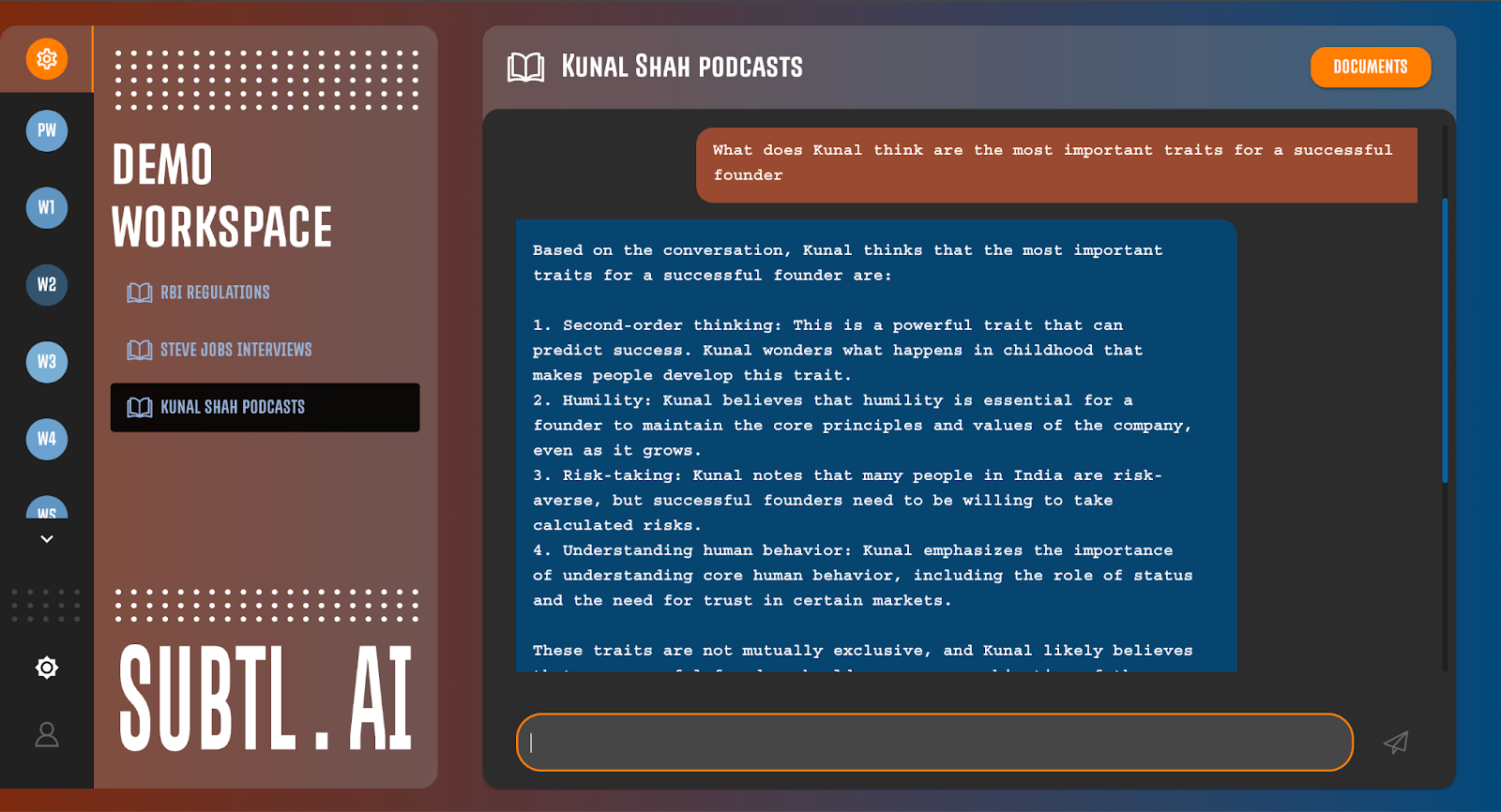
The only thing that falls short is that currently the offerings are only text based. When it comes to multimodal capabilities, Ramesh said that the data is converted to text from audios or videos and fed into the engine. In an example, he showed a video of all Kunal Shah podcasts, which were transcribed through YouTube and fed into the machine. If a user asks any question based on it, the chatbot generates the response giving the exact timestamp from the video where Shah mentioned the sentence.

Moreover, when it comes to multilingual capabilities, Ramesh said that they worked with Agastya Foundation, an NGO in Karnataka, where underprivileged kids would ask doubts in Kannada. These would be converted to English manually and fed into the system for answers.

“We are a small company and we do not have vast resources like OpenAI. But we are confident that our model can understand text and provide answers based on that. Everything else will just come around,” said Ramesh.

Ramesh narrated the story of a law firm that reached out to him for the offering. It made him curious about why someone would want the product when others are offering it. The reason is the same – giving exact information while also giving extracts from the documents, instead of PDFs and page numbers.

This also helps in reducing the hallucinations within the model as the information is being retrieved from small amounts of data sources instead of whole documents. Ramesh claims that Subtl.ai offers 75% lesser hallucination rate when compared to its competitors.

The company started with using OpenAI solutions, moved to Mistral, and now uses Llama 3 and has five models under the hood for seamless experience for its customers, with the second biggest model being only of 110 million parameters, making it very lightweight and easy for customers to integrate.

In the coming weeks, Subtl.ai plans to release the model for enterprise for free for a month and also give a private product on the internet for people to test out.

The post Meet the Indian AI Startup Building a Private Perplexity for Enterprise appeared first on Analytics India Magazine.

Fulcrum Digital’s Ryze Knocks-Down Barriers to GenAI Adoption for SMBs

Generative AI has the potential to revolutionise business operations. However, for many small and medium-sized businesses (SMBs), the high costs and complex pricing models have been major barriers to adoption.

Additionally, the lack of pricing transparency and the potential for hidden costs make it difficult to compare options and budget accordingly.

Fulcrum Digital, an IT service and enterprise AI organisation, aims to change that with its new Ryze platform and innovative bits-based pricing model. The platform uses LLMs, neuro readers, AI computing, and intelligent chatbots to automate unique business requirements and enable fine-tuning of models without coding expertise.

Fulcrum Digital’s chief AI officer, Sachin Panicker, believes that Ryze’s bits-based pricing model can help overcome barriers.

“We have incorporated an innovative approach that allows us to provide a unified experience for our customers, regardless of the data modality they are working with – be it text, images, audio, or video, and the size of it. Our cost-effective pricing is determined by the number of bits that pass through the Ryze platform,” Panicker explained in a conversation with AIM.

This approach is more granular and flexible compared to token-based pricing, allowing SMBs to better control their costs by only paying for the exact amount of data processed. It also offers more transparency and scalability, enabling businesses to start small and gradually increase their usage as they realise benefits and cost savings.

Differentiation from Similar Offerings

Platforms like OpenAI’s GPT series and Anthropic’s Claude offer general-purpose language models that may require additional fine-tuning for specific industries.

Panicker believes, “Ryze’s efficient training methodology is another standout feature. By leveraging model merging techniques like spherical linear interpolation and model soups, Ryze combines the strengths of multiple smaller pre-trained models without the need for extensive retraining from scratch” making AI more accessible to organisations with limited computational resources.

Although Hugging Face’s BigScience and EleutherAI have explored collaborative training approaches, “Ryze’s focus on efficient model merging sets it apart”.

While IBM Watson and Microsoft Azure provide industry-specific solutions, “Ryze’s comprehensive suite of capabilities under one umbrella and its seamless integration with enterprise data sources make it a compelling choice for businesses looking to adopt AI,” Panicker explained.

It is also suitable for both enterprise-scale deployments and individual projects, setting Ryze apart from platforms like IBM Watson and Microsoft Azure, which focus on enterprise customers with specific industry solutions.

Tailored Solutions for Diverse Industries

Ryze has been built with a focus on six key industries: financial services, insurance, consumer products, food tech, higher education, and e-commerce. This further sets it apart from other generative AI platforms.

Panicker observed that “enterprises had a tough time understanding how to adopt AI”. To address this, he wanted to create “a one-stop shop” that would make it “easier and faster for enterprises to adopt AI”.

The company already has several potential clients and interest from clients who were present at the launch, like PVR INOX Limited, a company in the entertainment and cinema sector; the American Urological Association, indicating a potential healthcare client; WPP Group, a major advertising and communications company and SIMERA SENSE, a satellite payload company.

Ryze has demonstrated promising results across these industries. In insurance, it has been used to “digitise redacted claims and extract data from invoices,” achieving “over 95% accuracy in classifying furniture through its engines that process images and documents”.

In financial services, Ryze powers conversational chatbots and IVRs, allowing users to ask questions in natural language. “Whatever it is, just add it, attach it to Ryze, and let Ryze work its magic,” Panicker said.

“Ryze already has text-to-speech and speech-to-text functionality. Then we build a UI out of it and deploy it as an IVR,” he further stated.

Automating menu planning based on dietary restrictions in food tech and providing product recommendations for sales and operations are other use cases.

Tech Stack

Ryze’s architecture comprises key components like computer vision, OCR, LLMs, a semantic search engine, and adjunct components such as a low-code LLM builder for interactive chatbots and an interface to select the appropriate LLM based on the query automatically.

The platform is entirely built on open-source technologies, aligning with the vision of Panicker. “The fundamental idea has been that we use open source, because I have been a big proponent of open source,” he said.

The Ryze Reader forms the foundation, handling 60% of the processing through three layers: a computer vision layer using OpenCV for enhancing document readability, an OCR layer employing Google’s Tesseract for text extraction, and an LLM layer for understanding the context of the extracted text.

“We have built a prompt engine just for the LLM layer. An English based, natural language-based prompt engine,” Panicker explained. This prompt engine allows Ryze to process any type of document seamlessly.

The structured output from the LLM layer is fed into Ryze’s semantic search engine, which employs RAG customised by Fulcrum Digital. It supports various LLMs, including OpenAI’s GPT-4, LLAMA2, SQL Coder, GenZ, DBRX, Grok, and Fulcrum’s proprietary Ryze LLM.

“We remain dedicated to constantly evaluating and integrating the newest models,” said Panicker, adding that their “configurator empowers customers to seamlessly select and deploy the LLM that best suits their unique needs, which now includes the recently added DBRX and Grok models”.

The search engine creates vectors from the enterprise’s external knowledge base and uses a native database for vectorisation to identify the most relevant information for a given query. Additionally, the platform seamlessly integrates customisable applications tailored to unique business requirements, allowing users to fine-tune models without coding expertise.

Broader Vision

While the company’s immediate vision is to continue evolving Ryze LLM and officially submit it to LLM leaderboards for wider recognition, Panicker looks to contribute to the bigger vision of making India the AI superpower.

“India has the right ingredients to be an AI superpower,” said Panicker. “With our demographic dividend, growing smartphone penetration, and initiatives like Aadhaar and UPI, we can build AI-first systems from the ground up without the limitations of legacy infrastructure.”

Panicker’s views are supported by a recent report from PEAK, which found that 84% of Indian companies use AI in some form, with 98% leveraging it for decision automation.

With India’s unique strengths, supportive policy environment, and focus on responsible development, Panicker is optimistic about the country’s AI future. “We are strategically placed to reap the benefits of AI,” he said. “The future of AI in India is much brighter than anywhere else.”

The post Fulcrum Digital’s Ryze Knocks-Down Barriers to GenAI Adoption for SMBs appeared first on Analytics India Magazine.

Is Sarvam AI the OpenAI of India?

“We’ve just started here, I don’t think we are trying to build the class of models that OpenAI is trying to build with GPT-5. If there are as many people who can use our models as OpenAI, I will be very happy,” said a camera-conscious Vivek Raghavan, the co-founder of Sarvam AI, a startup nestled in Indiranagar, the heart of Bengaluru, mirroring Starbucks.

“I would be very happy if we are as successful as OpenAI,” said Raghavan, kick-starting an exclusive interview with AIM on a humble note.

Now, OpenAI too is making its presence felt in India. The San Francisco-based company recently hired Pragya Misra, and is working with former Twitter India head Rishi Jaitly as a senior advisor to oversee the changing regulatory landscape, and facilitating talks with the government about AI policy in the country.

The Sam Altman-led company is likely to set up an office in Namma Bengaluru hopefully not in Indiranagar.

Established in July 2023, Sarvam AI was co-founded by Raghavan and Pratyush Kumar with the dire need to make generative AI accessible to everyone in India at scale.

“The intent was actually to leverage GenAI and make people’s lives better. We think this is a foundational technology, and we don’t want India to become solely a prompt engineering nation,” said Raghavan.

The duo have a strong background in AI, and have previously worked at AI4Bharat, a research initiative based at IIT Madras, which focuses on open-source Indian language AI. Raghavan has over a decade of experience at UIDAI, the entity overseeing the Aadhaar identity system in India.

Kumar, on the other hand, holds a PhD from ETH Zurich and a BTech from the Indian Institute of Technology Bombay. He was also involved in AI4Bharat, an initiative he co-founded, which is dedicated to advancing Indian language AI applications.

Last December, the company raised $41 million in its Series A funding round led by Lightspeed Ventures with participation from Peak XV Partners and Khosla Ventures. “The fact that we have been able to raise some money is actually a responsibility. It’s not an indicator of success.” Raghavan said that a significant portion of the amount has been invested in compute. He added that, in the near future, the company does not plan to raise more funds.

Small Team, Big Impact

Fifty-five-year-old Raghavan is young at heart and open to new ideas. He is currently leading a lean team of 25 members, in the age group of 25-30.

“Frankly, I never thought that I would be doing this at this age, but I’m very excited that I am,” said Raghavan. He shared that he got interested in deep learning 7-8 years ago while working for Aadhaar, where he worked with Transformer-based models.

“At this stage, our team consists of about 25 people, and we don’t plan on growing too large, maybe 30-40 at most,” Raghavan said about Sarvam AI’s team size.

Moreover, he believes there is no dearth of AI talent in India. “If you look at generative AI papers globally, you will see that a significant percentage of them are authored by Indians anyway,” he said.

OpenAI, on the other hand, is run by a bunch of ‘oldies’, with an average age of 35-40, and currently has about 500 employees. A majority of AI engineers at OpenAI happen to be Indians, with the country being the second largest market for them after the US.

OpenAI vs Sarvam AI

When OpenAI and other startups in the West are targeting AGI, Raghavan isn’t even thinking about it. “I don’t think much about AGI and those kinds of things. I think about how human lives can get easier,” he said.

He added that the countries that use generative AI are the ones that will benefit the most.

Meanwhile, when Altman visited India, he didn’t mention even once that OpenAI would build models for India. Disappointingly, no substantial discussions took place regarding the establishment of an office, fostering local talent and startups, or developing future models for Indian languages and use cases.

While Sarvam AI is leveraging its advantage with Indic datasets and building for India, OpenAI is still figuring out the legal aspects and complex language dynamics in the country. Sarvam AI is definitely a step ahead.

Last year, Sarvam AI open sourced OpenHathi, an Indic Hindi LLM built on top of Llama 2. Raghavan wasn’t sure about the exact number of downloads for the model. He explained, “It was more about offering something for users in the ecosystem to play and experiment with.”

On Hugging Face, the model has been downloaded more than 18,000 times last month.

Sarvam AI recently open-sourced ‘Samvaad’, a curated dataset with 100,000 high-quality conversations in English, Hindi, and Hinglish, totalling over 700,000 turns.

He said that the company’s goal is to create an LLM from scratch, while also using existing open-source models like Mistral, Databricks DBRX, and Meta’s Llama 2. “We’re going to experiment with all the open models available. From what we’ve seen, Meta’s latest release, Llama 3, looks quite good,” he said.

Meta is also working with Sarvam AI to build vernacular LLMs.

Moreover, Raghavan believes that to be a successful generative AI startup you do not necessarily need to build LLMs from scratch. “In the end, the test is going to be about who is building things that are useful for the market and actually moving generative AI forward in India,” he said.

Meanwhile, Soket Labs AI became the first Indian AI startup to focus on building solutions to achieve AGI and beyond, alongside building small foundational models from scratch for enterprises and consumers.

Recently, SML’s Hanooman also unveiled the alpha version of a ChatGPT-like platform to Indian consumers with extensive support for various Indian languages. The company is also looking to build search capabilities in the coming months (similar to Perplexity AI). Surprisingly, the Hanooman chatbot is way better than Ola Krutrim.

Ironically, there are now three OpenAIs in India.

How is Sarvam AI Different?

Earlier this year, during Microsoft chief Satya Nadella’s visit to India, he announced a partnership with Sarvam AI, which is looking to build an Indic voice LLM. The team said that this would be released in the coming months.

“We believe that in India, people will experience generative AI through the medium of voice,” said Raghavan.

He added that it is very hard to input text in Indian languages and that in India, people tend to prefer voice communication over text. With Ola Krutrim and SML’s Hanooman also building LLMs from scratch, Raghavan said that the voice interface is going to give Sarvam AI the edge.

“We want people to do things through voice and that will be the USP of Sarvam AI,” he said.

Further, he said that Sarvam AI will be building agentic systems, allowing users to not only receive information but also take action. “I hope in the next few months we’ll see some of these things being announced and released in the marketplace,” he said.

He highlighted that this preference has numerous practical applications in the country, such as in customer support and gathering feedback, where voice-based models can efficiently handle large-scale feedback listening. “We will support 10 languages and hopefully over time we will expand it even further from that,” he said.

The post Is Sarvam AI the OpenAI of India? appeared first on Analytics India Magazine.

Mindgrove Technologies Unveils Secure IoT, India’s First High-Performance SoC for IoT Devices

Mindgrove Technologies Shashwath TR

Mindgrove Technologies, a fabless semiconductor startup supported by Peak XV Partners, has unveiled India’s inaugural commercial high-performance SoC (system on chip) dubbed Secure IoT.

The chip, based on RISC-V architecture, targets Indian Original Equipment Manufacturers (OEMs) seeking cost-effective yet feature-rich solutions for IoT devices. Priced 30% lower than competitors, Secure IoT promises advanced functionalities without compromising performance.

Designed to operate at 700 MHz, Secure IoT is a versatile microcontroller catering to a spectrum of connected devices—from wearables and smart city infrastructure to EV management systems.

Right-sizing has been the key differentiating factor when it comes to Mindgrove, giving it an edge over others, with enhanced flexibility, adaptability, security and cost-efficiency coupled with a robust support system.” said Shashwath TR, CEO and C0-Founder of Mindgrove Technologies.

Apart from chip sales, Mindgrove extends design support to domestic brands, fostering innovation and local production scale-up. This initiative aligns with India’s goal of self-sufficiency and global competitiveness in the semiconductor domain. Shashwath forecasts a substantial market potential within India and anticipates global interest in Secure IoT.

The chip has completed a successful MPW tape-out at the 28nm node, with reference boards slated for OEM evaluation shortly.

Secure IoT boasts extensive I/O capabilities, hardware-accelerated security algorithms, secure boot features, and on-chip programmable memory. Its compatibility with bare-metal code or microcontroller RTOS opens avenues in diverse sectors like traffic management, autonomous vehicles, and medical devices.

The post Mindgrove Technologies Unveils Secure IoT, India’s First High-Performance SoC for IoT Devices appeared first on Analytics India Magazine.