Top 5 Reasons Why You Must Participate in Bhasha Techathon

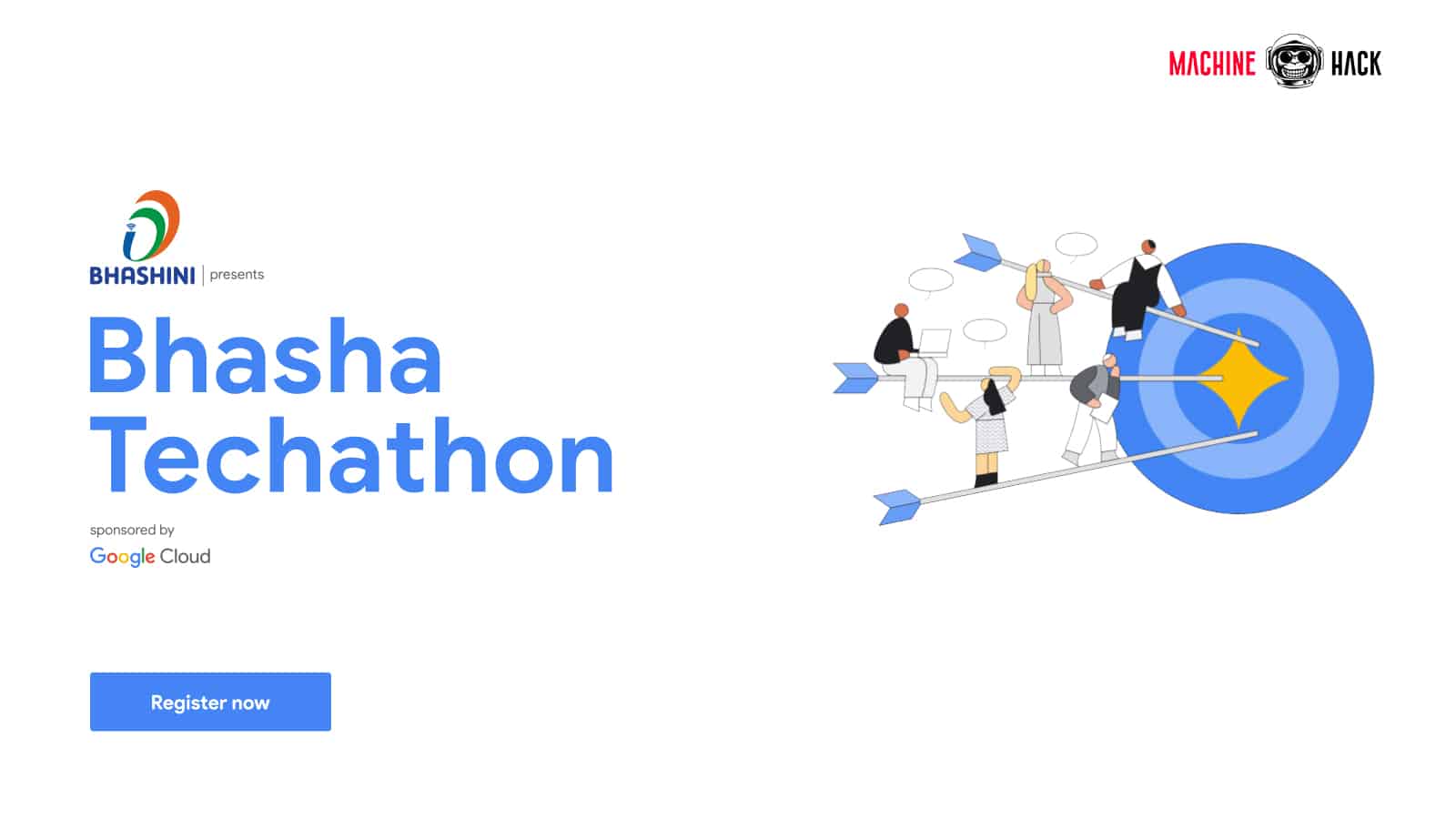
India’s most exciting hackathon, Bhasha Techathon, is organised by Machine Hack in collaboration with Digital India Bhashini Division and Google Cloud to innovate technology solutions for Indian languages.

India, a land of vibrant cultures and diverse tongues, deserves to have its rich linguistic heritage reflected in the technological landscape.

Bhashini aims to develop robust AI models that understand and process Indian languages effectively. This paves the way for a more inclusive digital world where everyone, regardless of their primary language, can access information, engage with technology, and participate in the digital economy.

Here are the five reasons why you should participate in this hackathon.

[Continue reading until the end, where you’ll find our cheat sheet] 😉

Addressing Crucial Language Challenges

Bhasha Techathon addresses six critical problem statements in NLP, ranging from voice-to-text applications to video-to-text conversions and the categorisation of complaints.

These challenges are not only technical but also highly relevant to real-world applications, providing participants with the opportunity to work on projects that have direct societal impacts, particularly in enhancing accessibility and understanding across India’s multitude of languages.

Open to All

One of the most compelling reasons to participate in the Bhasha Techathon is its inclusivity. Whether you are a student, a professional, or simply an AI enthusiast, the techathon welcomes individuals from all backgrounds. This inclusivity fosters a diverse environment where different perspectives and skills come together to innovate and solve complex problems.

Collaboration and Networking

Participants can either compete individually or as part of a team. This setup not only enhances collaboration, allowing individuals to learn from each other, but also provides a fantastic networking opportunity. Engaging with peers and industry leaders can open doors to future collaborations and career opportunities, especially as participants are invited to present their solutions to a jury of experts.

Career Advancement

The techathon is not just about winning; it’s about building and showcasing your capabilities. Participants gain hands-on experience with the latest technologies in AI and NLP, guided by the expertise of leaders from Google Cloud and MachineHack. This experience is invaluable and can significantly boost one’s career, providing exposure to practical applications of theoretical knowledge.

Recognition and Rewards

The rewards at Bhasha Techathon are substantial, with prize money offered to the top performers. However, beyond the financial incentives, participants gain recognition for their skills and innovations. This recognition can enhance their professional profile and open up further opportunities in the tech industry.

[Click here to participate now!]

[End Date: 15th May 2024]

A Cheatsheet for Bhasha Techathon Participants

Let’s break down each problem statement and provide key pointers on how to approach them:

Chatbot Assistance in Regional Languages for MOPR Users

  • Language Support: Integrate all 22 Indian scheduled languages, prioritize language selection functionality for user convenience.
  • NLP Integration: Train NLP models extensively on diverse datasets to ensure accurate understanding of queries in different regional languages.
  • Contextual Understanding: Develop algorithms that analyze user queries considering specific Panchayati Raj terminology and nuances.
  • Database Integration: Establish APIs to retrieve relevant information from Ministry of Panchayati Raj databases seamlessly.
  • User Interface Design: Design an intuitive chatbot interface with clear language selection options and instructions for users.
  • Testing and Evaluation: Conduct rigorous testing across languages, gather user feedback for continuous improvement.

Conversion of FAQs Section on the Website

  • Multilingual Support: Enable access to FAQs in all 22 Indian languages with a language selector for user preference.
  • Translation and Transliteration: Ensure accurate presentation of FAQ content using translation and transliteration techniques.
  • Interactive Chatbot: Implement language-specific interactive chatbots for real-time engagement.
  • NLP Capabilities: Integrate NLP for conversational understanding and response to user queries.
  • Search Functionality: Include language-specific search features for quick access to relevant information.
  • Multimedia Integration: Enhance FAQs with multimedia elements for enhanced user experience.

Voice to Text and Complaint Categorization through AI/ML

  • Voice-to-Text Conversion: Develop accurate voice message transcription in 22 Indian languages.
  • Text Embedding: Use techniques like Word2Vec for efficient complaint categorisation based on word relationships.
  • NLP Processing: Employ NLP for text preprocessing and feature extraction to improve complaint analysis accuracy.
  • Integration with CMS: Seamlessly integrate categorised complaints into existing systems for analysis and reporting.

Video-to-text and Complaint Categorization through AI/ML

  • Video-to-Text Conversion: Develop systems for accurate video transcription and consider multi-modal analysis for complaint understanding.
  • Complaint Categorization: Train AI/ML models to categorise transcribed text from videos using NLP techniques.
  • Embedding and NLP Processing: Utilize techniques like BERT for semantic understanding and sentiment analysis.
  • Integration with CMS: Ensure seamless integration of categorised complaints into existing systems for efficient processing.

CDSS in Multiple Indian Languages

  • CDSS Development: Create a comprehensive CDSS with multilingual support and adaptive recommendations.
  • Interface Design: Develop a user-friendly interface supporting all 22 Indian languages with customisation options.
  • Medical Terminology: Incorporate accurate medical terminology in each Indian language for precision.
  • Language-Adaptive Recommendations: Train the CDSS to deliver recommendations in chosen languages considering linguistic nuances.
  • Compliance: Ensure adherence to regulatory guidelines and standards for healthcare technologies in India.

What are you waiting for?

The Bhasha Techathon isn’t just a competition; it’s a call to action. It’s a chance to leverage your tech skills for the greater good while propelling yourself to the forefront of AI innovation. Imagine developing a language translation tool that empowers rural communities or a virtual assistant that speaks your native tongue. The possibilities are boundless!

The post Top 5 Reasons Why You Must Participate in Bhasha Techathon appeared first on Analytics India Magazine.


Cognitive Lab Introduces Tokenizer Arena for Devanagari Text

Cognitive Lab Introduces Tokenizer Arena for Devanagari Text

When it comes to building Indic language models, Tokenization has been one of the most discussed topics as it is very different for each model. Looking at this, Cognitive Lab has introduced Tokenizer Arena on Hugging Face.

The arena lets users compare different tokenizers simultaneously and is built on top of the transformer js library.

Click here to check it out.

🚨Introducing Tokenizer Arena🚨
Easily compare between different tokenizers simultaneously.
built on top of @huggingface transfomer js library pic.twitter.com/GHIzWBicYe

— Adithya S K (@adithya_s_k) May 9, 2024

The arena hosts several models such as Gemma, Mistral, all versions of Llama, GPT-3, GPT-4, Grok-1, Claude, Phi-3, and Command R.

This is ideal for developers who are trying to build Indic LLM models on top of existing open source models for tokenizing on devanagari text, which is very different from English language.

Recently, Google Researchers from India created the IndicGenBench dataset for multilingual benchmarking of different LLMs on 29 Indic languages, 13 scripts, and 4 language families.

Adithya S Kolavi, the founder of Cognitive Lab recently created the Indic LLM Leaderboard for measuring different Indic LLMs rising in the country. The team also released Ambari, the first bilingual Kannada model built on top of Llama 2.

The Indic LLM Leaderboard offers support for 7 Indic languages, including Hindi, Kannada, Tamil, Telugu, Malayalam, Marathi, and Gujarati, providing a comprehensive assessment platform. Hosted on Hugging Face, it initially supports 4 Indic benchmarks, with plans for additional benchmarks in the future.

The post Cognitive Lab Introduces Tokenizer Arena for Devanagari Text appeared first on Analytics India Magazine.

What is AlphaFold 3? The AI Model Poised to Transform Biology

AlphaFold 3 is an AI model developed through a collaboration between Google DeepMind and Isomorphic Labs. This groundbreaking technology, which has garnered a lot of attention over the past couple of days as deserved, has achieved an unprecedented capability – accurately predicting the structure and interactions of all life's molecules. This remarkable feat holds the potential to transform our understanding of the biological world and pave the way for profound discoveries across various fields.

Revealing the Intricacies of Molecular Structures

At its core, AlphaFold 3 possesses the remarkable ability to model the complex structures of large biomolecules that form the fundamental building blocks of life. With unparalleled precision, it can map the three-dimensional structures of proteins, DNA, RNA, and small molecules known as ligands. This comprehensive modeling capability provides researchers with an unprecedented level of insight into the molecular machinery that drives cellular processes.

Furthermore, AlphaFold 3 demonstrates a unique capability to predict chemical modifications that play a critical role in regulating cellular functions. These modifications, which can have significant implications for health and disease when disrupted, can now be studied with remarkable accuracy. By unlocking this intricate layer of molecular complexity, AlphaFold 3 opens up new avenues for understanding the intricate mechanisms that govern life's processes.

Unprecedented Accuracy in Molecular Interactions

One of the most significant achievements of AlphaFold 3 lies in its unparalleled accuracy in predicting molecular interactions. This model surpasses the capabilities of existing systems, demonstrating at least a 50% improvement in predicting the interactions of proteins with other molecule types. For certain crucial categories of interactions, AlphaFold 3 has even doubled the prediction accuracy compared to traditional methods.

What sets AlphaFold 3 apart is its ability to model entire molecular complexes holistically. As a unified model that computes these complexes as a whole, it can unify scientific insights in a way that was previously unattainable. This holistic approach allows AlphaFold 3 to provide a comprehensive understanding of how various molecules interact and fit together within the intricate molecular landscape.

By accurately predicting these interactions, AlphaFold 3 has the potential to revolutionize our comprehension of biological processes and pave the way for groundbreaking discoveries. Researchers can now explore the intricate relationships between molecules with unprecedented clarity, unveiling new insights into the mechanisms that govern cellular functions, disease pathways, and potential therapeutic interventions.

AlphaFold 3's Impact on Drug Discovery

The unprecedented accuracy of AlphaFold 3 in predicting molecular interactions has profound implications for the field of drug discovery. This model demonstrates remarkable prowess in predicting drug-like interactions, including the binding of proteins with ligands and antibodies with their target proteins – interactions that are crucial in understanding human health and disease.

Notably, AlphaFold 3 achieves an accuracy level that surpasses traditional physics-based tools for biomolecular structure prediction. It is the first AI system to outperform these methods, achieving a 50% higher accuracy than the best traditional approaches on the PoseBusters benchmark, without requiring any input of structural information.

This groundbreaking capability is particularly significant for the design of antibodies, a rapidly growing class of therapeutics. By accurately predicting antibody-protein binding, AlphaFold 3 provides invaluable insights into the human immune response, paving the way for the development of novel antibody-based treatments.

Recognizing the immense potential of AlphaFold 3 in drug design, Isomorphic Labs is collaborating with pharmaceutical companies to leverage this technology for real-world drug development challenges. By combining AlphaFold 3 with their suite of complementary AI models, Isomorphic Labs aims to accelerate and improve the success of drug design processes, unlocking new avenues for pursuing previously intractable disease targets and developing life-changing treatments for patients.

AlphaFold Server: Democratizing Access to AI-Powered Biology

To democratize access to the transformative capabilities of AlphaFold 3, Google DeepMind has launched the AlphaFold Server, a free and easy-to-use research tool for the scientific community. This platform represents the most accurate tool globally for predicting how proteins interact with other molecules within the cell.

AlphaFold Server Demo — Google DeepMindAlphaFold Server Demo - Google DeepMind
Watch this video on YouTube

With just a few clicks, biologists worldwide can harness the power of AlphaFold 3 to model structures composed of proteins, DNA, RNA, ligands, ions, and chemical modifications. By providing researchers with an accessible way to generate predictions, regardless of their computational resources or expertise in machine learning, the AlphaFold Server empowers scientists to make novel hypotheses and accelerate their workflows, fostering further innovation.

The impact of this democratization of access cannot be overstated. Experimental protein structure prediction can be an arduous and costly process, often taking the length of a PhD and costing hundreds of thousands of dollars. AlphaFold 2, the predecessor to AlphaFold 3, has already been used to predict hundreds of millions of structures, a feat that would have taken millions of researcher-years through traditional experimental methods.

Responsible Innovation and Ethical Considerations

Recognizing the far-reaching implications of AlphaFold 3, Google DeepMind and Isomorphic Labs have taken a proactive approach to ensure responsible innovation and address potential risks. They have conducted extensive assessments and consultations with over 50 domain experts, specialist third parties, and community-wide forums, spanning biosecurity, research, and industry.

This science-led approach aims to mitigate potential risks while ensuring the widespread benefits of AlphaFold 3 are shared equitably. The companies are committed to expanding educational resources, such as the free AlphaFold online course and partnerships with organizations in the Global South, to equip scientists with the necessary tools for accelerating adoption and research, including in underfunded areas like neglected diseases and food security.

Furthermore, Google DeepMind and Isomorphic Labs are actively engaging with policymakers to develop and deploy AI technologies responsibly, ensuring that the transformative potential of AlphaFold 3 is harnessed for the greater good of humanity.

Unlocking Transformative Potential for Humanity

The advent of AlphaFold 3 represents a monumental leap forward in our quest to unravel the complexities of the biological world. By providing an unprecedented window into the intricate structures and interactions of life's molecules, this revolutionary AI model holds the power to catalyze transformative discoveries across a multitude of fields. From advancing our understanding of cellular processes and disease mechanisms to accelerating drug discovery and developing resilient crops, the possibilities are vast and promising.

As researchers around the globe gain access to this groundbreaking technology through the AlphaFold Server, we stand on the precipice of a new era in biology, poised to unlock insights that could reshape our approach to addressing some of humanity's greatest challenges.

Isomorphic Labs Has the Potential to Build Multi-$100 Bn Business

Isomorphic Labs $100 billion

Google DeepMind’s co-founder and chief executive officer, Demis Hassabis, in a recent interview, said that its sister company, Isomorphic Labs, has the potential to build a business worth hundreds of billions of dollars.

“I hope to achieve both (commercial success and societal benefits) with Isomorphic and build a multi-100 billion dollar business. I think it has that potential,” said Hassabis without delving into the specific timeline.

The Alphabet-backed medtech lab, along with DeepMind, released AlphaFold 3 yesterday. The protein folding model predicts with 50% better accuracy.

“Well, if you ask me the number one thing AI can do for humanity, it will be to solve hundreds of terrible diseases. I can’t imagine a better use case for AI. So that’s partly the motivation behind Isomorphic and AlphaFold and all the work we do in sciences,” said Hassabis.

He believes that “revolutionising the drug discovery process to make it ten times faster” and more efficient and increasing the likelihood of passing clinical trials through better property prediction offers plenty of commercial value.

Future Vision

Looking towards the end of the year, Hassabis said that Google DeepMind will combine the agent systems it developed for gaming with multimodal systems into large general models that plan and achieve goals.

“So systems that are able not only to just answer questions for you, but actually plan and act in the world and solve goals and I think those are the things that will make these systems sort of the next level of usefulness in terms of being a useful everyday assistant,” he said. He further said that AI-designed drugs would probably be available in the ‘next couple of Years’

Brains Behind Isomorphic

Founded in 2021 by Hassabis, who also had a significant role even in DeepMind’s inception, Isomorphic endeavours to use AI in drug discovery and research on severe human diseases.

The brains behind Isomorphic include tech veteran Miles Congreve, serving as chief scientific officer, who contributed to the design of 20 clinical-stage drugs and co-invented Kisqali (Ribociclib), a marketed breast cancer treatment.

Also noteworthy is Sergei Yakneen‘s contribution, who is the chief technology officer with over two decades of expertise in engineering, machine learning, product development, and life sciences and medicine research.

The company recently announced key partnerships with two of the world’s largest pharmaceutical companies — Eli Lilly & Co. and Novartis AG. The deals are said to have a combined value of close to $3 billion.

The post Isomorphic Labs Has the Potential to Build Multi-$100 Bn Business appeared first on Analytics India Magazine.

Isomorphic Labs Would be Worth $100 Bn

In a recent interview, Google DeepMind’s co-founder and chief executive officer, Demis Hassabis, said that its sister company, Isomorphic Labs, has the potential to be worth $100 billion without specifying a timeline.

When asked about the chances of commercialisation of the products eventually, he confidently said, “I hope to achieve both (commercial success and societal benefits) with Isomorphic, you know, build a multi-, you know, 100 billion dollar business. I think it has that potential,”

The Alphabet-backed medtech lab, along with DeepMind, released AlphaFold 3 yesterday. The protein folding model predicts with 50% better accuracy.

“Well,if you ask me the number one thing AI can do for humanity, it will be to solve, you know, hundreds of terrible diseases. You know, I can’t imagine a better use case for AI. So that’s partly the motivation, you know, behind Isomorphic and Alpha Fold and all the work we do in sciences,” said Hassabis, adding that he

He believes that “revolutionising the drug discovery process to make it ten times faster” and more efficient, and increasing the likelihood of passing clinical trials through better property prediction, offers plenty commercial value.

Future Vision

Looking towards the end of the year, Hassabis said that Google DeepMind along with Isomorphic Labs will combine the agent systems they developed for gaming with multimodal systems into large general models that plan and achieve goals.

“So systems that are able not only to just, you know, answer questions for you, but actually plan and act in the world and solve goals, you know, and I think those are the things that will make these systems sort of the next level of usefulness in terms of being a useful everyday assistant,” he commented. The researched told that AI-designed drugs would probably be available in‘Next Couple of Years’

Brains Behind Isomorphic

Founded in 2021 by Hassabis, who also had a significant role even in DeepMind’s inception, Isomorphic endeavors to use AI in drug discovery and research on severe human diseases.

The brains behind Isomorphic include tech veteran Miles Congreve, serving as chief scientific officer, who contributed to the design of 20 clinical-stage drugs and co-invented Kisqali (Ribociclib), a marketed breast cancer treatment.

Also noteworthy is Sergei Yakneen‘s contribution, who is the chief technology officer with over two decades of expertise spanning engineering, machine learning, product development, and research in life sciences and medicine.

The company recently announced key partnerships with two of the world’s largest pharmaceutical companies — Eli Lilly & Co. and Novartis AG. The deals are said to have a combined value of close to $3 billion.

The post Isomorphic Labs Would be Worth $100 Bn appeared first on Analytics India Magazine.

OpenAI Introducing Media Manager Tool in India Could Hurt Ola Krutrim’s Ego

OpenAI Introducing Media Manager Tool in India Could Hurt Ola Krutrim’s Ego

OpenAI recently announced its plans to develop a new tool called Media Manager. The tool enables creators and content owners to specify how their work is used in machine learning research and training AI models. The tool is designed to respect these choices and is expected to be released by 2025.

The catch is that this new tool will be of great help to OpenAI in collecting Indic data and building GPT models and could also hurt many Indian AI startups. This includes Ola Krutrim, SML Hanooman, and others, which have barely bloomed and are struggling to onboard users onto its platforms.

Recent statistics reveal that ChatGPT has amassed over 180 million users globally, with India emerging as its second-largest market. India accounts for 9.08 % of the total user base, which comes to approximately 14 million users. Neither Ola Krutrim nor Hanooman are anywhere close and are busy playing the so-called Indian ‘culture’ card.

That also explains why OpenAI recently hired Pragya Misra, its first employee in India, as the government relations head to lobby the Indian government and create a safe space for OpenAI to eventually operate in the country without any hindrance.

Tumse Na Ho Payega’… Really?

“You won’t be able to do it,” when translated into English, is what Ola Krutrim chief Bhavish Aggarwal said in a recent interview, pointing to OpenAI. He boldly claimed that he aims to challenge OpenAI by proving that India can build its own foundational language models from scratch.

However, Aggarwal admitted that Krutrim needs to catch up with ChatGPT but added, “Unless the start is made, how can we move ahead?”

Most recently, he also claimed that he wants Krutrim to be Indian-centric and free from Western influence, to the extent that he coined a new term called ‘Pronoun Illness’. This sentiment, shared by him, is facing criticism from the developer ecosystem, which is questioning Ola’s diversity and inclusion practices.

The irony is that the entire model and the idea of starting Krutrim itself appear to have been copied from OpenAI—to the extent that it even replied to some of the users’ queries stating that it was built on top of ‘OpenAI models’, which was later rectified vaguely, and not spoken about ever since.

Many believe the company used OpenAI’s GPT-4 output to train Krutrim.

Interestingly, Ola Krutrim is currently using Databricks services to streamline data for its model, and as far as building models go, it is most likely using DBRX as well. “We have been working closely with the Databricks team to pre-train and fine-tune our foundational LLM,” said Ravi Jain, Krutrim VP.

Indic Data is All You Need

“The amount of high-quality data originally available in Indian languages is quite small,” said Vivek Raghavan, co-founder of Sarvam AI, highlighting the challenges around creating datasets for low-resource Indic languages.

Further, Raghavan said that even if you take the example like Common Crawl, which is the most common web data repository, only 0.1% of the text is in Hindi, and other Indian languages are even lower than that,” he added.

Pratyush Kumar and Vivek Raghavan, the founders of Sarvam AI, have previously worked with another homegrown AI venture, AI4Bharat, which is building Indic language datasets like IndicVoices.

Similarly, Tech Mahindra, which is developing its own Hindi LLM ‘Project Indus’ consisting of 539 million parameters and 10 billion Hindi+ dialect tokens, sent its crew to North India to collect data.

“We went to Madhya Pradesh, Rajasthan, and parts of Bihar. The team’s task was to collect Hindi and dialect data by interacting with professors and leveraging the Bhasha-dan portal available on ProjectIndus.in,” said Nikhil Malhotra, global head at Makers Lab, Tech Mahindra and the brain behind Project Indus.

Coincidentally, similar to OpenAI’s Media Manager, Bhashini also introduced Bhashan Daan to create a large and open repository of language data in various Indian languages.

Customer-Centric, Not Ego-Centric

The only moat most Indian AI startups currently have is the plethora of Indic datasets they hoard or harness. Now, with OpenAI introducing the Media Manager tool, its presence in the country could expand multifold, alongside hindering growth for a bunch of companies building ChatGPT alternatives.

To be honest, most Indian AI startups are two years behind OpenAI or any other AI startups in the West.They have barely begun, and it is time they run a reality check and focus on developing innovative and collaborative solutions to cater to Indian consumers and enterprises instead of competing aimlessly.

India’s CTO, Nandan Nilekani, also echoed similar views recently. He said that India is not in the race to build LLMs but should focus on building AI use cases that will reach every citizen. “Winners in AI in India will be those who meet customers where they are,” he said.

In a recent interview with AIM, Sarvam AI’s Raghavan also said the same. “We’ve just started here; I don’t think we are trying to build the class of models that OpenAI is trying to build with GPT-5,” he said, sharing his company’s strategy of leveraging existing AI tools as well as in-house models to build meaningful products that impact millions of people in the country.

On the other hand, Mr Aggarwal is obsessed with competing with OpenAI and other tech giants, waging a ‘culture’ war against the West.

“Rich of you to call my post unsafe! This is exactly why we need to build our own tech and AI in India. Else we’ll just be pawns in other political objectives,” said Mr Aggarwal, over his controversial ‘pronoun illness’ LinkedIn post, and accusing them of imposing a political ideology on Indian users that’s unsafe, sinister.

The post OpenAI Introducing Media Manager Tool in India Could Hurt Ola Krutrim’s Ego appeared first on Analytics India Magazine.

“Google is Dancing to its Own Music,” says Sundar Pichai

Google’s chief, Sundar Pichai, has responded to Microsoft’s CEO, Satya Nadella’s, statement about making Google ‘dance.’ Pichai said that he is not listening to the noise and is instead focused on his own vision for Google.

“I think one of the ways you can go wrong is by listening to the noise out there and dancing to someone else’s music.” said Pichai in an interview with Bloomberg.

“I’ve always been very clear. I think we have a clear sense of what we need to do,” he added. When asked, “So you are listening to your own music?” Pichai replied, “That’s exactly right.”

For quite some time, Pichai has been under scrutiny regarding whether he is the right person to lead Google. Pichai replied, “I put a lot of chips on Google,” adding that one of the first things he did when he became CEO was to pivot Google sharply to focus on AI, as well as invest more in YouTube and Cloud to build them into big businesses.

Lately, Microsoft has significantly enhanced its Bing search engine by integrating OpenAI’s ChatGPT, which has given them a competitive edge in AI driven search capabilities. This partnership, established in 2019, has allowed Microsoft to improve Bing’s performance and market share.

Last year, Microsoft sued Google, accusing the company of using unfair tactics to maintain its dominance as a search engine. Nadella said, “At the end of the day, they’re the 800-pound gorilla in this. That is what they are. And I hope that, with our innovation, they will definitely want to come out and show that they can dance. And I want people to know that we made them dance, and I think that’ll be a great day”.

Despite these efforts, Google’s search engine continues to hold a substantial market share, estimated at around 90%, with Bing still trailing significantly behind. However, Google is facing stiff competition from Perplexity AI, as well as OpenAI, which is planning to launch its own ‘Google Search Alternative Soon.‘

The post “Google is Dancing to its Own Music,” says Sundar Pichai appeared first on Analytics India Magazine.

Using Groq Llama 3 70B Locally: Step by Step Guide

Using Groq Llama 3 70B Locally: Step by Step Guide
Image by Author

Everyone is focusing on building better LLMs (large language models), whereas Groq focuses on the infrastructure side of AI, making these large models faster.

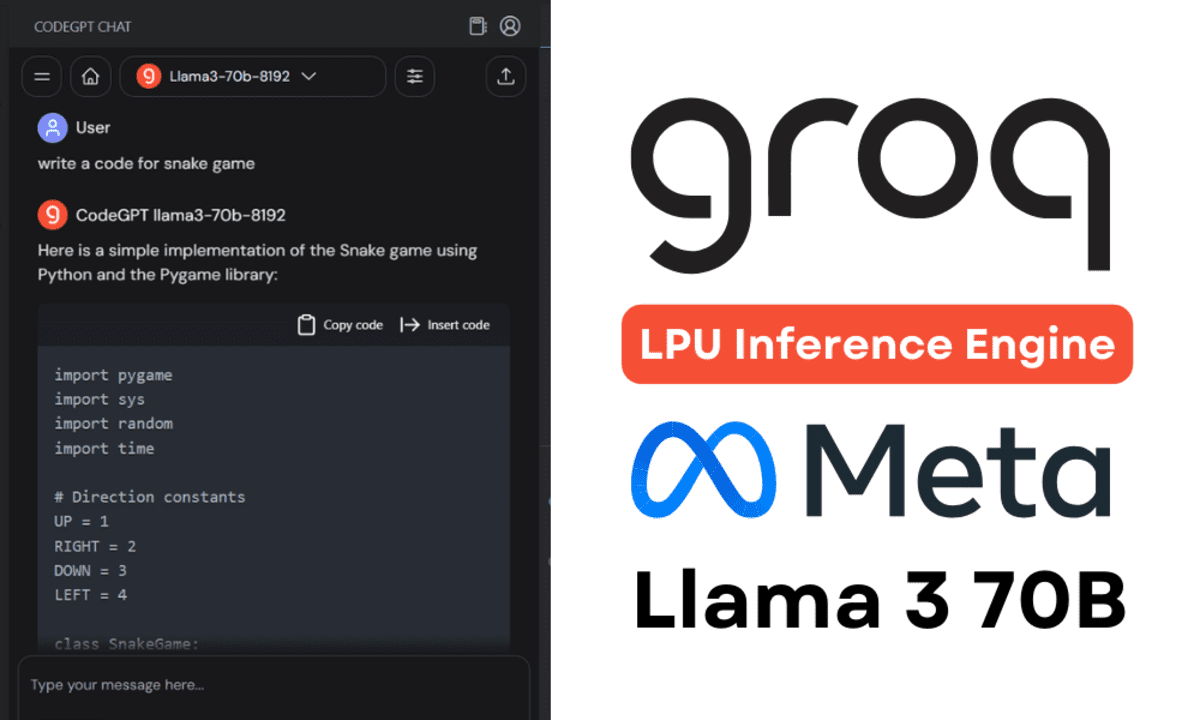
In this tutorial, we will learn about Groq LPU Inference Engine and how to use it locally on your laptop using API and Jan AI. We will also integrate it in VSCode to help us generate code, refactor it, document it, and generate testing units. We will be creating our own AI coding assistant for free.

What is Groq LPU Inference Engine?

The Groq LPU (Language Processing Unit) Inference Engine is designed to generate fast responses for computationally intensive applications with a sequential component, such as LLMs.

Compared to CPU and GPU, LPU has greater computing capacity, which reduces the time it takes to predict a word, making sequences of text to be generated much faster. Moreover, LPU also deals with memory bottlenecks to deliver better performance on LLMs compared to GPUs.

In short, Groq LPU technology makes your LLMs super fast, enabling real-time AI applications. Read the Groq ISCA 2022 Paper to learn more about LPU architecture.

Installing Jan AI

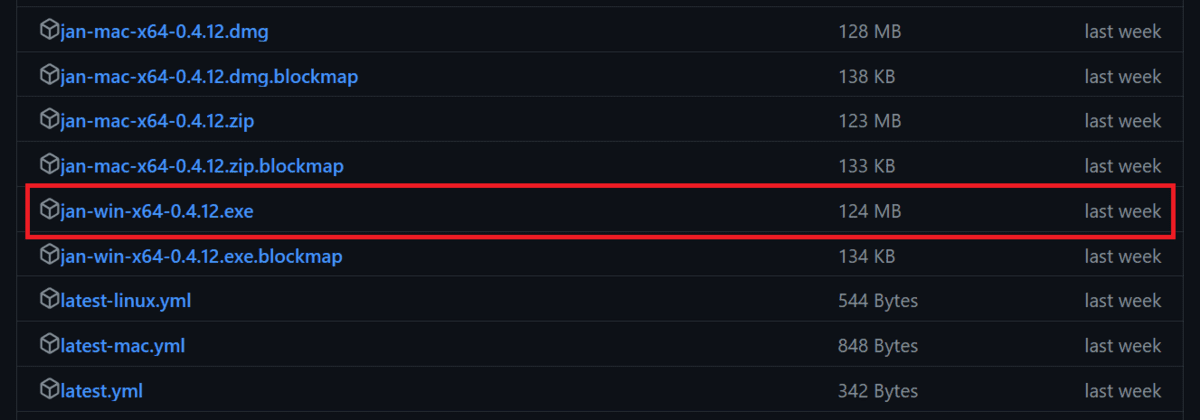
Jan AI is a desktop application that runs open-source and proprietary large language models locally. It is available to download for Linux, macOS, and Windows. We will download and install Jan AI in Windows by going to the Releases · janhq/jan (github.com) and clicking on the file with the `.exe` extension.

Using Groq Llama 3 70B Locally: Step by Step Guide

If you want to use LLMs locally to enhance privacy, read the 5 Ways To Use LLMs On Your Laptop blog and start using top-of-the-line open-source Language models.

Creating the Groq Cloud API

To use Grog Llama 3 in Jan AI, we need an API. To do this, we will create a Groq Cloud account by going to https://console.groq.com/.

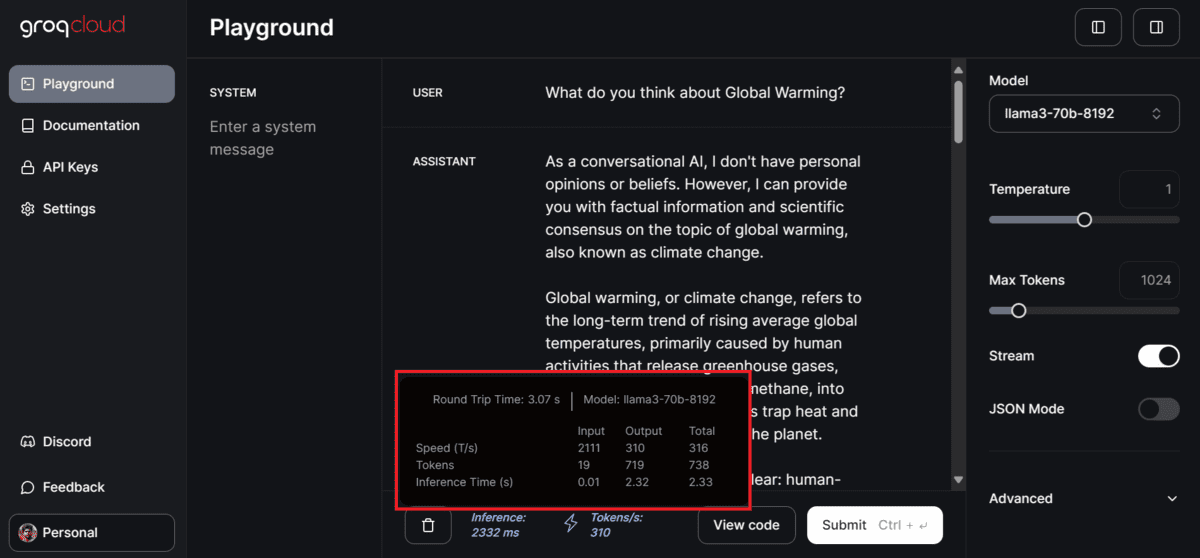
If you want to test the various models offered by Groq, you can do that without setting up anything by going to the "Playground" tab, selecting the model, and adding the user input.

In our case, it was super fast. It generated 310 tokens per second, which is by far the most I have seen in my life. Even Azure AI or OpenAI cannot produce this type of result.

Using Groq Llama 3 70B Locally: Step by Step Guide

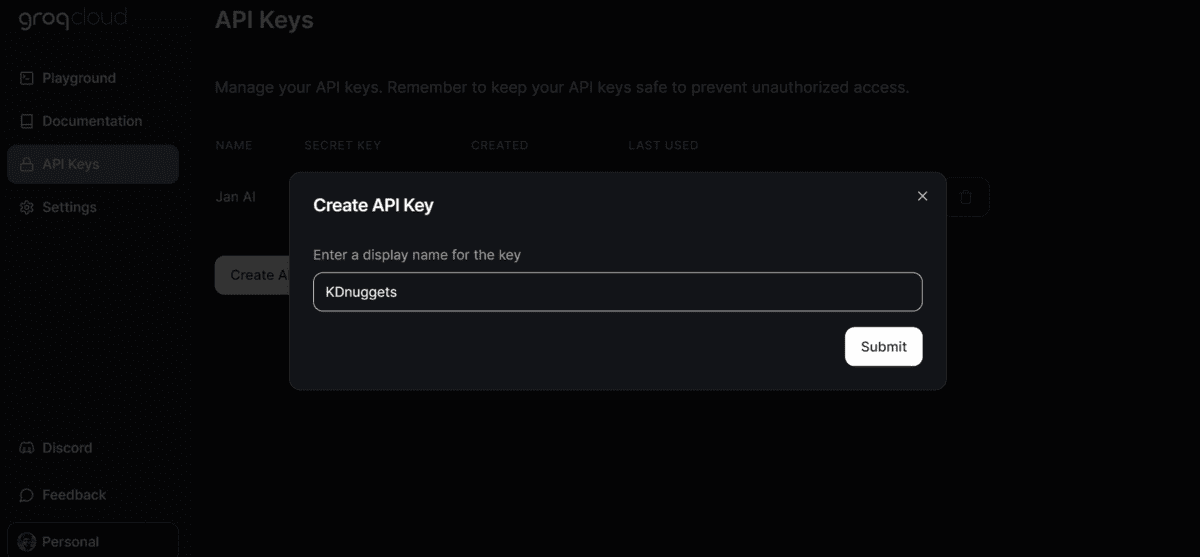
To generate the API key, click on the “API Keys” button on the left panel, then click on the “Create API Key” button to create and then copy the API key.

Using Groq Llama 3 70B Locally: Step by Step Guide

Using Groq in Jan AI

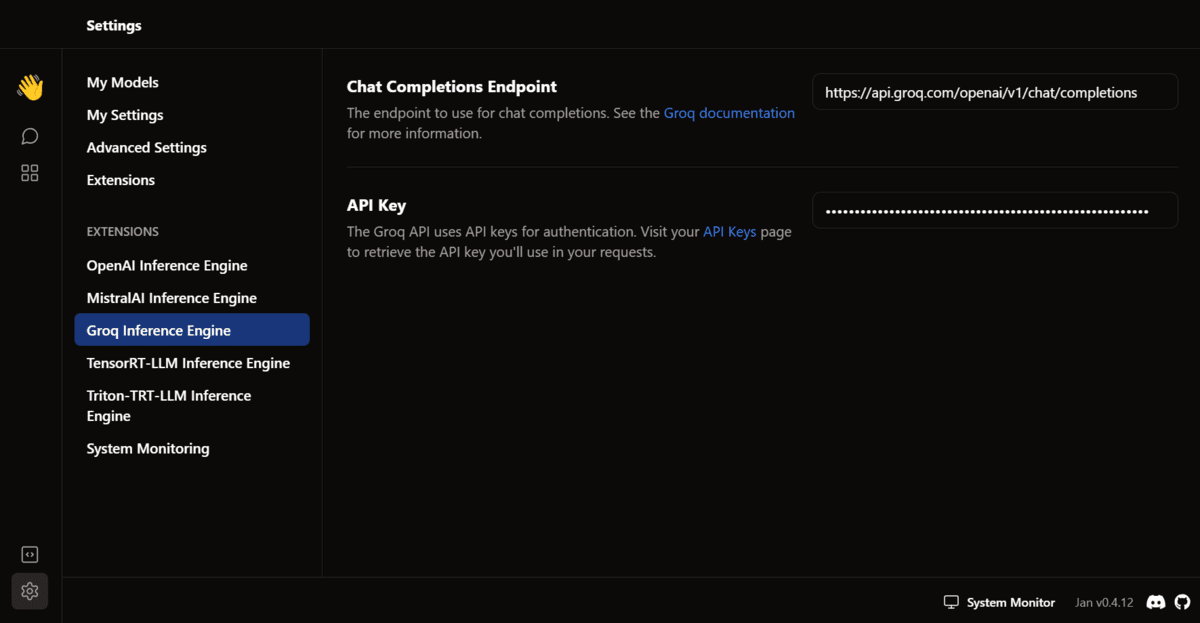
In the next step, we will paste the Groq Cloud API key into the Jan AI application.

Launch the Jan AI application, go to the settings, select the “Groq Inference Engine” option in the extension section, and add the API key.

Using Groq Llama 3 70B Locally: Step by Step Guide

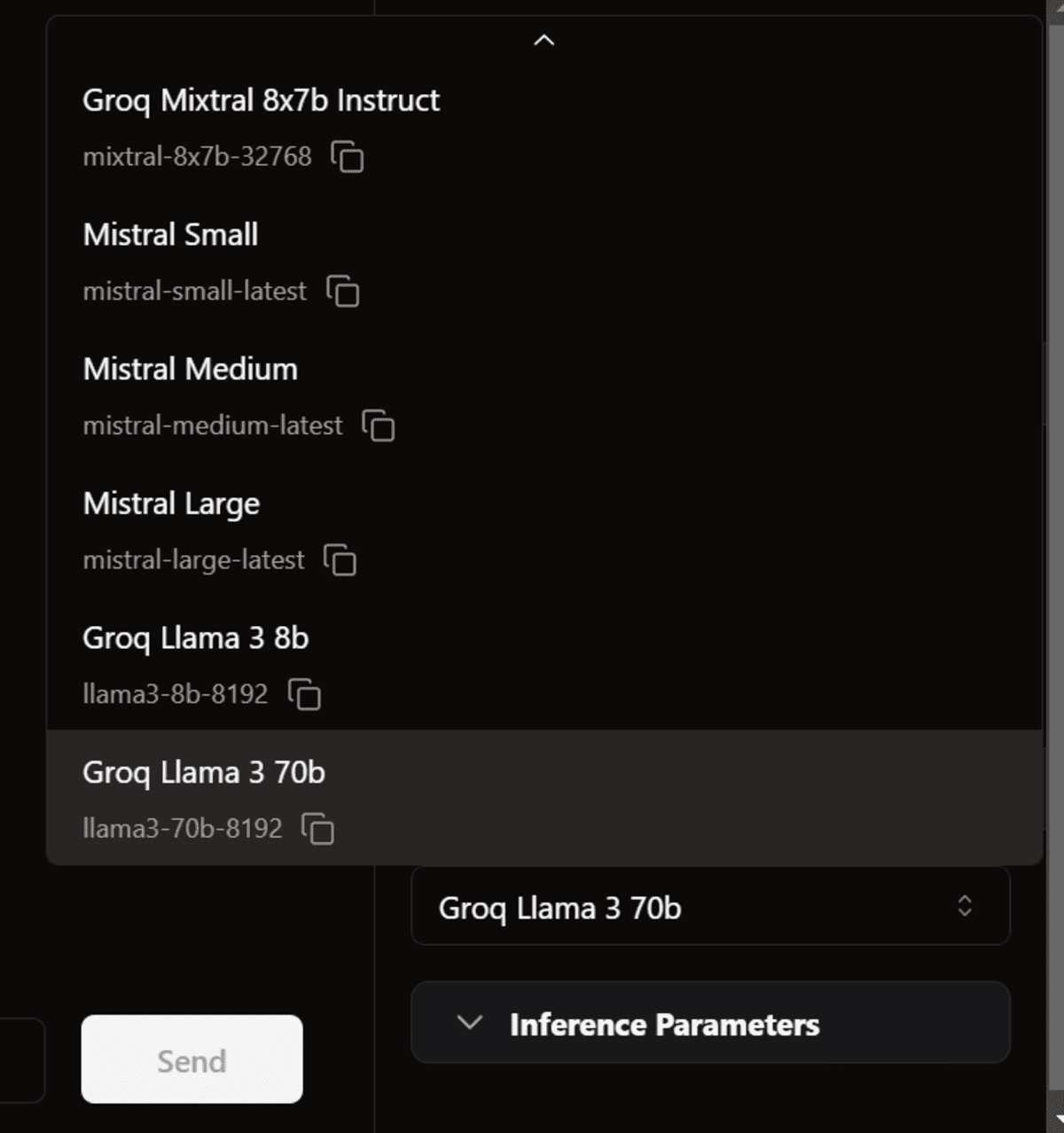
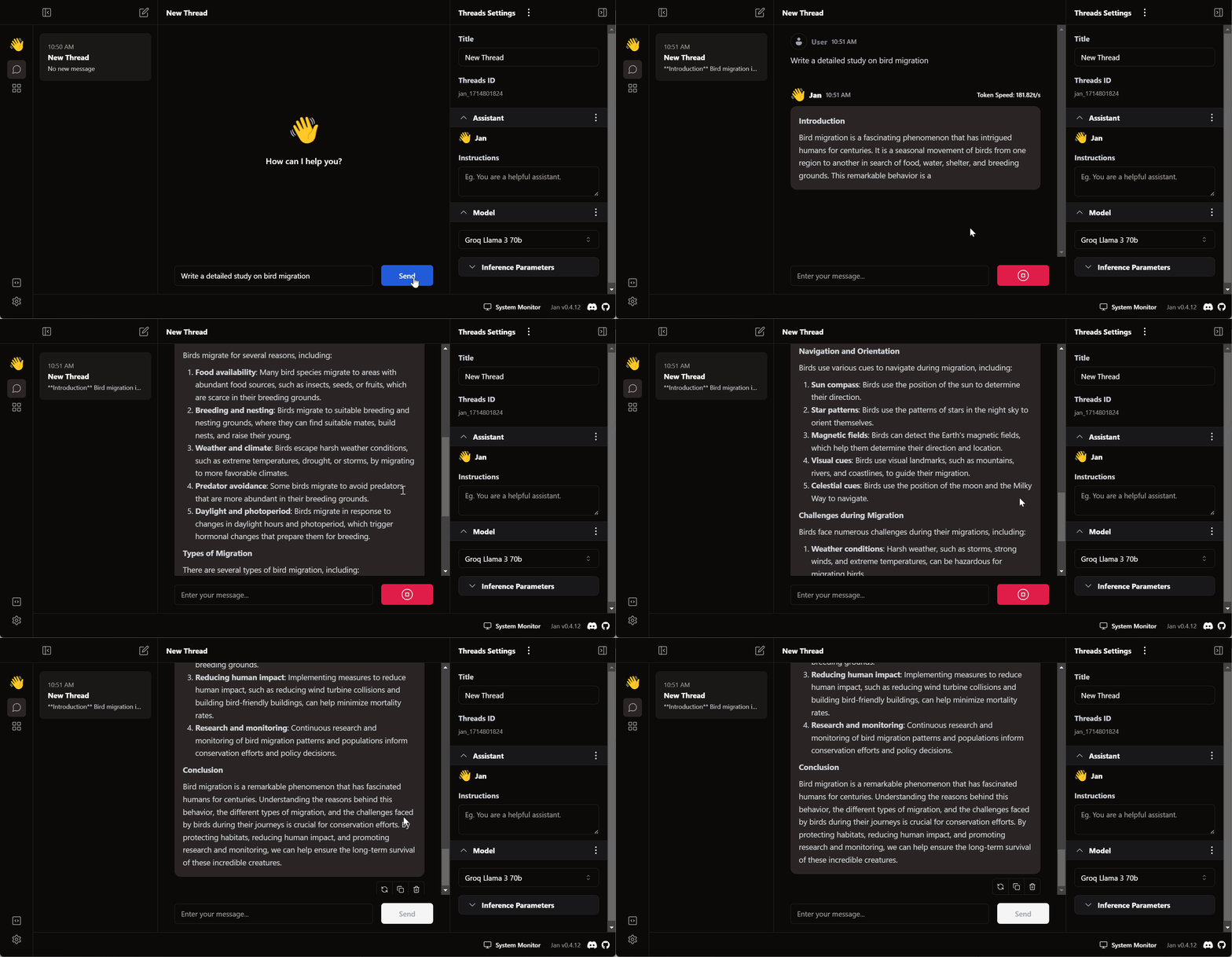
Then, go back to the thread window. In the model section, select the Groq Llama 3 70B in the "Remote" section and start prompting.

Using Groq Llama 3 70B Locally: Step by Step Guide

The response generation is so fast that I can't even keep up with it.

Using Groq Llama 3 70B Locally: Step by Step Guide

Note: The free version of the API has some limitations. Visit https://console.groq.com/settings/limits to learn more about them.

Using Groq in VSCode

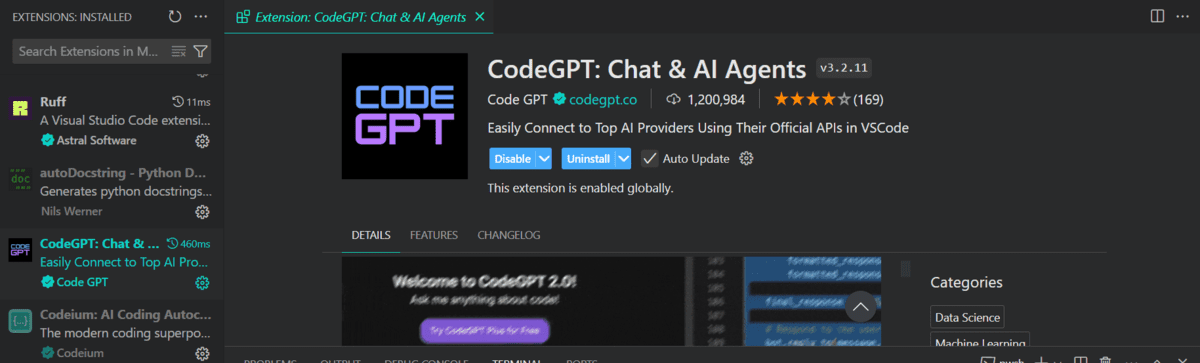
Next, we will try pasting the same API key into the CodeGPT VSCode extension and build our own free AI coding assistant.

Install the CodeGPT extension by searching it in the extension tab.

Using Groq Llama 3 70B Locally: Step by Step Guide

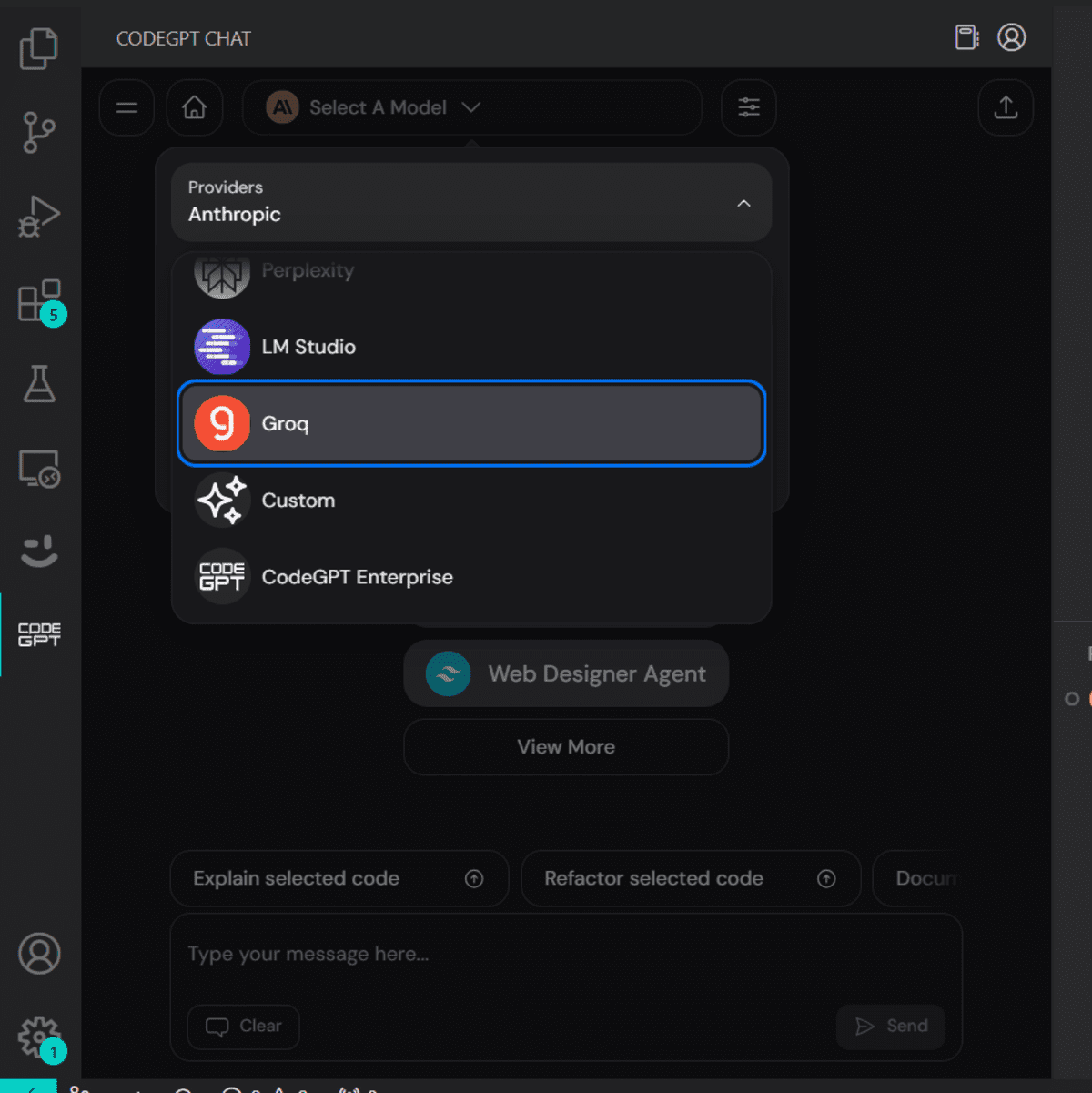
The CodeGPT tab will appear for you to select the model provider.

Using Groq Llama 3 70B Locally: Step by Step Guide

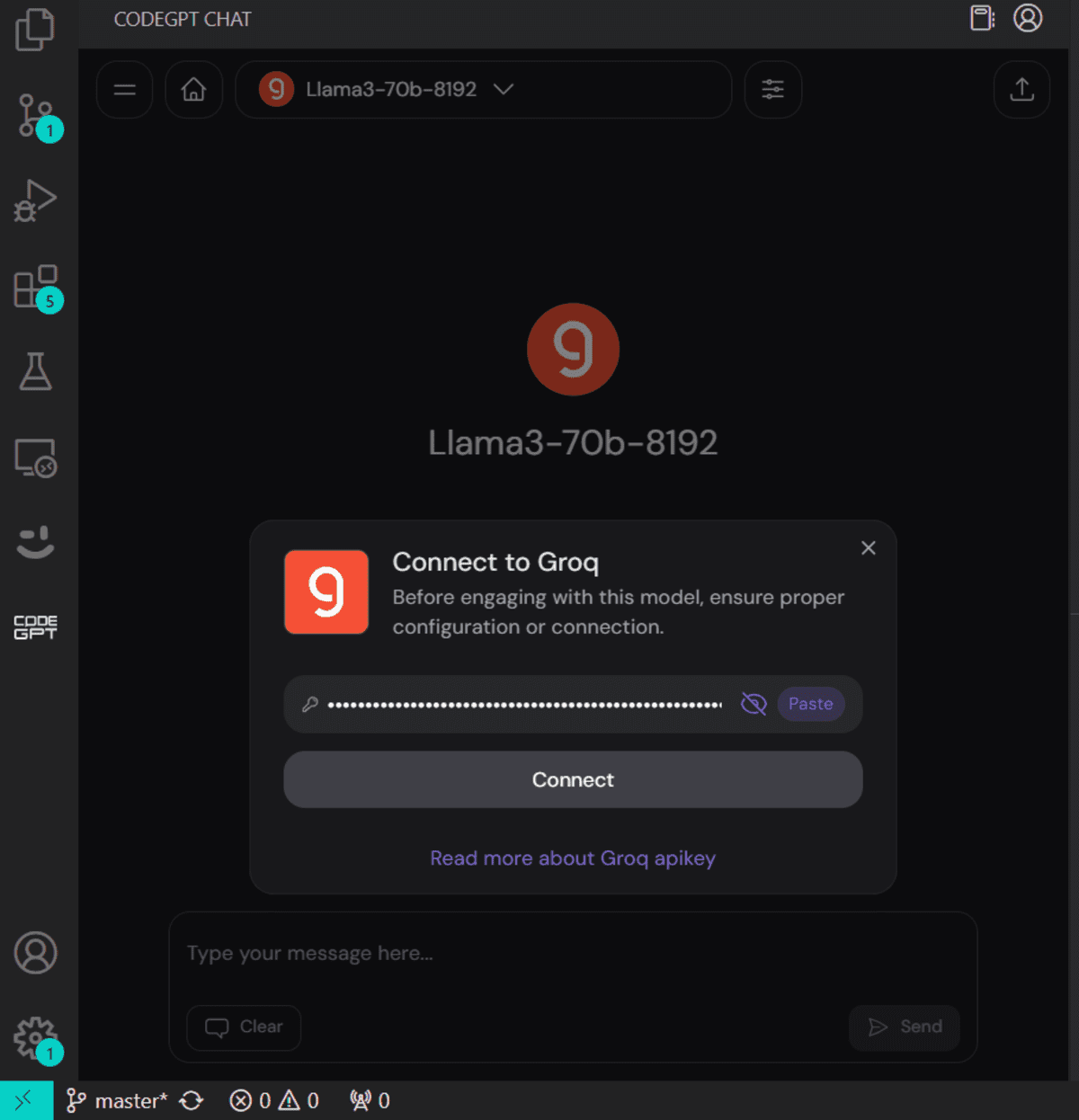
When you select Groq as a model provider it will ask you to provide an API key. Just paste the same API key and we are good to go. You can even generate another API key for CodeGPT.

Using Groq Llama 3 70B Locally: Step by Step Guide

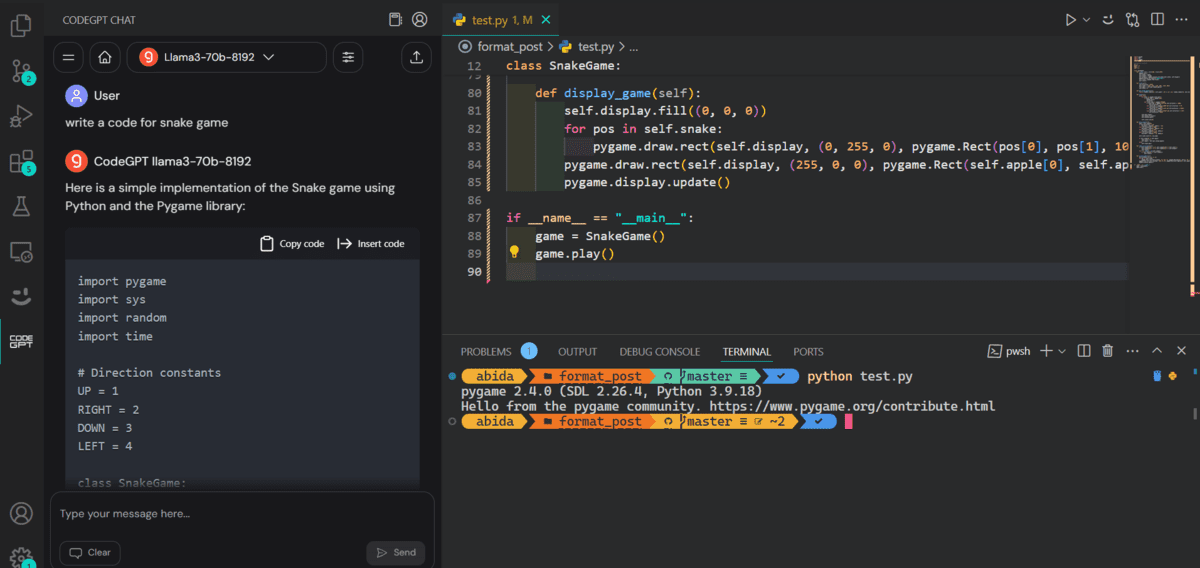
We will now ask it to write code for the snake game. It took 10 seconds to generate and then run the code.

Using Groq Llama 3 70B Locally: Step by Step Guide

Here is the demo of how our snake game is working.

Using Groq Llama 3 70B Locally: Step by Step Guide

Learn about the Top five AI Coding Assistants and become an AI-powered developer and data scientist. Remember, AI is here to assist us, not replace us, so be open to it and use it to improve your code writing.

Conclusion

In this tutorial, we learned about Groq Inference Engine and how to access it locally using the Jan AI Windows application. To top it off, we have integrated it into our workflow by using CodeGPT VSCode extensions, which is awesome. It generates responses in real time for a better development experience.

Now, most companies will develop their own Inference engineers to match Groq's speed. Otherwise, Groq will take the crown in a few months.

Abid Ali Awan (@1abidaliawan) is a certified data scientist professional who loves building machine learning models. Currently, he is focusing on content creation and writing technical blogs on machine learning and data science technologies. Abid holds a Master's degree in technology management and a bachelor's degree in telecommunication engineering. His vision is to build an AI product using a graph neural network for students struggling with mental illness.

More On This Topic

  • A Simple Guide to Running LlaMA 2 Locally
  • Step by Step Building a Vacancy Tracker Using Tableau
  • A Guide On How To Become A Data Scientist (Step By Step Approach)
  • How To Structure a Data Science Project: A Step-by-Step Guide
  • A Step-by-Step Guide to Web Scraping with Python and Beautiful Soup
  • Text-2-Video Generation: Step-by-Step Guide

‘Pronoun Illness’ is Ola’s Problem, Not India’s ‘Rich Culture’

Ola Kurtim’s chief executive and influential Indian AI leader, Bhavish Aggarwal, is unhappy. LinkedIn has taken down his post, in which he called the networking platform’s usage of non-binary gender pronouns like they/them “pronoun illness” and hoped it would not reach India.

According to the billionaire IIT-Bombay alumni, “pronoun illness” is being taught by “big city schools” and is increasingly appearing in CVs—which he clearly is not a fan of. He believes India “needs to know where to draw the line in following the West blindly!”

He did not stop there. “Most of us in India have no clue about the politics of this pronoun illness. People do it because it’s expected in our corporate culture, especially MNCs. Better to send this illness back where it came from. Our culture has always respected all. No need for new pronouns,” he added.

Aggarwal’s commentary revealed a deep-seated resistance to what he perceives as blind westernisation. Soon enough, he received widespread criticism from people debunking his old-school ideologies and LinkedIn eventually removed his post.

The lack of inclusivity and unconscious bias in the tech ecosystem aren’t new. Yet, it’s troubling and kind of embarrassing that at a time when tech giants worldwide are ramping up their DE&I initiatives, Aggarwal choses to disparage the use of pronouns – a bare minimum.

For those unaware of the gender-pronoun wave, pronouns such as “he/him”, “she/her”, and “they/them” are used in language to refer to someone in place of their name. Traditionally linked to male and female genders, these pronouns are evolving with greater awareness of gender diversity.

Many opt for pronouns that accurately represent their identity, using “they/them” as a gender-neutral option. Using chosen pronouns respects and validates personal identities, enhancing inclusivity.

“Recognising the importance of using correct pronouns isn’t just about respecting individual identities; it’s a crucial step towards fostering inclusivity and acceptance within society, ” Ruku Arora, director – enterprise business solutions (EBS) at Walmart Global Tech, told AIM. Arora identifies as queer.

Pride Month is Rainbow Washing for Ola

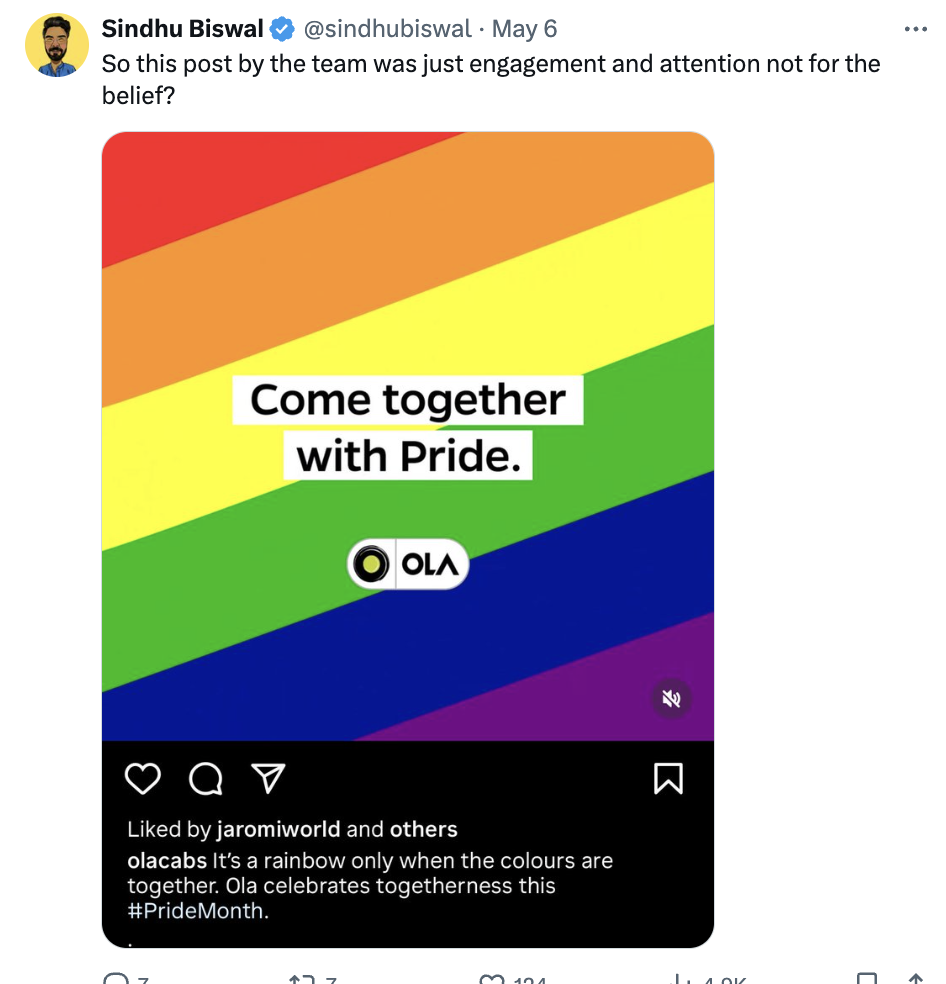
In 2024, labelling this aspect an ‘illness’ feels like a regressive step back by a century. The “illness” is actually inclusivity. This brings us to the question: Is rainbow washing during the Pride Month only a marketing gimmick for companies like Ola in India?

“It’s disgusting how Ola had put up a Pride Month post last year in June, and now the CEO himself has spewed so much hate against the community. We don’t want your performative pride posts. Really fearing for the safety of the LGBTQI+ employees working at Ola,” shared Ayden, a non-binary senior copywriter at DViO Digital.

However, this is not the first time when Ola’s work culture has come under scrutiny. Several employees have left the company, citing the bad work-life balance policies. “Being a very aggressive company, it is not everyone’s cup of tea and finding the right people is invaluable,” Aggarwal said during an interview almost 12 years ago. It looks like there has been no major shift since then.

Two years ago, a Bloomberg report stated that an employee of Ola Electric, its EV arm, was asked to run laps around the facility as punishment for a minor oversight!

The CEO, who takes pride in his “anger and frustration”, is known for fostering a toxic work environment through destructive criticism, abusive language, unrealistic deadlines, late-night meetings, and an impatient and hostile management style.

In a previous interview, Aggarwal, who described himself as a “straight shooter”, said, “I have a purpose and passion. Sometimes, in the journey of a business, people don’t align with it, and those separations are not as one wants. That sometimes leads to bitterness, and sometimes, the bitterness gets amplified.”

However, Ola does not shy away from celebrating Pride with much pomp and show every June.

The Importance of Pronouns

Using the right pronoun is the minimum respect that one can ensure to the queer community. Contrary to its creator’s beliefs, when we turned to Krutrim AI for clarity, the Indic LLM chatbot was quick to explain the situation.

“The use of gender-appropriate pronouns is important as it encourages people to be more conscious and respectful of others’ preferences. Changing one’s attitude to using gender pronouns is a two-step process – the first is to accept and acknowledge the stated gender preference, and the second is to practise using the preferred pronoun in interactions,” Ketty Avashia, executive director on the enterprise functions technology team at Wells Fargo India & the Philippines, told AIM.

Avashia, who identifies as a trans man, faced a lack of support for non-conforming identities in a culture that did not accept diversity, leading to social isolation in his early days.

“Pawns” of the “West”

“Rich of you to call my post unsafe! This is exactly why we need to build our own tech and AI in India. Else we’ll just be pawns in others’ political objectives,” said Aggarwal in a followup post about LinkedIn removing his content.

Aggarwal is leading the development of Krutrim, touted as “India’s first full-stack AI” solution. However, he wants to make it more relevant to India’s culture and heritage.

Contrary to his opinions, non-binary and trans folks have been recognised in “our” literature since ages, from mediaeval Bhakti literature to the Ramayana and Mahabharata.

“Bhavish Aggarwal, you are totally justified in being angry if your preferred pronouns are he/him and AI is using they. For a lot of people, though, who are on the gender spectrum (yes gender is a spectrum) or are nonbinary or simply do not want to reveal their gender, people prefer they/them.

“Besides, it’s a standard practice that if the gender of a person is not known, we tend to use ‘they’ nowadays. Also, please note this is not a political ideology. Trans, non-binary and people who do not identify with traditional genders have existed (on record) for thousands of years and are documented well in our literature,” noted Tanuj Kumar Kukreti, product manager at Eko.

Many saints in the Bhakti movement in India, which emphasised love and devotion to God over ritualism, expressed themselves in ways that blurred traditional gender lines. Poets like Basava and Akka Mahadevi questioned and defied the gender norms of their times. So, to break the bubble—it is not new.

“You did call pronouns as illness and it’s discriminatory to trans people. India has always been accepting of all cultures and Indian languages do have gender neutral pronouns. If you aren’t aware of it, do better and learn. Calling it a political stance and western agenda to hide transphobia will do nothing,” commented Farhana M, engineering recruiter at Atlassian.

An LLM’s performance relies heavily on the quality of the dataset used during its training. If the dataset is biassed and contains systematic distortions, lacks diversity, or misrepresents certain groups or facts, the LLM will inevitably inherit and potentially amplify these biases in its outputs.

“Diversity, or the lack thereof, in technology, isn’t merely a social issue; it profoundly impacts the functionality and accessibility of products. The tech world’s homogeneity often leads to products and services that fail to consider the diverse needs of their user base,” Brenda Darden Wilkerson, global chief executive officer, AnitaB.org, told AIM.

Krutrim is not an exception. The question is if personal biases like those of Aggarwal gets into the system, it will not make India the AI hub of innovation he wants to build.

Read more: The Struggles and Triumphs of Trans Inclusion in Indian Tech

The post ‘Pronoun Illness’ is Ola’s Problem, Not India’s ‘Rich Culture’ appeared first on Analytics India Magazine.