Zomato is Hiring for Its Generative AI Team

zomato

Indian unicorn Zomato is looking for new members to join its generative AI team.

Vaibhav Bhutani, who is working on building a central AI team for Zomato and its quick commerce business Blinkit, took to LinkedIn to share the update through an unconventional or what he calls a “clickbaity” post.

The call to action is clear: if you have built something impressive, Zomato wants to see it. Applicants are encouraged to prioritise showcasing demos of their work over simply submitting resumes.

Starting with a teaser question about Sam Altman’s daily shipments, Bhutani shifts focus, challenging readers about their future contributions using LLMs and introducing them to emergent AI companies like Jonathan Ross’s Groq and Vipul Ved Prakash’s Together AI.

Interested candidates can reach out directly by sending their demos alongside their resumes to bhutani@blinkit.com.

The expansion news comes soon after Zomato released its Q4FY24 earnings report, highlighting a robust year-over-year top-line growth of 61%, surpassing the projected outlook of 40%. This quarter also marked a milestone for Blinkit, which turned Adjusted EBITDA positive in March 2024.

According to founder and CEO Deepinder Goyal, the growth was driven by impressive increases across Zomato’s B2C businesses, with the food delivery, quick commerce, and Going-out verticals growing by 28%, 97%, and 207%, respectively.

Blinkit is planning further expansion, targeting an increase from 526 to 1,000 stores by the end of FY25.

Read more: Data science hiring process at Zomato

The post Zomato is Hiring for Its Generative AI Team appeared first on Analytics India Magazine.

5 Ways to Run LLMs Locally on a Computer 

Run LLM locally on computer

Every computer nerd wants to control how his data is collected on the internet. Apart from data privacy, there are other reasons for this, such as working in isolated software environments and being less likely to connect to the internet to run LLMs.

Sure, there are lots of open-source LLMs available these days, but they can not be directly accessed. To access, use, and modify them, one would need a platform to work with the data, and that’s where our five options come into play.

AIM tested the listed options with multiple LLMs, checking their performance on three platforms: Linux (Pop!_OS), MacBook M1, and Windows 10, including how they behaved with different LLMs, such as their response time, formatting, and UI.

Ways to Run LLMs Locally on Your Computer

  • Jan: Cleanest UI with useful features like system monitoring and LLM library.
  • Ollama: Fastest when used on the terminal, and any model can be downloaded with a single command.
  • llamafile: The easiest way to run LLM locally on Linux. No additional GUI is required as it is shipped with direct support of llama.cpp.
  • GPT4ALL: The fastest GUI platform to run LLMs (6.5 tokens/second).
  • LM Studio: Elegant UI with the ability to run every Hugging Face repository (gguf files).

Jan: Plug and Play for Every Platform

While testing, Jan stood out as the only platform with direct support for Ubuntu, as it offers a `.deb` file that can be installed with two clicks, with no terminal interaction required. Furthermore, its user interface is the cleanest among the listed options.

Also, by utilising the LLM, you can access the system monitor, which shows the total CPU and memory consumption. It uses a markdown markup language to output the answer, which means each point is well structured and highlighted, which can be quite helpful when working with programming questions.

You can also choose from a large library of LLMs, including closed-source (which requires API keys to download and use). It also lets you import LLMs, allowing you to easily load manually trained models.

To download/learn more about Jan, visit their GitHub page.

Ollama: The Fastest Way to Run LLMs Locally on Linux

Ollama running LLM locally on Linux

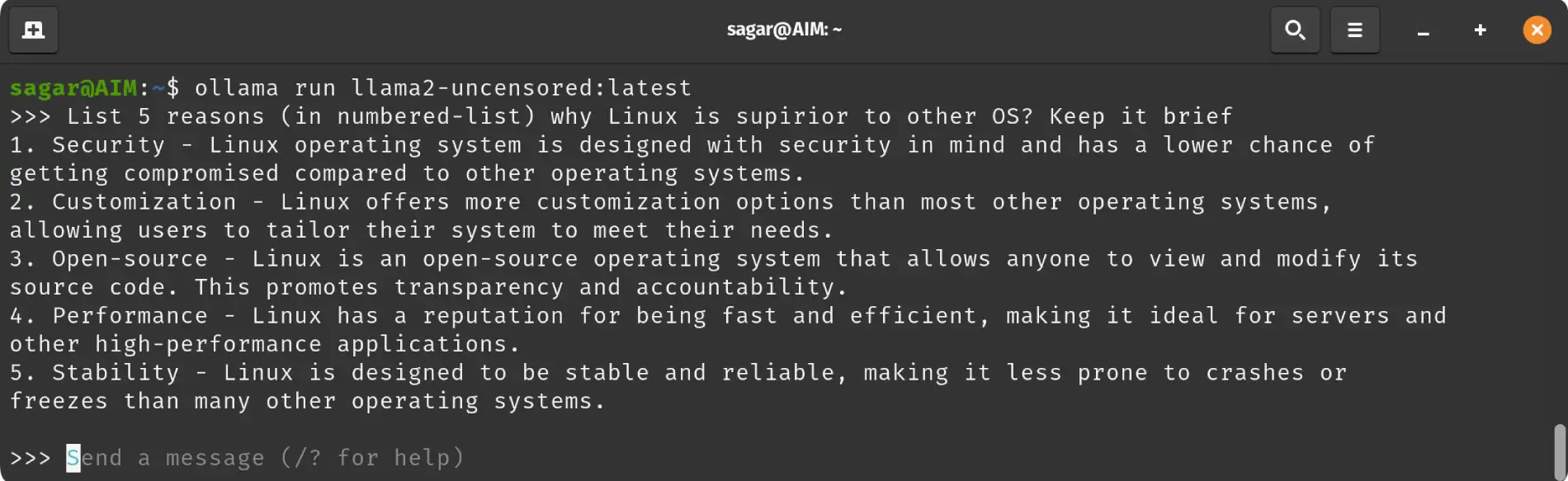
Ollama can be used from the terminal, but if you want to access the GUI, you can use the open web UI (it requires docker). We also tried Ollama on the terminal and GUI, and the response in the terminal was close to how we interact with LLMs over the internet.

This makes it the best option for someone who wants to run LLMs locally on Linux, as most Linux users will be interacting with the terminal. Besides, having access to lightning fast local LLMs directly in the terminal will be great news.

Ollama running LLM locally on Linuc
Running Ollama in Linux

Another good thing about this utility is how it manages dependencies for AMD GPUs automatically on Linux. So, you are not required to download any specific dependencies on your own, it will be taken care of automatically.

Furthermore, you can directly download LLMs with a single command. Also, you can customise the prompt with multiple parameters, such as changing temperature (to balance predictability and creativity), changing system messages, etc. Later on, you can load the custom model for fine-tuned answers.

It worked great when paired with an open web UI, but we encountered a problem when interacting with the terminal.

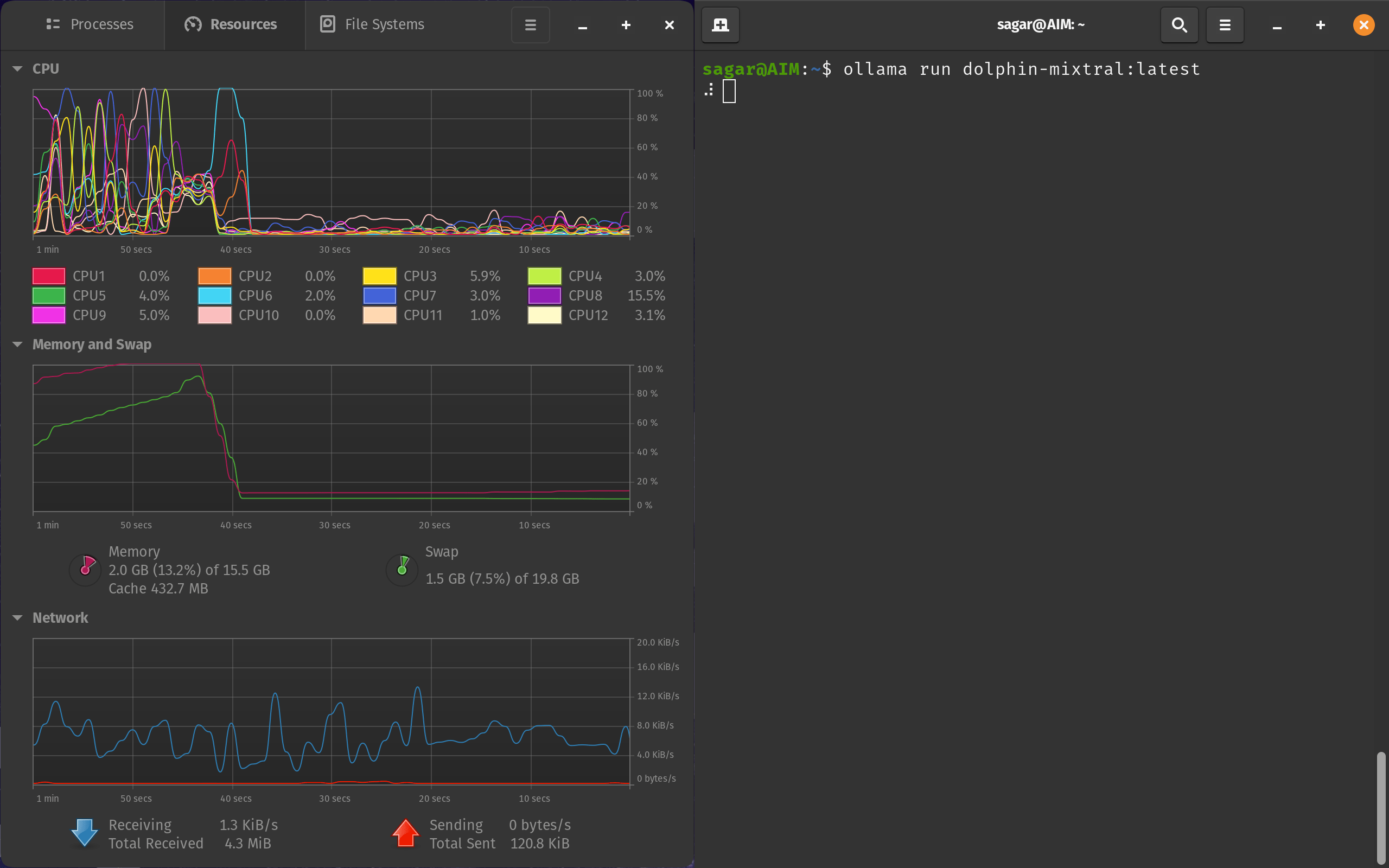
In the terminal, when you try to load a model, and, for some reason, if it does not load, it won’t show you any error message and show the loading LLM message forever.

It can be tackled by monitoring system resources while loading LLM. If you see a sudden drop in resource utilisation, it means Ollama has stopped loading LLM; you may close the terminal or stop Ollama:

Ollama can not report problem while loading a LLM
Sudden drop in system resources indicating failure while loading LLM in Ollama

You can visit Ollama’s GitHub page for installation instructions and configuration options.

llamafile: Only Option to Run Huge LLMs Locally on Mid-range Devices

Use Mixtrel 70B locally

When we started experimenting, llamafile was the only utility that let us use Mistral 70B on our laptop. Sure, it took a long time to generate, but the other options mentioned in the list simply could not load the model itself.

Unlike the other options, you have to download each model from its GitHub repository. This repository can be executed as a script, so you are not required to load the entire model in your RAM before execution.

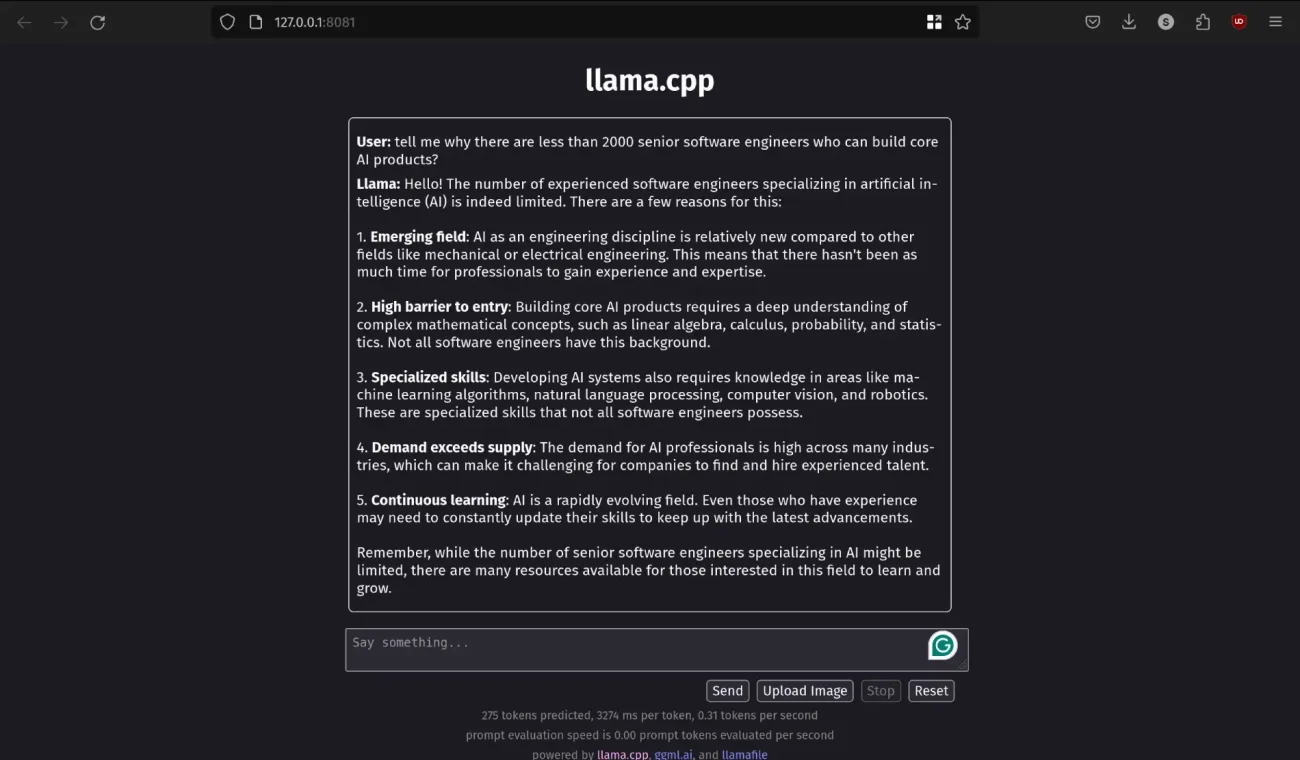
Also, you are not required to install the GUI platform manually, as it comes backed up with llama.cpp to provide you with a GUI. Besides, it is hosted locally on your browser to minimise resource consumption.

To cater to advanced users, there are many configuration options such as prompt template, temperature, Top-P and K sampling, and advanced options like how many probabilities to show and various Mirostat configuration options.

Visit llamafile’s GitHub page to download the LLM files directly.

GPT4ALL: Fastest Way to Run LLMs Locally on a Computer

Use GPT4ALL to run LLMs locally

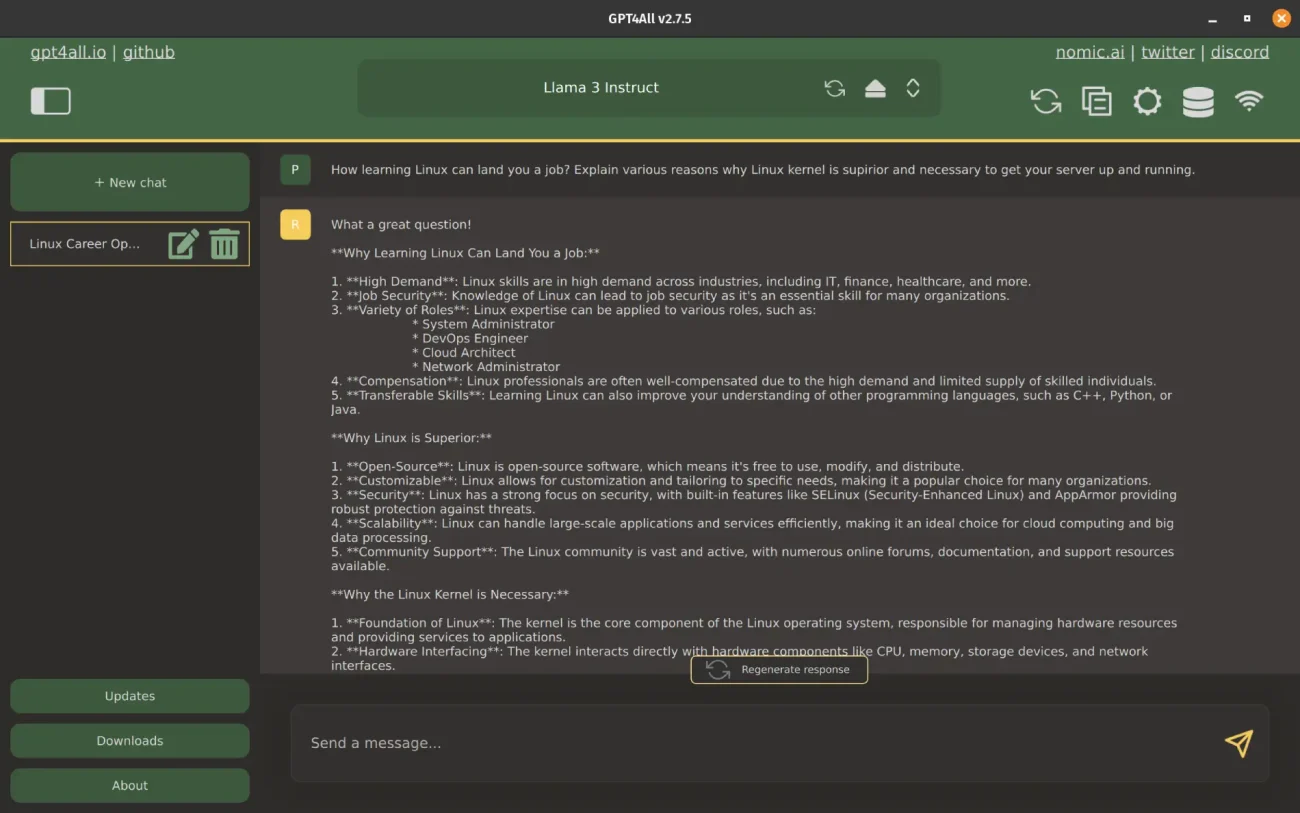
GPT4ALL was the fastest utility in our testing, giving 6.5 tokens/second. We own a mid-range computer, and it is fast for the specs we own. Sure, if you were to pair it with a high-end machine, you’d get better numbers.

Also, they provide an installer for Ubuntu, Mac and Windows for seamless installation, which is a positive thing but for Linux, it does not create a desktop icon, and you end up moving to a specific directory to launch the GPT4ALL.

It has a huge library of LLMs that you can download and run locally. But there was no way to load a locally downloaded model, so you had to rely on their offerings only. Also, it was the only utility on the list that prompts users to share their data and chat responses to improve GPT4ALL.

The only issue that we found is we were not able to use API keys to access the OpenAI GPT-4 model. Also, the user experience is cluttered as developers have added too many options.

Furthermore, the structure of the output was given in a markdown format but printed in plain text, so users end up having markdown symbols in their plain-text outputs.

Visit GPT4ALL’s homepage for further information.

LM Studio: Direct Access to Hugging Face Repository

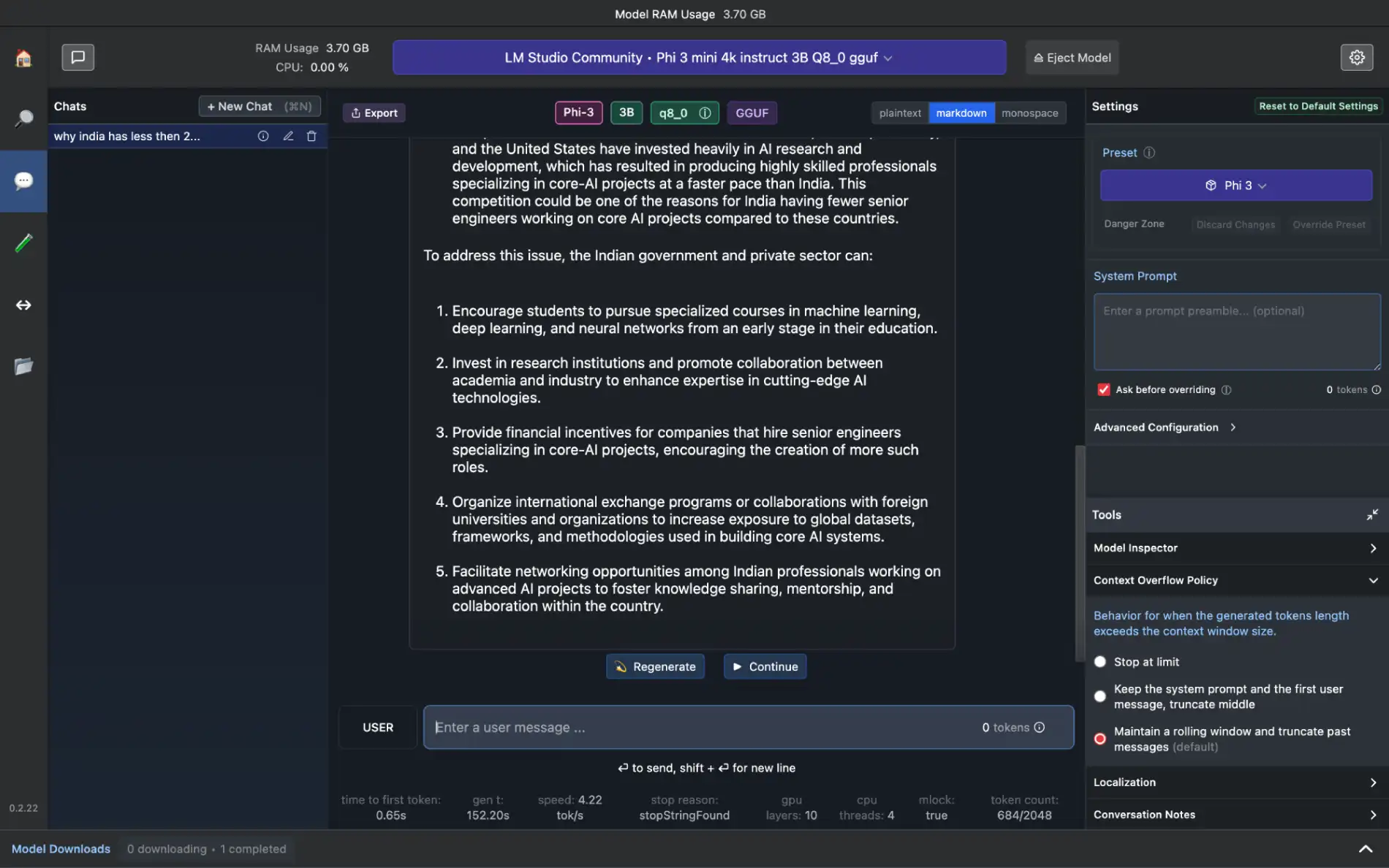
Use LM Studio to run LLM locally on computer

LM Studio was the only utility that did not work on Linux, and struggled to keep up when used on Mac. This means we were only able to use it smoothly on a Windows laptop. However, it can be different if you use different Linux distributions or a higher-spec version of Mac.

The best part is that you can load and prompt multiple LLMs simultaneously with the consult access. Also, you can access any Hugging Face repository within the LM Studio itself, and if not, you can still get the desired LLM from their large library.

Furthermore, you can use locally downloaded/modified LLMs and host an LLM on a local HTTP server.

For further information, visit LM Studio’s official webpage.

Next up, we will explore the possibilities of running LLMs locally on Android/iOS devices to help protect your privacy on the device you use the most – your smartphones.

The post 5 Ways to Run LLMs Locally on a Computer appeared first on Analytics India Magazine.

10 Free Must-Take Data Science Courses to Get Started

10 Free Must-Take Data Science Courses to Get Started
Image generated with Ideogram.ai

Are you a beginner in data science and want to start your career as a data scientist? Or have you learned them previously and need a refresher? Then, you just read the perfect article!

There are so many free Data Science courses out there, and it can take too much time and a lot of skills. So, this article will guide you in taking the right free course to optimize your learning.

What are these courses? Let’s get into it.

1. IBM: Introduction to Data Science

Before you jump into the data science field, you must understand what this field is about. With a good understanding of the work responsibilities and what the job entails, you might gain in the future.

That’s why he first must take a course that could introduce the importance of data science: the IBM: Introduction to Data Science course.

In this course, you would learn essential knowledge such as what data science definition is and what data scientists do, what tools are usually used, the necessary skills for success, and the data scientist's role in the business.

It’s a short course that would lay the foundation for your future career.

2. Introduction to Data Science for Complete Beginners

Let’s continue learning for you, and this time, a little in-depth study on the data science concept. You might have understood what data science is and how it works, but there are still some concepts you must learn.

In the Introduction to Data Science for Complete Beginners, you will learn more about the data science application, the machine learning concepts, and the difference between data science and similar data roles.

It’s also a short course that takes around a day to finish, but learn it well, and it could support your career well.

3. Introduction to Statistics

The data science field is identic with statistics. While it’s a different concept, they are closely intertwined as the statistic techniques were used in data science. It is why we need to learn statistics if we want to succeed in the data science career,

The Introduction to Statistics course by Stanford would introduce you to statistical thinking, essential for learning about data and sharing insight with others. In this course, you will learn all the basic statistical concepts such as descriptive statistics, inferential statistics, probability, resampling, regression, and many more.

It may be quite a challenging course for a beginner, but you can take it slowly, as it would help tremendously in your data science career.

4. Python for Data Science, AI & Development

Once you have a great understanding of the data science field, it’s time to plunge into the technical skills.

In the modern era, data science is now inseparable from the programming language as it allows the user to speed up the world. That’s why we would start by learning the basics of data science skills: Python programming.

Python for Data Science, AI & Development by IBM is the perfect course for you to start learning Python, which is necessary for the data science field. By learning through five different modules, you would learn all the basics, including Python fundamentals, data structures, how to work with Python for data, and API.

It’s a self-paced course that you can spend over a few weeks to get your basics on.

5. Machine Learning for Everybody – Full Course

With Python knowledge, let’s learn more about machine learning. Machine learning has become a must-use tool for data scientists to solve business problems. That is why we must understand the concept of machine learning much more.

In the Machine Learning for Everybody – Full Course by freecodecamp.org, you would learn the concept from an experienced instructor and how the model works with Python. The main takeaway is more about understanding the machine learning concept than the hands-on one, so you should focus on learning the concept.

It’s a short course you could try to finish in a day, but you should take a moment here and there to understand the course.

6. Introduction to Data Science with Python

With programming skills as a foundation, we would then learn more in-depth how to use Python for data science. In the next course, we will take Introduction to Data Science with Python from Harvard University.

This course is intended for those who want to learn more about data science but already have a minimum understanding of Python programming. It’s not a course to learn Python, but more about how to use them in data science works.

This is because many of the courses were about hands-on applications of Python in the data science field, such as using statistical learning, model development, model selection, and developing your first data science project.

If you finish this course, it could serve as your first data science portfolio.

7. Machine learning in Python with scikit-learn

The next course you should learn is Machine Learning in Python with scikit-learn from Inria. It’s a beginner course in developing your machine learning model but still requires understanding the programming and machine learning concepts.

A predictive machine learning model is an important tool for data scientists, and this course would teach you all the foundations to develop it. Using the popular library Scikit-Learn, the course would guide you on creating a pipeline, developing the best model, fine-tuning it, and evaluating it.

The course is self-paced, so you can take your time to finish them.

8. Learn SQL Basics for Data Science Specialization

Python is not the only Programming Language that data scientists should know. The importance of SQL in the data role has become even more prominent with how companies are now storing their data. This means that data scientists are expected to understand SQL for data querying.

Learn SQL Basics for Data Science Specialization from UC Davis is the right course for studying SQL, which data scientists require, as it is intended for any beginner who doesn’t have programming skills.

The course contains four modules that progressively become harder as you go on. Starting from the SQL basics, you will learn more about using SQL for data wrangling and analysis. You would also learn how to use distributed computing and end with developing your SQL project.

Going through with this course would take your career to the next level, so don’t miss it.

9. Introduction to Data Visualization

For data scientists, communicating your results to the audience is as important as the result. If you can’t make the audience understand your data science project and convince stakeholders of the importance of your project, then it’s the same as a failed project.

Data visualization is one way to present your results more aesthetically and in a much more friendly way than presenting the raw data. The Introduction to Data Visualization by Simplilearn would be a great start in learning how to visualize your data.

The course would teach you the data visualization principle, how to communicate with your visualization, and how to use several visualization tools such as PowerBI, Excel, and Matplotlib.

It’s a short course but could be effective if you learn them well.

10. Communicating Data Science Results

The last course we would learn is how to communicate, especially with the stakeholders and non-technical audiences. It’s a vital soft skill that every data scientist needs to understand as they are a part of data scientist work.

We might have our data science technical skills and excellent results, but wrong communication could lead to a disastrous project. The Communicating Data Science Results course by the University of Washington is necessary.

The course would teach you how to visualize your data results effectively, the privacy and ethics related to the data science project, and data science reproducibility with cloud computing. By learning all these skills, you could certainly be at the top of your career.

Conclusion

All the courses I have mentioned above are intended to be taken from top to bottom but feel free to take those necessary. The critical point in this article is that the free courses are a must-take because they teach you the necessary skills to survive as a data scientist.

Enjoy the process and believe that you can become a data scientist.

Cornellius Yudha Wijaya is a data science assistant manager and data writer. While working full-time at Allianz Indonesia, he loves to share Python and data tips via social media and writing media. Cornellius writes on a variety of AI and machine learning topics.

More On This Topic

  • 5 FREE Courses on AI and ChatGPT to Take You From 0-100
  • Read This Before You Take Any Free Data Science Course
  • KDnuggets News, May 4: 9 Free Harvard Courses to Learn Data…
  • How Long Does It Take to Learn Data Science Fundamentals?
  • Why Upskilling in Data Vis Matters (& How to Get Started)
  • Federated Learning: Collaborative Machine Learning with a Tutorial…

What to Expect from Google I/O 2024

What to Expect from Google I/O 2024

Google I/O 2024, the search giant’s flagship developer conference, will be held on May 14. Interestingly, it’s right on the day after OpenAI’s Spring Update, where the company is expected to announce a lot of exciting updates for developers and enterprises. And given the timing, I/O this year becomes an extremely important event for Google’s AI.

With almost every Google announcement over the past few years focussing on AI, this year’s event promises to be no different. Obviously, Gemini is likely to take centre stage, with Pixel phones also on the forefront.

Another area that Google is expected to put a lot of focus on is its Responsible AI deployment, given the recent debacle with its image generation platform Gemini creating historically inaccurate images. The company later apologised for “missing the mark” and CEO Sundar Pichai, in a recent interview, took full responsibility for it.

A lot of AI

There are reports of Google engaging in discussions with Apple to assist with generative AI features for iOS. At the same time, there are almost confirmed reports of OpenAI also partnering with Apple for similar features.

If the Apple deal materialises with OpenAI, which might happen today, or we may have to wait until Apple’s WWDC in June for further details, Google might have to devise another strategy to improve its AI game while continuing its partnership with Samsung.

Speaking of on-edge use cases, Google is also expected to announce Gemini Nano, its smallest AI model to compete with Microsoft’s Phi-3 or Meta’s Llama 3. The model has been in early access since its announcement in December 2023 and is running on Pixel 8 Pro, but it may be available for developers soon.

A developer preview of Android 15 was released last month, so Google might offer a deeper dive into its next mobile operating system, featuring deep Gemini integration. Additionally, we can expect previews of new versions of Google’s other platforms, including Wear OS, Android TV, and Android Auto, along with new AI developer tools for different OS.

One of the most important and loved features of Google’s generative AI has been on its Workspace platforms, such as Google Docs, Sheets, and others. The company has been constantly bumping up the capabilities of its products and might make further announcements about more capabilities on different platforms.

Since there are rumours that OpenAI might release its AI agents at the conference, Google is also expected to do the same. Recently, Google introduced Vertex AI Agent Builder, a platform that enables the easy creation of autonomous agents with little or no coding required.

A big focus on healthcare

Google has also found its moat in healthcare. In January, Google Research launched a new medical chatbot called AMIE, which specialises in expert-level differential diagnosis. Unlike the big tech’s previous AI models, Med-PaLM 2, which focuses on medical summaries or answering questions, AMIE serves as a diagnostic tool, generating differential diagnoses.

Meanwhile, Med-PaLM 2 is also expected to get a few updates.

Moreover in April, researchers from Google and DeepMind also developed Med-Gemini, a new family of highly capable multimodal AI models specialised for medicine. The model achieved an accuracy of 91.1%, surpassing the previous best by 4.6%. In multimodal tasks, the models outperformed GPT-4 by an average of 44.5%.

There is even a slight possibility of Google revealing an AI-developed drug at the event. Alphabet-backed Isomorphic Labs, along with DeepMind, recently released AlphaFold 3. The protein folding model predicts with 50% better accuracy.

In a recent interview, Demis Hassabis said, “Well, if you ask me the number one thing AI can do for humanity, it would be to solve hundreds of terrible diseases. I can’t imagine a better use case for AI. So that’s partly the motivation behind Isomorphic and AlphaFold and all the work we do in sciences.”

He believes that “revolutionising the drug discovery process to make it ten times faster” and more efficient and increasing the likelihood of passing clinical trials through better property prediction offers plenty of commercial value.

Hassabis said that Google DeepMind will combine the agent systems it developed for gaming with multimodal systems into large general models that plan and achieve goals.

“So systems that are able to not just answer questions for you, but actually plan and act in the world and solve goals… those are the things that will make these systems sort of the next level of usefulness in terms of being a useful everyday assistant,” he said. He further said that AI-designed drugs would probably be available in the ‘next couple of years’.

Something for developers

All these capabilities might make a big impact on Google’s integration of AI into its hardware devices at Google I/O. To up the ante with its competitors, Google’s biggest bet might also be to increase more AI models on its Google Cloud and Vertex AI platform.

According to Google’s page for the event, there are going to be several announcements about Google’s Cloud TPU and also accelerating its loads on PyTorch/XLA, which the company developed in collaboration with Meta.

Meanwhile, Google I/O 2024 promises several exciting updates and announcements for app developers. We might hear about a new version of Android Studio called Arctic Fox. This would include improvements in data security and privacy features.

New authentication methods such as face or fingerprint recognition for enhanced app security for Firebase are also expected to be announced.

Flutter, gaining popularity for cross-platform app development, might showcase a preview of Flutter 3 with support for new features in Android 15 and iOS 17, including better widgets and notifications.

When it comes to India, Google’s open-source model Gemma has been adored by developers for its Indic language capabilities. It is expected that Google may announce more updates to its AI models for building AI models in India.

All in all, it would be interesting to see how Google matches up with the announcements that OpenAI is going to make at its event.

The post What to Expect from Google I/O 2024 appeared first on Analytics India Magazine.

AIM Announced the 2nd Edition of MachineCon USA: 26th July 2024, New York

On July 26, 2024, the historic 583 Park Avenue in New York City will play host to one of the most anticipated events in the world of artificial intelligence and analytics—MachineCon USA 2024. This exclusive conference is set to bring together the brightest minds and leading figures in the AI and analytics industry, offering a unique platform for knowledge sharing, networking, and exploring the future of data-driven technologies.

MachineCon USA 2024 is more than just a conference; it is an immersive experience designed specifically for Chief Data Officers (CDOs), analytics leaders, and forward-thinking professionals from across the United States. Organized by AIM Research, a leading global analyst firm specializing in Artificial Intelligence, this event promises to be a pivotal gathering for those at the forefront of technological innovation.

Key Highlights of MachineCon USA 2024

Influential Speakers: The conference will feature an impressive lineup of speakers, including top executives from renowned companies like Mastercard, Bank of America, and Fisker. Attendees will have the opportunity to listen to insights from these industry leaders, who will share their experiences and strategies for leveraging AI and analytics within their organizations.

AI100 Awards: One of the highlights of MachineCon is the AI100 Awards, which recognize excellence and innovation in the field of artificial intelligence. This ceremony is a testament to the groundbreaking work being done by professionals in the industry and provides inspiration and benchmarks for success.

Networking Opportunities: With a curated guest list that includes the biggest names in the AI and analytics sectors, attendees will have numerous opportunities to forge valuable connections. Whether it’s during breakout sessions, cocktail receptions, or scheduled meetings, the potential for networking at MachineCon USA 2024 is immense.

Interactive Sessions and Panels: The agenda for MachineCon is carefully crafted to cover a broad range of topics relevant to today’s AI and analytics landscape. From discussions on the ethical implications of AI to workshops on the latest analytical techniques, the conference is designed to provide actionable insights and skills that attendees can take back to their teams and projects.

Exclusive Venue: The choice of 583 Park Avenue as the venue adds an element of exclusivity and prestige. Known for its stunning architecture and central location, it provides the perfect setting for an event that celebrates high achievements in technology.

Business Development: Beyond knowledge exchange, MachineCon offers its attendees a chance to explore new business avenues and collaborations. The conference is a breeding ground for ideas and partnerships that can lead to significant business transformations.

Why Attend MachineCon USA 2024?

Attending MachineCon USA 2024 is essential for anyone involved in the fields of data and analytics who wants to stay ahead of the curve in the rapidly evolving landscape of AI technologies. It is an opportunity to gain insights from leaders in the field, learn about the latest trends and technologies, and connect with peers from across the industry.

MachineCon USA 2024 is not just a conference; it’s a catalyst for innovation and growth in the AI and analytics sectors. Whether you are looking to boost your professional skills, expand your network, or gain new insights into managing and leveraging data, MachineCon is the place to be. Mark your calendars for July 26, 2024, and prepare to be part of an unforgettable gathering of the minds in the heart of New York City.

Sponsors: Amplifying Impact at MachineCon 2024

Sponsoring MachineCon 2024 offers companies a unique opportunity to showcase their brand to a curated audience of key decision-makers in the fields of data science and artificial intelligence. With a variety of sponsorship packages available, organizations can choose the level of exposure and type of engagement that best suits their needs. Whether it’s presenting at the AI100 Awards, hosting a reception, or leading a breakout session, sponsors will find themselves in a prime position to boost brand recognition and meet business objectives. This event’s multi-channel marketing campaign ensures sponsors receive maximum visibility before, during, and after the conference, amplifying their impact across the industry.

AI100 Awards: Celebrating Excellence in AI and Analytics

The AI100 Awards, a highlight of MachineCon 2024, recognize outstanding achievements in artificial intelligence and analytics. These awards celebrate the leaders and innovators who have significantly advanced the application of AI within their organizations, achieving remarkable outcomes. The nomination process is stringent, ensuring only the most deserving candidates are honored. Winners of the AI100 Awards are recognized not just for their professional achievements but also for their role in shaping the future of AI technology. The awards ceremony provides a prestigious platform for acknowledging the hard work and success of these individuals, offering them recognition among their peers and across the broader tech community.

For more information and to register, visit the MachineCon website. Join us as we explore the transformative potential of AI and set new standards for the future of analytics.

The post AIM Announced the 2nd Edition of MachineCon USA: 26th July 2024, New York appeared first on Analytics India Magazine.

Recursion’s BioHive-2, Powered by NVIDIA GPUs, Joins World’s Top 35 Supercomputers

NVIDIA has expanded its partnership with clinical-stagebiotech startup Recursion, utilising its AI supercomputer, BioHive-2, to expedite pharmaceutical research and development.

BioHive-2 integrates 504 NVIDIA H100 Tensor Core GPUs within an NVIDIA Quantum-2 InfiniBand network, achieving a staggering two exaflops of AI performance. This system is nearly five times faster than the initial BioHive-1, facilitating more efficient processing of complex biological data. The resulting NVIDIA DGX SuperPOD is nearly five times faster than Recursion’s first-generation system, BioHive-1.

Positioned at Recursion’s headquarters in Salt Lake City, BioHive-2 now ranks 35th on the Top 500 list of the world’s fastest supercomputers, marking a significant leap from its predecessor.

“Just as with large language models, we see AI models in the biology domain improve performance substantially as we scale our training with more data and compute horsepower, which ultimately leads to greater impacts on patients’ lives,” said Recursion’s CTO, Ben Mabey.

The power of BioHive-2 allows Recursion’s scientists to conduct AI-driven experiments, greatly reducing the dependency on traditional wet-lab research. By incorporating AI into workflows, the team can achieve approximately 80% of the outcomes with only 40% of the hands-on lab work.

Under the Hood

Founded in 2013 by Christopher Gibson, Recursion integrates experimental biology, bioinformatics, and artificial intelligence on a combined lab-to-cloud platform. This approach enables the identification of disease treatments that can be modelled using cellular data.

Its collaboration with global biopharma leaders, including Bayer AG, Roche, and Genentech, is supported by a vast database exceeding 50 petabytes of biological, chemical, and patient data. This repository not only enhances the training of its AI models but also speeds up the discovery and optimisation of new drugs.

One of its notable achievements includes the Phenom family of foundation models, which transforms microscopic cellular images into data models, streamlining the understanding of underlying biological processes.

Phenom models, for example, assist in discovering and improving treatments for diseases and cancers, with previous models accurately predicting COVID-19 drug candidates.

The partnership initiated in July between NVIDIA and Recursion quickly demonstrated its value.

In less than a month, using BioHive-1 and NVIDIA DGX Cloud, they analysed a vast chemical library to predict protein targets for billions of chemical compounds. Its innovations include LOWE, an AI workflow engine with a natural-language interface designed to make scientific tools more accessible, and a billion-parameter AI model built to predict molecular properties crucial in healthcare.

The shared vision between NVIDIA and Recursion emphasises AI’s transformative potential in simulating and understanding complex biological structures.

The post Recursion’s BioHive-2, Powered by NVIDIA GPUs, Joins World’s Top 35 Supercomputers appeared first on Analytics India Magazine.

Newsrooms Are (Not) Using AI Responsibly

The world of journalism is turning at Mach speed with several partnerships being forged on licensing and AI usage within the newsroom.

Last week, OpenAI partnered with Dotdash Meredith, the publisher of People magazine. The deal allows OpenAI to make use of “trusted content” from the publisher in ChatGPT, particularly to help improve the chatbot.

This is only the latest in a series of similar licensing partnerships that OpenAI has forged over the past year. As of now, OpenAI potentially has access to an entire portfolio of articles from Politico, Business Standard, Financial Times, and Associated Press, to name a few.

Meanwhile, partnerships are being established the other way around, too. Earlier this month, Bloomberg partnered with AppliedXL to make use of their AI agents to generate analyses for their Bloomberg Terminal users.

Similarly, in a survey taken by JournalismAI, around 90% of the newsrooms surveyed stated that they use AI, though mainly to fact-check, proofread and generate analyses, with end results being human-generated.

Meanwhile, Sports Illustrated has reportedly used AI to generate articles, which means that at least one major news organisation is making use of AI-generated content.

Now, the licensing deals make sense, especially in light of several publications, the most notable of which was The New York Times, suing OpenAI and Microsoft over copyright infringement. It seems that the AI companies have now taken a more cautious approach to their GenAI, opting to instead forge licensing deals preemptively rather than deal with legal issues later on.

However, the use of AI within the newsroom itself is not new – and it’s growing. While only a few years ago, the usage of AI in journalism would have been considered unethical or lazy, opinions are fast changing on how AI could help journalists streamline their processes.

AI Use Then and Now

AppliedXL CEO Francesco Marconi said that the Associated Press has been using AI tools as early as 2013, becoming possibly the first news organisation to deploy them at scale.

In conversation with AIM, Marconi, who had previously worked with AP and the Wall Street Journal, said, “Although there’s a lot of attention now to the AI boom, there have been things that have been in place for a long time, in terms of, even considering the implications, standards, and best practices.”

However, with AI tools advancing faster than ever before, the focus has sharpened significantly. As evidenced by the recent partnerships, news organisations have been scrambling to get ahead in the AI game.

“I think there’s a lot of excitement and many organisations are making investments in new technology. I see people embracing these technologies but also being mindful of the potential risks and issues,” Marconi said.

There are already several debates raging on possible ethical considerations in using AI in the industry. However, this is entirely reliant on how an organisation chooses to use AI and whether they’re focused on providing reliable information to their readers or cashing out.

Could AI Help Weed Out Bad Faith Actors?

Now it’s obvious that AI in journalism isn’t going to go away. However, on a level playing field, it could be used to figure who’s on the level and who’s not.

Marconi points out that the reason why AppliedXL’s agents work is because they focus on highly specific domains and rely on niche and reliable datasets.

When asked whether AI could potentially replace newswires, he said, “I don’t think so because, again, this is applicable for very specific domains. I think news agencies can become way more productive and have more depth, but there’s always going to be coverage that will simply be impossible to replicate.”

This seems to be the general sentiment currently, with AI being used only as a tool for assistance rather than something that can reliably cover all the bases of journalistic integrity.

However, this comes with a caveat that a certain standard of gatekeeping should be met.

Sports Illustrated’s recent debacle, where it was found publishing AI-generated content under fake names and bios, serves as a good reminder of why AI can’t be a good journalist – and how a news organisation can use AI irresponsibly.

Recently, ​​CyberMedia managing director Dhaval Gupta said, “We have to imagine a very different newsroom moving forward, where the quality of the story is the most critical element. I think newsrooms need to be the gatekeepers that not only produce good quality content, but in fact, protect against AI-generated content from bad actors.”

Marconi believes that if done right, AI could foster a new era of journalism with potentially new roles, responsibilities, and even a new horizon for journalism.

“There’ll be new forms of journalism. There will be new types of analyses that this generation of AI would enable, something not possible previously. I have an optimistic view. There will be new types of stories and things that we will unveil,” he said.

A proper conversation currently taking place around AI in journalism could potentially help separate the wheat from the chaff in terms of who is using AI responsibly and who is not.

The post Newsrooms Are (Not) Using AI Responsibly appeared first on Analytics India Magazine.

Sarvam AI Launches AI Residency Program Offering Up to INR 1 Lakh Monthly Salary

Indian AI Startup, Sarvam AI is seeking talented Data Engineers and ML Engineers to join its team to build state-of-the-art ML systems for Speech Recognition and Text-to-Speech applications in Indian languages.

The company is focused on creating full-stack GenAI systems and applications tailored for India, with a specific focus on Indian languages.

Candidates can apply here.

The startup is offering two full-time job opportunities: the Summer Internship and the AI Residency.

The Summer Internship is ideal for freshers or students with a foundational grasp of ML and programming, while the AI Residency is perfect for those with professional experience or significant expertise.

As a Data Engineer, responsibilities will include web scraping, managing distributed data processing, and developing robust data pipelines. As an ML Engineer, responsibilities will include training, monitoring, and evaluating state-of-the-art speech models.

The company is offering competitive salaries for the positions. The Summer Internship offers a stipend of up to 50,000 per month, while the AI Residency offers a salary of up to 1 lakh per month.

Sarvam AI is a well-funded GenAI startup focused on creating full-stack GenAI systems and applications tailored for India. Based out of Bangalore and Chennai, Sarvam AI is a place for those who are passionate about driving significant advancements through Generative AI, have a love for Indian languages, and are eager to make a substantial impact.

Earlier this year, Sarvam AI partnered with Microsoft, announcing plans to build an Indic voice LLM. The partnership aims to release the voice LLM in the coming months, which will enable users to interact with AI systems using voice commands.

“We believe that in India, people will experience generative AI through the medium of voice,” said Vivek Raghavan cofounder, Sarvam AI, in an exclusive interview with AIM.

He added that it is very hard to input text in Indian languages and that in India, people tend to prefer voice communication over text. “We want people to do things through voice and that will be the USP of Sarvam AI.” he said.

The company is also working on building agentic systems, allowing users to not only receive information but also take action. “I hope in the next few months we’ll see some of these things being announced and released in the marketplace,” said Raghavan.

Sarvam AI will support 10 languages and hopes to expand it further in the future. The company’s focus on voice-based interfaces has numerous practical applications in the country, such as in customer support and gathering feedback, where voice-based models can efficiently handle large-scale feedback listening.

Sarvam AI was founded in 2023 by Pratyush Kumar and Raghavan. Last year, the company raised a total of $41M in a Series A funding round led by Lightspeed Venture Partners, with participation from Khosla Ventures and Peak XV Partners.

The post Sarvam AI Launches AI Residency Program Offering Up to INR 1 Lakh Monthly Salary appeared first on Analytics India Magazine.

Ola’s Bhavish Aggarwal Questions Future of Social Media in Walled Gardens, Envisions UPI-like DPI

Amid controversies, Ola CEO Bhavish Aggarwal’s recent decision to build digital public infrastructure (DPI) for social media and the future of AI is starting to make a lot more sense, raising questions about online conversations and the impact these advanced AI systems have on users and their opinions.

Citing examples of how UPI democratised payment transactions and ONDC democratised e-commerce, Aggarwal wants to do something similar with online social conversations, where he envisions building a DPI social media framework.

“Why would social media remain in walled gardens in the future of AI and Digital Public Infra,” he asked while appreciating UPI’s disruption of traditional payment methods and ONDC’s opening up of e-commerce walled gardens in a recent tweet.

This idea of decentralising social media is an aftereffect of LinkedIn removing Aggarwal’s post in which he called the networking platform’s usage of non-binary gender pronouns like they/them “pronoun illness” and hoped such Western influence and biases would not reach India.

Social Media is Dead, and AI Rises

There’s no denying the fact that traditional social networking is dying. We have seen the fate of Facebook, the ‘hype death’ of threads, and even Instagram, the longtime sweetheart of Gen Z, losing its lustre because of promotional and influencer content, ads, and pushing users into echo chambers.

The only hope for these companies at the moment is the LLM-based chatbots that are helping users interact and engage with their website content, giving rise to new-age media or what we may call AI media.

X has Grok, Quora has Poe and Stack Overflow once had Overflow AI (now succumbs to OpenAI). Meta is also looking to introduce an AI chatbot for Instagram and WhatsApp.

Meanwhile, Reddit struck a $60 million deal with Google. OpenAI has been busy partnering with media companies and publishing houses, devising more engaging ways to interact with users, and planning to launch an AI voice assistant in the coming days.

Ironically, as former OpenAI board member Helen Toner recently said, the majority of these AI companies might end up like social media companies, fighting for user attention and consolidating power.

“Companies are already building and deploying AI all over the place anyway in ways that affect all of us. Left to their own devices, it looks like AI companies might go in a similar direction to social media companies, spending most of their resources on building web apps and fighting for users’ attention,” she said.

She further said that, by default, the enormous power of more advanced AI systems might remain concentrated in the hands of a small number of companies or even a small number of individuals.

Meta’s AI Chief Yann LeCun echoed similar views in one of his talks, and said that soon “AI platforms will control what everybody sees” and advocated for it to be open like the Internet.

He also emphasised that we cannot have a small number of AI assistants controlling the entire digital diet of every citizen worldwide, taking a dig at OpenAI and a few other companies without naming them.

“This will be extremely dangerous for diversity of thought, for democracy, for just about everything”, he added.

LeCun said, “Soon, we won’t use search engines. Instead, when it comes to interacting with digital content, we’ll use our AI assistants. We’ll ask them questions, and they’ll provide the answers. They’ll assist us in our everyday lives.”

The post Ola’s Bhavish Aggarwal Questions Future of Social Media in Walled Gardens, Envisions UPI-like DPI appeared first on Analytics India Magazine.

Ola Krutrim Launches its First Large Language Model for Free on the Databricks Marketplace

Ola Krutrim, India’s first AI unicorn, recently launched its LLM, Krutrim-7B-chat. This new model is trained in 10 Indian languages and is available on Databricks Marketplace. It can generate text in Hindi, English, Tamil, Telugu, Marathi, Malayalam, Gujarati, Bengali, and Kannada.

This is the first of several India-specific models trained by Ola Krutrim. It has been trained on a massive dataset of Indic languages— “Krutrim delivers text infused with Indian sensibilities and cultural awareness.”

Check out the model here.

The announcement came to light at the Data Intelligence Day in Mumbai on May 10, 2024, by Gautam Bhargava, VP & Head of AI Engineering at Krutrim.

“We’re excited to be at the forefront of building foundational LLMs trained on Indian languages to better serve our customers in India. We have been working very closely with the Databricks team to pre-train and finetune our foundational LLM,” said Bhargava.

He added, “We are confident that Krutrim, our base model, will be able to provide high-quality responses in Indian languages and dialects.”

According to Bhargava, Krutrim was trained using Databricks Mosaic AI Training’s GPU orchestration and system optimisations, enabling state-of-the-art generative AI solutions for customers globally. The model is now available on the Databricks Marketplace.

“We’re thrilled to be partnering with Databricks to bring this innovative technology to the market,” said Ravi Jain, Vice President, Krutrim. “Our goal is to provide high-quality language processing capabilities to our customers in India and globally.”

Earlier in an exclusive interview with AIM, Naveen Rao, VP of generative AI at Databricks, said that Krutrim is building its own LLM using the Databricks platform, custom-trained on their own mixed Indian language dataset.

Recently, Ola Krutrim launched its own mobile app for Android and an AI cloud service offering infrastructure and foundational models for enterprises.

A few days ago, Ola announced that it would move its entire workload from Microsoft Azure to Ola Krutrim Cloud after LinkedIn deleted Bhavish Aggarwal’s post where he pointed out that the platform’s AI chatbot used wrong pronouns for him, which Aggarwal referred to as ‘Pronoun Illness,’ and took it way too personally.

“Since LinkedIn is owned by Microsoft and Ola is a big customer of Azure, we’ve decided to move our entire workload out of Azure to our own Krutrim cloud within the next week. It is a challenge as all developers know, but my team is so charged up about doing this,” said Aggarwal.

Zoho’s Shridhar Vembu also joined Aggarwal’s rant on Linkedin and Microsoft’s ‘Wokeness’ and said India must resist the West’s woke imperialism.

The post Ola Krutrim Launches its First Large Language Model for Free on the Databricks Marketplace appeared first on Analytics India Magazine.