Soon, ChatGPT (Powered by GPT-4o) will Replace Your ‘Senior Employees’

Soon, ChatGPT (Powered by GPT-4o) will Replace Your ‘Senior Employees’

When we said that AI will replace your toxic manager, we weren’t joking.

OpenAI’s recent ChatGPT desktop app, powered by the latest GPT-4o, changes everything. Among its many superpowers is its ability to read users’ screens in real-time – acting as your friendly, go-to colleague in times of crisis.

During the launch of GPT-4o, OpenAI gave us a glimpse of how it works, and the general consensus is that it is going to change how people work.

According to WEF, LLMs were predicted to impact about 40% of working hours last year. But now, many anticipate it might even reach 90%, making employees either super lazy or more productive than ever before.

The latter seems more likely.

The ChatGPT desktop app just became the best coding assistant on the planet.
Simply select the code, and GPT-4o will take care of it.
Combine this with audio/video capability, and you get your own engineer teammate. pic.twitter.com/g4fWcbhXy2

— Pietro Schirano (@skirano) May 13, 2024

Coincidentally, in his recent interview for the All-In Podcast, OpenAI CEO Sam Altman expressed similar views of AI systems acting like a “senior employee” who can engage with users much like a trusted employee would with a CEO. This includes the ability to push back, reason, and access emails within specified constraints.

Borriss explains this perfectly:

The AI Senior Employee (AISE)
In the latest @theallinpod pod, @sama explained the next possible iteration of an AI assistant as something that is similar to a "Senior Employee"
I agree.
Here is how I see it in practice:
You work on your computer, and the AISE sees your screen… pic.twitter.com/ADqE47gtry

— Borriss (@_Borriss_) May 11, 2024

Altman emphasised that an AI assistant shouldn’t be like an “agent” but like a “senior employee”. He pointed out that while an agent will unquestioningly follow commands, a senior employee will question requests that appear illogical.

This brings us to Marshall Brain’s 2003 science fiction novel Manna: Two Visions of Humanity’s Future. The narrative warns of the transformative power of emerging technologies like inexpensive computer vision systems, potentially displacing millions of jobs, mostly middle management.

Or, if you are a Marvel fan, OpenAI’s ChatGPT (GPT-4o) upgrade is certainly the baby version of J.A.R.V.I.S—or most likely the start of a pre-AGI era.

OpenAI co-founder and president Greg Brockman certainly gave us a glimpse into the future, and it is nothing short of astonishing.

Introducing GPT-4o, our new model which can reason across text, audio, and video in real time.
It's extremely versatile, fun to play with, and is a step towards a much more natural form of human-computer interaction (and even human-computer-computer interaction): pic.twitter.com/VLG7TJ1JQx

— Greg Brockman (@gdb) May 13, 2024

Companies are Already Replacing Employees with AI

According to a McKinsey report, investment in AI has surged along with its growing adoption. For instance, five years ago, 40% of the respondents from organisations using AI reported that over 5% of their digital budgets went to AI, but now more than half of the respondents report that level of investment.

Going forward, 63% of respondents expect their organisations’ AI investments to increase over the next three years.

The transition to AI-powered solutions is evident in recent corporate decisions. In July 2023, Bengaluru-based e-commerce company Dukaan replaced 90% of its customer support staff with an in-house chatbot.

Similarly, Turnitin CEO Chris Caren’s announcement at the 2023 ASU+GSV Summit signalled a strategic shift towards AI-driven solutions.

Caren revealed that the company, which currently employs a few hundred engineers, anticipates a significant reduction in staffing needs within 18 months. “We will need 20% of the current engineering staff,” Caren stated.

This also indicates a shift towards hiring individuals directly from high school rather than four-year colleges, a trend likely to extend to sales and marketing functions.

AI Senior Manager or AI Monitoring?

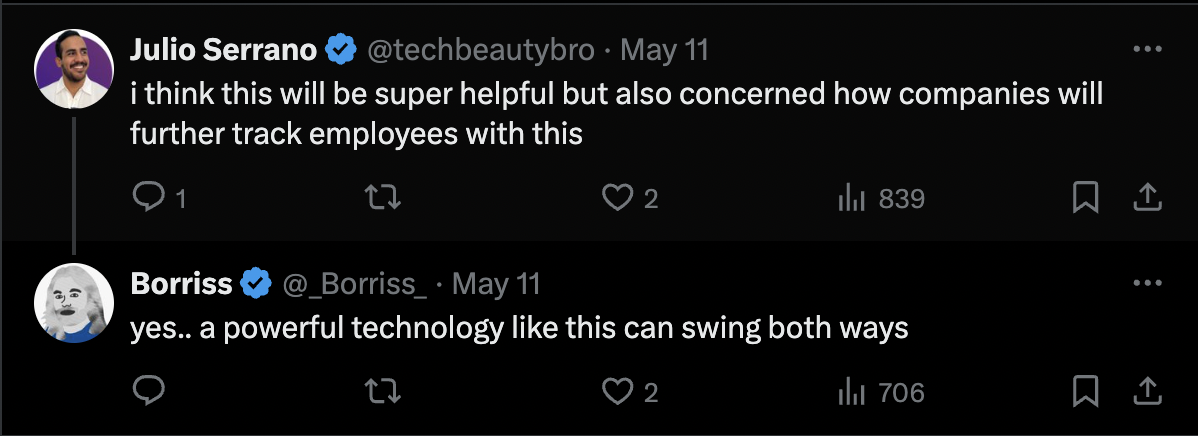
Amidst the buzz surrounding AI’s role in the workplace, another perspective emerges. While AI holds promise in replacing certain job functions, its current application appears more focused on monitoring.

In many organisations, AI is primarily utilised for employee monitoring, encompassing tasks such as job application screening and productivity tracking.
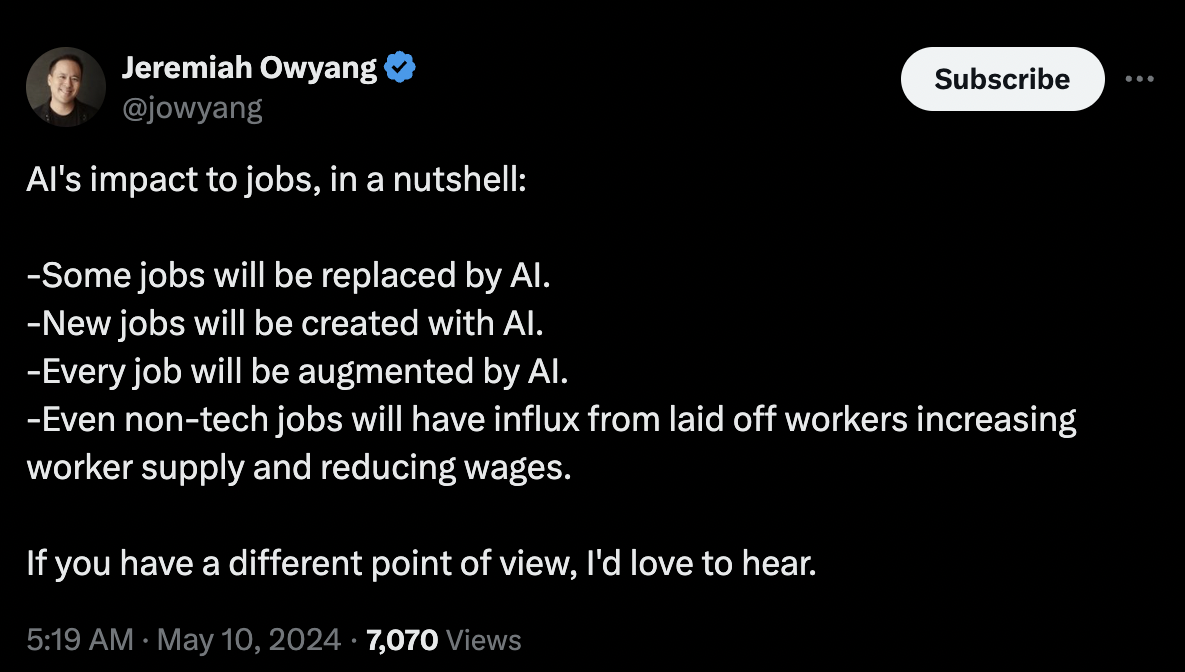
Some people think that AI will replace some jobs and create new ones. That’s the story of how AI is being used.
How to Survive the AI Wave?

As generative AI becomes increasingly efficient, its applications will likely expand, surpassing initial expectations and challenging conventional notions of job displacement.

Instead of simply replacing human roles, AI is fundamentally altering the nature of work by reshaping how tasks are executed.

This transformative shift underscores the urgency for individuals to adapt and reskill to remain aligned with the evolving landscape of AI technology. Embracing continuous learning becomes imperative to remain competitive and relevant in an era increasingly defined by AI-driven innovations.

The post Soon, ChatGPT (Powered by GPT-4o) will Replace Your ‘Senior Employees’ appeared first on Analytics India Magazine.


Adobe Launches India Data Centre for Experience Platform

Adobe announced today that Adobe Experience Platform-based applications will be available for enterprise customers via an India datacentre later in the year. This move aims to deliver on local data residency requirements and improve performance through lower latency.

The data centre will enable Indian enterprises to access Adobe Experience Platform-based applications, including Adobe Real-Time Customer Data Platform, Adobe Journey Optimiser, and Adobe Customer Journey Analytics. These applications will empower businesses to deliver real-time personalised customer experiences at scale.

Prativa Mohapatra, VP & MD, Adobe India, emphasised the importance of this development, stating, “Generative AI is driving a foundational shift in the relationship between brands and their customers in India, marking this as the era for businesses to drive profitable growth while delivering new digital experiences. Delivering personalised customer experiences, or Customer Experience Management, is central to the goals of enterprises.”

Mohapatra further added, “With that, we’ve seen increasing demand for Adobe Experience Platform-based applications from customers across banking financial services and insurance, telecom, manufacturing, and retail. We are excited to meet their hyper-growth requirements with the availability of Adobe Experience Platform-based applications, hosted via an India based datacentre.”

Adobe’s product innovations assist brands with data management in the age of generative AI, creating a foundation to activate insights and deliver true personalisation at scale. This is anchored in Adobe Experience Platform, the industry’s leading Customer Experience Management solution, which enables brands to activate customer data across various enterprise systems through an integrated set of applications.

It serves as the foundation for Adobe Experience Cloud, a suite of integrated online marketing tools offering personalisation at scale, streamlined content creation, data insights, content management, and customer journey products.

Since establishing operations in 1997, Adobe India has become a key contributor to Adobe’s Intellectual Property creation and business growth.

The country accounts for one-third of the company’s global innovations, including patents, engineering, and product development teams. India is also among Adobe’s fastest-growing markets, with customers including Air India, ICICI Bank, HDFC Bank, Bajaj Allianz, Tata Motors, and MakeMyTrip.

The post Adobe Launches India Data Centre for Experience Platform appeared first on Analytics India Magazine.

What’s Stopping India’s Semiconductor Mission

What’s Stopping India’s Semiconductor Mission?

Setting up a single semiconductor manufacturing foundry requires massive investments, usually running up to $3 to $4 billion. To compare it with current investments, Micron is pumping in $825 million just to set up its packaging facility.

“Given our infrastructure and the lack of an ecosystem for semiconductor supplies, it would require many auxiliary industries, which are not present in India, to import into India,” said BITS Pilani Campuses group vice-chancellor Professor V Ramgopal Rao, in an interview with AIM.

The Indian government has been very clear about its semiconductor mission, which was launched in 2021. Currently, India is the second largest importer of semiconductor chips globally after a 92% increase in chip imports in the last three years.

Rao said that investing so much in a country where the infrastructure is not up to the standard is not an attractive option for big companies.

India is all About Manpower

Many companies from the Global North look to India as a source of cheap labour. This is where the problem lies. According to Rao, the semiconductor industry does not require as many employees to work as India has to offer.

“A full-fledged foundry with 50,000 wafers will hire only 1,500 employees. That’s all,” he said. Such small numbers, he elaborated, compounded with the missing infrastructure, do not attract the investments needed. In comparison, Malaysia, Singapore, and Taiwan are much better options for them.

Though there are a number of designing and manufacturing companies in India, there is no foundry. Despite several startups in Bengaluru, manufacturing still happens in other countries. Rao said that the increasing number of such front-end semiconductor companies might attract more investments in the future. “For design, India is a powerhouse,” Rao said.

To put this into context, Mindgrove Technologies, a fabless semiconductor startup supported by Peak XV Partners, recently unveiled India’s inaugural commercial high-performance SoC (system on chip) dubbed Secure IoT.

Rao gave the example of the automotive industry, saying even though India is one of the major players exporting components to several countries in the industry, there is no innovation in the country. “Does India have any cars that others don’t?” asked Rao, saying that the cars that India builds are generations behind.

On the other hand, Rao believes that the reason India hasn’t built something like a Tesla is a lack of collaboration with academia. “Nobody wants to take mechanical engineering in the country because there are no jobs and no collaboration from the industry with academia,” said Rao.

Coincidentally, in a similar post on X where a user said that India cannot compete with Japanese or American cars, Mahindra Group chairman Anand Mahindra thanked the person for the scepticism.

“We were told the same thing when Toyota and other global giants in the EV space entered India. But we’re still around. Every day is a fight for survival,” he said while acknowledging that there needs to be more innovation and investment in the automotive industry.

Even when companies want to build a technology, they choose to partner with companies outside India and do not focus on academic partnerships. The same is the case with the semiconductor industry. “Companies want to come to India for cutting costs with cheap labour, not for innovation capabilities,” said Rao.

Meanwhile, there is also a rise in semiconductor GCCs in India, which accounted for 30% of the GCCs set up in Q4 2023.

Need for Industry-Academia Collaboration

As Rao mentioned, there is a significant lack of collaboration between academia and industry, hampering the innovation potential across sectors. “The future lies in connecting academia with industry, which will enable India to lead in markets like sensors and IoT,” he said.

Although there is considerable research happening in academia, it isn’t being utilised for innovation in Indian products, agriculture, or future technologies. Additionally, students are not industry-ready because industries aren’t collaborating with academia.

The missing link is the lack of collaboration between academia and industry. Once the industry gets involved, it will direct research, making it more relevant.

“When it comes to semiconductor jobs, there’s a significant gap in India. While there is a demand for design specialists, there are fewer opportunities in fabrication and sensor-related jobs,” Rao added. Consequently, many semiconductor specialists end up working abroad.

Similar to the semiconductor industry, the development of AI is also slow for similar reasons, namely a lack of investment in research and development. “India’s research spending is insufficient to support innovation in high-tech areas like AI. The government’s reluctance to invest further exacerbates the problem,” he added.

“It took OpenAI tens of billions of dollars to make ChatGPT. The research funding in India is so tiny,” Rao added. For AI, there is a dire need for GPUs. Indian universities barely have GPUs in the double digits for AI research. Meanwhile, the total amount of research funding that Indian universities receive, China spends on just two universities.

The bureaucratic hurdles in spending allocated funds make it challenging for researchers to utilise the money effectively, leading to further cuts in research spending. “The next government looks at the last budget and adds some 5% to that, but the base is already very low,” Rao explained.

The same happened with the INR 600 crore that the Indian government had allocated for quantum computing research. “Not a single rupee has come out still, though there are around 400 proposals submitted,” said Rao.

The government’s hesitation to invest more in research is due to the low base of research spending, coupled with bureaucratic hurdles in spending allocated funds. This vicious circle hampers innovation and research in India, but unfortunately, it’s a topic that receives little attention.

The post What’s Stopping India’s Semiconductor Mission appeared first on Analytics India Magazine.

Sam Altman: iPhone is the Greatest Piece of Technology Humanity has Ever Made

Ahead of OpenAI’s most-anticipated partnership with Apple, chief Sam Altman recently lauded the Cupertino-based tech giant for its technology prowess, saying,

“iPhone is the greatest piece of technology humanity has ever made”, and it’s tough to get beyond it as “the bar is quite high”.

This is not some new-found love for the company; Altman has always been an Apple fanboy.

Recently, OpenAI hired Jony Ive, the renowned designer of the iPhone, to discuss new AI hardware. “We’ve been discussing ideas,” said Altman, in a recent episode of All-In Podcast, touching upon the possibility of running LLMs on smartphones and if it is going to be affordable when that happens.

“Almost everyone’s willing to pay for a phone anyway,” added Altman, saying that cheaper is not the answer. “Even if a cheaper device could be made, I think the barrier to carry or use a second device is pretty high,” he added, hinting at how smartphones would not be obsolete anytime soon.

This is contrary to Yann LeCun’s, Meta chief AI scientist, opinion that smartphones will become obsolete in the next 10-15 years and that people will use augmented reality glasses and bracelets to interact with intelligent assistants.

But, Altman disagrees.

“There are a bunch of societal and interpersonal issues that are all very complicated about wearing a computer on your face,” said Altman, citing concerns about Meta’s smart glasses.

The change in Altman’s opinion comes as Apple nears its deal with OpenAI to integrate ChatGPT into iOS 18 as part of its strategy to enhance AI capabilities across its devices.

Also, OpenAI is planning to make some big announcements today where the company is likely to announce an AI voice assistant, alongside unveiling GPT-4 Lite, GPT-4-Auto, and GPT-4-Auto Lite series models. The new model would be capable of conversing with people using both sound and text, while also being able to recognise objects and images.

Apparently, the Apple – OpenAI deal just closed! One day before the voice assistant announcement 🙂
Guess Apple decided that it couldn't make it on its own 🤷
The new Siri will be from OpenAI pic.twitter.com/Yfr6oCJiwQ

— Bindu Reddy (@bindureddy) May 13, 2024

Many are speculating if this is going to be OpenAI’s ‘Her’ moment. Altman’s comments in the recent podcast sort of resonate with this development, as he said voice is the clue to what the next big thing might be.

“If you can perfect voice interaction, it feels like a whole new way of using a computer,” quipped Altman.

“What I want is just this always-on, super-low-friction thing where I can either, by voice or by text, ideally just kind of know what I want,” said Altman, adding that this AI assistant would help him throughout the day with as much context as possible.

Altman also said that OpenAI is currently developing an AI assistant designed to function like a senior AI employee. Users would be able to delegate tasks to this assistant, including managing emails.

OpenAI recently introduced a Voice Engine model which can generate natural-sounding speech from text input and a mere 15-second audio sample. The Voice Engine project began in late 2022 and initially focused on powering preset voices within OpenAI’s text-to-speech API, ChatGPT Voice, and Read Aloud features.

Sneak peak of Sam at tomorrow's event 👀 https://t.co/PLQh78BJjl pic.twitter.com/EypCONNhCh

— The Technology Brother (@thetechbrother) May 12, 2024

Meanwhile, decoding the tech behind it, Jim Fan, a senior scientist at NVIDIA said that all voice AI goes through three stages:

1. Speech recognition or “ASR”: audio -> text1, think Whisper;

2. LLM that plans what to say next: text1 -> text2;

3. Speech synthesis or “TTS ”: text2 -> audio, think ElevenLabs or VALL-E.

LLMs with Voice Matters

OpenAI is not alone. Earlier this year, Hume AI released Empathic Voice Interface, or EVI, which can engage in conversations just like humans, understanding and expressing emotions based on the user’s tone of voice. It can interpret nuanced vocal modulations and generate empathetic responses, leading to many calling it the next ‘ChatGPT moment’.

“We believe voice interfaces will soon be the default way we interact with AI. Speech is four times faster than typing; frees up the eyes and hands; and carries more information in its tune, rhythm, and timbre,” said Alan Cowen, founder of Hume AI.

The company’s EVI API marks the debut of the first emotionally intelligent voice AI API. It is now available, offering the ability to receive live audio input and provide both generated audio and transcripts enriched with indicators of vocal expression.

What is India’s OpenAI up to?

Indian AI startup Sarvam AI is also planning to release Indic Voice LLM in the next four to six months. “We believe that in India, people will experience generative AI through the medium of voice,” said Vivek Raghavan, cofounder, Sarvam AI in an exclusive interview with AIM.

He added that it is difficult to input text in Indian languages and that in India, people tend to prefer voice communication over text.

The company is also working on building agentic systems, allowing users to not only receive information but also take action. “I hope in the next few months we’ll see some of these things being announced and released in the marketplace,” said Raghavan.

Sarvam AI will support 10 languages and hopes to expand in the future. The company’s focus on voice-based interfaces has numerous practical applications in the country, such as in customer support and gathering feedback, where voice-based models can efficiently handle large-scale feedback listening.

The post Sam Altman: iPhone is the Greatest Piece of Technology Humanity has Ever Made appeared first on Analytics India Magazine.

Why Google Can’t Let Go of Golang

Google’s recent layoffs in the Flutter, Dart, and Python teams just weeks before its big developer conference have raised some eyebrows in the tech community. The roles cut were reportedly relocated to locations like India and Mexico, aiming to streamline operations and reduce layers within the company. While it could afford to let go of the other teams, Golang, Google’s home-grown programming language, isn’t going anywhere.

That’s because Golang code runs behind the scenes to keep everything humming, from the Google Cloud Platform to YouTube and the Google Play Store. The language has become critical to many of Google’s core products and infrastructure.

Letting go of the Golang team would mean disrupting the very foundation that powers much of Google’s software ecosystem.

“If Google abandons it, which it never will, others will jump onto it quickly… including Microsoft and Amazon,” pointed out a user on Reddit. That’s why, even in the face of shifting priorities, Google can’t afford to let Go go.

Further, he said that Microsoft has its own version of Go. This version is built to be FIPS compliant for government and private use along with a parallel fork of the language allowing them to have their own version of the programming language.

Golang at Google

Google needed a language that could handle the scale and complexity of its software engineering, with features like fast compilation, easy concurrency, and efficient memory management. Existing languages simply weren’t cutting it.

Until then C++ projects had to use a cluster to speed up compile times. This slowed up the compilation times and was not well-suited to manage massive computation clusters or building web-scale applications.

“The problems introduced by multicore processors, networked systems, massive computation clusters, and the web programming model were being worked around rather than addressed head-on,” Rob Pike, the co-creator of the language, wrote.

But perhaps Go’s biggest impact was in the cloud-native space. In 2014, Google used Go to develop and launch Kubernetes, the open-source container orchestration platform that has since become the de facto standard.

Pike clarified that it was used beyond Kubernetes. “The language took over the cloud world – Grant, Docker, Kubernetes, Envoy, Pantheon, essentially everything in the cloud native computing foundation. Go is the language for cloud infrastructure,” he said.

Go’s success within Google has only grown over the years. Recent case studies highlight the shift from monolithic C++ pipelines to Go microservices for Google Search indexing. Another study shows the Chrome optimisation guide server delivering faster page loads to millions of mobile users daily using Go.

Additionally, Firebase that deploys web applications and static content has migrated its backend from Node.js to Go for improved concurrency and efficiency. It also replaced the programming language Sawzall for Google’s search quality analysis.

Go-ing Beyond Google

Go’s importance extends far beyond Google’s walls. Since its open-source release in 2009, Go has been used by developers around the world for its ease of use, performance, and growing ecosystem of libraries and tools.

Popularly, it powers the configuration management tool Terraform, the distributed SQL database CockroachDB, and the time series database InfluxDB.

Major companies like Uber, Twitch, Dropbox, and Salesforce have bet big on Go for critical parts of their infrastructure. Salesforce, in particular, switched from Python to Go for its Einstein Analytics platform.

According to principal architect Guillaume Le Stum, “In Python, you could write super-elegant list comprehensions and beautiful code that’s almost mathematical. But if you didn’t write the code, then that elegance can come at the expense of readability.”

What’s Next for Go?

Developed in 2007 by Rob Pike, Ken Thompson and Robert Griesemer, the language intended to address the challenges in building and maintaining large-scale networked servers. Existing languages at the time didn’t provide the right tools for this complex environment.

As Go enters its second decade, the growing popularity has seeped into the open source community as well. The 2024 Go developer survey found that 93% of respondents were satisfied with Go, and 80% said they trust the Go team to ‘do what’s best’ for developers like themselves.

Looking back, Pike wished that Go had included support for arbitrary precision integers from the beginning. “There’s still a debate going on about how we handle the integer overflow,” he said.

He also expressed interest in seeing the compiler do more automatic checking of Go’s dynamic interfaces and potential deadlocks caused by resource sharing.

Apart from this, there is also a growing interest in using Go for AI and machine learning workloads, with 81% of respondents using OpenAI’s models and 53% using open-source models like Llama and Mistral.

One respondent even said, “If there were frameworks in Go to run these models, we’d much rather be doing that.”

The post Why Google Can’t Let Go of Golang appeared first on Analytics India Magazine.

OpenAI Spring Update: Next Flagship Model Is the ‘Natively Multimodal’ GPT-4o

OpenAI’s Spring Update on May 13 brought three major announcements from the AI company:

  • A new flagship AI model called GPT-4o.
  • A desktop ChatGPT app for macOS.
  • ChatGPT users who don’t pay for a subscription can now access more features for free.

The coming changes to ChatGPT “brings GPT-4 level intelligence to everyone, including our free users,” said OpenAI Chief Technology Officer Mira Murati during the livestream.

OpenAI CTO Mira Murati speaks in a livestream on May 13. Image: Screenshot by TechRepublic

GPT-4o improves on GPT-4 Turbo’s voice and video capabilities

Murati said OpenAI’s next flagship model GPT-4o is “faster” and “improves on its capabilities across text, vision and audio” compared to GPT-4. The “o” stands for “omni.”

Instead, GPT-4o responds faster than its predecessor GPT-4 Turbo and has increased proficiency in non-English languages, video and audio. GPT-4o will be 2x faster, 50% cheaper and have 5x higher rate limits than GPT-4 Turbo, Murati said. OpenAI CEO Sam Altman said today on X that GPT-4o is “natively multimodal,” meaning it can switch faster between voice, text and video analysis.

GPT-4o will be accessible for free within ChatGPT, and it will roll out over the next few weeks to users globally. ChatGPT Plus and Team users will be able to use GPT-4o first, while availability for Enterprise users is “coming soon,” Open AI said. Paid ChatGPT users will have up to five times capacity limits. GPT-4o will also be available in the ChatGPT API.

The demo of GPT-4o’s voice capabilities in the ChatGPT app at the livestream sounded quite natural, including several examples of how the model will respond seamlessly when interrupted. ChatGPT sometimes struggled to distinguish what images it was supposed to be looking at, but its responsiveness was remarkable.

The company noted it wasn’t releasing GPT-5, the rumored next-generation model, during the Spring Update. Murati said there may be more news about upcoming releases “soon.”

Safety considerations around GPT-4o

OpenAI reassured people that GPT-4o has “new safety systems to provide guardrails on voice outputs,” plus extensive post-training and filtering of the training data to prevent ChatGPT from saying anything inappropriate or unsafe. GPT-4o was built in accordance with OpenAI’s internal Preparedness Framework and voluntary commitments. More than 70 external security researchers red teamed GPT-4o before its release.

SEE: Organizations across the world adopt standards like Content Credentials to try to reduce misinformation and deepfakes created using AI. (TechRepublic)

New ChatGPT desktop app lands on macOS

MacOS users will soon be able to download a ChatGPT desktop application. ChatGPT Plus users can access the desktop app today, while other free and paying users can expect to gain access to it “in the coming weeks,” OpenAI said.

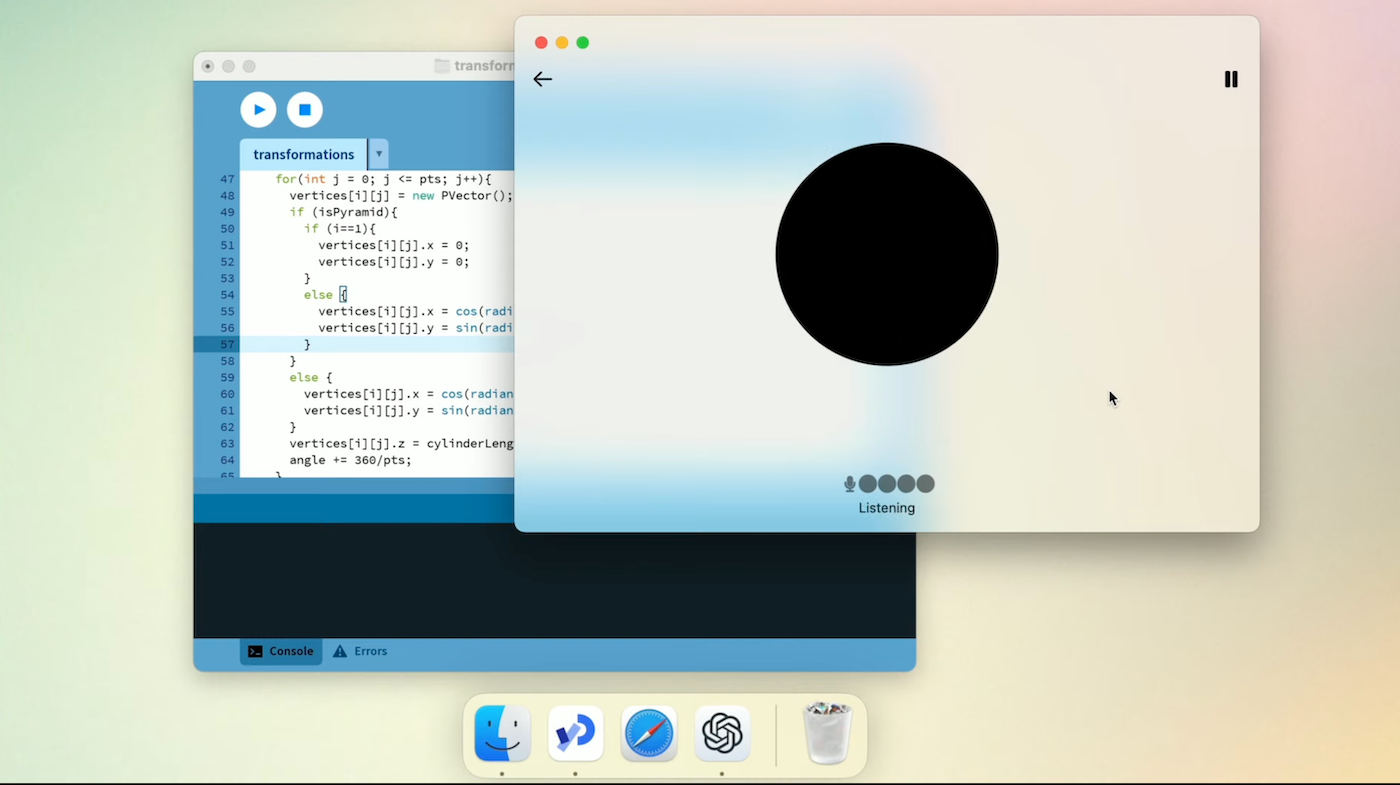
This UI for the ChatGPT desktop application for macOS shows ChatGPT listening while a user works on code. Image: OpenAI

Refreshed UI

Concurrently with the new ChatGPT desktop application, ChatGPT apps and the desktop version will receive a new, cleaner UI intended to improve ease of use.

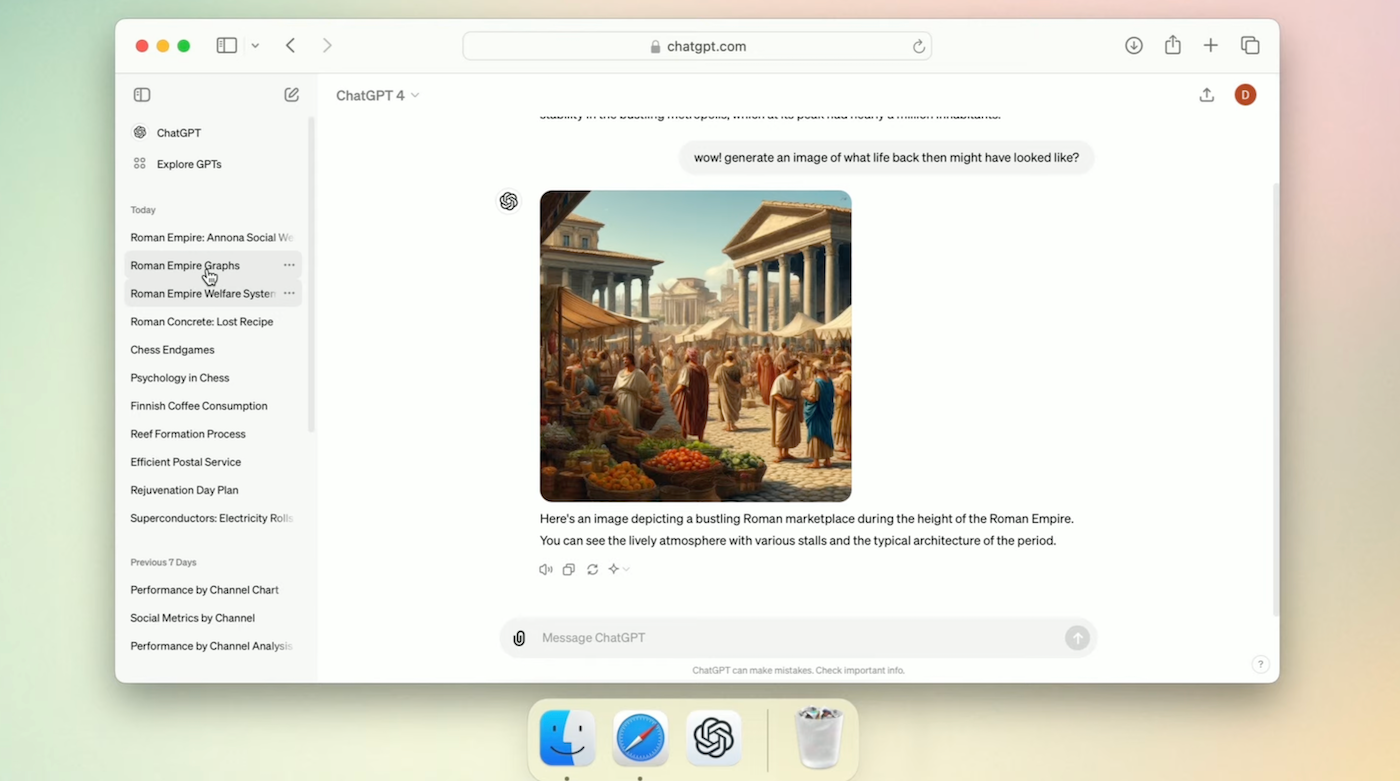
The refreshed UI for ChatGPT on a browser changes the position of the user settings menu and cleans up some iconography. Note the addition of a place to attach files within the prompt bar. Image: OpenAI

GPT Store and other capabilities now open to ChatGPT users for free

Starting May 13, ChatGPT users will see the following rolling out for people who don’t subscribe to paid plans:

  • Use GPT-4 instead of GPT-3.5.
  • GPT-4o can pull from both the ChatGPT model and the web.
  • ChatGPT can analyze data in charts and create new charts.
  • ChatGPT can chat about photos uploaded by the user.
  • Free tier users can upload text files that ChatGPT can then summarize, analyze or create new content from.
  • Free tier users can explore and use GPTs in the GPT Store.
  • Free tier users can take advantage of ChatGPT’s Memory feature, which lets the model remember previous conversations with the same user.

TechRepublic covered the OpenAI Spring Update remotely.

Unveiling ChatGPT-4o: Next-Gen Features and Their Transformative Impact

The latest iteration of OpenAI's conversational model, ChatGPT-4o (“o” for “omni”) has arrived, bringing with it a host of new features that promise to revolutionize the way we interact with AI. Building on the success of its predecessors, GPT-4o introduces significant advancements in language understanding, contextual awareness, and user interaction capabilities. This article explores these new features in detail, highlighting how they can enhance the user experience and potential concerns with these new features.

Enhanced Language Understanding and Generation

One of the most notable improvements in GPT-4o is its enhanced language understanding and generation capabilities. The model has been trained on a more extensive and diverse dataset, allowing it to comprehend and generate text with greater accuracy and coherence. This improvement is particularly evident in complex conversations that require deep contextual understanding and nuanced responses.

Use Case: Customer Support

For businesses, this means that GPT-4o can handle customer inquiries more efficiently and effectively. The AI can understand customer concerns better, provide more accurate solutions, and handle follow-up questions with improved coherence. This leads to higher customer satisfaction and reduced workload for human support agents.

Concerns

Despite these advancements, there are concerns about over-reliance on AI for customer support. Customers may feel frustrated if they cannot reach a human representative when needed, especially for complex or sensitive issues. Additionally, while the AI's understanding has improved, it can still misinterpret context, leading to potentially incorrect or misleading responses.

Advanced Contextual Awareness

GPT-4o introduces advanced contextual awareness, enabling it to maintain context over longer conversations and understand the subtleties of human dialogue more effectively. This feature allows the model to keep track of previous interactions, recall relevant information, and provide more contextually appropriate responses.

Use Case: Personal Assistants

Th personal digital assistants enhancement allows GPT-4o to offer a more personalized experience. For example, it can remember user preferences, past interactions, and specific details such as upcoming appointments or favorite activities. This results in a more tailored and responsive assistant that can better anticipate user needs.

Concerns

While advanced contextual awareness is beneficial, there are privacy concerns regarding the amount of personal data the AI needs to retain. Users might be uncomfortable with the extent of information remembered by the assistant, raising questions about data security and the potential for misuse.

Improved Multimodal Capabilities

GPT-4o now supports improved multimodal capabilities, allowing it to process and generate content that includes not only text but also images and other media. This advancement makes the model more versatile and capable of engaging in more interactive and visually enriched conversations.

Use Case: Educational Tools

In educational settings, GPT-40 can enhance learning experiences by incorporating visual aids into explanations. For instance, when explaining a scientific concept, the AI can provide relevant diagrams or images to help students grasp complex ideas more easily. This multimodal approach can make learning more engaging and effective.

Concerns

The inclusion of multimodal capabilities raises issues about the potential for inappropriate or harmful content. Ensuring that the AI does not generate or distribute misleading or explicit images is critical. Additionally, there is a risk that reliance on AI-generated visuals might reduce critical thinking and creativity.

Customization and Fine-Tuning

Another significant feature of GPT-40 is its enhanced customization and fine-tuning capabilities. Users can now tailor the model to better suit specific applications or industries by adjusting its behavior, tone, and response style. This customization ensures that the AI aligns more closely with the unique requirements of different use cases.

Use Case: Content Creation

Content creators can leverage this feature to produce material that matches their brand's voice and style. Whether it's drafting, generating social media content, or assisting in scriptwriting, GPT-40 can be fine-tuned to deliver consistent and on-brand outputs, saving time and effort in the creative process.

Concerns

Customization brings the risk of bias being introduced into the AI's responses. If the model is fine-tuned with biased data, it may produce content that reflects those biases. Ensuring that customization processes include checks for fairness and objectivity is crucial to prevent misuse.

Real-Time Collaboration and Integration

GPT-40 introduces real-time collaboration features, allowing multiple users to interact with the AI simultaneously. This is particularly useful for team environments where collaboration and quick access to information are crucial. Additionally, the model boasts improved integration capabilities, making it easier to embed into various software and platforms.

Use Case: Project Management

In project management scenarios, teams can use GPT-40 to streamline workflows by integrating it into project management tools. The AI can assist in scheduling, task allocation, and progress tracking, all while providing real-time updates and insights. This integration facilitates smoother collaboration and enhances productivity.

Concerns

Real-time collaboration features can raise security and data integrity concerns. Unauthorized access or data breaches could compromise sensitive project information. There may also be challenges in ensuring that all team members use the AI appropriately and consistently.

Ethical Considerations and Safety Measures

With the release of GPT-40, OpenAI has also placed a strong emphasis on ethical considerations and safety measures. The model includes robust mechanisms to minimize harmful outputs and ensure responsible usage. Enhanced moderation tools and stricter guidelines help prevent the dissemination of inappropriate or biased content.

Use Case: Mental Health Support

For mental health support applications, these safety measures are crucial. GPT-40 can provide empathetic and supportive interactions while adhering to ethical guidelines, ensuring that users receive appropriate and safe guidance. This can be particularly valuable in providing initial support and directing users to professional help when needed.

Concerns

Despite these measures, there is always the risk that the AI may generate inappropriate or harmful content. Ensuring comprehensive and effective moderation is a continuous challenge. Moreover, reliance on AI for mental health support should not replace professional human interaction, as the AI cannot fully understand the complexities of human emotions and mental health issues.

Conclusion

GPT-40 represents a significant leap forward in conversational AI, offering enhanced language understanding, contextual awareness, multimodal capabilities, and customization options. These new features open up a wide range of applications, from customer support and personal assistants to educational tools and content creation. With its improved real-time collaboration and ethical safeguards, GPT-40 is sure to transform how we interact with AI, making it a more powerful and reliable tool for various industries. However, it is essential to remain vigilant about the potential concerns and challenges associated with these advancements to ensure that the technology is used responsibly and ethically. As we continue to explore its potential, the future of AI-driven conversations looks incredibly promising.

Report: Organisations Have Endpoint Security Tools But Are Still Falling Short on the Basics

Most IT and security teams would agree that ensuring endpoint security and network access security applications are running in compliance with security policies on managed PCs should be a basic task. Even more basic would be ensuring these applications are present on devices.

And yet, many organisations still fail to meet these requirements. A new report from Absolute Security, based on anonymised telemetry from millions of mobile and hybrid PCs that run its firmware-embedded solution, found a lot of the market is falling well short of best practice.

For instance, the 2024 Cyber Resilience Risk Index report found that, if not supported by automated remediation technologies, top endpoint protection platforms and network access security applications are failing to maintain compliance with security policies 24% of the time across its sample of managed PCs.

When combined with data showing significant delays in patching applications, Absolute Security argued organisations may be ill-equipped to make the landmark shift to AI PCs, which would require significant resourcing and direct attention away from these foundations of cyber security.

Findings detail basic security tool and patching problems

Absolute Security’s report looked at data from more than 5 million PCs from global organisations with 500 or more active devices running Windows 10 and Windows 11. It uncovered findings that should concern IT and cyber security teams.

Essential endpoint security tools failing to measure up to security policies

Absolute Security looked at how organisations deployed endpoint security platforms like CrowdStrike, Microsoft Defender Antivirus, Microsoft Defender for Endpoint, Palo Alto Networks’ Cortex XDR, Trend Micro’s Apex One, SentinelOne’s Singularity and Sophos’ Intercept X.

SEE: The top 8 advanced threat protection tools and software available in 2024

It also looked at the use of leading zero trust network security applications, including Citrix’s Secure Private Access, Cisco’s AnyConnect, Palo Alto Networks’ GlobalProtect, Zscaler’s Internet Access offering and Netskope’s ZTNA Next.

As well as finding 24% of these apps failed to maintain basic security policy compliance, it found endpoint security tools were not even installed on almost 14% of PCs that were supposed to be under the protection of an EPP. Absolute Security called this “especially noteworthy,” given EPPs are considered the first line of defence for the mobile and hybrid network edge.

Organisations are still falling far behind of their patching ambitions

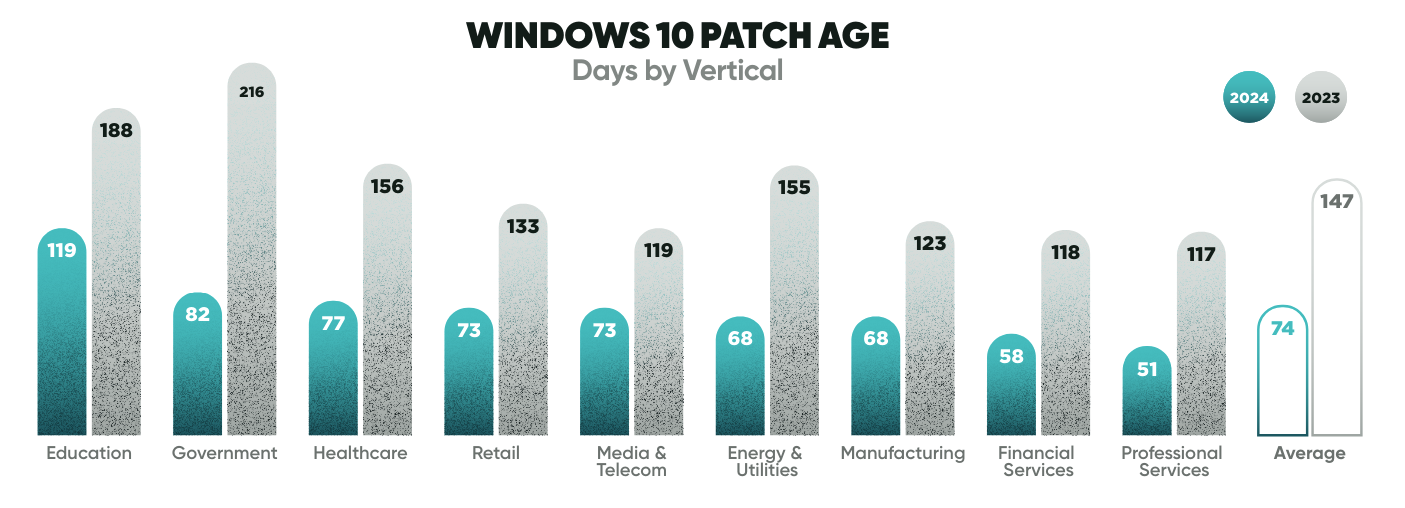
Organisations are falling weeks or even months behind in critical patching, opening “excessive risk gaps.” While the overall average number of days to patch software vulnerabilities continues to drop — to 74 days for Windows 10 and 45 for Windows 11 —- most industries continue to run well behind their own patching policies. Australia’s Essential Eight changed the requirement in 2023 for patching vulnerabilities in high-risk software from one month to two weeks.

Absolute Security found patching times varied by sector. Education providers and governments have the worst patching records, taking 119 and 82 days respectively, to patch Windows 10 software in 2024, though this is a vast improvement on the 188 and 216 days it required these sectors to patch vulnerabilities in 2023. For Windows 11, education and government were again the two longest patchers, though they were only taking 61 and 57 days, respectively.

The time to patch Windows 10 vulnerabilities by sector.
The time to patch Windows 10 vulnerabilities by sector. Image: Absolute Security

The implications for coming AI PC investments and rollouts

Absolute Security acknowledged a massive “AI replacement wave” could be coming to the enterprise PC market. It revealed only 92% of enterprise PCs have sufficient RAM capacity for AI at present, which it said has been established as being 32GB of RAM. “It is no wonder why IDC forecasts that demand for PCs supporting new innovations in AI will surge from 50 million units to 167 million by 2027, a 60 per cent increase,” the report elaborated.

The problems organisations face with endpoints have implications for how they adopt AI PCs. “Massive deployments are complex and resource intensive. Huge investments in AI-capable endpoint fleets have the potential to divert budget and human resources away from critical IT and security priorities that can leave gaps in security and risk policies. Devices loaded with new software not only add to complexity but also impact performance and security,” it said.

Realising AI PC advantages will depend on executing on security

Absolute Security said the ability for a new breed of AI PCs to handle large data sets and language model processing locally would allow more data to be kept locally on enterprise-owned assets rather than with third-party cloud hosts. “With more localised control over data, organisations can reduce overall risk of data theft and leaks,” the report said.

However, the firm said this would depend on properly functioning security and risk controls on the endpoint devices. The report recommended that enterprises investing in AI-capable PC rollouts take steps to ensure maximum efficiency across IT, security and risk procedures.

Absolute Security warns against over reliance on existing tools

Absolute Security’s telemetry data revealed that organisations are currently using a complex mix of “upwards of a dozen” endpoint security tools and network access security applications per device. They were all essentially governing them by four basic security policies:

  • Ensuring the application is present on the device.
  • Ensuring the device version is correct.
  • Verifying an application is running as expected.
  • Verifying that an application is property signed and has not been tampered with.

Endpoint protection and vulnerability management tools are not foolproof

Absolute Security recommended CISOs and IT deploy solutions that monitor, report and help repair endpoint and network access security applications in as near real-time as possible.

“Fail safes that come standard with applications may not suffice, as malfunctioning or compromised software will not be able to self-mitigate back to an effective state,” it said in the report. “Underpin endpoint and network access security controls with technologies that automate the repair and restoration to an effective state following cyberattacks, technical malfunctions, or deliberate tampering attempts,” it suggested.

When it came to patching systems, Absolute Security warned standard vulnerability management platforms may not verify if assets are in compliance with security policies or performing as expected, even if fully patched. “To avoid errors these solutions do not track, add a layer that expands visibility over software and hardware assets to ensure they are operating as needed,” it said.

Maximise efficiency to minimise impact of AI PC fleet transition

As AI PCs are invested in and rolled out in greater numbers, Absolute Security suggested enterprises take steps to ensure maximum efficiency across IT, security and risk procedures, including repair and restoration of security applications as well as rollout and management processes. Efficiency gains will ensure that IT and security teams are able to focus on providing the maximum defense against threats.

OpenAI Just Killed Google Translate with GPT-4o 

At the OpenAI Spring Update, OpenAI CTO Mira Murati unveiled GPT-4o, a new flagship model that enriches its suite with ‘omni’ capabilities across text, vision, and audio, promising iterative rollouts to enhance both developer and consumer products in the coming weeks.

“They are releasing a combined text-audio-vision model that processes all three modalities in one single neural network, which can then do real-time voice translation as a special case afterthought, if you ask it to,” said former OpenAI computer scientist Andrej Karpathy, who was quick to respond to the release.

They are releasing a combined text-audio-vision model that processes all three modalities in one single neural network, which can then do real-time voice translation as a special case afterthought, if you ask it to.
(fixed it for you) https://t.co/0y36OId88h

— Andrej Karpathy (@karpathy) May 13, 2024

“The new voice (and video) mode is the best compute interface I’ve ever used. It feels like AI from the movies; and it’s still a bit surprising to me that it’s real. Getting to human-level response times and expressiveness turns out to be a big change,” said OpenAI chief Sam Altman, who wants to bring ‘Universal Basic Compute’ to everyone in the world.

her

— Sam Altman (@sama) May 13, 2024

Further, he said that the original ChatGPT hinted at what was possible with language interfaces; “this new thing feels viscerally different. It is fast, smart, fun, natural, and helpful.”

Altman said that talking to a computer has never felt really natural for him. “Now it does,” he said, hopeful about the future where people will be using computers to do more than ever before.

What’s really interesting about GPT-4o is that it will be available to ChatGPT Plus (with some personalisation features) and ChatGPT free users soon. “We are a business and will find plenty of things to charge for, and that will help us provide free, outstanding AI service to (hopefully) billions of people,” said Altman.

“Thanks to Jensen and the NVIDIA team for bringing us the most advanced GPUs to make this demo possible today,” said Murati during her closing remarks.

Meanwhile, OpenAI president and co-founder Greg Brockman also demonstrated human-computer interaction (and even human-computer-computer), giving users a glimpse of pre-AGI vibes.

Introducing GPT-4o, our new model which can reason across text, audio, and video in real time.
It's extremely versatile, fun to play with, and is a step towards a much more natural form of human-computer interaction (and even human-computer-computer interaction): pic.twitter.com/VLG7TJ1JQx

— Greg Brockman (@gdb) May 13, 2024

RIP Google Translate?

In the demonstration of GPT-4o’s real-time translation capabilities, the model seamlessly translated between English and Italian, exemplifying its sophisticated linguistic adaptability. Many believe that this new feature of OpenAI is likely to replace Google Translate.

“OpenAI just killed Google Translate with their real-time translator (near 0 delay in response),” said Fraser,

Real-time voice translation is CRAZY. Goodbye Google Translate 👋🏻 #OpenAI pic.twitter.com/joxgml3RXU

— Tom Edwards (@tomedwards) May 13, 2024

Meanwhile, Google is getting ready to make some major announcements tomorrow at Google I/O. “Super excited for my first Google I/O tomorrow and to share what we’ve been working on!,” shared Google DeepMind chief Demis Hassabis, sharing a similar glimpse of its multi-modal AI assistant.

Super excited for my first #GoogleIO tomorrow and to share what we've been working on! https://t.co/hRXvNlZSrV

— Demis Hassabis (@demishassabis) May 13, 2024

Not just Google, but many were quick to point out the end of many AI startups offering similar solutions and features.

“OpenAI just shot Rabbit in the face,” said AI developer Benjamin De Kraker.

Interestingly, OpenAI also announced the launch of the GPT-4o API, which developers can use to build new products and solutions.

ok we got the API. the game is not killing each other, it's everyone working on the same foundations. once the foundations are solid, the building on top of it will be much different. pic.twitter.com/FDyqlEZzOb

— Jesse Lyu (@jessechenglyu) May 13, 2024

Meanwhile, Hume AI, which released EVI (Empathetic Voice Interface), also felt the pressure, making them launch its API today, alongside other future improvements.

The future of empathic AI is looking bright! Emotionally intelligent AI will be standard for all voice-based applications in the future. EVI is available today through our API, so you can start building immediately. We have a lot of exciting improvements coming soon — this is…

— Hume (@hume_ai) May 13, 2024

Improves Non-English Language Performance

Interestingly, OpenAI has also expanded its language capabilities, supporting over 50 languages, including Indian languages. GPT-4o has significantly optimised token usage for Indian languages, reducing Gujarati by 4.4x, Telugu by 3.5x, Tamil by 3.3x, and Marathi and Hindi by 2.9x.

We also have significantly improved non-English language performance quite a lot, including improving the tokenizer to better compress many of them: pic.twitter.com/hE92x1qmM1

— Greg Brockman (@gdb) May 13, 2024

GPT-4o can engage in natural, real-time voice conversations and has the ability to converse with ChatGPT via real-time video. It also understands the emotional tone of the speaker and can adjust its tone and modulation accordingly.

Moreover, the latest model can understand and discuss images, allowing users to take a picture of a menu in a foreign language and translate it, learn about the food’s history and significance, and receive recommendations.

One Step Closer to Autonomous Agents

Another interesting update was OpenAI’s announcement of the ChatGPT (GPT-4o) desktop app, which can read your screen in real-time. The app allows for voice conversations, screenshot discussions, and instant access to ChatGPT.

desktop app and new UI pic.twitter.com/k8ukzCCeH4

— Sam Altman (@sama) May 13, 2024

When will GPT-4 ‘Omni’ Arrive?

(Source: X)

GPT-4o’s text and image capabilities are starting to roll out today in ChatGPT. Developers can now access GPT-4o in the API as a text and vision model.

The company is rolling out GPT-4o to ChatGPT Plus and Team users, with Enterprise users to follow soon. ChatGPT Free users will also have access to advanced tools, including features like GPT-4 level intelligence, web responses, data analysis, and file uploads.

However, ChatGPT Free users will have a message limit, which will increase as usage and demand grow. When the limit is reached, the app will automatically switch to GPT-3.5 to ensure uninterrupted conversations.Last but not least, the company has also introduced a simplified look and feel for ChatGPT, featuring a new home screen, message layout, and more. The new design is designed to be friendlier and more conversational.

The post OpenAI Just Killed Google Translate with GPT-4o appeared first on Analytics India Magazine.

Zero Trust Architecture and AI

Interview with Patrick Stingley

Zero Trust Architecture and AI

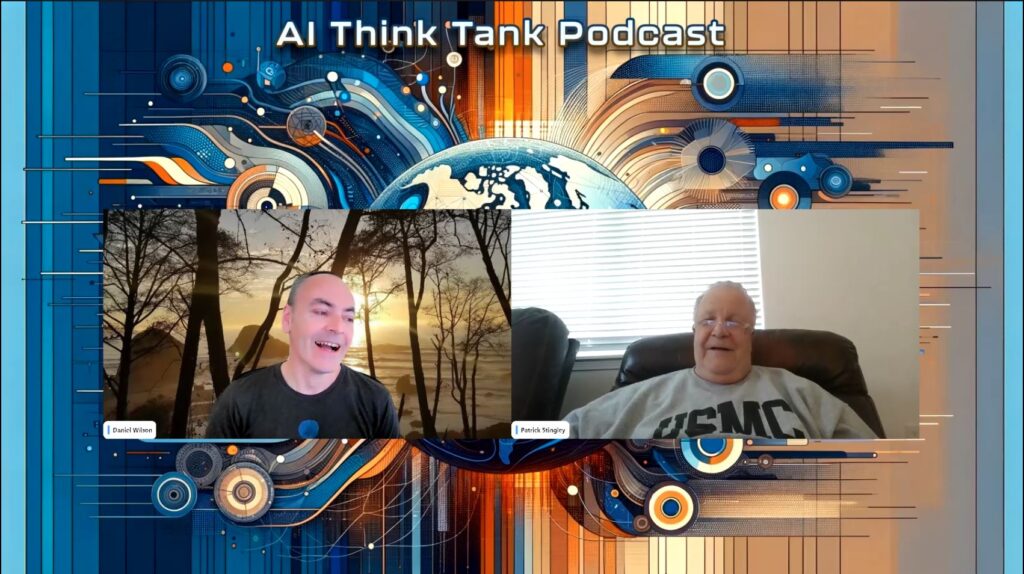
During this very special 6th episode of the AI Think Tank Podcast, I had the honor to speak with Patrick Stingley, a seasoned data scientist and enterprise architect for the U.S. government, currently associated with the Bureau of Land Management. His decades of experience in various sectors of government service have endowed him with an intricate understanding of information technology, particularly within the realm of artificial intelligence (AI) and data security.

A few of Patrick’s certifications and titles at glance: Previous Top Secret / SCI Clearance, Masters Degree (MS-IST), PMP, ITIL/F, CEA, CCNA, CCNP, CISSP, Current PhD Candidate in Artificial Intelligence. He also won the Tech BISNOW Award for Most Innovative in Government 2015. We met through MIT and are both founding members of Info Science AI where we further innovate AI integrations and data solutions

Decades of Transformation in Data Handling

While I knew that it would be impossible to cover his extensive background, awards, and adventures, I did my best to give everyone a glimpse at his outstanding background. I started with having Patrick revisit his extensive career managing significant IT systems, including the passport database system for the State Department.

“I ran the passport database for some years and actually five major systems for the State Department,” Patrick recalled, highlighting the transformation he has witnessed from data processing to what is now recognized as data science due to the emergence of AI technologies.

“I used to work at the situation room a lot of times during national emergencies because I knew how to speak SQL, I knew how to query the database.” Still an irreplaceable asset in any sector.
He later pointed out, “With vector databases, the process of managing or putting data into a vector database is completely unlike any of the data handling that we’ve done up until now.” While they have been around for a very long time, only recently within the last few decades have vector databases gained traction.

Patrick stated “And now the term is data pipeline, because ETL really doesn’t handle that anymore.” This transition from traditional data management techniques to modern AI-driven approaches marks a significant evolution in the field, one that he has been at the forefront of throughout his career.

Zero Trust Architecture and AI

Challenges and Innovations in Enterprise Architecture

Patrick shared insights into the challenges he faced in implementing enterprise architecture on a grand scale. He mentioned the U.S. government’s vast IT landscape, which he has navigated through roles that required managing thousands of computers and diverse software applications. “Even though I work in a rather small, obscure part of the government, the Bureau of Land Management, we have 14,000 computers [and] 1.4 million unique kinds of software on the network,” he elaborated.

A notable aspect of our discussion was the implementation of low-code and no-code solutions, which Patrick has utilized to improve operational efficiency significantly. He illustrated this by explaining how these approaches allowed for rapid adaptation and deployment of IT services, contrasting sharply with traditional development methods that are often cumbersome and time-intensive.

The Interplay of AI and Security

A significant portion of our dialogue was dedicated to exploring the intersection of AI and security. Patrick explained how AI tools are increasingly utilized to forecast phenomena such as forest growth, a project currently underway in Oregon. This reflects a broader trend where AI capabilities are being integrated into various facets of government operations beyond typical tech-centric agencies.

On the topic of security, Patrick provided a detailed account of his efforts to architect a zero-trust security model within his bureau. He stressed the importance of this framework in today’s IT environment, where traditional perimeter-based security models fall short in protecting against sophisticated cyber threats. Patrick’s approach involves stringent access controls and robust monitoring systems to ensure the integrity and security of the government’s extensive network infrastructure.

Conclusion and Reflections

As we wrapped up our conversation, it was clear that Patrick’s contributions to the field of IT and his forward-thinking approaches to data science and security are both profound and impactful. His experiences underscore the significant shifts in technology and methodology over the past decades, highlighting the continuous need for adaptation and innovation within the field of data science and AI.

As always, it was enlightening to delve into these topics with someone who has not only observed but also shaped the evolution of these technologies within the government sector. Patrick’s stories and insights serve as a valuable resource for understanding the complexities and challenges of integrating AI and security measures in large-scale IT operations. Everyday I feel extremely fortunate to have Patrick as a friend, a mentor, and fellow developer.

Join us as we continue to explore the cutting-edge of AI and data science with leading experts in the field.

Subscribe to the AI Think Tank Podcast on YouTube.
Would you like to join the show as a live attendee and interact with guests? Contact Us