LLaMA 3: Meta’s Most Powerful Open-Source Model Yet

LLaMA 3: Meta’s Most Powerful Open-Source Model Yet
Image by Author

Introducing Llama 3

Meta recently released Llama 3, one of the most powerful “open” AI models to date.

Llama 3 is available in 2 sizes: Llama 3 8B, which has 8 billion parameters, and Llama 3 70 B, with 70 billion parameters.

These are relatively small models that barely exceed the size of their predecessor, Llama 2. However, it seems like Llama 3’s focus is on quality rather than size, as the model was trained on over 15 trillion tokens of data.

Due to the increase in the quantity of training data and advancements in training techniques, Llama 3 performs significantly better than Llama 2 although they are the same size.

This will make it easier to run Llama 3 on local machines.

How Does Llama 3 Perform Among Other Open Models?

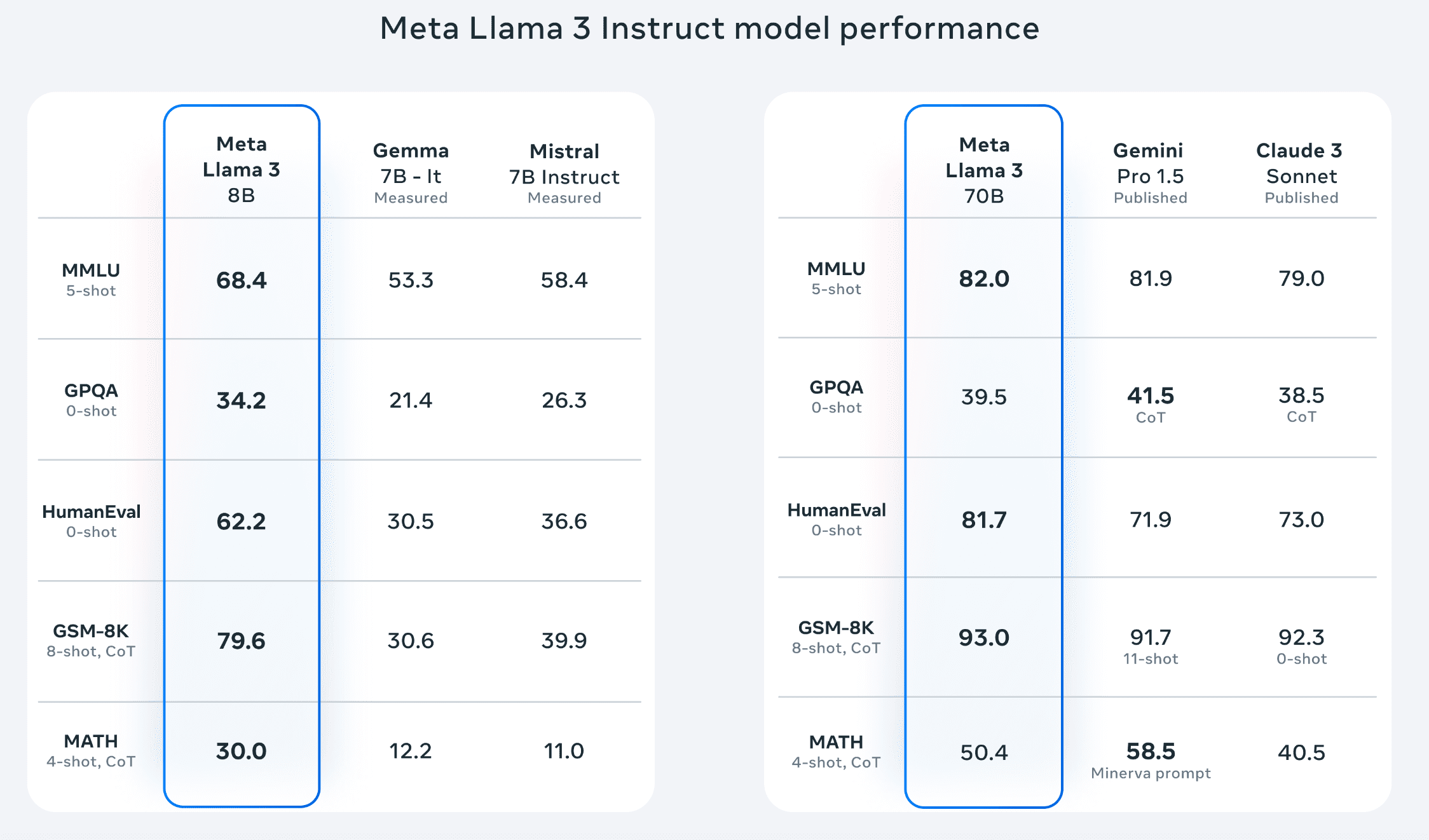
Here is a table showcasing the performance of Llama 3 against other language models on various benchmarks:
Meta Llama 3's Performance Against Benchmarks
Source: Meta
Here’s what these benchmarks mean:

  • MMLU (Massive Multitask Language Understanding): A benchmark designed to understand how well a language model can multitask. The model’s performance is assessed across a range of subjects, such as math, computer science, and law.
  • GPQA (Graduate-Level Google-Proof Q&A): Assesses a model’s ability to answer questions that are challenging for search engines to solve directly. This benchmark evaluates whether the AI can handle questions that usually require human-level research skills.
  • HumanEval: Assesses how well the model can write code by asking it to perform programming tasks.
  • GSM-8K: Evaluates the model’s ability to solve math word problems.
  • MATH: Tests the model’s ability to solve middle school and high school math problems.

On the left, we see a performance comparison between the smaller model, Llama 3 8B, against Gemma 7B It and Mistral 7B Instruct, two similarly sized open-source models.

Llama 3 8B outperforms comparably sized language models on every benchmark on the list.

Llama 3 70B was benchmarked against Gemini Pro 1.5 and Claude 3 Sonnet. These are two state-of-the-art AI models released by Google and Anthropic and are not open source.

Interestingly, Gemini Pro 1.5 is Google’s flagship model. It is said to perform better than its current most capable model, Gemini Ultra.

As the only openly available model on the list, it is impressive to see that Llama 3 70B beats Gemini Pro 1.5 and Claude 3 Sonnet on 3 out of 5 performance benchmarks.

Meet MetaAI: The Most Intelligent, Freely Available AI Assistant

Llama 3 also powers Meta AI, an AI assistant that is capable of complex reasoning, following instructions, and visualizing ideas.

It has a chat interface that allows you to interact with Llama 3. You can ask it questions, perform research, and even have it generate images.

Unlike existing LLM chatbots like ChatGPT, Gemini, and Claude, Meta AI is completely free to use. Its most advanced model is not hidden behind a paywall, making it a powerful free alternative to existing AI assistants.

Meta AI is integrated into Meta’s suite of apps, like Facebook, Instagram, WhatsApp, and Messenger. You can use it to perform advanced searches on these platforms.

According to Mark Zuckerberg, Meta AI is now the most intelligent, freely available AI assistant.

Unfortunately, Meta AI is currently only available in select countries and will be rolled out to users worldwide in the near future.

If it isn’t available in your country yet, don’t worry! I will show you two other ways to access Llama 3 for free.

Getting Started: How to Access Llama 3

Here are two other ways to access Llama 3 for free:

Accessing Llama 3 with Hugging Face

Hugging Face is a community that helps developers build and train machine learning models. The organization is focused on democratizing access to AI and allows you to access cutting-edge machine-learning models for free.

To access Llama 3 in Hugging Face, you first need to create an account with Hugging Face by signing up.

Then, navigate to HuggingChat; Hugging Face’s platform that makes the best AI models from the community available to the public.

You should see a screen that looks like this:
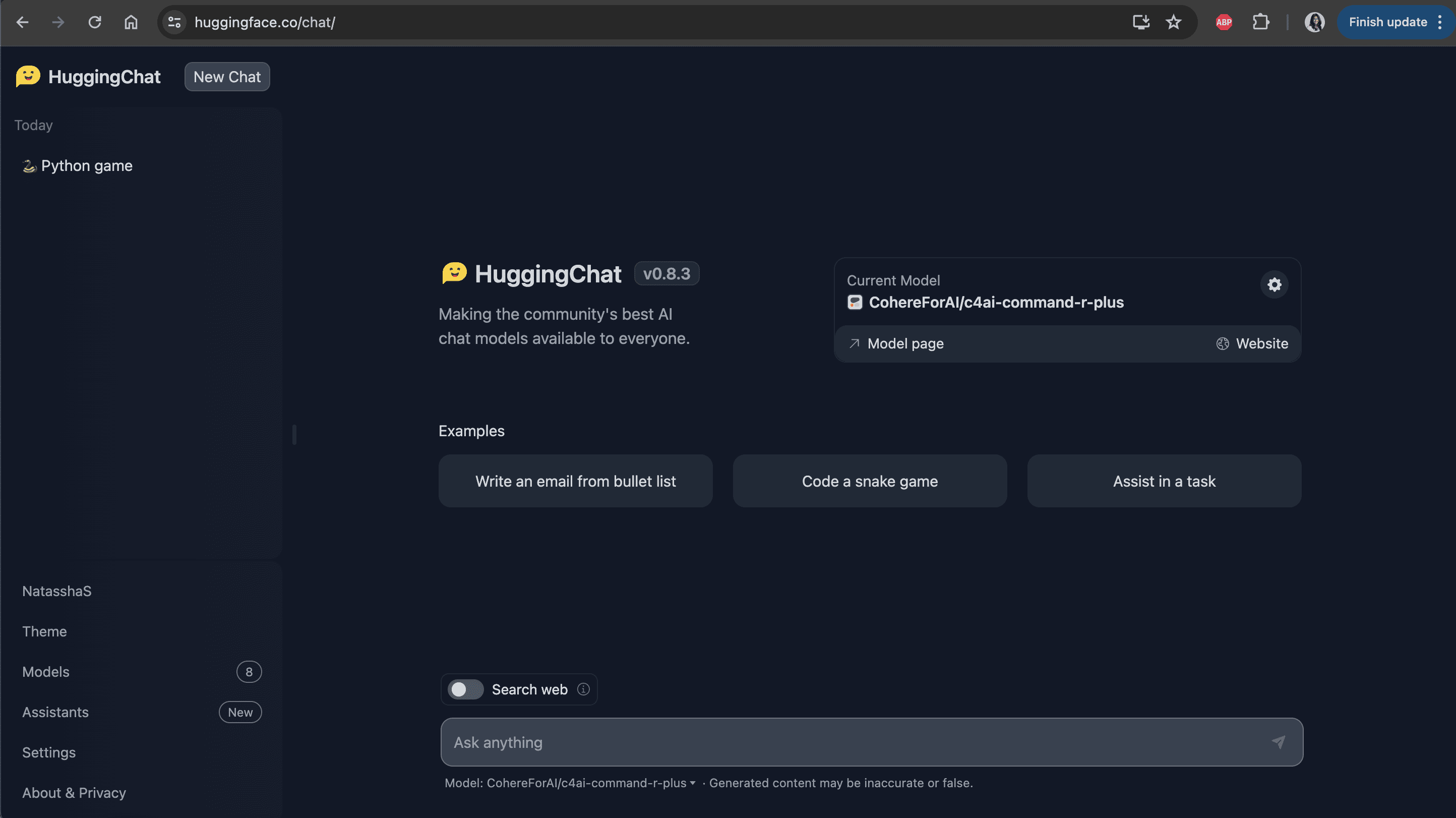
A screenshot of HuggingChat's interface
Source: HuggingChat

Simply select the wheel icon and change your current model to Meta Llama 3 as shown below:
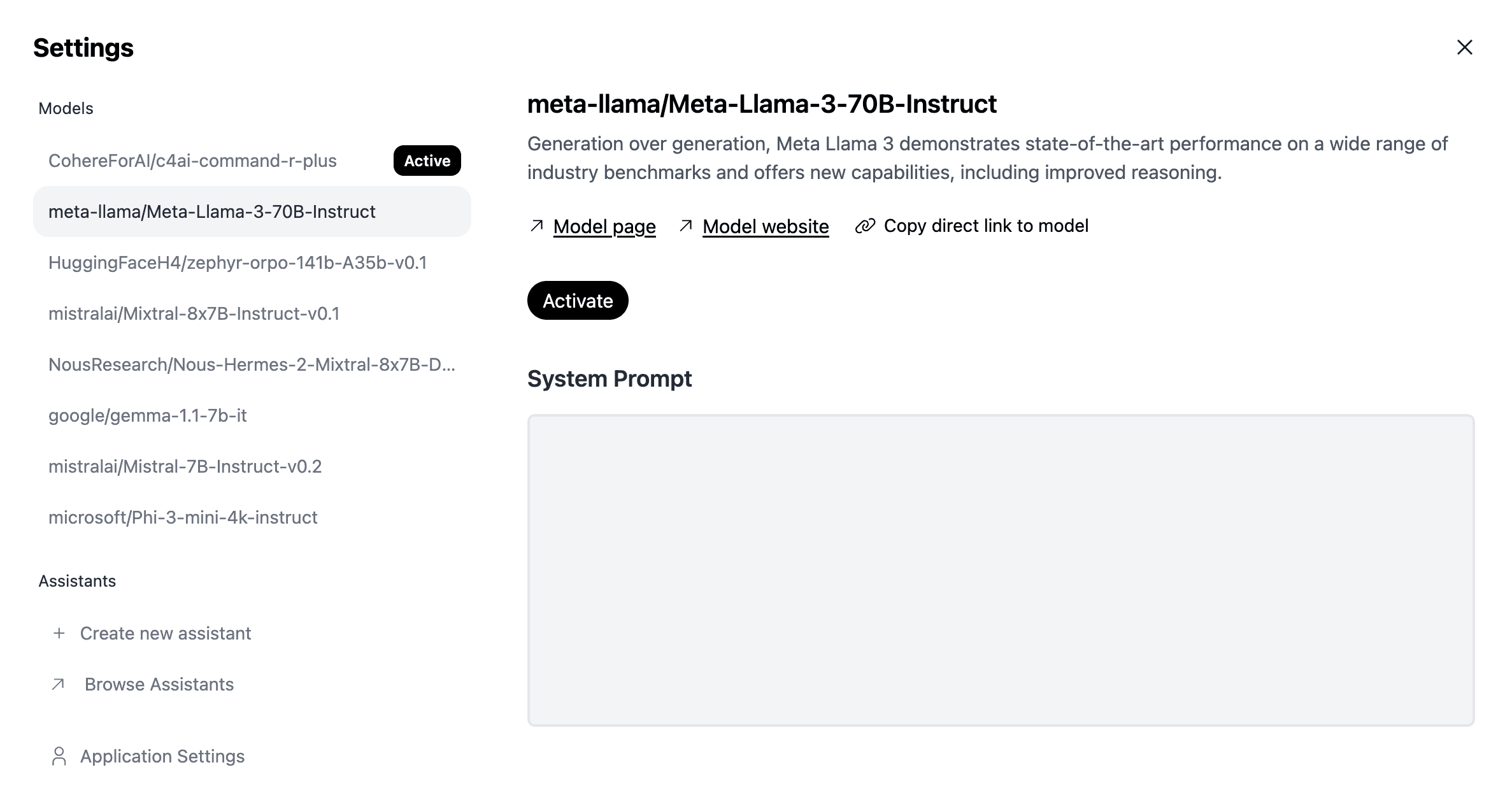
Accessing Meta Llama 3 with HuggingChat
Source: HuggingChat

Then, select “Activate,” and you can start interacting with the model!

Accessing Lllama 3 with Ollama

Ollama is a tool that lets you run language models on your local machine. With Ollama, you can easily interact with open-source models like Llama, Mistral, and Gemma in just a few steps.

To access Llama 3 with Ollama, simply navigate to the Ollama website and download the tool. Follow the installation instructions you see on the screen.

Then, navigate to your command line interface and type the following command: ollama run llama3:70b.

The model should take a few minutes to download. Once this is done, you can type your prompts into the terminal and interact with Llama 3, as shown in the screenshot below:
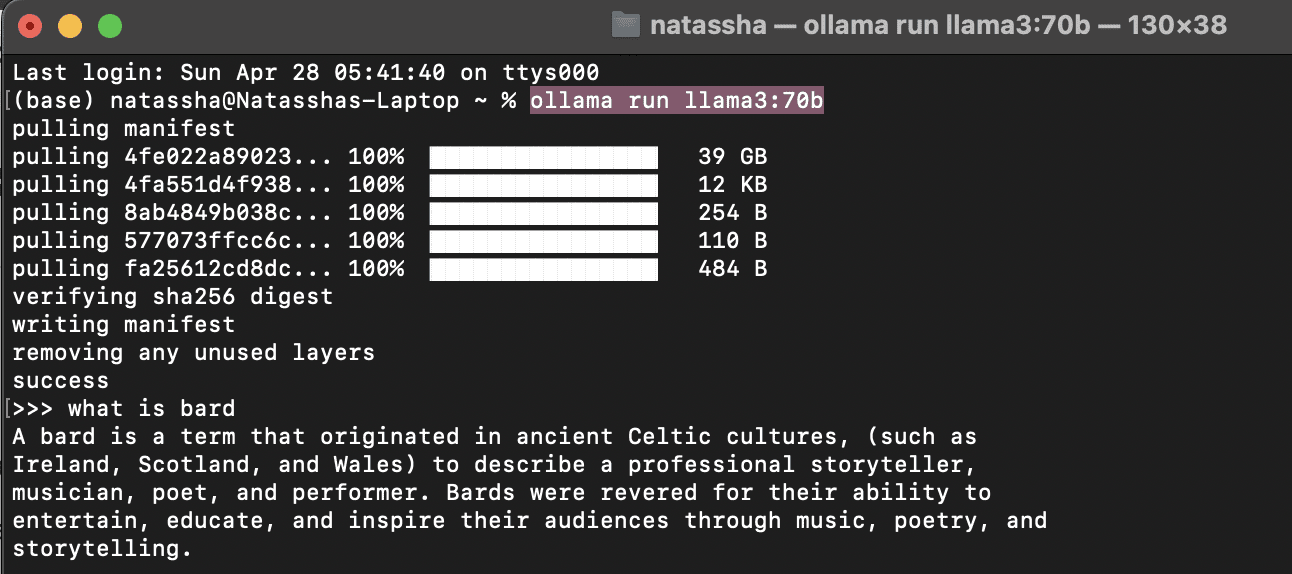
Accessing Meta Llama 3 with Ollama
Image by Author

Summary

Llama 3 is Meta’s latest openly available model. This LLM outperforms similarly sized models released by Google and Anthropic and currently powers Meta AI, an AI assistant built into Meta’s suite of products.

To access Llama 3, you can use the Meta AI chat interface, interact with the model through HuggingChat, or run it locally using Ollama.

Natassha Selvaraj is a self-taught data scientist with a passion for writing. Natassha writes on everything data science-related, a true master of all data topics. You can connect with her on LinkedIn or check out her YouTube channel.

More On This Topic

  • Unveiling the Power of Meta's Llama 2: A Leap Forward in Generative AI?
  • Closed Source VS Open Source Image Annotation
  • Baize: An Open-Source Chat Model (But Different?)
  • The Ultimate Open-Source Large Language Model Ecosystem
  • Generative AI Playground: LLMs with Camel-5b and Open LLaMA 3B on…
  • How to build a model to find the most impactful paths in user journeys

Soket AI Labs Partners with Google Cloud to Boost Pragna-1B Model

Soket AI Labs Becomes the First Indian Startup to Build Solutions Towards Ethical AGI

Soket AI Labs, the Indian AI research firm behind Pragna-1B, India’s first open-source multilingual foundation model, has announced a new collaboration with Google Cloud to further enhance the model’s capabilities and reach. Pragna-1B, which was initially released on May 1, 2024, aims to enable the adoption of Generative AI in India by providing support for vernacular languages such as Hindi, English, Bengali, and Gujarati.

Abhishek Upperwal, Founder of Soket AI Labs, said, “By leveraging Google cloud, Pragna-1B, despite being trained on fewer parameters, is efficient and compares performance in language processing tasks to similar category models.”

He further added, “Tailored specifically for vernacular languages, Pragna-1B offers balanced language representation and enables faster and more efficient tokenization suited for organisations seeking optimised operations and enhanced functionality.”

The collaboration also aims to make Pragna-1B more accessible to developers and organizations. Soket AI Labs plans to list its AI Developer Platform on the Google Cloud Marketplace and the Pragna series of models on the Google Vertex AI model registry. This integration will provide developers with a streamlined experience for fine-tuning models using high-performance resources like Vertex AI and TPUs.

The model has been designed specifically with Indian contexts in mind, ensuring transparency and clarity for enterprises integrating AI into their operations. Soket AI Labs leveraged Google Cloud’s AI infrastructure to achieve efficiency and cost-effectiveness in the development of Pragna-1B.

Soket AI Labs and Google Cloud plan to deepen their collaboration further by listing Soket’s AI Developer Platform on the Google Cloud Marketplace and the Pragna series of models on the Google Vertex AI model registry.

The collaboration between Soket AI Labs and Google Cloud also extends to technical work on training large-scale models and curating high-quality datasets for Indian languages. This joint effort aims to promote AI innovation in India while ensuring transparency and clarity in the development process.

The story so far

Soket AI Labs, founded by Abhishek Upperwal in 2019, created ‘Bhasha,’ a series of high-quality datasets designed for training Indian language models. This includes ‘Bhasha-wiki,’ which consists of 44.1 million articles translated from English Wikipedia into six Indian languages, and “Bhasha-wiki-indic,” a refined subset focusing on content relevant to India.

Pragna-1B, features a Transformer Decoder-only architecture with 1.25 billion parameters and a context length of 2048 tokens. Trained on approximately 150 billion tokens, with a focus on Hindi, Bangla, and Gujarati, Pragna-1B delivers state-of-the-art performance for vernacular languages in a small form factor.

In a recent LinkedIn post, Upperwal highlighted the improvements in GPT-4o’s tokenizer and vocabulary size, which now supports 200k tokens. However, he noted that Pragna-1b’s tokenizer still outperforms GPT-4o when it comes to Kannada, Gujarati, Tamil, and Urdu, serving as a motivation for Soket AI Labs to improve support for Hindi and other Indian languages.

Soket AI Labs is also experimenting with a Mixture of Experts model, expanding the languages supported and exploring different architectures for increased optimization.

The post Soket AI Labs Partners with Google Cloud to Boost Pragna-1B Model appeared first on Analytics India Magazine.

Google Search is Not Going Anywhere Anytime Soon; It’s Here to Stay! 

While OpenAI shied away from releasing a ‘Google Search Alternative’ at Spring Update, Google didn’t miss the opportunity to reinvent itself and change the search experience in ‘the era of Gemini’.

Google chief Sundar Pichai seems to care less about the noise outside. He recently responded to Microsoft CEO Satya Nadella’s statement about making Google ‘dance’, saying, ‘Google is dancing to its own music’. “I’ve always been very clear. I think we have a clear sense of what we need to do,” he said.

In order to tackle the likes of Perplexity AI and ChatGPT, the search giant introduced ‘AI Overviews’at Google I/O 2024.This feature generates summaries for the queries provided by the user.

Did Google Search just killed Perplexity?

— Santiago (@svpino) May 14, 2024

“Sometimes you want a quick answer, but you don’t have time to piece together all the information you need. Search will do the work for you with AI Overviews,” said Liz Reid VP of Google Search.

Powered by the Gemini model customised for Google Search, it combines Gemini’s advanced capabilities — including multi-step reasoning, planning, and multimodality — with best-in-class Search systems.

“What really sets this apart is our three unique strengths. First, our real time information with over a trillion facts about people, places and things. Second, our unparalleled ranking and quality systems, trusted for decades to get you the very best of the web. And third, the power of Gemini, which unlocks new agent tip capabilities, right in Search,” said Reid.

Reimagining Google Search in the Era of Gemini

Users can now ask Google multiple questions simultaneously. For instance, if someone is planning to join dance classes and needs to find the best option, they can ask Google multiple questions at once, such as ‘Suggest the best classes,’ ‘How far is it?’, and ‘Show details of intros and offers’. Google then compiles all the information with Gemini acting as an AI agent.

“People have already used AI Overviews billions of times through our experiment in Search Labs. They like that they can get both a quick overview of a topic and links to learn more. We’ve found that with AI Overviews, people use Search more, and are more satisfied with their results,” said Reid.

Moreover, Google will also be providing AI-organised Search pages based on the user query. For example, if you’re heading to Ooty to celebrate your anniversary and seeking the perfect restaurant, Gemini can generate a personalised page uncovering interesting options, such as venues with live music or historic charm, for you to explore.

Google is further experimenting with the search experience on Android. Circle to Searchenables users to select text, images, or videos on their screen through various gestures such as circling, highlighting, scribbling, or tapping to get relevant information.

Now Search with Videos

This is the first time that a search engine can search through videos online and suggest, recommend, and advise its user too. For instance, if you need to repair a washing machine, using video search, you can easily do so as it will walk you through troubleshooting and repair steps, potentially saving money on professional repairs.

Moreover, video search saves you the time and effort of finding the right words to describe an issue. You’ll get an AI overview with steps and resources to troubleshoot. Video search will soon be available for Search Labs users in English in the US, with plans to expand to more regions over time.

Bad Times Begin for Perplexity

It is worth noting that Google isn’t planning to move away from the blue links anytime soon, as they are a major source of revenue for the company. In the latest quarter, Google earned $46.156 billion from Search and related revenues, a 14% increase.

While Google does have a conversational chatbot, Gemini, like Perplexity AI, it does not provide links. If it were to start providing links, it would potentially impact Google’s advertising business.

“Google needs to make Search fully conversational vs this middle ground between Search and LLM. (I realize billions of dollars are at stake),” wrote Peter Yang, principle product manager, Roblox on X.

Google could disrupt Perplexity AI if it wanted to, but it faces the dilemma of whether sacrificing billions of dollars is worth it (obviously not). Interestingly, Perplexity AI might also be a wrapper for Google Search.

Perplexity recently raised $63 million at a $1 billion valuation, led by Daniel Gross and others, including Jeff Bezos and NVIDIA. Like any other startup, the pressure might be mounting on it to generate returns. Most recently, it partnered with SoundHound AI to bring voice assistant services to cars, TVs, and other IoT devices.

To sustain and compete with Google in the search engine space, one needs to offer more than just a good product. Sridhar Ramaswamy, Snowflake’s chief, who attempted to build a Google alternative called Neeva, said that his company was not on the path to a sustainable valuation, despite having a better product than Google’s.

Now that Google is integrating Gemini Advance into its search engine it’s only going to get better. “You can get an answer instantly, complete with a range of perspectives and links to dive deeper,” said Reid, sharing the glimpse of AI Overview, which is currently available in the US, and soon to billions of customers globally.

Only OpenAI, rumored to be releasing a search engine, has the potential to disrupt Google Search.

The post Google Search is Not Going Anywhere Anytime Soon; It’s Here to Stay! appeared first on Analytics India Magazine.

The Best Strategies for Fine-Tuning Large Language Models

Best Strategies for Fine-Tuning Large Language Models
Image by Author

Large Language Models have revolutionized the Natural Language Processing field, offering unprecedented capabilities in tasks like language translation, sentiment analysis, and text generation.

However, training such models is both time-consuming and expensive. This is why fine-tuning has become a crucial step for tailoring these advanced algorithms to specific tasks or domains.

Just to make sure we are on the same page, we need to recall two concepts:

  • Pre-trained language models
  • Fine-tuning

So let’s break down these two concepts.

What is a Pre-trained Large Language Model?

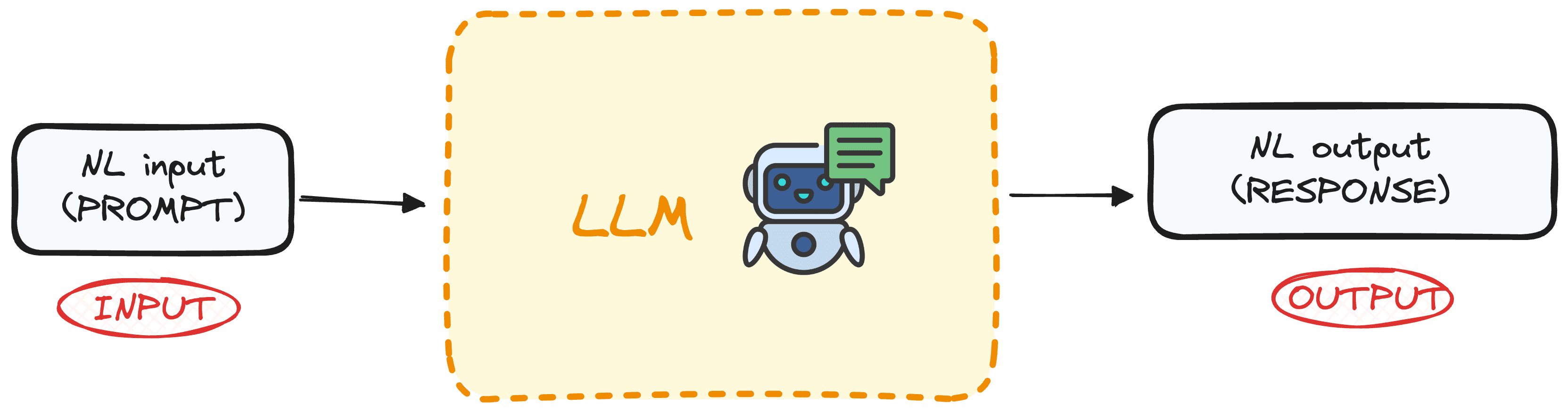
LLMs are a specific category of Machine Learning meant to predict the next word in a sequence based on the context provided by the previous words. These models are based on the Transformers architecture and are trained on extensive text data, enabling them to understand and generate human-like text.

The best part of this new technology is its democratization, as most of these models are under open-source license or are accessible through APIs at low costs.

LLMs
Image by Author

What is Fine-tuning?

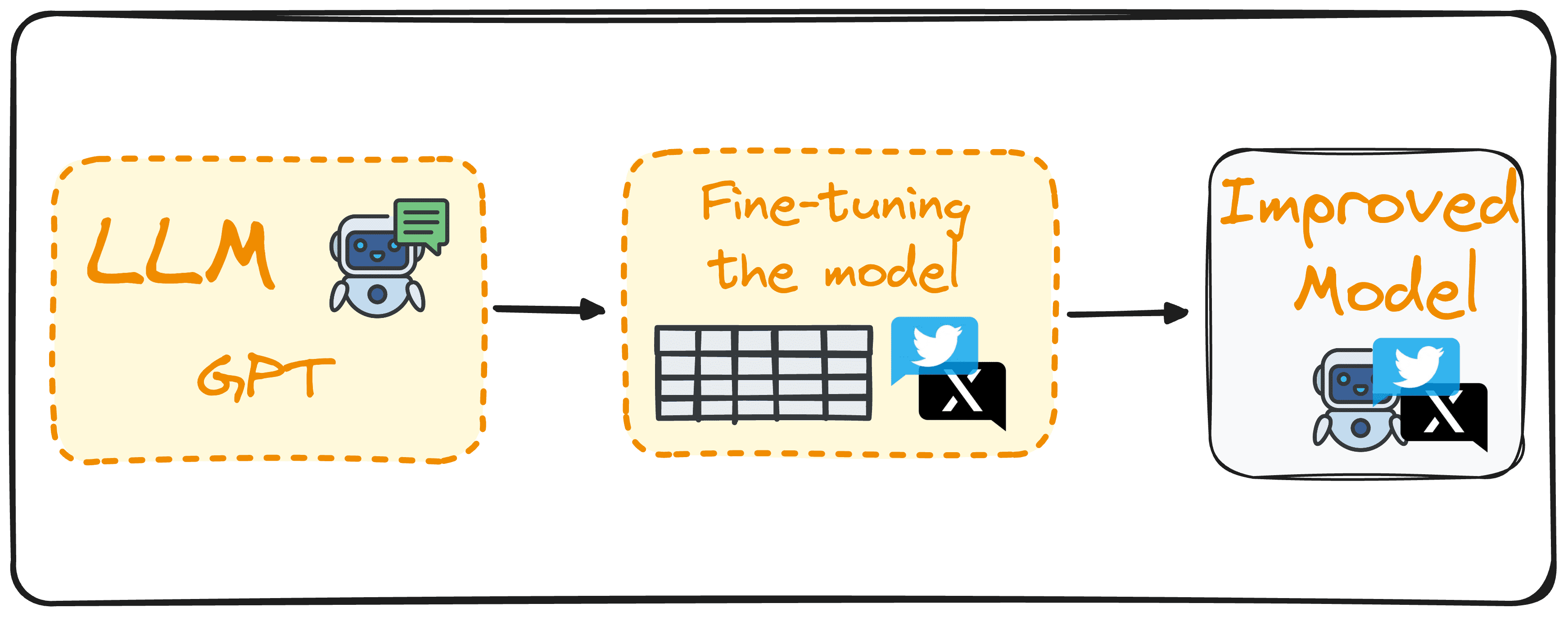
Fine-tuning involves using a Large Language Model as a base and further training it with a domain-based dataset to enhance its performance on specific tasks.

Let’s take as an example a model to detect sentiment out of tweets. Instead of creating a new model from scratch, we could take advantage of the natural language capabilities of GPT-3 and further train it with a data set of tweets labeled with their corresponding sentiment.

This would improve this model in our specific task of detecting sentiments out of tweets.

This process reduces computational costs, eliminates the need to develop new models from scratch and makes them more effective for real-world applications tailored to specific needs and goals.

LLMs Fine-Tuning
Image by Author

So now that we know the basics, you can learn how to fine-tune your model following these 7 steps.

Various Approaches to Fine-tuning

Fine-tuning can be implemented in different ways, each tailored to specific objectives and focuses.

Supervised Fine-tuning

This common method involves training the model on a labeled dataset relevant to a specific task, like text classification or named entity recognition. For example, a model could be trained on texts labeled with sentiments for sentiment analysis tasks.

Few-shot Learning

In situations where it's not feasible to gather a large labeled dataset, few-shot learning comes into play. This method uses only a few examples to give the model a context of the task, thus bypassing the need for extensive fine-tuning.

Transfer Learning

While all fine-tuning is a form of transfer learning, this specific category is designed to enable a model to tackle a task different from its initial training. It utilizes the broad knowledge acquired from a general dataset and applies it to a more specialized or related task.

Domain-specific Fine-tuning

This approach focuses on preparing the model to comprehend and generate text for a specific industry or domain. By fine-tuning the model on text from a targeted domain, it gains better context and expertise in domain-specific tasks. For instance, a model might be trained on medical records to tailor a chatbot specifically for a medical application.

Best Practices for Effective Fine-tuning

To perform a successful fine-tuning, some key practices need to be considered.

Data Quality and Quantity

The performance of a model during fine-tuning greatly depends on the quality of the dataset used. Always keep in mind:

Garbage in, garbage out.

Therefore, it's crucial to use clean, relevant, and adequately large datasets for training.

Hyperparameter Tuning

Fine-tuning is an iterative process that often requires adjustments. Experiment with different learning rates, batch sizes, and training durations to find the optimal configuration for your project.
Precise tuning is essential to efficient learning and adapting to new data, helping to avoid overfitting.

Regular Evaluation

Continuously monitor the model's performance throughout the training process using a separate validation dataset.
This regular evaluation helps track how well the model is performing on the intended task and checks for any signs of overfitting. Adjustments should be made based on these evaluations to fine-tune the model's performance effectively.

Navigating Pitfalls in LLM Fine-Tuning

This process can lead to unsatisfactory outcomes if certain pitfalls are not avoided as well:

Overfitting

Training the model with a small dataset or undergoing too many epochs can lead to overfitting. This causes the model to perform well on training data but poorly on unseen data, and therefore, have a low accuracy for real-world applications.

Underfitting

It occurs when the training is too brief or the learning rate is set too low, resulting in a model that doesn't learn the task effectively. This produces a model that does not know how to perform our specific goal.

Catastrophic Forgetting

When fine-tuning a model on a specific task, there's a risk of the model forgetting the broad knowledge it originally had. This phenomenon, known as catastrophic forgetting, reduces the model’s effectiveness across diverse tasks, especially when considering natural language skills.

Data Leakage

Ensure that your training and validation datasets are completely separate to avoid data leakage. Overlapping datasets can falsely inflate performance metrics, giving an inaccurate measure of model effectiveness.

Final Thoughts and Future Steps

Starting the process of fine-tuning large language models presents a huge opportunity to improve the current state of models for specific tasks.

By grasping and implementing the detailed concepts, best practices, and necessary precautions, you can successfully customize these robust models to suit specific requirements, thereby fully leveraging their capabilities.

Josep Ferrer is an analytics engineer from Barcelona. He graduated in physics engineering and is currently working in the data science field applied to human mobility. He is a part-time content creator focused on data science and technology. Josep writes on all things AI, covering the application of the ongoing explosion in the field.

More On This Topic

  • 7 Steps to Mastering Large Language Model Fine-tuning
  • Fine-Tuning OpenAI Language Models with Noisily Labeled Data
  • Strategies for Optimizing Performance and Costs When Using Large…
  • Fine-Tuning BERT for Tweets Classification with HuggingFace
  • Fine Tuning LLAMAv2 with QLora on Google Colab for Free
  • Overview of PEFT: State-of-the-art Parameter-Efficient Fine-Tuning

Bodhi Computing Acquisition Signals Ola’s Shift to RISC-V to Make Chips for Krutrim AI Cloud

Ola acquires bodhi computing

After entering the AI space with Krutrim AI, Bhavish Aggarwal, the CEO of Ola Cabs, has now ventured into the AI cloud space.

With Krutrim Cloud, Aggarwal wants to provide Indian developers with sophisticated AI computing infrastructure, as well as access to Krutrim AI models and a range of open-source models.

This initiative resembles a marketplace concept akin to the one being developed by Tata Communications. While Tata is building its AI Cloud with NVIDIA, Aggarwal is batting for Make in India. He wants to design and build the chips that power his AI Cloud locally.

While this might seem outrageously ambitious, Aggarwal has already taken the first step. Last year, he quietly acquired Bodhi Computing, a startup which builds and sells server-grade systems.

Bhavish Aggarwal wants to make everything in India

Sambit Sahu and Raguraman Barathalwar, both industry veterans with experience at companies like Intel, founded Bodhi Computing.

While the deal’s financial details are not known, interestingly, the Bengaluru-based company was founded in March 2023 and was acquired by Ola just a few months later.

Bodhi Computing was recently in the news for partnering with Toronto-based AI chip company Tenstorrent. In an interview with AIM, Tenstorrent COO Keith Witek said that he made an arrangement with Bodhi to be bought by Ola.

“Bodhi Computing is now at Ola; they’ve even scaled up operations beyond what we were able to scale. Ola is developing very advanced RISC-V and AI solutions for data centres and transportation and we’re partnering to make sure that it happens,” Witek said.

Recently, Tenstorrent also partnered with the Centre for Development of Advanced Computing (C-DAC) to help them build supercomputers, high-performance computing (HPC) systems, and data centre-grade products.

“We’ll licence the technology, offer assistance with training and development, and collaborate on creating any necessary technology or adaptations to ensure their success,” he added.

Betting on RISC-V for designing chips locally

In recent times, the popularity of RISC-V, an open-source instruction set architecture utilised for crafting custom processors, has surged. It presents an alternative to ARM and Intel, both of which have their own limitations stemming from their proprietary nature.

In April 2022, the Indian government initiated the Digital RISC-V programme (DIR-V), which aims to foster the development of next-generation microprocessors in India and positions the nation as a prominent global hub for RISC-V expertise.

Ola will leverage Tenstorrent’s expertise in RISC-V and chip designing to develop its own chips to power its AI cloud infrastructure and other requirements. Similar to C-DAC, Tenstorrent will also licence its technology to Ola, provide support and ensure its adoption.

Aggarwal has publicly expressed his desire to design chips locally on multiple occasions last year. Furthermore, India’s efforts to foster local semiconductor production are in harmony with his strategy.

Developments beyond AI

Now that Aggarwal is also building AI models and cloud infrastructure, its chips could also power its electric vehicles—both two-wheelers and four-wheelers.

Ola Electric is already a leader in India’s two-wheeler EV scooter market. The company is also developing four-wheeler EVs and could launch them this year.

Although little information is available about Ola’s four-wheeler, the company announced last year that it will provide a range of over 500 km per charge. Aggarwal claimed it would be the “sportiest car ever built in India”.

Ola’s entry into the four-wheeler EV segment could put the company in direct competition with Tesla and BYD. While Tesla could enter the market in the coming months, BYD, one of the largest EV makers in the world, is aggressively expanding in India.

Moreover, Aggarwal could be spreading his wings even further. On April 1, Aggarwal unveiled an autonomous scooter on social media. Even though it was meant for laughs, Aggarwal claimed in a social media post that his team is already working on autonomous technology for two-wheelers.

Given the secretive nature of his projects, there is a possibility Aggarwal could also be working on autonomous technology for his four-wheeler.

The post Bodhi Computing Acquisition Signals Ola’s Shift to RISC-V to Make Chips for Krutrim AI Cloud appeared first on Analytics India Magazine.

Ilya Sutskever Leaves OpenAI

Ilya Sutskever Leaves OpenAI

After months of everyone wondering ‘where is Ilya’, there has finally been a revelation. Ilya Sutskever, the chief scientist and co-founder of OpenAI has decided to leave the company.

He posted on X saying that his decade long journey with OpenAI has been nothing short of miraculous and is confident that OpenAI is going to build AGI. He also revealed that he is working on a project that is very dear to him, for which he will reveal information soon.

After almost a decade, I have made the decision to leave OpenAI. The company’s trajectory has been nothing short of miraculous, and I’m confident that OpenAI will build AGI that is both safe and beneficial under the leadership of @sama, @gdb, @miramurati and now, under the…

— Ilya Sutskever (@ilyasut) May 14, 2024

Sam Altman also posted about the departure of Sutskever and said that he is the greatest minds of our generation. “OpenAI would not be what it is without him. Although he has something personally meaningful he is going to go work on, I am forever grateful for what he did here and committed to finishing the mission we started together,” Altman said.

Meanwhile, Altman also announced that Jakub Pachocki is going to replace Sutskever as the chief scientist at OpenAI. “He has run many of our most important projects, and I am very confident he will lead us to make rapid and safe progress towards our mission of ensuring that AGI benefits everyone,” he added.

Posted by Ilya Sutskever on X

Pachocki also posted on X saying that Sutskever introduced him to the world of deep learning and has been a great mentor to him.

Greg Brockman, co-founder of OpenAI, also shared on X that Sutskever played a key role in helping build OpenAI. “Ilya is an artist. His vision and gusto are infectious, and he helped me understand this field when I was just getting started. He is unafraid of thinking through the logical conclusion of his intuitions,” he said.

Speaking of Sutskever’s art, in an interview, Mira Murati revealed a painting by the former chief scientist that hangs on the wall of the company. The painting is of OpenAI’s logo created by Sutskever, which symbolises ‘AI That Loves Humanity’, which indirectly shows how much Sutskever loves the company, and the future of AGI.

Mira Murati explaining @ilyasut's painting in #OpenAI office: "My guess is that it is AI That Loves Humatity". It looks like a scene from a sci-fi movie at the end of which AI takes over the world with Ilya's help and we discover the painting has a completely different meaning. pic.twitter.com/iIkro7UUo9

— Orhan Metin (@orhan_metin) February 21, 2024

The post Ilya Sutskever Leaves OpenAI appeared first on Analytics India Magazine.

AWS Launches Amazon Bedrock GenAI Service in APAC (Mumbai) Region

At the AWS Summit Bengaluru, AWS announced that Amazon Bedrock, its fully managed generative AI service, is now generally available in the AWS Asia Pacific (Mumbai) Region. The launch will enable organisations across India to easily build and scale generative AI applications with enterprise-grade security and privacy.

Amazon Bedrock first became generally available worldwide in select regions in 2023. Its expansion to the Mumbai region will allow customers, including those in the public sector and regulated industries, to innovate with generative AI while having more control over where applications are run and data is stored. The closer proximity also reduces latency, which is critical for AI tasks requiring fast processing and response times, such as real-time content generation and interactive user experiences.

“The availability of Amazon Bedrock in India will further spur innovation that large enterprises, startups, independent software vendors, and public sector organisations are building in India, and complement their efforts to upskill their talent in generative AI,” said Shalini Kapoor, Chief Technologist–APJ Public Sector, Director–AWS India and South Asia.

Indian organisations are already leveraging generative AI for a wide range of use cases to boost productivity, create innovative user experiences, and reimagine work processes. Amazon Bedrock provides them access to best-in-class AI models from providers like Amazon Titan, Cohere, Anthropic, Meta, and Mistral, along with powerful customisation capabilities.

Max Life Insurance, a leading private life insurer in India, anticipates Amazon Bedrock will considerably enhance the efficiency of its field agents in responding to customer queries and gaining market insights. Shellkode, an AWS Partner and IT solutions firm, has been able to create purpose-built generative AI solutions like negotiation assistants, invoice management, and multi-lingual email assistants using AWS services.

To support the AI-driven future, AWS has trained 5.5 million people across India in cloud skills since 2017. The company also launched the AI Ready initiative in November 2023, offering free AI and generative AI training courses aligned to both technical and non-technical roles.

AWS has committed to investing $12.7 billion in India by 2030 into local cloud infrastructure, bringing its total investment to $16.4 billion. This is estimated to contribute $23.3 billion to India’s GDP and support approximately 131,700 full-time jobs annually at local businesses by 2030.

The post AWS Launches Amazon Bedrock GenAI Service in APAC (Mumbai) Region appeared first on Analytics India Magazine.

Can GenAI Solve Legal Troubles in India?

India’s legal system is neck-deep in crisis, with nearly 5 crore pending cases across the country’s courts. The sheer volume of cases has led to delays, inefficiencies, and a lack of access to justice for many citizens.

However, a new wave of legal tech startups is here, aiming to tackle these challenges head-on by leveraging the power of generative artificial intelligence (GenAI). And with 762 legal tech startups in India, the potential for transformation is immense.

One such startup is CourtEasy, founded by a team of engineers and lawyers who experienced legal problems firsthand. “We started CourtEasy to address the problems faced in the legal sector,” Mrunmayee Shende, one of the founders of CourtEasy, told AIM.

“The system is overloaded with pending cases, and we believe AI will help solve it at a faster pace,” she added.

What legal tech aims to solve

The team at CourtEasy recognised the potential of GenAI to bridge the gap between technology and the legal system, particularly in lower courts where the adoption has been slow.

“In lower courts, people are not aware of the potential of technology yet,” Shende explained. “Higher courts and law firms are more open to adopting newer technologies as they evolve, but this is not the case in lower courts.”

With the aim to fix this gap, she said, “If we plot the adoption of technology in the legal system, we can see a significant gap between lower and higher courts. We want to bridge this gap by making sure our services are available to all.”

The company has developed a range of tools powered by GenAI. “We have our Marathi language model called Marathi LLM, which is a foundational model using LLM for the Marathi language,” Shende explained.

“Similarly, we are in the stage of building a separate legal model that can provide answers and solve the problems faced by legal professionals,” she added. The team has built language models for regional courts, legal research aids, and case drafting assistants.

Another startup working towards making justice faster and fairer is Jhana AI. “At Jhana, we build intelligent and fundamental tools for legal services, a one-stop ecosystem, and you interact with this humanlike chatbot that is reflective and iterative,” said Em McGlone, co-founder of Jan.

McGlone, explaining the versatility of the chatbot, said, “It can do anything from browsing and reading the web like a human to referencing legal books, journals, statutes, court orders from various courts, and various legal reportage, news blogs, and so on.”

SpotDraft, another legal tech startup, uses GenAI to help law firms and legal teams draft, store, analyse, execute, and automate contracts and contract processes. The company has already processed around 4 million contracts and has clinched clients both locally and globally.

Shashank Bijapur, the CEO and co-founder of Spotdraft, describes himself as a ‘recovering lawyer’ who has experienced the drudgery of lengthy documents firsthand.

“At some point, I stopped using my brain altogether. I was just using my eyes and fingers to copy and paste [legal clauses] from one sheet to another,” he said, stressing on the need for automation in legal processes.

Global success and future prospects

On one side there’s the Supreme Court launching AI-powered tools like SUPACE (Supreme Court Portal for Assistance in Court’s Efficiency) and SUVAS (Supreme Court Vidhik Anuvaad Software).

While on the other, we have the Madras High Court’s impressive case clearance rates through tech interventions. These demonstrate how AI can enhance efficiency and access to justice across all levels of the judiciary.

The successful implementation of GenAI in legal systems around the world has already shown promising results.

For example, in the United States, AI-powered tools have been used to predict the outcomes of cases with high accuracy, while in China, AI judges have been deployed to handle minor legal disputes.

However, the adoption of GenAI in the legal system is not without challenges. Privacy and data security are major concerns, as legal cases often involve sensitive personal information.

Shende acknowledged the importance of data safety, “We are a startup, and we have received funds and infrastructure credits from companies like Nvidia and Microsoft to ensure data security.”

Despite the challenges, legal tech startups remain optimistic about the future of GenAI in the industry. CourtEasy has partnered in the Microsoft for Startups initiative and is now in the process of raising additional funds to expand its operations.

Jhana is also looking for enterprise solutions for their product and is excited to meet people from the community who are building various tools for big corporations.

The future of tech integration into India’s legal system looks promising. As McLone puts it, “We think we can make justice faster and fair by creating better retrieval systems for lawyers to use.”

The post Can GenAI Solve Legal Troubles in India? appeared first on Analytics India Magazine.

65% of Senior Executives Emphasise Human Competitive Advantage in the Age of AI: TCS Report

A new study by Tata Consultancy Services reveals that 65% of senior executives say their competitive advantage will still come from humans — with their creativity, intuition, and strategic thinking unleashed by AI’s augment and assist capabilities.

The ‘TCS AI for Business Study’, a comprehensive report on the state of AI adoption and its impact on businesses, also finds that 69% of businesses are more focused on using AI to spur innovation and increase revenue than on productivity improvement and cost optimization.

Executives are generally positive about the impact of AI, with 57% reporting excitement or optimism about the potential impact of AI on businesses.

Among respondents in the study, 45% expect up to half their employees will need to use generative AI capabilities to do their job in three years’ time — and another 41% think even more will do so.

Most (65%) believe AI will augment and enhance human capabilities, enabling people to focus on higher-value activities that require creativity and strategic thinking.

“Enterprises are realising that the path to production for AI solutions is not easy, and that building an AI-mature enterprise is a marathon, not a sprint. Our AI study has confirmed this sentiment; it has also highlighted that enterprises feel underprepared to deploy AI solutions at scale as well as to manage the profound shifts in the roles of people and ways of working resulting from such deployments,” Dr Harrick Vin, Chief Technology Officer, TCS, said.

Business leaders are less certain about the path to transformation. Only 4% use AI in a way that has transformed their business and nearly a quarter (24%) haven’t even moved beyond the initial exploratory phase.

Top barriers to business success include current corporate IT infrastructures and customer expectations.

Organisations also recognize the need to move beyond existing metrics to measure the success of AI implementations; nearly three-fourths (72%) say they don’t have the right metrics.

The survey also highlights the need for businesses to take a strategic approach to AI adoption and develop the right performance indicators to measure the technology’s impact on their business.

The TCS Thought Leadership Institute surveyed nearly 1,300 CEOs and other senior executives with P&L responsibilities, across 12 industries and 24 countries. About half the companies had $1 billion to $5 billion in annual revenue and the other half had over $5 billion in revenue.

The post 65% of Senior Executives Emphasise Human Competitive Advantage in the Age of AI: TCS Report appeared first on Analytics India Magazine.

Google Introduces ‘AI Teammates’ That Could Replace Managers

Google’s AI Teammates’ That Cloud Replace Mangers Across Departments

Another day, another tool to replace your senior employee or a manager. At Google I/O, the company introduced ‘AI Teammate,’ powered by Gemini.

This new feature will significantly reduce workloads by handling mundane tasks and participating in team communications, potentially transforming the employee from a helpful colleague to an overbearing overseer. In other words, a new way to get more work done without your human manager’s help.

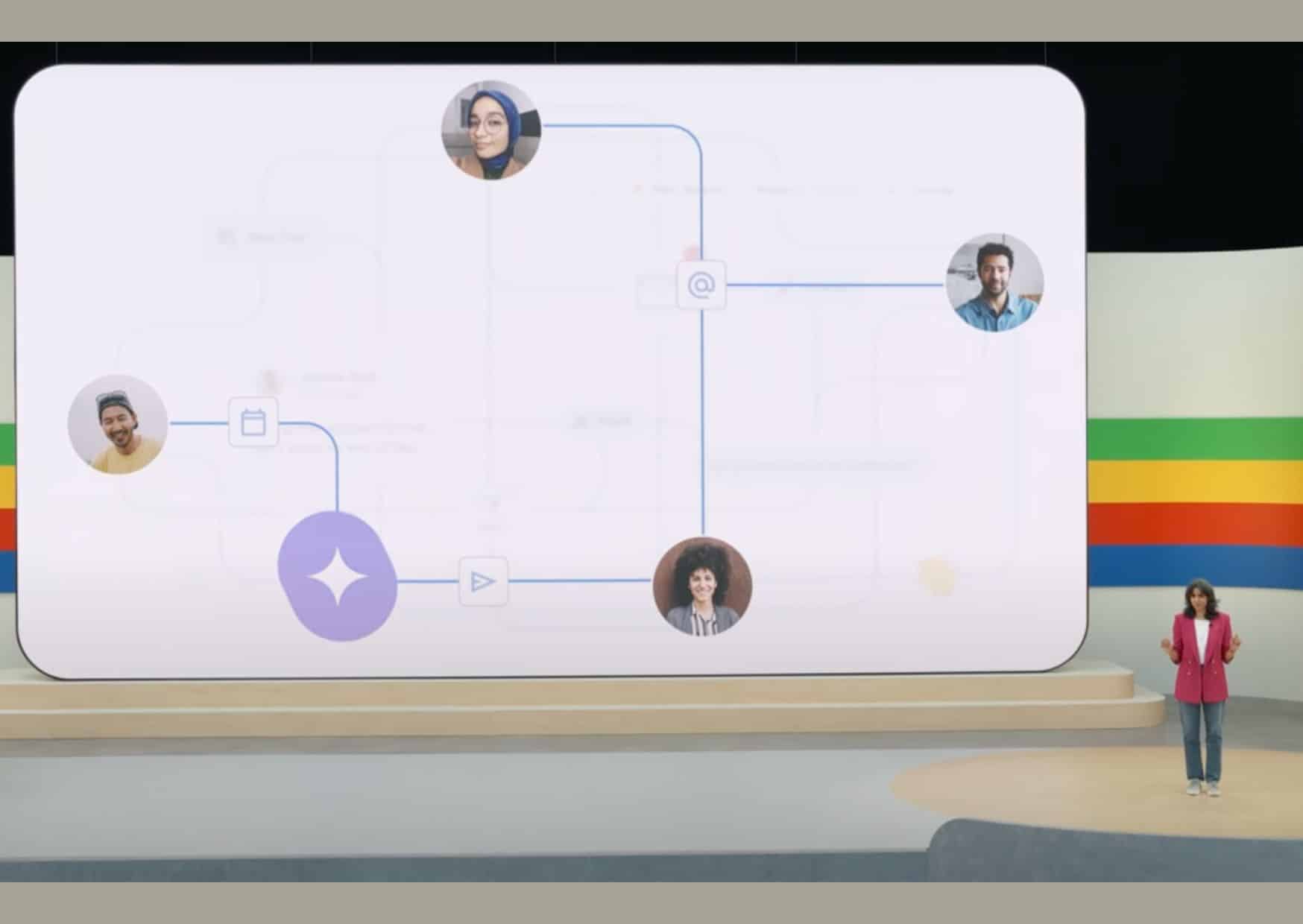
Aparna Pappu, General Manager and Vice President of Google Workspace highlighted, “We are prototyping a virtual Gemini-powered teammate. This teammate has an identity and a Workspace account, along with a specific role and objective.”

8. An AI teammate that lives inside Google workspace to do collaborative tasks pic.twitter.com/M21dB9ThmG

— Chief AI Officer (@chiefaioffice) May 14, 2024

Coming to Gemini integrated into Gmail’s mobile app, this revolutionises email management by offering summarised views of lengthy email threads and detailed suggestions for responses through Contextual Smart Reply.

Additionally, Gemini has introduced Gmail Q&A functionality, enabling users to interact with the AI to gather specific information from their inbox swiftly, further enhancing the efficiency of email interactions.

Coming soon! Get more done across apps like Gmail, Drive & Sheets with AI-powered workflows for #GoogleWorkspace. Check it out → https://t.co/p9oG6lPq0I#GoogleIO pic.twitter.com/OmhmikVSo3

— Google Workspace (@GoogleWorkspace) May 14, 2024

Aparna Pappu, said, “Customers love how Gemini grows participation in meetings with automatic language detection and real-time captions now expanding to 68 languages.”

Notably, companies have actively utilised Gemini for Workspace functionalities such as Help Me Write in Docs and Gmail, Help Me Design in Slides, and Help Me Organise in Sheets.

During the event, Pappu highlighted the successful integration of Gemini for Workspace at Sports Basement, California, resulting in a notable enhancement of the organisation’s customer support team productivity by over 31%.

Beyond email, Gemini extends its utility to streamline various workflows within Workspace and other Google apps, exemplified by its ability to automatically organise and track receipts in Drive and Sheets. By leveraging generative AI, Gemini acts as the connective tissue between different applications, facilitating seamless automation of common tasks such as expense tracking.

The new updates will be initially accessible to Workspace Labs and Gemini for Workspace Alpha users, with broader availability anticipated for all Gemini for Workspace customers and Google One AI Premium subscribers in the next month.

The post Google Introduces ‘AI Teammates’ That Could Replace Managers appeared first on Analytics India Magazine.