Top Data Engineering Service Providers – PeMa Quadrant 2024

The data engineering services are rapidly expanding and evolving, owing to the advent of AI. Companies are increasingly seeking reliable standards to assess provider competencies. AIM Research’s Penetration and Maturity (PeMa) Quadrant emerges as the guiding beacon in this dynamic landscape.

The Rise of Data Engineering: Transforming AI Infrastructure and Deployment

Data engineering is vital for AI projects, serving as the foundation for creating, managing, and enhancing data systems that support effective AI and machine learning operations. As companies increasingly rely on data to drive sophisticated models, the significance of data engineering continues to grow.

The Role of Data Engineering Service Providers

Data engineering service providers design and manage data infrastructures crucial for analytics and AI, focusing on optimizing data architecture to handle large volumes efficiently. Additionally, automated data pipelines are developed to maintain the data flow and accessibility, while implementing security measures to protect data integrity and comply with regulations. Whether in healthcare, finance, or beyond, data engineering service providers catalyze growth and facilitate transformative change.

AIM Research’s PeMa Quadrant

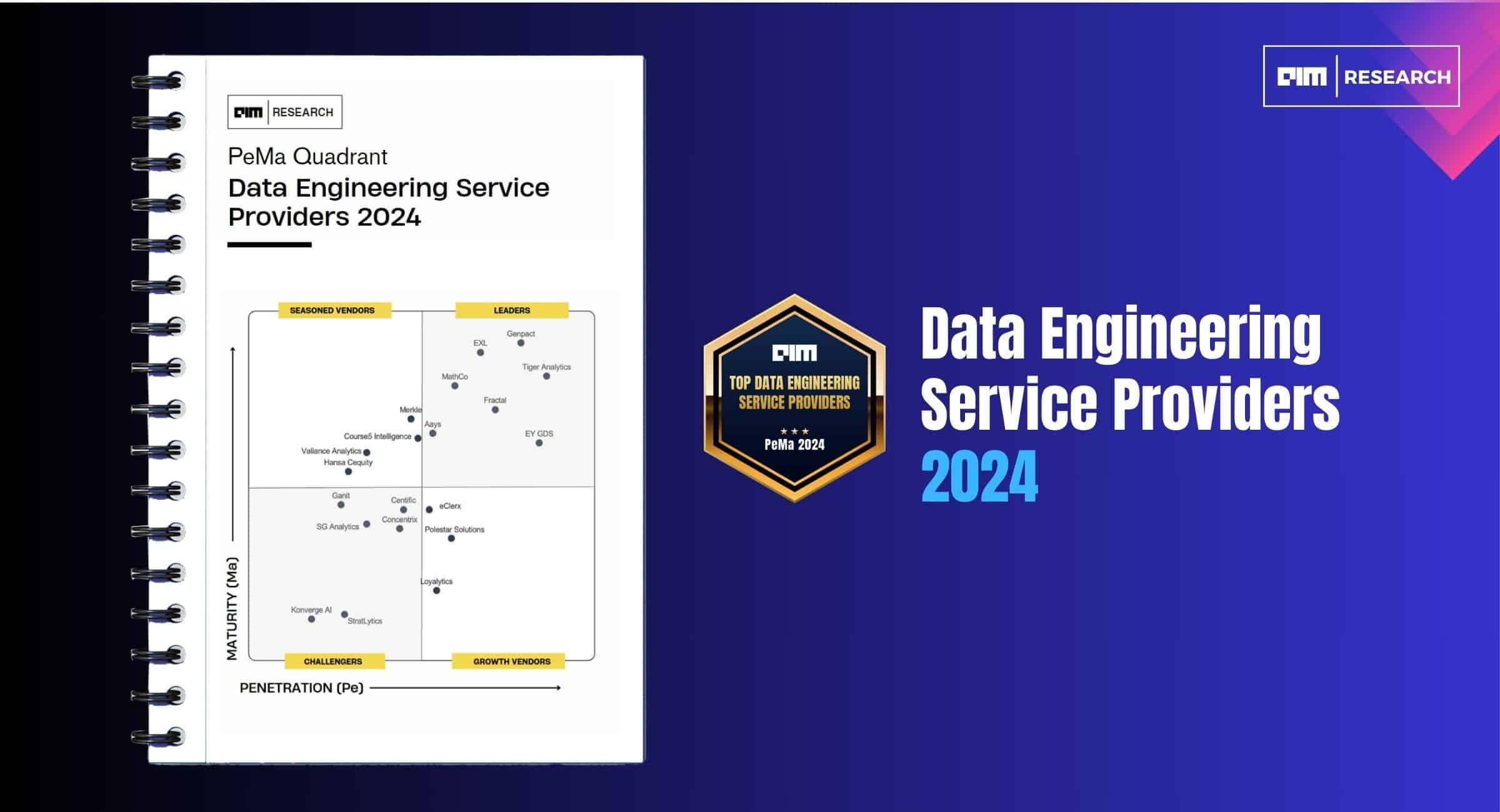
The PeMa Quadrant is AIM Research’s tool designed to help businesses navigate this complex landscape. By evaluating service providers across various parameters, the Quadrant assists in making informed decisions, ensuring that businesses partner with providers that align with their unique requirements.

Strategic Developments in Data Engineering Services

Data engineering service providers significantly enhance AI initiatives through focused strategies on data management. These providers streamline data integration and improve data quality, ensuring that data is clean and readily available for various analytical tasks. Moreover, the service providers automate the data pipelines to manage complex data operations. Data engineering encourages collaboration within organizations by eliminating data silos, leading to a cohesive approach to data management. They also continuously monitor and refine data systems to help businesses quickly adapt to changing data needs and maintain optimal performance in AI operations.

Selecting the Right Data Engineering Service Provider

Businesses must carefully evaluate data engineering service providers based on several factors. These include model capabilities, ease of integration, pricing, transparency, quality of customer support, compliance standards, scalability potential, and integration flexibility.

Classifying the Service Providers

The PeMa Quadrant classifies providers into Seasoned Vendors, Challengers, Leaders, and Growth Vendors, each with its own strengths and areas for development. This categorization aids businesses in aligning with providers that match their growth trajectory and innovation appetite.

Conclusion

As the data engineering ecosystem continues to mature, the PeMa Quadrant emerges as an indispensable guide for businesses seeking to capitalize on its potential. With innovation abound, choosing the right data engineering service providers can empower enterprises to outpace their competition in the digital landscape.

While this article offers a glimpse into the insights provided by the AIM PeMa Quadrant, the full report offers a wealth of information for organizations eager to explore the nuances of the data engineering service market. By leveraging this resource, businesses can make informed decisions and cultivate partnerships that drive success in an increasingly AI-driven world.

AIM Research’s PeMa Quadrant Webinar

AIM Research is hosting a webinar on the PeMa Quadrant data engineering service provider on 22nd May 2024 from 3 PM to 4 PM.

Please register for the webinar: AIM Research webinar on the Penetration and Maturity (PeMa) Quadrant 2024 for Data Engineering Service Providers

AIM Penetration And Maturity (PeMa) Quadrant is an Industry Benchmark of Data Vendor Capabilities. Refer this page.

The post Top Data Engineering Service Providers – PeMa Quadrant 2024 appeared first on AIM.

OpenAI Needs Apple, Badly!

OpenAI Needs Apple, Badly!

When it comes to AI, OpenAI is killing it as an undisputed leader in the space. Its multibillion-dollar partnership with Microsoft has worked rather well for the company. However, the tech couple seems to be drifting apart – slowly but surely. And now, as things stand, OpenAI badly needs Apple.

Take OpenAI’s Spring Update conference, for instance, where the company announced the launch of GPT-4o. Though Microsoft is one of the biggest backers of OpenAI, and the company has trained all its models with Microsoft’s Azure and GPU clusters, there was no single mention of Microsoft throughout the conference.

On the other hand, after rumours circulating around a possible partnership between Apple and OpenAI for integrating GPT on iPhone devices, OpenAI seems to be inching closer to the Cupertino giant. This was pretty evident at the conference as well where most of the announcements were made on the iPhone with the ChatGPT app.

But what happens to the Microsoft and OpenAI love story?

Interestingly, it is not just OpenAI which is moving away from Microsoft. The tech giant is striving for independence when it comes to AI. It is done relying on others for its models. According to reports, though the company had been training smaller models like Orca and Phi all this while (using GPT and incorporating Meta’s Llama on its platform), this time it is training a model large enough to compete with others.

Referred to as MAI-1 (possibly Microsoft AI-1), the model is being developed internally by the company, and is around 500 billion parameters in size.

Its development is being headed by Mustafa Suleyman, formerly the co-founder of DeepMind and most recently CEO of the AI startup Inflection, who now oversees Microsoft’s AI division. In March, Microsoft acquired a majority of Inflection’s staff and paid $650 million for its intellectual property rights.

Though the exact purpose of MAI-1 has not been disclosed yet, it is possible that Microsoft might incorporate its products into all its Copilot products. This would mean that the company will move away from OpenAI’s GPT and Codex models.

Meanwhile, Microsoft is making every effort to project a harmonious relationship between the two companies. While the companies are releasing models which seem to rival each other, Microsoft’s CTO Kevin Scott went on LinkedIn to explain that it was not in any way a competition to OpenAI.

“I’m not sure why this is news, but just to summarise the obvious: we build big supercomputers to train AI models. Our partner OpenAI uses these supercomputers to train frontier-defining models; and then we both make these models available in products and services so that lots of people can benefit from them. We rather like this arrangement,” he said.

But inversely, it would be ideal for Microsoft to have a backup plan just in case the deal with OpenAI falls through, as has been the case with several others in the field. Chief Satya Nadella seems to be playing a different AI game. Under him, Microsoft has invested in all kinds of AI companies, from OpenAI and Mistral to Databricks and Figure AI.

Suleyman recently posted on X saying, “AI is everything at Microsoft”. He also highlighted that the company is building massive products using AI and has a definite vision for Copilot.

Everything about this seems forced. There seems to be no other reason for Microsoft to build such large models and spend so much on compute if they’re not making it for commercial purposes. Moreover, on his hiring, Suleyman was touted as the “new” Sam Altman.

Meanwhile, ahead of OpenAI’s most-anticipated partnership with Apple, Altman recently lauded the Cupertino-based tech giant for its technology prowess, saying, “iPhone is the greatest piece of technology humanity has ever made”, and it’s tough to get beyond it as “the bar is quite high”.

Everyone is leaving OpenAI

To add another layer to all this is the fact that many OpenAI employees are starting to leave the company. Most recently, former co-founder and chief scientist Ilya Sutskever quit the company to work on something he loves. A few others, like Jan Leiki from the super alignment team of OpenAI, also left with him. Andrej Karpathy, another founding member, left OpenAI.

Perhaps, Altman is a genius strategist leading OpenAI to perfection by changing the board, turning it into a for-profit company, launching a search engine to compete with Google, while also eliminating threats like Elon Musk. Even though their products are probably the best out there, the company is also heavily in favour of weeding out competition.

For now, OpenAI is positioned very well between the two biggest giants of the globe, Apple and Microsoft. It is becoming the de facto name for AI, which everyone wants to partner with. But as Microsoft is getting heavily self-reliant with Nadella playing 5D chess, OpenAI needs the Apple partnership badly.

The post OpenAI Needs Apple, Badly! appeared first on Analytics India Magazine.

Indian Government to Procure 10,000 GPUs Within Next 18 Months

Indian Government to Procure 10,000 GPUs Within 18 Months

To enhance India’s computational capabilities, the government has announced plans to procure 10,000 graphics processing units (GPUs) within the next 18 months.

Amitabh Kant, the G20 Sherpa for India and also the former CEO of NITI Aayog, posted on X saying that this strategic investment aims to dramatically boost the nation’s processing power, aligning its resources with its substantial data generation capabilities.

Govt is set to enhance India’s computational capabilities significantly by procuring 10,000 graphics processing units (GPUs) within the next 18 months.
This strategic investment will dramatically boost our processing power, aligning our resources with our data generation…

— Amitabh Kant (@amitabhk87) May 16, 2024

However, the post does not mention the particular maker or model of the GPU, but it is expected to be built for generative AI and supercomputing.

Kant also highlighted that India is responsible for generating 20% of the world’s data and holds the second-highest number of GitHub AI projects globally, contributing 19% to the worldwide total. This reflects India’s active and vibrant participation in AI development on an international scale.

This is also in line with the recent report by IDC, unveiled at Intel’s AI for India conference that India’s spending on AI may reach $5.1 billion by 2027. This surge is largely attributed to AI infrastructure provisioning. This includes spending on hardware such as servers and chips (CPUs, GPUs, and accelerators), as well as software components like frameworks and libraries.

In March, Yotta Data Services announced the arrival of over 4,000 NVIDIA H100 Tensor Core GPUs at its NM1 data centre. The state-of-the-art chips, billed as the world’s fastest AI accelerators, will power Yotta’s upcoming Shakti Cloud platform – set to be the 10th quickest supercomputer globally.

The post Indian Government to Procure 10,000 GPUs Within Next 18 Months appeared first on Analytics India Magazine.

The top AI announcements from Google I/O

Google’s going all-in on AI — and it wants you to know it. During the company’s keynote at its I/O developer conference on Tuesday, Google mentioned “AI” more than 120 times. That’s a lot! But not all of Google’s AI announcements were significant per se. Some were incremental. Others were rehashed. So to help sort […]

© 2024 TechCrunch. All rights reserved. For personal use only.

The Multimodal Marvel: Exploring GPT-4o’s Cutting-Edge Capabilities

Discover the groundbreaking capabilities of GPT-4o, the latest in AI technology. Explore its applications, ethical considerations, limitations, and future potential across diverse sectors

The remarkable progress in Artificial Intelligence (AI) has marked significant milestones, shaping the capabilities of AI systems over time. From the early days of rule-based systems to the advent of machine learning and deep learning, AI has evolved to become more advanced and versatile.

The development of Generative Pre-trained Transformers (GPT) by OpenAI has been particularly noteworthy. Each iteration brings us closer to more natural and intuitive human-computer interactions. The latest in this lineage, GPT-4o, signifies years of research and development. It utilizes multimodal AI to comprehend and generate content across various data input forms.

In this context, multimodal AI refers to systems capable of processing and understanding more than one type of data input, such as text, images, and audio. This approach mirrors the human brain’s ability to interpret and integrate information from various senses, leading to a more comprehensive understanding of the world. The significance of multimodal AI lies in its potential to create more natural and unified interactions between humans and machines, as it can understand context and nuances across different data types.

GPT-4o: An Overview

GPT-4o, or GPT-4 Omni, is a leading-edge AI model developed by OpenAI. This advanced system is engineered to perfectly process text, audio, and visual inputs, making it truly multimodal. Unlike its predecessors, GPT-4o is trained end-to-end across text, vision, and audio, enabling all inputs and outputs to be processed by the same neural network. This holistic approach enhances its capabilities and facilitates more natural interactions. With GPT-4o, users can anticipate an elevated level of engagement as it generates various combinations of text, audio, and image outputs, mirroring human communication.

One of the most remarkable advancements of GPT-4o is its extensive language support, which extends far beyond English, offering a global reach and advanced capabilities in understanding visual and auditory inputs. Its responsiveness is like human conversation speed. GPT-4o can respond to audio inputs in as little as 232 milliseconds (with an average of 320 milliseconds). This speed is 2x faster than GPT-4 Turbo and 50% cheaper in the API.

Moreover, GPT-4o supports 50 languages, including Italian, Spanish, French, Kannada, Tamil, Telugu, Hindi, and Gujarati. Its advanced language capabilities make it a powerful multilingual communication and understanding tool. In addition, GPT-4o excels in vision and audio understanding compared to existing models. For example, one can now take a picture of a menu in a different language and ask GPT-4o to translate it or learn about the food.

Furthermore, GPT-4o, with a unique architecture designed for processing and fusion of text, audio, and visual inputs in real-time, effectively addresses complex queries that involve multiple data types. For instance, it can interpret a scene depicted in an image while simultaneously considering accompanying text or audio descriptions.

GPT-4o's Application Areas and Use Cases

GPT-4o's versatility extends across various application areas, opening new possibilities for interaction and innovation. Below, a few use cases of GPT-4o are briefly highlighted:

In customer service, it facilitates dynamic and comprehensive support interactions by integrating diverse data inputs. Similarly, GPT-4o enhances diagnostic processes and patient care in healthcare by analyzing medical images alongside clinical notes.

Additionally, GPT-4o's capabilities extend to other domains. In online education, it revolutionizes remote learning by enabling interactive classrooms where students can ask real-time questions and receive immediate responses. Likewise, the GPT-4o Desktop app is a valuable tool for real-time collaborative coding for software development teams, providing instant feedback on code errors and optimizations.

Moreover, GPT-4o's vision and voice functionalities enable professionals to analyze complex data visualizations and receive spoken feedback, facilitating quick decision-making based on data trends. In personalized fitness and therapy sessions, GPT-4o offers tailored guidance based on the user's voice, adapting in real-time to their emotional and physical state.

Furthermore, GPT-4o's real-time speech-to-text and translation features enhance live event accessibility by providing live captioning and translation, ensuring inclusivity and broadening audience reach at public speeches, conferences, or performances.

Likewise, other use cases include enabling seamless interaction between AI entities, assisting in customer service scenarios, offering tailored advice for interview preparation, facilitating recreational games, aiding individuals with disabilities in navigation, and assisting in daily tasks.

Ethical Considerations and Safety in Multimodal AI

The multimodal AI, exemplified by GPT-4o, brings significant ethical considerations that require careful attention. Primary concerns are the potential biases inherent in AI systems, privacy implications, and the imperative for transparency in decision-making processes. As developers advance AI capabilities, it becomes ever more critical to prioritize responsible usage, guarding against the reinforcement of societal inequalities.

Acknowledging the ethical considerations, GPT-4o incorporates robust safety features and ethical guardrails to uphold responsibility, fairness, and accuracy principles. These measures include stringent filters to prevent unintended voice outputs and mechanisms to mitigate the risk of exploiting the model for unethical purposes. GPT-4o attempts to promote trust and reliability in its interactions by prioritizing safety and ethical considerations while minimizing potential harm.

Limitations and Future Potential of GPT-4o

While GPT-4o possesses impressive capabilities, it is not without its limitations. Like any AI model, it is susceptible to occasional inaccuracies or misleading information due to its reliance on the training data, which may contain errors or biases. Despite efforts to mitigate biases, they can still influence its responses.

Moreover, there is a concern regarding the potential exploitation of GPT-4o by malicious actors for harmful purposes, such as spreading misinformation or generating harmful content. While GPT-4o excels in understanding text and audio, there is room for improvement in handling real-time video.

Maintaining context over prolonged interactions also presents a challenge, with GPT-4o sometimes needing to catch up on previous interactions. These factors highlight the importance of responsible usage and ongoing efforts to address limitations in AI models like GPT-4o.

Looking ahead, GPT-4o's future potential appears promising, with anticipated advancements in several key areas. One notable direction is the expansion of its multimodal capabilities, allowing for seamless integration of text, audio, and visual inputs to facilitate richer interactions. Continued research and refinement are expected to lead to improved response accuracy, reducing errors and enhancing the overall quality of its answers.

Moreover, future versions of GPT-4o may prioritize efficiency, optimizing resource usage while maintaining high-quality outputs. Furthermore, future iterations have the potential to understand emotional cues better and exhibit personality traits, further humanizing the AI and making interactions feel more lifelike. These anticipated developments emphasize the ongoing evolution of GPT-4o towards more sophisticated and intuitive AI experiences.

The Bottom Line

In conclusion, GPT-4o is an incredible AI achievement, demonstrating unprecedented advancements in multimodal capabilities and transformative applications across diverse sectors. Its text, audio, and visual processing integration sets a new standard for human-computer interaction, revolutionizing fields such as education, healthcare, and content creation.

However, as with any groundbreaking technology, ethical considerations and limitations must be carefully addressed. By prioritizing safety, responsibility, and ongoing innovation, GPT-4o is expected to lead to a future where AI-driven interactions are more natural, efficient, and inclusive, promising exciting possibilities for further advancement and a greater societal impact.


Project Navarasa Takes Center Stage at Google I/O

Just a few days ago, we wrote about how Gemma outperformed Meta’s Llama 3 for Indic languages. Today, at Google I/O, India’s Project Navarasa took centre stage, highlighting the use of Gemma, making it accessible for 15 Indic languages.

Google highlighted the success of ‘Project Navarasa,’ a multilingual variant of Gemma for Indic languages developed by Telugu LLM Labs.

Harsh Dhand, head of APAC research partnerships at Google said, “When technology is developed for a particular culture, it won’t be able to solve and understand the nuances of a country like India.”

Project Navarasa leverages Gemma’s powerful tokenizer to enable AI-driven language generation for 15 Indic languages.

“One of Gemma’s features is an incredibly powerful tokenizer which enables the model to use hundreds of thousands of words, symbols and characters across so many alphabets and language systems. This large vocabulary is critical to adapting Gemma to power projects like Navarasa,” said Ramsri Goutham Golla, the co-creator of Navarasa.

“Our biggest dream is to build a model to include everyone from all corners of India,” said Golla, saying that Navarasa is a model trained for Indic languages, and a fine-tuned model based on Google’s Gemma.

He said they built Navarasa to create culturally rooted large language models where people can talk in their native language and receive responses in their native language.

Many developers that AIM spoke to said that Gemma is better than Llama for Indic languages. “Gemma shines compared to the Llama 2 and 3 models,” said Adithya S Kolavi, founder of Cognitive Lab, who built a leaderboard for Indic LLMs.

“Models using Llama 2 extended its tokenizer by 20 to 30k tokens, reaching a vocabulary size of 50-60k. Continuous pre-training is crucial for understanding these new tokens. In contrast, Gemma’s tokenizer initially handles Indic languages well, requiring minimal fine-tuning for specific tasks,” explained Kolavi.

According to Vivek Raghavan, the co-founder of Sarvam AI, Gemma’s powerful tokenizer gives it an advantage over Llama when it comes to Indic Languages. He explained, “The tokenization tax for Indic languages means asking the same question in Hindi costs three times more tokens than in English, and even more for languages like Odiya due to their underrepresentation in these models.”

Meanwhile, OpenAI recently released GPT-4o, an update to their language model that includes a new tokenizer and an extended vocabulary size of 200k tokens, compared to 100k tokens in GPT-4.

This update significantly improved the support for several Indian languages, including Hindi, Gujarati, Marathi, Telugu, Tamil, and Urdu.

Although Gemma 2’s tokenizer limit wasn’t clearly mentioned in the demo, it is stated that the model can handle ‘hundreds of thousands of words, symbols and characters’. In comparison, GPT-4o’s 200k base tokenizer so far outperforms Gemma for Indic and non-English languages in terms of token reduction.

At Google I/O, the tech giant today introduced PaliGemma, a powerful open vision-language model (VLM), and provided a sneak peek into the upcoming Gemma 2, the next generation of their Gemma family of models.

Now you can try out our Indic Gemma Model Navarasa 2.0 (supports language generation in 15 languages) easily as a chat interface at https://t.co/KFQ6qfWBf0
Ask a question in English and ask it to respond in Hindi, Telugu etc or ask directly in the native language.
Kudos to… pic.twitter.com/YuHniHo5s4

— Ramsri Goutham Golla (@ramsri_goutham) April 2, 2024

Google Unveils Open Vision Language Model, PaliGemma

PaliGemma, inspired by PaLI-3 and built on open components, including the SigLIP vision model and the Gemma language model, is designed for class-leading fine-tune performance on a wide range of vision-language tasks.

These tasks include image and short video captioning, visual question answering, understanding text in images, object detection, and object segmentation.

Google is providing both pre-trained and fine-tuned checkpoints at multiple resolutions, as well as checkpoints specifically tuned to a mixture of tasks for immediate exploration.

PaliGemma is available through various platforms and resources, including free options like Kaggle and Colab notebooks, and academic researchers can apply for Google Cloud credits to support their work.

The release of PaliGemma brings several key benefits, such as multimodal comprehension, a versatile base model for fine-tuning on a wide range of vision-language tasks, and off-the-shelf exploration with a checkpoint fine-tuned on a mixture of tasks for immediate research use.

Several have started experimenting with it already.

I tried it with some plant disease images. It could identify the crop, but it would refuse to detect plant diseases. Found this example quite funny: pic.twitter.com/bASP74bgMn

— Thomas Friedel (@thomascygn) May 14, 2024

More Power to Gemma

Looking ahead, Google announced the upcoming arrival of Gemma 2, the next generation of Gemma models. Gemma 2 will be available in new sizes for a broad range of AI developer use cases and features a brand-new architecture designed for breakthrough performance and efficiency. Key benefits include class-leading performance, reduced deployment costs, and versatile tuning toolchains.

At this year’s developer conference, Google literally poked fun at OpenAI by making it clear that it is making AI helpful for everyone, not just for him or her.

The post Project Navarasa Takes Center Stage at Google I/O appeared first on Analytics India Magazine.

The Easiest Way of Running Llama 3 Locally

Most Easiest Way of Running Llama 3 Locally
Image by Author

Running LLMs (Large Language Models) locally has become popular as it provides security, privacy, and more control over model outputs. In this mini tutorial, we learn the easiest way of downloading and using the Llama 3 model.

Llama 3 is Meta AI's latest family of LLMs. It is open-source, comes with advanced AI capabilities, and improves response generation compared to Gemma, Gemini, and Claud 3.

What is Ollama?

Ollama/ollama is an open-source tool for using LLMs like Llama 3 on your local machine. With new research and development, these large language models do not require large VRam, computing, or storage. Instead, they are optimized for use in laptops.

There are multiple tools and frameworks available for you to use LLMs locally, but Ollama is the easiest to set up and use. It lets you use LLMs directly from a terminal or Powershell. It is fast and comes with core features that will make you start using it immediately.

The best part of Ollama is that it integrates with all kinds of software, extensions, and applications. For example, you can use the CodeGPT extension in VScode and connect Ollama to start using Llama 3 as your AI code assistant.

Installing Ollama

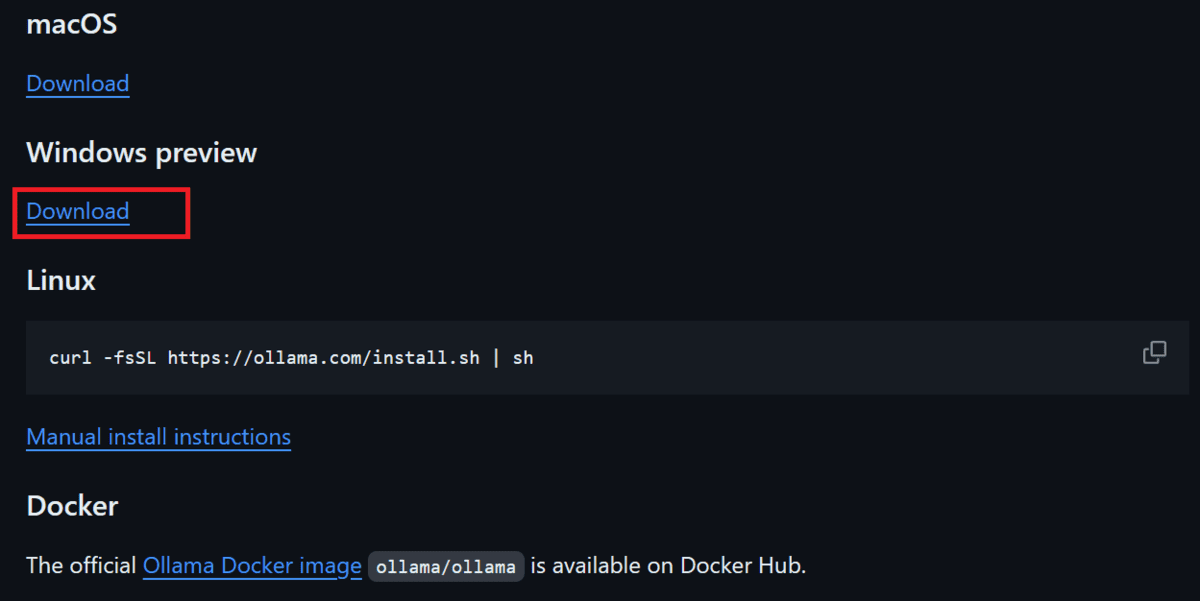
Download and Install Ollama by going to the GitHub repository Ollama/ollama, scrolling down, and clicking the download link for your operating system.

Download option for various operating systems of Ollama
Image from ollama/ollama | Download option for various operating systems

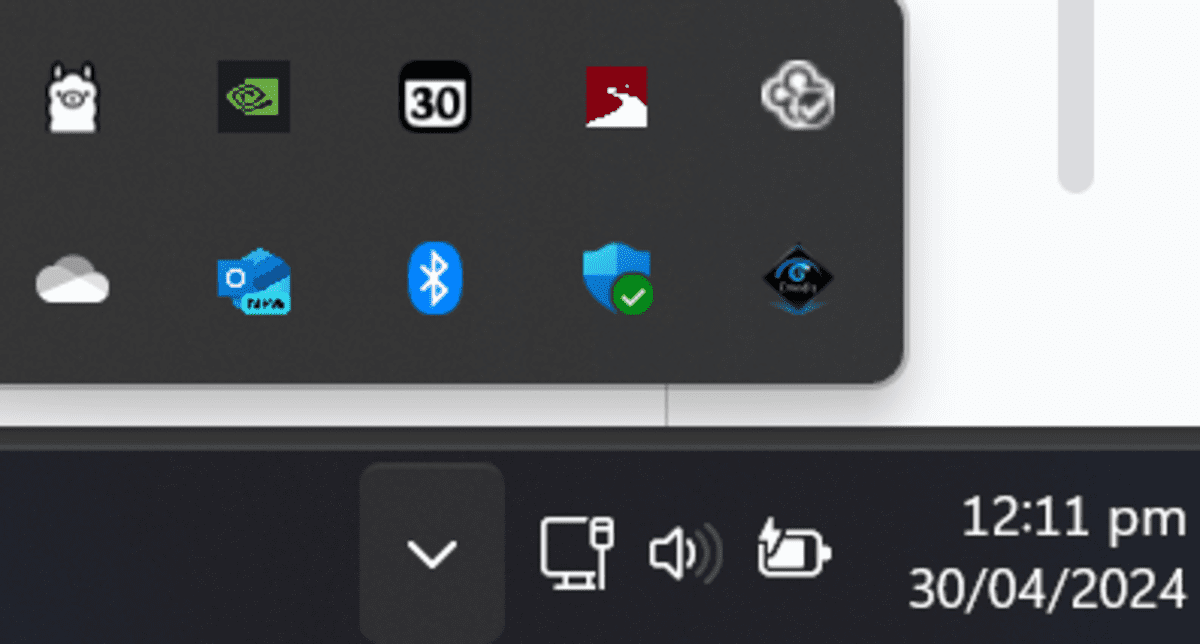
After Ollama is successfully installed it will show in the system tray as shown below.

Ollama in system tray

Downloading and Using Llama 3

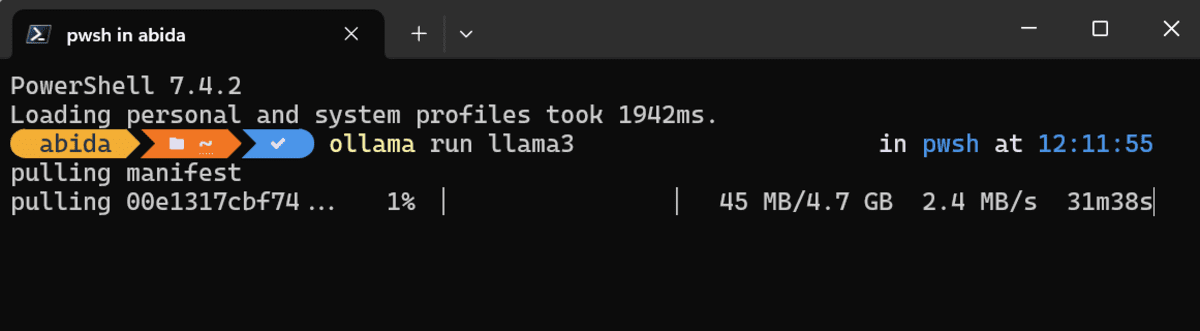
To download the Llama 3 model and start using it, you have to type the following command in your terminal/shell.

ollama run llama3

Depending on your internet speed, it will take almost 30 minutes to download the 4.7GB model.

PowerShell: downloading the Llama 3 using Ollama

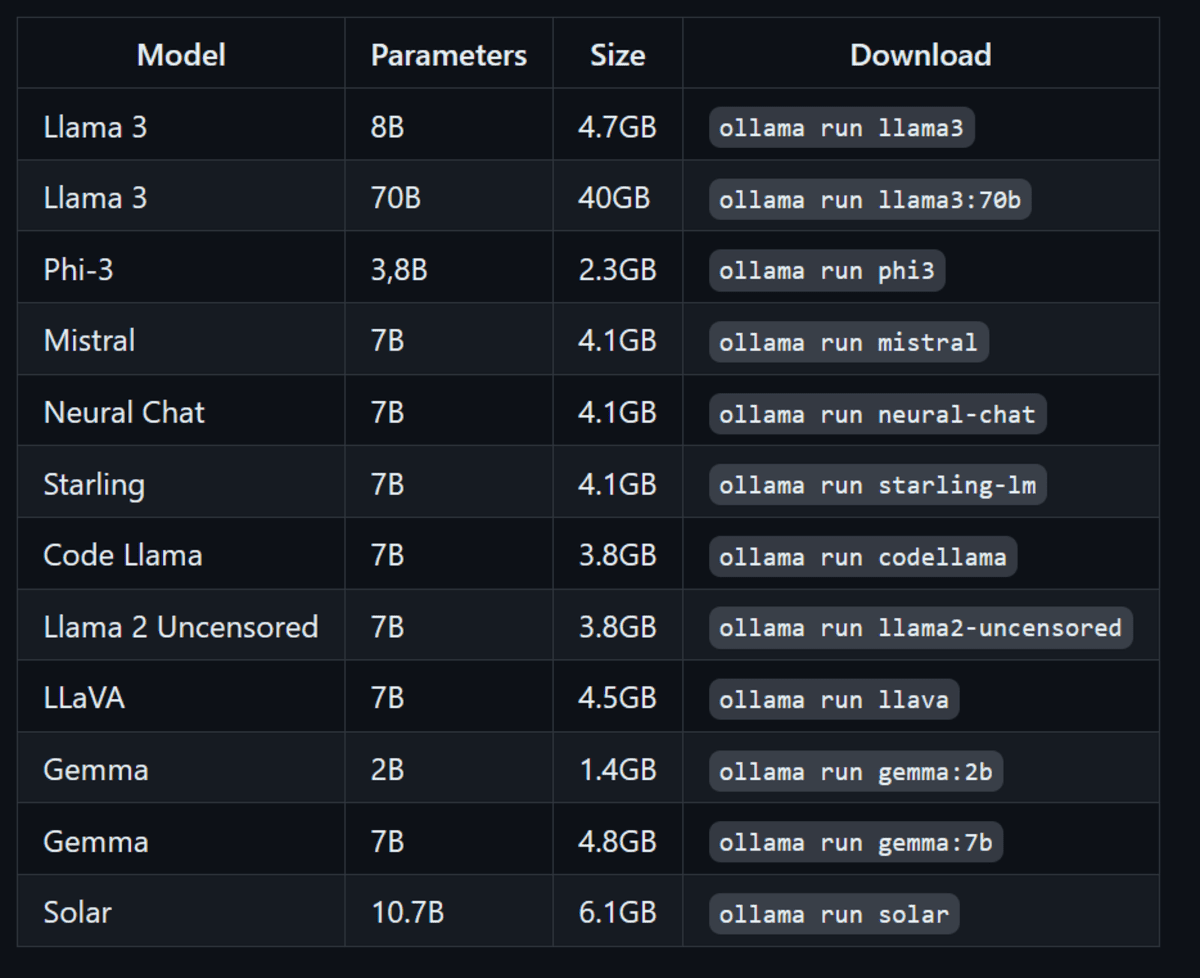
Apart from the Llama 3 model, you can also install other LLMs by typing the commands below.

Running other LLMs using Ollama
Image from ollama/ollama | Running other LLMs using Ollama

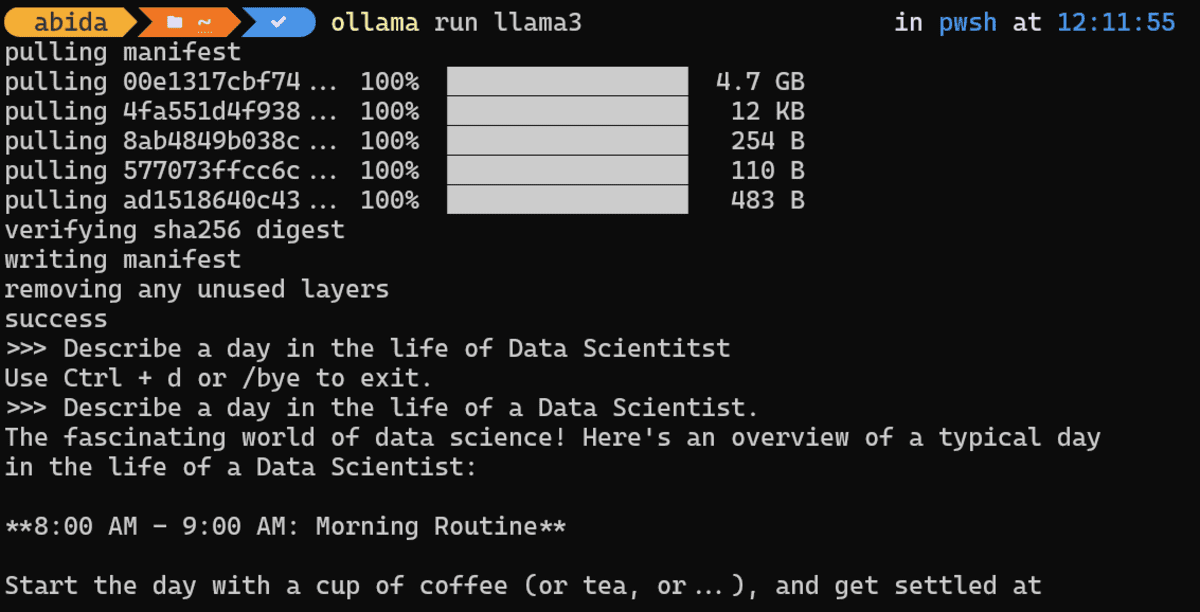
As soon as downloading is completed, you will be able to use the LLama 3 locally as if you are using it online.

Prompt: "Describe a day in the life of a Data Scientist."

Using Llama 3 in Ollama

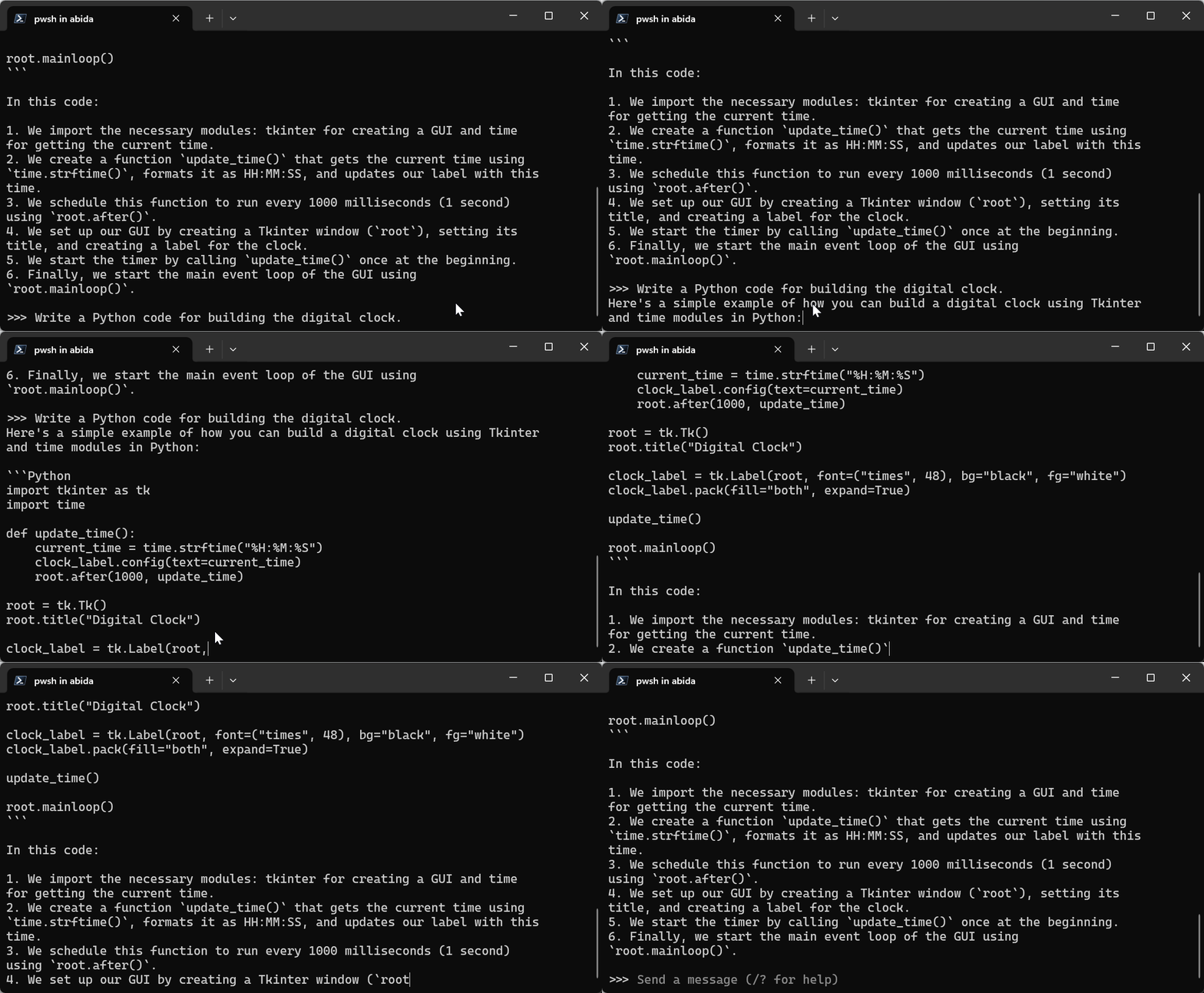
To demonstrate how fast the response generation is, I have attached the GIF of Ollama generating Python code and then explaining it.

Note: If you have Nvidia GPU on your laptop and CUDA installed, Ollama will automatically use GPU instead of CPU to generate a response. Which is 10 better.

Prompt: "Write a Python code for building the digital clock."

Checking the speed of Llama 3 response generation on GPU using Ollama

You can exit the chat by typing /bye and then start again by typing ollama run llama3.

Final Thoughts

Open-source frameworks and models have made AI and LLMs accessible to everyone. Instead of being controlled by a few corporations, these locally run tools like Ollama make AI available to anyone with a laptop.

Using LLMs locally provides privacy, security, and more control over response generation. Moreover, you don't have to pay to use any service. You can even create your own AI-powered coding assistant and use it in VSCode.

If you want to learn about other applications to run LLMs locally, then you should read 5 Ways To Use LLMs On Your Laptop.

Abid Ali Awan (@1abidaliawan) is a certified data scientist professional who loves building machine learning models. Currently, he is focusing on content creation and writing technical blogs on machine learning and data science technologies. Abid holds a Master's degree in technology management and a bachelor's degree in telecommunication engineering. His vision is to build an AI product using a graph neural network for students struggling with mental illness.

More On This Topic

  • A Simple Guide to Running LlaMA 2 Locally
  • The Easiest Way to Make Beautiful Interactive Visualizations With Pandas
  • Ollama Tutorial: Running LLMs Locally Made Super Simple
  • Using Groq Llama 3 70B Locally: Step by Step Guide
  • Running Redis on Google Colab
  • How to Get Up and Running with SQL — A List of Free Learning Resources

Anthropic hires Instagram co-founder as head of product

Mike Krieger, one of the co-founders of Instagram and, more recently, the co-founder of personalized news app Artifact (which TechCrunch corporate parent Yahoo recently acquired), is joining Anthropic as the company’s first chief product officer. As CPO, Krieger will oversee Anthropic’s product engineering, management, and design efforts, Anthropic says, as the company works to expand […]

© 2024 TechCrunch. All rights reserved. For personal use only.

Will Linux Land You a Job?

Will Linux land you a job

If you’re a software engineer, adding Linux as a skill or adding a Linux certification to your resume can give you an edge over other applicants. In an increasingly competitive field, this helps improve the probability of you getting selected for the job you applied for.

Now, if you’re a computer graduate looking for a job, Linux is a must. From cloud interactions to building apps for Android (because Android is based on Linux), you have to have at least a basic knowledge of how to interact with the operating system in a terminal.

Furthermore, a huge chunk of the web is powered by Linux, as the OS is usually the first choice to run data centres for its efficiency and stability. This means that positions like network engineer, cybersecurity specialist, and more become open to you.

Knowing vs Learning Linux

Linux is one of the most powerful operating systems in the world. It is not only helpful in getting you a job but also gives you total control over how you want your computer to behave.

The demand for Linux skills is consistently high. According to the 2021 Open Source Jobs Report from the Linux Foundation, Linux is the second most sought-after skill after cloud technologies, which often also requires Linux knowledge.

Every major cloud platform, including AWS, GCP, and Azure, heavily relies on Linux. So, while cloud skills are in higher demand, a solid understanding of Linux is necessary to work effectively with these cloud technologies.

Linux is a fundamental component of DevOps practices and cloud computing.

Think of it for a second! Let’s say you want to use Docker on Windows; guess what? It used WSL (Windows Subsystem for Linux). Want to use Docker on Mac? It’s already a UNIX operating system and works fundamentally the same as Linux but with some restrictions.

Furthermore, Linux is a fundamental skill for cybersecurity professionals. Many essential security tools, such as Metasploit, Nmap, and Wireshark, are built for Linux systems.

Linux skills are also vital for conducting vulnerability assessments, as scanners like Nessus and OpenVAS have native support for Linux platforms.

Linus converts are of the same opinion. One user on Reddit posted that even if his workload didn’t require Linux, one Windows update corrupted his entire drive, and when he switched to Linux, he realised what software freedom meant.

“Don’t learn Linux to make money or to get a better job. Do it because you deserve the feeling of freedom and fun that Windows has deprived you of,” he declared.

Another reason is that when you use Linux, you are exposed to how a computer works from its core, and that feeling alone is a reason for most users to switch to the operating system.

Organisations Love Linux

The prime reason why organisations love Linux is because it’s free. This is in comparison to the Windows Server 2022 Standard Edition (used for physical or minimal virtualised environments), which starts from $1,069, and the Datacenter Edition, which starts from $6,155.

Apart from the cost, there are other reasons as well for learning Linux.

Linux can be configured on the kernel level, and you can load only the required modules, making it the perfect choice for a specific use case. Eventually, it takes fewer resources and does the given task a lot faster.

Extensive hardware support makes Linux the most versatile OS on the planet. It can be configured to run on refrigerators, cars, and power card-sized computers such as Raspberry Pi.

Security and privacy are the most crucial aspects of using Linux. Most malware and spyware are made for Windows, as it has the largest desktop computer share. But on Linux, you don’t require any antivirus software, as everything is managed through scripts and can not be executed without specific permissions.

Because of its compatibility, big tech companies often create their own versions of Linux. For example, Amazon has Amazon Linux 2, specifically crafted for AWS needs.

As mentioned earlier, even Android is a highly customised version of Linux developed by Google. The framework for apps is entirely different, but it runs Linux at its core. This is why if you’ve ever looked through a security patch, it usually has mention of SE in its name, indicating LinuxSE (Security Enhanced Linux).

In conclusion, learn Linux, even if your work profile does not require it. Linux is one of those things that you don’t think you’ll need until you realise you need it the most. Freedom, hardware choices, and privacy were the three key features that led me to use Linux.

The post Will Linux Land You a Job? appeared first on Analytics India Magazine.

Google’s ‘Astra’ Marks the Beginning of Autonomous AI Agents

A new era of autonomous AI agents has begun. At Google I/O 2024, the tech giant unveiled Project Astra, a first-of-its-kind initiative to develop universal AI agents capable of perceiving, reasoning, and conversing in real-time.

“Building on Gemini, we’ve developed prototype agents that can process information faster by continuously encoding video frames, combining the video and speech input into a timeline of events, and caching this information for efficient recall,” said Google DeepMind chief Demis Hassabis, in a blog post.

Hassabis added that with the release it would be easy to see a future where people could have an expert AI assistant by their side via phone or glasses.

We’re sharing Project Astra: our new project focused on building a future AI assistant that can be truly helpful in everyday life. 🤝
Watch it in action, with two parts – each was captured in a single take, in real time. ↓ #GoogleIO pic.twitter.com/x40OOVODdv

— Google DeepMind (@GoogleDeepMind) May 14, 2024

The release comes just a day after OpenAI unveiled GPT-4o, which won hearts online with its ‘omni’ capabilities across text, vision, and audio. OpenAI’s demos, which included a real-time translator, coding assistant, AI tutor, friendly companion, poet, and singer, soon became the talk of the town.

However, its agentic capabilities in particular have caught everyone’s attention, with some even calling it ‘the biggest part of the update’ and ‘a step closer to autonomous agents’.

The GPT-4o desktop app can read your screen in real-time and interact with your OS, revolutionising the way people work. The app allows for voice conversations, screenshot discussions, and instant access to ChatGPT. It’s like having an AI teammate on your device who can help you with whatever you’re working on.

The ChatGPT desktop app just became the best coding assistant on the planet.
Simply select the code, and GPT-4o will take care of it.
Combine this with audio/video capability, and you get your own engineer teammate. pic.twitter.com/g4fWcbhXy2

— Pietro Schirano (@skirano) May 13, 2024

Source: X

OpenAI president and co-founder Greg Brockman also demonstrated human-computer interactions (and even human-computer-computer interactions), giving users a glimpse of pre-AGI vibes.

Introducing GPT-4o, our new model which can reason across text, audio, and video in real time.
It's extremely versatile, fun to play with, and is a step towards a much more natural form of human-computer interaction (and even human-computer-computer interaction): pic.twitter.com/VLG7TJ1JQx

— Greg Brockman (@gdb) May 13, 2024

You can get different instances of GPT-4o to interact with each other. The model can be interrupted in real-time, change its emotion, and even adjust its response with little to no latency. All this is a big breakthrough for building AI agents.

Real-time conversation with a voice agent that can understand the emotion in a person’s voice and that someone can interrupt with no lag, makes GPT-4o extremely helpful for building voice and vision-enabled smart agents.

A promising application is customer service, including a new type of technical support where customers can walk through their problems via video stream, allowing the agent to troubleshoot it in real time with the customer.

This was a fun one! Take a look at 2 AI agents resolving a customer service claim with #OpenAI new #GPT4o.
Working with customers to build transformational solutions always gets me fired up. The potential solutions we can build with this new SOTA model has my head spinning! pic.twitter.com/86SNgNI6Tl

— Joe Beutler (@JoeBeutler) May 14, 2024

These developments show that with GPT-4o, the future is poised to be agent-to-agent. However, with their latest release, it’s clear that Google has also gone all in on AI agents, deploying them across the company’s product ecosystem.

From an agent who can continuously organise all receipts in your inbox into a spreadsheet to an agent who can return your orders, Google has it all. Use cases for the assistant also include aiding in multi-step researching, and reasoning, to even shopping to prepare a meal plan. Need to do something as tedious as updating your email? It has you covered there too, with a browser agent that works across multiple external websites to do tasks like updating addresses across dozens of websites.

Google also introduced an AI Teammate who lives inside Google Workspace to do collaborative tasks.

TLDR: Google is ALL IN on AI agents
AI agents are deployed across their whole product ecosystem.
8 wild demos from Google I/O today:
1. An email agent to continuously organise all receipts in your inbox into a spreadsheet pic.twitter.com/A4ij23uOV1

— Chief AI Officer (@chiefaioffice) May 14, 2024

Despite all this, Google’s Project Astra and AI agent developments have received mixed responses online.

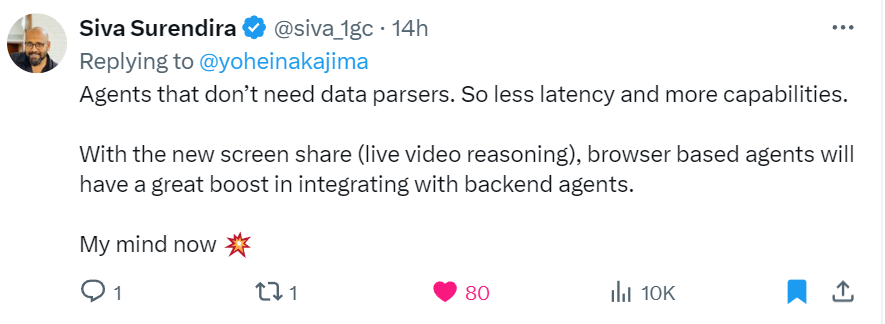
On the one hand, people appreciate Astra’s long context support, memory ‘to remember where the glasses were’, and native video processing capabilities compared to GPT-4o, which some contest only processes a single frame at a time.

Source: X

Many are also saying that with these advanced AI email, browser, and search agent demos, as well as an AI Teammate, Google will likely obliterate many startups focusing on email & browser-based agents.

“One thing Google is doing right: they are finally making serious efforts to integrate AI into the search box. I sense the agent flow: planning, real-time browsing, and multimodal input, all from the landing page. Google’s strongest moat is distribution. Gemini doesn’t have to be the best model to be the most used one in the world,” wrote a user on X.

Not just perplexity but every other vertically focused tool that google touches
Google meet + Gemini – competes against zoom, even gong
Gmail + Gemini – competes against any other AI email assistant
Directly competing against any one of googles offerings will be challenging

— Jerry Liu (@jerryjliu0) May 14, 2024

On the other hand, some are not impressed with Google Astra’s slightly longer latency and are even sceptical on whether the real product will match the ‘too good to be true’ promises made in the demo.

“Remember the last time Google demo’d (sic) their AI it was all a complete lie,” wrote a user online, “Google promised a lot in events but never released like OpenAI does,” added another. Many even went so far as to call the demo an advertisement, rather than an actual demo.

Compared to OpenAI’s live demo, Google making use of a pre-recorded demo has some taking things with a pinch of salt. At least until they get to test the product.

Source: X

After watching Google I/O, it's safe to say what OAI showed yesterday was mind-blowing!!🤯🤯
Astra is a prototype voice assistant and seemed like a 2-year-old baby to OAI's Scarlett Johansson!!

— Bindu Reddy (@bindureddy) May 14, 2024

Everybody Is Bullish on ‘AI Agents’

Regardless of who wins this race, the important thing is that everybody seems to be bullish on AI agents, and soon, we might see a lot more interesting developments take shape.

Source: X

Recently, venture capitalist Vinod Khosla envisioned a future where internet interactions will be done mostly through agents. He predicted a future in which most consumer access to the internet will be agents acting for consumers doing tasks and fending off marketers and bots. “Tens of billions of agents on the internet will be normal,” he wrote.

Similarly, Meta CEO Mark Zuckerberg highlighted the evolving role of AI agents in customer interactions, envisioning a future where businesses and creators each have their own AI to represent their interests.

“A lot of people talk about the ‘ChatGPT moment’, where you’re like ‘Wow, never seen anything like this’. Many people will have kind of a ‘Wow, I couldn’t imagine an AI agent doing this’ moment,” said DeepLearning.AI founder Andrew Ng at Sequoia Capital’s AI Ascent.

Looks like it is finally happening.

The post Google’s ‘Astra’ Marks the Beginning of Autonomous AI Agents appeared first on Analytics India Magazine.