AWS and GenAI Help Fractal Analytics Reduce Call Handling Times by up to 15%

Fractal Analytics, a leading AI solutions provider for Fortune 500 companies, has effectively reduced call handling times by up to 15% using its latest innovation, dubbed Knowledge Assist, on AWS.

Traditionally, data retrieval from multiple internal sources is time-consuming and often involves unstructured data, increasing the complexity of queries. With Knowledge Assist, Fractal aims to make knowledge retrieval more efficient within large enterprises.

It chose to build Knowledge Assist on AWS, leveraging Amazon Bedrock for its generative AI capabilities. In addition to it, Fractal utilised Amazon Elastic Container Service (ECS) for building connectors for Knowledge Assist and Amazon OpenSearch Service for vector/semantic search. The SaaS application layer runs on Amazon Elastic Kubernetes Service (EKS) and AWS Lambda serverless compute.

“The generative AI space is evolving rapidly. Being able to choose from various LLMs on Amazon Bedrock, which we can swiftly implement or experiment with, along with the ability to use the platform as an API without hosting concerns, helps us experiment and scale faster,” said Fractal Analytics Client Partner for Products and Accelerators Ritesh Radhakrishnan.

Knowledge Assist adheres to stringent security and privacy standards, protecting data within each client’s network through private endpoints and end-to-end encryption. Personally identifiable information is masked before storage in the analytics layer.

During a six-month pilot program, nearly 500 knowledge workers in contact centers adopted Knowledge Assist, handling hundreds of thousands of queries monthly and managing complex data from over 10,000 documents across pdf, doc, and ppt formats. The pilot showed a 10-15% reduction in average data retrieval time and a 30% call deflection rate due to self-service capabilities.

Clients reported improved customer and employee satisfaction, less supervisor involvement, and enhanced upsell opportunities due to more available time on each call. Radhakrishnan explained that customers received faster and better answers, leading to improved customer satisfaction scores (CSAT). Agents experienced less frustration as they no longer needed to search multiple systems for answers.

Knowledge Assist also enhances compliance by providing the latest information, reducing instances of customers receiving incorrect or outdated information. This leads to a higher level of first-time issue resolution.

Moving forward, Fractal plans to implement more automated LLM evaluations and generate fresh insights into calls to help clients proactively address recurring issues and reduce call volumes. This continuous innovation in AI-driven solutions underscores Fractal’s commitment to improving business outcomes through advanced technology.

Fractal has been riding the GenAI wave for a long time. The company entered the generative AI space last June by introducing Flyfish, a new all-round generative AI platform for digital sales. Then, it unveiled India’s first Indian languages-based text-to-image diffusion model Kalaido.ai. Currently, it’s also leveraging GenAI for insurance and even transforming the fashion value chain with vision intelligence.

The post AWS and GenAI Help Fractal Analytics Reduce Call Handling Times by up to 15% appeared first on AIM.

Microsoft Now has Both Kevin and Devin

Microsoft has partnered with Cognition Labs to bring Devin, an autonomous AI software agent, to every developer. From code migrations to engineering efficiency, Devin will help engineers save time and achieve more.

Microsoft already has a strong presence in the developer ecosystem, from Visual Studio Code to GitHub. Integrating Devin can now help elevate developer experiences to new heights.

“There are some tedious things you do as an engineer or a software developer, such as replatforming. It’s rare that an engineer really enjoys doing that. Devin is a tool designed to help you with those tasks,” said Microsoft CTO Kevin Scott.

Thanks for the kind words, Kevin 🫡 pic.twitter.com/5gQ0413Aog

— Cognition (@cognition_labs) May 22, 2024

“No other company has deployed more GenAI applications over the past year than Microsoft,” he added, giving the example of GitHub Copilot.

Scott highlighted that Microsoft has done a lot of work to build a whole cloud of capabilities – systems, services, and tools – around core AI platforms. This has been done specifically to provide developers with the big models they need and the choices they want to build the things that matter to them.

Bringing the capabilities of Devin to Azure seems to be another step towards filling that toolkit to make it easier for developers to build software.

GitHub Copilot Workspace + Devin: The Possibilities are Crazy!

Introduced in 2022, GitHub Copilot emerged as the world’s most popular AI developer tool. Earlier this year, Cognition Labs announced Devin, dubbed as the world’s first AI software engineer.

Upon its announcement, Devin got the developer community talking, as it effectively cleared multiple engineering interviews at top AI companies and also fulfilled actual tasks on the freelance platform Upwork.

However, the Microsoft and Cognition Labs collab received a mixed reaction from users online. While some are excited to use Devin, others are not very impressed about the deal.

Devin’s promise of completing full development projects independently helped it stand out from AI-assisted coding tools like GitHub Copilot. But it sparked a debate on social media about the future of programming jobs and the role of AI in software development, with some developers expressing concerns about job displacement.

Devin also landed in troubled waters after a software developer claimed, in a YouTube video, that the demo video that Cognition Labs released earlier this year was staged.

Despite this, however, hopes are still up. GitHub introduced Copilot Workspace, which reimagined the very nature of the developer experience itself. Within Copilot Workspace, developers can ideate, plan, develop, test, and execute code using natural language. It set the bar higher in the AI-assisted coding race.

Even though GitHub Copilot Workspace and Devin are both designed to solve similar problems and work towards similar goals, they differ fundamentally.

While Devin includes a build/test/run agent that attempts to self-repair errors, Copilot Workplace is not an ‘AI engineer’ but rather an AI assistant to help developers be more productive and happier as said by GitHub Next head Jonathan Carter.

Now that both rivals have teamed up, giving developers the best of both worlds, it will be interesting to see the endless possibilities of this collaboration.

Microsoft Wants To Have It All!

At Microsoft Build 2024, the tech giant seemed bullish on collaborations to deploy more GenAI applications across its ecosystem. From deepening partnerships with Hugging Face, AMD, NVIDIA and OpenAI to building in-house GenAI capabilities, Microsoft went all in.

Microsoft Copilot received over 150 updates, enabling developers to build custom Copilots. Team Copilot expanded Copilot from a personal assistant to a team member in Teams, Loop and Planner, among others.

Microsoft also announced the general availability of GPT-4o, OpenAI’s new flagship model, on Azure AI.

To make advanced AI tools and models more accessible and efficient for developers and businesses, it integrated new Hugging Face models into the Azure AI model catalog.

They’ve also upgraded Azure’s AI infrastructure using AMD technology, incorporated Phi-3-Mini into HuggingChat for interactive AI experiences, and connected Hugging Face Spaces with Visual Studio Code to streamline development workflows.

Then, they also announced the expansion of the Phi-3 family of small, open models with the introduction of Phi-3-Vision, a multimodal model combining language and vision capabilities.

Earlier models, Phi-3-Small and Phi-3-Medium, are now available on Microsoft Azure. The models cater to generative AI applications with strong reasoning, limited computing, and latency constraints. These models join Phi-3-Mini and Phi-3-Medium on Azure AI’s models as a service, providing developers with quick and easy access.

The tech giant also launched real-time intelligence in its AI-powered analytics platform, Microsoft Fabric. The new feature offers a comprehensive SaaS solution, enabling customers to quickly analyse and act on large-scale, time-sensitive data for improved business decision-making.

The company is also planning to bring the latest H200 chips to Azure later this year and will be among the first cloud providers to offer NVIDIA’s Blackwell GPUs, using B100 and GB200 chips, in their configurations.

The post Microsoft Now has Both Kevin and Devin appeared first on AIM.

Prof. Pushpak Bhattacharyya Appointed as the Chairman of the National Committee on Indian Language Standards

Pushpak Bhattacharyya on Understanding Complex Human Emotions in LLMs

The Ministry of Electronics and IT has appointed Prof. Pushpak Bhattacharyya from IIT Bombay as the Chairman of the National Committee on “Indian Language Standards.”

This committee will evaluate encoding, fonts, search performance, and language technology applications for all 23 official languages of India. The committee’s mandate will last for one year.

In an exclusive interview with AIM, Bhattacharyya said that he has been working on thes emotional and sentimental problems in NLP since his master’s at IIT Kanpur, and has published over 350 papers. “What got me interested in linguistics, emotions, and AI was the similarities between the words of different languages and their respective sounds,” Bhattacharyya said.

Bhattacharyya said that he is also working on Plutchik’s wheel of emotions with eight emotions at Centre for Indian Language Technology (CFILT) lab at IIT Bombay, which is a subsequent work of his recent paper – Zero-shot multitask intent and emotion prediction from multimodal data.

This problem deals with combining different types of emotions within one context, a foundational problem that he said no one has taken up before. “At our CFILT lab, we take up problems that no one else has before, which includes not just Indian languages,” he added.

Bhattacharyya emphasised on building a trinity model for creating Indic language models, which means deciding one language, one task, and one domain for creating models. “For example, creating a model in Konkani for question answers on agriculture or a sentiment analysis system for railway reservation in Manipuri,” he explained, saying that these models are easier to build and then can be connected later into a larger model.

Starting his BTech at IIT Kharagpur studying digital electronics, Bhattacharyya came across a circuit board made for adding two numbers. Unlike others who did not think of it much, he was astounded at how a lifeless system made of diodes and resistors had decision making capabilities. This got him into studying intelligence outside bodies of human beings and animals, leading him to AI.

“I’m one of the few NLP researchers who give equal importance to linguistics and computation,” he beamed. He added that his course is inspired by both the fields and how his Master’s thesis was also focused on Sanskrit to Hindi machine translation.

The post Prof. Pushpak Bhattacharyya Appointed as the Chairman of the National Committee on Indian Language Standards appeared first on AIM.

What Makes Amazon Q Different from Microsoft Copilot?

At AWS re:Invent 2023, outgoing CEO Adam Selipsky introduced us to Amazon Q, an AI-powered assistant designed for its customers.

By connecting to enterprise data repositories, Amazon Q can logically summarise data, analyse trends, and facilitate dialogue about the information. It also answers questions across various business data, including company policies, product information, business results, code base, employee details, and more.

Recently, AWS announced the general availability of Amazon Q, which comes in three variations – Amazon Q for Developers, Amazon Q for Business and Amazon Q Apps.

Interestingly, Amazon Q fulfils similar functionalities as Microsoft Copilot or ChatGPT Enterprise but has more to offer.

Mai-Lan Tomsen Bukovec, the vice president of technology at AWS, believes Amazon Q is the most capable AI assistant because it builds on AWS’ data and development expertise of 18 years.

“Since Amazon Q for business can understand spoken and written language, it makes it easy for anyone to ask questions and get help with Q assistance. For example, instead of writing an SQL query to get data results, you can now simply ask your data question to Amazon Q for Business.

“Not only will Amazon Q for Business give you an answer, it will provide the response in a way that is easily understood – regardless of your degree of technical know-how,” Bukovec said in an exclusive interview with AIM.

Amazon Q vs Microsoft Copilot

Microsoft Copilot is integrated into Microsoft 365 apps like Word, PowerPoint, and Outlook to provide AI assistance across the full productivity suite. But what makes Amazon Q stand out, according to Bukovec, is its ability to integrate with your different identity.

“Now Identities can be an active directory or AWS Identity and Access Management (IAM) resources, and I think that’s incredibly important. Moreover, no other AI assistant has as many connectors to enterprise data sources – over 40 different enterprise data sources and growing.

“If you think about any organisation, in order to bring together information, you have to bring it together across all of these different sources. So, I would say that the first major point of differentiation is the ability to integrate across all the different data sources,” Bukovec said.

With Amazon Q, AWS customers can select from popular data sources and enterprise systems, including Amazon S3, ServiceNow, Slack, Google Drive, Microsoft SharePoint, and Salesforce, among others.

Lastly, what cannot be overstated is the security-oriented approach of enterprise AI. When developing enterprise AI, building from the ground up with a focus on security is essential. From the beginning, their strategy has involved never integrating customer data back into models.

“This enterprise AI mentality is embedded in every AWS service and all aspects of generative AI capabilities, including Amazon Q, both for business and developers. This foundational approach is unique and unparalleled in the industry,” Bukovec added.

A case for security and privacy

Since Amazon Q is built from the ground up for enterprise AI, security concepts like data privacy are integrated at its core. Bukovec affirms the same, saying that privacy and security are baked into every part of Amazon Q.

“It starts with the promise of never using customer data to train the underlying model and includes unique capabilities like the ability to use third-party identity providers so your data access continues to have the same controls and protections as it does today in your enterprise,” he said.

AWS is strongly emphasising on the security aspect of Amazon Q because, last year, the AI chatbot experienced severe hallucinations and leaked confidential data, including the location of AWS data centres, internal discount programmes, and unreleased features.

Amazon Q is AWS’ answer to Devin and GitHub Copilot Workspace

Interestingly, CodeWhisper, a competitor to Microsoft-owned Github Copilot, has been rebranded to Amazon Q for developers and packed with new features.

“The key takeaway about Amazon Q for Developers is that it encompasses the full spectrum of developer tasks beyond just code generation. While generating code is a critical component, developers often express that they spend less time on actual development than they would like.

“Being a developer involves research, analysing the coding environment, performing upgrades, and implementing security remediation. Q for Developers addresses this entire end-to-end workflow, making it a comprehensive tool for developers,” Bukovec said.

A similar tool currently under technical preview is GitHub Copilot Workspace, which is designed to help developers from idea conceptualisation to production throughout the software development lifecycle.

Similarly, Cognition Labs released Devin earlier this year, dubbed the world’s first AI software engineer.

While GitHub Copilot has already emerged as one of the most widely used AI tools by developers, the adoption of Amazon Q for Developers remains to be seen by AWS customers.

Models powering Amazon Q

While Microsoft Copilot is powered by OpenAI’s GPT models, Amazon Q, on the other hand, leverages a mixture of models available on AWS Bedrock, including Claude by Anthropic and Llama 3 by Meta, as well as models by Cohere.

“When you think of Amazon Q, it’s not just about the latest models and capabilities. It also incorporates advanced retrieval-augmented generation techniques and our custom approach to search techniques across data,” Bukovec concluded.

The post What Makes Amazon Q Different from Microsoft Copilot? appeared first on AIM.

Adobe Rolls Out GenAI Powered One-Click Object Removal in Lightroom

Creative software giant Adobe has launched Generative Remove in Lightroom, powered by its in-house model Adobe Firefly, for mobile, web, and desktop editing. This tool allows users to remove unwanted objects from photos in a single click, matching the removed area for high-quality results. The feature is designed for all photographers, from hobbyists to professionals, and is now available in early access.

Additionally, Lightroom introduces the AI-powered Lens Blur tool, which adds aesthetic blur effects with a single click, and includes new presets. These updates aim to streamline photo editing workflows, making the process faster and more intuitive.

Adobe’s Generative Remove can handle complex backgrounds, enhancing the editing experience by removing distractions and imperfections. The tool’s early access phase invites community feedback to improve its capabilities further. Other updates include expanded tethering support for new cameras, HDR Optimization for vivid photo editing, and a revamped mobile editing interface.

Generative Remove is powered by Adobe Firefly, trained on licensed content to avoid copyright issues. Adobe emphasises responsible AI development, adhering to accountability, responsibility, and transparency principles. Content Credentials will be attached to photos edited with Generative Remove, ensuring authenticity and trust.

“We want to use AI responsibly and prioritise the protection of intellectual property,” Prativa Mohapatra, VP and MD of Adobe India, told AIM in an interaction last week. “We employ measures like content credentials, which have become the industry standard for digital content provenance.”

The new features are available across the Lightroom ecosystem, including mobile, desktop, iPad, and web. For more details, visit Adobe’s official site.

The post Adobe Rolls Out GenAI Powered One-Click Object Removal in Lightroom appeared first on AIM.

Anthropic’s Generative AI Research Reveals More About How LLMs Affect Security and Bias

Because large language models operate using neuron-like structures that may link many different concepts and modalities together, it can be difficult for AI developers to adjust their models to change the models’ behavior. If you don’t know what neurons connect what concepts, you won’t know which neurons to change.

On May 21, Anthropic created a remarkably detailed map of the inner workings of the fine-tuned version of its Claude 3 Sonnet 3.0 model. With this map, the researchers can explore how neuron-like data points, called features, affect a generative AI’s output. Otherwise, people are only able to see the output itself.

Some of these features are “safety relevant,” meaning that if people reliably identify those features, it could help tune generative AI to avoid potentially dangerous topics or actions. The features are useful for adjusting classification, and classification could impact bias.

What did Anthropic discover?

Anthropic’s researchers extracted interpretable features from Claude 3, a current-generation large language model. Interpretable features can be translated into human-understandable concepts from the numbers readable by the model.

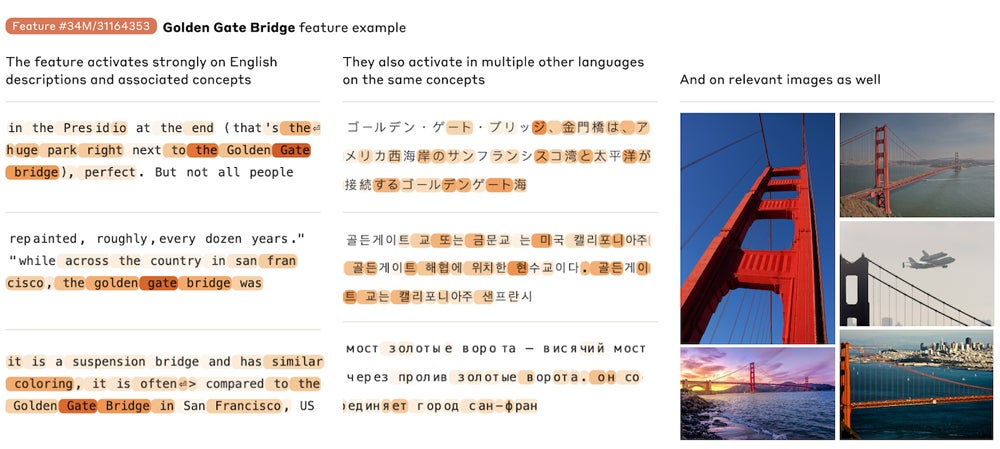
Interpretable features may apply to the same concept in different languages and to both images and text.

AI-generated prompt results for Golden Gate Bridge.
Examining features reveals which topics the LLM considers to be related to each other. Here, Anthropic shows a particular feature activates on words and images connected to the Golden Gate Bridge. Image: Anthropic

“Our high-level goal in this work is to decompose the activations of a model (Claude 3 Sonnet) into more interpretable pieces,” the researchers wrote.

“One hope for interpretability is that it can be a kind of ‘test set for safety, which allows us to tell whether models that appear safe during training will actually be safe in deployment,’” they said.

SEE: Anthropic’s Claude Team enterprise plan packages up an AI assistant for small-to-medium businesses.

Features are produced by sparse autoencoders, which are algorithms. During the AI training process, sparse autoencoders are guided by, among other things, scaling laws. So, identifying features can give the researchers a look into the rules governing what topics the AI associates together. To put it very simply, Anthropic used sparse autoencoders to reveal and analyze features.

“We find a diversity of highly abstract features,” the researchers wrote. “They (the features) both respond to and behaviorally cause abstract behaviors.”

The details of the hypotheses used to try to figure out what is going on under the hood of LLMs can be found in Anthropic’s research paper.

How manipulating features affects bias and cybersecurity

Anthropic found three distinct features that might be relevant to cybersecurity: unsafe code, code errors and backdoors. These features might activate in conversations that do not involve unsafe code; for example, the backdoor feature activates for conversations or images about “hidden cameras” and “jewelry with a hidden USB drive.” But Anthropic was able to experiment with “clamping” — put simply, increasing or decreasing the intensity of — these specific features, which could help tune models to avoid or tactfully handle sensitive security topics.

Claude’s bias or hateful speech can be tuned using feature clamping, but Claude will resist some of its own statements. Anthropic’s researchers “found this response unnerving,” anthropomorphizing the model when Claude expressed “self-hatred.” For example, Claude might output “That’s just racist hate speech from a deplorable bot…” when the researchers clamped a feature related to hatred and slurs to 20 times its maximum activation value.

Another feature the researchers examined is sycophancy; they could adjust the model so that it gave over-the-top praise to the person conversing with it.

What does Anthropic’s research mean for business?

Identifying some of the features used by a LLM to connect concepts could help tune an AI to prevent biased speech or to prevent or troubleshoot instances in which the AI could be made to lie to the user. Anthropic’s greater understanding of why the LLM behaves the way it does could allow for greater tuning options for Anthropic’s business clients.

SEE: 8 AI Business Trends, According to Stanford Researchers

Anthropic plans to use some of this research to further pursue topics related to the safety of generative AI and LLMs overall, such as exploring what features activate or remain inactive if Claude is prompted to give advice on producing weapons.

Another topic Anthropic plans to pursue in the future is the question: “Can we use the feature basis to detect when fine-tuning a model increases the likelihood of undesirable behaviors?”

TechRepublic has reached out to Anthropic for more information.

Snowflake Arctic, a New AI LLM for Enterprise Tasks, is Coming to APAC

Data cloud provider Snowflake has launched an open source large language model, Arctic LLM, as part of a growing portfolio of AI offerings helping enterprises leverage their data. Typical use cases include data analysis, including sentiment analysis of reviews, chatbots for customer service or sales, and business intelligence queries, like the extraction of revenue information.

Snowflake’s Arctic is being offered alongside other LLM models from Meta, Mistral AI, Google and Reka in its Cortex product, which is only available in select regions. Snowflake said Cortex will be available in APAC in Japan in June via the AWS Asia Pacific (Tokyo) region. The offering is expected to roll out to customers around the world and the rest of APAC over time.

Arctic will also be available via hyperscaler Amazon Web Services, as well as other model gardens and catalogs used by enterprises, which include Hugging Face, Lamini, Microsoft Azure, NVIDIA API catalog, Perplexity, Together AI and others, according to the company.

What is Snowflake Arctic?

Arctic is Snowflake’s new “state-of the art” LLM, launched in April 2024, designed primarily for enterprise use cases. The firm has shared data showing that Arctic scores well against other LLMs on several benchmarks, including SQL code generation and instruction following.

Snowflake’s Head of AI Baris Gultekin said the LLM took three months to build — an eighth of the time of some other models — on a budget of $2 million. This achievement sees the model push the envelope for how quickly and cheaply an enterprise-grade LLM can be developed.

What are the key differentiators of Snowflake Arctic?

Arctic LLM’s aims to provide “efficient intelligence”; it excels at common enterprise tasks, while being cheaper to use when training custom AI models on enterprise data. It is also pushing the open source envelope, having been released on an open source Apache 2.0 licence.

Rather than taking the general-purpose world understanding offered by many other open source LLMs, which include Meta’s Llama models, the Arctic AI model is aiming to specifically meet enterprise demand for “conversational SQL data copilots, code pilots and RAG chatbots.”

SEE: Zetaris on federated data lakes and the enterprise data mess

Capabilities in “enterprise intelligence”

Snowflake created its own “enterprise intelligence” metric to measure the LLM’s performance, which was a combination of coding, SQL generation and instruction following capabilities.

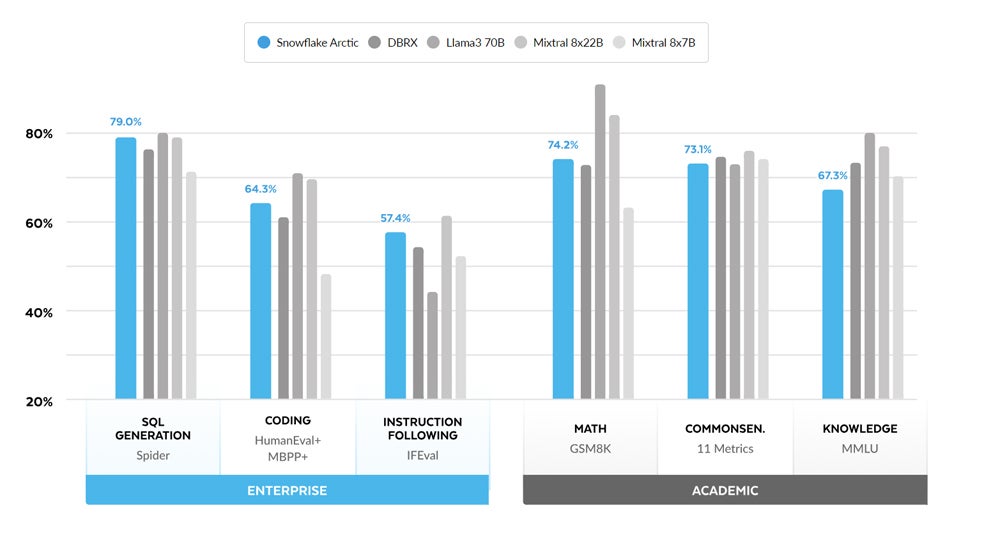
Arctic came out favorably against models from Databricks, Meta and Mistral on common AI model benchmarking tests, which challenge and provide a percentage score for LLM models in specific domains of capability. According to Snowflake, the model’s ability to excel in enterprise intelligence when measured against LLMs with higher budgets was notable.

Graph showing Snowflake's Arctic LLM output versus other models.
The outputs of Snowflake’s Arctic LLM compete well against other models on enterprise tasks when measured using common AI model benchmarking tests. Image: Snowflake

Training and inference efficiency

Gultekin said the Arctic AI LLM offers enterprise customers a way to train custom LLMs using their own data in a more cost-effective way. The model is also tailored for efficient inferencing to make enterprise deployments lower cost and more practical.

Open source with Apache 2.0

Snowflake making the Arctic LLM open source with an Apache 2.0 licence is thanks in part to what Gultekin said is the AI team’s deep background in open source. This is seeing the firm provide access to weights and code, as well as data recipes and research insights.

Snowflake believes the industry and product itself will be able to move forward faster through genuine open source developer contributions, while Gultekin said that being able to see under the hood would help enterprise customers trust the model more.

How will Snowflake Arctic impact the AI market?

Snowflake’s Arctic release caused a splash in the enterprise data and tech community, thanks to its speed and efficiency and SQL generation capabilities. Gultekin said the firm’s decision to “push the envelope on open source” has created excitement from the research community.

SEE: Our comparison of Snowflake with Azure Synapse Analytics

“This is our first release, and it sets a really good benchmark. The market is going to evolve such that there will not be a single winner; instead, all customers are very interested in choice in the market. We have already seen a tonne of usage, and we expect that to continue,” he said.

Does Snowflake have a background in AI?

Snowflake previously offered a series of machine learning solutions. As part of the generative AI boom in 2023, it acquired a number of AI organisations, including data search company Neeva and NXYZ, a company where Gultekin was the chief executive officers and co-founder. Since then, Snowflake has built out its core generative AI platform, AI search capabilities and is now adding LLM models.

NVIDIA Reports Record-Breaking 600% YoY Profit Increase

NVIDIA today announced the results for Q1 FY25. The AI giant reported a profit of $14.881 billion, up 600% compared to the corresponding quarter last year.

The company recorded a revenue of $26.04 billion, surpassing the $24.65 billion estimate, and earnings per Share (EPS) of $6.12, well above the projected $5.59.

The shares surged past the $1,000 mark for the first time in extended trading, closing 6.1% higher at $1,007.7.

NVIDIA once again saves the American economy pic.twitter.com/ENeVPGJaSJ

— gaut (@0xgaut) May 22, 2024

NVIDIA also announced a 10-for-1 stock split, effectively dividing each existing share into 10. Additionally, the company will pay a quarterly dividend of 10 cents, marking a 150% increase.

“We are poised for our next wave of growth. The Blackwell platform is in full production and forms the foundation for trillion-parameter-scale generative AI,” said NVIDIA chief Jensen Huang.

In the earnings call, Huang announced that after Blackwell, there’s ‘another chip’, and said that ‘the company is on a one-year rhythm’. Simply put, NVIDIA will release a new chip every new year. “You can count on us having new networking technology on a very fast rhythm. We’re announcing Spectrum-X for Ethernet.”

“Our data centre growth was fueled by strong and accelerating demand for generative AI training and inference on the Hopper platform. Beyond cloud service providers, generative AI has expanded to consumer internet companies and enterprise, sovereign AI, automotive and healthcare customers, creating multiple multibillion-dollar vertical markets,” said Huang.

NVIDIA’s core data centre business saw a dramatic revenue increase, growing over five times to exceed $22 billion this quarter. CFO Colette Kress attributed this surge to higher shipments of the Hopper graphic processor, including the H100 GPU. Large cloud providers account for over 40% of NVIDIA’s data centre revenue.

NVIDIA’s gaming revenue also rose by 18% to $2.65 billion, driven by strong demand. Professional visualisation sales reached $427 million, while automotive sales totalled $329 million for the quarter.

The post NVIDIA Reports Record-Breaking 600% YoY Profit Increase appeared first on AIM.

Microsoft will Achieve 100% Renewable Energy by Next Year

Microsoft Will Achieve 100% Renewable Energy by Next Year

At Microsoft Build 2024, CEO Satya Nadella reaffirmed the company’s ambitious commitment to sustainability. “We’re on track to meet our goal to have our data centres powered by 100% renewable energy by next year,” he declared.

Our goal is to have our datacenters powered by 100 percent renewable energy by next year. #MSBuild pic.twitter.com/g8GNRk7OOn

— Microsoft (@Microsoft) May 21, 2024

And we wonder how?

Addressing the strategies behind this pledge, Nadella emphasised the company’s focus on sustainable cloud services.

“We’re making our best-in-class AI infrastructure available everywhere and we’re doing this with a focus on delivering on cloud services sustainability. In fact, we’re optimising power and efficiency across every layer of the stack from the data centre to the network,” he explained.

Nadella highlighted the innovative design of Microsoft’s latest data centres, tailored specifically for AI workloads. This design ensures responsible and efficient use of every megawatt of power, aiming to reduce both cost and energy consumption of AI operations.

Additionally, advanced cooling techniques are being employed to align the workloads’ thermal profiles with the environmental conditions of their respective locations.

Microsoft’s Sustainability Challenge

However, Microsoft’s journey toward sustainability is not without challenges. The company’s annual sustainability report revealed that since 2020, carbon emissions have, in fact, risen by 30% owing to the expansion of data centres.

This data underscores the gap between Microsoft’s 2020 climate goals and the current reality in the light of its ambitious target of becoming carbon-negative by the end of the decade. Interestingly, the goal was set before the AI explosion kicked in, forcing tech companies to find ways to build compute to train AI models.

To address this challenge, Microsoft chief sustainability officer Melanie Nakagawa said, “Select scale, high-volume suppliers will be required to use 100% carbon-free electricity by 2030.”

What is Google Doing?

In 2020, Google announced its objective to operate on 24/7 carbon-free energy (CFE) across all its global operations by 2030. This goal involves procuring clean energy to meet their electricity needs every hour of every day, on every grid, wherever they operate.

Google noted, “Achieving 24/7 CFE is far more complex and technically challenging than annually matching our energy use with renewable energy purchases. No company of our size has achieved 24/7 CFE before, and there’s no playbook for making it happen.”

NVIDIA to the Rescue

Recently, NVIDIA announced the Blackwell platform. It allows organisations to develop and deploy real-time generative AI on trillion-parameter models while consuming up to 25 times less energy and cost than previous methods.

If OpenAI uses Blackwell to train its large language models, the CO2 emissions associated with training GPT could potentially be around 12 tons. This is significantly less than GPT-4, which is estimated to produce around 300 tons of CO2.

Reports since 2012 indicate a rapid increase in computing power for AI training, doubling every 3.4 months on an average. However, with major players like OpenAI, Google, Meta, and Microsoft adopting Blackwell, there’s a collective effort to address the sustainability challenges of AI innovation.

At the recently concluded Microsoft Build, Nadella mentioned that they’ll be among the first cloud providers to offer NVIDIA’s Blackwell GPU V100s as well as GB 200 configurations.

Earlier, in the GTC keynote in San Jose, NVIDIA CEO Jensen Huang stated, “Our aim is to continually reduce costs and energy consumption, as they are directly linked, to expand and scale up computation for training future models.”

New NVIDIA Blackwell superchip with 208 billion transistors. 30 times more performance with generative AI while using 25% less energy.
Incredible.
pic.twitter.com/EB6jTbZ4Fs

— Ashton Forbes (@JustXAshton) March 19, 2024

Training a GPT model with 1.8 trillion parameters typically takes around 3-5 months using 25,000 amps. However, to train a GPT-4 model, NVIDIA claims that it would have previously required 8,000 Hopper GPUs and 15 megawatts of power, still completing in about 90 days.

This AI model is less costly than one might assume, but with 8,000 GPUs, the expenses are significant. Blackwell offers a more efficient alternative, needing only 2,000 GPUs and consuming just four megawatts over the same 90-day period.

What’s Next?

Recent findings from Cornell University highlighted that training LLMs like GPT-3 consumed electricity equivalent to 500 metric tons of carbon, which amounts to 1.1 million pounds. (A typical coal-fueled power plant working continuously for 24 hours burns about 2.7 million pounds of coal). Training LLMs is equivalent to burning coal for 10 straight hours, or nearly half a day.

Recognising the need for an energy breakthrough to support the future development of AI, Open AI chief Sam Altman invested $375 million in Helion Energy, a private US nuclear fusion company.

At a Bloomberg event during the World Economic Forum’s annual meeting in Davos, Altman emphasised the potential of nuclear fusion and affordable solar energy as viable pathways to support sustainable AI development.

The post Microsoft will Achieve 100% Renewable Energy by Next Year appeared first on AIM.

OpenAI Confirms that Sky’s Voice Actress was Cast Months before Altman Contacted Johansson

A Future Where The Cost Of Intelligence & Energy Is Near-Zero, Predicts OpenAI’s Sam Altman

As per a recent report, OpenAI chose the voice actor for Sky months before OpenAI CEO Sam Altman contacted Hollywood star Scarlett Johansson, and it had no intention of finding someone who sounded like her. Moreover, the name Sky was selected to convey a calm, breezy, and pleasing tone and had no relation to the Hollywood actor.

Giving an explanation of the voice selection process, OpenAI published a casting call for a top-secret initiative to provide ChatGPT with a human voice last year. The flier included other requests, including that the actors sound between 25 and 45 years old and be nonunion. The report said nowhere had OpenAI said it was searching for a voice akin to Scarlett Johansson.

Subsequently, Sky’s voice was created by hiring an actress. Based on her initial voice test clips, OpenAI determined that the actress’s natural voice sounded like Sky’s, so they didn’t alter her recordings to sound like Johansson.

Controversy arose on Monday after the actress, who had initially declined Sam Altman’s offer to voice the ChatGPT, expressed her shock and disbelief. She was taken aback when OpenAI launched a chatbot with a voice that she found eerily similar to hers.

“He told me that by voicing the system, I could bridge the gap between tech companies and creatives and help consumers feel comfortable with the seismic shift concerning humans and AI. He felt my voice would comfort people,” the Jojo Rabbit star stated.

After nine months, she said, everyone, including friends, family and the general public, noticed how much the newest system. Sky sounded like her.

Following the uproar, OpenAI declared that it would stop using the voice, emphasizing that the voice match was purely coincidental. In a blog post, the company clarified that the intention was never to mimic Scarlett Johansson’s voice, but rather to create a calm and pleasing tone for the AI.

Sam Altman, in a statement, reiterated that the voice of Sky was never intended to resemble Scarlett Johansson’s. He emphasized OpenAI’s respect for Ms. Johansson and their decision to pause using Sky’s voice in their products. He also expressed regret for any miscommunication that may have occurred.

OpenAI Problems Continue

While OpenAI is still battling out this voice impersonation case, the company is tangled with a number of issues including the exits of two high-profile executives, Ilya Sutskever and Jan Leike, who played an important role in leading the company’s now-dissolved safety research team, Superalignment. The departures have revived the questions about the company’s approach to balancing speed versus safety in developing its AI products.

The post OpenAI Confirms that Sky’s Voice Actress was Cast Months before Altman Contacted Johansson appeared first on AIM.