Why Isn’t There an Alibaba of AI in India Yet?

The US currently boasts major tech companies such as Microsoft, Apple, NVIDIA, and Google, along with startups like OpenAI, spearheading AI advancements. Similarly, China is close behind, just a year away in the AI race, with giants like Alibaba and Tencent, as well as emerging players such as 01.AI, leading the charge. And India?

“We need someone to engage as a frontline player in this space actively. Someone who has the resources to start from scratch; not relying on existing solutions but creating foundational models,” Stition.ai founder and Devika creator Mufeed VH told AIM in the latest episode of Tech Talks.

Further, he said that Indian companies can either sponsor or utilise their resources for these initiatives, yet no one has taken the initiative to start. “However, I am optimistic that India will develop a foundational model within this year,” he said.

Is India’s ‘Jio Moment in AI’ Coming Soon?

Recently, Reliance Jio collaborated with NVIDIA for the use of GH200 GPUs to build AI models in India. During his visit to India last year, NVIDIA head Jensen Huang was optimistic about Reliance building its own LLMs that power generative AI applications made in India.

For now, Reliance Jio is keeping its AI developments under wraps, with no public disclosures to date. “Reliance wants to revolutionise the enterprise space with the use of AI… There is a centre of excellence with 100 experts working on AI solutions. Mukesh believes it is going to be transformative,” said Reliance New Energy Council chairman R A Mashelkar, in a recent interaction with Fortune India.

Meanwhile, Jio recently launched Jio Brain, positioned as the industry’s first 5G-integrated ML platform. It aims to empower telecom networks, enterprise networks, and industry-specific IT environments to incorporate ML tools into their day-to-day operations seamlessly.

TWO, a startup backed by Reliance Jio, also recently launched a family of models called SUTRA. These cost-efficient, multilingual GenAI models excel in 50+ languages, offering speech, search, and visual processing capabilities.

Renowned startup accelerator JioGenNext introduced its latest cohort, MAP’ 24, consisting of ten dynamic, generative AI startups spanning diverse sectors such as healthcare, banking, legal services, entertainment, and agriculture.

Earlier this year, Jio also partnered with IIT Bombay to bring about initiatives like BharatGPT, which focuses on developing AI solutions for several sectors, including the telecom and retail sectors. However, there have not been any significant revelations yet.

Adani AI Labs, an initiative by the Adani Group aimed at leveraging AI to tackle large-scale industrial problems, is also working on exciting AI projects and bringing them to the masses. One such notable work led us to ‘Train PNR Prediction,’ which predicts the confirmation probability of waitlisted train tickets, which will be useful for end users.

“We have achieved 95% accuracy in predicting it,” said Adani Digital Labs senior manager Gaurav Jain to AIM.

India is not left behind. Other giants like TCS, Infosys, Wipro, HCLTech, and LTIMindtree seem focused on enterprise solutions, upskilling and reskilling, alongside experimenting with real use cases.

Last year, Tech Mahindra became the first IT giant to launch something like a Generative AI Studio. ​​The IT solution provider introduced Tech Mahindra amplifAI0->∞, a comprehensive suite of AI offerings and solutions aimed at democratising and responsibly scaling AI deployment.

It is also working on an indigenous LLM in 40 different Indic languages, most notably Hindi. Called Project Indus, the model will be able to speak in many Indic languages.

One prominent initiative taking flight in India is AI4Bharat, which started as a collaboration between IIT Madras and Nandan Nilekani’s EkStep Foundation. It is sponsored by Bhashini, Microsoft, Google, and NVIDIA, with its contribution to the Indic open-source AI community tremendous. But the problem is, it is the only prominent one in the country so far. That’s why India needs more ‘AI4Bharats’.

The time is ripe, and Indian conglomerates and IT giants can do a lot more. Recent earnings from big tech companies show growth driven by advancements in generative AI, and it’s unlike anything seen before.

China Is a Year Away From the US. And India?

“People in China cannot access ChatGPT, OpenAI blocked China from accessing it,” revealed 01.AI founder Kai-Fu Lee, saying that his country shouldn’t be left out of this revolution.

“I strongly believe that the US will lead in breakthrough innovations, but China is better at execution,” said Lee.

01.AI is a Chinese AI startup that only emerged about a year ago and is already at a billion-dollar valuation. It takes pride in calling itself open source, giving away its AI models to cultivate a loyal developer community that can contribute to the creation of groundbreaking AI applications. The startup also raised $200 million in investment from Chinese e-commerce giant Alibaba.

Lee believes that Chinese companies have closed the AI gap between the US and China greatly by executing better.

“Taking my company as an example, we were eight years behind a year ago. Now we’re probably less than one year behind the top American company,” he said.

Ex-Google CEO Eric Schmidt says otherwise. He had earlier said that China is focused on dominating several industries, but as of now, the US still maintains a significant lead in AI.

“In the case of AI, we are well ahead two or three years, probably, of China, which in my world is an eternity,” he added.

The rapid AI advancements coming from China question this claim. Brands such as Baidu, Tencent, Alibaba, and Huawei have become household names in China, and these are the very companies investing heavily in generative AI and releasing AI models like there is no tomorrow.

Last year, Alibaba developed Qwen-72B, Tencent released ‘Hunyuan’, and Lee’s AI startup, 01.AI, also open-sourced its foundational LLM called Yi-34B.

China has also released a SORA rival, named ‘Vidu’, and recently, French luxury group LVMH also extended its partnership with the Alibaba Group to integrate Alibaba Cloud’s generative AI capabilities, including Qwen and Model Studio (Bailian), to enhance customer experience in China.

Lately, the internet has been abuzz with new AI developments coming from China daily—from posts about teachers in China using AI to grade exams to Chinese developing military robot dogs.

Chinese scientists also developed the world’s first AI child entity called Tong Tong.

It’s high time Indian conglomerates and IT giants took the lead in disrupting the AI space.

The post Why Isn’t There an Alibaba of AI in India Yet? appeared first on AIM.

5 Free MIT Courses to Learn Math for Data Science

math-courses-fimg
Image by Author

As a data professional, you probably know that mathematics is fundamental to data science. Mathematics underpins data science: from understanding how data points are represented as vectors in a vector space to optimization algorithms that find the best parameters for a model and more.

Getting the hang of math fundamentals, therefore, can help you both in interviews and to get a deeper understanding of the algorithms that you implement. Here, we’ve compiled a list of free courses from Massachusetts Institute of Technology (MIT) on the following math topics:

  • Linear algebra
  • Calculus
  • Statistics
  • Probability

You can take these courses on the MIT OpenCourseWare platform. So make the most out of these courses and level up your data science expertise!

1. Linear Algebra

Besides being comfortable with high school math, linear algebra is by far the most important math topic for data science. The super popular Linear Algebra course by Prof. Gilbert Strang is one of the best math classes courses you can take. For this course and for the courses that follow, solve problem sets and attempt exams to test your understanding.

The course is structured into the following three main modules:

  • Systems of equations Ax = b and the four matrix subspaces
  • Least squares, determinants, and eigenvalues
  • Positive definite matrices and applications

Link: Linear Algebra

2. Single Variable and Multivariable Calculus

A good understanding of calculus is important to become proficient with data science concepts. You should be comfortable with both single variable and multivariable calculus computing, derivatives partial derivatives, applying chain rule, and more. Here are two courses on single variable and multivariable calculus.

The Calculus I: Single Variable Calculus course covers:

  • Differentiation
  • Integration
  • Coordinate systems and infinite series

Once you feel comfortable with single variable calculus, you can proceed to the Multivariable Calculus course that covers:

  • Vectors and matrices
  • Partial derivatives
  • Double integrals and line integrals in the plane
  • Triple integrals and surface integrals in 3D space

Links to the courses:

  • Calculus I: Single Variable Calculus
  • Multivariable Calculus

3. Probabilistic Systems Analysis and Applied Probability

Probability is yet another important math topic for data science, and a good foundation in probability is essential to ace mathematical modeling and statistical analysis and inference.

The Probabilistic Systems Analysis and Applied Probability course is a great resource that covers the following topics:

  • Probability models and axioms
  • Conditioning and Bayes rule
  • Independence
  • Counting
  • Discrete and continuous random variables
  • Continuous Bayes rule

Link: Probabilistic Systems Analysis and Applied Probability

4. Statistics for Applications

To become proficient in data science, you should have a good foundation in statistics. The Statistics for Applications course covers a lot of applied statistics concepts relevant in data science.

Here’s a list of topic covered:

  • Parametric inference
  • Maximum likelihood estimation
  • Moments
  • Hypothesis testing
  • Goodness of fit
  • Regression
  • Bayesian statistics
  • Principal component analysis
  • Generalized linear models

If you are interested in exploring statistics in depth, check out 5 Free Courses to Master Statistics for Data Science.

Link: Statistics for Applications

5. Matrix Calculus for Machine Learning and Beyond

You should already be familiar with optimization from the courses on single and multivariable calculus. But in machine learning, you may run into large-scale optimization requiring matrix calculus and calculus on arbitrary vector spaces.

The Matrix Calculus for Machine Learning and Beyond will help you build on what you’ve learned in the linear algebra and calculus courses. This is, perhaps, the most advanced course on this list. But it can be very helpful if you plan on doing a graduate course in data science or would like to explore machine learning and research.

The following are some of the topics covered in this course:

  • Derivatives as linear operators; linear approximations on arbitrary vectors space
  • Derivatives of functions with matrix as input or output
  • Derivatives of matrix factorizations
  • Multi-dimensional chain rule
  • Forward and reverse-mode manual an automatic differentiation

There are many other approximations and optimization algorithms you can explore too.

Link: Matrix Calculus for Machine Learning and Beyond

Wrapping Up

If you ever want to master math for data science, this list of courses should suffice to learn everything you’d ever need—be it getting into machine learning research or an advanced degree in data science.

If you’re looking for a few more courses to learn math for data science, read 5 Free Courses to Master Math for Data Science.

Bala Priya C is a developer and technical writer from India. She likes working at the intersection of math, programming, data science, and content creation. Her areas of interest and expertise include DevOps, data science, and natural language processing. She enjoys reading, writing, coding, and coffee! Currently, she's working on learning and sharing her knowledge with the developer community by authoring tutorials, how-to guides, opinion pieces, and more. Bala also creates engaging resource overviews and coding tutorials.

More On This Topic

  • KDnuggets News, April 6: 8 Free MIT Courses to Learn Data Science…
  • 8 Free MIT Courses to Learn Data Science Online
  • How To Overcome The Fear of Math and Learn Math For Data Science
  • A Collection Of Free Data Science Courses From Harvard, Stanford,…
  • Free MIT Courses on Calculus: The Key to Understanding Deep Learning
  • 5 Free Courses to Master Math for Data Science

How Oracle is Fueling India’s GenAI Ambitions 

Why Governments Trust Oracle

Oracle recently joined the Open Cloud Compute (OCC) project and collaborated with People+ai and its partners to enhance the compute ecosystem in India and drive the country’s digital growth.

Under the OCC project, a network of interoperable micro data centres will be established nationwide. This will address the increasing demand for such resources, providing faster processing, lower latency, and improved data sovereignty.

“Many compute providers in India are smaller than major global cloud providers,” said Pramod Varma, former chief architect of Aadhaar, adding that with OCC India can create a network of hundreds of smaller players, each acting like a mega network.

“OCC can benefit from Oracle’s distributed cloud capabilities like speeding up project execution, providing greater transparency, delivering enterprise-grade efficiency and unlocking innovation through AI and analytics in customer data centres or on the public cloud,” said Shailender Kumar, senior vice president, Oracle India.

Oracle’s Love for India

Oracle is witnessing significant demand in India, with over 600 customers across various sectors. This includes notable names such as UPI, Flipkart, Apollo Hospitals, Fortis, Ola, ICICI Bank, Federal Bank, Wipro, PwC, Meesho, and Genpact.

“We run core banking systems for banks in India, handling every transaction in the core banking ledger. We manage hotel systems, from check-in to room key card taps and beyond. We run hospitality management systems, point of sales terminals, and utilities, including customer care and billing,” said Chris Chelliah, senior vice president of Oracle, JAPAC.

“We have got a fundamentally different network, or cloud, that can build the largest clusters of these GPUs working together,” he said, adding that OCI networking offers secure, low-latency, and high-performance connections within a virtual cloud network. This enables users to experience on-premises performance in the cloud.

Oracle Cloud Infrastructure incorporates RDMA (Remote Direct Access Memory) to improve the performance of its services. RDMA in OCI allows for faster data transfer rates and lower latency, making it ideal for high-performance computing (HPC), AI, and other data-intensive applications.

“Oracle commercialised RDMA in 2008, and we are 14-15 years ahead in this technology,” said Chelliah, adding that people didn’t know about RDMA even about four or five years ago.

Moreover, he explained that with OCI, customers can fine-tune existing models. For example, he said people could use OCI to build AI startups in India, such as developing an Indic LLM specifically for the country’s legal system.

He further said that Oracle gives choices in the cloud. “We’re providing customers with a single database that can store structured data, unstructured data, document data, relational data, and graph data, and can access your object storage data,” said Chelliah.

Oracle’s Autonomous Database allows users to rapidly build new features using SQL, JSON documents, graphs, geospatial data, text, and vectors in a single database.

Indian Cloud Providers

In India, Oracle faces stiff competition from Microsoft Azure, AWS, and local cloud players like Yotta, E2E Networks, and Krutrim AI Cloud. “We can’t force customers. We’re here to provide a platform where customers can bring in and train their models,” said Chelliah, adding that at the end of the day, customers will deploy based on a variety of factors.

Meanwhile, Ola CEO Bhavish Aggarwal recently fulfilled his promise of moving all AI infrastructure workloads from Microsoft Azure to Krutrim AI Cloud, citing high costs.

Oracle believes it is way ahead of its competitors. “One of them [the competitors] is very API dependent. One of them is all about ‘my model is the best’. Another says, ‘I have a kitchen where you can cook anything. Just bring your ingredients’,” said Chelliah.

According to Chelliah, Musk’s favourite, Oracle, is growing 50-60% faster than its competitors. He added that their competitors have been around for 20 years, yet only 30% of the workloads have been moved to the cloud.

Cohere for the Win

Further, Chelliah said that unlike other players, Oracle is not betting on LLMs as it requires a huge amount of money and computation. “[Even] If I train this model on everything in the Encyclopaedia Britannica and it has read every bit of William Shakespeare, it’s completely useless in solving a manufacturing problem,” he said.

Oracle has a strong partnership with Cohere. The former recently added generative AI capabilities within the Oracle Fusion Cloud Applications Suite, which consists of applications designed to manage various aspects of a company, including finance, human resources, supply chain, sales, marketing, and customer service.

On the other hand, Cohere recently announced Aya 23, a family of generative LLMs with open weights for 8-billion and 35-billion parameter versions.

These models cover 23 languages: Arabic, Chinese, Czech, Dutch, English, French, German, Greek, Hebrew, Hindi, Indonesian, Italian, Japanese, Korean, Persian, Polish, Portuguese, Romanian, Russian, Spanish, Turkish, Ukrainian, and Vietnamese.

The post How Oracle is Fueling India’s GenAI Ambitions appeared first on AIM.

Wipro Brings ‘Parallel Reality’ to Airports 

Wipro AI Airport

A couple of years ago, Delta Airlines introduced the concept of ‘Parallel Reality’ at the Detroit Metropolitan Airport. With this, they enhanced a customer’s airport experience by using a public screen to display personalised information relevant to each passenger.

Now, interestingly, one of the largest IT companies in India is building a customised passenger experience on similar lines.

“We are in the process of developing a comprehensive web-based mobile digital concierge that represents a significant leap forward in meeting modern travellers’ expectations,” said Wipro Limited Canada transportation cluster head and general manager Anudeep Kambhampati in an exclusive interaction with AIM.

The new platform integrates journey planning, baggage tracking, and personalised recommendations that will be tailored to each passenger’s travel path.

“The integration of generative AI chatbots further enriches this personalised experience, offering real-time, interactive assistance,” said Kambhampati. Wipro has conducted a few PoCs around this in different stages and is in the process of refining the experience before it is launched to its clients.

Wipro vs the World

While Wipro is increasingly working its way into the airline industry, with strategic partnerships with Toronto Pearson and industry bodies such as the International Air Transport Association (IATA) and Airport Council International, other Indian IT players are also in the race.

IT giant Infosys also offers similar AI/ML solutions through its cloud platform Infosys Cobalt Airline Cloud where services such as optimised baggage tracking, handling, security monitoring and many more are offered.

TCS has Aviana which provides smart airport solutions and engineering operations through its unified data platform. Non-IT players such as Prisma AI are also providing services through computer vision technologies at Adani airports.

Interestingly, the current technology partner for Digi Yatra is IDEMIA, a French company which provides their services at the Delhi, Hyderabad and Goa airports. In addition, the Digi Yatra Foundation recently severed ties with Dataevolve, a Hyderabad-based company who served as their initial IT solutions provider, seeking to partner with Infosys and TCS.

Wipro told AIM that it has been offering technological and operational services to enhance airport facilities. “Our computer vision AI technology has revolutionised passenger flow analytics, providing real-time wait times with over 90% accuracy,” said Kambhampati.

The company’s in-house product, VisionEDGE, powers more than 5,000 flight information displays across 15+ airports in the US, Canada, India, and the Middle East.

Wipro’s services reach over 300 million passengers per year, covering over 200 airlines across 300+ destinations, with over 15+ terminals and 25+ runways covered as well.

“On the customer-facing side, we are collaborating with airports in North America and the Middle East to deploy generative AI-powered virtual assistants,” said Kambhampati.

In 2022, Wipro also developed a first-of-its-kind passenger queue system that provided passengers with real-time boarding updates.

A Unique Generative AI Strategy

Wipro uses Azure OpenAI, AWS AI, OpsRamp, ServiceNow AI, Zensors, the Wipro AI 360 platform – the company’s holistic and AI-centric innovation ecosystem, and several other tech infrastructure products.

Kambhampati highlights that generative AI’s inherent intelligence can be trained but not fully controlled. Thanks to this, Wipro recommends a “phased implementation strategy” to address inaccuracies and legal concerns by exposing AI applications to a select section of the public for feedback and benchmarking.

Wipro has been making long strides in the generative AI race. With a rising demand from Wipro’s customers for AI solutions, the company is providing enterprise services by developing AI models using a generative AI framework. The company has even trained 225,000 employees in AI 101.

Wipro CEO Srini Pallia had earlier said, “We focus on industry-specific offerings and business solutions led by consulting and infused with AI, and we’ll continue to build this.”

The post Wipro Brings ‘Parallel Reality’ to Airports appeared first on AIM.

Google AI Overview Changes Internet Forever, Pushes Only High-Quality Content

Google AI Overview Changes Internet Forever, Pushes Only High-Quality Content

Google recently introduced AI Overview in search results in the US, marking one of the most significant updates to its search engine in 25 years. These results, displayed at the top of the search page, provide users with a condensed overview before delving into the typical list of blue links.

The internet is abuzz with discussions on the impact of this new technology, from recommending unconventional ingredients for pizza recipes to suggesting unusual remedies for medical conditions like kidney stones and whatnot.

“I understand the sentiment. You know, it’s a big change. These are disruptive moments,” said Google chief Sundar Pichai.

Many experts believe generative AI in search has reduced organic search traffic by over 3%, and many businesses are facing the blunt reality of their website traffic dropping significantly since its recent algorithmic update.

A study by Search Engine Land has predicted an 18% to 64% decrease in organic clicks due to generative search. This search is poised to influence various query types, from its influence on featured snippets and knowledge panels to its effects on search ads, navigation, transactional queries, and even long-tail queries.

It’s important to note that mobile disparities, website quality issues, accidental content alterations, and technical SEO challenges can all negatively impact traffic.

Pichai acknowledged the concerns raised by media outlets and publishers about the rollout of AI previews in Google Search. In a recent interview, he said, “If you put content and links within AI Overviews, they get higher click-through rates than if you put it outside of AI Overviews.”

Maintaining an optimistic outlook, Pichai highlighted that integrating AI Overviews into search results is not a simple win-lose scenario. Instead, he believes it will ultimately contribute to a richer and more dynamic search experience.

Meanwhile, Perplexity CEO Aravind Srinivas has criticised Google’s selective use of AI in search. He argued that users expect immediate access to traditional search results, and any deviation from this standard diminishes the product’s quality.

“When that changes… and you’re not exactly sure what’s going to happen when you type in a query on Google anymore, it actually makes the product worse,” Srinivas said.

Amid the ongoing criticism of Google’s AI Search, a spokesperson for the company has stated that a majority of AI Overviews offer accurate information along with verifiable links. They noted that several instances shared on social media involve “uncommon queries” or cases that were manipulated and couldn’t be replicated.

The spokesperson emphasised that extensive testing was conducted before the launch of this new feature, and expressed gratitude for the feedback received.

They also mentioned that swift action is being taken in line with content policies, with these instances serving as valuable input for enhancing their systems, some of which are already being implemented.

The Problem of Small Websites

The online landscape is largely shaped by SEO practices, which revolve around techniques aimed at enhancing the visibility of articles and web pages on Google Search.

Google itself offers SEO tips, tools, and guidance to assist website owners in optimising their content. For countless businesses dependent on the mechanisms of search engines, engaging in SEO becomes an inevitable strategy.

Small website owners have constantly reported concerns about a significant decline in Google traffic, leading to fears about the viability of their businesses.

Addressing the issue, Pichai emphasised the complexity of individual cases and the challenge of interpreting anecdotal evidence without broader data analysis. “You know, ironically, there are times when we have made changes to actually send more traffic to the smallest sites,” he said.

Also, websites can use Seona, which will help instantly optimise SEO. It does so by analysing the website and providing valuable SEO tips to improve rankings.

Google Search Dominance Continues

In the era of Gemini, Google Search is undergoing a significant transformation, offering users the ability to pose multiple questions simultaneously, streamlined by the AI model’s capabilities.

“What sets this apart is our three unique strengths:

  1. Our real-time information includes over a trillion facts about people, places, and things.
  2. Our unparalleled ranking and quality systems have been trusted for decades to get you the best of the web.
  3. The power of Gemini, which unlocks new agentic capabilities, right in Search,” said Liz Reid, the VP of Google Search.

These advancements highlight Google’s dedication to providing more efficient, personalised, and user-friendly search experiences driven by AI, posing a challenge to competitors like Perplexity AI, Microsoft Bing, and OpenAI.

The post Google AI Overview Changes Internet Forever, Pushes Only High-Quality Content appeared first on AIM.

TCS & IIT-Bombay to Build India’s First Quantum Diamond Microchip Imager

Tata Consultancy Services (TCS) has announced a strategic partnership with the Indian Institute of Technology, Bombay (IIT-Bombay), to develop India’s first Quantum Diamond Microchip Imager.

This advanced sensing tool has the potential to unlock new levels of precision in the examination of semiconductor chips, reduce chip failures, and improve the energy efficiency of electronic devices.

Over the next two years, experts from TCS will work with Dr. Kasturi Saha, Associate Professor in the Department of Electrical Engineering of IIT-Bombay to develop the quantum imaging platform in the PQuest Lab.

This platform will enable better quality control of semiconductor chips, thereby improving product reliability, safety, and energy efficiency of electrical devices.

Semiconductor chips are an essential component of all modern electronic devices, making them smart and efficient. With the ability to process data and complete tasks, these chips act as the brain of devices across industries such as communications, computing, healthcare, military systems, transportation, clean energy, and more.

Moreover, TCS said that the collaboration between TCS and IIT-Bombay is aligned with the National Quantum Mission – an initiative by the government of India to position the nation as a global quantum technology leader.

An indigenous Quantum Diamond Microchip Imager that integrates quantum diamond microscopy with AI/ML-powered software imaging will help India leap ahead in the Quantum Revolution.

“The Second Quantum Revolution is progressing at an unprecedented speed, making it imperative to pool our resources and expertise to build cutting-edge capabilities in sensing, computing, and communication technologies.

Our collaboration with IIT Bombay is perfectly aligned with the National Quantum Mission’s Quantum Sensing and Metrology vertical. We firmly believe this initiative will have a transformative impact on various industries and society, with applications ranging from electronics to healthcare, and beyond. By working together, we can drive innovation and create a brighter future for all,” Dr Harrick Vin, Chief Technology Officer, TCS, said.

The post TCS & IIT-Bombay to Build India’s First Quantum Diamond Microchip Imager appeared first on AIM.
Zoho Invests in Drone Startup Yali Aerospace to Solve Emergency Medical Deliveries 

Zoho Yali Aerospace Drone

Sridhar Vembu, founder and CEO of Saas giant Zoho Corporation, announced that the company will invest in Yali Aerospace. The drone startup based out of Thanjavur, in Tamil Nadu, has built a fixed wing drone with vertical take off and landing capabilities.

With a range of 150 km, payload of 7kg, and a maximum speed of 155 km/hr, the drone can help in delivering medicines and organs to remote hospitals, thereby bypassing the problems of emergency road transport.

Source: X

Yali Aerospace, is led by a husband-wife duo Dinesh Baluraj and Anugraha who returned from the Netherlands to build the startup in their hometown. Baluraj comes from an Aerospace engineering background having done his masters from Technical University of Munich.

Zoho’s Rural Push

Vembu has always been a strong voice for pushing rural and local growth and has been continuously working towards growing tier 2 and 3 cities. Zoho has opened up over 25 satellite offices in these tier cities.

Recently, the company has also opened up R&D centres in Tenkasi (Tamil Nadu) and Kottarakara (Kerala) to retain local talent and encourage people to move closer to their hometowns. The 3500 sq. ft. park in Kottarakara is said to train over 5000 people over the next five years.

“I have to look at how to positively create jobs, moving skills and capabilities, and ensuring that we retain our talent, because there is a lot of pressure in rural areas for talent to migrate away,” said Vembu in an earlier interview.

Zoho, is the first bootstrapped company in the world to cross 100 million users and the company serves over 700K businesses across 150 countries.

The post Zoho Invests in Drone Startup Yali Aerospace to Solve Emergency Medical Deliveries appeared first on AIM.

How Microsoft HoloLens Bridges the Healthcare Gap in Rural India

When it comes to healthcare, the challenge lies not only in ensuring the availability of Indic datasets to train AI models but also in safeguarding patient privacy and balancing innovation with ethical guidelines, particularly concerning bias and transparency.

These complexities, clubbed with the diversity in India’s healthcare needs, have propelled tech giant Microsoft to craft AI solutions that resonate with local contexts, languages, and cultural nuances.

“Our approach involves co-creating solutions with Indian healthcare providers and tailoring them to address these unique challenges,” Venkat Krishnan, executive director of public sector, healthcare, and education at Microsoft India, told AIM.

As a guiding principle for its AI initiatives in India, the company wants to democratise technology-powered healthcare accessible to all.

The introduction of mixed reality devices, such as Microsoft HoloLens, has been a game-changer, particularly in Tier-2 and Tier-3 locations. “These devices allow clinicians to assist their peers during consultations and surgeries, irrespective of geographical boundaries,” Krishnan commented.

However, Microsoft HoloLens competes with several advanced AR and VR models in this space like Google Glass, Magic Leap, Meta Oculus, Apple Vision Pro and more.

Similarly, Krishnan stated that AI-powered chatbots are making a major impact in the field by providing accurate information, facilitating appointment bookings, and offering services in local languages, thus reaching the remotest of patients.

The company works closely with healthcare providers and institutions to develop and implement customised solutions that address real-world needs.

Additionally, Microsoft’s AI services are also automating operational and administrative tasks, such as documentation and managing Electronic Medical Records (EMR), which has reduced hospital costs and alleviated physician burnout.

The company has partnered with Apollo Hospitals to develop AI algorithms to detect heart disease risks and improve treatment.

Additionally, it has collaborated with the LV Prasad Eye Institute and other global partners on the Microsoft Intelligent Network for Eyecare to predict outcomes and prevent visual impairments.

The company also worked with the Telangana government to screen children’s vision and launched a mobile vision rehabilitation unit with Sankara Eye Hospital. Other projects include the 99 Dots technology for tuberculosis treatment adherence and various partnerships to enhance hospital management and data analysis through cloud solutions and AI​.

Microsoft Fabric for Smart Health Analytics

At Microsoft Build last week, the company introduced real-time intelligence in its AI-powered analytics platform, Microsoft Fabric, to provide a comprehensive SaaS solution, allowing customers to efficiently analyse and act on large-scale, and time-sensitive data.

“The healthcare sector faces unique challenges: patients want convenient, personalised digital services, while the industry faces workforce burnout, rising costs, and health equity gaps. Hospitals create massive amounts of data (50 petabytes annually), but only 3% of it is effectively used,” said Krishnan.

Microsoft Fabric addresses these issues by unifying complex, siloed data using standards like FHIR and DICOM. It supports secure data access, analysis, and visualisation with tools like Azure Synapse Analytics, Azure Machine Learning, and Power BI.

These enable healthcare organisations to gain actionable insights, improve efficiency, and enhance patient care.

The Heart of Microsoft’s Healthcare Focus

The global AI healthcare market, valued at $16.3 billion in 2022, is projected to grow at a 40.2% annual rate, reaching $173.55 billion by 2029. Apart from Microsoft, Google, Apple, and AWS are leading this charge.

At NVIDIA GTC this year, the company expanded its longstanding collaboration with Microsoft to include new integrations. This would leverage the former’s generative AI stack and Omniverse technologies across Microsoft Azure, Azure AI services, Microsoft Fabric and Microsoft 365.

Microsoft, along with Epic, announced expanding their collaboration to integrate generative AI into healthcare. This will combine Azure OpenAI Service with Epic’s EHR software, building on their existing partnership to run Epic environments on Microsoft Azure cloud​.

Central to this strategy is the Healthcare NExT program, designed to establish a dedicated brand for Microsoft’s healthcare technology innovations, driving advancements and efficiencies.

The key components of Microsoft’s healthcare offerings include the Microsoft Cloud for Healthcare, Healthcare NExT, Microsoft Genomics, Medical Scribe, and Microsoft Health Bot. It has also forged notable partnerships with healthcare leaders like Providence, Walgreens, Novartis, and Humana, among others.

About 79% of healthcare organisations are currently using the company’s AI capabilities. They are experiencing a swift return on their investment, typically within just 14 months, with an impressive average return of $3.20 for every $1 invested in AI.

The company wants to improve patient outcomes and streamline clinical workflows through AI and collaboration with clinicians, focusing on accelerating healthcare progress, personalising experiences, reducing burnout among clinicians, and democratising access.

“Our belief in the transformative power of technology drives our focus on healthcare initiatives,” he added.

Microsoft’s generative AI capabilities have been well-received in healthcare, notably through a collaboration with Stanford Medicine using Nuance Dragon Ambient eXperience Copilot (DAX Copilot).

Clinicians report that DAX Copilot streamlines documentation, freeing them to focus more on patient care, as seen with WellSpan Health’s adoption of the technology.

What’s Next?

“We’re focused on three key areas: fixing care continuum problems, enhancing data systems for better insights, and accelerating cloud adoption while ensuring security,” said Krishnan.

However, there are several challenges to overcome at first. For example, ensure high-quality data for AI model training, maintaining privacy and security, and navigating social, legal, and ethical issues.

In March, along with 16 health systems and two healthcare technology companies, it launched a health AI governance network called The Trustworthy & Responsible AI Network, or TRAIN.

“The integration of technology and AI in healthcare is changing the landscape of medical services in India, making quality care more accessible and affordable for everyone,” Krishnan concluded.

The post How Microsoft HoloLens Bridges the Healthcare Gap in Rural India appeared first on AIM.

Apple Introduces Denoising LM for Correcting Errors in ASR Systems

Apple Introduces Denoising LM for Correcting Errors in ASR Systems

Apple has introduced Denoising Language Model (DLM), a scaled error correction model trained with extensive synthetic data, surpassing previous methods and achieving SOTA automatic speech recognition (ASR) performance.

The process involves using text-to-speech (TTS) systems to create audio that is fed into an ASR system, generating noisy hypotheses. These hypotheses are paired with the original texts to train the DLM.

The approach includes several key elements: an up-scaled model and data, multi-speaker TTS systems, a variety of noise augmentation strategies, and new decoding techniques. Using a Transformer-CTC ASR, DLM achieves a 1.5% word error rate (WER) on test-clean and 3.3% WER on test-other on LibriSpeech, which are the best reported numbers without using external audio data, and match results from self-supervised methods that do use external data.

A single DLM can be applied to different ASRs, significantly outperforming conventional LM-based beam-search rescoring. These results suggest that well-designed error correction models can potentially replace traditional LMs, leading to a new level of accuracy in ASR systems.

A significant challenge for error correction models is the need for a large number of supervised training examples, which are limited in typical ASR datasets. DLM addresses this issue by using TTS systems to generate synthetic audio, which is then fed into an ASR system to create hypotheses paired with the original text, forming the training dataset. This method allows for scaling up the training data by using a larger language corpus.

Main Contributions

  • State-of-the-Art ASR Error Correction: DLM achieves a word error rate (WER) of 1.4% on dev-clean and 3.1% on dev-other, and 1.5% on test-clean and 3.3% on test-other on LibriSpeech without using any external audio data.
  • Key Ingredients of DLM:
    • Multiple zero-shot, multi-speaker TTS systems to generate audio in different styles.
    • Mixing real and synthetic data during training to maintain grounding.
    • Combining multiple noise augmentation strategies like frequency masking of spectral features and random substitution of ASR hypothesis characters.
  • Universal, Scalable, and Efficient:
    • The same DLM can be applied to different ASR systems and datasets.
    • Performance improves with the increasing number of speakers, model size, and training text corpus size.
    • Can match traditional neural LM results using simple greedy decoding without the need for heavy beam search decoding and rescoring.

Three aspects of DLM scalability were tested: number of speakers, model size, and training dataset size. Results show that increasing the model size decreases WER, DLMs outperform neural LMs of the same size, and more training data leads to further gains.

DLMs trained on synthetic audio perform comparably to those trained on real audio, with only small differences in WER, demonstrating that high-quality TTS is not necessary for effective error correction.

The post Apple Introduces Denoising LM for Correcting Errors in ASR Systems appeared first on AIM.

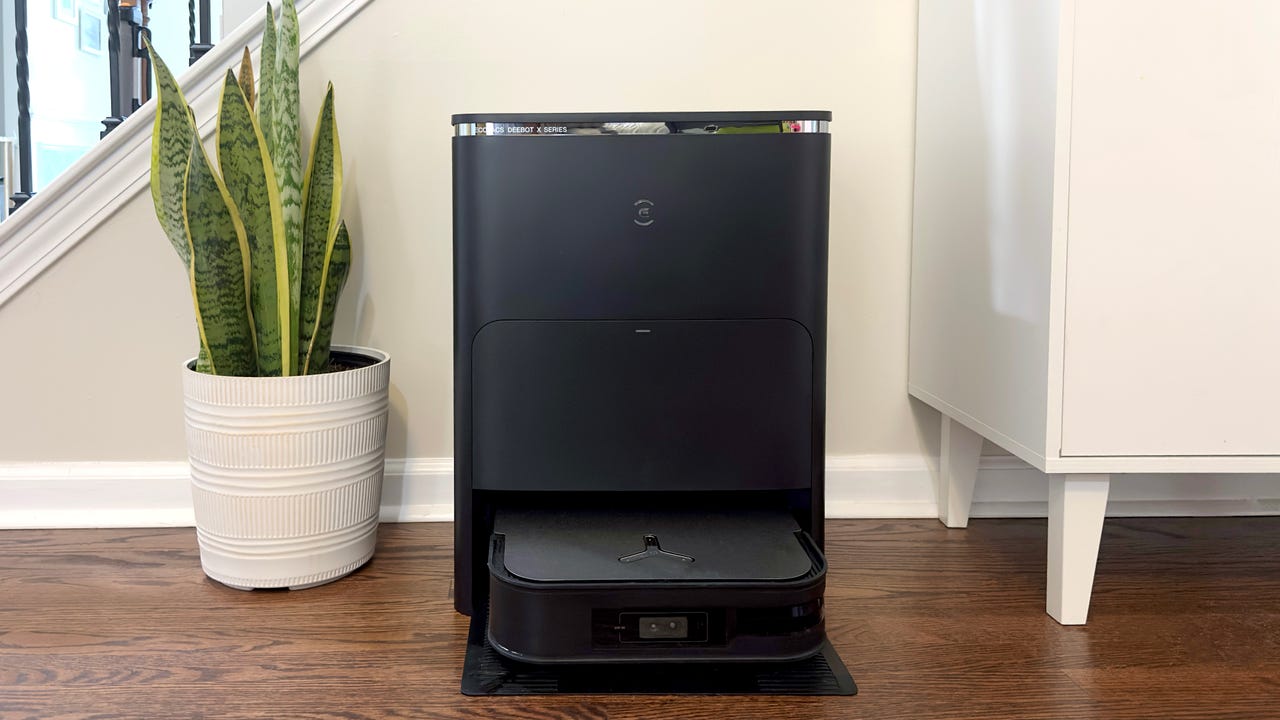
Save $500 this Memorial Day on the Ecovacs Deebot X2 Omni robot vacuum and mop and keep your floors sparkling

Ecovacs Deebot X2 Omni

What's the deal?

This is a great time to get spring cleaning supplies and the Ecovacs Deebot X2 Omni is one of them, available now for $999 (save $500).

Also: The 100+ best Memorial Day deals you can shop now

Why this deal is ZDNET-recommended

You know that gratifying feeling of coming home to a clean house? With a family of five, that's not a feeling I often get, if at all. Enter the Ecovacs Deebot X2 Omni.

Also: Ecovacs announced a new robot vacuum that squares up to the competition

I've tested a fair share of robot vacuum and mop combinations, so I quite appreciate the experience of having a robot roaming around my home that picks up crumbs, dust, and everything in between. But the Deebot X2 Omni is the best robot vacuum and mop I've tried.

View at Amazon

Ecovacs launched the Deebot X2 Omni today, a new flagship robot vacuum and mop combo with a clear edge. After testing it out for a couple of weeks, I've found room for improvement in some tasks — largely outweighed by its long list of strengths.

The X2 Omni checks all the specs boxes for a high-end robot vacuum and mop. It has 8,000Pa of suction power, higher than the 6,000Pa of the current market leader, the Roborock S8 Pro Ultra. Using artificial intelligence (AI), the robot can detect and avoid objects strewn about the floor, such as socks and charging cables, and has a mopping pad that automatically lifts 15mm when carpets or rugs are detected.

Also: The best robot mops you can buy

The Omni station charges the robot vacuum and mop and works as a base where it empties its dustbin and self-washes and dries its mop pads. This feature means you only have to worry about keeping the base station's clean water tank filled and its dirty water tank empty, which you must complete every few cleaning cycles.

Designed to be a hands-free experience, the base station is also self-cleaning. Running the self-cleaning option in the Ecovacs app will clean the base plate in the station — the spot where your mops are cleaned that typically sees water and dirt accumulation. This feature is a level above competitors like Yeedi, which requires users to periodically clean dirty water at the bottom of the docking station.

The dust bag holds everything the Deebot X2 sweeps from your floors and only needs emptying about once a month, although your mileage may vary.

This closure is supposed to hold four liters of clean water when you carry the clean water tank by the handle.

One of my only gripes is that the clean water tank feels awkward to hold when filled — it almost feels like it's not built to last, although I won't know for certain until I've used it for several months. It's a four-liter water tank with a handle to carry it on the lid, held shut by a plastic clip. I hold the tank from the bottom because I feel like using the handle to carry the full tank around will result in the closure failing and four liters of water going everywhere.

About the square shape

The Deebot X2 Omni has several superpowers, starting with its compact package. The squared edges stood out to me as a feature when I unpacked the device, along with how narrow and short it was. At only 12.6 inches wide, it's about 0.3 inches narrower than the Eufy X9 Pro robot vacuum mop, which had been my super mop until the X2 Omni arrived.

Although 0.3 inches sounds like a small difference in size, it's proven to be considerable when a robot has to navigate through furniture legs. Case in point: the Eufy X9 Pro uses AI to avoid objects, but whenever I sent it to clean the first floor, it'd get stuck between the kitchen barstools legs. The stools are fairly lightweight, so the robot would drag them around instead of signaling it was stuck. I'd see my kitchen barstools gliding around my floor or randomly find one hanging out by the shoe bench.

Also: The best iRobot vacuums

This isn't a big deal and is highly subjective, so it's not something I included in my Eufy review; it's not the robot's fault that it's the exact size as the width of the distance between my barstool's legs. But the narrower Deebot X2 Omni can clean under the barstools and figure its way back out, which means no more 'guess where the barstools are today' games.

The Ecovacs Deebot X2 Omni making its way out of the traveling barstools.

The Deebot X2 is also almost an inch shorter than my Eufy robot vacuum, at 3.7 inches in height. The lower dimensions and narrow build allow the Deebot X2 to clean in places other robots typically can't reach or navigate under.

Some AI-powered features

The Deebot X2 leverages Ecovacs' AIVI 3D 2.0 and combines an AI processor with 3D-structured light sensors with dual-laser LiDAR technology. The result is efficient maps that allow the robot to detect objects during navigation and clean around them intelligently. This feature set means you won't have to ensure your floors are free of charging cables, toys, or shoes before sending out the X2.

The AI-powered navigation and obstacle avoidance, backed by Ecovacs' proprietary AINA Model, uses visual recognition and reinforcement learning based on sensor information.

Also: 6 things to know about robot vacuums before you buy one

The Deebot X2's clever technology also makes for a customized cleaning process if that's your thing. The device's AI-powered visual recognition, ability to detect floor type, and historical cleaning logs let the robot infer which room it's cleaning, such as the kitchen, living room, or bedroom, and adjust its suction power and mopping mode.

A new level of voice control

Voice control makes everything in my home easier. Countless robot vacuums let you use a third-party virtual assistant for voice control, such as Amazon Alexa, Google Assistant, or Siri. Saying, "Alexa, clean the floors" in my house dispatches the Eufy X9 Pro to clean my bedroom and hallway. However, these assistants are limited in the functions they can make the robot perform.

Sure, you can dispatch your robot with Alexa or Google, but have you ever been able to tell it to "turn right, move three meters forward, turn left, and clean there"?

Also: This robot vacuum connects to your home's water supply for full automation

Ecovacs robot vacuums have a built-in voice assistant named YIKO that users can talk with to control the robot directly — and it works swimmingly. Saying "OK, YIKO" wakes up the voice assistant. If your robot is out cleaning, you can ask it to return and clean the dining room again or give it multiple commands in one sentence without pulling up the app.

ZDNET's buying advice

The Ecovacs Deebot X2 Omni is the company's new flagship robot with all the smart features and a price to match, at $1,500, though $500 off right now after Cyber Monday. Over the past few weeks, it's gained a top-dog position in our home, becoming the main robot to clean the downstairs floor — and that's saying a lot.

The great thing about an all-in-one, self-emptying, and self-cleaning robot vacuum and mop is that it's not best suited for some circumstances — it's suited for all. Some mid-range models might be great at mopping but suffer from not having strong or effective suction, making them best suited for homes with hard floors. Others might boast great suction power, okay mopping, and short battery life, making them best for mostly carpeted apartments or small homes.

The Deebot X2 Omni is great at all of these things. The biggest challenge in our home is downstairs because it's mostly hardwood and tile with some area rugs — it's where the dog comes in and out from the yard, where we cook, and where the toddler drops most of the crumbs.

Also: Skip the Dyson: This $150 stick vacuum is just as powerful (and can mop, too)

The X2 Omni's MSRP of $1,500 compares to $1,600 for the Roborock S8 Pro Ultra (also discounted right now at $600 off). Suppose I were looking for a hands-free robot vacuum and mop suitable for my home's complex needs. In that case, I'd have to choose the Deebot X2 Omni over the Roborock's flagship because the extra features, like the self-cleaning station and stronger suction, set it apart.