macOS 15 Sequoia Cheat Sheet: Release Date, Name, Features and More

The latest operating system for Mac PCs is macOS 15 Sequoia, unveiled by Apple at its 2024 Worldwide Developer Conference. This cheat sheet explores important new capabilities as well as requirements for the new operating system.

Sequoia has neat quality-of-life changes for work, such as the way dragging a window to the edge of the screen will automatically put it in a tile folded to the side so you can see the whole window. Continuity, a feature that enables sharing between devices, is getting even more seamless with the ability to control an iPhone from a Mac, including interacting with apps.

The biggest change is that macOS 15 will come with Apple Intelligence, which brings generative AI capabilities such as email summarisation throughout tentpole Mac applications like Mail and Pages.

What is macOS 15 Sequoia?

macOS 15 Sequoia is the latest operating system for Macs, announced on June 10, 2024 at WWDC. The name Sequoia continues Apple’s trend of naming its OS after areas in California, with previous iterations named Sonoma, Ventura, Monterey and Big Sur. Sequoia is a national park in the Sierra Nevada mountain range.

It is the first Mac operating system to support Apple Intelligence, the company’s proprietary artificial intelligence platform. AI features include audio transcription in Notes, Smart Reply in Mail and a more intelligent Siri that can understand natural language prompts.

Craig Federighi, Apple’s senior vice president of software engineering, said in a press release: “The all-star combination of the power of Apple silicon and the legendary ease of use of macOS have made the Mac more capable than ever. Today, we’re excited to take macOS to new heights with macOS Sequoia, a big release that elevates productivity and intelligence.

“macOS Sequoia ushers in Apple Intelligence, unlocking incredible new features that will be a game changer for working on Mac. And with more ways to help users effortlessly get things done, new Continuity features like iPhone Mirroring, major updates to Safari, and a host of new games, we think Mac users are going to love it.”

What are the main features of macOS 15 Sequoia?

Apple Intelligence features

Writing Tools

When you highlight a section of text on Sequoia and right click, you will be presented with a number of AI Writing Tools:

  • Proofread will go through the text and make suggestions on grammar and spelling.
  • Rewrite will rewrite the entire section in either a friendly, professional or concise style.
  • You can also click Summary or Key Points to extract the main takeaways of the text.

Writing Tools will be available everywhere you can write, including Mail, Notes, Pages and third-party apps. In Mail, emails in the Inbox will have AI-generated summaries as previews rather than a summary of the subject line or first sentence. When typing a reply, macOS Sequoia will give you numerous Smart Reply options generated using the original email’s content.
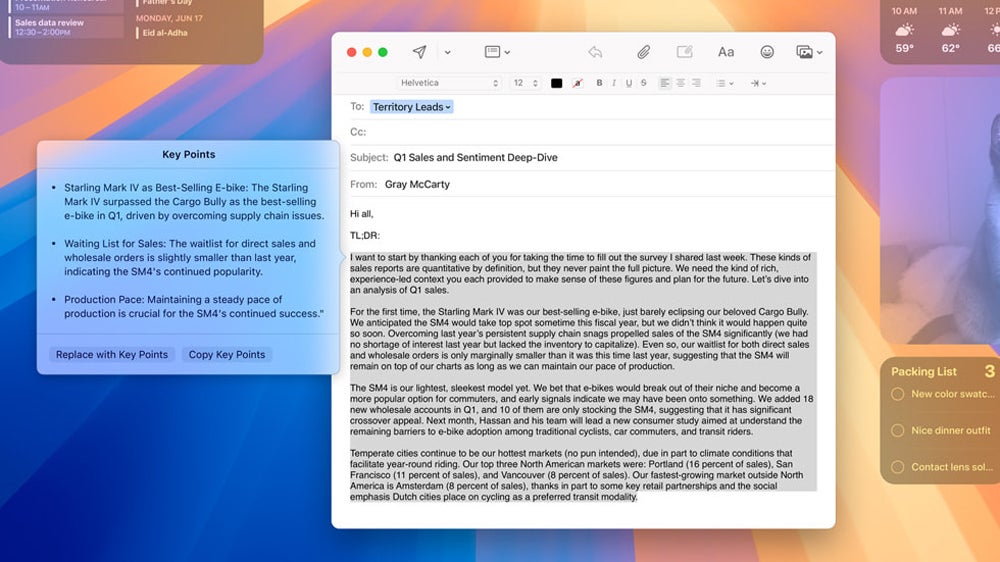
macOS 15 allows users to generate summaries of long text with AI.
macOS 15 allows users to generate summaries of long text with AI. Image: Apple

Notes

Notes now comes with audio transcription and summarisation using Apple Intelligence. This means the app can activate the Mac microphone during a meeting, and it will generate a transcription and summary of the discussion in real time. Notes will also automatically solve any calculations typed into a Note.
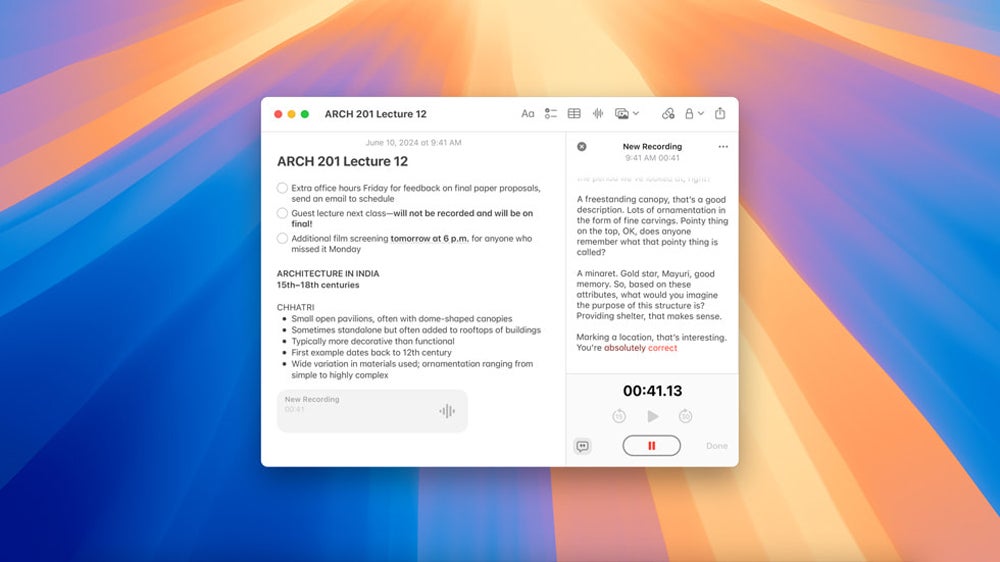
Notes can transcribe and take meeting notes in real time.
Notes can transcribe and take meeting notes in real time. Image: Apple

Image Playground

Image Playground is an AI image generating tool included on macOS 15. It is a dedicated app and built into native apps like Messages and Pages so AI images can be created and used within them. macOS will suggest prompts based on the context of the open app, or you can input your own.

Siri

Siri has been augmented with Apple Intelligence. New capabilities include on-screen awareness, in-app actions, text commands and a better understanding of natural language commands. It also has a new look, appearing as a glowing light bar that wraps around the sides of the screen and pulsates to indicate it is listening.

You can read about the AI features in more detail in TechRepublic’s Siri cheat sheet.

ChatGPT and Private Cloud Compute

While Apple Intelligence runs on hardware built into the Mac, for some functions, the level of compute it provides will not be sufficient; therefore, macOS 15 offers the ability to connect to ChatGPT without leaving an app. ChatGPT can be used to gain real-time information that cannot be accessed on the device as well as for more powerful text and image generation.

SEE: ChatGPT Cheat Sheet: A Complete Guide for 2024

But ChatGPT is not the only option for Mac users to access additional computational resources. More intensive requests can be routed through Private Cloud Compute, Apple’s new cloud intelligence system, which sends it to external Apple servers. The data transferred during this process is not stored or made accessible to Apple, ensuring privacy.

Other features

iPhone Mirroring

iPhone Mirroring is a feature that allows users to fully access and interact with their iPhone from their Mac. The phone’s wallpaper and icons appear as a window on the PC screen, so users can view notifications, open apps and perform tasks on it using the Mac’s controls. The iPhone remains locked, while iPhone Mirroring is taking place to keep it private.

With iPhone Mirroring, Mac users can view and interact with their iPhone on their PC.
With iPhone Mirroring, Mac users can view and interact with their iPhone on their PC. Image: Apple

Safari

Apple has made a number of upgrades to Safari as part of the macOS 15 update. A button in the address bar will now show page Highlights when clicked, such as a summary of the page’s content, directions via Maps or links for further information.

The Reader tool got a makeover, offering a more streamlined view of the content being read. There are new customisation options for colours and fonts, and table of contents and summary appear in a sidebar for longer articles.

If a video appears on a web page, Safari enlarges it and brings it front-and-centre, or puts it into a smaller pop up when the user changes the window.

Safari on macOS 15 will detect videos and bring them front-and-centre.
Safari on macOS 15 will detect videos and bring them front-and-centre. Image: Apple

Window Tiling

If a user has multiple windows open on the desktop and drags one of them to the edge of the screen, macOS Sequoia will automatically move and resize them so they are in an intuitive tiled arrangement that maximises visibility.

macOS 15 will organise multiple windows to maximise their visibility.
macOS 15 will organise multiple windows to maximise their visibility. Image: Apple

Video conferencing

When using video conferencing apps like Zoom or FaceTime, macOS Sequoia will show the presenter an image of what exactly will be visible to other meeting attendees when they share their screen before actually sharing it. They can also use built-in or custom backgrounds during a video call.

macOS 15 will show a presenter a preview of their screen before they share it in a meeting.
macOS 15 will show a presenter a preview of their screen before they share it in a meeting. Image: Apple

Passwords app

Replacing Keychain, Passwords is a new app for the Mac that securely stores all the user’s credentials. Its contents syncs between Apple devices using iCloud with end-to-end encryption, and Windows devices with the iCloud for Windows app.

SEE: Best Password Managers for Mac

Calculator and Calendar

The Calculator app on macOS Sequoia will now store a history of previous calculations and can perform unit conversions. Complete expressions, including parentheses, trigonometry and other operations, can be viewed before hitting equals.

Calendar in macOS 15 shows events and tasks put into Reminders and has an updated, more easy-to-read Month View.

Which devices support macOS 15 Sequoia?

macOS Sequoia is compatible with the following devices:

  • iMac – 2019 and later.
  • Mac Studio – 2022.
  • Mac mini – 2018 and later.
  • Mac Pro – 2019 and later.
  • iMac Pro – 2017 and later.
  • MacBook Air – 2020 and later.
  • MacBook Pro – 2018 and later.

Apple Intelligence and its associated features will only function on devices with an Apple M-series chip inside, so M1 or newer. Any Mac older than 2020 using an Intel chip will not have this capability.

SEE: New M3 Chip Family, MacBook Pro Line & iMacs

Therefore, Apple Intelligence will run on the following devices:

  • MacBook Pro – 2021 or later, and 2020 13-inch M1 version.
  • MacBook Air – 2022 or later, and 2020 M1 version.
  • iMac – 2021 or later.
  • Mac mini – 2020 or later.
  • Mac Studio – 2022 or later.
  • Mac Pro – 2023.

When is the release date for macOS 15 Sequoia?

A beta version of macOS Sequoia can be downloaded by developers through the Apple Developer Program today, and it will be made available to the public through the Apple Beta Software Program in July.

The final version will be released as a free software update to all owners of compatible Macs in autumn 2024. Apple Intelligence will be included with the release on devices with an M-Series chip.

How to download and install macOS 15 Sequoia

For now, only registered developers can download the beta of macOS 15 Sequoia through the Apple Developer Program.

Members of the Developer Program can download the operating system by following these steps:

  1. Open System Settings on a compatible Mac and sign into an Apple ID that is registered for the Developer Program.
  2. Navigate to General, and then Software Update.
  3. Ensure Beta Updates is set to On; if it is Off, click the i and select macOS Sequoia Developer Beta in the Beta Updates dropdown menu.
  4. A macOS 15 Beta banner should now appear in the Software Update tab. Click Upgrade Now to download and install.

As this is a beta version of the software, you may encounter bugs and issues that you can report to Apple. Remember to back up your Mac before updating to ensure you can restore your system if necessary.

Not ready to make the transition to Sequoia, yet? Explore TechRepublic’s cheat sheets for macOS 14 Sonoma and macOS 13 Ventura.

How to use Microsoft Edge’s integrated AI image generator

Microsoft Edge's integrated Designer AI Image Creator

While you can use Microsoft's Designer tool to generate AI-based images from any web browser by visiting the dedicated website for Copilot or Designer, accessing them is quicker and easier right in Microsoft Edge.

Through an integrated sidebar, you can launch and use Copilot or Designer to request images based on your descriptions. You can view the images in the sidebar and then open one in the main browser window to share, save, and modify it.

Also: The best AI art generators to try

Let's see how this tool works.

How to use Copilot within Microsoft Edge

First, ensure you're signed in to Edge with a Microsoft or work/school account. In Edge, click the three-dot More icon in the upper-right corner and select Settings. At the Profiles screen, choose the account you want to use and click the "Sign in to sync data" button. When you're done, click the Sync setting and turn off any items you don't want to sync.

Also: ChatGPT vs. Microsoft Copilot vs. Gemini: Which is the best AI chatbot?

Next, make sure you're running the latest version of Edge. Click the More icon again, go to "Help and feedback," and select "About Microsoft Edge." Edge will automatically download and install any available update.

How to use Designer within Microsoft Edge

You can also access the Designer tool directly from the Edge sidebar.

Disclaimer: You should consider the legal consequences (e.g. copyright) of using AI-generated images before implementing them in your work.

More on AI tools

Fake reviews are a big problem — and here’s how AI could help fix it

AI generated thumbs up

Trustpilot, formed in 2007, is a site that aggregates user reviews of companies and websites. The company boasts 238 million reviews on its site, having reviewed nearly a million sites across 50 nationalities.

Although Trustpilot offers reviews of US-based businesses, the few local shops I looked for weren't listed. I had better luck on Yelp. Trustpilot seems to have a much stronger presence in Europe.

Anoop Joshi, Trustpilot's Chief Trust Officer

For our purposes in this article, it doesn't matter where the preponderance of companies profiled are located. This article focuses on a problem dangerously endemic on review sites: fake reviews.

Also: When's the right time to invest in AI? 4 ways to help you decide

In 2023 alone, Trustpilot identified 3.3 million fake reviews on its site. That's after eliminating 2.6 million just the year before. Worse, according to research documented in the Proceedings of the National Academy of Sciences of the United States of America (PNAS), only about half of consumers can distinguish between text written by artificial intelligence and text written by a real human being.

The rise of generative AI leaves consumers and companies like Trustpilot with an increasingly serious problem: filtering out fake reviews and identifying real opinions by real consumers.

Also: Generative AI is the technology that IT feels the most pressure to exploit

Trustpilot has made this challenge a key mission of the company. ZDNET spoke with Anoop Joshi, Trustpilot's chief trust officer, to learn how the company is combatting AI-generated fake reviews. It's quite an interesting challenge.

And with that, let's get started.

ZDNET: Can you share your journey to becoming Trustpilot's Chief Trust Officer?

Anoop Joshi: As Trustpilot's chief trust officer, I oversee our Trust and Safety and Legal and Privacy operations with a team of around 80, covering a wide range of activities across litigation, public affairs, global comms, commercial contracting, content moderation, brand protection, and fraud investigations.

I joined Trustpilot over four years ago. I was initially responsible for the company's enforcement-related work, meaning the actions taken against misuse on the Trustpilot platform by businesses or consumers. This included overseeing and supporting our actions to tackle fake reviews and investigate forms of abuse and misuse. Litigation was also a part of this role, specifically relating to content posted on the platform and claims submitted by businesses attempting to have reviews removed or hidden on the platform.

Also: Generative AI can transform customer experiences. But only if you focus on other areas first

This team developed into the company's first platform integrity team and became more involved with the operational side of trust and safety, leading to greater prominence of the work we were doing at an industry level. Our impact was recognized as Trustpilot became a founding member of the Coalition of Trusted Reviews, together with Amazon, TripAdvisor, Glassdoor, Booking.com, Expedia, and others, with the goal of further improving trust in online reviews.

I have a background as a lawyer and software engineer, and today that mixed background supports my chief trust officer role at Trustpilot. Critically, we're at a place where law and technology intersect in multiple different ways, and this is particularly the case for Trustpilot when it comes to building and earning trust.

ZDNET: How do you define the role of a chief trust officer in today's digital landscape?

AJ: At Trustpilot, our vision is to be the universal symbol of trust and this role is here to ensure we're delivering on that commitment. As the chief trust officer, I'm responsible for establishing what trust means at Trustpilot. A large part of that is our reviews, the content on our website, and the way we treat our customers, both consumers and businesses.

It's also about driving the governance and processes that mitigate risk, enable compliance and ultimately, earn the trust and the loyalty of our stakeholders, which include consumers, employees, businesses that use Trustpilot, investors, policymakers, journalists, and more.

As technology becomes increasingly more pervasive in the work of organizations across the world, and more and more engagement happens online, the question of trust will continue to surface, and I expect we'll start to see more demand for this type of role in the C-suite.

ZDNET: What are the most common fake reviews you encounter on Trustpilot?

AJ: We define fake reviews as reviews that aren't based on a genuine experience or have otherwise been left as an attempt to mislead the reader in some way. The types we commonly come across and remove are:

  • Spam reviews: People leave a review that is ultimately some form of advertisement or is masquerading as a promotion for another business
  • Conflicts of interest reviews: An owner or employee of a business reviewing that business itself
  • Reviews left as an attempt to mislead: Someone submitting a review where they haven't had an experience at all with the business
  • Incentive-based reviews: The nature of the review itself is misleading and the motivation of submitting that review is nefarious

ZDNET: How has the rise of AI-generated content impacted the authenticity of online reviews?

AJ: Generative AI in this space has reduced the cost for individuals to create content. As a platform, Trustpilot has designed its automated systems and engines to detect fake reviews by focusing on behaviors.

Our engines look at how a review got onto Trustpilot by examining the relationship between the user who submitted the review and looking for patterns or suspicious markers. While the content of the review is absolutely something we look at, it's a small part of the overall picture when it comes to the detection of fake reviews.

Also: Agile development can unlock the power of generative AI — here's how

Our systems are constantly looking at the behaviors leading up to the submission of a review, and our findings in our latest Transparency Report show a relative consistency year-over-year in terms of the volume and number of fake reviews detected.

This shows that since the launch of AI technologies like ChatGPT, we have not seen a surge in the number of fake reviews and have remained consistent in our findings as a company.

ZDNET: Can you explain how Trustpilot's AI and machine-learning systems detect fake reviews?

AJ: Every review that is submitted to Trustpilot is analyzed by automated fake review detection engines. These engines look at different features or facets of a review such as prior user behavior — what other reviews this user has submitted to the platform — or even promotional statements to detect suspicious activity. Some patterns detected are not immediate and may take time to evolve before we take action.

In addition to our detection engines, we rely on our Trustpilot community of consumers and businesses who can flag any review they deem suspicious or breach our guidelines. These are flagged to our human moderators (our "content integrity team"), who then assess the review and determine the action taken.

Whenever we remove a review, we contact the reviewer directly to let them know the reasons why, and to give them an opportunity to challenge the decision.

Our detection engines and our content integrity team work hand-in-hand to continually improve our approach to detecting and removing fake reviews.

ZDNET: What challenges does Trustpilot face in distinguishing between genuine and fake reviews?

AJ: One of our biggest challenges is that some patterns of behavior are not immediately apparent and take time to develop and understand that this is, in fact, a fake or misleading review. This will always be a challenge when distinguishing between genuine or fake reviews.

ZDNET: How do you deal with the issue of keeping genuine reviews where users legitimately used AIs to help write them?

AJ: We look at whether reviewers have had a genuine experience with a business, and if that experience is reflected in their review. We analyze a variety of factors when determining if a review is suspicious, which can include if a reviewer used data copied from another source (such as being generated elsewhere, including from a generative AI model).

Where these factors amount to a high degree of suspicion, we'll automatically remove the review and let the reviewer know we've taken action, giving them an opportunity to challenge our decision.

Also: Rote automation is so last year: AI pushes more intelligence into software development

We think that's the right balance to take when it comes to this emerging technology, acknowledging there are use cases where reviewers may use generative AI-based tools to help frame genuine experiences or to support reviewer needs, such as accessibility or neurodiversity.

ZDNET: How does Trustpilot balance the need for automated detection with the importance of human oversight?

AJ: In thinking about the platform's future, we always have and always will ensure that humans are involved in the creation of the design and implementation of the automation software we develop.

We acknowledge that automation is impactful in supporting operations at scale, but the nature of the problems that we're solving are human. Those problems and challenges change over time, and so automation needs to adapt, and that adaptation is often driven by what we learn from human behavior.

ZDNET: How has the percentage of fake reviews detected changed over the years, and what factors have contributed to this?

AJ: Total reviews written on Trustpilot continue to increase year on year, from 46 million (FY 2022) to 54 million (FY 2023), an increase of 17%. With that, more fake reviews were removed in FY 2023, a total of 3.3 million compared to 2.6 million in FY 2022. However, our removal rate remains consistent at 6% of the total year-on-year proportionally.

In 2023, 79% of the fake reviews were detected and removed by our fake detection systems, demonstrating our continued investment in technology to automatically detect fake reviews is becoming increasingly more effective. While AI and machine learning continue to rapidly evolve, generative AI tools allow written information to be quickly created from a few simple prompts.

Also: 4 ways to help your organization overcome AI inertia

Recent research shows that participants in a study could only distinguish between human and AI text with 50-52% accuracy. Today, our investments in technology to better detect behavioral patterns that focus as much on how reviews get onto the platform as they do on the specific content of a review means we continue to identify and remove suspicious reviews, even where the content may have been generated using AI.

Additionally, the community on Trustpilot helps us to promote and protect trust on the platform. Our reviewer and business communities can flag a review to us at any time if they believe it breaches our guidelines. We refer to those reviews flagged to us as reported reviews.

By utilizing both technology like AI and machine learning as well as our community, we are able to continue providing a platform built on trust and transparency.

ZDNET: What are the long-term effects of fake reviews on consumer trust and business reputation?

AJ: Fake reviews have the ability of impacting consumer decisions. A consumer that makes a purchase based on a fake review could ultimately have a bad experience, or at least not the experience they were expecting. Ultimately this impacts their trust in online platforms.

And if platforms aren't doing all that they can to reduce the likelihood of fake reviews, this will have long-term effects, as consumers will ultimately lose faith in the platforms that they rely on to make their buying decisions.

ZDNET: What ethical considerations guide Trustpilot's use of AI in review moderation?

AJ: Ultimately it's our commitment to transparency. Where we are using AI for automated decision-making, we are transparent about that fact. We design our platform for trust between consumers and businesses.

That transparency is at the core of the approach we take when it comes to using and developing AI tools for our platform and is something that consumers increasingly come to expect

ZDNET: How do you educate consumers about distinguishing real reviews from fake ones?

AJ: We use Trust Signals to highlight verified reviews, plus reviewers have the ability to verify themselves. Our dedication to a high standard of verification ensures that consumers browsing Trustpilot are able to distinguish between the different types of reviews on our platform.

It's another piece of our commitment to transparency throughout everything we do. Where we take enforcement actions against businesses for misuse of the platform, we display prominent banners (we call them Consumer Warnings) to help consumers make better-informed choices.

ZDNET: How do you foresee the future of AI in combating fake reviews evolving?

AJ: There are massive opportunities in using AI for platforms like ours. Generative AI specifically excels at pattern prediction and I'm interested to see how innovation develops using that technology to better identify fake reviews. We have been operating since 2007 and have a massive amount of data and experience in determining which reviews are fake and which are genuine to help us build better fake detection models.

Also: Want to work in AI? How to pivot your career in 5 steps

It's also important to recognize that these technologies can be used to foster greater transparency, using the technology to support and guide people online, something we're seeing a lot of when it comes to online chat. This technology is only going to improve over time, but with that level of sophistication comes a deep sense of responsibility.

ZDNET: What future developments do you envision in the landscape of online reviews?

AJ: Looking at the wider web, I expect the disparity between content that is human-generated and potentially AI-generated will become greater, impacting trust in online content. As a result, content created by real people, based on the experiences of real people, will become increasingly more valuable in the future.

Platforms like Trustpilot, where we have invested in a combination of technology, people, community, and processes to highlight genuine, authentic voices and opinions, will provide more meaningful value to consumers and businesses.

Final thoughts

ZDNET's editors and I would like to give a shoutout to Anoop Joshi for engaging in this in-depth interview. There's a lot of food for thought here. Thank you, Anoop.

What do you think? Did these recommendations give you any insights into how to navigate the sea of online reviews? Let us know in the comments below.

You can follow my day-to-day project updates on social media. Be sure to subscribe to my weekly update newsletter, and follow me on Twitter/X at @DavidGewirtz, on Facebook at Facebook.com/DavidGewirtz, on Instagram at Instagram.com/DavidGewirtz, and on YouTube at YouTube.com/DavidGewirtzTV.

Featured

6 Incredible Ways LLMs are Transforming Healthcare

Last year, Google decided to explore the use of large language models (LLMs) for healthcare, resulting in the creation of Med-PaLM, an open-source large language model designed for medical purposes.

The model achieved an 85% score on USMLE MedQA, which is comparable to an expert doctor and surpassed similar AI models such as GPT-4.

Just like Med-PaLM, several LLMs positively impact clinicians, patients, health systems, and the broader health and life sciences ecosystem. As per a Microsoft study, 79% of healthcare organisations reported using AI technology currently.

The use of such models in healthcare is only expected to grow due to the ongoing investments in artificial intelligence and the benefits they provide.

LLMs in Medical Research

Recently, Stanford University Researchers used an LLM to find a potential new heart disease treatment. Using MeshGraphNet, an architecture based on graph neural networks (GNNs), the team created a one-dimensional Reduced Order Model (1D ROM) to simulate blood flow.

MeshGraphnet provides various code optimisations, including data parallelism, model parallelism, gradient checkpointing, cuGraphs, and multi-GPU and multi-node training, all of which are useful for constructing GNNs for cardiovascular simulations.

Cardiovascular Care with AI Surrogates ❤
The research team from @Stanford leveraged #MeshGraphNet, a graph neural network (GNN)-based architecture, to devise a one-dimensional Reduced Order Model (1D ROM) for simulating blood flow.
🌎 Read more: https://t.co/Q7nszvIUwG pic.twitter.com/O9J8R0atYk

— Jousef Murad (@Jousefm2) March 25, 2024

Llama in Medicine

Researchers at the Yale School of Medicine and the School of Computer and Communication Sciences at the Swiss science and technology institute EPFL used Llama to bring medical know-how into low-resource environments.

One such example is Meditron, a large medical multimodal foundation model suite created using LLMs. Meditron assists with queries on medical diagnosis and management through a natural language interface.

This tool could be particularly beneficial in underserved areas and emergency response scenarios, where access to healthcare professionals may be limited.

Researchers at @ICepfl & @YaleMed teamed up to build Meditron, an LLM suite for low-resource medical settings. With Llama 3, their new model outperforms most open models in its parameter class on benchmarks like MedQA & MedMCQA.
More details ➡ https://t.co/nqKebwOGKa pic.twitter.com/BHlwd8Q3zJ

— AI at Meta (@AIatMeta) April 29, 2024

According to a preprint in Nature, Meditron has been trained in medical information, including biomedical literature and practice guidelines. It’s also been trained to interpret medical imaging, including X-ray, CT, and MRI scans.

Bolstering Clinical Trials

Quantiphi, an AI-first digital engineering company, uses NVIDIA NIM to develop generative AI solutions for clinical research and development. These solutions, powered by LLMs, are designed to generate new insights and ideas, thereby accelerating the pace of medical advancements and improving patient care.

Likewise, ConcertAI is advancing a broad set of translational and clinical development solutions within its CARA AI platform. The Llama 3 NIM has been incorporated to provide population-scale patient matching for clinical trials, study automation, and research.

Data Research

Mendel AI is developing clinically focused AI solutions to understand the nuances of medical data at scale and provide actionable insights. It has deployed a fine-tuned Llama 3 NIM for its Hypercube copilot, offering a 36% performance improvement.

Mendel is also investigating possible applications for Llama 3 NIM, such as converting natural language into clinical questions and extracting clinical data from patient records.

Advancing Digital Biology

The Techbio pharmaceutical companies and life sciences platform providers use NVIDIA NIM for generative biology, chemistry, and molecular prediction.

This involves using LLMs to generate new biological, chemical, and molecular structures or predictions, thereby accelerating the pace of drug discovery and development.

Transcripta Bio, a company dedicated to drug discovery has a Rosetta Stone to systematically decode the rules by which drugs affect the expression of genes within the human body. Its proprietary AI modelling tool Conductor AI discovers and predicts the effects of new drugs at transcriptome scale.

It also uses Llama 3 to speed up intelligent drug discovery.

BioNeMo is a generative AI platform for drug discovery that simplifies and accelerates the training of models using your own data and scaling the deployment of models for drug discovery applications. BioNeMo offers the quickest path to both AI model development and deployment.

Then there is AtlasAI drug discovery accelerator, powered by the BioNeMo, NeMo and Llama 3 NIM microservices. AtlasAI is being developed by Deloitte.

Medical Knowledge and Medical Core Competencies

One way to enhance the medical reasoning and comprehension of LLMs is through a process called ‘fine-tuning’. This involves providing additional training with questions in the style of medical licensing examinations and example answers selected by clinical experts.

This process can help LLMs to better understand and respond to medical queries, thereby improving their performance in healthcare applications.

Examples of such tools are First Derm, a teledermoscopy application for diagnosing skin conditions, enabling dermatologists to assess and provide guidance remotely, and Pahola, a digital chatbot for guiding alcohol consumption.

ChatDoctor: A medical chat model fine-tuned on LLaMA using medical domain knowledge.
Collects data on around 700 diseases and generated 5K doctor-patient conversations to finetune the LLM.
paper: https://t.co/XaLLaem9U6
code: https://t.co/aJOCOwKDyF pic.twitter.com/YbQqXLig26

— elvis (@omarsar0) March 28, 2023

Chatdoctor, created using an extensive dataset comprising 100,000 patient-doctor dialogues extracted from a widely utilised online medical consultation platform, could be proficient in comprehending patient inquiries and offering precise advice.

They used the 7B version of the LLaMA model.

Microsoft Delays Recall Launch, Seeking Community Feedback First

Microsoft’s Recall feature, the AI-enabled timeline for Windows 11 on Copilot+ PCs, will be available only to members of the Windows Insider Program in June, instead of the initial planned public preview slated for June 18. This change follows Microsoft’s decision last week to make Recall opt-in instead of enabled by default. Other users will have access to Recall “soon,” after the Redmond giant has had time to respond to feedback from the Windows Insider preview.

Recall takes snapshots of a user’s activity on their Copilot+ PC, enabling generative AI to trawl through all of that activity to answer questions phrased in natural ways. It could be a benefit for performing open-ended searches (such as “Show me the spreadsheet my boss sent to me yesterday”), but some security researchers have expressed concerns about how that activity is stored.

Recall feature will be previewed in Windows Insider Program

On June 13, Microsoft Corporate Vice President of Windows and Devices Pavan Davuluri wrote an update to the blog post written about shifting Recall to opt-in last week.

“We are adjusting the release model for Recall to leverage the expertise of the Windows Insider community to ensure the experience meets our high standards for quality and security,” he wrote. “This decision is rooted in our commitment to providing a trusted, secure and robust experience for all customers and to seek additional feedback prior to making the feature available to all Copilot+ PC users.”

Microsoft pointed out that work on Recall is guided by the Secure Future Initiative, an ongoing attempt to improve security methods and practices.

After Windows Insider members have a chance to provide feedback, Recall will be made available to anyone with a Copilot+ PC.

People interested in the Windows Insider program can join for free.

Microsoft switched Recall from active by default to opt-in

While Microsoft reassured customers data from Recall would only be stored locally, security researchers such as Kevin Beaumont pointed out attackers don’t even need physical access to a Copilot+ laptop to exfiltrate Recall data. About a week after this discovery, Microsoft made some changes to how Recall will operate.

  • Recall will be opt-in.
  • In order to use Recall, you’ll need to enroll in Windows Hello — which lets you sign in with facial recognition, fingerprint or a PIN instead of a password — and provide proof of presence such as your face being visible to the laptop.
  • Encrypting the search index database Recall uses.

SEE: Curious about Microsoft Copilot? Our cheat sheet has the details on Redmond’s AI PC plans and more.

Microsoft faces security probe

The changes to Recall come amid discussion of Microsoft’s overall security posture in the U.S. Congress. On June 13, Microsoft President Brad Smith spoke to the House Homeland Security Committee about a federal report suggesting Microsoft’s security stance contributed to a breach last year by state actors.

How does Recall compare to Apple Intelligence?

Apple’s answer to Copilot+ PCs is its upcoming Apple Intelligence, created in part through a partnership with OpenAI. Apple Intelligence works mostly by letting Siri respond to more natural questions, as well as providing the summarization and translation functions generative AI is proven to perform. Apple Intelligence runs on-device and on Apple servers when needed. Since it was only announced this week, security researchers haven’t had as much time to dig into how Apple Intelligence works.

But, having waited longer than its competitors to integrate AI into its laptops, Apple seems to have a better awareness of potential security problems. At WWDC, Apple’s Craig Federighi, senior vice president of software engineering, said, “You should not have to hand over all the details of your life to be warehoused and analyzed in someone’s AI cloud.”

Anthropic Talks Red Teaming for AI

The security and safety of AI tools is a topic that’s become ever more important as the technology influences more of our world. Achieving this goal is going to require a multi-faceted approach, but red teaming techniques will play a crucial goal in securing AI tools.

Specifically, red teaming is the process of testing some system to identify vulnerabilities. Done without malicious intent, this process is meant to find problems before hackers do.

Anthropic recently published a post outlining some insights the company has come across in the process of testing its AI systems. In doing so, Anthropic hopes to spark a conversation of how to do red teaming right with AI and how the world needs more standardized practices with red teaming.

New Tech, New Rules

One of the larger problems in AI security in general – and with the technology more generally – is that we currently lack a set of standardized practices. Specifically, Anthropic pointed out that a lack of standardization “complicates the situation.”

For instance, Anthropic points out that developers might use different techniques to assess the same type of threat model. Even using the same technique itself doesn’t remove the problem, as they may go about the red teaming process in different ways.

Additionally, the solutions to many of these problems aren’t as simple as they may appear. At the moment, there aren’t any disclosure standards that dictate the entire industry. An article from Tech Policy Press discussed the Pandora’s box or protective shield dilemma. There are many advantages to sharing the outcomes of red-teaming efforts in academic papers, but doing so may inadvertently provide adversaries with a blueprint for exploitation.

While that’s more of a general discussion that must happen in the AI field in the years to come, Anthropic went on to outline specific red teaming methods that they have tried:

  • Domain-specific, expert red teaming
    • Trust & Safety: Policy Vulnerability Testing
    • National security: Frontier threats red teaming
    • Region-specific: Multilingual and multicultural red teaming
  • Using language models to red team
    • Automated red teaming
  • Red teaming in new modalities
    • Multimodal red teaming
  • Open-ended, general red teaming
    • Crowdsourced red teaming for general harms
    • Community-based red teaming for general risks and system limitations

Anthropic does a great job of diving into each of these topics, but the company’s focus on red teaming in new modalities is especially interesting. AI has been heavily focused on text inputs rather than other forms of media like photos, videos, and scientific charts. Red teaming in these multimodal environments is challenging, but it can help identify risks and failure modes.

Anthropic’s Claude 3 family of models are multimodal, and while that gives users more flexible applications it does present new risks in the form of fraudulent activity, threats to child safety, violent extremism, and more.

Before deploying Claude 3, Anthropic asked its Trust and Safety team to red team the system for both text- and image-based risks, They also worked with external red teamers to assess how well Claude 3 does at refusing to engage with harmful inputs.

Multimodal red teaming clearly has the benefit of catching failure modes prior to public deployment, but Anthropic also pointed out the benefit it provides with end-to-end system testing. Many AI models are actually a system of interrelated components and features. This can include a model, harm classifiers, and prompt-based interventions. Multimodal red teaming is an effective way to stress test the resilience of an AI system end-to-end and therefore understand overlapping safety features.

Of course, there are challenges to a multimodal approach to red teaming. To begin, the security team requires deep subject matter expertise in high-risk areas such as dangerous weapons – which is a rare skill. Additionally, multimodal red teaming can involve viewing graphic imagery as opposed to reading text-only content. This presents a risk to red teamer wellbeing, and as such must warrant additional safety considerations.

Red teaming is a complex process, and multimodality is only one of topics that Anthropic covered in their extensive report. However, it’s clear that the world requires a standardized approach to AI safety and security.

Fake reviews are a big problem: How AI can help, according to Trustpilot’s Chief Trust Officer

AI generated thumbs up

Trustpilot, formed in 2007, is a site that aggregates user reviews of companies and websites. The company boasts 238 million reviews on its site, having reviewed nearly a million sites across 50 nationalities.

Although Trustpilot offers reviews of US-based businesses, the few local shops I looked for weren't listed. I had better luck on Yelp. Trustpilot seems to have a much stronger presence in Europe.

Anoop Joshi, Trustpilot's Chief Trust Officer

For our purposes in this article, it doesn't matter where the preponderance of companies profiled are located. This article focuses on a problem dangerously endemic on review sites: fake reviews.

Also: When's the right time to invest in AI? 4 ways to help you decide

In 2023 alone, Trustpilot identified 3.3 million fake reviews on its site. That's after eliminating 2.6 million just the year before. Worse, according to research documented in the Proceedings of the National Academy of Sciences of the United States of America (PNAS), only about half of consumers can distinguish between text written by artificial intelligence and text written by a real human being.

The rise of generative AI leaves consumers and companies like Trustpilot with an increasingly serious problem: filtering out fake reviews and identifying real opinions by real consumers.

Also: Generative AI is the technology that IT feels the most pressure to exploit

Trustpilot has made this challenge a key mission of the company. ZDNET spoke with Anoop Joshi, Trustpilot's chief trust officer, to learn how the company is combatting AI-generated fake reviews. It's quite an interesting challenge.

And with that, let's get started.

ZDNET: Can you share your journey to becoming Trustpilot's Chief Trust Officer?

Anoop Joshi: As Trustpilot's chief trust officer, I oversee our Trust and Safety and Legal and Privacy operations with a team of around 80, covering a wide range of activities across litigation, public affairs, global comms, commercial contracting, content moderation, brand protection, and fraud investigations.

I joined Trustpilot over four years ago. I was initially responsible for the company's enforcement-related work, meaning the actions taken against misuse on the Trustpilot platform by businesses or consumers. This included overseeing and supporting our actions to tackle fake reviews and investigate forms of abuse and misuse. Litigation was also a part of this role, specifically relating to content posted on the platform and claims submitted by businesses attempting to have reviews removed or hidden on the platform.

Also: Generative AI can transform customer experiences. But only if you focus on other areas first

This team developed into the company's first platform integrity team and became more involved with the operational side of trust and safety, leading to greater prominence of the work we were doing at an industry level. Our impact was recognized as Trustpilot became a founding member of the Coalition of Trusted Reviews, together with Amazon, TripAdvisor, Glassdoor, Booking.com, Expedia, and others, with the goal of further improving trust in online reviews.

I have a background as a lawyer and software engineer, and today that mixed background supports my chief trust officer role at Trustpilot. Critically, we're at a place where law and technology intersect in multiple different ways, and this is particularly the case for Trustpilot when it comes to building and earning trust.

ZDNET: How do you define the role of a chief trust officer in today's digital landscape?

AJ: At Trustpilot, our vision is to be the universal symbol of trust and this role is here to ensure we're delivering on that commitment. As the chief trust officer, I'm responsible for establishing what trust means at Trustpilot. A large part of that is our reviews, the content on our website, and the way we treat our customers, both consumers and businesses.

It's also about driving the governance and processes that mitigate risk, enable compliance and ultimately, earn the trust and the loyalty of our stakeholders, which include consumers, employees, businesses that use Trustpilot, investors, policymakers, journalists, and more.

As technology becomes increasingly more pervasive in the work of organizations across the world, and more and more engagement happens online, the question of trust will continue to surface, and I expect we'll start to see more demand for this type of role in the C-suite.

ZDNET: What are the most common fake reviews you encounter on Trustpilot?

AJ: We define fake reviews as reviews that aren't based on a genuine experience or have otherwise been left as an attempt to mislead the reader in some way. The types we commonly come across and remove are:

  • Spam reviews: People leave a review that is ultimately some form of advertisement or is masquerading as a promotion for another business
  • Conflicts of interest reviews: An owner or employee of a business reviewing that business itself
  • Reviews left as an attempt to mislead: Someone submitting a review where they haven't had an experience at all with the business
  • Incentive-based reviews: The nature of the review itself is misleading and the motivation of submitting that review is nefarious

ZDNET: How has the rise of AI-generated content impacted the authenticity of online reviews?

AJ: Generative AI in this space has reduced the cost for individuals to create content. As a platform, Trustpilot has designed its automated systems and engines to detect fake reviews by focusing on behaviors.

Our engines look at how a review got onto Trustpilot by examining the relationship between the user who submitted the review and looking for patterns or suspicious markers. While the content of the review is absolutely something we look at, it's a small part of the overall picture when it comes to the detection of fake reviews.

Also: Agile development can unlock the power of generative AI — here's how

Our systems are constantly looking at the behaviors leading up to the submission of a review, and our findings in our latest Transparency Report show a relative consistency year-over-year in terms of the volume and number of fake reviews detected.

This shows that since the launch of AI technologies like ChatGPT, we have not seen a surge in the number of fake reviews and have remained consistent in our findings as a company.

ZDNET: Can you explain how Trustpilot's AI and machine-learning systems detect fake reviews?

AJ: Every review that is submitted to Trustpilot is analyzed by automated fake review detection engines. These engines look at different features or facets of a review such as prior user behavior — what other reviews this user has submitted to the platform — or even promotional statements to detect suspicious activity. Some patterns detected are not immediate and may take time to evolve before we take action.

In addition to our detection engines, we rely on our Trustpilot community of consumers and businesses who can flag any review they deem suspicious or breach our guidelines. These are flagged to our human moderators (our "content integrity team"), who then assess the review and determine the action taken.

Whenever we remove a review, we contact the reviewer directly to let them know the reasons why, and to give them an opportunity to challenge the decision.

Our detection engines and our content integrity team work hand-in-hand to continually improve our approach to detecting and removing fake reviews.

ZDNET: What challenges does Trustpilot face in distinguishing between genuine and fake reviews?

AJ: One of our biggest challenges is that some patterns of behavior are not immediately apparent and take time to develop and understand that this is, in fact, a fake or misleading review. This will always be a challenge when distinguishing between genuine or fake reviews.

ZDNET: How do you deal with the issue of keeping genuine reviews where users legitimately used AIs to help write them?

AJ: We look at whether reviewers have had a genuine experience with a business, and if that experience is reflected in their review. We analyze a variety of factors when determining if a review is suspicious, which can include if a reviewer used data copied from another source (such as being generated elsewhere, including from a generative AI model).

Where these factors amount to a high degree of suspicion, we'll automatically remove the review and let the reviewer know we've taken action, giving them an opportunity to challenge our decision.

Also: Rote automation is so last year: AI pushes more intelligence into software development

We think that's the right balance to take when it comes to this emerging technology, acknowledging there are use cases where reviewers may use generative AI-based tools to help frame genuine experiences or to support reviewer needs, such as accessibility or neurodiversity.

ZDNET: How does Trustpilot balance the need for automated detection with the importance of human oversight?

AJ: In thinking about the platform's future, we always have and always will ensure that humans are involved in the creation of the design and implementation of the automation software we develop.

We acknowledge that automation is impactful in supporting operations at scale, but the nature of the problems that we're solving are human. Those problems and challenges change over time, and so automation needs to adapt, and that adaptation is often driven by what we learn from human behavior.

ZDNET: How has the percentage of fake reviews detected changed over the years, and what factors have contributed to this?

AJ: Total reviews written on Trustpilot continue to increase year on year, from 46 million (FY 2022) to 54 million (FY 2023), an increase of 17%. With that, more fake reviews were removed in FY 2023, a total of 3.3 million compared to 2.6 million in FY 2022. However, our removal rate remains consistent at 6% of the total year-on-year proportionally.

In 2023, 79% of the fake reviews were detected and removed by our fake detection systems, demonstrating our continued investment in technology to automatically detect fake reviews is becoming increasingly more effective. While AI and machine learning continue to rapidly evolve, generative AI tools allow written information to be quickly created from a few simple prompts.

Also: 4 ways to help your organization overcome AI inertia

Recent research shows that participants in a study could only distinguish between human and AI text with 50-52% accuracy. Today, our investments in technology to better detect behavioral patterns that focus as much on how reviews get onto the platform as they do on the specific content of a review means we continue to identify and remove suspicious reviews, even where the content may have been generated using AI.

Additionally, the community on Trustpilot helps us to promote and protect trust on the platform. Our reviewer and business communities can flag a review to us at any time if they believe it breaches our guidelines. We refer to those reviews flagged to us as reported reviews.

By utilizing both technology like AI and machine learning as well as our community, we are able to continue providing a platform built on trust and transparency.

ZDNET: What are the long-term effects of fake reviews on consumer trust and business reputation?

AJ: Fake reviews have the ability of impacting consumer decisions. A consumer that makes a purchase based on a fake review could ultimately have a bad experience, or at least not the experience they were expecting. Ultimately this impacts their trust in online platforms.

And if platforms aren't doing all that they can to reduce the likelihood of fake reviews, this will have long-term effects, as consumers will ultimately lose faith in the platforms that they rely on to make their buying decisions.

ZDNET: What ethical considerations guide Trustpilot's use of AI in review moderation?

AJ: Ultimately it's our commitment to transparency. Where we are using AI for automated decision-making, we are transparent about that fact. We design our platform for trust between consumers and businesses.

That transparency is at the core of the approach we take when it comes to using and developing AI tools for our platform and is something that consumers increasingly come to expect

ZDNET: How do you educate consumers about distinguishing real reviews from fake ones?

AJ: We use Trust Signals to highlight verified reviews, plus reviewers have the ability to verify themselves. Our dedication to a high standard of verification ensures that consumers browsing Trustpilot are able to distinguish between the different types of reviews on our platform.

It's another piece of our commitment to transparency throughout everything we do. Where we take enforcement actions against businesses for misuse of the platform, we display prominent banners (we call them Consumer Warnings) to help consumers make better-informed choices.

ZDNET: How do you foresee the future of AI in combating fake reviews evolving?

AJ: There are massive opportunities in using AI for platforms like ours. Generative AI specifically excels at pattern prediction and I'm interested to see how innovation develops using that technology to better identify fake reviews. We have been operating since 2007 and have a massive amount of data and experience in determining which reviews are fake and which are genuine to help us build better fake detection models.

Also: Want to work in AI? How to pivot your career in 5 steps

It's also important to recognize that these technologies can be used to foster greater transparency, using the technology to support and guide people online, something we're seeing a lot of when it comes to online chat. This technology is only going to improve over time, but with that level of sophistication comes a deep sense of responsibility.

ZDNET: What future developments do you envision in the landscape of online reviews?

AJ: Looking at the wider web, I expect the disparity between content that is human-generated and potentially AI-generated will become greater, impacting trust in online content. As a result, content created by real people, based on the experiences of real people, will become increasingly more valuable in the future.

Platforms like Trustpilot, where we have invested in a combination of technology, people, community, and processes to highlight genuine, authentic voices and opinions, will provide more meaningful value to consumers and businesses.

Final thoughts

ZDNET's editors and I would like to give a shoutout to Anoop Joshi for engaging in this in-depth interview. There's a lot of food for thought here. Thank you, Anoop.

What do you think? Did these recommendations give you any insights into how to navigate the sea of online reviews? Let us know in the comments below.

You can follow my day-to-day project updates on social media. Be sure to subscribe to my weekly update newsletter, and follow me on Twitter/X at @DavidGewirtz, on Facebook at Facebook.com/DavidGewirtz, on Instagram at Instagram.com/DavidGewirtz, and on YouTube at YouTube.com/DavidGewirtzTV.

Featured

Databricks is Helping CEOs Embrace AI Before AI Becomes the CEO 

Recently, Perplexity AI chief Aravind Srinivas said that the CEO role is highly replaceable. He believes future AIs like GPT-5 or GPT-6 could perform CEO tasks better by continuously processing information and making decisions.

Databricks chief Ali Ghodsi couldn’t agree less and is doing everything he can to ensure CEOs embrace and understand AI before it replaces them.

“Every company on the planet now wants to be a data and AI company. In the last 18 months, every CIO and CEO I meet from a Fortune 500 company or a small company thinks that data and AI will be super strategic for them over the next five years,” Ghodsi said in his keynote speech at the 2024 Data + AI Summit.

Ghodsi believes that CEOs worldwide find it challenging to understand their own organisation, and Databricks aims to make it easier for them by democratising AI and data.

“Your CEO will not access the data and ask questions directly from the data; instead, they will go to the data team and ask, ‘Hey, can you get me this report?’” he predicted, saying that CEOs do not speak SQL or Python or, at the very least, don’t know where to find the data and submit their own queries.

“We’re really hoping that we can democratise this [AI and data] so that if you speak English or any other natural language, you should just be able to ask your question from the data, and many more people in the organisation should be able to get insights,” said Ghodsi.

Making CEOs Data + AI Literate

“AI is the future, there’s no doubt about that. If CEOs are not aligned with this, I don’t think they’ll become CEOs in the future,” said Databricks India and SAARC region vice president Anil Bhasin, touching upon how the company is helping businesses in India with their AI initiatives.

Bhasin said that Databricks has launched a new Learning Festival, which will train practitioners and provide them with more hands-on training and certification.

Further, he said that the initiatives at the CXO level are really about thought leadership, understanding what they are thinking and whether they’re in any industry vertical or horizontal, depending on the industries served for digital natives.

“We provide what are called CXO roundtables, where customers share their problems and knowledge, and discuss their experiences,” added Bhasin. This, he said, was being done across industries, with an emphasis on value creation and go-to-market strategies for businesses.

Bhasin said that Databricks is the only company on the planet that is providing community training, learning enablement, and driving thought leadership at scale. “The fact that we want to build a CIO community around data in itself is a great value proposition,” he said.

Databricks believes in building strategic alliances and collaboration. Citing Databricks’ field engineering SVP Arsalan Tavakoli, Bhasin said that he was in India last year, where he met with top CXOs, CTOs, and CEOs who were very happy to see him because it was an exchange of ideas between the US and other parts of the world.

Ghodsi—who once stayed in Paharganj, Delhi, India, in the mid-2000s—told AIM that he would love to visit India soon, given the excitement around generative AI in the country.

“Every CEO wants to know what generative AI can do, but right now, it is all about experimentation and exploitation. I think it’d be another six months from now when it starts,” said Bhasin, saying that they’ve already got a couple of customers in India implementing them. Some of the notable ones include TCS, Infosys, Wipro, Tech Mahindra, Celebal Technologies, Krutrim and LTI Mindtree.

“We firmly prescribe the notion that if you are not embracing data and AI, you’re really going to be left behind,” said Databricks vice president of field engineering APJ Nick Eayrs, adding that CEOs should just get started with AI to differentiate their products and services.

Making CXO’s Job Easy With Databricks

Databricks has launched a new tool called Databricks AI/BI, which will help CEOs gain insights across organisations through an AI-first approach. It leverages generative AI to enable self-service analytics, allowing them to ask complex questions and receive accurate answers without requiring data science expertise.

“A truly intelligent BI solution needs to understand the unique semantics and nuances of a business to effectively answer questions for business users. The launch of AI/BI is a step towards building such a system,” said Ghodsi.

AI/BI consists of two complementary experiences—AI/BI Dashboards, a low-code interface for quickly creating interactive dashboards, and AI/BI Genie, a conversational interface that uses natural language to address ad-hoc and follow-up questions. Both are powered by a compound AI system that continuously learns from usage across an organisation’s data stack, including ETL pipelines, lineage, and queries.

Top 10 Next-Gen Videos Created by Dream Machine’s Luma AI, a Sora and Kling Alternative

Close on the heels of Sora & Kling, comes a new contender – Dream Machine. California-based startup Luma AI, which focuses on visual AI, has unveiled this new video generator that stands out due to its use of AI to create realistic visual content.

One of the key differentiators is the photorealistic quality of its videos. The AI algorithms employed by Luma meticulously analyse and enhance every detail, from texture to lighting, ensuring that the final output looks almost indistinguishable from real-world footage.

A prime contributor to Luma’s success is AWS. Amazon’s cloud computing subsidiary has provided Luma AI with the infrastructure, exposure and practical applications, showcasing its capabilities in streamlining production processes.

“Great to see how AWS H100 training infrastructure helped the Luma AI team reduce time to train foundation models and support the launch of Dream Machine,” said Swami Sivasubramanian, vice president for data and machine learning services, AWS.

Co-founded in 2021 by CEO Amit Jain, Luma AI is currently based in San Francisco, California.

AIM decided to try out Dream Machine to produce a video. Here’s a look at it.

Meanwhile, we have also compiled a list of the top 10 mind-blowing videos produced by Dream Machine.

A Woman

This AI-generated video features a woman with a shaved head wearing a blue outfit. She appears to have a serious expression, and the background includes a building with multiple windows, suggesting an urban setting.

By allowing everyone to experiment with AI-powered video generation for free on its website, Luma AI has hit a major milestone in the field.

The abandoned Building

The video depicts a long, narrow hallway with dim lighting, likely located in an abandoned or poorly maintained building. The corridor has graffiti writing, peeling paint, and debris scattered on the floor. The ambience is eerie and desolate.

This highlights the advanced visual capabilities of AI in capturing and rendering detailed environments.

Girl with a Pearl Earring

Here, the video brings the painting, ‘Girl with a Pearl Earring’, the timeless beauty of Johannes Vermeer’s masterpiece to life using AI.

As the painting is transformed into a realistic video with every brushstroke and delicate detail, it captures the subtle play of light and shadow, the intricate textures, and the serene expression of the girl.

This visual experience shows the original artwork while offering a fresh, modern perspective through the unsettling potential of AI.

Kabosu!

With Dream Machine, this video brings Kabosu to life. Every detail, from the eyes to the fluffy coat, is rendered with creativity and high-quality visuals, demonstrating the advanced capabilities of the model.

The body reconstruction, backed by the model’s new technology, allows users to create videos in various aspect ratios. Overall, it showcases its potential in generating high-quality, life-like video content, making it a standout in the field of digital animation.

Mark Zuckerberg

The Mark Zuckerberg video made by Dream Machine showcases an innovative application of artificial intelligence and technology.

In this video, it appears as though Zuckerberg is in the middle of the woods, looking outside through a glass window. This almost-realistic clip can be viewed from multiple angles. It also captures and renders his movements and expressions, bringing a new level of realism to virtual representations.

The potential of AI in creating life-like digital avatars paves the way for future advancements in virtual communication and entertainment.

Willy Wonka Walks Off

In this video, Willy Wonka is digitally recreated where he walks away, expressing disappointment. The character’s facial expressions, gestures, and mannerisms align perfectly which offers a glimpse into the future of digital media and storytelling possibilities.

The precise features and seamless editing add to future creativity in AI.

Disaster Girl Meets Firefighters

This AI-generated video contains several realistic elements, such as a young girl smiling, firefighters attempting to extinguish a fire, and two officers having a conversation at the end.

This serves as an example of AI’s capacity to bridge digital content with real-world impact.

A Girl & a Zeal of Zebras

This video featuring a girl and zebras in the forest goes beyond mere visuals; it intricately weaves together elements of nature, human curiosity, and storytelling.

Set against the backdrop of lush greenery it shows the girl’s encounter with the zebras showing seamless integration of AI technology in entertainment. Through advanced algorithms, the characters exhibit life-like movements and expressions, enhancing the immersive experience.

The Eye

The video focusing on the eye exemplifies an exploration of visual perception through advanced AI techniques. This captivating clip delves into the intricacies of the human eye, capturing its mesmerising colours.

The AI algorithms show the light refraction, intense colour, and slow zoom, creating a highly realistic and captivating scene.

The Masked People

This clip features a captivating scene in which a group of masked individuals are situated within a vibrant environment painted in striking hues of bright blue and pink. The contrasting colours of the room amplify the presence of the masked figures, creating an intriguing visual that captivates viewers.

The characters’ movements within their space are rendered with detail. The AI ensures that each gesture and reaction is natural, enhancing the viewer’s engagement and the characters’ believability.

Apple’s AI features and Nvidia’s AI training speed top the Innovation Index

screenshot-2024-06-10-at-2-13-27pm.png

Welcome to ZDNET's Innovation Index, which identifies the most innovative developments in tech from the past week and ranks the top four, based on votes from our panel of editors and experts. Our mission is to help you identify the trends that will have the biggest impact on the future.

It was another big week for AI, with Apple's coming releases taking over — but not without Nvidia squeaking through to remind everyone of its dominance in neural network training.

While WWDC stole the show this week with several innovative releases, the standout for our team was Apple Intelligence. The company's cleverly named brand of AI emphasizes what Apple calls "personal intelligence" — mostly on-device, convenient AI features that are hyper-personalized for a user's activity.

It isn't the features themselves that are especially interesting (that was kind of the point). As ZDNET Contributor David Gewirtz put it, it's that AI is "now being added at the OS level and made accessible to developers across platforms. That moves AI out of its fairly walled chat garden and into becoming much more of a system component."

Coming in second is Nvidia, which reportedly maintained its lead as the fastest chip when it comes to training neural networks. According to several benchmarks, the company continues to massively outperform competitors like AMD, Intel, and Google. Considering benchmarks for AI testing are still in flux, Nvidia's demonstrated advantage here bodes well for its future in the space.

In third place is Apple's forthcoming iOS 18, which looks to upgrade the iPhone in ways that are revolutionary for Apple loyalists, but almost standard for Android users. Beyond updates to customizability, Siri, and certain apps, the refresh brings long-desired functionality to Photos and Messages, including schedule-send. The new OS version should make the most of Apple Intelligence on the iPhone with subtle but crucial improvements for everyday use — an impactful, if quiet, move for the best-selling smartphone of 2023.

Closing out the week at #4 is Apple's Private Cloud Compute, the equally on-brand and impressive counterpart to Apple Intelligence. In keeping with the company's historical commitment to user privacy, Private Cloud Compute aims to solve server security concerns with bespoke Apple silicon. Scaling computation without sacrificing privacy, the custom chips add a layer of trust when Apple Intelligence moves commands off-device and into the cloud. That Apple won't gather user data to train its models — the tricky price we're used to paying for generative AI — is a massive security win. If Apple delivers, the service could set a new standard for consumer AI that may be hard to beat.

Artificial Intelligence