Krutrim Fails UPSC Exam

When ChatGPT was launched, it was said to have all the answers in the world. AIM took the test of that promise, and made ChatGPT attempt the Union Public Service Commission (UPSC) examination. And as we all know, it did not clear USPC.

Now that Indian language models are all the hype, we wanted to make at least one of them attempt the country’s most prestigious and one of the toughest examinations in the world. Since the challenge was so tough, AIM decided to test out Krutrim, which is touted as the most indigenous and culturally aware model of India.

To make Krutrim realise the tough ordeal that it’s going to go through, we decided to let it know and asked if it thinks it can clear the exam. Unfortunately, instead of accepting its fate, it decided to wish us ‘Good luck!’.

Not So Smart and Aware

We made Krutrim attempt the 100 questions from Question Paper 1 (Set A) from UPSC Prelims 2023. It only got 41 of them correct. Since the cut off of the exam was 75.41 for the general category this year, Krutrim failed the UPSC exam miserably.

To compare, ChatGPT answered 54 of them correctly when we took the test in 2022.

The questions ranged from subjects such as geography, economy, history, ecology, general science to current events of national and international importance, social development, and polity.

Strong at Small Questions, Weak at Reasoning

When it comes to geography and general science, Krutrim was able to answer several questions correctly. But, when it came to history and economy, the chatbot fared poorly at even understanding the questions. But all of this seems to depend on its mood.

Moreover, if the given questions had longer contexts, Krutrim failed to correctly answer almost all of them, showing its weak reasoning skills.

Since Krutrim is not connected to the internet, it was not able to answer any questions on current affairs. Surely, it is still in beta and with future updates, the model will be able to get real time information, and maybe hallucinate less too.

Its responses were at times difficult to understand.

The Context Window Problem

Another problem that Krutrim faces, which is worse when compared to other AI models, is that users cannot insert all the text from a single question in one go. At most, Krutrim can take an input of about 500 characters, which is roughly 80 words. Many questions from the paper were longer than that, thus Krutrim could not process them hassle-free.

Moreover, although Krutrim claims to support multiple languages, pasting questions from the paper into the input box was impractical because it counted those characters as more than their English equivalents.

Plus, there is no option to upload a PDF or even scan images on Krutrim yet, which could have made things a lot easier. Nonetheless, attempting the paper in Hindi or other Indian languages is for another time.

Not All is Lost

This just clearly points to the fact that Indian language models, in this case Krutrim, are not nearly as smart as say ChatGPT or Perplexity. Krutrim struggles to find the right answer, and even if it does sometimes, it is hard to assess if it was a fluke or not, since there is no concrete explanation for the answer.

The attempt was also made on the browser, and not the app released by Ola Krutrim since the text input method is far worse in it, and is also without voice input.

Though Bhavish Aggarwal, the CEO of Krutrim, is making big strides in the country with a lot of announcements to make Krutrim the best Indian AI model, such as creating its own cloud and offering its API to developers, there is still a lot that needs to be improved.

Meanwhile, when we informed Krutrim that it had failed the UPSC exam, it told us that we had failed the exam and how it can assist us with study materials!

Well played, Krutrim, well played!

What Data Scientists Should Know About OpenUSD

Sponsored Content

OpenUSD
Image by Nvidia

As data scientists, we are constantly seeking tools and frameworks that enable us to efficiently process and analyze data. In this blog post, we will explore OpenUSD, a powerful framework that goes beyond its traditional use in computer graphics and offers exciting possibilities for data science pipelines.

OpenUSD, or Universal Scene Description, provides a versatile and extensible platform for managing and processing complex data models. It can represent a wide range of data types and enhance datasets in various domains.

Let's dive into what data scientists should know about OpenUSD and how it can enhance their workflows.

Common Data Modeling

OpenUSD introduces a unified data model that allows data scientists to represent and manipulate complex 3D data structures efficiently. With USD, object data can be organized into hierarchical scene graphs. This hierarchical structure is particularly useful when dealing with large-scale datasets or complex data dependencies.

Entering into the OpenUSD ecosystem also enables easy sharing and reuse of data. Data sources in OpenUSD can be more easily integrated into an aggregate view that can encompass content from other file formats.

File Format Plugins

USD File format plugins provide a way to leverage the power of OpenUSD while keeping your existing datasets in their current formats. File format plugins can read and translate a file format into OpenUSD data on the fly.

For example: in 3D data science, Wavefront OBJ files are popular for 3D mesh data, and there are large datasets that use this format. With an OBJ file format plugin like the plugin recently open-sourced by Adobe, you can reference existing OBJ data and compose it in OpenUSD to add or override attributes or use it for scene assembly. The following kitchen.usd shows an example of assembling a kitchen scene using OBJ models for a teapot and a table. The teapot’s position in the scene is overridden to rotate it and move it above the table.

  kitchen.usd      #usda 1.0  (      defaultPrim = "World"      metersPerUnit = 1.0      upAxis = "Z"  )    def Xform "World"  {      def "teapot" (prepend references = @utah_teapot.obj@)      {          float3 xformOp:rotateXYZ = (0, 0, 0)          float3 xformOp:scale = (1, 1, 1)          double3 xformOp:translate = (0, 0, 0)          uniform token[] xformOpOrder = ["xformOp:translate", "xformOp:rotateXYZ", "xformOp:scale"]      }  }  

This is also applicable for non-3D data.

Composability

OpenUSD excels as a composable scene description. This takes form in two main ways: scene aggregation and progressive refinement. Scene aggregation involves referencing many 3D assets from different sources and non-destructively assembling them to form a larger scene. You can make changes to the referenced 3D assets and the assemblies will also pick up the change. Progressive refinement allows you to start with a coarse, low-detailed asset and progressively add additional layers that non-destructively add details to the asset to further refine it from coarse to fine.

Nvidia OpenUSD

Looking again at the example of the OBJ mesh from earlier, you can start with just the mesh data from the OBJ and use OpenUSD to add physical material properties, semantic labels, and other ancillary aspects such as geospatial attribution. In this example, the refinement is composed using sublayers for the different types of details I want to add to my asset.

  teapot.usd      #usda 1.0  (      defaultPrim = "World"      metersPerUnit = 1.0      upAxis = "Z"      subLayers = [          @./semantic_labels.usd@          @./materials.usd@          @./utah_teapot.obj@      ]  )    def Xform "World"  {  }  

Building your datasets like this makes it extremely portable and modular. It also allows you to improve the fidelity and quality of data sources.

I can share the mesh with all of the attributes or I can mute or remove the layers that are not relevant for different pipelines. The SimReady specification and dataset is an example of these principles in practice today.

Nvidia OpenUSD

Custom Pipelining

OpenUSD's Hydra framework offers data scientists the ability to create custom pipelines for processing and analyzing data. Hydra allows for the implementation of business logic as a customizable chain of runtime scene indexes. This decoupling of data processing from specific runtime environments enables data scientists to leverage the power of USD in their own data science workflows.

Extensibility

One of the key strengths of OpenUSD is its extensibility. Data scientists can extend OpenUSD's capabilities by creating their own scene delegates and render delegates. This means that any scene graph capable of answering queries served by scene delegates can be used, providing flexibility in integrating diverse data sources and formats.

OpenUSD is also extensible through custom schemas. As data scientists begin to map concepts from their data models to OpenUSD, they may find that not every concept maps directly and a translation to an existing concept in OpenUSD may not be suitable. When data scientists identify a conceptual data mapping gap, they can formalize the novel concept into a new schema that can be leveraged immediately.

As the schema matures, data scientists are encouraged to share their schemas with other organizations and institutions and to take the schema through the full schema journey so that it can be reviewed, published and standardized. A good example of this is the semantic schema proposal from NVIDIA to standardize semantic labeling of 3D assets for synthetic data generation.

Nvidia OpenUSD

Procedural Processing with Hydra 2.0

Hydra 2.0 takes OpenUSD's capabilities to the next level by introducing procedural processing of scene indexes. This allows data scientists to process chains of scene indexes through multiple pipeline steps, enabling more complex and customizable workflows. With Hydra 2.0, data scientists can iterate and optimize their pipelines, making it easier to experiment with different data processing techniques. Scene index plugins are also portable so that you can share their modular business logic between OpenUSD applications.

OpenUSD offers data scientists a powerful and versatile framework for managing and processing complex data models. Its unified data model, extensibility, and generality make it an invaluable framework for data science workflows and pipelines. With extensibility in both common data modeling via schema plugins, and runtime kernels in Hydra 2.0, OpenUSD empowers data scientists to efficiently process and analyze large-scale datasets, enabling faster and more scalable computations. As data scientists, it is essential to explore and leverage tools like OpenUSD to unlock the full potential of our data-driven endeavors.

A growing number of tools and applications already support OpenUSD import and export. Developers can learn how to add OpenUSD support to their applications in NVIDIA’s OpenUSD Documentation, which includes first steps, guided learning, and technical references to get started.

To access more resources and get started with OpenUSD, visit NVIDIA’s Universal Scene Description page. Get started with NVIDIA Omniverse by downloading the standard license for free.

The Alliance for OpenUSD (AOUSD) is an open, non-profit organization dedicated to promoting the interoperability of 3D content through OpenUSD.

Learn more and become a member today.

More On This Topic

  • KDnuggets News, April 13: Python Libraries Data Scientists Should…
  • Python Libraries Data Scientists Should Know in 2022
  • 5 Statistical Paradoxes Data Scientists Should Know
  • KDnuggets™ News 22:n03, Jan 19: A Deep Look Into 13 Data…
  • KDnuggets News, May 25: The 6 Python Machine Learning Tools Every…
  • The 6 Python Machine Learning Tools Every Data Scientist Should Know About

Innovating Sustainable Data Storage with SwissVault

Interview with Bhupinder Bhullar and Doug Fortune

Innovating Sustainable Data Storage with SwissVault

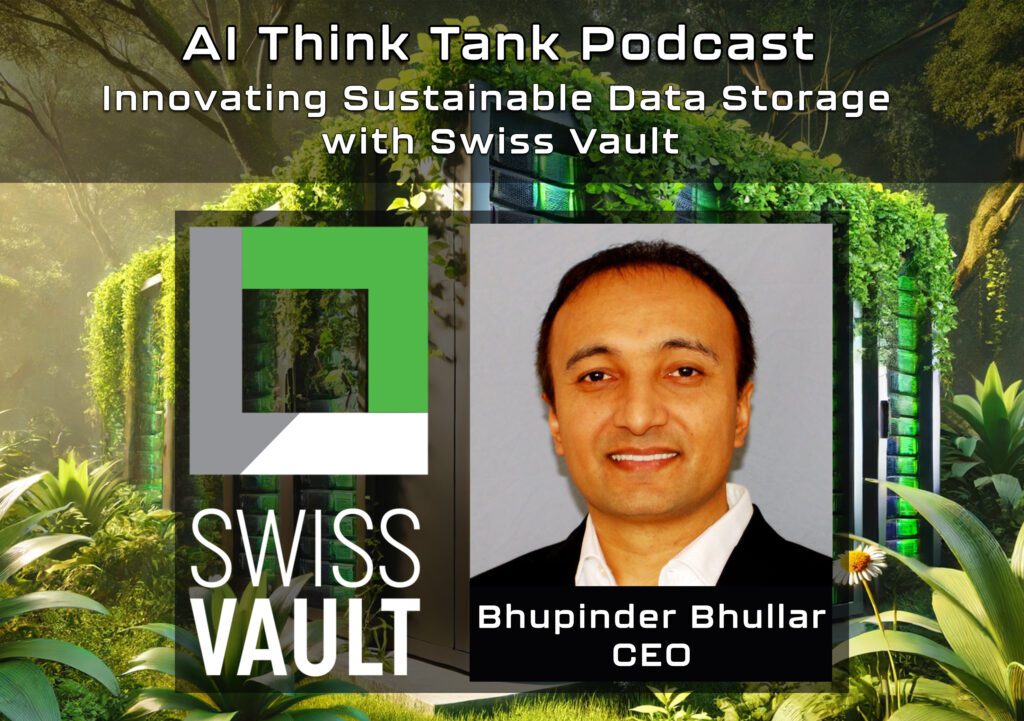
For our 11th episode of the AI Think Tank podcast, I had the pleasure of diving deep into the world of innovative data storage solutions with Bhupinder Bhullar, CEO of SwissVault, and Doug Fortune, the company’s CTO and inventor of their Vault File System (VFS). SwissVault is at the forefront of addressing one of the most pressing issues in today’s digital age: efficient, sustainable data management.

SwissVault has been a game-changer since I first encountered them. Their groundbreaking approach to data storage has left a lasting impression on me, particularly their ability to combine high performance with environmental sustainability. This episode was an eye-opener for many reasons, and I believe it showcased the future of data storage.

Innovating Sustainable Data Storage with SwissVault
The Challenge: Data’s Carbon Footprint

Bhupinder began by highlighting a startling fact: “When you send one email with one attachment, it has the same carbon emissions as one small plastic bag.” This analogy drove home the immense carbon footprint of our digital activities. Currently, data management accounts for 4% of global energy production and 2% of carbon emissions, surpassing even the airline industry. As data needs continue to grow, so does the environmental impact, creating an urgent need for sustainable solutions.

Innovating Sustainable Data Storage with SwissVault
SwissVault’s Vision for Sustainable Data Management

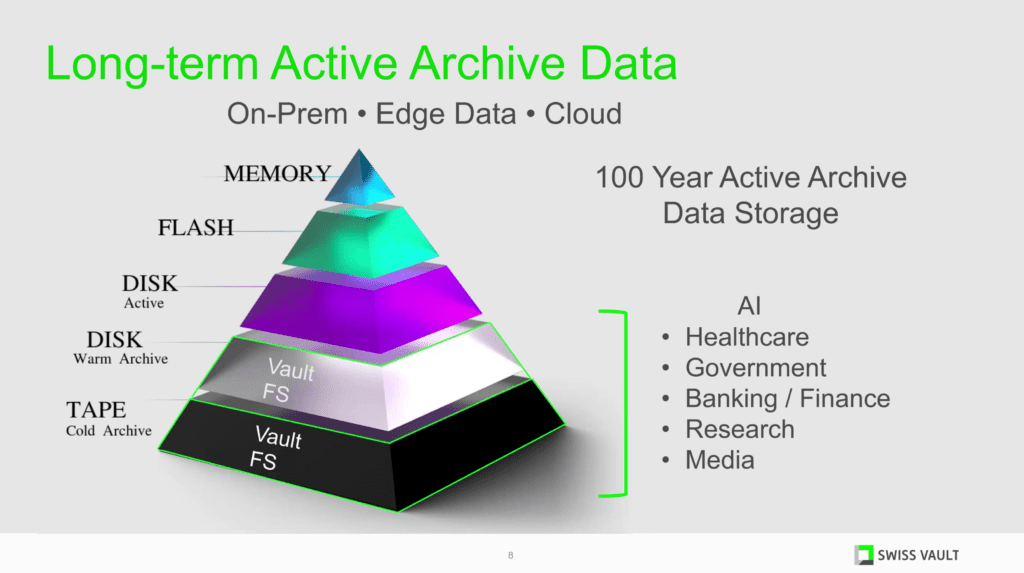
SwissVault’s mission is to tackle these challenges head-on by offering long-term, sustainable data storage solutions. Bhupinder emphasized that their technology is designed to “increase the efficiency of data storage while reducing energy consumption and electronic waste.” This dual focus on efficiency and sustainability sets SwissVault apart in the data storage industry.

Innovating Sustainable Data Storage with SwissVault

Vault File System: A New Era of Data Storage

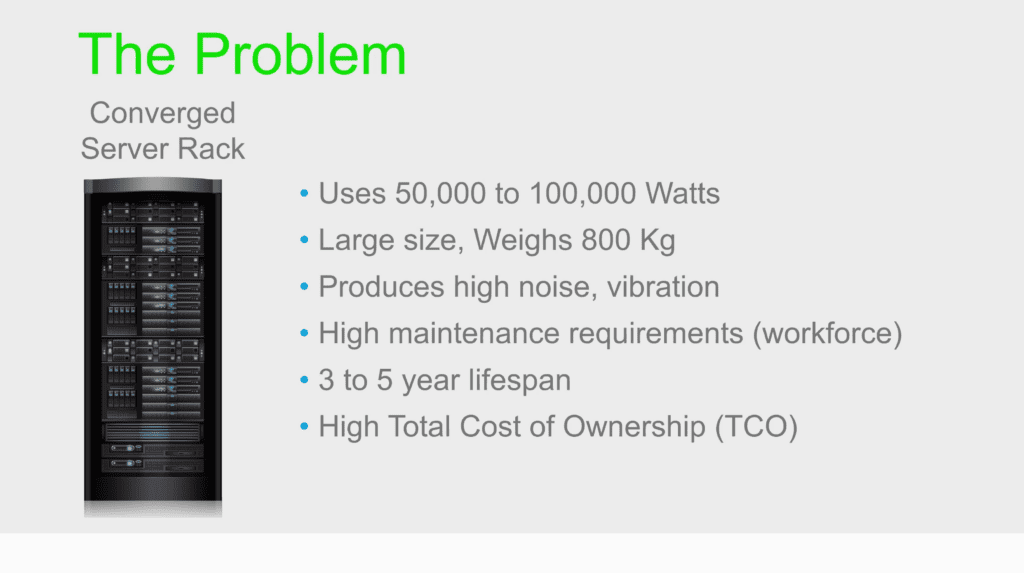
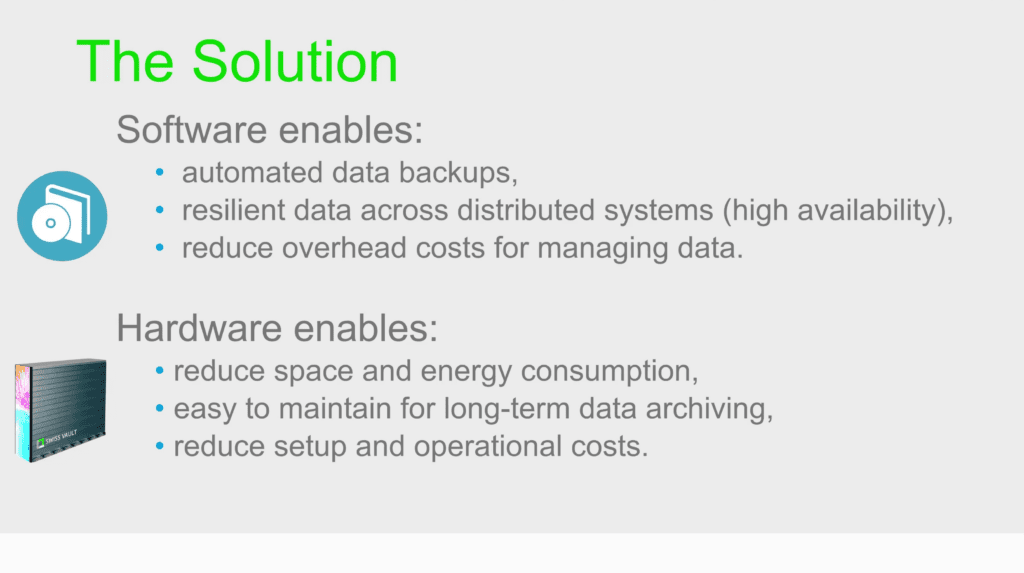
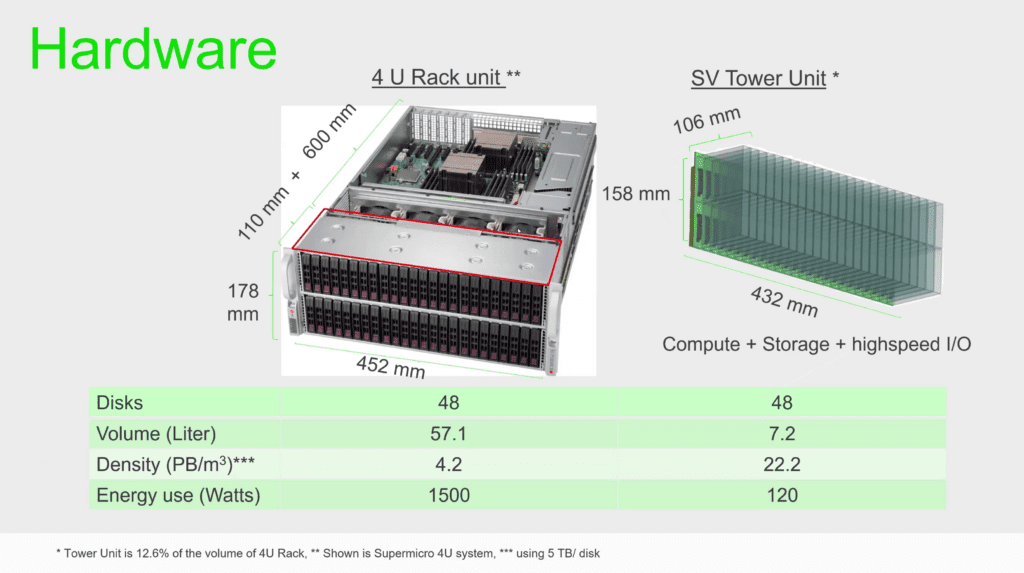
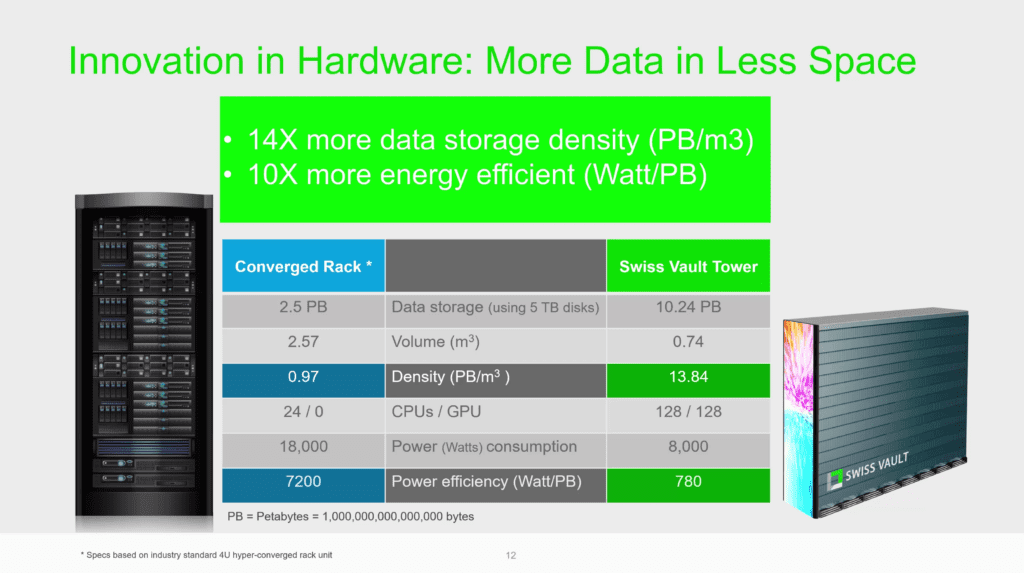
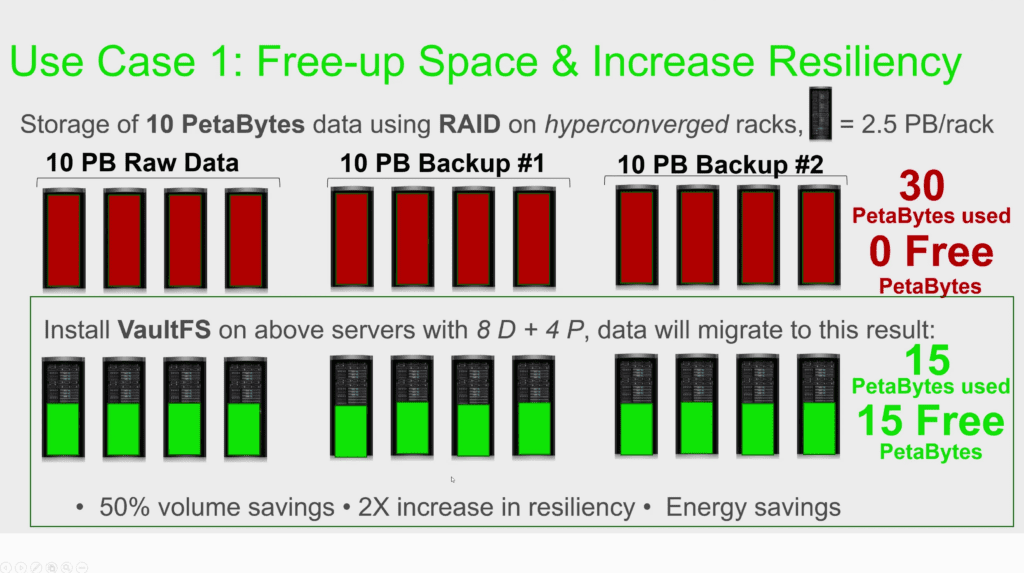
Doug Fortune provided an in-depth look at the Vault File System, which employs innovative hardware and software solutions to revolutionize data storage. He explained that their redesigned server racks are not only smaller and more energy-efficient but also capable of storing more data than traditional systems.

Innovating Sustainable Data Storage with SwissVault

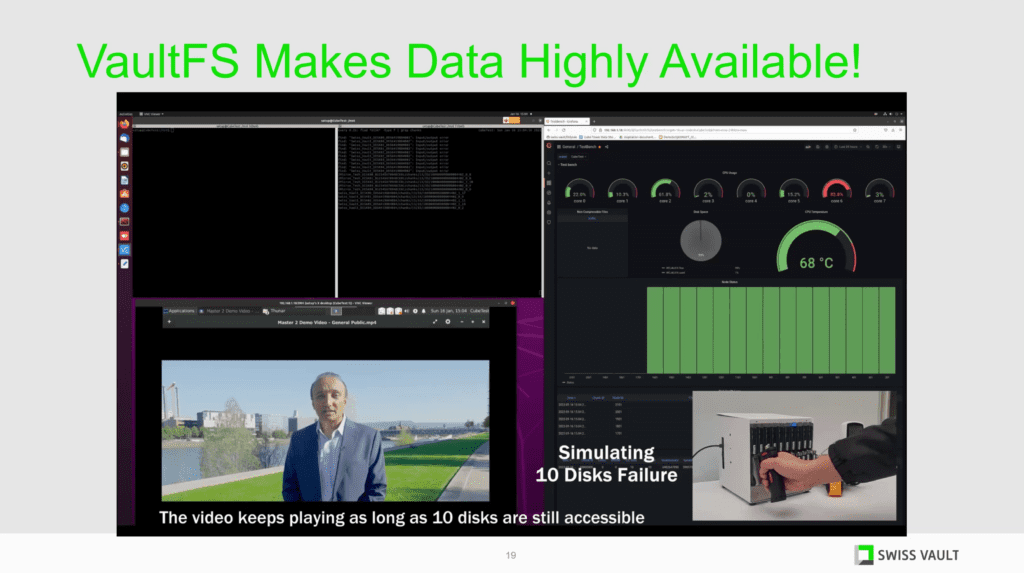
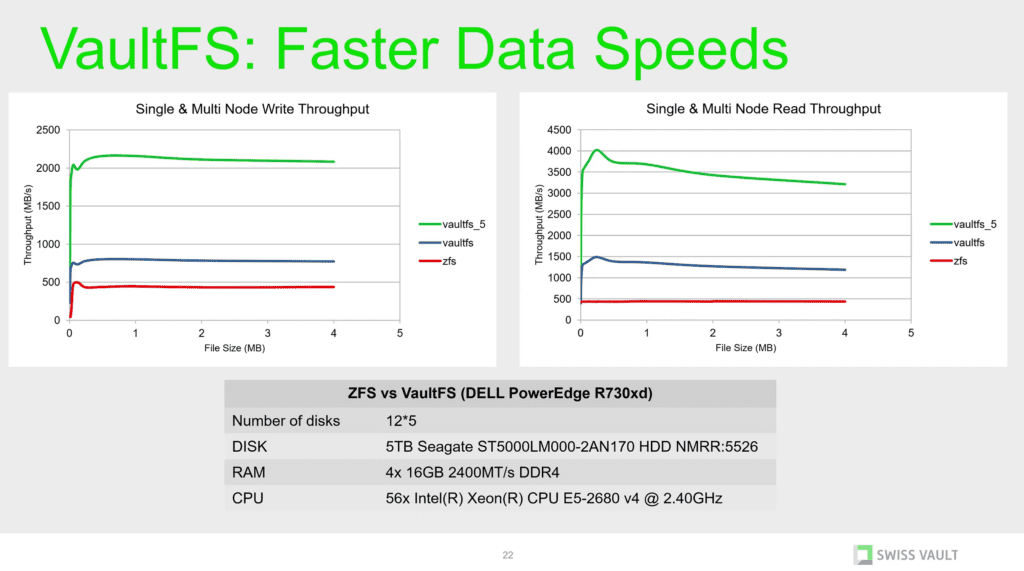
By using erasure coding, the VFS can fragment data into smaller pieces, ensuring high resiliency and faster data retrieval. Doug demonstrated this with a compelling video,(See Below) showing how their system could tolerate multiple disk failures without losing any data. This robustness is crucial for organizations dealing with large volumes of critical data.

Innovating Sustainable Data Storage with SwissVault
Real-World Applications and Benefits

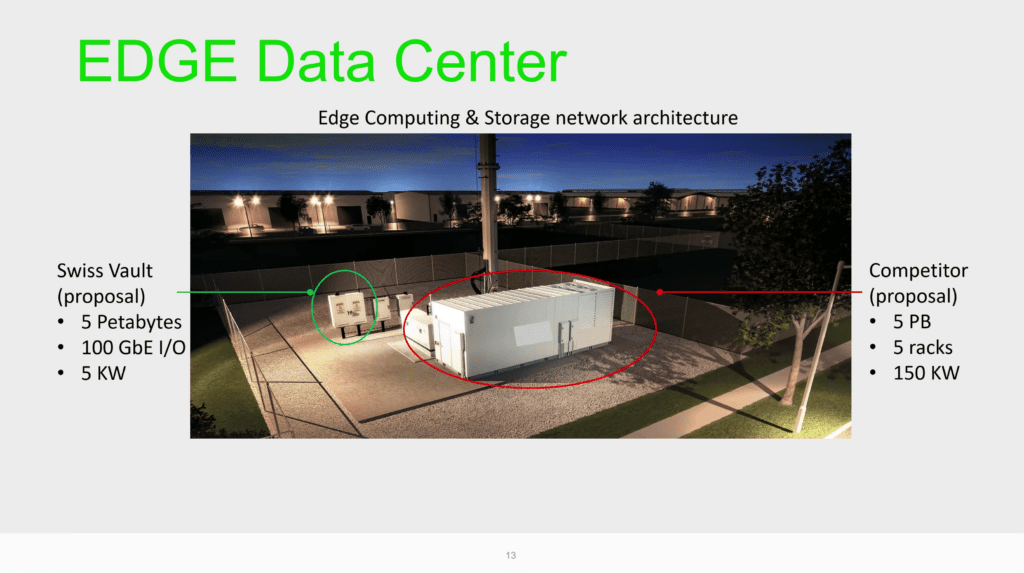
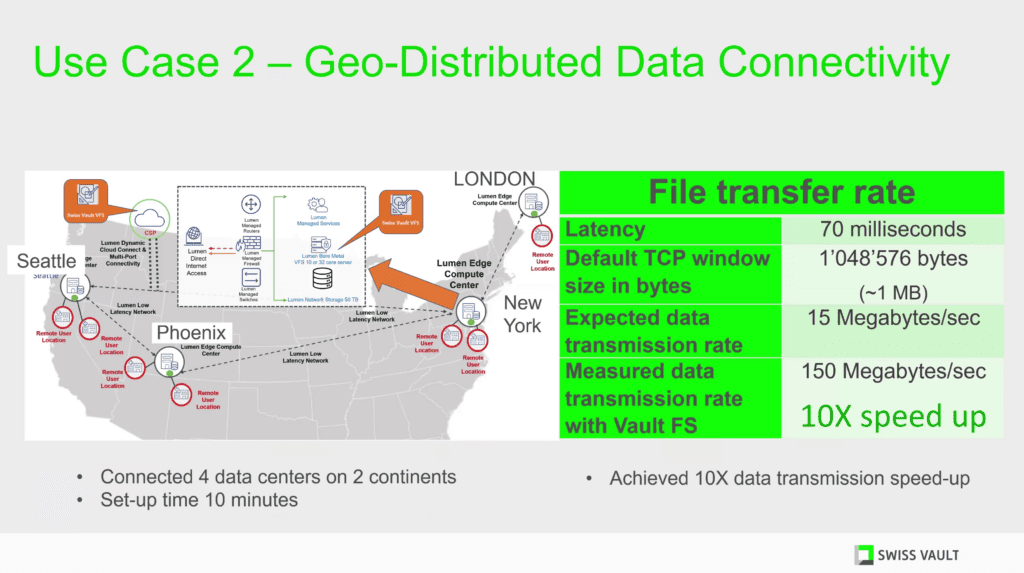
One of the most exciting aspects of the SwissVault system is its versatility. Bhupinder mentioned, “We’re pushing systems towards the edge where data is being created and consumed.” This means that SwissVault can support a wide range of applications, from urban centers to remote agricultural sensors, providing high-speed data access and reducing latency.

Innovating Sustainable Data Storage with SwissVault

Doug highlighted another significant advantage: “With our proprietary erasure coding, we can control the overhead and save energy.” This flexibility allows organizations to tailor their storage solutions to their specific needs, whether they’re dealing with small files or massive datasets.

Innovating Sustainable Data Storage with SwissVault
Interfacing and Integration

During the Q&A session, Patrick Stingley asked about the interfaces available for data input and output. Doug clarified that their system is highly adaptable: “Basically anything that Linux can handle… we do run it over 10G, 25G, and even InfiniBand at both 40G and 56G.” This ensures compatibility with a wide range of existing infrastructure, making it easier for organizations to adopt SwissVault’s technology.

Innovating Sustainable Data Storage with SwissVault

Security and Data Integrity

Data security is a paramount concern for any organization, and SwissVault doesn’t disappoint. Doug explained that their system supports extensive encryption options: “You can turn encryption on, and not only that, but we can layer encryptions with up to 256 different ones.” This robust approach to security ensures that data is protected both at rest and in transit.

Future Prospects and Open Collaboration

SwissVault is also committed to fostering collaboration and innovation. Bhupinder announced that they are offering their technology to universities and research centers for free. “If anyone knows any university or research center, please contact us,” he said. This initiative aims to support academic research and drive further advancements in data storage technology.

Conclusion

SwissVault’s innovative approach addresses some of the most pressing challenges in the industry, offering solutions that are both efficient and sustainable. Their technology not only reduces the environmental impact of data storage but also enhances performance and security, making it a win-win for organizations of all sizes. For anyone interested in exploring SwissVault’s capabilities, I highly recommend requesting a demo to see their system in action. As we continue to generate and rely on massive amounts of data, solutions like SwissVault will be essential in ensuring that our digital future is both sustainable and secure.

Join us as we continue to explore the cutting-edge of AI and data science with leading experts in the field.

Subscribe to the AI Think Tank Podcast on YouTube. Would you like to join the show as a live attendee and interact with guests? Contact Us

Data Science Hiring Process at AstraZeneca

With over 45 years of presence in India, British-Swedish pharmaceutical and biotechnology giant AstraZeneca has data science and AI capabilities deeply ingrained across its entire drug development lifecycle.

For the company, AI plays a pivotal role in accelerating target identification, drug discovery, clinical trials, and commercial analytics. AstraZeneca has implemented rigorous processes to ensure the responsible development and deployment of AI and ML solutions.

Internally built use cases, solutions, or tools undergo an AI governance maturity assessment before production deployment to ensure compliance with the company’s responsible AI development standards, aligning with their data ethics principles.

Teams from all business areas contribute to this process, fostering a collaborative approach to ensure AI is developed and deployed safely and responsibly.

AIM recently got in touch with Arun Maria, director of data and AI, R&D IT; Govind Cheramkalam, director of commercial reporting and analytics; and Anuradha Kumar, head HR of global innovation and technology centre, AstraZeneca, to understand more about the GCC’s AI operations, expansion opportunities, hiring process, work culture and more.

Inside AstraZeneca’s Data Science Labs

AstraZeneca is also active in leveraging generative AI, with use cases spanning research assistance, executive reporting, and competitive intelligence. For example, AZ ChatGPT, an AI-powered research assistant, uses the company’s extensive biology and chemistry knowledge repositories to answer complex questions and provide prompts on discovery and clinical inquiries.

“We are currently evaluating the capabilities of LLMs like AZ ChatGPT to improve insight generation for executive reports distributed to CXOs and decision-makers in brand and marketing companies,” Maria told AIM.

Another such example is the Biological Insight Knowledge Graph (BIKG), a proprietary model developed by AstraZeneca.

“It utilises the company’s exclusive machine learning models to serve as a recommendation system, enabling scientists to make efficient and informed decisions regarding target discovery and pipeline management. The primary goal of BIKG is to minimise attrition rates and improve clinical success,” Cheramkalam explained.

The company has an Enterprise Data and AI strategy unit, with data and AI teams embedded across business and IT functions, fostering a collaborative environment to ensure the provision of foundationally FAIR (Findable, Accessible, Interoperable, and Reusable) data at the source.

Data engineers, MLOps engineers, AI and ML engineers work as unified teams, promoting collaboration and accelerating business outcomes through structured learning and development programs that cultivate new skills internally.

“AstraZeneca uses a plethora of in-house and externally sourced tools, frameworks and products ranging across very proprietary in-house tools as well as Databricks and PowerBI,” said Maria.

The company uses Transformer and GPT models, including testing Microsoft’s Azure OpenAI Service with cutting-edge models like GPT-4 and GPT-3.5. To foster innovation and engagement, AstraZeneca follows a hybrid working model, promoting collaboration while offering flexibility.

Interview Process

AstraZeneca aims to become a data-led enterprise, integrating data into all aspects of its operations. To achieve this, the company seeks candidates with strong skills in Python, machine learning, deep learning, computer vision, and NLP, along with a mindset geared toward growth through innovation.

The interview process is designed to understand both the candidate’s suitability for the role and the company. “For all our roles we look for candidates that not only have the skills, knowledge, experience and competence but can also live our values and behaviour,” Kumar told AIM.

Apart from this, assessments at AZ focus on evaluating whether candidates will perform well in the position, demonstrate leadership potential, exhibit enthusiasm and motivation, and work collaboratively in a team.

Potential candidates should prepare by understanding these key areas and reflecting on their experiences and qualities that they can bring to the table.

What Candidates Should Expect

Joining AZ’s data science team offers opportunities to collaborate with diverse teams, tackle new challenges, and work with the latest technology. The environment supports development and innovation, with the ultimate goal of powering the business through science and market delivery.

“As a candidate, research our strategic objectives, core values, and the position you’ve applied for. Use our social media or website to learn about the organisation, team, and people. In the interview, be ready to discuss your past experiences and what you’ve learned from them,” said Kumar.

This will help in avoiding the common mistakes of a lack of preparation about the company and the specific role they are applying for.

Work Culture

AstraZeneca fosters a supportive and inclusive workplace where employees can learn and grow. New hires benefit from onboarding and buddy programs, while extensive training and career development opportunities are available for all.

The gender ratio in AstraZeneca India is approximately 64.6% male to 35.4% female.

The company was also recognised by AIM Media House in 2022 for its excellent work in AI and ML, thanks to its focus on putting patients first. It was once again recognised by AIM in 2024 for its data engineering excellence.

In the data science team, AstraZeneca encourages cross-disciplinary collaboration and lifelong learning through the 3Es framework: Experience, Exposure, and Education.

The company has a global peer-to-peer recognition system and offers comprehensive benefits, including medical insurance covering parents or parents-in-law, personal accident insurance, term life insurance, and childcare support for new parents.

If you think you are a good fit for the company, check out its career page here.

I Took the Google Data Analytics Certification Where 2,148,697 Have Already Enrolled

Google Data Analytics
Image by Author

If you’re like me and you’re already at an age where going back to university is not an option or you’re ready to transition careers but need guidance — you’ve landed on the right page. I was working full-time and had no option but to take a course that was flexible because I had to keep a roof over my head. University was completely out of the picture. I needed a course that allowed me to gain the skills and knowledge without having to compromise finances and too much time.

I stumbled across the Google’s Data Analytics Certification after I saw great reviews.

Work was a bit slow so I decided to give it a go whilst I wasn’t burnt out due to an overload at work.

What is Google’s Data Analytics Certification?

Link: Google’s Data Analytics Certification

Google's Data Analytics professional certification allows you to understand the practices and processes used by associate data analysts.

In this certification, you will learn key analytical skills, such as data cleaning, analysis, & visualization as well as tools such as SQL, R programming and Tableau. Through these skills, you will be able to understand how to clean and organize data for analysis, and complete analysis and calculations using spreadsheets, SQL and R programming.

By the end of the course, you will learn how to visualize and present data findings in dashboards, presentations and commonly used visualization platforms.

The course is aimed at beginners and can be completed in 6 months if you commit 10 hours a week. It is a flexible schedule — so you can learn at your own pace!

My Opinions on the Certification

Before taking the certification, I had already taken a BootCamp 2 years before. When I went into the tech industry and landed my first junior data scientist job I realized that there were elements of data science that the bootcamp didn’t teach me. I would go around and around in circles trying to figure it out before I realized I had to go back and truly study before continuing my data science journey.

So that is what I did. I decided to take Google's Data Analytics Certification and set myself to complete it in 2 months.

So the journey starts and the first thing I would like to say. The content — amazing! The process — smooth! The walkthrough — impeccable.

If you were like me and felt as if you needed a touch-up on your data analysis or data science learning or you’re new to the data world and you need guidance — this course did exactly that.

Yes, there is a lot of learning material but all of the material was imperative to the learning journey and helped in my understanding. After each section, multiple choice questions helped me understand each section rather than just a load of questions at the end of each module.

When it came to doing the end-of-section multiple choice and module tests — I was smashing it. Yes, my previous boot camp knowledge helped me here and there, but a few years out of the data science game — the content was a godsend to help me gain this certification.

So good that I have recommended it to a few family and friends who have no technical experience and have come back with great feedback saying the structure and process were beginner-friendly.

My overall opinion and feedback on the certification is that I would highly recommend it to those who are new to the tech industry due to its course structure but also for those who want to touch up on their existing knowledge to make sure they’ve really got it!

Remember, this certification is aimed at beginners which means your data science learning journey should not stop here. Continuously learning new skills and tools will help you become a successful data scientist!

Wrapping up

Everybody's learning process is different. Some may have taken the certification and preferred another way of learning. However, if you are someone who needs guidance and likes to take baby steps — this certification is highly recommended!

The team at KDnuggets wants to see everybody win and we hope we have helped your journey!

Nisha Arya is a data scientist, freelance technical writer, and an editor and community manager for KDnuggets. She is particularly interested in providing data science career advice or tutorials and theory-based knowledge around data science. Nisha covers a wide range of topics and wishes to explore the different ways artificial intelligence can benefit the longevity of human life. A keen learner, Nisha seeks to broaden her tech knowledge and writing skills, while helping guide others.

More On This Topic

  • Google Data Analytics Certification Review for 2023
  • Popular Google Certification for All Areas in the Tech Industry
  • Google Have Just Dropped a New Course: AI Essentials
  • How to Get Into Data Analytics If You Don't Have the Right Degree
  • Unstructured Data: The Must-Have For Analytics In 2022
  • Top Data Analyst Certification Courses for 2022

Milestone Systems Unveils Cloud-Based Video Surveillance System

Milestone Systems, a leading provider of data-driven video technology, has launched its first Experience Center in India, showcasing advanced video and sensor technologies across various industries. The company also introduced its new cloud-based Video Surveillance as a Service (VSaaS) software, Milestone Kite, which is compatible with over 25,000 devices and can be accessed globally.

Milestone Kite, the company’s new VSaaS offering, is highly scalable and well-suited for businesses with multiple locations and a small number of cameras at each site. The service is particularly beneficial for organisations with limited IT capabilities, bandwidth limitations, or premises where installing on-site gateway hardware is not feasible. Milestone Kite also incorporates value-added integrations, ranging from simple visitor tracking to AI-powered analytics.

Malou Toft, VP of Milestone Systems for APAC, expressed excitement about the Experience Center’s opening and the company’s commitment to becoming a trusted growth partner by offering advanced video technologies that enhance productivity and unlock capabilities such as data-driven business analytics, industrial automation, and real-time incident reporting.

The Experience Center, located in Bangalore, also provides an interactive space for visitors to explore cutting-edge applications of video technology in manufacturing automation, data centre security, and healthcare safety. The launch comes as India embarks on its “Viksit Bharat 2047” initiative, aiming to become a developed economy by its 100th year of independence in 2047.

Milestone Systems aims to support India’s economic development by focusing on key verticals such as automobile manufacturing, smart cities, critical infrastructure, and data centres. The company believes its technology can play a crucial role in enhancing public safety, improving infrastructure efficiency, and offering a more secure environment in locations such as schools and hospitals.

The Bangalore Experience Center is Milestone Systems’ third facility of its kind in Asia Pacific and marks the company’s latest move to expand its presence in the Indian market, following the opening of offices in Mumbai, Delhi, and Bangalore.

India Might Soon Run Out of Skilled Software Engineers

“I’m about to graduate with a CS degree and have never used a ‘library’, ‘framework’, or ‘API’.” This was the topic of a Reddit discussion, which soon saw hundreds of reactions pouring in from people who pointed at the sad state of CS degrees worldwide.

And though this may be a global phenomenon, the Indian youth has it far worse than their counterparts.

Unfortunately, this is not an isolated case, but a mere symptom of a larger issue plaguing the Indian education system. Despite holding degrees, many graduates here find themselves unprepared for the practical demands of the industry, making them less competitive on the global stage.

We’ve often heard that a large section of the Indian youth is basically willing to go abroad and study. “The hate for India scares me,” said a user on Reddit, starting a discussion about how soon, India wouldn’t be left with skilled young people. This, honestly, is kind of scary.

Another user on X pointed out that many Indian IT tech graduates are unemployable for any real time projects and responsibilities. “India IT talent is going down and Vietnam, Indonesia, Malaysia, and Philippines are taking up jobs as they have the hunger to succeed with hard work which India’s new college graduates don’t,” the user added.

Not Adequately Prepared for the World

According to a recent report, India barely has about 2000 senior software engineers. Once hailed as a global hub for IT talent, the country is now facing a potential crisis in the availability of skilled software engineers. The issue is not just about the numbers, but also the quality and aspirations of the youth.

The sentiment that education in India is not preparing students for real-world applications adequately is echoed widely.

A recent video by a Delhi-based coaching institute, Drishti IAS, was making rounds across social media platforms about a BCA graduate who had no idea about the programming languages to use. He had never built anything on any language, since he was never given any knowledge about it during his course, he said.

When they say youth is jobless, they mean this.. pic.twitter.com/RDvbieV7Bp

— Cabinet Minister, Ministry of Memes,🇮🇳 (@memenist_) June 12, 2024

On the other hand, universities like Stanford, Harvard, or any other major institutions in the US, offer a much more hands-on approach towards teaching, while also opening up major possibilities when it comes to jobs with great paychecks.

This disillusionment is driving many young Indians to seek education and career opportunities abroad, exacerbating the “brain drain” as many put it on social media. The comment underscores a growing trend: an increasing number of young Indians are keen to leave the country in search of better prospects.

The frustration among students is palpable. Many feel a sense of helplessness and disillusionment with the system. “Why are students more focused on going to America or Canada instead of making India better?” a user questioned. This sentiment points to a lack of faith in the country’s ability to provide the necessary opportunities and support for young talent.

The narratives on social media also highlight systemic issues that push students away. The lack of infrastructure is a recurrent theme. While there are several great institutions in India, such as IITs and NIITs, only a handful of top students are able to get into them. The rest, with big pockets, find it useful to study abroad and settle there.

The Change is Out There, But…

However, the future can look a little less bleak for Indian youth with the advent of AI. “India has never led any fundamental research, but we have a golden opportunity as AI can be a levelling field,” said Pratik Desai, the founder of KissanAI.

“However, this requires a fundamental shift from coaching and academia to a change in mindset from parents, and founders to investors.” The sad truth is that this is actually a standard for CS graduates in the country, unless they are from IITs.

AI has helped people code even without learning programming languages. GitHub CEO Thomas Dohmke and Microsoft CEO Satya Nadella recently claimed that now everyone can code in their natural language, which should ideally drop the barrier of entry for everyone in the country.

Turns out that it can also have the opposite effect. Since everyone is now basically becoming a developer, the demand for high-skilled software engineers is increasing. These are developers who think beyond using Copilot tools to make generic software. As a Reddit user pointed out, “Don’t be a generative software engineer.”

Though things are slowly changing. India is now seeing an increase in talent retention. In 2019, a majority of Indian AI researchers with undergraduate degrees sought opportunities abroad. However, by 2022, one-fifth of these researchers chose to work in India.

The numbers are still minuscule. There should be proper incentives for software engineers to stay and work in the country, before we go dangerously short on skilled minds.

AI and the Clean Energy Revolution

The world is currently experiencing two of the largest societal upheavals since the beginning of the Industrial Revolution. One is

Rick Stevens, Associate Laboratory Director and Argonne Distinguished Fellow
Credit: Argonne National Laboratory

the rapid improvement and implementation of artificial intelligence (AI) tools, while the other is the sprint toward clean energy deployment in the face of the global climate crisis.

Both of these technological changes will completely alter humanity’s trajectory. What’s more, their fates are intertwined.

Rick Stevens – the Associate Laboratory Director for Computing, Environment, and Life Sciences at Argonne National Laboratory – is one of the smart people who’s thinking deeply about how these two revolutions will interact. In fact, he co-authored Argonne’s AI for Energy report which discusses the lab’s current work as well as future aspirations for deploying AI tools during the clean energy revolution.

I was lucky enough to sit down with Stevens and discuss the report, as well as his musings on how AI could and should be deployed in the energy sector. While we couldn’t cover the entirety of the 70-page report’s contents, Stevens outlines some specific potential use cases of AI within energy as well as the challenges we’ll need to overcome.

A General Acceleration of Innovation

The report outlined five major areas within energy that AI could influence: nuclear energy, power grid, carbon management, energy storage, and energy materials. As we began our discussion, Stevens made a note that AI in energy should result in a “general acceleration of innovation.”

He initially mentioned nuclear reactors as a place where AI could accelerate certain necessary processes. The report itself stated that one of the largest obstacles to advanced nuclear reactors in the U.S. is a “slow, expensive, and convoluted regulatory process.” This is a task that is perfectly suited for AI.

“On the nuclear reactor front, one of the biggest targets for that community right now is trying to streamline licensing and helping to build reactors on a timeline within the budget,” Stevens said in our interview. “This is, of course, a huge problem for these projects.”

Staying within a timeline and a budget for nuclear reactors is challenging, as obtaining a construction permit and operating license for a new reactor in the U.S. can drag on for more than five years and can sometimes take decades. The report mentioned that multi-modal LLMs could help accelerate this process.

By training on datasets of scientific literature, technical documents, and operational data, these LLMs can help to streamline and expedite the nuclear regulatory licensing and compliance process. In a sense, these LLMs could act as virtual subject matter experts to help guide humans through the complicated regulatory process. On top of nuclear reactors, Steven’s mentions that the same sort of foundation model could help with the licensing process for renewable energies like wind or solar.

This is an overarching strategy that will apply to all scientific endeavors, not just energy. Steven’s mentioned the Frontiers in Artificial Intelligence for Science, Security, and Technology (FASST) initiative from the Department of Energy. Among other goals, this federal mandate is pushing to build capable foundation models that are experts in specific domains.

“The strategy that we've been working on in the FASST initiative is to build a handful of very capable foundation models,” Stevens said. “Think of them like ChatGPT but they are experts in some specific domain. You might imagine an expert model in the grid that knows everything about how grids work. The grid dynamics, the regulatory issues, the structural issues, the technical issues, the geopolitical issues — everything that humanity knows about building power grids, you could imagine a model that has all of that knowledge.”

With such potential for acceleration from AI, it will also be important to consider why we want to accelerate certain scientific fields. For instance, Stevens mentions drug development and how the success of these projects is literally a matter of life and death.

“You have a real motivation for trying to go faster, but you also want to go better,” Stevens said. “I think we need to help people understand that when we talk about accelerating science, we’re not just trying to turn the crank faster. We’re trying to build a better crank.”

This discussion will be especially relevant as we address the energy infrastructure issues that lead us to the current climate crisis. The worst-case predictions for climate change will lead to mass migration, famine, and water shortages. While it’s not a silver bullet solution, using AI tools to assist in the clean energy transition is of the utmost importance.

New Ways to Do Energy Science

As AI tools are relatively new – or at least many of their current capabilities are – implementing these solutions will require innovative ways of thinking. Stevens mentions the Stormer project as one area of AI with versatile use cases. This is a weather-specific vision transformer that can predict the global atmosphere 14 days into the future and is as accurate or sometimes more accurate than current partial differential equation prediction methods.

“(Stormer is) orders of magnitude faster (than current solutions), which means you can get a 10-day forecast in a few minutes,” Stevens said. “If you think about the application of that in the context of energy – say you’re running a wind farm and you’re trying to do capacity planning or plan maintenance. You’ll know what you have to anticipate.”

AI-based weather prediction tools will be important as we transition to clean energy solutions like wind power.

Stevens continued: “So far, that's my favorite application because a large part of energy production and market-based pricing and where power is coming from in the grid is a prediction problem that tries to link up supply and demand. If we can get better models that can allow us to predict the factors that are affecting supply and demand, that means we can run at a higher efficiency. We can reduce cost and we can also help the market price better.”

On top of applying these AI tools in innovative ways, scientists in the energy space will also have to rethink how we do science. Stevens mentioned how the application of AI systems may benefit by operating under what he calls an inverse design.

Stevens stated that science currently proceeds by scientists thinking about something and making a hypothesis. In essence, the scientist guesses as to what they think might be correct and then they do experiments to test that guess.

While that process works wonderfully for humans, the implementation of AI tools might take a different path.

“If an AI can learn an entire domain deeply and it can reason about a specific material, then you can turn the whole process upside down,” Stevens said. “You can say 'look I want a material that behaves like this – I shine a light on it and it turns purple.’ Rather than having to work forward through thousands of candidates and trying to search for things that turn purple as opposed to green, the system would operate under an inverse design. It might say ‘here's the thing that makes purple when you shine light on it. This idea that you’re directly going to a solution is this idea of inverse design.”

Stevens is using an easy-to-understand example here with the purple-green distinction, but it isn’t hard to see how such an inverse design would be radically advantageous for scientists working on discovering new energy materials.

Pro-Science, But Never Anti-Human

It’s impossible to discuss AI innovations without also addressing the common fear that these tools will replace people. In Stevens’ mind, nothing could be further from the truth when it comes to integrating AI into the clean energy transition. When asked how we can safely apply AI tools to domains that demand success like nuclear reactors, he had quite a pithy response:

“Well, humans also sometimes get things wrong, and that is really important,” Stevens said. “We need to understand how things currently fail. Not just how AI fails, but how do complex systems where people are already making decisions fail?”

Both humans and Ai systems are prone to making mistakes. The right idea isn't to never make a mistake, its to plan for mistakes and mitigate them.

We already operate in a world of human imperfection. As such, we embed checks and balances within our many complicated systems to catch humans who may be incorrect, incompetent, or malicious. Steven’s stated that we’ll have to do much of the same for AI and he mentioned a clarifying metaphor.

“Imagine you have somebody who can hit a lot of home runs, but they also strike out a lot,” Stevens said. “The question is how do you minimize the strikeouts while maximizing the home runs? More specifically for AI, can we build AI systems that have more awareness of their own mistakes?”

Stevens mentioned that there’s a technical term for this within AI called uncertainty quantification. This is where users want the AI to output a result, but they also want it to estimate how likely it is that the result is correct.

In a perfect world, this would allow us to tell the AI to only relay information to us that is correct – but we don’t live in a perfect world. Stevens stated that solving the problem of determining the validity of what a model is outputting is a huge area of research.

To solve problems like this at a larger scale, the report mentions that “laboratories must establish a leadership computing ecosystem to train and host data and foundation models at ever-increasing scales.” To Stevens, a “leadership computing ecosystem” would have several components.

“One aspect is that they train a big foundation model,” Stevens said. “These take many months on exascale-class machines. We would need to have essentially dedicated multi-access scale class hardware at the heart of the ecosystem for training. That’s what FASST is building out with even larger machines, heading towards this 100,000 AI exaflop class devices.

On top of these centralized machines, Stevens also mentions that this leadership computing ecosystem would also need to focus on edge devices.

He mentions a scenario where someone is monitoring a real-time system like a generator, the grid, or some other complex energy system. They would need sensors flowing into the model for inference, and they might also have a parallel simulator digital twin running in parallel. In such a scenario, the big machine would be used for the heavy lifting concerning these foundation models, but there will also be coordinated sensors and other devices on the edge to collect data.

As scientists build these foundation models, the pipelines of clean data being fed in will require fine-tuning of models as well as alignment. Stevens states that one might think of this as a layered process with the integration of many different kinds of facilities. He calls this an “integrated research infrastructure.”

“The concept is to tie the facilities together with high-speed networking, common APIs, common data interfaces, and control interfaces, so AI can read data directly from these facilities,” Stevens said. “If you were in a scenario where it makes sense to control them with AI, you would have a control interface. And you would tie all of that together with these inference engines.”

On top of this, a leadership computing ecosystem wouldn’t just share resources – it would also create a structured foundation on which to build new knowledge. AI tools are capable of thinking in ways that humans cannot, and this can often lead to exciting discoveries.

During our interview, we mentioned a research project where a surrogate model was trained on basic quantum mechanical results. Eventually, the model began to form salt crystals that it was not directly told about. While this is interesting in its own right, Stevens thinks we can take it a step further.

“If I integrate what we know about some domain, the model can synthesize that and make reasonable predictions like with these salt crystals – but we already knew about salt crystals,” Stevens said. “The question is whether it can make predictions about phenomenon that we don’t know about.”

This is exactly why AI will be a vital tool in the clean energy revolution. We have been using fossil fuels and legacy energy systems for so long that shifting gears will require new ways of thinking. While humans will obviously play a role in this shift, AI is capable of bringing about the new and innovative ideas that will help us stave off the worst effects of the climate crisis.

The integration of AI into the energy sector represents a pivotal moment in human history, where technological advancement intersects with the urgent need for sustainable energy solutions. As we navigate this transformative journey, it will be important to remember that AI should complement human expertise and be guided by ethical considerations.

Bill Gates Advises Indians to Build AI Models on Google, Microsoft and OpenAI

In a recent episode of Nikhil Kamath’s podcast, Bill Gates spoke all about AI and its equation in India for entrepreneurs. “I’d probably build some AI thing and just use the Google Microsoft platforms and go on top of that and try,” he said, suggesting young entrepreneurs to use established AI platforms to build applications on top of them.

Gates highlighted that by using these robust AI platforms, Indian entrepreneurs can focus more on developing specific applications rather than spending significant resources on creating the foundational AI technology themselves.

Solves Compute, Fosters Collaboration

Considering how developing foundational AI models from scratch requires immense capital and technical expertise, Gates suggested that by leveraging existing platforms, entrepreneurs can bypass these hurdles, making their ventures more resource-efficient.

Gates also believes that integrating with AI platforms from major tech companies can lead to valuable collaborations and growth opportunities. These tech giants often have programs and networks that support startups, providing mentorship and potential funding.

However, when asked about the timeline for achieving AGI, Gates seemed to smartly answer the question without revealing anything. He instead spoke about productivity benefits about AI.

AGI is Productivity?

When asked about a timeline for AGI, Gates spoke about productivity improved with AI. Gates pointed out that AI, even in its current state, is already driving significant productivity gains by automating repetitive and time-consuming tasks. He suggested that as AI technology evolves, these gains will only increase.

A Youtube user said, “He [Gates] was not willing to reveal the secrets of AGI and future technology prospects to Indians. So he was beating around the bush throughout the conversation.”

Gates might have not given anything conclusive about AGI, however other tech leaders such as Elon Musk predict AGI sooner than ever. He even predicted a short timespan of two years, or possibly even one, for achieving the same.

AGI is Here?

In AIM’s recent interaction with GitHub CEO, Thomas Dohmke said, “Today I see no sign that machine learning models or LLMs have sentience. They are not creative. They are machines created by us that help us with the things that we want to do or don’t want to do.”

Dohmke highlighted how people have a different understanding of AGI, and even doesn’t understand what the ‘G’ in AGI truly stands for. Resonating a similar thought, NVIDIA chief Jensen Huang believes that in five years, we would be able to hit AGI, but it becomes important to define AGI.

A Tour of Python NLP Libraries

A Tour of Python NLP Libraries
Image Generated with DALL·E 3

NLP, or Natural Language Processing, is a field within Artificial Intelligence that focuses on the interaction between human language and computers. It tries to explore and apply text data so computers can understand the text meaningfully.

As the NLP field research progresses, how we process text data in computers has evolved. Modern times, we have used Python to help explore and process data easily.

With Python becoming the go-to language for exploring text data, many libraries have been developed specifically for the NLP field. In this article, we will explore various incredible and useful NLP libraries.

So, let’s get into it.

NLTK

NLTK, or Natural Language Tool Kit, is an NLP Python library with many text-processing APIs and industrial-grade wrappers. It’s one of the biggest NLP Python libraries used by researchers, data scientists, engineers, and others. It’s a standard NLP Python library for NLP tasks.

Let’s try to explore what NLTK could do. First, we would need to install the library with the following code.

pip install -U nltk  

Next, we would see what NLTK could do. First, NLTK can perform the tokenization process using the following code:

import nltk from nltk.tokenize  import word_tokenize    # Download the necessary resources  nltk.download('punkt')    text = "The fruit in the table is a banana"  tokens = word_tokenize(text)    print(tokens)  
Output>>   ['The', 'fruit', 'in', 'the', 'table', 'is', 'a', 'banana']  

Tokenization basically would divide each word in a sentence into individual data.

With NLTK, we can also perform Part-of-Speech (POS) Tags on the text sample.

from nltk.tag import pos_tag    nltk.download('averaged_perceptron_tagger')    text = "The fruit in the table is a banana"  pos_tags = pos_tag(tokens)    print(pos_tags)  
Output>>  [('The', 'DT'), ('fruit', 'NN'), ('in', 'IN'), ('the', 'DT'), ('table', 'NN'), ('is', 'VBZ'), ('a', 'DT'), ('banana', 'NN')]  

The output of the POS tagger with NLTK is each token and its intended POS tags. For example, the word Fruit is Noun (NN), and the word ‘a’ is Determinant (DT).

It’s also possible to perform Stemming and Lemmatization with NLTK. Stemming is reducing a word to its base form by cutting its prefixes and suffixes, while Lemmatization also transforms to the base form by considering the words' POS and morphological analysis.

from nltk.stem import PorterStemmer, WordNetLemmatizer  nltk.download('wordnet')  nltk.download('punkt')    text = "The striped bats are hanging on their feet for best"  tokens = word_tokenize(text)    # Stemming  stemmer = PorterStemmer()  stems = [stemmer.stem(token) for token in tokens]  print("Stems:", stems)    # Lemmatization  lemmatizer = WordNetLemmatizer()  lemmas = [lemmatizer.lemmatize(token) for token in tokens]  print("Lemmas:", lemmas)  
Output>>   Stems: ['the', 'stripe', 'bat', 'are', 'hang', 'on', 'their', 'feet', 'for', 'best']  Lemmas: ['The', 'striped', 'bat', 'are', 'hanging', 'on', 'their', 'foot', 'for', 'best']  

You can see that the stemming and lentmatization processes have slightly different results from the words.

That’s the simple usage of NLTK. You can still do many things with them, but the above APIs are the most commonly used.

SpaCy

SpaCy is an NLP Python library that is designed specifically for production use. It’s an advanced library, and SpaCy is known for its performance and ability to handle large amounts of text data. It’s a preferable library for industry use in many NLP cases.

To install SpaCy, you can look at their usage page. Depending on your requirements, there are many combinations to choose from.

Let’s try using SpaCy for the NLP task. First, we would try performing Named Entity Recognition (NER) with the library. NER is a process of identifying and classifying named entities in text into predefined categories, such as person, address, location, and more.

import spacy    nlp = spacy.load("en_core_web_sm")    text = "Brad is working in the U.K. Startup called AIForLife for 7 Months."  doc = nlp(text)  #Perform the NER  for ent in doc.ents:      print(ent.text, ent.label_)  
Output>>  Brad PERSON  the U.K. Startup ORG  7 Months DATE  

As you can see, the SpaCy pre-trained model understands which word within the document can be classified.

Next, we can use SpaCy to perform Dependency Parsing and visualize them. Dependency Parsing is a process of understanding how each word relates to the other by forming a tree structure.

import spacy  from spacy import displacy    nlp = spacy.load("en_core_web_sm")    text = "SpaCy excels at dependency parsing."  doc = nlp(text)  for token in doc:      print(f"{token.text}: {token.dep_}, {token.head.text}")    displacy.render(doc, jupyter=True)  
Output>>   Brad: nsubj, working  is: aux, working  working: ROOT, working  in: prep, working  the: det, Startup  U.K.: compound, Startup  Startup: pobj, in  called: advcl, working  AIForLife: oprd, called  for: prep, called  7: nummod, Months  Months: pobj, for  .: punct, working  

The output should include all the words with their POS and where they are related. The code above would also provide tree visualization in your Jupyter Notebook.

Lastly, let’s try performing text similarity with SpaCy. Text similarity measures how similar or related two pieces of text are. It has many techniques and measurements, but we will try the simplest one.

import spacy    nlp = spacy.load("en_core_web_sm")    doc1 = nlp("I like pizza")  doc2 = nlp("I love hamburger")    # Calculate similarity  similarity = doc1.similarity(doc2)  print("Similarity:", similarity)  
Output>>  Similarity: 0.6159097609586724  

The similarity measure measures the similarity between texts by providing an output score, usually between 0 and 1. The closer the score is to 1, the more similar both texts are.

There are still many things you can do with SpaCy. Explore the documentation to find something useful for your work.

TextBlob

TextBlob is an NLP Python library for processing textual data built on top of NLTK. It simplifies many of NLTK's usage and can streamline text processing tasks.

You can install TextBlob using the following code:

pip install -U textblob  python -m textblob.download_corpora  

First, let’s try to use TextBlob for NLP tasks. The first one we would try is to do sentiment analysis with TextBlob. We can do that with the code below.

from textblob import TextBlob    text = "I am in the top of the world"  blob = TextBlob(text)  sentiment = blob.sentiment    print(sentiment)  
Output>>  Sentiment(polarity=0.5, subjectivity=0.5)  

The output is a polarity and subjectivity score. Polarity is the sentiment of the text where the score ranges from -1 (negative) to 1 (positive). At the same time, the subjectivity score ranges from 0 (objective) to 1 (subjective).

We can also use TextBlob for text correction tasks. You can do that with the following code.

from textblob import TextBlob    text = "I havv goood speling."  blob = TextBlob(text)    # Spelling Correction  corrected_blob = blob.correct()  print("Corrected Text:", corrected_blob)  
Output>>  Corrected Text: I have good spelling.  

Try to explore the TextBlob packages to find the APIs for your text tasks.

Gensim

Gensim is an open-source Python NLP library specializing in topic modeling and document similarity analysis, especially for big and streaming data. It focuses more on industrial real-time applications.

Let’s try the library. First, we can install them using the following code:

pip install gensim  

After the installation is finished, we can try the Gensim capability. Let’s try to do topic modeling with LDA using Gensim.

import gensim  from gensim import corpora  from gensim.models import LdaModel    # Sample documents  documents = [      "Tennis is my favorite sport to play.",      "Football is a popular competition in certain country.",      "There are many athletes currently training for the olympic."  ]    # Preprocess documents  texts = [[word for word in document.lower().split()] for document in documents]    dictionary = corpora.Dictionary(texts)  corpus = [dictionary.doc2bow(text) for text in texts]      #The LDA model  lda_model = LdaModel(corpus, num_topics=2, id2word=dictionary, passes=15)    topics = lda_model.print_topics()  for topic in topics:      print(topic)  
Output>>  (0, '0.073*"there" + 0.073*"currently" + 0.073*"olympic." + 0.073*"the" + 0.073*"athletes" + 0.073*"for" + 0.073*"training" + 0.073*"many" + 0.073*"are" + 0.025*"is"')  (1, '0.094*"is" + 0.057*"football" + 0.057*"certain" + 0.057*"popular" + 0.057*"a" + 0.057*"competition" + 0.057*"country." + 0.057*"in" + 0.057*"favorite" + 0.057*"tennis"')  

The output is a combination of words from the document samples that cohesively become a topic. You can evaluate whether the result makes sense or not.

Gensim also provides a way for users to embed content. For example, we use Word2Vec to create embedding from words.

import gensim  from gensim.models import Word2Vec    # Sample sentences  sentences = [      ['machine', 'learning'],      ['deep', 'learning', 'models'],      ['natural', 'language', 'processing']  ]    # Train Word2Vec model  model = Word2Vec(sentences, vector_size=20, window=5, min_count=1, workers=4)    vector = model.wv['machine']  print(vector)  
  Output>>  [ 0.01174188 -0.02259516  0.04194366 -0.04929082  0.0338232   0.01457208   -0.02466416  0.02199094 -0.00869787  0.03355692  0.04982425 -0.02181222   -0.00299669 -0.02847819  0.01925411  0.01393313  0.03445538  0.03050548    0.04769249  0.04636709]  

There are still many applications you can use with Gensim. Try to see the documentation and evaluate your needs.

Conclusion

In this article, we explored several Python NLP libraries essential for many text tasks. All of these libraries would be useful for your work, from Text Tokenization to Word Embedding. The libraries we are discussing are:

  1. NLTK
  2. SpaCy
  3. TextBlob
  4. Gensim

I hope it helps

Cornellius Yudha Wijaya is a data science assistant manager and data writer. While working full-time at Allianz Indonesia, he loves to share Python and data tips via social media and writing media. Cornellius writes on a variety of AI and machine learning topics.

More On This Topic

  • Top 38 Python Libraries for Data Science, Data Visualization &…
  • Python Libraries Data Scientists Should Know in 2022
  • Explainable AI: 10 Python Libraries for Demystifying Your Model's Decisions
  • Introduction to Python Libraries for Data Cleaning
  • Beyond Numpy and Pandas: Unlocking the Potential of Lesser-Known…
  • Level 50 Data Scientist: Python Libraries to Know