Databricks VP of GenAI recently praised Sam Altman for turning OpenAI into a profitable product company.
Contrarian view: @sama is actually doing the right things with Open AI. He has the impossible job of taking an ideologically driven research group and trying to make it into a product company. Goals aside, if he didn't do this, investment would stop. Arguably, some of this issue…
— Naveen Rao (@NaveenGRao) June 24, 2024
“Contrarian view: Sam is actually doing the right things with Open AI. He has the impossible job of taking an ideologically driven research group and trying to make it into a product company. Goals aside, if he didn’t do this, investment would stop,” he posted on X.
“See, this is the issue…everyone is angry about the fact it was “open” AI. The problem is, that wasn’t going to sustain. It had to become a product company at some point to survive,” he added.
Altman recently told some shareholders that the company is considering changing its governance structure to a for-profit business that the firm’s nonprofit board doesn’t control. One scenario Altman said the board is considering is a for-profit benefit corporation, which rivals such as Anthropic and xAI are using.
OpenAI has more than doubled its annualised revenue to $3.4 billion in the past six months or so, Altman has told staff, a sign that growth in the ChatGPT developer’s business is accelerating despite intensifying competition.
Databricks recently hosted its Data+ AI Summit 2024. The company announced a host of new generative AI capabilities and a major push to its open-source strategy
The new offerings, such as Mosaic AI Model Training, Mosaic AI for RAG, and Mosaic AI Gateway, in addition to open-sourcing their Unity Catalog, aim to help enterprises build high-quality, domain-specific AI applications.
“We want to help people get the best quality possible in their domain for their GenAI application,” said CTO and co-founder Matei Zaharia in an exclusive interview with AIM. “And to do that, we see a lot of companies are building what we call compound AI systems.”
The compound AI systems involve multiple components, such as calls to different models, retrieval of relevant data, use of external APIs and databases, and breaking problems into smaller steps.
At the same time, Databricks is also focusing on open-source models. Last year, Databricks acquired Mosaic ML, and earlier this year, the company released its first open-source model, DBRX. “DBRX was the best model in the world for two whole weeks, and thank you, Mark Zuckerberg, for releasing that model two weeks later,” said Databricks chief Ali Ghodsi, jokingly, about the release of Llama 3.
The post Databricks’ Naveen Rao Praises Sam Altman for Making OpenAI a Product Company appeared first on AIM.
Microsoft AI chief Mustafa Suleyman said that it won’t be until GPT-6 in 2 years time that AI models will be able to follow instructions and take consistent action.
“I think that it’s going to require not just one but two orders of magnitude more computation to train the models. So, we’re not looking at GPT-5 but more like GPT-6 scale models. I believe we’re talking about two years before we have systems that can truly take action,’ said Suleyman in a recent podcast.
He added that predicting actions is no different from predicting the next token of words. Citing an example, he explained that the model would be able to take multiple actions. He said that the model could make restaurant bookings for dinner by checking availability, consulting the calendar, and entering credit card details.
“When asking a model to complete a sequence of actions, like booking a restaurant, there are three key steps: checking availability in both calendars, ensuring the restaurant has availability, and signing in to book with credit card details,” he said.
He further explained that the sequence of actions should be in the right order. “The model has to produce a perfect function call for each element and do so in sequence; it can’t be arbitrary. It’s like writing a four-page document in response to one question and that document must be exactly right, not approximate,” he said
He added that it’s necessary for the models to call APIs with 99% accuracy. “The question is can it do it with 99% accuracy because if it does it 80% then you know one in five times it is getting it wrong it’s not usable for a consumer,” he said.
Further, he added that humans are on the path to autonomous AI agents, about which he is a little skeptical and worried. “We’re on a path towards fully autonomous, and I think that’s actually quite undesirable. I think fully autonomous is quite dangerous, and you know I got a lot of stick after my TED talk because I said that the autonomous capability was dangerous and so on, and that’s one that should be regulated,” he said.
OpenAI CTO Mira Murati said in an interview that the next generation of GPT will be ‘PhD-level’ compared to GPT-3 (toddler) and GPT-4 (high school). She also said the next model will be released in a year and a half.
In March Suleyman, former co-founder and head of DeepMind and Inflection AI, was appointed as the CEO of Microsoft AI. He leads the consumer AI products which includes Copilot, Bing, and Edge at Microsoft.
Zoom CEO Eric Yuan recently shared an innovative vision of an AI clone that can attend office meetings on your behalf. According to Yuan, leveraging AI’s power in video conferencing can reduce the time spent in meetings.
“I can send a digital version of myself to join the meeting, freeing me up to hit the beach,” Yuan shared with The Verge.
“There’s no need for five or six Zoom calls a day when AI can take care of that for you,” he added.
Zoom has already launched Zoom Workplace, an AI-powered collaboration platform designed to enhance teamwork and productivity. The platform offers 40 new features like updates to Zoom AI Companion for Zoom Phone, Team Chat, Events, Contact Center, and the Ask AI Companion feature.
Speaking of AI Companion, it is a generative AI assistant seamlessly integrated across its platform. It boosts productivity, fosters better connections and collaboration among team members, and aids users in improving their skills.
Importantly, Zoom has emphasised its commitment to responsible AI. According to the video communications platform, they ensure that none of your audio, video, chat, screen sharing, attachments, or other communication-like customer content will be used to train Zoom’s or third-party AI models.
Users Raise Questions
Earlier in 2022, a similar project was presented on Shark Tank US. AI productivity platform Beulr enables a person to be at two places simultaneously. American businessman Mark Cuban commented on the model, saying, “If you want to succeed in this space, you must have a deep understanding of AI.”
As expected, the shift from AI co-pilots towards AI ‘autopilots’ has raised some concerns. Leaders like Henry Ajder, founder of Latent Space have questioned whether an AI avatar can truly make decisions “as you” and how such avatars would handle the vast array of personal data needed to act authentically in various contexts.
There’s also scepticism about how colleagues would interact with these avatars in a way that maintains continuity with real human interactions.
One user commented on X, “Creating clones that attend meetings for you will cause people to stop having meetings, thereby rendering these clones useless. Meetings should be there to get input from your expertise. Your clone can’t do that. And if it can, they don’t need you, do they?”
Also, now the usage of video messaging platforms is declining. Atlassian’s recent acquisition of video messaging firm Loom for $975 million, a significant drop from its 2021 valuation of $ 1.5 billion, highlights the market trend.
Once experiencing a pandemic-driven boom with app usage soaring to 21 times pre-COVID levels, video conferencing platforms are now losing their appeal.
What Others are Doing?
The launch of the Apple Vision Pro (AVP) this year has once again changed the way we communicate and how media integrates into our interactions. Some believe AVP is the first hardware to seamlessly merge the physical and digital worlds for both entertainment and practical purposes.
The AVP and similar devices are set to profoundly impact our communication, enabling 3D video calls, playback of real-life “memories”, and the sharing of immersive experiences.
Further, leaders including OpenAI CEO Sam Altman and Microsoft’s Satya Nadella, are of the view that AI systems could replace “senior employees” and “project managers”.
At Google I/O, the AI Teammate, powered by Gemini, was unveiled with the promise of alleviating workloads by automating routine tasks and facilitating team communications. Integrated into Gmail’s mobile app, Gemini for Workspace streamlines email management through summarisation and Contextual Smart Reply suggestions.
ChatGPT’s desktop app, available to both free and paid users, offers seamless integration into users’ workflow, further exemplifying the trend of AI co-pilots enhancing productivity across different platforms and applications.
In 2023, Meta announced a new feature allowing users to use their avatars for answering and making video calls on Instagram and Messenger. According to the company, this functionality enables users to participate in video calls even when they’re not camera-ready.
The result is an animated video call where you can interact without actually seeing each other.
What’s Next?
As tech giants roll out AI features for the workplace, startups are also joining the race. A UK-based startup Artisan AI is on a mission to create advanced human-like digital workers called Artisans.
So far, they have released Ava, a sales representative for Artisan. Ava operates as a business development representative (BDR) who streamlines the entire outbound sales process, requiring only a brief 10-minute conversation for setup.
Well, in today’s rapidly evolving landscape, AI’s ability to understand emotions is emerging as a powerful asset rather than a cause of concern. Despite initial reservations regarding privacy, these AI systems can significantly enhance employee well-being.
At the recently held World Tour Essentials event in Mumbai, Salesforce, the leading CRM software provider, announced its entry into the public sector domain.
In a press conference, Salesforce India CEO and Chairperson Arundhati Bhattacharya shared the company’s desire to bring its cloud and AI solutions to the government to help them deliver better citizen services to India’s populace.
Bhattacharya revealed that the company has formed a new division focusing on selling its solution to the Union government, the state governments, and Quasi-government agencies.
Under Bhattacharya, who was the first woman to be the Chairperson of the State Bank of India (SBI), Salesforce has grown significantly, recording a 50% revenue jump to INR 6,000 crore in FY 2023. The company’s employee count has also increased from around 2500 to over 10,000 in the country.
Given Salesforce India’s above-average performance, venturing into the public sector seems the next logical step. Nonetheless, announcing the public sector division was the easier part. The biggest test for Salesforce remains convincing the government to leverage its solutions.
( Salesforce press conference held in Jio World Convention Centre, Mumbai)
Government’s Appetite for Public Cloud
In an exclusive interview with AIM at the sidelines of the World Tour Essentials event, Bhattacharya said that Salesforce’s biggest challenge is that the majority of its critical services are on the cloud.
“We do have some on-prem solutions, such as the integration layer in Mulesoft or the graphic analytics layer in Tableau. But other than that, much of our solutions are cloud-based. We need to find out what is the appetite of the government in order to use the public cloud,” she said.
While major government agencies and departments are in dire need of digital transformation, the government has shown an appetite to leverage the cloud and has formed the National Cloud Initiative of India. The initiative, called Meghraj, aims to host various government applications and services on the cloud.
Moreover, the Ministry of Electronic and Information Technology (MeitY) has provided Cloud Service Provider (CSP) empanelment to public cloud companies like AWS. Notably, Salesforce leverages AWS’ cloud infrastructure.
Even though the company refrained from revealing much about this new division, Bhattacharya did say that it is still in its nascent stage and could take a couple of years before we see any possible outcomes. She also said that Salesforce has initiated talks with a few parties.
“The other thing, of course, is that we have to learn how to participate and respond to a request for proposals (RFPs) on time. These documents are often extensive and detailed, requiring a learning curve to understand the response process, which also involves collaborating with partners,” Bhattacharya said.
Data Cloud Could be a Seller for Salesforce
One of the biggest hindrances for many organisations is that most of the data is in silos, and this is even true for many government organisations.
Bringing scattered data together into a cohesive source and deriving meaningful insights remains a significant challenge. This is where Salesforce’s Data Cloud could prove to be a valuable tool when it tries to woo the government.
“Data Cloud isn’t something you need ages and ages to build. We have customers that have actually done it in the span of just 90 days and these are not small customers. These are large-scale customers, nothing in the scale of the government, but definitely large scale.
“When you leverage Data Cloud, it’s something where you are not really storing any data; you are merely getting intelligence from the pools of data that you already have and presenting it in real-time. That’s what it does and that’s something the government could possibly use or be interested in using,” she said.
Data Cloud is one of the fastest, if not the fastest growing, organic innovation to come out of Salesforce. In fact, the company is projected to make half a billion dollars in revenue from Data Cloud in just two years.
Moreover, it also does not matter where the data is sitting. “It’s irrelevant whether the data is stored in Snowflake, DataBricks, or elsewhere. Organisations have a wealth of additional data beyond their typical data warehouse, such as client email interactions, contact centre chats, social media profiles, and ongoing online interactions,” she pointed out.
The data, however, do need to be in digital form. In some government offices, some data could be in physical form. “If the data is not digital, then it becomes a challenge. “ If it is not digitised, we can help you digitise it and ensure that the data that’s coming in in the future stays in a digital format.”
Salesforce Public Sector Solutions go beyond Data Cloud, offering out-of-the-box apps tailored for rapid digital service delivery in government agencies.
Leveraging the Salesforce Einstein Platform, these solutions empower government organisations to future-proof their IT investments with citizen developer tools, AI, and automation. This approach enhances service agility and efficiency and supports digital transformation efforts.
Building Trust in AI
Over Time, multiple thinkers in the AI space, as well as many Salesforce spokespersons, have stressed the importance of building trust in AI.
The primary concerns, be it public or private sector enterprises, regarding trust in AI primarily revolve around the data. According to Bhattacharya, catering to the customer’s data requirement and ensuring there are no mishaps is the best way to build trust in AI.
“If we commit to ensuring data privacy and confidentiality, we must uphold that promise without compromise. It is imperative that our offerings reflect this commitment.
“Moreover, the government will have its own laws and regulations as to where it wants the data, how it wants it to be treated, what data can be accessed, and what data should not be accessed. How should it be masked when at rest? How should it be encrypted when in flight, so all of that has to be very assiduously met,” she said.
AI Needs a Global Compact
Bhattacharya also opines that AI today is mostly self-regulated. While some jurisdictions have some regulations, some don’t have any regulations at all. However, it requires a global compact.
“All countries should agree that for the good of mankind, this is akin to the nuclear non-proliferation treaty. We must now agree on principles and actions that benefit humanity collectively,” she said.
This does not have to be a regulatory body but a collective agreement where countries agree that ‘this is what we will do and this is what we will not do with AI.’
Interestingly, this is not the first time an idea like this has been conceived. Sam Altman, the CEO of OpenAI, also shared similar thoughts.
He urged the US to establish a global organisation similar to the International Atomic Energy Agency (IAEA), focusing specifically on AI regulation.
His comments raised some concerns in India as technology’s impact and implications are shaped by human choices, values, and societal contexts. India also has unique socio-economic challenges, such as income inequality, poverty, and access to basic services.
Furthermore, if such a regulatory body is established, does India secure a seat at the table? If so, does it wield a significant voice in decision-making? Or will it be dominated by Western bureaucrats who will regulate the technology based on their country’s risks and concerns?
Bhattacharya believes India already has a strong voice in the global space. Also, today, the world itself is very interconnected. “You should go to Silicon Valley and see how many Indians are working there. Our chief engineer happens to be from Andhra. He’s obviously an expat and lives in the US, but he’s from India,” she pointed out.
Moreover, we can’t take an approach like China, which bans Western technologies. What is required is a collective approach in which all parties work together for the betterment of humanity.
It is no secret that when you turn 40, finding a new tech job or avoiding layoffs, becomes a challenge. In this article, I discuss how to prepare for this, and what to do when you get older. Somehow, a tech career has some similarities to professional football players: a few select become millionaire at a young age, many will never make money in tech despite their education, and with few exceptions, you are deemed unfit to play in the field when you turn 40.
This is particularly true in pure tech (working for a tech company creating new technology) as opposed to applied tech (working for brick and mortar to help solve business problems with technology). In most pure tech companies, the average age for employees is below 30. Even VCs are reluctant to invest in older founders. I think this mindset will change in the future. Afterall, it comes with a drawback: there is no unicorn under 30. By unicorn, I mean a visionary who masters computer science, statistics, machine learning, AI, product design, engineering. Someone familiar with all aspects of business operations who can design much better products a lot faster.
Hiring managers believe these unicorns don’t exist, because themselves are under 30 and would be unable to recognize one, or don’t want employees who know too much. Eventually, investors and board members will look for them. But let’s pretend that this situation will not change for at least 10 years. In other words, the idea that in the corporate world, you are a dinosaur at 40. If your only experience in generating significant income for yourself is via a tech job, what strategy should you adapt? I now discuss action plans to address this issue.
The Big Picture
If your job involves many repetitive coding tasks, it will be eliminated in the next 10 years. For instance, manual SQL queries, A/B testing, or routine analyses. Automate your job as much as you can to save as much time as possible. Use the saved time for projects not linked to your employer: more on this in the next section. You could even pay someone outside your organization to help with the mundane tasks in your job. Or use efficient tools. I hired many overseas contractors to help with various projects. In my next article, I will discuss how to find great ones.
Should you learn new skills? Which ones? Get a new degree? Attend a bootcamp? At my age, none of them matters. It started to become irrelevant when I turned 45, about 15 years ago. Doing it when you are 40 — just to increase your odds of landing an interview — could be a waste of time and money. But there are other reasons to do it. What about building a large portfolio? See mine here. It is of no use to land a job interview; I created it for other purposes. Likewise, my large network, though useful to bring revenue, is of no use on the job market. Being in better health in your sixties than many in their twenties does not help either.
When you are 25, networking, portfolio, upgrading your skills are very important. So is learning job interview skills, resume building, and mastering LeetCode. But you must prepare for the fact that when you turn 40, it stops working. No matter how relevant the jobs you are apply for, and how modest your salary requirements. In the next section, I discuss what to do to get prepared.
Hope for the Best, Prepare for the Worst
It helps to think with the mindset of a CEO. Most of them will do whatever they can to minimize hiring and automate, if anything to better compete. Some may claim that they are more “humane”, but it’s just empty words. In the end, they are subject to considerable market pressures, even if self-funded. Some employers are concerned that employees over 40 are a liability: dangerous to lay off due to discrimination laws. The solution is not to hire people approaching 40. If you are doing a PhD, keep in mind that you may earn income from a job for only 12 years: between 28 and 40. In my case it ended up at 45. But I did not end up poor, quite the contrary; I will share my experience later in a future article.
Below are some steps to take when you are fully employed:
Build a strong presence on LinkedIn. Post material that shows the depth and breadth of your knowledge. But keep the reader in mind: is my content useful and original? How would you react to it if you were the reader rather than the writer? The more you post, the faster your network grows.
Write articles in respected outlets. Eventually, you will be invited to write paid articles. Same with writing books; Packt Publishing is more accessible to beginners. You want to build credibility more so than revenue, at least initially.
Carefully choose potential consulting opportunities when you have a full-time job. Once your network is large enough, clients will come to you. Don’t say yes to everyone; do your due diligence before accepting a gig. I don’t recommend moving to a full-time consulting career though. It is not an easy path.
Reduce expenses, save money: I live in a place where heating or cooling is rarely needed. I barely travel but watch many traveling videos on YouTube. Telecommuting jobs can help you save a lot of money — I gave my car to my son. Working remotely in Washington State for a company in California gets you a California salary, but no state or local taxes. Living in a boat could be less expensive than renting. If you are homeowner, you could rent out a room.
If you produce a lot of content and build a large network as suggested, eventually you can monetize it via influencer marketing. A niche tech audience with 100k followers on LinkedIn easily brings $100k yearly revenue in advertising. Participate in conferences to talk to potential advertising sponsors.
Plant seeds. Identify and seize the chance at every turn. My first modest home doubled in value just before the 2008 crash. I sold in time and moved on to buy and sell many in the following 20 years, becoming a landlord in the process. Back in 2006, many homeowners in the same Titanic boat did not sell and lost the opportunity. Real estate has little potential these days. Ten years ago, buying Nvidia stocks was the right thing to do, assuming you sell now. You just don’t know what is going to work, but if you plant enough random seeds, one is bound to become a sequoia. Make sure the seeds you plant are not totally random but backed by common sense.
Get your degree abroad to reduce debt linked to education. You may learn a foreign language in the process. I earned my PhD in Belgium, where you get paid about the same as a teacher during these 5-6 years. A potential path is to do your undergrad in India, then get a graduate degree in US. Likewise, look for remote work opportunities overseas, not just in US. Right now, all my consulting clients are outside US. If anything, because US represents only 3% of the world population.
Consider moving out of tech. It may sound awkward for a PhD in computer science to turn plumber at 40, but it could mean owning your plumbing company over time and bringing in $1 million in revenue each year, without chasing clients.
About the Author
Vincent Granville is a pioneering GenAI scientist and machine learning expert, co-founder of Data Science Central (acquired by a publicly traded company in 2020), Chief AI Scientist at MLTechniques.com and GenAItechLab.com, former VC-funded executive, author (Elsevier) and patent owner — one related to LLM. Vincent’s past corporate experience includes Visa, Wells Fargo, eBay, NBC, Microsoft, and CNET. Follow Vincent on LinkedIn.
At the recently held World Tour Essentials event in Mumbai, Salesforce, the leading CRM software provider, announced its entry into the public sector domain.
In a press conference, Salesforce India CEO and Chairperson Arundhati Bhattacharya shared the company’s desire to bring its cloud and AI solutions to the government to help them deliver better citizen services to India’s populace.
Bhattacharya revealed that the company has formed a new division focusing on selling its solution to the Union government, the state governments, and Quasi-government agencies.
Under Bhattacharya, who was the first woman to be the Chairperson of the State Bank of India (SBI), Salesforce has grown significantly, recording a 50% revenue jump to INR 6,000 crore in FY 2023. The company’s employee count has also increased from around 2500 to over 10,000 in the country.
Given Salesforce India’s above-average performance, venturing into the public sector seems the next logical step. Nonetheless, announcing the public sector division was the easier part. The biggest test for Salesforce remains convincing the government to leverage its solutions.
( Salesforce press conference held in Jio World Convention Centre, Mumbai)
Government’s Appetite for Public Cloud
In an exclusive interview with AIM at the sidelines of the World Tour Essentials event, Bhattacharya said that Salesforce’s biggest challenge is that the majority of its critical services are on the cloud.
“We do have some on-prem solutions, such as the integration layer in Mulesoft or the graphic analytics layer in Tableau. But other than that, much of our solutions are cloud-based. We need to find out what is the appetite of the government in order to use the public cloud,” she said.
While major government agencies and departments are in dire need of digital transformation, the government has shown an appetite to leverage the cloud and has formed the National Cloud Initiative of India. The initiative, called Meghraj, aims to host various government applications and services on the cloud.
Moreover, the Ministry of Electronic and Information Technology (MeitY) has provided Cloud Service Provider (CSP) empanelment to public cloud companies like AWS. Notably, Salesforce leverages AWS’ cloud infrastructure.
Even though the company refrained from revealing much about this new division, Bhattacharya did say that it is still in its nascent stage and could take a couple of years before we see any possible outcomes. She also said that Salesforce has initiated talks with a few parties.
“The other thing, of course, is that we have to learn how to participate and respond to a request for proposals (RFPs) on time. These documents are often extensive and detailed, requiring a learning curve to understand the response process, which also involves collaborating with partners,” Bhattacharya said.
Data Cloud Could be a Seller for Salesforce
One of the biggest hindrances for many organisations is that most of the data is in silos, and this is even true for many government organisations.
Bringing scattered data together into a cohesive source and deriving meaningful insights remains a significant challenge. This is where Salesforce’s Data Cloud could prove to be a valuable tool when it tries to woo the government.
“Data Cloud isn’t something you need ages and ages to build. We have customers that have actually done it in the span of just 90 days and these are not small customers. These are large-scale customers, nothing in the scale of the government, but definitely large scale.
“When you leverage Data Cloud, it’s something where you are not really storing any data; you are merely getting intelligence from the pools of data that you already have and presenting it in real-time. That’s what it does and that’s something the government could possibly use or be interested in using,” she said.
Data Cloud is one of the fastest, if not the fastest growing, organic innovation to come out of Salesforce. In fact, the company is projected to make half a billion dollars in revenue from Data Cloud in just two years.
Moreover, it also does not matter where the data is sitting. “It’s irrelevant whether the data is stored in Snowflake, DataBricks, or elsewhere. Organisations have a wealth of additional data beyond their typical data warehouse, such as client email interactions, contact centre chats, social media profiles, and ongoing online interactions,” she pointed out.
The data, however, do need to be in digital form. In some government offices, some data could be in physical form. “If the data is not digital, then it becomes a challenge. “ If it is not digitised, we can help you digitise it and ensure that the data that’s coming in in the future stays in a digital format.”
Salesforce Public Sector Solutions go beyond Data Cloud, offering out-of-the-box apps tailored for rapid digital service delivery in government agencies.
Leveraging the Salesforce Einstein Platform, these solutions empower government organisations to future-proof their IT investments with citizen developer tools, AI, and automation. This approach enhances service agility and efficiency and supports digital transformation efforts.
Building Trust in AI
Over Time, multiple thinkers in the AI space, as well as many Salesforce spokespersons, have stressed the importance of building trust in AI.
The primary concerns, be it public or private sector enterprises, regarding trust in AI primarily revolve around the data. According to Bhattacharya, catering to the customer’s data requirement and ensuring there are no mishaps is the best way to build trust in AI.
“If we commit to ensuring data privacy and confidentiality, we must uphold that promise without compromise. It is imperative that our offerings reflect this commitment.
“Moreover, the government will have its own laws and regulations as to where it wants the data, how it wants it to be treated, what data can be accessed, and what data should not be accessed. How should it be masked when at rest? How should it be encrypted when in flight, so all of that has to be very assiduously met,” she said.
AI Needs a Global Compact
Bhattacharya also opines that AI today is mostly self-regulated. While some jurisdictions have some regulations, some don’t have any regulations at all. However, it requires a global compact.
“All countries should agree that for the good of mankind, this is akin to the nuclear non-proliferation treaty. We must now agree on principles and actions that benefit humanity collectively,” she said.
This does not have to be a regulatory body but a collective agreement where countries agree that ‘this is what we will do and this is what we will not do with AI.’
Interestingly, this is not the first time an idea like this has been conceived. Sam Altman, the CEO of OpenAI, also shared similar thoughts.
He urged the US to establish a global organisation similar to the International Atomic Energy Agency (IAEA), focusing specifically on AI regulation.
His comments raised some concerns in India as technology’s impact and implications are shaped by human choices, values, and societal contexts. India also has unique socio-economic challenges, such as income inequality, poverty, and access to basic services.
Furthermore, if such a regulatory body is established, does India secure a seat at the table? If so, does it wield a significant voice in decision-making? Or will it be dominated by Western bureaucrats who will regulate the technology based on their country’s risks and concerns?
Bhattacharya believes India already has a strong voice in the global space. Also, today, the world itself is very interconnected. “You should go to Silicon Valley and see how many Indians are working there. Our chief engineer happens to be from Andhra. He’s obviously an expat and lives in the US, but he’s from India,” she pointed out.
Moreover, we can’t take an approach like China, which bans Western technologies. What is required is a collective approach in which all parties work together for the betterment of humanity.
The Chief Data Officer (CDO) role has evolved significantly over the past five to seven years. It has transitioned from a CIO Mini-me, focused on managing data infrastructure, to a business executive tasked with deriving value from the organization’s data. Senior management now recognizes the potential of data to optimize operations, mitigate risks, generate new revenue streams, and create a more compelling, differentiated customer experience. As a result, there is an increased demand for CDOs with economics training, highlighting the importance of an interdisciplinary approach to data management, advanced analytics, and business strategy.
Research shows that CDOs with economic backgrounds are increasingly successful[1]. Economics training equips CDOs with a robust framework for creating value and aligning data initiatives with organizational business and operational goals. These economics-equipped CDOs blend technical data expertise with strategic economic principles, enhancing their ability to interpret complex data and optimize operational decision-making. Their understanding of causal relationships and business implications further aligns data and AI strategies with broader organizational goals.
“The CDO Toolkit”
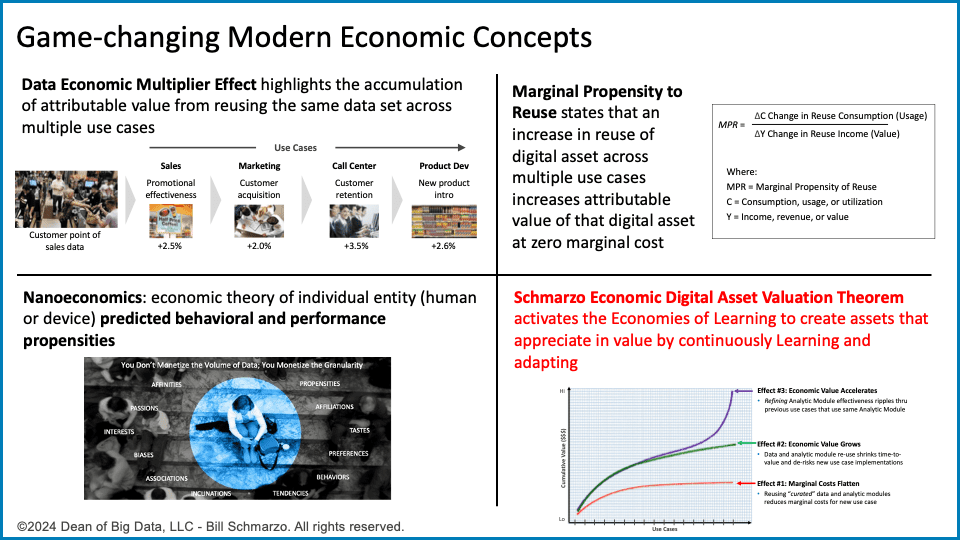
The original title for my book, “The Economics of Data, Analytics, and Digital Transformation,” was the “CDO Toolkit.” Given the CDO’s rapidly changing role and charter, I envisioned the book as a comprehensive resource to help CDOs navigate their evolving responsibilities. The CDO could use a toolkit to help them apply modern data economic concepts to unleash the value of their data by optimizing or re-engineering key business processes, reducing operational and compliance risks, creating a more compelling and engaging customer experience, and driving data-driven innovation. This toolkit would equip CDOs with economic-based strategies and methodologies to manage and leverage data more effectively as a strategic business asset (Figure 1).
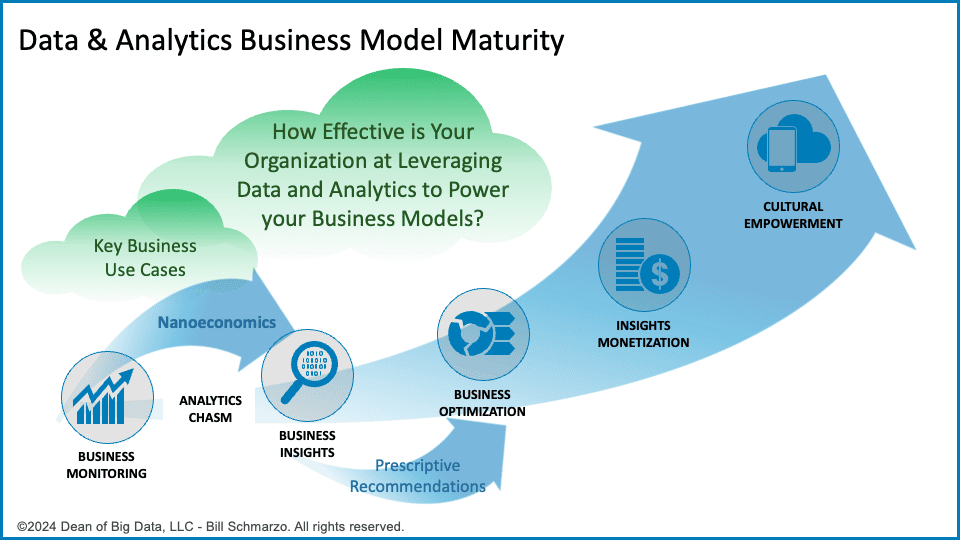
Organizations increasingly recognize the importance of leveraging data for a competitive edge. This has led to a growing requirement for Chief Data Officers (CDOs) who have a firm grasp of business and economic principles and the ability to “more effectively leverage data and analytics to power the organization’s business and operational models” (Figure 2).
Figure 2: Data & Analytics Business Model Maturity Index
Let’s consider a situation where you need to interact with the Chief Data Officer (CDO) of a major theme park. Let’s explore how modern economic concepts can help facilitate a more relevant and meaningful discussion with the CDO.
Engaging a CDO: Theme Parks Scenario
Leading theme parks concentrate intensively on guest experience, utilizing sophisticated metrics to measure customer satisfaction and engagement. These metrics can encompass four core indicators: Safety, Courtesy, Show, and Efficiency, each contributing to exceptional service and memorable guest experiences.
To effectively engage the theme park’s CDO, aligning with the business and operational initiatives that the CDO is seeking to optimize is crucial. Start by thoroughly researching how data and analytics can enhance guest experiences in the abovementioned areas. Tools like the “Dean of Big Data” GPT can be invaluable in identifying, exploring, and understanding potential use cases (it’s free if you have ChatGPT4). This preparation will help you shape your conversation around initiatives to improve guest experiences, thus resonating with the CDO’s objectives and demonstrating your commitment to their key concerns. Table 1 lists some use cases that the “Dean of Big Data” GPT identified that might be relevant to the CDO conversation.
Guest Satisfaction Aspects
Potential Use Cases
Safety: Ensure guests feel safe and fully enjoy their experience without worry.
Predictive maintenance for rides and attractions to prevent accidents and unplanned downtime
Real-time monitoring, alerts and recommendations for crowd control and emergency response
Facial recognition for enhanced security and lost child recovery
Health monitoring and safety compliance tracking for staff
Courtesy: Accentuate the importance of friendly, polite, and helpful employees (cast members)
Real-time sentiment analysis of guest feedback to customize staff interactions and improve guest experience
Personalized guest services using AI chatbots and virtual assistants to optimize park flow and guest experience
Employee training programs using AI-driven simulations for better service
Automated language translation services for international guests
Show: Create an immersive experience that contributes to the overall brand magic.
AI-driven content creation for immersive shows and attractions
Personalized Virtual reality (VR) and augmented reality (AR) experiences
Real-time data analytics to adjust shows and in-park promotions based on guest engagement
Efficiency: Eliminate inefficiencies and streamline operations to minimize guest frustration.
Optimizing park operations through AI-driven scheduling and staffing
Queue management systems using real-time data to reduce guest wait times
Optimizing energy, water, and waste management systems for cost savings and sustainability
Predictive analytics for inventory and supply chain management
Table 1: Potential “Improve Guest Experience” Use Cases
While the data and analytic technologies enabling these use cases are essential, the CDO will probably find the economic aspects of the data and analytics conversation even more compelling. Focusing on how to leverage data and analytics to create new sources of value for guests, the park, and individual attractions will better align with the CDO’s strategic goals. Highlighting the economic impact of data initiatives – such as increased revenue, improved operational efficiency, and enhanced guest satisfaction – can make your conversation more relevant, meaningful, and impactful.
Table 2 outlines how various economic data concepts can assist the CDO in unlocking the economic value of their data.
Data Economic Concept
Benefits to Guest Experience Satisfaction Initiative
Data Economic Multiplier Effect
The accumulation of attributable and quantifiable value from using a data set across multiple use cases. For the CDO, this means investing in the most important data sets that can be used to support multiple use cases, such as reducing ride wait times, personalizing guest interactions, promoting in-park activities, and increasing guest advocacy.
Economies of Learning
Improves decision-making and innovation over time, leading to continuously better guest experiences. By learning from customer, service, operational, and market data patterns, the CDO can enable the continuous refinement of attractions, services, and interactions to meet evolving guest expectations and preferences.
Nanoeconomics
Optimizes individual customer experiences by tailoring interactions, increasing guest satisfaction. Personalized recommendations, targeted marketing, and customized experiences based on micro-level data analysis can make each guest feel uniquely valued and catered to, driving higher engagement and loyalty.
Marginal Propensity to Reuse
Maximizes return on data investment by reusing data and analytics across use cases, leading to consistent improvements in guest experiences. Data collected in one area (e.g., dining preferences) can be applied to enhance other areas (e.g., in-park personalized dining recommendations), ensuring a cohesive and enriched guest journey.
Schmarzo Economic Digital Asset Valuation Theorem
Prioritizes data investments based on potential business outcomes, ensuring data-driven strategies enhance guest experiences. The CDO can allocate resources to the most impactful data initiatives, such as predictive maintenance for attractions or enhanced guest service training programs, ultimately boosting the overall quality of the guest experience.
Table 2: Mastering the Economics of Data and Analytics
CDO: Thinking Like an Economist Summary
If you want to communicate effectively with the Chief Data Officer (CDO), it’s essential to understand that their role has evolved significantly. They are no longer just responsible for managing data systems; instead, they now focus on using data to create business, operational, and customer value. This shift means there is a growing demand for CDOs with a background in economics. Research shows that CDOs with expertise in economics are successful because they can combine their technical knowledge of data with strategic economic principles. This unique blend of skills allows them to lead their organization in leveraging data and analytics to achieve better business and operational outcomes.
[1] PWC “The Chief Data Officer: the key to business strategies, innovation and culture that deliver value”, Deloitte Insight “Organizing to drive change” and Splunk “The Chief Data Officer Role: Responsibilities, Skills & Career Path”.
In a recent interview, Kai-Fu Lee, Taiwanese computer scientist, entrepreneur, and author of ‘AI Superpower’ said that China will catch up with the US in AI capabilities. Speaking about his company, 01.ai, which Lee founded, he said that it is the first company in China to achieve GPT-4 performance.
“If there are breakthroughs, the US will continue to lead. If most technologies are known and it’s about execution, then China with its tenacious, hardworking culture and tremendous market opportunity will be able to catch up,” said Lee.
China’s Advantage
Lee went on to explain how 14 months ago, they had nothing, including no GPT. “At that time, we were six or seven years behind, and at this moment we are six to nine months behind. So the catch up has already been happening and going forward, we hope that it can continue,” said Lee.
China;s advantage lies in execution. Lee believes that building a robust model involves more than just invention; it requires others to replicate, like Mistral and similar companies have.hina’s strategy involves extensive data collection, cleansing, and prioritisation for effective training. They utilise advanced infrastructure and distributed computing to maximise GPU performance.
The country excels in application development, emphasising practical implementation above all else.“China’s advantage is doing whatever it takes to catch up,” said Lee.
Interestingly, such conversations have been gaining traction. Recently, investor and entrepreneur Chamath Palihapititya, also posted about how China is zooming ahead in advancements across varied fields. “China is absolutely destroying us in discovering the future,” he said.
While Lee believes China is only months behind the US in AI capabilities, a few months ago, former Google CEO Eric Schmidt believes that the US still maintains a significant lead in AI.
“In the case of AI, we are well ahead two or three years, probably, of China, which in my world is an eternity,” said Schmidt.
Recently, in Varanasi, children and elderly women were seen sitting with folded hands and peering intently into their VR headsets for a virtual darshan of the famous Kashi Vishwanath temple.
Harshit Shrivastava and his TechXR team are exploring the virtual world beyond gaming to develop immersive content for temples and other religious places around India.
“Two virtual reality devices are being used during the trial. On an average, 250 devotees get a virtual darshan of Baba Kashi Vishwanath daily,” said Shrivastava, in an interview with AIM.
God Comes Home
This feature isn’t new. In 2022, Shrivastava and his team first experimented with this technology at Ujjain’s Mahakaleshwar temple. “We set up three physical experience centres, replete with VR headsets, AR devices, and 3D-printed scale models of the sanctum sanctorum,” said Shrivastava.
Another startup company Tagbin’s pet project Temple 360 has integrated 36 temples on its virtual website. This allows people to visit these temples remotely and perform virtual darshan, prayers, and rituals online for any of the 36 temples covered on the platform.
Similarly, Experience Makkah, offers a similar experience, making yatris incapable of undertaking Hajj and Umrah on a virtual tour.
It uses 3D modelling to let users circle the Kaaba building, meet praying pilgrims dressed in white terry cloth garments, learn about the rituals and explore other significant landmarks. Experience Makkah’s latest version can be explored through Google Cardboard, a low-cost cardboard attachment that turns smartphones into virtual reality viewers.
Holy City, another VR application, gives a glimpse of Jerusalem’s Old City.
Saurav Bhaik, the founder and CEO of Tagbin, and his team have also developed a hologram of Shri Krishna. Devotees can ask about their life problems, and the hologram will answer based on verses from Bhagavad Gita.
“This speech-to-text and text-to-speech technology is a large language model trained on only Bhagwad Gita translations in English,” Bhaik said.
Such encounters are just one of the many emerging locations in the metaverse. In this immersive virtual world, individuals can connect via avatars, which have risen in popularity throughout the pandemic.
The metaverse pilgrimage tours aim to replicate the feel in a virtual world. Regardless of age or medical condition, you can efficiently perform darshan from the comfort of your home.
Limitations
While the experience might be immersive for devotees, the technology is expensive. Shrivastava had to import VR devices into India, with each device costing INR 1 lakh. That’s when he got the idea of augmenting VR into our smartphones.
“Through our Durlabh Darshan app, devotees can take live darshan. The subscription cost is as low as INR 2,500 per year,” he added.
Other startups, too, need to make it accessible to all.
“In the past, VR headsets were very bulky and of low quality, requiring phones to be inserted into basic viewers like Google Cardboard. However, now high-end headsets like Apple Vision Pro are lighter, more comfortable to wear for longer periods, and provide improved visual experiences,” said Bhaik.
Difficult To Scale
Apart from the cost, scaling VR into pilgrimage has another set of problems. VR headsets have no safety requirements in India.
“The lack of data sets specific to the Indian context leads to hallucinations in these tools. For example, one of the GenAI images of Goddess Saraswati had seven toes,” said Ajit Padmanabh, the founder & CEO of Who VR. His company is integrating VR into museums and temples.
The numbers support the claim. As of 2024, the VR market in India is $789 million. In contrast, the USA, which is the leading revenue generator in this market, has a projected volume of $10,900 million.
Needs Heavy Computing
One of the key advantages of virtual pilgrimage events is accessibility. When the coronavirus put a break on travel, Nimrod Shanit came up with the Holy City that gives a glimpse of Jerusalem’s Old City.
“In creating these 3D spaces, hundreds of thousands of photos were captured using extremely high-resolution cameras. The data footprint of this project exceeded 50 terabytes, and the computer power required to process it was immense,” said Shanit.
Is it really worth it?
Traditionalists dismiss the idea as analogous to converting a temple into a theme park or that these are simple gimmicks that do not stir spiritual energies. They raise the question: “How can one do a pilgrimage without doing a pilgrimage?”
However, Shrivastava disagrees. “The idea of introducing VR is to enhance the devotee’s experience, not replace it.”
Opportunities Galore
India’s spiritual sector is estimated to be worth between $30 billion and $40 billion. According to the tourism ministry, India’s religious tourism sector attracted 1,439 million tourists in 2022.
It is predicted to increase by 16% by 2030. The sector is expected to earn $59 billion in revenue by 2028 and provide 140 million temporary and permanent jobs by 2030. The need to augment technology is real.
“The tourism industry is starved of technology. India needs to be at the forefront of the metaverse. We cannot let our artisans and locals miss this bus the way our population missed the internet boom in the 2000s,” said Padmanabh.