Former Amazon chief Jeff Bezos is returning to an active leadership role as he takes the helm of a newly formed AI startup, Project Prometheus. He will serve as co-chief executive officer, marking his first major operational post since stepping down as Amazon’s CEO in 2021, according to a report by The New York Times.
Project Prometheus has reportedly raised about $6.2 billion in early funding, with Bezos contributing to the investment.
The startup is said to be building AI technologies aimed at manufacturing, engineering, and other physical-systems applications, spanning everything from computing and automotive work to aerospace.
Project Prometheus is one of several companies concentrating on utilising AI for tangible applications, such as robotics, drug design, and scientific discovery.
Bezos will co‐lead the venture alongside Vik Bajaj, a physicist and chemist previously affiliated with Google X and other advanced research labs.
Last year, Bezos invested in Physical Intelligence, an AI robotics startup. The company’s mission is to bring general-purpose AI into the physical world.
Although many operational details remain undisclosed, including headquarters location and exact launch date, the startup is reported to have already hired roughly 100 employees drawn from leading AI organisations such as OpenAI, DeepMind and Meta Platforms.
By taking on this new role, Bezos is entering a crowded AI market where big companies and young startups are competing to lead in physical-AI, robotics, and large-scale automation. The move also raises questions about how his well-known Amazon leadership style will fit into the faster, more flexible world of AI.
The huge early funding makes Project Prometheus one of the best-backed AI startups to date, even as the industry faces pressure over proving real-world results, building sustainable business models, and attracting top talent.
Whether Bezos’s return to hands-on leadership will lead to major breakthroughs is still uncertain, but it highlights how veteran tech leaders are re-joining the race to shape the next era of AI.
The post Jeff Bezos Launches Project Prometheus, a Billion-Dollar Push Into Industrial AI appeared first on Analytics India Magazine.
YouTube unveiled new AI tools and major strategic partnerships at its Impact Summit in New Delhi on 17 November, reinforcing its role in India’s digital learning and creator ecosystems.
The company cited a new Oxford Economics report that showed YouTube’s creative economy contributed over ₹16,000 crore to India’s GDP last year and supported more than 930,000 jobs.
The platform announced two collaborations, one with the Indian Institute of Creative Technologies (IICT) to support emerging talent in animation, gaming and visual effects, and another with AIIMS’ College of Nursing to expand access to professional medical training.
“Our impact isn’t just about views; it’s about livelihoods and shared economic growth. We see this when 63% of our monetising creators agree YouTube is their primary source of revenue,” Gunjan Soni, MD for India at YouTube, said in a statement.
The IICT partnership will include industry-led workshops, AI-driven creative project funding through the new Create with AI programme, and support for the institute’s official YouTube channel.
Vishwas Deoskar, CEO of IICT, said the collaboration would give students direct access to technology and expertise needed to compete globally. He highlighted, “India’s creative industry is at a pivotal moment, and AI is set to redefine storytelling.”
With AIIMS, YouTube will bring expert-designed courses on wound care and infection control to more than 5,000 nursing students and professionals across India.
Dr Latha Venkatesan, principal at College of Nursing, AIIMS, said digital learning was critical to scaling high-quality medical education.
YouTube is rolling out a new conversational AI tool designed to enhance the viewing experience. This feature allows viewers to pose questions and receive immediate answers directly within the video player, thereby making content consumption more educational and interactive. It is currently available in English, with support for Hindi slated for future release.
The company also expanded First Aid shelves for credible health information, and digital well-being controls, including daily limits for Shorts scrolling.
New creator-focused tools include Edit with AI and a likeness detection feature to help protect creators from unauthorised AI-altered content.
Soni said India continued to be a global driver of digital creativity, noting that YouTube aimed to support both economic opportunities and responsible online experiences as the country’s digital landscape evolves.
The post YouTube Expands India Push with AI Tools, Partners with IICT and AIIMS appeared first on Analytics India Magazine.
Bionic hands have been one of the marvels of medical engineering, promising amputees the ability to grip, lift and hold through muscle-signal control. These devices read electrical impulses from the user’s forearm, translate them into movement and attempt to mimic the everyday ease of a natural hand.
Yet, the technology has remained out of reach for most people, as global prosthetic systems are expensive, slow to customise and designed far from the realities of developing countries. It is this gap between innovation and accessibility that Hyderabad-based Makers Hive is trying to bridge.
The startup is on a mission to provide amputees a chance at an everyday life through their technology, said founder Pranav Vempati as he shared the story behind their inception.
Through his conversations with amputees, Vempati realised that they struggle to perform even the basic daily tasks, such as using the washroom. His exploration of bionic hands led him to deduce that “they’re outrageously expensive”.
Pondering over the problem, he was asked by his mentor: “Why don’t you build one yourself?” That is when his team took shape to deal with this often-overlooked problem.
What emerged from the R&D is a product called KalArm (inspired by the work of Dr APJ Abdul Kalam), a 3D-printed bionic hand with embedded EMG (electromyography) sensors that interpret muscle signals from the wearer’s forearm.
“We wanted to build a product which is future-proof,” said Vempati. KalArm offers 18 pre-defined grip patterns and six custom grips, with Bluetooth connectivity, firmware updates, and mobile app monitoring built in.
The startup is also currently raising series A funding with Silverneedle Ventures being the first to invest in the ongoing round, according to sources.
Ajay Jain, managing partner of Silverneedle Ventures, said the prosthetics market is set to grow, and the world needs a solution as advanced as KalArm at a price point that is affordable in India.
“Now, a 25-year-old breadwinner of a family can get back into the workforce with close to complete capability. There is a growing need for such products in adjoining areas such as Parkinson’s and others,” Jain said.
Shubham Tiwari (left), armed forces personnel with the chief of the armed forces (right). After losing his arm in the line of duty, he is now the beneficiary of KalArm.
Affordable Than the West
Vempati noted, “These advanced prosthetic bionic hands cost as much as ₹35 lakh to ₹60 lakh in developed nations.” Makers Hive significantly reduced costs by designing core components in-house, utilising local manufacturing, and incorporating 3D-printed parts.
That cost reduction wasn’t just about chemistry and engineering; it was about access. As Vempati put it, “If you want to create impact, make it affordable, only then can you make it accessible.” By offering comparable features at a fraction of the price, the team aims to shift the paradigm in assistive technology.
“This hand is currently available in the market from ₹4.5 lakhs to the cost of around ₹7.2 lakhs. However, we’re providing the hand for somewhere between 4.5 and six lakhs,” Vempati said.
He added that the price also varies with the level of amputation—transradial (below the elbow), transhumeral (above the elbow), wrist disarticulation (separation at the wrist joint), and elbow disarticulation (separation at the elbow joint).
People at the Centre
Behind every grip pattern and sensor lies a story. Vempati reflected on the user experiences of different customers. He asked them what they would do first once they got the product.
“I never picked up my own baby before. The first thing I’ll do is hold her,” a female user said. Another male user said he would scratch first since both his hands are amputated. These real-life moments drive the design behind KalArm.
Engineers at Makers Hive spent time with amputees to understand routines that many people take for granted, such as sipping from a bottle, holding a pen, or pressing a key. “We place a pair of EMG sensors and try to interpret what the person is trying to do,” explained Vempati. That insight informed the design of a handset with custom forearm sockets, colour panel choices, and mobile app configuration.
Upcoming Roadmap
Vempati shared an extensive product and funding roadmap that outlines how the company plans to scale its bionic business beyond India.
“We have already raised about ₹30 crores till date. Recently, Silver Needle Ventures invested about ₹10 crores in our organisation, and we are raising another five crores in a bridge round right now,” he said.
He added that once the bridge round closes, the team will shift focus towards regulatory approvals over the next six months, with plans to clear CE and FDA compliance. He added that Makers Hive’s intention is to explore the international market post series A funding.
The company is also widening its product portfolio. Beyond the flagship KalArm hand, Vempati confirmed two new variants. The first is an affordable model called KalArm Lite. This will be out in the market by April or May and “available to people under ₹3 lakh.”
He confirmed a new product line that will be out in the market in another nine to 12 months. “We are launching another variant of KalArm called KalArm X, which is specifically going to be for industrial robots and possibly also for humanoids.”
He laid out a comprehensive 12-month rollout plan.
“Six months from now, we have KalArm Lite out in the market, eight to nine months from now, we have KalArm entering the international markets, and probably nine to twelve months from now, we’ll have KalArm X out in the market.”
Vempati revealed that their bionic hand is already being tested as an end-effector, and that this early experiment led to interest from ISRO as well.
These expansions mark one of India’s first attempts to use a domestically built bionic hand platform to power industrial robotics, humanoid systems and future mobility-assist devices.
Why It Matters Now
As India and other developing nations push for tech-driven health solutions, accessibility remains a critical barrier. With advanced bionics becoming luxury items, the KalArm model changes the equation.
As Vempati put it, “Technology should empower, not exclude.” The startup aligns with global trends in health-tech democratisation and local manufacturing. The timing also aligns with the expansion of manufacturing ecosystems, the decline in 3D-printing costs, and the national focus on “Make in India,” making tech-for-good possible at scale.
The startup aims to scale production, establish manufacturing facilities, and explore new categories of assistive devices. Beyond hands, Makers Hive also plans to enter full-body assistive robotics, believing that the next frontier will be exoskeletons, bionic vision, and more. When asked about the future, Vempati said, “We’re not just building bionic hands, we’re bringing back dignity.”
With regulations and certifications in mind, including CE and FDA-type compliance, the startup is charting a course from prototype to global market. Every aspect, from materials to sensors, firmware, and mobile connectivity, has been carefully tuned for both reliability and user-centric design.
While the hands they build are mechanical, their first approach is to restore control and everyday normalcy to people whose lives changed in an instant.
The post This Indian Startup is Building a Bionic Future with its KalArm appeared first on Analytics India Magazine.
Perplexity AI was voted the startup “most likely to fail” at the Cerebral Valley AI Conference in San Francisco last week.
More than 300 founders, investors and operators ranked the fast-growing answer-engine company at the top of a list of high-valuation AI firms facing the highest perceived risk. The company was followed by OpenAI.
The survey was led by organiser and independent journalist Eric Newcomer. The poll, conducted during a closed-door session, immediately became the most discussed outcome of the event.
Attendees said the scepticism is driven by Perplexity’s soaring valuation and its rapid push into new markets without demonstrating a clear, defensible business model.
Perplexity AI’s most recent valuation stands at $20 billion, achieved after its latest funding round in September 2025, where it raised $200 million from top-tier investors.
Despite positioning itself as a challenger to traditional search, several investors argued the company has yet to show sustainable monetisation or meaningful differentiation from larger AI players.
The company recently rolled out upgrades to its Comet Assistant to deliver faster and more accurate answers, along with enhanced privacy controls such as a new Snapshot feature.
Notably, Amazon recently accused Perplexity and issued a legal threat to prevent users from using its AI assistant, Comet, to make purchases on Amazon’s platform.
Meanwhile, the vote also reflected broader concerns about a potential AI investment bubble. Many participants warned that valuations across the sector have outpaced financial fundamentals, leaving companies that scale aggressively like Perplexity increasingly vulnerable to market correction.
Some founders described the sentiment as a “reality check” for startups relying on hype rather than proven revenue paths.
While the result is not a forecast of immediate collapse, it signals a shift in investor expectations as the industry moves from experimentation to financial accountability.
For now, Perplexity maintains strong brand visibility and significant funding, but insiders say the next year will determine whether the company becomes a breakout success or an early casualty of the overheated AI race.
The post Perplexity AI Rated ‘Most Likely to Fail’ by Investors at Major SF Summit appeared first on Analytics India Magazine.
NVIDIA recently became the first publicly listed company to cross a $5 trillion market capitalisation. India, however, is yet to see a homegrown company touch the trillion-dollar mark. Reliance Industries Limited currently holds the highest valuation.
India’s own NVIDIA moment will arrive via industrial AI and robotics, according to Amey Mashelkar, head of JioGenNext. Fusion of data, automation, and real-time intelligence will drive major breakthroughs, he told AIM.
However, that process will take its time. “NVIDIA wasn’t built in a moment,” he said, adding that the company spent decades pushing through ups and downs.
Mashelkar believes India must take a long-term view. “It’s a multi-decade marathon. We have to keep building, keep pushing—and one day we’ll look back and say this was the moment everything changed,” he said, adding that India is firmly “on the right path.”
Building on that optimism, Reliance JioGenNext has evolved from a startup accelerator to being a national deep tech engine aiding early founders across AI, retail, industrial systems, and infrastructure turn ideas into real, scalable solutions.
Mashelkar said that JioGenNext has moved beyond being a regular accelerator. It has evolved into a market-access engine, one where startups earn what Mashelkar calls “the one credential money can’t buy.”
“If your technology works at Reliance scale, it works anywhere in the world.”
The flagship program is the Market Access Program (MAP), which annually onboards startups, offering guided access to Reliance and Jio ecosystem resources, mentors, investors, and opportunities to develop proofs of concept (PoCs). This year’s MAP 2025 cohort features 21 deep tech startups building new tools such as robot-training world models, smart grid security systems, blockchain-based finance platforms, and drone-powered digital twins for infrastructure.
Among startups backed by JioGenNext, Asteria Aerospace is a notable example, actively pursuing international expansion, focusing on scaling drone technology and data analytics solutions across key global industries. In early 2025, Asteria Aerospace signed a memorandum of understanding (MoU) with Drone Destination to expand its drone-based services into international markets.
What is so special about Reliance?
Mashelkar said that while most accelerator programs groom founders. JioGenNext validates technology inside real production environments.
“Earlier, founders needed mentorship on how to build or scale. Today, there’s enough advice in the ecosystem. What startups lack is enterprise-scale validation—and Reliance has a massive appetite for integrating new technology.”
Mashelkar explained that JioGenNext’s POC runs as a structured four-phase program over roughly 90 days, though timelines can vary depending on complexity. Once a solution proves itself and enters the commercial phase, “sky’s the limit,” he said.
On what it takes for a startup to actually scale inside Reliance, the first non-negotiable is building trust, Mashelkar said with clarity. A founder must convince the stakeholders about their value proposition and establish a strong working relationship internally, something that requires time, follow-ups, and consistent engagement, he added.
For the POC itself, the success criteria are even more specific. Mashelkar said the outcome must be measurable and must show clear improvement over the baseline, ideally exponential impact rather than incremental gains. Integration readiness is another must-have, especially given Reliance’s many legacy systems.
Bridging Innovation and Industrial Scale
Speaking about India’s ₹1 lakh crore RDI mission, Mashelkar said the initiative sends a clear signal that the country wants to shift from importing innovation to owning it across AI, semiconductors, clean energy, and advanced manufacturing.
He explained that JioGenNext sits at the intersection of research, startups, and large-scale deployment, operating as a bridge between ideas in the lab and technologies that work in the real world.
“When a technology is in the lab, it is only a promise, but when it is deployed at scale, it becomes proof.”
JioGenNext works to fill this “missing middle” between research and commercial rollout by de-risking innovation, speeding up the lab-to-market cycle, and strengthening business confidence for scale.
The post When Will ‘NVIDIA Moment’ in India Arrive? appeared first on Analytics India Magazine.
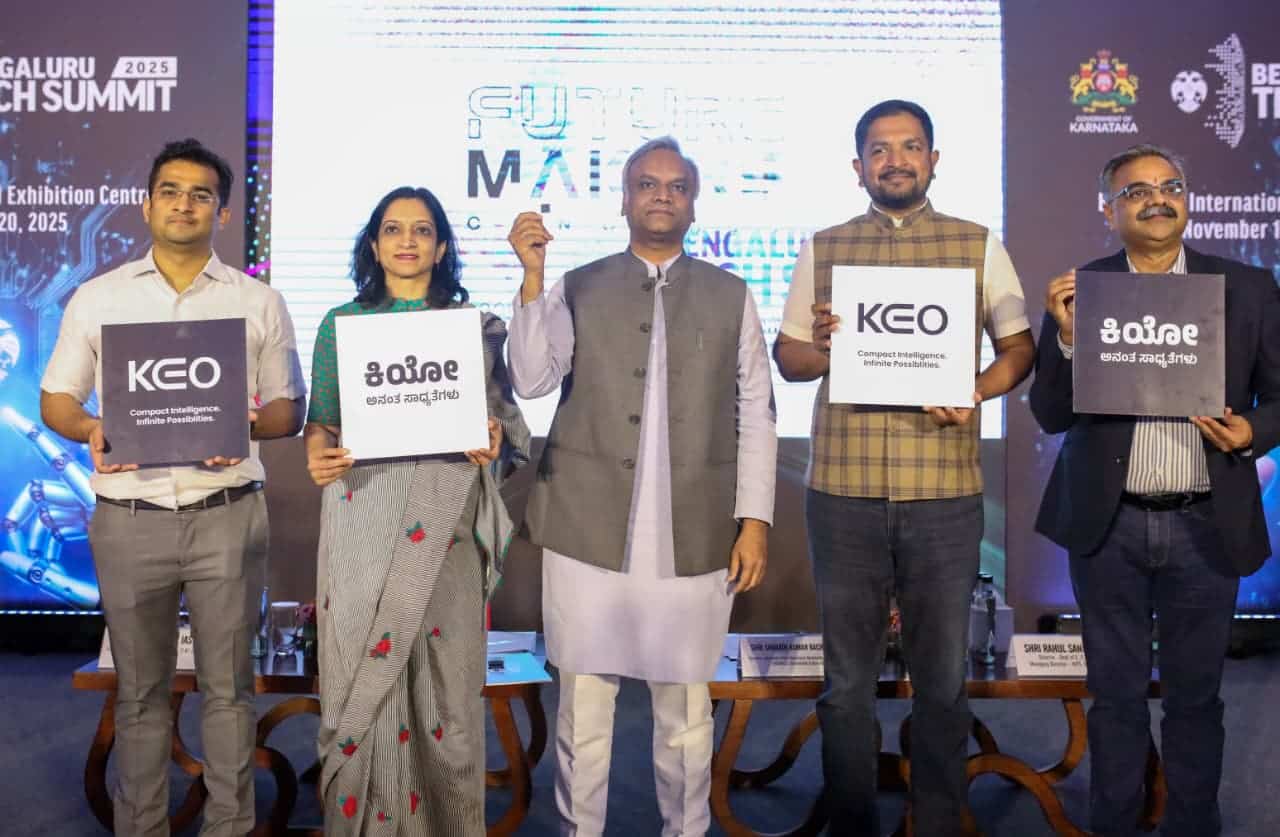
Karnataka on Monday unveiled KEO, an AI-powered, fully open-source personal computer developed under the state’s electronics, IT & BT department in partnership with the Karnataka State Electronics Development Corporation Ltd (KEONICS).
The device, India’s most affordable PC with an onboard AI core, marks what the government is calling a milestone in democratising access to computing and artificial intelligence.
Ahead of the official launch on November 18 by chief minister Siddaramaiah and deputy CM DK Shivakumar at the Bengaluru Tech Summit, Karnataka IT minister Priyank Kharge called KEO “world’s first (such) initiative taken up by a state.” Explaining the rationale behind it, Kharge said accessibility to smartphone, internet is more than 90% but when it comes to serious online learning or computing, there is not enough affordable hardware in urban, tier-2 towns or rural areas. This gap leaves students from these areas out of the learning bracket, though India’s digital economy is growing at a fast pace, he added. “The idea is to take computing to the grassroots and make it more affordable, not just learning,” he said. Kharge said KEO stands for Knowledge-driven, Economical and Open Source. “It is not a luxury device, it is an inclusive device,” he said, adding that it took just a year for the government to unveil KEO. Kharge said KEONICS is doing what it is supposed to do after getting deviated in the past, when it “missed the previous electronic revolution”.
“The department of IT and BT and KEONICS will be accelerating the future of electronics and AI for India from Karnataka,” he stressed. Stating that the government wants to make Karnataka the RISC-V capital of India, Kharge shared the vision to turn Karnataka into a hub of processor designing and architecture testing, where new AI hardware solutions are built for the world.
Inside KEO
KEONICS chairman Sharath Bachegowda said the project represents “inclusion, innovation and access to computing at the grassroots.”
The KEO has been engineered entirely in Bengaluru, from chip design to device architecture. Its RISC-V based processor and Linux-Ubuntu operating system make it one of the country’s first end-to-end open-source personal computers.
“The ethos of KEO is open source,” Bachegowda said.
He added: “We asked ourselves: How can we get out of the proprietary ecosystem? How can we build a new ecosystem where students, rural innovators and young creators can build technology instead of just consuming it?”
Every component and tool, from the OS to AI models, programming environments, and productivity suites, is open-source and licence-free.
A defining feature of KEO is its 4-TOPS (Trillions of Operations Per Second) edge AI engine, enabling local AI computation without relying on the cloud.
“This is India’s first AI PC capable of four trillion operations per second,” Bachegowda said. “We’ve created a solution where AI is deployed on the edge, programming, inference, and even LLM computation can happen offline, on a compact device.”
KEO also includes an AI chatbot called Buddh trained exclusively on the state DSERT curriculum, offering instant academic assistance for students from Classes 8 to 12. “Students can ask questions in science, maths or social science and get answers within a fraction of a second,” he said.
KEO’s development took nearly a year, with repeated hardware iterations and field tests aimed at ensuring ruggedness and reliability in rural environments.
Connectivity options include 4G, Wi-Fi, Ethernet, USB-A and C ports, HDMI, and audio jacks.
Cost was treated as a core engineering priority. “We’ve kept affordability as a high mark,” he said. “This is a mass computing solution, every feature of a modern computer in a compact, low-cost form factor.”
Broad applicability
The initiative has already secured early buy-in: Shikshana Foundation, an education-focused organisation, has pre-booked 500 units for deployment across schools.
While early use cases centre around education, the state envisions broad applicability across public and private sectors.
“The potential and opportunities are multiple,” Bachegowda explained. “We can deploy KEOs in hospitals, pharmacies, police stations, government offices, SMEs, startups and homes. We’ve built a purpose-designed device for every application.”
When asked if the government is planning to replace the existing computers in the government departments with KEO, Kharge said the use case in the government is currently in the education sector. He added that once KEO is competent there, it will see heavy deployments across the departments. On whether the government has acknowledged or made contributions to the open source community maintaining these tools, Kharge said that they have not reached out. “They don’t know yet. Once they know, they will reach out,” he said. Kharge said that over the past year, the government closely examined earlier public-technology efforts like the Aakash tablet and the Simputer, projects that were ambitious but ultimately stumbled due to execution gaps, quality issues and the lack of a supporting ecosystem. He said that the success of KEO will depend entirely on how well we design the blueprint and avoid those pitfalls.
“We are determined not to repeat the same mistakes,” Kharge said.
The post Karnataka Unveils India’s First Open-Source AI PC for the Masses appeared first on Analytics India Magazine.
Sarla Aviation announced that it will invest ₹1,300 crore to set up a 500-acre aerospace manufacturing facility in Andhra Pradesh. The project will develop electric vertical take-off and landing (eVTOL) aircraft, aiming to accelerate India’s transition to aerial mobility.
The facility will function as an integrated Urban Air Mobility (UAM) campus, encompassing manufacturing, flight testing, certification, training, and maintenance all under one roof. According to reports, the company said that it aims to position India as a global contender in future aviation technologies, with an initial investment of ₹1,300 crore and significantly adding more in the future.
The complex will be India’s first end-to-end ecosystem for eVTOL manufacturing and operations. Built to international aerospace standards, it will have the capacity to produce up to 1,000 aircraft a year, placing it among the world’s largest eVTOL manufacturing hubs. The company also said, “This giga facility will shape the aircraft of the future, create thousands of high-skill jobs, and establish India as a global force in sustainable aerial mobility.”
The site will include manufacturing lines for composites, powertrains, wire harnesses, landing-gear systems, flight-control computers and embedded systems. It will also house India’s largest wind tunnel, a two-kilometre runway, VTOL testing pads, R&D labs, simulation environments, pilot training centres, and MRO units.
Sustainability features will include renewable energy systems, water recycling, and zero-liquid-discharge processes, along with biodiversity zones. Sarla Aviation is collaborating with the Andhra Pradesh government on certification infrastructure, R&D support, and UAM corridors, including planned vertiports.
The company expects these systems to enable commercial air-taxi operations across major South Indian cities by 2029. Commercial routes such as Bengaluru, Hyderabad, Chennai and Kochi are among the early geographies under consideration for UAM services.
Previously this year, Sarla has raised$10 million in a Series A1 round led by Accel, with participation from the founders of leading Indian tech companies. The company’s early partnership discussions began with Bengaluru International Airport for future air-mobility trials.
The post Sarla Aviation to Invest ₹1,300 Cr & Set up Aerospace Facility in Andhra Pradesh appeared first on Analytics India Magazine.