Why Purpose, Ownership & Measurable Business Outcomes Will Decide the Future of GCCs

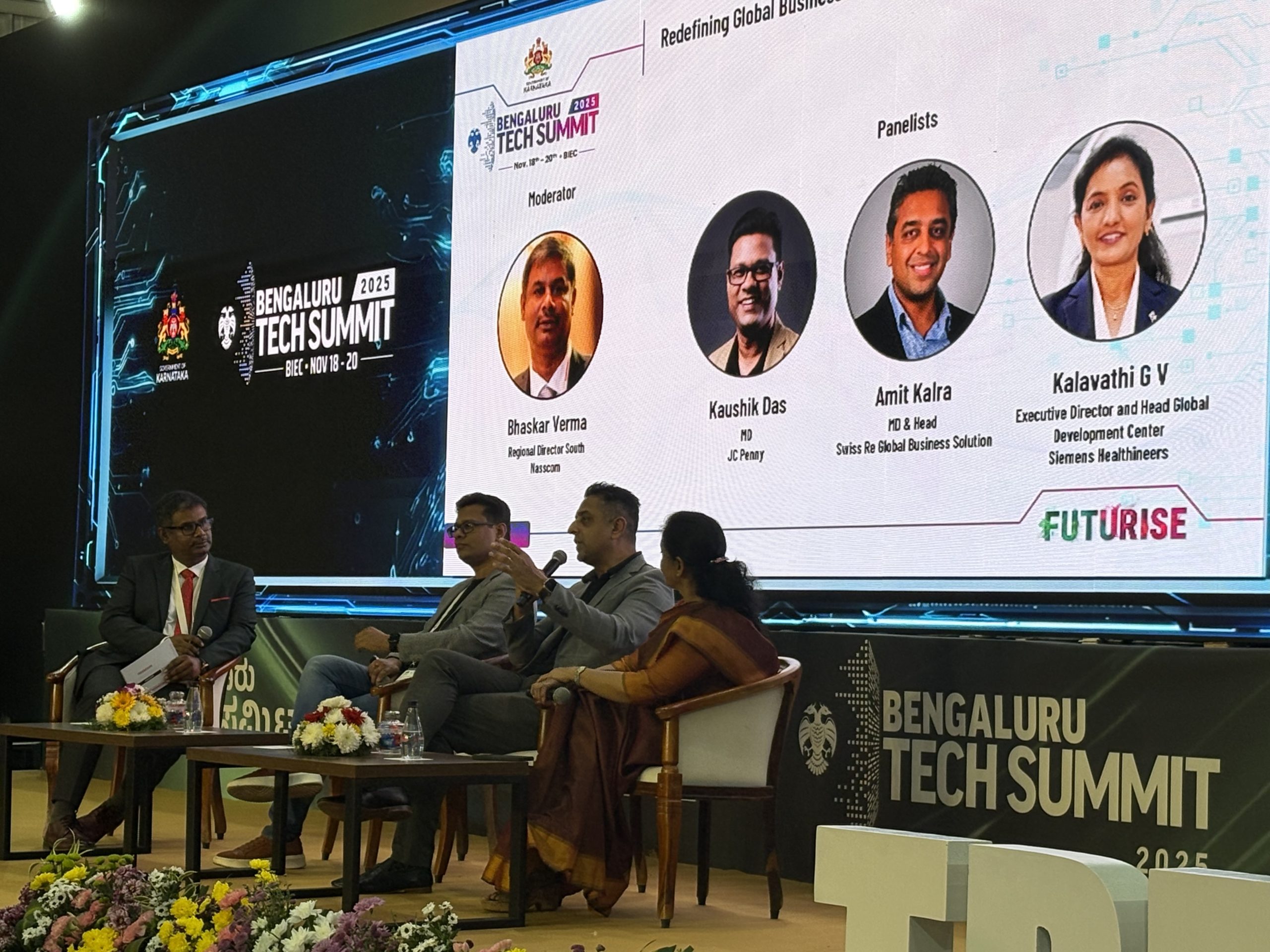
The accelerating evolution of global capability centres (GCCs) and their growing strategic influence on multinational enterprises was a topic of deep discussion during a session at the Bengaluru Tech Summit 2025, where leaders from healthcare, insurance and retail examined how India’s GCCs are reshaping global business value.

In a panel titled ‘Redefining Global Business Through GCCs – The Value Matrix’, industry heads from Siemens Healthineers, Swiss Re and JCPenney discussed the shift from cost-driven operations to ownership, innovation, AI-led transformation and enterprise-level impact.

They argued that India’s GCCs must now be measured by business outcomes, not cost arbitrage.

The discussion featured Kaushik Das, managing director of JCPenney; Amit Kalra, managing director and head of Swiss Re Global Business Solutions; and Kalavathi GV, executive director and head of the global development centre at Siemens Healthineers.

Opening the conversation, Kalavathi said the rapid growth of GCCs, now nearly 1,800 in India, has pushed centres beyond execution to owning the “why” behind their work.

Using med-tech as an example, she said value today is defined by business impact, such as patient touchpoints, IP generation, global roles, time-to-market improvements and taking products from concept to scale.

For Siemens Healthineers, Kalavathi revealed, India now houses over half of its software engineering workforce and leads end-to-end development of products like the mobile C-arm surgical imaging system, which is designed and manufactured in India and exported globally.

AI-enabled diagnostics, including a radiology companion that can increase reporting efficiency by up to 43%, are also being developed at the India centre, positioning the country as a driver of both innovation and access, she added.

Kalra stressed that true value creation requires aligning Indian centres with the enterprise’s core purpose rather than treating GCCs as separate entities.

In insurance and reinsurance, he added, the business value chain, actuarial, underwriting, modelling, risk management and technology, must remain integrated, and India’s contribution should be measured by its role in global outcomes.

He described how Swiss Re’s early accelerator model had evolved from “letting a thousand flowers bloom” into a focused innovation strategy tied directly to business priorities.

He noted that while India’s talent base and ecosystem have matured, the industry is still heavily execution-led, with only a small share of global strategic roles located in GCCs.

The next leap, he said, must be a shift from execution to ownership, supported by domain expertise, leadership depth and distributed decision-making.

Kaushik Das said retail GCCs have become essential to driving customer-facing outcomes, with India teams increasingly making core business decisions, from assortment and sizing to store dispatches.

In the newly formed Catalyst brands group, which includes JCPenney, he said the key value metric is elevating customer satisfaction, and GCCs contribute through both ground-up and top-down innovation.

He cited examples, including augmented-reality beauty solutions developed in India, and said that the maturity of retail GCCs now allows them to deploy disruptive solutions globally.

Value, he said, is no longer about reporting cost metrics but about directly influencing enterprise-level goals.

A debate on whether GCCs should separately report value metrics saw all three leaders agree that measures must mirror those of the enterprise.

Kalra argued that creating GCC-specific metrics distances centres from headquarters and undermines one-team culture.

He said hygiene indicators like engagement, diversity, attrition and operational resilience are necessary, but strategic metrics should tie back to global KPIs and business impact.

Kalavathi added that value metrics should highlight revenue influence, compliance, IP and customer outcomes, while Das said the true test of a mature centre is its place in the company’s strategic roadmap.

On generative AI, Kalavathi said the healthcare sector is using AI models to bridge workforce shortages and accelerate clinical decision-making, with India playing a major role in integrating AI into global product lifecycles.

Siemens Healthineers’ GenAI Centre of Competence in India, she said, works across functions to speed up R&D, customer service, marketing and operational processes.

Kalra said organisations need a dual approach, prioritising high-impact, top-down AI initiatives and democratisation, ensuring every employee improves productivity through AI.

Das added that GCCs must strengthen data readiness, infrastructure, workforce education and ecosystem partnerships before scaling AI applications.

Closing the session, the panel offered brief calls to action for GCC leaders. Kalra called for boldness and courage, while Das said leaders must stay aligned with enterprise strategy and “own” their mandates.

The post Why Purpose, Ownership & Measurable Business Outcomes Will Decide the Future of GCCs appeared first on Analytics India Magazine.

Google Launches Gemini 3, Claims Benchmark Lead Over GPT-5.1 and Claude Sonnet 4.5

Google on Tuesday announced Gemini 3, calling it another big step on the path toward AGI.

“It’s state-of-the-art in reasoning, built to grasp depth and nuance — whether it’s perceiving the subtle clues in a creative idea, or peeling apart the overlapping layers of a difficult problem,” said Google CEO Sundar Pichai in a statement.

Google said it is rolling out Gemini 3 across its major products, including Search. The model is now live in AI Mode in Search with expanded reasoning capabilities and new dynamic experiences.

The model is also available in the Gemini app, as well as to developers through AI Studio, Vertex AI and Google’s new agent-focused development platform, Google Antigravity.

Demis Hassabis, CEO of Google DeepMind, and Koray Kavukcuoglu, the company’s CTO and chief AI architect, announced in a joint statement that Gemini 3 Pro is now available in preview.

“We’re beginning the Gemini 3 era,” they said, noting that the model is being integrated into Search, Workspace, the Gemini app and developer platforms.

Google said Gemini 3 Pro outperforms Gemini 2.5 Pro, OpenAI GPT-5.1 and Claude Sonnet 4.5 across major AI benchmarks, including LMArena, Humanity’s Last Exam, GPQA Diamond and MathArena Apex.

The company highlighted improvements in multimodal capabilities, citing scores of 81% on MMMU-Pro and 87.6% on Video-MMMU. It also recorded 72.1% on SimpleQA Verified, a measure of factual accuracy.

The launch also introduced Gemini 3 Deep Think, an improved reasoning mode. Google said it scores 41% on Humanity’s Last Exam, 93.8% on GPQA Diamond and 45.1% on ARC-AGI-2 with code execution. “Deep Think pushes the boundaries of intelligence even further,” the company said.

With broader multimodal input, longer context and new planning abilities, Google said users can apply Gemini 3 to tasks such as analysing research papers, translating handwritten family recipes, generating visualisations, or evaluating sports performance. In Search, AI Mode now supports generative UI elements and interactive simulations.

For developers, Google launched Google Antigravity, an agent-first development platform built around Gemini 3. The company said Antigravity allows agents to “autonomously plan and execute complex, end-to-end software tasks” with direct access to an editor, terminal and browser. Gemini 3 also integrates with tools including Google AI Studio, Vertex AI, Gemini CLI, Cursor, GitHub, JetBrains and Replit.

The model’s long-horizon planning was cited as another improvement. Google said Gemini 3 Pro leads the Vending-Bench 2 leaderboard, sustaining consistent decision-making over a simulated year of operations.

Subscribers to Google AI Ultra can access these agentic capabilities through Gemini Agent in the Gemini app.

Google emphasised expanded safety testing, saying Gemini 3 has undergone its most extensive evaluations to date, including assessments by external partners such as Apollo, Vaultis and Dreadnode.

“Gemini 3 is our most secure model yet,” the company said, noting reduced sycophancy, better prompt-injection resistance and stronger protection against misuse.

The post Google Launches Gemini 3, Claims Benchmark Lead Over GPT-5.1 and Claude Sonnet 4.5 appeared first on Analytics India Magazine.

Microsoft and NVIDIA to Invest Up to $15 Billion in Anthropic

Microsoft, NVIDIA and Anthropic on Tuesday announced a series of new partnerships that reshape how Anthropic’s Claude models will be scaled, deployed and accessed across major cloud platforms.

At the centre of the announcement is Anthropic’s decision to scale its Claude AI systems on Microsoft Azure, backed by NVIDIA infrastructure.

Anthropic has committed to purchase $30 billion in Azure compute capacity, with the option to contract up to one gigawatt of additional compute. The move will expand Claude’s availability for Azure enterprise users and increase model options through Microsoft Foundry.

Moreover, NVIDIA and Microsoft will invest up to $10 billion and up to $5 billion, respectively, in Anthropic as part of the deal.

The investment follows Anthropic’s $13 billion Series F round in September, led by ICONIQ, which valued the company at $183 billion post-money. Fidelity Management & Research Company and Lightspeed Venture Partners also co-led that round.

“We’re working to broaden access to Claude for organisations building with AI,” Anthropic CEO Dario Amodei said during a joint discussion with Microsoft’s Satya Nadella and NVIDIA’s Jensen Huang.

For the first time, Anthropic and NVIDIA have also formed a deep technology partnership focused on co-design and engineering. The companies will work to optimise Claude models for performance and efficiency on NVIDIA’s architectures, while NVIDIA will tune future chips for Anthropic workloads.

Anthropic’s compute commitment with NVIDIA will include Grace Blackwell and Vera Rubin systems, reaching up to one gigawatt.

Microsoft and Anthropic are simultaneously expanding their existing collaboration, giving Microsoft Foundry customers access to Claude’s frontier models—Sonnet 4.5, Opus 4.1 and Haiku 4.5. Microsoft will continue integrating Claude across its Copilot products, including GitHub Copilot, Microsoft 365 Copilot and Copilot Studio. “We want developers and enterprises to have choice in the models they use,” Nadella said.

Amazon, however, remains Anthropic’s primary cloud and training partner, the companies clarified.

Huang said the expanded collaboration aims to support the next phase of AI development as demand for compute continues to rise.

Anthropic recently announced a $50 billion investment in US computing infrastructure, partnering with Fluidstack to build data centres in Texas and New York, with additional sites planned. The facilities are designed specifically for Anthropic’s workloads to support continued AI research and development.

The project is expected to create around 800 permanent jobs and 2,400 construction jobs, with sites scheduled to come online through 2026. It aligns with the Trump administration’s AI Action Plan, which aims to strengthen domestic AI leadership and technology infrastructure.

The post Microsoft and NVIDIA to Invest Up to $15 Billion in Anthropic appeared first on Analytics India Magazine.

Indian Startups Can Now Vibe Code With AWS Kiro

Amazon Web Services (AWS) has announced the general availability of Kiro, its vibe coding platform, introducing new capabilities across the IDE, terminal, and enterprise management.

The company said Kiro now supports property-based testing (PBT), checkpointing, multi-root workspaces, and a new command-line interface that brings Kiro agents directly into developers’ terminals.

Amazon said that since Kiro’s preview launch in July, developers have adopted Specs as a structured way to build with AI.

Speaking with AIM, Massimo Re Ferre, director of product management at AWS for Kiro, revealed that Kiro IDE has been shaped heavily by developer feedback collected since its tech preview launch, which saw more than 100,000 users sign up within just the first three days.

The company has also launched a startup program providing one year of Kiro Pro+ credits to eligible companies up to Series B. The offer is available through December 31, 2025, and can be combined with AWS Activate credits.

The program is open to most countries and offers three levels of support. The Starter tier covers up to two Kiro users, the Growth tier supports up to 50 users, and the Scale tier extends access to up to 100 users.

Re Ferre believes this offer could be transformative for early-stage teams racing to build fast.

He believes Kiro’s two development modes uniquely support how startups grow. The by-coding method helps teams try out ideas quickly and experiment without much setup, making it ideal for early validation.

Once a concept starts to work, the spec-driven method helps turn that idea into production-ready software with a more structured and reliable approach.

“Startups are incredibly hungry to become more efficient,” he said. “With Kiro, they can experiment quickly and then shift into production with the same tool.”

Re Ferre stands against the motion in the debate on vibe coding’s so-called “death”. He believes both manual coding and vibe coding can co-exist. He described by-coding as ideal for rapid ideation, especially among non-developers, while spec-driven development suits engineers who want production-grade output. “It’s not one replacing the other.”

Despite Kiro being developed by AWS, Re Ferre stressed that it is not intended to be a locked-in AWS-only tool. “We’re not building Kiro specifically for AWS customers,” he said. “We want it to be a developer tool everyone can use, without requiring a particular backend or cloud.”

New Features of Kiro

As Kiro exits preview, AWS is shipping three significant enhancements. The first is checkpointing, a feature that allows developers to roll back not only the files Kiro has modified, but also Kiro’s internal memory of the actions it previously took.

“You’re literally rolling back the history of what Kiro remembers,” Re Ferre explained, adding that typical AI coding tools fail to handle this problem cleanly. Each agent action creates a restorable step, allowing users to roll back without losing ongoing work.

The second new feature is multi-root workspace support. Until now, Kiro has allowed only a single project within a workspace, limiting developers who work across multiple interconnected repositories.

Re Ferre described the addition as very close to his heart, calling it one of the most requested capabilities among users who rely on complex multi-repo setups.

The third major addition is property-based testing, an upgrade to Kiro’s spec-driven development model. With this, Kiro can automatically generate hundreds or even thousands of test cases by analysing the intended behaviour of a feature, far beyond what traditional manually written unit tests cover.

“It brings more accuracy and guarantees that the code adheres to what the specifications were meant to produce,” he said.

Enters Kiro CLI

Alongside the IDE, AWS is also launching Kiro CLI, a terminal-native agent designed for developers who prefer to work outside the browser.

The newly introduced Kiro CLI extends the platform’s agent framework to the terminal. Amazon said the CLI allows engineers to “build features, automate workflows, analyse errors, trace bugs, and suggest fixes” without leaving their shell.

It includes support for Claude Sonnet 4.5, Claude Haiku 4.5, and the Auto agent. Custom agents can be configured for backend, frontend, or DevOps tasks using shared steering files and MCP tools.

According to Re Ferre, the company has seen a growing appetite for generative-AI tools within the command-line environment. “There is a growing preference for having a terminal modality,” he said, adding that the CLI will act as a natural companion to the IDE.

Another significant update is focused on teams rather than individual developers. AWS is rolling out organisation-level onboarding, enabling enterprises to manage developers through AWS Identity Centre, enforce tighter governance, and monitor usage through centralised dashboards.

Re Ferre said this will eliminate the need for individual sign-ups and give administrators far more control over how Kiro is used within their environments.

For organisations, Kiro now integrates with AWS IAM Identity Centre. Admins can assign Pro, Pro+, and Power plans, manage overages, and monitor usage from a unified dashboard.

With Kiro’s GA release, a new CLI, enterprise controls, and a generous startup program, AWS is placing a confident bet on the future of AI-assisted software development.

The post Indian Startups Can Now Vibe Code With AWS Kiro appeared first on Analytics India Magazine.

Indian Developers Rank #1 in Cheating

GitHub-Loves-Indian-Coding-TalentGitHub-Loves-Indian-Coding-Talent

The tech world relishes rankings. Fastest growing sector, highest paid skill, most in-demand framework. Now, a new lead role in tech is around, and India seems to be grabbing it, albeit it’s not an achievement.

Indian developers are getting caught cheating more than anyone else. A wave of interviewers across companies, continents and hiring pipelines say the same thing.

A Redditor on r/developersIndia said that India cheated the most during interviews. In the now viral post, “I took several tech interviews, and our Indian developers cheated the most”, the user, who is a hiring manager, said Indian developers cheat the most and it is basically a common behaviour now.

“I am involved in hiring several developers (80+) across the globe, and one of the trends I noticed is that a lot of Indian developers cheat, sometimes blatantly, during these interviews, while developers from other places don’t,” they added.

They explained that the situation is so bad at this point that “we have earned a reputation that if a developer is doing well in the interview, they are suspected of cheating.”

Some are subtle, some are outright comic. One interviewer wrote that a candidate had both hands under her chin while code continued to type itself. Another said he watched eyes dart mechanically between two monitors. “I have seen magic,” he joked. Except, none of this is funny anymore, because the pattern is too large to be dismissed as anecdotal.

It Gets Worse

The most uncomfortable evidence came from Codeforces. Data shared by Pranav Mehta, who is a senior software engineer at Mercor, showed that India had the highest number of cheaters in their contests. Not by a small margin. Nearly twelve times higher than Vietnam, the next on the list.

“It’s easy to fall back on pseudo-nationalism and cry of bias or discrimination. But to be honest, actions like cheating in contests or sending toxic messages to GSoC contributors do reflect poorly on the entire community,” Mehta said.

Some argued that the numbers are skewed because Indians form a large part of the user base. But, the scale is still stark. Russia and China have far lower cheating rates despite fierce competition. Mehta said that excuses miss the point. “Normalising such behaviour doesn’t just hurt our individual reputation. It creates a stereotype that affects every Indian techy trying to make a mark.”

The rise of AI is one part of the answer. Interviewers say they can now recognise ChatGPT-generated code almost instantly. Word by word. Line by line. Even variable names match. A developer who used to interview regularly said candidates often repeat answers with the exact phrasing he sees on AI tools.

When asked to explain what they just wrote, they freeze. Another wrote that bad candidates get lost in the AI-generated maze. They push out code they do not understand and inputs they cannot reason about.

Other hiring managers are changing their methods completely. One said they explicitly allow candidates to use ChatGPT only to observe how they use it. They watch prompts. They watch iterating patterns. They watch how people adapt output when told to modify the solution.

“The ones who actually understand what they’re doing survive,” the interviewer said.

Who’s to Blame?

Still, blaming the system is not justified. The cheating problem is real enough that large tech companies see it as a strategic risk. Google is bringing back at least one in-person round because of how common AI-assisted cheating has become.

“It’s a combination,” Microsoft India head Puneet Chandok, earlier told AIM. “We’re using AI as part of all our processes, including hiring, and always with the human in the loop.” He said that interviews now go deep into AI fluency because developers must know how to work with these tools responsibly.

Google’s Sundar Pichai earlier also said that in-person assessments give interviewers a clearer read on whether a candidate actually understands computer science fundamentals. Virtual interviews make it harder to verify competence when the candidate might be circulating prompts behind a muted camera.

Engineers inside NVIDIA say body language reveals more than people think. Avoiding the camera. Constantly shifting gaze. Long delays before answering obvious follow-ups. Companies now use tools like CoderPad to observe code being written in real time. Everyone hiring knows they are in a new era.

Some founders insist at least one round must happen face to face. “Micro expressions and body language reveal a wealth of information,” Ankush Sabharwal of Corover.ai, earlier told AIM. He pointed out that people reading out polished answers stick out because their responses have no depth or spontaneity.

Even stricter proctoring has not stopped cheating attempts. One candidate at Wipro used his local IDE because the test environment lacked IntelliSense. He claimed he solved the problem honestly. HR forced him to resign for malpractice.

Developers have their own frustrations. Many feel the interview process itself is flawed. They say panelists often show superiority, ask irrelevant questions or arrive unprepared. Some point out that interviewers themselves use ChatGPT to prepare questions, then get offended when candidates use the same tool for answers.

One wrote that cheating in India starts early. Exams reward memorisation and shortcuts. Colleges prioritise placement numbers. Students learn to clear tests instead of learning skills. And this habit carries into work life.

Companies now want proof of reasoning, not memorised answers. They want real discussions. They want candidates who can think.

Developers frustrated with the system are demanding interviews that reflect actual job work. They want live pair programming. They want practical tests, and interviewers who are as prepared as they expect candidates to be.

The tech world will not stop using AI. Candidates will not stop experimenting with tools. Companies will not abandon automated filters. But, everyone now agrees on one point: If cheating becomes the norm, trust collapses.

India cannot afford that collapse.

The post Indian Developers Rank #1 in Cheating appeared first on Analytics India Magazine.

Karnataka Targets 50% of India’s Space Market by 2033

Karnataka has released a five year space technology policy aiming to capture 50% of India’s space market, pegged at $22 billion by 2033, while also targeting 5% of the global market. The policy plans to turn the state into a full-stack space hub with capabilities across the upstream and downstream value chain.

The plan focuses on creating a skilled force of 50,000 people, including 15,000 women, through training programmes for school students, diploma holders, graduates and young professionals. Colleges will get support to set up labs, upgrade courses and run space tech modules with ISRO and IN-SPACe.

The state aims for $3 billion in cumulative investments during the policy period. Investments under ₹100 crore will get 20% subsidy on plant and machinery, 25% subsidy on five acres of land, rent reimbursement for five years, stamp duty exemption, concessional registration charges, full land conversion fee reimbursement, 50% ETP subsidy and full electricity duty exemption for five years.

Larger investments above ₹100 crore will get special packages.

Dedicated space manufacturing parks will be set up with plug-and-play units and common testing facilities. Karnataka will create a single window space technology cell and push PPP-based test centres to address long wait times for testing at national facilities.

The policy also sets aside support for 500 startups and MSMEs. They will get funding through Elevate and venture funds like KITVEN, technology acquisition reimbursement up to ₹75 lakh, quality certification support up to ₹75 lakh, testing reimbursement up to ₹1 crore, patent support up to ₹10 lakh for international filings, global marketing support up to ₹1.5 crore, and research support up to ₹75 lakh.

Startups will also get provident fund (PF) and employees’ state insurance (ESI) reimbursement of ₹1,800 per employee per month for two years, and internship support capped at ₹30 lakh. A special grant of up to ₹1 crore will be offered for biotech space research.

The government will push the adoption of space technologies in governance through KSRAC. An interdepartmental panel will shortlist use cases across agriculture, mining, water, forest and disaster management. Leading universities will get grants to build AI-based earth observation models.

The policy will run for five years once notified and will only be available to firms registered under KITS with IN SPACe authorisation or vendor credentials to ISRO or global OEMs.

The post Karnataka Targets 50% of India’s Space Market by 2033 appeared first on Analytics India Magazine.