Gnani.ai Launches Vachana Speech-to-Text Model Under IndiaAI Mission

Gnani AIGnani AI

Gnani.ai, India’s conversational AI company, announced the launch of Vachana speech-to-text (STT), an Indic STT model trained on over one million hours of real-world voice data, as part of its selection under the Indian government’s IndiaAI Mission.

The model is designed to support enterprise speech recognition across multiple Indian languages and sectors, the company said.

“Speech recognition in India is not a localisation problem. It is a foundational systems problem,” said Ganesh Gopalan, co-founder and chief executive officer of Gnani.ai. “Vachana STT is built as core infrastructure, trained on how India actually speaks, and designed to operate across channels.”

The Bengaluru-based company said Vachana STT forms the first release in its upcoming VoiceOS stack and is available immediately via API for enterprise customers. According to the company, early adopters will receive one lakh free minutes of usage.

Gnani.ai said in a statement that the model has been trained on proprietary multilingual datasets spanning more than 1,056 domains. It supports real-time and batch transcription and is already deployed across banking, telecom and customer support operations, collectively processing about 10 million calls per day with a P95 latency of 200 milliseconds.

In internal and public dataset evaluations, Vachana STT recorded 30-40% lower word error rates for low-resource Indian languages and 10-20% lower error rates for the eight most-used languages in India, the company said.

The evaluations covered languages including Hindi, Tamil, Telugu, Kannada, Bengali and Marathi.

The model is built to handle compressed audio, variable network conditions and high concurrency, making it suitable for compliance monitoring, analytics and voice-driven workflows, Gnani.ai said.

The company added its selection under the IndiaAI Mission reflects a focus on building sovereign foundational AI infrastructure rather than application-layer tools.

The post Gnani.ai Launches Vachana Speech-to-Text Model Under IndiaAI Mission appeared first on Analytics India Magazine.

Will 2026 be the year of AI IPOs?

This year, artificial intelligence moved from hype to hyper-personalisation. Retail brands incorporated AI to offer tailored experiences, tech companies used AI agents to handle workflows, and AI giants such as OpenAI, Anthropic, and Google drove innovation with GPT-5, Claude 4/4.5, and Gemini 3, respectively.

Meanwhile, something interesting was unfolding on the bourses too.

The US saw its biggest tech IPO since 2021, when CoreWeave, the AI cloud provider backed by Nvidia, became the first pure-play AI company to debut on Nasdaq, raising $1.5 billion this year. Back home, the Securities and Exchange Board of India gave its nod to homegrown AI firm Fractal Analytics’ massive Rs 4,900-crore IPO, positioning it as India’s first pure-play AI company to go public.

If 2025 was the year of AI, could 2026 be the year of AI IPOs? Companies are already laying the groundwork for giga IPOs.

OpenAI is reportedly eyeing a trillion-dollar valuation, looking to raise at least $60 billion by going public. Both Anthropic and AI-focused software company Databricks are widely expected to pursue listings in the US in 2026, reflecting strong investor appetite for AI enterprises. Meanwhile, Chinese AI startups MiniMax, known for its large multimodal models, and Zhipu AI, focused on general language models, are preparing to debut on the Hong Kong Stock Exchange.

Favourable Conditions

The new year comes on the tailwinds of renewed momentum in 2025, with 18 startups listing on Indian stock exchanges—a 38% improvement year-over-year. Meanwhile, Nasdaq saw a robust demand for growth-oriented stocks, raising $46.65 billion from new listings in 2025.

Plus, technology and AI-linked IPOs have revived confidence in the broader tech IPO cycle.

Saurabh Kumar, partner at Deloitte India, is optimistic about AI startups trying their luck at the bourses. “With the right funding, tech infrastructure support, focus on governance and demonstration of predictable revenue models, investors now understand AI’s long-term value proposition,” he said.

“Moreover, the focus of Indian startups on steady performance and transparency makes them ready to thrive in the long run and scale efficiently. As operational and research demands grow, AI startups may also look into moving from private funding to seeking public investment with their IPO offerings.”

Private markets and strategic investors (VCs, PE) have built up capital that they need to return via IPO exits, creating both pressure and support for listings. But strong late-stage funding for AI firms means companies don’t have to rush public before they’re ready. Also, AI’s broad adoption and clear integration into enterprise IT, software, compute, and cloud infrastructure provide a compelling growth narrative for public investors.

The India Angle

India is still early in the development of pure AI businesses. But experts believe that, with established revenue streams already in place, AI serves only as a valuation multiplier rather than a fundamental risk for these companies. This dynamic makes public markets more inclined to back AI-enabled IT and engineering firms ahead of standalone AI research players.

Apart from Fractal Analytics, which is expected to get listed in the coming year, AI-powered consumer platform InMobi (Glance AI) and Qure.Ai (focused on medical imaging AI used globally) have also expressed their plans to get listed in the future. But getting listed in India is widely different from going public in the US.

Ankit Kedia, Founder and Lead Investor, Capital-A, explained, “The US markets are more receptive to long-term bets that may take time to translate into commercial performance.”

“In India, investors seek clarity on how and when AI converts into revenue because they value commercial maturity and predictable business models. Here, the central question for any company is whether the business is at a stage where retail investors can understand the product, assess the revenue engine, and assign a rational valuation. This discipline influences both timing and approach for any company considering a public listing in India,” he added.

Indian public markets reward fundamentals such as clean governance, consistent reporting, real customers, recurring revenue, predictable cash flows, clarity on IP ownership, and responsible disclosures on risks.

“The VC’s role is to help founders institutionalise these practices early. When governance, reporting discipline, and customer-centric growth become part of the company’s operating rhythm, the path to IPO readiness becomes far more straightforward,” Kedia said.

But is India Ready?

There are enough indicators that prove that the world considers India a major AI hub.

Google announced a $15 billion investment to build a major AI hub in Visakhapatnam, spanning data centres, cloud networking, and AI R&D infrastructure. Recently, Microsoft also committed $17.5 billion to expand cloud and AI infrastructure in India, including hyperscale data centres, sovereign cloud options, and AI skills training for millions. Amazon, one-upped that and announced a massive investment plan of more than $35 billion in India by 2030—one of the largest foreign corporate commitments in the country’s history.

But are Indian homegrown AI companies really IPO-ready?

Ashish Fafadia, Partner, Blume Ventures, doesn’t think so. “There won’t be any wave of IPOs in 2026. At most, a couple of companies here may get listed apart from a few big ones in the US, which are already being talked about. Fractal is a different case. It’s successful and best equipped to use AI and maximise on the use cases.”

According to Fafadia, 2026 will be the year of consolidation. “We have to see that these AI-first companies that have raised capital for crazy valuations bring down those numbers or match up to their valuation in the next 3–4 years. We are looking at businesses with a real application of AI and with a relatively faster vertical specialisation.”

Beyond Big Tech stock pullbacks and profit concerns, there’s also high capital expenditure and debt growth tied to AI data centres and deals. And the fear of the AI bubble still looms large over the IPO momentum.

The post Will 2026 be the year of AI IPOs? appeared first on Analytics India Magazine.

Odisha Partners With OpenAI to Train Students and Officials in AI

StartupStartup

The Odisha government has partnered with OpenAI for multiple initiatives, including building AI skills among students and government officials, piloting AI-led public-sector applications, and supporting Odia-language use cases.

Under the collaboration, OpenAI will deliver structured online AI training programmes for college students across Odisha. The company will also conduct training sessions for state-level government officials, focusing on the practical use of AI tools, productivity applications, and responsible adoption in governance.

To support pilot projects, OpenAI will provide API credits for its core models to Odisha’s Electronics and Information Technology Department. These credits will be used to develop initial applications, including a Government Productivity Co-Pilot that uses ChatGPT as its backend.

“For AI to truly deliver public value, it must be accessible, practical, and grounded in local context,” said Pragya Misra, head of strategy and global affairs, OpenAI India, in a statement. “Our work with the Government of Odisha will focus on building AI capabilities at scale among students and public officials, while supporting real-world applications that can strengthen public service delivery and innovation.”

Manas Panda, special secretary to the government and managing director of Odisha Computer Application Centre, said the state is prioritising digital capacity building across education and governance. “Our collaboration with OpenAI will help scale AI awareness and skills among students and government officials,” he said.

The partnership aligns with the Government of India’s IndiaAI Mission and Odisha’s broader efforts to strengthen digital governance and emerging technology capabilities, the state government said. It aims to support responsible AI adoption and the development of locally relevant applications for public service delivery.

The post Odisha Partners With OpenAI to Train Students and Officials in AI appeared first on Analytics India Magazine.

How a PC Company Became an AI Infrastructure Powerhouse?

For decades, Lenovo was recognised mainly as a global PC pioneer, innovating form factors, developing rugged ThinkPads, and eventually becoming a leading PC manufacturer.

But today, the company finds itself at the heart of a vastly different opportunity: the AI infrastructure revolution.

Vikash Kumar, GCC segment head at Lenovo India, said – What was once a hardware-focused business has quietly evolved into a diverse technology powerhouse, where almost half of global revenue derives from non-PC sectors such as servers, storage, edge AI, cloud software solutions, and sustainability-driven innovation.

This strategic pivot is not accidental, but it’s engineered into the system. “By 2026, every platform you’re buying will be enabled with a neural processing unit,” Sachin Kinagi, category head of Notebooks at Lenovo India, said at the Machinecon GCC 2025 Summit.

This signals more than an upgrade. It reflects a fundamental shift in the computing model itself. The PC is becoming an AI device. The data centre is becoming an AI factory. And the Edge AI is becoming an intelligent ecosystem powering every industry.

The AI PC Is No Longer Coming, It’s Here

The introduction of Neural Processing Units (NPUs) is reshaping what work devices can do. An NPU is designed to process trillions of AI operations per second while consuming ultra-low power.

For enterprises, this means laptops will run large language models (LLMs) locally rather than rely entirely on cloud-based inference.

Lenovo’s rollout of “AI Now” underscores this transition. Equipped with onboard AI engines and contextual intelligence, these devices adapt to user behaviour, optimise workflows, protect privacy, and deliver real-time insights without hitting the cloud.

Collaboration tools like Teams and Zoom are already leveraging device-side AI engines to offload nearly 70% of their audio and video processing.

What was once a PC is becoming a personal AI platform.

Lenovo’s metamorphosis is quantifiable: “47% of non-PC revenue reflects a shift toward infrastructure, solutions, and services, categories that now power growth,” Sachin mentioned.

Sachin added that its ThinkSystem and ThinkAgile platforms support advanced AI training, model serving, and high-performance workloads, increasingly underpinning mission-critical deployments for hyperscalers and GCCs alike.

Meanwhile, the ThinkEdge series enables inference close to the point of action, factories, hospital labs, retail stores, and logistics hubs, reducing latency and enabling autonomous decision-making.

Lenovo enhances enterprise multi-cloud strategies with storage and hybrid architectures that combine on-premise resilience and cloud agility. The company also invests in AI engines, context-aware computing, and enterprise intelligence to unify data, devices, and workloads.

Hybrid AI

The company envisions enterprises operating across three AI layers. Public AI uses cloud LLMs and generative tools for consumer apps and low-risk workflows, while Enterprise AI involves organisational models trained on company data in secure environments.

Complementing these is Personal or Private AI, where on-device LLMs powered by NPUs ensure privacy and contextual understanding.

This blended approach allows companies to retain control over sensitive information while harnessing the full potential of generative AI. Sachin added that “the future of work will be built on hybrid AI architectures that bring intelligence closer to the user, the edge, or the workload.”

One of Lenovo’s most significant innovations is a manufacturing breakthrough known as low-temperature soldering, a process that dramatically reduces carbon emissions, improves energy efficiency, and enhances device longevity.

Rather than treat sustainability as an afterthought, Lenovo treats it as core engineering. This patented innovation reduces thermal stress on the motherboard and increases component reliability.

In a rare move for a competitive industry, Lenovo made portions of this innovation available globally, enabling greener manufacturing across the sector. It’s a powerful example of ESG meeting engineering excellence.

The Convergence of Hardware, Software, and Partnerships

During the session, Vikash said the future of AI isn’t about any single player. It requires a coordinated ecosystem of hardware, semiconductors, software, cloud platforms, and enterprise builders.

Its model reflects this vision by integrating multiple layers of innovation and collaboration. At the hardware level, Intel’s NPU and chip-level advancements provide the processing power needed for AI workloads.

Meanwhile, one of Lenovo’s latest innovations is the Lenovo Aura Edition, a collaboration with Intel that delivers a significantly enhanced experience for both end users and enterprises.

On the software side, Microsoft and Google’s collaboration platforms enable seamless enterprise workflows, while ISVs are building AI-native applications that leverage this infrastructure.

Creative and design requirements are supported by Adobe and other design software creators, and enterprise developers, along with GCC talent, ensure these solutions are tailored for large-scale organisational deployment.

Vikash mentioned that sectors with stringent privacy and compliance mandates are rapidly adopting on-device and hybrid AI solutions.

In healthcare, applications such as clinical decision support and diagnostics demand secure processing. Legal-tech firms rely on AI for document summarisation and compliance, while the BFSI sector leverages it for risk modelling and fraud detection.

Even manufacturing benefits from predictive maintenance and defect detection. For these industries, where sensitive data cannot risk exposure to public LLMs, Lenovo’s secure, edge-enabled AI approach is not optional but essential.

What Lenovo’s Evolution Means for GCCs

Global capability centres (GCCs) are entering a new era of innovation. AI-rich workloads, model fine-tuning, inference orchestration, workflow automation, and Edge intelligence will increasingly depend on device-side AI, hybrid cloud optimisation, and scalable infrastructure.

Lenovo’s roadmap empowers GCCs to deploy enterprise-grade AI workflows at scale, build on-device or on-prem LLMs, and architect hybrid intelligence ecosystems. It also enables AI-driven edge automation while optimising costs by balancing cloud and local compute resources.

The role of GCCs is no longer support; it is now innovation and acceleration.

From NPUs in AI PCs to edge inference platforms to hybrid AI architectures, Lenovo is building the computing foundation for the next decade.

The post How a PC Company Became an AI Infrastructure Powerhouse? appeared first on Analytics India Magazine.

Meta’s Yann LeCun in Talks to Raise €500 Mn for New AI Start-Up at €3 Bn Valuation

‘AI will Soon Match or Surpass Human Intelligence,’ says Yann LeCun‘AI will Soon Match or Surpass Human Intelligence,’ says Yann LeCun

Meta’s chief AI scientist, Yann LeCun, is in early discussions to raise about €500 million ($586.00 million) for a new AI startup, a move that would value the company at roughly €3 billion ($3.5 billion) before its formal launch, the Financial Times reported.

LeCun, who is set to leave Meta by the end of the year, has lined up Alexandre LeBrun, founder of French health-tech company Nabla, to serve as chief executive. The discussions are at a preliminary stage, and the valuation could change, the report added.

The venture, called Advanced Machine Intelligence (AMI) Labs, is expected to be announced in January. LeCun will serve as the executive chair.

The leadership transition was confirmed by the company, which stated, “As part of a planned, board-supported transition, Nabla co-founder and CEO Alex LeBrun will transition from his role to become CEO of AMI Labs.”

Nabla has also entered into a strategic research partnership with AMI Labs. LeBrun will remain Nabla’s chair and chief AI scientist, while Delphine Groll, Nabla’s co-founder and COO, will lead the company during the search for a permanent CEO.

Under the partnership, Nabla will receive early access to AMI Labs’ world model technologies, which the company plans to use to develop agentic AI systems for healthcare that are intended to meet FDA certification requirements.

The funding talks follow November’s report that LeCun was planning to leave Meta after 12 years to start his own AI company. LeCun is a French-American scientist, a Turing Award winner, and one of the pioneers of modern AI.

AMI Labs will develop AI systems based on “world models”—architectures that can understand the physical world rather than relying primarily on language data.

The systems are intended for applications including robotics and transport. The work builds on research led by LeCun at Meta, involving AI models trained on video and spatial data, with features such as persistent memory, reasoning and planning.

Meta will not invest directly in the start-up but plans to form a partnership that would give it access to the technology for commercial use, according to the report.

LeCun’s departure comes amid broader changes to Meta’s AI strategy under CEO Mark Zuckerberg, who has shifted focus toward faster product development to compete with companies such as OpenAI and Google.

Meta has scaled back longer-term research at its Facebook Artificial Intelligence Research unit, which LeCun founded in 2013, and laid off about 600 staff from the group in October.

His exit follows other senior departures from Meta’s AI leadership. In May, vice president of AI research, Joelle Pineau, left the company and later joined Canadian AI start-up Cohere.

The post Meta’s Yann LeCun in Talks to Raise €500 Mn for New AI Start-Up at €3 Bn Valuation appeared first on Analytics India Magazine.

HCLTech Buys Hewlett Packard Enterprise’s Telco Solutions for AI-led Network Capabilities

HCLTechHCLTech

HCLTech has signed an agreement to acquire Hewlett Packard Enterprise’s (HPE) telco solutions business, strengthening its engineering and AI-led network offerings for global communication service providers (CSPs).

The acquisition follows an earlier transaction in 2024, when HCLTech bought select assets from HPE’s Communications Technology Group (CTG).

Through the latest deal, HCLTech will gain additional intellectual property, product engineering and R&D capabilities, and established client relationships with leading global CSPs.

HPE’s telco solutions business supports more than one billion devices across over 200 deployments worldwide.

Its portfolio includes Operations Support Systems (OSS), Home Subscriber Server. and 5G Subscriber Data Management, along with AI-driven closed-loop network automation aimed at improving network monetisation.

Telco solutions were earlier part of HPE’s CTG portfolio.

HCLTech said the CTG assets acquired in 2024, covering Business Support Systems, network applications, service cloudification and data intelligence, have since been integrated into its operations and are showing growth.

With the expanded portfolio, HCLTech plans to accelerate network transformation initiatives for telecom operators, including network-as-a-service and AI-led autonomous networking.

As part of the agreement, nearly 1,500 engineering and telecom specialists across 39 countries are expected to join HCLTech’s global delivery organisation.

“HCLTech is uniquely positioned to empower CSPs to realise their transformation into true technology companies, advancing the shift from telcos to techcos,” said Anil Ganjoo, chief growth officer and global head of telecom, media, publishing, entertainment and technology at HCLTech, in a statement.

He added that the integration would strengthen HCLTech’s product-aligned model and support its move towards higher-value, IP-led services and non-linear growth.

Rami Rahim, executive vice president, president and general manager of networking at HPE, said the transaction would allow the telco solutions business to build on its momentum under HCLTech, while enabling both companies to pursue distinct strategies to support the telecom sector.

The transaction is subject to regulatory approvals and customary closing conditions and is expected to close in about six months.

The post HCLTech Buys Hewlett Packard Enterprise’s Telco Solutions for AI-led Network Capabilities appeared first on Analytics India Magazine.

Dell & NVIDIA Bring an AI Developer Meetup to Bengaluru

As AI moves from experimentation to deployment, developers are grappling with practical questions around infrastructure, performance and workflow design.

The shift is less about model access and more about how AI systems are built, tested and run in real environments, locally, at the edge, and in production contexts with real constraints.

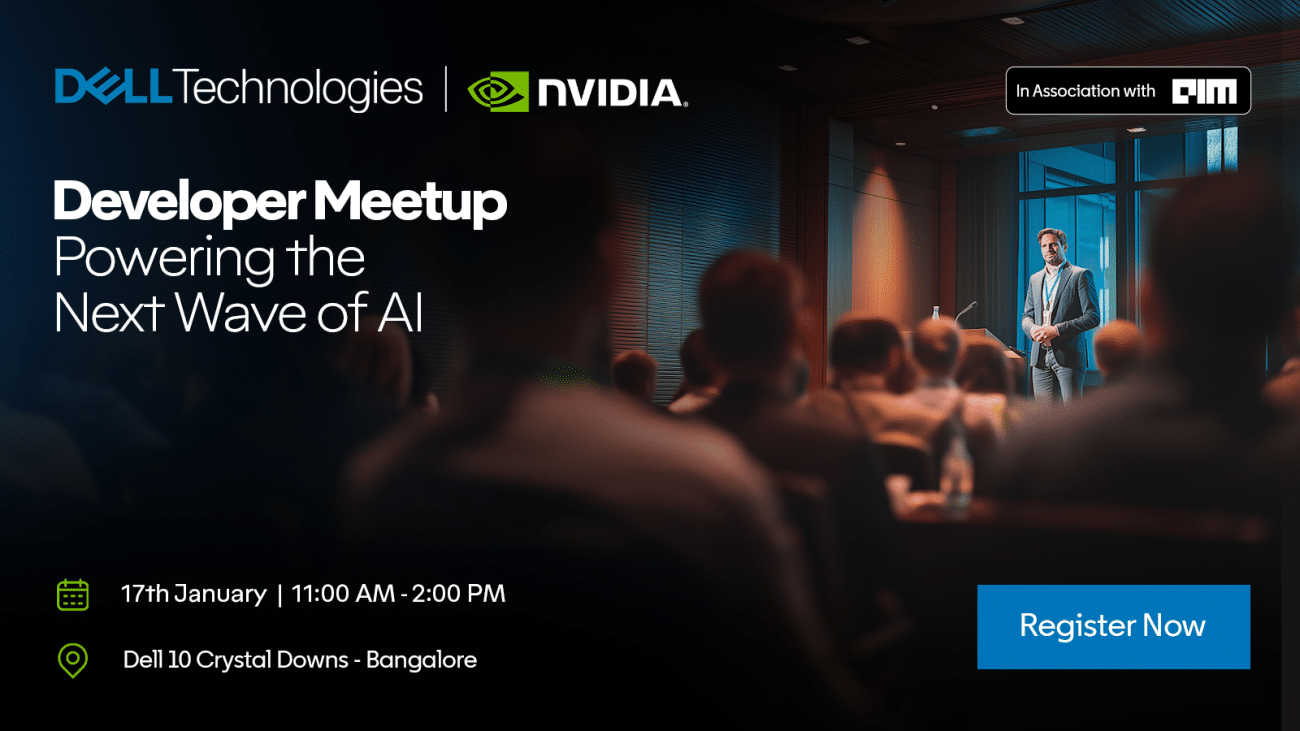
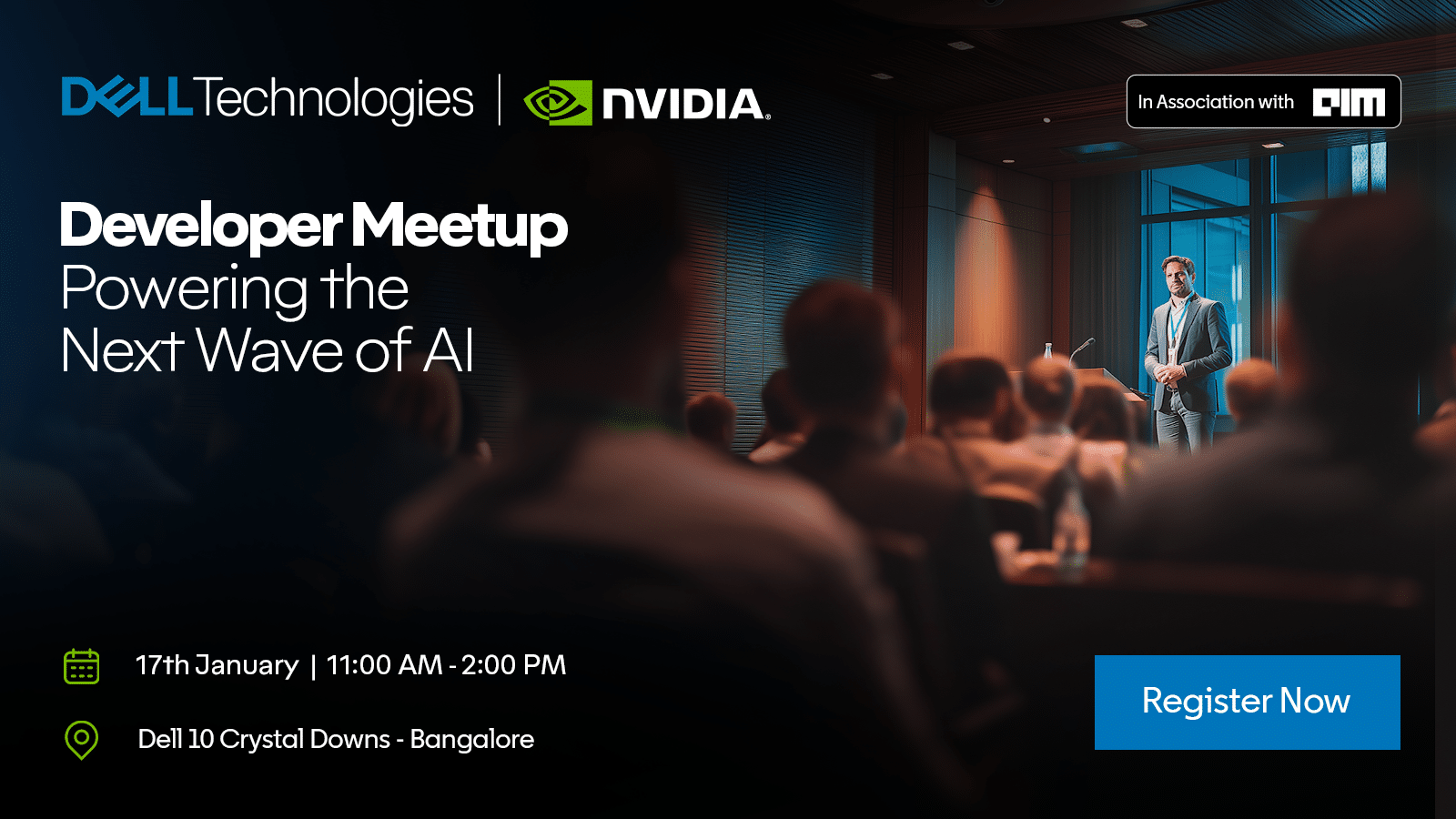
An upcoming developer meetup—Dell x NVIDIA Developer Meetup: Powering the Next Wave of AI in association with AIM—is designed as a working session for builders, practitioners, and enterprise teams engaging with AI beyond proofs-of-concept.

The event focuses on applied perspectives, such as how AI development is unfolding across organisations and the trade-offs teams are making as they move from demos to deployment.

The meetup brings together Dell x NVIDIA leaders alongside customers and AI practitioners to discuss real-world problem statements, solution approaches, and patterns emerging across the AI and developer ecosystem.

For this invite-only event, registrations will be screened, and confirmed invitations will be sent to selected participants.

The meetup is designed for AI engineers, data scientists, data engineers and other professionals working with AI and machine learning.

📅 Date: January 17, 2026

⏰ Time: 11.00 am – 2.00 pm (Registration starts at 10.30 am)

📍 Venue: Dell 10, Crystal Downs, Off Intermediate Ring Rd,

Embassy Golf Links Business Park, Domlur, Bengaluru, Karnataka

Register Now

Rather than centring on announcements, the emphasis is on shared learning from implementation: infrastructure choices, performance considerations and developer workflows that are evolving alongside new hardware and models.

A core element of the event is a product demonstration of the Dell Pro Max with GB10, offering participants a closer look at a compact, developer-focused AI system and the technologies underpinning it.

The demo is intended to ground discussions in concrete capability—how local AI development and inferencing can be approached in practice, and where such systems may fit within broader AI architectures.

The agenda is structured to balance context with experience. A keynote will frame the current direction of AI infrastructure and the developer ecosystem.

Register Now

Customer sessions and AI practitioner sessions will focus on applied use cases and lessons from the field, followed by a fireside chat and closing discussion that connects these perspectives.

The event concludes with a networking lunch and hands-on product experience at the booth.

Overall, the meetup is designed to create space for direct, practitioner-led conversations, surfacing what teams are building today, the constraints they face, and how AI development is adapting as it moves closer to real-world deployment.

The post Dell & NVIDIA Bring an AI Developer Meetup to Bengaluru appeared first on Analytics India Magazine.

CoLab Joins NVIDIA Inception Program to Accelerate AI-Powered Engineering for the Physical World

Sandia, Los Alamos, and Livermore Complete Federated AI Pilot Across Classified Data

A federated-learning model prototype to enhance national security efforts Dec. 18, 2025 — A significant milestone…

OpenAI Opens App Submissions for ChatGPT Integration

ChatGPT’s Deep ResearchChatGPT’s Deep Research

OpenAI has opened app submissions for developers looking to integrate their applications directly within ChatGPT.

Developers can now submit apps for review through the OpenAI Developer Platform, where they can also track approval status.

“Once ready, developers can submit apps for review and track approval status in the OpenAI Developer Platform,” the company said in the announcement.

It added that the first batch of approved apps will begin rolling out gradually over the next year.

The move builds on OpenAI’s Apps SDK, which was unveiled at DevDay in October.

The SDK allows users to interact directly with apps inside ChatGPT and is currently available in preview.

The Apps SDK is built on the Model Context Protocol (MCP), an open standard that enables models to connect securely to external tools and services.

OpenAI’s pilot partners, including Booking.com, Canva, Coursera, Figma, Expedia, Spotify and Zillow, were among the first to launch app integrations.

The ecosystem has since expanded to include apps such as OpenTable, Airtable, Apple Music, Replit, Target, Agentforce Sales and others.

OpenAI said all ChatGPT apps are subject to a structured review process focused on safety, privacy and transparency before publication.

App submissions must include details on MCP connections, the specific data accessed or transmitted, testing workflows and country-level availability.

“Developers must include clear privacy policies with every app submission, and we require developers to only request the information needed to make their apps work,” the company said.

OpenAI also stated that when users connect to a new app, it will disclose what types of data will be shared with third-party developers, alongside the app’s privacy policy.

“And users are always in control: disconnect an app at any time, and it immediately loses access,” OpenAI stated.

The post OpenAI Opens App Submissions for ChatGPT Integration appeared first on Analytics India Magazine.

Cerebras Systems and DOE Sign MOU to Accelerate Genesis Mission and US National AI Initiative

Sandia, Los Alamos, and Livermore Complete Federated AI Pilot Across Classified Data

A federated-learning model prototype to enhance national security efforts Dec. 18, 2025 — A significant milestone…