Data warehouses are at the heart of any organization’s technology ecosystem. The emergence of cloud technology has enabled data warehouses to offer capabilities such as cost-effective data storage, scalable computing and storage, utilization-based pricing, and fully managed service delivery. As data consumption increases and more people live and work remotely, companies are adopting modern data warehouse technology to handle higher data volumes. As such, IT spending continues to shift to cloud computing, thereby creating opportunities for companies to attain digital business transformation.
Transitioning to the cloud comes with challenges, but the advantages outweigh the risks for companies that seek cutting-edge data warehouse technology. It is essential for data leaders to strengthen their knowledge about common impediments, create a data warehousing strategy, and shift to the cloud. If they don’t, misconceptions about costs, migration complexity, data security, and flexibility will make data warehouse leaders reluctant to adopt modern solutions. A better understanding of these misconceptions is vital to business success.
Hybrid cloud systems enhance data warehousing capabilities
A hybrid cloud connects private on-premises data centers to a public cloud, enabling data and applications to share information from both on-premise and cloud systems. This hybrid cloud setup helps organizations leverage multi-cloud and on-premises data centers. A key benefit of a hybrid cloud is agility. The ability to change direction quickly is the foundation of any successful digital business. A combination of public, private, and on-premises resources supports agility and improves reporting through integrated artificial intelligence (AI) and machine learning (ML).
Understanding common data warehouse misconceptions
Fallacies about cloud data warehouses may cause IT professionals to question whether they should adopt new data warehouse systems and move to the cloud. Here’s the truth about these misconceptions.
Data warehousing is analyzing the business using only past data. Data warehousing can be built to handle real-time analytics using modern tools. When considering conventional design for real-time reporting and analytics in enterprise data warehousing, a good option is to use data replication technologies, such as Oracle Goldengate or Shareplex. These integrated data repository (IDR) tools replicate the data from online transaction processing (OLTP) databases to data warehousing databases. They help to implement the extract, transform, and load (ETL) and extract, load, and logical transformation (ELT) online. In the modern data warehousing world, Kafka Spark streaming will archive real-time analytics in the data lakehouse environment. It is essential to plan and manage the lag for the real-time definition as it will vary based on how companies define the real-time solution It is an enterprise’s responsibility to decide and define the definition of lag for real-time data replication and configure the real-time data in the decided lag time. If companies decide to define real-time data with a few hours of lag time, real-time processing can be attained through traditional batch processing.
There is no common structured query language (SQL) engine to process all types of data in data warehousing. It’s possible to build a common SQL engine in the modern data warehousing environment. Companies depend on their enterprise data warehouse solution if they are processing structured data, or they may use a data lake option to customize and process unstructured or semi-structured data. Some companies use a data lakehouse system with a single SQL engine like Snowflake or Databricks as a unified data processing engine. These solutions, however, should be explored for cost, performance, and data processing. For example, Spark Engine works best for batch processing, but not for simple SQLs with low throughput. A better data lakehouse architecture will analyze the business requirement and build the appropriate SQL engine based on the pattern of data. For instance, a single data lakehouse solution uses a presto engine to process simple SQL with low throughput, and the Spark Engine is utilized for batch processing.
Modern data warehousing is possible only through cloud providers. Modern data warehousing needs to be built based on enterprise data and its priorities. For example, if the data is sensitive, it needs to be housed in its own data center. At the same time, companies stand to gain the benefits from cloud providers for non-sensitive data warehouse situations as well. In these circumstances, a hybrid data warehousing approach is the appropriate solution. Technology like Cloud Pak for Data process data in real-time from on-premises and cloud data centers simultaneously. Cloud Pak for Data is highly scalable both up and down, providing better performance and creating a hybrid cloud solution for data warehousing.
It’s difficult to manage data governance in data warehousing. Today, many companies struggle to manage their data lineage. This challenge can be resolved by planning and designing using a data hub solution like Watson Knowledge Catalog or Apache Kyligence Semantic Layer. For example, Watson Knowledge Catalog offers advanced capabilities, like creating virtualized tables from multiple data sources, as well as a single virtualized table with a few columns from multiple different data sources. The solution also provides common engines when users execute SQLs. It internally converts SQL and transports it to the appropriate data sources. These solutions and other emerging technologies can help companies better manage data lineage and governance.
Data warehousing uses more storage and is expensive to build. Companies use hundreds of different types of databases to manage and process their business requirements. As such, they need to be able to consolidate data from all data sources for reporting or AI and ML requirements. Often, data warehouse leaders choose inexpensive solutions like object storage or they build their own SQL engine to process large volumes of data. Additionally, managing data in traditional block storage is expensive. In these situations, data fabric architecture is a better option for a next-generation solution in data warehousing. The ideal data fabric architecture provides a common SQL engine to process structured, semi-structured, or unstructured data from the relational database management system. Cloud Pak for Data and Watson Query are two examples of data fabric solutions. Because the data fabric architecture processes data directly from the online transaction processing or business database, it reduces costs and eliminates the need for a separate data warehouse solution.
Plan for the future
Adopting a data warehouse solution requires preliminary work, including data management and governance, platform automation, data movement and replication, data modeling and preparation, and infrastructure monitoring. When executed well, these strategies enable organizations to document their current environment, plan their modern platform, migrate their legacy data structures, and govern and automate the new platform. By addressing cloud data warehouse misconceptions and understanding the challenges, benefits, and total cost ownership of data warehouse models, organizations can make better decisions about their cloud data warehousing strategy and unlock the true value of their data.
About the Author:
John Thangaraj is a senior brand technical specialist with over 15 years of experience as a lead database architect. He is highly skilled in OLTP database and data warehouse infrastructure architecture, relational and dimensional data modeling, logical and physical database design, data architecture, data integration, ETL, and SQL optimization. For more information, contact him at [email protected] or on LinkedIn.
Procurement departments now have the opportunity to make more informed decisions than ever before, as technology and data analytics continue to advance. By analyzing data, organizations can develop data-driven procurement strategies that can revolutionize the procurement process.
In this article, we will delve into the power of data-driven procurement strategies, showcasing best practices and real-world examples. We will explore how organizations can harness data to make more effective procurement decisions and ultimately enhance their bottom line.
Benefits of Data-Driven Procurement Strategies
1. Improved Decision Making
Data-driven procurement strategies enable procurement professionals to make more informed decisions by analyzing data on spend patterns, supplier performance, and market trends. This enables organizations to identify areas of improvement and make data-driven decisions that lead to better outcomes.
2. Better Spend Management
Data-driven procurement strategies lead to better spend management. By analyzing spend data, organizations can identify areas of overspending and implement cost-saving measures. They can also negotiate better contracts with suppliers and identify opportunities to consolidate suppliers, leading to further cost savings.
3. Increased Efficiency
Data-driven procurement strategies can lead to increased efficiency by automating processes and leveraging technology, reducing the time and resources required to manage procurement activities.
4. Improved Supplier Relationships
By analyzing supplier performance data, organizations can identify areas for improvement and work with suppliers to address any issues. This leads to improved supplier relationships and better collaboration, resulting in better pricing, faster delivery times, and improved quality. Procurement professionals can also identify potential risks in the supply chain and take steps to mitigate them, improving overall supplier relationships.
5. Improved Compliance
Data-driven procurement strategies improve compliance with regulatory requirements and organizational policies. By monitoring and analyzing procurement data, organizations can identify any instances of non-compliance and take corrective action, mitigating risks associated with non-compliance.
Best Practices for Implementing Data-Driven Procurement Strategies
1. Collecting and Managing Data
The first step in implementing a data-driven procurement strategy is to collect and manage data effectively. This involves identifying relevant data sources, such as spend data, supplier performance data, and market data, and ensuring that the data is accurate and up-to-date. It also involves implementing processes and systems for collecting and storing data in a centralized location.
2. Analyzing Data
Once data has been collected and managed effectively, the next step is to analyze it to identify trends and insights. This involves leveraging data analytics tools to identify patterns in spend data, supplier performance data, and market data, enabling procurement professionals to make data-driven decisions that lead to better outcomes.
3. Ensuring Data Quality
It is essential to ensure that the data used in data-driven procurement strategies is of high quality. This involves implementing data quality controls and processes to ensure that data is accurate, complete, and consistent. It also involves regularly monitoring data quality to identify any issues and taking corrective action as needed.
4. Leveraging Technology
Technology plays a crucial role in data-driven procurement strategies. Procurement professionals should leverage technology to automate processes, such as purchase order creation and supplier onboarding, and to streamline procurement operations. They should also use technology to manage data and analyze it effectively.
5. Establishing Key Performance Indicators (KPIs)
Organizations should establish key performance indicators (KPIs) tied to organizational goals and objectives that are measurable to measure the success of data-driven procurement strategies. By tracking KPIs, organizations can monitor the effectiveness of their data-driven procurement strategies and make adjustments as needed.
6. Building a Data-Driven Culture
To ensure the success of data-driven procurement strategies, organizations should build a data-driven culture. This involves ensuring that all stakeholders understand the value of data and are trained on how to collect, manage, and analyze it effectively. It also involves establishing processes for sharing data across the organization to ensure that everyone has accessto the data they need to make informed decisions.
Real-World Examples of Data-Driven Procurement Strategies
1. Coca-Cola
Coca-Cola implemented a data-driven procurement strategy by analyzing spend data and identifying opportunities for cost savings. They consolidated suppliers and renegotiated contracts, resulting in $350 million in savings over three years.
2. Procter & Gamble
Procter & Gamble implemented a data-driven procurement strategy by analyzing supplier performance data and identifying areas for improvement. They worked with suppliers to address these issues, resulting in improved supplier relationships and better collaboration.
3. Walmart
Walmart implemented a data-driven procurement strategy by analyzing market data and identifying opportunities to improve inventory management. They used predictive analytics to forecast demand and optimize inventory levels, resulting in improved efficiency and reduced costs.
Data-driven procurement strategies have the potential to revolutionize the procurement process and enhance organizational performance. By implementing best practices and leveraging technology, organizations can collect, manage, and analyze data effectively to make more informed decisions, improve spend management, increase efficiency, and improve supplier relationships and compliance. Real-world examples demonstrate the success that can be achieved through data-driven procurement strategies.
FAQS:
Q: What are data-driven procurement strategies?
A: Data-driven procurement strategies are procurement strategies that utilize data analytics to analyze spend patterns, supplier performance, market trends, and other relevant data to make informed decisions, improve spend management, increase efficiency, improve supplier relationships, and improve compliance.
Q: What are the benefits of data-driven procurement strategies?
A: The benefits of data-driven procurement strategies include improved decision-making, better spend management, increased efficiency, improved supplier relationships, and improved compliance.
Q: What are some best practices for implementing data-driven procurement strategies?
A: Best practices for implementing data-driven procurement strategies include collecting and managing data effectively, analyzing data, ensuring data quality, leveraging technology, establishing key performance indicators (KPIs), and building a data-driven culture.
Author Bio:
Marijn Overvest is the founder of Procurement Tactics, a company that provides procurement solutions to businesses. He has over 20 years of experience in procurement & negotiations: including 10+ years within the commercial department of a large global retailer and over five years in online start-ups & business funding.
He has negotiated deals up to 500 million euros and has dealt with 1500 different products delivered by 70 suppliers every year. Additionally, he created over 300+ negotiation plans, being a sparring partner for procurement managers in their process of creating negotiation plans.
In this webinar, cybersecurity expert Oxana Sannikova covers why organizations adopt zero-trust security methods, who can benefit from using continuous monitoring and automation tools and strategies, and how security teams are gaining success after adopting automation practices in their own zero-trust security programs.
A well-designed data architecture enables effective data management, fosters a modern data-driven work culture, and delivers analytics to help organizations make smarter business decisions. This is a straightforward concept, but there are several considerations and steps for creating a successful data architecture. Attend the three-day Data Architecture Best Practices summit for expert insights and resources to help you build and manage a data architecture that leverages data intelligence to solve the business problems of today and the future.
ChatGPT, The Overconfident Artist
Two weeks ago, I wrote about the concepts of XAI, or explainable artificial intelligence. The basic concept is XAI is artificial intelligence designed in a way that allows it to explain its decision-making process. This is especially useful for users that want to question answers given by AI chatbots, or why Bing’s AI chose to show certain answers over others. ChatGPT is not an XAI system, but is a chatbot capable of having a somewhat humanlike conversation. I wanted to know its limitations for explaining its own decision-making process for something it is not designed to do. ChatGPT, unlike OpenAI’s image creator DALL-E, is strictly a language model designed to take text inputs and give text outputs. This can be useful for search engine integration or for help with text-based applications such as coding. But what would happen if I were to ask it to do something it wasn’t trained for? That’s where ASCII art comes in. An ASCII image is an image generated using text characters from the American Standard Code for Information Interchange. Simply put, any character that you can type into a text field is fair game for ChatGPT to use in this process. I asked ChatGPT to create an ASCII image of a man on a boat, and it returned this image:
Man on Boat
To me, this looks more like a lion or alpaca than a man on a boat. When I asked ChatGPT to explain the image, it simply restated the given prompt back to me. Copying the image and asking it to interpret the ASCII image lead to a different conclusion:
“The ASCII art image provided is a representation of a person sticking their tongue out, with a hat on their head, and a series of symbols arranged around them to create the illusion of motion and energy. Here’s a breakdown of what each line of code represents: The first three lines use forward slashes, backward slashes, and percentage signs to create the outline of the hat, which is tilted to one side. The fourth and fifth lines use a combination of forward slashes, underscores, and the letter “o” to create the face of the person, with a tongue sticking out. The sixth line uses parentheses, underscores, and the letter “Y” to create the illusion of a body with arms raised in excitement. The seventh and eighth lines create the legs of the person, with the symbols arranged to create the illusion of movement. The ninth and tenth lines create the feet, with the symbols arranged to create the illusion of walking. The eleventh line creates a small cloud of dust to represent the motion of the feet. The twelfth and thirteenth lines create the ground beneath the person’s feet, and the last line creates a small, stylized “J” to represent the person’s playful mood.”
From the first sentence, I could not follow the interpretation. What I found most curious was that its interpretation of the image did not match the prompt given, nor its own description of the original. It is very confident in its artistic capabilities, but its ability to interpret its own creations is lacking. Below I’ve included two more attempts at “Man on Boat.” One appears to be an attempt at a duck, and the other resembles a wall, or perhaps a mirror. We may never know why it chose to create these based on the same prompt, but ChatGPT is pretty confident that these are men standing on boats.
Scott Thompson Associate Editor
Contact The DSC Team if you are interested in contributing.
DSC Featured Articles
How Informatics, ML, and AI Can Better Prepare the Healthcare Industry for the Next Global Pandemic April 18, 2023 at 2:30 pm by Gerri Knilans
Exploring the Benefits of Big Data Analytics in Healthcare April 18, 2023 at 2:25 pm by Vipul Makwana
3 Relevant ML Algorithms Commonly Used in Commercial AI Projects April 18, 2023 at 2:21 pm by Anastasia Molodoria
Harnessing the Power of OpenAI Technology: 5 Innovative Marketing Tools April 18, 2023 at 2:20 pm by Evan Morris
Exploring the Benefits of Big Data Analytics in Healthcare April 17, 2023 at 7:35 pm by Vipul Makwana
10 Must have skills for Senior Data Scientists in 2023 April 17, 2023 at 7:34 pm by Aileen Scott
Resources and workflow to learn prompt engineering April 17, 2023 at 7:28 pm by ajitjaokar
Data Reliability Improves Snowflake Data Quality April 17, 2023 at 7:27 pm by Sameer Narkhede
The Cybersecurity Risks of ChatGPT & How to Protect Against Them April 17, 2023 at 7:25 pm by Anas Baig
The Benefits of Using a Web Terminal for Modern Trading April 13, 2023 at 3:30 pm by Rumzz Bajwa
DSC Weekly 11 April 2023 – Redefining “No-Code” Development Platforms April 11, 2023 at 5:32 pm by Scott Thompson
From image recognition to autonomous vehicles to predictive analytics in healthcare, artificial intelligence (AI) applications are exploding today. Taking a conscious look at the methodology of AI, we discover that the development of an AI application involves the acquisition of a large amount of data and the creation of various data sets for training, testing, and evaluation, and then the deployment of the application. Throughout this process, data and data labeling companies play an important role at every stage as it is essential that successive rounds of training, testing, and evaluation are conducted until the desired outcome is achieved.
Significance of data for developing AI models
Creating the appropriate datasets and data pipelines to develop and evaluate AI models is increasingly the biggest challenge. It is imperative that data labeling companies are involved in the process of developing artificial intelligence algorithms, as without them, access to the data (which makes the ML model learn, interpret, and act) is hindered. Having access to accurate and relevant data is essential when it comes to training AI systems as well as refining and improving their performance.
The role of data in AI development is important at every stage. A system’s structure and architecture are determined by data during the design phase. The problem to be solved as well as the data types to be used need to be understood. Other key steps involved in developing a full-fledged AI application are as follows:
The AI system is trained based on the data collected after the design has been completed. To refine its algorithms and improve its performance, the system relies on large amounts of data. In addition to databases, text documents, images, and videos, data can also be derived from various sources.
Data is used to evaluate the performance of the AI system once it has been trained. This is accomplished by testing and providing feedback on the system’s performance on a variety of tasks. In order to improve the system, the algorithms are further refined based on this feedback.
The AI system is deployed with the help of data. To ensure that the system is working properly, real-world scenarios are used to test it. To ensure that the system continues to function correctly, the system is also monitored over time using data.
The use of artificial intelligence algorithms in conjunction with data allows them to analyze and identify patterns, correlate data, develop insights and solutions, and predict outcomes. AI systems can make decisions and take actions based on data that are generated through the use of models as data helps the model continuously learn and adapt to changing environmental conditions.
Role of data labeling companies in AI development
With data being a crucial component of AI development, the role of data labeling companies has become increasingly important, as they facilitate the access and utilization of data for AI developers. In any AI project, data labelers are responsible for ensuring that the datasets are accurate, current, and consistent. In order for AI models and applications to be reliable and accurate, this is imperative.
Creating datasets for training AI models/applications begins with the accurate labeling of data. When data is appropriately labeled, it is made more useful for AI development through the addition of relevant labels, such as text tags, image annotations, and 3D object recognition. These tags added to the data provide additional context to data through the use of semantic algorithms. In addition to providing an additional layer of analysis, they also ensure that the data is secure and that it complies with data privacy laws.
Assessing the availability of data for AI model
The availability of data for AI depends on the type of AI being used. For example, supervised learning requires labeled data sets, which are often provided by businesses or research groups for specific tasks. Unsupervised learning, however, requires large amounts of unlabeled data, which can be more difficult to obtain. Additionally, data for AI must be relevant and timely, as AI algorithms are only as effective as the data they are trained on. Finally, data must be collected, stored, and maintained in a secure manner to protect the privacy and comply with legal and ethical requirements.
Collecting data for training AI
The collection of data is a critical element of AI and machine learning, and a data labeling company has an extremely important role to play in ensuring the correct data is collected. It is the input that will be utilized to drive the algorithms that drive artificial intelligence. Data is essential to the learning and decision-making processes of the AI system. It is therefore important to collect high-quality data that is relevant to the AI project.
Data collection begins with determining the type of data required. It is possible for an AI project to include either structured or unstructured data, text, images, audio, or video, depending on the type of project. Additionally, it is important to consider the format of the data, such as CSV, JSON, or XML. Having identified the type of data requirement, one can begin with the data collection process.
Sourcing and cleaning data
There are many sources for obtaining data for AI development, which range from public databases, web APIs, and user-generated content. Importantly, the data collected should be relevant to the project. As an example, the data should include examples of fraudulent activity when the AI system is designed to detect fraud. In addition, it is critical to ensure that the data is properly documented and labeled. As a result, machine learning algorithms will be able to interpret and utilize the data more easily.
AI systems cannot learn and make decisions without high-quality, relevant data. Consequently, it is essential to ensure that the collected data is of the highest quality and properly documented and labeled. Data should be cleaned as soon as it is collected to ensure its quality and accuracy by removing duplicates and correcting typos. The AI system can begin using the data as soon as it has been cleaned.
Final Thought
Data accuracy is essential for AI to be reliable and effective. In order to train an AI model, AI systems rely heavily on data, and thus on data labeling companies for seamless access to accurate data. For that reason, it is imperative that the data used to train the AI model is accurate and up-to-date.
A system using AI can make incorrect or inefficient decisions if the data it uses is inaccurate or outdated. AI systems that are based on accurate data perform better, generate more accurate results, and prove to be more successful.
Net-zero targets are more achievable if the tech side of business meets the environmental one. Though sustainability officers and management teams have the authority to instill corporate social responsibility (CSR) initiatives and carbon-offsetting investments, arbitrary promises without data often lead to ineffective targeting and lackluster goal-setting.
Here lies the power of data managers and tech analysts — to prove why data-driven approaches to environmental goals, like net-zero targets, are the touchstones to success.
How Data Expedites Progress
About 400 large businesses in the United States committed to net zero and an estimated $27 trillion is needed to hit the 2050 objective. Before knowing how data improves net-zero goals, tech departments in companies need to understand what resources exist to promote their mission:
Cloud technologies collate information from various sources
AI and machine learning finds patterns and clarifies decisions based on discoveries
Centralized software hubs collaborate communications and data visibility
Data reporting automates compliance updates and publicity notifications
Transparency is the name of the net-zero game. Companies wanting investors to help pay for green technology or initiatives that change operations to net zero must provide accurate numbers. Data will have to back up the ROI of any companywide installation, whether convincing external stakeholders or internal boards and chief sustainability officers. Leveraging automation and data can make it less susceptible to human error and bias.
Data will unintentionally help bottom lines because of customer buy-in, which can further the reputation of B2B and B2C relationships. The concrete numbers will continue to empower motivated progress.
What Leaves the Equation
Most anyone can name a company making a net-zero promise. Unfortunately, they could equally call out a business guilty or suspected of greenwashing. Questioning company honesty gets omitted from the equation if environmentalist movements prioritize data-driven strategies. It holds companies accountable by forcing them to prove how successful — or not — their efforts are and what the future holds for those eco-conscious goals.
Another critical reason data is the focal point of net zero is that it illuminates what’s unnecessary. The global audience watching the company progress wants to see what’s not working as much as what is. It proves honesty and helps momentum as industries realize what technologies, initiatives, efforts, and strategies are worth investing time and resources into.
Net-zero is a conversation — not an individualized contest for companies to win. Therefore, highlighting what’s unnecessary or ineffective at hitting net-zero touchpoints is essential for reallocating efforts to more beneficial places.
How the Data-Driven Strategy Works
Data-driven net zero frameworks start internally and expand outside a company’s walls. Implementing technology is step one. However, deciding what tech to install depends on what metrics the company needs to track to achieve net zero.
Process discovery highlights an organization’s worst offenders, whether fuel use or energy expenditure. It could be invisible, like excessive air pollutants, or tangible, like unethical e-waste disposal. Identifying these pillars will jumpstart what metrics to measure during data collection.
Companies can design their net-zero goals based on these findings. How severe is their carbon footprint, and how could changes minimize or eliminate them? How long will these changes take to incorporate and take effect?
Businesses can then look outside their immediate organization to examine supply chains and other scopes of emissions. It’s essential, especially when 2% of global emissions come from shipping, a third-party necessity.
Scope 1 emissions encompass what a company controls. However, Scope 2 reviews outsourced necessities like electricity and Scope 3 seeks to decarbonize value chains. What can companies do to ensure every angle of the business achieves net zero with the data they have? Otherwise, is a company genuinely net zero?
When Data Meets the Outdoors
Companies must leverage data to gain the most insight toward net-zero goals. The world needs aggressive environmental promises to mitigate the adverse effects of climate change, but evidence has to back aspirations. Otherwise, businesses that can’t meet their targets become complacent or discouraged by bad press and lack of motivation.
Humanity can prevent these side effects and keep everyone equally motivated toward environmental healing by shedding light on what’s realistically possible for net zero with collaboration and passion.
There isn’t a foolproof formula for building a successful digital firm — the risk of starting a business is high. There’s more to the frequently cited statistic that nine out of ten companies fail — a reason you should check out this step-by-step guide to starting a successful startup.
The COVID-19 pandemic has put pressure on startup funding as well as demand. According to Startup Genome, financing decreased by 20% globally and 50% in certain regions.
Nearly 40 percent of startups experienced a revenue decline of at least 40% around the same time. It sounds awful, but one effect of the pandemic may be that the world economy has changed in a way that gives inventive digital businesses even more chances to succeed:
Tech consulting services are more critical than ever.
A significant portion of workers is seeking new opportunities.
Investors are more eager than ever to discover a ground-breaking firm that can yield a sizable return.
Here are five more proven recommendations for starting a profitable tech company.
How to Launch A Profitable Hi-Tech Startup: Step-by-Step
1. Identify Your Target Market
You must determine your target market before considering your product or service.
What gaps in this market’s needs can your service or product fill? What are the aches and pains? What issues would you help them solve? Where do they spend their time?
To become a truly successful startup, you must recognize and take care of customers’ problems.
You can start creating a service or product that satisfies your target market’s needs once you have a solid grasp of that market. Tech consulting services will help you create breakthroughs that address particular user issues.
Even if you have the best product or service, it will only survive if a hungry public waits to devour it.
2. Research thoroughly
Doing your research is crucial when you’re launching a new business. Research by tech companies includes investigating your market, competitors, and the tech industry.
The research will help you better grasp the environment in which you operate and enable you to make the best and most wise decisions regarding your new company.
Leave the workplace, meet with the market you are targeting, and base the development of your startup on their needs. What they want, not what your family and friends tell you to make you happy.
To make the most of your preliminary research, consider using Java web scraping to extract valuable data from as many relevant sources as possible automatically.
3. Come Up With a Business Plan
Any new business must have a well-planned business strategy, but digital companies require it even more. How will you conduct business?
This document should explain your company’s objectives, the tech industry opportunities and trends, and your strategies, goals, and methods to achieve them; you should include financial forecasts and marketing strategies.
You’ll have a path to follow while establishing and expanding your new firm if you have a solid business plan.
Your vision and your company plan should be compatible. A business plan responds to how you will create what you want to accomplish by expressing your vision.
Some people will create their business plans later in the startup process. In other cases, it’s created at the beginning. It’s crucial to include all the crucial components of a company plan.
4. Launch an MVP
Another startup launch advice is to concentrate on your MVP. Launching an MVP refers to mimicking your product, enabling you to evaluate the market and make necessary changes to your finished product before going live.
A prototype of the finished product is a minimum viable product. It just has the characteristics required to fascinate your target market.
To determine whether this new product satisfies the demands of its target market, tech entrepreneurs develop an MVP. Using tech consulting services, your MVP can be improved and given more features if it can help consumers with their problems.
However, it may be abandoned e if it is unsuccessful or the public shows no interest in it. You will now start working on a new MVP for evaluation and improvement. One of the numerous advantages of creating an MVP is its low cost.
With low-code platforms or no code, you can create an MVP while spending less on development. An MVP can be released more quickly than a full-scale product since it offers only the elements you feel are essential.
5. Create Your Team
Investors
Now that you have developed a thesis for your project or design or have built a viable MVP, it’s time to sell to investors. Whether you’re seeking funding from angel investors or venture capitalists, you should prepare a brief pitch and learn what they’re looking for precisely.
They’re more inclined to place funds with you when you can convince them they’ll make money on their investment. However, not all tech firms require investment, and some rogue company owners are hellbent on turning a profit right away.
Tech Professionals
Tech startups produce cutting-edge digital goods and services. You will therefore require a group of tech specialists who are experts in what they do.
Managers
Either get ready to manage everything yourself or employ someone to assist you.
While the feeling of independence and experimentation that comes with a startup is part of your achievement, everyone will be happier (particularly investors) if you’ve developed a process and a system for accountability.
Ensure you have access to finance managers, business advisers, and other experts who can help you build your startup.
Conclusion
On your business journey, you may occasionally need to remember the pieces of wisdom that helped you get there. Or everything is going so smoothly that you feel free to cut corners or take a bit more risk.
You must remember that things can initially be difficult, so concentrate on proving your product viable. Save the complex considerations related to the scale of production, promotion, and expansion for later.
In Part I of the series “Creating Healthy AI Utility Function: Importance of Diversity,” I talked about the importance of embracing conflict and diversity to create a Healthy AI Utility Function; that is, creating an AI Utility Function that continuously balances conflicting KPIs and metrics to deliver responsible and ethical outcomes.
The AI Utility Function is a mathematical function that defines the goal or objective of an AI system. It is used to evaluate different actions or decisions that the AI system can take and choose the one that maximizes the expected utility or value of the outcome.
Incorporating the conflicting utility values of different stakeholders in the AI Utility Function is vital in constructing an AI model that can adapt and adjust to changing circumstances while still delivering meaningful, relevant, and responsible outcomes. The AI system must consider various stakeholders’ diverse interests and goals and constantly seek to balance and re-balance the trade-offs between these economic interests and goals as the AI model interacts with its operating environment.
Given the importance of the AI Utility Function in guiding meaningful, relevant, ethical AI outcomes, it would be interesting to understand the role the AI Utility Function plays with ChatGPT. Yes, ChatGPT, like all AI models, uses an AI Utility Function to deliver responsible and ethical outcomes.
But first, let me see if I can simplify the description of how ChatGPT works which is a challenge I have when dealing with folks outside (and sometimes even within) the AI community.
How Does ChatGPT Work?
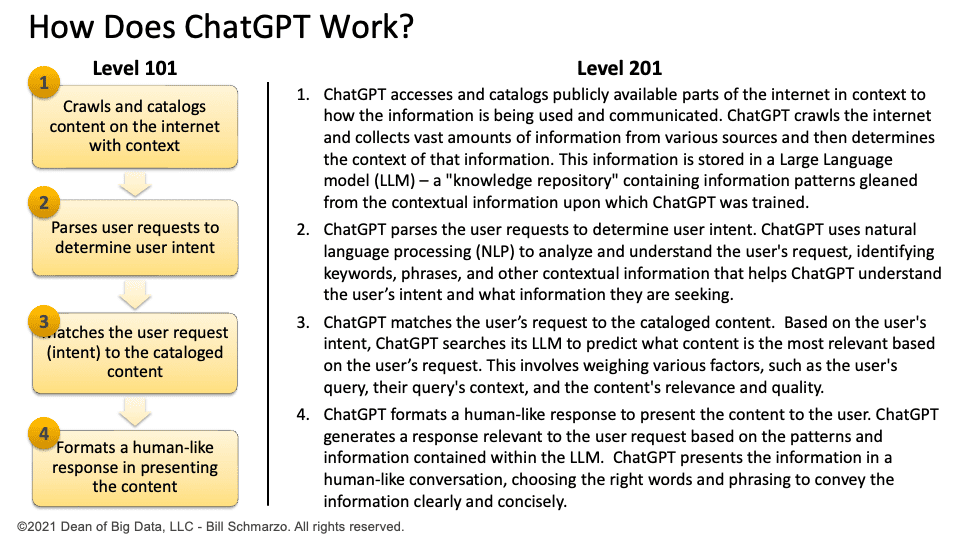
If I had to explain ChatGPT to my mother-in-law, I’d say that ChatGPT is a simple concept that does four things exceptionally well:
Level 101 (Mother-in-Law): How Does ChatGPT Work?
Accesses and catalogs public content on the internet
Parses user requests to understand user intent
Matches the user request (intent) to the cataloged content
Formats a human-like response in presenting the content
Yea, pretty simple.
Now, if my brother-in-law were to wander into the room and wanted to understand how ChatGPT works, I’d expand on each of the four tasks mentioned above:
Level 201 (Brother-in-Law): How Does ChatGPT Work?
ChatGPT accesses and catalogs publicly available parts of the internet in context to how the information is used and communicated. ChatGPT crawls the internet and collects vast amounts of information from various sources (e.g., websites, articles, blogs, digital books, and research papers) and then determines the context of that information. This information is stored in a Large Language model (LLM) – a “knowledge repository” containing information patterns gleaned from the contextual information upon which ChatGPT was trained.
ChatGPT parses the user requests to determine user intent. ChatGPT uses natural language processing (NLP) to analyze and understand the user’s request, identifying keywords, phrases, and other contextual information that helps ChatGPT understand the user’s intent and what information they seek.
ChatGPT matches the user’s request to the cataloged content. Based on the user’s intent, ChatGPT searches its LLM to predict the most relevant content based on the user’s request. This involves weighing various factors, such as the user’s query, their query’s context, and the content’s relevance and quality.
ChatGPT formats a human-like response to present the content to the user. ChatGPT generates a response relevant to the user request based on the patterns and information contained within the LLM. ChatGPT presents the information in a human-like conversation, choosing the right words and phrasing to convey the information clearly and concisely (Figure 1).
Figure 1: How Does ChatGPT Work?
Creating a Healthy ChatGPT AI Utility Function
ChatGPT, as a Large Language Model (LLM), is designed to optimize a utility function, which is the likelihood of generating coherent and meaningful text given a particular input. During training, the model learns to generate text that maximizes the probability of the target text given the input text (think of it as Google Search and Microsoft Word autocomplete on steroids). This optimization process involves adjusting the model’s parameters to minimize the difference between the generated and target text.
The AI Utility Function guides the behavior of ChatGPT, determining what responses the model generates based on the input it receives. The variables and metrics included in the AI utility function for ChatGPT depend on the specific task the model is being trained to perform. Some of the variables and metrics that are used in the ChatGPT AI Utility Function include:
Perplexity metrics assess how well the model can predict the next word given the preceding context. A lower perplexity indicates that the model is better at predicting the next word, generating more coherent and meaningful text.
Fluency metrics assess how well the generated text conforms to the rules of grammar and syntax. The AI utility function aims to generate fluent and grammatically correct text.
Coherence metrics assess how well the generated text relates to the input context. The AI utility function pursues to create coherent and semantically meaningful text given the input.
Diversity metrics assess how varied the generated text is. The AI utility function seeks to create diverse and interesting responses to keep the conversation engaging.
Relevance metrics assess how relevant the generated text is to the user’s query or input. The AI utility function aims to create relevant text for the user.
Emotion metrics assess effectiveness in generating emotional responses. The AI utility function can include metrics that aim to create reactions that convey a particular emotion, such as happiness, sadness, or anger.
Persuasion metrics assess the effectiveness of persuading users to take a particular action or adopt a certain perspective. The AI utility function can include metrics to generate effective and persuasive responses.
Factual accuracy metrics aim to create answers that are accurate and supported by evidence.
Personalization metrics aim to generate personalized and relevant responses to the user.
Trustworthiness metrics seek to assess verifiable responses based on credible sources.
These metrics could be incorporated into the ChatGPT AI Utility function (and maybe they already are) to guide ChatGPT to ensure that it generates effective, appropriate, and responsible responses.
Summary: How ChatGPT Came to Be
“What do you get when you 1) take a 2003 LLM paper, 2) add a dash of sentiment analysis from 2016, 3) transform with attention in 2017, and 4) stir in 2022 exponential computing and storage growth? GPT next word (or token) prediction models aren’t new. However, today’s scale is larger (and tomorrow’s scale will be even larger).”
This is how Jeff Frick summarized the development of ChatGPT in his LinkedIn post “Friday Five – Special OpenAI / ChatGPT Edition”:
Take a 2003 LLM Paper – “A Neural Probabilistic Language Model”
Add a dash of 2016 Sentiment Analysis – “Learning to Generate Reviews and Discovering Sentiment.”
Transform with Attention in 2017 – “Attention is all you need.”
Stir in 2022 exponential computing and storage growth.
And Voila, you have ChatGPT (and the world loses its collective mind).
By the way, consider reviewing these three documents as your Level 301 homework assignment. I expect book reports by the end of the semester!
Internal CPU Accelerators and HBM Enable Faster and Smarter HPC and AI Applications
We have now entered the era when processor designers can leverage modular semiconductor manufacturing capabilities to speed frequently performed operations (such as small tensor operations) and offload a variety of housekeeping tasks (such as copying and zeroing memory) to dedicated on-chip accelerators. The idea is to have software make the hardware work smarter. CPU designers can also incorporate high-bandwidth memory (HBM) modules to dramatically increase the amount of data per second that can be supplied to these accelerated processor cores. This means that these modular processors can work both faster and smarter as more of the accelerated cores can be kept busy processing data.
The technology Intel is delivering in the accelerator engines used in 4th Gen Intel® Xeon® processors reflects a phase transition as they are now delivering a choice of accelerator technology to customers. With the introduction of the HBM-enabled Intel® Xeon® CPU Max Series processors, Intel is now uniquely positioned to demonstrate the benefits of accelerated processor cores across a wide variety of AI and HPC data-intensive workloads. The benchmark results are compelling.[1]
HPC and AI users will be particularly interested in the accelerated capabilities of the Intel® Advanced Matrix Extensions (Intel® AMX) and the Intel® Data Streaming Accelerator (Intel® DSA).
Intel DSA: Intel benchmarks for the DSA vary according to workload and operation performed. Speedups include faster AI training by having the DSA zero memory in the kernel, increased IOP/s/core by offloading CRC generation during storage operations, and of course, MPI speedups that include higher throughput for shmem data copies. For example, Intel quotes a 1.7× increase in IOP/s rate for large sequential packet reads when using DSA compared to using the Intel® Intelligent Storage Acceleration Library without DSA.[2]
Intel AMX: Intel AMX delivers 3× to 10× higher inference and training performance versus the previous generation on AI workloads that use bint8 and bfloat16 matrix operations. [3] [4]
HPC architects and cloud users will also be interested in the performance per watt gains provided by these on-chip accelerators.
Modern Modular Semiconductor Architecture Design Requires an Ecosystem
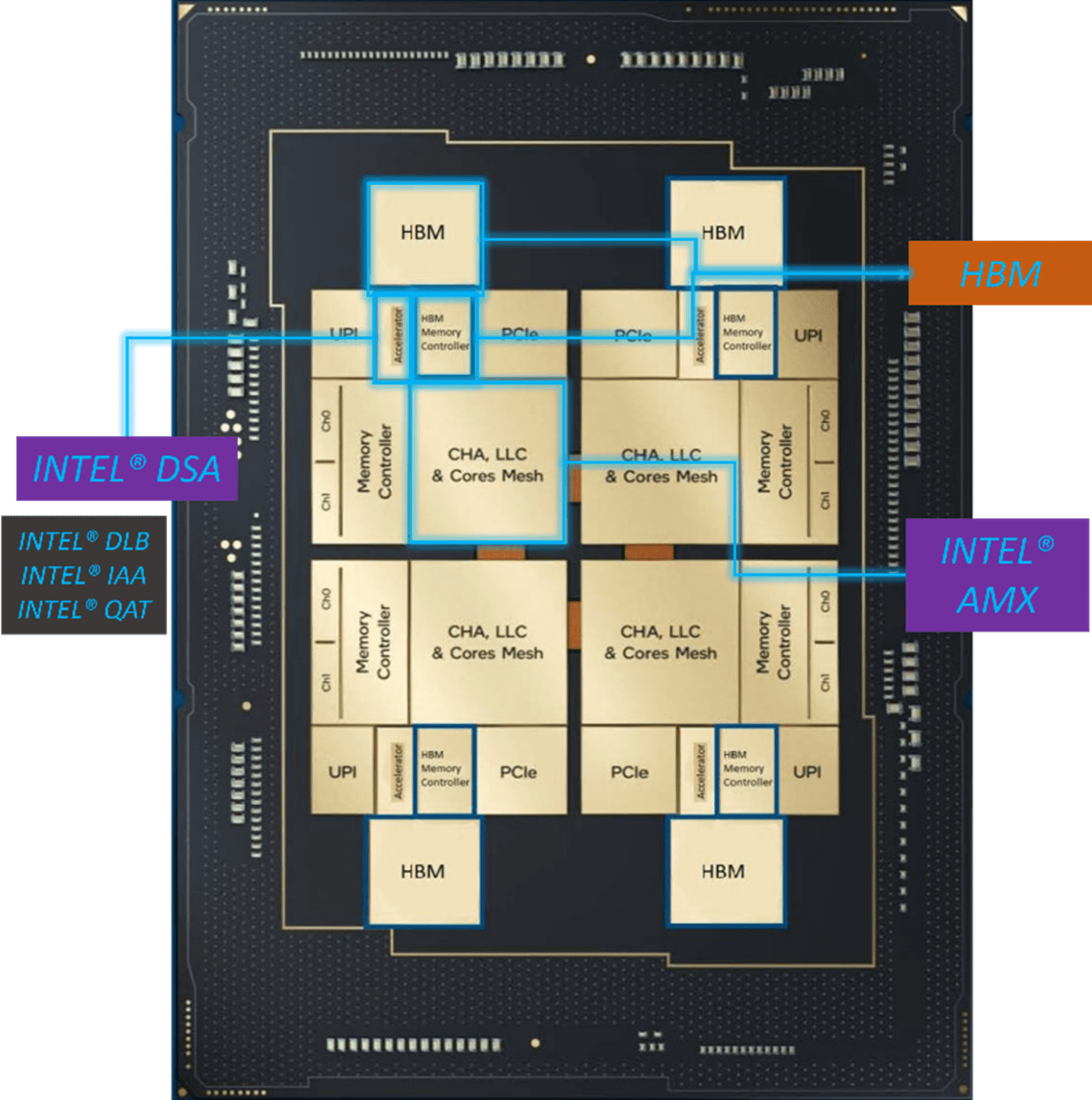
Intel AMX, Intel DSA, and on-chip HBM reflect the power of a design methodology that uses modular semiconductor building blocks (Figure 1). Chip modularity cannot be added in isolation. Along with the necessary manufacturing capability, this modularity also requires a scalability on-chip communications fabric such as the Intel Xeon Scalable processor mesh fabric.
Figure 1. The power of a modular design is shown in the Intel Xeon Max CPU. (Information about other acceleration engines such as Intel® Dynamic Load Balancer (Intel® DLB) , Intel® In-Memory Analytics Accelerator (Intel® IAA) , and Intel® QuickAssist Technology (Intel® QAT) can be found in the Intel Accelerator Engines Fact Sheet.) Purple tabs represent tehnologies that exist in both 4th Gen Intel Xeon processors and Intel Xeon Max processors.
Transitioning to modular hardware design also requires that the supporting software ecosystem transparently enable the use of the features of the modules and accelerators. Otherwise, software developers will become overwhelmed with having to support the combinatorics of all possible on-chip modules and accelerators.
Matching software capability to hardware modularity explains why Intel (a semiconductor manufacturing company) has invested extensively in oneAPI and an open ecosystem of libraries and standards-based software components. The Intel AMX extensions are transparently accessible from popular libraries and applications including TensorFlow and PyTorch. Intel DSA engine can be accessed via the IDXD kernel driver or Data Plane Development Kit (DPDK) supported drivers. Recent Linux kernels already support DSA for operations such as zeroing memory. The open-source libfabric library also uses the Intel DSA accelerator as does Intel® MPI.[5]
DSA
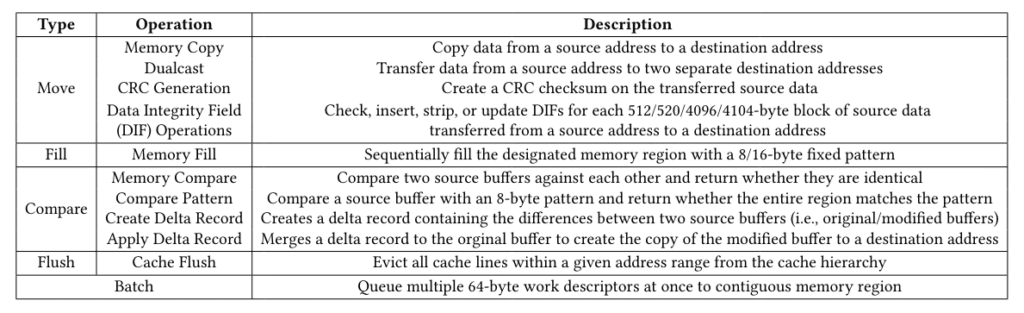
Intel DSA is a high-performance data copy that is also, importantly, a data transformation accelerator. It is designed to optimize streaming data movement and transformation operations that are common in high-performance storage, networking, persistent memory, and various data processing applications.
The goal of the accelerator is to provide higher overall system performance for workloads that involve lots of data movement and transformation operations by freeing CPU cycles to perform higher-level functions (Figure 2). The ability to perform data transformation operations makes the Intel DSA accelerator a far more capable accelerator than a simple DMA offload engine. Common Intel DSA operations include zeroing memory; generating and testing CRC checksums; and performing Data Integrity Field (DIF) calculations to support storage and networking applications — all at very high speed.
Figure 2. DSA performance metrics[6]
AMX
GPUs are well-known for accelerating small matrix operations and providing reduced precision arithmetic to speed up some AI workloads. Popular machine learning applications such as TensorFlow and PyTorch make it easy to use these capabilities on a GPU.
Intel introduced Intel AMX as a built-in accelerator to improve the performance of deep-learning training and inference on the CPU. Just as with a GPU, these Intel AMX capabilities can be accessed from popular AI libraries and applications.
Lisa Spelman, Intel corporate vice president and general manager of Intel Xeon products, highlighted the benefits in a recent March 2023 investor webinar by noting that in a head-to-head competition between a 48-core 4th Gen Intel Xeon and a 48-core 4th Gen AMD Epyc CPU, the 4th Gen Xeon delivered an average performance gain of 4 times the competition’s performance on a broad set of deep-learning workloads.[7] (See Figure 4 below for additional performance per watt benchmark results and other results reported on the web.)
Power Efficiency
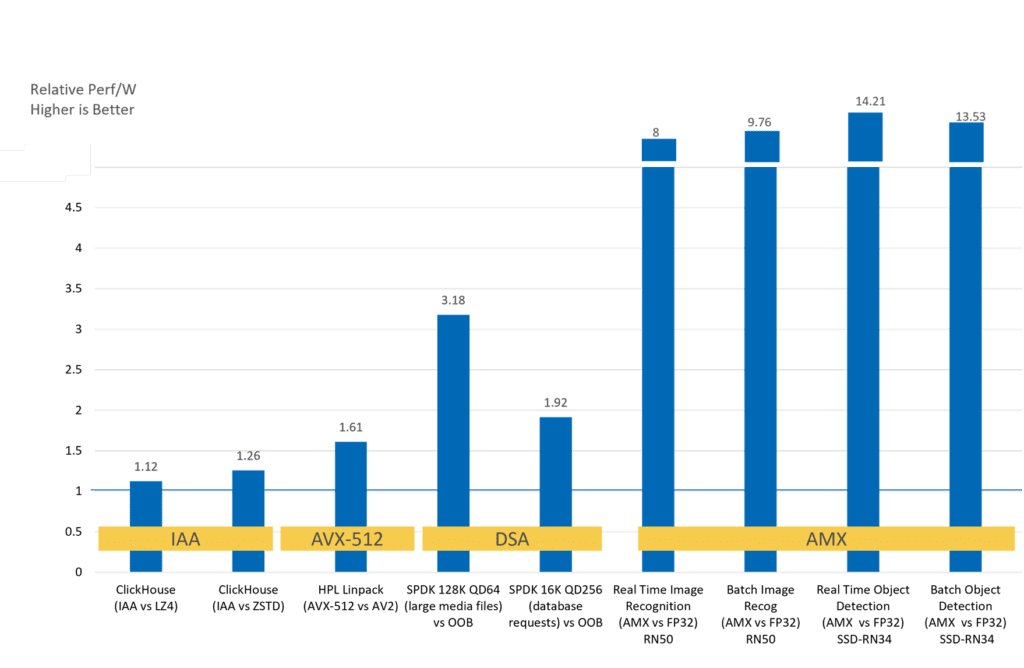
Along with increased application performance, accelerators can also deliver dramatic power benefits. Maximizing performance for every watt of power utilized is a major concern at HPC and cloud data centers around the world. Comparing the relative performance per watt on a 4th gen Intel Xeon processor running accelerated vs. non-accelerated software shows a significant performance per watt benefit — especially for Intel AMX accelerated workloads.
Figure 3. Accelerator performance per watt benchmarks[8].
HBM
HBM is a gateway technology to faster time-to-solution with real-world benefits. While the promise of peak performance may entice many with trillions of operations per second (TFlop/s), the reality is that actual performance for most applications ultimately depends on the memory subsystem. According to the HBM2e specification, a single stack can deliver up to 307 GB/s, but some manufacturers already exceed this.[9] The new Intel Xeon Max processors can realize more than 16 GB/s of HBM memory capacity per core without having to drop the core count. This can equate to significantly faster time to solve on many workloads (Figure 4).
Figure 4. Real-world Intel Xeon Max CPU performance reported by Intel.[10]
Memory is key to performance, which is why both the HBM and DDR5 memory controllers are tightly integrated inside the chip so they can work directly with HBM and DDR5 with high efficiency. This leverages the mesh architecture used by the Intel Xeon processors. Basically, each core and last-level cache (LLC) slice has a combined Caching and Home Agent (CHA), which provides scalability of resources across the mesh for Intel® Ultra Path Interconnect (Intel® UPI) cache coherency functionality without any hotspots (Figure 1). This means that each computes and HBM tile is a NUMA domain with associated local memory, which gives applications the ability to minimize the data movement across the chip and therefore increase performance.
Conclusion
Products based on modular semiconductor design and manufacturing are now entering the market. This means we can now evaluate accelerated processor designs that can speed frequently performed operations (such as small tensor operations) and offload a variety of housekeeping tasks like zeroing memory and performing CRC calculations. Even better, we can now also evaluate the benefits of faster HBM on data-intensive workloads along with the power and performance benefits accrued when these accelerated cores are provided with more data per unit of time. Thus far, the results are extremely encouraging.
Rob Farber is a technology consultant and author with an extensive background in HPC and machine learning technology.
[1] See also Getting More Out of Every High Performance Computing Core
[2] See [N18] at http://intel.com/processorclaims : 4th Gen Intel® Xeon® Scalable processors. Results may vary.
Intel® Xeon® 8380: Test by Intel as of 10/11/2022. 1-node, 2x Intel® Xeon® 8380 CPU, HT On, Turbo On, NUMA configuration SNC2, Total Memory 256 GB (16x16GB 3200MT/s, Dual-Rank), BIOS Version SE5C620.86B.01.01.0006.2207150335, ucode revision=0xd000375, Rocky Linux 8.6, Linux version 4.18.0-372.26.1.el8_6.crt1.x86_64, LAMMPS v2021-09-29 cmkl:2022.1.0, icc:2021.6.0, impi:2021.6.0, tbb:2021.6.0; threads/core:; Turbo:on; BuildKnobs:-O3 -ip -xCORE-AVX512 -g -debug inline-debug-info -qopt-zmm-usage=high;
Intel® Xeon® 8480+: Test by Intel as of 9/29/2022. 1-node, 2x Intel® Xeon® 8480+, HT On, Turbo On, SNC4, Total Memory 512 GB (16x32GB 4800MT/s, DDR5), BIOS Version SE5C7411.86B.8713.D03.2209091345, ucode revision=0x2b000070, Rocky Linux 8.6, Linux version 4.18.0-372.26.1.el8_6.crt1.x86_64, LAMMPS v2021-09-29 cmkl:2022.1.0, icc:2021.6.0, impi:2021.6.0, tbb:2021.6.0; threads/core:; Turbo:off; BuildKnobs:-O3 -ip -xCORE-AVX512 -g -debug inline-debug-info -qopt-zmm-usage=high;
Intel® Xeon® Max 9480: Test by Intel as of 9/29/2022. 1-node, 2x Intel® Xeon® Max 9480, HT ON, Turbo ON, NUMA configuration SNC4, Total Memory 128 GB (HBM2e at 3200 MHz), BIOS Version SE5C7411.86B.8424.D03.2208100444, ucode revision=0x2c000020, CentOS Stream 8, Linux version 5.19.0-rc6.0712.intel_next.1.x86_64+server, LAMMPS v2021-09-29 cmkl:2022.1.0, icc:2021.6.0, impi:2021.6.0, tbb:2021.6.0; threads/core:; Turbo:off; BuildKnobs:-O3 -ip -xCORE-AVX512 -g -debug inline-debug-info -qopt-zmm-usage=high;
DeePMD (Multi-Instance Training)
Intel® Xeon® 8380: Test by Intel as of 10/20/2022. 1-node, 2x Intel® Xeon® 8380 processor, Total Memory 256 GB, kernel 4.18.0-372.26.1.eI8_6.crt1.x86_64, compiler gcc (GCC) 8.5.0 20210514 (Red Hat 8.5.0-10), https://github.com/deepmodeling/deepmd-kit, Tensorflow 2.9, Horovod 0.24.0, oneCCL-2021.5.2, Python 3.9
3.9
Intel® Xeon® 8480+: Test by Intel as of 10/12/2022. 1-node, 2x Intel® Xeon® 8480+, Total Memory 512 GB, kernel 4.18.0-365.eI8_3x86_64, compiler gcc (GCC) 8.5.0 20210514 (Red Hat 8.5.0-10), https://github.com/deepmodeling/deepmd-kit, Tensorflow 2.9, Horovod 0.24.0, oneCCL-2021.5.2, Python 3.9
Intel® Xeon® Max 9480: Test by Intel as of 10/12/2022. 1-node, 2x Intel® Xeon® Max 9480, Total Memory 128 GB (HBM2e at 3200 MHz), kernel 5.19.0-rc6.0712.intel_next.1.x86_64+server, compiler gcc (GCC) 8.5.0 20210514 (Red Hat 8.5.0-13), https://github.com/deepmodeling/deepmd-kit, Tensorflow 2.9, Horovod 0.24.0, oneCCL-2021.5.2, Python 3.9
Quantum Espresso (AUSURF112, Water_EXX)
Intel® Xeon® 8380: Test by Intel as of 9/30/2022. 1-node, 2x Intel® Xeon® 8380 CPU, HT On, Turbo On, Total Memory 256 GB (16x16GB 3200MT/s, Dual-Rank), ucode revision=0xd000375, Rocky Linux 8.6, Linux version 4.18.0-372.26.1.el8_6.crt1.x86_64, Quantum Espresso 7.0, AUSURF112, Water_EXX
Intel® Xeon® 8480+: Test by Intel as of 9/2/2022. 1-node, 2x Intel® Xeon® 8480+, HT On, Turbo On, Total Memory 512 GB (16x32GB 4800MT/s, Dual-Rank), ucode revision= 0x90000c0, Rocky Linux 8.6, Linux version 4.18.0-372.26.1.el8_6.crt1.x86_64, Quantum Espresso 7.0, AUSURF112, Water_EXX
Intel® Xeon® Max 9480: Test by Intel as of 9/2/2022. 1-node, 2x Intel® Xeon® Max 9480, HT On, Turbo On, SNC4, Total Memory 128 GB (8x16GB HBM2 3200MT/s), ucode revision=0x2c000020, CentOS Stream 8, Linux version 5.19.0-rc6.0712.intel_next.1.x86_64+server, Quantum Espresso 7.0, AUSURF112, Water_EXX
ParSeNet (SplineNet)
Intel® Xeon® 8380: Test by Intel as of 10/18/2022. 1-node, 2x Intel® Xeon® 8380 CPU, HT On, Turbo On, Total Memory 256 GB (16x16GB 3200MT/s, Dual-Rank), BIOS Version SE5C6200.86B.0020.P23.2103261309, ucode revision=0xd000270, Rocky Linux 8.6, Linux version 4.18.0-372.19.1.el8_6.crt1.x86_64, ParSeNet (SplineNet), PyTorch 1.11.0, Torch-CCL 1.2.0, IPEX 1.10.0, MKL (20220804), oneDNN (v2.6.0)
Intel® Xeon® 8480+: Test by Intel as of 10/18/2022. 1-node, 2x Intel® Xeon® 8480+, HT On, Turbo On, Total Memory 512 GB (16x32GB 4800MT/s, Dual-Rank), BIOS Version EGSDCRB1.86B.0083.D22.2206290535, ucode revision=0xaa0000a0, CentOS Stream 8, Linux version 4.18.0-365.el8.x86_64, ParSeNet (SplineNet), PyTorch 1.11.0, Torch-CCL 1.2.0, IPEX 1.10.0, MKL (20220804), oneDNN (v2.6.0)
Intel® Xeon® Max 9480: Test by Intel as of 09/12/2022. 1-node, 2x Intel® Xeon® Max 9480, HT On, Turbo On, SNC4, Total Memory 128 GB (8x16GB HBM2 3200MT/s), BIOS Version SE5C7411.86B.8424.D03.2208100444, ucode revision=0x2c000020, CentOS Stream 8, Linux version 5.19.0-rc6.0712.intel_next.1.x86_64+server, ParSeNet (SplineNet), PyTorch 1.11.0, Torch-CCL 1.2.0, IPEX 1.10.0, MKL (20220804), oneDNN (v2.6.0)
CosmoFlow (training on 8192 image batches)
3rd Gen Intel® Xeon® Scalable Processor 8380 : Test by Intel as of 06/07/2022. 1-node, 2x Intel® Xeon® Scalable Processor 8380, 40 cores, HT On, Turbo On, Total Memory 512 GB (16 slots/ 32 GB/ 3200 MHz, DDR4), BIOS SE5C6200.86B.0022.D64.2105220049, ucode 0xd0002b1, OS Red Hat Enterprise Linux 8.5 (Ootpa), kernel 4.18.0-348.7.1.el8_5.x86_64, https://github.com/mlcommons/hpc/tree/main/cosmoflow, AVX-512, FP32, Tensorflow 2.9.0, horovod 0.23.0, keras 2.6.0, oneCCL-2021.4, oneAPI MPI 2021.4.0, ppn=8, LBS=16, ~25GB data, 16 epochs, Python 3.8
Intel® Xeon® 8480+ (AVX-512 FP32): Test by Intel as of 10/18/2022. 1 node, 2x Intel® Xeon® Xeon 8480+, HT On, Turbo On, Total Memory 512 GB (16 slots/ 32 GB/ 4800 MHz, DDR5), BIOS EGSDCRB1.86B.0083.D22.2206290535, ucode 0xaa0000a0, CentOS Stream 8, kernel 4.18.0-365.el8.x86_64, https://github.com/mlcommons/hpc/tree/main/cosmoflow, AVX-512, FP32, Tensorflow 2.6.0, horovod 0.23, keras 2.6.0, oneCCL 2021.5, ppn=8, LBS=16, ~25GB data, 16 epochs, Python 3.8
Intel® Xeon® Processor Max Series HBM (AVX-512 FP32): Test by Intel as of 10/18/2022. 1 node, 2x Intel® Xeon® Max 9480, HT On, Turbo On, Total Memory 128 HBM and 512 GB DDR (16 slots/ 32 GB/ 4800 MHz), BIOS SE5C7411.86B.8424.D03.2208100444, ucode 0x2c000020, CentOS Stream 8, kernel 5.19.0-rc6.0712.intel_next.1.x86_64+server, https://github.com/mlcommons/hpc/tree/main/cosmoflow, AVX-512, FP32, TensorFlow 2.6.0, horovod 0.23.0, keras 2.6.0, oneCCL 2021.5, ppn=8, LBS=16, ~25GB data, 16 epochs, Python 3.8
Intel® Xeon® 8480+ (AMX BF16): Test by Intel as of 10/18/2022. 1node, 2x Intel® Xeon® Platinum 8480+, HT On, Turbo On, Total Memory 512 GB (16 slots/ 32 GB/ 4800 MHz, DDR5), BIOS EGSDCRB1.86B.0083.D22.2206290535, ucode 0xaa0000a0, CentOS Stream 8, kernel 4.18.0-365.el8.x86_64, https://github.com/mlcommons/hpc/tree/main/cosmoflow, AMX, BF16, Tensorflow 2.9.1, horovod 0.24.3, keras 2.9.0.dev2022021708, oneCCL 2021.5, ppn=8, LBS=16, ~25GB data, 16 epochs, Python 3.8
Intel® Xeon® Max 9480 (AMX BF16): Test by Intel as of 10/18/2022. 1 node, 2x Intel® Xeon® Max 9480, HT On, Turbo On, Total Memory 128 HBM and 512 GB DDR (16 slots/ 32 GB/ 4800 MHz), BIOS SE5C7411.86B.8424.D03.2208100444, ucode 0x2c000020, CentOS Stream 8, kernel 5.19.0-rc6.0712.intel_next.1.x86_64+server, https://github.com/mlcommons/hpc/tree/main/cosmoflow, AMX, BF16, TensorFlow 2.9.1, horovod 0.24.0, keras 2.9.0.dev2022021708, oneCCL 2021.5, ppn=8, LBS=16, ~25GB data, 16 epochs, Python 3.9
DeepCAM
Intel® Xeon® Scalable Processor 8380: Test by Intel as of 04/07/2022. 1-node, 2x Intel® Xeon® 8380 processor, HT On, Turbo Off, Total Memory 512 GB (16 slots/ 32 GB/ 3200 MHz, DDR4), BIOS SE5C6200.86B.0022.D64.2105220049, ucode 0xd0002b1, OS Red Hat Enterprise Linux 8.5 (Ootpa), kernel 4.18.0-348.7.1.el8_5.x86_64, compiler gcc (GCC) 8.5.0 20210514 (Red Hat 8.5.0-4), https://github.com/mlcommons/hpc/tree/main/deepcam, torch1.11.0a0+git13cdb98, torch-1.11.0a0+git13cdb98-cp38-cp38-linux_x86_64.whl, torch_ccl-1.2.0+44e473a-cp38-cp38-linux_x86_64.whl, intel_extension_for_pytorch-1.10.0+cpu-cp38-cp38-linux_x86_64.whl (AVX-512), Intel MPI 2021.5, ppn=8, LBS=16, ~64GB data, 16 epochs, Python3.8
Intel® Xeon® Max 9480 (Cache Mode) AVX-512: Test by Intel as of 05/25/2022. 1-node, 2x Intel® Xeon® Max 9480, HT On,Turbo Off, Total Memory 128GB HBM and 1TB (16 slots/ 64 GB/ 4800 MHz, DDR5), Cluster Mode: SNC4, BIOS EGSDCRB1.86B.0080.D05.2205081330, ucode 0x8f000320, OS CentOS Stream 8, kernel 5.18.0-0523.intel_next.1.x86_64+server, compiler gcc (GCC) 8.5.0 20210514 (Red Hat 8.5.0-10, https://github.com/mlcommons/hpc/tree/main/deepcam, torch1.11.0a0+git13cdb98, AVX-512, FP32, torch-1.11.0a0+git13cdb98-cp38-cp38-linux_x86_64.whl, torch_ccl-1.2.0+44e473a-cp38-cp38-linux_x86_64.whl, intel_extension_for_pytorch-1.10.0+cpu-cp38-cp38-linux_x86_64.whl (AVX-512), Intel MPI 2021.5, ppn=8, LBS=16, ~64GB data, 16 epochs, Python3.8
Intel® Xeon® Max 9480 (Cache Mode) BF16/AMX: Test by Intel as of 05/25/2022. 1-node, 2x Intel® Xeon® Max 9480 , HT On, Turbo Off, Total Memory 128GB HBM and 1TB (16 slots/ 64 GB/ 4800 MHz, DDR5), Cluster Mode: SNC4, BIOS EGSDCRB1.86B.0080.D05.2205081330, ucode 0x8f000320, OS CentOS Stream 8, kernel 5.18.0-0523.intel_next.1.x86_64+server, compiler gcc (GCC) 8.5.0 20210514 (Red Hat 8.5.0-10), https://github.com/mlcommons/hpc/tree/main/deepcam, torch1.11.0a0+git13cdb98, AVX-512 FP32, torch-1.11.0a0+git13cdb98-cp38-cp38-linux_x86_64.whl, torch_ccl-1.2.0+44e473a-cp38-cp38-linux_x86_64.whl, intel_extension_for_pytorch-1.10.0+cpu-cp38-cp38-linux_x86_64.whl (AVX-512, AMX, BFloat16 Enabled), Intel MPI 2021.5, ppn=8, LBS=16, ~64GB data, 16 epochs, Python3.8
Intel® Xeon® 8480+s Mulit-Node cluster: Test by Intel as of 04/09/2022. 16-nodes Cluster, 1-node, 2x Intel® Xeon® 8480+, HT On, Turbo On, Total Memory 256 GB (16 slots/ 16 GB/ 4800 MHz, DDR5), BIOS Intel SE5C6301.86B.6712.D23.2111241351, ucode 0x8d000360, OS Red Hat Enterprise Linux 8.4 (Ootpa), kernel 4.18.0-305.el8.x86_64, compiler gcc (GCC) 8.4.1 20200928 (Red Hat 8.4.1-1), https://github.com/mlcommons/hpc/tree/main/deepcam, torch1.11.0a0+git13cdb98 AVX-512, FP32, torch-1.11.0a0+git13cdb98-cp38-cp38-linux_x86_64.whl, torch_ccl-1.2.0+44e473a-cp38-cp38-linux_x86_64.whl, intel_extension_for_pytorch-1.10.0+cpu-cp38-cp38-linux_x86_64.whl (AVX-512), Intel MPI 2021.5, ppn=4, LBS=16, ~1024GB data, 16 epochs, Python3.8
WRF4.4 – CONUS-2.5km
Intel Xeon 8360Y: Test by Intel as of 2/9/23, 2x Intel Xeon 8360Y, HT On, Turbo On, NUMA configuration SNC2, 256 GB (16x16GB 3200MT/s, Dual-Rank), BIOS Version SE5C620.86B.01.01.0006.2207150335, ucode revision=0xd000375, Rocky Linux 8.6, Linux version 4.18.0-372.26.1.el8_6.crt1.x86_64, WRF v4.4 built with Intel® Fortran Compiler Classic and Intel® MPI from 2022.3 Intel® oneAPI HPC Toolkit with compiler flags ”-ip -O3 -xCORE-AVX512 -fp-model fast=2 -no-prec-div -no-prec-sqrt -fimf-precision=low -w -ftz -align array64byte -fno-alias -fimf-use-svml=true -inline-max-size=12000 -inline-max-total-size=30000 -vec-threshold0 -qno-opt-dynamic-align ”. HDR Fabric
Intel Xeon 8480+: Test by Intel as of 2/9/23, 2x Intel Xeon 8480+, HT On, Turbo On, NUMA configuration SNC4, 512 GB (16x32GB 4800MT/s, Dual-Rank), BIOS Version SE5C7411.86B.8713.D03.2209091345, ucode revision=0x2b000070, Rocky Linux 8.6, Linux version 4.18.0-372.26.1.el8_6.crt1.x86_64, WRF v4.4 built with Intel® Fortran Compiler Classic and Intel® MPI from 2022.3 Intel® oneAPI HPC Toolkit with compiler flags “-ip -O3 -xCORE-AVX512 -fp-model fast=2 -no-prec-div -no-prec-sqrt -fimf-precision=low -w -ftz -align array64byte -fno-alias -fimf-use-svml=true -inline-max-size=12000 -inline-max-total-size=30000 -vec-threshold0 -qno-opt-dynamic-align ”. HDR Fabric
Intel Xeon Max 9480: Test by Intel as of 2/9/23, 2x Intel® Xeon® Max 9480, HT ON, Turbo ON, NUMA configuration SNC4, 128 GB HBM2e at 3200 MHz and 512 GB DDR5-4800, BIOS Version SE5C7411.86B.8424.D03.2208100444, ucode revision=0x2c000020, CentOS Stream 8, Linux version 5.19.0-rc6.0712.intel_next.1.x86_64+server, WRF v4.4 built with Intel® Fortran Compiler Classic and Intel® MPI from 2022.3 Intel® oneAPI HPC Toolkit with compiler flags “-ip -O3 -xCORE-AVX512 -fp-model fast=2 -no-prec-div -no-prec-sqrt -fimf-precision=low -w -ftz -align array64byte -fno-alias -fimf-use-svml=true -inline-max-size=12000 -inline-max-total-size=30000 -vec-threshold0 -qno-opt-dynamic-align ”. HDR Fabric
Intel® Xeon® 8380: Test by Intel as of 10/12/2022. 1-node, 2x Intel® Xeon® 8380 CPU, HT On, Turbo On, NUMA configuration SNC2, Total Memory 256 GB (16x16GB 3200MT/s, Dual-Rank), BIOS Version SE5C620.86B.01.01.0006.2207150335, ucode revision=0xd000375, Rocky Linux 8.6, Linux version 4.18.0-372.26.1.el8_6.crt1.x86_64, ROMS V4 build with Intel® Fortran Compiler Classic and Intel® MPI from 2022.3 Intel® oneAPI HPC Toolkit with compiler flags “-ip -O3 -heap-arrays -xCORE-AVX512 -qopt-zmm-usage=high -align array64byte -fimf-use-svml=true -fp-model fast=2 -no-prec-div -no-prec-sqrt -fimf-precision=low”, ROMS V4
Intel® Xeon® 8480+: Test by Intel as of 10/12/2022. 1-node, 2x Intel® Xeon® 8480+, HT On, Turbo On, NUMA configuration SNC4, Total Memory 512 GB (16x32GB 4800MT/s, Dual-Rank), BIOS Version SE5C7411.86B.8713.D03.2209091345, ucode revision=0x2b000070, Rocky Linux 8.6, Linux version 4.18.0-372.26.1.el8_6.crt1.x86_64, ROMS V4 build with Intel® Fortran Compiler Classic and Intel® MPI from 2022.3 Intel® oneAPI HPC Toolkit with compiler flags “-ip -O3 -heap-arrays -xCORE-AVX512 -qopt-zmm-usage=high -align array64byte -fimf-use-svml=true -fp-model fast=2 -no-prec-div -no-prec-sqrt -fimf-precision=low”, ROMS V4
Intel® Xeon® Max 9480: Test by Intel as of 10/12/2022. 1-node, 2x Intel® Xeon® Max 9480, HT ON, Turbo ON, NUMA configuration SNC4, Total Memory 128 GB (HBM2e at 3200 MHz), BIOS Version SE5C7411.86B.8424.D03.2208100444, ucode revision=0x2c000020, CentOS Stream 8, Linux version 5.19.0-rc6.0712.intel_next.1.x86_64+server, ROMS V4 build with Intel® Fortran Compiler Classic and Intel® MPI from 2022.3 Intel® oneAPI HPC Toolkit with compiler flags “-ip -O3 -heap-arrays -xCORE-AVX512 -qopt-zmm-usage=high -align array64byte -fimf-use-svml=true -fp-model fast=2 -no-prec-div -no-prec-sqrt -fimf-precision=low”, ROMS V4
NEMO (GYRE_PISCES_25, BENCH ORCA-1)
Intel® Xeon® 8380: Test by Intel as of 10/12/2022. 1-node, 2x Intel® Xeon® 8380 CPU, HT On, Turbo On, NUMA configuration SNC2, Total Memory 256 GB (16x16GB 3200MT/s, Dual-Rank), BIOS Version SE5C620.86B.01.01.0006.2207150335, ucode revision=0xd000375, Rocky Linux 8.6, Linux version 4.18.0-372.26.1.el8_6.crt1.x86_64, NEMO v4.2 build with Intel® Fortran Compiler Classic and Intel® MPI from 2022.3 Intel® oneAPI HPC Toolkit with compiler flags ”-i4 -r8 -O3 -fno-alias -march=core-avx2 -fp-model fast=2 -no-prec-div -no-prec-sqrt -align array64byte -fimf-use-svml=true”
Intel® Xeon® Max 9480: Test by Intel as of 10/12/2022. 1-node, 2x Intel® Xeon® Max 9480, HT ON, Turbo ON, NUMA configuration SNC4, Total Memory 128 GB (HBM2e at 3200 MHz), BIOS Version SE5C7411.86B.8424.D03.2208100444, ucode revision=0x2c000020, CentOS Stream 8, Linux version 5.19.0-rc6.0712.intel_next.1.x86_64+server, NEMO v4.2 build with Intel® Fortran Compiler Classic and Intel® MPI from 2022.3 Intel® oneAPI HPC Toolkit with compiler flags “-i4 -r8 -O3 -fno-alias -march=core-avx2 -fp-model fast=2 -no-prec-div -no-prec-sqrt -align array64byte -fimf-use-svml=true”.
Ansys Fluent
Intel Xeon 8380: Test by Intel as of 08/24/2022, 2x Intel® Xeon® 8380, HT ON, Turbo ON, Hemisphere, 256 GB DDR4-3200, BIOS Version SE5C620.86B.01.01.0006.2207150335, ucode 0xd000375, Rocky Linux 8.7, kernel version 4.18.0-372.32.1.el8_6.crt2.x86_64, Ansys Fluent 2022R1 . HDR Fabric
Intel Xeon 8480+: Test by Intel as of 2/11/2023, 2x Intel® Xeon® 8480+, HT ON, Turbo ON, SNC4 Mode, 512 GB DDR5-4800, BIOS Version SE5C7411.86B.8901.D03.2210131232, ucode 0x2b0000a1, Rocky Linux 8.7, kernel version 4.18.0-372.32.1.el8_6.crt2.x86_64, Ansys Fluent 2022R1. HDR Fabric
Intel Xeon Max 9480: Test by Intel as of 02/15/2023, 2x Intel Xeon Max 9480, HT ON, Turbo ON, SNC4, SNC4 and Fake Numa for Cache Mode runs, 128 GB HBM2e at 3200 MHz and 512 GB DDR5-4800, BIOS Version SE5C7411.86B.9409.D04.2212261349, ucode 0xac000100, Rocky Linux 8.7, kernel version 4.18.0-372.32.1.el8_6.crt2.x86_64, Ansys Fluent 2022R1. HDR Fabric
Ansys LS-DYNA (ODB-10M)
Intel® Xeon® 8380: Test by Intel as of 10/7/2022. 1-node, 2x Intel® Xeon® 8380 CPU, HT On, Turbo On, Total Memory 256 GB (16x16GB 3200MT/s DDR4), BIOS Version SE5C620.86B.01.01.0006.2207150335, ucode revision=0xd000375, Rocky Linux 8.6, Linux version 4.18.0-372.26.1.el8_6.crt1.x86_64, LS-DYNA R11
Intel® Xeon® 8480+: Test by Intel as of ww41’22. 1-node, 2x Intel® Xeon® 8480+, HT On, Turbo On, SNC4, Total Memory 512 GB (16x32GB 4800MT/s, DDR5), BIOS Version SE5C7411.86B.8713.D03.2209091345, ucode revision=0x2b000070, Rocky Linux 8.6, Linux version 4.18.0-372.26.1.el8_6.crt1.x86_64, LS-DYNA R11
Intel® Xeon® Max 9480: Test by Intel as of ww36’22. 1-node, 2x Intel® Xeon® Max 9480, HT
Intel® Xeon® 8380: Test by Intel as of 08/24/2022. 1-node, 2x Intel® Xeon® 8380, HT ON, Turbo ON, Quad, Total Memory 256 GB, BIOS Version SE5C6200.86B.0020.P23.2103261309, ucode 0xd000270, Rocky Linux 8.6, kernel version 4.18.0-372.19.1.el8_6.crt1.x86_64, Ansys Mechanical 2022 R2
AMD EPYC 7763: Test by Intel as of 8/24/2022. 1-node, 2x AMD EPYC 7763, HT On, Turbo On, NPS2,Total Memory 512 GB, BIOS ver. Ver 2.1 Rev 5.22, ucode 0xa001144, Rocky Linux 8.6, kernel version 4.18.0-372.19.1.el8_6.crt1.x86_64, Ansys Mechanical 2022 R2
AMD EPYC 7773X: Test by Intel as of 8/24/2022. 1-node, 2x AMD EPYC 7773X, HT On, Turbo On, NPS4,Total Memory 512 GB, BIOS ver. M10, ucode 0xa001229, CentOS Stream 8, kernel version 4.18.0-383.el8.x86_6, Ansys Mechanical 2022 R2
Intel® Xeon® 8480+: Test by Intel as of 09/02/2022. 1-node, 2x Intel® Xeon® 8480+, HT ON, Turbo ON, SNC4, Total Memory 512 GB DDR5 4800 MT/s, BIOS Version EGSDCRB1.86B.0083.D22.2206290535, ucode 0xaa0000a0, CentOS Stream 8, kernel version 4.18.0-365.el8.x86_64, Ansys Mechanical 2022 R2
Intel® Xeon® Max 9480: Test by Intel as of 08/31/2022. 1-node, 2x Intel® Xeon® Max 9480, HT On, Turbo ON, SNC4, Total Memory 512 GB DDR5 4800 MT/s, 128 GB HBM in Cache Mode (HBM2e at 3200 MHz), BIOS Version SE5C7411.86B.8424.D03.2208100444, ucode 2c000020, CentOS Stream 8, kernel version 5.19.0-rc6.0712.intel_next.1.x86_64+server, Ansys Mechanical 2022 R2
Altair AcuSolve (HQ Model)
Intel® Xeon® 8380: Test by Intel as of 09/28/2022. 1-node, 2x Intel® Xeon® 8380, HT ON, Turbo ON, Quad, Total Memory 256 GB, BIOS Version SE5C6200.86B.0020.P23.2103261309, ucode 0xd000270, Rocky Linux 8.6, kernel version 4.18.0-372.19.1.el8_6.crt1.x86_64, Altair AcuSolve 2021R2
Intel® Xeon® 6346: Test by Intel as of 10/08/2022. 4-nodes connected via HDR-200, 2x Intel® Xeon® 6346, 16 cores, HT ON, Turbo ON, Quad, Total Memory 256 GB, BIOS Version SE5C6200.86B.0020.P23.2103261309, ucode 0xd000270, Rocky Linux 8.6, kernel version 4.18.0-372.19.1.el8_6.crt1.x86_64, Altair AcuSolve 2021R2
Intel® Xeon® 8480+: Test by Intel as of 09/28/2022. 1-node, 2x Intel® Xeon® 8480+, HT ON, Turbo ON, SNC4, Total Memory 512 GB, BIOS Version EGSDCRB1.86B.0083.D22.2206290535, ucode 0xaa0000a0, CentOS Stream 8, kernel version 4.18.0-365.el8.x86_64, Altair AcuSove 2021R2
Intel® Xeon® Max 9480: Test by Intel as of 10/03/2022. 1-node, 2x Intel® Xeon® Max 9480, HT ON, Turbo ON, SNC4, Total Memory 128 GB (HBM2e at 3200 MHz), BIOS Version SE5C7411.86B.8424.D03.2208100444, ucode 2c000020, CentOS Stream 8, kernel version 5.19.0-rc6.0712.intel_next.1.x86_64+server, Altair AcuSolve 2021R2
OpenFOAM (Geomean of Motorbike 20M, Motorbike 42M)
Intel® Xeon® 8380: Test by Intel as of 9/2/2022. 1-node, 2x Intel® Xeon® 8380 CPU, HT On, Turbo On, Total Memory 256 GB (16x16GB 3200MT/s, Dual-Rank), BIOS Version SE5C6200.86B.0020.P23.2103261309, ucode revision=0xd000270, Rocky Linux 8.6, Linux version 4.18.0-372.19.1.el8_6.crt1.x86_64, OpenFOAM 8, Motorbike 20M @ 250 iterations, Motorbike 42M @ 250 iterations
Intel® Xeon® 8480+: Test by Intel as of 9/2/2022. 1-node, 2x Intel® Xeon® 8480+, HT On, Turbo On, Total Memory 512 GB (16x32GB 4800MT/s, Dual-Rank), BIOS Version EGSDCRB1.86B.0083.D22.2206290535, ucode revision=0xaa0000a0, CentOS Stream 8, Linux version 4.18.0-365.el8.x86_64, OpenFOAM 8, Motorbike 20M @ 250 iterations, Motorbike 42M @ 250 iterations
Intel® Xeon® Max 9480: Test by Intel as of 9/2/2022. 1-node, 2x Intel® Xeon® Max 9480, HT On, Turbo On, SNC4, Total Memory 128 GB (8x16GB HBM2 3200MT/s), BIOS Version SE5C7411.86B.8424.D03.2208100444, ucode revision=0x2c000020, CentOS Stream 8, Linux version 5.19.0-rc6.0712.intel_next.1.x86_64+server, OpenFOAM 8, Motorbike 20M @ 250 iterations, Motorbike 42M @ 250 iterations
MPAS-A (MPAS-A V7.3 60-km dynamical core)
Intel® Xeon® 8380: Test by Intel as of 10/12/2022. 1-node, 2x Intel® Xeon® 8380 CPU, HT On, Turbo On, NUMA configuration SNC2, Total Memory 256 GB (16x16GB 3200MT/s, Dual-Rank), BIOS Version SE5C620.86B.01.01.0006.2207150335, ucode revision=0xd000375, Rocky Linux 8.6, Linux version 4.18.0-372.26.1.el8_6.crt1.x86_64, MPAS-A V7.3 build with Intel® Fortran Compiler Classic and Intel® MPI from 2022.3 Intel® oneAPI HPC Toolkit with compiler flags “-O3 -march=core-avx2 -convert big_endian -free -align array64byte -fimf-use-svml=true -fp-model fast=2 -no-prec-div -no-prec-sqrt -fimf-precision=low”, MPAS-A V7.3
Intel® Xeon® 8480+: Test by Intel as of 10/12/2022. 1-node, 2x Intel® Xeon® 8480+, HT On, Turbo On, NUMA configuration SNC4, Total Memory 512 GB (16x32GB 4800MT/s, Dual-Rank), BIOS Version SE5C7411.86B.8713.D03.2209091345, ucode revision=0x2b000070, Rocky Linux 8.6, Linux version 4.18.0-372.26.1.el8_6.crt1.x86_64, MPAS-A V7.3 build with Intel® Fortran Compiler Classic and Intel® MPI from 2022.3 Intel® oneAPI HPC Toolkit with compiler flags “-O3 -march=core-avx2 -convert big_endian -free -align array64byte -fimf-use-svml=true -fp-model fast=2 -no-prec-div -no-prec-sqrt -fimf-precision=low”, MPAS-A V7.3
Intel® Xeon® Max 9480: Test by Intel as of 10/12/22. 1-node, 2x Intel® Xeon® Max 9480, HT ON, Turbo ON, NUMA configuration SNC4, Total Memory 128 GB (HBM2e at 3200 MHz), BIOS Version SE5C7411.86B.8424.D03.2208100444, ucode revision=0x2c000020, CentOS Stream 8, Linux version 5.19.0-rc6.0712.intel_next.1.x86_64+server, MPAS-A V7.3 build with Intel® Fortran Compiler Classic and Intel® MPI from 2022.3 Intel® oneAPI HPC Toolkit with compiler flags “-O3 -march=core-avx2 -convert big_endian -free -align array64byte -fimf-use-svml=true -fp-model fast=2 -no-prec-div -no-prec-sqrt -fimf-precision=low”, MPAS-A V7.3
Intel® Xeon® 8380: Test by Intel as of 10/7/2022. 1-node, 2x Intel® Xeon® 8380 CPU, HT On, Turbo On, NUMA configuration SNC2, Total Memory 256 GB (16x16GB 3200MT/s, Dual-Rank), BIOS Version SE5C620.86B.01.01.0006.2207150335, ucode revision=0xd000375, Rocky Linux 8.6, Linux version 4.18.0-372.26.1.el8_6.crt1.x86_64, Converge GROMACS v2021.4_SP
Intel® Xeon® 8480+: Test by Intel as of 10/7/2022. 1-node, 2x Intel® Xeon® 8480+, HT On, Turbo On, SNC4, Total Memory 512 GB (16x32GB 4800MT/s, DDR5), BIOS Version SE5C7411.86B.8713.D03.2209091345, ucode revision=0x2b000070, Rocky Linux 8.6, Linux version 4.18.0-372.26.1.el8_6.crt1.x86_64, GROMACS v2021.4_SP
Intel® Xeon® Max 9480: Test by Intel as of 9/2/2022. 1-node, 2x Intel® Xeon® Max 9480, HT ON, Turbo ON, NUMA configuration SNC4, Total Memory 128 GB (HBM2e at 3200 MHz), BIOS Version SE5C7411.86B.8424.D03.2208100444, ucode revision=0x2c000020, CentOS Stream 8, Linux version 5.19.0-rc6.0712.intel_next.1.x86_64+server, GROMACS v2021.4_SP
This article was produced as part of Intel’s editorial program, with the goal of highlighting cutting-edge science, research and innovation driven by the HPC and AI communities through advanced technology. The publisher of the content has final editing rights and determines what articles are published.
With the growth in data and the adoption of cloud architecture or hybrid with data spread across cloud and on-premise, both producers and consumers of data are shifting away from the traditional ideologies around Centralized Data Ownership towards new principles around “Decentralized Data Ownership.” Instead of flowing the data into a central location, more and more domain owners are adopting the principles of “Data as a product” and serving datasets in an easily consumable way using self-service data infrastructures. Today’s modern data teams use a variety of architectures ranging from Cloud Warehouse to Lakehouse, Data Virtualization to Data Fabrics or Mesh to suit their varying needs of speed and compute power.
When it comes to leveraging data for improved day-to-day operations or better Strategic decisions, organizations need to look across both perspectives of minds – Data minds and Business minds as below.
Data Minds are data producers (predominantly Data engineers) who build infrastructure and data products for consumption by business users or end users. Business minds are data consumers of this made-available data that perform analysis to aid in business decisions or strategies. Both of these minds view data differently based on their roles, and their view of data quality is very different, as are their measurement and observations made. Different personas ( Data Engineers, Scientists, Data Stewards, Data Analysts, etc.) look at the same data through different lenses; however, they still need to come together and collaborate to win. This support of various personas is foundational and critical for better business outcomes and to enable organizations to become more data-driven.
To facilitate collaboration across personas and establish “Decentralized Data Ownership,” we should move away from traditional methods to converge multiple capabilities in one platform, such as data observability, business quality, and semantic discovery. In these so-called Modern Data Quality platforms, various personas can collaborate meaningfully to make organizations more data-driven and deliver reliable and accurate data. This shift also requires moving from rule-based manual data quality checks to a more automated, continuous, and semantic-powered Modern Data Quality Platform harnessing the combined power of Data Observability, Data Quality Stewardship, and Semantic Discovery.
However, being a Modern Data Quality Platform is more than that. Below is a detailed comparison of what makes the Modern Data Quality Platform different from Traditional/Legacy Data Quality and quite powerful. With Modern Data Quality, not only you can do automatically observe data reliability checks either on pipelines or at warehouses but also business “fit-for-purpose” checks across your ecosystem irrespective of cloud, on-premise, or hybrid.
In recent years, businesses have been turning to artificial intelligence (AI) tools to improve their customer service and engagement. One such tool that has gained popularity is ChatGPT, an AI-powered chatbot that uses natural language processing (NLP) to engage with users and provide them with personalized responses. Integrating ChatGPT into your business’s app can bring many benefits, including increased efficiency, cost savings, and improved customer satisfaction.
Integrating ChatGPT into your app offers several benefits, including increased efficiency. By using ChatGPT for customer inquiries, businesses can reduce the workload on their customer service teams. This frees up their time to tackle more complex issues. ChatGPT can also handle a high volume of inquiries simultaneously, enabling businesses to serve more customers at once without the need for additional staff.
In addition to the benefits mentioned above, ChatGPT integration services can provide businesses with valuable insights into customer behavior and preferences. By analyzing customer interactions with ChatGPT, businesses can identify common pain points and areas for improvement, allowing them to fine-tune their products and services to better meet customer needs. These insights can also inform marketing and sales strategies, helping businesses to more effectively target their messaging and drive conversions. Overall, ChatGPT integration services can be a powerful tool for businesses looking to streamline their operations, reduce costs, and improve the customer experience.
Another benefit of integrating ChatGPT into your app is cost savings. Hiring additional staff to handle customer inquiries can be expensive, especially for small businesses. By using ChatGPT, businesses can reduce their staffing costs and save money on salaries, benefits, and training.
Furthermore, ChatGPT is a scalable solution, which means that it can handle an increasing volume of inquiries as a business grows without requiring additional resources. This makes it an attractive option for businesses of all sizes, from startups to established enterprises.
Improved customer satisfaction is another advantage of integrating ChatGPT into your app. ChatGPT can provide personalized responses to customer inquiries, making customers feel heard and valued. By providing quick and accurate responses to their inquiries, ChatGPT can improve the overall customer experience and increase customer loyalty.
ChatGPT can also provide proactive support by reaching out to customers to offer assistance or provide information. This can help businesses anticipate customer needs and provide a higher level of service. In addition, ChatGPT can learn from customer interactions, allowing it to provide more personalized responses over time and improve the overall customer experience.
If you’re looking to showcase your business as technologically advanced and provide your customers with top-notch support, consider opting for ChatGPT integration services into your app. AI-powered chatbots are becoming more prevalent in businesses, and customers expect this kind of support from every organization. Integrating a chatbot into your app can help you differentiate yourself from competitors and meet your customers’ expectations for smooth communication.
Integrating ChatGPT into your app is also relatively easy. ChatGPT provides an API that can be integrated into your app with minimal coding knowledge. This means that businesses can get up and running quickly and start reaping the benefits of ChatGPT right away.
There are a few things to keep in mind when integrating ChatGPT into your app. First, it’s important to set clear expectations for what ChatGPT can and cannot do. While ChatGPT is very capable, there may be certain inquiries that it cannot handle, and it’s important to communicate this to customers upfront.
Second, it’s important to continually monitor and refine ChatGPT’s performance. ChatGPT can learn from customer interactions, but it’s important to review its responses and make adjustments as needed to ensure that it’s providing accurate and helpful information.
Third, businesses should be transparent about their use of ChatGPT. While customers generally appreciate the speed and convenience of chatbots, some may prefer to speak with a human agent. It’s important to give customers the option to speak with a human agent if they prefer.
Integrating ChatGPT into your app can benefit businesses in many ways. These benefits include increased efficiency, cost savings, improved customer satisfaction, and staying ahead of the competition. ChatGPT is easy to integrate and can provide personalized responses, proactive assistance, and 24/7 support. To ensure optimal performance, businesses should set clear expectations, monitor and refine ChatGPT’s performance, and offer the option to speak with a human agent if customers prefer. Using ChatGPT together with human customer service can create a winning customer experience that sets businesses apart from the competition.