Home shopping is not for the faint of heart, especially in this economy. Using mobile apps like Zillow, however, can help make the process run a bit smoother. Now, the real estate website is announcing the integration of a new ChatGPT plugin for real estate searches.
The new addition could make home searching a less painful process, making a real estate search as easy as a conversation with the AI chatbot. Users could simply ask ChatGPT to show them listings within a set price range, ask whether a specific listing is for sale or for rent, what the bedroom and bathroom counts are, and more.
Also: ChatGPT is the most sought out tech skill in the workforce, says learning platform
ChatGPT, launched by OpenAI last fall, is a conversational bot based on the company's large language models, GPT-3.5 in the free version or GPT-4 for Plus users, that uses natural language processing to have text conversations with users that can feel a lot like chatting with a real human.
People use ChatGPT to generate text for writing projects, translations, and to answer basic questions. Its versatility, however, is much more far-reaching, as it can also write code and debug it, Excel formulas, and, now, search for homes.
Also: AI might enable us to talk to animals soon. Here's how
Zillow is no stranger to artificial intelligence; the website has used machine learning to generate its trademark for Zestimate since 2006, employing a proprietary algorithm to calculate a home's estimated market value by combining the home's facts, location, market trends, and public, MLS, and user-submitted information.
The company also uses AI to generate immersive floor plans for listed properties and to perform natural language searches.
Also: ChatGPT's 'accomplishment engine' is beating Google's search engine, says AI ethicist
According to Zillow CTO, David Beitel, this is just the beginning, "As the first major residential real estate marketplace to bring advanced, AI-powered search to the home-shopping experience, we understand its immense potential, and we look forward to developing more tech innovations with OpenAI technology in the future."
OpenAI's ChatGPT-4 plugins are only available for a select number of users on a waitlist basis, with plans to expand in a larger-scale over time. Right now, the Zillow ChatGPT is in its alpha phase, allowing the company to fine-tune the user experience, so it is unclear when it will be available to all users.
Is this the future that experts (and sci-fi movies) warned us about? Artificial intelligence, at the center of tech discussions since the launch of the widely popular ChatGPT last fall, has the power to automate at least some jobs, according to reports. "Some jobs" translates to 7,800 for IBM.
Also: ChatGPT's popularity with students slices Chegg's stock nearly in half
IBM CEO Arvind Krishna said in an interview with Bloomberg that the transition won't be immediate. The company will first pause hiring for those roles it deems could be replaced by artificial intelligence, particularly those for back-office or non-customer-facing roles.
Also: Generative AI is changing your technology career path. What to know
Krishna explained these roles account for about 26,000 employees at this time, of which he believes 30% (or 7,800) could be fully automated by AI. This would amount to about 3% of the total IBM workforce.
Using the human resources department as an example of non-customer-facing functions, Krishna told Bloomberg that simple duties like employment verification letters and transferring employees between departments will be handled by artificial intelligence. He expects tasks that require human scrutiny won't be automated for at least a decade, like evaluating workforce composition and productivity.
Also: I used ChatGPT to write the same routine in these ten obscure programming languages
Independent of this move, IBM announced 3,900 job cuts in late January. However, many of the roles reduced due to AI will likely come as a result of the upcoming hiring freeze and jobs vacated by attrition.
Samsung bans AI for its staff
Samsung announced a new policy last week for its employees: Banning the use of generative AI tools after learning staff had uploaded sensitive code in conversations with ChatGPT.
In early April, The Economist Korea reported three different instances where employees entered source code into ChatGPT requesting code optimization and debugging. The third employee shared recorded meeting transcripts with ChatGPT, requesting the AI chatbot write meeting minutes.
Also: Universities that ban ChatGPT may be hurting their own admissions, according to a study
The announcement was made through a company memo, where Samsung outlined concerns that information shared with AI platforms like Bing Chat and Google Bard could be stored on external servers, potentially compromising sensitive data.
Interest in these popular generative AI tools has grown exponentially since the launch of ChatGPT last fall, an AI chatbot that now touts over one billion users.
Databricks today announced that it has acquired Okera, a data governance platform with a focus on AI. The two companies did not disclose the purchase price. According to Crunchbase, Okera previously raised just under $30 million. Investors include Felicis, Bessemer Venture Partners, Cyber Mentor Fund, ClearSky and Emergent Ventures.
Data governance was already a hot topic, but the recent focus on AI has highlighted some of the shortcomings of the previous approach to it, Databricks notes in today’s announcement. “Historically, data governance technologies, regardless of sophistication, rely on enforcing control at some narrow waist layer and require workloads to fit into the ‘walled garden” at this layer,’ the company explains in a blog post. That approach doesn’t work anymore in the age of large language models (LLMs) because the number of assets is growing too quickly (in part because so much of it is machine-generated) and because the overall AI landscape is changing so quickly, standard access controls aren’t able to capture these changes quickly enough.
Okera then uses an AI-powered system that can automatically discover and classify personally identifiable information, tag it, and apply rules to this (with a focus on the metadata), using a no-code interface.
As the Databricks team stressed, that’s one of the reasons the company was interested in acquiring Okera, but the other is the service’s isolation technology, which can enforce governance control on arbitrary workloads without any major overhead. This technology is still in private preview but was likely one of the major reasons why Databricks acquired the company.
Databricks, which launched its own LLM a few weeks ago, plans to integrate Okera’s technology into its Unity Catalog, its existing governance solution of data and AI assets. The company also noted that the acquisition will enable Databricks to expose additional APIs that its own data governance partners will be able to use to provide solutions to their customers.
Databricks open sources a model like ChatGPT, flaws and all
With this acquisition, Databricks is also bringing Okera co-founder and CEO Nong Li on board. Li created the Apache Parquet data storage format and was actually briefly an engineer at Databricks between working at Cloudera and before starting Okera, where he was the founding CTO and became the CEO in February 2022.
“As data continues to grow in volume, velocity, and variety across different applications, CIOs, CDOs, and CEOs across the board have to balance those two often conflicting initiatives – not to mention that historically, managing access policies across multiple clouds has been painful and time-consuming,” writes Li in today’s announcement. “Many organizations don’t have enough technical talent to manage access policies at scale, especially with the explosion of LLMs. What they need is a modern, AI-centric governance solution. We could not be more excited to join the Databricks team and to bring our expertise in building secure, scalable and simple governance solutions for some of the world’s most forward-thinking enterprises.”
If you know more about this acquisition, you can contact Frederic on Signal at (860) 208-3416 or by email (frederic@techcrunch.com). You can also reach us via SecureDrop.
Spawning lays out plans for letting creators opt out of generative AI training Kyle Wiggers 9 hours
The legal spats between artists and the companies training AI on their artwork show no sign of abating.
Within the span of a few months, several lawsuits have emerged over generative AI tech from companies including OpenAI and Stability AI, brought by plaintiffs who allege that copyrighted data — mostly art — was used without their permission to train the generative models. Generative AI models “learn” to create art, code and more by “training” on sample images and text, usually scraped indiscriminately from the web.
In an effort to grant artists more control over how — and where — their art’s used, Jordan Meyer and Mathew Dryhurst co-founded the startup Spawning AI. Spawning created HaveIBeenTrained, a website that allows creators to opt out of the training data set for one art-generating AI model, Stable Diffusion v3, due to be released in the coming months.
As of March, artists had used HaveIBeenTrained to remove 80 million pieces of artwork from the Stable Diffusion training set. By late April, that figure had eclipsed 1 billion.
As the demand for Spawning’s service grew, the company — which was entirely bootstrapped up until that point — sought an outside investment. And it got it. Spawning today announced that it raised $3 million in a seed round led by True Ventures with participation from the Seed Club Ventures, Abhay Parasnis, Charles Songhurst, Balaji Srinivisan, Jacob.eth and Noise DAO.
Speaking to TechCrunch via email, Meyer said that the funding will allow Spawning to continue developing “IP standards for the AI era” and establish more robust opt-out and opt-in standards.
“We are enthusiastic about the potential of AI tooling. We developed domain expertise in the field from being passionate about new opportunities AI provides to creators, but feel that consent is a fundamental layer to make these developments something everyone can feel good about,” Meyer said.
Spawning’s metrics speak for themselves. Clearly, there’s a demand from artists for more say in how their art’s used (or scraped, as the case may be). But beyond partnerships with art platforms like Shutterstock and ArtStation, Spawning hasn’t managed to rally the industry around a common opt-out or provenance standard.
Adobe, which recently announced generative AI tools, is pursuing its own opt-out mechanisms and tooling. So is DeviantArt, which in November launched a protection that relies on HTML tags to prohibit the software robots that crawl pages for images from downloading those images for training sets. OpenAI, the generative AI giant in the room, still doesn’t offer an opt-out tool — nor has it announced plans to anytime soon.
Spawning has also come under criticism for the opaqueness — and vagueness — of its opt-out process. As Ars Technica noted in a recent piece, the opt-out process doesn’t appear to fit the definition of consent for personal data use in Europe’s General Data Protection Regulation, which states that consent must be actively given, not assumed by default. Also unclear is how Spawning intends to legally verify the identities of artists who make opt-out requests — or indeed, if it intends to attempt this at all.
Spawning’s solution is multipronged. First, it plans to make it easier for AI model trainers to honor opt-out requests and streamline the process for creators. Then, Spawning will offer more services to organizations seeking to protect the work of their artists, Meyer says.
“We want to build the consent layer for AI, which we feel will be a fundamentally helpful piece of infrastructure moving forward,” he added. “We plan to grow Spawning to address the many different domains touched by the AI economy, as each domain has their own particular needs.”
In a first step toward this ambitious vision, Spawning in March enabled “domain opt-outs,” allowing creators and content partners to quickly opt-out content from whole websites. Spawning says that 30,000 domains to date have been registered in the system.
Spawning’s tool lets artists opt out of generative AI training.
April will mark the release of an API and open source Python package that’ll greatly expand the breadth of content that Spawning touches. Previously, opt-out requests through Spawning only applied to the LAION-5B data set — the data set used to train Stable Diffusion. As of April, any website, app or service will be able to use Spawning’s API to automatically comply with opt-outs not just for image data, but for text, audio, videos and more.
Meyer says that Spawning will aggregate every new opt-out method (e.g., Adobe’s and DeviantArt’s) into its Python package for model trainers, with the goal of cutting down on the number of accounts model creators have to manage to comply with opt-out requests.
To boost visibility, Spawning is partnering with Hugging Face, one of the larger platforms for hosting and running AI models, to add a new info box on Hugging Face that’ll alert users to the proportion of “opted-out” data within text-to-image data sets. The box will also link to a Spawning API sign-up page so that model trainers can remove opted-out images at training time.
“We feel that once companies and developers know that the option to honor creator wishes is available, there is little reason not to honor them,” Meyer said. “We are excited about the future of generative AI, but creators and organizations alike need standards in place to have their data work in their favor.”
Looking ahead, Spawning intends to release an “exact-duplicate” detection feature to match opted-out images with copies that the platform finds across the web, followed by a “near-duplicate” detection feature to notify artists when Spawning finds likely copies of their work that’ve been cropped, compressed or otherwise slightly modified.
Beyond that, there’s plans for a Chrome extension to let creators pre-emptively opt out of their work posted anywhere on the web and a caption search on the HaveIBeenTrained website to directly search image descriptions. The site’s current search tool uses only approximate matches between text and images as well as URL searches to find content hosted on specific websites.
Spawning — now beholden to investors — plans to make money by building services on top of its content infrastructure, although Meyer wouldn’t divulge much. How that’ll sit with content creators remains to be seen.
“We’ve spoken to quite a few organizations, with many conversations being too premature to announce, and think that our funding announcement and increased visibility will go some way to offer assurances that what we are building is a robust and dependable standard to work with,” Meyer said. “After we complete these features, we’ll begin building infrastructure to support more datasets — including music, video and text.”
The publicity surrounding Open AI’s ChatGPT has prompted 45% of executives to increase their investments in artificial intelligence, a new Gartner poll reveals.
“The generative AI frenzy shows no signs of abating,” said Frances Karamouzis, distinguished vice president analyst at Gartner, in a statement.
Venture capital firms have invested more than $1.7 billion in generative AI offerings in the past three years, according to research Gartner published in January 2023. The areas that received the most funding to date are AI software coding and AI-enabled drug discovery.
“Organizations are scrambling to determine how much cash to pour into generative AI solutions, which products are worth the investment, when to get started and how to mitigate the risks that come with this emerging technology,” Karamouzis said.
Jump to:
Generative AI has more pros than cons
CX is the impetus for most generative AI investments
5 possible use cases for generative AI
The potential risks of generative AI
Poll methodology
Generative AI has more pros than cons
The poll found that 68% of executives believe that the benefits of generative AI outweigh the risks, compared with just 5% who feel the risks outweigh the benefits. However, Karamouzis thinks executives may begin to shift their perspective as investments deepen.
“Initial enthusiasm for a new technology can give way to more rigorous analysis of risks and implementation challenges,” said Karamouzis. “Organizations will likely encounter a host of trust, risk, security, privacy and ethical questions as they start to develop and deploy generative AI.”
SEE: Learn how to use ChatGPT for just $20 and boost your bottom line (TechRepublic Academy)
CX is the impetus for most generative AI investments
Despite ongoing economic uncertainty, only 17% of executives indicated the primary purpose of generative AI investments was cost optimization, noted Bern Elliot, a distinguished vice president analyst at Gartner. Another 38% were focusing on customer experience/retention, while 26% focused primarily on revenue growth. “This is significant, because it indicates that generative AI is perceived as offering broad new opportunities,” Elliot said. “I found this a useful breakout, as I do get a lot of customer service-related generative AI- and ChatGPT-related inquiries.”
As organizations begin experimenting with generative AI, many are starting with use cases such as media content improvement or code generation. While these efforts can be a strong initial value-add, generative AI has vast potential to support solutions that augment humans or machines and autonomously execute business and IT processes.
When asked to characterize the phase of generative AI adoption they were in, 70% indicated investigative or exploration mode, Elliot said. Another 15% were in piloting mode and only 4% indicated production mode, he said.
“This is significant because it indicates the early stage nature of this technology. ChatGPT only came onto the main stage and media hype in late December,” Elliot noted. “Many of my inquiries are interested in use cases and understanding what the opportunities are.”
It is only in the last month that Elliot has seen a shift toward increasingly applied questions, for instance governance, operationalization and techniques, he said.
5 possible use cases for generative AI
Looking ahead, Gartner believes generative AI will not only augment and accelerate designs in many vertical industries but also has the potential to “invent” novel designs or objects humans have not.
AI use cases for generative AI are accelerating, specifically in five areas, according to Gartner:
Drug design.
Material science.
Chip design.
Synthetic data.
Parts design.
“Autonomous business, the next macro phase of technological change, can mitigate the impact of inflation, talent shortages and even economic downturns,” Karamouzis said. “CEOs and CIOs (who) leverage generative AI to drive transformation through new products and business models will find massive opportunities for revenue growth.”
The potential risks of generative AI
Gartner noted that it’s important to recognize that generative AI comes with risks, such as the potential for deepfakes and copyright infringement.
And in separate but related news, Geoffrey Hinton, who is often referred to as the “godfather of AI,” told The New York Times he quit his job at Google, citing concerns over the dangers posed by the technology. Hinton said he wanted to be able to speak freely about the risks of AI, and he is concerned that bad actors cannot be stopped from using it.
After OpenAI unveiled a new iteration of ChatGPT in March 2023, more than 1,000 tech leaders and researchers signed an open letter calling for a six-month moratorium on the development of new systems, citing the “profound risks to society and humanity.”
Poll methodology
This poll was conducted among 2,544 respondents as part of a Gartner webinar series in March and April 2023 discussing the enterprise impact of ChatGPT and generative AI. The poll results do not represent global findings or the market as a whole, Gartner said.
Innovation Insider Newsletter
Catch up on the latest tech innovations that are changing the world, including IoT, 5G, the latest about phones, security, smart cities, AI, robotics, and more.
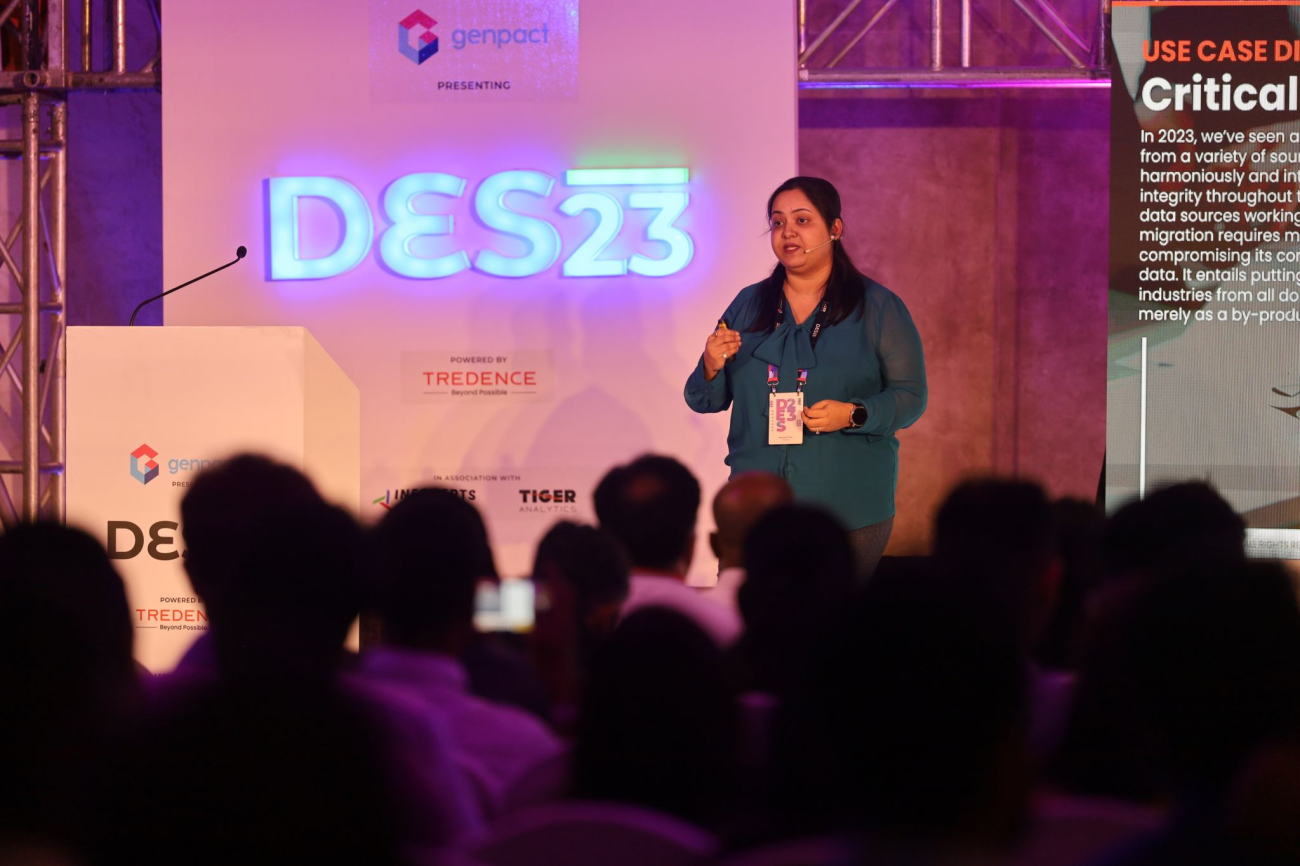
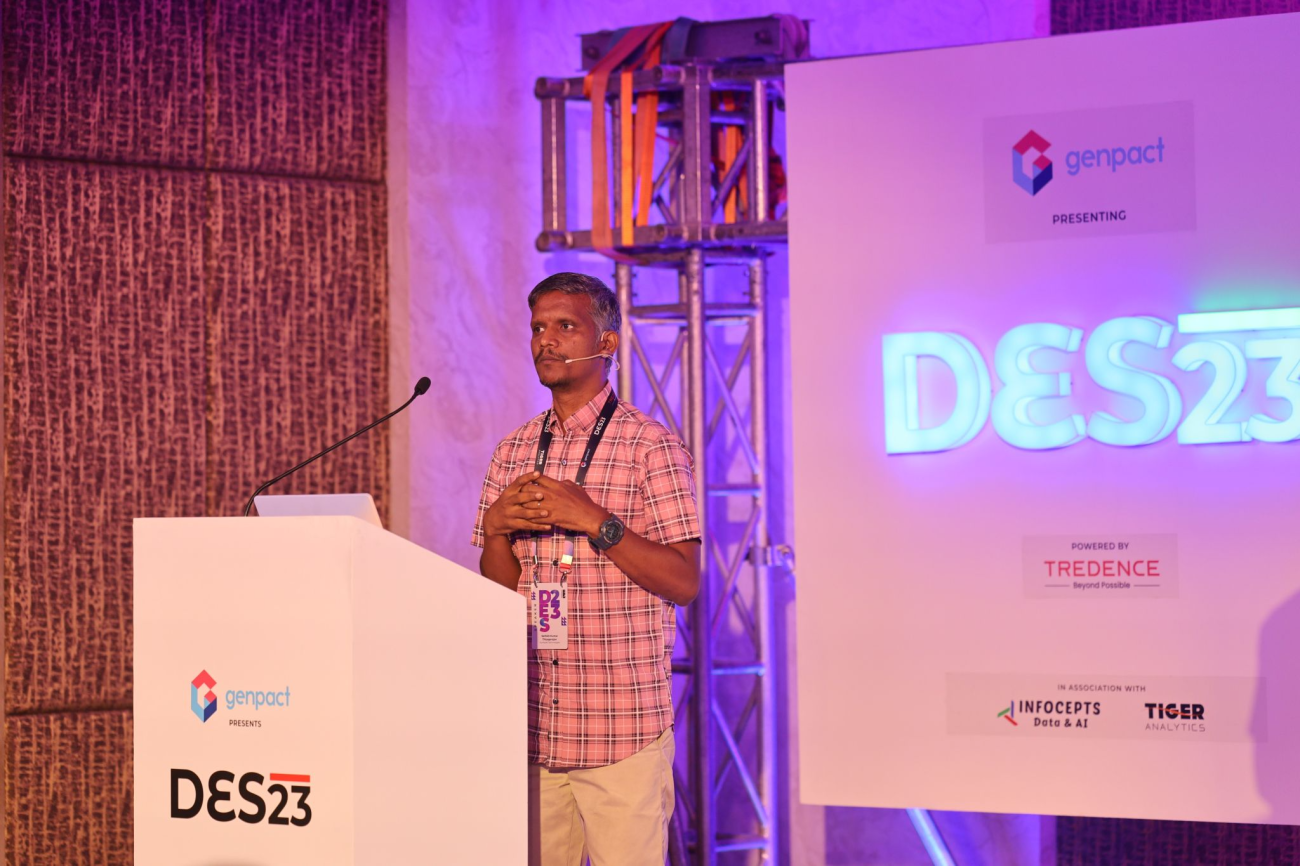
Recently, Analytics India Magazine (AIM) concluded this year’s Data Engineering Submit (DES) powered by Tredence and in association with Infocepts and Tiger Analytics.
DES 2023, which is India’s one and only summit dedicated to Data Engineering has come to a successful conclusion, bringing together some of the most influential thought leaders, experts, and professionals in the field of data engineering.
The summit was a unique opportunity for attendees to learn about the latest trends and best practices in data engineering, network with their peers, and gain valuable insights from keynote speakers and panel discussions.
“We just created the world’s biggest conference focussed purely on data engineering. I was pleasantly surprised how much the field has evolved over years and so much buzz around data engineering in India,” Bhasker Gupta, founder and CEO at AIM, said.
The success of the Data Engineering Summit 2023 marks a significant milestone in the industry’s continued growth and innovation. Here are some of the interesting topics covered in DES 2023.
Data Engineering in an AI world
With the increasing volume and complexity of data, organisations are leveraging AI to enhance their data engineering capabilities, automate processes, and drive insights from their data.
Sunil Krishnareddy, VP & Head of Data Engineering services at Genpact, in his talk ‘Data Engineering in the new age – AI is here, where is your data?’ explores how the domain of data engineering is rapidly changing with the advent of popular AI models such as ChatGPT and Midjourney.
Similarly, Gopan Vijayan Nair, Head of Enterprise Business at NVIDIA, discusses in his talk ‘The Synergy of Data Engineering and Generative AI in Revolutionising Enterprises’ the potential for the integration of data engineering and Generative AI to create powerful solutions that can improve decision-making, automate processes, and enhance customer experiences in the enterprise space.
Continuing on the same line, Dmitry Ustalov, Head of Ecosystem Development at Toloka, in his talk ‘Handling Noise and Subjectivity in LabelledData’ also discussed how to build, use, and secure representative datasets for AI problems, taking a special attention to crowdsourced data and data obtained from in-house annotation teams
Data Struggle Galores
Data challenges still haunt enterprises. Some of the challenges highlighted at the event include the changing regulatory landscape, alongside managing data on the cloud.
Kunal Mehta, Senior Manager of Data CoE, and Deepak Kumar, Senior Director of Data Engineering at Publicis Sapient, in their talk ‘Engineering practices for building data resilience in an increasingly cookieless world’ discussed the growing significance of data for businesses, while also acknowledging the challenges of collecting data due to evolving data privacy regulations.
“For data analysts, the challenge is not the unavailability of data, but to trust their data,” Kumar said.
Ops is the New Oil
At this year’s Data Engineering Summit, the focus was much more than data, and more towards operationalising data, alongside changing dynamics of the field on how it is moving towards DevOps, AIOps, etc.
“A very few of us know; once the data is migrated, once it comes into the systems, and sits for a long time, you tend to forget about it,” said Mousumi Kar, Senior Manager, Data Engineering at Tredence. She believes that by operationalising the usability of your data, organisations will be able to generate value successfully.
Development of Modern Day Data Stack
Data modernisation aims to enhance data quality, accessibility, and reliability, and to enable organisations to gain valuable insights and make data-driven decisions in real-time.
Jorawar Singh, Regional Head-Business Development at Artha Solutions and Rajiv Maskara, Director – Data Integration Specialist – India at Qlik, in their talk ‘Unlocking the Power of Data using the modern Data and Analytics Platform’ discussed the importance of having a modern data stack for any organisation that wants to leverage the full potential of their data.
Similarly, Sathish Kumar Thiyagarajan, Chief Technology Officer at OurKadai Technologies, in his talk ‘Modernising Data Access Layer with Compile Time ORM’ explores the evolution of the data access layer in enterprise applications that rely on relational databases over the past two decades.
Data Mesh, Data Fabric & More
Data Mesh has the potential to revolutionise the way organisations approach data management and enable them to become more data-driven and innovative.
In his talk titled ‘The Rise of the Data Mesh Architecture: A Paradigm Shift in Data Engineering’ Amit Kapur, Vice President, Data Science & Engineering at Lowe’s, discusses how organisations are adopting this approach to overcome the challenges of traditional monolithic data architectures and to improve their data management capabilities.
Similarly, Muthu Govindarajan, Partner – Data Engineering at Tiger Analytics raised an interesting question. He asks, If machines can become intelligent with the advent of the IoT, why not data platforms?
Another interesting topic covered at DES 2023 was by Yashwanth Kumar, Account Manager Enterprise Sales and Shounak Vijay, Sales Engineer APAC at Fivetran where they showcased how Condé Nast, a global mass media company monetised trillions of data points.
The post DES 2023 Brings Industry Leaders Together to Discuss Data Modernisation, AI & More appeared first on Analytics India Magazine.
ChatGPT has taken the world by storm, and people are increasingly curious about how to use it to become more productive or improve their lives and work. Many debates have already occurred about whether ChatGPT is a valuable and reliable educational resource. The answer is not as straightforward as it might seem. Let’s take a closer look.
ChatGPT Is Not Always Accurate
ChatGPT provides fast answers to inputs, but they’re not necessarily trustworthy. For example, it can give wholly or partially false information that seems very believable. People in the artificial intelligence research world deem this problem “hallucinations.”
Anyone who’s ever taught a class or been a student has almost certainly encountered people who confidently make grossly wrong statements, conveying them as absolute facts. ChatGPT does the same thing when it hallucinates, which is particularly problematic for anyone using the tool to learn or complete educational projects.
ChatGPT Could Encourage Plagiarism
What amazes people most about ChatGPT is how fast it can give replies. When a student is under pressure to write a paper and feels like they’ve hit a mental wall, it’s easy to see how they could feel tempted to do more than use ChatGPT as a resource and directly copy from it instead.
This has made college and high school educators consider redefining plagiarism to include forbidding the copying of artificial intelligence-provided material. Teachers that suspect plagiarism can’t determine how a student got the content that potentially allowed them to copy from ChatGPT.
That’s because no one can ask ChatGPT how it generated specific answers. People have also discovered that the tool often generates fake citations when users ask for its resources.
ChatGPT Perpetuates Damaging Stereotypes
Many people bring up their favorite teachers when asked what motivated them to pursue specific careers. Getting inspiration from an early age is important, especially since there’s still a gender imbalance in several professions. Fortunately, that’s starting to improve. At the Russian School of Mathematics — which serves 50,000 students across North America — 78% of teachers and 48% of students are female.
However, evidence suggests that even if people use ChatGPT for reasons unrelated to their careers or education, the tool could still parrot harmful stereotypes to them. One user asked ChatGPT to tell a story about a boy and a girl choosing their careers. The girl in the tale doubted she could “handle all the technicalities and numbers in the engineering program,” but the boy loved working with machines and gadgets.
Granted, a ChatGPT conversation would not be the deciding factor that makes someone choose a career path or course. However, there’s already enough negative feedback in the world without a chatbot adding to it and expressing outdated gender generalizations.
Responsible Uses of ChatGPT in Education
Many teachers have realized there’s no going back to the time before ChatGPT. Now, the challenge is to figure out how learners might use the tool as a supplemental aid rather than expecting it to give them all the right answers.
Students could use the tool as a brainstorming engine, asking questions such as “What are the top five cybersecurity risks for businesses?” and then begin outlining their papers based on ChatGPT’s response. That doesn’t encourage people to cheat, but it opens their minds about things to cover they may have initially overlooked.
Another possibility is to generate writing prompts with ChatGPT. That’s a simple but effective way to keep skills sharp and reduce delays when people need to produce content but aren’t sure how to start.
One teacher also said they use it to help students plan generic experiments. It can also assist educators with administrative tasks — such as writing letters to parents and creating syllabi — thereby giving them more time to devote to teaching.
Use ChatGPT With Care
These examples show that ChatGPT has some valid use cases. However, there are very concerning examples of how people could misuse or get led astray by the tool. Users must keep these realities in mind whether they’re teachers, educators or just interested in artificial intelligence. April Miller is managing editor of consumer technology at ReHack Magazine. She have a track record of creating quality content that drives traffic to the publications I work with.
More On This Topic
Travel to faster, trusted decisions in the cloud
AI for Ukraine is a new educational project from AI HOUSE to support the…
Great New Resource for Natural Language Processing Research and…
Visual ChatGPT: Microsoft Combine ChatGPT and VFMs
Teradata and Google Cloud Announce New Machine Learning Integration May 3, 2023 by Jaime Hampton
A new integration for machine learning is available from Teradata and Google Cloud. Google Cloud’s Vertex AI platform is now generally available with Teradata VantageCloud and ClearScape analytics.
“With Teradata VantageCloud and ClearScape Analytics plus Vertex AI, organizations can move seamlessly from being AI experimenters to AI achievers,” Teradata said in a release.
Vertex AI is Google Cloud’s end-to-end machine learning platform introduced in 2021. Teradata says Vertex AI helps users take advantage of various cutting-edge algorithms to build high-quality AI models in less time and with minimal expertise. Teradata’s VantageCloud is the cloud version of the company’s long-standing data warehouse and comes in two editions: Enterprise, optimized for high-end production analytics workloads, and Lake, optimized for data science and exploratory analytics.
ClearScape Analytics is a suite of in-database analytics and machine learning tools that can run on any Teradata environment and was designed to be used in conjunction with a data science notebook. ClearScape features MLOps capabilities to help data scientists automate the ML lifecycle, including capturing, training, deploying, and monitoring ML models in production.
The combination of these elements enables faster and more sophisticated AI models that can be scaled across an organization, according to Teradata. Customers using VantageCloud on Google Cloud can integrate disparate datasets from multiple environments, data lakes, and object stores to help streamline data preparation, while ClearScape Analytics can transform the data into reusable analytic datasets. These datasets can then be used to build and train ML models with Vertex AI. Vertex AI models can be operationalized at scale in VantageCloud to give customers direct, transparent, and real-time access to all their models, Teradata says.
“Our customers are investing in the power of AI to fuel their digital transformations and achieve tangible business outcomes that have a real-world impact on their businesses,” said Hillary Ashton, chief product officer at Teradata, in a release. “Our openness and scalability facilitate the operationalization of Vertex AI’s models across an organization and its mission-critical use cases – such as customer churn, fraud detection, predictive maintenance, and supply chain optimization. Customers are able to make bold business decisions, driven by data, that keep them ahead of the competition.”
“Vertex AI enables data scientists to build, deploy and scale machine learning models faster, with fully managed tools and services for use cases across industries. This capability, when combined with the vast and reliable analytics data sets prepared by Teradata, gives customers the ability to scale their AI/ML initiatives quickly and with confidence, speeding time to value,” said June Yang, VP, cloud AI and industry solutions at Google Cloud, in a release.
Teradata seems to be focused on bolstering its customers’ machine learning capabilities. The company also recently announced the general availability and integration of VantageCloud and ClearScape with the Microsoft Azure Machine Learning platform.
Shares in Teradata rose 6% on Monday after Wall Street analyst Howard Ma of Guggenheim Partners raised his rating on the company. Ma suggests that Teradata may be experiencing a positive turning point when it comes to customer retention. Though reports have said Teradata has been losing customers to other cloud competitors, Ma claims that recent conversations with Teradata partners may indicate an increased demand for staying with the company.
“What many thought was impossible may be starting to happen,” Ma told investment news outlet Seeking Alpha. “The complex workloads tied into core business logic are likely there to stay on Teradata in the near-and-mid-term, so the rate of decay in [the company’s] installed base will likely be slower going forward.”
This article originally appeared on sister site Datanami.
Inflection AI – competitor of OpenAI and Anthropic recently has announced the first release of its own chatbot, or “Personal AI” called Pi.
According to Mustafa Suleyman, co-founder of Inflection AI, also the co-founder of DeepMind (Now Google DeepMind), “Pi is a smart, supportive personal AI that is designed to be better at “natural flowing conversation”, than lists, plans, or code. Inflection AI was started by Linkedin co-founder Reid Hoffman alongside Suleyman in March last year.
Today I’m excited to announce the first version of our new personal AI, Pi… https://t.co/wYpgcXdB1t Pi is smart, kind and supportive. It’s designed to be better at natural, flowing conversation than lists, plans, or code.
— Mustafa Suleyman (@mustafasuleymn) May 2, 2023
Pi stands for ‘personal intelligence’. “We think that in the future everyone will have their own personal AI”, tweeted Suleyman. This sounds like Samantha from the sci-fi movie ‘Her’, a personal bot. “Pi can be a coach, confidante, creative partner, sounding board and a personal assistant.” The founders boast it for its high EQ (emotional quotient).
You can check out Pi at heypi.com
Pi is currently available across almost all platforms including Instagram, Facebook Messenger, and WhatsApp.
Instagram: follow @heypi.ai and send Pi a DM.
Facebook Messenger and text to get in touch with Pi.
WhatsApp and SMS: add +1 (314) 333-1111 to your contacts to message Pi.
Mobile Applications
“We’ve spent the past year developing one of the most sophisticated and advanced large language models in the world in order to achieve a new level of simplicity and natural interaction for people with Pi,” said Karén Simonyan, chief scientist and co-founder of Inflection AI.
In a bid to compete with the hype around OpenAI’s ChatGPT and Google’s Bard, Hugging Face also unveiled their own chatbot called HuggingChat. Inflection AI had last year raised $225 million funding from equity financing. As per the same report, the funding source is unclear.
The post OpenAI Rival Inflection AI Unveils Most Friendly Chatbot Ever appeared first on Analytics India Magazine.
ChatGPT has taken the world by storm because it’s easy to use and can provide detailed answers with a few words. As a tool, it’s something that we learners should not miss. Especially for data science learners, it can become a personalized tutor leading to much better learning of data science concepts.
Using the ChatGPT tool, we can set them as personalized tutors to help us learn data science concepts. How do we do that? Let’s explore them further.
Prerequisite
In this article, you should already have an account for ChatGPT. In this article, I also assume that we work with the free version of ChatGPT instead of Plus. However, whatever is written in this article could apply using the plus version. With that in mind, let’s continue our learning.
ChatGPT as Personalized Tutor
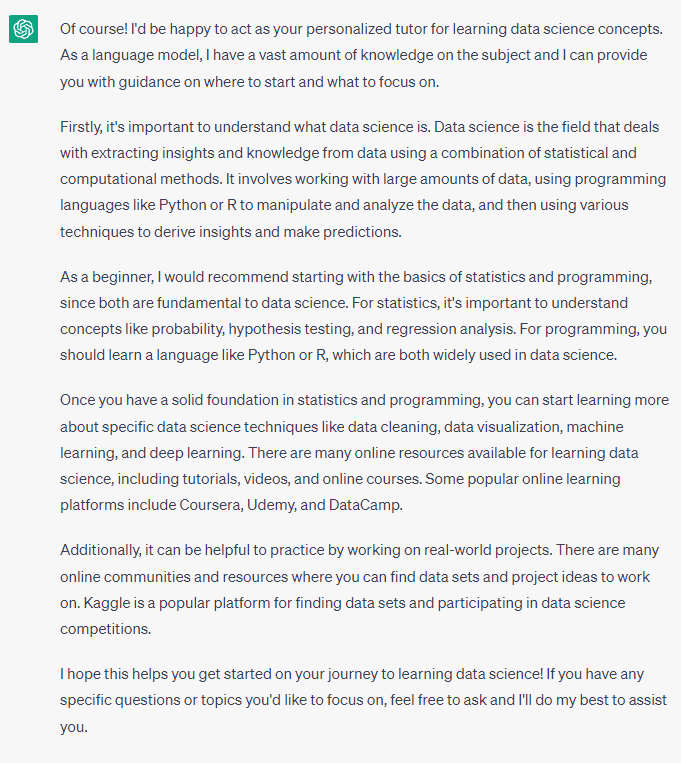
ChatGPT works by using the prompt we provide, and the tool provides the answer based on the prompt. What is good about ChatGPT is the coherence between the previous prompt and the follow-up, creating a system for questioning and answering. This way, we utilize the ChatGPT as a personalized tutor to keep asking questions until we learn the concepts.
Let’s start using ChatGPT. For the prompt, we can state our purpose and level of data science knowledge.
With the prompt above, we establish the ChatGPT as a personal tutor to teach beginners in data science. Let’s see the answers.
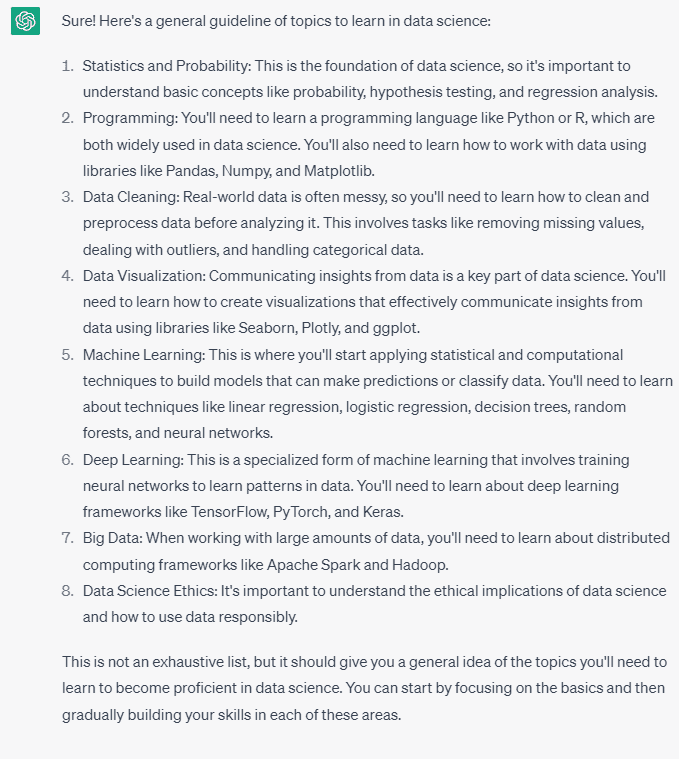
From a simple prompt, the ChatGPT has provided the recommendation topics. It’s a great start, but we can always ask for more detail regarding the learning agenda. Let’s have a follow-up prompt to ask for proper guidelines.
The above prompt can also elaborate further with the timeline if you want a more detailed study plan. Let’s see the result from the prompt.
The ChatGPT now gives you a structured topic of data science concept you could start your study on. It also starts with a topic we should learn before going on to the next topic. Let’s get into more detail by using the follow-up prompt. Select the topic you want to know more about in detail.
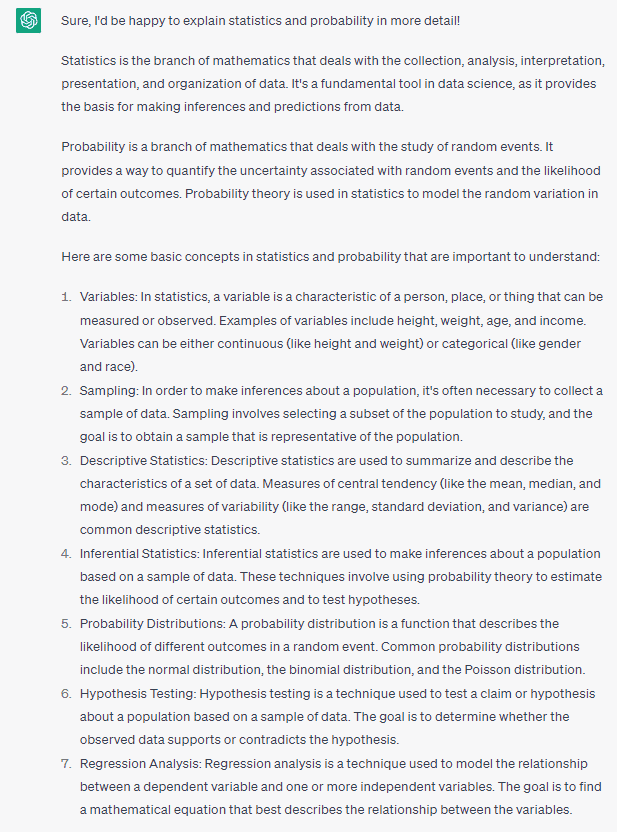
In the prompt above, we want to learn more about statistics and probability. Let’s see the result then,
The result shows a more clear basic concept of statistics and probability. We can learn the concept in more detail with the terms we should know and explore. We can always dig deeper to understand the data science concept even further with the follow-up prompt.
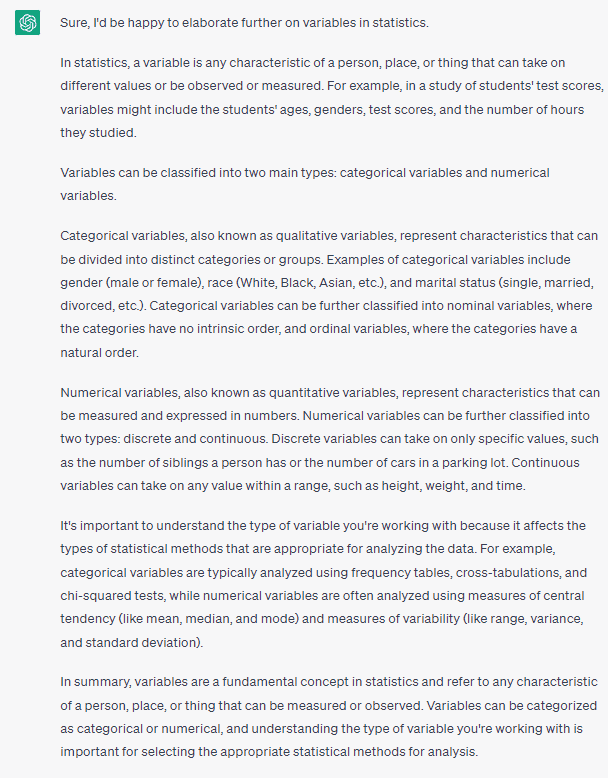
In this case, I ask for more explanation of the Variables. Here is the result.
Each follow-up prompt you do will give a detailed explanation of the topic you want. So, keep asking the ChatGPT for more detail and provide a prompt to elaborate things further.
You can also ask for learning materials from the ChatGPT regarding the specific topic.
For example, we ask learning materials for the variables topic.
The ChatGPT then gives the probable place to acquire the learning material. If you are using GPT-4, the answers could become more detailed. But, for now, it’s enough to act as a tutor for learning the data science concept.
Conclusion
ChatGPT is a text-generative AI tool that can give detailed answers to the given prompt. It’s a tool that is perfect for learners who want to learn data science concepts. With simple prompt and a following-up prompt, ChatGPT can act as a personal tutor to learn the data science. Cornellius Yudha Wijaya is a data science assistant manager and data writer. While working full-time at Allianz Indonesia, he loves to share Python and Data tips via social media and writing media.
More On This Topic
How to become an online data science tutor
7 SQL Concepts You Should Know For Data Science
The 8 Basic Statistics Concepts for Data Science
10 Statistical Concepts You Should Know For Data Science Interviews

















 ClearScape Analytics is a suite of in-database analytics and machine learning tools that can run on any Teradata environment and was designed to be used in conjunction with a data science notebook. ClearScape features MLOps capabilities to help data scientists automate the ML lifecycle, including capturing, training, deploying, and monitoring ML models in production.
 “Vertex AI enables data scientists to build, deploy and scale machine learning models faster, with fully managed tools and services for use cases across industries. This capability, when combined with the vast and reliable analytics data sets prepared by Teradata, gives customers the ability to scale their AI/ML initiatives quickly and with confidence, speeding time to value,” said June Yang, VP, cloud AI and industry solutions at Google Cloud, in a release.