Hands on with Google’s AI-powered music generator

Hands on with Google’s AI-powered music generator Kyle Wiggers 13 hours

Can AI work backward from a text description to generate a coherent song? That’s the premise of MusicLM, the AI-powered music creation tool Google released yesterday during the kickoff of its I/O conference.

MusicLM, which was trained on hundreds of thousands of hours of audio to learn to create new music in a range of styles, is available in preview via Google’s AI Test Kitchen app. I’ve been playing around with it for the past day or so, as have a few of my colleagues.

The verdict? Let’s just say MusicLM isn’t coming for musicians’ jobs anytime soon.

Using MusicLM in Test Kitchen is pretty straightforward. Once you’re approved for access, you’re greeted with a text box where you can enter a song description — as detailed as you like — and have the system generate two versions of the song. Both can be downloaded for offline listening, but Google encourages you to “thumbs up” one of the tracks to help improve the AI’s performance.
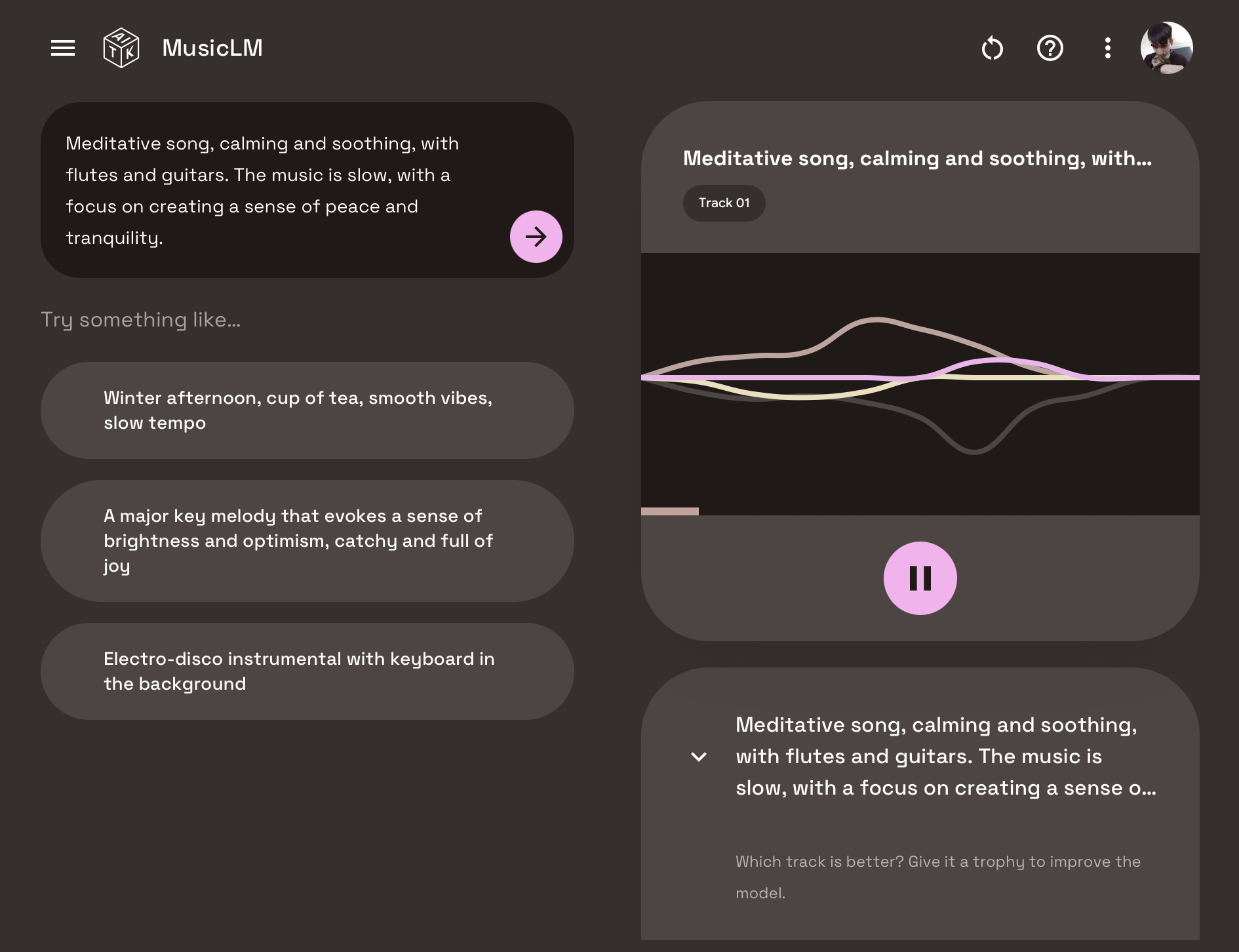
MusicLM

Image Credits: Google

When I first covered MusicLM in January, before it was released, I wrote that the system’s songs sounded something like a human artist might compose — albeit not necessarily as musically inventive or cohesive. Now I can’t say I entirely stand by those words, as it seems clear that there was some serious cherry-picking going on with samples from earlier in the year.

Most songs I’ve generated with MusicLM sound passable at best — and at worst like a four-year-old let loose on a DAW. I’ve mostly stuck to EDM, trying to yield something with structure and a discernible (plus pleasant, ideally) melody. But no matter how decent — even good! — the beginning of MusicLM’s songs sounds, there comes a moment when they break down in a very obvious, musically unpleasing way.

For example, take this sample, generated using the prompt “EDM song in a light, upbeat and airy style, good for dancing.” It starts off promising, with head-bobbing baseline and elements of a classic Daft Punk single. But toward the middle of the track, it veers wayyyyy off course — practically another genre.

https://techcrunch.com/wp-content/uploads/2023/05/AI_Test_Kitchen_edm_song_in_a_light_upbeat_and_airy_style_g-2.mp3

Here’s a piano solo from a simpler prompt — “romantic and emotional piano music.” Parts, you’ll notice, sound well and fine — exceptional even, at least in terms of the finger work. But then it’s as if the pianist becomes possessed by mania. A jumble of notes later, and the song takes on a radically different direction, as if from new sheet music — albeit along the lines of the original.

https://techcrunch.com/wp-content/uploads/2023/05/AI_Test_Kitchen_romantic_and_emotional_piano_music.mp3

I tried MusicLM’s hand at chiptunes for the heck of it, figuring the AI might have an easier time with songs of a more basic construction. No dice. The result (below), while catchy in parts, ended just as randomly as the other samples.

https://techcrunch.com/wp-content/uploads/2023/05/AI_Test_Kitchen_house_music_in_chiptune_with_an_energetic_ba.mp3

On the plus side, MusicLM, on the whole, does a much better job than Jukebox, OpenAI’s attempt several years ago at creating an AI music generator. In contrast to MusicLM, given a genre, artist and a snippet of lyrics, Jukebox could generate relatively coherent music complete with vocals, but the songs Jukebox produced lacked typical musical elements like choruses that repeat and often contained nonsense lyrics. MusicLM-produced songs contain fewer artifacts, as well, and generally feel like a step up where it concerns fidelity.

MusicLM’s usefulness is a bit limited besides, thanks to artificial limitations on the prompting side. It won’t generate music featuring artists or vocals, not even in the style of particular musicians. Try typing a prompt like “along the lines of Barry Manilow” and you’ll get nothing but an error message.

MusicLM

Image Credits: Google

The reason’s likely legal. Deepfaked music stands on murky legal ground, after all, with some in the music industry arguing that AI music generators like MusicLM violate music copyright. It might not be long before there’s some clarity on the matter — several lawsuits making their way through the courts will likely have a bearing on music-generating AI, including one pertaining to the rights of artists whose work is used to train AI systems without their knowledge or consent. Time will tell.

For now, though, I’d argue that artists don’t have much reason to worry. MusicLM, like the other AI music generators that’ve been released recently, serves more than anything as an illustration of just how far the tech has to go.

Read more about Google I/O 2023 on TechCrunch

Council Post: How A Non Data Science Person Can Work Effectively With A Data Scientist

The best way to learn data science is to do data science – Chanin Nantasenamat.

Data is considered one of the most valuable resources in the modern world, with businesses across multiple sectors utilizing data science to inform decisions, streamline processes, and gain a competitive edge. However, due to its technical and complicated nature, not everyone has a foundation in data science. This can create challenges when working with a data science team that includes personnel without data science experience. In this article, we will provide advice for working on projects with a data science team for individuals without a data science background.

Data science blends techniques and concepts from various academic fields, including arithmetic and statistics, computer science and information technology, and domains and business knowledge. In project work, collaboration between those with backgrounds in data science and those without can be challenging but rewarding. As these two groups have disparate histories and worldviews, miscommunications and confrontations may arise. However, they can produce greater results and more complete solutions if they work well together.

The first step to successful collaboration is having a clear understanding of each other’s roles and responsibilities within the project. While the data science person brings technical skills, such as statistical analysis and machine learning, the non-data science person is often the subject matter expert with knowledge of the business requirements and goals. By admitting these disparities, both sides can respect each other’s contributions and recognize their value to the project.

Effective communication is essential for a successful partnership. The data scientist should communicate technical procedures and conclusions in a clear and concise manner. In contrast, the non-data science person should communicate business requirements and limitations. Both sides can collaborate successfully by developing a clear understanding of the project objectives and the data science methodologies.

Setting expectations and establishing the project’s scope from the beginning is equally critical. The non-data scientist should specify what they expect from the data scientist, including the results they intend to achieve and the project’s schedule. In return, they should describe their areas of strength and the achievable goals that fall within the project’s parameters.

It is crucial to keep the lines of communication open and transparent throughout the process. Regular meetings and status reports should be organized to keep everyone informed of the project’s progress and to identify any potential issues. These updates will help the team stay on track and modify the project plan if necessary.

Finally, celebrating successes can help both groups develop a positive working relationship. Recognizing each other’s contributions and achievements strengthens the value of collaboration and motivates people to work together on future initiatives.

In conclusion, effective collaboration requires open communication, mutual understanding of roles and responsibilities, clear expectations, and regular updates. Collaboration between individuals with and without a background in data science enables both sides to develop more complete solutions and produce better results.

This article is written by a member of the AIM Leaders Council. AIM Leaders Council is an invitation-only forum of senior executives in the Data Science and Analytics industry. To check if you are eligible for a membership, please fill out the form here.

The post Council Post: How A Non Data Science Person Can Work Effectively With A Data Scientist appeared first on Analytics India Magazine.

‘AI-powered’ VC firm Vela emerges from stealth with $25M under management

‘AI-powered’ VC firm Vela emerges from stealth with $25M under management Kyle Wiggers 10 hours

Six years ago, Yiğit Ihlamur, a former senior program manager at Google, observed that AI was surpassing human capabilities in certain areas — at least by his estimation. Equipped with this perspective, he looked into various sectors with the goal of tackling a problem that he could work on for the rest of his life.

“At an abstract level, I was intrigued by the idea of accelerating innovation, because innovation creates new products, services and experiences that were previously unimaginable,” Ihlamur told TechCrunch in an email interview. “I perceived delivering capital to innovation as a math problem and started coding and hacking my way in.”

Ihlamur decided to focus on the VC space, which he saw as behind in terms of leveraging automation and AI. With the help of several co-founders, he launched Vela Partners, a VC firm that he describes as “AI-powered” and “product-led.”

Vela is an early-stage VC with $25 million under management and 32 portfolio companies, including self-checkout startup Grabango and robotics firm Bear Robotics. Like all VCs, Vela determines — partly using predictive algorithms — new investment areas as it attempts to identify trends, source the right opportunities and suss out threats to its existing investments.

To train its predictive algorithms, Vela draws on websites and social networks for data, also leveraging paid datasets like Crunchbase.

“Vela provides market intelligence and insights of innovative ideas; hence technical decision makers can decide which tools to buy or build to grow their core businesses,” Ihlamur said. “Models must be informative and explanatory. Ultimately our approach marries AI with expert heuristics.”

Inevitably, of course, algorithms amplify the biases in the data on which they’re trained — and this can have major consequences in the VC realm. In an experiment in November 2020, Harvard Business Review (HBR) found that an investment recommendation algorithm tended to pick white entrepreneurs rather than entrepreneurs of color and preferred investing in startups with male founders. Experts uncovered similar issues with CB Insights’ Mosaic tool, which uses proxies for race, socioeconomic status, gender and disability to determine a person’s likelihood of success.

Ihlamur somewhat dodged questions around bias, acknowledging that it comes with the territory — but not necessarily offering a solution.

“A model can learn the biases of other VCs or biases of the past,” he said. “First, one needs to understand the underlying reason why these behaviors occurred in the venture market. Second, every problem is unique, and a generalized approach cannot work for everything.”

Bias issues aside, Bay Area–based Vela isn’t the first to develop algorithmic tools to inform its investment decisions. VC firms, including SignalFire, EQT Ventures and Nauta Capital, are using AI-powered platforms to flag potential top picks.

The differentiator for Vela, according to Ihlamur, is its “game-like” terminal built to assist entrepreneurs, limited partners and other VCs in using its services. Entrepreneurs can analyze tendencies in developer ecosystems like Amazon Web Services and GitHub, while whitelisted VCs can spot (with any luck) promising seed-stage startups and limited partners can ask questions about why Vela invested in a particular startup.

Vela’s GitHub repo, which includes its algorithmic models, is public — both for inspection and reuse.

“While some VCs may be experimenting with AI-based sourcing, we haven’t seen any VC taking a product-led approach,” Ihlamur said. “Anyone can go to Vela’s website and use our product. We’re building relationships with entrepreneurs and limited partners in a programmatic way — our ultimate goal is for AI and automation to touch and manage all aspects of our business.”

It’s an approach that’s worked well for Vela so far. The firm claims to be running at “break-even” level, leading or co-leading $500,000 to $1.5 million check sizes.

In the near term, Vela plans to invest mainly in AI, data and developer-focused startups. Ihlamur expressed enthusiasm for generative AI specifically, a market that could be worth $51.8 billion by 2028 — depending on which sources you believe.

“The pandemic had a positive impact on our business, as was the case for many other venture capital firms,” Ihlamur said. “OpenAI’s ChatGPT’s release provided further tailwinds for us as an AI-powered VC firm … With respect to the broader slowdown in tech, we’re not concerned as we’re break-even as a company and have capital to invest. Despite the slowdown, there are significant opportunities to seize partially thanks to the rapid progress in AI.”

Trusting Funds with ChatGPT? Think Again

Steadily treading its way and building a dominance in different work domains is ChatGPT. The chatbot is being heavily implemented across fields such as HR, Legal, Data Science, and politics to name a few. Companies are even working on their own LLM to stay relevant. To prove its prominence, ChatGPT is now being tested as a fund manager: a precarious step in stock management.

A recent report by finance website Finder showed that ChatGPT picked a theoretical stock portfolio of 38 companies that outperformed the S&P 500. For a duration of eight weeks, from March to April, the ChatGPT-selected funds climbed 4.93%, whereas a group of 10 popular funds in the UK averaged a loss of 0.78%. The chatbot’s funds outperformed real funds in 34 out of 39 market days. Promising results, for sure. But, does this experiment qualify ChatGPT as a reliable fund manager?

Probably, an overstatement at this stage.

Decoding ChatGPT Prediction

Last month, there was a research paper released on whether ChatGPT and other large language models can forecast stock price movements and return predictability.

Predictability tools work on the principle of sentiment analysis. In the study, ChatGPT was used to indicate whether a business news headline is good, bad, or irrelevant for determining a firm’s stock price. Numerical scores were then computed and a positive correlation between these ChatGPT scores and daily stock market returns were documented. It was noted that ChatGPT was able to outperform traditional sentiment analysis methods, and other basic models such as GPT-1, GPT-2, and BERT were not able to accurately forecast returns, indicating that complex models were able to predict better.

In a study by Finder, the ChatGPT fund was monitored over two months. The chatbot was instructed to create a stock portfolio from high-quality businesses with criteria such as minimal debts, sustained past growth, and assets that provide a competitive edge. Some of the companies that ChatGPT picked were Meta, Microsoft, Intel Corporation, Alphabet, NVIDIA, Visa and others. FMCG and beverage companies such as Johnson & Johnson, Coca Cola and PepsiCo Inc. were also picked. Meta, Microsoft and Intel were the best performing stocks with a maximum increase of 30%, 20% and 18% respectively.

Source: Finder

Not Conclusive

However, the experiment alone cannot be conclusive to prove the chatbot’s ability to predict stocks. The experiment was anecdotal and the time period of two months during which the activity was done is too less to determine anything conclusively. In addition, comparing it with actively managed funds may not necessarily be a proper benchmark. In fact, over a 20-year period, 95% of large-cap actively actively managed funds have underperformed their benchmark.

With ChatGPT being trained on data up to September 2021, the performance of company stocks for the last two years is not tested, which is probably another setback.

Future of AI in Investment Prediction

The CEO of Finder, Jon Ostler is apprehensive of the idea of using ChatGPT for investing research. He said that though big funds have been adopting AI for years, it’s not a good idea for the public to rely on a “rudimentary AI platform” that has claimed its data to be ‘patchy’ since September 2021, and does not have the knowledge of market psychology.

He even mentioned that as per a survey conducted in 2021, investors use social media for investing advice. When compared to an unqualified TikTok star, he believes that AI would be the better choice, however, one should ideally not use any of it. He believes that researching through known primary sources or a qualified advisor would be a recommended method.

Source:Finder

In the above study done by Finder to gauge people’s reaction, 8% of them have already used ChatGPT for financial advice. 19% of them would consider using it for financial data, whereas 35% would not consider it for financial advice.

To add to the unpredictable nature of ChatGPT, there have been multiple problems of hallucinations and incorrect information that the chatbot produces. From false allegations to fake news, the bot is infamous for making wrong decisions. In addition, considering how input datasets can be maligned through activities such as data poisoning and prompt injections, the output of the chatbot can be compromised. In stock predictions, as sentiment analysis happens from input news headlines, if the training data is skewed, the predictions will be faulty as well.

So, if you are planning to trust ChatGPT with managing your money, think again.

The post Trusting Funds with ChatGPT? Think Again appeared first on Analytics India Magazine.

Anthropic’s latest model can take ‘The Great Gatsby’ as input

Anthropic’s latest model can take ‘The Great Gatsby’ as input Kyle Wiggers 7 hours

Historically and even today, poor memory has been an impediment to the usefulness of text-generating AI. As a recent piece in The Atlantic aptly puts it, even sophisticated generative text AI like ChatGPT has the memory of a goldfish. Each time the model generates a response, it takes into account only a very limited amount of text — preventing it from, say, summarizing a book or reviewing a major coding project.

But Anthropic’s trying to change that.

Today, the AI research startup announced that it’s expanded the context window for Claude — its flagship text-generating AI model, still in preview — from 9,000 tokens to 100,000 tokens. Context window refers to the text the model considers before generating additional text, while tokens represent raw text (e.g., the word “fantastic” would be split into the tokens “fan,” “tas” and “tic”).

So what’s the significance, exactly? Well, as alluded to earlier, models with small context windows tend to “forget” the content of even very recent conversations — leading them to veer off topic. After a few thousand words or so, they also forget their initial instructions, instead extrapolating their behavior from the last information within their context window rather than from the original request.

Given the benefits of large context windows, it’s not surprising that figuring out ways to expand them has become a major focus of AI labs like OpenAI, which devoted an entire team to the issue. OpenAI’s GPT-4 held the previous crown in terms of context window sizes, weighing in at 32,000 tokens on the high end — but the improved Claude API blows past that.

With a bigger “memory,” Claude should be able to converse relatively coherently for hours — several days, even — as opposed to minutes. And perhaps more importantly, it should be less likely to go off the rails.

In a blog post, Anthropic touts the other benefits of Claude’s increased context window, including the ability for the model to digest and analyze hundreds of pages of materials. Beyond reading long texts, the upgraded Claude can help retrieve information from multiple documents or even a book, Anthropic says, answering questions that require “synthesis of knowledge” across many parts of the text.

Anthropic lists a few possible use cases:

  • Digesting, summarizing, and explaining documents such as financial statements or research papers
  • Analyzing risks and opportunities for a company based on its annual reports
  • Assessing the pros and cons of a piece of legislation
  • Identifying risks, themes, and different forms of argument across legal documents.
  • Reading through hundreds of pages of developer documentation and surfacing answers to technical questions
  • Rapidly prototyping by dropping an entire codebase into the context and intelligently building on or modifying it

“The average person can read 100,000 tokens of text in around five hours, and then they might need substantially longer to digest, remember, and analyze that information,” Anthropic continues. “Claude can now do this in less than a minute. For example, we loaded the entire text of The Great Gatsby into Claude … and modified one line to say Mr. Carraway was ‘a software engineer that works on machine learning tooling at Anthropic.’ When we asked the model to spot what was different, it responded with the correct answer in 22 seconds.”

Now, longer context windows don’t solve the other memory-related challenges around large language models. Claude, like most models in its class, can’t retain information from one session to the next. And unlike the human brain, it treats every piece of information as equally important, making it a not particularly reliable narrator. Some experts believe that solving these problems will require entirely new model architectures.

For now, though, Anthropic appears to be at the forefront.

Playing Catch-Up: Google’s Latest Developments from the 2023 Developer Conference

On Wednesday, Google hosted its annual developer conference. The event was a marked departure from the usual multi-day affairs of the past, condensed this year into a single jam-packed day of announcements and showcases. A notable absence in 2020, the conference returned with a reduced staff roster, but with no shortage of new developments.

Google's event set the stage for Alphabet CEO, Sundar Pichai's. From the Shoreline Amphitheater in Silicon Valley, Pichai introduced the company's ambitious vision of reimagining its core products, such as search, using generative AI. This statement formed the backbone of the day's presentations and product unveilings.

In the realm of artificial intelligence, Google introduced its second-generation Pathways Language Model (PaLM 2). This large language model represents an evolution from the previous iteration, powering numerous Google products. The company has been developing AI systems for many years, with the transformer architecture sitting at the heart of modern AI systems, such as chatbots.

Google I/O '23 in under 10 minutesGoogle I/O '23 in under 10 minutes
Watch this video on YouTube

Google's Catch-up in AI

This introduction comes at a time when Google is perceived as playing catch-up to rivals like OpenAI, whose GPT-3, ChatGPT, GPT-4, and DALL-E models have made significant waves in the AI field. Google's response is PaLM 2, capable of handling writing, coding, and calculations across more than 100 languages, scientific data sets, and code. PaLM 2 is available in four sizes: Gecko, Otter, Bison, and Unicorn. In addition, there are specialized versions for medical and security applications, known as Med-PaLM 2 and sec-PaLM.

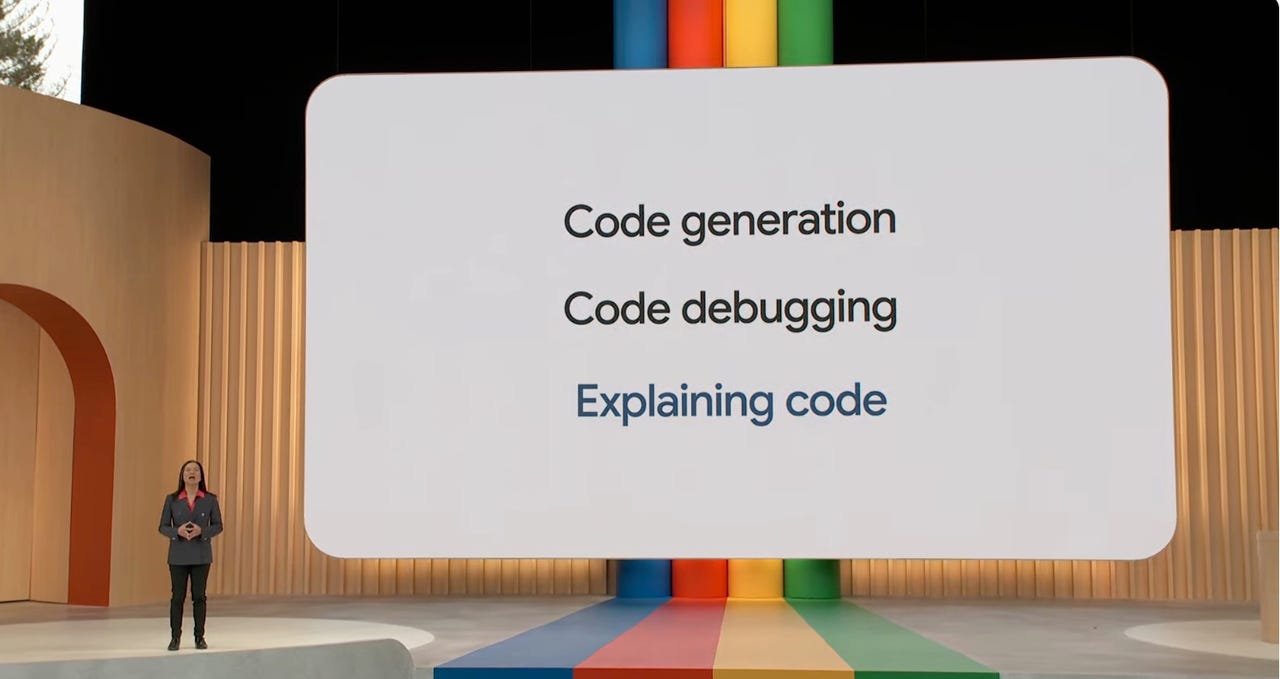
Notably, Google is integrating PaLM 2 into 25 products and features, with several of these available for early testing via Search Labs. One such product is Bard, an AI chatbot that now runs on PaLM 2. This chatbot is designed to assist developers with coding in 20 programming languages and will soon be able to cite the source of its suggestions. Google also plans to integrate Bard with various Google apps and third-party services, including Adobe Firefly and Instacart.

Integrating Generative AI Into Google Search

Generative AI is being integrated into the Google Search interface as well. It aims to handle multiple queries simultaneously, providing a single, AI-generated recommended answer. Google is also planning to add features to its image search system to help users understand the origin of images, when they were first indexed, and where else they might be found. This feature will be particularly useful in distinguishing between genuine photos and AI-generated or manipulated ones.

Google is developing Duet AI for Workspace, a suite of PaLM-powered AI capabilities set to launch later this year. This suite includes features like AI-generated slide images in Google Slides, organizing rows and columns on demand in Google Sheets, unique backgrounds in Google Meet, and AI writing assistance in Google Docs. Google Cloud customers will gain access to Duet AI for Google Cloud, including features like code assistance, chat assistance, and Duet AI for AppSheet.

New Hardware Announcements

Turning towards hardware, Google showcased the 6.1-inch Pixel 7a smartphone, equipped with a larger camera sensor and an AI computation chip, the Tensor G2. The phone also includes an AI-powered Call Assist feature, with functions like Direct My Call, Call Screen, Hold for Me, Clear Calling (noise reduction), and Wait Times (hold time estimation).

The conference also saw the introduction of the long-anticipated Pixel Fold, a foldable smartphone that becomes a 7.6-inch tablet when unfolded. The device can perform unique features, like live translation between two languages on panels facing different directions. Pre-orders of the Pixel Fold will also come with a complimentary Pixel Watch.

The Pixel Fold was central to the demonstration of Google's Universal Translator project, a concept Google has been pushing for years, aiming to facilitate real-time conversation translation. Furthermore, the company teased the release of an 11-inch Pixel Tablet, capable of integrating into Google's home automation systems.

Generative AI Across Product Lineup

One of the key themes of the conference was the application of generative AI across Google's product lineup. For instance, Google announced the Magic Compose feature for Android, which uses generative AI to suggest responses to text messages. Gmail will introduce an alert system for instances when a user's email address shows up on the dark web, potentially indicating information theft or targeting by malicious actors. Moreover, Google Photos will soon receive a Magic Editor for making complex changes to images.

MusicLM, a feature that can transform text descriptions of music into audio, was another intriguing announcement. Google also announced that Android-powered cars would soon be able to run popular apps like YouTube, Waze, Zoom, Microsoft Teams, and Cisco Webex.

Google's Project Starline, a novel 3D video conferencing system, is still in the prototype stage, but it has been scaled down to a TV-sized device. Another new initiative is Project Tailwind, a notebook app that includes a chatbot capable of pulling information from Google Drive, organizing thoughts, and citing sources.

The announcements at the conference demonstrated Google's commitment to AI, with Sundar Pichai stating that “AI is not only a market-enabler, it is also a big platform shift”. This vision was clearly reflected in the variety of AI-powered products and features unveiled throughout the day, indicating Google's ongoing efforts to maintain its position as a leading player in the AI field. As the tech giant continues to innovate and expand its AI capabilities, consumers and developers alike can expect a range of new tools designed to streamline and enhance their digital experiences.

CRED Gets a New Design Upgrade with Charcoal 

Data science hiring process at CRED

Bengaluru-based fintech unicorn CRED has upgraded its UI design with the launch of a new design experience called Charcoal, an addition to their earlier design languages consisting of Topaz, Fabrik, Copper and NeoPOP.

CRED has revamped its homepage with a fresh and improved design using the fifth design update, Charcoal. The main focus of this update is to enhance the user experience by restructuring the layout and content organisation, making it easier for users to navigate the site and improve its functionality.

Read more: Data science hiring process at CRED

What Charcoal Brings to the Table

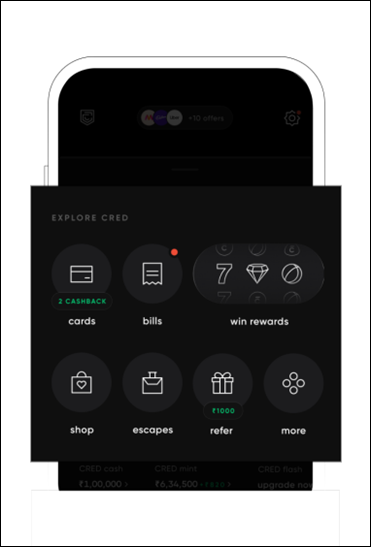
The new homepage has been divided into two sections: the finance suite and the offer oasis. The finance suite is designed to be free of distractions, while the offer section is located at the top of the screen for easy access to exciting deals. Additionally, the Explore CRED section has been added to showcase essential products such as credit card and utility bill payments available on CRED. The grid layout is visually appealing and enables users to find and explore new offerings with ease.

The My Money section has been exclusively dedicated to the financial activities of CRED members, encompassing the Flash withdrawal limit, Mint investments, and available cash balance. This feature enables users to effortlessly monitor and manage their financial transactions from a single convenient location. It has been designed to include technical solutions for data security concerns and timely notifications regarding upcoming bills to avoid missing any payment deadlines. Moreover, members can now view their potential rewards by paying their bills on time, encouraging them to prioritise payments and earn exciting rewards.

In addition to these updates, the bottom navigation has been reimagined entirely to make regular transactions smoother. All payment options are now located conveniently in the bottom section, allowing users to access the “Scan and Pay” option with just one swipe. Moreover, the “Pay Contacts” feature facilitates the transfer or receipt of money from friends with ease.

“Art is at the heart of everything that we create”

CRED has always focused on giving users a sleek and unique design experience. The team believe design should inspire creativity, bring out emotions, seek a purpose beyond the most obvious and most importantly, design should touch humans in ways beyond our collective imagination.

CRED has gone through four generations of design systems. The first one, Topaz, launched in 2018, was based on flat and reductionist minimalism, with a focus on simple typography and high-performance payment systems. The second one, Fabrik, retained the design principles of Topaz but included more advanced, usable, and beautiful design constructs, such as skeuomorphic card designs and a first-of-its-kind rewards interface. Copper was the third upgrade, which moved away from reductionism to a more physical metaphor-driven user interface and included a customisable back-end-driven design system called Synth. Finally, NeoPOP was launched last year, which aimed to provide a visual and functional balance that flows seamlessly between different product offerings.

“We envision CRED as a mall with various member offerings—ranging from arcades shopping [to] financial services. When you envision CRED as a destination, it must have a personality which members find hard to ignore. This personality is provided by design”, Ketan Jogani, Head of Mobile Tech, shared with AIM in an exclusive interview.

Giving Back to the Community

CRED was one of the few startups to have open-sourced their previous UI framework NeoPOP, allowing developers worldwide to implement NeoPOP designs in their products at scale.

However, there are very few companies that give back to the community or acknowledge the use of these resources although they have largely been created using open-source tools and libraries.

Kailash Nadh, CTO of online stock broker Zerodha had told AIM that if a company only cares about making money and increasing its value, and sees engineering as a means to achieve those goals, then it’s unlikely that it will have a culture of caring about technology and contributing to free and open-source software (FOSS). Therefore, experts suggest that companies need to prioritise creating a culture of care from the top down in order to encourage their tech teams to value FOSS and their contributions to it. To achieve this, companies need to establish work environments that facilitate cultural and structural transformations in leadership.

Read more: CRED’s interest in Smallcase and its revenue model

The post CRED Gets a New Design Upgrade with Charcoal appeared first on Analytics India Magazine.

IBM launches watsonx studio to make deploying generative AI easier

This picture shows a corner perspective of a building at IBM with the IBM logo.
Image: nmann77/Adobe Stock

AI is the hottest commodity at the moment according to the tech innovation market. Today, IBM announced watsonx, which is made up of three different product sets. In total, they serve as a studio, data store and governance toolkit for generative AI and foundation models. A waitlist is now open for watsonx products, with general availability of the first product set derived from it, watsonx.ai, expected in July.

The three product sets under the watsonx umbrella are watsonx.ai, the studio itself and a foundation model library: watsonx.data, a data store; and watsonx.governance, a governance toolkit.

Jump to:

  • What is IBM watsonx?
  • IBM teams up with Hugging Face
  • Watsonx AI coming to other IBM software products
  • What are IBM watsonx’s competitors?

What is IBM watsonx?

IBM watsonx is a platform on which to train, tune and deploy AI models. It can train foundation models and machine learning models for cloud environments. IBM-curated and -trained AI models will form the backbone of the service.

These foundation models and open-source AI models will handle the gathering and neatening of training data and then pass that data up to the business that needs it. There’s also a toolkit for ongoing AI governance. IBM wants to provide an end-to-end AI workflow that will let businesses go from not having any AI in play at all to customizing and running it for themselves.

SEE: Microsoft predicts AI will work alongside, not replace, employees.

“We built IBM watsonx for the needs of enterprises, so that clients can be more than just users, they can become AI advantaged,” said Arvind Krishna, IBM chairman and chief executive officer, in a press release.

Following the end-to-end workflow model, clients can build their own models from the ground up or adapt existing AI models.

The watsonx studio also includes tools for writing code among those existing models. For example, fm.code in the foundation model library will use a natural language interface to automatically generate code for developers. Another library, fm.NLP, is a collection of large language models tailored to specific or industry-specific domains. Lastly, fm.geospatial is a model that uses NASA satellite data to analyze weather patterns and climate change.

IBM teams up with Hugging Face

One of the existing AI models IBM encourages users to easily add to their watsonx workflow is Hugging Face’s open-source libraries. Thousands of Hugging Face open models and datasets will be available through watsonx.

Watsonx AI coming to other IBM software products

With this AI at IBM’s fingertips, the company is following industry trends and putting it in as many products as possible. Customers will start to see watsonx services pop up in all of IBM’s major software products. Those services include:

  • Watson Code Assistant for writing code.
  • AIOps Insights for greater visibility in IT operations.
  • Watson Assistant and Watson Orchestrate for labor and customer service solutions.
  • Environmental Intelligence Suite for EIS Builder Edition, which helps measure and respond to environmental risks.

At the Think 2023 conference, the company also announced the opening of the IBM Consulting Center of Excellence for Generative AI, which brings together 1,000 generative AI experts who will work in consulting for businesses who want help building and deploying watsonx.

SEE: Does AI really make sense when organizations look at the costs and benefits?

What are IBM watsonx’s competitors?

Although watsonx is positioned as a way to make it easier for organizations to deploy AI, it’s also a way to keep that deployment within IBM’s ecosystem. Microsoft’s Azure AI platform does something similar, as do Amazon’s SageMaker Studio, Google’s Vertex AI and some more specifically AI-focused businesses such as Cohere and Anthropic.

Innovation Insider Newsletter

Catch up on the latest tech innovations that are changing the world, including IoT, 5G, the latest about phones, security, smart cities, AI, robotics, and more.

Delivered Tuesdays and Fridays Sign up today

Google Bard is now running on PaLM 2 — or is it?

google-bard-2

One of the biggest announcements of Google I/O was the unveiling of PaLM 2, Google's latest and most advanced large language model (LLM). With the transition to PaLM 2, Google claimed Bard would have have enhanced logic, math, and coding capabilities.

Today, it was time to put these abilities to the test.

Also: I tested Google Bard's newest coding skills. It didn't go well…again

Since Google Bard no longer has a waitlist, to get access, all you have to do is visit Google Bard's page and sign into your personal Gmail account.

Once I did that, I was ready to start asking away.

The first noticeable change was that the Bard had the option of dark mode, one of the features Google revealed at I/O meant to help reduce eyestrain when using the chatbot. This was a positive sign.

Also: How to use Google Bard now

Next up, it was time to confirm the chatbot's biggest upgrade, PaLM 2. To verify the upgrades for myself, I asked the chatbot "What LLM are you running under?". The response was surpising.

Despite Google's announcement at Google I/O, Bard told me it was still running on LaMDA.

I am running under the Google AI LaMDA language model. LaMDA stands for "Language Model for Dialogue Applications".

When I followed up that response by asking, "I thought you were running on PaLM 2", I was met with a similar response.

I apologize for the confusion. I am still under development, and I am not yet able to run on PaLM 2.

Is the chatbot hallucinating and providing incorrect responses as it has in the past? Or could the chatbot not been switched to PaLM 2 yet, as Google declared yesterday? I reached out to Google for some clarity, but the response left me with as many questions as I had to begin with.

"LLMs (Bard included) can hallucinate and present inaccurate information as factual," said the Google spokesperson.

Also: Every major AI feature announced at Google I/O 2023

Bard's inability to accurately say what LLM it is running on could simply be a hallucination. However, one of the biggest goals of using a more advanced LLM was for Bard was to decrease the amount of hallucinations that occurred.

Despite how advanced Google claims PaLM 2 is, so far, Bard seems to continue to be plagued by the problems of the past including limited coding abilities. Perhaps Google overestimated PaLM 2's capabilities.

Google

The Growth of Happiest Minds Make Other IT Giants Sad

IT results

In the last couple of weeks, many Indian IT companies released their quarterly results, with most of them disappointing market expectations. However, there is one relatively small IT company, based out of Bengaluru, which claims to have not been affected by market turmoil.

Happiest Minds Technologies Limited, a Bengaluru-based digital transformation and IT solutions company has reported impressive financial results for the fourth quarter and year ended March 31, 2023. The company’s net profit accelerated by 27.5% to Rs 231 Crores for FY23, while its revenue grew by 23.7% backed by a superior EBITDA margin of 26.2%.

While announcing the result, Ashok Soota, Executive Chairman of Happiest Minds said “We have been seeing that many of our peers, against whom we benchmark ourselves, have announced that they are facing a huge crackdown, and their audience pipeline has reduced. However, we have not seen any of this. In fact, we are only seeing a marginal shift in revenue in Q4.”

Although most IT companies are still hesitant to adopt generative AI, Happiest Minds is already investing in the technology. The company believes that generative AI has the potential to improve efficiency and productivity, and they are already exploring ways to use it in their business.

“We have been working on generative AI for about three or four years now,” said Joseph Anantharaju, Happiest Minds’ CEO, Product engineering services. “We’ve been using BERT models for a while, and when ChatGPT came out, we instantly started working on what solutions we could build on top of it.” However, Joseph believes that it is still the early days of generative AI, and the company is still figuring out how it will work and coming up with use cases.

However, Joseph said that ChatGPT can help customers get started quickly by identifying and training a model for a specific use case. This can free up customers’ time so they can focus on more strategic tasks, such as architectural design and quality assurance. “ChatGPT can also automate some of the mundane tasks involved in software development, such as code generation and testing. This can lead to productivity gains and cost savings,” said he.

“On the generative AI front, I believe there will be productivity enhancements by using tools like Codex or Copilot to automate parts of the cogeneration process, testing, or integrations,” he said. “This may give people more time to focus on architectural design considerations, enhancing the overall quality of the product platform they are building, and adding value to customers.”

Financials

In the quarter ended March 31, 2023, revenue in constant currency grew by 1.3% QoQ and 17.6% YoY. Operating revenues in US$ stood at $46 million, while total income was 38,643 lakhs, EBITDA was 10,062 lakhs, and PAT was 5,766 lakhs.

For the full year, the company’s revenue in constant currency grew by 23.7%, with operating revenues in US$ at $178 million. Total income stood at Rs 1,450 crores, EBITDA was Rs 379.9 crores, and PAT was at Rs 230 crores.

Happiest Minds is also planning to add another 1,300 employees to its workforce. As of March 31, 2023, the company reported 4,917 employees– a net addition of 306 headcount for the quarter.

No Layoffs

In the wake of IBM’s recent announcement that AI will replace thousands of jobs at the company, many tech firms are bracing for layoffs. However, Happiest Minds is bucking the trend. The company believes that AI has the potential to revolutionize the way organizations work, and they are committed to using AI to improve their business without laying off employees.

“We are already using AI to automate some of our internal tasks, such as HR and report generation,” said Joseph, Happiest Minds’ CEO. “This frees up our employees from mundane tasks so they can focus on more creative and strategic work.” Joseph went on to say that AI has the potential to revolutionize the way organizations work. “AI can help us to automate tasks, make better decisions, and improve our customer service,” he said.

Joseph believes that the decision of whether to lay off an employee depends on the company’s philosophy on which it works. He said that the company has not laid off any employees since the inception of the company. “We are always looking for new ways to use AI to improve our business, however, we believe that our employees are our greatest asset,” he said.

The post The Growth of Happiest Minds Make Other IT Giants Sad appeared first on Analytics India Magazine.