The 5 best robot mops of 2023

Put down that bucket of dirty water. The arrival of the robot mop combines technology with convenience, meaning that you no longer have to put in that elbow grease to get sparkling clean floors.

However, not all robot mops are created the same. They can be expensive, too, calling for a hefty investment if you want certain upgraded features. It makes it all the more important that you make the right decision when choosing the best robot mop.

Before you buy a new robot mop, this is what you need to know. Plus, check out our tested picks for the best robot mops you can buy. (You can also find our expert picks for the best robot vacuums, and the best robot vacuum/mop combos.)

ZDNET Recommends

Killed By Amazon (Part 2)

What doesn’t kill you, makes you stronger. Tech giant Amazon exemplifies this philosophy of Friedrich Nietzsche for it not only survived after the failure of dozens of its products, but came out stronger and is continuing to strengthen its position in the tech space.

Yesterday we published ‘Killed by Amazon (Part 1)’. The list of the world’s largest marketplace’s axed products and services continues.

  1. Amazon Distribution

In late 2022, Amazon shut down its distribution business without revealing the reason. The service was designed for Indian kirana stores and pharmacies to secure inventory from Amazon’s marketplace.

  1. Kindle Scout

Amazon’ Kindle Scout a ‘reader-powered publishing’ was one of the first crowdsourced publishing platforms. But in 2018, the platform stopped accepting submissions without stating the reason.

  1. Amazon Smile

Launched in 2013, a decade later Amazon shut down its charity platform in 2023 to cut costs. Through the program, the company donated a percentage of eligible purchases to the user’s choice of charity.

  1. Amazon Product Ads

In 2015, Amazon pulled the plug on its pay-per-click “product ads” that showed links and photos at the bottom of search results and diverted traffic out to other sites.

  1. Amazon Cloud Cam

Amazon bid farewell to the Cloud Cam, its trusted indoor security camera in 2019 and offered customers a free Blink Mini as a replacement it in 2019

  1. Fire TV Cube (Gen 1)

Without specifying the reason, Amazon decided to discontinue its cool little box with Alexa built-in, Fire TV Cube Generation 1.

  1. PayPhrase

Debuted in 2009, Amazon’s PayPhrase was a shortcut to purchasing online. “We think this is a huge benefit for the holidays,” said Matt Williams, general manager of Amazon PayPhrase while announcing the product. But the company quietly ended it in 2012.

  1. Amazon WorkDocs Companion

On its official page, Amazon declared that Amazon WorkDocs Companion is reaching the end of its life and will not be available after November 15, 2023.

  1. Amazon Restaurants (UK)

Amazon entered the UK food delivery market in 2016 but ceased operations in 2018, possibly due to intense competition in the region.

  1. Endless

In 2007, Amazon started Endless.com, its first fashion e-tailer focused on shoes and accessories. The project shuttered in 2012, and the URL now redirects to Amazon.com/fashion.

  1. MyHabit

Amazon shut its flash sale site Myhabit.com in 2016 and pushed it under its Fashion umbrella. But unlike the above Myhabit.com does not redirect its visitors to Amazon.com/Fashion.

  1. WebStore

Amazon set up the WebStore for small and medium businesses to easily set up their own store and sell online directly to customers. But in 2015, it was shut down within a year of its debut.

  1. Wallet

Wallet, a standalone Android app to store gift and loyalty cards was cancelled in 2015, about six months after its debut.

  1. Local Register

Amazon Local Register let small businesses accept credit-card payments through Amazon’s payment processing with a card reader on the users’ phone. Amazon stopped selling the dongle in 2015 and quit supporting it completely in 2016.

  1. WebPay

WebPay was Amazon’s version of PayPal that shut down in 2014 and was replaced by AmazonPay.

  1. AskVille

AskVille was Amazon’s reply to Yahoo Answers, but users had to go through a gamified process to answer those questions. The service ended in 2013, and the archive of the message board was taken down in 2019.

  1. Book Depository

Amidst the ongoing layoffs by Amazon, the UK-based Book Depository announced its closure recently. Book Depository was purchased by the e-commerce giant in 2011 and stopped all its operations on 26 April, 2023.

  1. Digital Photography Review

Similar to the above, photography community website DPReview shut down on April 10, 2023, due to layoffs.

  1. Junglee

In 2012, Amazon entered the Indian market through Junglee. However, in 2017, Amazon decided to shut down the service altogether and its features were integrated into Amazon India’s Local Finds platform.

  1. Twitch Prime

In 2020, Amazon discontinued Twitch Prime only to later rebrand it as Prime Gaming, offering the enhanced service to its millions of members worldwide at no extra cost.

  1. Amazon GameOn

After Google Play and the Amazon Appstore, GameOn came to the iOS app store and was discontinued in June 2022.

  1. Prime Now

On May 21, 2021, ​​Amazon announced by the end of the year it would shut down its stand-alone Prime Now platforms and direct users to order them through the Amazon app or website.

  1. Alexa Rank

The Alexa Rank score was used as a metric to determine a site’s popularity in the initial days of SEO. Over time it became irrelevant and Amazon retired the service in 2022.

  1. Amazon Academy

Amazon will discontinue its edtech platform, Amazon Academy, in a phased manner starting August 2023. However, users will have online access to course material until October 2024.

  1. Scout

In October 2022, Amazon halted testing its home delivery robot Scout, which it started testing in 2019. The company did not reveal the official reason but it’s likely they shut it down due to unsatisfactory customer feedback.

  1. Amazon Care

Within a year of piloting its telehealth service for its employees, Amazon ceased operations of its Amazon Care service in December 2022.

  1. A9 Portal

In 2008, the famous portal a9.com was discontinued. Prior to that in 2006, Amazon also sunsetted the A9 Instant Reward program, the A9 Toolbar and personalised services such as history, bookmarks, and diary.

The post Killed By Amazon (Part 2) appeared first on Analytics India Magazine.

Samsung decides to keep Google as its default device search engine after all

Google lwebsite is displayed on a laptop screen for illustration photo. Gliwice, Poland on January 23, 2022.

Samsung was considering replacing the default search engine for its smartphones from Google to Bing. But according to recent reports, the company has abandoned this idea and decided to keep Google as the default search engine for its phones.

Had Samsung, the largest smartphone manufacturer in the world, chosen Bing as its default search engine for Samsung devices over Google, it would've been an unprecedented win for Microsoft's search engine, and a huge loss for Google.

Also: The best Samsung phones you can buy

Since its launch, Bing has struggled to gain any foothold in the search engine race. In 2022, Google's dominance over the search engine market represented 96% in mobile users, while Bing barely held only 1%.

The change would've only affected the default browser app within Samsung smartphones. The company was initially unconcerned that it would affect users much, as most of them don't prefer the default browser and opt for Google Chrome, which also comes preinstalled in Samsung phones.

Also: Apple restricts employee use of ChatGPT. Here's why

Google, an Alphabet-owned company, has been struggling to keep up amid the artificial intelligence revolution that has exploded with the widespread release of generative AI tools in recent months. As OpenAI's chatbot, ChatGPT, dominates the generative AI craze, other big players, like Microsoft and Google, have been scrambling to compete.

Microsoft injected a large investment into OpenAI months ago, with the goal of incorporating GPT-4, OpenAI's latest-released large language model, into Bing and other tools. Since then, Bing has gained generative AI capabilities, powered by the largest LLM to be released in combination with internet access.

Also: ChatGPT vs. Bing AI: Which AI chatbot is better for you?

This has given Bing new momentum as a search engine, especially since Google's own AI chatbot, Bard, has failed to measure up.

Even though the discussion has been tabled, the Wall Street Journal reports Samsung isn't permanently excluding Bing as a future option for a default search engine.

Featured

Microsoft Build 2023: How to watch and why you should

Microsoft Build Logo

The season of annual tech conferences is upon us, with Google I/O kicking it off last week. On Wednesday, it will be Microsoft's turn to take the stage with its annual developer conference, Microsoft Build.

The conference will take place from May 23-May 25 in Seattle and May 23-24 online. If you can't make your way to Seattle, you can also attend the conference virtually for free by registering on the Microsoft Build page.

Also: Now you can access Bing Chat without a Microsoft account

The entire conference catalog is available on the Build website, and by using it you can choose which sessions you want to tune in for, or all of them if you are a true Microsoft aficionado. The sessions will run all day beginning at 9 AM PT.

The different sessions include conversation with Microsoft leaders and experts regarding different topics including generative AI.

Microsoft's AI efforts, specifically Bing Chat, have propelled the company to the forefront of the AI race.

Given the increased attention, Microsoft will likely leverage its growing popularity and momentum at Build and announce a multitude of AI advancements and projects.

Also: How to use Bing Chat (and how it's different from ChatGPT)

For the last couple of weeks, Microsoft has been dropping a steady stream of AI upgrades across all of its platforms.

We can expect Microsoft to continue this streak at Build, especially since some features announced in early May have yet to be rolled out, including plug-ins for third parties such as Open-Table.

If you can't attend, ZDNET will cover all of the major news and recap it for you so stay tuned.

More Microsoft

Blame it on Altman: Microsoft Makes Risky Bet on Nuclear Fusion

Last week, Microsoft made the unlikeliest bet – the tech giant has signed on the dotted line to purchase electricity from a nuclear fusion generator. The company, Helion Energy announced an agreement with Microsoft with the goal to generate at least 50 megawatts of power by 2028 with a one-year ramp-up period. Helion is liable to pay a penalty if it fails to stick to these terms. The deal will entail the world’s first commercial fusion generator connected to a power grid in Washington.

Why did Microsoft sign Helion?

If you’re wondering why a big-tech company has latched itself to a nascent source of energy – in November 2021, Helion raised USD 2.2 billion in funding in a round led by Sam Altman among others like Facebook Dustin Moskovitz, Peter Thiel’s Mithril Capital and sustainable tech VC, Capricorn Investment Group. Of this chunk, Altman has put in USD 375 million himself.

According to The Wall Street Journal, Altman is actively involved in Helion’s operations and visits the company once a month to help execs decide what to work on efficiently as well as hiring and sifting through talent.

Altman’s interest in Helion isn’t brand new. In 2014, during his tenure as the YC president, Altman expressed his intent to put more money into hard tech and clean energy companies eventually going on to accept Helion into his cohort.

Observing YC’s rule to commercialise quickly, Helion then stated that its goal was to create net energy gain from nuclear fusion within an incredible span of three years. (At this point in time, experts still believed that the possibility of the nuclear fusion dream was still 30 to 50 years away)

“We are optimistic that fusion energy can be an important technology to help the world transition to clean energy. Helion’s announcement supports our own long-term clean energy goals and will advance the market to establish a new, efficient method for bringing more clean energy to the grid, faster,” Brad Smith, vice chair and president at Microsoft said.

Smith went on to describe the interrelation between fusion energy, AI and quantum computing. As the demands for larger amounts of energy and compute requirements for AI escalate, Smith believes fusion could be the way out in the future. “As a purchaser, when we lean in at the right moment in the right way, we can help make new markets,” he said.

What is the ground reality at Helion?

But for all that we know, the goal is still at a fair distance despite gaining ground.

Last December, a team of physicists at the National Ignition Facility (NIF) in California claimed an important breakthrough – it had managed to generate more energy from a controlled nuclear fusion reaction than what had been used to trigger it.

In a recent piece by Scientific American, Omar Hurricane, a program leader at the Lawrence Livermore National Laboratory, which houses the NIF team, spoke about the current stage that nuclear fusion stood at. “I do think fusion looks a lot more plausible now than it did 10 years ago as a future energy source. But it’s not going to be viable in the next 10 to 20 years, so we need other solutions,” he stated.

How far has Helion gotten in comparison?

The company aims to become the world’s first nuclear fusion plant by using a method that differs from its competition. The company claims that this cuts down the risk of radiation while increasing efficiency. This is also why other fusion power station experiments like International Thermonuclear Experimental Reactor or ITER (the largest fusion project in the world) cost more than USD 50 billion while Helion’s reactors are much more compact and run at less than tens of millions.

It is also one of the faster-growing companies in this space, having created seven prototypes in less than 10 years.

In July 2021, Helion announced that its sixth fusion generator prototype had exceeded 100 million degrees Celsius, which is the temperature a commercial reactor would normally operate at. But despite these pluses, Helion hasn’t wound up generating any energy in reality. It is a stretch to imagine that Helion will end up generating 50 megawatts of power within the next five years. But Altman’s push for forward-looking sectors and given what he’s done with OpenAI gives him more than some legroom.

But overall, it must be noted that Microsoft’s agreement for 50 megawatts is a small and reasonable one. Since last year, Microsoft has announced several deals for 1.2 gigawatts of clean power, as reported by BloombergNEF showing a redirection towards renewable sources of energy.

The post Blame it on Altman: Microsoft Makes Risky Bet on Nuclear Fusion appeared first on Analytics India Magazine.

Apple restricts employee use of ChatGPT. Here’s why

ChatGPT on a phone

Generative AI models continually improve their performance by utilizing user interactions to refine their algorithms. As a result, even confidential information in your prompts could potentially be used to further train the model.

For that reason, data privacy is one of the biggest challenges surrounding generative AI — including ChatGPT in particular.

Also: OpenAI rolled out a free ChatGPT app for iPhones. Does it live up to the hype?

Fears over data leaks have caused many companies like Verizon, JPMorgan Chase and Amazon to restrict usage of ChatGPT by employees. Now Apple joins the list.

According to documents reviewed by the Wall Street Journal, ChatGPT and other external AI tools, such as Microsoft owned Github Copilot, have been restricted for some employees.

The worries arise from the potential for unintentional release of private information when utilizing these models, which has happened before.

Also: Most Americans think AI threatens humanity, according to a poll

The most recent example is the ChatGPT Mar. 20 outage, which allowed some users to see titles from other users' chat history. This event caused Italy to temporarily ban ChatGPT.

OpenAI has tried addressing concerns regarding data before. In late April, OpenAI released a feature which allows users to turn off their chat history. This gives users more control of their own data, allowing them to choose what chats can be used to train OpenAI's models or not.

See also

Drag Your GAN: A New Image Editing Model Wows the Internet

A group of researchers from Google, alongside the Max Planck Institute of Informatics and MIT CSAIL, recently released DragGAN, an interactive approach for intuitive point-based image editing. This new method leverages a pre-trained GAN to synthesise images that not only precisely follow user input, but also stay on the manifold of realistic images.

In comparison to many previous approaches, the researchers have presented a general framework by not relying on domain-specific modelling or auxiliary networks. In order to achieve this, they used an optimisation of latent codes that incrementally moves multiple handle points towards their target locations, alongside a point tracking procedure to faithfully trace the trajectory of the handle points.

GANs are still the king at latent space exploration.
DragGAN looks amazing. pic.twitter.com/KT3AEtdBJK

— Marko 🎩 (@markopolojarvi) May 19, 2023

Both components use the discriminative quality of intermediate feature maps of the GAN to yield pixel-precise image deformations and interactive performance. The researchers claimed that their approach outperforms the SOTA in GAN-based manipulation and opens new directions for powerful image editing using generative priors. In the coming months, they look to extend point-based editing to 3D generative models.

GAN vs Diffusion Models

This new technique shows that GAN models are more impactful than pretty pictures generated from diffusion models – namely used in tools like DALLE.2, Stable Diffusion, and Midjourney.

While there are obvious reasons why diffusion models are gaining popularity for image synthesis, general adversarial networks (GANs) saw the same popularity, sparked interest and were revived in 2017, three years after they were proposed by Ian Goodfellow.

GAN uses two neural networks—generator and discriminator—set against each other to generate new and synthesised instances of data, whereas diffusion models are likelihood-based models that offer more stability along with greater quality on image generation tasks. Read: GANs in The Age of Diffusion Models

The post Drag Your GAN: A New Image Editing Model Wows the Internet appeared first on Analytics India Magazine.

Alibaba to spin off cloud unit, take two others to IPO

Cloud computing concept

Alibaba Group is making plans to carve out its cloud business unit and push two others to IPO, as it shifts up the gear on its organizational overhaul.

The Chinese tech giant is aiming to spin off the cloud business within a year and will look to bring in external investors through private financing in the lead up. This new entity will become an independent publicly listed company, Alibaba said Thursday.

Also: The top cloud storage services

IPO plans also are in the works for its retail supermart business Freshippo, also called Hema, and logistics unit Cainiao, subject to the usual conditions and approvals.

Alibaba is hoping to push Cainiao to IPO in the next 12 to 18 months, while Freshippo's public listing is targeted for the next six to 12 months.

The moves are part of a major organizational restructure announced in March, from which the Chinese vendor looks to gain agility and respond more quickly to market changes.

Also: Cloud specialists get the big bucks, but there's still a role for generalists

These efforts will be necessary amid "challenges and opportunities" in an uncertain economic landscape, according to Alibaba chairman and CEO Daniel Zhang.

Speaking during an earnings call with investors, Zhang outlined plans to drive the company's strategy in three key areas — cloud, consumption, and globalization — to tap market opportunities.

In cloud, specifically, digitalization and the emergence of artificial intelligence (AI) have pushed demands for computing power, with foundational models expanding to support AI applications across all aspects of life, he said.

Zhang noted that cloud business models, customer profiles, and development are fundamentally different from other consumer businesses within Alibaba's ecosystem. Spinning off its cloud unit will provide the full independence it needs to "further sharpen" its business strategy and optimize its operations, he said.

Alibaba's cloud revenue dipped 2% year-on-year in the last quarter, ended March 31, which Zhang attributed to an adjustment of its revenue structure and changes in external market environments, as well as customer profiles. A top customer, for example, had moved away from the vendor's cloud services to an on-premises infrastructure for its international business. The customer's contribution to Alibaba's cloud revenue dropped 41% year-on-year.

Also: How to use ChatGPT: What you need to know now

The resurgence of the COVID-19 pandemic in China also affected public cloud consumption and led to delays in the delivery of some hybrid cloud projects for the quarter, he said.

Beyond these short-term fluctuations in cloud revenue, Zhang expressed confidence in future growth and opportunities amid the rapid development of AI.

"The emergence and broad application of AI, large models, and various vertical models have raised new requirements for computing power. This is a huge first-mover advantage for Alibaba Cloud as we have established sizeable IaaS and PaaS to provide stable, secure, high-performance, and cost-efficient computing services," he said.

Also: How to set up your own NAS for more reliable data backups

Zhang expressed hope that the company's cloud services could support not only its own generative AI model, but also training and services of other large models and vertical use cases.

He pointed to further opportunities in offering "model-as-a-service", where Alibaba would provide its proprietary foundation model to the general public and support its customers, partners, and developers in building customized vertical-specific AI models and services based on its own AI model.

Alibaba launched its large language model, Tongyi Qianwen, last month, which it said will be integrated with all its business applications, including e-commerce, search, navigation, entertainment, enterprise communication, and intelligence voice assistance. More than 200,000 customers have since applied for beta access and work has begun with several industry partners to develop vertical models based on Tongyi Qianwen, according to Zhang.

Also: How to install a cloud service at home: It's easy

Reiterating the company's plans to integrate AI across its businesses, he said: "Starting from Dingtalk, we believe all of our consumer-facing businesses can be reinvented with large models to offer a new AI-based service experience for our users. Qianwen, a large-language model, is just one member in the family of our Tongyi series of pre-training models. We plan to release some of the other large models in the Tongyi series in the near future."

Alibaba last month also unveiled price cuts of between 15% and 50% for its core cloud products and services in China, as part of efforts to gain a wider footprint in its domestic public cloud market.

Zhang said such moves would help expand its customer base and drive consumption of its public cloud services, as well as providing the high-performance computing power needed to train AI models and services. "These will provide a healthier and more sustainable growth driver for Alibaba Cloud's long-term development," he said.

Featured

ChatGPT dropped a free app for iPhones. Does it live up to the hype?

ChatGPT iOS app

Since its release in late November, ChatGPT has taken the world by storm. Its advanced capabilities such as coding and writing have made it an integral part of people's everyday workflow.

Now, incorporating it into your everyday life will be even easier.

Also: OpenAI just released an official ChatGPT app for the iPhone

On Thursday, OpenAI released a ChatGPT app for iOS, which is meant to have all the same features the desktop version has, including instant answers for any prompt you ask it.

In addition to the desktop features, the app incorporates OpenAI's Whisper technology, an open-source speech-recognition system, to allow for voice prompts within the app.

The app, which came only a couple of days after Microsoft unveiled its own Bing Chat widget, is free and already available for download through the App Store.

Also: 6 harmful ways ChatGPT can be used

So does it live up to the expectations? We downloaded the app to find out for you.

Downloading the app

If you are an iPhone user with iOS 16.1 or later, you can download the app by clicking on this app link, which will take you to the App Store.

Beware that if you just type in the name of the app into the App Store, OpenAI's ChatGPT app will not come up. Rather, you will be met with apps trying to imitate ChatGPT, which we don't recommend you download.

Getting started

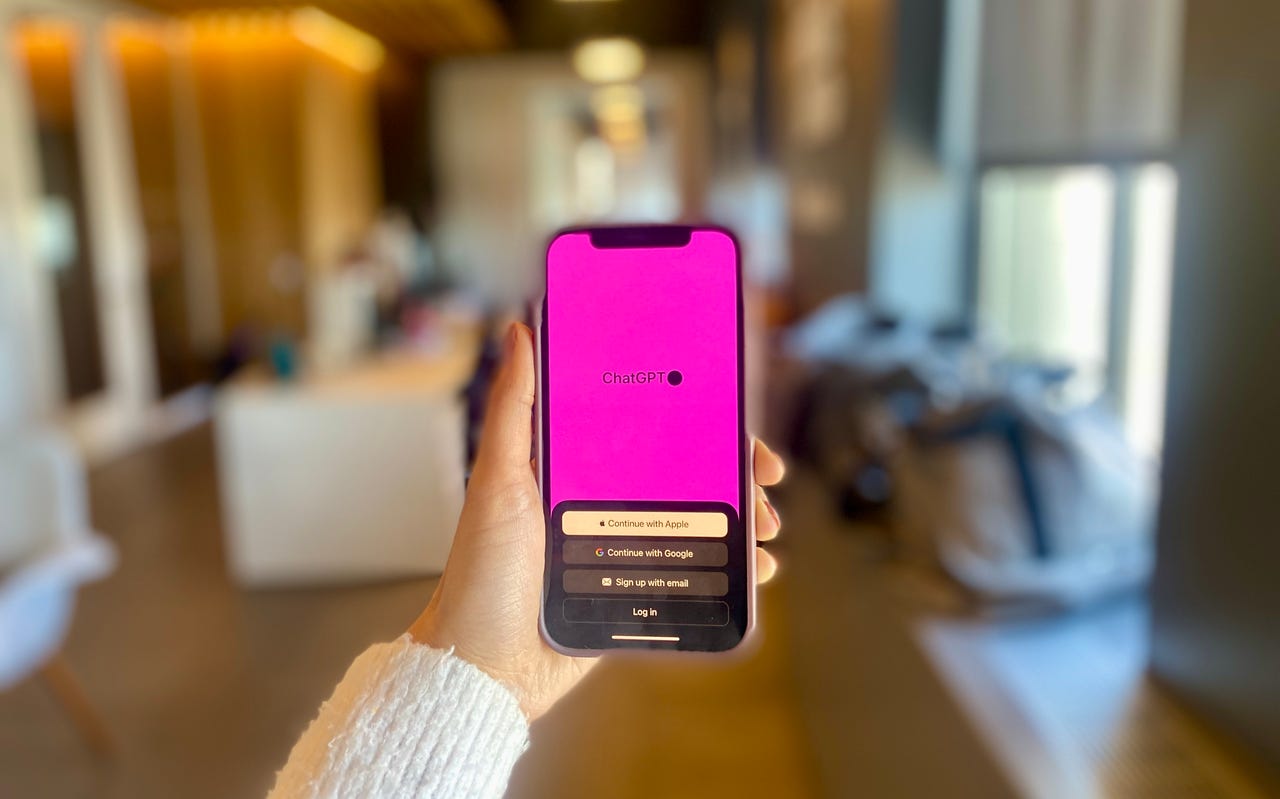
Once you download the app, you will be prompted to sign into your OpenAI account. If you don't have an account already, you can easily create one on the app.

Once you sign in, you are ready to start chatting away.

Hands-on with the app

The interface of the app is sleek and has a layout that resembles the Messages app used to send texts on iPhones.

In the same manner, you would start a conversation via text with a friend, you can type up a prompt and send it to ChatGPT.

The first prompt I gave the chatbot was, "Can you write me an email telling my boss that I am going to have to call out sick?".

Also: How to use ChatGPT to build your resume

The response was generated quickly, and it had the same quality of output it would on a desktop, as seen by the photo above. The email had an introduction, body, and conclusion that I could copy and paste into an email.

Then, I tested out the app's biggest differentiating feature, voice input. With this feature, users can click on the sound wave icon, located in the same spot the microphone button is located in the Messages app, and say a verbal prompt to ChatGPT.

I verbally asked ChatGPT, "Can you write me a text telling my best friend that I would love to meet her for dinner at the new restaurant she suggested?".

Also: How to write better ChatGPT prompts

To my surprise, ChatGPT perfectly transcribed what I said. Since the chatbot got all the words right, I just entered the prompt without any tweaks. As per usual, the chatbot had the text I asked for generated within seconds.

Hey [Friend's Name]! I hope you're doing well. I wanted to let you know that I would absolutely love to meet you for dinner at the new restaurant you suggested. It sounds like a fantastic place, and l'm really excited to try it out together. When would be a good day for you? Let's catch up and enjoy some delicious food!

Looking forward to seeing you soon.

Lastly, to make sure I covered all the bases, I asked ChatGPT a basic coding question on the app to see how it performed.

Also: How to use ChatGPT to write code

I asked prompted it to "Write a function that finds the second largest element in an array" and within seconds it did. I was apprehensive about how the code would show up on a tiny phone screen, but the code was clear and I didn't find it to be an issue at all.

Should you use the app or the desktop version?

Both the app and the desktop accomplish the same tasks and can offer the same assistance. Ultimately, choosing which one to use depends on what you use ChatGPT for in your everyday life.

If you use ChatGPT for phone-centric activities such as composing texts, emails, or captions, I recommend downloading the app.

Also: The best AI chatbots

If you use ChatGPT for assistance with activities you primarily do on your desktop such as coding or writing long prose, I recommend sticking to the desktop version.

However, you don't have to pick one over the other. If you use ChatGPT often, my best advice would be to use both the app and the desktop. Since both are linked to your OpenAI account, you will be able to access your conversations with ChatGPT amongst all of your signed-in devices, making it easy to switch back and forth.

Artificial Intelligence

China is ramping up efforts to drive AI development

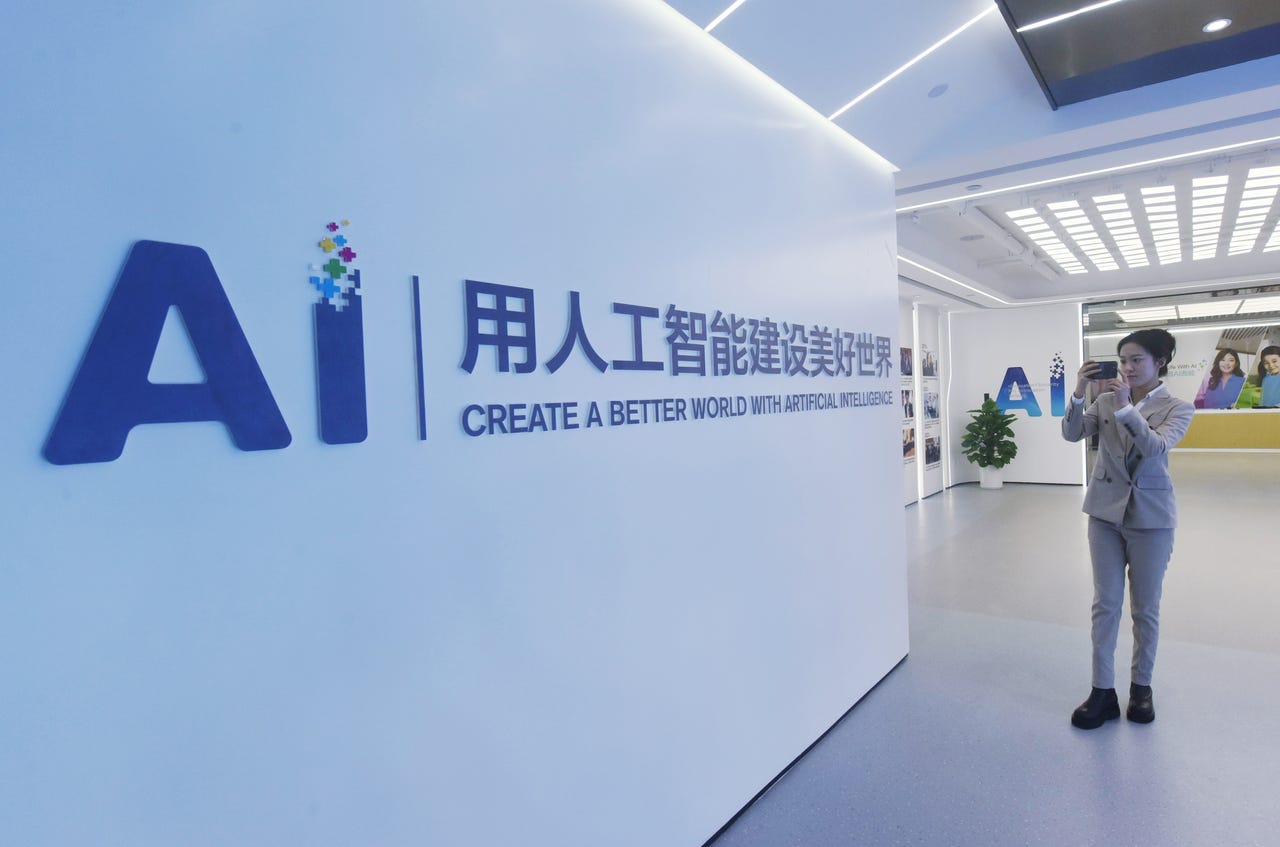
Iflytek AI Experience Hall In Hangzhou

Iflytek AI Experience Hall In Hangzhou

China is ramping up efforts to drive the development of artificial intelligence (AI) and calling for global collaborators to participate.

The Chinese government this week unveiled plans to build AI industrial hubs and tech platforms across the country to support research and development work.

To date, development plans have been launched for 18 national AI pilot areas and 32 innovation platforms, including in Beijing and Tianjin, according to a report by state-owned publication Global Times.

China believes AI is essential to improving productivity and public wellbeing as well as industry transformation, said Minister of Science and Technology Wang Zhigang, who was speaking Thursday at the 7th World Intelligence Conference in Tianjin.

Also: Generative AI brings new risks to everyone. Here's how you can stay safe

The nationwide AI platforms would help deepen integration of research and application, Wang said, but gave no further details on these new infrastructures.

He noted, though, that the government was conscious of the potential risks and existing challenges AI faced, such as fragmented underlying algorithms, lack of quality data, and inefficient AI models. There also were concerns about personal privacy and public safety, and its impact on education and employment.

He said the Beijing administration had made efforts to address such issues, which included advocating the development of ethical and responsible AI. Guidelines, for instance, were published on AI ethical norms.

Also: 6 harmful ways ChatGPT can be used

China last month also released draft legislation on the development of generative AI technologies, such as ChatGPT, which it said could lead to abuse if left unregulated. Under the proposed rules, for instance, operators will be required to send their applications to regulators for "safety reviews" before offering the services to the public.

Wang further called on local companies to work with research and education institutions to drive AI advancements that could contribute to China's economic and societal growth.

The minister also called for global collaborators to help address challenges related to AI, specifically, in the areas of data privacy, public security, and employment.

Also: ChatGPT and the new AI are wreaking havoc on cybersecurity

Touting China's investment in AI development, he said the country led in several areas last year, including patent submissions and technology advancements, such as voice recognition, computer vision, and natural language processing.

China in 2022 had the world's largest number of AI patent applications and the most number of published academic papers and citations, according to state-owned media China Daily, which cited stats from Ministry of Science and Technology. The country's core AI sectors topped 500 billion yuan ($71.85 billion), with more than 4,200 market players contributing about 16% of the world's total.

Also: Human or bot? New Turing test AI game challenges you to take your best guess

The Chinese government as early as 2017 had earmarked AI as a key growth area, releasing a blueprint with the aim to lead the world in AI by 2030. It had identified 17 technology areas as AI development priorities, including intelligent vehicles, intelligent drones, and neural network chips.

It also wants its judicial sector to be supported by an AI infrastructure by 2025, with a directive to drive integration of the technology with judicial work and enhance legal services. In addition, a national supercomputing framework is expected to be in place by end-2025 to drive the country's digital plans and the development of emerging technologies, including AI.

Local players including Tencent and Alibaba already are offering or integrating generative AI models into their products.

Also: This new AI system can read minds accurately about half the time

Apart from its draft laws on generative AI, China has introduced other regulations related to AI. For example, legislation came into effect this January that laid out ground rules to prevent "deep synthesis" technology, including deepfakes and virtual reality, from being abused. Anyone using these services must label the images accordingly and refrain from tapping the technology for activities that breach local regulations.

Artificial Intelligence