Top 5 Companies Hiring for Data Science Roles

Building upon the backdrop of 2022’s legacy characterised by substantial layoffs, numerous tech giants have succumbed to the practice of downsizing, persisting even in this year, as a strategic response to combat prevailing macroeconomic conditions and address the repercussions of overhiring. However, amidst this grim period, we have compiled an extensive catalogue of open positions that actively seek out individuals having exceptional expertise and proficiency.

Microsoft

Microsoft is looking to add a Partner Research Director, IDC who will oversee team management, emphasise the cultivation of diverse and inclusive team dynamics, collaborate with leaders and the wider organisation through cross-functional collaboration, and establish long-term growth plans in collaboration with geographically dispersed research teams. Additionally, you will devise research strategies and effectively supervise skilled individuals specialising in data science, machine learning, and threat hunting. Moreover, you will develop key metrics, forecasts, and reports, partnering with peer teams across geographically diverse research divisions.

Minimum Qualifications:

  • Over 15 years of experience successfully managing result-oriented R&D teams that deliver solutions for customers.
  • Experience in leading large teams and overseeing multiple levels of management.
  • Exceptional communication skills across different groups and adept at issue management.
  • Background in the protection/security industry.
  • Proficiency in understanding attack patterns in identity, endpoint (Windows, Linux, Mac, and mobile), and cloud/SaaS systems.
  • Familiarity with security incident response, forensic investigation, and threat intelligence.
  • Experience speaking at security-focused conferences on threats and protective measures.

Location: Hyderabad, Telangana (Hybrid)

Click here to apply.

Read more: Data Science Hiring Process at Meesho

Cisco

Networking giant Cisco is in search of a skilled Data Scientist to add business insights to various customer experience entities. This requires a combination of extensive domain expertise and technological proficiency. The primary responsibilities include developing a deep understanding of the business domain and fostering collaboration among stakeholders. Additionally, the data scientist will assist in designing and developing solutions, implementing them effectively, and promoting data-driven decision-making. The ultimate goal is to drive significant business outcomes, such as revenue growth, cost reduction, and improved customer and employee satisfaction.

Minimum Qualifications:

  • Master’s or Bachelor’s degree in management, operations, statistics, mathematics, or computer science, along with a minimum of five years of professional experience.
  • Strong background in various domains such as business consulting, statistical modelling, applied machine learning/AI and data-driven storyboarding.
  • Candidate should possess proficient skills in SQL, R, and Python.

Location: Bangalore, Karnataka

Visit Cisco’s career page to learn more about it.

Zoom

Online video communications platform Zoom has an open position for a data analyst to support important marketing, pricing, revenue, and compliance initiatives. The role involves identifying and measuring the impact on customer audiences on a weekly basis. The analyst will become an expert in revenue and subscription data for the online business, improving existing processes for increased productivity. They will also create dashboards to measure the outcomes of new growth initiatives and ensure the delivery of relevant insights to online partners. The analyst will conduct in-depth research and analysis to discover new business opportunities and use advanced analytics techniques such as incrementality analysis, forecasting, and modelling.

Minimum Qualifications:

  • Bachelor’s Degree and a minimum of five years of experience utilizing data for decision-making.
  • Strong SQL skills along with excellent communication abilities, problem-solving skills, and a growth mindset suitable for a dynamic business environment.

Location: Bangalore, Karnataka

Check out the opportunity here.

JP Morgan & Chase

JP Morgan & Chase, a financial services company, is actively involved in AI development. Their AI software service, IndexGPT, aims to provide financial assistance. Currently, they are seeking a Vice President – Annotation (Lead), Conversational AI Product. This role involves data labeling and annotation for machine learning models. Responsibilities include sifting through data, identifying relevant content, and applying accurate labels. Tasks include comprehending business objectives, establishing entity relationships, validating model results, and providing feedback for improvement. The role also includes developing workflows, processes, and KPIs for measuring annotation performance and ensuring quality. Collaboration with cross-functional teams to design data annotation projects and leadership in data annotation operations are key responsibilities.

Minimum Qualifications

  • Minimum 10 years of work experience, with more than seven years in data collection, analysis, or research, and around three years leading small teams.
  • Strong knowledge and experience in the financial domain.
  • Ability to work independently and collaboratively to achieve project goals.
  • Curiosity, diligence, and attention to detail, with a motivation for solving complex analytical problems and an interest in data analytics techniques.
  • Interest in machine learning and the ability to develop a working level of domain knowledge in machine learning concepts.
  • Understanding of model scoring parameters, including precision, recall, and f-score.

Location: Bangalore, Karnataka

Apply here.

Read more: Believe it or Not, 55% of Digital Frauds Happen Via UPI

Accenture

Acceture is expanding its team with the addition of an AI Platform Engineer who develops applications and systems that use AI to improve performance and efficiency. The primary responsibilities include building predictive models, developing advanced algorithms for data analysis, evaluating emerging technologies, identifying new data patterns, deploying models in production, integrating front-end and back-end systems.

Minimum Qualifications

  • Proficient coding skills and familiarity with Python, R programming languages.
  • Prior experience in data analysis and a strong interest in utilising data for statistical modeling and extracting valuable insights.
  • Experience working with machine learning data mining toolkits such as NLP, Semantic Web, R, Core NLP, NLTK, as well as information retrieval libraries like Lucene/SOLR.
  • Ability to thrive in a fast-paced, test-driven, collaborative, and iterative programming environment.

Location: Hyderabad, Telangana

Click here to apply for this.

The post Top 5 Companies Hiring for Data Science Roles appeared first on Analytics India Magazine.

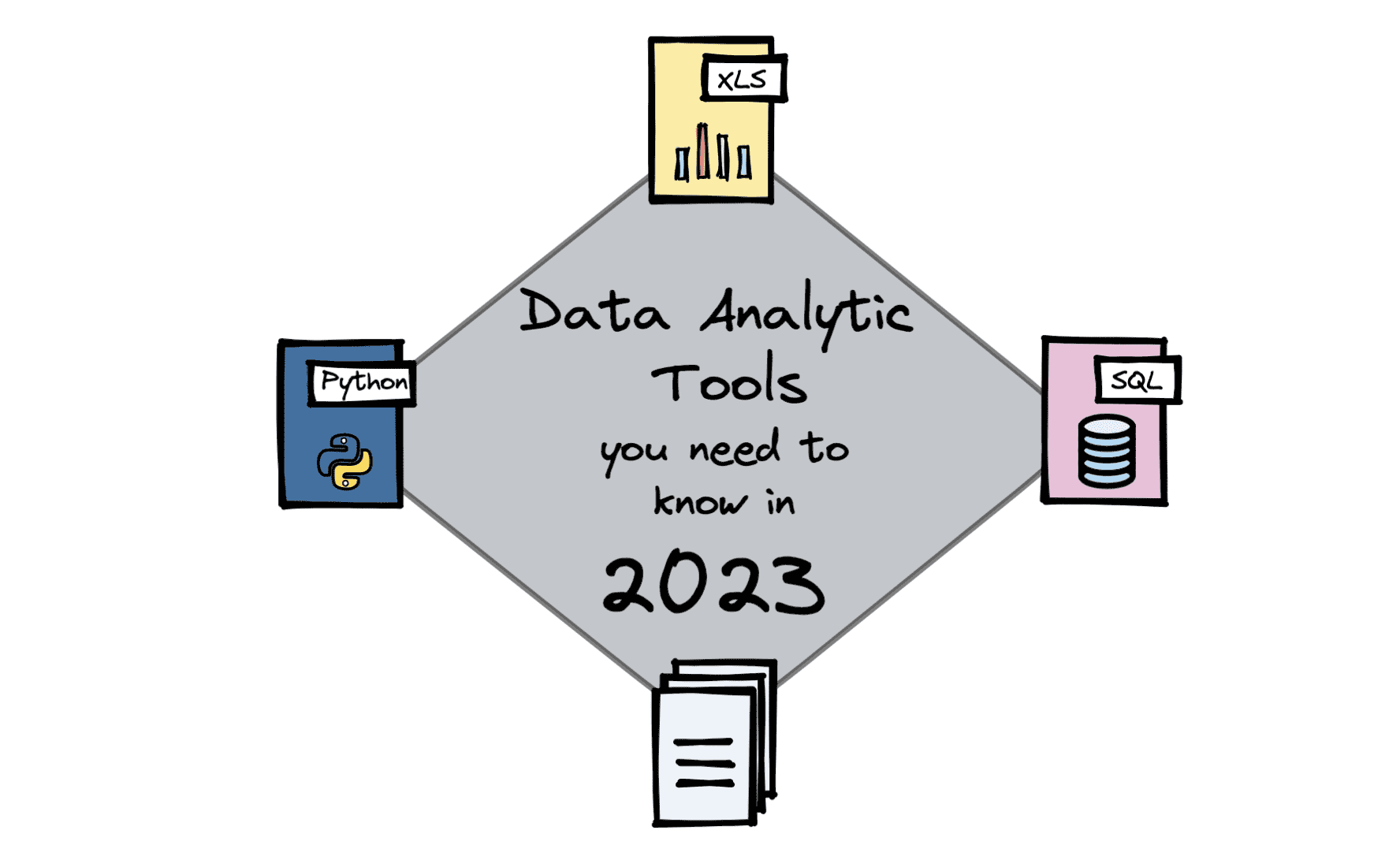
Data Analytics Tools You Need To Know in 2023

Data Analytics Tools You Need To Know in 2023
Image by Author

You may want to transition into data analytics, or it could be a completely new field for you. Regardless, being prepared is always crucial. The majority of people who enter a new career are looking at the end goal: getting a job. However, some are so focused on landing their dream job: they forget that they need to be proficient in the required skills and tools.

What is a Data Analyst?

A Data Analyst is someone who looks through data and provides reports and visualisations which explain the data.

A data analyst does not typically spend their day coding. Their responsibilities involve using their technical mindset along with their excel, coding, or SQL skills to identify trends, patterns and solutions that can aid a business’s decision-making process. They are also responsible for turning these findings into visualisations to present to stakeholders.

Now let’s get into the must-have tools that a data analyst needs to be successful in their job.

What tools do you need to know as a Data Analyst?

Excel

  • Type of tool: Spreadsheet software.
  • Availability: Commercial.
  • Use: Data wrangling and reporting.

Excel has been frequently used by many people from different industries — it is a staple in most fields. If you remember in school, you probably used it but didn’t realise its full capabilities. Apart from sorting and organising data, it also has calculation and graphing functions which are very ideal for data analysis.

Although Excel is popular and uses a lot of useful functions and plug-ins. It also comes with its downfalls. Due to its capabilities and processing power, it runs very slowly when dealing with big datasets and can lead to calculation errors and inaccuracies.

Python

  • Type of tool: Programming language.
  • Availability: Open-source.
  • Use: Developing websites/software, task automation, data analysis, and data visualization

Python is a general-purpose programming language known for its simple syntax making it easy to learn a programming language. It is currently the most popular programming language due to its intuitive syntax. It contains a variety of libraries, such as NumPy to help process computational tasks.

As a Data Analyst, you can use Python to help with your data analysis, such as importing and filtering data, statistical tests, finding correlations between the data and producing visualization.

R

  • Type of tool: Programming language.
  • Availability: Open-source.
  • Use: Statistical analysis and data mining.

A lot of people have trouble choosing which programming language to learn — Python or R. Python is known for being a general-purpose programming language, whereas R is a statistical programming language.

The syntax for R is more complicated in comparison to Python, but this is due to it being built specifically to handle heavy statistical computing tasks and create data visualizations.

SQL

  • Type of tool: Standardized programming language.
  • Availability: Commercial.
  • Use: Communicate with a database

As a Data Analyst, you will spend a lot of time communicating with databases. It is used to perform tasks such as updating data on a database or retrieving data from a database. It provides you with a simpler way to scan through your database and explore new findings with a few lines of code.

Jupyter Notebook

  • Type of tool: Interactive authoring software.
  • Availability: Open-source.
  • Use: creating and sharing code/computational documents.

Jupyter Notebook is an open-source software which provides interactive computing and is compatible across different programming languages. It can create and share documents that contain live code, equations, visualizations, and text between members of the team.

Its top uses are programming practice, collaboration across projects, data cleaning, data visualisation, and sharing. It also integrates with big data analysis tools such as Apache Spark, which we will speak about next.

Apache Spark

  • Type of tool: Data processing framework.
  • Availability: Open-source.
  • Use: Big data workloads.

Apache Spark is an analytics engine that can process large-scale data, quickly and effectively. It is known that Apache Spark can help you run your workloads 100 times faster. As a Data Analyst, you will use it to process various datasets and analyze unstructured big data, along with machine learning.

The framework is compatible with programming languages such as Python, R, Java, Scala, and SQL.

Tableau

  • Type of tool: Data visualization tool.
  • Availability: Commercial.
  • Use: Connect data, and build workbooks, stories, and dashboards.

Tableau is one of the market-leading business intelligence tools which is used to analyze and visualize data in an easy format. If you are a data analyst that doesn’t have proficient coding skills but you still want to be able to create interactive visualizations and dashboards to present to stakeholders, Tableau is here to save you.

It contains features such as machine learning, statistics, natural language, and smart data prep. It has not only made life easier for data scientists, but also for business users.

SAS

  • Type of tool: Statistical software suite.
  • Availability: Commercial.
  • Use: statistical analysis and data visualization.

SAS is a command-driven software, only for Windows operating systems. It stands for Statistical Analysis System and is a group of programs that work collectively to store and retrieve data, be able to modify it, compute statistical analyses, and create visualisations and reports.

The software helps you to gain quick insights into your data, in which you can then use automated analysis which is backed by machine learning, to then produce reports that are easy to understand for the decision-making process.

KNIME

  • Type of tool: Data integration platform.
  • Availability: Open-source.
  • Use: access, blend, analyze, and visualize data

KNIME is an open-source software, that allows you to build analyses at any complexity level. You can either use the:

  • KNIME Analytics Platform – to clean and gather your data, analyze it and make it accessible to everyone using visualisations.
  • KNIME Server – the deployment of workflows, whilst making them accessible to the team for collaboration, management, and automation.

Microsoft Power BI

  • Type of tool: Business analytics suite.
  • Availability: Commercial.
  • Use: Transform data into visually immersive, and interactive insights

Microsoft Power BI allows you to take your data and create interactive visual reports and dashboards to share your findings more comfortably. It operates with Excel, text files, SQL, and cloud sources. Your data is safe with Power BI as it uses sensitivity labelling, end-to-end encryption, and real-time access monitoring.

You have a choice between their range of products such as Power BI Desktop, Power BI Pro, Power BI Premium, Power BI Mobile, Power BI Embedded, and Power BI Report Server.

Conclusion

As you continue your journey as a data analyst, you will see these current tools advance and new tools emerge in the market. Your skillset is dependent on where you want to be in the next 10 years. The more you know, the better.

If you are still unsure about the path to data analysis and need more guidance, have a read of:

  • Top Data Analyst Certification Courses for 2022

Nisha Arya is a Data Scientist, Freelance Technical Writer and Community Manager at KDnuggets. She is particularly interested in providing Data Science career advice or tutorials and theory based knowledge around Data Science. She also wishes to explore the different ways Artificial Intelligence is/can benefit the longevity of human life. A keen learner, seeking to broaden her tech knowledge and writing skills, whilst helping guide others.

More On This Topic

  • A List of 7 Best Data Modeling Tools for 2023
  • Google Data Analytics Certification Review for 2023
  • Top Data Python Packages to Know in 2023
  • Top 19 Skills You Need to Know in 2023 to Be a Data Scientist
  • Tapping into the Potential of Data Products in 2023
  • 5 Free Data Science Books You Must Read in 2023

Merck Group and Palantir Forge Ahead with Open Collaboration

In the fast-paced world of innovation, companies are constantly seeking new ways to collaborate and leverage cutting-edge technologies. Merck Group, a global leader in the life science industry, has achieved a significant milestone in open collaboration and innovation with its first-ever open-source library, in partnership with Palantir Technologies.

Not only does this venture foster internal collaboration among Merck’s developers but also aims to serve as a blueprint for boosting productivity and quality for software developers outside of the company, all while leveraging the powerful Palantir Foundry ecosystem.

Impact of the Analytics COE on the business

To gain further insight into this achievement, Analytics India Magazine spoke with Subbu Iyer, the head of the Analytics Center of Excellence at MilliporeSigma (Merck KGaA Germany). With four years of progress under his leadership, Iyer emphasised the positive impact of the Analytics COE on the business.

“We have gained valuable insights to support our colleagues and customers while driving revenue generation,” he added. Expressing his enthusiasm for the future, Iyer looks forward to continuing this journey with his exceptional global team and partners.

Naturally, we were curious to learn how the partnership between Merck and Palantir Technologies came to fruition. Iyer shed light on the origins of their collaboration: “In 2017, Merck Healthcare and Palantir Technologies joined forces to accelerate research efforts for Syntropy, a technology company aimed at providing comprehensive analytics approaches to help researchers gather, analyse, and exchange data from diverse sources.”

Iyer said that the shared goal of making a positive contribution to healthcare inspired Merck and Palantir to combine the scientific expertise of EMD Digital Inc, a Merck subsidiary, with Palantir Foundry’s unique technology. Together, they developed software solutions for data administration, governance, and stewardship, among other critical areas.

This collaboration laid the foundation for further joint endeavours between the two companies, including the creation of a secure collaborative data analytics platform for the semiconductor industry, known as the Athinia platform.

What does Merck want to achieve with the Library?

The open-source library created by Merck in partnership with Palantir Technologies serves as a crucial component of their digitalisation strategy.

Iyer articulates the significance of this library, stating, “This open-source initiative exemplifies how data and a robust code base can enhance Merck’s quality, responsiveness, and productivity, both internally and externally.

By leveraging Palantir Foundry, developers outside of Merck can access practical value from data and analytics, ultimately boosting the Developer Experience (DevX) for Foundry programmers.”

The primary objective of this library is to democratise data provision by eliminating complexity and providing a standardised set of developer tools. Merck aspires to lower the barriers to entry for data teams, empowering them to deliver enhanced output and quality.

This milestone project, born from a customer-driven and open-source approach, not only reinforces Merck’s commitment to open collaboration but also paves the way for increased productivity and innovation throughout the industry.

How secure are the Foundry APIs?

Addressing concerns about security in the context of the Foundry APIs, Iyer assures that the Palantir platform prioritises security as a fundamental principle of its development. Palantir’s track record of collaborating with highly regulated and secure industries for over a decade attests to its commitment to data protection.

While acknowledging the potential risks associated with APIs, Iyer emphasises the importance of user vigilance. Safeguarding API keys or tokens is paramount, as any accidental exposure should be treated as a breach of data security. In such cases, immediate action should be taken to disable the tokens, followed by prompt notification to the organisation’s information security staff.

Palantir’s Information Security team has implemented an automated tool that helps identify and revoke tokens inadvertently leaked in source control on GitHub.com. If a token is exposed in a public GitHub repository, the GitHub token revocation service is promptly alerted and will make every effort to automatically revoke the token on behalf of the user.

The post Merck Group and Palantir Forge Ahead with Open Collaboration appeared first on Analytics India Magazine.

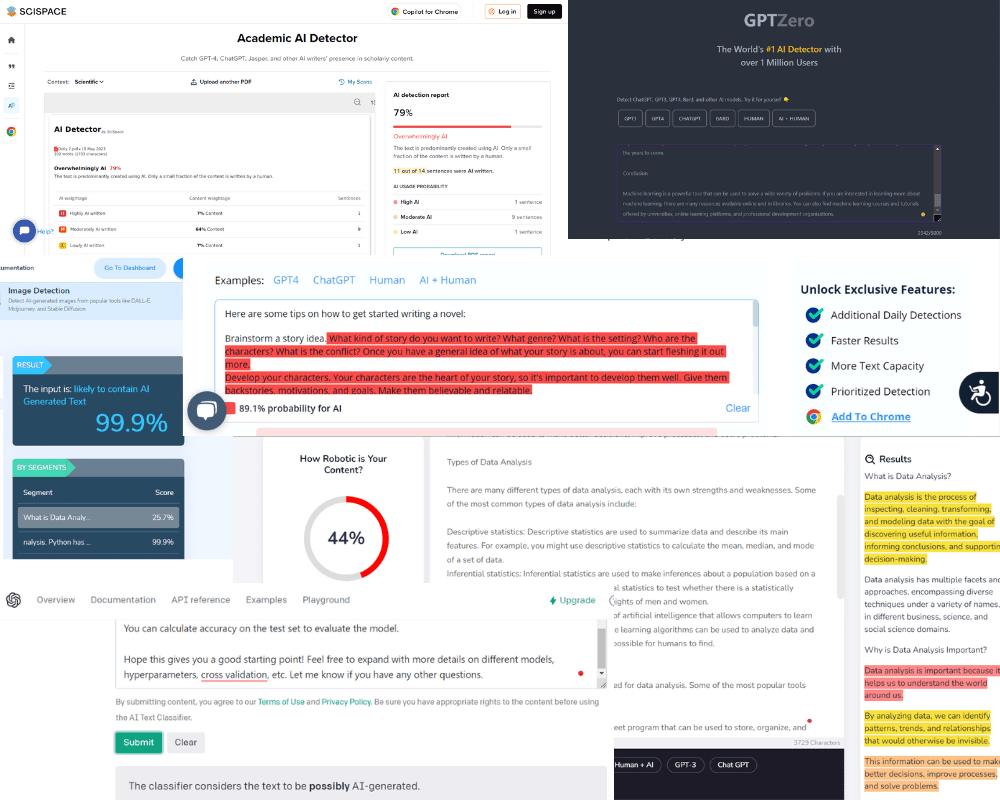
Top 10 Tools for Detecting ChatGPT, GPT-4, Bard, and Claude

Top 10 Tools for Detecting ChatGPT, GPT-4, Bard, and Claude
Image by Author

We live in an era of artificial intelligence (AI) boom, where new large language models (LLMs) that can write like humans are released every week. These models can generate highly creative content, and unfortunately, some students and professionals are misusing them to plagiarize.

As a result, AI detection tools have become essential for every classroom, workplace, and research institute. All of the tools mentioned in this blog are free, and some of them even come with Chrome extensions so that you can detect content on the go.

1. GPTZero

GPTZero has been significantly improved. It is now highly accurate, easy to use, and comes with a Chrome extension. You can use it to detect a wide range of AI-generated text, including text from the latest models like Bard (PalM 2), ChatGPT, GPT-4, and other open-source models. It is also fast and highlights the generated text for easy identification.

Top 10 Tools for Detecting ChatGPT, GPT-4, Bard, and Claude
Image from GPTZero 2. OpenAI AI Text Classifier

OpenAI's AI Text Classifier is highly accurate, but it does not provide additional information about the content. I use it daily to maintain quality assurance, and I am satisfied with the results. It works for New Bard, ChatGPT, GPT-4, and other LLaMA-based models.

Top 10 Tools for Detecting ChatGPT, GPT-4, Bard, and Claude
Image from OpenAI 3. CopyLeaks

I was introduced to CopyLeaks by a Reddit user in the r/freelanceWriters subreddit. It is a fast, accurate plagiarism checker that comes with a simple Chrome extension. You can even hover over highlighted text to check the popularity of AI. It can detect Bard, ChatGPT, GPT-4, and other large language models (LLMs).

Top 10 Tools for Detecting ChatGPT, GPT-4, Bard, and Claude
Image from CopyLeaks 4. Typeset

The Typeset Academic AI Detector is a bit different from the other tools I've mentioned. It is highly accurate, but it was specifically designed to detect scholarly content in PDFs. There is no copy and paste option at the moment, but the tech team is working on adding that feature. You can upload any type of academic work as a PDF, and Typeset will generate results.

I tested Typeset with content generated by Bard, ChatGPT, and HuggingChat, and it accurately detected all of it.

Top 10 Tools for Detecting ChatGPT, GPT-4, Bard, and Claude
Image from Typeset 5. Hive Moderation

Hive Moderation’s AI Generative Content Detection occasionally misidentifies human-generated content as AI. To ensure reliable results, it is advisable to have a backup tool when using it as the primary resource. The AI Generative Content Detection provides results accompanied by probability percentages and segments. Furthermore, it offers the capability to detect AI-generated images from platforms such as DALL-E, Midjourney, and Stable Diffusion.

Top 10 Tools for Detecting ChatGPT, GPT-4, Bard, and Claude
Image from Hive Moderation 6. Content at Scale

Content at Scale’ AI Content Detector is simple to use and produces fairly accurate reports on predictability, probability, and pattern. It works with all kinds of latest large language models (LLMs) and highlights content based on the variable probability of AI-generated work.

Top 10 Tools for Detecting ChatGPT, GPT-4, Bard, and Claude
Image from Content at Scale 7. Hello Simple AI

The ChatGPT Detector by Hello Simple AI is a free, open-source tool that can be used to detect text generated by ChatGPT. It is hosted on Hugging Face Spaces and provides fast and fairly accurate results. The detector is not as accurate as the OpenAI classifier, but it does provide two metrics (GLTR and PPL probability) that can help you determine if the content is generated by AI or not.

Top 10 Tools for Detecting ChatGPT, GPT-4, Bard, and Claude
Image from Hugging Face 8. OpenAI HF Detector

The OpenAI Detector is a free, open-source tool that can be used to detect text generated by OpenAI's GPT language model. It is hosted on Hugging Face Spaces and provides fast results. However, the detector can be highly inaccurate, especially when it comes to detecting newer versions of OpenAI’s models and other open-source large language models.

Top 10 Tools for Detecting ChatGPT, GPT-4, Bard, and Claude
Image from Hugging Face 9. Corrector.app

Corrector.app’s AI Detector is a fairly accurate tool that can be used to detect text generated by ChatGPT, Bard, and other older versions of large language models (LLMs). However, it is not able to detect newer versions of LLMs. This is because the AI Detector works by analyzing the syntax and semantics of the text, and newer LLMs are better at generating text that is indistinguishable from human-written text.

Top 10 Tools for Detecting ChatGPT, GPT-4, Bard, and Claude
Image from Corrector.app 10. Writer.com

Writer.com’s AI Content Detector concludes our list, presenting itself as the least accurate option with a character limitation of 1500. It serves as a fallback solution when other tools are unavailable or ineffective.

Top 10 Tools for Detecting ChatGPT, GPT-4, Bard, and Claude
Image from Writer.com

Abid Ali Awan (@1abidaliawan) is a certified data scientist professional who loves building machine learning models. Currently, he is focusing on content creation and writing technical blogs on machine learning and data science technologies. Abid holds a Master's degree in Technology Management and a bachelor's degree in Telecommunication Engineering. His vision is to build an AI product using a graph neural network for students struggling with mental illness.

More On This Topic

  • 5 Free Tools For Detecting ChatGPT, GPT3, and GPT2
  • 8 Open-Source Alternative to ChatGPT and Bard
  • ChatGPT vs Google Bard: A Comparison of the Technical Differences
  • Super Bard: The AI That Can Do It All and Better
  • What is Google AI Bard?
  • Why Data Scientists Expect Flawed Advice From Google Bard

AI Battle Heats Up: Microsoft to Take on Apple Head-on

Animoji. FaceID. On-device AR. All these features were made possible by one small compute cluster deep inside Apple’s chips — the Apple Neural Engine (ANE). After taking over mobile AI compute with the ANE, Apple brought the chip to its M series of MacBooks. This represented a paradigm shift for ML researchers, that of on-device specialised AI compute.

Now, there’s a new kid on the block. Announced recently at the three-day Microsoft Build conference, the Redmond giant is going big on AI compute on the edge. Partnering with market leaders Intel, AMD, and NVIDIA, Microsoft has announced a new line of silicon-level improvements made specifically for AI compute.

With this move, the pillars of the PC ecosystem have teamed up to challenge Apple’s dominance in the AI ecosystem.

Dreams of the edge

At the recent Microsoft Build conference, the company expressed its desire to integrate AI into all its products. Developers were also incentivised to build AI features for Windows and other Microsoft products through the Hybrid AI Loop and Windows Olive for model optimisation. However, one important thing that stood out to us was the announcement of partnerships with AMD, Intel, NVIDIA, and Qualcomm to create new silicon optimised for AI compute.

In conjunction with hardware manufacturers like Dell, HP, Lenovo, and more, this will create a new generation of personal computers with on-device AI capabilities.

By working more closely with chip manufacturers, Microsoft seems to be pushing for more efficient inference on-device, rather than relying on Azure to do so. Not only will this cut down the cost for Microsoft, but it will also equip the next generation of computers with neural processing units (NPUs). These chips are purpose-built for AI tasks, and can perform them faster than general-purpose chips while remaining more efficient.

AMD and Microsoft have already been reported as working together to create more capable AI chips. Reports have emerged that Microsoft is “providing support” to strengthen AMD’s AI chips. While these were only rumours before the Windows AI announcement, they now seem to be coming to fruition.

AMD’s 7040-series of laptop chips has an in-built NPU, and already works with Windows 11 through the ONNX runtime. Documentation is now available for the 7040-series chips’ AI capabilities, making it easy for developers to add AI functionality to their applications.

As part of the partnership, another company Intel has stated that its new line of Meteor Lake chips have a built-in neural vision processing unit or VPU. This will reportedly accelerate AI inference while also working in software like Adobe Premiere Pro for more “effective machine learning”. Apart from this, Intel has also added support for these chips on WinML and DirectML, so developers can directly address the new hardware.

While NVIDIA has done its part in creating the AI compute market, it seems that it’s not completely done yet. As part of the partnership with Microsoft, NVIDIA has released updates to its driver software that will make RTX-enabled GPUs even faster at AI tasks. By leveraging the GPUs’ in-built tensor cores, NVIDIA has promised performance improvements for ML models, such as a 2x improvement for Stable Diffusion.

Beyond the partnerships, Microsoft has been pouring resources into creating a robust dev chain for AI tasks on Windows. The biggest part of this is the ONNX runtime and tools like Windows Olive, which can help optimise models. The WinML API also plays a huge role in facilitating AI development on the platform, as it provides an easy way to integrate ML capabilities into Windows applications.

While this partnership might seem like the Avengers of the tech world coming together, it seems that Thanos is sitting pretty waiting for the battle. Apple has already set the stage for on-edge AI development workloads.

Apple-Microsoft: Head-on-Head

Ever since Apple moved to the SoC (system on chip) design for laptop chips, the Neural Engine has been a mainstay of its chips. In 2021, TensorFlow was updated with the capability to allow AI models to be trained on the ANE. According to Apple, this resulted in almost a 5x improvement in training times for common workloads like CycleGAN, Style Transfer, DenseNet and more.

Microsoft is trying to catch up to the M-series of chips by tying up with chipmakers to recreate the magic of ANE.

While the Neural Engine is one of the most important pieces of the puzzle, it is just one part of the story. Apart from releasing all its new laptops with AI compute on board, Apple has also been hard at work creating developer tools to leverage the ANE.

The devchain includes offerings like the Core ML library which allows developers to add pre-built ML models. It also allows them to integrate AI into their applications. What’s more, Apple also has machine learning APIs for common tasks like vision, speech, and natural language, all powered by the ANE.

In a way, the WinML API is Microsoft’s answer to Apple’s Core ML library. WinML allows developers to leverage on-device processing capabilities to add ML to their applications.

Apple is big on on-device ML processing, so it’s no surprise that all their offerings are aligned with this strategy. However, Microsoft always provides Azure as a fallback for developers when target devices do not have AI capabilities, maximising compatibility.

John Giannandrea, Apple’s SVP for machine learning and AI strategy, stated in an interview, “I understand this perception of bigger models in data centres somehow being more accurate, but it’s actually wrong. It’s technically wrong. It’s better to run the model close to the data, rather than moving the data around.”

As we can see, Apple and Windows may be targeting the same market, but in fundamentally different ways. With its lead in the market, privacy-preserving features, and on-device processing, it seems that Apple might hold on to the lead for now. On the other hand, Microsoft’s approach will bring AI to the masses, putting Windows devices on par with Apple’s for AI-focused tasks.

While it might seem that this puts Apple and Windows head-to-head in the AI ecosystem, both companies are trying to stay on the curve. The market is progressing towards deployment of AI at the edge, pushing system manufacturers to include AI capabilities in the devices. Offering support and creating a developer ecosystem is a no-brainer for both these companies which are leading personal computing towards an AI-powered future.

The post AI Battle Heats Up: Microsoft to Take on Apple Head-on appeared first on Analytics India Magazine.

Nvidia unveils new kind of Ethernet for AI, Grace Hopper ‘Superchip’ in full production

nvidia-ceo-jensen-huang-holds-up-spectrum-4-ethernet-switch.png

Nvidia CEO Jensen Huang showed off the first iteration of Spectrum-X, the Spectrum-4 chip, with one hundred billion transistors in a 90-millimeter by 90-millimeter die.

Nvidia CEO Jensen Huang, offering the opening keynote of the Computex computer technology conference, on Monday in Taipei, Taiwan, unveiled a host of new products, including a new kind of ethernet switch dedicated to moving high-volumes of data for artificial intelligence tasks.

"How do we introduce a new ethernet, that is backward compatible with everything, to turn every data center into a generative AI data center?" posed Huang in his keynote. 
"For the very first time we are bringing the capabilities of high performance computing into the ethernet market," said Huang.

The Spectrum-X, as the family of ethernet is known, is "the world's first high-performance ethernet for AI," according to Nvidia. A key feature of the technology is that it "doesn't drop packets," said Gilad Shainer, the senior vice president of networking, in a media briefing.

The first iteration of Spectrum-X is Spectrum-4, said Nvidia, which it called "the world's first 51Tb/sec Ethernet switch built specifically for AI networks." The switch works in conjunction with Nvidia's BlueField data processing unit, or DPU, chips that handle data fetching and queueing, and Nvidia fiber-optic transceivers. The switch can route 128 ports of 400-gigabit ethernet, or 64 800-gig ports, from end to end, the company said.

Huang held up the silver Spectrum-4 ethernet switch chip on stage, noting that it's "gigantic," consisting of a hundred billion transistors on a 90-millimeter by 90-millimeter die built with Taiwan Semiconductor Manufacturing's "4N" process technology. The part runs at 500 watts, said Huang.

"For the very first time we are bringing the capabilities of high performance computing into the ethernet market," said Huang.

Spectrum-4 is the first in a line of Spectrum-X chips that are a new kind of ethernet purpose-built to provide lossless packet transmission for AI workloads.

The Spectrum-X family is built to address the bifurcation of data centers into two forms. One is what he called "AI factories," facilities that cost hundreds of millions of dollars for the most powerful GPUs, based on Nvidia's NVLink and Infiniband, used for AI training. 


The other data center facility is AI cloud (multi-tenant, based on ethernet), which is multi-tenant and focused on serving up the predictions to consumers of AI, which will be served by the Spectrum-X.

The Spectrum-X, said VP Shainer, is able to "spread traffic across the network in the best way," said Shainer, using "a new mechanism for congestion control," that averts a pile-up of packets that can happen in the memory buffer of network routers.

"We use advanced telemetry to understand latencies across the network to identify hotspots before they cause anything, to keep it congestion-free."

Nvidia said in prepared remarks that "the world's top hyperscalers are adopting NVIDIA Spectrum-X, including industry-leading cloud innovators."

Nvidia is building a test-bed computer, it said, at its Israel offices, called Israel-1, a "generative AI supercomputer," using Dell PowerEdge XE9680 servers composed of H100 GPUs running data across the Spectrum-4 switches.

All the news at Computex is available in Nvidia's newsroom.

In addition to the new ethernet technology, Huang's keynote featured a new model in the company's "DGX" series of computers for AI, the DGX GH200, which the company bills as "a new class of large-memory AI supercomputer for giant generative AI models."

Generative AI refers to programs that produce more than a score, sometimes being text, sometimes being images, other artifacts, as, for example, OpenAI's ChatGPT bot.

The GH200 is the first system to ship with what the company calls its "superchip," the Grace Hopper board, which contains on a single circuit board a Hopper GPU, and the Grace CPU, a CPU based on ARM instruction set that is meant to compete with x86 CPUs from Intel and Advanced Micro Devices.

Nvidia's Grace Hopper "superchip," a board containing its Grace CPU, left, and Hopper GPU, is now in full production, the company said.

The first iteration of Grace Hopper, the GH200, is "in full production," said Huang. Nvidia said in a press release that "global hyperscalers and supercomputing centers in Europe and the U.S. are among several customers that will have access to GH200-powered systems."

The DGX GH200 combines 256 of the superchips, said Nvidia, to achieve a combined 1 exaflops — ten to the power of 18, or, one billion, billion floating point operations per second — utilizing 144 terabytes of shared memory. The computer is 500 times as fast as the original DGX A100 machine released in 2020, according to Nvidia.

The keynote also unveiled MGX, a reference architecture for system makers to quickly and cost-effectively build 100+ server variations. The first partners to use the spec are ASRock Rack, ASUS, GIGABYTE, Pegatron, QCT and Supermicro, with QCT and Supermicro to be first to market with systems, in August, said Nvidia.

The entire keynote can be seen as a replay from the Nvidia Web site.

MGX is a reference architecture for computer system makers to quickly and cost-effectively build over 100 server variations using Nvidia chips. QCT and Supermicro will be the first to market with systems, in August, said Nvidia.

All the Nvidia news announced by Jensen Huang at Computex

All the Nvidia news announced by Jensen Huang at Computex

Generative AI and accelerated computing are transforming the world, said the CEO

Catherine Shu @catherineshu / 7 hours

Jensen Huang wants to bring generative AI to every data center, the Nvidia co-founder and CEO said during Computex in Taipei today. During the speech, Huang’s first public speech in almost four years he said, he made a slew of announcements, including chip release dates, its DGX GH200 super computer and partnerships with major companies. Here’s all the news from the two-hour-long keynote.

  1. Nvidia’s GForce RTX 4080 Ti GPU for gamers is now in full production and being produced in “large quantities” with partners in Taiwan.

2. Huang announced the Nvidia Avatar Cloud Engine (ACE) for Games, an customizable AI model foundry service with pre-trained models for game developers. It will give NPCs more character through AI-powered language interactions.

3. Nvidia Cuda computing model now serves four million developers and more than 3,000 applications. Cuda seen 40 million downloads, including 25 million just last year alone.

4. Full volume production of GPU server HGX H100 has begun and is being manufactured by “companies all over Taiwan,” Huang said. He added it is the world’s first computer that has a transformer engine in it.

5. Huang referred to Nvidia’s 2019 acquisition of supercomputer chipmaker Mellanox for $6.9 billion as “one of the greatest strategic decisions” it has ever made.

6. Production of the next generation of Hopper GPUs will start in August 2024, exactly two years after the first generation started manufacture.

7. Nvidia’s GH200 Grace Hopper is now in full production. The superchip boosts 4 PetaFIOPS TE, 72 Arm CPUs connected by chip-to-chip link, 96GB HBM3 and 576 GPU memory. Huang described as the world’s first accelerated computing processor that also has a giant memory: “this is a computer, not a chip.” It is designed for high-resilience data center applications.

8. If the Grace Hopper’s memory is not enough, Nvidia has the solution—the DGX GH200. It’s made by first connecting eight Grace Hoppers togethers with three NVLINK Switches, then connecting the pods together at 900GB together. Then finally, 32 are joined together, with another layer of switches, to connect a total of 256 Grace Hopper chips. The resulting ExaFLOPS Transformer Engine has 144 TB GPU memory and functions as a giant GPU. Huang said the Grace Hopper is so fast it can run the 5G stack in software. Google Cloud, Meta and Microsoft will be the first companies to have access to the DGX GH200 and will perform research into its capabilities.

9. Nvidia and SoftBank have entered into a partnership to introduce the Grace Hopper superchip into SoftBank’s new distributed data centers in Japan. They will be able to host generative AI and wireless applications in a multi-tenant common server platform, reducing costs and energy.

10. The SoftBank-Nvidia partnership will be based on Nvidia MGX reference architecture, which is currently being used in partnership with companies in Taiwan. It gives system manufacturers a modular reference architecture to help them build more than 100 server variations for AI, accelerated computing and omniverse uses. Companies in the partnership include ASRock Rack, Asus, Gigabyte, Pegatron, QCT and Supermicro.

11. Huang announced the Spectrum-X accelerated networking platform to increase the speed of Ethernet-based clouds. It includes the Spectrum 4 switch, which has 128 ports of 400GB per second and 51.2T per second. The switch is designed to enable a new type of Ethernet, Huang said, and was designed end-to-end to do adaptive routing, isolate performance and do in-fabric computing. It also includes the Bluefield 3 Smart Nic, which connects to the Spectrum 4 switch to perform congestion control.

12. WPP, the largest ad agency in the world, has partnered with Nvidia to develop a content engine based on Nvidia Omniverse. It will be capable of producing photos and video content to be used in advertising.

13. Robot platform Nvidia Isaac ARM is now available for anyone who wants to build robots, and is full-stack, from chips to sensors. Isaac ARM starts with a chip called Nova Orin and is the first robotics full-reference stack, said Huang.

Thanks in large to its importance in AI computing, Nvidia’s stock has soared over the past year, and it is currently has a market valuation of about $960 billion, making it one of the most valuable companies in the world (only Apple, Microsoft, Saudi Aramco, Alphabet and Amazon are ranked higher).

Artificial Intelligence and the Tetris Conundrum

In a pioneering study led by Cornell University, researchers embarked on an exploratory journey into the realms of algorithmic fairness in a two-player version of the classic game Tetris. The experiment was founded on a simple yet profound premise: Players who received fewer turns during the game perceived their opponent as less likable, regardless of whether a human or an algorithm was responsible for allocating the turns.

This approach marked a significant shift away from the traditional focus of algorithmic fairness research, which predominantly zooms in on the algorithm or the decision itself. Instead, the Cornell University study decided to shed light on the relationships among the people affected by algorithmic decisions. This choice of focus was driven by the real-world implications of AI decision-making.

“We are starting to see a lot of situations in which AI makes decisions on how resources should be distributed among people,” observed Malte Jung, associate professor of information science at Cornell University, who spearheaded the study. As AI becomes increasingly integrated into various aspects of life, Jung highlighted the need to understand how these machine-made decisions shape interpersonal interactions and perceptions. “We see more and more evidence that machines mess with the way we interact with each other,” he commented.

The Experiment: A Twist on Tetris

To conduct the study, Houston Claure, a postdoctoral researcher at Yale University, made use of open-source software to develop a modified version of Tetris. This new version, dubbed Co-Tetris, allowed two players to alternately work together. The players’ shared goal was to manipulate falling geometric blocks, neatly stacking them without leaving gaps and preventing the blocks from piling to the top of the screen.

In a twist on the traditional game, an “allocator”—either a human or an AI—determined which player would take each turn. The allocation of turns was distributed such that players received either 90%, 10%, or 50% of the turns.

The Concept of Machine Allocation Behavior

The researchers hypothesized that players receiving fewer turns would recognize the imbalance. However, what they didn’t anticipate was that players' feelings towards their co-player would remain largely the same, regardless of whether a human or an AI was the allocator. This unexpected result led the researchers to coin the term “machine allocation behavior.”

This concept refers to the observable behavior exhibited by people based on allocation decisions made by machines. It is a parallel to the established phenomenon of “resource allocation behavior,” which describes how people react to decisions about resource distribution. The emergence of machine allocation behavior demonstrates how algorithmic decisions can shape social dynamics and interpersonal interactions.

Fairness and Performance: A Surprising Paradox

However, the study did not stop at exploring perceptions of fairness. It also delved into the relationship between allocation and gameplay performance. Here, the findings were somewhat paradoxical: fairness in turn allocation didn't necessarily lead to better performance. In fact, equal allocation of turns often resulted in worse game scores compared to situations where the allocation was unequal.

Explaining this, Claure said, “If a strong player receives most of the blocks, the team is going to do better. And if one person gets 90%, eventually they'll get better at it than if two average players split the blocks.”

In our evolving world, where AI is increasingly integrated into decision-making processes across various fields, this study offers valuable insights. It provides an intriguing exploration of how algorithmic decision-making can influence perceptions, relationships, and even game performance. By highlighting the complexities that arise when AI intersects with human behaviors and interactions, the study prompts us to ponder crucial questions about how we can better understand and navigate this dynamic, tech-driven landscape.

Can The 2024 US Elections Leverage Generative AI?

Featured-Blog-Image-Can-The-2024-US-Elections-Leverage-Generative-AI

The power of AI-driven data analytics became evident in the 2012 and 2016 US election campaigns. In 2012, Obama's team used AI and big data to innovate voter targeting. In 2016, Trump's team used it to identify specific voter segments and tailor outreach strategies.

Previously, AI has been used to deliver personalized campaign messages and write emails. But, with the rapid development of AI, generative AI tools will feature prominently in the 2024 US elections. They can offer several advantages for political parties and candidates, including predictive analysis, automated outreach, personalized advertising, etc. And, we are already witnessing its impacts (discussed below).

The flexibility, cost-efficiency, and velocity of AI-generated content will drive political parties to harness this technology to develop and create influential campaign materials. For instance, AI-driven deep fakes and audio generation models can be used to criticize competitors using satire, sarcasm, and propaganda.

According to US Congresswoman, Yvette Clarke, generative AI will impact the elections significantly. She recently said,” The upcoming 2024 election cycle will be the first time in U.S. history where AI-generated content will be used in political ads by campaigns, parties, and Super PACs. If AI-generated content can manipulate and deceive people on a large scale, it can have devastating consequences for our national security and election security.”

Let’s explore how generative AI will potentially affect the 2024 US presidential elections.

1. AI-Generated Campaigns

US-Election-2024-AI-Generated-Campaigns

Currently, both Republican and Democratic political engineers are in a competitive race to capitalize on the latest AI tools before their rivals.

Recently, the Republican National Committee (RNC) utilized an AI art generator to create an advertisement that shows a dystopian future under Biden’s weak leadership after his recent re-election bid announcement.

This demonstrates how political entities can leverage AI technology in a time-sensitive and resource-efficient manner to effectively communicate their narrative.

Generative AI in politics will free political workers from repetitive tasks to focus on more critical campaign aspects. However, bad actors can use the same tools to generate misinformation to interfere in elections.

2. Precise Audience Targeting

US-Election-2024-Precise-Audience-Targeting

Election campaigns are particularly meant to engage fence-sitters or swing voters and encourage them to vote in order to prevent an election upset.

The April 2023 survey shows that 6% of voters were undecided, with 43% supporting Biden, 41% favoring Trump, and 10% preferring another candidate. Hence, undecided voters are expected to play a significant role in the 2024 US elections.

AI-powered audience targeting can capitalize on the granular details of individuals' preferences, behaviors, and beliefs to maximize voter engagement.

Recently, the Democratic Party has tested AI to generate initial drafts of fund-raising messages to target specific audiences. Surprisingly, these drafts have shown much better results than those composed solely by humans.

However, the use of AI-driven persuasive techniques that taps into voters’ vulnerabilities and influence their political inclinations is a concern among the general public.

3. AI-Powered Chatbots

US-Election-2024-AI-Powered-Chatbots

AI-powered chatbots, especially those built using Large Learning Models (LLMs) such as ChatGPT, are quite popular these days. They can have several useful political applications. For instance, in the US elections, AI-powered chatbots can be used to answer voters’ questions precisely, saving campaign staff a lot of time.

Political chatbots can leverage Natural Language Processing (NLP) algorithms to understand text in real time. Hence, they can assist with voter inquiries by delivering accurate and personalized responses 24/7 without compromising the party narrative.

Furthermore, leveraging voters' interactions allows for the gathering of information about their preferences, likes, and dislikes. Insights can help form policy on relevant election issues, develop targeted political engagement, and improve outreach.

Chatbots can help generate personalized fundraising initiatives, and get voters to fundraise for their candidates to ensure transparency in campaign financing. Moreover, LLMs can be used to conduct micro-polling and message testing. Candidates could gather perspectives and testimonies from political audiences at scale to make sure that their policies and vision match with a majority of people’s expectations.

Chatbots can provide voter registration assistance and election information, such as Hillary Clinton’s election campaign in 2016 – reportedly. For users, chatbots can help them explain the political ideologies of candidates and hold thoughtful policy conversations to expand and depolarize their views.

While careful monitoring is essential to eliminate campaign inaccuracies, political bots can improve narrative building and information flow, and combat misinformation.

4. AI-Based Information Democratization

US-Election-2024-AI-Based-Information-Democratization

With easy-to-use generative AI tools, people can create and consume audio/video information easily. AI tools reduce barriers to accessibility that can benefit candidates with limited campaign funds. Additionally, AI democratization can empower volunteers to build powerful solutions to analyze voter sentiments, research opponents, and personalize messaging.

In 2019, an AI-powered communication platform called NaMo was employed in Indian elections to communicate with voters. The idea behind launching an AI application was to answer the questions of the public in real-time. Besides, holographic technology powered by AI was used as well to address multiple rallies simultaneously in different locations across India. This is a prime example of AI democratizing information and enabling Modi to reach many voters all over the country.

However, AI democratization presents the risk of shadow AI which can compromise voters' data. Any lack of transparency in political campaigns can cause a loss of control over data. Moreover, anyone can use AI to generate content that promotes false biased narratives and spread disinformation. Therefore, AI in politics needs regulation, restricting people from taking unfair and unethical advantages.

AI in Politics: Ethical Implications and Restrictions

Generative AI capabilities are improving rapidly. The implications of AI in politics and the US elections especially aren’t explored entirely. Hence, ethical implications and restrictions must be regulated to prevent any critical consequences.

  • The lack of guardrails or disclosure requirements distinguishing real and false news can create ambiguity and mislead the public. It can pose a severe threat to the integrity of the 2024 US elections.
  • US legislation allows candidates to keep their usage of AI-generated content private. Any ambiguity can undermine the democratic process. So, it is crucial to develop a robust regulatory framework that promotes transparency and safeguards the integrity of US presidential elections.
  • Other than that, the increasing use of AI in politics violates voter data privacy because in many cases users don't consent to the collection and analysis of personal information.
  • AI could make elections an uneven playing field for candidates where one candidate with access to advanced AI tools can gain an unfair advantage over others. Besides, algorithm bias is another AI shortcoming that can inadvertently make decision-making processes not based solely on merit.
  • Lastly, the spread of misinformation through deepfakes by malicious actors during elections can complicate the political landscape.

Generative AI has been influencing the political campaigns of other countries such as Germany, India, France, and Canada mainly to send personalized messages to targeted voter groups to increase engagement and donations.

Political parties can leverage this technology to their advantage. But its consequences remain uncertain. AI legislation can be the answer. It can ensure the ethical use of AI in political campaigns. However, an effort must be laid to discuss the ethics and regulations for using AI in politics.

Visit Unite.ai to learn more about generative AI and the latest technology trends.

This week in AI: AI heavyweights try to tip the regulatory scales

This week in AI: AI heavyweights try to tip the regulatory scales Kyle Wiggers 9 hours

Keeping up with an industry as fast-moving as AI is a tall order. So until an AI can do it for you, here’s a handy roundup of the last week’s stories in the world of machine learning, along with notable research and experiments we didn’t cover on their own.

This week, movers and shakers in the AI industry, including OpenAI CEO Sam Altman, embarked on a goodwill tour with policymakers — making the case for their respective visions of AI regulation. Speaking to reporters in London, Altman warned that the EU’s proposed AI Act, due to be finalized next year, could lead OpenAI ultimately to pull its services from the bloc.

“We will try to comply, but if we can’t comply we will cease operating,” he said.

Google CEO Sundar Pichai, also in London, emphasized the need for “appropriate” AI guardrails that don’t stifle innovation. And Microsoft’s Brad Smith, meeting with lawmakers in Washington, proposed a five-point blueprint for the public governance of AI.

To the extent that there’s a common thread, tech titans expressed a willingness to be regulated — so long as it doesn’t interfere with their commercial ambitions. Smith, for instance, declined to address the unresolved legal question of whether training AI on copyrighted data (which Microsoft does) is permissible under the fair use doctrine in the U.S. Strict licensing requirements around AI training data, were they to be imposed at the federal level, could prove costly for Microsoft and its rivals doing the same.

Altman, for his part, appeared to take issue with provisions in the AI Act that require companies to publish summaries of the copyrighted data they used to train their AI models, and make them partially responsible for how the systems are deployed downstream. Requirements to reduce the energy consumption and resource use of AI training — a notoriously compute-intensive process — were also questioned.

The regulatory path overseas remains uncertain. But in the U.S., the OpenAIs of the world may get their way in the end. Last week, Altman wooed members of the Senate Judiciary Committee with carefully-crafted statements about the dangers of AI, and his recommendations for regulating it. Sen. John Kennedy (R-LA) was particularly deferential: “This is your chance, folks, to tell us how to get this right … Talk in plain English and tell us what rules to implement,” he said.

In comments to The Daily Beast, Suresh Venkatasubramanian, Brown University’s director of the Center for Tech Responsibility, perhaps summed it up it best: “We don’t ask arsonists to be in charge of the fire department.” And yet that’s what’s in danger of happening here, with AI. It’ll be incumbent on legislators to resist they honeyed words of tech execs and clamp down where it’s needed. Only time will tell if they do.

Here are the other AI headlines of note from the past few days:

  • ChatGPT comes to more devices: Despite being U.S.- and iOS-only ahead of an expansion to 11 more global markets, OpenAI’s ChatGPT app is off to a stellar start, Sarah writes. The app has already passed half a million downloads in its first six days, app trackers say. That ranks it as one of the highest-performing new app releases across both this year and the last, topped only by the February 2022 arrival of the Trump-backed Twitter clone, Truth Social.
  • OpenAI proposes a regulatory body: AI is developing rapidly enough — and the dangers it may pose are clear enough — that OpenAI’s leadership believes that the world needs an international regulatory body akin to that governing nuclear power. OpenAI’s co-founders argued this week that the pace of innovation in AI is so fast that we can’t expect existing authorities to adequately rein in the technology, so we need new ones.
  • Generative AI comes to Google Search: Google announced this week that it’s starting to open up access to new generative AI capabilities in Search after teasing them at its I/O event earlier in the month. With this new update, Google says that users can easily get up to speed on a new or complicated topic, uncover quick tips for specific questions, or get deep info like customer ratings and prices on product searches.
  • TikTok tests a bot: Chatbots are hot, so it’s no surprise to learn that TikTok is piloting its own, as well. Called “Tako,” the bot is in limited testing in select markets, where it will appear on the right-hand side of the TikTok interface above a user’s profile and other buttons for likes, comments and bookmarks. When tapped, users can ask Tako various questions about the video they’re watching or discover new content by asking for recommendations.
  • Google on an AI Pact: Google’s Sundar Pichai has agreed to work with lawmakers in Europe on what’s being referred to as an “AI Pact” — seemingly a stop-gap set of voluntary rules or standards while formal regulations on AI are developed. According to a memo, it’s the bloc’s intention to launch an AI Pact “involving all major European and non-European AI actors on a voluntary basis” and ahead of the legal deadline of the aforementioned pan-EU AI Act.
  • People, but made with AI: With Spotify’s AI DJ, the company trained an AI on a real person’s voice — that of its head of Cultural Partnerships and podcast host, Xavier “X” Jernigan. Now the streamer may turn that same technology to advertising, it seems. According to statements made by The Ringer founder Bill Simmons, the streaming service is developing AI technology that will be able to use a podcast host’s voice to make host-read ads — without the host actually having to read and record the ad copy.
  • Product imagery via generative AI: At its Google Marketing Live event this week, Google announced that it’s launching Product Studio, a new tool that lets merchants easily create product imagery using generative AI. Brands will be able to create imagery within Merchant Center Next, Google’s platform for businesses to manage how their products show up in Google Search.
  • Microsoft bakes a chatbot into Windows: Microsoft is building its ChatGPT-based Bing experience right into Windows 11 — and adding a few twists that allow users to ask the agent to help navigate the OS. The new Windows Copilot is meant to make it easier for Windows users to find and tweak settings without having to delve deep into Windows submenus. But the tools will also allow users to summarize content from the clipboard, or compose text.
  • Anthropic raises more cash: Anthropic, the prominent generative AI startup co-founded by OpenAI veterans, has raised $450 million in a Series C funding round led by Spark Capital. Anthropic wouldn’t disclose what the round valued its business at. But a pitch deck we obtained in March suggests it could be in the ballpark of $4 billion.
  • Adobe brings generative AI to Photoshop: Photoshop got an infusion of generative AI this week with the addition of a number of features that allow users to extend images beyond their borders with AI-generated backgrounds, add objects to images, or use a new generative fill feature to remove them with far more precision than the previously-available content-aware fill. For now, the features will only be available in the beta version of Photoshop. But they’re already causing some graphic designers consternation about the future of their industry.

Other machine learnings

Bill Gates may not be an expert on AI, but he is very rich, and he’s been right on things before. Turns out he is bullish on personal AI agents, as he told Fortune: “Whoever wins the personal agent, that’s the big thing, because you will never go to a search site again, you will never go to a productivity site, you’ll never go to Amazon again.” How exactly this would play out is not stated, but his instinct that people would rather not borrow trouble by using a compromised search or productivity engine is probably not far off base.

Evaluating risk in AI models is an evolving science, which is to say we know next to nothing about it. Google DeepMind (the newly formed superentity comprising Google Brain and DeepMind) and collaborators across the globe are trying to move the ball forward, and have produced a model evaluation framework for “extreme risks” such as “strong skills in manipulation, deception, cyber-offense, or other dangerous capabilities.” Well, it’s a start.

Image Credits: SLAC

Particle physicists are finding interesting ways to apply machine learning to their work: “We’ve shown that we can infer very complicated high-dimensional beam shapes from astonishingly small amounts of data,” says SLAC’s Auralee Edelen. They created a model that helps them predict the shape of the particle beam in the accelerator, something that normally takes thousands of data points and lots of compute time. This is much more efficient and could help make accelerators everywhere easier to use. Next up: “demonstrate the algorithm experimentally on reconstructing full 6D phase space distributions.” OK!

Adobe Research and MIT collaborated on an interesting computer vision problem: telling which pixels in an image represent the same material. Since an object can be multiple materials as well as colors and other visual aspects, this is a pretty subtle distinction but also an intuitive one. They had to build a new synthetic dataset to do it, but at first it didn’t work. So they ended up fine-tuning an existing CV model on that data, and it got right to it. Why is this useful? Hard to say, but it’s cool.

Frame 1: material selection; 2: source video; 3: segmentation; 4: mask Image Credits: Adobe/MIT

Large language models are generally primarily trained in English for many reasons, but obviously the sooner they work as well in Spanish, Japanese, and Hindi the better. BLOOMChat is a new model built on top of BLOOM that works with 46 languages at present, and is competitive with GPT-4 and others. This is still pretty experimental so don’t go to production with it but it could be great for testing out an AI-adjacent product in multiple languages.

NASA just announced a new crop of SBIR II fundings, and there are a couple interesting AI bits and pieces in there:

Geolabe is detecting and predicting groundwater variation using AI trained on satellite data, and hopes to apply the model to a new NASA satellite constellation going up later this year.

Zeus AI is working on algorithmically producing “3D atmospheric profiles” based on satellite imagery, essentially a thick version of the 2D maps we already have of temperature, humidity, and so on.

Up in space your computing power is very limited, and while we can run some inference up there, training is right out. But IEEE researchers want to make a SWaP-efficient neuromorphic processor for training AI models in situ.

Robots operating autonomously in high-stakes situations generally need a human minder, and Picknick is looking at making such bots communicate their intentions visually, like how they would reach to open a door, so that the minder doesn’t have to intervene as much. Probably a good idea.