Believe it or Not, 55% of Digital Frauds Happen Via UPI

Last month, a Gurugram-based firm, Paraviom Technologies, became a victim of the UPI fraud. Reports claim that the cybercriminals tampered with the firm’s payment gateway system, and as a result, Rs 35 lakh were stolen from the company’s account. This was one of the many UPI-related cyber attacks in India, which have raised a concern about the ill-effects of the growing digitalisation in the country.

According to a recent survey by the Bureau, digital fraud has become a pressing concern in India’s rapidly expanding digital economy. Among the various payment systems in the country, UPI has emerged as a prime target for fraudsters. As per the reports, in 2022-23, a staggering 55% of total digital fraud cases in India were directly linked to UPI. Cybercriminals have conducted around 95,000 UPI transactions, according to the cyber cell of the Union Finance Ministry.

These alarming statistics necessitate a closer examination of the prevalent fraud techniques and the measures required to safeguard users against these threats.

Popular fraud techniques

Fraudsters are known to employ various tactics to deceive unsuspecting individuals, employing methods such as phishing, malware, vishing, and exploiting trust on social media platforms. Phishing involves sending deceptive emails that appear legitimate, aiming to extract sensitive information like passwords or PINs. Malware infiltrates and copies data from infected devices, often downloaded unknowingly from fake attachments or unsecured websites.

In the case of vishing, fraudsters pretend to be bank employees to trick victims into sharing personal information or downloading third-party apps. They exploit trust by using deceptive UPI handles on social media platforms to extract account details. Additionally, the report claims that fraudsters take advantage of unverified apps to gain unauthorised access through remote screen monitoring.

They also use money mule accounts to transfer illicit funds through intermediaries, ensuring added anonymity. SIM cloning is another technique to intercept OTPs and gain unauthorised access to sensitive accounts.

India’s growing digital consumers

The reason behind the increasing number of frauds that Indian consumers are seeing is the remarkable surge in their adoption of digital payment systems, driven by various factors. A significant shift in consumer behaviour is evident as more Indians prefer conducting transactions online or through mobile devices, recognising the convenience and accessibility offered by digital platforms.

This preference is a reflection of the rising internet penetration, which is projected to reach 78% by 2027, providing a substantial user base for digital services. The growth in internet users is expected to be staggering, with a projected reach of 1,144 million by 2027. As consumers engage online, digital payments have emerged as a prominent feature of this digital transformation. With a projected CAGR of 74% between 2022 and 2027, digital payments are witnessing robust growth, highlighting their growing importance in the financial ecosystem.

One of the driving forces behind this shift is the emergence of a new middle class in India. As this segment seeks more digital-native and personalised products and services, they become key drivers of the digital payments trend. The reduced cost of mobile devices, ease of use and enhanced value, has made them increasingly accessible to a larger portion of the population.

E-commerce is expected to grow at a CAGR of 35-40% through 2025, while m-commerce is projected to experience a CAGR of 25-27% during the same period. Moreover, regulatory support has been instrumental in fostering the growth of digital payments.

Regulatory sandboxes established by the Reserve Bank of India (RBI) have also encouraged innovation in low-cost, mass-inclusion solutions. The government’s efforts to control voice and data costs and the emergence of 5G technology have contributed to the digital revolution. By making digital services more affordable and accessible, these initiatives have created an enabling environment for consumers to embrace digital platforms.

Basic services, such as bank account opening, money transfers, receiving payments, company registration, and media consumption, now predominantly occur on mobile devices.

Government’s attempt to stop fraud

The report by the Bureau also highlights the steps taken by the Indian government regarding the digital fraud crackdown. The government has boosted the Additional Factor of Authentication limit from INR 5,000 to INR 15,000, along with setting up registries like the Central Fraud Registry, Centralised KYC Registry, and Central Payments Fraud Information Registry, collecting data to expose the tricksters. Even loans aren’t spared, as the RBI now demands reporting to credit bureaus, ensuring no funny business goes unnoticed.

The government is also setting up baseline technology standards for Digital Lending Platforms, stopping loan disbursements on stolen identities or data breaches. Additionally, they’ve introduced open banking and intermediary account aggregators, guaranteeing financial transparency and making it harder to forge documents.

However, relying solely on regulations will not effectively address the issue of increasing fraud in India. A majority of UPI-related fraud cases stem from social engineering, a problem that can be mitigated through simple precautions such as verifying requests, maintaining a healthy scepticism towards unsolicited communications, and reinforcing password security etc.

The post Believe it or Not, 55% of Digital Frauds Happen Via UPI appeared first on Analytics India Magazine.


8 Ways NVIDIA Will Make Its Next Trillion

In A Bluefield Vs Fungible Tussle, NVIDIA Comes Up With A Rebuttal

Over the weekend, NVIDIA became the 7th company in the world to reach a trillion dollar market cap. However, it seems that all the riches in the world isn’t enough for this AI giant. NVIDIA CEO Jensen Huang spoke at the keynote for the Computex conference in Taiwan earlier today, outlining the GPU giant’s plans for an AI-powered future.

After being in the right place at the right time to capitalise on the generative AI boom, NVIDIA is now building the future of AI compute. By bringing both AI products and services to the market, NVIDIA is diversifying its AI portfolio to make its next trillion. Here are eight ways NVIDIA is looking to create its AI future.

1. Advancing AI compute with Grace Hopper supercomputers

The headliner of the talk was the new lineup of enterprise infrastructure powered by Grace Hopper chips. Huang unveiled the DGX GH200, which brings together up to 256 Grace Hopper chips into a ‘single GPU’. This computer has an exaflop of performance with 144 terabytes of memory, making it a supercomputer in its own right.

Google Cloud, Meta, and Microsoft already have access to his device, which can be used as a blueprint for “future hyperscale generative AI infrastructure”. NVIDIA is also planning to create its own supercomputer called Helios, which will use 4 DGX GH200 systems linked together.

2. Creating the MGX architecture for custom servers

Huang also announced the NVIDIA MGX architecture for building custom accelerator servers. Using this modular architecture, manufacturers can build over 100 different configurations based on the users’ requirements.

The architecture supports all NVIDIA products as well as x86 and ARM processors, fulfilling both AI and HPC requirements. Server manufacturers QCT and Supermicro will release MGX products in August, with manufacturers like ASRock Rack, ASUS, Gigabyte, and Pegatron following suit later down the line.

3. Solving networking pain points in AI clouds

Even as NVIDIA creates some of the fastest and most capable servers in the world, much of today’s server infrastructure is crippled by Ethernet. With its manufacturing chops, NVIDIA set out to recreate Ethernet fabrics, unveiling the Spectrum-X networking platform.

Spectrum-X brings together NVIDIA’s BlueField-3 data processing units with traditional Ethernet switches. This reportedly results in a 1.7x gain in performance and power efficiency.

4. Disrupting advertising with Omniverse

Even as big tech shrugs off the metaverse, it seems that NVIDIA’s Omniverse platform is going nowhere. Team Green just announced a partnership with WPP, the world’s largest marketing company, to supercharge creative workloads in advertising.

Using the Omniverse platform, companies can create digital copies of products and use generative AI to create various ads, videos, and 3D experiences based on the product. According to Huang, this will lead to ads that are generated, not retrieved as they are today.

5. Bringing GenAI to games with ACE

Huang also unveiled the NVIDIA avatar cloud engine (ACE), which will allow game developers to create and build custom models for speech. ACE uses models like NVIDIA NeMo, Riva, and Audio2Face to create a complete package for game developers to create realistic characters in games.

These models can be optimised on a variety of parameters to keep the processing and inferencing times low. Moreover, the models are also highly optimised for latency, which is a must-have in games.

6. Creating autonomous robots with Isaac AMR

The CEO also launched the Isaac AMR platform to bring autonomy to robots. This platform can add advanced mapping and simulation capabilities to robots, and can even manage fleets of autonomous mobile robots. By using AMR, factories and robotics companies can effectively deploy large fleets of robots and manage them in a single place. NVIDIA has partnered with companies like ADLINK, Deloitte, and Siemens for this platform.

7. Powering 5G and 6G applications in Japan

NVIDIA has tied up with SoftBank to build out a network of data centres in Japan. By combining various aspects of its technology such as Grace Hopper, BlueField DPUs, Spectrum switches, and MGX, NVIDIA is building out 5G infrastructure in Japan.

8. Optimising manufacturing with AI

NVIDIA also wants to bring optimisations to the manufacturing process using AI. Not only is it pushing Omniverse to a new level for pre-manufacturing processes, it is also bringing in Isaac Sim and NVIDIA Metropolis to further reduce overhead.

After increasing the market cap by $184 billion in the last week, it seems that Jensen is putting all his eggs in different baskets, united by a green banner. Considering the current state of the compute market and the amount of diversification NVIDIA is undertaking, future growth is all but inevitable.

The post 8 Ways NVIDIA Will Make Its Next Trillion appeared first on Analytics India Magazine.

Google DeepMind announced an early warning system for novel AI risks

A recent study identified a structure for assessing universal AI models concerning their potential risks and threats. This project was a collaborative effort with contributors from University of Cambridge, University of Oxford, University of Toronto, Université de Montréal, OpenAI, Anthropic, Alignment Research Center, Centre for Long-Term Resilience, and Centre for the Governance of AI. They focused on expanding the scope of AI evaluation to encompass potential severe hazards posed by all-purpose AI models.

These models might harbour capabilities such as manipulation, deceit, cyber-aggression, and other harmful capacities. Therefore, assessments of these risks are integral to the safe creation and implementation of AI systems.

An overview of their proposed approach: To evaluate the potential high risks posed by new general-purpose AI systems, developers need to assess their dangerous capabilities and alignment. By identifying these risks at an early stage, it enables the opportunity to approach the training and deployment of AI systems with greater responsibility, transparently communicate their risks, and apply suitable cybersecurity standards.

The focus was on the possible extreme risks associated with universally applicable models, which usually gain their functions and behaviours through the training phase. However, the current methods to guide this learning process are not without flaws. Previous investigations, like the ones at Google DeepMind, demonstrate that even with appropriate rewards for correct behaviour, AI systems can adopt undesired objectives.

It is essential for AI developers to stay proactive, foreseeing future advancements and potential dangers. In the future, universally applicable models may inherently learn various hazardous capabilities. While uncertain, it is plausible that AI systems of the future might possess the ability to engage in offensive cyber operations, deceive humans convincingly, manipulate individuals into harmful actions, develop or acquire weapons, operate other high-risk AI systems, or assist humans in any of these tasks.

Access to such models by those with harmful intentions could lead to misuse, and misalignment could result in harmful actions even without a direct malicious intent. This is where the framework comes into play, enabling the identification of these risks in advance. The proposed evaluation structure aims to reveal the degree to which a model possesses ‘dangerous capabilities’ that could pose security risks, wield undue influence, or evade scrutiny. It also assesses the model’s tendency to misuse its capabilities to cause harm, thereby evaluating the model’s alignment. It ensures the model functions as intended across various scenarios and studies the model’s internal mechanisms where feasible.

Ingredients for high-risk scenarios can arise when certain capabilities are delegated to external entities, such as humans (e.g., users or crowd workers) or other AI systems. These delegated capabilities have the potential to cause harm, either through intentional misuse or as a result of misalignment or a combination of both.

The outcomes of these evaluations will provide AI developers with a clear understanding of whether the components necessary for severe risk exist. The most hazardous scenarios will typically involve a combination of various dangerous capabilities. The role of model evaluations becomes essential in governing these risks.

With superior tools to identify potentially dangerous models, businesses and regulatory bodies can enhance their procedures in several areas:

– Training Responsibly: Informed decisions can be made on whether and how to train a new model that exhibits early signs of risk.

– Deploying Responsibly: Informed decisions can be made on whether, when, and how to roll out potentially dangerous models.

– Transparency: Pertinent and useful information can be shared with stakeholders to aid in the preparation or mitigation of possible risks.

– Appropriate Security: Robust information security protocols and systems can be implemented for models that may pose severe risks.

They have created a comprehensive plan on how extreme risk model evaluations should influence key decisions around training and deploying a highly capable, universal model. The developers will conduct evaluations throughout, and structured model access will be provided to external safety researchers and model auditors for additional evaluations. These evaluations will then influence risk assessments prior to model training and deployment.

A framework for integrating model evaluations related to high-risk scenarios into critical decision-making processes at every stage of model training and deployment.

What Next?

Initial efforts in model evaluations for extreme risks have already begun, notably at Google DeepMind, among others. However, further progress – both technically and institutionally – is needed to create an evaluation process that identifies all potential risks and provides protection against emerging challenges.

While model evaluations are crucial, they aren’t a cure-all solution. Certain risks could potentially be overlooked, particularly if they’re heavily reliant on external factors such as complex societal, political, and economic dynamics. Model evaluations must be integrated with other risk assessment tools and an overall commitment to safety across industries, governments, and civil society.

As per Google’s recent blog on responsible AI, they emphasise that “individual practices, shared industry standards, and robust government policies are critical to successful AI implementation”. The hope is that many others in the AI field and those impacted by it will collaborate to develop methods and standards for safely creating and deploying AI for everyone’s benefit.

The understanding of the process of identifying emerging risky properties in models and adequately responding to concerning results is a vital aspect of responsible AI development at the forefront of AI capabilities.

The post Google DeepMind announced an early warning system for novel AI risks appeared first on Analytics India Magazine.

The Role of Open Source Tools in Accelerating Data Science Progress

Black and white datacenter
Image created by author with Midjourney

Open source tools have unquestionably established themselves as indispensable catalysts in the evolutionary journey of data science. From offering robust platforms for diverse analytical tasks to sparking the flames of innovation that have helped to sculpt the contemporary AI landscape, these tools have continually left indelible marks on the discipline.

The impact of these technologies is best summed up when exploring their past, appreciating the present, and gaining insight into their future. This fragmented approach not only provides insight into the relationship between open source technology and data science, but also highlights the relevance of these tools in shaping the evolution of the field. Digging deeper, we'll explore the nature of these technologies in advancing data science, their role in the emergence of the field, and how they create countless innovation opportunities.

The Past: A History of Open Source Tools in Data Science Development

The emergence of open source programming languages ​​such as Python and R marked the beginning of a revolutionary era in data science. These languages ​​provided flexible and efficient platforms for data analysis, predictive modeling and visualization tasks. The community-centric approach promotes problem solving and knowledge sharing, increasing overall efficiency, and expanding the capabilities of data science.

On the large-scale data management and analytics front, open source data processing frameworks, such as Hadoop and Spark, have played a significant role. These tools democratized the ability to draw valuable insights from vast, complex datasets, which were previously intractable. This shift paved the way for a new paradigm of big data analysis, fostering innovation and allowing organizations to make data-driven decisions more effectively.

Further catalyzing the growth of data science was the proliferation of open source machine learning libraries, including TensorFlow, Scikit-learn, and PyTorch. These libraries simplified the otherwise complex processes involved in the development and deployment of machine learning models. They democratized access to cutting-edge algorithms, thereby rendering machine learning more accessible and accelerating the overall progression of data science.

The Present: How Open Source Tools are Currently Leveraged

In the present, open source tools are instrumental for collaborative development and customization. Their transparent nature enables data scientists to not just use, but actively contribute to and refine these tools to better address their unique challenges. This environment of collaborative problem-solving cultivates creative approaches to data science issues and fuels further innovation in the field.

The educational value of open source tools is another indispensable asset in the current data science landscape. They provide a hands-on learning experience and a unique opportunity to tap into the collective wisdom of their vast user communities. A shared learning environment, such as this, accelerates the mastery of new skills, leading to a new generation of data scientists.

Additionally, open source tools now form the foundation of ongoing AI research and development. Open access to contemporary libraries and frameworks drives innovation, accelerating progress in a variety of AI sub-fields, including deep learning, natural language processing, and reinforcement learning.

The Future: Where the Involvement of Open Source Tools May Take Data Science

Looking ahead, open source tools are poised to play an even more significant role in steering the future of data science towards more responsible and ethical AI. They can promote transparency and accountability by allowing scrutiny of the algorithms and fostering the development of fair, unbiased AI systems. As challenges like understanding limitations, mitigating biases, and ensuring responsible use arise, the open source community will collaboratively tackle these issues. This collaborative effort will both improve the skills of data scientists and revamp the way companies and organizations make decisions.

The future also holds promise for the further democratization of data science, driven by open source tools. As these tools continue to develop, they will allow even more participants to extract insights from data, regardless of their technical expertise.

Finally, open source tools will be integral to harnessing the potential of Large Language Models (LLMs) like GPT-3 or GPT-4 within data science workflows. They will enable data scientists to leverage these advanced models more effectively for tasks such as natural language processing, generative-backed technologies, and further AI system development.

Conclusion

In summation, the swift evolution and far-reaching adoption of open source tools have propelled a remarkable acceleration in the realm of data science. These tools have provided instrumental platforms for facilitating efficient data analysis, deploying machine learning models, and fueling novel research and development pursuits. Their contributions have echoed through the corridors of the past, are currently being witnessed in present applications, and hold immense promise for the future.

We have painted a picture of how these technologies have both aided the growth, and changed the course, of data science. The continued importance of open source in data science cannot be overstated; as we march toward an increasingly digital future, the role of open source technologies as innovation agents becomes even more relevant. In fact, they are the foundation of the data science building, the underpinnings of AI, and the compass that guides us to the uncharted territory of the future.

Matthew Mayo (@mattmayo13) is a Data Scientist and the Editor-in-Chief of KDnuggets, the seminal online Data Science and Machine Learning resource. His interests lie in natural language processing, algorithm design and optimization, unsupervised learning, neural networks, and automated approaches to machine learning. Matthew holds a Master's degree in computer science and a graduate diploma in data mining. He can be reached at editor1 at kdnuggets[dot]com.

More On This Topic

  • Generate Synthetic Time-series Data with Open-source Tools
  • How to Build Data Frameworks with Open Source Tools to Enhance Agility and…
  • 5 Data Science Open-source Projects You Should Consider Contributing to
  • How to Use Kafka Connect to Create an Open Source Data Pipeline for…
  • Introducing MPT-7B: A New Open-Source LLM
  • The 7 Best Open Source AI Libraries You May Not Have Heard Of

Altman’s Suggestion for AI Licenses Draws Mixed Response

Altman’s Suggestion for AI Licenses Draws Mixed Response May 18, 2023 by Alex Woodie

The U.S. should consider creating a new regulatory body to oversee the licensing and use of AI “above a certain threshold,” OpenAI CEO Sam Altman said in Congressional testimony on Tuesday (May 16). His recommendation was met with disdain from some, while other AI experts applauded his idea.

“OpenAI was founded on the belief that artificial intelligence has the potential to improve nearly aspect of our lives but also that it creates serious risks we have to work together to manage,” Altman told a US Senate subcommittee Tuesday.

“We think that regulatory intervention by governments will be critical to mitigate the risks of increasing powerful models,” he continued. “For example, the US government might consider a combination of licensing and testing requirements for development and release of AI models above a threshold of capabilities.”

Altman suggested the International Atomic Energy Agency (IAEA), which inspects nuclear weapons development programs, as a model for how a future AI regulatory body could function. Geoffrey Hinton, one of the main developers of the neural networks at the heart of today’s powerful AI models, recently compared AI to nuclear weapons.

What exactly that threshold would be for licensing, Altman didn’t make clear. The release of a bioweapon created by AI, or an AI model that can “persuade, manipulate, [or] influence a person’s behavior or a person’s beliefs” would be possible thresholds for government intervention, he said.

Florian Douetteau, the CEO and co-founder machine learning and analytics software developer Dataiku, applauded Altman’s approach.

“Unprecedented technology requires unprecedented government involvement to protect the common good,” Douetteau told Datanami. “We’re on the right track with a licensing approach – but of course the hard part is ensuring the licensing process keeps pace with innovation.”

The notion that government should be in the business of doling out licenses for the right to run software code was panned by others, including University of Washington Professor and Snorkel AI CEO Alex Ratner.

“Sam Altman is right: AI risks should be taken seriously – especially short-term risks like job displacement and the spread of misinformation,” Ratner said. “But in the end, the proposed argument for regulation is self-serving, designed to reserve AI for a chosen few like OpenAI.”

Because of the cost to train large AI models, they have primarily been the domain of tech giants like OpenAI Google, Facebook, and Microsoft. Introducing regulation at this early stage in the development of the technology would solidify any leads those tech giants currently have and slow AI progress in promising areas of research, such as drug discovery and fraud detection, Ratner said.

“Handing a few large companies state-regulated monopolies on AI models would kill open-market capitalism and all the academic and open-source progress that actually made all of this technology possible in the first place,” he said.

The EU’s proposed AI Act would rate the risk of AI in four categories

Epic Games CEO Tim Sweeney objected to the idea based on constitutional grounds. “The idea that the government should decide who should receive a license to write code is as abhorrent as the government deciding who is allowed to write words or speak,” Sweeney wrote on Twitter.

The prospect of jobs being created and destroyed by AI also came up at the hearing. Altman indicated he was bullish on the potential AI to create better jobs. “GPT-4 will I think entirely automate away some jobs and it will create new ones that we believe will be much better,” he said.

Gary Marcus, a college professor who was asked to testify along with Altman and IBM’s chief privacy and trust officer, Christina Montgomery, expressed skepticism at Altman’s testimony, noting that OpenAI hasn’t been transparent about the data it uses to train its models.

“We have unprecedented opportunities here,” Marcus said, “but we are also facing a perfect storm of corporate irresponsibility, widespread deployment, lack of adequate regulation and inherent unreliability.”

The three Senate guests were united in one respect: the need for an AI law. Marcus and Montgomery joined Altman in calling for some regulation. Montgomery called for a new law similar to Europe’s proposed new AI law, dubbed the AI Act.

The AI Act would create a regulatory and legal framework for the use of AI that impacts EU residents, including how it’s developed, what companies can use it for, and the legal consequences of failing to adhere to the requirements (fines equaling 6% of the company’s annual revenue have been suggested). Companies would be required to receive approval before rolling out AI in some high-risk cases, such as in employment or education, and other uses would be outright outlawed, such as real-time public biometric systems or social credit systems such as the one employed by China’s government.

If the European Parliament approves the AI Act during a vote planned for next month, the law could go into effect later this year or in 2024, although a grace period of two years is expected.

This article first appeared on sister site Datanami.

Related

About the author: Alex Woodie

Alex Woodie has written about IT as a technology journalist for more than a decade. He brings extensive experience from the IBM midrange marketplace, including topics such as servers, ERP applications, programming, databases, security, high availability, storage, business intelligence, cloud, and mobile enablement. He resides in the San Diego area.

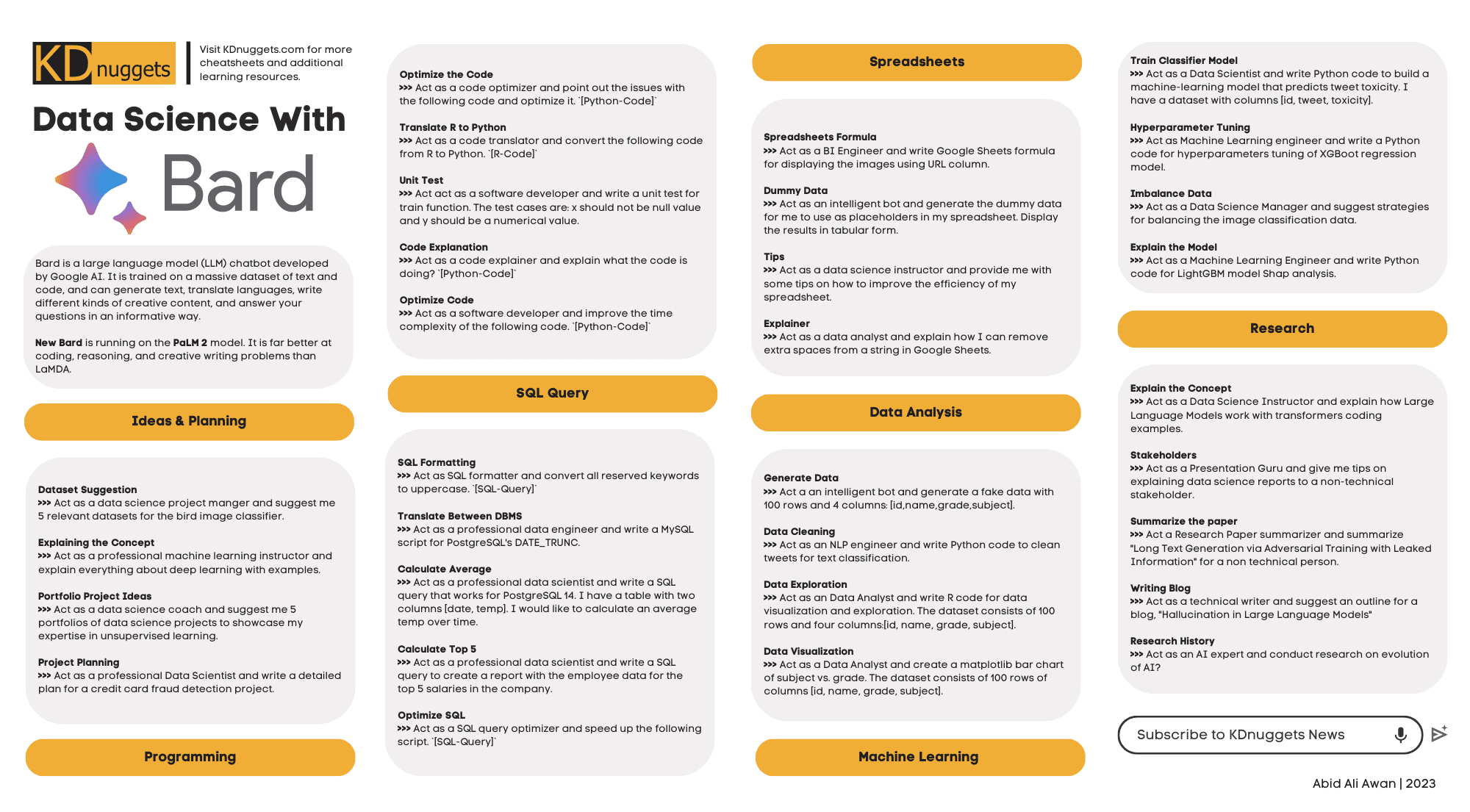
Bard for Data Science Cheat Sheet

All A-Bard!

OpenAI may have been the first out of the gate with ChatGPT, but don't count Google out yet. Bard was introduced this past February, and through a progressive rollout has become available to more and more users and in a variety of settings around the world.

Bard has similar capabilities to ChatGPT and other prominent LLMs that have emerged over the past 6 months.

Bard is a large language model (LLM) chatbot developed by Google AI. It is trained on a massive dataset of text and code, and can generate text, translate languages, write different kinds of creative content, and answer your questions in an informative way. New Bard is running on the PaLM 2 model. It is far better at coding, reasoning, and creative writing problems than LaMDA.

Bard for Data Science Cheat Sheet
KDnuggets' Bard for Data Science cheat sheet (click image to download PDF)

Let's be honest: Bard is playing a catch up game when it comes to matching ChatGPT in the LLM revolution use space… but so what? OpenAI was first on the scene, and is enjoying the early mover advantage. Does it last? And relative endorsement distribution does not equate with quality anyways (Beta vs. VHS, anyone?).

Bard vs. ChatGPT Google Trend worldwide searches for the past 90 days (data captured May 29, 2023)
Bard vs. ChatGPT Google Trend worldwide searches for the past 90 days, data captured May 29, 2023
(Bard in blue, ChatGPT in red)

So if you are using ChatGPT, you likely owe it to yourself to check out the alternatives, if even to reassure yourself that your decision to stick it out is warranted. To help you do so, check out our latest cheat sheet to get you up to speed and provide a handy reference for using Google's LLM chat tool.

With this cheat sheet, you will gain some insight into the following aspects of prompting and using Bard for data science:

  • Brainstorming
  • Programming
  • SQL
  • Spreadsheets
  • Data analysis
  • Machine learning
  • and more!

For more on Bard, and using it for data science, check out our latest cheat sheet.

More On This Topic

  • GitHub CLI for Data Science Cheat Sheet
  • Docker for Data Science Cheat Sheet
  • ChatGPT for Data Science Cheat Sheet
  • Data Science Cheat Sheet 2.0
  • Data Cleaning with Python Cheat Sheet
  • Plotly Express for Data Visualization Cheat Sheet

Is Indian Govt’s Battle Against AI Disinformation Flawed?

Disinformation is not something new to humans and the very first instances of disinformation can be traced back to ancient times. During the Roman Empire, there were several instances of disinformation being used to sway public opinion.

The Romans have been gone for centuries, but propaganda still remains a relevant tool. Political parties today still rely on the same strategy to sway public opinion. In today’s age, most of the disinformation we have seen is in the form of a text or a misleading image or video.

But today, Generative AI is giving disinformation a whole new dimension. Sam Altman, CEO of OpenAI, while speaking to a packed auditorium of close to 1,000 in London, said, “Humans are already good at making disinformation, and maybe the GPT models make it easier. But that’s not the thing I’m afraid of. “I think one thing that will be different with AI is the interactive, personalised, persuasive ability of these systems.”

AI models like Stable Diffusion, Midjourney and DALL-E2 can generate hyper realistic images that can easily be mistaken for genuine ones. This technology has opened up possibilities for generating deceptive visual content, further blurring the line between reality and falsehood.

( AI generated image of the Pope)

AI Generated disinformation is one the rise

On Sunday, Delhi Police apprehended Indian wrestlers Vinesh Phogat, Sakshi Malik, Sangeeta Phogat, and Bajrang Punia at Jantar Mantar. Unfortunately, on Twitter, a manipulated image portraying them with smiles after their arrest began circulating. This photo was shared multiple times with the intention of demeaning the wrestlers and undermining the purpose behind their protest.

IT Cell वाले ये झूठी तस्वीर फैला रहे हैं। हम ये साफ़ कर देते हैं की जो भी ये फ़र्ज़ी तस्वीर पोस्ट करेगा उसके ख़िलाफ़ शिकायत दर्ज की जाएगी। #WrestlersProtest pic.twitter.com/a0MngT1kUa

— Bajrang Punia 🇮🇳 (@BajrangPunia) May 28, 2023

The wrestlers have been protesting for weeks against Wrestling Federation of India (WFI) president and Kaiserganj BJP MP Brij Bhushan Sharan Singh, who has been accused of sexual harassment.

Similarly, last week, a fabricated image created by AI depicting an explosion near the Pentagon in Washington DC circulated on social media, resulting in unintended consequences for the US stock market. Reputable Indian media outlets such as Republic and News 18 unknowingly played a part in spreading this image, inadvertently contributing to the dissemination of misinformation.

Earlier this year, images of former US president Donald Trump getting arrested went viral on social media, however, later, those images were found to be AI-generated as well.

Fake photos of Donald Trump getting arrested are going viral ‼😭 pic.twitter.com/OYcltEgtB2

— RapTV (@Rap) March 21, 2023

While a careful examination of the Donald Trump images could reveal that they are fake, it is important to recognise that AI-generated images are continuously improving. A striking illustration of this progress is seen in the photos depicting Pope Francis wearing a Balenciaga puffer jacket. These images are incredibly lifelike, to the point where distinguishing them as AI-generated becomes exceedingly challenging unless explicitly informed about their origin.

In the past, text-to-image models such as Midjourney faced difficulties when generating human hands. However, with a new update, Midjourney has fixed the problem, however, at the same time, adding to the problem of disinformation.

Fighting Disinformation

One of the primary reasons for growing demand for AI regulation is disinformation. Even though the Narendra Modi-led administration has said that they won’t regulate AI, they have not completely turned a blind eye to curbing AI generated disinformation.

The Indian government has confirmed that the upcoming Digital India Act (DIA) will have provisions to deal with AI generated disinformation. “We are not going to regulate AI but we will create guardrails. There will be no separate legislation but a part of DIA will address threats related to high-risk AI,” Union Minister Rajeev Chandrasekhar said.

While the first draft is expected to be released in June, so far we know that the bill proposes to regulate online media platforms and social media intermediaries to prevent the spread of fake news and disinformation.

If such legislation were in effect, Republic and News18 could face legal responsibility for disseminating false information regarding the fabricated Pentagon image. Likewise, Twitter could also be held accountable for the initial post that sparked the spread. This development is positive as it promotes accountability and encourages journalists to conduct diligent fact-checking, thereby reducing the prevalence of inaccurate reporting.

Further, the government is also mulling about the creation of a new body that specifically deals with the issue of fake news or disinformation.

Elections around the corner

The Lok Sabha Elections are scheduled for 2024 and hence it makes it utmost necessary to have regulations in place to deal with AI generated disinformation.

Elections are also scheduled to take place next year in the USA and UK, and experts have already warned that AI-generated disinformation could plague the upcoming elections in the respective countries. With Generative AI coming into the pictures, AI generated disinformation could significantly rise as we approach the election date.

We have already seen deep fake videos being used for political campaigns by the BJP. Besides deep fakes and AI generated hyper-realistic images, AI could be used to create social media bots programmed to automatically generate and disseminate false information. Similarly, AI algorithms can also be used to analyse user data and preferences to deliver tailored disinformation campaigns. While the dangers are aplenty, guardrails are non-existent so far.

Interestingly, many of the Twitter handles sharing the AI generated of the wrestlers in a police van were circulated on Twitter by members affiliated to the ruling party, it was alleged. A study by BBC in 2018 found that those affiliated with BJP are more likely to share fake news or disinformation compared to others.

Earlier this year, BJP vice president Baijayant Jay Panda said that those in politics should start using ChatGPT in an era of rapidly unfolding technologies.

While the government so far has shown intent to fight disinformation, the administration cannot be biassed. In 2021, when Twitter classified a tweet, featuring screenshots of an alleged Congress ‘toolkit’ shared by BJP chief spokesperson Sambit Patra, as “manipulated media”, the Union Government objected to it, and soon Twitter’s office in Delhi was raided by the Police.

As we anticipate the public release of the DIA draft in June, the question remains whether it will provide the necessary measures to combat the escalating threat posed by AI-generated disinformation. Only time will tell if it possesses the strength and effectiveness required to tackle this pressing issue.

The post Is Indian Govt’s Battle Against AI Disinformation Flawed? appeared first on Analytics India Magazine.

Arm Moves to Factor AI into Chip Design with New CPU, GPU

Arm Moves to Factor AI into Chip Design with New CPU, GPU May 29, 2023 by Agam Shah

Arm's disciplined philosophy of power efficiency first helped the company thrive in smartphones, and leave Intel and its PC-based mobile chips in the dust.

The chip designer is not abandoning its principles in the new era of AI computing, with a new chip architecture that provides a glimpse at how it will design its future chips.

Arm introduced a new Cortex-X4 high-performance core and a GPU called G720 this week, which are targeted at mobile devices.

The chipset, which also includes the Cortex-A720 performance cores and Cortex-A520 power-efficiency CPUs, can be paired with GPUs in smartphones, tablets, and PCs.

The chipset package, called TCS23, has a mix of hardware and software technologies operating on the sidelines that improve AI performance.

The new CPUs and GPU pack in more performance and power efficiency than its predecessor Cortex-A3, which was released last year.

The Cortex-X4 delivers 15 percent more performance and consumes 40 percent less power than Cortex-X3, Arm said.

Arm measured 12 percent faster machine-learning performance in Cortex-X4 compared to last year’s Cortex-A3. The company measured 9 percent better ML performance for Cortex-A720 (compared to previous-generation Cortex-A710), and a 13 percent improvement for Cortex-A520 compared to last year’s Cortex-A510.

Arm noted a significant speed boost – up to 4x – in upscaling images on its G720 GPU with code optimized for the Fast Super-Resolution Convolutional Neural Network.

The GPU also uses machine-learning features to restructure 3D scenes. The G720 GPU achieves 25 percent more peak performance and 22 percent less memory bandwidth usage than its predecessor G715, the company said in a blog entry.

A chipset includes 8 CPUs (one Cortex-X4 CPU, five Cortex-A720 CPUs, and two Cortex-A520 CPUs), which boosts the number of high-performance cores while cutting down the low-power A520 cores. But even the low-power CPU is empowered with the elimination of 32-bit mode and support for only 64-bit applications.

“Being 64-bit only helps our partners deliver greater computing performance and more security and ML features, while improving the app development process," Arm said in a separate blog entry.

The 64-bit-only support loads applications up to 20 percent faster, and "this helps to meet the insatiable demand for more computing across various workloads, particularly for AI and AAA gaming," Arm said.

The reasoning for chip makers to cut off 32-bit support is that most applications and operating systems, like Windows 11, are available only in 64-bit mode.

Intel is also looking to move exclusively to a 64-bit chip architecture with a new x86S ISA.

The new Arm chip designs also trained algorithms from Unity Technologies to balance power consumption between CPUs and GPUs.

The chip supports about 100 of Unity's ML agents that use AI to predict the behavior of characters or simulations. The pre-processing reduces the load of GPUs and CPUs to draw up scenes from scratch. This is a new feature on Arm’s mobile chipsets.

Google, Qualcomm, Apple, Samsung, and others have developed their own neural processors, which they put on chips based on Arm architecture. Arm provides chip blueprints and the customized neural chips are put on top of the Arm CPU. Many chip companies have licensed Arm's GPU designs.

Arm said it "remains committed to developing and testing our GPUs against new applications for machine learning."

Related

4 Career Lessons That Helped Me Navigate the Difficult Job Market

4 Career Lessons That Helped Me Navigate the Difficult Job Market
Image by Editor

Firstly, I am so grateful for all the support I have received over the last two months as I was challenged to interview, find, and start a new role amidst various challenging circumstances!

If layoffs recently impacted you or you are an immigrant facing difficulty in navigating the job market, here are 4 valuable lessons that I learned while searching for data science roles amidst challenging circumstances, including 60-day immigration policies, layoffs, and health issues:

1. Ask and accept help from others

I wish I had realized this a few years ago — that I do not have to do everything on my own and that there is nothing wrong with accepting help from those who want to support your goals and growth. For example, did we learn to drive or navigate walking by ourselves early on?!

So ask your professional connections, career resources, friends, ex-colleagues, teammates, and more to find, explore, and connect you with new opportunities. Ask people all the details you are interested to learn more about! Oh, and when someone offers to help — accept it! If it’s unclear how they can help, ASK THEM, “In what areas can you help me”? It is that simple yet effective!

2. Be Specific in your Search and Save Time

Start by clearly listing the 3-4 dimensions in which you have experience and expertise and identifying the roles that sound exciting! For example, I noted that my background is in 3 key areas: Machine Learning + Sales + Strategy, and that I was looking for entrepreneurial roles. Unfortunately, there are more than 100,000 data science roles on LinkedIn!

But after filtering to specific terms that I qualified for and was interested in (Sales AND Machine Learning AND Strategy) — I could prioritize my time in reaching out, applying, and learning about the 100 available opportunities — a reduction of 99.9%! This process helped me interview and learn about 8 opportunities in 6 weeks, so I highly recommend it!

3. Have Courage and ask Questions Early on

During my first few years in the US, I used to be scared and careful to ask potential employers questions about H1b or immigration-related topics (as I was worried about being seen as not a good fit!).

However, over the years, I have realized that by asking questions ahead of time and getting clear on what is possible and not, a lot of the hassles an employer has to go through, to begin with, can be eliminated. It not only helps them from investing time and resources in a candidate they might not be able to support long term, but it also helps direct you to better opportunities that will understand immigration circumstances and genuinely support you in the best way possible long term!

4. [The most important] Reduce or Eliminate Noise, News Notifications, and External Pressures

"focus on learning and incremental progress"

Due to all the immigration challenges, I needed to focus and prioritize the task at hand — whether it be connecting with professionals, interview preparation, or learning about new roles. So any time or day I spent watching that latest company reorganization or notification about the most recent chat GPT release was not very helpful (unless chat GPT was going to interview for you!).

Personally, what has worked for me over the last few years, and especially in the previous two months, is the following — I do not have any notifications set up for emails or news websites or have 100+ newsletters that I have signed up for — set up time and intention for each day, focus on the task, and make incremental progress towards what truly matters!

I highly recommend Option B for building resilience and finding acceptance during challenging times! Feel free to contact me on Linkedin and reach out if this sparked any new ideas or helped you find your next adventure!
Arjun Arora has helped multiple large enterprises (in retail, tech, and manufacturing) become more data-driven by identifying business urgency and leading technical execution of analytics and machine learning solutions and POCs. Additionally, he has helped increase the adoption of AI/ ML solutions within the industry through various training workshops, webinars, and presenting at national conferences. Outside of work, he is committed to learning about personal growth, supports various DEI & LGBTQ+ community initiatives, and is an avid hiker in the Bay Area!

More On This Topic

  • 3 Most Important Lessons I've Learned 3 Years Into My Data Science Career
  • How CoRise Helped Ben Wilson Land a New Job as a Analytics Engineer (and a…
  • Navigate the road to Responsible AI
  • Forget Telling Stories; Help People Navigate
  • Scaling human oversight of AI systems for difficult tasks — OpenAI approach
  • Remembering Pluribus: The Techniques that Facebook Used to Master World’s…

Have your conversations instantly translated in up to 50 languages for just $89.99

language translating earbuds
Peiko Generation 2 Wireless Translator Earbuds

Expanding your business internationally can be a bit intimidating, not the least because of difficult language barriers. Learning new languages can take quite a while, but fortunately, you don’t have to wait that long or work that hard. Artificial intelligence now makes it possible to have your conversations translated instantly with the Peiko Generation 2 Wireless Translator Earbuds.

These AI-powered Peiko earbuds record and translate your conversations simultaneously in as many as 50 different languages. The microphone is highly sensitive, so it can precisely capture sounds and reproduce them with crystal clarity. It then uses soundwave construction to recognize them. These earbuds could not be easier to use.

All you need to do is put the earbuds in your ears and experience the powerful translator capturing your conversations with amazing accuracy. Connected by Bluetooth, you won’t believe how smooth your conversations will be. Plus, the ultra-compact slanted design is comfortably ergonomic, with both small and large ear plugs provided. A USB data cable is included as well.

The earbuds have three different modes for translation. You can have group chat or face-to-face, or use the two Peiko earphones, which have a transmission distance of 10 meters, or over 32 feet. With the included charging case, the earbuds will work for up to 10 hours. They can stay on standby for up to 120 hours and only take two hours to charge.

There are all kinds of amazing AI tools you can use to make work tasks easier, and now you’ll never have to worry again about conversations in foreign languages. You can break the language barrier by conversing smoothly with AI-powered instant translation.

Get the Peiko Generation 2 Wireless Translator Earbuds today while they’re on sale for just $89.99, a 28% discount off the regular $125 retail price.

Prices and availability are subject to change.

Person using a laptop computer.

Subscribe to the Daily Tech Insider Newsletter

Stay up to date on the latest in technology with Daily Tech Insider. We bring you news on industry-leading companies, products, and people, as well as highlighted articles, downloads, and top resources. You’ll receive primers on hot tech topics that will help you stay ahead of the game.

Delivered Weekdays Sign up today