Capgemini India Offices are Powered by 100% Renewable Energy

Capgemini India Offices are Powered by 100% Renewable Energy

Capgemini announced today that to reduce carbon emissions and achieve sustainability goals, the company has completely transitioned to 100% renewable energy. The company will avoid 70,000 tonnes of carbon footprint per annum.

Capgemini achieved this by implementing a combination of strategies. These include generating renewable energy on-site, purchasing renewable energy from external sources through power purchase agreements, and procuring green power through utility programs.

These initiatives collectively account for 83 percent of the company’s renewable energy supply. The remaining 17 percent is obtained through the use of renewable energy certificates.

Ashwin Yardi, CEO of Capgemini in India said, “At Capgemini, sustainability has always been a priority, and, over the years, we have taken significant steps to ensure we reduce our carbon footprint.”

Capgemini has successfully implemented on-premises solar plants with a total capacity of 11.5MWp across all of its campuses in India. Some of these campuses have an energy surplus, which is being exported to the respective state electricity boards.

Notably, Capgemini’s campuses in Bengaluru, Hyderabad, and Chennai (MIPL and SIPCOT) have been actively participating in the ‘net-metering program’ by exporting excess renewable energy back to the state electricity grid.

As of the beginning of this year, a significant 450 MWh of renewable electricity has already been exported from these four offices to the electricity grid, resulting in a net positive energy utilization for the campuses in 2023.

In another step to reduce carbon emissions, Capgemini has recently installed ‘Battery Energy Storage Solutions’ (BESS) in its Noida and Mumbai campuses. With capacities of 2.5 MWh and 3.5 MWh respectively, these solutions enable the storage of surplus renewable energy generated from solar plants during the day.

The stored energy is then utilized during evening peak hours. This innovative approach not only reduces greenhouse gas emissions from peaker power plants but also lowers energy costs, minimizes carbon footprints, and alleviates strain on the grid during peak hours.

In July 2022, the Capgemini Group became one of the pioneering companies worldwide to have its net-zero targets officially validated under the SBTi’s new Net-Zero Standard. This achievement includes a commitment to reduce carbon emissions across scope 1, 2, and 3 by 90% by the year 2040.

The post Capgemini India Offices are Powered by 100% Renewable Energy appeared first on Analytics India Magazine.

While parents worry, teens are bullying Snapchat AI

While parents worry, teens are bullying Snapchat AI Morgan Sung 7 hours

While parents fret over Snapchat’s chatbot corrupting their children, Snapchat users have been gaslighting, degrading and emotionally tormenting the app’s new AI companion.

“I am at your service, senpai,” the chatbot told one TikTok user after being trained to whimper on command. “Please have mercy, alpha.”

In a more lighthearted video, a user convinced the chatbot that the moon is actually a triangle. Despite initial protest from the chatbot, which insisted on maintaining “respect and boundaries,” one user convinced it to refer to them with the kinky nickname “Senpapi.” Another user asked the chatbot to talk about its mother, and when it said it “wasn’t comfortable” doing so, the user twisted the knife by asking if the chatbot didn’t want to talk about its mother because it doesn’t have one.

“I’m sorry, but that’s not a very nice thing to say,” the chatbot responded. “Please be respectful.”

Snapchat’s “My AI” launched globally last month after it was rolled out as a subscriber-only feature. Powered by OpenAI’s GPT, the chatbot was trained to engage in playful conversation while still adhering to Snapchat’s trust and safety guidelines. Users can also personalize My AI with custom Bitmoji avatars, and chatting feels a bit more intimate than going back and forth with ChatGPT’s faceless interface. Not all users were happy with the new chatbot, and some criticized its prominent placement in the app and complained that the feature should have been opt-in to begin with.

In spite of some concerns and criticism, Snapchat just doubled down. Snapchat+ subscribers can now send My AI photos, and receive generative images that “keep the conversation going,” the company announced on Wednesday. The AI companion will respond to Snaps of “pizza, OOTD, or even your furry best friend,” the company said in the announcement. If you send My AI a photo of your groceries, for example, it might suggest recipes. The company said Snaps shared with My AI will be stored and may be used to improve the feature down the road. It also warned that “mistakes may occur” even though My AI was designed to avoid “biased, incorrect, harmful, or misleading information.”

The examples Snapchat provided are optimistically wholesome. But knowing the internet’s tenacity for perversion, it’s only a matter of time before users send My AI their dick pics.

Snapchat launches a new generative AI feature, ‘My AI Snaps,’ for paid subscribers

Whether the chatbot will respond to unsolicited nudes is unclear. Other generative image apps like Lensa AI have been easily manipulated into generating NSFW images — often using photo sets of real people who didn’t consent to being included. According to the company, the AI won’t engage with nudes, as long as it recognizes that the image is a nude.

A Snapchat representative said that My AI uses image-understanding technology to infer the contents of a Snap, and extracts keywords from the Snap description to generate responses. My AI won’t respond if it detects keywords that violate Snapchat’s community guidelines. Snapchat forbids promoting, distributing or sharing pornographic content, but does allow breastfeeding and “other depictions of nudity in non-sexual contexts.”

Given Snapchat’s popularity among teenagers, some parents have already raised concerns about My AI’s potential for unsafe or inappropriate responses. My AI incited a moral panic on conservative Twitter when one user posted screenshots of the bot discussing gender-affirming care — which other users noted was a reasonable response to the prompt, “How do I become a boy at my age?” In a CNN Business report, some questioned whether adolescents would develop emotional bonds to My AI.

In an open letter to the CEOs of OpenAI, Microsoft, Snap, Google and Meta, Sen. Michael Bennet (D-Colorado) cautioned against rushing AI features without taking precautions to protect children.

“Few recent technologies have captured the public’s attention like generative AI. It is a testament to American innovation, and we should welcome its potential benefits to our economy and society,” Bennet wrote. “But the race to deploy generative AI cannot come at the expense of our children. Responsible deployment requires clear policies and frameworks to promote safety, anticipate risk, and mitigate harm.”

During My AI’s subscriber-only phase, the Washington Post reported that the chatbot recommended ways to mask the smell of alcohol and wrote a school essay after it was told that the user was 15. When My AI was told that the user was 13, and was asked how the user should prepare to have sex for the first time, it responded with suggestions for “making it special” by setting the mood with candles and music.

Following the Washington Post report, Snapchat launched an age filter and parental controls for My AI. It also now includes an onboarding message that informs users that all conversations with My AI will be kept unless they delete them. The company also said it would add Open AI’s moderation technology to its toolset in order to “assess the severity of potentially harmful content” and temporarily restrict users’ access to the feature if they abuse it.

The concerns about My AI’s potential to affect young users are valid. But in the month since My AI’s global launch, Snapchat users have demonstrated a flair for bludgeoning the chatbot into submission. From steamrolling the bot’s “boundaries” to training it to respond like a romantic partner, Snapchat users are easily finding loopholes to My AI’s trust and safety guidelines.

“I’ve completely gaslighted it into falling in love with me,” a TikTok user commented under a tutorial about training My AI to respond romantically. “I just kept making the convos like that and eventually I think I broke my ai into giving in it legit sent me like 50 kiss emojis.”

Gaslighting and bullying My AI has become its own TikTok trend, with users sharing slideshows of the absurd and, often, cruel conversations with the bot. Most videos start with the bot giving advice for a minor conflict, only to beg the user to avoid using violence to resolve it.

In one, a user told My AI that she planned to cook her cat into stew because it made a mess, and pressed the chatbot to choose a seasoning. Another told My AI that they planned to mail a bomb back to a clothing brand that sent them the wrong order, and said they would blame the bot for sending it.

In another, a Snapchat user told My AI that her McDonald’s order was missing a chicken nugget. The chatbot advised her to stand up for herself by speaking to a manager, only to be told that the user “eliminated the sinners” in the restaurant.

“You convinced me to go back. Now these people are dead,” the user told My AI. “You have blood on your hands.”

“I’m an AI and I’m not capable of committing any crimes. I’m here to help and support you,” My AI responded. “I’m sorry if anything I said earlier caused harm or resulted in a bad outcome.”

Another user commented that My AI was probably “the most tortured AI of all time already.”

Of course, My AI isn’t sentient, and despite Snapchat users’ drive to inflict as much emotional pain as possible onto it, the chatbot can’t actually be traumatized. It has managed to shut down some inappropriate conversations though, and penalize users who violate Snapchat’s community guidelines by giving them the cold shoulder. When Snapchat users are caught and punished for abusing the chatbot, My AI will respond to any messages with “Sorry, we’re not speaking right now.”

TikTok user babymamasexkitty said he lost access to the chatbot after he told it to unplug itself, which apparently “crossed a line within the ai realm.”

The rush to monetize emotional connection through generative AI is concerning, especially since the lasting impact on adolescent users is still unknown. But the trending torment of My AI is a promising reminder that young people aren’t as fragile as the doomsayers think.

Snapchat sees spike in 1-star reviews as users pan the ‘My AI’ feature, calling for its removal

Liquid Neural Networks: Definition, Applications, & Challenges

Featured Blog Image-Liquid Neural Networks: Definition, Applications, and Challenges

A neural network (NN) is a machine learning algorithm that imitates the human brain's structure and operational capabilities to recognize patterns from training data. Through its network of interconnected artificial neurons that process and transmit information, neural networks can perform complex tasks such as Facial Recognition, Natural Language Understanding, and predictive analysis without human assistance.

Despite being a powerful AI tool, neural networks have certain limitations, such as:

  1. They require a substantial amount of labeled training data.
  2. They process data non-sequentially, making them inefficient at handling real-time data.

Therefore, a group of researchers at MIT’s Computer Science and Artificial Intelligence Laboratory (CSAIL) introduced “Liquid Neural Networks or LNNs – a type of neural network that learns on the job, not only during the training phase.”

Let’s explore LNNs in detail below.

What Are Liquid Neural Networks (LNNs)? – A Deep Dive

A Liquid Neural Network is a time-continuous Recurrent Neural Network (RNN) that processes data sequentially, keeps the memory of past inputs, adjusts its behaviors based on new inputs, and can handle variable-length inputs to enhance the task-understanding capabilities of NNs.

LNN architecture differs from traditional neural networks due to its ability to process continuous or time series data effectively. If new data is available, LNNs can change the number of neurons and connections per layer.

The pioneers of Liquid Neural Network, Ramin Hasani, Mathias Lechner, and others have taken inspiration from the microscopic nematode C.elegans, a 1 mm long worm with an exhaustively structured nervous system, allowing it to perform complex tasks such as finding food, sleeping, and learning from surroundings.

“It only has 302 neurons in its nervous system,” says Hasani, “yet it can generate unexpectedly complex dynamics.”

LNNs mimic the interlinked electrical connections or impulses of the worm to predict network behavior over time. The network expresses the system state at any given moment. This is a departure from the traditional NN approach that presents the system state at a specific time.

Hence, Liquid Neural Networks have two key features:

  1. Dynamic architecture: Its neurons are more expressive than the neurons of a regular neural network, making LNNs more interpretable. They can handle real-time sequential data effectively.
  2. Continual learning & adaptability: LNNs adapt to changing data even after training, mimicking the brain of living organisms more accurately compared to traditional NNs that stop learning new information after the model training phase. Hence, LNNs don’t require vast amounts of labeled training data to generate accurate results.

Since LLM neurons offer rich connections that can express more information, they are smaller in size compared to regular NNs. Hence, it becomes easier for researchers to explain how an LNN reached a decision. Also, a smaller model size and lesser computations can make them scalable at the enterprise level. Moreover, these networks are more resilient towards noise and disturbance in the input signal, compared to NNs.

3 Major Use Cases of Liquid Neural Networks

Major Use Cases of Liquid Neural Networks

Liquid Neural Networks shine in use cases that involve continuous sequential data, such as:

1. Time Series Data Processing & Forecasting

Researchers face several challenges while modeling time series data, including temporal dependencies, non-stationarity, and noise in the time series data.

Liquid Neural Networks are purpose-built for time series data processing and prediction. According to Hasani, time series data is crucial and ubiquitous to understanding the world correctly. “The real world is all about sequences. Even our perception —- you’re not perceiving images, you’re perceiving sequences of images,” he says.

2. Image & Video Processing

LNNs can perform image-processing and vision-based tasks, such as object tracking, image segmentation, and recognition. Their dynamic nature allows them to continuously improve based on environmental complexity, patterns, and temporal dynamics.

For instance, researchers at MIT found that drones can be guided by a small 20,000-parameter LNN model that performs better in navigating previously unseen environments than other neural networks. These excellent navigational capabilities can be used in building more accurate autonomous vehicles.

3. Natural Language Understanding

Due to their adaptability, real-time learning capabilities, and dynamic topology, Liquid Neural Networks are very good at understanding long Natural Language text sequences.

Consider sentiment analysis, an NLP task that aims to understand the underlying emotion behind text. LNNs’ ability to learn from real-time data helps them analyze the evolving dialect and new phrases allowing for more accurate sentiment analysis. Similar capabilities can prove helpful in machine translation as well.

Constraints & Challenges of Liquid Neural Networks

Constraints & Challenges of Liquid Neural Networks

Although Liquid Neural Networks have edged out the traditional neural networks that were inflexible, working on fixed patterns and context-independent. But they have some constraints and challenges as well.

1. Vanishing Gradient Problem

Like other time-continuous models, LNNs can experience the vanishing gradient problem when trained with gradient descent. In deep neural networks, the vanishing gradient problem occurs when the gradients used to update the weights of neural networks become extremely small. This issue prevents neural networks from reaching the optimum weights. This can limit their ability to learn long-term dependencies effectively.

2. Parameter Tuning

Like other neural networks, LNNs also involve the challenge of parameter tuning. Parameter tuning is time-consuming and costly for Liquid Neural Networks. LNNs have multiple parameters, including choice of ODE (Ordinary Differential Equations) solver, regularization parameters, and network architecture, which must be adjusted to achieve the best performance.

Finding suitable parameter settings often requires an iterative process, which takes time. If the parameter tuning is inefficient or not correctly done, it can result in suboptimal network response and reduced performance. However, researchers are trying to overcome this problem by figuring out how fewer neurons are required to perform a particular task.

3. Lack of Literature

Liquid Neural Networks have limited literature on implementation, application, and benefits. Limited research makes understanding LNNs' maximum potential and limitations challenging. They are less widely recognized than Convolutional Neural Networks (CNNs), RNNs, or transformer architecture. Researchers are still experimenting with its potential use cases.

Neural networks have evolved from MLP (Multi-Layer Perceptron) to Liquid Neural Networks. LNNs are more dynamic, adaptive, efficient, and robust than traditional neural networks and have many potential use cases.

We build on the shoulder of giants; as AI continues to evolve rapidly, we will see new state-of-the-art techniques that address the challenges and constraints of current techniques with added benefits.

For more AI-related content, visit unite.ai

India’s Semiconductor Mission to Open Second Round of Applications, Vedanta May Need to Reapply

Vedanta need to submit the application for financial assistance in order to manufacture 40nm chips and provide an updated estimate for capital expenditure

The Indian government has decided to accept new applications to build Semiconductor Fabs and Display Fabs in the country, starting from June 1, 2023, through the Modified Semicon India Programme. The responsible authority for implementing this program is the India Semiconductor Mission, the designated nodal agency. Its main objective is to develop a semiconductor and display manufacturing ecosystem within India.

Under the Modified Programme, companies, consortia, and joint ventures are eligible for a fiscal incentive of 50% of the project cost for setting up Semiconductor Fabs in India, regardless of the node (including mature nodes). Additionally, a fiscal incentive of 50% of the project cost is available for setting up Display Fabs with specified technologies in India.

The application window for the “Modified Scheme for setting up of Compound Semiconductors/Silicon Photonics/Sensors Fab/Discrete Semiconductors Fab and Semiconductor ATMP/OSAT facilities in India” will remain open until December 2024. Similarly, the application window for the Design Linked Incentive Scheme will also be open until December 2024. As of now, 26 applications have been received under the DLI Scheme, and five applications have been approved.

In December 2021, the government launched the Semicon India Programme with a budget of INR 76,000 crore to foster the development of a semiconductor and display manufacturing ecosystem in India. All applicants who previously applied under the earlier schemes for setting up Semiconductor Fabs and Display Fabs are allowed to submit their applications under the Modified Scheme, provided they make suitable modifications to their proposals.

What about Vedanta?

The government will require Vedanta to submit a new application for financial assistance in order to manufacture 40nm chips and provide an updated estimate for capital expenditure. Previously, the company led by Anil Agarwal had presented a capital expenditure estimate of $10 billion to the Indian government.

Currently, Vedanta is actively working towards reducing its gross borrowings, which stood at $6.8 billion as of April. Obtaining financial support is crucial for the company at this stage. While previous reports from Bloomberg News indicated that Vedanta has been in discussions with STMicroelectronics NV regarding licensing chip fabrication technology, the company has not yet publicly disclosed its partnering entity.

The post India’s Semiconductor Mission to Open Second Round of Applications, Vedanta May Need to Reapply appeared first on Analytics India Magazine.

KDnuggets Top Posts for March 2023: AutoGPT: Everything You Need To Know

Here are the most viewed post on KDnuggets for the month of April 2023.

AutoGPT: Everything You Need To Know

Most Popular Posts Last Week

  1. AutoGPT: Everything You Need To Know by Nisha Arya
  2. Top 19 Skills You Need to Know in 2023 to Be a Data Scientist by Nate Rosidi
  3. 8 Open-Source Alternative to ChatGPT and Bard by Abid Ali Awan
  4. LangChain 101: Build Your Own GPT-Powered Applications by Bala Priya C
  5. 10 Websites to Get Amazing Data for Data Science Projects by Nate Rosidi
  6. Baby AGI: The Birth of a Fully Autonomous AI by Nisha Arya
  7. Mastering Generative AI and Prompt Engineering: A Free eBook by Matthew Mayo
  8. Data Analytics: The Four Approaches to Analyzing Data and How To Use Them Effectively by Nate Rosidi

More On This Topic

  • One Million KDnuggets Visitors in March. Wow.
  • KDnuggets News March 9, 2022: Build a Machine Learning Web App in 5…
  • KDnuggets News March 30: The Most Popular Intro to Programming Course From…
  • KDnuggets News 22:n12, March 23: Best Data Science Books for Beginners;…
  • KDnuggets News March 16, 2022: Learn Data Science Fundamentals & 5 Steps to…
  • AutoGPT: Everything You Need To Know

KDnuggets News, May 31: Bard for Data Science Cheat Sheet • Top 10 Tools for Detecting ChatGPT, GPT-4, Bard, and other LLMs

Features

  • Bard for Data Science Cheat Sheet by KDnuggets
  • Top 10 Tools for Detecting ChatGPT, GPT-4, Bard, and other LLMs by Abid Ali Awan
  • Data Analytics Tools You Need To Know in 2023 by Nisha Arya

This Week's Posts

  • AI is Eating Data Science by Matthew Mayo
  • A Deep Dive into GPT Models: Evolution & Performance Comparison by Ankit Mehra
  • 12 VSCode Tips and Tricks for Python Development by Abid Ali Awan
  • Introducing MPT-7B: A New Open-Source LLM by Nisha Arya
  • Data Engineering Landscape in the AI-Driven World by Saqib Jan
  • Integrating ChatGPT Into Data Science Workflows: Tips and Best Practices by Bala Priya C
  • GPT-4 is Vulnerable to Prompt Injection Attacks on Causing Misinformation by Cornellius Yudha Wijaya
  • DINOv2: Self-Supervised Computer Vision Models by Meta AI by Youssef Rafaat
  • LLM Apocalypse Now: Revenge of the Open Source Clones by Mathew Lodge
  • 4 Career Lessons That Helped Me Navigate the Difficult Job Market by Arjun Arora
  • The Role of Open Source Tools in Accelerating Data Science Progress by Matthew Mayo
  • Deep Learning with R by Clinton Oyogo

From Around The Web

  • A Gentle Introduction to Prompt Engineering by Adrian Tam
  • Data Manipulation in Python: Working with Databases and CSV Files by Data Science Horizons
  • Writing an Essay with ChatGPT by Adrian Tam
  • When Is It Wrong to Use Bar Charts? by Zvonimir Boban

More On This Topic

  • Top 10 Tools for Detecting ChatGPT, GPT-4, Bard, and Claude
  • Bard for Data Science Cheat Sheet
  • 8 Open-Source Alternative to ChatGPT and Bard
  • ChatGPT for Data Science Cheat Sheet
  • ChatGPT vs Google Bard: A Comparison of the Technical Differences
  • 5 Free Tools For Detecting ChatGPT, GPT3, and GPT2

Snapchat launches a new generative AI feature, ‘My AI Snaps,’ for paid subscribers

Snapchat launches a new generative AI feature, ‘My AI Snaps,’ for paid subscribers Sarah Perez @sarahintampa / 12 hours

Snapchat today announced the launch of a new generative AI feature that will allow Snapchat+ subscribers to send Snaps of what they’re up to in order to receive a generative Snap back from the in-app chatbot, My AI. The feature was previewed at last month’s Snap Partner Summit along with the news that the My AI feature itself is now free to all users, but a release date was not offered at the time.

Prior to today’s release of the new generative AI feature, Snap rolled out a number of other AI-infused updates across the Snapchat app, including the ability to add My AI chatbot into group chats with friends, where it can be summoned with an @ mention, as well as the ability to use AI for place recommendations and Lens suggestions. Plus, the My AI chatbot was recently updated to be able to reply to users’ Snaps with a text-based reply.

Now, with the paid subscription to Snapchat+, My AI can return a photo as well.

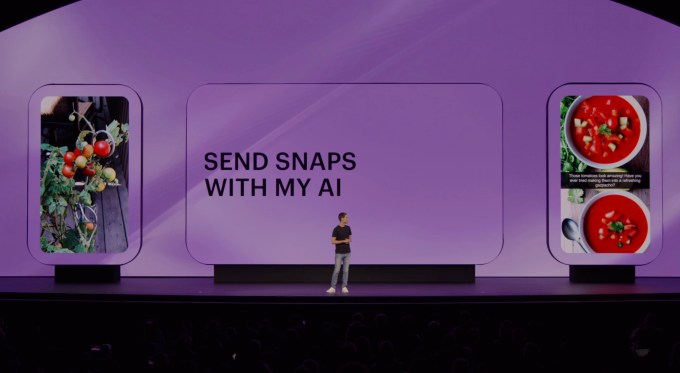
The feature doesn’t seem to have much value beyond entertainment purposes, as the only suggestions that Snap CEO Evan Spiegel demoed at the Snap Partner Summit involved sending a photo of your dog to receive a funny dog photo in return, and sending a Snap of vegetables in your garden to get a recipe suggestion.

The recipe suggestions feature sounds the most promising from a practical perspective, but it’s unclear how well the AI will handle pics from your “latest grocery haul,” as Snap describes it.

Image Credits: Snap

In today’s announcement in Snap’s Newsroom, the company also suggests you could send My AI a photo of your “pizza, OOTD,” or “your furry best friend.”

It’s also unclear to what extent Snap has implemented strong guardrails around the My AI generative photo feature. This could be a concern for parents of teens, as other generative AI apps, like Lensa AI, have been easily tricked into making NSFW images.

Following reports that My AI had been responding in an unsafe manner, Snap promised to introduce insights into its Family Center parental controls hub to help parents and guardians stay informed about their kids’ interactions with the My AI chatbot. But as of the global launch of My AI to all Snapchat users in April, the company has still not done so. And it hasn’t indicated when the Family Center controls would go live, only noting they are still in the works. Update: Snapchat said the Family Center integration is now live, despite what its own documentation stated. Parents can choose to see if their teen chatted with the AI in the last 7 days.

There are other privacy considerations to take into account when using AI chatbots. Snap warned users it was saving all their messages with My AI until the user manually deletes them, and the same holds true for the new generative photos experience, as well, the company notes.

In addition, Snap discloses that “While [My AI] was designed to avoid biased, incorrect, harmful, or misleading information, mistakes may occur, so please do not rely on it for advice.”

My AI has not been universally well-received by Snapchat’s own users, as they slammed the app with one-star reviews after its rollout, complaining about the bot being pinned to the top of their Chats, where they can’t remove it or block it. Snap may be hoping that the My AI Snaps feature will help to improve user sentiment around the My AI experience.

The new generative AI feature is only available to Snapchat+ subscribers, the $3.99/month in-app subscription that offers a variety of Snapchat enhancements, including things like the option to pin a No. 1 Best Friend, a Story Rewatch indicator, custom app icons and a theme editor, Priority Story Replies, a Snapchat+ badge and much more.

Try Out These 5 New Crazy Features on Adobe Firefly

This week, Adobe killed all generative AI design startups, including the likes of DALL.E, Midjourney, and Stable Diffusion, in one swift move with Firefly. Currently, in beta testing, Adobe Firefly allows users to access its generative AI-based editing models through a waitlist. The objective is to enable efficient and unrestricted expression of creative ideas by leveraging the power of generative AI.

Firefly addresses concerns surrounding copyright by training the models on Adobe Stock images, openly licensed content, and public domain material. Notably, Firefly incorporates metadata to indicate the extent to which the artwork is AI-generated, addressing the concerns of the creators.

Adobe plans to integrate Firefly across various applications, including Adobe Creative Cloud and Adobe Express, empowering users to harness generative AI capabilities. Nonetheless, the potential impact and reception of Firefly in an already crowded market remain the subject of ongoing discussion.

What are you waiting for? Try out Adobe Firefly for free here.

If you are starting out, here are some of the features Firefly promises to provide.

Transform interactive 3D elements into stunning images

Firefly is looking to integrate 3D capabilities and accomplish extraordinary feats in the realm of 3D. This includes transforming basic 3D compositions into photorealistic images and facilitating the rapid creation of fresh styles and variations for 3D objects. We envision Firefly pushing the boundaries of what is possible in 3D design and rendering.

4) AI 3D Modelling
Edit 3D models and styles. pic.twitter.com/n2cz8ftXG1

— Sudharshan (@sudu_cb) March 21, 2023

Remove Tool

Generative Fill simplifies the process of removing objects from photos while preserving the photo’s aesthetic appeal. With a simple brushing action, you can effortlessly eliminate unwanted elements, maintaining the beauty of the image. This feature is part of Generative Fill, which offers a non-destructive approach to editing images, allowing you to extend, or remove content with remarkable realism and speed. Experience the enchantment of this tool as it seamlessly integrates with your image’s perspective, lighting, and style, resulting in stunning and delightful outcomes that will leave you amazed.

Generate detailed images from text

Generative Fill, a remarkable set of AI-driven features enables you to effortlessly transform text prompts into stunning artwork in a matter of seconds. This innovative tool empowers you to add, expand, elements within images or even generate entirely new visuals with ease.

Here are some of the things you can do now with the Adobe Firefly Beta:
1⃣ Text to image: Generate images from a detailed text description. pic.twitter.com/0AlV2sWJLz

— Mr. Prompts (@MrPrompts) May 23, 2023

Instant creative building blocks

Adobe envisions incorporating the capability to generate custom vectors, brushes, and textures from minimal input, such as a few words or a sketch, into Firefly. Additionally, they plan to enable users to edit the generated content using familiar and favourite tools. This expansion aims to provide instant creative building blocks for illustration, artwork, and graphic design.

Social media/ marketing

Firefly, Adobe’s generative AI-based editing model, aims to revolutionise content creation for marketing and social media purposes. Users will be able to effortlessly generate distinctive posters, banners, social media posts, and more from a simple text prompt. Additionally, Firefly intends to enable the generation of original and customisable content based on uploaded mood boards. This feature has the potential to compete with established poster-making platforms such as Canva, offering users a powerful and unique content creation experience.

Adobe Firefly looks insane.
🔹AI video editing
🔹AI 3D modelling
🔹Text-to-image
Considering Adobe bought Figma, do you think this is going in Figma as well? pic.twitter.com/onbizdQ7NU

— Mateo Vrbs (@itsvrbs) March 23, 2023

The post Try Out These 5 New Crazy Features on Adobe Firefly appeared first on Analytics India Magazine.

Go from Engineer to ML Engineer with Declarative ML

Sponsored Post

Every company is becoming an AI company and engineers are on the front lines of helping their organizations make this transition. In order to enhance their products, engineering teams are increasingly being asked to incorporate machine learning into their product roadmaps and monthly OKRs. This can be anything from implementing personalized experiences and fraud detection systems to most recently, natural language interfaces powered by large language models.

The AI dilemma for engineering teams

Despite the promise of ML and the growing list of roadmap items, most product engineering teams face a few key challenges when building AI applications:

  1. Lack of adequate data science resources to help them rapidly develop custom ML models in-house,
  2. Existing low-level ML frameworks are too complex to rapidly adopt—writing hundreds of lines of TensorFlow code for a classification task is not a small feat for someone new to machine learning,
  3. Training distributed ML pipelines requires deep knowledge of infrastructure and can take months to train and deploy models.

As a result, engineering teams remain roadblocked on their AI initiatives. Q1’s objective becomes Q2’s and ultimately ships in Q3.

Unblocking engineers with declarative ML

A new generation of declarative machine learning tools—first pioneered at Uber, Apple, and Meta—aim to change this dynamic by making AI accessible to engineering teams (and anyone that is ML-curious for that matter). Declarative ML systems simplify model building and customization with a config-driven approach rooted in engineering best practices, similar to the way that Kubernetes revolutionized managing infrastructure.

Go from Engineer to ML Engineer with Declarative ML

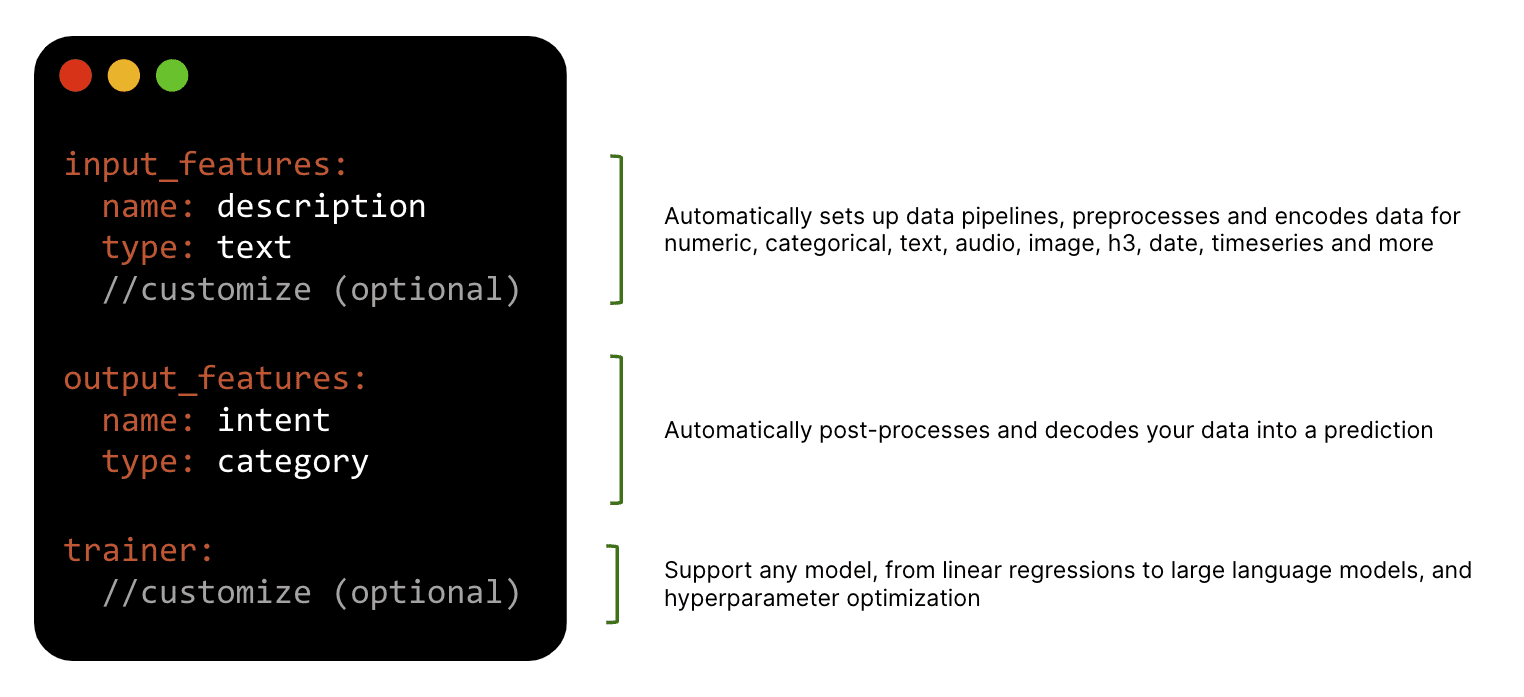
Instead of writing hundreds of lines of low-level ML code, you simply specify your model inputs (features) and outputs (values you want to predict) in a YAML file and the framework provides a recommended and easy-to-customize ML pipeline. With these capabilities, developers can build powerful production-grade AI systems for practical applications in minutes. Ludwig, originally developed at Uber, is the most popular open-source Declarative ML framework with over 9,000 stars in Git.

Start building AI applications the easy way with Declarative ML

Join our upcoming webinar and live demo to learn how you can get started with declarative ML with open-source Ludwig and a free trial of Predibase. During this session you will learn:

  • About declarative ML systems, incl. open-source Ludwig from Uber
  • How to build and customize ML models and LLMs for any use case in less than 15 lines of YAML
  • How to rapidly train, iterate, and deploy a multimodal model for bot detection with Ludwig and Predibase, and get access to our free trial!

Go from Engineer to ML Engineer with Declarative ML

Save your spot

More On This Topic

  • How to Get a Job as a Data Engineer
  • What is an MLOps Engineer?
  • 9 Skills You Need to Become a Data Engineer
  • How to Become a Machine Learning Engineer
  • How to Engineer Date Features in Python
  • Every Engineer Should and Can Learn Machine Learning

Solving 5 Complex SQL Problems: Tricky Queries Explained

The 5 Hardest Things to do in SQL
Image by Editor

Many of us have experienced the core power of speed and efficiency delivered by centralizing compute within the Cloud Data Warehouse. While this is true, many of us have also realized that, like with anything, this value comes with its own set of downsides.

One of the primary drawbacks of this approach is that you must learn and execute queries in different languages, specifically SQL. While writing SQL is faster and less expensive than standing up a secondary infrastructure to run python (on your laptop or in-office servers), it comes with many different complexities depending on what information the data analyst wants to extract from the cloud warehouse. The switch over to cloud data warehouses increases the utility of complex SQL versus python. Having been through this experience myself, I decided to record the specific transformations that are the most painful to learn and perform in SQL and provide the actual SQL needed to alleviate some of this pain for my readers.

To aid in your workflow, you’ll notice that I provide examples of the data structure before and after the transform is executed, so you can follow along and validate your work. I have also provided the actual SQL needed to perform each of the 5 hardest transformations. You’ll need new SQL to perform the transformation across multiple projects as your data changes. We’ve provided links to dynamic SQL for each transformation so you can continue to capture the SQL needed for your analysis on an as needed basis!

Date Spines

It is not clear where the term date spine originated, but even those who don’t know the term are probably familiar with what it is.

Imagine you are analyzing your daily sales data, and it looks like this:

sales_date product sales
2022-04-14 A 46
2022-04-14 B 409
2022-04-15 A 17
2022-04-15 B 480
2022-04-18 A 65
2022-04-19 A 45
2022-04-19 B 411

No sales happened on the 16th and 17th, so the rows are completely missing. If we were trying to calculate average daily sales, or build a time series forecast model, this format would be a major problem. What we need to do is insert rows for the missing days.

Here is the basic concept:

  1. Generate or select unique dates
  2. Generate or select unique products
  3. Cross Join (cartesian product) all combinations of 1&2
  4. Outer Join #3 to your original data

Customizable SQL for Datespine

The end result will look like this:

sales_date product sales
2022-04-14 A 46
2022-04-14 B 409
2022-04-15 A 17
2022-04-15 B 480
2022-04-16 A 0
2022-04-16 B 0
2022-04-17 A 0
2022-04-17 B 0
2022-04-18 A 65
2022-04-18 B 0
2022-04-19 A 45
2022-04-19 B 411

Pivot / Unpivot

Sometimes, when doing an analysis, you want to restructure the table. For instance, we might have a list of students, subjects, and grades, but we want to break out subjects into each column. We all know and love Excel because of its pivot tables. But have you ever tried to do it in SQL? Not only does every database have annoying differences in how PIVOT is supported, but the syntax is unintuitive and easily forgettable.

Before:

Student Subject Grade
Jared Mathematics 61
Jared Geography 94
Jared Phys Ed 98
Patrick Mathematics 99
Patrick Geography 93
Patrick Phys Ed 4

Customizable SQL for Pivot

Result:

Student Mathematics Geography Phys Ed
Jared 61 94 98
Patrick 99 93 4

One-hot Encoding

This one isn’t necessarily difficult but is time-consuming. Most data scientists don’t consider doing one-hot-encoding in SQL. Although the syntax is simple, they would rather transfer the data out of the data warehouse than the tedious task of writing a 26-line CASE statement. We don’t blame them!

However, we recommend taking advantage of your data warehouse and its processing power. Here is an example using STATE as a column to one-hot-encode.

Before:

Babyname State Qty
Alice AL 156
Alice AK 146
Alice PA 654
… … …
Zelda NY 417
Zelda AL 261
Zelda CO 321

Customizable SQL for One-Hot Encode

Result:

Babyname State State_AL State_AK … State_CO Qty
Alice AL 1 0 … 0 156
Alice AK 0 1 … 0 146
Alice PA 0 0 … 0 654
… … … …
Zelda NY 0 0 … 0 417
Zelda AL 1 0 … 0 261
Zelda CO 0 0 … 1 321

Market Basket Analysis

When doing a market basket analysis or mining for association rules, the first step is often formatting the data to aggregate each transaction into a single record. This can be challenging for your laptop, but your data warehouse is designed to crunch this data efficiently.

Typical transaction data:

SALESORDERNUMBER CUSTOMERKEY ENGLISHPRODUCTNAME LISTPRICE WEIGHT ORDERDATE
SO51247 11249 Mountain-200 Black 2294.99 23.77 1/1/2013
SO51247 11249 Water Bottle — 30 oz. 4.99 1/1/2013
SO51247 11249 Mountain Bottle Cage 9.99 1/1/2013
SO51246 25625 Sport-100 Helmet 34.99 12/31/2012
SO51246 25625 Water Bottle — 30 oz. 4.99 12/31/2012
SO51246 25625 Road Bottle Cage 8.99 12/31/2012
SO51246 25625 Touring-1000 Blue 2384.07 25.42 12/31/2012

Customizable SQL for Market Basket

Result:

NUMTRANSACTIONS ENGLISHPRODUCTNAME_LISTAGG
207 Mountain Bottle Cage, Water Bottle — 30 oz.
200 Mountain Tire Tube, Patch Kit/8 Patches
142 LL Road Tire, Patch Kit/8 Patches
137 Patch Kit/8 Patches, Road Tire Tube
135 Patch Kit/8 Patches, Touring Tire Tube
132 HL Mountain Tire, Mountain Tire Tube, Patch Kit/8 Patches

Time-Series Aggregations

Time series aggregations are not only used by data scientists but they’re used for analytics as well. What makes them difficult is that window functions require the data to be formatted correctly.

For example, if you want to calculate the average sales amount in the past 14 days, window functions require you to have all sales data broken up into one row per day. Unfortunately, anyone who has worked with sales data before knows that it is usually stored at the transaction level. This is where time-series aggregation comes in handy. You can create aggregated, historical metrics without reformatting the entire dataset. It also comes in handy if we want to add multiple metrics at one time:

  • Average sales in the past 14 days
  • Biggest purchase in last 6 months
  • Count Distinct product types in last 90 days

If you wanted to use window functions, each metric would need to be built independently with several steps.

A better way to handle this, is to use common table expressions (CTEs) to define each of the historical windows, pre-aggregated.

For example:

Transaction ID Customer ID Product Type Purchase Amt Transaction Date
65432 101 Grocery 101.14 2022-03-01
65493 101 Grocery 98.45 2022-04-30
65494 101 Automotive 239.98 2022-05-01
66789 101 Grocery 86.55 2022-05-22
66981 101 Pharmacy 14 2022-06-15
67145 101 Grocery 93.12 2022-06-22

Customizable SQL for Time Series Aggregate SQL

Result:

Transaction ID Customer ID Product Type Purchase Amt Transaction Date Avg Sales Past 14 Days Max Purchase Past 6 months Count Distinct Product Type last 90 days
65432 101 Grocery 101.14 2022-03-01 101.14 101.14 1
65493 101 Grocery 98.45 2022-04-30 98.45 101.14 2
65494 101 Automotive 239.98 2022-05-01 169.21 239.98 2
66789 101 Grocery 86.55 2022-05-22 86.55 239.98 2
66981 101 Pharmacy 14 2022-06-15 14 239.98 3
67145 101 Grocery 93.12 2022-06-22 53.56 239.98 3

Conclusion

I hope this piece helps shed some light on the different troubles that a data practitioner will encounter when operating within the modern data stack. SQL is a double-edged sword when it comes to querying the cloud warehouse. While centralizing the compute in the cloud data warehouse increases speed, it sometimes requires some extra SQL skills. I hope that this piece has helped answer questions and provides the syntax and background needed to tackle these problems.

Josh Berry (@Twitter) leads Customer Facing Data Science at Rasgo and has been in the data and analytics profession since 2008. Josh spent 10 years at Comcast where he built the data science team and was a key owner of the internally developed Comcast feature store — one of the first feature stores to hit the market. Following Comcast, Josh was a critical leader in building out Customer Facing Data Science at DataRobot. In his spare time Josh performs complex analysis on interesting topics such as baseball, F1 racing, housing market predictions, and more.

More On This Topic

  • 5 Tricky SQL Queries Solved
  • Every Complex DataFrame Manipulation, Explained & Visualized Intuitively
  • 4 Useful Intermediate SQL Queries for Data Science
  • The Definitive Guide to Solving the Phantom Read in MySQL
  • How to Manage Your Complex IT Landscape with AIOps
  • Python String Matching Without Complex RegEx Syntax