“The Art and Science of Data, Analytics and AI: How eClerx is helping Fortune 500 Clients in Retail, Tech & Industrial Manufacturing”

Welcome to the fourth edition of our five-part series with eClerx. Previously, we offered an overview of their data science and analytics practice, L&D ecosystem and spoke to their leaders on their birth and journey from a KPO to a data science and AI company. In this article, we explore how eClerx’s niche, award-winning solutions have helped Fortune 500 clients achieve measurable business impact in several key industries.

Over the years, data science and analytics has exploded to become a crucial backbone for companies now. According to Gartner, by 2024, 75% of businesses will shift from piloting to operationalising AI.

As companies seek to unlock insights from their data, they are turning to innovative solution providers such as eClerx, a global leader with a presence in 29 countries and over 15 industry verticals. The company’s award-winning solutions have had a transformative impact on its 250+ clients, including 45+ Fortune 500 companies. Their solutions have generated multi-million dollars, top-line impact, helped them unlock new revenue streams, optimised customer experiences, and drove operational efficiency.

This article goes on to explore eClerx’s core service lines that are on the priority list for everyone in the executive suite; customer relationship management, customer support and operations, business intelligence, merchandising analytics, and marketing and campaign optimisation. eClerx’s clients range across a broad range of industries such as retail, technology, industrial manufacturing, e-commerce marketplaces, hospitality and media.

Creating and Sustaining Superior CRM through Personalisation and Advanced Models

In today’s fast-paced business environment, acquiring customers is only the first step. The real challenge starts post acquisition, where we need to foster strong customer relationships across the entire lifecycle, from activation to engagement, retention and eventually loyalty. This is where eClerx’s personalisation and advanced data science models come into play.

Identifying key questions for each stage helps us align customer behaviour with strategy

Across these stages, personalisation enables superior customer experiences and drives significant customer lifetime value, per-transaction value, and experience metrics. By leveraging advanced data science models like lead scoring, customer profiling, propensity modelling, and next best action and recommender systems, eClerx delivers richer consumer data and insights to its clients by making CRM systems more capable, intelligent and timely.

The ability to advance customers across lifecycle stages, and to optimise individual journeys from their reach to engagement and buy has improved significantly as well. CRM platforms have become much more capable and feedback loops have become shorter with data science and AI/ML.

On the D2C side, eClerx helped a leading apparel retailer to improve their conversion rate and average order value by 8-10% by enabling customer journey optimization, personalization, and content optimization.

In the B2B space, for a global technology giant, eClerx’s solution led to a 20% higher conversion from marketing leads to sales leads, leading to net new revenue increment of 13-15% through incremental customer lifetime value using lead scoring, propensity modelling, churn prediction and product recommendation engines.

Intelligent Customer Support: Revolutionising Operations with Analytics & AI

The way organisations provide customer support has evolved significantly with calls, chats, SMS and WhatsApp, eServices websites, virtual agents and much more. Needless to say, the increasing levels of complexity in decoding places the onus on analytics and AI to identify inefficiencies in these processes. Advanced techniques are leveraged to troubleshoot optimal resolution paths, maintaining the balance between cost and customer satisfaction.

eClerx’s solutions in this space are multifold, ranging across key customer support and operations areas:

  • Voice.AI and Text.AI, which are eClerx proprietary tools that help in monitoring and improving the performance of call centres and support centres
  • Guided resolution engines that identify optimal resolution paths
  • eServices journey optimisation engines that take the customers on a self-resolution journey
  • Virtual agents and chatBots that integrate agent learning and AI-driven mechanisms

For a leading technology and consumer products retailer, eClerx’s teams optimised their multi-channel support capabilities across call centres, eSupport websites, chatbots and virtual agents, and for on the box support. This led to cost savings of $30M+ by optimisation of first touch resolution, handling time, and dispatches, maintaining high customer satisfaction levels.

Similar outcomes can be achieved in other niche areas like inventory management, partner operations, finance back-end operations and other operationally intense processes leveraging AI and process reengineering.

From Data to Insightful Business Stories: How AI and Automation is Transforming Business Intelligence

Business Intelligence teams still spend most of their time traversing the cycle from data to insights, instead of considering ready-to-look insights and making decisions accordingly. However, more mature organisations are now envisioning a self-serve BI solution that is either fully or semi-automated. This is being enabled by advancements in tools and platforms, design thinking approach to BI and automation enablers.

eClerx’s approach is driven by laying the groundwork that creates high quality BI ready data, which is powered by robust data engineering pipelines. This leads to the creation of strong KPIs and deep-dive metrics that are contextual, insightful and intuitive.

The highlights of eClerx’s Visualization and Data Storytelling solution

Some of the unique selling propositions of eClerx’s BI capabilities are marked by next-gen visualisations and storyboards that tell dynamic data stories, dashboard automations and scenario-planners. Advanced features like forecasting, anomaly detection and alert mechanisms allow teams to proactively obtain signals, plan and avoid surprises.

For one of the world’s largest global retailers, they optimised the data-to-insights cycle time by 30-40% by setting up centralised business intelligence suites and command centres that helped business stakeholders optimise certain areas in day-to-day operations by 10-12% via easy to consume, self-serve insights across marketing, sales, ecommerce, operations and more.

Smarter Merchandising Decisions: Driving Revenue Growth with Analytics and AI

Industry manufacturers and distributors face the challenging task of making critical merchandising decisions every day, including what to sell, who to sell to, and how to sell it. To make these decisions, they often turn to eClerx, which offers an ecosystem of solutions to help drive revenue growth with analytics and AI.

The ecosystem includes accelerators like eRange and Market360, hybrid teams comprising data scientists, domain experts, product data management SMEs, rapid experimentation and stakeholder collaboration.

eClerx’s ecosystem has several proprietary tools that act as accelerators

For a large industrial manufacturer and distributor, eClerx developed a customised assortment and product portfolio optimisation engine combined with merchandising and trading scenario planners impacting realised value on revenue. The engine recognised ~£1M opportunities per product category, improved average order value by 2.9% and optimised margins by ~£0.5M annually for key product categories.

This success was achieved through the use of custom scenario planners, which were consumed by stakeholders such as category managers and merchandisers. eClerx’s solutions have been validated through an ISG Outstanding Case Study, demonstrating the value they bring to their clients’ businesses.

Customer-Centric Marketing and Campaign Optimisation

Companies are known to spend millions of dollars on their marketing initiatives in order to attract and engage customers. However, new forms of marketing are evolving as a result of changing customer engagement patterns. These include web-based, social, offline, virtual reality, calls, chats, and third-party marketplace-driven marketing. This has led to a growth in partner-driven marketing, offline-online integrated marketing, retargeting on external platforms, content marketing, brand marketing, and so on.

One of the biggest challenges in marketing is accurately measuring the impact of campaigns and initiatives. This often leads to sub-optimal planning of spends for the future. The reason for this is the disparate nature of data, complex navigation, evolving and messy tech stacks, and a lack of standardisation.

The key to bringing customer-centricity to marketing optimisation is to develop solutions that adopt both a top-down planning approach and a bottom-up execution approach highlighted in the figure below showing an overview of eClerx’s marketing and ad spends optimisation solution. This approach ensures that there is proper alignment between strategy and execution, which will in turn result in accurate measurement and optimisation.

eClerx’s ROI optimisation solution for ad spends

There are several marquee solutions available to address these challenges. These include multi-touch attribution, market mix modelling, marketing spends optimisation scenario planners, in-flight optimisation and recommendation engines, robust MarTech setup, content personalisation, next best campaign, and channel targeting recommendation engines. By leveraging these solutions, companies can improve the efficiency of their marketing initiatives, reduce costs, and achieve better customer engagement.

In conclusion, companies need to adopt a customer-centric approach to marketing optimisation, which will require a top-down planning approach and bottom-up execution. By leveraging marquee solutions like multi-touch attribution, market mix modelling, and marketing spend optimization, companies can ensure accurate measurement and optimization of their marketing initiatives. This will enable them to reduce costs, improve efficiency, and achieve better customer engagement.

For a leading global consumer services provider, eClerx optimised $200M worth of marketing spends and initiatives with a 15% higher RoI from marketing initiatives by developing an end-to-end marketing optimisation engine deployed on cloud. This was leveraged by campaign managers, channel marketing managers, and product marketing stakeholders across the organisation to measure, plan and optimise the marketing lifecycle.

With regard to the power of analytics and AI in driving business growth, it’s clear that the future belongs to those organisations that are able to leverage data and emerging technologies to make smarter decisions and stay ahead of the curve. eClerx is committed to helping its clients achieve just that, by providing them with cutting-edge solutions and services that are tailored to their unique needs and challenges.

In the next and final part of this series, some of the most exciting areas of innovation in the field of data and analytics will be explored, including Natural Language Processing (NLP)/Large Language Models (LLMs), AutoML, Cloud, Self-Serve BI and more. Our team of thought leaders will share their insights and perspectives on how these technologies can be harnessed to drive business value, and we look forward to continuing the conversation with you. Stay tuned for more!

The post “The Art and Science of Data, Analytics and AI: How eClerx is helping Fortune 500 Clients in Retail, Tech & Industrial Manufacturing” appeared first on Analytics India Magazine.

Apple Vision Pro Is Out & It’s Everything You Imagined It Would Be

At WWDC 2023, Apple finally unveiled its long-anticipated virtual reality (VR) product, Apple Vision Pro. This augmented reality (AR) headset is a significant departure for the company, representing its most ambitious venture in recent years. The headset features straps and offers a fully immersive 3D interface without the need for controllers. It boasts a range of functionalities, including capturing photos and videos, watching movies, and more.

Apple Vision Pro headset will cost $3,499 and would be out early next year (2024).

CEO Tim Cook described the device as “spatial computing” and highlighted its control through eye movements, hand gestures, and voice commands, stating, “It’s not just a device you look at; it’s a device you look through.”

One of the key features of Apple Vision Pro is its ability to control apps in the space around the user, casting shadows on the real world. The device relies on the user’s eyes, hands, and voice for control, offering a seamless and intuitive user experience. It comes pre-loaded with various apps such as Apple TV, Photos, Mail, Messages, Music, Freeform, and Safari. Additionally, it has its own dedicated App Store, allowing users to access a wide range of compatible applications.

To ensure a seamless experience, Apple developed a technology called EyeSight, which allows the device to display the user’s eyes on its screen. This feature helps users maintain a sense of connection while using the headset. The Vision Pro can also display people who are nearby, enhancing social interaction during AR experiences.

Not Just For Show

Apple emphasises that Vision Pro is not limited to entertainment but can also be used for work. It seamlessly synchronises with the user’s iPhone and iPad, enabling functions such as browsing web pages with Safari and multitasking with multiple windows on a large, immersive desktop. The device also offers integration with Apple’s messaging platform, allowing users to view 3D objects in Messages while simultaneously engaging with the real world.

The headset comes with a virtual Magic Keyboard and Magic Trackpad, providing a familiar input experience for Mac users. It can even wirelessly connect to a Mac, offering a private 4K display and the ability to run other apps alongside it. Vision Pro supports collaboration on documents and features spatial FaceTime, enabling users to engage in video calls with an augmented reality overlay.

In terms of media capabilities, Apple Vision Pro allows users to view panoramas in life-size, as captured by an iPhone, and capture 3D photos using its built-in camera. The device also supports Spatial Audio, enhancing the immersive experience when watching movies or playing games. Speaking of gaming, while Vision Pro supports gaming with a screen, it currently does not offer immersive VR games.

Challenges and Doubt

The development of Apple VR has faced its fair share of challenges, including reports of uncertainty regarding its direction and manufacturing difficulties. Questions about the device’s “killer app” and the potential mass market appeal of VR have also been raised. However, the unveiling of Apple Vision Pro showcases the company’s engineering prowess and positions it as a premium product in the VR market.

Considering the likely high price of Vision Pro, there is anticipated competition between Apple’s offering and the more affordable Meta Quest 3, which was recently revealed. It remains to be seen whether VR can achieve mass market appeal beyond the hardcore gaming niche. Nevertheless, Apple’s confident reveal demonstrates its commitment to the VR market, even as doubts persist about the future of VR and the metaverse concept.

The post Apple Vision Pro Is Out & It’s Everything You Imagined It Would Be appeared first on Analytics India Magazine.

Vision Transformers Overcome Challenges with New ‘Patch-to-Cluster Attention’ Method

Artificial intelligence (AI) technologies, particularly Vision Transformers (ViTs), have shown immense promise in their ability to identify and categorize objects in images. However, their practical application has been limited by two significant challenges: the high computational power requirements and the lack of transparency in decision-making. Now, a group of researchers has developed a breakthrough solution: a novel methodology known as “Patch-to-Cluster attention” (PaCa). PaCa aims to enhance the ViTs' capabilities in image object identification, classification, and segmentation, while simultaneously resolving the long-standing issues of computational demands and decision-making clarity.

Addressing the Challenges of ViTs: A Glimpse into the New Solution

Transformers, owing to their superior capabilities, are among the most influential models in the AI world. The power of these models has been extended to visual data through ViTs, a class of transformers that are trained with visual inputs. Despite the tremendous potential offered by ViTs in interpreting and understanding images, they've been held back by a couple of major issues.

First, due to the nature of images containing vast amounts of data, ViTs require substantial computational power and memory. This complexity can be overwhelming for many systems, especially when handling high-resolution images. Second, the decision-making process within ViTs is often convoluted and opaque. Users find it difficult to comprehend how ViTs differentiate between various objects or features in an image, which is crucial for numerous applications.

However, the innovative PaCa methodology offers a solution to both these challenges. “We address the challenge related to computational and memory demands by using clustering techniques, which allow the transformer architecture to better identify and focus on objects in an image,” explains Tianfu Wu, corresponding author of a paper on the work and an Associate Professor of Electrical and Computer Engineering at North Carolina State University.

The use of clustering techniques in PaCa drastically reduces the computational requirements, turning the problem from a quadratic process into a manageable linear one. Wu further explains the process, “By clustering, we're able to make this a linear process, where each smaller unit only needs to be compared to a predetermined number of clusters.”

Clustering also serves to clarify the decision-making process in ViTs. The process of forming clusters reveals how the ViT decides which features are important in grouping sections of the image data together. As the AI creates only a limited number of clusters, users can easily understand and examine the decision-making process, significantly improving the model's interpretability.

PaCa Methodology Outperforms Other State-of-the-Art ViTs

Through comprehensive testing, researchers found that the PaCa methodology outperforms other ViTs on several fronts. Wu elaborates, “We found that PaCa outperformed SWin and PVT in every way.” The testing process revealed that PaCa excelled in classifying and identifying objects within images and segmentation, efficiently outlining the boundaries of objects in images. Moreover, it was found to be more time-efficient, performing tasks more quickly than other ViTs.

Encouraged by the success of PaCa, the research team aims to further its development by training it on larger foundational datasets. By doing so, they hope to push the boundaries of what is currently possible with image-based AI.

The research paper, “PaCa-ViT: Learning Patch-to-Cluster Attention in Vision Transformers,” will be presented at the upcoming IEEE/CVF Conference on Computer Vision and Pattern Recognition. It is an important milestone that could pave the way for more efficient, transparent, and accessible AI systems.

Apple WWDC 2023 Key Highlights

Apple WWDC 2023 Key Highlights

Step aside, mind-blowing inventions of the past, because Apple just raised the bar at the WWDC 2023, leaving attendees in awe and sceptics scratching their heads. This year’s event was a playground of cutting-edge technology, where machine learning, transformer models, and virtual reality collided to create a spectacle that had jaws dropping faster than a neural network can crunch numbers. Apple’s daring foray into the realm of the extraordinary has left us all wondering, “Are we still in reality, or did we just slip into a parallel universe of mind-bending possibilities?”

Apple Vision Pro

“Mac introduced us to personal computing and iPhone introduced us to mobile computing, Apple vision Pro will introduce us to spatial computing,” said Tim Cooke.

Meet Apple Vision Pro, a groundbreaking computer that seamlessly merges the real and digital worlds through augmented reality. With Vision Pro, you can interact with digital content as if it exists in your physical space, using your eyes, hands, and voice as natural and intuitive tools. It revolutionises the way you perceive your surroundings, transforming them into an infinite canvas where apps can be used anywhere and resized at will.

Capture precious moments in a whole new way with photos and videos. Immerse yourself in movies, shows, sports, and games on a large virtual screen with immersive audio. Connect with others as if you’re sharing the same physical space. Vision Pro brings digital content to life around us, marking the dawn of spatial computing—a new era in personal technology.

M2 Ultra

Apple is expanding its M2 chip family by introducing the M2 Ultra chip, which pushes Mac performance to new heights. This powerhouse chip incorporates the groundbreaking Ultra fusion architecture and joins forces with the M2 Max die to deliver unparalleled performance. The M2 Ultra chip boasts a 24-core CPU, doubling the performance of the M2 Max. In terms of graphics capabilities, the M2 Ultra’s 76-core GPU achieves a 30% increase in speed compared to the M1 Ultra.

Additionally, the 32-core neural engine is now 40% faster. The M2 Ultra chip sets new standards for memory capacity, supporting an impressive 192 gigabytes of unified memory—50% more than the previous M1 Ultra chip. This expanded memory capacity enables the M2 Ultra to handle massive machine learning workloads, including large transformer models, surpassing the limitations of other chips on the market.

iOS 17 and Transformer-based Autocorrect

Apple has unveiled its latest software update, iOS 17, which introduces significant enhancements to the keyboard intelligence, promising an improved typing experience for iPhone users. Autocorrect is now powered by on-device machine learning, with Apple continuously advancing the underlying models over the years.

The keyboard now incorporates a SOTA transformer language model, greatly enhancing word prediction accuracy. With the power of Apple silicon, the iPhone can efficiently run this model with every keystroke, resulting in a more capable and reliable autocorrect system. “When you just want to type a ducking word, autocorrect will learn that.”

Dictation, another integral part of the keyboard, has also received an upgrade. It now utilises a transformer-based speech recognition model, leveraging the power of Apple’s neural engine to deliver even more accurate dictation results.

macOS Sonoma

Apple has recently unveiled macOS 14, the latest iteration of its desktop operating system. Continuing the tradition of naming versions after California towns, this release is named Sonoma, after the picturesque wine country in Northern California.

One of the notable features in macOS 14 is the introduction of widgets, a feature borrowed from the mobile side of Apple’s ecosystem. These widgets are designed to dynamically adjust to your usage, ensuring they don’t dominate the screen while you’re engaged in other tasks. Furthermore, these interactive widgets allow for seamless actions, such as selecting images directly from the widget window, enhancing the overall user experience.

Gaming Mode and toolkit

Apple is revolutionising the gaming experience on Mac with the introduction of Game Mode. This presents an incredible opportunity for developers to bring their games to a wider audience than ever before. The advancements in Metal 3, Apple’s graphics technology, have further enhanced gaming performance. Games like Resident Evil Village have seen significant gains in performance, thanks to Metal Effects and upscaling capabilities.

Traditionally, evaluating game compatibility and optimising performance for Mac could take months. However, with the new game porting toolkit, developers can accomplish this in a matter of days. The toolkit streamlines the conversion of game shaders and graphics code, allowing developers to fully leverage the powerful features and performance of Apple silicon. As a result, the total development time is significantly reduced, empowering developers to bring their games to the Mac ecosystem more efficiently.

Safari Updates

Apple’s own browser is built from the ground up again to be powered by WebKit technology used by over a million apps. Apple prioritises privacy, and the latest update enhances private browsing by locking windows, blocking trackers, and removing tracking from URLs. New feature of secure password and passkey sharing through iCloud Keychain. Profiles help separate work and personal browsing, while students can create unique collections.

Additionally, Apple introduced web apps for faster access to sites. With simplified toolbars and seamless integration, web apps provide an app-like experience without extra developer work. Safari makes accessing favourite websites effortless on Mac.

Airpods

With Adaptive Audio, AirPods Pro takes personalised audio to the next level. By utilising machine learning, these earbuds can learn your listening preferences over time and adapt to the surrounding conditions to provide an optimal media experience. Whether you’re in a quiet room or a noisy environment, AirPods Pro will dynamically adjust the audio to deliver the best sound quality and clarity for your specific situation.

But that’s not all. Apple has introduced an exciting new feature that enhances your interactions with others while wearing AirPods Pro. Conversation Awareness automatically detects when you start speaking, and in response, it intelligently lowers the volume of your music or audio playback. This allows you to focus on the voices and conversations happening around you, without the need to manually adjust your audio settings.

Apple Health App

In a not so surprising announcement, Apple announced that it’s introducing a new Health app for the iPad. The new app will launch as part of iPadOS 17 later this year. With this, users will be able to see their health data, such as electrocardiogram results, on a larger screen.

This new feature gives users the access to users’ health data securely, so that they can see their health information across Apple ecosystem of products, iPad, iPhone, Apple Watch, etc, alongside compatible third party apps and devices all in one place.

For developers, HealthKit is coming to iPad, unleashing new ways to build health and fitness experiences for the devices. So far, Health app was available on the iPhone, now it is available on iPad, which gives users more control when it comes to viewing health metrics, perceptions, lab tests and more.

Apple Watch

Apple just dropped another update to their WatchOS with WatchOS 10. This builds on the focus of privacy and health that is one of the key features of the Apple conference this year. Apart from adding more widget to the screen, the company has integrated Mindfulness into the software. This enables the watch to track your mood and logging features.

Moreover, the company has decided to put more focus on mental health this time. In an interesting note, the new update to the WatchOS also enables users to measure their screen time on the watch by tracking their eyes.

Journal App

In addition to these improvements and announcements, Apple has announced an upcoming app called Journal, set to debut on iPhones later this year. The Journal app aims to help users reflect on and relive their special moments by providing personalised suggestions based on various aspects of their day, such as photos, locations, music, and workouts.

The post Apple WWDC 2023 Key Highlights appeared first on Analytics India Magazine.

Thanks to AI, iOS 17 will learn your swears

Thanks to AI, iOS 17 will learn your swears Kyle Wiggers 8 hours

Autocorrect in iOS is set to vastly improve — thanks to AI.

At its annual WWDC conference, Apple announced that iOS 17 will feature an upgraded autocorrect powered by an AI model that can more accurately predict the next words and phrases you might use. Over time, it’ll personalize, learning your most frequently-used words — including swear words.

“In those moments where you just want to type a ducking word, well, the keyboard will learn it, too,” Craig Federighi, Apple’s software chief, in a prerecorded presentation.

The model in question is a “Transformer” model. Dating back to 2017, the Transformer has become the architecture of choice for complex AI reasoning tasks, demonstrating an aptitude for summarizing documents, generating music, classifying objects in images and even analyzing proteins.

Or learning swears, as the case may be.

Read more about WWDC 2023 on TechCrunch

NVIDIA’s Game-Changing Fix for the GPU Crisis

NVIDIA has been at the forefront of the generative AI wave and has been one of the biggest takers of the pie — thanks to its GPUs.The chip giant showed a staggering forecast of $11 billion for the next quarter, which is 50% higher than Wall Street’s estimates.

But this has also been a double-edged sword for chip manufacturers because the demand has outpaced the supply by a huge margin. The Wall Street Journal quoted Sharon Zhou, co-founder and CEO of Lamini, a startup that helps companies build AI chatbots, as saying, “It’s like the toilet paper during the pandemic… because there is a shortage, it’s about who you know.”

The generative AI revolution and capacity augmentation from big data and server operators are causing a shortage. Companies are making a run to acquire GPUs for training large language and vision models due to their suitability for parallel processing tasks like matrix multiplication. The scarcity of advanced chips used in generative AI systems has led to competition to secure spare capacity and computing power.

The impact is such that NVIDIA’s GPU inventory tumbled 10.6% in March—its first decline since the fourth quarter of 2019. Elon Musk, who is said to have acquired a significant portion of Oracle’s available server space for his OpenAI rival called X.AI, leaving startup seekers in the dust, also famously said, “GPUs at this point are considerably harder to get than drugs.”

Sam Altman, meanwhile, believes that the era of scaling larger AI models is ending due to cost constraints arising from training and operating large language models on powerful GPUs and diminishing returns. But NVIDIA is looking to save the day and keep the stack flowing in. The market leader, having recently reached a trillion-dollar market cap, is focused on building an AI-powered future which will bring them their next trillion. CEO Jensen Huang outlined the company’s plans at the Computex conference. With its expertise in generative AI, NVIDIA aims to diversify its AI portfolio and capitalise on the market.

This is business

NVIDIA CEO Jensen Huang announced that the company plans to make their powerful supercomputers available for rent to businesses. Through the DGX Cloud rental service, developers can access tens of thousands of NVIDIA chips, including the flagship A100 or H100 chips, to accelerate AI advancements. The rental service, priced at $37,000 per month for eight chips, is aimed at meeting the growing demand in the AI industry. NVIDIA is collaborating with major companies such as Oracle, Microsoft, and Alphabet to offer supercomputers as a service, further expanding access to their powerful technology.

To make AI products more cost-effective, NVIDIA unveiled new chips and software solutions at the announcement. They also launched AI Foundations, a service designed to assist companies in training customised AI models. Additionally, NVIDIA introduced technology to expedite semiconductor design and manufacturing processes, significantly reducing calculation times from weeks to overnight. Collaborations with industry giants like AT&T, Taiwan Semiconductor Manufacturing Co (TSMC), and ASML Holding are in progress to bring these advancements to market.

Huang emphasised that NVIDIA’s entire data centre product lineup, including the H100, Grace CPU, Grace Hopper Superchip, NVLink, Quantum 400 InfiniBand, and BlueField-3 DPU, is now in production to meet the increasing demand. The company announced that the GeForce RTX 4060 Ti GPU for gamers, HGX H100 GPU server, and GH200 Grace Hopper superchip are also in full production. These developments highlight NVIDIA’s commitment to advancing AI computing and providing high-performance solutions for a range of applications.

In particular, the GH200 Grace Hopper Superchip, which combines the Arm-based NVIDIA Grace CPU and Hopper GPU architectures, is now in full production. The GH200 offers high bandwidth and compute capability, making it suitable for complex AI and high-performance computing workloads. Global hyperscalers, supercomputing centres, and system manufacturers like Cisco, Dell, and Lenovo will have access to GH200-powered systems. NVIDIA’s software stack, including NVIDIA AI, the Omniverse platform, and RTX technology, will be supported across these accelerated systems, with availability expected later this year.

NO competition, whatsoever!

NVIDIA currently dominates the global GPU market, holding 88% shares, while competitors AMD and Intel make up the remaining 12%. However, other companies are entering the AI accelerator market, including AMD with its AMD Instinct AI accelerator. Although AMD’s consumer GPUs are not as well-suited for AI applications as NVIDIA’s GPUs due to the lack of an equivalent API to NVIDIA’s CUDA, AMD has developed the ROCm open software platform for machine learning. However, CUDA is more mature and widely integrated, offering better compatibility with popular AI tools like TensorFlow and PyTorch.

In an effort to reduce dependence on NVIDIA, major tech giants like Google and Amazon have developed their own custom chips tailored for AI workloads. For instance, AWS has introduced Inferentia for inference tasks, while Google has developed the Tensor Processing Unit (TPU) specifically for TensorFlow. Despite the emergence of these custom chips, NVIDIA has been a key player in the AI space for a long time, even before the application of GPUs in training AI algorithms became prominent.

The post NVIDIA’s Game-Changing Fix for the GPU Crisis appeared first on Analytics India Magazine.

Revolutionizing Data Analysis with PandasGUI

Effective data analysis is key for businesses in today’s data-driven world, and Pandas, a Python library for manipulating and cleaning data, has become an invaluable asset. Though not easy for beginners or those preferring more visual approaches to learn it quickly. But PandasGUI provides an incredible solution: an amazing library with graphical user interfaces to streamline data manipulation and visualization capabilities. This article will walk through installing it and show its remarkable features that can enhance data analysis capabilities.

Revolutionizing Data Analysis with PandasGUI
Photo by Mateusz Butkiewicz on Unsplash Getting Started with PandasGUI

To start using PandasGUI the first step is to download its package. You can do so by running the following command in the command line:

pip install pandasgui

Now you can load and import it using the following commands:

import pandas as pd  import pandasgui

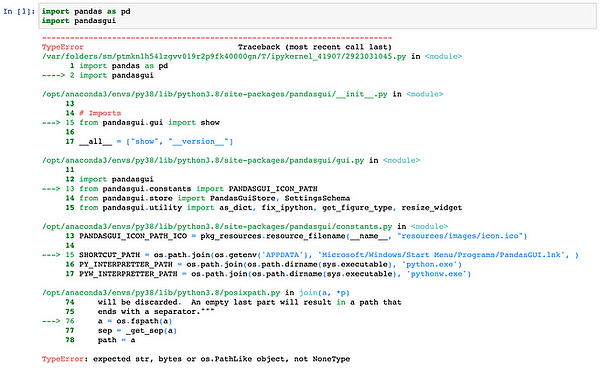
If you are using other operating systems than Windows you might face some problems due to the absence of the environment variable APPDATA. If you are using Mac OS or Linux and tried to import PandasGUI you will get a similar error:

Revolutionizing Data Analysis with PandasGUI

To address this problem, one simple workaround is to assign an empty string as the value for the environmental variable causing the error. By doing so, you can bypass any errors and allow your code to continue without interruption?—?an efficient solution that provides quick relief from the problems at hand.

import os  os.environ['APPDATA'] = ""

Now you can import it without no errors. You might get a warning message which is okay. The reason for this warning is the missing implementation of some recommended interfaces in Mac OS, so the system gives this warning.

Revolutionizing Data Analysis with PandasGUI

The last step is to load a dataset to use to demo the features of this library. You can load a structured dataset of your choice or you can use PandasGUI available dataset. In this article, we will use the Titanic dataset which comes packaged with the PandasGUI library.

from pandasgui.datasets import titanic

Now, we are ready to launch PandasGUI. Simply call the show() function as shown in the code below:

pandasgui.show(titanic)

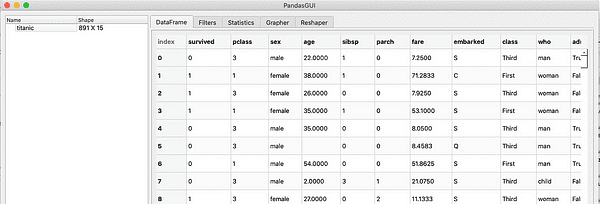
Once these commands are executed, a new window will open to reveal your uploaded dataframe.

Revolutionizing Data Analysis with PandasGUI
The Titanic Dataframe as shown by PandasGUI PandasGUI Capabilities

The UI is pretty straightforward. It consists of the following components. I’ll introduce them in the later sub-sections.

  • Viewing and sorting DataFrames
  • Reshaping DataFrames
  • DataFrame filtering
  • Summary statistics
  • Interactive plotting

Viewing and sorting DataFrames

The first feature of PandasGPU is to view and sort DataFrames in both ascending and descending orders. This is an important step for data exploration and can be done easily as shown in the image below:

Revolutionizing Data Analysis with PandasGUI
Viewing and sorting DataFrames

Reshaping DataFrames

PandasGUI provides two methods to reshape dataframes which are pivot and melts. The Pivot transforms dataframes by shifting values from one column to several columns. You can use it when you are trying to restructure your data by pivoting around a particular column. By specifying an index and columns for pivoting operations you can reshape your dataframe with greater ease.

On the other hand, the melt method enables you to unpivot your dataframe, combining multiple columns into a single one while maintaining others as variables. This feature is especially helpful when transitioning from wide-form to long-form or normalizing your dataset.

In the gif below we will use the pivot method to reshape the Titanic dataframe:

Revolutionizing Data Analysis with PandasGUI
Reshaping dataframes using pivot

DataFrame filtering

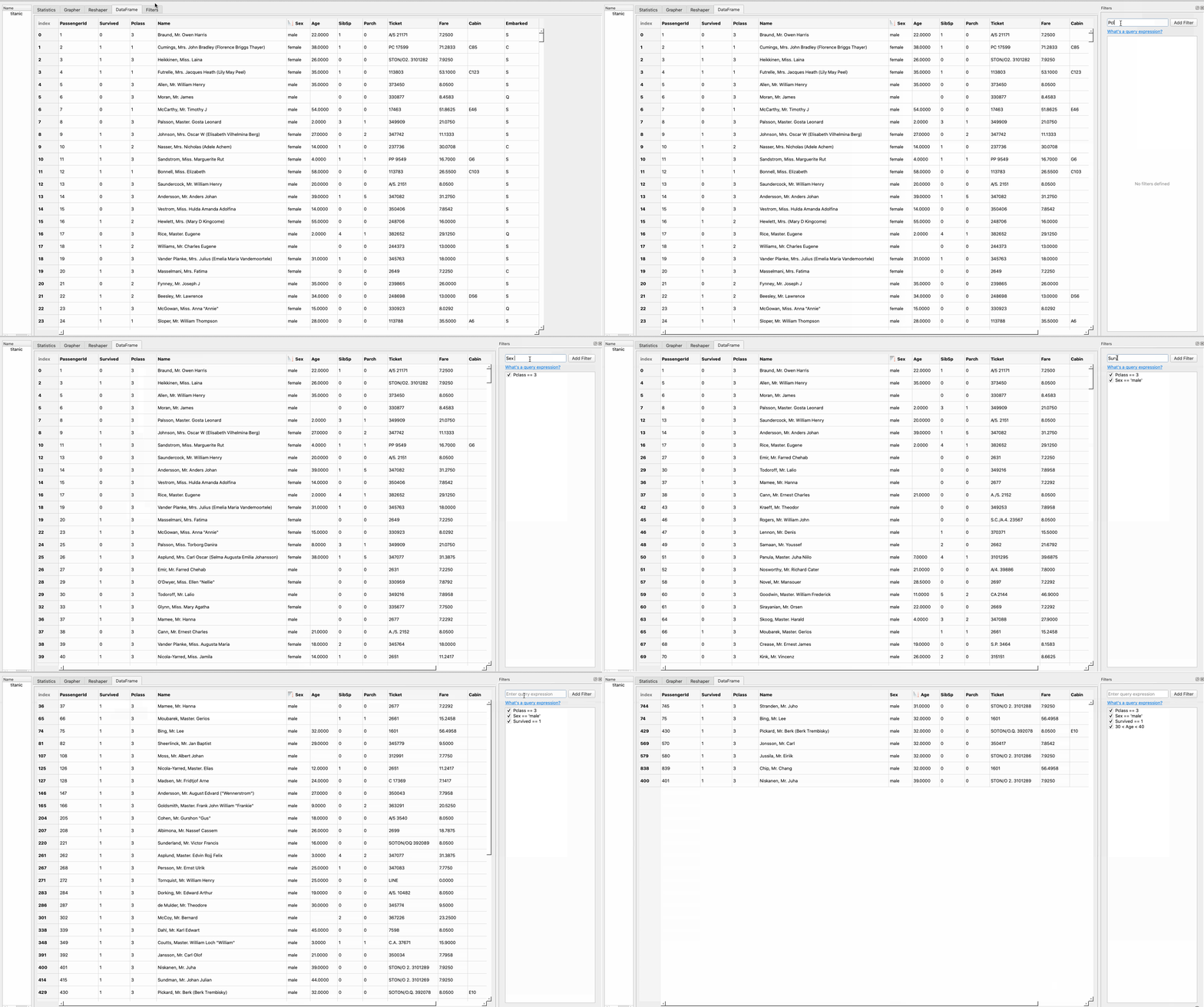
On many occasions, you would like to filter your datasets based on certain conditions to further understand the data or to extract a certain slice out of your dataset. To apply filters on your data using PandasGUI first you will go to the filters section and write each filter and then apply it. Assume we would like to get only the passengers who are:

  • Male
  • Belong to Pclass 3
  • Survived the shipwreck
  • Age between 30 to 40

Therefore here are the four filters we will apply to our datasets:

  • Sex == ‘male’
  • Pclass == ‘3'
  • Survived ==1
  • 30 < Age < 40

In the gif below is a step-by-step guide on applying these four filters to the Titanic dataset:

Revolutionizing Data Analysis with PandasGUI

Summary statistics

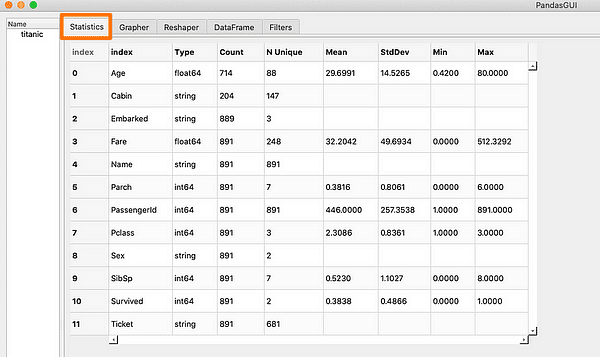
You can also use PandasGUI to provide a detailed statistical overview for the DataFrame. This will include the mean, std, min, and max of each column of the dataset.

Revolutionizing Data Analysis with PandasGUI

Interactive plotting

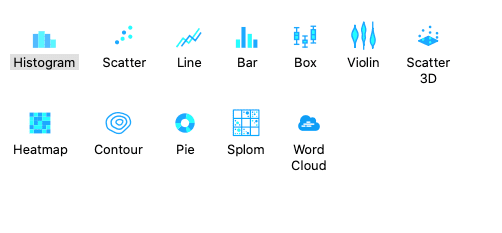
Finally, PandasGUI provides powerful interactive plotting options for your dataset which includes:

  • Histogram
  • Scatter plotting
  • Line plotting
  • Bar plotting
  • Box plotting
  • Violin plotting
  • 3D scatter plotting
  • Heatmap
  • Contour plots
  • Pie plots
  • Splom plot
  • Word cloud

Revolutionizing Data Analysis with PandasGUI
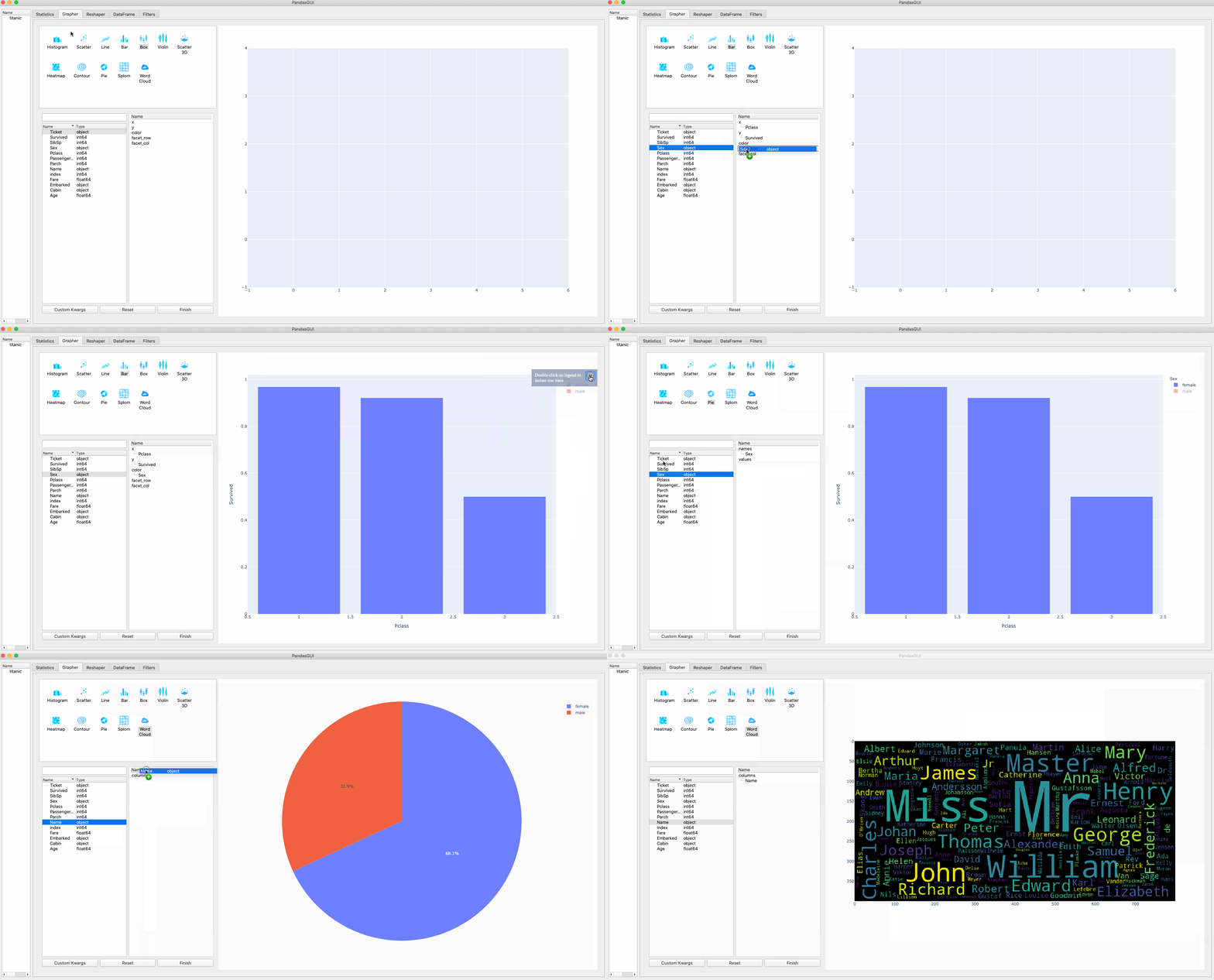
In the gif below we will create three interactive for our dataset: a pie chart, bar plot, and word cloud.
Revolutionizing Data Analysis with PandasGUI
This article highlights the features of PandasGUI a powerful library that adds a graphical user interface to the widely used Pandas library. We first demonstrated its installation, loaded a sample dataset, and explored features such as filtering, sorting, and statistical analysis. References

  • PandasGUI: Analyzing Pandas dataframes with a Graphical User Interface
  • Everything You Need To Know About PandasGUI
  • PandasGUI — The Ultimate Secret to Effortless Data Analysis

Youssef Rafaat is a computer vision researcher & data scientist. His research focuses on developing real-time computer vision algorithms for healthcare applications. He also worked as a data scientist for more than 3 years in the marketing, finance, and healthcare domain.

More On This Topic

  • Data Analysis Using Tableau
  • Data Analysis Using Scala
  • Data Scientist Job Salaries Analysis
  • 5 Data Analysis Projects For Beginners
  • How To Collect Data For Customer Sentiment Analysis
  • The Data Matters: Choosing the right data to analyze can make or break your…

StyleDrop: Transform Designs with Google’s Personalised Text-To-Image Generator

Google has introduced a new method called StyleDrop, which allows the synthesis of images in a specific style using the Muse text-image model. The technique captures the details of a custom style, including color schemes, shading, design patterns, and local and global effects, requiring only a single image as input.

StyleDrop rapidly learns the new style by fine-tuning a small number of trainable network parameters. It then improves the model’s quality through iterative training, either with human feedback or automatic feedback. The process is efficient, taking less than three minutes even with human feedback, as StyleDrop requires only a few images for iterative training.

According to Google, StyleDrop outperforms other methods for style transfer from text-to-image models, surpassing techniques such as Dreambooth, LoRAs, Textual Inversion in Imagen, and Stable Diffusion.

The team at Google combines StyleDrop with Dreambooth to learn and create new objects in different styles. By utilising Muse, they can generate custom objects in custom styles.

Google envisions StyleDrop as a versatile tool that allows designers or companies to train with their brand assets and rapidly prototype new ideas in their desired style. The project page for StyleDrop provides further information on its capabilities and applications.

Google had previously introduced an AI model called Imagen, which is a text-to-image diffusion model. Unlike other AI text-to-image generators, Imagen had specific limitations in its initial release. Users could generate buildings with different themes or style animated creatures using Imagen AI. The model had been released through the AI Test Kitchen app, where Google tests various AI projects before public release. Imagen utilises the LAION-400M dataset for training.

Google’s cautious release of Imagen and its focus on photorealistic outputs distinguished it from other models like DALL-E or Midjourney. Imagen’s unique features include City Dreamer, which allows users to construct buildings based on text descriptions, and Wobble, which generates animated creatures.

While generative AI tools like this offer creative possibilities, concerns remain regarding provenance and copyright issues in content creation using AI. The use of internet-posted text to train AI text generation tools has seen less debate compared to image-based tools, while AI tools for music production are also likely to raise similar questions.

The post StyleDrop: Transform Designs with Google’s Personalised Text-To-Image Generator appeared first on Analytics India Magazine.

AI Researchers Issue Warning: Treat AI Risks as Global Priority

AI Researchers Issue Warning: Treat AI Risks as Global Priority June 5, 2023 by Jaime Hampton

Does artificial intelligence represent an existential threat to humanity along the lines of nuclear war and pandemics? A new statement signed by AI scientists and other notable figures says it should be treated as such.

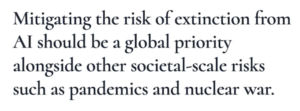
The statement reads: “Mitigating the risk of extinction from AI should be a global priority alongside other societal-scale risks such as pandemics and nuclear war.” The 22-word statement was published by the Center for AI Safety (CAIS), a San Francisco-based non-profit organization that said the statement is aimed at opening a global discussion about AI’s urgent risks.

Topping the list of signatories is Geoffrey Hinton, an AI research pioneer who recently left Google to have more freedom to sound the alarm regarding what he calls the clear and present danger presented by AI, saying, “These things are getting smarter than us.”

Hinton is one of the founders of the deep learning methods employed by large language models like GPT-4, along with fellow endorser Yoshua Bengio. Notably absent from the list is the third member of the Turing Award-winning research team–Yann LeCun, chief AI scientist at Meta.

The statement was also signed by several CEOS of major AI players including OpenAI’s Sam Altman, Google DeepMind’s Demis Hassabis, and Anthropic’s Dario Amodei.

The CAIS statement as shown on its website. (Source: Center for AI Safety)

A section of CAIS’s website lists potential AI risks including weaponization, misinformation, deception, power-seeking behavior, and more. Regarding AI’s possible attempt at a power grab, the website says: “AIs that acquire substantial power can become especially dangerous if they are not aligned with human values. Power-seeking behavior can also incentivize systems to pretend to be aligned, collude with other AIs, overpower monitors, and so on. On this view, inventing machines that are more powerful than us is playing with fire.”

The organization also asserts that building this power-hungry AI may be incentivized by political leaders who see its strategic advantages, quoting Vladimir Putin who said, “Whoever becomes the leader in [AI] will become the ruler of the world.”

The CAIS statement marks the latest in a series of high-profile initiatives focused on addressing AI safety. Earlier in the year, a controversial open letter—supported by some of the same individuals endorsing the current warning—urged a six-month hiatus in AI development that was met with mixed reactions within the scientific community. Critics argued that the letter either overstated the risk posed by AI or, conversely, they agreed with the potential risk but disagreed with the proposed solution.

The Future of Life Institute (FLI) authored the previous open letter and had this to say about the CAIS statement: “Although FLI did not develop this statement, we strongly support it, and believe the progress in regulating nuclear technology and synthetic biology is instructive for mitigating AI risk.”

This meme circulating on Twitter highlights the more immediate risks of AI harm. (Source: Twitter)

FLI recommends a series of actions in mitigating this risk including developing and instituting international agreements to limit particularly high-risk AI proliferation and mitigate the risks of advanced AI, as well as founding intergovernmental organizations, similar to the International Atomic Energy Agency (IAEA), to promote peaceful uses of AI while mitigating risk and ensuring guardrails are enforced.

Some experts are calling these open letters misguided and that AGI, or autonomous systems with general intelligence, is not the most pressing concern. Emily Bender, a professor of computational linguistics at the University of Washington and a member of the infamous AI ethics team fired by Google in 2020, said in a tweet that the statement is a “wall of shame where people are voluntarily adding their own names.”

“We should be concerned by the real harms that [corporations] and the people who make them up are doing in the name of ‘AI,’ not [about] Skynet,” she wrote.

One of these harms can be seen in the example of an eating disorder helpline that recently fired its human team to employ a chatbot called Tessa. The helpline has been active for 20 years and is run by the National Eating Disorder Association. A report from Vice noted that after NEDA workers moved to unionize early last month, the association announced it would replace the helpline with Tessa as the group’s main support system.

Tessa was taken offline by the organization just two days before it was set to take over due to the chatbot encouraging damaging behaviors that could make eating disorders worse, such as severely restricting calories and weighing oneself daily.

This article first appeared on sister site Datanami.

Related

10 ways to simplify data quality and sharing efforts

music-store-349883_1920

Pondering a blue-sky scenario helps to clarify what a company’s long-term objectives should be. For example, say your company could pick one data-wish to come true. What wish would it be?

Off the top of your head, I’m guessing you wouldn’t answer “transform our architecture so that it’s data-centric.” But maybe that should be your answer.

Companies ultimately all want the same things when it comes to data:

  • The right data
  • In the right place
  • In the right format
  • For the right purpose
  • At the right time.

Unfortunately, the likelihood that companies will ultimately get the data they want that meets all of these parameters is rather slim at the moment. Often, when it comes to data, companies “make it work.” They generate, collect, or acquire some data that can be made somewhat useful, and refine and analyze it enough to extract some value from it. And they manage the kinds of data using a rough data lifecycle approach to keep extracting that value from it.

Part of the reason for this status quo is that creating and managing quality data is hard work. For most, it’s harder than it should be.

Most companies haven’t found, believed in, or focused on a way to make the work easier. But some have made easier data integration, quality, and management work possible. Ask me for a list of case studies if you’re interested.

Observational bias and the data quality challenge

When I was a research fellow at the Center for Technology and Innovation at PwC back in 2009, I had an ex-Stanford Research Institute boss who always started with first principles and blue-sky scenarios. He taught us to do divergent research first, then convergent.

In 2009, he asked us to research what the challenge of business intelligence was. After research, we decided the biggest challenge was data integration, true integration. After more in-depth research, we agreed the best solution to the integration problem was web semantics, i.e., smarter data modeled using standard, semantic graphs. Today they’re called knowledge graphs.

If you consider all the types of bias that occur in data and how it’s analyzed, observational bias is one of the most common and pervasive. You don’t just need a lot of observations to solve that kind of bias problem. You need a fuller picture of the problem landscape to find the right questions to ask and be open to how to answer those questions. For that reason, discoverability and richness in data is key.

Also, the answer can’t be supplied with quantitative data alone. Qualitative data often provides a means of capturing context for what data you should collect, and how.

One of the interviews we conducted in 2009 was with Doug Lenat, head of Cycorp. Doug described the observational bias problem this way: You’re looking for your keys under the lamppost because that’s where the light is. The challenge is to put the light in more places, with the help of smarter data and large-scale integration and interoperation.

Ten ways to simplify data quality and sharing efforts

True data quality simplification requires a transformation of both code and data because the two are inextricably linked. Code sprawl and data siloing both imply bad habits that should be the exception, rather than the norm.

  1. Transform your data architecture. Today’s “modern” architectures tend to carry a load of legacy baggage from previous generations. It’s best to sidestep this baggage and build a parallel system that innovates at the data layer.
  2. Design to eliminate code waste and data duplication. Code that should be reusable is trapped in applications.
  3. Think knowledge graphs instead of data lakehouses. Quality data is knowledge and logic enriched. All types of heterogeneous data can be brought together and managed via knowledge graphs.
  4. Make zero-copy integration a goal. When it comes to new projects, assume locally owned and controlled data that’s reusable at the source. Design apps to use others’ data. Share data via named graphs rather than APIs. That’s the SOLID approach Tim Berners-Lee envisions, one that also enables zero-copy integration and management.
  5. Focus on semantics up front, and refine semantics in mid-stream. Semantics is the art and science of meaning. When it comes to digital data, shared semantics forms a bridge between users and between machines and users. Smart data includes semantics, which allows a fuller picture of the problem and the solution to be painted in terms of the environment.
  6. Integrate using graphs instead of tables only. Graphs are well-articulated and easily extensible. Table-to-graph conversion is straightforward.
  7. Expose and articulate relationships between entities. Ironically, most relational databases treat relationships as second-class entities. Thinking and working in graphs makes it possible to contextualize your data.
  8. Use an extensible graph data model as the mother of your data children for integration. Other models are useful for other purposes, not large-scale integration and interoperation.
  9. Rationalize your SaaSes and internal applications. Adding more SaaSes to your subscription list adds unnecessary complexity. Do you really want to struggle to use your own data?
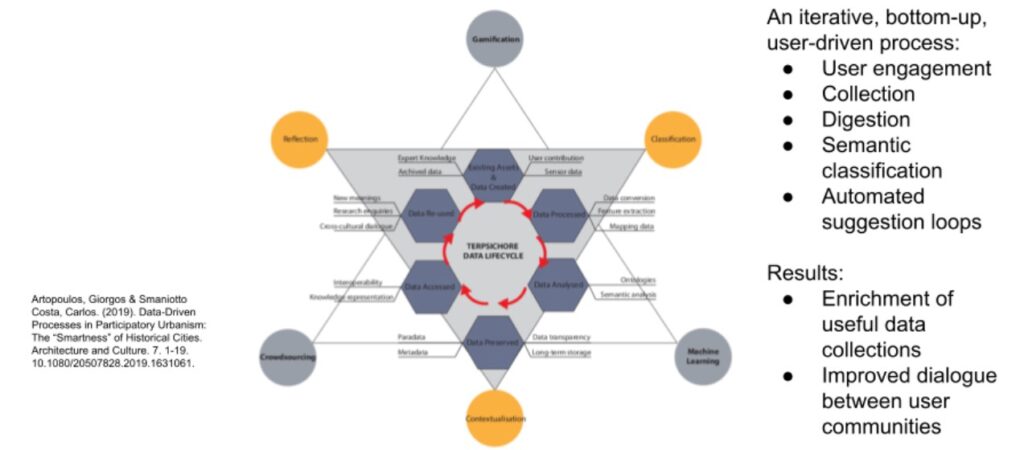
  10. Map your future organization to a semantic data lifecycle. A data lifecycle such as Terpsichore, for example, suggests a need to commit to smart, contextualized data and contextual computing–what DARPA calls the Third Wave of AI.
10 ways to simplify data quality and sharing efforts
Terpsichore: Human in the loop semantic data lifecycle