Eleven Labs, the generative AI company leading the way for audio and voice generation products has got more fuel for its mission to make its content universally accessible. The research company has raised $19 million in a series A fund led by Nat Friedman, Daniel Gross, and Andreessen Horowitz.
Other notable investors include Credo Ventures, Concept Ventures, as well as a group of strategic angel investors, including Mike Krieger, co-founder of Instagram; Brendan Iribe, co-founder of Oculus VR; Anjney Midha, co-founder of Ubiquity6; Mustafa Suleyman, co-founder of Deepmind & Inflection; Siqi Chen, co-founder of Runway; Ali Albazaz, co-founder of Inkitt; Dima Shvets, co-founder of Reface; Aravind Srinivas, co-founder of Perplexity AI; Guillermo Rauch, founder of Vercel; Tim O’Reilly, founder of O’Reilly Media; as well as Creator Ventures, SV Angel, Embark Studios, Storytel, and TheSoul Publishing.
We're thrilled to open a new chapter at ElevenLabs! Today we’re announcing new voice AI products & our $19m Series A round led by @natfriedman @danielgross & @a16z. Listen & read more: https://t.co/8LHtqvdCQt
— ElevenLabs (@elevenlabsio) June 20, 2023
The company has also announced a new set of products called Projects. Currently available in early access, Projects hosts a production workflow for creating dynamic long-form spoken content, along with an editing suite. This will give creators and authors huge control over AI-generated audio content without needing to leave the platform at all.
Projects joins the ElevenLabs product lineup with other notable offerings such as Speech Synthesis and VoiceLab. Speech Synthesis utilizes pre-existing synthetic voices, while VoiceLab facilitates the creation of distinctive voices or digital renditions of existing ones. Additionally, ElevenLabs has made available Eleven Multilingual, a speech synthesis model capable of supporting various major European languages.
Moreover, ElevenLabs is also introducing AI Speech Classifier, allowing users to upload an audio sample and determine if it contains AI-generated audio from ElevenLabs. This innovative tool is the pioneer in the field of generative audio and is now accessible to the general public and a few chosen partners through an API. By launching the AI Speech Classifier, ElevenLabs demonstrates its dedication to transparency and plays a vital role in establishing a secure environment for generative media.
Mati Staniszewski, the co-founder of Eleven Labs, said, “Our mission is to be the ultimate tool for storytelling, dissolving language barriers and putting all audiences in the reach of all content creators in a safe and responsible way. With an incredible, growing team and these exceptional investors, ElevenLabs is now ever closer to realizing its long-term goal of making all content universally accessible in any language and in any voice.”
Launched in Beta in January, Eleven Labs has already attracted 1 million users for creative, entertainment, and publishing spaces. The company says that over 10 years worth of audio content has been generated using its services.
The post Eleven Labs Raises $19 million Fund, Launches New Generative AI Products appeared first on Analytics India Magazine.
Intel announced on Thursday that the upcoming Meteor Lake processors will bring major change to its classic naming convention. The Core i series, which has used the same branding for 15 years, will drop the “i” from its naming scheme starting with the upcoming Meteor Lake processors. Meanwhile, the Intel Core brand will now have a new segment: the performance-focused Ultra brand.
“To better align with our product strategies, we are introducing a branding structure that will help PC buyers better differentiate the best of our latest technology and our mainstream offerings,” said Caitlin Anderson, Intel’s vice president and general manager of Client Computing Group Sales, in a press release.
The changes are also part of the wider trend of tech companies emphasizing that their products are compatible with customers’ interest in artificial intelligence.
Jump to:
Intel’s upcoming branding changes
Meteor Lake is built on the Intel 4 process node
Intel AI Boost is a dedicated AI engine
Alternatives to Intel Core
Intel’s upcoming branding changes
Beginning in the second half of 2023, Intel will no longer use the “i” name on client processors. For example, Core i3/i5/i7/i9 will be known as Core 3/5/7/9.
The Core brand will now have two tiers: Core and Core Ultra. The more performance-focused of the two tiers will be Core Ultra. Intel Arc graphics will work with either Core or Core Ultra processors.
The change streamlines the naming system and is intended to “highlight [a] significant shift in architecture and design,” according to Intel’s marketing material.
The brand changes also include:
A new Intel Evo Edition platform brand for Evo-verified designs.
Introducing Intel vPro Enterprise and Intel vPro Essentials device labels for the relevant commercial systems.
Meteor Lake is built on the Intel 4 process node
Meteor Lake is a line of client processors — the first to be manufactured on the new Intel 4 process node. It will also be the first Intel client processor that includes a dedicated artificial intelligence engine. It is expected to be available in the second half of 2023.
The chipset configuration is Intel’s first to be designed using Foveros advanced 3D packaging.
SEE: NVIDIA has an answer to the demand for AI, too — if you happen to be in the market for a supercomputer.
Intel AI Boost is a dedicated AI engine
Intel AI Boost joins the company’s portfolio of AI accelerators (or “neural processing units“) and other supporting hardware. With many of today’s enterprises interested in deploying AI services, Intel needs to keep AI at the forefront to keep up with Apple and other competitors. It is not yet known how exactly the AI engine may be integrated into Meteor Lake products, but Intel already has AI and deep learning accelerators across other parts of its portfolio.
Alternatives to Intel Core
The largest competitors to Intel’s Core CPUs are AMD and Apple. In 2020, Apple announced that it would switch from Intel-built chips to the company’s own M1 chips in Macs. NVIDIA is also a major player in the area of AI-accelerated chips.
Subscribe to the Innovation Insider Newsletter
Catch up on the latest tech innovations that are changing the world, including IoT, 5G, the latest about phones, security, smart cities, AI, robotics, and more.
According to Stack Overflow’s 2023 developer survey, 44% of developers are already using artificial intelligence in their development process, and 26% plan to soon. Developers were also asked which AI tools they use, and out of the 21 options Stack Overflow listed this year, a vast majority are just using these two popular products: ChatGPT (83%) and GitHub Copilot (56%).
Stack Overflow survey author Erin Yepis observed that “professional developers may need time to adjust existing workflows and will most likely be motivated by their junior colleagues who are using AI tools while learning to code.”
Stack Overflow said it expects it will take time before developers start using more AI tools more broadly.
“Another factor that may be contributing to the slow adoption of AI tools into the development process is that professional developers don’t highly trust the accuracy of AI tools,” Yepis wrote in a blog accompanying the survey.
Of those using or planning to use AI tools, only 3% of respondents highly trust the accuracy they provide, and twice as many (6%) highly distrust them. “While the majority (39%) are somewhat trusting of AI tools, this response tells us that AI tools still need to prove their usefulness,” the survey’s authors said.
Approximately 90,000 people from all over the world submitted their top picks for tools and programming languages they are using, Stack Overflow said.
Jump to:
What are the top programming languages for 2023?
Did developers’ salaries increase in 2023?
“Admired” and “desired” programming languages, other technologies
What are the top programming languages for 2023?
The top programming language for 2023 is JavaScript, with three other popular languages increasing their standing: Python, Bash/Shell (all shells) and C.
Nearly 64% of respondents use JavaScript, followed by almost 53% who use HTML/CSS. From tracking tags on Stack Overflow, the developer website gleaned that Python has been growing in popularity for the last three years, and this year, it moved up one spot to take the number three position at 49%. SQL placed fourth at almost 49%, and TypeScript came in fifth at nearly 39%.
Placing 10th is C, which the survey noted “is an interesting language to see a rise in popularity: It has not been in the top 10 for programming languages in the developer survey before despite being around since the 1970s.” Stack Overflow also pointed out that “the TIOBE index has C as the second most popular programming language as of June 2023 and has engagement numbers close to their number one language, Python.”
C is one of the most popular low-level languages and the language of choice in embedded programming within IoT devices, the survey authors said. They added that, according to Codecademy, C “powers almost every technological experience we have,” and for that reason, “it makes sense that developers are using C more than ever this year.”
SEE: The top programming languages employers want in 2023 (TechRepublic)
On average, the more popular a programming language is, developers report the less experience with it — around 10 years for Stack Overflow’s top three languages, and closer to 14 years for those languages reporting less than 1% usage, the survey said.
“Less experienced developers reporting higher usage of some programming languages possibly strengthens the argument that a lower barrier of entry into the job force increases their popularity among coders,” the survey’s authors said.
Did developers’ salaries increase in 2023?
Overall, the baseline for salary growth in 2023 for developers surveyed was 10% over last year.
“When controlling for comparable years of experience, we see a wide range of growth and decline amongst the programming languages — as much as 42% growth and 69% contraction year-over-year,” the survey authors said. “If we take a language’s popularity as a proxy for the prevalence of developers in the labor market, then we could assume that salaries for popular languages will fall and less popular ones will rise.”
However, Stack Overflow’s most popular languages — JavaScript, HTML/CSS and Python — all saw negative growth in median salary, ranging from 5% to 10% contraction. There was even less salary growth, ranging from 8 to 80% contraction with comparable experience for the three least popular languages: APL, Crystal and SAS.
If you’re looking at the same programming languages but adjusting for less than average experience (e.g., five years less experience than average per programming language), “we see marginal growth for our top three and double-digit growth for APL and Crystal,” the survey’s authors said, noting that SAS was filtered from the results because it did not receive enough responses.
“What we surmise is that developers’ negotiating power has been affected this year, and those with a few less years of experience and working in more niche languages have more salary upside this year than developers with more experience in more popular programming languages.”
“Admired” and “desired” programming languages, other technologies
This year, Stack Overflow added a new section to the survey results for tech trends for developers who have used or want to use certain programming languages, tools, environments and libraries that it has dubbed “admired and desired.”
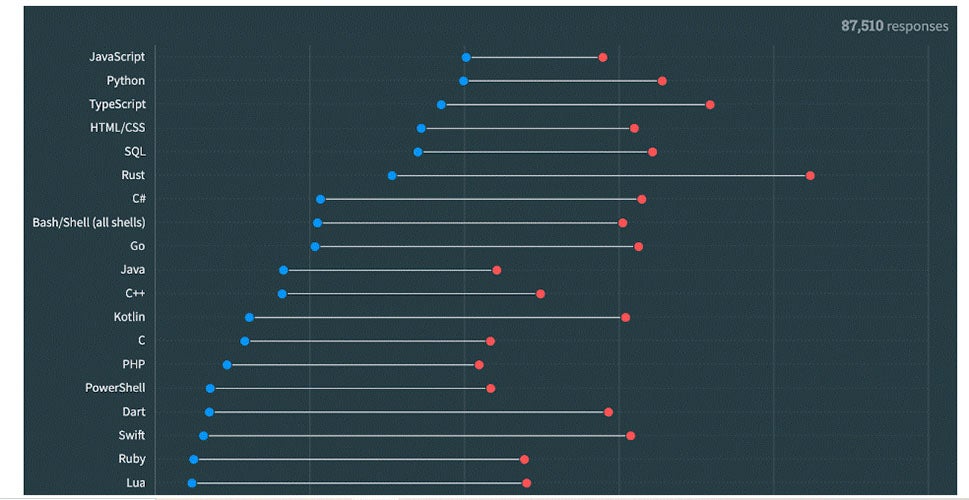
To better gauge hype versus reality, Stack Overflow created a visualization (Figure A) that shows the distance between the proportion of respondents who want to use a particular technology (“desired”) and the proportion of users who have used the same technology in the past year and want to continue using it (“admired”).
Figure A
Stack Overflow created a visualization indicating the distance between the proportion of respondents who “desired” to use a technology and those who have used the same technology in the past year and “admired” it. Image: Stack Overflow
For example, JavaScript, ranked as the most popular programming language since 2011, “has a relatively short distance between admired and desired (<10 percentage points), while Rust, a top choice for developers who want to use a new technology for the past eight years, shows a wide distance (>60 percentage points),” the survey said.
“Rust is a language that generates more desire to use it once you get to know it than JavaScript,” the survey added. “Seeing this growth in admiration for certain technologies provides insight into what has staying power and what needs help in order to generate coveted evangelists to convert new users into ones that will stick around.”
Subscribe to the Developer Insider Newsletter
From the hottest programming languages to commentary on the Linux OS, get the developer and open source news and tips you need to know.
As a text-to-image model, Stable Diffusion is accessible through various websites.
The popularity of generative AI has led to a host of websites and services that are able to create an image from a text description or prompt. One option worth trying is Stable Diffusion.
How to use: Midjourney | Bing Image Creator | DALL-E 2 | Craiyon AI
An effective and versatile tool, Stable Diffusion is available through a range of websites and as a standalone application. Simply type your description, and it generates corresponding images. Here's how it works.
How to use the various Stable Diffusion websites
As a text-to-image model, Stable Diffusion is accessible through various websites.
Stable Diffusion Online
View the generated images.
View and save an image.
Regenerate the images.
Hugging Face
1. Generate an image
Another website that uses the Stable Diffusion model is Hugging Face. Browse to the site and type your description at the prompt.
You'll notice that there's also a field for Negative prompt. Here, you're able to type text and suggest anything you don't want to include in the image. Click the Generate Image button, and four images appear in response.
View the images.
2. Select an image
Click a specific image to view it. Right-click on the image to save or copy it.
View an image.
DreamStudio
DreamStudio is another site that uses the Stable Diffusion model. However, this time you'll need to sign in with a supported account. You should also be aware that DreamStudio offers you a certain number of free credits that count toward generating images. If you use up those credits, you'll have to pay for more to continue using the site.
Also:How to use Bing Image Creator (and why it's better than DALL-E 2)
Browse to the Stability.AI login page. You can either log in with an existing Google or Discord account or click the sign-up link at the bottom to create a new account. After signing in with your account, you're taken to the DreamStudio website where you can log in.
Before you can generate an image, you'll want to select a couple of options. First, click the field for Model and choose the version of Stable Diffusion you want to use — either one of the production versions or the latest beta. Next, click the Style field and choose the type of style you'd like for your image, such as Anime, Photographic, Comic Book, Cinematic, or 3D Model.
Also:This new technology could blow away GPT-4 and everything like it
Under Settings, move the first slider to set the size of the image. Then move the second slider to choose how many images you wish to see.
1. Generate an image
Type your text description in the prompt. You can also exclude certain items from the image by adding them to the Negative prompt. When ready, click the Dream button. In response, the site displays the number of images that you selected in Settings.
View the generated images.
2. Select an image
Click an image to see a larger version. Right-click the image to save or copy it.
View and save an image.
Download and install Stable Diffusion
Rather than relying on the different websites that use Stable Diffusion as a model, you can install the program on your computer. However, be forewarned that setting up the application is challenging and requires several precise steps. The good news is that, once you're done, you can run it whenever and how often you want.
Also: The best AI art generators to try
Before you get started, you'll need to make sure your PC meets the minimum requirements: Windows 10 or 11, and a discrete NVIDIA video card with 4GB or more of VRAM. You can check the name and model of your video card and the amount of VRAM via the DirectX Diagnostic Tool. Press Win key+R to trigger the Run box. In the Open field, type dxdiag. In the DirectX Diagnostic Tool window, click the Display tab to see the name of your card and the amount of VRAM.
If your card is up to snuff, go through the following steps:
1. Install Python
Browse to the Python 3.10.6 website. Scroll down to the Files section and click the link for the Windows installer (64-bit) (assuming you're running 64-bit Windows). Run the downloaded file to install Python.
2. Install Git
Browse to the Download page for Git for Windows. Click the link for 64-bit Git for Windows Setup. Install the downloaded file, accepting all the default options.
3. Download the Stable Diffusion project file
Browse to the GitHub page for the Stable Diffusion project file. Click the green Code button in the upper right and select Download ZIP. Extract the downloaded ZIP file. Doing so creates a folder named stable-diffusion-webui-master. Copy this folder with all the extracted files to a simple location, such as the root of your C: drive.
4. Download and set up the checkpoint file
Browse to the Hugging Face webpage for the Stable Diffusion checkpoint file. Click the download link to save the 768-v-ema.ckpt file. This is a huge file, so be patient while it downloads. After the file has been downloaded, navigate to the following location: C:stable-diffusion-webui-mastermodelsStable-diffusion (assuming you copied this folder to the root of your C: drive). Inside this folder is a file named Put Stable Diffusion checkpoints here.txt. Copy the 768-v-ema.ckpt file into this folder.
5. Download the config yaml file
Browse to the page for the config yaml file. The file will appear as straight text. Right-click anywhere on the page and select Save as. Navigate to the C:stable-diffusion-webui-mastermodelsStable-diffusion folder and save the yaml file in this location. Change the name of the file to 768-v-ema but keep the yaml extension, so it should be named 768-v-ema.yaml.
6. Run the webui-user.bat file
Move to the stable-diffusion-webui-master folder and run the webui-user.bat file. After a couple of minutes, the window should display a line that reads: Running on local URL, followed by a URL with the IP address of your local machine and a port number. Copy and paste that entire URL with the port number into your favorite browser to display the Stable Diffusion application. However, keep the command window open.
7. Generate an image
Now you can finally generate an image. In the Stable Diffusion application, type a description for the image you want at the prompt. Enter any text you wish to exclude in the Negative prompt. If you want, you can change the parameters for Sampling method, width, height, and the rest. Set values for Batch count and Batch size if you need to change the defaults. When ready, click the Generate button. The application displays the images based on the count you requested.
Generate and view the images.
Peek around the Stable Diffusion application and you'll find a host of other options, including ones to upload an image to generate a variation of it, scale and otherwise tweak an image, and tap into different extensions.
Also: Meta's new AI model can identify objects in images. Here's why that matters
If you find an image you like, click it to enlarge it. Click the Save or Zip button to save it. Otherwise, all the generated images are automatically saved in a folder that you can access by clicking the Folder button.
Generative AI has the ability to generate all types of content including text, art, images, and even speech.
The AI startup, ElevenLabs, has supported text-to-speech generation and voice cloning since its beta launch in January and has accumulated over one million registered users.
Also: Meta unveils Voicebox AI to replicate the voices of your friends and loved ones
On Tuesday, ElevenLabs announced the closing of a $19 million dollar Series A round, as well as some major updates to the platform, including ones to address its biggest controversy.
Since its launch, Elevenlabs' voice-generating technology has had both positive and negative implications.
Some of the positive uses, as delineated by ElevenLabs, include "independent authors creating audiobooks, developers voicing characters in video games, supporting the visually impaired to access online written content, and powering the world's first AI radio channel."
Although these use cases are positive and advance the business processes of many different industries, there have been equally detrimental applications.
The voice-cloning tool, which takes snippets of a person's voice to generate new audio, has been used for nefarious means, making public figures seem like they are saying horrible, discriminatory statements.
Weeks after releasing the beta, ElevenLabs immediately took to Twitter to address the "voice cloning misuse cases." The company suggested potential ways to combat the issue such as additional account verification, verifying copyright to the voice, moving voice cloning to a paid tier, and even manually verifying each request.
Also: Vimeo adds a suite of AI tools to make video creation significantly easier
Today, it released to the public what seems to be the company's solution to the issue, an AI Speech Classifier. This tool will be able to decipher whether uploaded audio contains AI-generated audio from ElevenLabs or doesn't.
"The release of the AI Speech Classifier is the latest step in the company's push for transparency, and it is a cornerstone of their commitment to creating a safe generative media landscape," said ElevenLabs in the release.
According to a previous post announcing the tool, the tool maintains >99% accuracy in identifying when the audio is unmodified.
However, if the audio underwent Codec or reverb transformations, accuracy drops to over 90% accuracy, and the more the content has been processed, the more the accuracy drops, according to the release.
This tool won't prevent misuse and may simply help clear up the confusion after the initial harm is done. Its effectiveness in solving the issue is questionable, but it's a small step.
This isn't the first time AI-generation technology has been misused to target public figures. For example, an AI music generator was able to generate a Drake and The Weekend collaboration that sounded real although neither artist was actually on the track.
Also: Can AI-generated music win a music award? The Grammys reveal new rules
AI art and image generators have also been used to generate fake, realistic images of public figures doing certain activities. Some of these images have been used negatively as political propaganda while others have just been used for entertainment purposes, such as the meme of Pope Francis in a puffer coat.
In addition to the AI Speech Classifier, ElevenLabs also announced the arrival of "Projects" to its suite of products.
"Projects" is a workflow for editing and creating long-form spoken content available for early access now. It is meant to serve as a one-stop shop for audio-editing needs and provide a "Google Docs level of simplicity" to audio creation, according to the release.
The addition of the "Projects" feature is similar to those we have seen from other creativity platforms, such as Vimeo, TikTok, and Adobe Express. The goal of all of these platforms is to implement AI in a way that optimizes user workflow and allows for easier, optimized creation of content.
India might be the biggest market for tech giants, but it’s definitely not the first choice for them. On his recent India visit, though OpenAI chief Sam Altman mentioned that there has been a lot of early adoption and enthusiasm from Indian users, India was not considered in the first list of countries that got access to the ChatGPT app on iOS. Interestingly, even countries such as Nicaragua, Nigeria and Jamaica made the cut to the list of early release. Similarly, Google’s Bard was first released in the US and UK in March. It was only after two months that Google’s chatbot was released to 180 countries, including India.
Now recently, Google made several new improvements to its Search Generative Experience, inviting users to experiment with its generative AI-powered search engine via Search Labs. However, the service is not available in India and is open for limited users in the US only.
What’s more? Launched in 2021, Meta’s social VR platform Horizon Worlds that allows users to create and explore virtual worlds was originally available in the US and Canada only. It is now available in seven countries, restricted to US and Europe. Ironically, Facebook has the highest number of users from India. There are a close to 315 million Indian users, followed by the US with almost half the number.
So, why is India being ignored when it comes to big tech launches?
Rules to be blamed
India rules and regulations have often been considered less conducive for tech firms’ functioning. It was only recently that the government was mulling over removing the rule of storing data locally. As per the draft of the Digital Personal Data Protection Bill that was unveiled for feedback in November last year, India is planning to allow transfer and storage of personal data in some countries.
India has always been vocal about having specific privacy laws that would cater to the governance of the country. Looking at the current scenario, when countries across the globe are thinking about bringing AI regulations and even contemplating having an international body for regulating AI, India holds a different view. When Altman was crusading for AI regulatory frameworks, Union Minister Rajeev Chandrasekhar was clear in his stance on how AI should have guardrails.
Catering specifically to the needs of the local market becomes another determining factor when releasing products that require local needs and preferences. When products such as voice assistants were released such as Amazon’s Alexa and Apple’s Siri, companies chose to first launch them in their home country sticking to English alone. Understanding the local languages, accents and user behaviour was essential before releasing it in a country such as India. Alexa was launched in the US in 2014 in the US, but reached India only in 2017. Similarly, Google Home was introduced in the US in 2016 but came to India only in 2018.
In spite of having contradictory views with the world or having its own set of restrictions, India has been a market of quick adoption, including AI technology. As of May, India had the second highest number of ChatGPT users across the globe (6.32% of total users), right after US (15.22%). India is also poised to grow tremendously in the AI market, and as per AIM report, the AI market size in India is expected to grow to $71 bn by 2027.
Source: AIM
The importance of India
With increased tech adoption and investments in the tech space, India has always been the forerunner in the technology adoption. India was ranked among top 10 countries in the world in terms of spending and investments on AI made by public, government and private institutions.
GitHub had mentioned earlier that India is the fastest-growing country in the world in terms of developers contributing to open source. As of November, GitHub has over 9.75 million developers in India which makes it the second largest developer community on the platform, only behind the US.
Replit, another developer community, has also been witnessing similar growth. India is one of the fastest and second largest markets for Replit. Anshul Bide, BizOps, India head at Replit told AIM that people even code using their mobile devices in India — a makeshift way of moving forward despite difficulties.
It is obvious that big techs skipping India for tech launches are losing on the massive pool of quick adopters, which is an opportunity wasted.
The post Big Tech Launches: Why India Always Plays the Second Fiddle appeared first on Analytics India Magazine.
European antitrust regulators are getting ready to initiate an official inquiry into the proposed acquisition of cloud-based designer platform Figma by software giant Adobe which is valued at $20 billion. The investigation is expected to commence later in the year, according to the Financial Times.
According to the report, the investigation over anti-competition concerns could go on for months which might possibly stop the deal.
This comes after the UK launched an initial probe into the deal last month, after blocking a tech deal between Microsoft and Activision Blizzard. In February, Brussels regulators said that even though the market in Europe is very less, it still needs to be regulated according to EU’s justification, to which the EU agreed saying that it might threaten competition significantly.
The US Department of Justice is also preparing to file a lawsuit against the deal citing the same reasons. It blocked the NVIDIA-Arm deal in February.
“Adobe is trying to buy a credible competitor,” a person with direct knowledge of the matter told FT. The deal represents that Adobe is simply trying to eliminate a smaller rival.
Earlier this year, Adobe expressed its anticipation for extended evaluations of the acquisition as global scrutiny on technology transactions intensified. CEO Shantanu Narayen cautioned against impeding the merger, emphasizing that regulatory intervention would result in reduced investment in start-ups.
Adobe is ready to put up the claim that both the companies operate in a different market. Internal research found that only there is a 10 percent overlap between Photoshop and Figma users. This means that the company still has a chance to avoid an in-depth probe if it provides a compelling argument.
According to the European Commission, the acquisition has not yet been officially reported to them. They clarified that if the transaction qualifies as a concentration and has relevance to the European Union, it is the responsibility of the companies involved to notify the Commission.
Adobe stated that it is currently engaged in initial dialogues with regulators in the EU, UK, and US, while expressing confidence in the validity of the case and expressing eagerness to successfully finalise the transaction.
The post EU to Investigate Adobe’s $20 Billion Figma Acquisition appeared first on Analytics India Magazine.
OpenAI Explores Launching an AI Model Marketplace: Report June 20, 2023 by Jaime Hampton
OpenAI is considering launching a new marketplace, according to a report from The Information.
This marketplace, similar to an app store, would allow customers to sell their own custom AI models to other businesses, as per two people with knowledge of discussions at the company, as reported by The Information.
An OpenAI marketplace would potentially offer businesses access to the company’s large language models for a variety of use cases in finance, retail, and more, the sources said. The Information reports that it is not yet known if OpenAI would charge commissions on sales or generate revenue from the marketplace in other ways.
OpenAI CEO Sam Altman divulged the possibility of a marketplace during a London meeting with developers last month according to an attendee of the meeting.
Sam Altman testifies before Congress in May 2023. The OpenAI CEO reportedly discussed the possibility of a marketplace in a London meeting last month.
An OpenAI spokesperson said in a statement that the company is not involved in “active efforts” to develop a marketplace. The spokesperson did not respond to a request for comment on Altman’s discussion, The Information said.
OpenAI is currently valued at $27 billion and boasts large investments from companies like Microsoft, Khosla Ventures, and Infosys. An OpenAI marketplace would compete with app stores from its customers and technology partners like Salesforce and Microsoft, two stores where access is sold to chatbots created with OpenAI. The Information posits that the store could also give OpenAI an edge over competitors like Anthropic and Cohere by reaching a broader audience.
The Information’s report states that a company eager to participate in this as-yet theoretical marketplace is Aquant, a developer of software for device manufacturers. The company launched its own chatbot application, called Service Copilot, last month via a modified version of ChatGPT trained with proprietary data including support tickets and employee feedback rating the helpfulness of ChatGPT. Aquant currently offers the model on marketplaces including Salesforce AppExchange and the ServiceNow Store.
Generative AI is rapidly transforming the life sciences and healthcare industries, offering new possibilities for drug discovery, manufacturing and sales engagement, disease diagnosis, and personalized treatment. In the upcoming Generative AI in Life Sciences and Healthcare: Current and Future Trends webinar, Dataiku & Deloitte leaders Ben Taylor and Ayan Bhattacharya will explore the latest trends in generative AI and their potential applications in the life sciences and healthcare space. Join us to learn how cutting-edge Generative AI applications can improve patient care and help develop new products to drive wellness.
Since deals are harder to come by, each account interaction is more important than ever. The right ABM tactics can grow your revenue, but activating any effective ABM strategy links together many tactics. Teams must laser-focus their targeting using superior behavioral signals, and leverage intelligence to tailor content and engage buying teams. Join us on June 21 for Focus: ABM Power Tactics, a virtual event brought to you by BrightTALK. We’ve gathered top practitioners from around the globe to break down their favorite ABM power tactics for you. Their sessions will help build momentum in your organization and add real impact to your own ABM programs.
Image source: https://www.airbus.com
Is optimized structural efficiency ‘human’ design?
I recently read a paper titled “On the use of Artificial Neural Networks in Topology Optimisation,” about the process of topological optimization. In short, topological optimization is the process of determining the most efficient distribution of structural material for a given design. Typically there are simulation models involved that can predict stresses and directions of force that can aid in these designs. Advances in neural networks and AI capabilities have given this technique more attention in recent months. Airbus created the bike frame above, and as you can see, it is a somewhat offputting design. The overall silhouette is familiar but the specifics of its design feel strangely organic. It’s reminiscent of the 1986 classic Aliens, whose environmental design was meant to evoke unease at the merger of biological and mechanical design elements. The design may be far lighter while retaining the structural integrity, but it almost feels unnecessary for a bike frame, where the leading designs are already highly optimized for weight reduction. One place where it could shine is structural engineering. Gone are the days of brutalist architecture where ‘minimalism’ meant as little flair as possible. Minimalism now can be taken more literally as there is a minimal amount of building material used for supposedly the same structural integrity. A recent article by The Guardian stated that certain sections of New York City are sinking from 1-4 millimeters per year due to the massive weight of the structures built on top of the bedrock. Just over a century ago, the widespread use of steel as a building material allowed skyscrapers like the Empire State Building to exist at such unfathomable heights. Like in the mid-19th century, we have to choose what we value in our designs. Brutalism came about in a period when modernism was gaining popularity and functionality and efficiency was a priority over aesthetics. While this new, highly functional design is not nearly as plain as the large concrete cubes that brutalism is known for, is it an aesthetic we actually like, or is it something we merely tolerate for its utility?
The Editors of Data Science Central
Contact The DSC Team if you are interested in contributing.
DSC Featured Articles
How governments use alternative data to inform policy decisions June 20, 2023 by Aleksandras Šulženko
Government 2.0: Enhancing governance with AI and data transformations June 19, 2023 by John Lee
How AI is reshaping the recruitment landscape June 19, 2023 by Vikram Seth
Artificial Intelligence: A Board of Directors Challenge – Part III June 18, 2023 by Bill Schmarzo
Enhancing patient care with AI-powered health monitoring and remote patient management June 16, 2023 by Ahana Pearl
The ABCs of data management June 15, 2023 by Ovais Naseem
How do different personas in an organization see data quality? June 15, 2023 by Vanitha
Data-centric development: A hypothetical tech manufacturing example June 15, 2023 by Alan Morrison
Enhancing metadata-driven data warehousing through AI June 15, 2023 by Ovais Naseem
Prompt engineering and few-shot learning: An experience beyond data science June 15, 2023 by Aileen Scott
How AI is revolutionizing change data capture June 13, 2023 by Julia Kesprov
DSC Weekly 13 June 2023 – Can Boards of Directors’ steer AI business ethics? June 13, 2023 by Scott Thompson
There are copyright implications, especially when artists aren't explicitly agreeing to their voices being re-used for new songs.
Every year, the Recording Academy, the organization behind the Grammy Awards, must reevaluate its guidelines and award rules to reflect such factors as the shifting popularity of music genres and new award categories. This year, the Academy has to account for a new up-and-coming artist—AI.
Generative AI has permeated many different industries including the music scene, allowing people to create entire songs simply by using AI.
As demonstrated by an AI-generated song featuring The Weeknd and Drake that went viral a couple of months ago, AI is capable of creating songs that sound like the real deal.
Also: Meta unveils Voicebox AI to replicate the voices of your friends and loved ones
However, there are copyright implications, especially when artists — like The Weeknd and Drake, in this instance — aren't explicitly agreeing to their voices being re-used for new songs.
In other instances, artists are approving of music AI generation within their music. For example, The Beatles are harnessing the power of AI to bring John Lennon's voice back for one last track.
So how do these songs fare against the Grammy Awards' standards and guidelines?
"Only human creators are eligible to be submitted for consideration for, nominated for, or win a Grammy Award," according to the new 2024 Grammy Awards rules.
Even though only human creators will be recognized for their work, it doesn't mean AI-generated music won't be recognized.
Also: Most US workers want to adopt emerging tech like AI but see senior leaders as an obstacle
AI music and content can be submitted to the Grammys for consideration, but the awards will only go to the humans who contributed to the piece.
If the work contains no human authorship and depends solely on AI, it is not eligible for consideration.
Furthermore, in the songwriting and performance categories, the piece has to be mostly written or performed by a human for the work to be considered for a Grammy.
Also: AI has created areas so grey, you could write a song about it
As AI continues to impact and change the music industry, we can expect the Recording Academy's guidelines will also continue to evolve, with one day perhaps rewarding AI artists for their work.