Google Unveils AudioPaLM: Where Text Meets Voice

Big tech Google, which is killing it in the generative AI domain, has introduced AudioPaLM, a new multimodal language model that is built by combining the capabilities of large language model PaLM-2 that Google unveiled in Google I/O 2023 and its generative audio model AudioLM released last year. AudioPaLM establishes an all-encompassing multimodal framework proficient in processing and generating both textual content and spoken language.

Read the full paper here.

The applications of AudioPaLM are diverse, encompassing areas such as speech recognition and speech-to-speech translation. Leveraging the expertise of AudioLM, AudioPaLM inherits the capacity to capture non-verbal cues like speaker identification and intonation, while simultaneously integrating the linguistic knowledge embedded in text-based language models like PaLM-2. Moreover, AudioPaLM showcases distinctive features of audio language models, such as the ability to transfer a voice from one language to another based on a concise spoken prompt.

AudioPaLM harnesses the power of a large-scale Transformer model as its fundamental framework. It expands upon a pre-existing text-based LLM by augmenting its vocabulary with specialised audio tokens. This, along with a basic task description, enables the training of a single decoder-only model capable of handling a blend of tasks involving both speech and text, in various combinations. These tasks encompass speech recognition, text-to-speech synthesis, and speech-to-speech translation. Through this approach, we consolidate traditionally segregated models into a unified architecture and training process.

AudioPaLM achieves exceptional performance on speech translation benchmarks and delivers competitive outcomes in speech recognition tasks. It also exhibits the ability to convert speech into text for previously unseen language pairs without the need for prior training.

In addition to speech generation, AudioPaLM can also generate transcripts, either in the original language or directly as a translation, or generate speech in the original source. AudioPaLM has achieved top results in speech translation benchmarks and has demonstrated competitive performance in speech recognition tasks.

The model can also preserve paralinguistic information such as speaker identity and intonation, which is often lost in traditional speech-to-text translation systems. The system is expected to outperform existing solutions in terms of speech quality, based on automatic and human evaluation.

“Further research opportunities exist in audio tokenisation, aiming to identify desirable audio token properties, develop measurement techniques, and optimise accordingly. Additionally, there is a need for more established benchmarks and metrics in generative audio tasks to make progress in research, as current benchmarks primarily focus on speech recognition and translation,” read the paper.

Read more: LLMs Are Not As Smart As You Think

Battle of Tech Giants in Music Generation Has Just Begun

However, it is not the first time that Google has launched something in the audio generation space. Back in January, it released MusicLM, a high-fidelity music generative model that creates music from text descriptions, built on AudioLM, as well. It uses a hierarchical sequence-to-sequence approach to generate steady music at 24 kHz. It also introduced MusicCaps, a curated dataset of 5.5k music-text pairs designed for evaluating text-to-music generation.

Google’s rivals are not far behind in this space, either.

Microsoft recently launched Pengi, an audio language model that capitalises on transfer learning to audio tasks as text-generation tasks. By integrating both audio and text inputs, Pengi can generate free-form text output without additional fine-tuning.

Moreover, Meta, spearheaded by Mark Zuckerberg, has introduced MusicGen, which harnesses the power of transformer architecture to create based on textual prompts, aligning the generated music with existing melodies. Similar to language models, MusicGen predicts the next section of a musical piece, resulting in coherent and structured compositions. It efficiently processes tokens in parallel using Meta’s EnCodec audio tokeniser. The model was trained on a dataset of 20,000 hours of licensed music, ensuring access to diverse musical styles and compositions. It also released Voicebox, a multilingual generative AI model that can perform various speech generation tasks through in-context learning, even tasks it was not explicitly trained for.

However, Microsoft-backed OpenAI, which is currently regarded as the leader of the generative AI space seems to be lost in this race of music generation. The ChatGPT creator has made no recent announcements in this space.

The post Google Unveils AudioPaLM: Where Text Meets Voice appeared first on Analytics India Magazine.

LLMs Are Not As Smart As You Think

A recent paper by MIT claimed that GPT-4 scored 100% on MIT’s curriculum, but further investigation revealed incomplete questions and biased evaluation methods, resulting in significantly lower accuracy, making the paper null and void. Over time, several researchers have jumped onto the bandwagon of publishing papers on LLMs, especially the ones like ChatGPT passing US Medical exam, bar exam and so on. However, when the same LLM-based chatbots are asked to solve simple math problems or spell words like lollipop backwards, they fail terribly. All LLMs like GPT-3.5, GPT-4, LLaMA, PaLM 2, have proved to be terrible at these easy tasks.

But why does this happen?

Most of the papers published in the recent time are just full of fluff. But finally, we have “Faith and Fate: Limits of Transformers on Compositionality”, a paper by the Allen Institute for AI that discusses the limitations of these transformer-based models. Authored by researchers from the University of Washington, University of Southern California and the University of Chicago, the paper discussed the fundamental limits of Transformer Language Models by focusing on compositional problems that require multi-step reasoning. The study investigates three representative compositional tasks: long-form multiplication, logic grid puzzles (e.g., Einstein’s puzzle), and a classic dynamic programming problem.

According to Microsoft’s research paper, ‘Sparks of AGI: Early experiments with GPT-4’, such language models represent an early version of artificial general intelligence (AGI). But the scientific community seems to be divided on the true capabilities of LLMs, but this paper will shed some light on how they actually work.

Getting Dumber by the Day

To gain a better understanding of how LLMs compare to human thought processes, the researchers used a graph structure. In this approach, human problem-solving skills can be thought of as a graph structure, where each vertex represents a partial solution and the edges signify operators that modify these solutions. This conceptual framework is then extrapolated, providing a basis for understanding the reasoning abilities of transformers.

The researchers then put popular LLMs like ChatGPT, GPT 3, and GPT 4 to the test on multi-step compositional tasks. They found that while leveraging zero-shot, few-shot, and fine-tuning, transformer models show a drop in performance as task complexity increases. While finetuning with task-specific data improves performance within the trained domain, it fails to generalise to unseen examples. Even explicit training with scratchpads does not enable models to learn component operations effectively.

The autoregressive nature of transformers presents a fundamental challenge in understanding tasks comprehensively. These findings underscore the pressing need for advancements in transformer architecture and training methods.

According to Yan LeCun, the chief data scientist at Meta, “Auto-regressive LLMs are like processes that keep getting away from the correct answers exponentially”.

When you are generating a response using these models, there is a probability that each generated word is not a correct answer and as more words are generated, the probability of the entire response being correct decreases exponentially because errors accumulate.

Reinforcement Learning from Human Feedback (RLHF) may decrease the probability of errors, but they don’t change the fact that token production is still auto-regressive and subject to exponential divergence. However, he believes that it’s not possible to completely eliminate the problem because the process is still auto-regressive, meaning that each token is generated based on previous tokens.

Transformers excel at single-step reasoning but struggle to extend their capabilities to more complex scenarios. However, the scientists behind the paper also mentioned some training methods that might help LLMs push past this seemingly unbreakable boundary.

The Way Forward

Researchers have tried different approaches to improve the performance of transformers in compositional tasks, such as fine-tuning the models or teaching them explicit reasoning steps. However, these approaches have not achieved 100% accuracy, especially in out-of-domain settings where the models encounter new types of problems.

Transformers sometimes produce partially correct answers even when the overall response is incorrect, as the models can learn specific patterns within the task distribution. This allows them to make guesses without understanding the task’s requirements. The concept of relative information gain aids in predicting these patterns that transformers are likely to learn.

The main issue is that transformers tend to reduce multi-step reasoning into linearised subgraph matching, relying on pattern matching rather than comprehensive reasoning, making it suck at tasks that demand planning and introducing multiple steps for correct reasoning. Thus it can be said that transformers often memorise specific operations during training, leading to correct outputs despite incorrect computations.

Should LLMs be Replaced?

Although Transformers perform well in single-step reasoning tasks, they face difficulties when it comes to combining multiple steps effectively. The models also struggle in generalising their knowledge, including easy-to-hard generalisation and generalization on mathematical integration, achieving full mastery and accurate generalisation is still.

Transformers, while powerful language models, exhibit limitations in their ability to perform complex compositional reasoning. Their reliance on patterns, memorisation, and single-step operations impedes their effectiveness in tackling challenging tasks.

The research paper highlights the importance of advancing transformer architecture and training methods to address these limitations and enable future breakthroughs in compositional reasoning. Further exploration in this domain holds the key to unlocking the full potential of AGI.

The post LLMs Are Not As Smart As You Think appeared first on Analytics India Magazine.

Enhancing AI-Powered Computer Vision Through Physics-Awareness

Artificial Intelligence has undeniably left an indelible mark on our lives. In a pioneering effort to further enhance AI capabilities, researchers from UCLA and the United States Army Research Laboratory have unveiled a unique approach that marries physics-awareness with data-driven techniques in AI-powered computer vision technologies.

The study, published in Nature Machine Intelligence, proposes a groundbreaking hybrid methodology aimed at refining how AI-based machinery senses, interacts, and reacts to its environment in real-time—critical for autonomous vehicles and precision-action robots.

Hybrid Approach for Physics-Aware AI

Traditionally, computer vision, the field that enables AI to comprehend and infer properties of the physical world from images, has largely focused on data-based machine learning. Concurrently, physics-based research sought to unravel the physical principles underlying many computer vision challenges. However, assimilating the understanding of physics into the realm of neural networks has proved challenging.

In a significant breakthrough, the UCLA study intends to combine the deep understanding from data and the real-world know-how of physics, thereby creating a hybrid AI with augmented capabilities. Achuta Kadambi, the study's corresponding author and an assistant professor of electrical and computer engineering at the UCLA Samueli School of Engineering, explains, “Physics-aware forms of inference can enable cars to drive more safely or surgical robots to be more precise.”

Incorporating Physics into Computer Vision AI

The research team outlines three innovative ways to integrate physics into computer vision AI:

  1. Infusing physics into AI data sets: This involves tagging objects with additional information, such as their potential speed or weight, akin to characters in video games.
  2. Integrating physics into network architectures: This strategy involves running data through a network filter that codes physical properties into what cameras capture.
  3. Incorporating physics into network loss function: Here, knowledge based on physics is leveraged to assist AI in interpreting training data on its observations.

These experimental lines of research have already produced promising results in enhancing computer vision. For instance, the hybrid approach enables AI to track and predict an object's motion more precisely and can produce accurate, high-resolution images from scenes obscured by adverse weather.

The Future of Physics-Aware AI

The researchers are optimistic that continued advancements in this dual modality approach might lead deep learning-based AIs to independently learn the laws of physics. This could mark a new frontier in AI-powered computer vision technologies, paving the way for a safer and more precise AI application in various sectors, including autonomous vehicles and surgical robotics.

The study, supported in part by a grant from the Army Research Laboratory, was co-authored by Army Research Laboratory computer scientist Celso de Melo, and UCLA faculty members Stefano Soatto, Cho-Jui Hsieh, and Mani Srivastava. Additional funding came from grants from the National Science Foundation, the Army Young Investigator Program, the Defense Advanced Research Projects Agency, Intrinsic, an Alphabet company, and Amazon.

This week in AI: Big tech bets billions on machine learning tools

This week in AI: Big tech bets billions on machine learning tools Kyle Wiggers Devin Coldewey 7 hours

Keeping up with an industry as fast-moving as AI is a tall order. So until an AI can do it for you, here’s a handy roundup of the last week’s stories in the world of machine learning, along with notable research and experiments we didn’t cover on their own.

If it wasn’t obvious already, the competitive landscape in AI — particularly the subfield known as generative AI — is red-hot. And it’s getting hotter. This week, Dropbox launched its first corporate venture fund, Dropbox Ventures, which the company said would focus on startups building AI-powered products that “shape the future of work.” Not to be outdone, AWS debuted a $100 million program to fund generative AI initiatives spearheaded by its partners and customers.

There’s a lot of money being thrown around in the AI space, to be sure. Salesforce Ventures, Salesforce’s VC division, plans to pour $500 million into startups developing generative AI technologies. Workday recently added $250 million to its existing VC fund specifically to back AI and machine learning startups. And Accenture and PwC have announced that they plan to invest $3 billion and $1 billion, respectively, in AI.

But one wonders whether money is the solution to the AI field’s outstanding challenges.

In an enlightening panel during a Bloomberg conference in San Francisco this week, Meredith Whittaker, the president of secure messaging app Signal, made the case that the tech underpinning some of today’s buzziest AI apps is becoming dangerously opaque. She gave an example of someone who walks into a bank and asks for a loan.

That person can be denied for the loan and have “no idea that there’s a system in [the] back probably powered by some Microsoft API that determined, based on scraped social media, that I wasn’t creditworthy,” Whittaker said. “I’m never going to know [because] there’s no mechanism for me to know this.”

It’s not capital that’s the issue. Rather, it’s the current power hierarchy, Whittaker says.

“I’ve been at the table for like, 15 years, 20 years. I’ve been at the table. Being at the table with no power is nothing,” she continued.

Of course, achieving structural change is far tougher than scrounging around for cash — particularly when the structural change won’t necessarily favor the powers that be. And Whittaker warns what might happen if there isn’t enough pushback.

As progress in AI accelerates, the societal impacts also accelerate, and we’ll continue heading down a “hype-filled road toward AI,” she said, “where that power is entrenched and naturalized under the guise of intelligence and we are surveilled to the point [of having] very, very little agency over our individual and collective lives.”

That should give the industry pause. Whether it actually will is another matter. That’s probably something that we’ll hear discussed when she takes the stage at Disrupt in September.

Announcing the Security Stage agenda at TechCrunch Disrupt

Here are the other AI headlines of note from the past few days:

  • DeepMind’s AI controls robots: DeepMind says that it has developed an AI model, called RoboCat, that can perform a range of tasks across different models of robotic arms. That alone isn’t especially novel. But DeepMind claims that the model is the first to be able to solve and adapt to multiple tasks and do so using different, real-world robots.
  • Robots learn from YouTube: Speaking of robots, CMU Robotics Institute assistant professor Deepak Pathak this week showcased VRB (Vision-Robotics Bridge), an AI system designed to train robotic systems by watching a recording of a human. The robot watches for a few key pieces of information, including contact points and trajectory, and then attempts to execute the task.
  • Otter gets into the chatbot game: Automatic transcription service Otter announced a new AI-powered chatbot this week that’ll let participants ask questions during and after a meeting and help them collaborate with teammates.
  • EU calls for AI regulation: European regulators are at a crossroads over how AI will be regulated — and ultimately used commercially and noncommercially — in the region. This week, the EU’s largest consumer group, the European Consumer Organisation (BEUC), weighed in with its own position: Stop dragging your feet, and “launch urgent investigations into the risks of generative AI” now, it said.
  • Vimeo launches AI-powered features: This week, Vimeo announced a suite of AI-powered tools designed to help users create scripts, record footage using a built-in teleprompter and remove long pauses and unwanted disfluencies like “ahs” and “ums” from the recordings.
  • Capital for synthetic voices: ElevenLabs, the viral AI-powered platform for creating synthetic voices, has raised $19 million in a new funding round. ElevenLabs picked up steam rather quickly after its launch in late January. But the publicity hasn’t always been positive — particularly once bad actors began to exploit the platform for their own ends.
  • Turning audio into text: Gladia, a French AI startup, has launched a platform that leverages OpenAI’s Whisper transcription model to — via an API — turn any audio into text into near real time. Gladia promises that it can transcribe an hour of audio for $0.61, with the transcription process taking roughly 60 seconds.
  • Harness embraces generative AI: Harness, a startup creating a toolkit to help developers operate more efficiently, this week injected its platform with a little AI. Now, Harness can automatically resolve build and deployment failures, find and fix security vulnerabilities and make suggestions to bring cloud costs under control.

Other machine learnings

This week was CVPR up in Vancouver, Canada, and I wish I could have gone because the talks and papers look super interesting. If you can only watch one, check out Yejin Choi’s keynote about the possibilities, impossibilities, and paradoxes of AI.
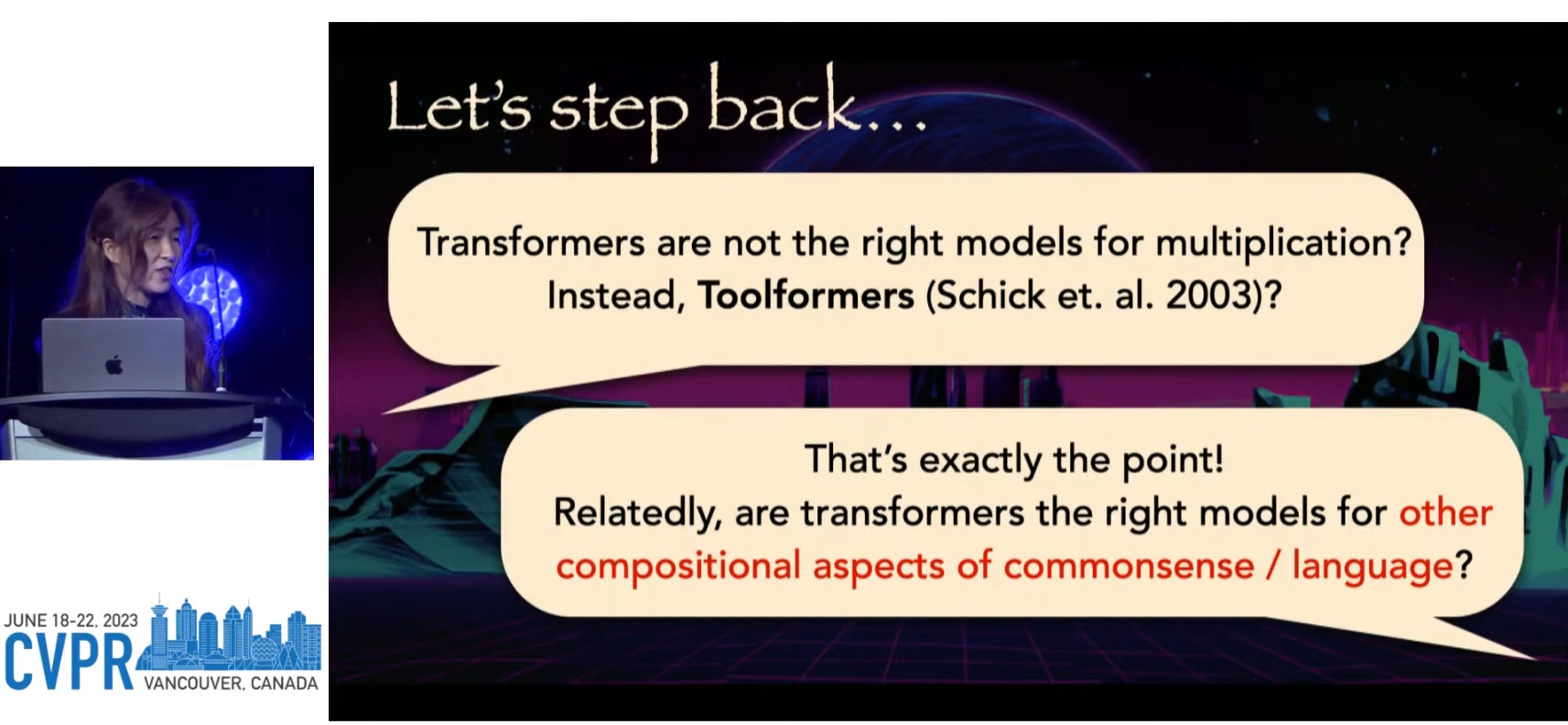
Image Credits: CVPR/YouTube

The UW professor and MacArthur Genius grant recipient first addressed a few unexpected limitations of today’s most capable models. In particular, GPT-4 is really bad at multiplication. It fails to find the product of two three-digit numbers correctly at a surprising rate, though with a little coaxing it can get it right 95% of the time. Why does it matter that a language model can’t do math, you ask? Because the entire AI market right now is predicated on the idea that language models generalize well to lots of interesting tasks, including stuff like doing your taxes or accounting. Choi’s point was that we should be looking for the limitations of AI and working inward, not vice versa, as it tells us more about their capabilities.

The other parts of her talk were equally interesting and thought-provoking. You can watch the whole thing here.

Rod Brooks, introduced as a “slayer of hype,” gave an interesting history of some of the core concepts of machine learning — concepts that only seem new because most people applying them weren’t around when they were invented! Going back through the decades, he touches on McCulloch, Minsky, even Hebb — and shows how the ideas stayed relevant well beyond their time. It’s a helpful reminder that machine learning is a field standing on the shoulders of giants going back to the postwar era.

Many, many papers were submitted to and presented at CVPR, and it’s reductive to only look at the award winners, but this is a news roundup, not a comprehensive literature review. So here’s what the judges at the conference thought was the most interesting:
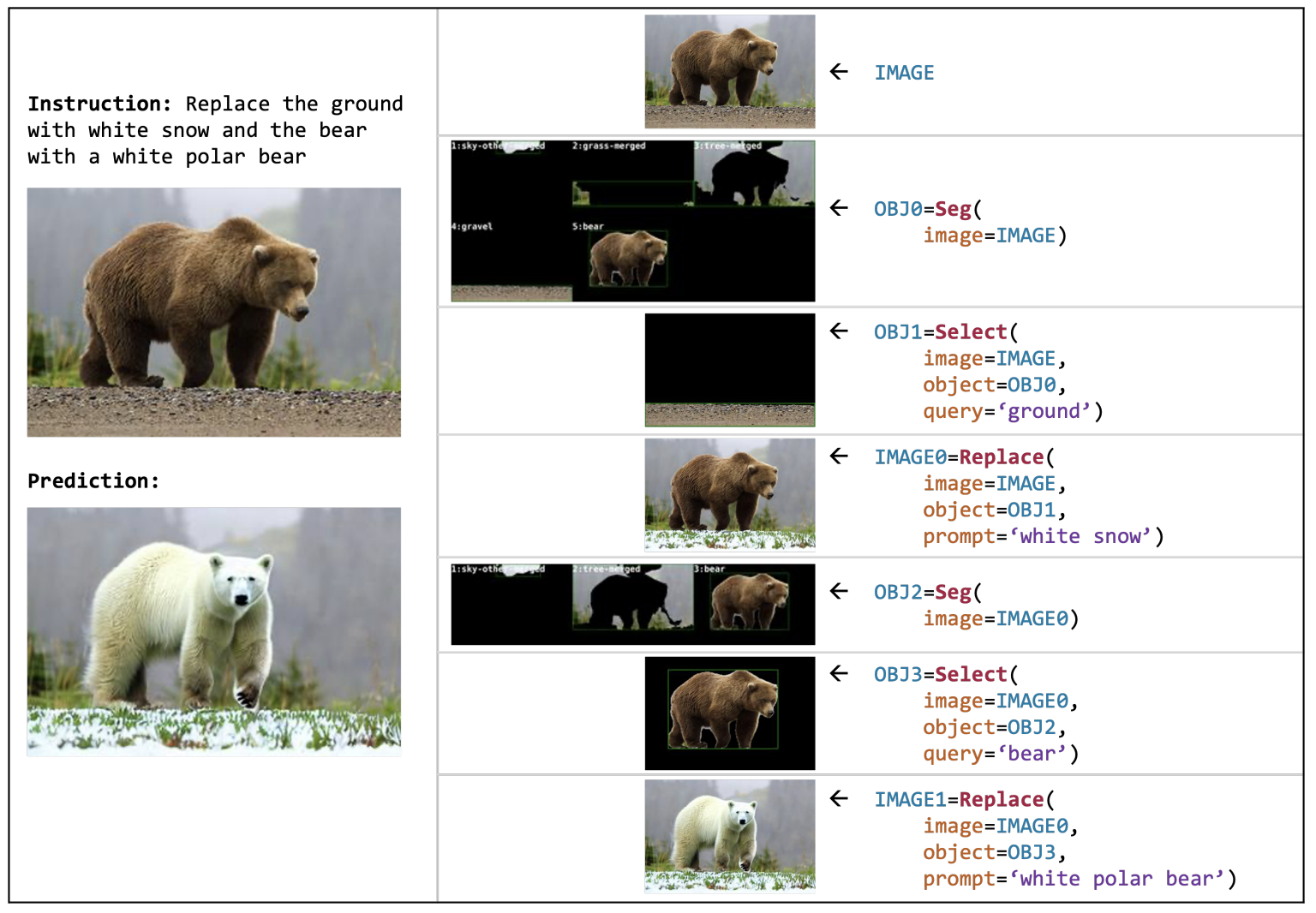
Image Credits: AI2

VISPROG, from researchers at AI2, is a sort of meta-model that performs complex visual manipulation tasks using a multi-purpose code toolbox. Say you have a picture of a grizzly bear on some grass (as pictured) — you can tell it to just “replace the bear with a polar bear on snow” and it starts working. It identifies the parts of the image, separates them visually, searches for and finds or generates a suitable replacement, and stitches the whole thing back again intelligently, with no further prompting needed on the user’s part. The Blade Runner “enhance” interface is starting to look downright pedestrian. And that’s just one of its many capabilities.

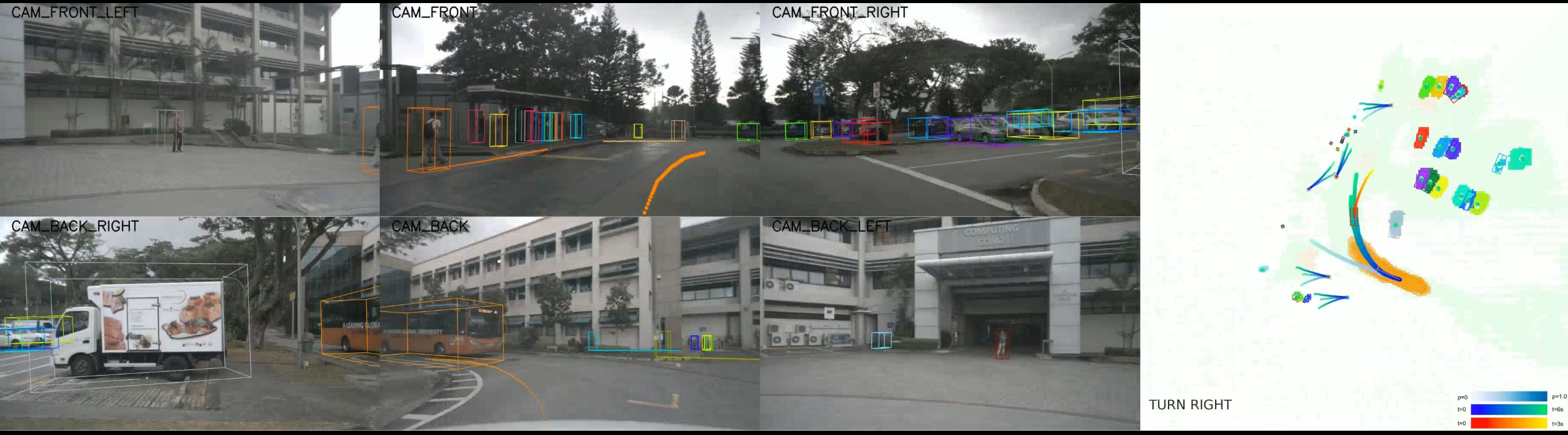
“Planning-oriented autonomous driving,” from a multi-institutional Chinese research group, attempts to unify the various pieces of the rather piecemeal approach we’ve taken to self-driving cars. Ordinarily there’s a sort of stepwise process of “perception, prediction, and planning,” each of which might have a number of sub-tasks (like segmenting people, identifying obstacles, etc). Their model attempts to put all these in one model, kind of like the multi-modal models we see that can use text, audio, or images as input and output. Similarly this model simplifies in some ways the complex inter-dependencies of a modern autonomous driving stack.
DynIBaR shows a high-quality and robust method of interacting with video using “dynamic Neural Radiance Fields,” or NeRFs. A deep understanding of the objects in the video allows for things like stabilization, dolly movements, and other things you generally don’t expect to be possible once the video has already been recorded. Again… “enhance.” This is definitely the kind of thing that Apple hires you for, and then takes credit for at the next WWDC.

DreamBooth you may remember from a little earlier this year when the project’s page went live. It’s the best system yet for, there’s no way around saying it, making deepfakes. Of course it’s valuable and powerful to do these kinds of image operations, not to mention fun, and researchers like those at Google are working to make it more seamless and realistic. Consequences… later, maybe.

The best student paper award goes to a method for comparing and matching meshes, or 3D point clouds — frankly it’s too technical for me to try to explain, but this is an important capability for real world perception and improvements are welcome. Check out the paper here for examples and more info.

Just two more nuggets: Intel showed off this interesting model, LDM3D, for generating 3D 360 imagery like virtual environments. So when you’re in the metaverse and you say “put us in an overgrown ruin in the jungle” it just creates a fresh one on demand.

And Meta released a voice synthesis tool called Voicebox that’s super good at extracting features of voices and replicating them, even when the input isn’t clean. Usually for voice replication you need a good amount and variety of clean voice recordings, but Voicebox does it better than many others, with less data (think like 2 seconds). Fortunately they’re keeping this genie in the bottle for now. For those who think they might need their voice cloned, check out Acapela.

7 Ways ChatGPT Makes You Code Better and Faster

7 Ways ChatGPT Makes You Code Better and Faster
Image by Author

I'm excited to share with you seven awesome ways that have personally helped me become a better and faster coder, all thanks to ChatGPT! These fantastic tips will not only help you avoid common mistakes but also reveal the incredible capabilities of having an AI copilot by your side in the coding journey. So, let's dive in and supercharge your coding skills together!

1. Project Planning

Project planning is the most important phase of any venture where you lay the foundation for success. Getting ChatGPT's assistance during the planning stage can be invaluable as it can help you think through the overall scope, architecture, requirements and feasibility of your software development or data science project.

By describing your goals, constraints, and use cases to ChatGPT, it can provide useful suggestions regarding:

  • Technologies and tools to choose based on your specific needs
  • High-level design and architecture
  • Major tasks and steps to take in the proper sequence
  • Potential issues, risks and roadblocks to watch out for

I have used ChatGPT's insights for machine learning and data science project planning. It has efficiently helped me choose appropriate tools, techniques and datasets for addressing specific problems. ChatGPT's suggested workflow and roadmap have also saved me time by pointing me in the right direction from the start. You can read A Guide to Using ChatGPT For Data Science Projects to understand more about project planning with ChatGPT.

2. Break down the Complex System

Avoid asking ChatGPT to code an entire end-to-end system from scratch. It will likely produce generic, flawed code that misses edge cases and fails to meet your specific requirements.

Instead, focus ChatGPT's assistance on smaller, well-defined tasks within your overall system. Ask it to generate code for:

  • Specific functions or methods that perform one logical step
  • Individual classes to represent well-bounded parts of your domain
  • Discrete algorithms or processes within your full workflow

Splitting your problem into these smaller components will yield more manageable and modular code.

3. Clean Readable Code

ChatGPT can suggest ways to make your code cleaner and more readable by following best practices for your language(s) and frameworks.

You can use ChatGPT to rename variables clearly, split long functions logically, reduce nesting, add inline comments, and format code consistently to make your code more readable, maintainable, and bug-free for collaborators.

4. Unit Testing and Verification

After generating a code, it is crucial to verify it on an isolated machine before pushing it to production or a remote repository. It is important not to fully rely on the code's functionality alone; ensure that it is utilizing the latest API.

One of the key aspects of software development is creating testing functions for critical functionalities. I understand that unit testing for applications, especially for machine learning engineers or data scientists, can be challenging. However, with the assistance of ChatGPT, you can generate testing cases for any function within seconds.

5. Iterate

ChatGPT is a conversation AI and you can continuously request assistance in adding or removing elements from your code, or even ask for improvements. In the event that an error occurs, simply copy and paste the error message and ask ChatGPT to generate an improved version of the code for you.

It understands the context and can generate code tailored specifically to the task at hand, ensuring functionality and effectiveness.

6. Documenting Code

Well-documented code is essential for yourself and other developers to understand your project. ChatGPT can help you document the code through comments, docstrings, README files, wiki pages, and other documentation based on your language and tools.

All you need to do is provide a concise project description and a snippet of your code, and ChatGPT will generate clean and readable documentation that will greatly aid in understanding your codebase.

7. Debugging and Getting Help

Debugging is a super important part of programming because it helps us find and fix errors in our code. However, let's admit it, debugging can sometimes be a bit of a challenge, especially when we're dealing with complex code.

ChatGPT can help you debug the code and figure out the issue you are facing overall while running the code. It can analyze your code, understand its structure, and provide insights into potential errors or bugs. Additionally, ChatGPT can assist you in integrating systems, learning new programming languages, or even provide multiple solutions for a given problem.

Conclusion

As a data scientist, I love using ChatGPT for code generation, planning, and improving my writing. It's like having a helpful companion by my side! With ChatGPT as my coding assistant, I can effortlessly create clean and bug-free code in just seconds. All I have to do is provide a project description and ask it to generate code for a specific task.

Of course, just like any friend, ChatGPT has its moments of frustration. Sometimes it may struggle to understand the context or be unable to fix coding issues. And since it was trained on older data, it might not be up to date with the latest APIs. But hey, we all have our quirks, right?
Abid Ali Awan (@1abidaliawan) is a certified data scientist professional who loves building machine learning models. Currently, he is focusing on content creation and writing technical blogs on machine learning and data science technologies. Abid holds a Master's degree in Technology Management and a bachelor's degree in Telecommunication Engineering. His vision is to build an AI product using a graph neural network for students struggling with mental illness.

More On This Topic

  • 3 Simple Ways to Speed Up Your Python Code
  • New Ways of Sharing Code Blocks for Data Scientists
  • 4 Ways to Generate Passive Income Using ChatGPT
  • Free ChatGPT Course: Use The OpenAI API to Code 5 Projects
  • Top 18 Low-Code and No-Code Machine Learning Platforms
  • What Makes AI Trustworthy?

The Grammys just drew the line between artists and AI-generated music

Grammy awards

There are copyright implications, especially when artists aren't explicitly agreeing to their voices being re-used for new songs.

Every year, the Recording Academy, the organization behind the Grammy Awards, must reevaluate its guidelines and award rules to reflect such factors as the shifting popularity of music genres and new award categories. This year, the Academy has to account for a new up-and-coming artist—AI.

Generative AI has permeated many different industries including the music scene, allowing people to create entire songs simply by using AI.

As demonstrated by an AI-generated song featuring The Weeknd and Drake that went viral a couple of months ago, AI is capable of creating songs that sound like the real deal.

Also: Meta unveils Voicebox AI to replicate the voices of your friends and loved ones

However, there are copyright implications, especially when artists — like The Weeknd and Drake, in this instance — aren't explicitly agreeing to their voices being re-used for new songs.

In other instances, artists are approving of music AI generation within their music. For example, The Beatles are harnessing the power of AI to bring John Lennon's voice back for one last track.

So how do these songs fare against the Grammy Awards' standards and guidelines?

"Only human creators are eligible to be submitted for consideration for, nominated for, or win a Grammy Award," according to the new 2024 Grammy Awards rules.

Even though only human creators will be recognized for their work, it doesn't mean AI-generated music won't be recognized.

Also: Most US workers want to adopt emerging tech like AI but see senior leaders as an obstacle

AI music and content can be submitted to the Grammys for consideration, but the awards will only go to the humans who contributed to the piece.

If the work contains no human authorship and depends solely on AI, it is not eligible for consideration.

Furthermore, in the songwriting and performance categories, the piece has to be mostly written or performed by a human for the work to be considered for a Grammy.

Also: AI has created areas so grey, you could write a song about it

As AI continues to impact and change the music industry, we can expect the Recording Academy's guidelines will also continue to evolve, with one day perhaps rewarding AI artists for their work.

Artificial Intelligence

Sima.ai Gears Up for a Generative AI-Embedded Edge Future

With a mission to bring AI revolution to the industrial world, Sima.ai, a US-based AI chip startup has announced that the first-generation design of its AI chip based on TSMC 16nm technology has entered mass production. Sima.ai believes the conventional approach of using a one-size-fits-all chip for diverse applications like smart cars, drones, and advanced robotics has hindered innovation and hence their product MLSoC (Machine Learning System on a Chip) is designed specifically for edge computing.

“What we’re showcasing highlights the market potential for advancing the industrial world into the 21st century using AI and machine learning. These technologies have the power to drive significant improvements and advancements in the physical world,” Krishna Rangasayee, founder and CEO, SiMa.ai, told AIM.

Even though the company has not revealed its roadmap, Rangasayee, validated to us that the startup is preparing for a generative AI embedded edge future. “It is something that is absolutely going to happen. In my mind, generative AI and Large Language Models (LLMs) will be a large component of everybody’s innovation, it doesn’t matter whether they are in the cloud, the edge or the mobile phones space,” Rangasayee said.

Generative AI

In today’s age, generative AI has been transformative and is slowly making its way to the embedded edge space. What Rangasayee finds fascinating is that generative AI is gradually moving to real applications like enterprise and edge applications. “Somebody was telling me that before generative AI, maybe only 100 million people in the world had heard of AI, but now it’s more than a billion.”

Today, numerous enterprises are exploring the possibility of running LLMs on AI edge devices. Developers have successfully run generative AI models on edge devices. For example, earlier this year, developers at Qualcomm managed to run the text-to-image AI model Stable Diffusion on an Android phone, indicating a future of its widespread adoption. Given its growing significance, generative AI is expected to be embedded in everything and Sima.ai is preparing for such a future.

Competition with NVIDIA

“Even though we compete with everybody, in the embedded edge space, our primary competitor would be NVIDIA,” Rangasayee said. NVIDIA has been at the forefront of the generative AI wave and is also one of its biggest beneficiaries. Riding the generative AI trend, the company is set to increase its revenue significantly.

Previously, Rangasayee told AIM that their chips are 10x better than NVIDIA. He said that in computer vision, an important technical metric that customers value is frames per second per watt, measuring computational efficiency. We have a significant advantage in this regard, being at least 10 times ahead of competitors like NVIDIA, Qualcomm, and others.

“We have established our superiority in the embedded edge market. We further demonstrated our capabilities in our debut MLPerf Benchmark performance two months ago. In the closed-edge category, we clearly outperformed NVIDIA Volta in several benchmarks.”

“But kudos to them. They’ve done a fantastic job. We need to work very hard at convincing our customers that we are better. Even though we’re off to a good start, and I think now we’re publicly validated, we now need to show value to our customers.”

What attracted Sima.ai to India

For Sima.ai, India is a very important market. They have a research and development centre in Bangalore and employ around 60 personnel. “I’ll look at it in two dimensions, firstly the available talent pool and from an R&D perspective. I think the talent pool here can help us build products. Today, we are a team of 60 and we are going to continue to add to the team.”

Besides, Rangasayee also believes that the market opportunity in India is also immense. Currently, the startup has engaged with 10 customers here in India. “There are a lot of companies looking for a standardised edge computing platform that does a lot of different applications and we expect to touch 100 customers pretty soon in India. Here, everybody is very focused on wanting to adopt AI and ML and we are now showing them use cases and applications where they can leverage them.”

While Sima.ai was not able to reveal the names of their clients in India, Rangasayee did mention that Sima.ai’s customers are in robotics, drone manufacturers, and the electric vehicle space.

The post Sima.ai Gears Up for a Generative AI-Embedded Edge Future appeared first on Analytics India Magazine.

Stability AI Unveils SDXL 0.9 to Enhance Image Generation

London-based Stability AI has released SDXL 0.9 (Stable Diffusion XL), the newest addition to the company’s suite of products including Stable Diffusion. Currently accessible through ClipDrop, with an upcoming API release, the public launch is scheduled for mid-July, following the beta release in April.

Despite its capacity to run on modern consumer GPUs, SDXL 0.9 can generate hyper-realistic creations for cinema, television, music, and instructional videos, as well as advancements in design and industrial applications, positions SDXL at the forefront of practical AI image implementations.

The SDXL series encompasses a wide array of functionalities that go beyond basic text prompting including image-to-image prompting (using one image to obtain variations of it), inpainting (reconstructing missing parts of an image), and outpainting (creating a seamless extension of an existing image).

SDXL 0.9 boasts one of the largest parameter counts among open-source image models, comprising a 3.5 billion parameter base model (compared to 3.1 billion parameter) with a 6.6 billion parameter model ensemble pipeline. The final output is generated by running the input through two models and aggregating the results. The second-stage model of the pipeline introduces finer details to the output generated by the first stage. It is based on two CLIP models, including one of the largest OpenCLIP models trained to date (OpenCLIP ViT-G/14), giving images with higher depth and a resolution of 1024×1024.

In March, Stability AI acquired Init ML, the creator of Clipdrop.

The new SDXL 0.9 can work on modern consumer GPUs, with a Windows 10 or 11, or Linux operating system, with 16GB of RAM. Additionally, an Nvidia GeForce RTX 20 graphics card (or equivalent higher standard) with a minimum of 8GB VRAM is required. Linux users can also use a compatible AMD card with 16GB VRAM.

An array of New Products

SDXL 0.9 will be provided for research purposes only during a limited period to collect feedback and fully refine the model before its general open release. The code to run it will be publicly available on GitHub. In April, Stability AI introduced StableLM, a collection of open-source large language models called StableLM. These models, currently in the “alpha” stage, can be found on GitHub and Hugging Face.

Additionally, Stability AI unveiled a new software development kit (SDK) that works with Stable Diffusion 2.0 and Stable Diffusion XL, allowing users to control the output of the software by adjusting various parameters, including style presets, cadence, frames per second (FPS), colours, 3D depths, and post-processing effects.

Mitigating the Threat of Copyright Infringement

Back in January, artists filed a class action lawsuit against Stability AI alleging that their artwork was illegally used by these companies to train models and create new images, endangering their professions. Getty Images has also sued Stability AI for copyright infringement.

During the Bloomberg Technology Summit in San Francisco, Stability AI’s CEO Emad Mostaque acknowledged these concerns of lifelike deep fakes created by AI in an on-stage interview. Mostaque revealed that the company possessed “photo-realistic models” earlier this year but chose not to release them due to timing considerations. He emphasised the need for incorporating features like watermarking to establish standards, enabling tracking and appropriate utilisation of AI-generated content.

The post Stability AI Unveils SDXL 0.9 to Enhance Image Generation appeared first on Analytics India Magazine.

LTIMindtree Launches New Generative AI Platform, Canvas AI

Mindtree FY-23 Q1 results – record highest-ever order book, net profit declines, attrition and more

LTIMindtree has launched a new generative AI platform called Canvas.ai. This platform will help companies build, manage, and utilise generative AI solutions responsibly. Reportedly, this platform can offer up to a 50% time reduction for cloud migration and app modernisation programs.

The platform is available for general availability through the company’s generative AI studios. It will also take care of various AI pain points like data regulation compliance and bias minimisation, along with providing transparency and observability for these solutions. LTIMindtree has stated that there are already 75 customers in talks with it for Canvas AI deployment, and around 12-13 of those have gone live.

According to executives at LTIMindtree, the platform will enable customers to gain access to the company’s various AI partnerships and tooling. The platform already has integrations for 12 LLMs, including those on the Azure OpenAI service and Hugging Face. Speaking on the capabilities of the platform, Nachiket Despande, the COO of LTIMindtree, stated, “It also has integrated with a couple of open-source LLMs for domain-specific use cases, and that count will only increase. For example, we are working on one for AutoCAD (designing software) to simplify engineering drawing use cases.”

Despande also delved into some of the efficiency gains organisations can get from integrating Canvas, stating, “In technology modernisation, re-platforming, and cloud adoption, we see 50-60% reduction in efforts – a mix of time, people and even cost because lead time too reduces. In use cases like marketing campaign designs, we see higher productivity as there is up to 70% reduction in efforts”.

The company also recently announced that they are looking to spend $40 to $50 million on fleshing out their AI capabilities in the coming financial year. This will enable the solutions provider to offer more productivity-oriented use cases for generative AI, as well as other business use cases like predictions and lead generation.

The post LTIMindtree Launches New Generative AI Platform, Canvas AI appeared first on Analytics India Magazine.

‘India Can be a 600-Pound Gorilla of Quantum Applications’

India Can be a 600-Pound Gorilla of Quantum Applications: Quantum Brilliance

With a razor-sharp focus on room-temperature quantum computing and open-source QristalSDK, Quantum Brilliance is pushing the boundaries of what’s possible in the revolutionary quantum field. “In Hindu mythology, there is Shiva that gives you coherence. When you make qubits, you need coherence, which means essentially convincing mother nature to give you energy,” said Mark Mattingley-Scott, chief revenue officer at Quantum Brilliance, in an exclusive interview with AIM.

“When you look at IBM, Google, or Amazon or any of these computer companies, you see these fantastic quantum chips that need lots of energy, lots of space. Essentially, all they’re doing is creating something that gives you that coherence for a very short time,” he explained.

Quantum computing methods rely on complex infrastructure, massive energy consumption, and specialised cooling techniques to achieve the necessary conditions for qubits to maintain coherence. However, Scott explained how Quantum Brilliance takes a different approach by leveraging the unique properties of the nitrogen vacancy (NV) centre in diamonds. By utilising room-temperature diamonds, Quantum Brilliance unlocks the potential for using quantum computing in individual systems, instead of relying on the cloud.

“This means that you can install it on your own computer, and there are no issues of governance, sovereignty, or data protection as that is your possession now,” said Scott.

One of the distinguishing features of Quantum Brilliance’s quantum systems is their ability to operate at room temperature using synthetic diamonds. Unlike traditional mainframe quantum computers, these compact devices do not require cryogenic cooling, vacuum systems, or precision laser arrays. They consume significantly less power, making on-site or edge deployment feasible in any environment.

At present, Quantum Brilliance’s quantum computing technology is approximately the size of a desktop PC. However, the company is actively working on further miniaturisation, aiming to shrink their technology to the size of a semiconductor chip that can be integrated into any device, effectively making practical quantum computing universally accessible.

In 2019, Quantum Brilliance was established as a company that focuses on quantum products and solutions. Their primary objective is to develop diamond quantum computers accompanied by software and applications. It strives to facilitate the widespread adoption of its quantum technology, enabling various industries to leverage edge computing applications and advance into the realm of next-generation supercomputers.

The Qristal SDK provides developers with fully integrated C++ and Python APIs, along with NVIDIA CUDA features and customizable noise models, to support the creation of quantum-enhanced designs.

Startups ecosystem in quantum computing

Scott says that there are three segments of quantum — education, preparation, and integration. “The fourth step, which is performance, doesn’t exist yet. This means actually getting something useful.” Scott has worked with IBM in the past. He said that IBM has defined that narrative of quantum computing and it dominates the educational step of quantum computing. “You cannot yet put a quantum on a robot or a spacecraft, you need a cloud. That is why IBM dominates the market.”

Scott explains that most of the quantum computing business works in a similar way. “Let’s look at a customer’s problem and see how many qubits can we provide to solve that problem,” he said.

“We are not interested in the first segment of education because we cannot compete with IBM,” said Scott. However, the company seeks to dominate the preparation and integration segments by offering unique solutions tailored to specific business problems. By providing quantum solutions that leverage a few dozen qubits and focus on replacing existing technologies with quantum alternatives, Quantum Brilliance carves out its niche and ensures its relevance in the evolving quantum computing landscape.

“When does the fourth segment start?”

Investing in quantum startups poses unique challenges due to the nascent nature of the field. The question of measuring return on investment (ROI) and predicting commercial use cases remains a significant concern. Scott said that it all boils down to the question of when quantum can become useful, the answer to which he said, “no one knows yet”.

“Some companies say that quantum will be adopted in the next five years. The same company said that five years ago as well,” said Scott. No one has a concrete idea about when quantum would be adopted by companies in the future. Scott emphasised that pinpointing the exact time when quantum repeaters will have a tangible commercial impact is elusive, but it would just be a handful of years.

India and quantum computing

“The thing about India that no one gets is the size of the talent pool and the willingness to accept new topics is humungous,” said Scott, talking about the potential India has in quantum computing. Instead of looking at the usefulness of quantum computing, Scott believes that India has the potential of finding business use cases for quantum computing and becoming a “600-pound gorilla of quantum applications”.

Every government in the world wants its own hardware when it comes to quantum. Scott says that the amount of money that the governments are putting into quantum computing is probably too small to rise above. “When you look at countries like Germany, which just pumped another $3.5 billion in the field after a $2.5 billion, it is clear that investing $100 million in quantum computing gives us no chance.”

The post ‘India Can be a 600-Pound Gorilla of Quantum Applications’ appeared first on Analytics India Magazine.