Harnessing the power of weather data: A guide to actionable insights

Abstract umbrella form lines and triangles, point connecting net

In the era of big data and AI, harnessing weather data to predict, plan, and optimize various industries has become an indispensable practice. Today, we will delve into the fascinating process of turning this voluminous weather data into actionable insights. By combining cutting-edge technology, analytical models, and industrial applications, we’ll explore how weather data can be converted into valuable strategies for business and life.

Gathering weather data: A tech-filled task

The first step to creating actionable insights from weather data is gathering the data itself. There’s a myriad of tools that meteorologists and data scientists utilize for this purpose. Doppler radars, for instance, are used to measure precipitation movement, intensity, and the velocity of droplets in the air.

Weather satellites orbiting the Earth provide essential data for a global overview of the atmosphere, tracking weather systems, and measuring cloud properties. Weather balloons or radiosondes are launched twice daily across the globe, yielding crucial information about the upper atmosphere, including temperature, humidity, and pressure (source: NOAA).

The science of transforming weather data into actionable insights

Once the data is collected, it needs to be cleaned, processed, and interpreted. This is where data science comes into play. Companies like Tomorrow.io leverage Machine Learning (ML) algorithms to interpret and predict weather patterns. Recently, the company boosted their data gathering capabilities by launching their own satellite (source: Geospatial World).

Tomorrow.io, a leader in weather data collection, approaches weather data with a rigorous multi-step process that leverages the latest technologies in data ingestion, analysis, and interpretation.

  1. Data ingestion: Data ingestion is the first crucial step, where data from multiple sources are collected. One significant source is their satellite, which orbits the Earth, recording various atmospheric parameters. This data is complemented with information from ground weather stations, other satellites, weather balloons, and buoys. By doing so, they ensure a broad coverage of data, capturing the dynamic complexities of the weather.
  2. Data cleaning & preprocessing: Once ingested, the raw data undergoes an essential cleaning and preprocessing stage. This involves checking for missing values, dealing with outliers, normalizing different data scales, and resolving discrepancies between different data sources. The goal here is to create a coherent, consistent dataset that is ready for further analysis.
  3. Data structuring: The clean data is then structured and stored in a format that enables efficient access and computation. Given the massive volume and velocity of weather data, Tomorrow.io employs distributed storage and big data technologies to handle this efficiently.
  4. Data analysis & interpretation: This is the most critical phase where the real magic happens. Tomorrow.io uses a combination of traditional statistical methods and advanced Machine Learning (ML) techniques to analyze and interpret the data. Statistical methods help in understanding the relationships between different weather parameters and identifying patterns and trends in the data.
    The ML component takes this a step further by learning from historical data to predict future weather patterns. These ML models employ complex algorithms that can capture non-linear relationships and subtle patterns in the data, often beyond human comprehension. Models are continuously trained and updated as new data flows in, thereby improving their predictive accuracy over time.
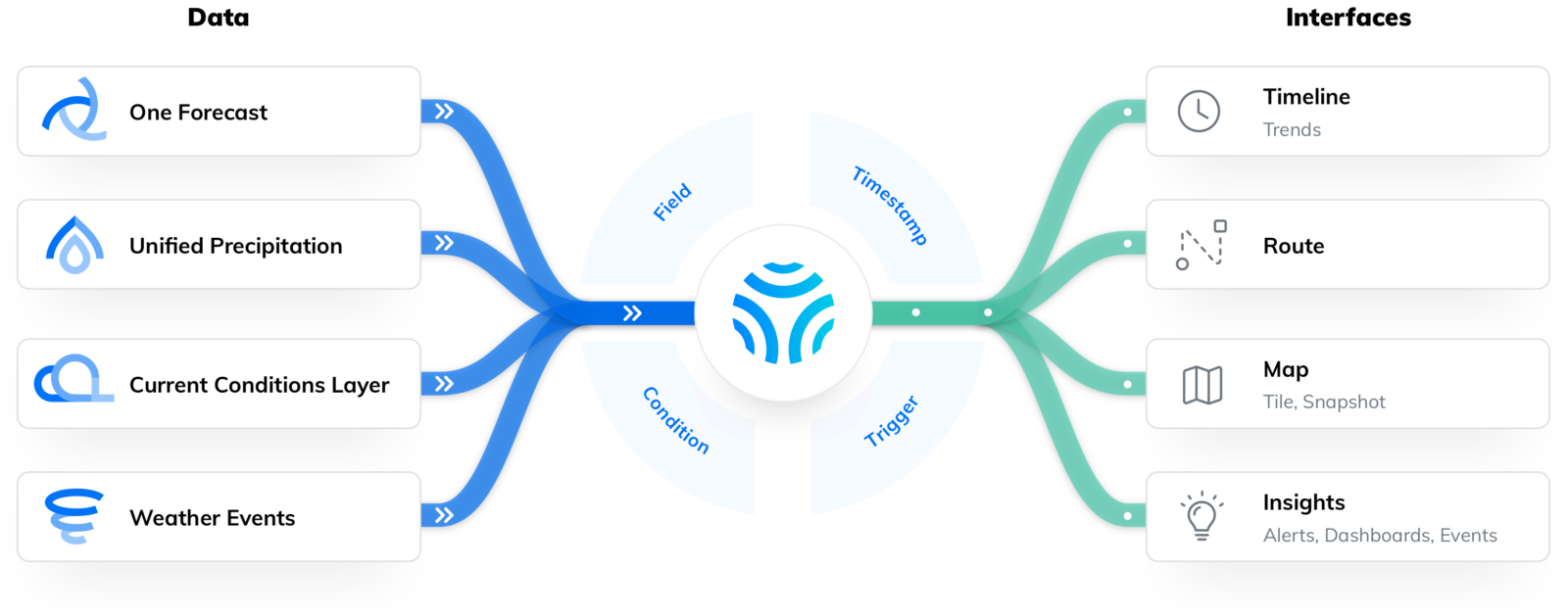
  5. Generation of actionable insights: The output from the data analysis and ML models is then transformed into high-resolution, hyperlocal weather forecasts. These aren’t just generic forecasts but tailored insights that cater to specific geographical locations and timeframes. The result is reliable, actionable weather information that users can apply in their decision-making process, whether they’re planning their daily commute or strategizing their crop planting schedule.

Harnessing the power of weather data: A guide to actionable insightsSource (tomorrow.io)

In essence, the Tomorrow.io approach demonstrates the immense potential of data science in converting raw, seemingly chaotic weather data into reliable, precise, and actionable insights. As technology advances and the field of data science matures, we can expect even more accuracy and granularity in our weather forecasts.

The far-reaching value of weather data

The practical applications of these insights from weather data are wide-ranging and influence many sectors.

  1. Agriculture: Farmers can optimize their sowing, irrigation, and harvesting schedules based on accurate weather forecasts.
  2. Aviation: Airlines can plan their flight schedules and routes more efficiently by anticipating weather disruptions.
  3. Energy: The energy sector can accurately forecast the availability of wind, solar, or hydropower, enhancing their production efficiency and reducing wastage.
  4. Retail: Retail businesses can optimize their inventories based on weather predictions. Accurate weather data can help businesses forecast consumer behavior and align their offerings accordingly.

By harnessing weather data effectively, businesses can significantly improve their operational efficiency, reduce costs, and boost revenue.

The future of weather data

With advances in technology, the future of weather data looks promising. Improved satellite technology, better data collection methods, and more sophisticated machine learning algorithms will allow for even more precise and localized weather predictions.

  1. Improved Satellite Technology: New-generation satellites, such as those recently launched by Tomorrow.io, provide superior data collection capabilities. They come equipped with advanced sensors, enabling them to capture a broader range of atmospheric data with higher resolution. These advancements facilitate a granular view of weather phenomena, leading to improved precision in local weather forecasts. Moreover, with modern satellites’ reduced latency, we can access almost real-time data, making forecasts more timely and relevant. The combination of increased volume, precision, and timeliness of data will significantly enhance our ability to derive valuable insights from weather data.
  2. Advanced Data Collection Methods: Besides satellites, other data collection methods are also witnessing improvements. For example, IoT (Internet of Things) devices and sensor networks are increasingly used to capture hyperlocal weather data. Advanced radar systems are being developed to provide more detailed information about precipitation and wind patterns. These advanced data collection methods, in conjunction with improved satellite technology, promise a future where weather data is not only more voluminous but also more diverse, covering various facets of the weather.
  3. Enhanced Machine Learning Algorithms: The improvements in data collection and volume would be ineffective without sophisticated tools to analyze this data. Fortunately, the field of machine learning is progressing rapidly. Advanced deep learning models, like convolutional neural networks (CNNs), are being used to interpret satellite imagery more accurately. Time series forecasting models, such as LSTM (Long Short Term Memory), can handle the temporal aspects of weather data more effectively.
    Moreover, ensemble methods that combine multiple machine learning models are being employed to make more robust and accurate predictions. Techniques such as reinforcement learning are being explored to create adaptive weather models that learn and improve with each forecast.
  4. The Role of High-Performance Computing: To handle the surge in data volume and the computational requirements of advanced ML models, high-performance computing (HPC) solutions are crucial. The use of HPC, along with cloud-based technologies and GPU-accelerated computing, will allow for faster analysis of massive weather datasets and real-time or near-real-time predictions.

The transformation of weather data into actionable insights has immense potential to impact industries, economies, and everyday life. While we’ve come a long way in weather prediction and data analysis, the future is ripe with even more possibilities. As businesses, data scientists, and decision-makers, our task is to harness these advancements effectively, driving growth, sustainability, and innovation. The weather data revolution is here, and the time to act is now.

Data transformation 101: Process and new technologies

Big Data

Data transformation involves converting data from one format into another for further processing, analysis, or integration. The data transformation process is an integral component of data management and data integration. Likewise, companies can improve their data-driven decision-making by streamlining their data management and integration processes through data transformation.

However, as more and more companies adopt cloud-based data storage (IDC reports that today 67% of enterprise infrastructure is cloud-based), the data transformation process must follow suit. Consequently, many companies are searching for alternative data integration processes and data transformation tools that help improve the data quality, readability, and organization company-wide.

In this article, I will explore the data transformation process, how it contributes to the broader processes of data integration, as well as new data transformation technologies.

Benefits of data transformation

From a general perspective, data transformation helps businesses take raw data (structured or unstructured) and transform it for further processing, including analysis, integration, and visualization. All teams within a company’s structure benefit from data transformation, as low-quality unmanaged data can negatively impact all facets of business operations. Some additional benefits of data transformation include:

  • Improved data organization and management
  • Increased computer and end-user accessibility
  • Enhanced data quality and reduced errors
  • Greater application compatibility and faster data processing

Data integration

Before examining the various ways to transform data, it is important to take a step back and look at the data integration process. Data integration processes multiple types of source data into integrated data, during which the data undergoes cleaning, transformation, analysis, loading, etc. With that, we can see that data transformation is simply a subset of data integration.

Data integration as a whole involves extraction, transformation, cleaning, and loading. Over time, data scientists have combined and rearranged these steps, consequently creating four data integration processes: batch, ETL, ELT, and real-time integration.

Batch integration

Another common method is batch data integration, which involves moving batches of stored data through further transformation and loading processes. This method is mainly used for internal databases, large amounts of data, and data that is not time-sensitive.

ETL integration

Similar to ELT, ETL data processing involves data integration through extraction, transformation, and loading. ETL integration is the most common form of data integration and utilizes batch integration techniques.

ELT integration

ELT data processing involves data integration through extraction, loading, and transformation. Similar to real-time integration, ELT applies open-source tools and cloud technology, making this method best for organizations that need to transform massive amounts of data at a relatively quick pace.

Real-time integration

One of the more recent data integration methods, real-time integration, processes and transforms data upon collection and extraction. This method utilizes CDC (Change Data Capture) techniques, among others, and is helpful for data processing that requires near-instant use.

These same concepts utilized in data integration have also been applied to the individual steps within the larger integration process, such as data transformation. More specifically, both batch data processing and cloud technology, utilized in real-time integration, have been crucial in developing successful data transformation processes and data transformation tools. Now, let’s take a closer look at the types of data transformation processes.

First party data (data you collect yourself about your company and your customers) is rapidly growing in value. Your ability to transform and use that data to drive decisions and strategies will increasingly become the source of competitive advantage.
– Rich Edwards, CEO of Mindspan Systems

Types of data transformation

Batch data transformation

Batch data transformation, also known as bulk data transformation, involves transforming data in groups over a period of time. Traditional batch data transformation involves manual execution with scripted languages such as SQL and Python and is now seen as somewhat outdated.

More specifically, batch transformation involves ETL data integration, in which the data is stored in one location and then transformed and moved in smaller batches over time. It is important to note the significance of batch data transformation on many data integration processes, such as web application integration, data warehousing, and data virtualization. When applied to other data integration processes, the concepts and logistics within batch data transformation can improve the overall integration process.

Interactive data transformation

As many companies turn to cloud-based systems, IBM even reports that 81% of companies use multiple cloud-based systems, end-users of said data are also looking for more versatile methods to transform data. Interactive data transformation, also referred to as real-time data transformation uses similar concepts seen in real-time integration and ELT processing.

Interactive data transformation is an expansion of batch transformation. However, the steps are not necessarily linear. Gaining traction for its accessible end-user visual interface, interactive data transformation takes previously generated and inspected code to identify outliers, patterns, and errors within the data. It then sends this information to a graphical user interface for human end-users to quickly visualize trends, patterns, and more, within the data.

Data transformation languages

In addition to the various types of data transformation, developers can also utilize a variety of transformation languages to transform formal language text into a more useful and readable output text. There are four main types of data transformation languages: macro languages, model transformation languages, low-level languages, and XML transformation languages.

The most commonly used codes in data transformation include ATL, AWK, identity transform, QVT, TXL, XQuery, and XSLT. Ultimately, before deciding what transformation method and language to use, data scientists must consider the source of the data, the type of data being transformed, and the project’s objective.

The data transformation process

Now that I’ve covered the bigger picture of how data transformation fits into the larger picture of data integration, I can examine the more granular steps in data transformation itself. Firstly, it is important to note that while it’s possible to transform data manually, today, companies rely on data transformation tools to partially or fully transform their data. Either way, manual and automated data transformation involves the same steps detailed below.

1. Data discovery and parsing

The first step in the data transformation process involves data discovery and data parsing. Data discovery and data parsing are processes that involve collecting data, consolidating data, and reorganizing data for specific market insights and business intelligence.

2. Data mapping and translation

Once you have profiled your data and decided how you want to transform your data, you can perform data mapping and translation. Data mapping and translation refer to the process of mapping, aggregating, and filtering said data so it can be further processed. For example, in batch transformation, this step would help filter and sort the data in batches so executable code can run smoothly.

3. Programming and code creation

The data programming involves code generation, in which developers will work with executable coding languages, such as SQL, Python, R, or other executable instructions. During this stage, developers are working closely with transformation technologies, also known as code generators. Code generators provide developers with a visual design atmosphere and can run on multiple platforms, making them a favorite among developers.

4. Transforming the data

Now that the code is developed, it can be run against your data. Also known as code execution, this step is the last stage the data passes through before reaching human end-users.

5. Reviewing the data

Once the code executes the data, it is now ready for review. Similar to a quality assurance check, the purpose of this step is to make sure the data has been transformed properly. It is important to note that this step is iterative, in that end-users of this data are responsible for reporting any errors they found in transformed data to the developers, so edits to the code can be made.

Data extraction and transformation have an effect on other business activities. When data is transformed into a more readable format, data analysis can be completed more quickly and accurately than before. Not only does this have an effect on employee morale, but it also has an impact on company decision-making.
– Brian Stewart, CTO of ProsperoWeb

ETL vs. ELT

The recent advancements in big data have required businesses to look elsewhere when storing, processing, and analyzing their data. Moreso, the increasing variety in data sources has also contributed to the strain being placed on data warehouses. Particularly, while companies acquire powerful raw data from data types such as firmographic data, employee data, and social media data, these same data types typically export very large file sizes. Consequently, companies have been searching for alternative methods.

This search has greatly impacted data integration processes, specifically data transformation. That is, companies have been transitioning from traditional data integration processes, such as ETL methods, to cloud-based integration processes, such as ELT and real-time integration.

In the past, many companies have relied on local servers for data storage, making ETL integration the preferred method. However, due to the significant increase in digital communication and business operations in 2020, global data creation is now modeled at a CAGR of 23%, according to Businesswire. Subsequently, the upward trend in global data creation has put a strain on local servers and data storage, and many businesses are looking elsewhere for cloud-based solutions.

What is data transformation in ETL?

ETL, which stands for extraction, transformation, and loading, is a data integration process that involves extracting data from various external sources, often from third-party data providers, transforming the data into the appropriate structure, and then loading that data into a company’s database. The ETL process is considered the most common integration process compared to ELT, ETM, and EMM transformation processes.

Data transformation within ETL occurs in the transformation step; however, it is closely linked to the extraction and loading stages. Traditionally, data transformation within the ETL method utilizes batch transformation with linear steps, including discovery, mapping, programming, code execution, and data review.

Summary

As businesses collect an increasing volume of data, many are forced to find data storage and processing solutions that can handle massive amounts of data with limited money and resources. Similarly, companies are also looking for data transformation solutions that can meet the current needs and industry standards. Companies are recognizing the future of data transformation and shifting towards utilizing cloud-based technology in processes such as ELT integration and interactive data transformation.

How decentralized apps can help businesses improve data security and privacy

Securing Data Privacy- Harnessing Decentralized Apps for Enhanced Cybersecurity

In today’s digital landscape, data privacy, and security have become the most critical concerns for businesses across industries. With the ever-evolving threat of data breaches, unauthorized access, and privacy violation, companies are increasingly seeking innovative ways to protect their digital assets and sensitive information.

One such solution that helps businesses significantly safeguard their crucial information and reinforce cybersecurity measures is decentralized app development. Decentralized applications provide users with a transparent, trusted, and tamper-proof way to secure sensitive data. Also, it helps reduce the risk of cyber theft.

Decentralized app development

Built on blockchain technology, decentralized apps are an immutable ledger that efficiently eliminates the need for a centralized authority. It makes dApps inherently resistant to unauthorized access and manipulation. While a significant portion of the World Wide Web operates in a centralized manner, decentralization has its own advantages. It offers significant benefits in terms of privacy protection. Let’s discover how decentralized app development helps improve data security and privacy, empowering organizations to navigate their digital landscape confidently without fearing data breaches or cyber theft.

Immutable and transparent

Decentralized apps enable an immutable and transparent record of data, which can’t be altered or deleted. From users’ names, contact details, and addresses to transaction history, dApps protect all sensitive information. Consequently, it helps enhance data security and reduces the rate of cybercrime.

Smart contracts

DApps work on the principles of smart contracts, which are self-executing contracts stored on blockchain technology. Smart contracts aim to enforce predefined rules, enabling secure and automatic data interactions without the need for any intermediaries. This way, decentralized app development effectively reduces the risk of unauthorized access and data breaches.

Decentralized control

One of the most remarkable ways dApp helps businesses improve data security is that they are decentralized. It eliminates the need for a centralized authority to control users’ information. It provides users with greater control over their data, as they can choose what information to share and with whom. Also, with decentralized solutions, users can maintain ownership of their data and grant access on a need-to-know basis. This decentralized nature of the application reduces the risk of a single point of failure, preventing cybercriminals from executing to execute their evil plans of cyber theft.

Identity management

Another way that dApps help protect data privacy is by enabling blockchain-based identification. Decentralized applications are widely used to employ a secure, immutable, and distributed system for identity management. Unlike the current centralized identity management system, blockchain-based identification can only be accessed using an encrypted “fingerprint.” It is a highly secure way to protect users’ identities and incredibly intimidating hackers to steal the data. Embracing the decentralized approach to storing users’ data reduces the vulnerability to cyber attacks, mitigates identity theft risk, and fortifies data privacy.

Improved transparency

Decentralized solutions enable the secure collection of all the interactions and transactions on the public ledger, offering complete transparency to users to know what is happening on the platform. Gaining transparent access to the platform helps users comprehend how the system works and increases trust in the operations.

Easy accessibility

DApp development enables users to access crucial information at any time and from any corner of the world. All they need is an active internet connection, and they can easily access their digital assets even on the go. It is an efficient option for users who are more concerned about their data privacy and don’t want the involvement of any intermediaries to manage their digital records.

The powerful impact of dApps on securing users’ privacy and data

With the ever-evolving utilization of digital solutions and online services, the impact of decentralized app development seems extremely powerful in the tech world. Leveraging the power of blockchain technology, dApps significantly transform the way businesses protect users’ privacy and enhance cybersecurity systems.

For a better understanding of dApps, let’s imagine a landscape where every piece of information is connected to one another. There is no centralized authority to manage that information. The users have complete control to manage their digital records and know what is happening on the platform.

This distributed and immutable way of storing information helps organizations secure users’ sensitive information and reinforce cybersecurity measures. Accordingly, it threatens cybercriminals to execute their malicious attempts of a data breach or cyber theft. This is the world a mobile app or software development company New York helps to create by building custom decentralized solutions.

Conclusion

Decentralized app development is a game-changing technology, redefining the way we interact with the internet and protecting users’ privacy. It secures users’ sensitive information, interactions, and transactions in an immutable, transparent, and tamper-proof way.

Navigating the future of learning: AI, certification, and higher education

ai certification

The world of higher education is undergoing a transformative shift as artificial intelligence (AI) continues to reshape various aspects of our society. From classrooms to career development, the integration of AI and its impact on learning is undeniable. In this article, we will explore the intersection of AI, certification, and higher education, and delve into the significance of staying ahead of the curve in an ever-evolving educational landscape.

As technology rapidly advances, it becomes crucial for educators, administrators, and students alike to understand and adapt to the potential of AI in order to harness its benefits. AI has the power to revolutionize the learning experience, personalize education, and equip individuals with the skills needed for the future workforce. By embracing emerging technologies and recognizing their potential, we can prepare ourselves to navigate the shifting terrain of higher education and unlock new opportunities for growth and success.

In this fast-paced digital age, remaining informed and proactive about AI’s influence on education is more important than ever. By exploring the relationship between AI, certification, and higher education, we can gain valuable insights into the skills and knowledge that will be in high demand in the coming years. Whether you are an educator seeking to enhance your teaching methods or a student aiming to stay competitive in the job market, understanding AI and its role in education is a key step toward building a successful future.

Join us as we delve into the dynamic world of AI in education, examining its transformative potential and the importance of embracing emerging technologies. By staying abreast of the latest developments and insights, we can position ourselves to thrive in the rapidly evolving landscape of higher education. Let us embark on this journey together and discover the exciting possibilities that lie ahead.

I. The role of AI in learning

AI is reshaping the learning experience, revolutionizing traditional educational approaches, and opening up new avenues for personalized and adaptive learning. By harnessing the power of AI, educators can provide tailored instruction and support to students, leading to improved outcomes and engagement. Here, we will explore how AI is transforming learning and highlight some notable examples, statistics, and expert insights.

One significant way AI is revolutionizing learning is through the use of intelligent tutoring systems. These systems leverage AI algorithms to provide personalized instruction and feedback to students, adapting to their individual learning styles and pace. For example, Carnegie Learning’s Cognitive Tutor, an AI-powered program, has shown impressive results. In a study conducted by the U.S. Department of Education, students who used Cognitive Tutor scored higher on standardized tests compared to their peers using traditional methods.

statistical data
https://ies.ed.gov/ncee/wwc/Docs/InterventionReports/wwc_cognitivetutor_062116.pdf

AI-powered tools and platforms are enhancing educational processes by automating routine tasks, freeing up educators’ time for more meaningful interactions with students. For instance, chatbots equipped with natural language processing capabilities can provide instant support and guidance to students, answering frequently asked questions and directing them to relevant resources. Georgia State University implemented an AI chatbot called “Pounce” to assist students with administrative inquiries. The chatbot successfully handled over 200,000 student interactions, reducing response times and improving student satisfaction.

Personalized learning, facilitated by AI, tailors educational content to individual students’ needs, interests, and abilities. Adaptive learning platforms, such as Knewton and DreamBox, use AI algorithms to analyze student performance data and dynamically adjust the learning materials to optimize engagement and mastery.

AI also plays a crucial role in adaptive assessments, where tests dynamically adjust the difficulty level and content based on the student’s responses. This approach provides a more accurate and comprehensive evaluation of a student’s knowledge and skills. For example, the Graduate Management Admission Test (GMAT) introduced an AI-powered adaptive assessment section, providing a more precise measurement of a test-taker’s abilities in real-time, leading to a more accurate assessment of their potential.

Experts recognize the potential of AI in transforming the learning landscape. Dr. Rose Luckin, Professor of Learner-Centred Design at UCL Knowledge Lab, emphasizes, “AI holds enormous potential for personalizing learning, improving educational outcomes, and making education more accessible.” Similarly, Satya Nitta, IBM’s Director of Education and Research, highlights that “AI technologies can augment human capabilities, enabling educators to focus on what they do best—inspiring and mentoring students.”

With AI’s ability to personalize instruction, automate routine tasks, and provide adaptive assessments, it is clear that the integration of AI in education is reshaping traditional learning approaches and paving the way for a more efficient and effective educational experience.

II. The growing significance of AI certifications

As artificial intelligence (AI) continues to advance and reshape industries across the globe, the demand for AI-related skills and knowledge is skyrocketing. In various fields, from technology and healthcare to finance and manufacturing, professionals with expertise in learning AI and holding the best AI certifications are highly sought after. In this section, we will explore the increasing demand for AI skills, the relevance of AI certifications in validating expertise, and provide examples of reputable AI certification programs.

The demand for AI-related skills is fueled by the rapid integration of AI technologies in diverse sectors. According to a report by LinkedIn, AI specialist roles have experienced a significant growth rate in recent years, with a 74% annual increase in job postings between 2015 and 2019. The report also highlighted that AI skills were among the fastest-growing skills sought by employers. This trend indicates the rising importance of AI competencies in the job market and the need for professionals to stay competitive.

AI certifications play a crucial role in validating individuals’ expertise in AI and enhancing their career prospects. These certifications provide a standardized and recognized credential that demonstrates proficiency in AI concepts, algorithms, and tools. They give employers confidence in an individual’s capabilities and serve as a differentiator in a highly competitive job market. An AI certification can showcase a professional’s commitment to continuous learning and staying up-to-date with the latest advancements in the field.

Several reputable AI certification programs are available for students and professionals looking to gain expertise in AI.

A notable certification is the “AI Engineer” certification offered by Microsoft Azure. This certification provides comprehensive training and assessment in AI development and deployment using Azure technologies. It equips individuals with the skills needed to build AI models, deploy AI solutions, and optimize their performance.

Furthermore, TensorFlow, an open-source machine learning platform, offers the “TensorFlow Developer Certificate.” This certification validates proficiency in TensorFlow, a widely used AI framework, and demonstrates competence in building and training neural networks.

Experts recognize the value of AI certifications in today’s job market. Andrew Ng, a prominent AI researcher and entrepreneur, emphasizes the significance of AI certifications, stating, “Certifications are a signal to the world that you can get things done.” Demonstrating AI proficiency through certifications can open doors to exciting career opportunities and increase employability.

By pursuing reputable AI certification programs, individuals can enhance their knowledge and skills in learning AI, validate their expertise, and increase their chances of securing rewarding positions in AI-related roles. These certifications serve as tangible evidence of one’s commitment to professional growth and demonstrate the ability to contribute effectively in the AI-driven landscape.

III. Integrating AI into higher education

The integration of artificial intelligence (AI) into higher education institutions is gaining momentum as educators recognize its potential to transform teaching and learning. In this section, we will explore how universities and colleges are incorporating AI into their curricula and programs, discuss the challenges and opportunities of integrating AI courses and initiatives, and highlight successful case studies of institutions embracing AI in education.

To stay at the forefront of technological advancements, many universities and colleges are introducing AI courses and programs into their academic offerings. These initiatives aim to equip students with the necessary knowledge and skills to thrive in an AI-driven world. Institutions are developing dedicated AI courses, creating interdisciplinary programs in AI and machine learning, and integrating AI components into existing curricula across various disciplines. For example, universities may offer AI courses in computer science, business analytics, or data science programs.

However, integrating AI into higher education also presents challenges and opportunities. One of the primary challenges is the rapid pace at which AI technology evolves. Educators must continuously update their knowledge and adapt their curricula to keep up with the latest advancements in AI. This requires collaboration with industry experts, staying informed about emerging AI trends, and ensuring that course content remains relevant and aligned with real-world applications. Additionally, there may be a shortage of qualified faculty members with expertise in AI, necessitating professional development opportunities to bridge this gap.

Despite the challenges, incorporating AI courses and initiatives provides numerous opportunities for students and institutions alike. AI education enables students to develop critical thinking, problem-solving, and data analysis skills, which are highly valuable in today’s job market. It prepares them to contribute to AI research, development, and application across various industries. Moreover, AI integration fosters interdisciplinary collaboration and encourages innovation by bringing together experts from diverse fields to tackle complex challenges.

Successful case studies and examples of institutions embracing AI in education abound. For instance, Stanford University’s AI Lab is renowned for its cutting-edge research and contributions to AI advancements. The lab collaborates with industry partners and offers interdisciplinary AI courses, attracting top talent and fostering innovation. Another notable example is the University of Toronto’s Vector Institute, a world-leading AI research center that partners with universities to provide AI-focused training programs and conducts groundbreaking research.

Furthermore, Arizona State University has established the Global AI Talent Hub, which offers AI-related courses, training, and workforce development programs to address the growing demand for AI skills in the job market. These initiatives showcase how universities are actively embracing AI to equip their students with the knowledge and skills needed for the AI-driven future.

By integrating AI into higher education, institutions are preparing students to navigate the evolving landscape of technology and contribute to the advancement of AI-driven solutions. Through innovative curricula, interdisciplinary collaborations, and strategic partnerships, universities and colleges are shaping the future of education and empowering students to thrive in the AI era.

ai ethical considerations
https://media.licdn.com/dms/image/D5612AQHW9L8XGxdS7A/article-cover_image-shrink_423_752/0/1680452496147?e=1693440000&v=beta&t=OC1_qcCBk_GcPLyN5R_OTpvUh4pdtTOeN6Ya6e9haGE

IV. Addressing ethical considerations

The widespread adoption of artificial intelligence (AI) in education raises important ethical considerations that must be addressed to ensure responsible and equitable implementation. In this section, we will discuss the ethical implications of AI in education, emphasize the importance of responsible implementation, address concerns related to privacy, bias, and algorithmic transparency, and advocate for ethical guidelines and responsible AI practices within higher education.

The integration of AI technologies in educational settings brings forth a range of ethical implications. One significant concern is the potential impact on student privacy. As AI systems collect and analyze vast amounts of student data, there is a need to ensure robust data protection measures and secure storage practices. Institutions must establish clear policies regarding data usage, consent, and access to safeguard student privacy rights. Ethical considerations also extend to the responsible use of AI-generated insights and recommendations to prevent the misuse or misinterpretation of sensitive information.

Another critical aspect of AI in education is the potential for bias in algorithms and AI-powered systems. Algorithms can inadvertently perpetuate existing biases present in the data they are trained on, leading to discriminatory outcomes. It is essential to identify and mitigate biases in AI models to ensure fair and unbiased decision-making processes. This requires ongoing monitoring, rigorous testing, and diverse representation in dataset creation and algorithm development.

Algorithmic transparency is another key concern in AI systems. As AI technologies become more complex and sophisticated, understanding how decisions are made by AI systems becomes increasingly challenging. The lack of transparency can hinder accountability and hinder the ability to address potential biases or errors. Institutions should strive for transparency by promoting explainable AI models and disclosing the underlying algorithms and decision-making processes to ensure stakeholders can understand and question the results produced by AI systems.

To address these ethical considerations, it is crucial for higher education institutions to establish clear ethical guidelines and responsible AI practices. These guidelines should encompass principles of fairness, transparency, accountability, and inclusivity. Institutions should encourage interdisciplinary collaboration among educators, AI researchers, ethicists, and policymakers to develop comprehensive frameworks that guide the responsible implementation and use of AI in education.

Additionally, partnerships with industry experts, regulatory bodies, and professional associations can contribute to the development of ethical standards and best practices. Collaboration fosters ongoing dialogue and knowledge sharing to keep up with evolving ethical challenges in the AI landscape. Regular audits and evaluations of AI systems should be conducted to assess their compliance with ethical guidelines and to identify areas for improvement.

By addressing ethical considerations and promoting responsible AI practices, higher education institutions can harness the potential of AI while ensuring fairness, privacy, and transparency. It is crucial to foster an environment where AI technologies are developed and deployed with a focus on enhancing learning outcomes and creating inclusive educational experiences.

preparing for the future - edcucational photo
https://unsplash.com/photos/WE_Kv_ZB1l0

V. Preparing for the future

As the role of artificial intelligence (AI) in learning continues to evolve, it is imperative for educators, administrators, and students to proactively prepare for the future. In this section, we will offer insights on how to navigate the evolving landscape of AI in learning, emphasize the importance of continuous learning and upskilling, and provide recommendations for fostering a culture of innovation and adaptability in higher education.

To prepare for the future of AI in learning, educators, administrators, and students must embrace the mindset of lifelong learning and continuous upskilling. The rapid advancements in AI technology necessitate staying updated with the latest developments and acquiring new skills. Educators can engage in professional development programs, attend AI-focused conferences, and participate in online courses to deepen their understanding of AI in education. By continuously expanding their knowledge and expertise, educators can effectively integrate AI technologies into their teaching practices and design innovative learning experiences for students.

Administrators play a crucial role in preparing their institutions for the future of AI in learning. They can allocate resources to establish AI-focused research centers, create funding opportunities for faculty research projects in AI, and promote interdisciplinary collaboration to foster innovation. Administrators can also facilitate partnerships with industry experts and organizations to gain insights into AI trends and industry demands. By fostering a culture of innovation and providing support for faculty and students, administrators contribute to building an ecosystem that embraces AI-driven educational practices.

For students, developing AI literacy and acquiring AI-related skills are essential for their future careers. Institutions can offer AI-focused courses, workshops, and boot camps to provide students with practical experience in AI technologies. By integrating AI concepts and applications across various disciplines, students gain a holistic understanding of the potential and impact of AI in their fields of study. Encouraging students to participate in AI competitions, hackathons, or research projects further enhances their AI skills and prepares them to navigate the AI-driven job market.

The importance of fostering a culture of innovation and adaptability cannot be overstated in higher education. Institutions should create spaces and initiatives that encourage experimentation and exploration of AI applications. Setting up innovation labs or centers dedicated to AI research and development allows students and faculty to collaborate on AI-driven projects. Institutions can also establish innovation challenges or incubators that encourage students to develop AI-driven solutions for real-world problems.

Incorporating industry perspectives and engagement is vital to preparing for the future of AI in learning. Partnerships with industry stakeholders provide insights into emerging AI trends and help align educational programs with industry needs. Collaborative efforts can include internships, industry mentorships, and joint research projects that expose students to real-world applications of AI and equip them with industry-relevant skills. The University of Waterloo’s AI Institute, for instance, collaborates with industry partners to provide students with experiential learning opportunities and foster AI innovation.

To foster a culture of innovation and adaptability, institutions should also support faculty-led AI research initiatives. Encouraging interdisciplinary collaboration and providing platforms for knowledge sharing and collaboration, such as AI-focused conferences or symposiums, will facilitate the exchange of ideas and promote innovative approaches in AI education. Additionally, creating mechanisms for ongoing evaluation and assessment of AI implementation in learning environments ensures that institutions continuously adapt and refine their AI strategies.

As Dr. Anthony Scriffignano, Chief Data Scientist at Dun & Bradstreet, highlights, “AI is not a panacea. It is an accelerator of what we can do as humans.” By leveraging the power of AI and embracing continuous learning, upskilling, and a culture of innovation, educators, administrators, and students can harness the potential of AI to enhance teaching and learning outcomes, promote critical thinking, and prepare individuals for an AI-driven future.

VI. Conclusion

Collaboration, research, and ongoing dialogue are essential for maximizing the potential of AI in higher education. By fostering partnerships between academia, industry, and policymakers, institutions can stay informed about emerging AI trends, address ethical implications, and develop effective AI strategies. Ongoing research and experimentation are crucial for understanding the impact of AI on teaching and learning outcomes, and for continuously refining AI implementation in educational contexts.

It is important for readers to embrace the opportunities and navigate the challenges presented by AI and certification. AI offers exciting possibilities for personalized learning, adaptive assessments, and student support, but it also requires careful consideration of ethical considerations, such as privacy, bias, and algorithmic transparency. By engaging in responsible AI practices, institutions can mitigate risks and ensure equitable access to AI-driven educational opportunities.

Continuous learning, upskilling, and the pursuit of reputable AI certifications are paramount in preparing for the future. Educators, administrators, and students should prioritize professional development, engage in AI-focused training programs, and leverage reputable certification programs to validate their expertise and enhance their career prospects. By equipping themselves with AI knowledge and skills, individuals can adapt to the evolving demands of the job market and contribute effectively in an AI-driven world.

Will coding be a collaborative experience using GitHub Copilot? – Part two

hongkong-1886027_1280

In the first part of this blog, we discussed how coding could be a collaborative experience using tools like the GitHub Copilot. In the second part, we will explore the impact and significance of collaboration due to GitHub Copilot on the wider developer ecosystem.

As we have seen, developers have a specific definition of collaboration that spans internally i.e. within their teams – but also externally i.e. beyond their teams.

In this blog, we will discuss the possible impact of GitHub Copilot within the wider ecosystem.

To under this potential impact, let’s first look at the limitations of Agile itself

The article Why Are There So Many Misconceptions Around Agile?

  • The agile manifesto establishes abstract principles for skilled practitioners in a healthy environment.
  • But novices can’t apply such abstract principles directly, they have to start with unambiguous, context-free, concrete rules. So it’s perfectly natural, to begin with concrete, hard-and-fast rules such as a two-week iteration or a stand-up meeting with a fixed format.
  • But while rules are effective to help beginners get started, they also then limit you to beginner levels of performance
  • Agile is a mindset and approach used for working effectively in complex domains.
  • As such, the Agile manifesto was really aimed at skilled practitioners in a healthy environment. But most people work in unhealthy work environments with low psychological safety and degraded information flows.
  • Additionally, many team members have a desire to “just be told what to do”—in other words, concrete rules.
  • But agile is all about being able to adapt quickly in volatile and uncertain environments, so there will never be concrete rules to tell you what to do.

In other words, software development is a complex adaptive system

According to Wikipedia

A complex adaptive system is a system that is complex in that it is a dynamic network of interactions, but the behavior of the ensemble may not be predictable according to the behavior of the components. It is adaptive in that the individual and collective behavior mutate and self-organize corresponding to the change-initiating micro-event or collection of events. It is a “complex macroscopic collection” of relatively “similar and partially connected micro-structures” formed in order to adapt to the changing environment and increase their survivability as a macro-structure. The Complex Adaptive Systems approach builds on replicator dynamics.

Software development can be considered a complex adaptive system due to several key characteristics:

  • Emergence: In software development, complex behaviors, and patterns emerge from the interaction of numerous components and agents, such as developers, code modules, and user feedback. The system as a whole exhibits behaviors that cannot be predicted solely by understanding the individual parts.
  • Non-linearity: Software development involves interconnected elements and dependencies that can lead to non-linear and unpredictable outcomes. Small changes in one part of the system can have disproportionate and unexpected effects on other parts.
  • Feedback loops: Software development relies on feedback loops to adapt and improve. Feedback can come from various sources, including users, stakeholders, and testing. This feedback helps identify issues, refine requirements, and guide the development process, enabling continuous learning and adaptation.
  • Self-organization: Within a software development project, teams and individuals self-organize and adapt their workflows based on changing circumstances. Developers collaborate, make decisions, and adjust their strategies to meet project goals and respond to challenges, without relying on a centralized command structure.
  • Uncertainty and variability: Software development is characterized by inherent uncertainty and variability. Requirements can change, technology can evolve, and unforeseen challenges can arise. Developers must adapt their plans, employ creative problem-solving, and make trade-offs to navigate these uncertainties effectively.
  • Co-evolution: Software development involves a co-evolution between the software being developed and the development process itself. As developers gain experience and learn from previous projects, they refine their practices and tools, leading to the evolution of the development process and improving future software products.
  • Scalability: Software development projects can scale from small teams working on a single feature to large distributed teams working on complex systems. The interactions and dependencies within the system must adapt to accommodate the growing scale, requiring flexible coordination and communication mechanisms.

The book Practices of an Agile Developer: defines Agile in terms of collaboration

Agile Development uses feedback to make constant adjustments in a highly collaborative environment.

Specifically,

  1. Lack of collaboration is often seen when you have little to no stakeholder or user involvement
  2. Even if you are getting feedback, you have to act on it ie constantly adjust.

Now, when it comes to using tools like GitHub Copilot for coding, then there are some best practices based on testing ex: iterate and test in chunks

If we see test scripts as a touch point to manage complex adaptive systems then the testpilot from copilot labs

Leveraging the cutting-edge machine-learning models powering GitHub Copilot, TestPilot creates readable unit tests with meaningful assertions for your JavaScript/TypeScript code.

TestPilot takes the pain out of writing unit tests. It uses GitHub Copilot’s AI technology to suggest tests based on your existing code and documentation. Unlike many other tools, TestPilot generates readable tests with meaningful assertions, and it can iteratively improve its suggestions based on your feedback.

To conclude, while the testpilot feature is new, it could play an important role in the future.

Image source: traffic flows. An example of a complex adaptive system

Image source: https://pixabay.com/photos/hongkong-street-view-central-1886027/

Aligning IT infrastructure with business objectives 

align-business-it-departments

Introduction

In the modern business landscape, aligning IT infrastructure with business objectives is desirable and indispensable. At a time when data is being dubbed the ‘new oil,’ managing it has become critical to achieving strategic business objectives. But how can businesses leverage their IT assets to serve their goals better? This is where the alignment of IT infrastructure and business objectives comes into play, transforming how organizations operate and compete. This article delves into the crucial process of aligning IT infrastructure with business objectives, the role of data management software in propelling business success, and how data virtualization tools can pave the way for strategic alignment. By understanding and implementing these practices, businesses can harness their full potential, catalyze growth, and navigate the path to success with greater agility and confidence. Let’s take a closer look at this transformative journey.

Understanding IT infrastructure and business objectives

IT infrastructure forms the backbone of an organization’s operational capabilities which includes hardware, software, networks, and data centers that form the basis for delivering IT services and solutions across the enterprise. It is the critical enabler of all tech-based operations and services within a company. However, its utility goes beyond mere operational support; it strategically shapes business outcomes and drives growth.

On the other hand, business objectives refer to the strategic goals that an organization sets for itself. These range from increasing revenue and expanding market share to enhancing customer satisfaction and fostering innovation. They act as the compass guiding all business activities and need to be translated into operational strategies effectively.

Aligning IT infrastructure with business objectives involves synchronizing IT strategies, systems, and services with the goals and needs of the business. It means that IT capabilities should not only support but also enable the achievement of business objectives. It’s about strategically leveraging IT resources to create business value and enhance competitive advantage.

The alignment process starts with a clear understanding of the organization’s strategic goal. Once these are defined, they must be translated into IT objectives and strategies. This requires close collaboration between the IT and business sides of the organization. A vital part of this process is understanding the role of data in achieving business goals. Effective data management software can provide the tools to manage, analyze, and leverage data to drive strategic decision-making and goal achievement.

Incorporating data virtualization tools into the IT infrastructure can further strengthen this alignment. By providing a unified, real-time view of data from various sources, these tools can enhance data accessibility and usability, enabling organizations to derive actionable insights and make data-driven decisions. This strategic integration of IT infrastructure and business objectives can lead to improved business performance, increased agility, and a stronger competitive position in the market.

The role of data management software in business success

In the age of digital transformation, data has become an invaluable asset for businesses across industries. However, the real value of data lies not in its accumulation but in its effective management and utilization. This is where data management software comes into play.

Data management software is an integrated suite of applications designed to manage, process, and analyze vast volumes of structured and unstructured data. It helps organizations organize their data meaningfully, ensuring that it is accurate, consistent, and accessible. By implementing effective data management, businesses can make informed decisions, streamline operations, enhance productivity, and drive business success.

Furthermore, efficient data management software can unlock insights into customer behavior, market trends, and operational efficiency. These insights can help businesses identify growth opportunities, understand customer needs, improve service delivery, and increase customer satisfaction. For instance, it can help segment the customer base, personalize marketing efforts, optimize the supply chain, and predict future trends.

In the context of aligning IT infrastructure with business objectives, data management software plays a critical role. Ensuring data integrity, accessibility, and usability helps create an IT environment that supports and drives business objectives. It gives businesses the tools and capabilities to leverage their data to achieve their strategic goals.

However, to maximize the value of data management software, it is essential to integrate it effectively with other IT infrastructure components. One such critical component is data virtualization. By providing a consolidated, real-time view of data from multiple sources, data virtualization tools can enhance the functionality and efficiency of data management software. This seamless integration can significantly strengthen the ability of businesses to align their IT strategies with their business objectives. Top of Form

How data virtualization supports business objectives

The modern business landscape is characterized by a constant influx of data from diverse sources. Organizations that can effectively manage and utilize this data stand a chance to gain a significant edge over their competitors. This is where the concept of data virtualization comes into play.

Data virtualization is an approach to data management that allows an application to retrieve and manipulate the data without knowing its technical details, such as how it is formatted or where it is physically located. It provides a consolidated, real-time, abstracted view of data spread across multiple sources without moving or replicating data.

Data virtualization plays a crucial role in supporting business objectives by enabling real-time access to data across disparate sources. It breaks down data silos, enhances data consistency, accelerates data delivery, and reduces the complexities of data management. This results in improved decision-making, increased operational efficiency, enhanced customer satisfaction, and business growth.

For instance, an organization aiming to improve its customer experience can leverage data virtualization to gain a 360-degree view of customer interactions across various touchpoints. This holistic view can enable the organization to understand customer preferences, personalize interactions, and enhance customer satisfaction, thereby driving business growth.

Similarly, an organization striving to optimize its operations can use data virtualization to integrate operational data from various sources. This integrated view can help identify bottlenecks, streamline processes, improve resource utilization, and enhance operational efficiency.

Thus, by facilitating the integration, accessibility, and usability of data, data virtualization supports the alignment of IT infrastructure with business objectives. It helps create an agile, flexible, data-driven IT environment that drives business success. However, to maximize its benefits, it is essential to integrate data virtualization with effective data management software. This combination can significantly enhance the organization’s ability to utilize data to achieve its business objectives.

Steps to align IT infrastructure with business objectives

1. Identify business objectives: The first step is understanding the business’s strategic objectives. These range from expanding into new markets and improving customer satisfaction to increasing operational efficiency. This understanding helps to set clear goals for the IT infrastructure.

2. Conduct a current state analysis: This involves assessing the IT infrastructure – hardware, software, data, and processes. Understanding the capabilities and limitations of the existing IT atmosphere is crucial. This includes the evaluation of current data management software and data virtualization capabilities.

3. Identify gaps and set IT objectives: Compare the IT infrastructure’s current state with the business objectives needs. The gap identified should help in setting IT-specific goals. These objectives should be SMART – Specific, Measurable, Achievable, Relevant, and Time-bound.

4. Design IT strategy: Once the objectives are clear, design an IT strategy to meet them. This could involve implementing new technologies, redesigning processes, or adopting new data management software or data virtualization tools. The strategy should consider future business growth and be flexible to adapt to changing business needs.

5. Develop an implementation plan: A detailed plan should be developed outlining how the IT strategy will be implemented. This includes tasks, timelines, responsibilities, and resource allocation. This plan should be aligned with the overall business strategy to ensure a cohesive approach.

6. Implement and monitor: Execute the implementation plan and monitor the progress regularly. Use performance metrics to measure the efficiency of the changes. This could include system uptime, incident response times, user satisfaction levels, or data access and integration speed.

7. Review and optimize: IT alignment is not a one-time task but a continuous process. Regularly review the IT infrastructure to ensure it continues to support the business objectives. This may involve reassessing the effectiveness of the data management software or the data virtualization approach and making necessary adjustments.

Conclusion

Aligning IT infrastructure with business objectives is a complex but continuous endeavor. Adapting requires the right mix of strategic planning, technology, and flexibility. With tools like robust data management software and data virtualization, businesses can successfully navigate this journey, achieving both short-term goals and long-term growth.

OpenAI sued for ‘stealing’ data from the public to train ChatGPT

Robot hand with mallet coming out of screen

OpenAI's wildly popular ChatGPT is a generative AI model that was trained on vasts amount of data, specifically the entirety of the internet prior to 2021.

The data ChatGPT was trained on is now the subject of a new lawsuit against OpenAI.

In a class action lawsuit filed on June 28 against OpenAI and its partner Microsoft, the plaintiffs claim that OpenAI used "stolen data" to "train and develop" its products including ChatGPT 3.5, ChatGPT 4, DALL-E, and VALL-E.

Also: Human oversight key to keeping AI honest

The lawsuit claims that OpenAI stole data from "millions of unsuspecting consumers worldwide" including data from children of all ages to enable the chatbot to replicate human language.

Furthermore, the lawsuit alleges that OpenAI is "harvesting massive amounts of personal data from the internet" such as private conversations, medical data, and more, without asking for users' permission.

Also: The best AI chatbots to try

A section of the 157-page lawsuit specifically delineates a list of private information that is allegedly being collected, stored, tracked, and shared by OpenAI including social media information, cookies, keystrokes, typed swatches, payment information, and more.

In addition, the list claims that OpenAI is collecting data from applications that have incorporated GPT-4 such as image-related data through Snapchat, music preferences in Spotify, and financial information in Stripe.

The plaintiffs ask that the defendants immediately implement transparency about what data it is collecting, where and from whom it collected it, and how it is being used. They also seek that all the plaintiffs and class members are compensated for their stolen data.

Also: AI arms race: This global index ranks which nations dominate AI development

Lastly, the plaintiffs seek that OpenAI introduces an option where users can opt out of all data collection and that OpenAI stops the "illegal" scraping of internet data.

This isn't the first lawsuit brought upon OpenAI. Earlier this month, OpenAI was sued because of misinformation that ChatGPT output about a person.

Artificial Intelligence

Meituan buys founder’s months-old ‘OpenAI for China’ for $280M

Meituan buys founder’s months-old ‘OpenAI for China’ for $280M Rita Liao 9 hours

One of China’s most highly anticipated artificial intelligence startups is undergoing a significant change of direction.

Guangnian Zhi Wai, or Light Years Beyond, which was founded merely four months ago by Wang Huiwen, a co-founder of Meituan, with the ambition of becoming the “OpenAI for China”, is getting bought out.

In a filing released on Thursday, Meituan announced that it will be fully acquiring Light Years Beyond for $233.7 million in cash. It’s also taking on the startup’s $50.66 million debt.

The acquisition came shortly after Meituan announced Wang Huiwen was resigning from all his corporate roles at the food delivery giant due to health reasons. A widely circulated blog post claiming knowledge of the matter said Wang had been diagnosed with depression, sparking discussion on entrepreneurs’ mental health issues in China’s tech community.

The deal

As part of the agreement, Meituan will be paying the AI startup’s various investors, including $5 million to Qimai, which is controlled by Meituan’s current CEO Wang Xing, $28 million to HongShan, which was called Sequoia China before the recent restructuring of the parent firm, and $201 million to other investors. These transactions roughly amount to the $234 million cash payment.

In a series of recruitment posts on Jike, a social network popular in the Chinese tech community, Wang initially said he planned to personally invest $50 million in Light Years Beyond. It’s possible that the startup received the founder’s financing in the form of a convertible note, a type of debt that can be converted into equity, which would correspond to the company’s $50.66 million in debt.

That makes the deal’s total purchase price about $284 million.

According to the filing, Light Years Beyond had net cash of around $285 million as of June 29. That means Meituan is effectively acquiring Light Years Beyond at no cost.

While the filing says the deal helps Meituan “obtain” AI technology and talent, it’s possible that without the visionary leadership of Wang, the AI experts may not have been as inclined to join Meituan, which focuses on on-demand neighborhood services.

The startup’s limited spending of its raised funds suggests that its progress has been constrained in recent months. Developing large language models is known to be an expensive undertaking, especially given the soaring prices of AI chips after the U.S. banned the export of Nvidia’s state-of-the-art semiconductors to China.

With no product, Light Years Beyond had a valuation of $200 million at inception, as noted in one of Wang’s Jike posts. It speaks to investors’ confidence in Wang’s product ingenuity and their eagerness in chasing the potential OpenAI for China. Its journey might have been cut short too soon.

Amid ChatGPT frenzy, a hundred followers bloom in China

MLPerf Training 3.0 Showcases LLM; Nvidia Dominates, Intel/Habana Also Impress

MLPerf Training 3.0 Showcases LLM; Nvidia Dominates, Intel/Habana Also Impress June 29, 2023 by John Russell

As promised, MLCommons added a large language model (based on GPT-3) to its MLPerf training suite (v3.0) and released the latest round of results yesterday. Only two chips took on the LLM challenge – Nvidia’s H100 GPU and Intel/Habana’s Gaudi2 deep learning processor – each showcasing different strengths. Not surprisingly, the newer H100 was the clear performance winner.

MLCommons reported, “The MLPerf Training v3.0 round includes over 250 performance results, an increase of 62% over the last round, from 16 different submitters: ASUSTek, Azure, Dell, Fujitsu, GIGABYTE, H3C, IEI, Intel & Habana Labs, Krai, Lenovo, Nvidia, joint Nvidia- CoreWeave entry, Quanta Cloud Technology, Supermicro, and xFusion.” The number of submitters dipped slightly from last November (18) and last June (21) but the number of results submitted was up. Here’s a link to the full results.

“We’ve got almost 260 performance results, pretty significant growth over the prior round,” said David Kanter, executive director, MLCommons (parent organization for MLPerf) in media/analyst pre-briefing. “If you look at performance, generally speaking performance on each one of our benchmarks improved by between 5% and 54%, compared to the last round. So that’s a pretty, pretty nice showing. We also have our two new benchmarks, the new recommender and LLM. We had got three submitters to GPT-3 (based-test) and five submitters to DLRM-dcnv2.”

MLCommons also released results for the Tiny ML v1.1 inferencing benchmark (very small models, low power consumption) suite: “[They] include 10 submissions from academic, industry organizations, and national labs, producing 159 peer-reviewed results. Submitters include: Bosch, cTuning, fpgaConvNet, Kai Jiang, Krai, Nuvoton, Plumerai, Skymizer, STMicroelectronics, and Syntiant. This round includes 41 power measurements, as well. MLCommons congratulates Bosch, cTuning, fpgaConvNet, Kai Jiang, Krai, Nuvoton, and Skymizer on their first submissions to MLPerf Tiny.”

The big news, of course, was addition of a LLM to the suite. LLMs and generative AI are gobbling up much of the technology-communication air these days. Not only are LLMs expected to find ever widening use, but also expectations are high that thousands of smaller domain-specific versions of LLMs will be created. The result is likely to be high demand for both chips and systems to support these applications.

The new LLM joins BERT-Large which is a much smaller natural language processing model.

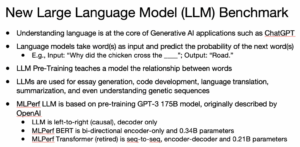
“Our LLM is based on pre-training GPT-3, the 175 billion (parameter) model that was originally described by OpenAI. Just to contrast this to the [NLP] MLPerf benchmark, Bert is a bidirectional encoder and has 340 million parameters. [That] gives you a sense of size and scope,” said Kanter.

“The C4 dataset (used by the GPT-3), as I mentioned is 305 gigabytes or 174 billion tokens. We are not training on all of C4, because that would take a really long time. We train on a portion of the training dataset to create a checkpoint, and the benchmark is training starting from that checkpoint on 1.3 billion tokens. Then we use a small portion of the validation dataset to do model accuracy evaluation to tell when you’ve got the right accuracy. To give you some rough numbers, this benchmark is about half a percent of the full GPT-3. We wanted to keep the runtime reasonable. But this is by far and away the most computationally demanding of our benchmarks. So the reference model is a 96 layer transformer,” said Kanter.
Turning to the results for a moment. Nvidia was again the top performer. In terms of MLPerf showings, it is hard to overstate its Nvidia recurring dominance (systems using Nvidia accelerators). This isn’t to say the Intel showings (4th-gen Xeon and Gaudi4) were insignificant. They were (more later), but Nvidia GPUs remained king.

David Salvator, director of AI, benchmarking and cloud, Nvidia, presented data comparing performance between accelerators.

“We essentially normalize the performance across the board (slide below), using as close to comparable GPU counts as we can to do the normalization. And what we’ve done here is normalized to H100, and shown a couple of competitors and how they fared,” said Salvator at a separate Nvidia briefing. “The basic takeaway is it first of all, we run all the workloads, which is something we’ve done since the beginning with MLPerf. We are unique in that regard. But the main takeaway is that we are significantly faster than competition. We are running all the workloads and basically either setting or breaking records on all of them.”

Nvidia also touted its joint submission with cloud provider CoreWeave of its HGX H100 infrastructure. The submission used 3584 H100 GPUs. “This instance is a live commercial instance that the CoreWeave GA’d at GTC. They were one of the very first to go GA with their HGX H100 instances. The instances have 8 SXM GPUs and make use of our third-generation switch technology to allow all communication at full bandwidth speed of 900 gigabytes per second,” said Salvator.

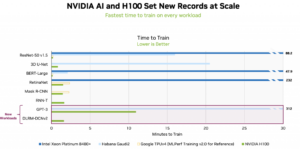
While there’s some quibbling around the edges, no one really disputes Nvidia dominance in MLPerf training. A broader question, perhaps is what does Nvidia’s dominance mean for the MLPerf Training benchmark?

Given the lack of diversity of branded accelerators (and to a lesser extent CPUs) in the MLPerf Training exercise, the twice-a-year issuing of results is starting to feel repetitive. Nvidia wins. Scarce rival “accelerator” chips – just two this time, including a CPU – typically are making a narrower marketing/performance points. Intel made no bones about this in the latest round, conceding Nvidia H100 performance at the top end.

The result: Rather than being a showcase for different accelerator chips’ performance, the MLPerf Training exercise, at least for now, broadly tracks Nvidia progress, and is really best suited as a spotlight for system vendors to tout the strength of their various system configurations using various Nvidia chips and preferred software frameworks. Perhaps it is best to think of the MLPerf Training exercise in this narrower way. The situation is a little different in other MLPerf categories (inference, edge, Tiny, HPC, etc.) Training is the most computationally-intense of the MLPerf benchmarks.

Kudos to Intel for the creditable showings from both 4th-gen Xeon and Gaudi2. The Intel position as spelled out by Jordan Plawner, senior director, AI product, was interesting.

Broadly speaking about CPUs, he argued that 4th gen Xeon, bolstered by many technical features such as built in matrix multiply and mixed precision capabilities, is well-suited for small-to-medium size model training, up to tens of billions or parameters. Moreover, while many CPU vendors have touted similar training and inference capabilities, none have them have participated in MLPerf. The submitted 4th-gen Xeon systems were without separate accelerators.

“You might have a real customer that says ‘I have all my Salesforce data, my own proprietary data, that I won’t even share with other people inside the company, let alone to an API [to an outside model].’ Now that person needs to fine tune the 7 billion parameter model with just his or her salesforce data, and give access to just the people who have asked who are allowed to have access, so they can query it and ask it, questions and generate plans out of it,” said Plawner. Intel’s 4th gen Xeon does that perfectly well, he contends.

So far, Intel is the only CPU maker that has MLPerf submissions that use only the CPU to handle training/inference tasks. Other CPU vendors have touted these AI-task capabilities in their chips but none has so far competed in that fashion. Plawner took a shot at them.

“The Intel Xeon scalable processor is the only CPU that’s submitted. For us, that’s an important point. We hear results that they get in the lab, and I say yes, but can you upstream those results into DeepSpeed, PyTorch, and TensorFlow, because that’s all that matters. I don’t care about the hardware roofline. I care about the software roofline. So there are lots of CPU companies out there and lots of startups in the accelerator space as well, and, to me, MLPerf is the place where you show up or don’t. As a CPU company, we have a lot of CPU competition and a lot of people wrapping AI messages around their CPUs. I say fine, are you going to submit to MLPerf? Let’s see your software. Let’s see how it works out of the box, don’t show me an engineered benchmark,” said Plawner.
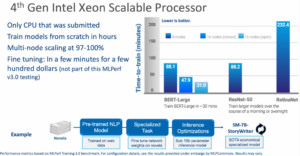
Intel makes a different argument for Habana’s Gaud2. Basically, it’s that yes, H100 currently is the top performer…if you can get them. Intel argues H100s are in short supply and unless you’re a huge customer, you can’t get them. Meanwhile, Gaudi2, argues Intel, is already par with (or better than) Nvidia’s A100 GPU and is built to handle large models. Compared with H100, the Gaudi chip is slower, but still very high-performing and offers a cost-performance advantage.

“I want to set that context, right? Okay. But these large clusters or pods, as people call them, which is obviously more than just the chips, but it’s all the networking and distributed storage. It’s really purpose-built at a datacenter scale for lots of money. Gaudi 2 is the Intel product to do these large, large training for models that are 10s of billions up to hundreds of billions. [Some] people are talking about a trillion parameters. There’s no doubt that you need this kind of dedicated system at scale to do that,” said Plawner

“For Gaudi, I think the really critical point – and we’ll talk about the performance and was it competitive or how competitive – but the most important point is simply [that it’s] the only viable alternative to Nvidia on the market. Our customers are screaming for an alternative to Nvidia and those customers are working out of the framework levels so CUDA doesn’t matter it matter to them. Intel/Habana was the only other company to submit for GPT-3 and large scale training is now data center scale [activity]. And if you can’t do GPT-3 then all you have is a chip and maybe a box. But what you need is a cluster. That’s what Gaudi has built,” he said.
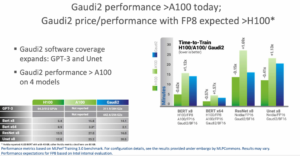
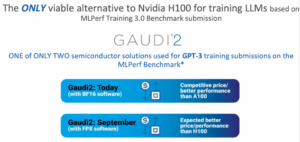
Wrapping up the 4th-gen Xeon/Gaudi2 positions, Plawner said Right now, you can’t buy one (H100) if you’re not Google or Microsoft. So as I said, Xeon is like a V100 class GPU (performance). Now, Gaudi is an A100 class today and it’s perfectly viable as customers are telling us and getting more interested in adopting it. You see here (slide) the H100 versus Gaudi2 performance per device is about 3.6x difference. Okay, I think that 3.6x is still significant, but I think we’re getting to diminishing returns. We’re talking about training (very large models) and hundreds of minutes.”

MLCommons holds a joint briefing before formally releasing results and the ground rules include not making directly competitive statements versus rival vendors. There was however some interesting comment around networking. Not surprisingly Nvidia touted InfiniBand while several others said fast Ethernet was quite adequate for LLM training.

As always, because system configurations differ widely and because there are a variety of tests, there is no single MLPerf winner as in the Top500 list. It was always necessary to dig into individual system submissions to make fair comparisons among them. MLCommons makes that fairly easy to on its web site. Also, MLCommons invites participating vendors to submit short statement describing their submissions. Those statements are appended to this article.

Link to MLPerf results, https://mlcommons.org/en/training-normal-30.

VENDOR STATEMENTS (unedited)

The submitting organizations provided the following descriptions as a supplement to help the public understand the submissions and results. The statements do not reflect the opinions or views of MLCommons.

Azure

Microsoft Azure is introducing the ND H100 v5-series which enables on-demand in sizes ranging from eight to thousands of NVIDIA H100 GPUs interconnected by NVIDIA Quantum-2 InfiniBand networking. As highlighted by these results, customers will see significantly faster performance for AI models over our last generation ND A100 v4 VMs with innovative technologies like:

  • 8x NVIDIA H100 Tensor Core GPUs interconnected via next gen NVSwitch and NVLink 4.0
  • 400 Gb/s NVIDIA Quantum-2 CX7 InfiniBand per GPU with 3.2Tb/s per VM in a non-blocking fat-tree network
  • NVSwitch and NVLink 4.0 with 3.6TB/s bisectional bandwidth between 8 local GPUs within each VM
  • 4th Gen Intel Xeon Scalable processors
  • PCIE Gen5 host to GPU interconnect with 64GB/s bandwidth per GPU
  • 16 Channels of 4800MHz DDR5 DIMMs

Last but not least, all Azure’s results are in line with on-premises performance and available on-demand in the cloud.

Dell Technologies

Businesses need an innovative, future-ready and high-performing infrastructure to achieve their goals. The continued growth of AI, for example, is driving business leaders to leverage AI further and examine how faster time-to-value will help them drive higher ROI.

The latest innovations in the Dell portfolio enable future-ready foundations with breakthrough compute performance for demanding, emerging applications such as Generative AI training of large language models, foundation models and natural language processing.

For the MLPerf training v3.0 benchmark testing, Dell submitted 27 results across 12 system configurations, including the Dell PowerEdge XE9680 and the Dell PowerEdge R760xa PCIe servers. Dell Technologies works with customers and partners including NVIDIA, to optimize software-hardware stacks for performance and efficiency, accelerating demanding training workloads.

Here are some of the latest highlights:

  • The PowerEdge XE9680, which delivers cutting-edge performance with 8x NVIDIA H100 SXM GPUs, achieved tremendous performance gains across many benchmarks, including over 600% faster on BERT language processing testing versus current 4-way A100 SXM solutions (on v2.1 benchmarks).
  • Image segmentation through object detection benchmarks also saw a 2 to 4x performance improvement over 4-way A100 solutions.
  • The newest Dell PowerEdge XE8640 with 4x NVIDIA H100 SXM GPUs also saw some double gains over the 4-way A100.
  • Similarly, comparing 4-way NVIDIA A100 PCIe vs H100 PCIe on PowerEdge servers also saw 2 to 2.5x performance improvements.

Training models and complex image detection require compute-intensive approaches, such as for Generative AI with Dell Technologies’ Project Helix. With Dell Technologies servers with NVIDIA GPUs, businesses can readily deploy the optimal performance foundation for AI/ML/DL and other initiatives.

Collaborate with our HPC & AI Innovation Lab and/or tap into one of our HPC & AI Centers of Excellence.

Fujitsu

Fujitsu offers a fantastic blend of systems, solutions, and expertise to guarantee maximum productivity, efficiency, and flexibility delivering confidence and reliability. We have continued to participate in and submit to every inference and training round since 2020.

In this training v3.0 round, we submitted two results. Our system used to measure the benchmark is new in two points compared to those in our past submissions. First, this system contains ten NVIDIA A100 PCIe 80GB GPUs and this number is more than that in any past submissions from Fujitsu. Next, all PCIe devices: GPUs, storages, and NICs are placed in PCI boxes outside nodes. These resources can be allocated to one node like in this submission, or to multiple nodes, and managed adaptively.

As for the results of benchmarks, we measured two tasks: resnet-50 and ssd-retinanet, and accomplished the best results in our past submissions. For resnet-50, we got 25.831min (8.13 % improvement) and 73.229 min (39.7 % improvement) for ssd-retinanet. We will continue to strive to provide attractive server products through the MLPerf benchmark.

Our purpose is to make the world more sustainable by building trust in society through innovation. We have a long heritage of bringing innovation and expertise, continuously working to contribute to the growth of society and our customers.

GIGABYTE

GIGABYTE is an industry leader in HPC & AI servers, and uses its hardware expertise, patented innovations, and industry connections to create, inspire, and advance. With over 30 years of motherboard manufacturing excellence and 20 years of design and production of server and enterprise products, GIGABYTE offers an extensive portfolio of data center products for x86 and Arm platforms.

In 2020, GIGABYTE joined MLCommons and submitted its first system- a 2U GPU server with AMD EPYC processors and sixteen NVIDIA T4 GPUs. Since then, we have continued to support the community by submitting our own systems for training and inferencing, as well as providing servers to submitters. In the past, we submitted systems for AMD EPYC and Intel Xeon processors, but last year we saw our first GIGABYTE systems using the Arm-based processor, Ampere Altra.

For MLPerf Training v3.0 we submitted an updated platform for NVIDIA H100 SXM5. Our server, G593-SD0, supports eight SXM5 modules and coordinates via dual Intel Xeon Platinum 8480+ processors.

Jumping from HGX platforms, from A100 to H100, we have seen drastic improvements in our training benchmarks. Across the board we saw an average reduction in time by 55%.

Results compared to v2.1 submission:

Image classification: 51% faster; from 28min to 13.5min

Image segmentation: 48% faster

Object detection, lightweight: 55% faster

Speech recognition: 44% faster

Natural language processing: 72% faster To learn more about our solutions, visit: https://www.gigabyte.com/Enterprise.

HabanaLabs

Intel and its Habana team are excited to announce impressive achievements on the MLPerf Training 3.0 benchmark. The Gaudi2 accelerator is one of only two solutions in the AI industry to have submitted GPT-3 training results, providing tangible validation that Gaudi2 provides the performance and efficiency required to serve customers training complex and large language models at scale. Gaudi2’s training results substantiate the accelerator’s efficient scaling up to very large clusters to support multi-billion parameter models such as the 175B parameter GPT-3 model. Gaudi2 delivered impressive time-to-train performance, as well as near-linear scaling of 95% from 256 to 384 Gaudi2s.

Habana’s software has evolved significantly and continues to mature. In this GPT-3 submission we employed the popular DeepSpeed optimization library (part of Microsoft AI at scale), enabling support of 3D parallelism (Data, Tensor, Pipeline) concurrently, further optimizing performance efficiency of LLMs. Gaudi2 results on the 3.0 benchmark were submitted using BF16 datatype; we expect to see a substantial leap in Gaudi2 performance when our software support of FP8 and additional features are released in Q3.

In total, we reported results on four models, of which GPT-3 and Unet3D are new. All results are reported in PyTorch with the addition of TensorFlow on BERT and ResNet-50. Gaudi2 showed performance increases of 10% and 4% respectively for BERT and ResNet models as compared to the November submission. Habana results are submitted on its “out of the box” software, enabling customers to achieve comparable results when implementing Gaudi2 in their own on-premises or cloud implementations.

We look forward to continuing to report on Gaudi2 training, as well as inference performance, on future MLPerf benchmarks and expanding coverage results of models that best address the customer needs as they evolve.

IEI

IEI Industry Co., LTD is a leading provider of data center infrastructure, cloud computing, and AI solutions, ranking among the world’s top 3 server manufacturers. Through engineering and innovation, IEI delivers cutting-edge computing hardware design and extensive product offerings to address important technology arenas like open computing, cloud data center, AI, and deep learning.

In MLCommons Training V3.0, IEI made submissions on NF5468M6.

NF5468M6 is a highly versatile 4U AI server supporting between 4 and 16 NVIDIA single and double-width GPUs, making it ideal for a wide range of AI applications including AI cloud, IVA, video processing and much more. NF5468M6 offers ultra-high storage capacity and the unique function of switching topologies between Balance, Common and Cascade in one click, which helps to flexibly adapt to various needs for AI application performance optimization.

Intel

Intel has surpassed the 100-submission milestone this MLPerf cycle and remains the only CPU vendor to publish results. The training cycle is especially important as it demonstrates how Intel Xeon Scalable processors help enterprises avoid the cost and complexity of introducing special-purpose hardware for AI training. Our MLPerf Training v3.0 results on the 4th Gen Intel Xeon Scalable processor product line (codenamed Sapphire Rapids) mirror the preview results from last cycle, and we’ve also added a larger model – namely RetinaNet – to our list of submissions to demonstrate it is the best general-purpose CPU for AI training across a range of model sizes. The 4th Gen Intel Xeon Scalable processors with Intel Advanced Matrix Extensions (Intel AMX) deliver significant out-of-box performance improvements that span multiple frameworks, end-to-end data science tools, and a broad ecosystem of smart solutions. These results also highlight the excellent scaling efficiency possible using cost-effective and readily available Intel Ethernet 800 Series Network Adapters, which utilizes the open source Intel Ethernet Fabric Suite Software that’s based on Intel oneAPI.

Intel’s results show the reach of general-purpose CPUs for AI so customers can do more with the Intel-based servers that are already running their business. This is especially true for training the most frequently deployed models or transfer learning (or fine tuning) with an existing Xeon infrastructure. The BERT result in the open division is a great example of where Xeon was able to train the model in ~30 mins (31.06 mins) when scaling out to 16 nodes. In the closed division, 4th Gen Xeons could train BERT and ResNet-50 models in less than 50 mins (47.93 mins) and less than 90 mins (88.17 mins), respectively. Even for the larger RetinaNet model, Xeon was able to achieve a time of 232 mins on 16 nodes, so customers have the flexibility of using off-peak Xeon cycles either over the course of a morning, over lunch, or overnight to train their models.

Notices & Disclaimers
Performance varies by use, configuration and other factors. Learn more at www.Intel.com/PerformanceIndex .
Performance results are based on testing as of dates shown in configurations and may not reflect all publicly available updates. See
backup for configuration details. No product or component can be absolutely secure.
Your costs and results may vary.
Intel technologies may require enabled hardware, software or service activation.
© Intel Corporation. Intel, the Intel logo, and other Intel marks are trademarks of Intel Corporation or its subsidiaries. Other names
and brands may be claimed as the property of others.

Krai

Founded by Dr Anton Lokhmotov in 2020, KRAI is a growing team of world-class engineers that is revolutionizing how companies develop and deploy AI solutions on state of the art hardware. Recognizing the growing importance of AI and the limitations of Computer Systems, KRAI and its technologies were created to serve leading industry partners and revolutionize AI solution development. Our team has been actively contributing to MLPerf since its inception in 2018, having prepared over 60% of all Inference and over 80% of all Power results to date. This feat was possible thanks to our unique workflow automation approach that unlocks the full potential of AI, software, and hardware co-design. We are proud to partner with companies like Qualcomm, HPE, Dell, Lenovo, and more.

Comparing “entry-level” options for training neural networks is of interest to many with limited resources. Our submissions uniquely use NVIDIA RTX A5000 GPUs. While A100 and A30 GPUs are more performant and efficient for ML Training, A5000 GPUs are more affordable for small organizations.

Another interesting point to note is that adopting a more recent software release doesn’t necessarily bring performance improvements. Comparing our ResNet50 submissions, we observe that the NVIDIA NGC MxNet Release 22.04 (CUDA 11.6) container enabled 12% faster training than the Release 22.08 (CUDA 11.7) on the dual A5000 system we tested.

Our team is committed to pushing the boundaries of MLPerf benchmarking in all categories, including Training ML. We are excited to pre-announce releasing the KRAI X automation technology in the near future. KRAI technologies deliver fully optimized end-to-end AI solutions, based on constraints and performance goals. Our technologies enable system designers to design and deploy AI solutions faster, by removing tedious manual processes. We are thrilled to continue helping companies develop, benchmark and optimize their AI solutions.

Nvidia

We are excited to make our first available submission and our first large-scale MLPerf Training submissions using up to 768 NVIDIA H100 Tensor Core GPUs on our internal “Pre-Eos” AI supercomputer. We are also thrilled to partner with cloud service provider, CoreWeave, on a joint submission using up to 3,584 NVIDIA H100 Tensor Core GPUs on CoreWeave’s HGX H100 infrastructure on several benchmark tests, including MLPerf’s new LLM workload, based on GPT-3 175B.

NVIDIA H100 Tensor Core GPUs ran every MLPerf Training v3.0 workload and, through software optimizations, achieved up to 17% higher performance per accelerator compared to our preview submission using the same H100 GPUs just six months ago.

Through full-stack craftsmanship, the NVIDIA AI platform demonstrated exceptional performance at scale across every MLPerf Training v3.0 workload, including the newly-added LLM workload as well as the updated DLRM benchmark. The NVIDIA AI platform was also the only one to submit results across every workload, highlighting its incredible versatility.

The NVIDIA AI platform starts with great chips and from there, innovations across core system software, powerful acceleration libraries, as well as domain-specific application frameworks enable order-of-magnitude speedups for the world’s toughest AI computing challenges. It’s available from every major cloud and server maker, and offers the quickest path to production AI and enterprise-grade support with NVIDIA AI enterprise.

Additionally, we were excited to see 11 NVIDIA partners submit great results in this round of MLPerf Training, including both on-prem and cloud-based submissions.

We also wish to commend the ongoing work that MLCommons is doing to continue to bring benchmarking best practices to AI computing, enable peer-reviewed, apples-to-apples comparisons of AI and HPC platforms, and keep pace with the rapid change that characterizes AI computing.

NVIDIA + CoreWeave

CoreWeave is a specialized cloud provider that delivers a massive scale of GPU compute on top of a fast, flexible serverless infrastructure. We build ultra-performant cloud solutions for compute-intensive use cases, including machine learning and AI, visual effects and rendering, batch processing and pixel streaming.

CoreWeave is proud to announce our first, and record setting, MLPerf submission in partnership with NVIDIA. CoreWeave’s MLPerf submission leveraged one of the largest HGX clusters in the world, featuring the latest HGX servers with NVIDIA H100 SXM5 GPUs, Intel 4th Generation Xeon Scalable Processors, and NVIDIA ConnectX-7 400G NDR InfiniBand and Bluefield-2 ethernet adapters.

This massive HGX cluster is one of the many GPU clusters built and designed for general purpose, public cloud consumption via the CoreWeave platform. The MLPerf submission, and the creation of several new HGX clusters, demonstrates CoreWeave’s ability to deliver best-in-class performance for the world’s most demanding AI/ML workloads in the public cloud.

Quanta Cloud Technology

Quanta Cloud Technology (QCT) is a global datacenter solution provider that enables diverse HPC and AI workloads. For the latest round of MLPerf Training v3.0, QCT submitted two systems in the closed division. QCT’s submission included tasks in Image Classification, Object Detection, Natural Language Processing, Speech Recognition, and Recommendation, achieving the specified quality target using its QuantaGrid-D54Q-2U System and QuantaGrid D74H-7U, a preview system. Each benchmark measures the wall-clock time required to train a model.

The QuantaGrid D54Q-2U powered by 4th Gen Intel Xeon Scalable processors delivers scalability with flexible expansion slot options including PCle 5.0, up to two double-width accelerators, up to 16TB DDR5 memory capacity and 26 drive bays, serving as a compact AI system for computer vision and language processing scenarios. In this round, the QuantaGrid-D54Q-2U Server configured with two NVIDIA H100-PCIe-80GB accelerator cards achieved outstanding performance.

The QuantaGrid D74H-7U is an 8-way GPU server equipped with the NVIDIA HGX H100 8-GPU Hopper SXM5 module, making it ideal for AI training. With innovative hardware design and software optimization, the QuantaGrid D74H-7U server achieved excellent training results.

QCT will continue providing comprehensive hardware systems, solutions, and services to academic and industrial users, and keep MLPerf results transparent with the public for the MLPerf training and inference benchmarks.

Supermicro

Supermicro has a long history of designing a wide range of products for various AI use cases. In MLPerf Training v3.0, Supermicro has submitted five systems in the closed division. Supermicro’s systems provide customers with servers built to deliver top performance for AI training workloads.

Supermicro’s mission is to provide application optimized systems for a broad range of workloads. For example, Supermicro designs and manufactures four types of systems for the NVIDIA HGX 8-GPU and 4-GPU platforms, each customizable for customers’ various requirements and workload needs through our building block approach. Supermicro offers a range of CPUs and quantities of GPU across multiple form factors for customers with different compute and environmental requirements. Furthermore, Supermicro provides customers choices on using cost-effective power supplies or genuine N+N redundancy to maximize the TCO. Now we also offer liquid cooling options for the latest NVIDIA HGX based-systems, as well as PCIe-based systems to help deployments use higher TDP CPUs and GPUs without thermal throttling.

Supermicro’s GPU A+ Server, the AS-4125GS-TNRT has flexible GPU support and configuration options: with active & passive GPUs, and dual root or single-root configurations for up to 10 double-width, full-length GPUs. Furthermore, the dual root configuration features directly attached 8 GPUs without PLX switches to achieve the lowest latency possible and improve performance, which is hugely beneficial for demanding scenarios our customers face with machine learning (ML) and HPC workloads.

The Supermicro AS-8125GS-TNHR 8U GPU Server demonstrated exceptional performance in the latest round of training. Equipped with 8x NVIDIA HGX H100 – SXM5 GPUs and support for PCIe expansion slots, this server significantly accelerates data transportation, offers impressive computational parallelism, and enhances the performance of HPC and AI/Deep Learning Training.

Supermicro’s SYS-821GE-TNHR is a high-performance, rack-mountable tower/workstation form factor GPU SuperServer. Designed to accommodate dual Intel CPUs and eight double-width NVIDIA H100 GPUs, this system delivers exceptional performance. With its outstanding results, the SYS-821GE-TNHR is an ideal choice for AI training, making it a compelling solution in the field today.

Supermicro offers a diverse range of GPU systems tailored for any environment. As part of their commitment to customer satisfaction, Supermicro continually fine-tunes these systems, ensuring optimized experiences and top-notch performance across a wide array of servers and workstations.

xFusion

xFusion Digital Technology Co., Ltd. is committed to becoming the world’s leading provider of computing power infrastructure and services. We adhere to the core values of “customer-centric, striver-oriented, long-term hard work, and win-win cooperation”, continue to create value for customers and partners, and accelerate the digital transformation of the industry.

In this performance competition of MLPerf Training v3.0, we used a new generation of GPU server product FusionServer G5500 V7 to conduct performance tests on all benchmarks under various GPU configurations and achieved excellent results.

FusionServer G5500 V7 (G5500 V7) is a new-generation 4U 2-socket GPU server. It supports a maximum of 10 x double-width GPU cards. We use Intel Xeon Platinum 6458Q CPU x2 and 8~10 A30 or L40 GPU configurations to test all evaluation items. It has made excellent achievements and achieved the best performance under the same GPU hardware configuration.

FusionServer G5500 V7 features high performance, flexible architecture, high reliability, easy deployment, and simplified management. It accelerates applications such as AI training, AI inference, high-performance computing (HPC), image and video analysis, and database, and supports enterprise and public cloud deployment.

This article first appeared on HPCwire.

Related

Upgrade your ChatGPT skills with this $30 training: Leverage AI to work smarter

OpenAI's ChatGPT has already become an integral tool for many professionals when it comes to streamlining workflows and saving time. However, there is more to learning to use ChatGPT than simply entering prompts and revising what the AI feeds back. If you want to use ChatGPT to craft high-quality text, support ideation, and more, then you may want to enroll in this online training that gives you a solid foundation and upskills you on AI for just $30 (reg. $52).

Become a more advanced ChatGPT user in four hours

This online course load contains dozens of lessons breaking down beginner and advanced skills to help you use ChatGPT effectively. If you are new to the AI chatbot or want to make sure you didn't miss any tips and tricks when you first jumped in months ago, then start with ChatGPT for Beginners, taught by Mike Wheeler. Wheeler is a cloud computing instructor who shows users how to write basic prompts to answer questions and craft prose.

For more advanced instruction, move on to ChatGPT: Artificial Intelligence (AI) that Writes for You. This course contains 12 lectures showing you how to write ChatGPT prompts that generate blog posts, sales copy, and other more professional content. Business owners may be able to save money or time writing content for their websites by using the chatbot, but of course, that content — business or otherwise — will still need some human revision and you'll have to verify that the words are original.

ChatGPT is already being used to automate basic tasks in the professional sphere, and you may be able to customize your own bot and make it work for you. The final two courses in this bundle require more technical experience, but they show users how ChatGPT can help you complete some of the tasks outlined in Create a ChatGPT A.I. Bot with Tkinter and Python and Create a ChatGPT A.I. Bot with Django and Python. Between these two courses, learners can find out how to use the Generative Pre-training Transformer tech to craft their own applications for ChatGPT, including building interactive coding websites and automatic text generators.

Take advantage of the power of this large language model

The accessibility of this NLP technology has given the power of AI to the masses. Gaining more advanced skills could help you work smarter and stand out from the crowd.

Get the Complete ChatGPT Artificial Intelligence OpenAI Training Bundle for $30 (reg. $52).

ZDNET Recommends