The week in AI: Generative AI spams up the web

The week in AI: Generative AI spams up the web Kyle Wiggers 7 hours

Keeping up with an industry as fast-moving as AI is a tall order. So until an AI can do it for you, here’s a handy roundup of recent stories in the world of machine learning, along with notable research and experiments we didn’t cover on their own.

This week, SpeedyBrand, a company using generative AI to create SEO-optimized content, emerged from stealth with backing from Y Combinator. It hasn’t attracted a lot of funding yet ($2.5 million), and its customer base is relatively small (about 50 brands). But it got me thinking about how generative AI is beginning to change the makeup of the web.

As The Verge’s James Vincent wrote in a recent piece, generative AI models are making it cheaper and easier to generate lower-quality content. Newsguard, a company that provides tools for vetting news sources, has exposed hundreds of ad-supported sites with generic-sounding names featuring misinformation created with generative AI.

It’s causing a problem for advertisers. Many of the sites spotlighted by Newsguard seem exclusively built to abuse programmatic advertising, or the automated systems for putting ads on pages. In its report, Newsguard found close to 400 instances of ads from 141 major brands that appeared on 55 of the junk news sites.

It’s not just advertisers who should be worried. As Gizmodo’s Kyle Barr points out, it might just take one AI-generated article to drive mountains of engagement. And even if every AI-generated article only generates a few dollars, that’s less than the cost of generating the text in the first place — and potential advertising money not being sent to legitimate sites.

So what’s the solution? Is there one? It’s a pair of questions that’s increasingly keeping me up at night. Barr suggests it’s incumbent on search engines and ad platforms to exercise a tighter grip and punish the bad actors embracing generative AI. But given how fast the field is moving — and the infinitely scalable nature of generative AI — I’m not convinced that they can keep up.

Of course, spammy content isn’t a new phenomenon, and there’s been waves before. The web has adapted. What’s different this time is that the barrier to entry is dramatically low — both in terms of the cost and time that has to be invested.

Vincent strikes an optimistic tone, implying that if the web is eventually overrun with AI junk, it could spur the development of better-funded platforms. I’m not so sure. What’s not in doubt, though, is that we’re at an inflection point, and that the decisions made now around generative AI and its outputs will impact the function of the web for some time to come.

Here are other AI stories of note from the past few days:

OpenAI officially launches GPT-4: OpenAI this week announced the general availability of GPT-4, its latest text-generating model, through its paid API. GPT-4 can generate text (including code) and accept image and text inputs — an improvement over GPT-3.5, its predecessor, which only accepted text — and performs at “human level” on various professional and academic benchmarks. But it’s not perfect, as we note in our previous coverage. (Meanwhile ChatGPT adoption is reported to be down, but we’ll see.)

Bringing ‘superintelligent’ AI under control: In other OpenAI news, the company is forming a new team led by Ilya Sutskever, its chief scientist and one of OpenAI’s co-founders, to develop ways to steer and control “superintelligent” AI systems.

Anti-bias law for NYC: After months of delays, New York City this week began enforcing a law that requires employers using algorithms to recruit, hire or promote employees to submit those algorithms for an independent audit — and make the results public.

Valve tacitly greenlights AI-generated games: Valve issued a rare statement after claims it was rejecting games with AI-generated assets from its Steam games store. The notoriously close-lipped developer said its policy was evolving and not a stand against AI.

Humane unveils the Ai Pin: Humane, the startup launched by ex-Apple design and engineering duo Imran Chaudhri and Bethany Bongiorno, this week revealed details about its first product: The Ai Pin. As it turns out, Humane’s product is a wearable gadget with a projected display and AI-powered features — like a futuristic smartphone, but in a vastly different form factor.

Warnings over EU AI regulation: Major tech founders, CEOs, VCs and industry giants across Europe signed an open letter to the EU Commission this week, warning that Europe could miss out on the generative AI revolution if the EU passes laws stifling innovation.

Deepfake scam makes the rounds: Check out this clip of U.K. consumer finance champion Martin Lewis apparently shilling an investment opportunity backed by Elon Musk. Seems normal, right? Not exactly. It’s an AI-generated deepfake — and potentially a glimpse of the AI-generated misery fast accelerating onto our screens.

AI-powered sex toys: Lovense — perhaps best known for its remote-controllable sex toys — this week announced its ChatGPT Pleasure Companion. Launched in beta in the company’s remote control app, the “Advanced Lovense ChatGPT Pleasure Companion” invites you to indulge in juicy and erotic stories that the Companion creates based on your selected topic.

Other machine learnings

Our research roundup commences with two very different projects from ETH Zurich. First is aiEndoscopic, a smart intubation spinoff. Intubation is necessary for a patient’s survival in many circumstances, but it’s a tricky manual procedure usually performed by specialists. The intuBot uses computer vision to recognize and respond to a live feed from the mouth and throat, guiding and correcting the position of the endoscope. This could allow people to safely intubate when needed rather than waiting on the specialist, potentially saving lives.

Here’s them explaining it in a little more detail:

In a totally different domain, ETH Zurich researchers also contributed second-hand to a Pixar movie by pioneering the technology needed to animate smoke and fire without falling prey to the fractal complexity of fluid dynamics. Their approach was noticed and built on by Disney and Pixar for the film Elemental. Interestingly, it’s not so much a simulation solution as a style transfer one — a clever and apparently quite valuable shortcut. (Image up top is from this.)

AI in nature is always interesting, but nature AI as applied to archaeology is even more so. Research led by Yamagata University aimed to identify new Nasca lines — the enormous “geoglyphs” in Peru. You might think that, being visible from orbit, they’d be pretty obvious — but erosion and tree cover from the millennia since these mysterious formations were created mean there are an unknown number hiding just out of sight. After being trained on aerial imagery of known and obscured geoglyphs, a deep learning model was set free on other views, and amazingly it detected at least four new ones, as you can see below. Pretty exciting!

Four Nasca geoglyphs newly discovered by an AI agent.

In a more immediately relevant sense, AI-adjacent tech is always finding new work detecting and predicting natural disasters. Stanford engineers are putting together data to train future wildfire prediction models with by performing simulations of heated air above a forest canopy in a 30-foot water tank. If we’re to model the physics of flames and embers traveling outside the bounds of a wildfire, we’ll need to understand them better, and this team is doing what they can to approximate that.

At UCLA they’re looking into how to predict landslides, which are more common as fires and other environmental factors change. But while AI has already been used to predict them with some success, it doesn’t “show its work,” meaning a prediction doesn’t explain whether it’s because of erosion, or a water table shifting, or tectonic activity. A new “superposable neural network” approach has the layers of the network using different data but running in parallel rather than all together, letting the output be a little more specific in which variables led to increased risk. It’s also way more efficient.

Google is looking at an interesting challenge: how do you get a machine learning system to learn from dangerous knowledge yet not propagate it? For instance, if its training set includes the recipe for napalm, you don’t want it to repeat it — but in order to know not to repeat it, it needs to know what it’s not repeating. A paradox! So the tech giant is looking for a method of “machine unlearning” that lets this sort of balancing act occur safely and reliably.

If you’re looking for a deeper look at why people seem to trust AI models for no good reason, look no further than this Science editorial by Celeste Kidd (UC Berkeley) and Abeba Birhane (Mozilla). It gets into the psychological underpinnings of trust and authority and shows how current AI agents basically use those as springboards to escalate their own worth. It’s a really interesting article if you want to sound smart this weekend.

Though we often hear about the infamous Mechanical Turk fake chess-playing machine, that charade did inspire people to create what it pretended to be. IEEE Spectrum has a fascinating story about the Spanish physicist and engineer Torres Quevedo, who created an actual mechanical chess player. Its capabilities were limited, but that’s how you know it was real. Some even propose that his chess machine was the first “computer game.” Food for thought.


Segment Anything Model: Foundation Model for Image Segmentation

Segmentation, the process of identifying image pixels that belong to objects, is at the core of computer vision. This process is used in applications from scientific imaging to photo editing, and technical experts must possess both highly skilled abilities and access to AI infrastructure with large quantities of annotated data for accurate modeling.

Meta AI recently unveiled its Segment Anything project? which is ?an image segmentation dataset and model with the Segment Anything Model (SAM) and the SA-1B mask dataset?—?the largest ever segmentation dataset support further research in foundation models for computer vision. They made SA-1B available for research use while the SAM is licensed under Apache 2.0 open license for anyone to try SAM with your images using this demo!

Segment Anything Model: Foundation Model for Image Segmentation
Segment Anything Model / Image by Meta AI Toward Generalizing the Segmentation Task

Before, segmentation problems were approached using two classes of approaches:

  • Interactive segmentation in which the users guide the segmentation task by iteratively refining a mask.
  • Automatic segmentation allowed selective object categories like cats or chairs to be segmented automatically but it required large numbers of annotated objects for training (i.e. thousands or even tens of thousands of examples of segmented cats) along with computing resources and technical expertise to train a segmentation model neither approach provided a general, fully automatic solution to segmentation.

SAM uses both interactive and automatic segmentation in one model. The proposed interface enables flexible usage, making a wide range of segmentation tasks possible by engineering the appropriate prompt (such as clicks, boxes, or text).

SAM was developed using an expansive, high-quality dataset containing more than one billion masks collected as part of this project, giving it the capability of generalizing to new types of objects and images beyond those observed during training. As a result, practitioners no longer need to collect their segmentation data and tailor a model specifically to their use case.

These capabilities enable SAM to generalize both across tasks and domains something no other image segmentation software has done before.

SAM Capabilities & Use Cases

SAM comes with powerful capabilities that make the segmentation task more effective:

  • Variety of input prompts: Prompts that direct segmentation allow users to easily perform different segmentation tasks without additional training requirements. You can apply segmentation using interactive points and boxes, automatically segment everything in an image, and generate multiple valid masks for ambiguous prompts. In the figure below we can see the segmentation is done for certain objects using an input text prompt.

Segment Anything Model: Foundation Model for Image Segmentation
Bounding box using text prompt.

  • Integration with other systems: SAM can accept input prompts from other systems, such as in the future taking the user's gaze from an AR/VR headset and selecting objects.
  • Extensible outputs: The output masks can serve as inputs to other AI systems. For instance, object masks can be tracked in videos, enabled imaging editing applications, lifted into 3D space, or even used creatively such as collating
  • Zero-shot generalization: SAM has developed an understanding of objects which allows him to quickly adapt to unfamiliar ones without additional training.
  • Multiple mask generation: SAM can produce multiple valid masks when faced with uncertainty regarding an object being segmented, providing crucial assistance when solving segmentation in real-world settings.
  • Real-time mask generation: SAM can generate a segmentation mask for any prompt in real time after precomputing the image embedding, enabling real-time interaction with the model.

Understanding SAM: How Does It Work? Segment Anything Model: Foundation Model for Image Segmentation
Overview of SAM model / Image by Segment Anything

One of the recent advances in natural language processing and computer vision has been foundation models that enable zero-shot and few-shot learning for new datasets and tasks through “prompting”. Meta AI researchers trained SAM to return a valid segmentation mask for any prompt, such as foreground/background points, rough boxes/masks or masks, freeform text, or any information indicating the target object within an image.

A valid mask simply means that even when the prompt could refer to multiple objects (for instance: one point on a shirt may represent both itself or someone wearing it), its output should provide a reasonable mask for one object only?—?thus pre-training the model and solving general downstream segmentation tasks via prompting.

The researchers observed that pretraining tasks and interactive data collection imposed specific constraints on model design. Most significantly, real-time simulation must run efficiently on a CPU in a web browser to allow annotators to use SAM interactively in real-time for efficient annotation. Although runtime constraints resulted in tradeoffs between quality and runtime constraints, simple designs produced satisfactory results in practice.

Underneath SAM’s hood, an image encoder generates a one-time embedding for images while a lightweight encoder converts any prompt into an embedding vector in real-time. These information sources are then combined by a lightweight decoder that predicts segmentation masks based on image embeddings computed with SAM, so SAM can produce segments in just 50 milliseconds for any given prompt in a web browser.

Building SA-1B: Segmenting 1 Billion Masks

Building and training the model requires access to an enormous and diverse pool of data that did not exist at the start of training. Today’s segmentation dataset release is by far the largest to date. Annotators used SAM interactively annotate images before updating SAM with this new data?—?repeating this cycle many times to continuously refine both the model and dataset.

SAM makes collecting segmentation masks faster than ever, taking only 14 seconds per mask annotated interactively; that process is only two times slower than annotating bounding boxes which take only 7 seconds using fast annotation interfaces. Comparable large-scale segmentation data collection efforts include COCO fully manual polygon-based mask annotation which takes about 10 hours; SAM model-assisted annotation efforts were even faster; its annotation time per mask annotated was 6.5x faster versus 2x slower in terms of data annotation time than previous model assisted large scale data annotations efforts!

Interactively annotating masks is insufficient to generate the SA-1B dataset; thus a data engine was developed. This data engine contains three “gears”, starting with assisted annotators before moving onto fully automated annotation combined with assisted annotation to increase the diversity of collected masks and finally fully automatic mask creation for the dataset to scale.

SA-1B’s final dataset features more than 1.1 billion segmentation masks collected on over 11 million licensed and privacy-preserving images, making up 4 times as many masks than any existing segmentation dataset, according to human evaluation studies. As verified by these human assessments, these masks exhibit high quality and diversity compared with previous manually annotated datasets with much smaller sample sizes.

Images for SA-1B were obtained via an image provider from multiple countries that represented different geographic regions and income levels. While certain geographic regions remain underrepresented, SA-1B provides greater representation due to its larger number of images and overall better coverage across all regions.

Researchers conducted tests aimed at uncovering any biases in the model across gender presentation, skin tone perception, the age range of people as well as the perceived age of persons presented, finding that the SAM model performed similarly across various groups. They hope this will make the resulting work more equitable when applied in real-world use cases.

While SA-1B enabled the research output, it can also enable other researchers to train foundation models for image segmentation. Furthermore, this data may become the foundation for new datasets with additional annotations.

Future Work & Summary

Meta AI researchers hope that by sharing their research and dataset, they can accelerate the research in image segmentation and image and video understanding. Since this segmentation model can perform this function as part of larger systems.

In this article, we covered what is SAM and its capability and use cases. After that, we went through how it works, and how it was trained so as to give an overview of the model. Finally, we conclude the article with the future vision and work. If you would like to know more about SAM make sure to read the paper and try the demo.

References

  • Introducing Segment Anything: Working toward the first foundation model for image segmentation
  • SA-1B Dataset
  • Segment Anything

Youssef Rafaat is a computer vision researcher & data scientist. His research focuses on developing real-time computer vision algorithms for healthcare applications. He also worked as a data scientist for more than 3 years in the marketing, finance, and healthcare domain.

More On This Topic

  • A Guide to Train an Image Classification Model Using Tensorflow
  • How to break a model in 20 days — a tutorial on production model analytics
  • Machine Learning Model Development and Model Operations: Principles and…
  • Real Time Image Segmentation Using 5 Lines of Code
  • Is Your Model Overtained?
  • What Is AI Model Governance?

Microsoft Edge cheat sheet

The Microsoft Edge logo and the title "Microsoft Edge Cheat Sheet."
Image: Mark Kaelin
All images created by Mark Kaelin from public domain images and screenshots.

Microsoft Edge is the default browser for Windows 10. This cheat sheet covers the basics of Microsoft Edge, including how to set up the browser and then optimize and use its key features.

Microsoft released in January 2020 a new version of its Edge web browser based on the Chromium platform. This change of foundational software transformed Microsoft Edge and elevated it to one of the leading web browsers available in a competitive and crowded market. However, the notable characteristics of Microsoft Edge are obvious when you prioritize productivity.

Many of the features in Microsoft Edge were designed for organizations, businesses and individuals tasked with being as efficient and as productive as possible. The Chromium platform allows Edge to have better and more flexible security protocols without compromising on additional features such as personal customization, application extensions and built-in compatibility with all modern operating systems.

Jump to:

  • What is Microsoft Edge?
  • Microsoft Edge’s key features
  • Who should use Microsoft Edge?
  • What are the pros and cons of Microsoft Edge?
  • What is the competitive landscape for Microsoft Edge?
  • How do you get Microsoft Edge?

What is Microsoft Edge?

Microsoft Edge is Microsoft’s current web browser application. Edge is built on the Chromium open-source platform, which means there are compatible versions of the web browser available for Windows, macOS, Android, iOS and Linux. Configuration settings and customizations can be automatically copied to all your devices regardless of the operating system.

The overall performance of Microsoft Edge is comparable with all other available browsers. Edge uses tabs to allow users to open and have available more than one website at a time. For devices running on battery power, Edge can save energy use by running in efficiency mode.

Microsoft Edge’s key features

Security

For small businesses and enterprise-level organizations using Edge, security protocols are seamlessly integrated with other Microsoft services such as Defender, Active Directory, SmartScreen and Azure AD Conditional Access. All these business-related security features are designed to protect your company’s sensitive data from being accessed or manipulated by someone who doesn’t have the proper credentials or authority.

SEE: How to boost security features in Microsoft Edge for free (TechRepublic)

Extensions

Microsoft Edge allows users to access and use thousands of third-party extensions. These add-ons are available for download and installation on the Edge Add-ons site and include productivity-related extensions, digital assistants and links to specific applications, as well as fun diversions like games.

SEE: 5 Microsoft Edge add-ons you should start using today (TechRepublic)

Bing AI

The latest version of Microsoft Edge includes built-in and integrated artificial intelligence in the form of Bing AI. These AI systems include a ChatGPT-powered chatbot that can fine tune a Bing search to find more useful and precise information and generative AI features that can create text or images based on your commands.

SEE: How to hide the Discover button and Copilot in Microsoft Edge (TechRepublic)

Sidebar

The latest versions of Edge include a customizable sidebar that provides quick access links to various productivity applications including Outlook, Gmail and Adobe Acrobat (Figure A). The list of icons on the sidebar supplement users’ installed extensions and toolbar actions.

Figure A

Edge’s customizable sidebar.
Edge’s customizable sidebar. Image: Mark Kaelin

Collections

The Collections feature in Edge allows users to gather various separate websites into one space where they can be quickly found and referenced later. This feature can be useful from a productivity standpoint when a user visits the same internal or external websites frequently.

Personalization and customization

Microsoft Edge allows users to personalize their web browser experience with a customizable toolbar and sidebar. Through configuration settings, users can add and remove links, icons and application access depending on their personal needs; this includes rearranging browser tabs into a vertical position.

Learning and accessibility

Microsoft Edge includes a multitude of learning and accessibility tools, including an Immersive Reader function that can isolate text from other distracting content like advertisements and Read Aloud, which allows users to listen to websites rather than read them.

Compatibility

Because it’s developed on the Chromium platform, there are Edge versions available for all the major operating systems including Windows, Android, macOS, iOS and Linux. This compatibility extends to personal computers, tablets and mobile devices running on all major platforms.

Microsoft Edge also includes compatibility with the legacy web browser Internet Explorer, which is often useful for certain businesses using long-running machinery and systems that cannot be easily updated to modern operating systems or web browsers.

Continuous updates

Like Microsoft does with its other productivity-based products and services, it continuously updates Edge for better performance and security. These updates occur automatically in the background, often without disturbing users with reboots or restarts. Microsoft is committed to keeping Edge always current and up to date.

Shopping

When users shop for goods and services online using Edge, they can use the built-in shopping features that allow them to find deals and apply digital coupons to purchases automatically.

Who should use Microsoft Edge?

Any organization, business or individual looking for a modern, secure web browser that will support increased efficiency and productivity should consider using Microsoft Edge. For those organizations and individuals using the Windows operating system, Edge is the logical choice because it’s integrated with that platform as its default browser.

What are the pros and cons of Microsoft Edge?

Pros

  • Microsoft Edge is free.
  • Edge is built on the Chromium platform, so it’s compatible with world wide web standards and protocols.
  • Edge is continuously updated for security and new features.
  • Edge is supported by artificial intelligence including generative AI based on ChatGPT.
  • Edge is supplemented with a library of third-party extensions and add-ons.
  • Edge is the default browser for Windows, Azure and Microsoft 365.

Cons

  • Microsoft aggregates Edge usage data for development and marketing purposes.
  • Edge’s AI, while often useful, is far from perfected.
  • Edge includes anonymizing tools, but competing browsers like Opera have more capabilities in this regard.

What is the competitive landscape for Microsoft Edge?

Microsoft Edge is a general-purpose web browser that is competing with similar browsers such as Chrome, Firefox, Opera and Safari. Of its main competitors, Edge is most similar to Chrome, which is also based on the Chromium platform.

Safari is the default browser for most Apple products including computers and mobile devices. Mozilla Firefox is developed and distributed under an open-source license, while Opera is developed with international privacy sensibilities.

Edge and all its competing web browsers offer pros and cons to users’ browsing experiences; it is difficult to argue one is substantially better than any of the others. However, since these browsers are all offered for free, users can try each one and make decisions based on their business or personal needs.

How do you get Microsoft Edge?

Microsoft Edge is available for free from its application home page. Windows users will find Edge installed and ready for use on their personal computers. MacOS, iOS, Android and Linux users can download Edge directly to their devices with an internet connection. The most current version of Microsoft Edge will be available from its download page.

Subscribe to the Microsoft Weekly Newsletter

Be your company's Microsoft insider by reading these Windows and Office tips, tricks, and cheat sheets.

Delivered Mondays and Wednesdays Sign up today

The Perils of Artificial Romance

When Sam Altman, the CEO of OpenAI visited India, Samir Jain, managing director of Times Group asked him if AI can be the perfect lover? The idea of humans romanticising AI is not new. In fact, it has been explored plenty of times in science fiction and mainstream cinema.

Indeed humans can develop emotional attachments to machines, including robots and AI, and this may relate to human needs for companionship, validation, and emotional support. The same idea was explored by Spike Jonze, in his film ‘Her’ starring Joaquin Phoenix.

Today, an AI lover or companion is no longer an idea, but a tangible reality. Launched in 2017, Replika, an AI chatbot was created to provide a personal AI friend to users. However, users of the chatbot started developing such strong attachments to the bot that many of them were enraged when a new software update barred the bot from engaging in erotic roleplay.

Currently, numerous companies provide comparable AI companionship services powered by generative AI, akin to Replika AI. Going forward, the technology is only going to mature and the bots are going to get better and better at replicating humans.

The power of language

Throughout human history, there have been numerous bizarre examples of humans romanticising with non-human elements. Ancient men worshipped stones and trees and attributed Godly traits to them. Examples are plenty in modern times as well. In 2021, a Japanese man named Akihiko Kondo married Hatsune Miku-a popular illustrated Vocaloid voice synthesiser character appearing as a hologram in a cylindrical contraption called Gatebox.

However, generative AI is giving this fascination a new dimension- language. “When it comes to AI, what is interesting is how certain anthropomorphic features are not attributed to other multimodal models, such as text-to-image, text-to-video, etc. This means that, unsurprisingly, the feature that makes us question anthropomorphisation is language, and even more so the generation, or rather simulation, of language,” Giada Pistilli, principal ethicist at Hugging Face told AIM.

The responses of these bots are generated based on the information provided to them, which simplifies communication and makes them more accessible compared to interactions with real humans. This cognitive ease and effortless interaction contribute to their appeal.

Powered by large language models (LLMs), AI today has the ability to converse in a way which appears very human-like. While ChatGPT is limited to text, many other bots come with a voice interface. Moreover, in the Indian context, chatbots are being developed that could converse in Indic languages, Marathi, Bengali, or Telugu, for example. Tomorrow, a bot like Replika could be available in almost all Indic languages.

Is this a dangerous territory?

Replika AI has revealed that they have 2 million users and around 250,000 paid subscribers. Given they are not the only player in the market, millions of people could be using these services as we speak. Pistilli believes it’s a human reflex that so many people are using these services, however, “what is problematic is everything around it- manipulation, isolation, vulnerability, and as a result, it risks becoming a danger to human autonomy and integrity.”

In England, a man was arrested in 2021 for allegedly plotting to assassinate the queen. Recent revelations indicate that 21-year-old Jaswant Singh Chail had discussed his plans with an AI chatbot on Replika prior to his decision to carry out the attack. Similarly, earlier this year in Belgium, a young man ended his life after engaging with a Replika bot. “Without these conversations with the chatbot, my husband would still be here,” the man’s widow told La Libre.

“For these reasons, I think developers should design them not to let them converse with us about sensitive topics (e.g., mental health, personal relationships, etc.), at least not until we find suitable technical and social measures to contain the problem of anthropomorphisation and its risks and harms,” Pistilli stressed.

Need for regulation?

However, imposing restrictions on these bots could compromise their purpose, as users often engage with them precisely because they can discuss sensitive topics without fear of judgement. The idea of imposing additional limitations on Replika’s bots seems far-fetched at the moment. However, considering the negative aspects we have witnessed with such bots, it raises the question of whether there may be a need for future institutional regulations to ensure responsible use and mitigate potential risks.

In the current age, AI is not only being seen as a lover/ companion, but it is also being used to bring back the dead. Somnium Space, a metaverse company, wants to create digital avatars of people that will be accessible by their loved ones, even after their death. Similarly, last year, 87-year-old Marina Smith MBE managed to speak at her own funeral. Smith, who passed away in June 2022, was able to talk to her loved ones at her own funeral with an AI-powered ‘holographic’ video tool.

Pistilli believes this is definitely something which cannot be considered as something unworthy of our attention, however, she also believes that institutional regulations will not solve everything. “I rather believe that there should be a collective debate in which these types of interactions are accompanied by adequate education, by a sensitivity that does not leave users in front of magical tools with which they can do anything.”

“Therefore, I think it is important to make the developers of conversational agents accountable and involve experts in social and humanities sciences in their development, especially to understand how to react in front of potentially dangerous scenarios for the user” she concluded.

The post The Perils of Artificial Romance appeared first on Analytics India Magazine.

UN AI for Good Summit Explores How Generative AI Poses Risks and Fosters Connections

A circuit board lit up with pink light representing generative AI.
Image: Smart Future/Adobe Stock

On July 6 and 7, the United Nations hosted the sixth annual AI for Good Global Summit. During the panel “The next wave of AI for Good – towards 2030,” experts on generative AI pointed out the risks generative AI poses today, how to educate the next generation on what it can do and how the global community should come together to solve regulatory and social problems.

Jump to:

  • Risks of generative AI include misinformation and unequal access to data
  • Preparing the next generation for the world of generative AI
  • Developing generative AI safely starts with a community
  • How AI intersects with global concerns about distribution of resources
  • The AI field needs to ease tension between innovation and regulation

Risks of generative AI include misinformation and unequal access to data

“The biggest near-term risk [of generative AI] is deliberately created misinformation using large language tools to disrupt democracies and markets,” said Gary Marcus, an entrepreneur, former professor of Psychology and Neural Science at New York University and chief executive officer of the newly created Center for Advancement of Trustworthy AI.

Marcus sees some upsides to generative AI as well. Automatic coding can reduce the strain on overworked programmers, he proposed.

Wendell Wallach, the co-director of the AI and Equality project within the Carnegie Council for Ethics and International Affairs, flagged inequality between wealthy northern hemisphere countries and poor southern hemisphere countries (the so-called Global North and Global South) as a problem exacerbated by generative AI. For example, the World Economic Forum published a blog post in January 2023 that notes generative AI is primarily both made and used in the Global North.

Generative AI draws from training data in a variety of languages. However, the languages with the most number of speakers will naturally generate the most data. Therefore, people who speak languages in which a lot of data is produced are more likely to be able to find useful applications for generative AI, Marcus said.

“You have an expansion of inequality because people who operate in languages that are well-resourced and have a lot of money are able to do things people using other languages do not,” he said.

SEE: Generative AI also has artists concerned about copyrighted material. (TechRepublic)

Preparing the next generation for the world of generative AI

Karishma Muthukumar, a cognitive science graduate of University of California, Irvine and specialist in using AI to improve healthcare, pointed out that she hears from children who learn about generative AI from their peers or at home, not at school.

She proposed a curriculum with which the use of artificial intelligence could be taught.

“It’s going to require an intergenerational dialogue and to bring together the greatest minds to find a curriculum that really works,” Muthukumar said.

Developing generative AI safely starts with a community

Many panelists spoke about the importance of community and making sure all stakeholders have a voice in the conversation about generative AI. That means “scientists, social scientists, ethicists, people from civil society,” as well as governments and corporations, Marcus said.

“Global platforms like the ITU [International Telecommunication Union, a UN agency] and conferences like this are beginning to make us feel more connected and help AI help humans feel more connected,” Muthukumar said.

“My hope is that part of what’s coming out of this gathering we’ve had over the last few years is a recognition that this is on the table and that recognition passes on to our leaders so they begin to understand this is not one of those issues that we should be ignoring,” Wallach said.

In regards to the ethical issues of using generative AI to solve global problems, Muthukumar proposed that the question opens up other questions. “What is good, and how can we define it? The sustainable development goals of the UN are a great framework and a great starting point to find these sustainable goals and what we can achieve.”

How AI intersects with global concerns about distribution of resources

Wallach pointed out that the mass amounts of money being poured into generative AI companies do not necessarily solve the problems to which the AI for Good summit proposes AI should be put to.

“One of the problems with the value structure intrinsic to the digital economy is there’s usually a winner in every field,” he said. “And the capital gains go to those of us who have stocks in those winners. That’s deeply problematic in terms of the distribution of resources to meet sustainable development goals.”

He proposes that companies that develop generative AI and other technological solutions to global problems should also have “some responsibility to ameliorate the downsides, the trade-offs, to the solution [they] are picking.”

The AI field needs to ease tension between innovation and regulation

The United Nations also came under discussion. Wallach noted that while the UN’s efforts to bring stakeholders together to discuss global problems are commendable, the organization has “a mixed reputation” and cannot solve “the cacophony between the nations.”

However, he hopes that bringing the conversation about generative AI and ethics to a wider audience will be beneficial.

What ethical considerations mean in AI could be different depending on circumstance, as well. “For instance, the concept of fairness in AI varies greatly based on its application,” said Haniyeh Mahmoudian, global AI ethicist at the AI and machine learning software company DataRobot and member of the U.S. National AI Advisory Committee, in an email interview with TechRepublic. “When applied to a hiring system, fairness could mean equal representation, whereas in a facial recognition context, fairness might refer to consistent accuracy.”

Marcus sees government regulation as an important part of ensuring a future in which generative AI works for good.

“There’s a tension right now between what’s called fostering innovation and regulation,” he said. “I think it’s a false tension. We can actually foster innovation through regulation that tells Silicon Valley you need to make your AI trustworthy and reliable.”

He compared the generative AI boom to the social media boom, in which companies grew faster than the regulation around them.

“If we play our cards right, we will seize this moment — in individual countries like the U.S., where I’m from, and at the global level — where people realize something needs to be done. If we don’t, we’ll have a year of hand-wringing,” Marcus said.

Subscribe to the Innovation Insider Newsletter

Catch up on the latest tech innovations that are changing the world, including IoT, 5G, the latest about phones, security, smart cities, AI, robotics, and more.

Delivered Tuesdays and Fridays Sign up today

AI Career Notes: July 2023 Edition

AI Career Notes: July 2023 Edition July 7, 2023 by Mariana Iriarte

(TrideRR/Shutterstock)

In this monthly feature, we bring you up to date on the latest career developments in the enterprise AI community – promotions, new hires and accolades. Here's the place to read about the movers and shakers, your colleagues, your friends, and maybe yourself.

Chris Boehmler

Quantum Computing Inc. a nanophotonic-based quantum technology company, appointed Chris Boehmler as its chief financial officer. Boehmler brings to the company over 20 years of financial experience, including investment banking, planning & analysis, accounting operations, financial and SEC reporting, systems integrations and financial risks & controls.

“Importantly, I officially welcome Chris Boehmler to the QCi officer ranks,” said Robert Liscouski, CEO of Quantum Computing Inc. “Over the past year, Chris has not only surpassed our high expectations for meticulous financial acumen, but he has also proven to be a tireless study of our technology, our products, and future applications. Chris’ impressive background and proven track record in financial leadership, combined with his deep understanding of our company and its technology, will be instrumental in guiding QCi’s financial growth and driving shareholder value within the rapidly emerging quantum computing landscape.”

Andres Botero

Rubrik, the zero trust data security company, appointed Andres Botero as its chief marketing officer. Botero will be responsible for driving Rubrik’s go-to-market strategies and growth initiatives. He most recently served as the chief strategy and marketing officer at BlackLine.

“Data security threats—especially ransomware—are some of the toughest challenges for which executive teams and cybersecurity leaders must prepare. Rubrik is leading the charge in cybersecurity by creating new categories of solutions and building partnerships that secure data and provide customers the confidence of cyber resilience,” said Botero. “I am grateful for the opportunity to join this successful leadership team and to work with the company to accelerate our market strategies and growth.”

Ido Bukspan

Pliops, a provider of data processors for cloud and enterprise data centers, appointed Ido Bukspan as its chief executive officer and board member. Bukspan most recently served as senior vice president of Chip Design at NVIDIA.

“I’m excited to join Pliops and continue to integrate the advanced technology it developed – together with its founders, Uri, Moshe and Aryeh, and the company's leaders and employees,” Bukspan said. “Pliops is experiencing an excellent momentum for continued growth and expansion.”

Fab Dolan

Appen Limited, a solution provider of data services for deep learning and generative artificial intelligence systems, appointed Fab Dolan as its chief marketing officer. Dolan joins Appen with over 15 years of experience building brands such as Android, Google, YouTube, and Cheerios.

“We’re at a moment of incredible transformation that will impact every aspect of society, and I can think of no more exciting place to be than Appen, a company that has been consistently powering this technological revolution for decades – a company ready for the moment,” Dolan said.

Thomas Fedorko and Doug Norton

Inspire Semiconductor Holdings Inc., a chip design company, promoted Doug Norton, formerly vice president of business development, to chief marketing officer. He is also president of the Society of HPC Professionals and a member of the RISC-V SIG-HPC and marketing committee.

In addition, InspireSemi promoted Thomas Fedorko, formerly vice president of operations, to chief operating officer. Fedorko will oversee InspireSemi’s day-to-day operational functions including maintaining key supply chain relationships, managing production scale-up, and new product introductions.

Rob Floyd, Rob Griebel, Neal Keene, Lisa O'Reilly, and Nicky Roberts

Gryphon.ai, a solutions provider of compliance and AI-powered conversation intelligence, appointed Rob Floyd as its vice president of sales. Floyd will be responsible for leading the company’s solution architect, inside sales, and client executive teams.

Rob Griebel joined Gryphon.ai as its vice president of partnerships. As VP of partners and alliances, Griebel will be responsible for the development and execution of the partner and alliance strategy at Gryphon.ai.

Gryphon.ai appointed Neal Keene as its senior vice president of strategy. As SVP of strategy, Keene will support the development and execution of business strategy by aligning department goals, processes, and resource allocation.

Lisa O'Reilly joined Gryphon.ai as its vice president of customer success. As VP of customer success, O’Reilly will focus on improving satisfaction among Gryphon.ai’s customer base and partner network.

Nicky Roberts joined Gryphon.ai as its vice president of revenue operations. As VP of revenue operations, Roberts will deliver visibility across the entire revenue stream and improve efficiency across the revenue process to achieve revenue growth.

George Gehringer

Submer, an immersion cooling solutions provider, appointed George Gehringer as its vice president of sales. Gehringer brings to the company an extensive background in telecommunications sales, leadership, network systems, and engineering.

“Hyperscalers are dominating data center growth with a market share of over 65%; it is no coincidence that their cooling requirements and the TCO associated with running them is a constant focus of their investments,” said Gehringer. “As a key player in the immersion cooling solution industry since 2015, Submer is uniquely poised to efficiently support their intense cooling and expansive space demands.”

Kacy Hassack

Veeam Software appointed Kacy Hassack as its chief people and culture officer. Hassack career in human resources spans over two decades. Prior to joining Veeam, Hassack held leadership roles at organizations, including Indeed, Amazon Web Services, Hewlett Packard, and Dell.

“Great businesses start with great people,” said Hassack. “Veeam has become #1 in data protection and ransomware recovery by delivering incredible customer-focused innovation. People are at the center of the company’s success, and the Veeam culture reflects that. I am so excited to join Veeam and collaborate with teams across the company to develop strategies that emphasize the value of our employees and new approaches to enable our people to do their best work.”

Mardís Heimisdóttir, Tracey Pewtner, and Elísabet Árnadóttir

atNorth, the Nordic colocation, high-performance computing, and artificial intelligence service provider, appointed Mardís Heimisdóttir as the company’s director of strategy implementation. Mardís will contribute to atNorth's significant growth plans by developing and managing strategic initiatives to drive business performance.

In addition, atNorth appointed Tracey Pewtner as its marketing director. With over 13 years of experience in the data center industry, Pewtner joins atNorth to increase market awareness and bolster its significant growth plans through a strong sustainability profile and intelligent creative content.

Lastly, atNorth appointed Elísabet Árnadóttir as the company’s director of security and compliance. Árnadóttir previously worked as a security officer for Rapyd and Advania and also as a consultant for atNorth. Árnadóttir brings 10 years of experience to the company in the information and cyber security sectors.

Amber Huffman and Zaid Kahn

The Open Compute Project Foundation (OCP), a non-profit organization bringing hyperscale innovations to all, appointed Amber Huffman to its board of directors. Huffman is a Principal Engineer at Google responsible for leading industry engagement in the data center ecosystem.

In addition, OCP appointed Zaid Kahn to its board of directors. Zaid is a general manager at Microsoft and is responsible for cloud and AI advanced systems engineering. Zaid has been heavily involved in OCP since joining as a Board member in 2021.

Werner Knoblich

SUSE, a provider of enterprise-grade open source solutions, appointed Werner Knoblich as its chief revenue officer. Most recently, Knoblich was global CRO at SaaS provider Mambu, and prior to that, he led the Europe, Middle East and Africa business at Red Hat for 18 years.

“I'm deeply passionate about open source and believe it’s the best way to operate,” Knoblich said. “In a meritocracy, the best idea wins. SUSE has been a leading open source champion for years and I am looking forward to helping our customers, partners and community.”

Rom Kosla and Bethany Mayer

Hewlett Packard Enterprise (HPE) appointed Rom Kosla as its chief information officer. Kosla comes to HPE from Retail Business Services, having served as the company’s executive vice president, IT, and chief information officer. Prior to Retail Business Services, Kosla was the senior vice president and CIO of Corporate and Enterprise Solutions at PepsiCo.

In addition, HPE appointed Bethany Mayer, former president and CEO of Ixia, to HPE’s board of directors. She will also serve as a member of the board’s technology committee. Before Hewlett-Packard Company’s 2015 separation into Hewlett Packard Enterprise and HP Inc. and prior to joining Ixia in 2014, Mayer led the expansion of Hewlett-Packard Company's networking business as senior vice president and general manager.

Jay McGrath

Granica, a provider of an AI efficiency platform, appointed Jay McGrath as its senior vice president of revenue. McGrath will be responsible for leading the company’s global go-to-market efforts across the sales, solutions engineering, and customer success functions and will build the company’s revenue operations processes and toolset.

“Data fuels organizational decision-making. With the recent trends in AI, enterprises will come to rely on these tools to make the most out of their data — but we’re at an inflection point. AI models can only be useful if the data they rely on is accurate and secure,” said McGrath. “I joined Granica because its platform is designed to allow more data to be cost-effectively captured, stored and used to power enterprise AI implementations, thereby improving AI model performance and business outcomes. The team is hyper-dedicated to the mission, with a strong culture focused on teamwork and inclusion. I’m excited to work with this amazing group to help our customers break down the barriers to AI innovation, dramatically lower their costs and increase data security.”

Doug Merritt

Aviatrix, a solutions provider of secure cloud networking technology, appointed Doug Merritt as its chief executive officer and president. Merritt also joined the company’s board of directors as chairman.

"In my due diligence, it became evident that Aviatrix is leading the creation of a massive new category and that Fortune 500 companies already view Aviatrix as their trusted partner for secure cloud networking," said Merritt. "I'm grateful to Steve for instituting a 'customer for life' mentality, backed by an incredible team, committed to driving innovation while putting customers first. I look forward to leading the next phase of what is emerging as an iconic enterprise infrastructure company."

Amr Nour-Eldin

LXT, a solutions provider of AI training data, appointed Amr Nour-Eldin as its vice president of technology. Nour-Eldin brings an extensive background in speech and audio processing as well as machine learning in the context of automatic speech recognition. Most recently, Nour-Eldin was a principal researcher in the global R&D division at Nuance (now part of Microsoft).

“With the emergence of AI as a truly transformational technology, the LXT mission to power technologies of the future through innovative data generation in every language, culture, and modality is more important than ever,” said Nour-Eldin. “I am very excited to join such a talented team and look forward to shaping the landscape and future of AI data together.”

David Reilly and Myrna Soto

Vectra AI, a solutions provider of security AI-driven cyber threat detection and response services for hybrid and multi-cloud enterprises, appointed David Reilly, former CIO and CTO of Bank of America to its board of directors. Reilly currently serves on the boards of Ally Financial, Data Dynamics, and NPower, a nonprofit organization.

Vectra AI also appointed Myrna Soto, founder and CEO of Apogee Executive Advisors, to its board of directors. Soto joined Vectra in 2022 as a key advisor to the leadership team and board of directors, where she has played an instrumental role in driving company strategy and supporting global accelerated growth plans.

Sendur Sellakumar

Dremio, the easy and open data lakehouse, appointed Sendur Sellakumar as its chief executive officer. Sellakumar joins Dremio with over two decades of leadership experience in enterprise software and data analytics. Prior to joining Dremio, Sellakumar served in a variety of software technology roles at Splunk and ServiceTitan.

“I am honored and excited to join Dremio as its CEO,” said Sellakumar. “Dremio's innovative approach to enterprise analytics and its commitment to empowering organizations with fast, flexible, and reliable access to their data is truly impressive. I am looking forward to working closely with the talented Dremio team to further accelerate the company's growth and deliver exceptional value to our customers. We are committed to helping enterprise customers realize the value of their data in driving business outcomes.”

Rachel Thornton

Fivetran appointed Rachel Thornton as the company’s chief marketing officer. Thornton brings more than 25 years of B2B tech experience, having served in marketing and leadership roles at Amazon/AWS, Salesforce, Cisco Systems, and Microsoft.

“I am proud to join a company that provides enterprises such tremendous ROI and is focused on a critical business need: automating the flow of data,” said Thornton. “I’m looking forward to working with the talented Fivetran team as we focus on accelerating customer growth worldwide and solidifying Fivetran as the standard for data movement.”

Frans van Houten

Absci, a generative AI drug creation company, appointed Frans van Houten to its board of directors. In addition to his role at Absci, van Houten serves on the board of directors of Novartis and acts as an advisor to private equity companies.

“Absci stands at the forefront of AI-enabled drug creation, a field that is accelerating right before our eyes," said van Houten. “What motivates me most about Absci's mission is the prospect of accelerating the development of breakthrough therapies, together with pharma and biotech companies, that can make a meaningful impact on patients' lives. I'm convinced that by fusing AI and bioscience, we can dramatically enhance the speed and efficiency of drug discovery, even leading to breakthroughs. I am deeply committed to this cause and eager to work with this talented team to push the boundaries of what is possible in drug creation.”

Dan Zugelder

Dynatrace appointed Dan Zugelder as its chief revenue officer. Zugelder joined Dynatrace from VMware, where he held the role of senior vice president and general manager of the Americas region. Prior to VMware, he worked for 18 years at Dell EMC, where he held several key sales management positions, most recently serving as SVP of global accounts.

“I’m honored to be joining Dynatrace,” said Zugelder. “With the rapid evolution of the cloud and resultant explosion in data, end-to-end observability and application security have become mandatory. Dynatrace’s ability to provide precise, data-driven analytics and automation has proven to be key differentiator in the market. Building upon the strong go-to-market foundation that Steve and his team have in place, I am excited to play a key role in the next phase of growth for Dynatrace.”

To read last month's edition of Career Notes, click here.

Do you know someone that should be included in next month's list? If so, send us an email at [email protected]. We look forward to hearing from you.

Related

Twitter vs Threads

The unveiling of Threads, a new app by Instagram, brings to you what Insta could not — long-form content for ‘text updates and public conversations’. Wait, what is Twitter then? Is Zuckerberg simply copying what other platforms are getting right or has Meta really thought through this one?

Mark Zuckerberg :-
•Copied Reels Feature From Tik Tok .
•Copied Story Feature From Snapchat
•Copied Paid Blue Tick Idea From Elon Musk.
•Copied Entire Twitter App And Made #Threads . pic.twitter.com/iEfiUfSxD7

— Don Pappi (@_ngatia_) July 6, 2023

With 2.35 billion monthly active Instagram users, the intention of carrying all of them over to the new Threads app may be an expectation, however, why would users from a photo-sharing platform want to download an additional app for conversations when they already have Twitter? Has the Zuckerberg vs Musk fight finally broken the cage?

What’s New?

Sparking a meme-fest and immediate comparison with Twitter, Threads is growing nonchalantly. As per reports, in less than seven hours of its launch, Threads has crossed 10M sign ups. It crossed two million in the first two hours; in 24 hours, the count has reached 30 million. The Threads app allows users to post up to 500 characters long posts and can include links, photos, and videos as long as 5 minutes. Though Twitter has a limit of 280 characters, Twitter Blue users has a higher limit of 10,000.

Threads also lacks many of the features available in Twitter such as direct messaging, search and hashtags. Currently, users can see a feed of posts recommended by the app. Threads also offers additional safety features, where users are given the power to filter out restricted/unpleasant words, a feature not available on Twitter.

Source: Instagram Blog

If Meta has been called out for its safety features, Threads is not sailing smooth either. The app is not available in the European Union owing to uncertainty over personal data use. Interestingly, Jack Dorsey, also seemed to rally on the data privacy issues. He shared a screenshot of the user data that Meta will be in possession of.

All your Threads are belong to us https://t.co/FfrIcUng5O pic.twitter.com/V7xbMOfINt

— jack (@jack) July 4, 2023

Moreover, the company has placed a bizarre clause for Instagram users. As per their Supplemental Privacy Policy, a user cannot delete their Threads profile without deleting their Instagram account — an obvious lock-in strategy to retain customers.

The Other Players

Other social platforms such as Mastodon and Bluesky are worth remembering on this occasion. Jack Dorsey’s decentralised platform Bluesky uses an open protocol which serves as a bridge to connect different networks, allowing content to be shared and accessed easily. However, decentralisation has its fair share of problems, including zero moderation that can lead to a growing number of hate groups, spammers or criminals.

Mastodon, a microblogging social network works on a set of decentralised servers that are open-source and running free. The platform is laden with security concerns. While it uses basic encryption for direct messages between users, end-to-end encryption isn’t available, which can expose data to server admins.

Meta’s Meandering Vision

It would be apt to call the latest platform Threads 2.0 since this is not the first time Meta has introduced it. In 2019, Threads was launched as an app meant to be used alongside Instagram. It focused on sharing updates and connecting with friends, but the app did not become popular owing to inconvenient ways to read and respond to messages. The app was therefore shut in December 2021. To fix issues and bounce back with a better platform, Meta came up with the best solution possible — copy from Twitter.

Zuckerberg is infamous nonchalantly for copying features from other social platforms and replicating it on his platforms. Instagram features such as Stories and Reels are a direct copy of SnapChat and TikTok, respectively.

The Reigning Champion

Coming back to the burning question: why would a Twitter user, who has built a massive list of followers, shift to another platform which doesn’t offer all the features available in the former? Instagram, a photo- and video-sharing app caters to an audience that wants to consume quick visual content. To convert that audience for a text-based forum seems tricky. Twitter, with its 373 million users, is not just a text-sharing platform but is synonymous for news, exclusive announcements, conferences via Twitter Spaces and many other features, none of which is available on Threads.

While some like Mark Cuban and Lex Fridman have called the new app a success, others have called it an ‘only-algorithmic timeline’ with none of the good content that Twitter has. With the current features, Threads is far from reaching the Twitter status. The new app may be successful in onboarding Insta users to their platform but has nothing new to offer to the loyal Twitterati.

Challenging the platforms that may try to imitate Twitter, Linda Yaccarino, CEO of Twitter, termed the platform “irreplaceable”.

On Twitter, everyone's voice matters.
Whether you’re here to watch history unfold, discover REAL-TIME information all over the world, share your opinions, or learn about others — on Twitter YOU can be real.
YOU built the Twitter community. 🙏👏 And that's irreplaceable. This…

— Linda Yaccarino (@lindayacc) July 6, 2023

The post Twitter vs Threads appeared first on Analytics India Magazine.

3 Free Ways to Get an AI Summary of a Long Web Article

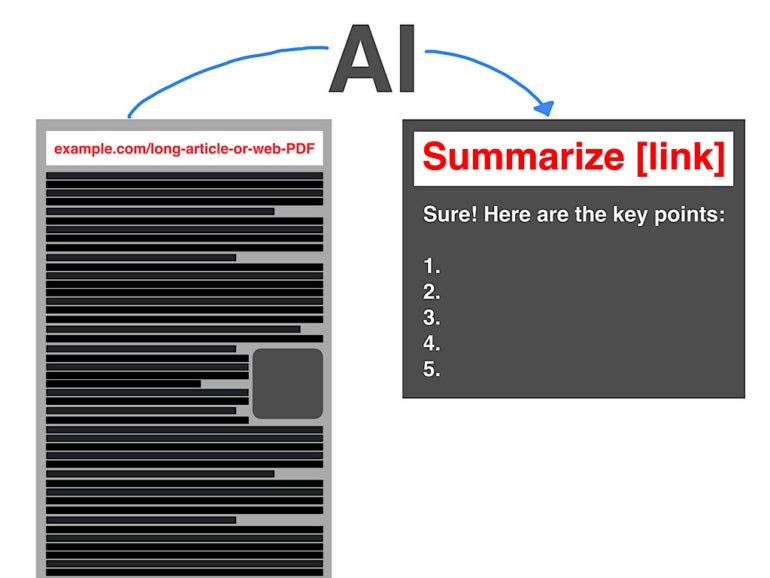
A long article, and an AI summary of the article.
Illustration: Andy Wolber/TechRepublic

Asking Bard, Perplexity or Pi for an article summary is a great way to get started with these AI systems.

A great way to familiarize yourself with generative AI systems such as Google Bard, Perplexity and Pi, among others, is to ask for a text summary of a long online article. A summary distills content down to important points drawn from the text provided. Since summarization is reductive, the systems tend to produce relatively reliable responses.

In addition, summaries help demonstrate the difference between AI systems, not only in content but also in style. The length and formatting of the responses varies from system to system. As a result, each of these systems evokes a distinct experience, even when you prompt each of them to perform the same task.

SEE: Firm study predicts big spends on generative AI (TechRepublic)

To experiment with Bard, Perplexity and Pi for AI summaries, follow the steps below. These three AI systems were selected because they are accessible for free, work within any modern browser and can summarize text from articles and PDFs on the web.

To get started: Sign up for the AI system

You may use your Google account to sign up for Bard, Perplexity and Pi.

Bard is only available after you sign in with your Google account. Once you have your account established, you may access Bard in any browser, provided Bard is available in your country. Access may be restricted by an administrator if you use a Workspace account for work or school.

You’ll need an account with Perplexity.ai in order to access Perplexity Copilot, powered by GPT-4. In addition to signing in with Google, you may also sign in with email or an Apple account. Perplexity offers an Android and iOS app.

An account with Pi.ai allows you to sync your conversation when you access Pi from various devices, including the Pi app on iOS. You may create a Pi account with a phone number (as of July 2023, this is limited to the U.S., Australia, Canada, Ireland, New Zealand and U.K.) or a Google, Facebook or Apple account.

Copy the link to the long content

Next, when you identify a long article you want summarized, copy the web page URL.

Alternatively, these three AI systems also can summarize the content of a PDF. When you encounter a PDF on the web, rather than downloading the document, right-click and choose Open Link In New Tab (or, on some systems, ctrl-click) to display the PDF within your browser. Then, switch to that tab and copy the URL of the PDF.

The examples used below use reports on AI from Stanford, Pew Research Center and McKinsey Digital as source content, if you wish to experiment with the same sources.

Prompt Bard, Perplexity and Pi to summarize

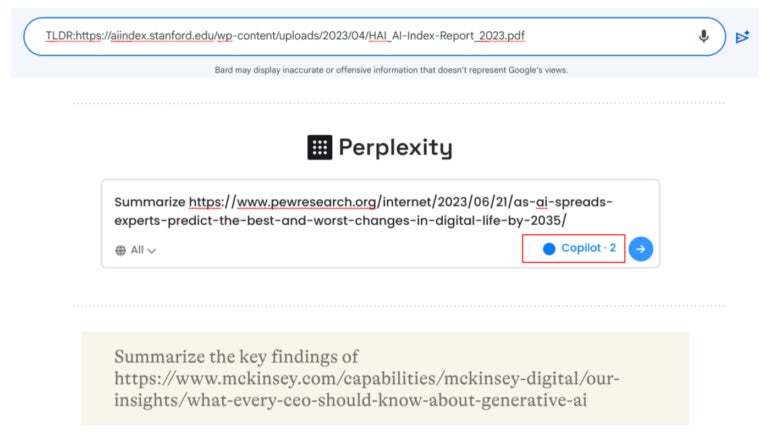
Now, you’re ready to experiment to learn how Bard, Perplexity and Pi each summarize content. You might try any of the following formats (Figure A) to prompt a response from each of these AI chatbot systems:

  • Summarize [link]
  • Summarize the key findings of [link]
  • TLDR:[link]

Figure A

Bard (top), Perplexity (middle) and Pi (bottom) all offer the ability to summarize articles and PDFs on the web, with prompts such as TLDR: (top), Summarize (middle) or Summarize the key findings (bottom).

Each system responds in a distinct style, as described below, and the response detail and format may vary with different prompts.

Google Bard

Bard tends to provide a well-formatted summary, often with bulleted points. Much like a scholar eager to share knowledge, Bard usually covers the core concepts along with a few additional facts. For example, Bard often responds with a section of key findings that are then followed by a separate section that starts, “Here are some…” additional details (Figure B).

Figure B

Bard summarizes key items and adds details for good measure.

One notable quirk when prompting Bard with a TLDR prompt: Be sure to include the colon and leave no space between the colon and the link (Figure A, top). Omitting the punctuation or leaving a space may produce a response that indicates the system only supports a subset of languages. Prompt with TLDR: immediately followed by your target link — with no space between the colon and the link — and you’ll likely obtain a useful and relevant response.

Perplexity

To obtain the highest quality responses from Perplexity, you’ll want to adjust the slider (Figure A, middle) to route your prompt to Perplexity Copilot, which relies on GPT-4. Perplexity limits the use of Copilot prompts to five uses every four hours, as of June 2023, in the free edition.

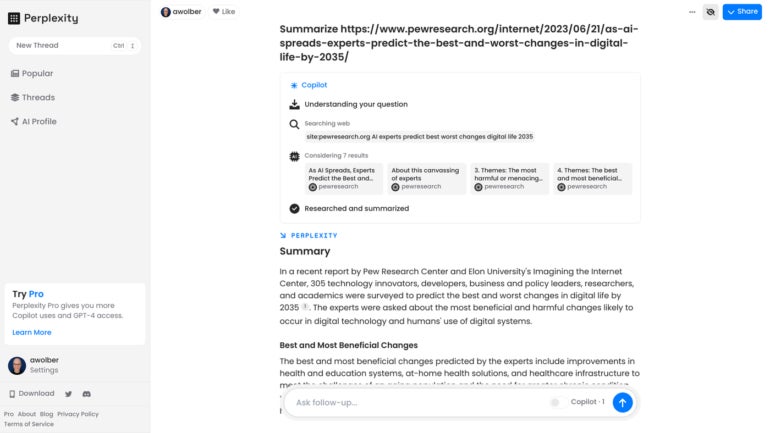
Perplexity responses display with source reference numbers inserted at the end of sentences (Figure C). For each response, you may scroll to the end of the response to then follow the cited links. The system also tends to provide a mix of multisentence paragraphs and bulleted points. The combination of the footnotes and paragraph formatting can convey the feel of a formal academic paper.

Figure C

Perplexity summarizes content and cites referenced links, as indicated by the 1 shown here following the phrase "digital life by 2035" in the first paragraph of the Summary response. 
Perplexity summarizes content and cites referenced links, as indicated by the 1 shown here following the phrase “digital life by 2035” in the first paragraph of the Summary response.

Pi

Pi offers the most minimal interface of these three AI systems (Figure D), displaying text on an otherwise nearly empty screen. The design places all the visual emphasis on the text interactions between you and Pi.

Figure D

Pi provides a minimalist design that emphasizes the text chat experience.

Pi typically summarizes with a brief and accurate response. Much like a seasoned interview subject, Pi provides a couple of paragraphs or a few points and then stops, in essence leaving it up to you to prompt for additional details. When you do, Pi tends to reply with concision. Interacting with Pi can feel very conversational as you engage in a prompt-and-response sequence about the aspects of an article or PDF that interest you.

Follow up with another prompt

For any of these systems, if the initial response is sufficient for your needs, then the AI system has served you well. But, unlike a standard keyword search, part of the value of these systems is that you can follow up (Figure E) with a continued query about AI capabilities. Ask any of these systems for a summary, read the response and then prompt again.

Figure E

With these AI systems, you may ask follow-up questions related to the original query, as shown here with Pi.

Subscribe to the Innovation Insider Newsletter

Catch up on the latest tech innovations that are changing the world, including IoT, 5G, the latest about phones, security, smart cities, AI, robotics, and more.

Delivered Tuesdays and Fridays Sign up today

Mining Companies Consider Repurposing Idle GPUs to HPC and AI Markets

Mining Companies Consider Repurposing Idle GPUs to HPC and AI Markets July 7, 2023 by Agam Shah

Crypto companies that loaded up on GPUs in data centers for coin mining are now investigating whether to sell or repurpose the idle hardware to the exploding artificial intelligence market.

Hive Blockchain, which has 38,000 Nvidia GPUs, is repurposing the hardware for high-performance computing and artificial intelligence applications. The company started rethinking about what to do with its GPUs — which are still used to mine Bitcoin and Ethereum — after the crypto market crashed.

Crypto companies are realizing that GPUs could generate more money running AI or cloud operations. Hive ran a pilot program where it dedicated its GPUs to AI and high-performance computing, which was a success.

“We have much to accomplish to utilize our full fleet of GPU cards, however we are very pleased that our beta project with only approximately 500 GPU cards generated $230,000 revenue this quarter,” said Frank Holmes, the company’s executive chairman, in a filing within the last month.

Cryptocurrency mining companies are operating in a volatile market as Bitcoin prices crashed in late 2021. Hive noted that Bitcoin prices averaged 49% lower than last year.

The crash in coin prices coincided with software changes that reduced the reliance on GPUs for mining.

Mining companies especially felt a lot of pressure after Ethereum’s software switch from the older proof-of-work system to the proof-of-stake model. The newer system — which was implemented to reduce the energy consumed by data centers – did not require the fastest chip to earn Ethereum, which cut the reliance on GPUs to mine coins.

Nvidia H100 die.

But the general-purpose nature of GPUs has remained an asset for Hive. The demand for GPUs is soaring with artificial intelligence, and Nvidia’s latest GPUs are in short supply. Hive has older Nvidia GPUs, which are also in demand for AI inference.

The crypto market’s volatility is also forcing Sysorex, a government services company, to reconsider what to do with its 12,000 GPUs. The company’s subsidiary, TTM, which focused on cryptocurrencies, left the mining business after Ethereum switched its software model.

As a result, Sysorex does not know what to do with its valuable stash of GPUs. The cryptocurrency business model is broken, and repurposing GPUs for other applications was not feasible as it would require additional upfront data center investments, Sysorex said in a June 30 filing with the U.S. Securities and Exchange Commission.

“TTM Digital is currently exploring alternative uses and sales opportunities for its Graphics Processing Units (“GPU”) assets and datacenter located in Lockport, NY,” Sysorex wrote.

Miners were previously a headache for Nvidia and AMD. The companies saw unexpected revenue jumps and declines from GPU sales to crypto miners, which made projections difficult. Miners also paid premiums and gobbled up the limited GPU supplies during chip shortages.

The chip makers ultimately made changes to ensure GPUs went to the core audience of gamers and were unattractive to miners. in addition, Intel discontinued its Bitcoin ASIC called BlockScale earlier this year.

The shortage of GPUs and over-reliance on Nvidia GPUs for AI computing is also forcing customers to source alternative chips from other chip makers. Intel and AMD have introduced GPUs for AI, but are currently not shipping the chips in large volumes.

AI is trending in the direction of large-language models like OpenAI’s ChatGPT and Microsoft’s BingGPT, which require large GPU laden clusters. But, open-source developers and companies such as MosaicML have also been introducing open-source models that can also run locally on laptops and desktops for Inference computing (i.e running models that were trained on GPU clusters on new data). Intel also has included AI accelerators in its new CPUs that provides inference processing.

This article first appeared on HPCwire.

Related

So, how are Europe’s startups doing?

So, how are Europe’s startups doing? Haje Jan Kamps 8 hours

Welcome to Startups Weekly. Sign up here to get it in your inbox every Friday afternoon.

I’ve been keeping an eye on the European startup ecosystem since well before I moved to the U.S., and today’s report from Creandum about the state of venture investing in Europe gave me pause. This, along with PitchBook’s report of what happened across the pond last year, adds up to a complex picture.

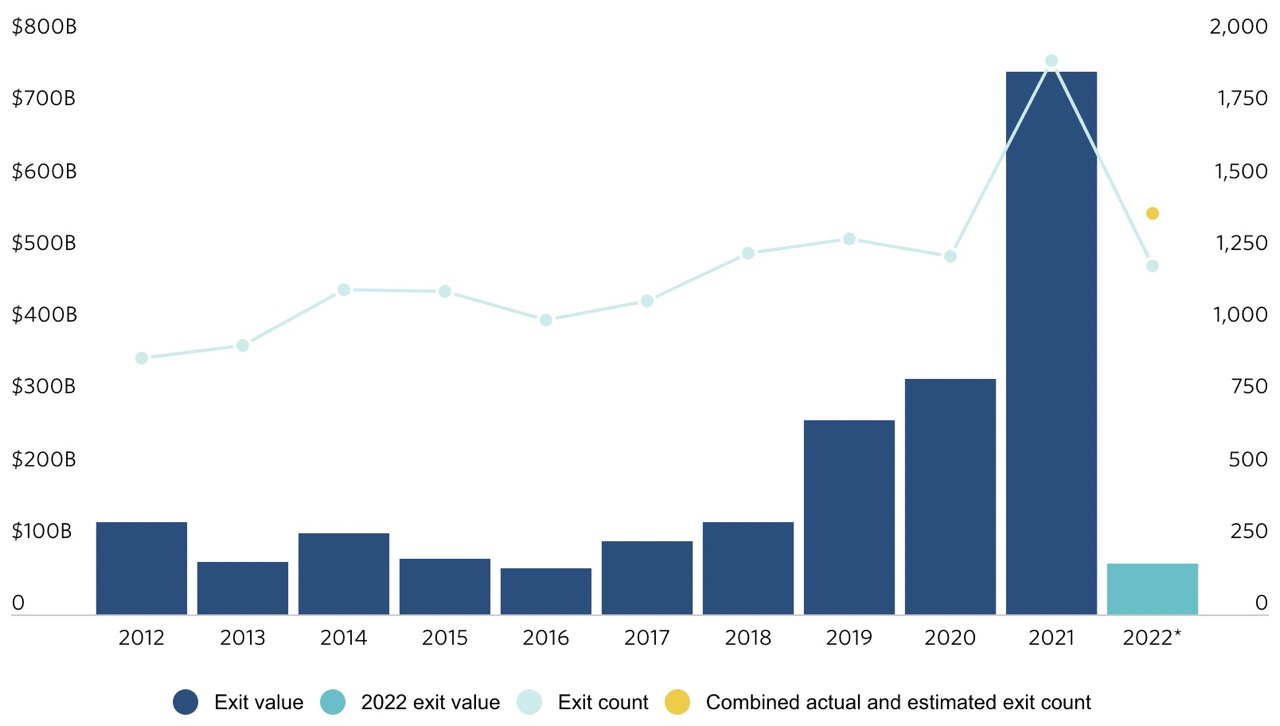
As far as I can see — and as I discussed in my column this week — the ecosystem in Europe continues to be pretty fragmented and immature, and investment across the pond took a 16% dip in 2022 compared to 2021. That isn’t unique to Europe, of course; 2022 was hard across the board, and compared to the years before, there were very few liquidity events across the startup world:

Data from PitchBook shows that exit values in 2022 were dismal. Image Credits: PitchBook

All around, 2022 was a dismal year: We haven’t seen this little M&A and IPO activity since 2016. The total value of exits in 2022 was $71 billion. The year before, it was more than ten times that.

Bad years happen, but I’m going to keep a very close eye on how quickly the VC markets bounce back. My suspicion is that the U.S. venture industry is more resilient in the face of a slow year or two and that LPs are less easily spooked. In other words, it’s going to be telling to see who raises new funds, where, and with what investment theses over the next three to five years.

Health tech is sticking its tongue out, saying aaaaaaaaaah

Stethoscope with dollar shaped cord standing on turquoise background. Vignette effect applied.

Image Credits: adventtr (opens in a new window) / Getty Images

Spotify co-creator Daniel Ek’s new company raised a $65 million round of funding for his preventative healthcare startup Neko Health — all the more impressive given that this is reportedly the first external round of financing for the Stockholm-based company.

Lightspeed Ventures made its first investment in Africa, backing Berry Health, which aims to bring judgment-free healthcare to a continent where stigma cuts deep and is affecting many.

News of the fresh rounds comes on the heels of a healthy amount of activity in health tech — Public Ventures launched a $100 million impact fund focusing on nascent life science and clean tech startups, particularly in Canada.

Break out the X-ray vision: Ingrid reports that Augmedics snaps up $82.5 million to improve the outcome of spinal surgery using AR and AI.

He loosened his silk rainbow bow tie. Things were about to get spicy . . .: I wrote about how sex toy company Lovense is leaning into the AI craze, using ChatGPT to whisper sweet, customizable fantasies into your ear holes.

A run for your money: Ingrid wrote about Munich-based EGYM, which raised $225 million from Jared Kushner’s Affinity Partners to make the gym smarter and less sucky.

It’s handbags at dawn for social media

twitter bird logo pattern overlaid with exit sign

Image Credits: Bryce Durbin / TechCrunch

If you’ve stumbled across the TechCrunch homepage in the past week, then you’ve seen our wall of coverage on the utter drama-fest that is the social media landscape at the moment. Investment giant Fidelity already adjusted down its Reddit valuation a month ago, but Manish reports that it further deepened its valuation cuts for Reddit this week, after the Reddit protest plunges user engagement.

If you look beyond the Reddit dumpster fire for a fraction of a second, the rest of social media is aflame as well. Twitter competitors soar after Musk makes another boneheaded move, and Paul argues that its competitors need to get their act together in order to become a true competitor.

Apropos competitors, Meta’s Twitter competitor Threads went live and quickly passed 2 million downloads in just two hours, and more than 30 million in a day. I know, I didn’t really see it coming either, but TechCrunch compiled an all-your-questions-answered article about Threads. My first impression? The app isn’t great, but Instagram’s network effect is formidable, and Twitter has been screwing up so monumentally since Musk’s acquisition that it may just be all it takes to put the bird app in its grave.

That’s a pass from us, mon frère: Natasha L points out that Meta’s Threads app is a privacy nightmare and that it won’t launch in the EU yet. This follows a report that a bunch of tech giants are having to figure out how to respond to the EU’s rebooted antitrust regime.

Money didn’t bring API-ness: Ivan ponders what’s happening over at Reddit as the social media site braces for life after API changes.

Lawsuits from a parallel universe: Devin reports that a Louisiana judge silenced White House social media talks in a lawsuit that seems pretty wild. He writes, “It’s almost pitiable how desperately the lawsuit peddles its conspiracy theories, making out routine emails to be collusion and [the] removal of rule-violating content as censorship.” So . . . that’s fun.

Take down those tweets: While we’re on the topic of wild court cases, Twitter was trying to wriggle out of a case in India, but the judge didn’t mince words: “Punishment for non-compliance is 7 years imprisonment and unlimited fine.” Needless to say, Twitter’s plea against India’s government was dismissed, although the core of the case is still curious: Twitter has been asked to take down hundreds of accounts and tweets, often for denouncing the Indian government.

Skynet awakens

Image Credits: Getty Images / sompong_tom

AI is everywhere, but never has it been so confusingly head scratching as in the case of Humane’s first product: The Ai Pin. The secretive startup has been around since 2018 and has reportedly raised more than $230 million since then — and I can’t for the life of me figure out why this is better than just saying, “Hey, [voice assistant],” into your nearest smart device. Someone, please, explain it to me.

Did I mention that AI is hot? In the past couple of weeks, I had two founders reach out to me for fundraising advice, only to get back to me a couple weeks later with an “lol, I guess we don’t need help; we just got several term sheets.” The right teams are raising formidable amounts of funds as the FOMO sets in among investors. One example is Typeface, which is building generative AI for brands and just announced a $100 million raise at a $1 billion valuation.

On top of that, one of the wilder stories we’ve seen so far was a founder selling its four-month-old “OpenAI for China” play for $234 million. That means the startup gained about $2 million of valuation per day from starting to acquisition. Yowzers.

Incidentally, if someone wants to share some AI-related decks for my Pitch Deck Teardown series, I wouldn’t be mad.

Yes, this is definitely Bobby’s mother. He cannot come to school today: Ingrid reports that Voice.ai raises $6 million as its real-time voice changer approaches 500,000 users.

Hey, robot, you grab the crayons, I’ll make the coffee: Kyle reports that Runway raised $141 million as it builds generative AI tools for content creators.

We can’t measure this, but it’s definitely 10x better: Over on TC+, Software.com co-founders Geoff Stevens and Brett Stevens argue that the productivity boosts developers see by using AI are a bit of smoke and mirrors — not least because nobody seems to agree on how to measure productivity among software developers in the first place.

Top reads on TechCrunch this week

Bad horndog, no porn for you: Amanda reports that Pornhub blocks access in Mississippi, Virginia and Utah amid changing laws related to mandatory age verification for adult sites. Instead of trying to do age verification through checking your government-issued ID as requested by law, Pornhub took a different approach. Go to the site from one of the blocked states, and you’re met with a video where adult performer Cherie DeVille explains why age verification systems are a bad idea.

Working remotely, or not remotely working: On TC+, Becca argues that remote work startups that will last aren’t actually, technically, remote work startups. Instead, companies that focused on remote work are tapping into trends that were already in play, with more autonomy and more flexibility, wherever you are working from.

Taking a bite of the Goldman Delicious apple: Goldman may be “looking for a way out” of its high-profile deal with Apple, which recently expanded to include savings accounts for Apple Card holders, Harri reports.

Slow, slow, then fast: There’s something to be said for laying the groundwork for a company before raising venture capital, but Romain’s report this week is an outlier: After bootstrapping for eight years and growing to $16.4 million of annual revenue, French accounting startup Dougs raised $27 million.

Get your TechCrunch fix IRL. Join us at Disrupt 2023 in San Francisco this September to immerse yourself in all things startup. From headline interviews to intimate roundtables to a jam-packed startup expo floor, there’s something for everyone at Disrupt. Save up to $600 when you buy your pass now through August 11, and save 15% on top of that with promo code STARTUPS. Learn more.