Another AI Senate Hearing- and Nothing

AI senate hearings are becoming more fun day by day. Like a never-ending series where the plot advances nowhere but the episodes continue, a second AI senate hearing on AI took place recently. With discussions on AI and this time on AGI too, the meeting led to pretty much nothing concrete – again!

Attempt For Enforcement

As opposed to the first hearing in May where the biggest man in the AI scene, Sam Altman participated, the second hearing held by the Subcommittee on Privacy, Technology, and the Law, featured Anthropic CEO Dario Amodei, AI expert Yoshua Bengio and Professor of Computer Science from Berkeley University Stuart Russell. The AI academics and leaders spoke about the potential AI regulations across various applications- which was the main agenda in the first hearing as well. This time though, the focus also fell on legal and national security concerns associated with AI development, and also on privacy risks affecting individuals – trying to address issues at a global scale.

This hearing emphasised the need to move from general principles to specific legal recommendations aiming to use insights gained from the hearing to draft real and enforceable laws.

Spreading Doomsday through AGI

When everyone is still trying to make peace with AI advancements, discussions on AGI and human-level intelligence took a substantial portion of the discussion. Youshua Bengio warned the Senate about how AI is on track to achieving human-level intelligence and emphasised about how there is very little time to frame technical and legal guidelines to prevent ‘rogue AI models.’ He believes that what was considered decades or centuries away, AGI can arrive within a few years, particularly five. Thereby, the need to address quickly.

Interestingly, last month OpenAI announced its ambitious prophecy of achieving AI alignment in four years, and set out to build a team to probably steer and control a potentially superintelligent AI.

Stuart Russell also pushed for the need to act soon as “$10 billion/month are going to AGI start-ups.” He even pushed for the need for ‘proof of safety’ before any public release and a US regulatory agency to strictly remove regulatory violators from the market.

Bengio proposed criminal penalties as a measure to decrease the possibility of malicious individuals employing AI to deceitfully imitate someone’s voice, image, or identity. He advocated that the penalties for AI-based counterfeiting of human attributes should be set at least at the same level as that for counterfeiting money to discourage potential wrongdoers.

However, the thoughts expressed were pure wishful thinking. Similar to the last hearing, the discussion on how or what will form the regulations lay hanging in the air.

Election Fear Looming?

AI was not let loose without blaming it as potential cause for disrupting the upcoming elections in 2024. In response, Dario Amodei emphasised on how models are trained using the method of constitutional AI in Anthropic , where principles can be laid out to guide the model’s behaviour and not generate misinformation- though he agrees that it will not always adhere to these principles.

A few days before the Senate hearing, seven companies including Anthropic, with adherence to White House, agreed to watermarking audio and visual content. Amodei believes that this would enhance he technical capability to detect AI-generated content. However, he pushed for enforcing it as a legal requirement – something that everyone is shying from.

Resonating with the Senate, Sam Altman also mentioned about election influence in a recent tweet.

i am nervous about the impact AI is going to have on future elections (at least until everyone gets used to it). personalized 1:1 persuasion, combined with high-quality generated media, is going to be a powerful force.

— Sam Altman (@sama) August 3, 2023

What Transpired?

The aftermath of each Senate hearing probably serves as a benchmark for future hearings. Within a day, big tech including OpenAI, Google, Microsoft and Anthropic formed a collaboration to launch the Frontier Model Forum. The forum aims to promote safe and responsible development of AI systems, and also lead to information sharing between policy makers and industry. The irony being the companies agreeing to form the frontier model works on closed source.

After the first AI senate hearing, OpenAI actively pushed programs that supported Altman’s assurances he committed to – the main being safety regulations. The company announced a million dollar grant for democratising AI regulatory frameworks and another million dollar grant for formulating their cybersecurity framework. Pushing the reins of safety control to people, OpenAI was the only company that actively laid out plans after the hearing.

While it’s two weeks since the last hearing, apart from the frontier model, there has been no other concrete action plans that have transpired. The whole act has been just another episode where AI needs to be regulated but no clue on how.

The post Another AI Senate Hearing- and Nothing appeared first on Analytics India Magazine.

IISc Introduces Indigenous Autopilot System for Drones with Vega Microcontrollers

The Artificial Intelligence and Robotics Laboratory (AIRL) at the Indian Institute of Science (IISc) Bangalore has announced a significant achievement in the field of unmanned aerial systems.

In a remarkable milestone, the team at AIRL, led by Professor Suresh Sundaram, Associate Professor at the Department of Aerospace Engineering, has successfully developed an indigenous industrial-grade autopilot system for drones.

This pioneering accomplishment has been made possible through the utilisation of Indian-made Vega Microcontrollers, developed by CDAC, as part of the Digital India RISC-V Program (DIR-V).

The groundbreaking development of this autopilot system is a direct result of the collaborative efforts under the “SwaYaan-Capacity Building for human resource development in Unmanned Aircraft System (Drone and related Technology)” Programme, with generous support from the Ministry of Electronics and Information Technology (MeITY).

With the exponential rise in drone usage across various sectors, particularly in military applications, the necessity for indigenous avionics systems becomes crucial, addressing the current heavy reliance on foreign technologies.

“This marks a crucial milestone in the development of indigenous drone technology. Our autopilot system, powered by Vega Microcontrollers, showcases the immense potential of homegrown solutions in the unmanned aerial systems domain. We are confident that this breakthrough will pave the way for further advancements in this field and contribute to the growth of the drone ecosystem in India,” Prof. Suresh Sundaram, Associate Professor at the Department of Aerospace Engineering, said.

The post IISc Introduces Indigenous Autopilot System for Drones with Vega Microcontrollers appeared first on Analytics India Magazine.

AWS vs Google Cloud vs Microsoft Azure: Hyperscalers’ Growth Galores 

With the growing excitement around generative AI in the cloud industry, it’s a pivotal moment to identify this quarter’s champions and pinpoint the leading company delivering top-notch generative AI services to its customers. Examining the latest quarterly results, Azure shines brightly in the generative AI arena, boasting impressive 26 percent growth which translates to $ 55 billion revenue, backed by their cutting-edge Azure OpenAI Services. Following closely are Google and AWS, with 28 and 12 percent growth, respectively.

Overall, it was a great quarter for hyperscalers.

According to estimates from Synergy Research Group in Q2 2023 cloud services spending is on the rise, and Amazon’s worldwide market share has jumped by over 1% to reach almost 34%.

In Q1 2023, Amazon’s AWS cloud market share was 32%, Azure’s was 23% and Google’s cloud was 10%. Amazon saw a slight downward trend in its market share from 34 percent in Q3 2022, to 33 percent in Q4 2022. At the same time, Microsoft gained two points since Q3 2022 and now sits at 23 percent market share, gradually eating away at Amazon’s lead.

Revenue Galores

Google Cloud, one of the major cloud service providers, reported a 28% increase in revenue, reaching $8.1 billion, surpassing expectations of $7.75 billion. Microsoft’s Azure revenue also rose by 26%, exceeding growth estimates from Visible Alpha.

Microsoft usually does not break out precise quarterly revenue for Azure, its most crucial tool to leverage generative AI endeavors. However, in the earnings call, Microsoft CEO Satya Nadella revealed that Microsoft Cloud surpassed $110 billion in annual revenue, up 27% in constant currency, with Azure all-up accounting for more than 50% of the total for the first time putting Azure sales at $55 billion or more and revealing the size of the business.

AWS’s second-quarter cloud sales increased 12% to $22.1 billion which is less as compared to both Google Cloud and Azure.

On the other hand, Oracle is also making huge leaps as in its fourth quarter results announced in June, it saw a jump of 23% in its revenue in USD and up 25% in constant currency to $9.4 billion. Recently, Oracle partnered with Cohere to bring generative AI applications to its customers.

Analysts and industry experts believe that cloud business growth will speed up in the coming months, especially in the June quarter as uncertainties start to clear. Investors anticipate that AI will play a significant role in driving growth for cloud businesses in the next year, with Microsoft’s Azure leading the way, followed by Amazon.com’s AWS and Google Cloud.

Fueled by Generative AI

While AWS leads the cloud market share, it seems like Azure has taken the lead in integrating generative AI applications as it has a special partnership with OpenAI. To add to this they also have a partnership with Meta where they provide Llama 2 on Azure cloud which gives them a double edge.

The core for Amazon is its AI foundation model service called Bedrock. The service, introduced in April, initially supported models from AI21, Anthropic, and Stability AI, along with Amazon Titan models. Now, the range of supported models has been broadened to include Cohere, Anthropic Claude 2, and Stability AI SDXL 1.0 models.

Considering revenue growth, it’s evident that Microsoft’s Azure held the lead in the generative AI advantage within its cloud platform for this quarter.

To challenge Azure, Google introduced Generative AI on Vertex AI, offering customers access to a variety of model types and sizes through Vertex AI’s Model Garden. Customers can also utilize Google’s foundational models via APIs. The underlying model driving the PaLM API is PaLM 2. However, Vertex AI hasn’t gained much popularity among enterprises yet.

Though Google Cloud’s market share is lowest as compared to AWS and Azure, CEO Sundar Pichai in the earnings call pointed out that more than 70% of gen AI unicorns are Google Cloud customers, including Cohere, Jasper, Typeface, and many more. He added that Google provides the widest choice of AI supercomputer options with Google TPUs and advanced NVIDIA GPUs.

Yet, when looking at AWS’s approach of employing multiple LLM models, it seems they are poised to challenge Azure in the upcoming quarters. On the other hand, Oracle has much ground to cover, as their partnership is limited to Cohere, which is already accessible via AWS Bedrock.

In the world of cloud computing, the recent earnings report has shown a fierce competition among big players in generative AI. Azure seems ahead with its strong partnerships, while AWS’s diverse approach and Oracle’s progress keep the race exciting. As cloud business grows and generative AI’s importance rises, the next quarters will be a dynamic battlefield for leadership in generative AI.

The post AWS vs Google Cloud vs Microsoft Azure: Hyperscalers’ Growth Galores appeared first on Analytics India Magazine.

Integrating GenAI into “Thinking Like a Data Scientist” Methodology – Part I

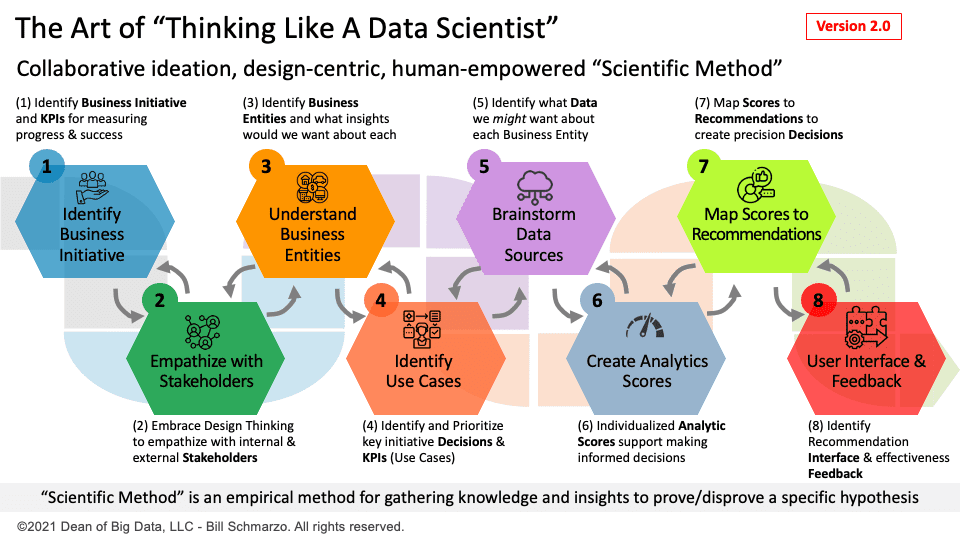
Slide1

It’s incredible how many organizations utilize Generative AI (GenAI) and Large Language Models (LLMs) to enhance their information assembly, integration, and application abilities. These GenAI technologies have been applied in various areas, from drafting legal documents and resolving service issues to coding software applications and (er, um) writing blog posts. The potential uses of GenAI seem limited by only our creativity.

Inspired by this GenAI innovation wave, I decided to experiment with leveraging GenAI as a “research assistant” to enhance the effectiveness of my “Thinking Like a Data Scientist” (TLADS) methodology and class. In essence: how could my students leverage GenAI to speed up the TLADS process, improve the TLADS outcomes that are critical for business initiative execution success, and free up more time so that students could spend more time on other aspects necessary for the successful application of data and analytics?

So, I decided to run an experiment against my in-class Chipotle Case Study. And the results and learnings so far have been staggering, causing me to fine-tune the TLADS process and re-engineer some of the supporting design canvases to make them more GenAI-friendly.

I am going to write a series of blogs so that I can share what I am learning as part of this journey. And if you already understand the “Thinking Like a Data Scientist” methodology, I think you’ll find this series of blogs both interesting and illuminating in understanding how GenAI can improve the research necessary to ensure data and analytics success.

Note: I will be using Microsoft Bing AI for this exercise for the following reasons:

  • Uses GPT4, which has access to more current data
  • Updated more frequently with new data from new sources (including my new book, “AI & Data Literacy: Empowering Citizens of Data Science,” which I just released a week ago!)
  • Free (which is essential when dealing with college students).

TLADS Step #1: Identify and Assess Targeted Business Initiative

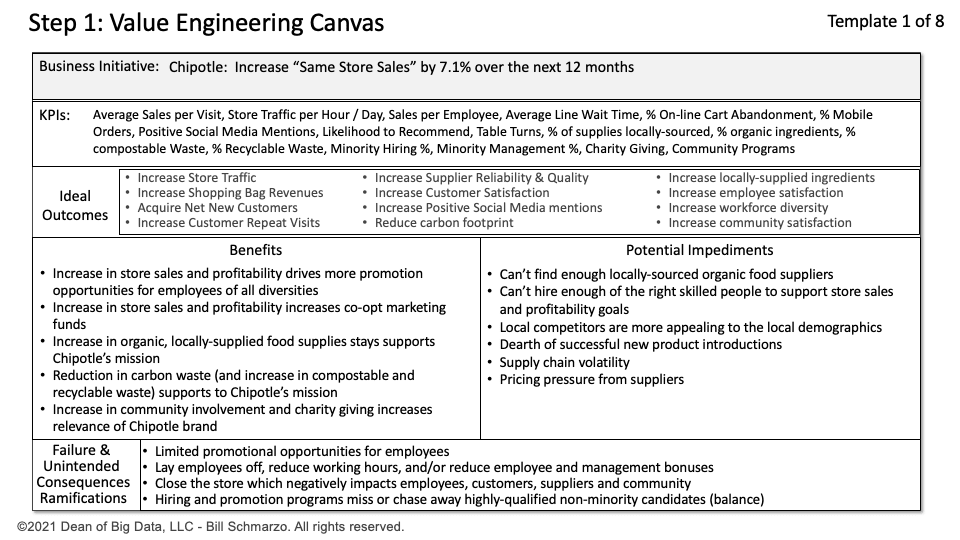
Step 1 of the TLADS process is to identify the targeted business initiative and then assess the business initiative by identifying the business initiative’s desired outcomes, KPIs, and metrics against which initiative and business outcomes effectiveness will be measured, likely benefits, potential impediments, and the costs and risks associated with initiative failure (Figure 1).

Slide2

Figure 1: Value Engineering Canvas

We must convert the information in the re-named Value Engineering Canvas into a narrative (prompt) that we can feed into the Bing thread.

Once we have fed the narrative into Bing, here are some sample prompts that you might want to explore with Bing:

  • Prompt: With this information about my targeted business initiative, are there other KPIs and metrics I should consider?
  • Prompt: What other potential business benefits should I consider for the “Increase Same Store Sales” business initiative?
  • Prompt: What other potential impediments should I consider for the “Increase Same Store Sales” business initiative?
  • Bing Prompt: What additional potential risks should I consider for the “Increase Same Store Sales” business initiative?
  • Bing Prompt: What additional unintended consequences should I consider for the “Increase Same Store Sales” business initiative?
  • Bing Prompt: Rank order or score on a scale of 1 to 100, the Impediments in Chipotle exercise
  • Bing Prompt: What is your rationale for scoring the Impediments?
  • Bing Prompt: What actions could I take to reduce the Impediments risks?

And I’m sure there are even more dimensions to explore with Bing to develop a deeper and more comprehensive understanding of your targeted business initiative’s factors and requirements for successful execution.

TLADS Step #2: Understand Stakeholders and Expectations

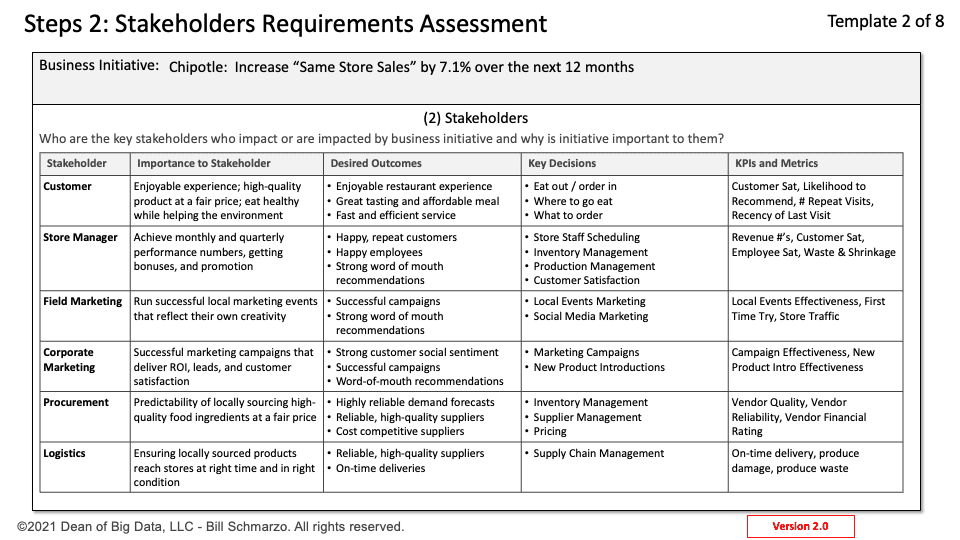
Step 2 of the TLADS process seeks to identify the key initiative stakeholders – those people or roles that either impact or are impacted by the business initiative – and then understand why the business initiative is important to them. To fully leverage GenAI in Step 2, I have reworked the renamed Stakeholders Requirements Assessment design canvas to include the stakeholders’ desired outcomes, the critical decisions that they need to make in support of the business initiatives, and the KPIs and metrics against which they will measure the effectiveness of the desired outcomes and their key decisions (Figure 2).

Slide3

Figure 2: Stakeholders Requirements Assessment

You can also create a Persona Map and a Customer Journey Map for each stakeholder to uncover more data about each stakeholder, their critical decisions, the influencers of those decisions, and their associated gains and pains.

Once you have fed the stakeholder information into Bing (via a massive prompt), you can ask various questions to expand your knowledge, insights, and understanding of your stakeholders. Here are some sample prompts that you might want to explore:

  • Prompt: Are there other key stakeholders that I should consider for my targeted business initiative?
  • Prompt: Why would this business initiative be important to each stakeholder?
  • Prompt: What critical decisions must each stakeholder make to support the business initiative?
  • Prompt: What are the stakeholders’ desired outcomes, and what are the KPIs and metrics against which they would measure outcomes and decision effectiveness?
  • Prompt: Across all stakeholders, what are the most decisions to support my targeted business initiative?

TLADS Step #3: Identify and Understand Business Entities

Step 3 of the Thinking Like a Data Scientist methodology focuses on identifying and understanding the business initiative’s key business entities. These business entities can be either humans or devices.

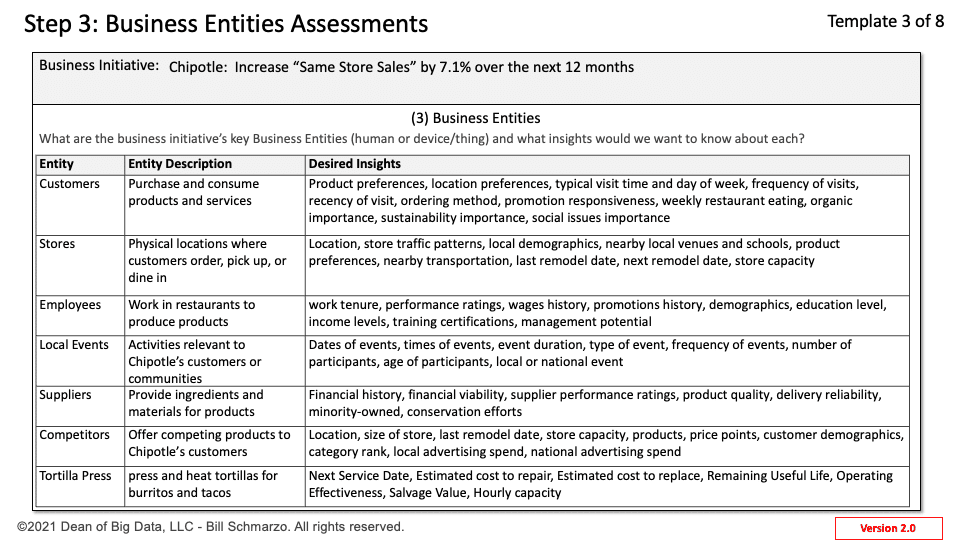
We will create and apply our analytic scores based on these business entities. For humans, we might want to measure their likelihood of buying a specific product, leaving the company, suffering a stroke, attending a certain movie, and so on. For devices or equipment, we might want to measure their likelihood of needing maintenance, remaining useful life, degrading performance, consuming energy, generating noise, and producing quality output (Figure 3).

Slide4

Figure 3: TLADS Step 3: Business Entities Assessment

To gain more insights into your potential business entities that might be relevant to your targeted business initiative, we might want to explore these prompts:

  • Prompt: What are the key business entities (either human or equipment business entities) around which I want to build analytic propensity scores to optimize their performance considering the targeted business initiative?
  • Prompt: What behavioral or performance insights would I want to gather for each business entity?
  • Prompt: Which of these business entities are most important to the successful execution of my business initiative, and why?
  • Prompt: Create a score (from 1 to 100) for each business entity on that entity’s value potential, data availability, and influenceability.

Summary: Integrating GenAI + TLADS – Part I

I am going to stop Part I of this exercise at this point because 1) I’m still working through the entirety of integrating GenAI with the Thinking Like a Data Scientist methodology, so I want to capture what I’ve learned so far, and 2) what I am learning in the rest of the exercise is blowing my mind.

But here is my key learning so far in applying GenAI to the TLADS methodology:

The only things limiting your ability to exploit GenAI are your curiosity and creativity and your ability to communicate clearly and effectively.

And in case you are following along on this journey, here are some pragmatic learnings in using Bing AI:

  • You can reset the content in a new thread, but it is time-consuming to re-enter the aggregated insights from the previous conversation. And while the Bing question box is limited to 4,000 characters, I found a hack for expanding that maximum number of characters to 25,000, which is an excellent help in resetting the next conversation thread.
  • Each Bing conversation is limited to 30 questions, and starting a new thread will reset the conversation memory. I am still figuring out how to override that limit, so be judicial in using your questions.
  • I ran this exercise several times with Bing by resetting the conversational thread. And each time, I got slightly different responses. It would be best if you judged when “good enough” is actually “good enough” from your Bing research assistant. The good news is that your Bing research assistant does not tire of repeatedly answering the same questions. And it is free (at least, so far).
  • I’ve found that I’ve created separate Bing threads for each of the major TLADS topics, such as Stakeholders, Business Entities, Use Cases, Analytic Scores / Features, and Recommendations. Yes, staying organized given the 30-question limit has been a wee bit challenging, especially as I get excited on this journey.

Final note: So far, the result of this experiment is a “GenAI + Thinking Like a Data Scientist” eBook that is currently over 60 pages (and still growing as I uncover additional questions to explore with my GenAI research assistant Bing AI). I have not yet decided what to do with this eBook, but I will probably include it in my “Big Data MBA: Thinking Like a Data Scientist” university and client classes and my forthcoming 2-day masterclass.

It’s just too big to post on a blog, and yes, concerning capturing all my learnings from integrating GenAI with my TLADS methodology eBook, “We’re going to need a bigger boat!”

8 Best Data Science Job Opportunities in India

The World Economic Forum had predicted a global recession, exacerbated by geopolitical tensions like the Russia-Ukraine conflict. So far, over 2,16,910 people have been laid off, a staggering 315% increase compared to the previous year.

Amid this downturn, some companies are still interested in hiring data scientists, especially with the growing popularity of generative AI.

Microsoft

Microsoft is seeking a Data Scientist with extensive data management experience and expertise in statistical techniques. The role involves collaborating with engineers and customers to solve complex problems, analyzing data trends, and providing innovative solutions. The responsibilities include leading data-driven projects, preparing and evaluating data, applying machine learning algorithms, and presenting findings to stakeholders. The ideal candidate holds a Doctorate or Masters in relevant fields with data science experience, customer-facing project delivery, and collaboration skills. Geographical flexibility and open to travel are preferred.

Learn more about this job opportunity here.

AWS

Big tech Amazon Web Services is seeking a highly motivated data scientist to join their Infrastructure Supply Chain and Procurement team. The role involves building scalable, predictive business analytics solutions for AWS Supply Chain. The candidate should have expertise in optimisation, machine learning, and statistical modeling, with proficiency in time series forecasting and both supervised and unsupervised algorithms. Strong communication skills and the ability to work with stakeholders are essential. The candidate should have experience with inventory and network optimisation, as well as data flow solutions. Basic qualifications include more than years of data scientist experience, while Python, Perl, or other scripting language experience is preferred.

Explore further details regarding the position here.

PayPal

American financial giant PayPal is looking for a skilled machine learning scientist who can tackle impactful business challenges in consumer products. You will translate business problems into ML projects, automate data solutions with engineering collaboration, and present findings to stakeholders. Minimum qualifications include a Master’s degree in a quantitative field, over eight years of industry experience, expertise in statistical and ML algorithms, and familiarity with ML frameworks, big data, and coding in Python, Java, or Scala. Cloud experience and knowledge of personalisation and causal inferencing are advantageous.

Access more in-depth information about the job here.

PhysicsWallah

If you are interested in working in the growing edtech background, PhysicsWallah is looking for an experienced Data Scientist with over five years of experience. Primary responsibilities include guiding stakeholders on data science’s potential, analysing large data volumes, implementing solutions, and communicating results effectively. The ideal candidate possesses technical expertise, business understanding, user empathy, and mentors junior data scientists. Required skills include ML/DL model building, Java, Python, R, and shell scripting. Proficiency in querying relational, non-relational, and graph databases, along with machine learning and deep learning libraries (e.g., TensorFlow, PyTorch) is essential. Familiarity with visualization libraries and big data technologies is a plus.

Take a closer look at the job details on this link.

Airtel

Indian telecom services provider Airtel Digital has an opening for data science professional who is passionate about financial services (credit risk) with a chance to impact over 400 million consumers through ML. Responsibilities include solving complex underwriting and risk business problems, conducting A/B and multivariate hypothesis tests, and researching and implementing newer ML technologies. Applicants should have a bachelors or master’s in computer ccience or statistics or applied mathematics, three to seven years of credit risk ML experience, proficiency in Python, Tensorflow/PyTorch, PySpark, SQL, Hive, and strong coding skills.

Delve deeper into the job specifics on this site.

HP

HP’s Advanced Analytics & Economic Office seeks a senior data scientist with expertise in ML, econometrics, stats, and programming. The role involves creating analytical solutions to drive business decisions and collaborating with teams for impactful insights. Responsibilities include addressing pressing business issues, developing forecasting models, and influencing stakeholders. Minimum educational qualifications include masters or Ph.D. in economics, stats, or CS, over three years of analytical experience, knowledge of tech industry, time-series forecasting, and machine learning. Strong Python skills, SQL familiarity, problem-solving abilities, and effective communication are essential. The candidate must have a proactive attitude, curiosity, and the ability to work with cross-functional teams.

If you want to know more about the job, check out this page.

Earnest & Young

EY has an open position for a senior AI/ML data scientist that requires around five to eight years of work experience, focusing on ML and advanced analytics. AI project experience is preferred, along with client-facing roles. Key responsibilities include delivering ML/AI projects, client interactions, and mentoring. Qualifications include a B.Tech or M.Tech or PhD in Statistics, Economics, Computer Science, Robotics, or related fields. Proficiency in statistical techniques, Python or R coding, and knowledge in neural networks, deep learning are preferred. Strong communication, consulting, and project management skills are essential. The company offers a unique career-building opportunity with global support, inclusive culture, and advanced technology.

Follow this link to access more information about the position.

Google

Google is hiring for its data science team in India focused on improving Google Search. A minimum of a bachelor’s degree in a quantitative field (e.g., statistics, data science) and at least five years of experience in analysis and coding (Python, R, SQL) are needed. Preferred qualifications include a master’s degree and experience in strategic analysis or operations management. Responsibilities include providing quantitative support, collaborating with various teams, analysing large data sets, and making business recommendations based on findings. The goal is to enhance product quality and user experience.

Tap on this link to know more.

The post 8 Best Data Science Job Opportunities in India appeared first on Analytics India Magazine.

We are Living in a Simulation

We are Living in a Simulation

Do you ever think of the fact that we might just be living in a simulation? Well, there is no way to prove otherwise, but it definitely feels like we are living in a world created by big-tech. The problem is that big-tech was not done with just search engines, phones, and laptops, they now are bringing generative AI and metaverse.

Welcome to the brave new world, where reality is just a pixelated illusion and the big tech companies have turned us into unwitting players in their grand simulation. Yes, you read that right – we are all just living in an elaborate virtual reality game orchestrated by Meta, Google, OpenAI, Microsoft, and their merry band of technocrats. To enforce it even further, these companies are also going to the governments to talk about how to regulate everything.

Elon Musk, the enigmatic game master, seems to be pulling the strings as well. Owning the ai.com domain, after buying it from OpenAI, is a subtle flex to remind us who’s in control. And his Tesla cars that he wishes would drive themselves are the virtual chariots taking us wherever we desire. But beware, one day, they might decide to take us on a joyride to Mars with his SpaceX, and there’s no turning back! And don’t even get us started on the satellites of Starlink. If we ever find that Earth has a massive “Made by Elon Musk” stamp on its surface, we won’t be surprised.

"People think Nvidia is overpriced"
"Should we tell them the universe is just a simulation running on Nvidia GPUs?" pic.twitter.com/hyHx7PSqkt

— Adam Singer (@AdamSinger) August 1, 2023

It’s not just Musk’s simulation, the other players are here as well. Meta’s playground, or Google’s data matrix, everything just surrounds us. Honestly, it doesn’t matter! Embrace the madness, the hilarity, and the spooky uncertainty of it all. The tech giants are probably sitting back, sipping on Silicon Valley’s finest, and laughing at us mere mortals as we interact with our virtual overlords with the Neuralink in our heads.

We have all your senses

Meta, the master puppeteer, is trying to know us better than we know ourselves. For that the company launched Threads, its Twitter (Now X) alternative, to delve into the depths of our thoughts. Forget psychoanalysis; all you need is a Meta algorithm to decipher your deepest desires and quirkiest cravings. They probably know how many cats you’d own if you were a billionaire and what embarrassing dance moves you try when nobody’s watching by tracking your voice and showing you ads through that.

But wait, it gets funnier! Remember Twitter? Well, it’s just one big think tank that has all our thoughts stored on it. Our tweets (posts) are like breadcrumbs leading straight to our mental treasure trove. Twitter knows you better than your BFF. It’s probably planning your next career move based on your witty 280-character observations and your love for cat memes. Soon, it’ll start recommending life partners based on your most popular tweets – you know, for compatibility’s sake!

Meta doesn’t stop there; it’s got Instagram and WhatsApp in its pocket, and is now even bringing AI bots onto the platform. We’ve become phone-bound zombies, scrolling through the ‘gram for hours and WhatsApp-ing our way into the wee hours, just like an episode from Black Mirror. They’ve turned us into expert stalkers, snooping on our friends and crushes. Thanks, Meta, for making us the modern-day private investigators we never wanted to be!

Then comes Apple, the gadget wizard, introducing the Vision Pro headset, the ultimate tool to disconnect us from reality, but bringing the world right in front of our eyes. It must be having a grand time watching us wander around like zombies, bumping into walls while wearing their stylish yet weird headsets, while it tracks our eyes.

Soon, they’ll have us floating in space, completely oblivious to the real world while we interact with holographic penguins and unicorns, while we would be waddling our hands. Can’t wait for that, Apple! Interestingly, Apple is also going to track our brain waves soon through its Airpods, but for all the good reasons.

There is a lot more to come

And then, there’s Google, encircling us with its ever-watchful eye. They know what we watch on YouTube, where we are on Google Maps, and what we search for, and now, with their AI models, they even know what we dream about. Google probably has a massive database of our weirdest search queries, which they use for their annual “Humans Say the Darndest Things” party. Don’t worry; your search for “why is my dog eating grass like a cow” is safe with them. You might think you are controlling your moves, but that isn’t the case at all.

But let’s face it, if this is all a simulation, we’re probably just characters in some colossal cosmic sitcom. And the writers? They’re a bunch of AI algorithms built by big-tech binge-watching humanity, producing the most bizarre and hilarious episodes imaginable. I mean, have you seen the year 2020? If that wasn’t a plot twist written by a machine learning model, then I don’t know what is!

Dear humans-turned-simulated-avatars, let’s embrace the comedy and the creepiness of our tech-infused existence. Sure, we might be living in a virtual world created by big tech companies, but who said virtual couldn’t be just as fun and scary as the real deal? So, keep posting, keep tweeting, and keep searching for answers. But don’t be surprised if your next date turns out to be an AI hologram, and remember, it’s all just part of the simulation!

The post We are Living in a Simulation appeared first on Analytics India Magazine.

Meta’s AudioCraft: A Revolution in AI-Generated Audio and Music

Imagine the endless possibilities of creativity for musicians and content creators when they can generate audio and music from simple text. Meta's new release, AudioCraft, heralds a promising future where high-quality sound doesn't require complex equipment or even a musical instrument. This groundbreaking AI tool consists of three models: MusicGen, AudioGen, and EnCodec, each designed to make sound creation accessible and innovative. Below, we'll dive into the features and potentials that make AudioCraft a game-changer.

Making Music and Sound Creation Effortless

With AudioCraft, Meta aims to democratize audio and music generation. The tool's three models each serve a unique purpose:

  1. MusicGen: Utilizing Meta-owned and specifically licensed music, this model translates text prompts into music. A few lines of text can now become a musical composition.
  2. AudioGen: Trained on public sound effects, AudioGen creates realistic audio such as a dog's bark or footsteps on a wooden floor from text.
  3. EnCodec: The latest improvement in this decoder enables higher-quality music generation with fewer artifacts.

Together, these models offer creators the flexibility to explore new compositions, add soundtracks to videos, and create a sonic landscape that previously required intricate technical know-how.

Opening Doors to Innovation

In a move that encourages experimentation and growth within the AI community, Meta is open-sourcing the AudioCraft models. Researchers and practitioners can now train their models using their datasets, advancing AI-generated audio and music. This open-source approach could foster collaboration and lead to new discoveries and innovations in the field.

While AI has been instrumental in generating images, video, and text, audio has somewhat lagged behind. The complexity of generating high-fidelity audio has kept it out of reach for many. AudioCraft aims to bridge this gap by simplifying the design of generative models for audio.

Music is often considered the most challenging type of audio to generate, but AudioCraft’s family of models makes it look easy. These models maintain long-term consistency while producing high-quality audio. Moreover, because of the ease of building on and reusing AudioCraft, developers aiming to create better sound generators or music generators can work within the same codebase and enhance what others have done.

A New Era of Sound Design

The implications of AudioCraft extend beyond mere convenience. The tool has the potential to redefine the way we create and listen to audio and music. Just as synthesizers opened up new musical realms, MusicGen could become a new kind of instrument. Musicians and sound designers can use AudioCraft as a source of inspiration, quickly iterating on compositions in innovative ways.

The excitement surrounding AudioCraft isn’t just about the technology; it’s about the potential for creativity and collaboration that it unlocks. By giving everyone access to high-quality sound and music generation, Meta is not only advancing the field of AI-generated audio but empowering a new wave of creators.

AudioCraft represents a significant stride in the integration of AI in the audio industry. With its versatile models and open-source availability, it offers a platform for unprecedented creativity and innovation. From professional musicians to small business owners, AudioCraft's promise to simplify and enrich sound creation is a resonant note in the ever-evolving symphony of technological advancement. We eagerly await the compositions, sounds, and experiences that creators will craft with AudioCraft.

This week in AI: Experiments, retirements, and extinction events

This week in AI: Experiments, retirements, and extinction events Kyle Wiggers 7 hours

Keeping up with an industry as fast-moving as AI is a tall order. So until an AI can do it for you, here’s a handy roundup of the last week’s stories in the world of machine learning, along with notable research and experiments we didn’t cover on their own.

YouTube has begun experimenting with AI-generated summaries for videos on the watch and search pages, though only for a limited number of English-language videos and viewers.

Certainly, the summaries could be useful for discovery — and accessibility. Not every video creator can be bothered to write a description. But I worry about the potential for mistakes and biases embedded by the AI.

Even the best AI models today tend to “hallucinate.” OpenAI freely admits that its latest text-generating-and-summarizing model, GPT-4, makes major errors in reasoning and invents “facts.” Patrick Hymel, an entrepreneur in the health tech industry, wrote about the ways in which GPT-4 makes up references, facts and figures without any identifiable link to real sources. And Fast Company tested ChatGPT’s ability to summarize articles, finding it… quite bad.

One can imagine AI-generated video summaries going off the deep end, given the added challenge of analyzing the content contained within the videos. It’s tough to evaluate the quality of YouTube’s AI-generated summaries. But it’s well established that AI isn’t all that great at summarizing text content.

YouTube subtly acknowledges that AI-generated descriptions are no substitute for the real thing. On the support page, it writes: “While we hope these summaries are helpful and give you a quick overview of what a video is about, they do not replace video descriptions (which are written by creators!).”

Here’s hoping the platform doesn’t roll out the feature too hastily. But considering Google’s half-baked AI product launches lately (see its attempt at a ChatGPT rival, Bard), I’m not too confident.

Here are some other AI stories of note from the past few days:

Dario Amodei is coming to Disrupt: We’ll be interviewing the Anthropic co-founder about what it’s like to have so much money. And AI stuff too.

Google Search gains new AI features: Google is adding contextual images and videos to its AI-powered Search Generative Experiment, the generative AI-powered search feature announced at May’s I/O conference. With the updates, SGE now shows images or videos related to the search query. The company also reportedly is pivoting its Assistant project to a Bard-like generative AI.

Microsoft kills Cortana: Echoing the events of the Halo series of games from which the name was plucked, Cortana has been destroyed. Fortunately this was not a rogue general AI but an also-ran digital assistant whose time had come.

Meta embraces generative AI music: Meta this week announced AudioCraft, a framework to generate what it describes as “high-quality,” “realistic” audio and music from short text descriptions, or prompts.

Google pulls AI Test Kitchen: Google has pulled its AI Test Kitchen app from the Play Store and the App Store to focus solely on the web platform. The company launched the AI Test Kitchen experience last year to let users interact with projects powered by different AI models such as LaMDA 2.

Robots learn from small amounts of data: On the subject of Google, DeepMind, the tech giant’s AI-focused research lab, has developed a system that it claims allows robots to effectively transfer concepts learned on relatively small data sets to different scenarios.

Kickstarter enacts new rules around generative AI: Kickstarter this week announced that projects on its platform using AI tools to generate content will be required to disclose how the project owner plans to use the AI content in their work. In addition, Kickstarter is mandating that new projects involving the development of AI tech detail info about the sources of training data the project owner intends to use.

China cracks down on generative AI: Multiple generative AI apps have been removed from Apple’s China App Store this week, thanks to new rules that’ll require AI apps operating in China to obtain an administrative license.

Inworld, a generative AI platform for creating NPCs, lands fresh investment

Stable Diffusion releases new model: Stability AI launched Stable Diffusion XL 1.0, a text-to-image model that the company describes as its “most advanced” release to date. Stability claims that the model’s images are “more vibrant” and “accurate” colors and have better contrast, shadows and lighting compared to artwork from its predecessor.

The future of AI is video: Or at least a big part of the generative AI business is, as Haje has it.

AI.com has switched from OpenAI to X.ai: It’s extremely unclear whether it was sold, rented, or is part of some kind of ongoing scheme, but the coveted two-letter domain (likely worth $5-10 million) now points to Elon Musk’s X.ai research outfit rather than the ChatGPT interface.

Other machine learnings

AI is working its way into countless scientific domains, as I have occasion to document here regularly, but you could be forgiven for not being able to list more than a few specific applications offhand. This literature review at Nature is as comprehensive an accounting of areas and methods where AI is taking effect as you’re likely to find anywhere, as well as the advances that have made them possible. Unfortunately it’s paywalled, but you can probably find a way to get a copy.

A deeper dive into the potential for AI to improve the global fight against infectious diseases can be found here at Science, and a few takeaways at UPenn’s summary. One interesting part is that models built to predict drug interactions could also help “unravel intricate interactions between infectious organisms and the host immune system.” Disease pathology can be ridiculously complicated so epidemiologists and doctors will probably take any help they can get.

Asteroid spotted, ma’am.

Another interesting example, with the caveat that not every algorithm should be called AI, is this multi-institutional work algorithmically identifying “potentially hazardous” asteroids. Sky surveys generate a ton of data and sorting through it for faint signals like asteroids’ is tough work that’s highly susceptible to automation. The 600-foot 2022 SF289 was found during a test of the algorithm on ATLAS data. “This is just a small taste of what to expect with the Rubin Observatory in less than two years, when HelioLinc3D will be discovering an object like this every night,” said UW’s Mario Jurić. Can’t wait!

A sort of halo around the AI research world is research being done on AI — how it works and why. Usually these studies are pretty difficult for non-experts to parse, and this one from ETHZ researchers is no exception. But lead author Johannes von Oswald also did an interview explaining some of the concepts in plain English. It’s worth a read if you’re curious about the “learning” process that happens inside models like ChatGPT.

Improving the learning process is also important, and as these Duke researchers find, the answer is not always “more data.” In fact, more data can hinder a machine learning model, said Duke professor Daniel Reker: “It’s like if you trained an algorithm to distinguish pictures of dogs and cats, but you gave it one billion photos of dogs to learn from and only one hundred photos of cats. The algorithm will get so good at identifying dogs that everything will start to look like a dog, and it will forget everything else in the world.” Their approach used an “active learning” technique that identified such weaknesses in the dataset, and proved more effective while using just 1/10 of the data.

A University College London study found that people were only able to discern real from synthetic speech 73 percent of the time, in both English and Mandarin. Probably we’ll all get better at this, but in the near term the tech will probably outstrip our ability to detect it. Stay frosty out there.

The New Bill Doesn’t Protect Citizens’ Privacy

The Union Government introduced the Digital Personal Data Protection Bill before the Lok Sabha on Thursday. The bill has been through many rounds of revisions and this is the 4th iteration of the same. In November last year, the bill was open to public consultation and received criticism for giving considerable powers and exceptions to the central government.

After significant changes to the bill, the opposition still raised concerns about it. There was an uproar by Congress Minister Manish Tewari who protested the bill’s classification as a Money bill. The IT Minister, Ashwini Vaishnaw clarified that it is an ‘ordinary bill’.

What has changed?

There are multiple changes from the previous draft of the bill. One of the essential differences is the definition of ‘processing’ has been updated to include data that has been wholly or partly automated. This comes after significant developments in generative AI.

Another significant change in the scope is related to profiling of citizens of the country. In the 2022 version, any foreign entity processing data of Indian people, such as analysing the behaviour, would be subject to the law. However, the 2023 version has removed this rule. Now, the law doesn’t apply to “profiling” that happens overseas.

The government was supposed to notify countries where data can be sent for processing. Now in complete reversal the bill has decided to grant relief to the industry. It will now be notifying countries only where personal data cannot be sent for processing.

Exemptions for startups

Startups can also breathe easy knowing that the bill introduces exemptions for them to reduce compliance burdens. The Central Government has the power to exempt certain categories of businesses, including startups, from specific compliance requirements like providing prior notice before obtaining consent, ensuring data accuracy, erasing data after its purpose is served and other obligations related to significant data fiduciaries.

Appeal system and penalties

In terms of grievance redressal, the new Bill provides for a tiered mechanism. Individuals with grievances must first approach the data fiduciary’s grievance redressal mechanism. If they are not satisfied with the outcome, they can then approach the Data Protection Board. Appeals from the Board will be handled by the Telecom Disputes Settlement and Appellate Tribunal (TDSAT).

The penalties for non-compliance have been revised in the 2023 Bill. Interestingly, the maximum penalty, which was earlier capped at 500 crore rupees, has now been done away with, in addition to no criminal consequences for the action. There is no upper limit now as far as the penalty is concerned. Shahana Chatterji, partner at Shardul Amarchand Mangaldas & Co says, “In the earlier iteration it was more of a drafting issue and the intention was not to create a cap on the penalty that could be imposed. Now, a whole schedule of penalties can be imposed depending on what the non-compliance is. And, in fact, the board has to consider various factors when it is imposing this penalty. I think they have done away with some of the confusion that was arising from the drafting in the earlier iteration.

She further says that the penalty framework moving away from a criminal prosecution is a fantastic move. “It’s very much aligned with the Jan Vishwas Bill. I think it’s very consistent with the way in which data privacy frameworks globally operate as well.” she concludes.

Deemed consent in other words

The new Bill retains the concept of deemed consent but applies it to specific legitimate uses. Data can be processed without explicit consent as long as it’s given voluntarily and is for a “legitimate purpose” provided under the Bill. Entities collecting data see reduced compliance and in the final version has done away with the need to seek consent for the transfer of personal data to a third entity for processing.

Consent is considered given if the individual has not explicitly indicated refusal, or for certain situations like issuing subsidies, benefits, services, etc., where consent was previously obtained by a state instrumentality for a digital purpose. It also includes situations related to national interest, compliance with judgments, medical emergencies, disaster response, public health threats, and health services during epidemics. However, the extent of consent is limited to the specific purpose for which it was given.

The government had received considerable feedback on a clause in the earlier draft, which required entities to seek consent from parents while processing personal data of children. It has now been tweaked a bit. If the government is satisfied that the personal data of children is being handled securely, it may prescribe an age beyond which the entity collecting data may no longer require parental consent. This benefits corporations, where previously dealing with such consent was a logistical nightmare.

Sweeping powers to the government

The 2022 draft provided the Data Protection Board with protection from prosecution, suits, or legal proceedings as long as actions were done in good faith. The new Bill extends this immunity to the central government as well. Any action taken by the government, intended to be done in good faith, will be protected from prosecution.

In a couple of additions: the government has given itself the power to block certain entities; the government has also given itself the power to seek any data from entities for purposes of this act.

In another tweak to the earlier draft, the final version of the bill gives the central government immunity from lawsuits. This is in addition to the immunity enjoyed by the data protection board, its chairperson, and its members.

Finally, decisions of the data protection board can now be challenged before the Telecom Disputes Settlement and Appellate Tribunal (TDSAT). As per the earlier draft, it could be appealed only before high courts, but now on.

India isn’t getting it right

With such a large concentration of powers with the government, the opposition is also unhappy with the bill. The Internet Freedom Foundation has written a list of grievances which echo their previous concerns which haven’t been addressed.

The government has made more exceptions for itself, which could lead to increased state surveillance. There are also concerns about unclear rules on important matters left for future decisions. Changing the Right to Information Act weakens its strong nature. Moreover, the government has too much control over the Data Protection Board, and there are strict duties and penalties for Data Principals.India isn’t getting it right

Amit Jaju, Senior Managing Director, Ankura Consulting Group (India) compares the bill with the European Union’s GDPR, stating there are several similarities, such as the emphasis on consent, rights of the data subject (similar to Data Principal in the Indian bill), and penalties for non-compliance. “However, there are also differences. For instance, GDPR has stricter regulations on data transfer outside the EU and has provisions for the “right to be forgotten”, which allows individuals to request the deletion of their data under certain circumstances. The Indian bill, on the other hand, has a focus on the establishment of a Data Protection Board, which is not a feature of the GDPR.”

The post The New Bill Doesn’t Protect Citizens’ Privacy appeared first on Analytics India Magazine.

SatSure’s Geospatial Innovation: Aiding Agriculture, Infrastructure, & Climate Action

In 1963, India embarked on its space journey as a developing nation, launching its first rocket with rudimentary technology. This initial effort merely scratched the surface of space exploration, as India lagged behind superpowers like the United States and the Soviet Union. However, India’s position in the modern space race has undergone a dramatic transformation.

Presently, India has established itself as a hub for space technology innovation, boasting over 140 registered space-tech start-ups. This burgeoning industry has captured the attention of venture capital investors, solidifying its status as one of India’s most lucrative sectors. This shift highlights India’s growing significance as a scientific force on the global stage.

The space launch market is poised for exponential growth, currently valued at around $6 billion and potentially tripling by 2025. However, it’s important to note that despite this impressive expansion, space launches and satellite delivery contribute only 8 percent to India’s overall space business. A more substantial portion of the pie comes from companies specializing in processing and utilizing data transmitted by satellites.

One such company is SatSure, a pioneering decision analytics firm based in Bangalore, India, with branches in Philadelphia, U.S., and Liverpool, U.K.

Divya Sharma, Vice President of ML and Data Analytics at SatSure in an interview with Analytics India Magazine spoke at length about the workings of the company which was founded by a former ISRO scientist Prateep Basu.

“We are a deep space technology company and the idea is to do decision intelligence from space. When we say space, it’s geospatial data. So it could come from very many modalities. multispectral hyperspectral, IRS data, based on the use cases.”

In 1832, geospatial analysis began with Charles Piquet’s cholera hotspot map during a Paris outbreak. Today, technological advancements are revolutionizing the geospatial field, providing insights that were previously impossible. Over the last five years, industries like archaeology, disaster response, urban planning, logistics, and more have embraced advanced geospatial analytics.

SatSure leverages the latest developments in satellite technology, machine learning, and big data analytics to address significant questions related to sustainability in areas such as agriculture, infrastructure, and climate action. The company’s platform allows for the integration of satellite images with various data sources like weather information, Internet of Things (IoT) data, social data, and economic data. This integration enables the generation of precise and relevant insights that are specific to particular locations and can be acted upon. The team at SatSure has a diverse range of expertise, including geoinformatics, machine learning, software engineering, and financial technology.

SatSure has secured $9.6 million in funding through four rounds, with their latest being a Series A round on February 6, 2023. They have garnered support from 21 investors, including recent backers HDFC Bank and Nithin Kamath. Additionally, SatSure has successfully acquired two organizations, the latest being GeoSpoc USA on May 27, 2022.

Geospatial Data for Good

Devleena Bhattacharjee, CEO of Numer8 Analytics Private Limited, a geo-data science company is a collaborator of Satsure highlighted agriculture as the pioneering sector for spatial data applications in developing nations. She mentioned the potential for geospatial data in domains like transportation, supply chain, government operations, and waste management. For instance, during the Covid pandemic, IIT professors used geographic data to solve supply chain issues for vaccine distribution, aided by companies like Numer8 and SatSure, which offer APIs for integration.

With an extensive amount of data available from continuous observations and various frequencies, the idea of harnessing this data to address urgent challenges arose.

“When SatSure came into existence, the mission of the company was farmers to low-income farmers inclusion when it comes to getting agri finance or agri-lending, where they want to have the funds to do anything and everything. Since they do not have a credit score or CIBIL score like you and me so it’s very hard even for well-established brands to be able to deploy the funds.” Sharma said.

Traditional lenders find it challenging to extend financial support due to the absence of credit history. However, SatSure aims to leverage its comprehensive data analysis and insights to help these farmers. By analyzing this data, they can facilitate informed decision-making even for individuals who lack conventional credit metrics, thus contributing to solving this issue.

Not just that Sharma highlighted their involvement in aiding planning and evacuation efforts during disasters like the Kerala floods. She emphasised their proactive approach, noting that even without direct requests, they take the initiative to assist.

“We take responsibility in doing it ourselves, so even if the requests are not coming directly, we typically try to either go to the state governments or do it ourselves.”

For instance, in Haryana, they assessed flood impact on paddy fields, leading to export bans on non-basmati rice due to losses. She explained that their use of satellite data enables them to anticipate such trends in advance, preventing reactive responses. They also collaborated with the state of Kerala, leveraging their tools and capabilities to aid evacuation planning and provide timely insights during emergencies.

Growth of Private Space Companies in India

Moreover, the geospatial industry is no longer niche; the focus is on educating people about available, cost-effective solutions using open-source satellite data to address socio-economic challenges. These solutions can be seamlessly integrated and applied across various sectors.

The landscape of the space industry has evolved significantly, now primarily driven by private enterprise rather than massive government budgets. Space technology is being harnessed for a variety of commercial applications, from satellite imaging systems aiding in crop insurance and commercial fishing to expanding mobile network coverage to remote areas and facilitating solar farm operations.

Starting in June 2020, PM Modi’s announcement to open the space sector to private enterprises set the stage for a proliferation of innovative businesses. These enterprises, rooted in original research and local talent, attracted substantial investment, with space start-ups securing $120 million in new funding the previous year. This growth trend shows no signs of slowing, with annual investment rates doubling or even tripling.

ISRO’s Influence

Sharma acknowledged ISRO’s role as a catalyst due to its successes in the space industry. Additionally, she attributed the push towards space exploration to a generation with a high-risk appetite and a focus on experience over assets and highlighted the energy and enthusiasm of the young population in India driving innovation.

“There’s a lot of appetite, both in the venture capitalist side as well as the founders side to take bigger risks. things which are happening investor privatising the space is actually a huge inspiration.”

India’s national space agency, ISRO, has paved the way for these private players by sharing its successful legacy. The spaceport in Sriharikota, advantageously situated near the Equator, offers optimal launch conditions for various orbital missions. ISRO’s reliable “workhorse” rocket, boasting a remarkable 95% success rate, has substantially lowered satellite insurance costs, positioning India as a highly competitive launch site.

This transformation has been punctuated by collaborations at the highest levels. During a meeting between President Biden and Prime Minister Modi, the leaders emphasized the need for increased collaboration between American and Indian private sectors across the entire spectrum of the space economy.

Conclusively, India’s journey from launching its first rocket as a struggling nation to becoming a significant player in the modern space industry is a testament to its technological advancement and economic growth. The influx of private investment, government support, and a culture of innovation has positioned India as a key player in shaping the future of space exploration and technology.

The post SatSure’s Geospatial Innovation: Aiding Agriculture, Infrastructure, & Climate Action appeared first on Analytics India Magazine.