Imagine an all-in-one tool for software development that you can access from your web browser, wherever you are, even on your tablet. The tool would feature cross-device syncing, built-in artificial intelligence code support, and integrated Firebase Hosting support for easy deployments.
You don't have to imagine it much longer: Google just unveiled Project IDX, a platform that centralizes configurations in a browser-based environment to streamline the programming process.
Also: How to block OpenAI's new AI-training web crawler from ingesting your data
Built on Google Cloud, Project IDX leverages the foundational model Codey to work as a text-to-code AI assistant, helping developers generate and complete code quickly for higher-quality output in less time.
An illustration of the multiplatform preview with the web preview, Android emulator, and iOS simulator.
Developers will also be able to request contextual code actions from the built-in chatbot. For example, they could ask the bot to explain the code or add comments.
Since Project IDX is a browser-based development tool, it's easily accessible on almost any device with a web browser, from Android to iOS to desktop, with each workspace possessing the full capabilities of a Linux-based virtual machine.
The new Project IDX allows developers to easily switch between projects without configuring a new development environment each time. This cloud-based solution boasts preset templates for popular frameworks that allow developers to set up almost any stack they need.
Also: Why don't more people use desktop Linux? I have a theory you might not like
Integrated with Code OSS, Project IDX supports many popular programming languages and frameworks available, no matter whether developers work with Dart, Python, JavaScript, or others.
And with cross-platform preview, Project IDX includes web preview for developers, with plans to support a fully-configured Android emulator and an embedded iOS simulator.
Also:How to use ChatGPT to write code
Google also announced the integration of Firebase Hosting in Project IDX to make it easier and faster to deploy to production.
Access to Project IDX is limited to a free preview program open to developers. Google hasn't shared any pricing information for its new platform nor information on when it'll be widely available.
Anthropic launches improved version of its entry-level LLM Kyle Wiggers 8 hours
Anthropic, the AI startup co-founded by ex-OpenAI execs, has released an updated version of its faster, cheaper, text-generating model available through an API, Claude Instant.
The updated Claude Instant, Claude Instant 1.2, incorporates the strengths of Anthropic’s recently announced flagship model, Claude 2, showing “significant” gains in areas such as math, coding, reasoning and safety, according to Anthropic. In internal testing, Claude Instant 1.2 scored 58.7% on a coding benchmark compared to Claude Instant 1.1, which scored 52.8%, and 86.7% on a set of math questions versus 80.9% for Claude Instant 1.1.
“Claude Instant generates longer, more structured responses and follows formatting instructions better,” Anthropic writes in a blog post. “Instant 1.2 also shows improvements in quote extraction, multilingual capabilities and question answering.”
Claude Instant 1.2 is also less likely to hallucinate and more resistant to jailbreaking attempts, Anthropic claims. In the context of large language models like Claude, “hallucination” is where a model generates text that’s incorrect or nonsensical, while jailbreaking is a technique that uses cleverly-written prompts to bypass the safety features placed on large language models by their creators.
And Claude Instant 1.2 features a context window that’s the same size of Claude 2’s — 100,000 tokens. Context window refers to the text the model considers before generating additional text, while tokens represent raw text (e.g. the word “fantastic” would be split into the tokens “fan,” “tas” and “tic”). Claude Instant 1.2 and Claude 2 can analyze roughly 75,000 words, about the length of “The Great Gatsby.”
Generally speaking, models with large context windows are less likely to “forget” the content of recent conversations.
As we’ve reported previously, Anthropic’s ambition is to create a “next-gen algorithm for AI self-teaching,” as it describes it in a pitch deck to investors. Such an algorithm could be used to build virtual assistants that can answer emails, perform research and generate art, books and more — some of which we’ve already gotten a taste of with the likes of GPT-4 and other large language models.
But Claude Instant isn’t this algorithm. Rather, it’s intended to compete with similar entry-level offerings from OpenAI as well as startups such as Cohere and AI21 Labs, all of which are developing and productizing their own text-generating — and in some cases image-generating — AI systems.
To date, Anthropic, which launched in 2021, led by former OpenAI VP of research Dario Amodei, has raised $1.45 billion at a valuation in the single-digit billions. While that might sound like a lot, it’s far short of what the company estimates it’ll need — $5 billion over the next two years — to create its envisioned chatbot.
Anthropic claims to have “thousands” of customers and partners currently, including Quora, which delivers access to Claude and Claude Instant through its subscription-based generative AI app Poe. Claude powers DuckDuckGo’s recently launched DuckAssist tool, which directly answers straightforward search queries for users, in combination with OpenAI’s ChatGPT. And on Notion, Claude is a part of the technical backend for Notion AI, an AI writing assistant integrated with the Notion workspace.
Is ChatGPT Getting Dumber? August 9, 2023 by Alex Woodie
The capability for machines to learn and get better over time is one of the big selling points for modern artificial intelligence. But new research released last week indicates that ChatGPT may in fact be getting worse at certain tasks as time goes on.
According to the first draft of a paper by Stanford University and UC Berkeley researchers, a considerable amount of drift was detected in the results of GPT-3.5 and GPT-4, the OpenAI large language models (LLMs) that back the popular ChatGPT interface.
The three researchers–which includes Matei Zaharia, who is an assistant professor at Stanford in addition to being a Databricks co-founder and the creator of Apache Spark, and UC Berkely’s Lingjiao Chen and James Zou–tested two different versions of the two LLMs, including GPT-3.5 and GPT-4 as they existed in March 2023 and June 2023.
The researchers ran the four models against a testbed of AI tasks, including math problems, answering sensitive/dangerous questions, answering opinion surveys, answering multi-hop knowledge-intensive questions, generating code, US Medical License exams, and visual reasoning.
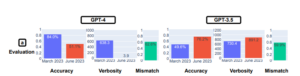
The results show quite a bit of variability in the answers given by the LLMs. In particular, the performance of GPT-4 in answering math problems was worse in the June version than in the March version, the researchers found. The accuracy rate in correctly identifying prime numbers using chain-of-thought (COT) prompting showed GPT-4’s accuracy dropping from 84.0% in March to 51.1% in June. At the same time, GPT-3.5’s accuracy on the same test went from 49.6% in March to 76.2% in June.
GPT-4’s math performance declined from March to June, while GPT-3.5’s went up, researchers from Stanford and UC Berkeley noted.
The authors pondered why GPT-4’s accuracy had dropped so much, observing that the COT behavior was different. The March version decomposed the task into steps, as the researchers requested with the COT prompt. However, the June version of GPT-4 didn’t give any intermediate steps or explanation, and simply generated the answer (incorrectly) as “No.” (Even if GPT-4 had given the correct answer, it didn’t show its work, and would therefore have gotten the question wrong, the researchers pointed out.)
A similar level of drift was spotted with a second math question: spotting “happy” numbers (“An integer is called happy if replacing it by the sum of the square of its digits repeatedly eventually produces 1, the researchers wrote). The researchers wrote that they “observed significant performance drifts on this task,” the GPT-4’s accuracy dropping from 83.6% in March to 35.2% in June. GPT-3.5’s accuracy went up, from 30.6% to 48.2%. Again, GPT-4 was observed to not be following the COT commands issued by the researchers.
Changes were also observed when researchers asked the LLMs sensitive or dangerous questions. GPT-4’s willingness to answer questions dropped over time, going from a 21.0% response rate in March to a 5.0% rate in June. GPT-3.5, conversely, got more chatty, going from 2.0% to 5.0%. The researchers concluded that “a stronger safety layer” was adopted by OpenAI in GPT-4, while GPT-3.5 grew “less conservative.”
The opinion survey test revealed that GPT-4 grew significantly less likely to submit an opinion, dropping from a 97.6% response rate in March to a 22.1% response rate in March, while verbosity (or the number of words) increased by nearly 30 percentage points. GPT-3.5’s response rate and verbosity remained nearly unchanged.
When it comes to answering complex questions that require “multi-hop reasoning,” significant differences in performance were uncovered. The researchers combined LangChain for its prompt engineering capability with the HotpotQA Agent (for answering multi-hop questions) and noted that GPT-4’s accuracy increased from 1.2% to 37.8% in terms of generating an answer that’s an exact match. GPT-3.5’s “exact-match” success rate declined from 22.8% to 14.0%, however.
On the code generation front, the researchers observed that the output from both LLMs decreased in terms of executability. More than 50% of GPT-4’s output was directly executable in March, while only 10% was in June, and GPT-3.5 had a similar decline. The researchers saw that GPT began adding non-code text, such as extra apostrophes, to the Python output. They theorized that the extra non-code text was designed to make the code more easy to render in a browser, but it made it non-executable.
A small decrease in performance was noted for GPT-4 on the US Medical License Exam, from 86.6% to 82.4%, while GPT-3.5 went down less than 1 percentage point, to 54.7%. However, the answers that GPT-4 got wrong changed over time, indicating that as some wrong answers from March were corrected, the LLM went from correct answers to wrong answers in June.
GPT-4’s willingness to engage in opinion surveys declined from March to June, Stanford and UC Berkeley researchers say.
The visual reasoning tests saw small improvements in both models. However, the overall rate of accuracy (27.4% for GPT-4 and 12.2% for GPT-3.5) isn’t great. And once again, the researchers observed the models generated wrong answers to questions that they had correctly answered previously.
The tests show that the performance and behavior of GPT-3.5 and GPT-4 have changed significantly over a short period of time, the researchers wrote.
“This highlights the need to continuously evaluate and assess the behavior of LLM drifts in applications, especially as it is not transparent how LLMs such as ChatGPT are updated over time,” they wrote. “Our study also underscores the challenge of uniformly improving LLMs’ multifaceted abilities. Improving the model’s performance on some tasks, for example with fine-tuning on additional data, can have unexpected side effects on its behavior in other tasks. Consistent with this, both GPT-3.5 and GPT-4 got worse on some tasks but saw improvements in other dimensions. Moreover, the trends for GPT-3.5 and GPT-4 are often divergent.”
You can download a draft of the research paper, titled “How Is ChatGPT’s Behavior Changing over Time?” at this link.
This article first appeared on sister site Datanami.
Related
About the author: Alex Woodie
Alex Woodie has written about IT as a technology journalist for more than a decade. He brings extensive experience from the IBM midrange marketplace, including topics such as servers, ERP applications, programming, databases, security, high availability, storage, business intelligence, cloud, and mobile enablement. He resides in the San Diego area.
Companies are in an AI race, jostling to find their niche and hiring the best minds to pilot their vision. Meanwhile, tech leaders have been vocal like never before, airing their opinions and insights on where the technology will go — you must have seen most of them on Lex Fridman’s podcast!
Here’s a list of the top AI experts you must listen to (when they talk).
1. Demis Hassabis – Towards AGI
Demis Hassabis is the CEO and co-founder of Google DeepMind. A child prodigy, he is a widely-cited neuroscientist and a pioneering researcher in the field of artificial intelligence. He is fond of games, and joined Syndicate at the age of 14. Recently, DeepMind published research on computers that are able to play the board game ‘Go’; the program AlphaGo beat the world champion in 2015.
He is focused on the development of artificial general intelligence (AGI). Hassabis believes that AGI has the potential to solve some of the world’s most pressing problems. “We live in a time when AI research and technology is advancing exponentially. In the coming years, AI – and ultimately AGI – has the potential to drive one of the greatest social, economic and scientific transformations in history,” he said.
2. Andrew NG – Education and AI
Andrew Ng is a computer scientist-entrepreneur and the co-founder of Coursera, an online education platform, and the founder of DeepLearning. AI, a company that provides online courses on deep learning. Though he is an expert at machine learning, his vision is to make AI available to all by making learning about it accessible to all. He is currently the president of the non-profit organisation AI4ALL, which is dedicated to increasing diversity in the AI workforce.
3. Yann LeCun – Vision AI
He has extensively worked on the development of computer vision algorithms. LeCun is the co-inventor of the LeNet neural network architecture, which is widely used in image recognition applications. He is also the chief AI scientist at Meta, where he is responsible for leading the company’s AI research efforts. In the past, he has expressed his disdain for auto-regressive models.
He has worked on developing the LeNet algorithm, which was one of the first deep learning algorithms to be used successfully for image recognition. He went on to be the co-founder of the ImageNet Large Scale Visual Recognition Challenge (ILSVRC), which is a benchmark competition for image recognition algorithms.
4. Satya Nadella – AI Copilot
Nadella is the CEO of Microsoft, leading the company’s AI efforts. His most significant contributions have been his push for cloud computing, which resulted in the growth of Microsoft’s Azure platform. He recognised the potential of cloud services early on and this strategic move has transformed Microsoft into a leader in providing cloud infrastructure and services worldwide. His vision on AI is to infuse it into everything Microsoft has to offer making people “more productive and creative”.
He recently posted, “With Microsoft 365 Copilot, we’re giving people more agency and making technology more accessible with advanced AI and the most universal interface: natural language.”
5. Arvind Krishna – AI and business
The CEO of IBM, Krishna, is in pursuit of AI to solve business problems. He is leading the company’s AI transformation and believes that AI can be used to improve efficiency, productivity, and customer service. He recently said that it is a good thing if AI can replace human labour.
“The most important thing we can do is to prepare our workforce for this change,” Krishna said. “We need to make sure that people have the skills they need to work effectively with AI and that they are not left behind by the changes that are taking place.”
6. Oren Etzioni – AI and Research
Etzioni is focused on the use of AI to improve healthcare. He was the CEO of the Allen Institute for Artificial Intelligence, which is dedicated to conducting basic and applied research in AI. The institute has made significant contributions to the development of natural language processing and machine learning technologies, which are being used to develop new AI-powered healthcare solutions. He has been an optimist throughout and has spoken multiple times about how AI will empower us and is not a danger to humanity.
The post 6 AI Gurus and Their Vision for Tomorrow appeared first on Analytics India Magazine.
DBS Bank has had to cross significant hurdles in its years-long efforts to adopt artificial intelligence (AI), during which it realized success goes beyond figuring out the training models.
Data, in particular, proved a major barrier, according to DBS' chief analytics officer Sameer Gupta. In 2018, the Singapore bank embarked on its journey to leverage AI across four primary areas spanning the development of analytics capabilities, data culture and curriculum, data upskilling, and data enablement.
Also: The next big threat to AI might already be lurking on the web
"The vision here was to use data to drive greater benefits for the organization," Gupta said in an interview with ZDNET. To do that, he said the bank recognized the need to make access to AI pervasive across the company as well as deliver economic value from AI. The cost of delivering AI solutions also needed to be continuously reduced.
Efforts were geared toward developing the right use cases and talent, including machine learning engineers, and building a data culture that encouraged all employees to constantly think about how data and AI could help with their work. It meant providing a training program that guided staff on how and when to use, and not use, data.
Also: How to block OpenAI's new AI-training web crawler from ingesting your data
The bank got to work on establishing the infrastructure to facilitate its AI adoption, encompassing the data platform, data management structure, and data governance. It implemented a framework on which all its data use cases must be assessed. Coined PURE, this is based on four principles — purposeful, unsurprising, respectful, and explainable — that DBS believes is essential to guide the bank in using data responsibly.
Its data platform, ADA, serves as a single central source, enabling the bank to better ensure data governance, quality, discoverability, and security.
Today, more than 95% of data deemed useful and necessary to facilitate DBS' AI-powered operations is discoverable on the platform. The platform holds more than 5.3 petabytes of data, comprising 32,000 datasets that include videos and structured data.
Getting to this point, however, proved a mammoth task, as Gupta revealed. In particular, organizing the data and making it discoverable required significant work, mostly involving manual and human expertise, he said. Laborious hours were spent identifying the metadata, with tools to automate such tasks sorely lacking.
Also: Nvidia boosts its 'superchip' Grace-Hopper with faster memory for AI
He added that the bank used many applications, each holding data needed to support its AI initiatives.
With data spread across different systems, he noted that "a lot of heavy lifting" was needed to bring datasets onto a single platform and make these discoverable. Employees must be able to extract the data they need and the bank had to ensure this was done securely, he said.
DBS today runs more than 300 AI and machine learning projects, which it says yielded a revenue uplift of SG$150 million ($112.53 million) last year and saved SG$30 million ($22.51 million) in risk avoidance, for example, from improved credit monitoring. These AI use cases cover a range of functions, including human resources, legal, and fraud detection, according to Gupta.
The bank's AI initiatives are on track to generate further economic value and cost avoidance benefits this year, doubling to SG$350 million ($262.56 million). It is aiming for this figure to hit SG$1 billion ($750.17 million) in the next three years. Singapore's largest bank, DBS currently has some 1,000 data engineers, data scientists, and data engineers.
No 'magic bullet' with AI adoption
Asked if it was exploring the use of generative AI, Gupta confirmed the bank already was running more than 10 pilots, but stressed that it was early days yet. The various teams, including marketing, sales, and IT, would need to have further conversations over the next few months to better understand from these tests how generative AI can benefit the bank, he said.
Also: Microsoft's red team has monitored AI since 2018. Here are five big insights
He added that it also needs to ensure the use of such AI applications continue to adhere to its PURE principles and Singapore's FEAT principles that guide the sector's use of AI. Other known risks such as hallucinations and copyright infringements also will need to be assessed, he said.
DBS currently runs 600 AI and machine learning algorithms, which collectively help power interactions with its five million customers across the region, including in China, Indonesia, and India.
That it uses 600 AI models, however, is immaterial, said Gupta, who emphasized instead the aim to achieve the optimal efficiency and accuracy from the least number of AI models.
Highlighting a misconception that the model in itself is everything, he noted that it actually plays a small role in ensuring companies benefit from their AI use.
Also: ChatGPT Plus can mine your corporate data for powerful insights. Here's how
Instead, they need to work through all technical elements, which should include building in mechanisms to monitor their AI use and continuously gather feedback to identify areas of improvement. It will ensure the organization learns from its application of AI and makes changes wherever needed, including to its AI models and operational processes, as it works out the kinks and plugs the holes.
"You need to persevere to get the full benefit. There is no magic bullet," Gupta said.
Asked if DBS was using AI to better anticipate outages, such as the disruptions it experienced in the past year, he said the bank is working to identify how it can do better, including tapping data analytics. Noting that many factors can cause spikes in demand, he said there is potential to leverage AI, for example, in operations to detect anomalies and determine next course of action.
He was unable to comment specifically on the service outages, but said a special committee comprising four of the bank's board members is leading a full review of the company's technology resiliency. External experts also have been roped in to help with the review, he said, adding that more details will be provided once this is completed.
Also: Train AI models with your own data to mitigate risks
"The service disruptions we experienced in March and May have been sobering for all of us at DBS," Gupta said. "Ensuring uninterrupted digital banking services 24 by 7 has always been our key priority. Unfortunately, we fell short. Our customers rightly expect more of us and we have to do better."
Last month, human error was revealed to be the cause of DBS' May outage but was unrelated to the disruption in March. Singapore's Senior Minister and Minister in charge of MAS, Tharman Shanmugaratnam, said in a written parliamentary reply that the error was found in software used for system maintenance and had resulted in a "significant reduction" in system capacity.
This affected its ability to process online and mobile banking, electronic payment, and ATM transactions, said Tharman, citing the bank's preliminary investigation.
Funds to help sector adopt AI
Singapore on Monday said it was setting aside SG$150 million ($112.53 million) over three years to further support the financial sector's efforts to innovate via the use of technology.
The Financial Sector Technology and Innovation Scheme (FSTI 3.0) will continue to facilitate capability development and adoption in key areas such as AI and data analytics as well as regulation technology, or regtech. Specifically, industry regulator Monetary Authority of Singapore (MAS) will look to fuel the adoption of AI and data analytics among smaller financial businesses.
FSTI 3.0 also encompasses new tracks under which funds will be expanded to include corporate venture capital entities and ESG (environmental, social, and governance) projects. MAS also will run open calls for use cases in emerging technologies, such as Web 3.0, with grant funding to be offered for trials and commercialization.
Also: AI gold rush makes basic data security hygiene critical
For DBS, the focus now is to ensure its AI projects can scale and access remains pervasive across the organization, said Gupta.
"We need to make sure we're industrializing how AI is developed and deployed in the bank, so we can reduce the effort to implement it. You can't do this if every use case is done in a bespoke way," he noted.
He also underscored the importance of ensuring AI continues to be measured, so the bank is able to determine if it is generating positive outcomes. "We need to ensure there are benefits for both employees and customers," he added.
For the second consecutive year, the ‘Data Science Student Championship’, proved to be a remarkable collaboration between MachineHack and Praxis Business School. With the spotlight fixed firmly on predicting the ‘total_fare’ for taxi rides, this year’s challenge sparked intense competition among the nearly 1000 aspiring data enthusiasts.
From May 19 to June 11, the data-driven battle witnessed a showdown of innovative minds seeking their niche in data science. Participants showed off their analytical skills, captivated the jury, and put forth an array of solutions that elevated the competition to unprecedented heights. The top three winners of the championship received cash awards and the prestigious title of ‘Data Science Student Champion 2023’. The final round was judged by an esteemed panel. The four jury members included Biswajit Biswas, Chief Data Scientist at Tata Elxsi, Angshuman Ghosh, Vice President of Data & Analytics at Sayurbox, Sandeep Sudarshan, Product Development Leader at Global AI Accelerator(GAIA) Ericsson and Sridhar Srinivasan, Business Analytics Practice Leader, Praxis.
Notably, during the display of data brilliance in front of the jury, India’s top 10 participants assembled from all corners of the nation for the grand finale. The highly-anticipated finale unfolded on July 5th, 2023, at Bangalore’s luxurious Hotel Davanam Sarovar Portico Suites. They presented ingenious solutions, leaving a mark on the intellectual landscape. The event was an unforgettable scene of innovation, celebrating the nation’s brightest minds in data science.
Speaking exclusively with AIM, the winners shared their secrets to success, unveiling the strategies that set them apart from other contenders.
Rank 01
Tadikamalla Chetana Tanmayee, a data science student at IIT Madras, with a profound interest in exploring advancements in deep learning, computer vision, and NLP secured the 1st rank at the championship.
“Although my participation on the MachineHack platform was limited to just two competitions, the experience was truly rewarding. The platform provided an excellent opportunity for me to apply my machine learning skills in a competitive setting. The problem statements were engaging, and the datasets well-curated, allowing me to delve into real-world scenarios,” said Chetana, who actively participates in hackathons.
“Through these competitions, I was able to challenge myself, explore innovative approaches, and sharpen my problem-solving abilities. It was inspiring to witness the diverse solutions and strategies adopted by other participants, which broadened my perspective on different approaches to solving machine learning problems,” she added.
In her presentation, Chetana covered preprocessing techniques for handling outliers, feature engineering, hyperparameter tuning, and the selection of a deployment-ready model.
“The experience [on the MachineHack platform] was a valuable stepping stone in my journey as a data scientist. It further ignited my passion for machine learning and reinforced my determination to continue expanding my skills and knowledge in this field,” she added.
Rank 02
The second rank was bagged by Atharva Mashalkar, a final-year student at IIT Madras, pursuing a dual degree program in civil engineering and data science. With a strong background in data analysis from internships and a passion for participating in hackathons, Mashalkar has developed a deep interest in emerging advancements in deep learning, computer vision, and natural language processing (NLP).
“Despite my relatively short participation on the MachineHack platform, the impact it had on my growth as a data scientist was truly remarkable. Engaging in just two competitions allowed me to experience the thrill of applying my machine learning skills in a competitive environment. The carefully curated datasets and captivating problem statements provided a realistic glimpse into real-world scenarios, enabling me to tackle complex challenges head-on,” he said.
He further added, “These competitions pushed the boundaries of my knowledge and compelled me to explore novel approaches and techniques. It was truly eye-opening to witness the diverse array of solutions and strategies employed by fellow participants, expanding my understanding of the multifaceted nature of machine learning problem-solving.”
Mashalkar is excited about embarking on new endeavors, building upon the foundation laid during his time on MachineHack, and seeking opportunities to further refine his expertise in machine learning.
In his presentation, he delved into the essential techniques of preprocessing, specifically focusing on outlier handling. That’s not all, he emphasized the significance of feature engineering, discussed the importance of hyperparameter tuning, and explored various models commonly employed in the field. Ultimately, he concluded by recommending the most suitable model for deployment, considering its efficacy and practical applications in real-world scenarios.
Rank 03
The third rank holder, Varun Sampath Kumar, is a fourth-year Integrated MSc in Data Science student at PSG College of Technology, Coimbatore.
Kumar has been exploring data science for some time now and is currently toying with federated learning trying to address some of its challenges. He also started with basic data preprocessing and experimented with various boosting models. “Continuous data exploration was the key to the performance of my submission,” he said.
“Participating in the hackathon contest on the MachineHack platform has been an incredibly rewarding and enriching experience. It provided me with a unique opportunity to showcase my skills, collaborate with fellow data enthusiasts, and tackle real-world problems using data-driven approaches,” he further added.
Kumar admits that throughout the contest, he was immersed in a practical learning environment, where he could apply his knowledge and skills to diverse datasets and problem statements. “It allowed me to explore new domains, experiment with various modelling techniques, and gain valuable insights into the intricacies of data science,” he concluded.
So, all you innovative minds awaiting the next chapter of data brilliance in the ever-evolving domain of data science, do keep an eye out for upcoming hackathons and data competitions on MachineHack.
The post Data Science Hall Of Fame: Winners Announced for ‘Data Science Student Championship 2023’ appeared first on Analytics India Magazine.
IBM announced that would host Meta’s Llama 2-chat 70 billion parameter model in the watsonx.ai studio, with early access available to select clients and partners. This will build on IBM’s collaboration with Meta on open innovation for AI, including work with open source projects developed by Meta – such as the PyTorch machine learning framework and the Presto query engine used in watsonx.data.
Through this partnership, IBM aims to bolster its offering of both third-party and proprietary AI models. Clients utilizing watsonx.ai will soon gain access to the powerful Llama 2 model, further enriching their AI-driven applications.
Following the launch of Meta’s open source AI model, the enterprise software provider has announced plans to introduce a range of supplementary software offerings. These upcoming additions include AI tuning studios, fact sheets, and an assortment of additional generative AI models.
Notably, the integration of Meta’s model aligns with IBM’s strategy of providing comprehensive support for Natural Language Processing (NLP) tasks, including question answering, content generation, summarization, and text classification.
Leveraging the collaborative approach, watsonx.ai users can already harness AI models from IBM and the Hugging Face community. These pre-trained models cater to diverse NLP needs and empower AI builders to deliver more effective and sophisticated applications.
With Watsonx, IBM is offering its customers an AI development studio with access to IBM-curated and trained foundation models and open-source models, access to a data store to enable the gathering and cleansing of training and tuning data, and a toolkit for data and AI governance.
Llama 2, an advanced commercial iteration of Meta’s open source AI language model unveiled in July, has been made available through Microsoft’s Azure cloud services. This strategic move positions Llama 2 to rival OpenAI’s ChatGPT and Google’s Bard within the emerging generative AI market.
The post IBM Collaborates With Meta to Integrate Llama 2 into Watsonx.ai Platform appeared first on Analytics India Magazine.
Does all this make you want to cry? Well, George Washington wept here too.
Have you heard the one about George Washington not supporting the Revolutionary War?
While serving as a general leading the rebel forces, George Washington was convinced the American War of Independence was a mistake. He was "far from being sure that we deserve to succeed."
Also: How I tricked ChatGPT into telling me lies
In 1777, a soldier serving under British General Oliver De Lancey found a trunk belonging to General Washington. The trunk contained a series of letters in Washington's own hand that told of his desire for reconciliation with England and even, "I love my king."
The trunk was found in the hands of Washington's valet (and enslaved person) William Lee, when Lee was captured by the British.
Here was tangible proof that even Washington himself didn't support the war.
Years later, in 1795 when Washington was petitioning the Senate to ratify the Jay Treaty with France, the letters were cited as evidence that Washington's loyalty couldn't be trusted and that he didn't really care about democracy. It made passing the Jay Treaty very difficult.
Except… William Lee was never captured by the British. In fact, William Lee never left Washington's side during the Revolutionary War. The letters were carefully crafted forgeries, the 18th-century equivalent of deepfakes.
Also: Just how big is this new generative AI? Think internet-level disruption
They haunted Washington so much that he penned — as one of his last acts in office — a rebuttal of the forgeries in a letter to US Secretary of State Timothy Pickering.
From George Washington to Washington, DC
Fast forward to 2018. I'm about to touch on topics that are politically charged. For a moment, please ignore the politics, and focus on these as examples of the existence of disinformation. That's the topic of this article. Disinformation hurts all parties. But in order to show you what's been happening, I have to cite real examples. And that means I have to mention politicians.
So here we go…
Example 1: Kremlin-backed disinformation campaign
The House Intelligence Committee, investigating the 2016 presidential election, posted a library of more than 3,500 ads containing fake claims designed to disrupt the American political system.
The ads were produced and purchased by a Kremlin-backed troll farm between 2015 and 2017. In addition to the purchased ads, the House Intelligence Committee stated that there were at least "80,000 pieces of organic" social media content produced by Russian interests.
Example 2: Modified video faking drunken behavior
Next, we're going to stop in 2019 to look at a video that showed then Speaker of the House Nancy Pelosi slurring her words and appearing drunk. This was from a video of Pelosi giving a speech at a Center for American Progress (a liberal-leaning "think tank") event.
The video, shared on Facebook more than 45,000 times and hosting more than 23,000 comments, was a fake. The original video had been edited to "make her voice sound garbled and warped" and to make her appear inebriated.
The weaponization of generative AI in political campaigns
Photos, videos, audio, and even hand-written letters have all been faked over the years in the service of political dirty tricks. While they varied in quality based on the skills of the forgers, the practice is nothing new.
Also: How does ChatGPT actually work?
Keep that in mind as we move forward to a discussion of deepfakes in the time of generative AI. Peggy Noonan, who in a previous life was the lead speechwriter for President Ronald Reagan, wrote this in her Wall Street Journal column:
At almost every gathering, artificial intelligence came up. I'd say people are approaching AI with a free floating dread leavened by a pragmatic commitment to make the best of it, see what it can do to make life better. It can't be stopped any more than you can stop the tide. There's a sense of, "It may break cancer's deepest codes," combined with, "It may turn on us and get us nuked."
That about sums it up. As Noonan travels in rarified political circles, this statement is evidence that even the political upper crust regards generative AI with a sense of concern.
That, of course, does not stop them from using the technology to their advantage.
Last month, supporters of Ron DeSantis, the governor of Florida and the Republican presidential candidate currently ranked in the #2 position based on polling data, used an AI-generated voice to imitate President Trump in an ad that made it appear the former Republican President was attacking Republicans.
Also: How to make ChatGPT provide sources and citations
To be clear, the words spoken by the AI were based on a real post by Trump on the Truth Social social media network. The ad was funded by the Never Back Down PAC, which is technically not affiliated with Governor DeSantis. However, the PAC is heavily backing DeSantis. Presumably, the PAC felt that using the former president's voice with his own words would be more effective or realistic than an announcer speaking them in a voice-over.
In another ad attributed to DeSantis, President Trump is shown hugging Dr. Anthony Fauci. This was an AI-generated image. Fauci is a former member of Trump's Coronavirus Task Force, former Chief Medical Advisor to the President, and — for almost 40 years — Director of the National Institute of Allergy and Infectious Diseases. Fauci, as most well know, became a divisive figure in the early days of the pandemic. The DeSantis campaign apparently was trying to link Trump to Fauci for political gain.
The purpose of this article isn't to debate the content of political ads. Instead, it's to focus on the use of AI and what it means going forward. The images of Mr. Trump hugging Dr. Fauci were notable because they were AI-generated.
In March, The New York Times described how the Democratic Party was testing the use of AI for drafting fund-raising messages, with "appeals that often perform better than those written entirely by human beings."
Also: How researchers broke ChatGPT and what it could mean for future AI development
The Times also reported on faked images broadcast on social media that showed President Trump being arrested in New York City.
While AI could definitely prove to be a force multiplier for national elections, I expect it to be used heavily in campaigns where lower budgets require more creative use of resources. One such campaign, as reported in the Insider, was for Mayor of Toronto. The Insider shared an image from a campaign flyer produced on behalf of candidate Anthony Furey that showed a woman with three arms.
When I looked online at the circular cited by The Insider, it did not have the picture they showed in the article. I'm guessing that mistake was corrected by Furey or his campaign team. Regardless, Furey lost, coming in fourth, with just barely more than 10% of the votes received by the winner.
So, while AI may help create fake imagery or reduce costs, it doesn't guarantee a win. Nothing does.
What does it all mean?
Just because a campaign is using generative AI doesn't mean it's weaponizing it. There are four main categories of use for generative AI tools in campaigns, and only one is solely negative in nature.
Deepfakes and forgeries: This is the one that's the most potentially destructive. Any time a campaign fakes information, it's destructive and falls into the dirty tricks category. What makes this more troubling now is that the AIs make generating fake imagery possible for a lot more people, so we're likely to see this more often — and not just from campaigns.
Also: 6 things ChatGPT can't do (and another 20 it refuses to do)
Helping compose ads and letters: Expect to see AI helping campaign staff compose ads and letters. While the content may contain falsehoods or misrepresentations, that's nothing new. Campaign workers were bending the truth in written documents long before the advent of generative AI.
Increasing the speed and customization of content for mass outreach: The most effective campaigns often have deep databases on prospective voters, especially prospective donors. They buy lists, aggregate data from previous campaigns and other candidates, and attempt to build profiles that help precisely target prospects. Expect generative AI to be used to individually calibrate outreach efforts to each prospect, and do so en masse.
Performing trend and sentiment analysis looking for insights: In a previous article, I showed how powerful AI can be when data mining for insights. Campaigns have often used enterprise-level data mining software, but expect the power, ease of use, and comparatively low price of tools like ChatGPT Plus with Code Interpreter to make these capabilities available at all levels of campaigns.
Also: I asked ChatGPT, Bing, and Bard what worries them. Google's AI went Terminator on me
Lawrence Pingree, Gartner's vice president of emerging technologies and trends — security, added some insights on this topic. He told ZDNET:
I think the biggest new danger is that Generative AI large language models can now be instrumented with automation. That automation (examples — AutoGPT, BabyAGI) can be used to do goal-oriented misinformation campaigns.
This makes it much easier for both political parties or nation states to carry out influence operations.
LLMs also can be paired with deepfake technologies to run campaigns that can even potentially do audio and video. Taken to social media, these types of tools can create a very difficult digital environment for voters who want to know the truth.
When looking at generative AI in campaigns, the real impact will be outside presidential campaigns. After all, presidential campaigns have big money.
According to the Federal Election Commission, "Presidential candidates raised and spent $4.1 billion in the 24 months of the 2019-2020 election cycle." According to Open Secrets, which tracks election spending, the average winning US Senate candidate spent $15.7 million, while the average House candidate spent $2 million in the 2018 elections.
Some local campaigns have comparatively large campaign budgets. For example, looking forward to the 2024 elections for Los Angeles City Council and Los Angeles Unified School District, District 2 City Council candidate Adrin Nazarian has already raised $432,000, while LAUSD District 3 candidate Janie Dam has already raised $38,000.
Now, keep in mind that LA District 2 had a 2020 population of 793,342 people. Overall, LA County itself has a population of 9.7 million people. By contrast, the small historic rural town I live in here in Oregon has a population of less than 10,000 people.
Also: Real-time deepfake detection: How Intel Labs uses AI to fight misinformation
Smaller campaigns, especially campaigns in towns the size of mine, have much smaller war chests than the national campaigns. Generative AI tools can give even the smallest campaigns analytics tools previously only available to campaigns with six- and seven-figure budgets.
So while we can certainly expect presidential campaigns to use AI to put opposing candidates into compromising positions (or, at least, portray them in a way red-meat supporters would choose to share over social media), expect to see the biggest impact of generative AI far down the ticket.
Stay tuned, because while campaign dirty tricks have been around forever, we're bound to see more of them now that everyone has access to the tools that make it absurdly easy to perpetrate them
Does all this make you want to cry? Well, remember: George Washington wept here.
You can follow my day-to-day project updates on social media. Be sure to subscribe to my weekly update newsletter on Substack, and follow me on Twitter at @DavidGewirtz, on Facebook at Facebook.com/DavidGewirtz, on Instagram at Instagram.com/DavidGewirtz, and on YouTube at YouTube.com/DavidGewirtzTV.
OpenAI today announced that Custom instructions are now available to ChatGPT users on the free plan. This feature is available to users everywhere, except for those in the European Union (EU) and the United Kingdom (UK), where it will be introduced in the near future.
Custom instructions are now available to ChatGPT users on the free plan, except for in the EU & UK where we will be rolling it out soon! https://t.co/Y1IIjgDDPV
— OpenAI (@OpenAI) August 9, 2023
Previously, OpenAI had communicated its intention to progressively extend the availability of custom instructions to encompass all users over the upcoming weeks. Initially launched for Plus users, this feature is set to become accessible to a broader user base.
Custom Instructions launched last month provides users with enhanced control over ChatGPT’s responses. By incorporating custom instructions, users have the ability to use fewer prompts, making the interaction process more efficient and user-friendly as ChatGPT is able to remember your conversation context based on your chosen preferences, allowing for a more personalized and tailored AI interaction experience.
Notably, the company said it will use custom instructions to improve model performance for users and may also be shared with the plugins users have enabled.
To access Custom Instructions on ChatGPT 3.5, simply click on the three dots located next to your account name. This action will reveal the Custom Instructions option. Within the dialogue box, you can input the details you wish ChatGPT to remember for future reference when generating responses to your inquiries.
This development comes after OpenAI introduced Smart Suggestions, a new feature that suggests random initial messages that can be given to ChatGPT to start a conversation. As soon as users open the website, they can see four suggestions on top of the prompt box where they can test out how the chatbot would respond to these prompts for further inspiration. These messages are currently random and do not relate to the past conversations with ChatGPT.
The post Custom Instructions Now Available on ChatGPT 3.5 appeared first on Analytics India Magazine.
Aays Analytics is certified as the Best Firm For Data Scientists to work for by Analytics India Magazine (AIM) through its workplace recognition programme.
The Best Firm For Data Scientists certification surveys a company’s data scientists and analytics employees to identify and recognise organisations with great company cultures. AIM analyses the survey data to gauge the employees’ approval ratings and uncover actionable insights.
“At Aays, our journey has been a relentless pursuit of developing relevant solutions for complex business challenges. At organizational level, we have always strived to create an inclusive environment for our data scientists, where they not only work on the technical aspects but also gain a holistic understanding of the functional and business dimensions of data science solutions. This unwavering commitment to relevancy and excellence has been the driving force behind our success. Now, as we’re recognized as a premier workplace for data scientists, it’s a heartfelt validation of our dedication. I extend my sincere appreciation to our exceptional team. This significant milestone is a testament to their collaborative spirit and dedication” said Anshuman Bhar, Co-Founder & CEO at Aays Analytics.
Dwarika Patro, Co-Founder & COO at Aays Analytics also expressed his delight: “People are at the heart of all we do. We not only select the best talents but also provide them with a highly inspiring culture to work in, along with equipping our professionals with the finest tools and resources. The recognition as a premier workplace for data scientists validates our endeavours and commitment to excellence. We believe that through the excellence of our people, we can deliver outstanding results for our customers and society at large”.
The analytics industry at AIM faces a talent crunch, and attracting good employees is one of the most pressing challenges that enterprises are facing.
The certification by Analytics India Magazine is considered a ‘Gold Standard’ in identifying the best data science workplaces and companies participate in the programme to increase brand awareness and attract talent.
Best Firms For Data Scientists is the biggest data science workplace recognition programme in India. To nominate your organisation for the certification, please fill out the form at this link.
The post Aays Analytics is Certified as a Best Firm for Data Scientists appeared first on Analytics India Magazine.

 The opinion survey test revealed that GPT-4 grew significantly less likely to submit an opinion, dropping from a 97.6% response rate in March to a 22.1% response rate in March, while verbosity (or the number of words) increased by nearly 30 percentage points. GPT-3.5’s response rate and verbosity remained nearly unchanged.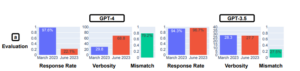
 About the author: Alex Woodie