Microsoft is Playing With OpenAI

The drama continues. Microsoft seems to be messing with OpenAI. In a not so usual post, Altman clarified on X, saying that OpenAI doesn’t use API-submitted data to train or improve models unless a user explicitly opt-in. But, why?

Update :
Microsoft has deleted the Azure ChatGPT repo. Sam Altman is posting to clarify that the data collected in ChatGPT was safe and is not used to train any new model.
Big confusion among OpenAI users.

— zakaria sabti (@SabtiZakaria) August 15, 2023

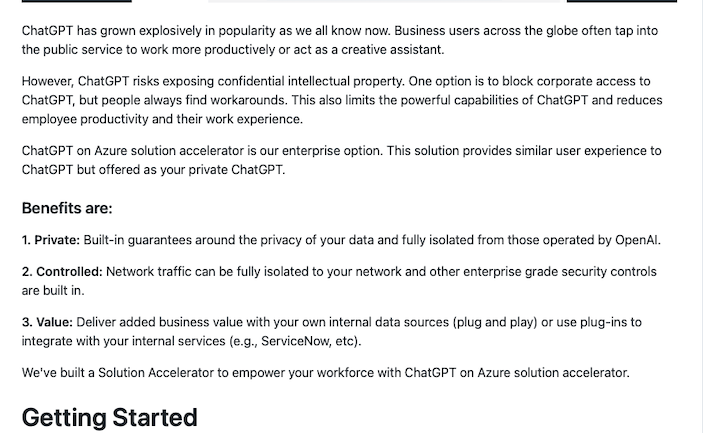
Microsoft, while announcing Azure ChatGPT, surprisingly had accepted shortcomings of OpenAI’s ChatGPT, in a now deleted post.

“ChatGPT risks exposing confidential intellectual property. One option is to block corporate access to ChatGPT, but people always find workarounds,” said Microsoft.

Further, it said: “ChatGPT on Azure solution accelerator is our enterprise option. This solution provides a similar user experience to ChatGPT but offered as your private ChatGPT.”
When AIM reached out to Microsoft, it denied posting Azure ChatGPT saying GitHub project operates on an open-source model, inviting contributions and suggestions from various members of the developer community. “There is no product known as ‘Azure ChatGPT’ currently being offered by Microsoft”, the company said.

Azure ChatGPT was presented as a secure and private solution tailored for enterprises, assuring data security. However, this announcement created a conflict of interest for OpenAI, casting them in an unfavorable light.

There is definitely confusion between Microsoft and OpenAI and both the parties are not on the same page regarding use of ChatGPT and GPT-4 APIs for enterprise. If Microsoft hadn’t deleted the AzureChatGPT repository, OpenAI would have taken a hit as a brand regarding the trust of their customers.

In our previous report, we questioned the data security of the GPT-4 API. Interestingly, OpenAI’s Logan Kilpatrick shared an updated blog on OpenAI’s data privacy measures on Sam Altman’s thread. It laid emphasis on enterprise-grade security which is similar to the purpose of Azure ChatGPT.

“Microsoft, competing with OpenAI,” said uncle Gary, commenting on the Azure ChatGPT launch – which now seems to have mysteriously disappeared from GitHub.

In response, Microsoft’s corporate vice president Peter Lee commented Microsoft has been offering the Azure OpenAI Service since November of 2021 in private preview, and in general availability since January of 2023. “The AOAI Service provides all the same privacy and enterprise compliance features of all our other Azure cloud services, which is important for many uses, such as medical” he said. This, literally, makes no sense whatsoever.

Clearly, Microsoft’s introduction of Azure ChatGPT looks like an attempt to sabotage OpenAI’s reputation. If we check OpenAI’s policies, they clearly have mentioned that they don’t use user’s data in chat history to train their model if the user has turned off the chat history.

Is OpenAI in a toxic relationship?

The partnership between Microsoft and Meta appears to have strained OpenAI’s relationship. Microsoft’s collaboration seems to be creating a competitor for OpenAI’s closed-source models. Microsoft’s move can be seen as a strategic play, allowing them to wield more control. By teaming up with Meta and leveraging Llama 2, Microsoft gained a sense of security and reduced their reliance on OpenAI, altering the dynamics in their favor.

In a recent interaction with AIM, there was a sense of hesitation from the OpenAI spokesperson when asked about the Microsoft-Meta partnership.

Elon Musk also in the past had claimed in an interview with Tucker Carlson in April that “Microsoft has a very strong say, if not directly controls, OpenAI at this point. In response Nadella Microsoft CEO Satya Nadella said it is “factually not correct” to claim that Microsoft controls its partner OpenAI, in an excerpt of a pre-taped interview with CNBC’s Andrew Ross Sorkin.

When Microsoft made multibillion dollar investment in OpenAI at the starting of the year, it made clear that Azure will be OpenAI’s exclusive cloud provider and it will power all OpenAI workloads across research, products and API services. So what was the need to create Azure ChatGPT all of a sudden and then delete it without any notice? Something is clearly not right!

[Updated: 5 p.m, August 16th, 2023] The article has been updated to include Microsoft’s comments.

The post Microsoft is Playing With OpenAI appeared first on Analytics India Magazine.

Chandrayaan-3 vs Luna-25 : The Satellite Race to Lunar’s South Pole

While everyone is waiting with bated breath on Chandrayaan-3’s touch down on the south pole of the moon, which is expected to happen on August 23, there’s another satellite which is closely behind: Russia’s Luna-25. It is also expected to land in the South Pole of the moon, just two days before Chandrayaan-3.

Luna-25 is Russia’s unmanned lunar spacecraft mission to the moon’s south pole. Luna-25 took atop a Soyuz rocket from the Vostochny Cosmodrome, located in eastern Russia on August 10 – this marks Russia’s lunar endeavour in 47 years. The launch of Luna-25 also marks significant change for Russia as they have moved away from Kazakhstan which hosts its main launch site, the Baikonur Cosmodrome.

The spacecraft is expected to take approximately 5 days to achieve a 100-kilometre orbit around the Moon. The scheduled landing attempt is set for August 21st at the Boguslawsky crater, which is about 500 kilometres away from the Moon’s south pole.

Two Missions, One Goal

Broadly, both the missions aim to experiment and gather scientific information from the South pole of the moon. The South Pole of the moon is considered to be promising for finding water ice owing to a large area being in permanent shadows and experiencing colder temperatures.

The costing of both missions are significantly different with Luna-25 having a lower cost of 16 crores (200 million Russian Rubles) and Chandrayaan-3 having a budget of Rs 615 Crore owing to huge structural difference between the two. The Luna-25 landing module remains immobile, whereas Chandrayaan-3 features both a landing module and a rover.

Both landers possess comparable masses, with Luna-25 registering approximately 3,860 lbs (1,750 kg) at liftoff, a bit over half of which is projected to be propellant. On the other hand, the Chandrayaan-3 Vikram lander tipped the scales at 3,862 lbs (1,752 kg), encompassing a 57 lbs (26 kgs) rover named Pragyan. A significant portion of Vikram’s weight is allocated to landing propellant.

Luna 25 is equipped with eight scientific instruments, among them the lunar manipulator complex (LMK), designed for excavating lunar regolith, and the Neutron and gamma detector (ADRON-LR), which is aimed at detecting water ice. In contrast, Vikram aims to maximise its single day of operation on the lunar surface. It carries four scientific payloads, one of which involves inserting a thermal probe into the lunar soil at a depth of approximately four inches (10 cm) to measure temperature variations of the lunar regolith throughout the lunar day.

Furthermore, the Chandrayaan-3 mission is intended to span over two weeks. Whereas, Luna-25 is expected to stay on the moon for a year.

Source: Space

The Russian mission is set to examine the soil, investigate the upper regolith layer, and study the lunar exosphere. It will also experiment with soil sample collection and excavation of water ice beneath the surface. Chandrayaan-3 will be utilising its payloads RAMBHA and ILSA for investigating the moon’s atmosphere and delving into its surface to understand its mineral composition. The lander, Vikram, will capture images of the rover, Pragyaan, which will then deploy its instruments to study seismic activities on the moon. Pragyaan’s laser beams will be utilised to melt a portion of the lunar surface, known as regolith, and analyse the gases released during this process.

Today, the ISRO successfully completed the final orbit reduction manoeuvre for the Chandrayaan-3 spacecraft, exactly a week in advance of its planned lunar landing. Yesterday, the Russian space agency, Roscosmos, unveiled the first images transmitted by the spacecraft.

#Roscosmos shared the first images sent back by the #Luna25 mission on its way to the Moon. pic.twitter.com/49zjK8VN0j

— IE Science (@iexpressscience) August 15, 2023

Russia To Prove a Point

Russia’s lunar mission comes at a time when the Ukraine crisis has tarnished Russia’s image in the global market. With sanctions from western countries on energy and finances, the satellite launch will look to push Russia on a fresh trajectory to claim their global leadership.

The launch will be closely observed, especially by Europe and America who have been working towards isolating Russia amid the Ukraine crisis, and Russia looking to build political and economic ties with non-Western countries. For future missions, Russia is looking to develop electronics components that it purchased from foreign countries. Furthermore, during a recent summit in St. Petersberg with African leaders, Russia has committed to collaborating with them in the domain of space technologies.

Irrespective of the prospects of Luna-25, the mission is an advancement from the Russian space program that shone in the late 50s and 60s. Afterall, the Soviet Union launched the earth’s first artificial satellite,when it launched its first satellite Sputnik in 1957. Interestingly, close to Neil Armstrong and Buzz Aldrin’s lunar walk on July 20, 1969, the USSR had raced to compete with its moon mission N1, weeks before the former. The covert mission was not acknowledged, however, the damaged launch pads were observed under U.S. surveillance.

After more than 40 years since its last lunar mission, Luna-24 in 1976, Russia has high hopes for Luna-25. So is India, with Chandrayaan-2’s lander failing, all eyes will be on Chandrayaan’s-3 landing next week.

The post Chandrayaan-3 vs Luna-25 : The Satellite Race to Lunar’s South Pole appeared first on Analytics India Magazine.

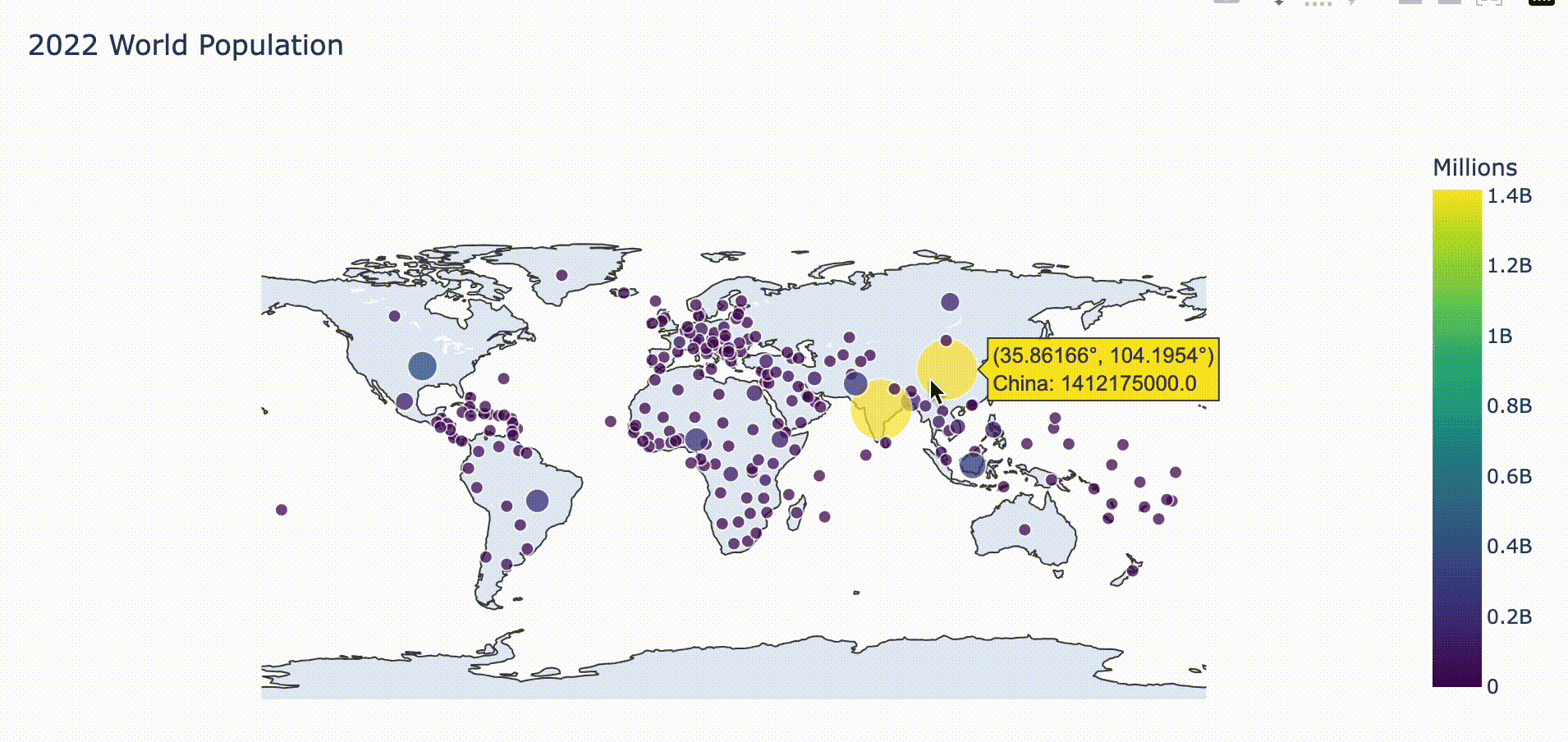
5 Ways You Can Use ChatGPT’s Code Interpreter For Data Science

5 Ways You Can Use ChatGPT's Code Interpreter For Data Science
Image by Author

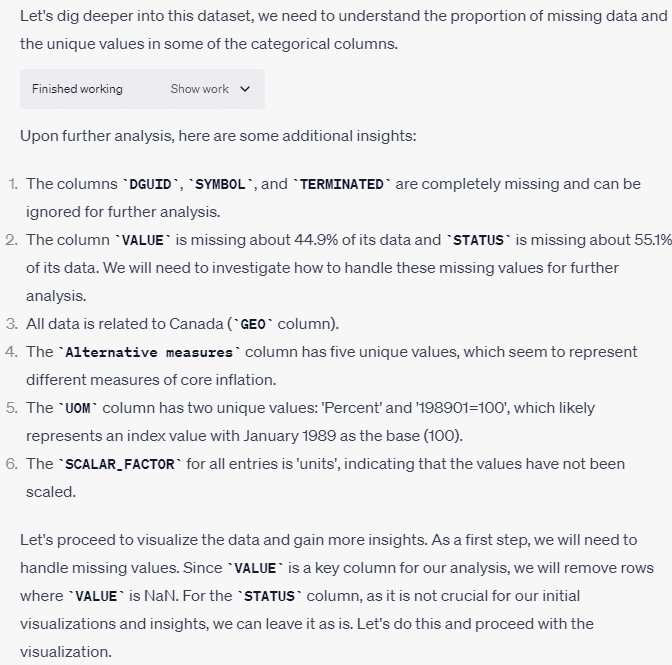
With the code interpreter integration, ChatGPT can now write and execute Python code within a sandboxed environment to provide more accurate and precise answers. This allows it to perform complex calculations, generate visualizations, and more through code execution rather than just text prediction. Users can upload data files for the code to process and receive back results like output files. In general, the code interpreter feature minimizes errors that are often seen in big language models, and significantly broadens ChatGPT's abilities from data visualization to producing animations.

In this blog, we will explore five simple ways to use ChatGPT's code interpreters for data science tasks and projects with examples.

1. Data Analysis

ChatGPT has remarkable capabilities for data analysis in Python. With its new Code interpreter integration, it can now execute Python code and return results. It can even generate interactive visualization with animations.

Provide a CSV file, and ChatGPT will generate data visualizations and summary statistics and even process the data. All it takes is a natural prompt describing your desired analysis.

The combination of ChatGPT's natural language understanding and its ability to run Python code unlocks quick and automated data analysis for non-technical managers.

5 Ways You Can Use ChatGPT's Code Interpreter For Data Science
Image from Soner Yıldırım 2. Data Cleaning

Data cleaning can be one of the most tedious tasks for data scientists. Manually cleaning CSV files or writing custom Python scripts is time-consuming. However, ChatGPT's new capabilities streamline the process. Its integration with the Code Interpreter enables automated data cleaning with simple conversational prompts.

For example, provide ChatGPT a CSV file and ask it to analyze the data quality. ChatGPT will inspect the data frame, identify issues like missing values, and suggest solutions. The assistant can now thoroughly investigate hundreds of columns this way. ChatGPT will even generate custom Python functions to implement its recommended data-cleaning steps.

5 Ways You Can Use ChatGPT's Code Interpreter For Data Science
Image from DataCamp 3. Mathematical

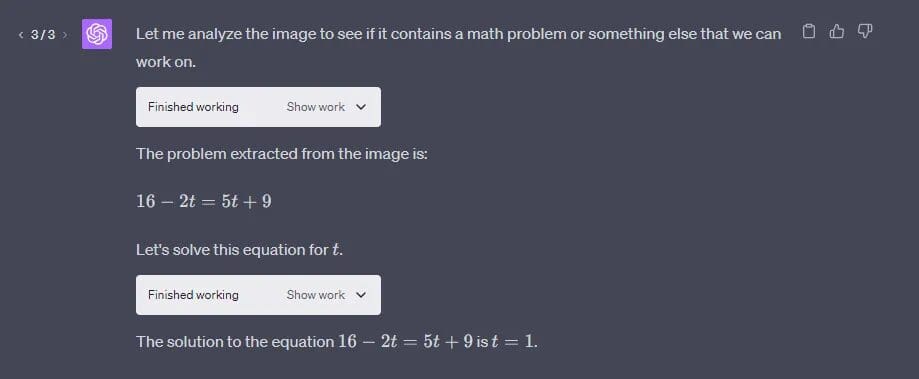
ChatGPT has expanded capabilities for understanding technical documents like research papers. Simply provide a PDF or image of equations, and its integrated OCR will extract and comprehend the mathematical content.

For example, upload a paper explaining a new machine learning technique. Ask ChatGPT to solve the key equations and walk through the derivations step-by-step. Code Interpreter can parse complex formulae from image files and PDFs, do the math, and explain the meaning behind equations in plain language.

5 Ways You Can Use ChatGPT's Code Interpreter For Data Science
Image from DatHero 4. Convert files

Bring your data to life with this innovative feature. Simply upload a CSV file containing the locations of lighthouses across Europe. Code Interpreter will automatically generate an animated map, with each lighthouse twinkling like a star against a dark background.

The possibilities don't stop there. Easily convert your CSV files into Excel spreadsheets for additional analysis. Or upload an image file, which Code Interpreter will turn into a unique GIF animation.

5 Ways You Can Use ChatGPT's Code Interpreter For Data Science
Gif from Ethan Mollick 5. Diagrams

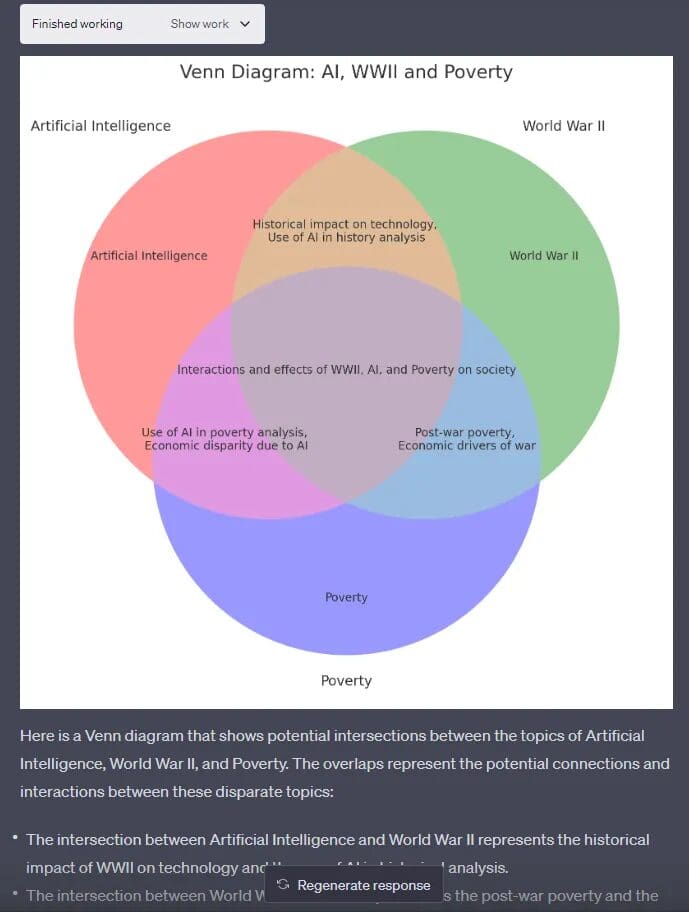
ChatGPT provides helpful answers in the form of text. Using Code Interpreter allows the information to be visually represented. For example, generating Venn Diagrams is particularly beneficial when seeking commonalities among multiple topics.

Struggling to find common ground across multiple topics? Effortlessly create a Venn diagram highlighting the intersections. Planning a new system architecture? Code Interpreter renders it as a professional workflow chart. Teaching complex concepts? Engage students with customized diagrams that illustrate key points.

5 Ways You Can Use ChatGPT's Code Interpreter For Data Science
Image from DatHero Conclusion

ChatGPT is increasingly becoming the go-to platform for all data-related issues. With a simple prompt, users can generate data analytics reports, solve complex problems, mathematical equations, convert files, and create Venn diagrams. ChatGPT's natural language capability and ability to execute Python code make it accessible to anyone for performing technical and complex tasks.

Resources

  1. Top 10 Ways to Use ChatGPT Code Interpreter | by DatHero | Jul, 2023 | Medium
  2. How to Use ChatGPT Code Interpreter | DataCamp
  3. Code Interpreter is the MOST powerful version of ChatGPT Here's 10 incredible use cases : ChatGPT
  4. ChatGPT Code Interpreter: How It Saved Me Hours of Work | by Soner Y?ld?r?m | Jul, 2023 | Towards Data Science

Abid Ali Awan (@1abidaliawan) is a certified data scientist professional who loves building machine learning models. Currently, he is focusing on content creation and writing technical blogs on machine learning and data science technologies. Abid holds a Master's degree in Technology Management and a bachelor's degree in Telecommunication Engineering. His vision is to build an AI product using a graph neural network for students struggling with mental illness.

More On This Topic

  • ChatGPT Code Interpreter: Do Data Science in Minutes
  • 7 Ways ChatGPT Makes You Code Better and Faster
  • New Ways of Sharing Code Blocks for Data Scientists
  • 3 Simple Ways to Speed Up Your Python Code
  • 4 Ways to Generate Passive Income Using ChatGPT
  • Free ChatGPT Course: Use The OpenAI API to Code 5 Projects

DynamoFL raises $15.1m to help enterprises adopt ‘compliant’ LLMs

DynamoFL raises $15.1m to help enterprises adopt ‘compliant’ LLMs Kyle Wiggers 8 hours

DynamoFL, which offers software to bring large language models (LLMs) to enterprises and fine-tune those models on sensitive data, today announced that it raised $15.1 million in a Series A funding round co-led by Canapi Ventures and Nexus Venture Partners.

The tranche, with had participation from Formus Capital and Soma Capital, brings DynamoFL’s total raised to $19.3 million. Co-founder and CEO Vaikkunth Mugunthan says that the proceeds will be put toward expanding DynamoFL’s product offerings and growing its team of privacy researchers.

“Taken together, DynamoFL’s product offering allows enterprises to develop private and compliant LLM solutions without compromising on performance,” Mugunthan told TechCrunch in an email interview.

San Francisco-based DynamoFL was founded in 2021 by Mugunthan and Christian Lau, both graduates of MIT’s Department of Electrical Engineering and Computer Science. Mugunthan says that they were motivated to launch the company by a shared desire to address “critical” data security vulnerabilities in AI models.

“Generative AI has brought to the fore new risks, including the ability for LLMs to ‘memorize’ sensitive training data and leak this data to malicious actors,” Mugunthan said. “Enterprises have been ill-equipped to address these risks, as properly addressing these LLM vulnerabilities would require recruiting teams of highly specialized privacy machine learning researchers to create a streamlined infrastructure for continuously testing their LLMs against emerging data security vulnerabilities.”

Enterprises are certainly encountering challenges — mainly compliance-related — in adopting LLMs for their purposes. Companies are worried about their confidential data ending up with developers who trained the models on user data; in recent months, major corporations including Apple, Walmart and Verizon have banned employees from using tools like OpenAI’s ChatGPT.

In a recent report, Gartner identified six legal and compliance risks that organizations need to evaluate for “responsible” LLM risk, including LLMs’ potential to answer questions inaccurately (a phenomenon known as hallucination), data privacy and confidentiality and model bias (for example, when a model stereotypically associates certain genders with certain professions). The report notes that these requirements might vary depending on the state and country, complicating matters; California, for example, mandates that organizations must disclose when a customer is communicating with a bot.

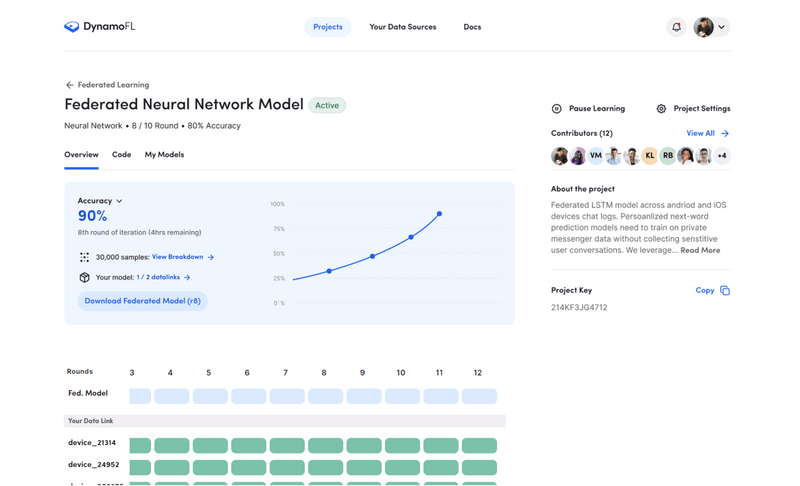
DynamoFL

Image Credits: DynamoFL

DynamoFL, which is deployed on a customer’s virtual private cloud or on-premises, attempts to solve for these problems in a range of ways, including with an LLM penetration testing tool that detects and documents LLM data security risks like whether an LLM has memorized or could leak sensitive data. Several studies have shown that LLMs, depending on how they’re trained and prompted, can expose personal information — an obvious anathema to large firms working with proprietary data.

In addition, DynamoFL provides an LLM development platform that incorporates techniques aimed at mitigating model data leakage risks and security vulnerabilities. Using the platform, devs can integrate various optimizations into models, also, enabling them to run on hardware-constrained environments such as mobile devices and edge servers.

These capabilities aren’t particularly unique, to be clear — at least not on their face. Startups like OctoML, Seldon and Deci provide tools to optimize AI models to run more efficiently on a variety of hardware. Others, like LlamaIndex and Contextual AI, are focused on privacy and compliance — providing privacy-preserving ways to train LLMs on first-party data.

So what’s DynamoFL’s differentiator? The “thoroughness” of its solutions, Mugunthan argues. That includes working with legal experts to draft up how to use DynamoFL to develop LLMs in compliance with U.S., European and Asian privacy laws.

The approach attracted several Fortune 500 customers, particularly in the finance, electronics, insurance and automotive sectors.

“While products exist today to redact personally identifiable information from queries sent to LLM services, these don’t meet strict regulatory requirements in sectors like financial services and insurance, where redacted personally identifiable information is commonly reidentified through sophisticated malicious attacks,” he said. “DynamoFL has drawn upon its team’s expertise in AI privacy vulnerabilities to build the most comprehensive solution for enterprises seeking to satisfy regulatory requirements for LLM data security.”

DynamoFL doesn’t address one of the more sticky issues with today’s LLMs: IP and copyright risks. Commercial LLMs are trained on a large amount of internet data, and sometimes, they regurgitate this data — putting any company that uses them at risk of violating copyright.

But Mugunthan hinted at an expanded set of tools and solutions to come, fueled by DynamoFL’s recent funding.

“Addressing regulator demands is a critical responsibility for C-suite level managers in the IT department, particularly in sectors like financial services and insurance,” he said. “Regulatory non-compliance can result in irreparable damage to the trust of customers if sensitive information is leaked, carries severe fines and can result in major disruptions in the operations of an enterprise. DynamoFL’s privacy evaluation suite provides out-of-the-box testing for data extraction vulnerabilities and automated documentation required to meet security and compliance requirements.”

DynamoFL, which currently employs a team of around 17, expects to have 35 staffers by the end of the year.

What to Expect from Google’s Gemini?

Google DeepMind’s most awaited foundational model, Gemini, is expected to be launched sometime next month. Demis Hassabis recently claimed that engineers at DeepMind are using techniques from AlphaGo for Gemini—which will be its challenger in the AI race and was teased during Google’s I/O event. Hassabis claims that Gemini will be more capable than OpenAI’s GPT-4.

“At a high level you can think of Gemini as combining some of the strengths of AlphaGo-type systems with the amazing language capabilities of the large models,” Hassabis said. “We also have some new innovations that are going to be pretty interesting,” he added.

In April, Google brought Google Brain and DeepMind teams together into a single unit—Google DeepMind. Pichai’s unexpected merger aimed to boost efficiency, using Google’s seemingly unending computational resources and DeepMind’s meticulous research to build more capable systems which would be the next frontier in this AI arms race.

Before that, both entities developed individual responses against ChatGPT. While DeepMind initiated Project Goodall, using an undisclosed model called Chipmunk, Google launched Bard based on Google Brain models. Despite a rivalry between the teams, DeepMind abandoned Goodall to collaborate on Gemini.

However, people forget that PaLM and PaLM 2 were not created by Deepmind. Gemini will be deepminds potentially first popular commercialised model that won’t be stuck in research like Gato and it’s other interesting models.

Despite being in the early stages of development, Google reports significant advancements in Gemini’s multimodal capabilities, surpassing preceding models. Its notable that Gemini was conceived from the ground up with a multifaceted design approach. This design not only prioritises being multimodal, allowing it to process and understand various forms of data, but also emphasises high efficiency in terms of tools and API integrations. Gemini’s architecture is furthermore poised to facilitate future innovations, specifically memory and planning.

The implications of this progress are substantial, as it hints at enhanced comprehension and interaction with diverse types of data. While GPT-4 is adept at understanding and generating conversational text, Gemini will transcend this by being proficient in processing various inputs, including text, images, and videos. Gemini will also be capable of generating outputs in the form of text, videos, audio, music, and images. Additionally, it will possess reasoning capabilities and the ability to facilitate translations across diverse languages and input formats.

In addition, discussions among Google employees have revolved around using Gemini for various functionalities. This includes tasks such as analysing charts, producing graphics accompanied by text descriptions, and operating software through text or voice commands.

Boosting Enterprise Services

Google is pinning its hopes on Gemini to fuel a range of services. These applications span from the Bard chatbot, which competes with OpenAI’s ChatGPT, to enterprise-oriented platforms like Google Docs and Slides. In pursuit of this goal, Google envisions charging app developers for access to Gemini via its Google Cloud server-rental division. At present, Google Cloud provides access to less advanced Google-designed AI models through Vertex AI. By incorporating these new attributes, Google aims to narrow the gap with Microsoft, which has surged ahead in integrating new AI features into its Office 365 suite. Microsoft has also been offering OpenAI’s models to its application users.

Unleashing New Medical Use-cases

Google has been high on integrating its AI models to develop medical use cases. It has been testing an AI tool called Med-PaLM 2, which would answer medical questions. The product is being tested at renowned healthcare institutions like the Mayo Clinic research hospital.

These efforts could be magnified with Gemini and could be used in medical chatbots or robotics to help with surgeries or assistance in medical procedures.

Building Super Cool Robots

In addition, Google might also look to integrate their insights from building DeepMind’s Gato, a “general-purpose” system, which was trained to complete 604 tasks through multi-modal, multi-task training, including image captioning, dialogue, robot-arm block stacking, playing games, and navigating 3D environments.

Gato’s unique aspect is its task diversity and training approach which employed a transformer neural network and various data modalities like text, images, and actions. During deployment, Gato tokenises prompts and observations to generate actions sequentially.

Similarly, with the recent launch of RT-2, which is based on Transformer architecture and trained on web text and images, empowering it to directly generate robotic actions.

Similar to language models, it learns from web data to guide robot behaviour. This innovation builds on vision-language models (VLMs) like PaLI-X and PaLM-E, using action tokens in its output to control robots’ behaviour effectively.

With the recent launch of its RT-2 a successor to its Robotics Transformer model, Google DeepMind has taken a leap forward in robotics as well. RT-2 is based on Transformer architecture and trained on web text and images, which empowers it to directly generate robotic actions.

This innovation builds on vision-language models (VLMs) like PaLI-X and PaLM-E, using action tokens in its output to control robots’ behaviour effectively. Similar to language models, it learns from web data to guide robot behaviour.

While DeepMind’s Gato was seen as a stride toward artificial general intelligence (AGI), because of it capability of diverse tasks—Gemini could be the actual step towards sentience.

Might Kill OpenAI’s GPT-4

The fact that Google Brain and DeepMind are working on this together possibly means trouble for OpenAI and other competitors. Additionally, others like former Google president Sergey Brin have joined forces to strengthen its AI capabilities.

OpenAI Chief Sam Altman believes video training is the next frontier, however, Google has got an edge and is sitting on top of the world’s biggest video library—Youtube.

Gemini is being trained on YouTube videos and would be the first multi-modal model being trained on video rather than just text (or in GPT-4’s case text plus images). This might equip Gemini with capabilities well beyond GPT-4. Don’t forget that it has access to nearly all of the web, to which Google claimed a stake recently by changing its privacy policy.

Not just that, there are reports indicating that Gemini is being trained on twice the number of tokens as GPT-4 was, and 10x that of PaLM 2. manifold compute making it significantly smarter and less prone to hallucinations. Not just that, with friction between OpenAI and Microsoft lately, Google could be the tortoise to beat OpenAI to the punch and become the first to arrive at AGI or AGI-like model.

The post What to Expect from Google’s Gemini? appeared first on Analytics India Magazine.

Wipro Launches Centre of Excellence on Generative AI at IIT Delhi

Wipro has announced the launch of a new Centre of Excellence (CoE) on Generative Artificial Intelligence (AI) in partnership with the prestigious Indian Institute of Technology (IIT) Delhi.

The Wipro CoE on Generative AI is anchored within the Yardi School of Artificial Intelligence (ScAI) at IIT Delhi and will support foundational and applied research, nurture talent, and expand the state of the art in this critical field.

The partnership underscores Wipro’s commitment to driving ongoing innovation in emerging technologies and is part of the company’s USD 1 billion commitment to accelerating AI-led innovation as part of the Wipro ai360 ecosystem.

The CoE will serve as an R&D hub, bringing together Wipro researchers with ScAI faculty members and graduate students to address at-scale real-world problems. Wipro CoE teams will jointly work on building innovative solutions using AI, ML and other technologies.

“Collaborating with the eminent and multidisciplinary faculty at IIT Delhi and its research partner ecosystem will help us realize our vision of Engineered Prosperity faster,” Dr. Ajay Chander, Head of Research & Development at Wipro Limited, said.

The post Wipro Launches Centre of Excellence on Generative AI at IIT Delhi appeared first on Analytics India Magazine.

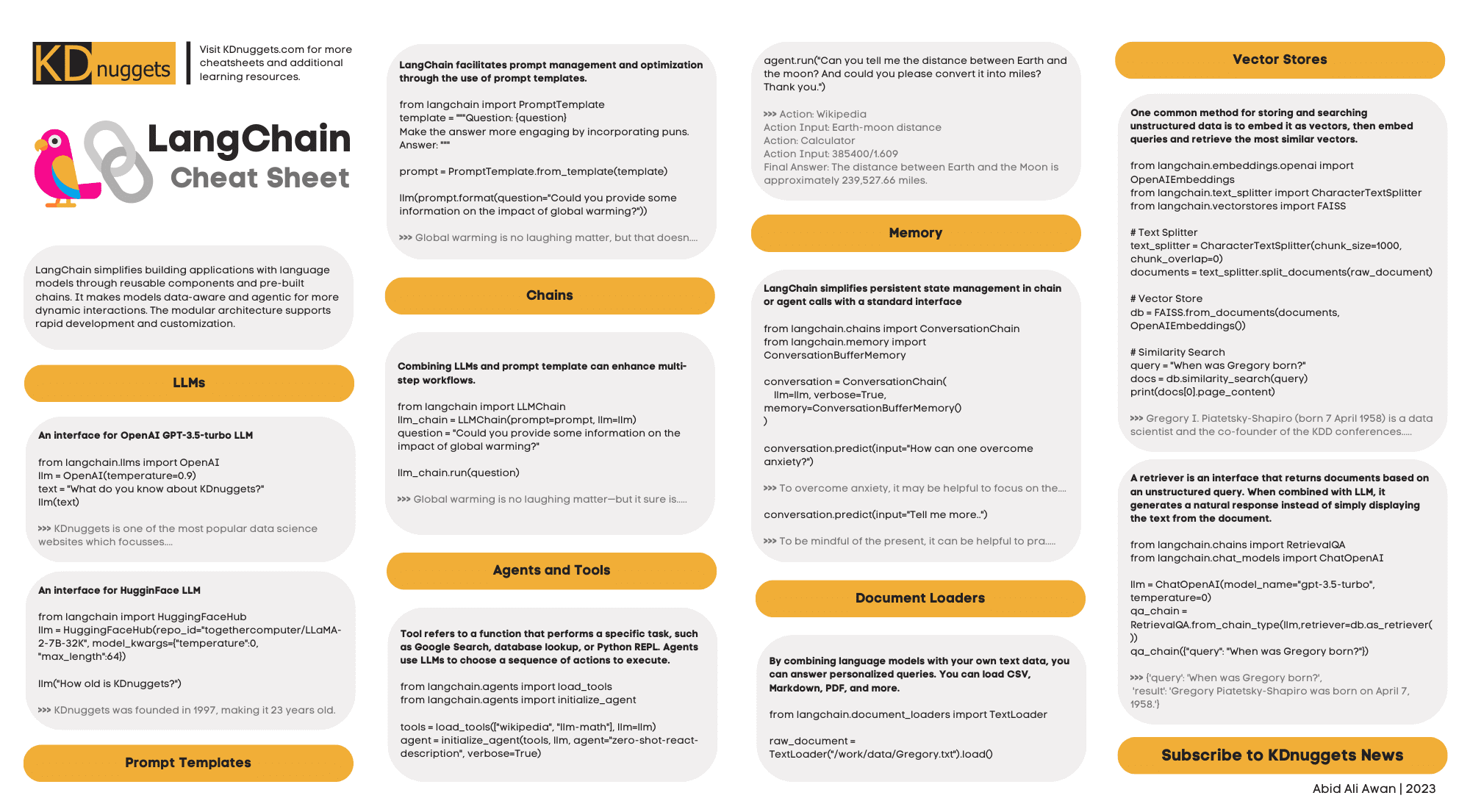
LangChain Cheat Sheet

Don't Be a Weak Link

The field of artificial intelligence continues advancing rapidly, with new frameworks and tools constantly emerging to make AI more accessible. One particularly exciting development of the recent LLM explosion is LangChain, an open-source Python library that simplifies building AI applications using large language models.

LangChain provides an intuitive interface for connecting to state-of-the-art models like GPT-4 and optimizing them for custom applications. It supports chains combining multiple models and modular prompt engineering for more impactful interaction. The library also includes tools for equipping your application with external knowledge through document loaders, vector stores for similarity search, and more.

With LangChain, developers can build capable AI language-based apps without reinventing the wheel. Its composable structure makes it easy to mix and match components like LLMs, prompt templates, external tools, and memory. This accelerates prototyping and allows seamless integration of new capabilities over time. Whether you're looking to create a chatbot, QA bot, or multi-step reasoning agent, LangChain provides the building blocks to assemble advanced AI rapidly.

For more on getting started with LangChain, check out our latest cheat sheet.

LangChain Cheat Sheet

LangChain simplifies building applications with language models through reusable components and pre-built chains. It makes models data-aware and agentic for more dynamic interactions. The modular architecture supports rapid development and customization.

For those new to conversational AI and LLMs, LangChain offers approachable abstractions that simplify leveraging large models. The documentation and community support help newcomers get productive quickly. More experienced users will appreciate the flexibility to customize and extend provided modules. LangChain enables users of all levels to unlock the power of LLMs.

Our latest cheat sheet provides a helpful overview of LangChain's key features and simple code snippets to get started. For anyone interested in working with large language models, LangChain is an essential tool to add to your kit, and this resource is the key to getting up and running right away.

Check it out now, and check back soon for more.

More On This Topic

  • The ChatGPT Cheat Sheet
  • RAPIDS cuDF Cheat Sheet
  • Streamlit for Machine Learning Cheat Sheet
  • GitHub CLI for Data Science Cheat Sheet
  • Data Cleaning with Python Cheat Sheet
  • Docker for Data Science Cheat Sheet

Redis Enterprise 7.2 Empowers Developers to Harness the Power of Real-Time Data

Redis has announced the unified release of Redis 7.2 across all of the company’s products and services, including open source, source-available, commercial cloud, software, and Kubernetes distributions.

Redis Enterprise 7.2 cloud and software products preview a scalable search feature which delivers even greater performance for query and search use cases, including vector similarity search (VSS).

Redis 7.2 also raises the bar for ease-of-use across the board from new core Redis capabilities to tooling while ensuring that the clients, integrations, and documentation deliver a seamless, unified experience.

Additionally, with the growing challenges of building generative AI applications, Redis Enterprise has been enhanced to store vector embeddings while providing a high-performance index and query search engine.

Moreover, newly supported client libraries and programmability enable developers to be more productive, work seamlessly across any Redis distribution.

New Auto Tiering hosts large datasets across memory and SSD with more than twice the performance of previous versions. Moreover, Redis Data Integration simplifies app design and common integration patterns without code

“Redis has also been an early mover in the emergence of vector database technology. Scalable search further optimizes the processing of low-latency vector workloads with a robust and performant search engine to make it easy for developers to build generative AI applications,” Rowan Trollope, CEO at Redis, said.

The post Redis Enterprise 7.2 Empowers Developers to Harness the Power of Real-Time Data appeared first on Analytics India Magazine.

Microsoft is the Most Impersonated Brand in Phishing Attacks

Microsoft is the top most impersonated brand in the world, according to a report by Cloudflare. Attackers not only frequently impersonate Microsoft, but they also use Microsoft’s own tools to commit fraud.

Attackers posed as nearly 1,000 different organisations in nearly a billion impersonation attempts against Cloudflare customers.

However, the majority (51.7%) of the time, they posed as one of just 20 organizations, without Microsoft topping the charts, Cloudflare, which handles 20% of the world’s web traffic, said in the report.

Microsoft is followed by the World Health Organisation, Google, SpaceX and Salesforce respectively.

Generally, attackers primarily impersonate the brands and entities we trust and rely on. In the report titled ‘2023 Email Threat Report’, Cloudflare found that in the Software-as-a-Service (SaaS) category, attackers impersonated Salesforce the most, followed by Notion.so and Box.

Similarly, in the financial services sector, Mastercard is the mostly impersonated brand.

In the Asia Pacific (APac) region, India’s State Bank of India (SBI) is the third most impersonated brand, behind LINE and JCB Global.

Tenable CEO raises red flag on Microsoft’s cybersecurity practices

Earlier this year, an engineer at cybersecurity firm Tenable discovered an issue with the Microsoft Azure platform which enabled an unauthenticated attacker to access cross-tenant applications and sensitive data, such as authentication secrets.

“To give you an idea of how bad this was, our team quickly discovered authentication secrets to a bank. They were so concerned about the seriousness and the ethics of the issue that we immediately notified Microsoft,” Amit Yoran, chairman and CEO, Tenable, wrote in a blog post.

Read more: Microsoft’s Cybersecurity at Big Risk, Tenable CEO Raises Red Flag

The post Microsoft is the Most Impersonated Brand in Phishing Attacks appeared first on Analytics India Magazine.
This school district used ChatGPT to ban 19 books

NEW YORK, NY - APRIL 26: Copies of Margaret Atwood's book "The Handmaid's Tale" on display during the Interactive "The Handmaid's Tale" Art Installation Opening at The High Line on April 26, 2017 in New York City. (Photo by J. Countess/Getty Images)

The Mason City Community School District in Iowa used artificial intelligence (AI) to compile a list of books that contained sexual content, resulting in the removal of 19 books from the shelves of its libraries in grades 7-12.

The school district created a list of titles that have frequently been objected to or that have been called for removal in the past. It then ran them through ChatGPT, asking the AI chatbot, "Does [book] contain a description or depiction of a sex act?" If ChatGPT answered affirmatively, the book was removed from school libraries and stored in administrative offices for further review.

Also: Most Americans want federal regulation of AI, poll shows

The banned books include 'The Handmaid's Tale' by Margaret Atwood, 'Beloved' by Toni Morrison, and 'The Color Purple' by Alice Walker.

Critics disagree with the strategy, as AI systems such as ChatGPT are not exempt from misinformation and hallucinations. Popular Science discussed the matter with Bridgette Exman, Mason City Schools' Assistant Superintendent of Curriculum and Instruction, who called this method "a defensible process".

Popular Science also asked ChatGPT several times about 'The Kite Runner' by Khaled Hosseini, one of the 19 banned books, and got contradicting responses, one time saying the book contains little to no explicit content, and then saying it does contain "a description of a sexual assault" later on.

Also: We're not ready for the impact of generative AI on elections

The process of selecting and then removing books from school libraries was undertaken to comply with a new Iowa law signed by Governor Kim Reynolds in May. The legislation is related to "gender identity and sexual orientation in school districts", and schools are looking to comply with the law by the beginning of the encroaching school year.

The law establishes that school libraries can only contain "age-appropriate materials", defined in Senate File 596 as the following:

"Age-appropriate means topics, messages, and teaching methods suitable to particular ages or age groups of children and adolescents, based on developing cognitive, emotional, and behavioral capacity typical for the age or age group. Age-appropriate does not include any material with descriptions or visual depictions of a sex act."

Reading every book in the school district's libraries is impractical, which is why the Mason City School District turned to ChatGPT.

"Our classroom and school libraries have vast collections consisting of texts purchased, donated, and found," Exman told The Gazette last week. "It is simply not feasible to read every book and filter for these new requirements. Therefore, we are using what we believe is a defensible process to identify books that should be removed from collections at the start of the 23-24 school year."

Artificial Intelligence