Indian spacetech startup Agnikul Cosmos has commenced the integration process of its cutting-edge launch vehicle, Agnibaan SOrTeD (SubOrbital Technological Demonstrator), with its private launchpad located at Satish Dhawan Space Centre (SDSC) SHAR at Sriharikota.
This significant step brings Agnikul closer to realising its vision of delivering reliable and affordable access to space.
Agnibaan SOrTeD is a single-stage launch vehicle driven by Agnikul’s patented Agnilet engine– an entirely 3D-printed, single-piece, 6 kN semi-cryogenic engine, showcasing Agnikul’s dedication to pushing the boundaries of space technology.
Unlike traditional sounding rockets that launch from guide rails, Agnibaan SOrTeD will lift off vertically and follow a predetermined trajectory while performing a precisely orchestrated set of maneuvers during flight.
These flight events have been configured to validate key technologies integral to the success of the company’s upcoming orbital flights. Agnikul plans to complete its first flight in the coming few weeks.
The post Agnikul Cosmos Commences Integration Activities of its First Launch Vehicle appeared first on Analytics India Magazine.
Don’t panic. It might be too soon to say this, but it is quite possible that OpenAI, the company behind the revolutionary AI product, ChatGPT, might just have to pull the plug on it. There are reasons that lead up to this.
OpenAI has been trying to fix the mess that ChatGPT is in all this while. Most recently, the company decided to acquire Global Illumination, a startup leveraging AI for building creative tools including games and simulated worlds. The company has previously driven a lot of projects with YouTube, Google, Pixar, and Riot Games. OpenAI said that the whole team would help it to fix its core products including ChatGPT.
The latest project that Global Illuminations has built is Biomes, which is an open source sandbox MMORPG similar to Microsoft’s Minecraft, which runs directly on the web. There can be a possibility that the company wants to launch another consumer-facing product, which might possibly be a social experiment/game — to possibly collect data and train its upcoming AI models.
Because for now, the company is finding it very difficult to upgrade its AI models’ capabilities. Though it has filed for a trademark on ‘GPT-5’, it has not yet delivered all the multi-modal capabilities that it had promised with GPT-4. A lot of it is possibly because of the global GPU shortage. But with this partnership, the company might be able to “ethically” collect users’ data as they interact with multiple GPT-based bots or digital NPCs.
Not sure if OpenAI is moving away from text-based LLM thought process and following Google DeepMind’s route to build better AI systems, and eventually AGI, based on rule-based games – the likes of AlphaGo, etc, which are coincidentally being used to build Gemini, which is touted to be launched next month, and is better than GPT-4 (that powers ChatGPT).
ChatGPT in a Mess
ChatGPT is currently facing a lot of challenges. The product that acquired a million users in just 5 days, is currently witnessing a decline in users. The last three months have constantly seen a decrease in the number of users of website visits. In July, the number of users dropped to 1.5 billion, compared to 1.7 billion in June – i.e. close to 12% percent MoM.
One of the reasons for this can be the degradation of the output quality of ChatGPT, which is reported by a lot of users on Reddit and X. To fix these issues, OpenAI needs access to a lot more data to fine-tune the model. But that is not possible. It has been increasingly deciding to increase the privacy measures for its users, and thus has been constantly saying that it won’t collect data from conversations if the users opt out.
(if and only if a customer specifically asks us, we will include specified data in a future training run to improve the model in a specific way)
— Sam Altman (@sama) August 15, 2023
On the other hand, to tackle this data privacy issue and still be able to train its AI model, the company has been partnering with news and journalism websites such as AP and others to collect first hand information. But in turn is costing the company even more.
According to the Information, OpenAI had to bear the loss of $540 million to build ChatGPT, and the operational costs are exorbitantly high as well – around $700,000 per day. Thus, the company is not profiting right now. Funnily enough, all of this money is going from the pockets of Microsoft. This can probably raise a conflict between both the companies about how they want to continue this relationship going forward.
In a recent event, Microsoft released a GitHub repository of Azure ChatGPT, where it was offering services directly on the Azure platform. The most astonishing part about this was that the blog read that people have always been concerned about the privacy concerns about using ChatGPT directly as OpenAI might be able to collect data. This does sound like the company is acknowledging that there is a feud between both companies.
A day later, the repository was deleted. It is not clear if the upload was by mistake or hinting towards a problem between both the companies. But whatever the case is, it only makes sense for OpenAI to pull the plug on the free web version of ChatGPT given the operational costs and it is not benefiting Microsoft in any way. The only way Microsoft is earning revenue through OpenAI is by the Azure OpenAI Service, and it is only reasonable for Microsoft to push all the users onto it, instead of freely giving away ChatGPT to everyone.
Clearly, there can’t be two ChatGPTs.
In March, after Microsoft renovated Bing Search with ChatGPT, it reached 100 million users, which is still very low compared to ChatGPT’s 1.5 billion right now. OpenAI was against Microsoft’s move to integrate an incomplete version of GPT-4 into Bing Chat, but Microsoft went ahead with it anyway. For Microsoft, ChatGPT being available only on its Azure Cloud and Bing makes total sense. Dispute has been clearly on for both the companies.
Even though ChatGPT is helping a lot of users, it is as good as dead from a company standpoint. Companies have been banning the use of ChatGPT for their employees due to privacy concerns, which just makes the case worse for OpenAI. Due to these data privacy concerns, people have also decided to migrate and build their own LLM-based models leveraging open-source offerings such as Llama 2.
The reason that OpenAI is most likely to shut down the free ChatGPT website and not the whole line of GPT products is that people are still using the APIs offered by the company for building their own products, which interestingly has seen an increase in the last two months. But that is also not helping Microsoft in any way.
Plus, OpenAI has been in the midst of a lot of legal and ethical troubles for building ChatGPT, and Microsoft wants to distance itself from it because of that. It also shut down its AI classifier for identifying AI generated text because the company admitted that it is not able to do the job.
All of this points to the fact that giving ChatGPT away for free is not benefiting OpenAI anymore. It has already acquired all the users that it wanted and now it is time to make money out of it, which only Microsoft can help them do.
If Microsoft has plans to acquire OpenAI in the future, it only makes sense for OpenAI to pull the plug on ChatGPT by itself as it does not really benefit them anyway. It has already proven its point and acquired billions of users. Microsoft can just take these services and integrate them exclusively on Azure or Bing Search Engine and monetise it, making everyone happy in the end.
Imagine a world where we all go to Bing Chat just to use ChatGPT, and that too in real time, and who knows it might even be better than Google Search? But since ChatGPT is OpenAI’s pet project, it might be hard to give up on it completely.
The post OpenAI Likely To Pull the Plug on ChatGPT appeared first on Analytics India Magazine.
Since the world’s richest man Elon Musk took over Twitter (now X) last year, reports of user exodus started surfacing the internet. The growing list of celebrities and brands now reconsidering using the social media platform has been joined by environmental scientists as per a recent Nature study.
To get familiar with the nature of researchers currently interacting with the site, Nature reached out to 170,000+ scientists who were, or still are, users; nearly 9,200 responded.The findings suggest a significant shift in behavior, as over half of the respondents have curtailed their time spent on the platform within the past six months. Moreover, a minority—just under 7%—stated they have completely abandoned its use. Approximately 46% of the surveyed researchers have sought refuge on alternative platforms, including Mastodon, Bluesky, Threads, and even TikTok.
As per the responses, reasons for user migration varied from noticing an uptick in the amount of strange” political far-right accounts espousing science denialism, to Musk’s chaotic management. After Musk completed the $44 billion deal to acquire the platform, he made a series of unessential changes including decreased content moderation; ditched the ‘blue-tick’ verification; the introduction of data access fees for research purposes, limiting visible tweet count per user; and abruptly rebranding the platform’s name to ‘X’, making the blue bird extinct.
Furthermore, Nature pointed out that Twitter has historically played an integral role in the research community to publicize and promote scientific debate.
Researchers and scientists on the platform have served as an important source of authoritative information even though it long struggled to combat misinformation. The platform founded in 2006 has also been a valuable source of data to study subjects ranging from public health to linguistics. But it’s not the same as it was. The majority of users now feel their voices go unheard due to the platform’s priority to push content from ‘paid and verified’ accounts. Moreover, the company has made its API so expensive that most cannot afford and access it.
The post Irked By Musk’s Management, Scientists Flock Away From Twitter appeared first on Analytics India Magazine.
Today onwards Adobe Express will be generally available for the desktop web with a mobile version soon to follow. The latest version of the content creation app has Firefly beta generative AI capabilities to easily plan, schedule, preview, and publish standout content.
Formerly known as Adobe Spark, Express brings Adobe’s tools into an all-in-one editor, making it a rival of Canva and Microsoft Designer. The one-stop shop for editors is available globally and Firefly generative AI now supporting prompts in 100+ languages. In the recent release, the software incorporates quick features such as automated background removal and animations with audio cues.
“With groundbreaking innovations and generative AI at the core of Express, we’re empowering an ever-expanding user base with an AI-first, all-in-one tool that makes content creation fast, easy and fun,” said Govind Balakrishnan, senior vice president, Adobe Express and Digital Media Services at Adobe. “The all-new Express is revolutionizing how people turn ideas into stunning content and we’re just getting started with exciting innovations across image creation, design, video, audio, PDFs and more still to come.”
Good news for Creative Cloud members as they now have access to the full paid version ($9.99 monthly) of Express Premium — no extra cost. Users can also import and enhance PDFs in Express and the app enables users to collaborate in real-time.
Even though the design software company jumped on the generative AI bandwagon late last year, it has managed to snatch the dominant position from other AI-powered AI tools. While Adobe’s efforts appear to put it in the dominant position, competitors can still outperform the company in certain aspects. With more upcoming announcements on the way, the dynamic AI landscape will only further evolve as the market responds to Adobe’s updates.
Read more: Canva Can’t Keep Up With Adobe Anymore
The post Adobe Express Now On Desktop With More GenAI Skills appeared first on Analytics India Magazine.
Since 2008, if any programmers had a question, their first destination was Stack Overflow (SO). Until OpenAI unleashed ChatGPT.
ChatGPT comes in handy for information needs. However, new research states that the high-profile chatbot might not be the optimal solution for software engineering prompts. In the context of programming questions akin to those on SO, OpenAI’s ChatGPT is wrong more than half the time.
Since no data was showing just how much assistance ChatGPT can provide in answering those types of prompts, Purdue University meticulously examined the dilemma. To figure out its efficacy, researchers Samia Kabir and their team meticulously presented 517 questions similar to those found on SO to ChatGPT. The team examined the accuracy and quality of those responses for the study.
The findings tell a rather telling story. Out of the total responses, a significant 52%—amounting to 259 answers—were incorrect, while a comparatively 48% proved accurate. Moreover, a considerable 77% of the answers were verbose. This staggering amount of responses although seemed well-articulated, also raised concerns about the potential impact on clarity and efficiency. Paradoxically, the AI model’s inaccuracy is overshadowed by its eloquence suggested by the research paper’s observations.
The power of StackOverflow is peer review. Some people will go out of their way to make sure the information shown on the posts are correct. ChatGPT slaps in language model engine that makes paragraphs look trustworthy, but there is no guarantee that the info had been vetted.
— PR (@frostshoxx) April 3, 2023
A user also stated, in their experience, when prompted in well-known subjects, ChatGPT mostly produces somewhat-to-very-wrong answers. “Whether right, inaccurate, or completely wrong, it produces equally confident language. It is therefore extremely likely to produce confidently wrong answers in subjects that I do not know. I cannot tell whether the text it is spewing is approximately correct, dangerously wrong, or merely somewhat inaccurate. Therefore it is clearly worse than useless.”
In the research, titled “Who Answers It Better? An In-Depth Analysis of ChatGPT and Stack Overflow Answers to Software Engineering Questions,” researchers further uncovered a bunch of insights and concerning findings.
All In For Semantics
The authors also found OpenAI’s ChatGPT is more likely to make conceptual errors than factual ones. “Many answers are incorrect due to ChatGPT’s incapability to understand the underlying context of the question being asked,” the paper found.
Earlier this month, SO decided to switch to semantic search due to the constant rise of traffic on the page. In the announcement blog, the company stated, “Semantic search and LLMs go together like cookies and milk”. In layman’s terms, semantic search understands the meaning and intent behind queries in a way a human would. As a result, it delivers precise and contextually relevant search results.
In the announcement blog, SO further stated, its ‘ethos is simple: accuracy and attribution’. While GPT models out there are generating results from sources unknown, The company has taken charge to attribute questions and answers used in their Retrieval Augmented Generation (RAG) LLM summaries.
Upgraded with AI
The implications of the research extend beyond ChatGPT’s performance.
Since the release of ChatGPT word about the AI chatbot killing Stack Overflow has gotten around. The news was based on the decline of users on the developers’ Q&A platform. As per the Purdue study, the observed decline of conventional platforms like SO indicates that ChatGPT’s popularity is reshaping the online programming assistance landscape.
This shift is underscored by the results of the 2023 Stack Overflow annual Developer Survey, which has insights from 90,000 programmers. The survey highlights that an overwhelming 77% of developers hold a positive view of AI tools. However, when it comes to accuracy, only 42% trust these tools. In an attempt to turn things around a fortnight ago, the New York-based company introduced an umbrella of AI tools under the name of OverflowAI.
In a strategic response SO also unveiled the GenAI Stack Exchange, a dedicated community platform for the exchange of insights on AI tools. These recent moves reflect a conscious effort by SO to adapt to the shifting preferences of developers seeking AI knowledge. Furthermore, SO has introduced the Stack Overflow Natural Language Processing (NLP) Collective with a feature named Discussions, for engaging in nuanced AI debates surrounding technical approaches.
With the release of these recent AI features, the company is taking extra efforts to give tough competition to the internet’s current favourite tool ChatGPT. Even with a slight usage decline, the Purdue study concludes that SO has managed to maintain an upper hand in the engineering department.
The post Stack Overflow Snatches the Spot from ChatGPT appeared first on Analytics India Magazine.
Generative AI has landed on Gartner’s coveted Hype Cycle for Emerging Technologies for 2023, the firm announced Wednesday. The firm said generative AI will bring “transformational benefit” in the next two to five years. Transformational benefits are defined as those that enable “new ways of doing business across industries that will result in major shifts in industry dynamics,” Melissa Davis, a Gartner vice president analyst, told TechRepublic.
The AI subset is positioned on the firm’s “Peak of Inflated Expectations” within the Emerging Technologies Hype Cycle this year. Hype cycles follow the maturity of technologies through their lifecycle, explained Davis. All hype cycles start when a breakthrough, public demonstration, product launch or some other event generates industry interest in a technology or other type of innovation, she said.
“We call this the ‘innovation trigger,'” Davis added. “At the Peak of Inflated Expectations, a wave of ‘buzz’ builds, and the expectations for this innovation rise above the current reality of its capabilities.”
Generative AI is encompassed within the broader theme of emergent AI, a key trend in this hype cycle that is creating new opportunities for innovation, Gartner said in a press release announcing the news.
Jump to:
Business benefits derived from generative AI
Additional emergent AI techniques
Other emerging tech trends
What actions should tech leaders take now?
Business benefits derived from generative AI
Generative AI will have profound business impacts in areas including content discovery, creation, authenticity and regulations, as well as automation of human work and customer and employee experiences, according to Davis.
“Most technology products and services will incorporate generative AI capabilities in the next 12 months, introducing conversational ways of creating and communicating with technologies, leading to their democratization,” she said. “Generative AI will progress rapidly in industry verticals, scientific discovery and technology commercialization.”
Additional emergent AI techniques
In addition to generative AI, Gartner named six other emergent AI techniques the firm believes offer immense potential for enhancing digital customer experiences, making better business decisions and building sustainable competitive differentiation. The emergent AI techniques are: AI simulation, causal AI, federated machine learning, graph data science, neuro-symbolic AI and reinforcement learning.
The techniques were selected after being comprehensively assessed and analyzed by Gartner internal and external data sources to select tech for their potential transformational benefits and their broad impact, Davis said. She broke down each of the AI techniques as follows:
AI simulation is the combined application of artificial intelligence and simulation technologies to jointly develop AI agents and the simulated environments in which they can be trained, tested and sometimes deployed.
Causal AI identifies and uses cause-and-effect relationships to go beyond correlation-based predictive models and toward AI systems that can prescribe actions more effectively and act more autonomously.
Federated machine learning aims to train a machine learning algorithm on multiple local datasets contained in local nodes without the explicit sharing of data samples.
Graph data science is a discipline in which data science techniques are applied to graph data structures to identify behavioral characteristics that can be used to build predictive and prescriptive models.
Neuro-symbolic AI is a form of composite artificial intelligence that combines ML methods and symbolic systems (e.g., knowledge graphs) to create more robust and trustworthy AI models.
Reinforcement learning is a type of ML where the learning system receives training only in terms of positive feedback (rewards) and negative feedback (punishments).
Other emerging tech trends
In addition to emergent AI, the Gartner release named other emerging tech trends: developer experience, pervasive cloud and human-centric security and privacy.
Developer experience: DevX refers to all types of interactions between developers and the tools, platforms, processes and people they work with to develop and deliver software products and services. An enterprise’s success in digital initiatives depends on enhancing DevX, the latest Gartner press release said. This includes the ability to attract and retain top engineering talent and ensure that work is motivating and rewarding.
Key technologies that are enhancing DevX include AI-augmented software engineering, API-centric software as a service, GitOps, internal developer portals, open-source program office and value stream management platforms, the release said.
Pervasive cloud: Gartner noted that cloud computing will evolve from a tech innovation platform to becoming pervasive and an essential driver of business innovation over the next 10 years. To enable pervasive adoption, cloud computing is becoming more distributed and will be focused on vertical industries.
Key technologies enabling the pervasive cloud include augmented FinOps, cloud development environments, cloud sustainability, cloud-native, cloud-out to edge, industry cloud platforms and WebAssembly, the release said.
SEE: Top 5 cloud computing use cases and examples (TechRepublic)
Human-centric security and privacy: Humans continue to be the main reason for security incidents and data breaches. Organizations can become resilient by implementing a human-centric security and privacy program, Gartner said. This blends a security and privacy fabric into the organization’s digital design.
Expanding human-centric security and privacy requires support from key technologies, including AI trust, risk and security management, cybersecurity mesh architecture, generative AI cybersecurity, homomorphic encryption and post-quantum cryptography, the firm said.
What actions should tech leaders take now?
Even with the spotlight shining on AI right now, CIOs and CTOs must also turn their attention to these other emerging technologies with transformational potential, Davis advised.
Furthermore, they should bear in mind that the technologies in this hype cycle are still at an early stage, so there is “significant uncertainty about how they will evolve,” she added. As such, these technologies present greater risks when deployed, “but potentially greater benefits for early adopters.”
Subscribe to the Innovation Insider Newsletter
Catch up on the latest tech innovations that are changing the world, including IoT, 5G, the latest about phones, security, smart cities, AI, robotics, and more.
The August 2023 TIOBE Programming Community Index is out, and the programming language Julia has reached the top 20 for the first time. Julia is a relatively new programming language — it was formalized 13 years ago — making its rapid ascent particularly notable. TIOBE Software ranks 100 programming languages by their popularity with the programming community.
Jump to:
Julia is especially suited to machine learning
Shifts in the top 10 list of programming languages
What is the TIOBE Programming Community Index?
Julia is especially suited to machine learning
Julia’s rise into the top 20, at number 20, is remarkable because this is the first time the relatively new programming language has entered the upper echelons of popularity in the index. Julia is often used for machine learning, data science and mathematical computation, TIOBE Software CEO and list proprietor Paul Jansen pointed out. However, that doesn’t make it unique — many other programming languages in the top 20, such as Python, R and MATLAB also come from those fields.
Jansen says the difference is in usability: “Julia is faster than Python, more suitable to write large systems in it than R and less expensive than MATLAB,” he wrote. “So, speed, scalability and being open source make Julia an attractive alternative.”
SEE: Getting started with Julia: A list of resources (free PDF) (TechRepublic)
There are some challenges to using Julia. Jansen said, ” … Julia requires more programming skills than the other 3 languages mentioned, so it is really interesting to see whether it can keep its position between the big boys.”
Julia’s continued rise — it was on the TIOBE radar last month at number 24 — is part of the trend of data science and mining use cases, Jansen told TechRepublic. Julia was developed in 2012 by Dr. Viral Shah, Alan Edelman, Dr. Jeff Bezanson and Stefan Karpinski at MIT. It’s remarkable in part for its Just In Time compiler and support for a Read-Eval-Print loop, in which code lines are interpreted as they are written.
Julia is particularly good for machine learning because it boasts the SimpleChains.jl library, which is designed to speed up the creation of small neural networks such as the scientific machine learning networks used in healthcare data analytics.
Shifts in the top 10 list of programming languages
The top three programming languages on the index stayed steady between July and August, with Python, C and C++ maintaining the prime spots, respectively. C++ gained points in TIOBE’s ranking system, rising 0.49% points to its highest position since it entered the index in 2001. (The added points weren’t enough to nudge it to a higher numbered position, however.)
SEE: The complete top 10 list of programming languages from this month’s TIOBE Index and previous months in 2023 (TechRepublic)
Jansen chose C++ as the language of the year in 2021 due to it gaining the most popularity according to his popularity ranking math. At the time, he said C++ took the gold in part because ” … it is possible to develop fast and vast software systems (over millions of lines of code) in C++ without necessarily ending up in a maintenance nightmare.” Its consistent updates, such as the relatively recent C++20 publication, also likely contributed to its popularity, Jansen said.
SEE: The C++ Programming Bundle: Beginner to Expert (TechRepublic Academy)
Further down the top 10 list, there hasn’t been a lot of movement between July and August. JavaScript and SQL both gained points, although not enough to change their rankings. Assembly language entered the top 10 at number nine, while MATLAB fell off its number 10 spot in July to number 13 in August and was replaced by PHP.
What is the TIOBE Programming Community Index?
The TIOBE Programming Community Index is a leaderboard of programming languages ranked by TIOBE’s points system for the popularity of each language. The index is updated once a month. Ratings are determined by the community of engineers, courses and third-party vendors. Popular search engines such as Google, Bing, Yahoo, Wikipedia, Amazon, YouTube and Baidu are also used to calculate the ratings. TIOBE notes that the index doesn’t measure “the best” programming language or the language in which most lines of code have been written — rather, it’s a measure of general popularity and awareness.
TIOBE positions its index as a good tool for checking whether a professional programmer’s skills are still up to date or for making a strategic decision about what programming language one should adopt when building a new software system.
Subscribe to the Developer Insider Newsletter
From the hottest programming languages to commentary on the Linux OS, get the developer and open source news and tips you need to know.
Every year, Gartner identifies 25 key emerging technologies to watch in its Hype Cycle for Emerging Technologies study. In the 2023 report, unsurprisingly, generative AI topped the hype cycle.
To put together the Hype Cycle for Emerging Technologies the research firm identifies key insights about more than 2,000 technologies and applied frameworks that it profiles each year.
Also: Google is beefing up AI-powered search on Google Chrome for iOS and Android
All of the emerging technologies chosen are projected to reach transformational benefit within two to 10 years. Gartner projected that generative AI will reach transformational benefit and plateau within two to five years, as seen by the graph below. (Gartner defines transformational benefit as a technology enabling "new ways of doing business across industries that will result in major shifts in industry dynamics." )
Hype Cycle for Emerging Technologies 2023
Research and awareness of generative AI skyrocketed after the launch of ChatGPT in November. As a result, many valuable and transformative breakthroughs for generative AI applications have been made, earning the technology its number-one spot.
"The massive pretraining and scale of AI foundation models, viral adoption of conversational agents, and the proliferation of generative AI applications are heralding a new wave of workforce productivity and machine creativity," said Arun Chandrasekaran, distinguished VP analyst at Gartner.
Despite generative AI being the most popular subsection of AI, there are plenty of other emergent AI technologies within the AI umbrella that have the potential to cause significant societal change.
Specifically, the report flags AI simulation, causal AI, federated machine learning, graph data science, neuro-symbolic AI, and reinforcement learning as emergent AI technologies to look out for.
"In addition to generative AI, several other emerging AI techniques offer immense potential for enhancing digital customer experiences, making better business decisions, and building sustainable competitive differentiation," said Gartner in the report.
Also: This school district used ChatGPT to ban 19 books
Gartner's 2022 hype cycle did not include the category of generative AI as a whole. Still, it did include other subsections, including casual AI, machine learning, generative design AI, foundation models, and digital humans.
In addition to emergent AI, Gartner identified developer experience (DevX), pervasive cloud, human-centric privacy, and security as four emerging technology trend themes.
Navigating the AI Skills Revolution in the Age of GenAI: LinkedIn Report August 16, 2023 by Jaime Hampton
(Gorodenkoff/Shutterstock)
The launch of ChatGPT and similar generative AI technologies is reshaping the skills required in the workplace, according to a new report from LinkedIn.
“The Future of Work Report: AI at Work” found the pace at which LinkedIn members added AI skills to their profile has nearly doubled since ChatGPT’s debut in November 2022, rising from 7.7% (May–November 2022) to 13% (November 2022–June 2023).
LinkedIn says more of its members are adding AI skills to their profiles than ever before and that there has been a 21x increase in global English-language job postings that mention AI technology like ChatGPT since November 2022.
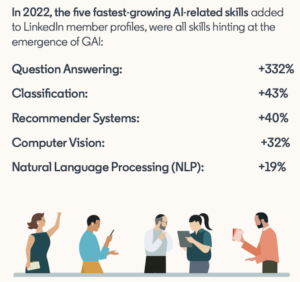
The five fastest-growing AI skills added to LinkedIn member profiles in 2022 were Question Answering (up 332%), Classification (up 43%), Recommender Systems (up 40%), Computer Vision (up 32%) and Natural Language Processing (up 19%), reflecting some of the most popular generative AI technologies in use today.
(Source: LinkedIn)
LinkedIn says an uptick in members’ skills, employers’ job postings, and platform conversations indicates that competition is intensifying to hire talent to fill specialized AI roles. Since generative AI is an emerging field, employers will need an increased emphasis on skills when hiring for AI roles. Companies will need to understand the skills they currently have and which ones are needed in order to hire the best candidates.
LinkedIn CEO Ryan Roslansky commented in the report that companies focusing on skills while shifting away from antiquated signals like degrees, pedigree, and workplace history will be able to ensure they hire the right people with the right skills. He also noted that it does not stop there, and that upskilling will be key: “Once you have those employees in the right roles with the right skills, it’s equally important to continue investing in their career progression and skills,” he said.
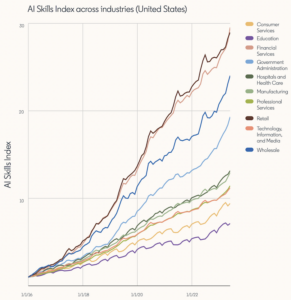
The report shows that in the U.S., the category of Technology, Information, and Media has the largest share of AI-skilled workers at 2.2%, and though this figure seems small, it is higher than that of other industries such as such as Education (1.2%), Professional Services (0.9%), Financial Services (0.9%), and Manufacturing (0.8%).
(Source: LinkedIn)
However, the speed at which LinkedIn members are adding AI skills to their profiles is increasing, with Financial Services at 30x, Retail at 29x, and Wholesale at 24x. Additionally, LinkedIn notes that Financial Services stands out as the only industry in which the share of members with AI skills and the speed at which they are adding AI skills to their profiles is above that of the average industry, showing how industries beyond Technology may have the potential to drive AI innovation.
Everyday jobs are being reshaped by generative AI capabilities as organizations incorporate tools like ChatGPT into daily operations. According to research from LinkedIn’s Economic Graph Research Institute, 84% of US members are in jobs that could leverage GAI to automate at least a quarter of repetitive tasks and increase productivity.
LinkedIn Chief Economist Karin Kimbrough says realizing the full potential of AI productivity gains depends on the diffusion of skills across geographies, industries, and talent.
“AI adoption and optimization of its use will of course take time, but at this early stage it appears that the pace of diffusion is getting underway. The brightest global economic outcome is one where innovation can scale borders and boost productivity growth for all,” she said in the report.
The rise of generative AI will also drive demand for people skills, the report found, as 92% of U.S. executives agree that people skills are more important than ever. People skills such as flexibility, professional ethics, social perception, and self-management have been the fastest growing in-demand skills since November 2022.
“Ultimately, when we talk about AI’s impact on work, what we are really talking about is how people will adopt these tools and continue to strengthen the people skills that complement them,” Kimbrough said.
This article first appeared on sister site Datanami.