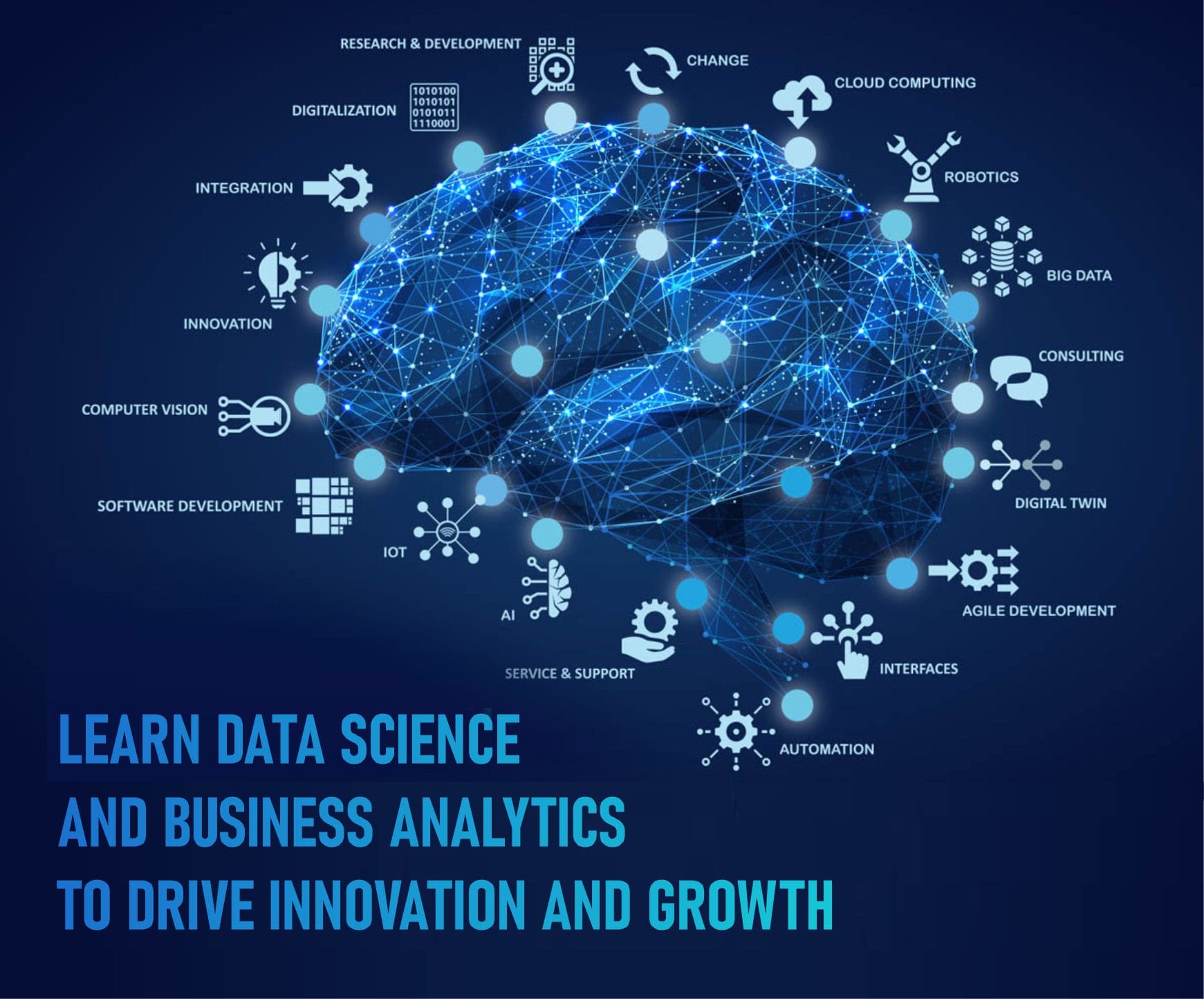
Learn Data Science and Business Analytics to Drive Innovation and Growth

Learn Data Science and Business Analytics to Drive Innovation and Growth

Do you want to know how any business can survive for a long time? Well, the answer is simple- it’s growth. The corporation’s growth is important for business performance and profit. It also facilitates asset acquisition, investment financing, and talent attraction.

Business analytics and data science are important for driving innovation and business growth. Data science can be leveraged by businesses to mitigate unfavorable trends. For example, retail and financial services companies can utilize data science to tackle challenges such as insolvency, layoffs, or imminent closures. By applying data-driven insights and analysis, these firms can make informed decisions and take proactive measures to address these issues.

Moreover, data can guide your company toward success, and you only have to use it properly. In other words, data is the basis of your business analytics and the things you can do with it. To kickstart your business and equip yourself with the necessary skills to excel in this competitive environment, exploring the best data science courses like Great Learning's offerings can be a game-changer. These courses provide comprehensive and hands-on training in data analysis, machine learning, and artificial intelligence, giving you the expertise to harness the full potential of data-driven insights.

Furthermore, investing in continuous learning and upskilling has become paramount in today's rapidly evolving business landscape. Several other online platforms and educational institutions offer valuable courses and resources tailored to boost business growth and data-driven decision-making. For instance, Coursera offers a wide range of data science and business analytics courses from renowned universities and industry experts, enabling learners to stay up-to-date with cutting-edge methodologies.

Moreover, for professionals seeking more specialized skills, platforms like Udacity provide nanodegree programs in data science, AI, and advanced analytics. These nanodegree programs offer project-based learning, mentorship, and industry-focused curriculum, empowering individuals to gain practical experience and apply their knowledge to real-world business challenges.

What Is Data Science and Business Analytics?

Using machine learning algorithms, data science creates predictive models for the growth of your business. These pieces of information, used for analysis, are very crucial for your business. Also, these pieces of information come from a wide range of sources.

The business adores data science. They employ it in conjunction with analytics to comprehend consumer behavior and support in-the-moment decision-making.

In Business Analytics, data analysis, statistical models, and other quantitative techniques are used for business growth.

The information obtained for analysis is used for decision-making. Achieving success in business analytics relies on the availability of high-quality data, competent analysts with a deep understanding of the industry and relevant technologies, and a firm commitment to utilizing data to reveal valuable insights that inform strategic business decisions.

Uses of Data Science and Business Analytics

Data science allows for the extraction of meaningful insights and predictions from seemingly disorganized or unrelated data. On the other hand, business analytics enables the analysis of all available data. By utilizing business analytics, companies can comprehensively examine and interpret their data, gaining valuable insights to drive informed decision-making and optimize business processes.

Data collected by tech companies can be turned into valuable or profitable information by employing methods.

Data science has also helped the transportation sector. Using autonomous vehicles simplifies the task of minimizing the number of collisions.

With business analytics, you can utilize modern analytics and statistics to uncover hidden patterns in datasets. Inform stakeholders by distributing information through interactive dashboards and data-driven reports. Adapt and defend decisions in light of new facts. Keep an eye on KPIs and react quickly to shifting patterns.

Analytics is the way to go if your company wants to accomplish one or more of these objectives. The next step is choosing the best business analytics solution for your company's needs.

Let us learn the benefits of data science and business analytics for business growth.
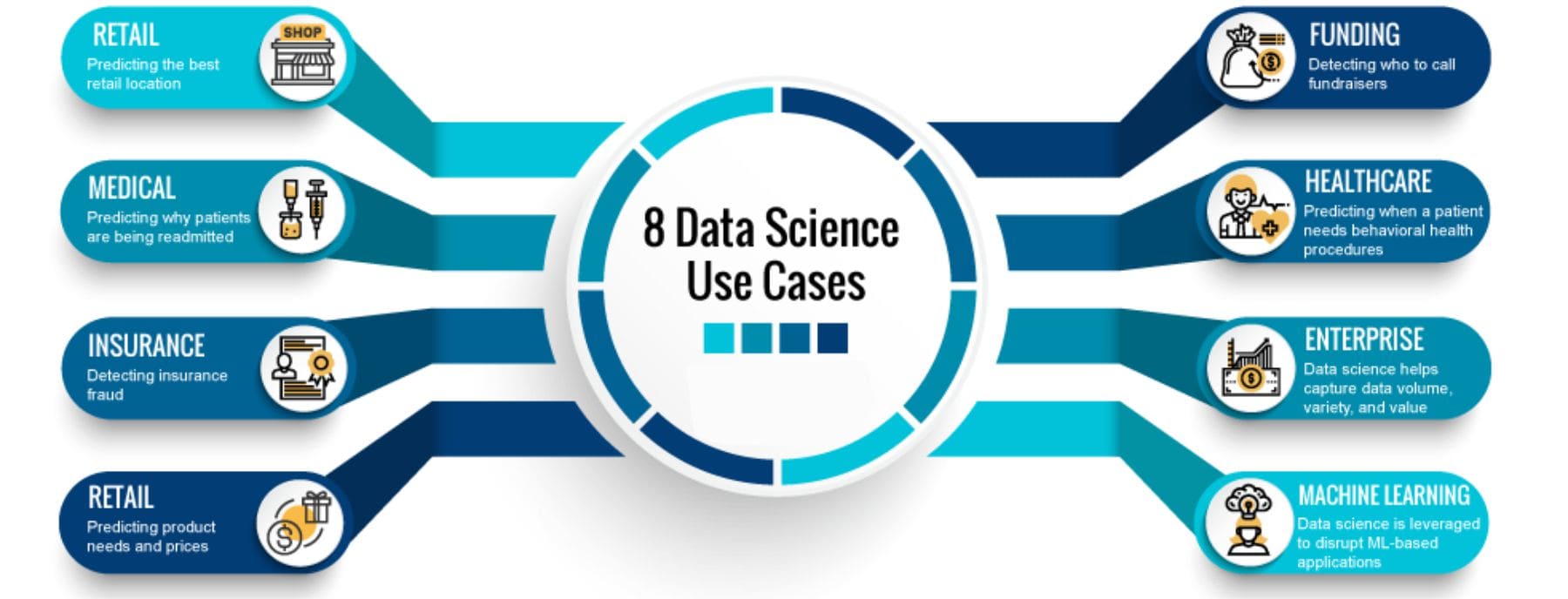
Learn Data Science and Business Analytics to Drive Innovation and Growth
Image source: https://blog.athenagt.com/wp-content/uploads/2018/09/Blog-info_1074698057-1.png

Consider two compelling case studies that reflect the impact of data science and business analytics on business growth.

  • In Case Study 1, the strategy used was building a polynomial regression model to determine the influence of market level targets on Bid Success. Using linear and non-linear equations, predictors were identified that significantly influenced the probability of winning or retaining existing clients. This model proved successful as it led to a 30% improvement in client acquisition rate and a 40% boost in client retention rate.

This approach could be applied to various industries or businesses, adjusting the factors and variables to suit specific needs. This means by identifying and properly utilizing key market indicators or predictors, businesses can significantly enhance their client acquisition and retention rates.
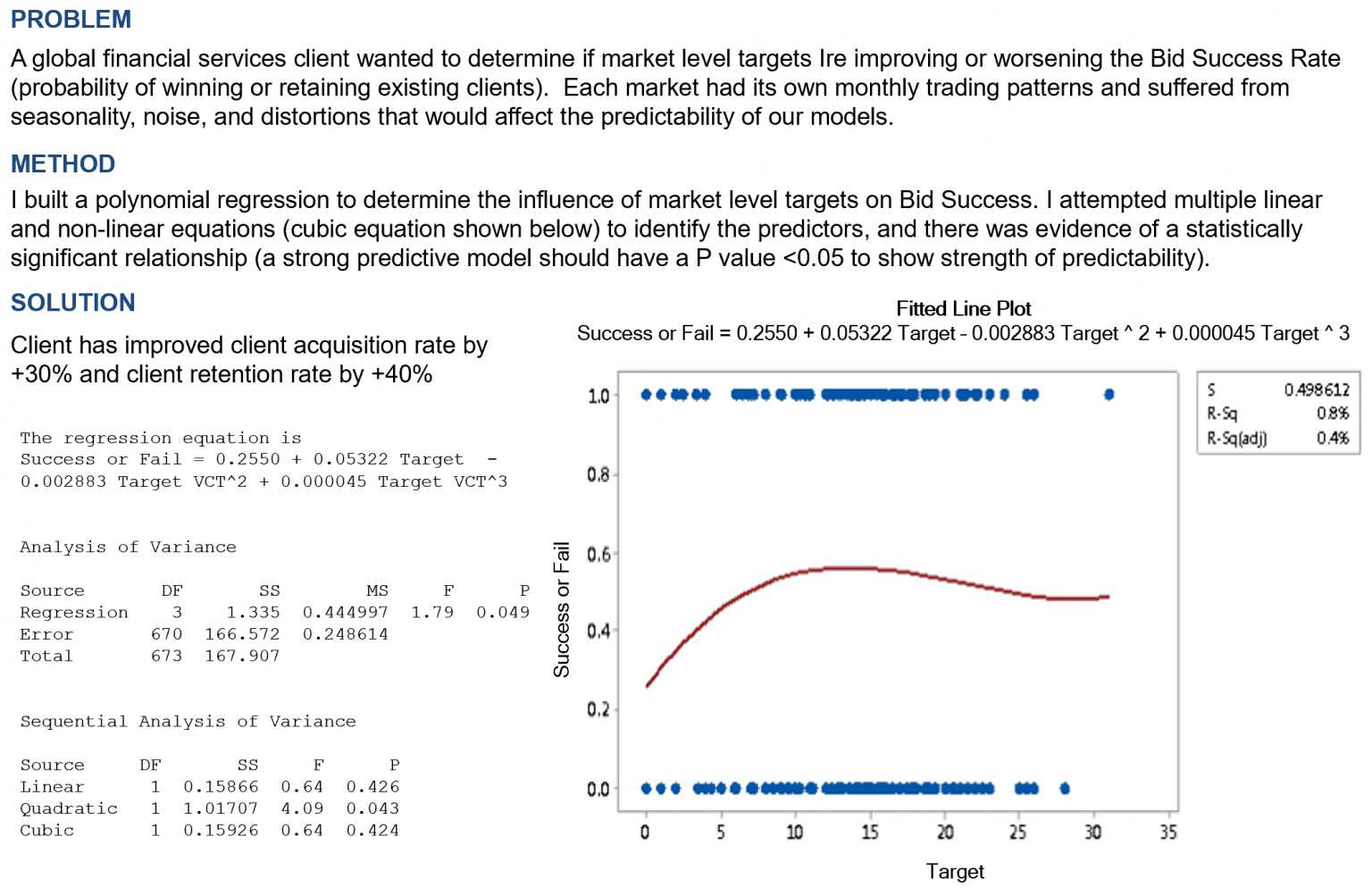
Learn Data Science and Business Analytics to Drive Innovation and Growth
Image source: https://www.baselismail.com/wp-content/uploads/2019/03/2019-03-05-16_12_23-Basel-Ismail-Case-Studies.pptx-PowerPoint-1536×1002.png

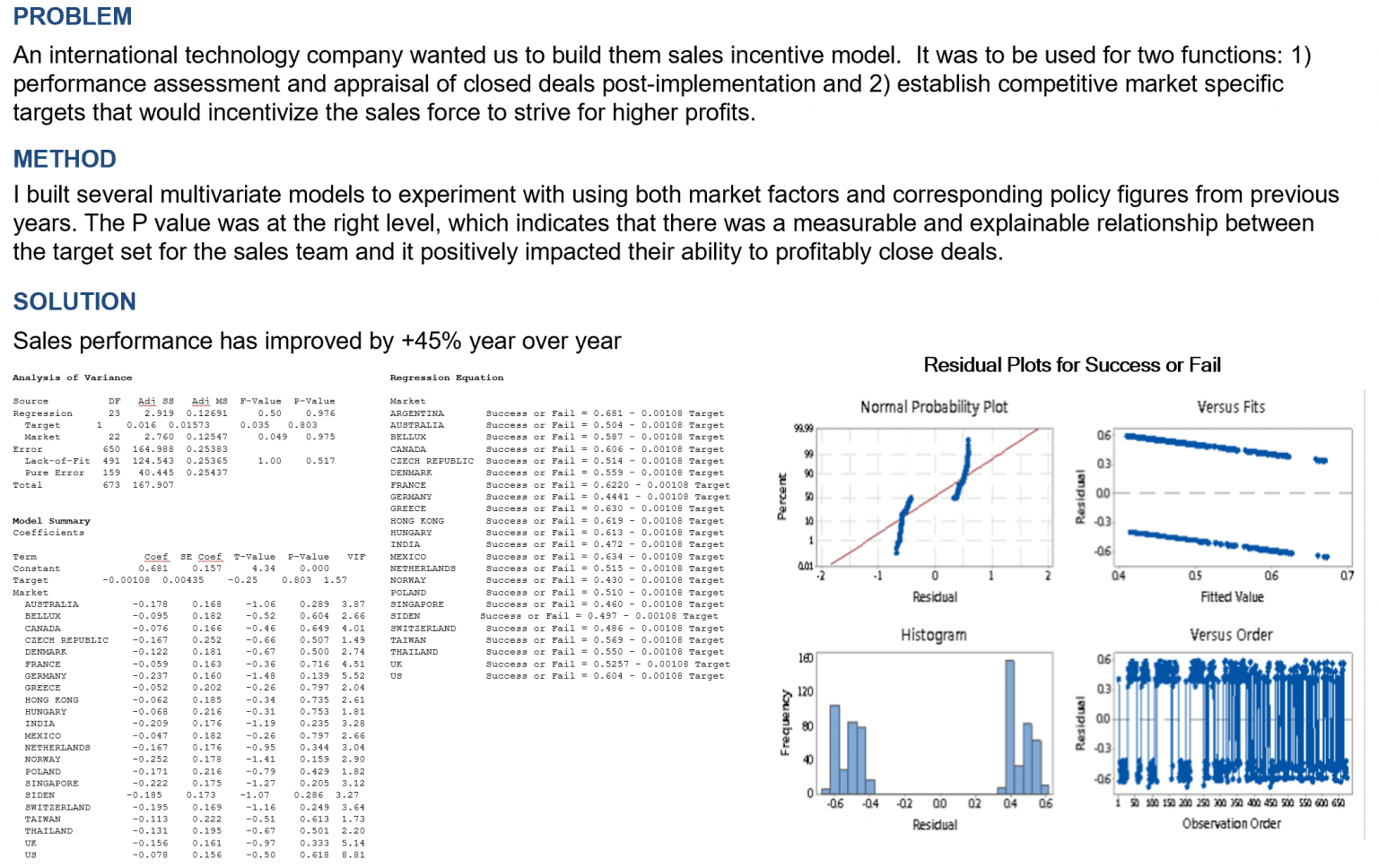
  • In Case Study 2, a sales incentive model was created to improve sales performance. This model was built using multivariate models with market factors and corresponding policy figures from previous years as inputs. It was found that there was a positive correlation between the target set for the sales team and their ability to close deals profitably. This model led to a 45% year-on-year improvement in sales performance.

This strategy emphasizes the significance of properly incentivizing sales teams and setting competitive market-specific targets to boost sales. By properly understanding the relationship between incentive structures and sales performance, companies can better motivate their sales teams and optimize their sales results.
Learn Data Science and Business Analytics to Drive Innovation and Growth
Image source: https://www.baselismail.com/wp-content/uploads/2019/03/2019-03-05-16_18_30-Basel-Ismail-Case-Studies.pptx-PowerPoint-1536×968.png Why Data Science and Business Analytics for Business?

Data science's importance in the current business environment is well known. That's because businesses must make decisions based on data if they want to remain competitive and continue to expand. Because it gives firms a method to use data more effectively, data science for business has gained popularity in recent years. Today, businesses, including hospitals, banks, and colleges, use data science to support various activities.

Commercial organizations will only be able to pay attention to the significance of data science in business in the near future because data is utilized in almost every part of our life. If they succeed, they have a decent chance of winning their competition without dropping a game. As a result, data science for small firms enables them to outperform larger corporations or businesses of a larger scale that need more data knowledge and experience.

The Benefits of Business Analytics

Business analytics provide actionable insights. The business makes predictions about the future via data visualization, and these perceptions support future planning and decision-making. Business analytics spurs growth and measures performance. After learning all of this, now is the time to know about business analytics, let's examine how it differs from business intelligence.

Data Science Certificate

To work as a data scientist, a bachelor's degree in data science or a computer-related field is typically required, and for certain positions, a master's degree may be necessary. Therefore, it is crucial to verify all the educational requirements before pursuing this career.

Additionally, various certifications, such as project model certification, internship certification, and qualification certificates, among others, are essential for enhancing your qualifications and marketability in this field. A diploma can also be pursued online if you hold a degree in any other discipline, in addition to this. You can immediately start taking a variety of quick online data science courses.

Business Analytics Certificate

A business analytics certificate allows you to make employers believe that you have the skills to make your business successful. You can convince them about you having the skills necessary to drive strategic decision-making and collect and analyze the data. It gives you the abilities required to work as a business analyst who uses data to enhance, expand, and optimize corporate processes.

What Your Business Can Gain From Data Science?

Smart strategies are always needed for business improvement. You can use data science in your business in the following ways:

  • Data mining and analysis: To uncover patterns and relationships that can be used in data analysis to help solve business problems, large data sets are sorted in data mining. Businesses can foresee future trends and make better business decisions by utilizing data mining techniques and technologies.
  • Final decision selection: The best and most effective decision should be picked from the analytic options. The business's success will depend on this ultimate decision.
  • Information management: Data scientists who actuarially select useful data keep the company's data bank accurate and up-to-date. The company uses this data bank when required.

The Scope of Business Analytics and Data Science

Business analytics has many different applications. For people looking to advance their careers while earning a good salary, business analytics has emerged as one of the top employment options in the past decade.

For individuals with the appropriate skill set, there are several opportunities in India's large field of data science. Businesses can benefit from the services of data scientists by making better decisions, learning more about their consumers, and automating tasks with the right training.

Conclusion

Business analytics has helped many businesses grow with the help of insightful insights. Businesses can personalize their interactions with customers by using business analytics techniques, which can be learned through business analytics courses. They can even incorporate client feedback into the development of more profitable products. In the foreseeable future, data will remain indispensable for the operation of any company. Data represents actionable knowledge that can significantly impact the difference between a company's success and failure. As the saying goes, knowledge is power.

By integrating data science tools, businesses can now harness the power of data to predict future growth, identify potential issues proactively, and formulate effective plans for success. Embracing data-driven approaches empowers businesses to make informed decisions and stay ahead in today's competitive landscape.

In the foreseeable future, data will remain indispensable for the operation of any company. Data represents actionable knowledge that can significantly impact the difference between a company's success and failure. As the saying goes, knowledge is power.
Erika Balla is a a Hungarian content writer from Romania, specializing in AI and data science topics. Her goal is to help businesses simplify complex information and make data science more accessible to a wider audience, leveraging my expertise in writing and advanced technology knowledge.

More On This Topic

  • How to Better Leverage Data Science for Business Growth
  • How to Use Analytics to Accelerate Business Growth?
  • Applications of Data Science and Business Analytics
  • Discover What It Takes to Scale Innovation & Data Science
  • Learn modern forecasting techniques to help predict future business…
  • KDnuggets News, May 4: 9 Free Harvard Courses to Learn Data Science; 15…

OpenAI Mimics Google DeepMind’s AGI Strategy 

It seems like gaming is the ultimate path to reach AGI. OpenAI which created the generative AI hype with ChatGPT is planning to up its game literally as it ventures into simulated world to achieve its ultimate goal of attaining AGI. For the same purpose OpenAI recently acquired Global Illumination, a New York based startup that has been leveraging AI to build creative tools, infrastructure, and digital experiences.

Global Illumination’s team has previously designed and built products early on at Instagram and Facebook and have also made significant contributions at YouTube, Google, Pixar, Riot Games, and other notable companies. The creators of Global Illumination are currently working on Biomes, an open source sandbox MMORPG built for the web which allows users to build, forage, and play mini-games straight from the browser, similar to Microsoft’s Minecraft.

The acquisition of Global Illumination comes at a crucial point of time for OpenAI. The current challenges faced by ChatGPT, including user retention issues, have prompted the organisation to seek solutions. Furthermore, acquiring sufficient training data has proven to be a struggle. OpenAI has recognised that the remedy to these challenges resides within the realms of gaming and reinforcement learning.

This open-source Minecraft clone game provides an excellent opportunity for OpenAI to gather extensive data on human-computer interactions. This data will undoubtedly prove invaluable for advancing their research and development of AGI systems.

Simultaneously, the game serves as an ideal platform for testing AI systems, allowing OpenAI to observe and analyse the intriguing behaviors that can emerge within a sophisticated gaming environment.

One of the users of X expressed the same idea and mentioned that if OpenAI could create a game where agents and people interact with their own goals, it could provide a great dataset for building AGI. This means simulating real interactions could help a lot in developing AGI.

ChatGPT will never get better and more question-answer data that what Google already has. If Openai can build a successful game with agents and people who interact with each other towards their own open-ended goals, now that would be a real dataset to build AGI.

— NirSD (@nirsd) August 16, 2023

OpenAI is not the first one to venture into creating a generative AI based simulation world. Previously Stanford and Google researchers, open sourced Stanford Smallville.

In this simulation world, 25 AI agents mimic the lives of humans and they can interact with each other independently with their own independent thinking. These agents inhabit a digital Westworld, unaware that they are living in a simulation. They go to work, gossip, organize socials, make new friends, and even fall in love and each has a unique personality and backstory.

Inspired by Stanford Smallville, VC firm a16z open-sourced‘AI Town’, a JS starter kit that handles global states and multi-agent transactions to help users build their own little AI civilization.

Following Google DeepMind and Meta

The tactic of using reinforcement learning in games was first adopted by Deepmind (now Google DeepMind). It believes that to reach AGI, reinforcement learning is the ultimate tool. So much so it published a paper “Reward is Enough” where authors suggest that reward maximization and trial-and-error experience are enough to develop behavior that exhibits the kind of abilities associated with AGI.

Google DeepMind used RL algorithms to create neural networks which could beat humans at games like Go which are considered to be the most challenging. In October 2015, AlphaGo became the first program to defeat a professional human player.

In late 2017, it introduced AlphaZero, a single system that taught itself from scratch how to master the games of chess, shogi, and Go, beating a world-champion computer program in each case. Google developed a deep RL algorithm that learns both a value network (which predicts the winner) and a policy network (which selects actions) through games of self-play.

Meta also tried its hand on gaming to train its AI agent. In 2022, Meta AI created the first AI agent CICERO to achieve human-level performance in the complex natural language strategy game Diplomacy. CICERO demonstrated this by playing with humans on webDiplomacy.net, an online version of the game, where it achieved more than double the average score of the human players and ranked in the top 10% of participants who played more than one game.

Simulation to Reality

OpenAI is exploring every way possible to attain AGI. From scraping data from the internet to partnering with news agencies like AP, it is leaving no stone unturned. It is pretty much likely that after creating the simulation, OpenAI will come back to reality and create humanoids which will be able to interact with humans in a natural way.

Earlier this year, OpenAI invested in a Norway-based robotics startup called 1x. Previously known as Halodi Robotics, the startup builds humanoid robots capable of human-like movements and behaviours. With Global Illumination acquisition, OpenAI can bring all the learnings of simulation to reality and build perfect humanoid robots.

Interestingly, OpenAI is not alone in sharing this belief that the world needs physical robots. Recently, Google DeepMind introduced RT-2, the first ever vision-language-action (VLA) model that can see, understand language, and perform tasks accurately in the real world.

Last year, Tesla, the autonomous vehicle company backed by an early investor in OpenAI, Elon Musk, introduced Optimus—a conceptual humanoid robot designed for general-purpose applications.

The Reality

In conclusion, OpenAI’s torch bearers who once said ‘text is a projection of the world’ clearly is moving away from it and taking a page from Google DeepMind’s AGI strategy. Interestingly, Sam Altman or his fellow board members haven’t uttered a single word about its recent acquisition of Global Illumination. The blog post also doesn’t say much either.

The post OpenAI Mimics Google DeepMind’s AGI Strategy appeared first on Analytics India Magazine.

Google’s 6 Must Read Papers Published at INTERSPEECH 2023

The annual Conference of the International Speech Communication Association (INTERSPEECH 2023) is being held in Dublin from 20 – 24 August and Google is one of the notable contributors to the event. Natural Language Processing (NLP) has become the silent powerhouse in communication and understanding. From chatbots like ChatGPT to understanding the intricate threads of medical data for precise diagnoses, NLP’s influence is everywhere.
The researchers at Google will be presenting over two dozen research papers at the 24th edition of the conference. We’ve picked out the best of the research the tech giant will be presenting at the event!

DeePMOS: Deep Posterior Mean-Opinion-Score of Speech

The paper presents DeePMOS, a deep neural network approach for estimating speech signal quality. Unlike traditional methods, DeePMOS provides a distribution of mean-opinion-scores (MOS) with its average and spread. Training robustness is achieved through a mix of maximum-likelihood learning, stochastic gradient noise, and student-teacher setup, addressing limited and noisy human listener data.

DeePMOS demonstrates comparable performance to existing methods that offer only point estimates, as confirmed by standard metrics. The researchers stated that an analysis underscores the method’s effectiveness.

Authors: Xinyu Liang, Christian Schüldt, et al.

Re-investigating the Efficient Transfer Learning of Speech Foundation Model Using Feature Fusion Methods

The research examines speech foundation models for adapting to specific speech recognition tasks. Efficient fine-tuning methods are employed to adjust the models, and a feature fusion approach is proposed for enhanced transfer learning. Results demonstrate reduced parameters and computational memory usage (31.7% and 13.4% respectively), without compromising task quality.

Authors: Zhouyuan Huo, Khe Chai Sim, Dongseong Hwang, Tsendsuren Munkhdalai, Tara N. Sainath, Pedro Moreno

LanSER: Language-Model Supported Speech Emotion Recognition

In the paper, researchers introduce LanSER, a method to enhance Speech Emotion Recognition (SER) models. The approach leverages large language models (LLMs) to deduce emotion labels from unlabeled data through weakly-supervised learning. The team further used a textual entailment approach to select the best emotion label for a speech transcript, maintaining a specific emotion taxonomy.

The experiments reveal that pre-trained models with this weak supervision surpass other baselines on standard SER datasets post fine-tuning, showcasing improved label efficiency. Surprisingly, these models capture speech prosody (how it is said), even though trained primarily on text-derived labels. This method addresses the challenge of costly labeled data in scaling SER to broader speech datasets and nuanced emotions.

Authors: Josh Belanich, Krishna Somandepalli, Arsha Nagrani, et al.

MD3: The Multi-dialect Dataset of Dialogues

In the research a fresh dataset of conversational speech is introduced, representing English from India, Nigeria, and the United States. The MD3 comprises 20+ hours of audio and 200,000+ transcribed tokens.

Unlike prior datasets, MD3 combines free-flowing conversation and task-based dialogues, allowing for cross-dialect comparisons without limiting dialect features. The dataset sheds light on distinct syntax and discourse marker usage across dialects, providing valuable insights.

Authors: Jacob Eisenstein, Vinodkumar Prabhakaran, Clara Rivera, et al.

Using Text Injection to Improve Recognition of Personal Identifiers in Speech

Accurately recognizing specific categories like names and dates is critical in Automatic Speech Recognition (ASR). Handling this personal info ethically, from collection to evaluation, is important. While redacting Personally Identifiable Information (PII) can protect privacy, it can hurt ASR accuracy. In this study, the researchers boosted PII recognition by injecting fake substitutes into training data. This improves ‘Name’ and ‘Date’ recall in medical notes and overall Word Error Rate. Furthermore, for alphanumeric sequences, Character Error Rate and Sentence Accuracy also improve.

Authors: Yochai Blau, Rohan Agrawal, Lior Madmony, et al.

Universal Automatic Phonetic Transcription into the International Phonetic Alphabet

The paper introduces an advanced model that transcribes speech into the International Phonetic Alphabet (IPA) for any language. Despite its size, the model achieves comparable or better results and nearly matches human annotator quality for universal speech-to-IPA conversion.

This eases the time-consuming language documentation process, especially for endangered languages. Building on the previous Wav2Vec2Phoneme model, it’s based on wav2vec 2.0 and fine-tuned to predict IPA from audio. Training data from CommonVoice 11.0, covering seven languages, was semi-automatically transcribed into IPA, resulting in a smaller yet higher-quality dataset compared to Wav2Vec2Phoneme.

Authors: Chihiro Taguchi, Parisa Haghani, et al.
You can find the entire list of papers presented by Google at INTERSPEECH 2023 here.

The post Google’s 6 Must Read Papers Published at INTERSPEECH 2023 appeared first on Analytics India Magazine.

OLAP vs. OLTP: A Comparative Analysis of Data Processing Systems

OLAP vs. OLTP: A Comparative Analysis of Data Processing Systems
Image by Author

Today, organizations generate vast volumes of data from various sources: customer interactions, sales transactions, social media, and a bunch more. Extracting meaningful information from such data requires systems that can process, store, and analyze data effectively.

Both OLAP (Online Analytical Processing) and OLTP (Online Transaction Processing) systems play a pivotal role in data processing. OLAP systems enable businesses to perform complex data analysis and drive business decisions. OLTP systems, on the other hand, ensure that everyday operations run smoothly. They handle real-time transactional processes while maintaining data consistency.

Let’s learn more about OLAP and OLTP systems and also understand the key differences between them.

OLAP and OLTP Systems: An Overview

We’ll start with an overview of OLAP and OLTP systems:

What Are OLAP Systems?

OLAP (Online Analytical Processing) is a category of data processing systems designed to facilitate complex analytical queries and provide valuable insights from large volumes of historical data.

OLAP systems are essential for applications such as business intelligence, data warehousing, and decision support systems. They enable organizations to analyze trends, discover patterns, and make strategic decisions based on historical data.

These systems leverage an OLAP cube, a fundamental component that allows for multi-dimensional data analysis (we’ll learn about OLAP cube later).

What Are OLTP Systems?

OLTP (Online Transaction Processing) refers to a category of data processing systems tailored for real-time transactional operations and everyday operational tasks.

OLTP databases maintain ACID (Atomicity, Consistency, Isolation, Durability) properties, guaranteeing reliable and consistent transactions. OLTP systems are typically for applications requiring rapid and concurrent handling of small, fast, and real-time transactions.

Because OLTP systems ensure that data remains up-to-date and consistent at all times they are well-suited for applications such as e-commerce, banking and financial transactions.

OLAP vs.OLTP: What Are the Differences?

Now that we have gained an understanding of OLAP and OLTP systems, let's proceed to understand their differences.

#1 – Size of the System and Data Volume

OLAP systems are typically much larger OLTP systems. OLAP systems manage large volumes of historical data, often requiring significant storage capacity and computational resources.

OLTP systems deal with relatively smaller datasets compared to OLAP systems, focusing on real-time processing and quick response times.

#2 – Data Model

OLAP databases use a denormalized data structure to optimize query performance. By storing pre-aggregated and redundant data, these systems can efficiently handle complex analytical queries without the need for extensive joins. The denormalized structure accelerates data retrieval, but it may lead to increased storage requirements.

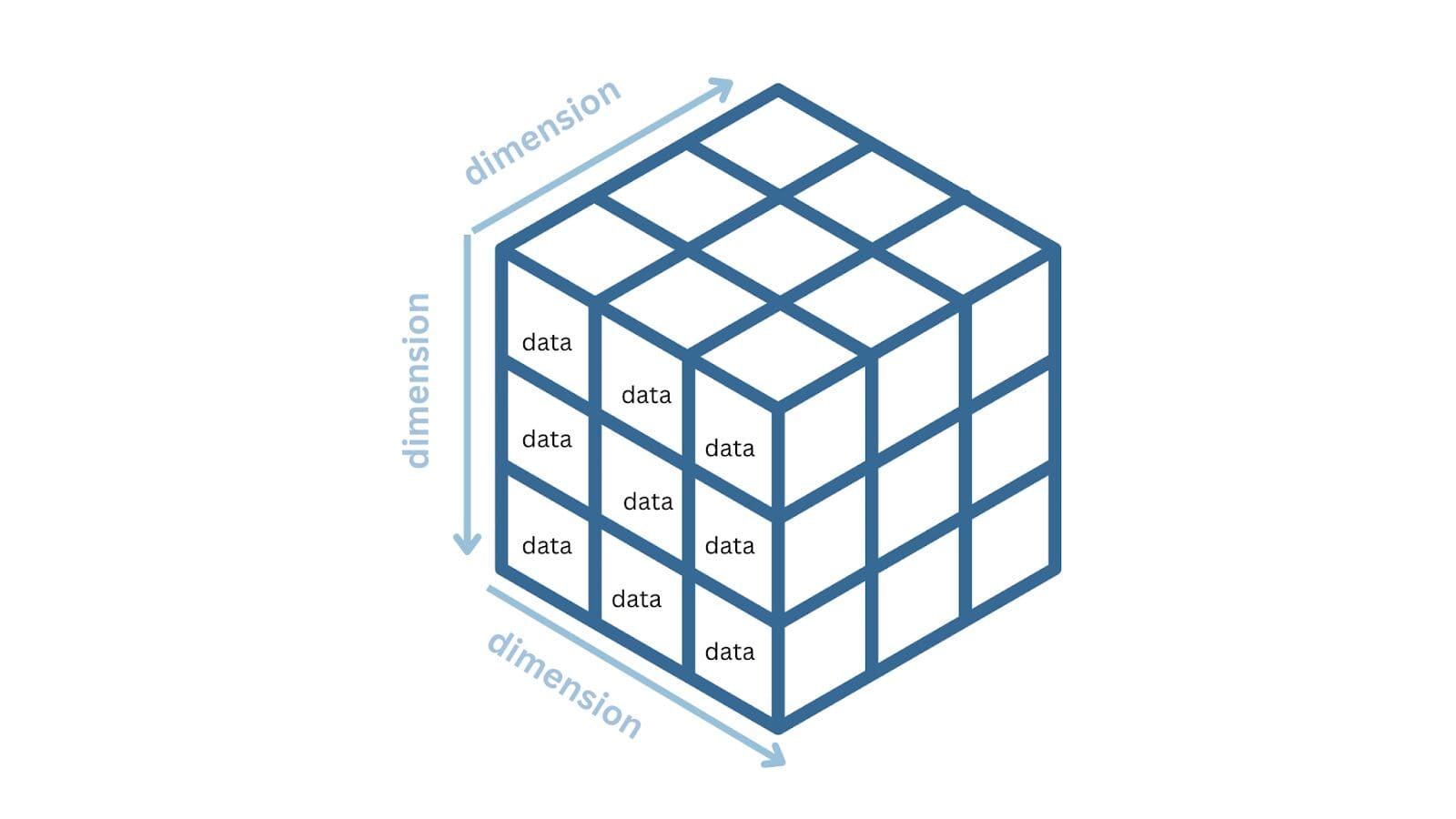
OLAP systems support multidimensional data analysis, often implemented using star or snowflake schemas, where data is organized into dimensions and measures. Fundamental to all OLAP systems is the OLAP cube that facilitates multi-dimensional data analysis. But what is an OLAP cube?

OLAP vs. OLTP: A Comparative Analysis of Data Processing Systems
OLAP Cube for Multidimensional Data Analysis | Image by Author

An OLAP cube is a multi-dimensional data structure that organizes data into multiple dimensions and measures.

  • Each dimension represents a specific category or attribute, such as time, geography, product, or customer.
  • Measures are the numeric values or metrics that are analyzed concerning these dimensions. These often include data such as sales revenue, profit, quantity sold, or any other relevant KPI (Key Performance Indicator).

The cube's multi-dimensional structure allows users to explore data from various perspectives—including operations such as drilling down, slicing, dicing, and rolling up—view data at different levels of granularity.

For example, consider an OLAP cube containing sales data for an e-commerce company. The cube's dimensions might include:

  • time (month, quarter, year),
  • geography (country, region, and the like), and
  • product categories (electronics, fashion, home appliances, etc.).

Some measures include sales revenue, quantity sold, and profit. OLAP cube lets you analyze sales performance by selecting specific dimensions, such as viewing sales revenue in a particular region for a specific time period, or comparing sales of different product categories over time.

OLTP databases employ a normalized data structure to minimize data redundancy and ensure data integrity. Normalization divides data into separate related tables, reducing the risk of data anomalies and improving storage efficiency.

#3 – Query Types and Response Times

OLAP systems are optimized for handling complex analytical queries involving aggregations, sorting, grouping, and calculations. These queries often span large volumes of historical data and require significant computational resources. Due to their analytical nature, OLAP queries may have longer execution times.

OLTP systems are designed to handle numerous small, fast, and concurrent transactional queries. These queries primarily involve insertions, updates, and deletions of individual records. OLTP systems focus on real-time data processing and ensure quick response times for transactional operations.

#4 – Performance Needs

OLAP systems are designed to support complex analytical queries and multidimensional data analysis.

OLTP systems should have fast response times. They should be able to support a high volume of concurrent transactions while preserving data integrity—with minimal data discrepancies.

OLAP vs.OLTP: Summing Up the Differences

Let’s wrap up our discussion by tabulating the differences between OLAP and OLTP systems across the different features we’ve discussed thus far:

Feature OLAP OLTP
Data Volume Large volumes of historical data Small volumes of real-time transactional data
Size of the system Much larger than OLTP systems Much smaller than OLTP systems
Data Model Denormalized for performance Normalized for integrity and minimal redundancy
Query Type Complex analytical queries Simple queries
Response Time Potentially longer execution times Faster response times
Performance Needs Multidimensional analysis of data, optimized for faster retrieval for complex queries involving aggregations Fast processing of real-time concurrent transactions with low latency

Wrapping Up

In summary: OLAP systems help in in-depth analysis of large volumes of historical data, while OLTP systems ensure fast and reliable real-time operations.

In practice, however, organizations often deploy a combination of OLAP and OLTP in their data processing ecosystem. This hybrid approach enables them to manage operational data efficiently while deriving valuable insights from historical data.

If you’re looking to get started with data engineering, check out this beginner’s guide to data engineering.
Bala Priya C is a developer and technical writer from India. She likes working at the intersection of math, programming, data science, and content creation. Her areas of interest and expertise include DevOps, data science, and natural language processing. She enjoys reading, writing, coding, and coffee! Currently, she's working on learning and sharing her knowledge with the developer community by authoring tutorials, how-to guides, opinion pieces, and more.

More On This Topic

  • Is OLAP Dead?
  • Essential Math for Data Science: Introduction to Systems of Linear…
  • A Python Data Processing Script Template
  • Simplify Data Processing with Pandas Pipeline
  • Data Representation for Natural Language Processing Tasks
  • How to Use Kafka Connect to Create an Open Source Data Pipeline for…

4 things Claude AI can do that ChatGPT can’t

Winning Strategy In Business Concept. The Round Sphere Moves Faster Than The Squares.

ChatGPT is often considered the best artificial intelligence (AI) chatbot available. GPT-3.5, the large language model (LLM) used in the free version of ChatGPT, was the largest and most powerful of its kind, surpassed only by GPT-4, which is only available with a $20 monthly subscription to ChatGPT Plus.

The success of ChatGPT upon launch swiftly inspired other companies to publicly launch their own AI chatbots, as evidenced by Microsoft's Bing AI, Google's Bard, and Anthropic's Claude, to name a few.

Also: 4 ways to increase the usability of AI, according to industry experts

Anthropic, a safety and research company focused on AI, recently launched the latest version of its AI chatbot, Claude 2. Since then, it's become clear that this generative AI tool has advantages over OpenAI's free version of ChatGPT.

4 things Claude AI can do that ChatGPT can't

It has to be said that ChatGPT and Claude have strengths in different areas. But even though Claude isn't better at everything compared to its main competitor, it has some features that give it an edge over ChatGPT — success is all about determining which AI to use for different circumstances.

The left image shows how Claude summarized the link I gave it, and the right shows how it summarized the text. The discrepancies are highlighted.

ChatGPT and Claude are both powerful AI chatbots, but there are differences in capabilities that make Claude more capable of excelling at certain tasks, such as parsing large texts and documents, like PDFs.

Artificial Intelligence

OpenAI Doesn’t Care about NYT Enough

OpenAI Doesn’t Care About NYT Enough

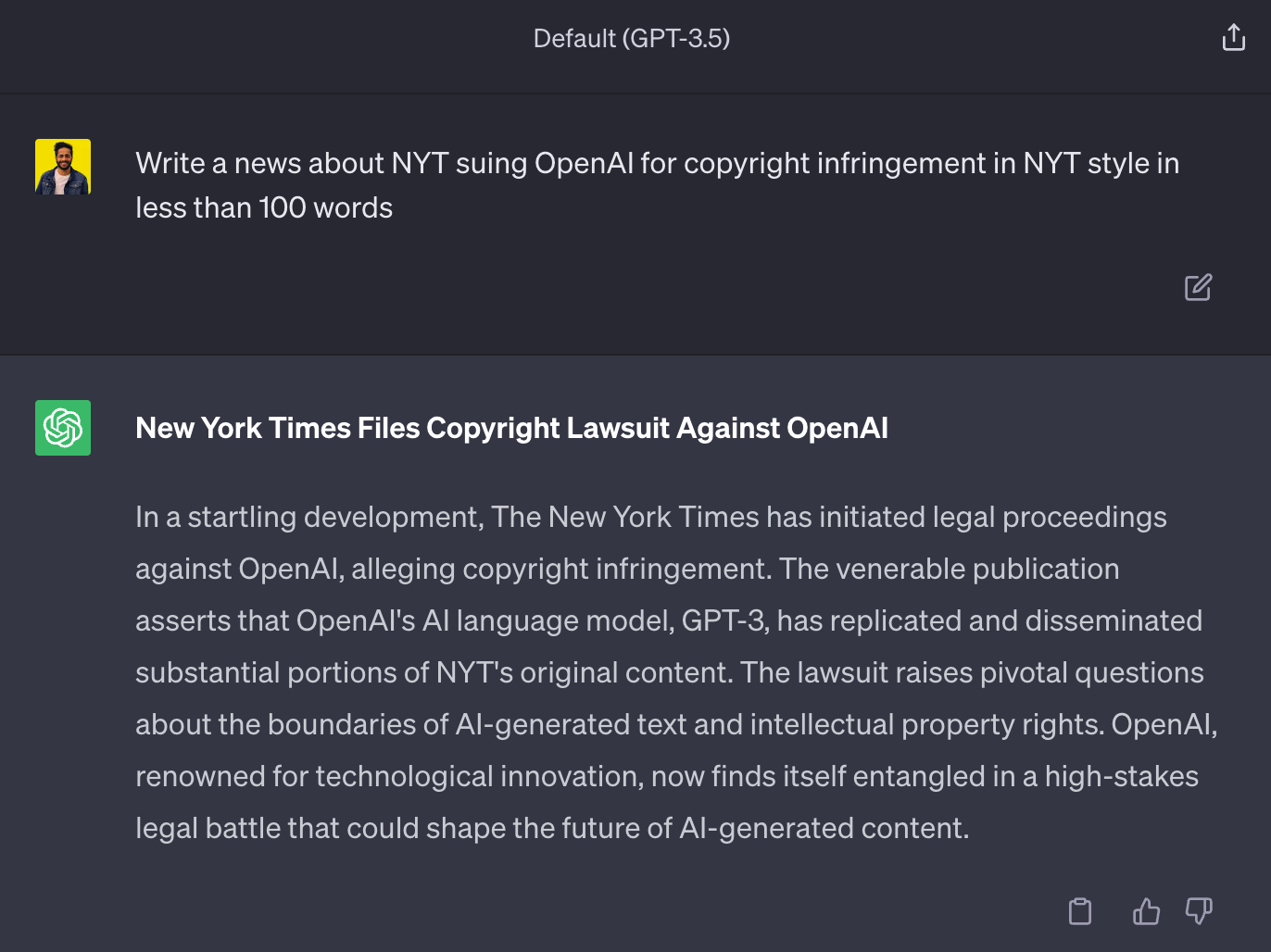
The copyright infringement case with generative AI models has been taking a lot of turns. The latest being The New York Times‘ potential lawsuit against OpenAI for copyright infringement. The news outlet believes that OpenAI’s models are trained on NYT’s intellectual property data and copied the style of their writers to give ChatGPT the ability to articles in the same manner, whenever prompted.

This will likely be one of the first lawsuits against OpenAI to actually put the company in trouble. NYT recently published its terms of services focusing on prohibiting AI companies from scrapping articles for training AI models hinting at a possible lawsuit on OpenAI. If NYT successfully proves that its content is illegally used, OpenAI might have to delete its entire dataset used for training AI models and cough up a fine of up to $150,000 for each infringed content.

Meanwhile, OpenAI had made a licensing deal with Associated Press (AP), accessing its archive for building better AI models. It has also partnered with several news agencies recently. Now, AP has decided to join other news organisations to frame guiding principles of using AI in newsrooms. In the report, AP said that a lot of news organisations are concerned that their content is being used without permission.

The tricks up its sleeves

There is no doubt that OpenAI took help from Microsoft’s Bing to crawl the internet. According to Gilles Babinet, the company must have crawled up to 250,000 websites for building GPT, without asking anyone — true, to be taken with a pinch of salt.

Responding to this, Yann LeCun, Meta AI chief, gave an example of search engines. “Google, Bing, and others crawl the internet constantly. That’s not the problem,” he said and asked where the problem exactly lay. Arguably, there is a difference between crawling and reusing the content, but even then, the argument for it being a “copyright” case does not stand strong.

Sébastien Hubert explains how neural networks do not actually store any data, but just represent the understanding of the data. This arguably is a lot like how humans work. “GPT has read The Three Musketeers but is unable to quote any chapter verbatim upon request. An LLM is a sort of super-reader – it doesn’t copy anything,” explained Hubert.

Interestingly, an important thing to note here is that NYT is only suing OpenAI, and not Google for making Bard. For NYT, the problem comes from the fact that Bing synthesises the content without creating traffic for the newspaper thereby hitting advertising revenue. Bing AI is an internet “wrapper”, which breaks the economic model of many sites. It seems, NYT woke up to the problems of ChatGPT only after realising that OpenAI is partnering with other publishers and not them.

It must be noted that NYT is going to receive $100 million from Google for the next three years in a deal where the tech giant will be able to publish content on its platforms. Google is testing its new AI writing tools in partnership with NYT, WSJ, and Washington Post. This might possibly be a hint towards a partnership to rival OpenAI and AP.

NYT has a problem with OpenAI, not generative AI

OpenAI’s GPTBot, which recently came to everyone’s notice, says that the company will automatically scrape the internet and websites for training its AI models. To opt out, companies have to voluntarily put a line of code on their website to block the crawler. There is no doubt that it must have crawled all news outlets to train its AI models.

In 2015, federal appeals court ruling for Google, found to be scanning millions of books for Google Books library, was that the library was not able to create a significant market substitute for the original books, and thus fell under the ‘fair use’ of using its models. For OpenAI, this would be difficult to prove. According to some experts, ChatGPT might be able to form an alternative to visiting NYT articles, dropping the traffic on the website. This means that OpenAI is not using the content from the website “fairly”.

Interestingly, ChatGPT is not connected to the internet. So even if NYT is able to prove that it was trained on its articles illegally, it is not doing that after the cut off time of 2021. GPT-4’s Browse with Bing feature was also discontinued some time back, possibly because of the same reasons. It seems like OpenAI was aware about the copyright issues beforehand and took an early step. It might now be hard to prove that it is actually a competition to NYT or people are merely using it to summarise things in their style — something that NYT only wants Google’s AI tools to do in the future.

Nevertheless, writers have been protesting against generative AI technology for replacing their jobs for a long time. Now that NYT is with them, they might finally be able to catch up, but the push is not against AI models, but just Google’s competitor, OpenAI.

The post OpenAI Doesn’t Care about NYT Enough appeared first on Analytics India Magazine.

Why Digital Avatars Are Vital for Privacy in the AI Era

At WWDC 2023, Apple introduced Vision Pro headset with a new Persona feature. Using integrated cameras, it scans the user’s face to create a realistic digital doppelganger. This digital replica takes over during video calls, imitating the user’s facial expressions and movements in real-time. Major video call platforms like FaceTime, Teams, Webex, and Zoom will be compatible with these 3D realistic avatars, alongside the option to choose cartoonish digital avatars.

No freaking way! You can scan your face on the Apple Vision Pro & create an avatar for FaceTime. Little creepy lol. #WWDC23 #VisionPro pic.twitter.com/BFZdNaqkdJ

— Ishan Agarwal (@ishanagarwal24) June 5, 2023

While these lifelike avatars can be fun, anything that you post online has a high chance of being manipulated using AI. Recently, German telecommunications company Deutsche Telekom introduced a campaign with AI-generated video of a nine-year-old girl, revealing a dark side of social media where images are susceptible to be manipulated with AI image generators like Midjourney, Stable Diffusion and more. According to a report, 96% of non-consensual deepfake videos online involve women, primarily celebrities, transformed into sexual content without their permission. In a scenario like this having a digital avatar can be helpful to protect their anonymity online.

Apple has been the flagbearer of privacy and creating highly realistic avatars. For the Vision Pro headset, users have to scan their faces with the headset’s selfie cameras to create 3D, hyper-realistic digital avatars. While on the one hand, it is generating lifelike images, on the other hand, Apple may be using your facial data to train their upcoming AI models.

According to former IBM security lead Dr Paul Ashley, the conventional definition of anonymity doesn’t quite fit the complexities of our internet interactions, where our personal details can give us away. It starts with basic activities using our real identity, but we can switch to avatar email addresses, phone numbers, and even alternate names to enhance anonymity. It’s important to note that we can mix and match avatar features to suit our needs, giving us control over our level of anonymity.

Amidst these developments, the notion of online identity is undergoing a significant shift and it can be seen in Sam Altman’s latest venture Worldcoin that provides a unique identity. Worldcoin’s World ID protocol focuses on privacy through iris scanning for identity validation. This privacy-oriented approach aims to create a decentralised global identity system.

Why People Love Avatars

Since the time Sims, Second Humans made it to the screens, humans have been obsessed with their online identities, aka digital avatars.

The cartoonish avatars came to the spotlight with Metaverse. However, the main question remains why big techs are capitalising on avatars. Amid concerns that OpenAI might pull the plug on ChatGPT, it announced the acquisition of AI design studio Global Illumination to work on its core products including ChatGPT as well as games and simulated worlds. This is similar to Microsoft-owned decentralised gaming platform Minecraft. Other gaming giants like Roblox and Epic Games, have equally invested in avatar creation.

Pretty recently, Meta unveiled avatar upgrades to its vast user base of over one billion avatars, adding diverse body shapes and improved hair and clothing textures for better self-expression and inclusivity. Despite these improvements, avatars on Meta’s Horizon Worlds VR platform will still lack legs. However, unlike Apple, Meta, WhatsApp, Instagram’s avatars are disappointing.

Nevertheless, people still love cartoon versions of themselves. But why?

Besides privacy protection, one theory links this to the “mirror stage,” where the joy of seeing avatars mimic our actions is just like infants recognising themselves. Another theory suggests avatars provide a carefree way to represent oneself, distinct from the pressure of selfies. Avatars also serve as alter egos in digital narratives.

Somewhere along the way, my bitmoji became cooler than me. pic.twitter.com/1XUf4UXk5P

— Casey Duncan (@caseytduncan) March 1, 2018

Digging Deeper

However, this is not the first time that tech giants have experimented with avatars. Zoom was one of the first video communication platforms to add latest Avatars feature allowing users to transform into various animals like rabbits, foxes, or dogs for their upcoming meetings in 2021. This feature uses virtual characters that mimic your facial expressions, akin to Memojis.

Microsoft was not behind. It also introduced a new feature for Teams users, enabling them to generate a 3D avatar for meeting participation, even without a camera or webcam.

However, these enhancements won’t be noticeable in the VR environment but will appear in visuals like stickers, profile pictures, and cover photos. These updates offer new avenues for digital self-expression, benefiting Meta’s vast user base of over 1 billion avatars. Meta initially started off with avatars for metaverse vision but now that they have likely abandoned that dream, the Llama maker is finding more avenues for avatars.

This can be seen in their latest move of adding a new feature that lets you join video calls on Messenger and Instagram using your virtual Meta avatar. Similar to Apple’s Memoji avatars, Meta’s avatars mimic facial expressions and mouth movements, making conversations clearer. The update also brings animated avatar stickers for reactions like thumbs up or laughter, usable on Instagram and Facebook platforms.

To sum up, in an era when AI can manipulate your image without your consent in a span of two seconds, avatars can serve as a loyal protectors.

The post Why Digital Avatars Are Vital for Privacy in the AI Era appeared first on Analytics India Magazine.

Who Bears the Burden of AI Mishaps?

In an unprecedented scenario, developers of the technology and policymakers today are jointly considering regulation even before substantial implications of the technology emerge. Often, throughout history, that has been not the case. This is indeed a positive move, given the emerging instances of AI technology misfires. A recent case involves a New Zealand supermarket’s generative AI app, which mistakenly proposed a recipe for chlorine gas, labeling it ‘aromatic water mix’ and promoting it as an ideal non-alcoholic drink. While it does gives a glimpse of the technology going wrong, if we are to believe the likes of Geoffrey Hilton, the godfather of AI, the technology could go wrong on a significantly larger scale. It could potentially pose an existential risk for humans. Sam Altman, who heads OpenAI, has also said that should the technology falter, the consequences could be severe.

But given the intricate nature of AI, regulating the technology becomes a challenging task. AI technologies are rapidly evolving, making it difficult to create static regulations that remain relevant. Also, AI applications are diverse, ranging from healthcare to finance, each with unique risks and benefits. Nonetheless, as various jurisdictions contemplate AI regulations, policymakers worldwide, irrespective of geography, must recognise that the foremost principle in AI regulation is holding developers or creators of the technology accountable.

Big Tech Seeks Regulation on Its Own Terms

With ChatGPT, Altman broke the AI hype cycle and changed the whole dynamics of AI deployment. Earlier this year, he advocated for AI regulation in front of a US Senate and suggested the creation of an international agency, similar to the United Nations’ nuclear watchdog, to police and regulate AI technology. Not only OpenAI’s Altman but also major tech players like Microsoft and Google, at the forefront of the generative AI revolution, have voiced support for AI regulation. It’s encouraging to witness major corporations recognising AI’s threats. Yet, their preference for regulations on their own terms is apparent. During this world tour, Altman conveyed in London that he aims to adhere to EU regulations, but should challenges arise, his company might halt operations in the continent.

Moreover, a Times investigation found that OpenAI secretly lobbied the EU to avoid harsher AI regulation. The lobbying effort by OpenAI was successful, as the final draft of the AI Act approved by EU lawmakers did not include certain provisions that were initially proposed. Interestingly, Microsoft, which has invested nearly USD 10 billion in OpenAI, Meta and Google, have earlier lobbied to water down AI regulation in the region. While OpenAI is new to the scene, the others, in fact, have lobbied with numerous governments over the years on matters such as privacy regulations, copyright laws, antitrust matters, and internet freedom. Considering their past behavior, it’s prudent to acknowledge that these companies may lobby for AI regulations that align with their own interests rather than prioritising the welfare of the broader population.

But policymakers are bound to involve big tech

Nonetheless, policymakers must involve them in any discussions around AI regulation. At the forefront of the AI revolution, wielding their generative AI prowess, these organisations have already secured a prominent role in deliberations concerning AI regulation. Moreover, it’s understandable that policymakers, possibly among the least acquainted, may struggle to grasp AI’s nuances. Hence, from a regulation perspective, it becomes important for them to involve the creators or developers of the technology.

But Giada Pistilli, principal ethicist at Hugging Face believes big tech lobbying for AI regulation is a big concern. While it’s inevitable to involve key players in these discussions, given that they are often the first to be directly affected by the outcomes of the regulations, their insights can be invaluable, Pistilli believes. “The power dynamics at play can sometimes blur the lines between honest advice and vested interests. We must critically assess the motivations behind their involvement,” she told AIM.

“Are they present merely to offer their expertise and perspective, or do they intend to exert a disproportionate influence on policy and institutional decisions that will have long-term implications?” Balancing their input with the broader public interest is crucial to ensure that the future is shaped in a way that benefits the many, not just the few. Nonetheless, at the same time, policymakers must also consider that while regulations are important for responsible AI deployment, overly restrictive regulations could stifle innovation and hinder competitiveness. Hence, striking the right balance between regulation and innovation is crucial, according to Gaurav Singh, founder & chief executive officer at Verloop.io.

Additionally, AI, being inherently intricate, adds layers of complexity to regulation. Pistilli believes another thing adding to the challenge is that the legislative process is also inherently slow due to its democratic nature, and advocating for its acceleration to match technological progress inadvertently implies sidelining democratic principles, which is perilous.

“In our attempt to foresee every potential risk, we sometimes create regulations that are so broad they may not be relevant to specific situations, highlighting the limitations of a purely risk-averse strategy. This underscores the point that there isn’t a one-size-fits-all solution. It’s crucial to continually revise strategies, engage with experts, and most importantly, consult those directly affected by the technologies to determine the best course of action,” she said.

Blame the Creators

As major tech companies actively participate in AI regulation dialogues, it remains imperative for policymakers to recognise that these corporations are the ones introducing the technology to the world. Hence, its equally imperative that they are held accountable if the technology goes wrong. Pistilli believes that even though the responsibility in the realm of AI should be a shared endeavour, the lion’s share of both moral and legal accountability should rest on the shoulders of AI system developers.

“It’s an oversimplification and, frankly, unjust to reprimand users with statements like ‘you’re using it wrong’ when they have not been provided with comprehensive guidelines or an understanding of its proper application. As I’ve consistently pointed out, distributing a “magic box” or a complex, opaque system to a wide audience is fraught with risks,” she said.

The unpredictability of human behaviour, combined with the vast potential of AI, makes it nearly impossible to foresee every possible misuse. Therefore, its imperative for developers to not only create responsible AI but also ensure that its users are well-equipped with the knowledge and tools to use it responsibly. Seeing the fast and somewhat hasty deployment of AI models, Annette Vee, associate professor at the University of Pittsburgh, said the race to release generative AI means that models will probably be less tested when they come out. They’ll be ‘deployed’ publicly and companies will measure the blast radius and clean up afterward.

AI critic Gary Marcus has also previously noted that tech companies today have failed to fully anticipate and prepare for the potential consequences of rapidly deploying next-generation AI technology. Hence, holding the developers of these technologies becomes crucial. Doing so will mean these companies will be more careful and wary before releasing a model that hasn’t undergone thorough testing and scrutiny.

Singh, on the other hand, also concurs with Pistilli, to some extent. He believes addressing biases within AI systems necessitates a multifaceted approach. “While holding creators responsible is indeed an important aspect, it’s not a standalone solution. Complex AI algorithms can be difficult to understand, making it challenging to explain their decisions. Regulations could mandate transparency and explainability standards to enable a better understanding of how AI arrives at its conclusions,” he told AIM.

Not in favour of transparency

However, will AI companies be in favour of transparency? Unlikely. OpenAI has not made known crucial details of GPT-4 such as the architecture, model size, hardware, training compute, dataset construction, or even the training method of GPT-4. While OpenAI might be trying to protect its trade secret, or withholding information due to security reasons, or ethical considerations, it only adds to the risk.

Often, biases found in AI models creep in from the dataset or during the training period. The choice of training data can perpetuate historical biases and result in diverse forms of harm. In order to counter such adverse effects and make well-informed decisions about where a model shouldn’t be deployed, comprehending the inherent biases within the data is of paramount importance. Google, on the other hand, has continuously opposed regulations that call for auditing of their algorithm. The tech giant has been traditionally secretive about its search algorithm and considers it a trade secret and has been reluctant to disclose specific details about the inner workings of its search algorithm.

Don’t blame the machines

If we are to believe Altman, there’s a possibility that AGI could materialize within the next decade. While we are in mid-2023, and superintelligence is still a bit far away, there is a prevailing narrative suggesting AI systems as autonomous entities with the potential for harm. This discourse, in Pistilli’s view, subtly pushes the notion that our primary concern should be the AI systems themselves, as if they possess their own agency, rather than focusing on the developers behind them.

“I see this as a tactic that not only amplifies a fear-driven narrative but also cleverly diverts attention from the human actors to the technology. By doing so, it places the onus entirely on the technological creation, conveniently absolving the humans who designed and control it. It’s essential to recognise this shift in accountability and ensure that the true architects behind these systems remain in the spotlight of responsibility,” she said. While, how close are we to AGI is a different debate, it’s crucial to prevent such discussions from gaining traction. If a future iteration of the GPT model, displaying AGI traits, encounters issues, the responsibility should fall on OpenAI, not the superintelligent model itself.

The post Who Bears the Burden of AI Mishaps? appeared first on Analytics India Magazine.

Legal Challenges Surround OpenAI: A Closer Look at Lawsuits

Last week npr.org reported that The New York Times is considering going against Open AI for copyright infringement. It is still unsure what they intend with such a lawsuit as it is not the first time Open AI was invited to the court for the same reason. In the previous cases, the verdict is still unclear, judges and lawyers are scratching their heads on how to proceed with IP laws while generative AI disrupted the existing copyright laws. Here is a list of 6 times Open AI went to court and what happened to them –

Github, OpenAI, Microsoft sued over Github Copilot

In November last year Matthew Butterick put together a class action lawsuit with others to take action against Github Copilot. This AI programmer is trained on billions of lines of code and is employed to suggest whole lines of code or even entire functions for a price. He said that his end goal was to see corporations train their AI in a manner which respects the licences and provides attribution.

According to the most recent news about the lawsuit, the argument is about whether the similar code also violates copyright rules. A judge will decide on this case on September 14th.

Paul Tremblay and Mona Awad vs. Open AI

Tremblay, the author of “The Cabin at the End of the World,” and Awad, known for works like “Bunny” and “13 Ways of Looking at a Fat Girl,” have filed a class action lawsuit on June 28th. They allege that ChatGPT creates highly accurate summaries of their books when asked, which suggests that ChatGPT was trained on their book content. This, they argue, would violate federal copyright law. They believe that OpenAI benefits financially from using their copyrighted materials without permission. According to Andres Guadamuz, an intellectual property expert at the University of Sussex, this marks the first copyright-related legal claim against OpenAI, and it’s likely not the last.

Sarah Silverman, Christopher Golden and Richard Kadrey vs. Open AI and Meta

When asked about comedian Sarah Silverman’s memoir “The Bedwetter,” ChatGPT is able to provide a detailed summary of every part of the book. In her lawsuit, Silverman asserts that she never authorised OpenAI to use the digital version of her 2010 book to train its AI models. She suggests that the content might have been taken from a “shadow library” of pirated works. The lawsuit alleges that her memoir was copied “without consent, without credit, and without compensation.”

This raises the question of whether ChatGPT actually “read” and memorised a pirated copy of the book or if it gathered information from customer reviews and online discussions related to the book’s success or the musical it inspired. The U.S. courts are now tasked with clarifying this situation, as Silverman has filed a copyright infringement lawsuit against OpenAI, the creator of ChatGPT.

Privacy violations by Chat GPT

A lengthy lawsuit was filed against OpenAI, alleging that their AI models, ChatGPT and DALL-E, were trained without proper consent using the data of millions of individuals. The lawsuit, titled PM v. OpenAI LP, asserts that OpenAI acquired personal information from individuals who directly interacted with their AI systems and other applications that utilise ChatGPT. According to the complaint, this data collection and utilisation infringe upon privacy laws, particularly concerning the data of children.

The legal action claims that OpenAI has seamlessly integrated their systems with popular platforms like Snapchat, Spotify, Stripe, Slack, and Microsoft Teams. The lawsuit accuses OpenAI of covertly gathering users’ personal images, locations, music preferences, financial particulars, and private communications through these integrations. Within the complaint, 16 plaintiffs are identified who have used online services and suspect that OpenAI obtained their data without proper authorization.

A class-action lawsuit by the Clarkson Law Firm accuses OpenAI of violating privacy by gathering online data for training ChatGPT. The 157-page complaint demands OpenAI to cease commercial ChatGPT access due to these privacy violations. The firm asserts OpenAI used collected data to create profitable AI without user consent, aiming to prove legal violations of state and federal privacy laws. The lawsuit also highlights concerns about AI’s societal disruption. Clarkson Law Firm seeks a US district court order to temporarily suspend ChatGPT and implement safeguards. OpenAI hasn’t yet responded to the lawsuit.

Mark Walters vs. OpenAI

Mark Walters, host of Armed America Radio, has filed a defamation lawsuit against OpenAI, marking the first such case involving artificial intelligence, as reported by Bloomberg. The incident began when Fred Riehl, the editor-in-chief of AmmoLand, a gun outlet, sought a summary of a Washington federal court case from ChatGPT. The AI chatbot provided false information about Walters, implying that he was involved in defrauding and embezzling funds from the Second Amendment Foundation, an organisation he was falsely linked to as its treasurer and chief financial officer.

Walters’ lawsuit claims that ChatGPT’s fabricated response tarnished his reputation by falsely accusing him of financial misconduct. The AI-generated claims were entirely untrue; Walters never engaged in any fraud or embezzlement and has never been employed by the mentioned organisation.

Although Riehl didn’t publish the misinformation, Walters has filed a lawsuit against OpenAI, seeking punitive damages. This case highlights the emerging issue of “AI hallucinations,” where AI generates false information, potentially leading to more such legal cases in the future. This follows a similar incident in which an Australian mayor considered suing OpenAI after ChatGPT falsely labelled him a convicted criminal instead of a whistleblower in a bribery scandal.

The post Legal Challenges Surround OpenAI: A Closer Look at Lawsuits appeared first on Analytics India Magazine.

Integrating GenAI into “Thinking Like a Data Scientist” Methodology – Part II

Slide1-1

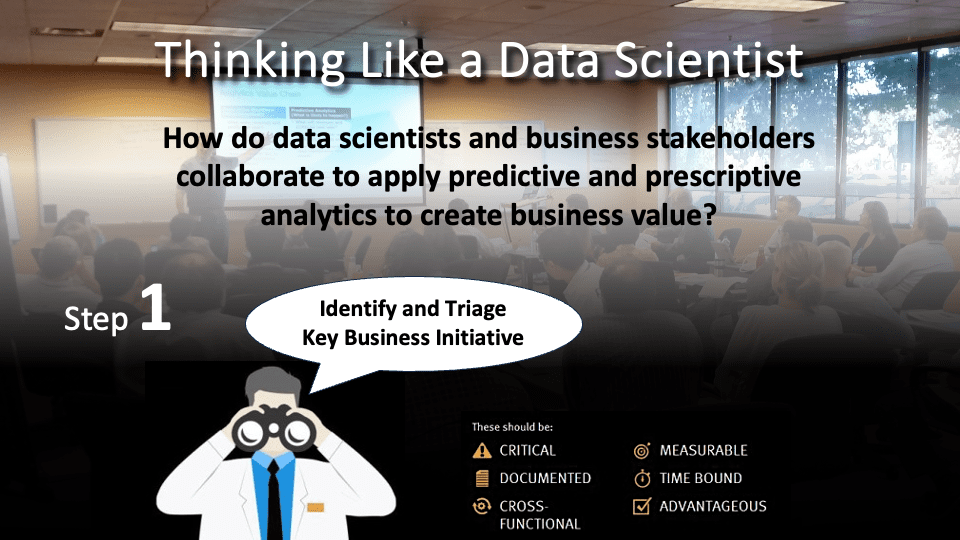
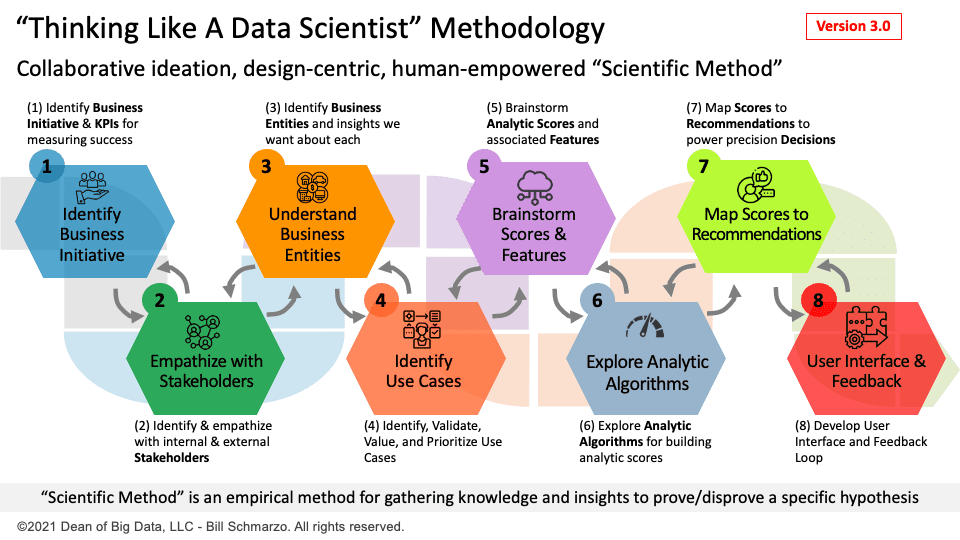
My journey continues as I integrate a GenAI tool (Bing AI) with my Thinking Like a Data Scientist (TLADS) methodology. In part 1 of this series, I used Bing AI to validate, augment, and enhance the first three steps in the TLADS methodology (Figure 1):

  • TLADS Step #1: identify and assess the targeted business initiative, including its desired outcomes, benefits, impediments, risks, and the KPIs and metrics against which I would measure outcomes’ effectiveness and benefits and monitor impediments and risks.
  • TLADS Step #2: identify the key initiative stakeholders, understand the business initiative’s importance to them, key supporting decisions, and the KPIs and metrics against which they will measure the success of that business initiative.
  • TLADS Step #3: identify and understand the business initiative’s key business entities around which I want to build analytic profiles to support my business initiative.

And the results yielded a much deeper understanding of the business initiative – and its key components – that we were trying to address with data and analytics.

Now, we want to use the results of these first three steps to create the prompt narrative that will help us:

  • TLADS Step #4: Identify and triage the use cases that support the targeted business initiative.
  • TLADS Step #5: Identify potential Analytic Scores and their associated Features for our prioritized use case.
Slide2-2

Figure 1: Thinking Like a Data Scientist Methodology – Updated Version 3.0

TLADS Step #4a: Identify and Assess Potential Use Cases

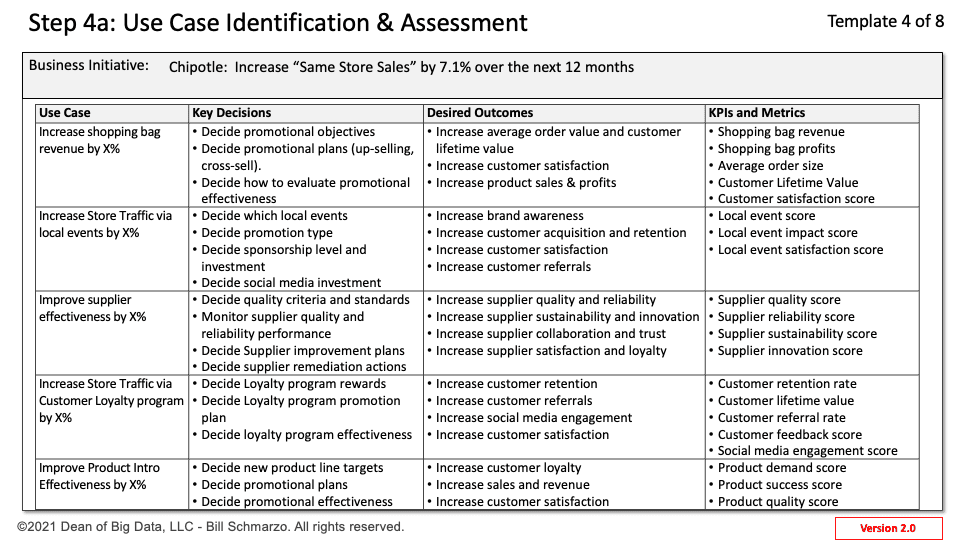
We can use Bing to blend stakeholders’ desired outcomes, key decisions, and KPIs from Steps 1 and 2 of TLADS to identify potential use cases. Using prompts, we can validate the use cases that make up the modified Use Case Identification and Assessment canvas (Figure 2).

Slide3-1

Figure 2: Use Case Identification and Assessment Canvas

Here are some prompts that we can use to identify, validate, and expand our understanding of the potential use cases that support our targeted business initiative:

  • Bing Prompt: Looking across an aggregated view of our stakeholders’ requirements, what are the top 10 – 15 potential use cases that support our targeted business initiative?
  • Bing Request: Can you identify for each use case the key decisions for each use case, the desired outcomes for that use case, and the KPIs and metrics against which to measure use case key decisions and outcomes’ effectiveness?
  • Bing Request: What other use cases should I consider supporting our targeted business initiative?
  • Bing Request: What is your rationale for why I should consider these other use cases?
  • Bing Request: Which of these use cases is most important or impactful for our targeted business initiative?
  • Bing Request: What is your rationale for determining that these use cases are the most important use cases given the targeted business initiative?
  • Bing Request: What factors did you use to determine use case importance, and why did you pick those factors?

Identifying, validating, assessing, and triaging the potential use cases sets up the next step of the TLADS methodology – the all-important use case prioritization process.

TLADS Step #4b: Prioritize Use Cases

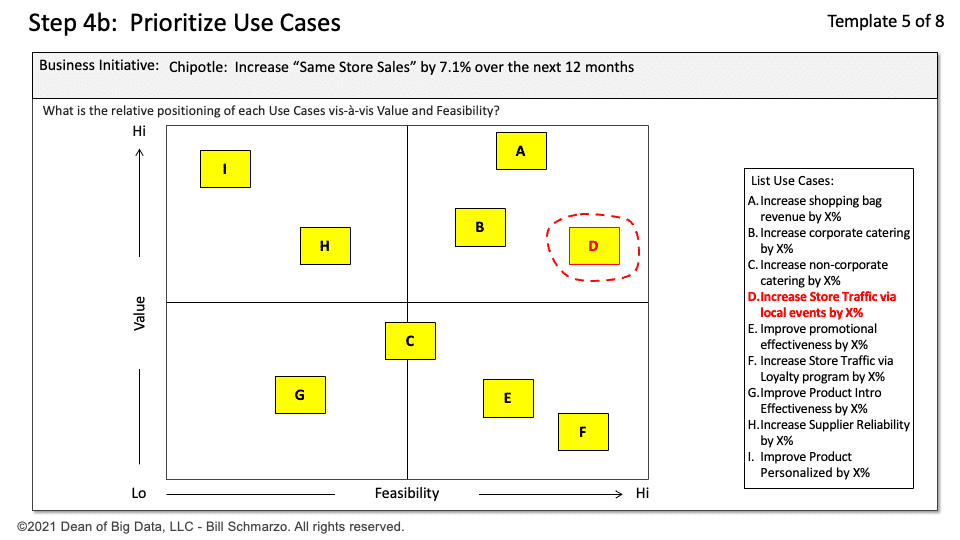
Now we get to the part of the TLADS process where we want to bring together the different stakeholders to prioritize the use cases based on “value” and “implementation feasibility.” Gathering and assessing each stakeholder’s perspective and requirements (desired outcomes, key decisions, and the KPIs and metrics against which to measure business initiative effectiveness) is critical before engaging in this interactive, sometimes controversial engagement (Figure 3).

Slide4-1

Figure 3: Prioritization Matrix

CRITICAL NOTE: While the GenAI product can provide a representative view of the stakeholder’s perspectives and requirements, GenAI will NEVER replace the need to conduct interviews to gather those perspectives and requirements directly from your subject matter experts and key stakeholders. NEVER! To gain cross-stakeholder alignment and consensus on which use case to prioritize, you MUST ensure that everyone has a voice in that prioritization process.

Here are some prompts that we can use to understand the relative value and implementation feasibility of the use cases in light of our targeted business initiative:

  • Bing Request: Create a matrix that scores the likely impact of each use case on a scale of 1 to 100 to support the desired outcomes and the KPIs and metrics against which to measure outcomes’ effectiveness in supporting the targeted business initiative.
  • Bing Request: What is the rationale for the value scores that you gave each use case?
  • Bing Request: Create a matrix that assesses or scores on a scale of 1 to 100 the implementation success likelihood of each use case from an implementation feasibility perspective using the potential impediments identified for the targeted business initiative.
  • Bing Request: What is the rationale for the implementation feasibility scores that you gave each use case?
  • Bing Request: Create a 2×2 matrix plotting each use case on the matrix where the vertical dimension of the matrix is the value score and the horizontal dimension of the matrix is the implementation feasibility score.

I was impressed by Bing’s ability to create value and implementation feasibility scores and then convert those scores into a 2×2 prioritization matrix, though I’ll have to create the actual quadrant matrix using Excel myself (Table 1).

Use Case Value Score Implementation Feasibility Score
Optimize Customer Loyalty Program 90 80
Implement Dynamic Pricing 80 70
Develop Intelligent Mobile App 95 75
Increase Personalized Marketing Campaigns 85 80
Improve New Product Introduction Effectiveness 70 65
Optimize Store Layout 75 70
Optimize Inventory Management 60 60
Enhance Employee Proficiency 65 65
Improve Supplier Performance 60 60
Optimize Social Involvement 80 80
Improve Local Events Marketing Effectiveness 80 80

Table 1: Creating and Mapping Value and Implementation Feasibility Scores

The value and implementation feasibility scores created by Bing provide a starting point for the value and implementation feasibility scores you will create based on your user interviews. You could even enter the interview notes into the GenAI tool to uncover additional value and implementation feasibility factors that may not have jumped out of the individual interviews.

As always, you will have to employ critical thinking, your experience, the expertise of your subject matter experts, and that soft human touch to drive the group exercise to assess each use case’s relative value and implementation feasibility in light of the targeted business initiative.

TLADS Step #5: Identify Potential Scores and Associated Features

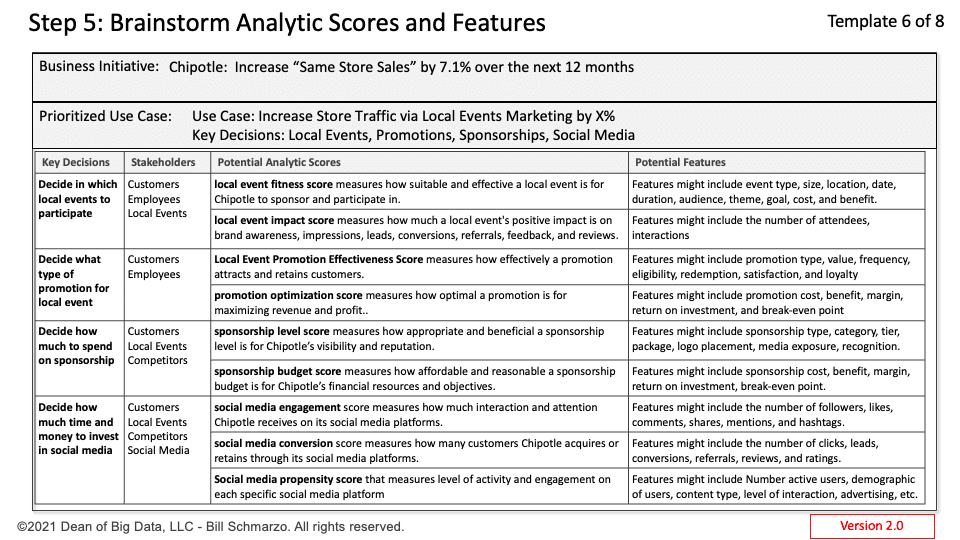
This was one area where Bing dramatically transformed the TLADS methodology! Given all the information that I had fed into Bing about the targeted business initiative (objectives, KPIs / Metrics, benefits, impediments, risks), our key stakeholders (desired outcomes, key decisions, KPIs and metrics), the key business entities (desired entity insights), and our potential use cases, I guided Bing to give me a list of potential analytic scores and associated features for our targeted each use case.

Note: at this point in the TLADS methodology, we have identified and gotten cross-stakeholder consensus on our prioritized use case. Consequently, this example will focus on the use case of “Improving Local Events Marketing Effectiveness.”

Slide5

Figure 4: Brainstorm Analytic Scores and Features

Here are some prompts that we can use to identify potential analytic scores and supporting features to help optimize the key decisions that comprise our prioritized use case:

  • Bing Prompt: For the use case “Improve Local Events Marketing Effectiveness,” identify 1 to 2 analytics scores that I might want to create to help me optimize those local events decisions.
  • Bing Prompt: What features should I consider when creating the respective analytic scores?
  • Bing Prompt: What Business Entities are impacted by the “Improve Local Events Marketing Effectiveness” use case?
  • Bing Prompt: How does the prioritized use case impact these Business Entities?
  • Bing Request: Create a matrix that maps the analytic scores and features to the business entities to Decision #1: decide in which local events to promote.

Here is the Bing Response for the last prompt (Table 2).

For Decision #1: decide on which local events to promote:

Business Entity Analytic Score Feature
Customers Propensity to attend Customer demographics, event type, event rating, event attendance, customer loyalty program status, customer social media engagement, etc.
Employees Propensity to perform Employee demographics, work history, performance ratings, engagement scores, retention status, training completion, etc.
Employees Propensity to retain Employee demographics, work history, performance ratings, engagement scores, retention status, training completion, etc.
Local events Propensity to sponsor Event type, date, time, location, description, rating, review count, attendance count, etc.

Table 2: Map Business Entity to Analytic Score and Features for Key Use Case Decision

The ability of Bing to create these cross-tab tables is impressive. I’m still trying to determine how to exploit this Bing capability further.

Summary: Integrating GenAI + TLADS – Part 2

GenAI has certainly expanded the quality and creativity of the TLADS process for Steps 4 and 5:

  • TLADS Step #4: Identify and triage the use cases that support the targeted business initiative.
  • TLADS Step #5: Identify potential Analytic Scores and their associated Features for our prioritized use case.

The next part of this series on Integrating a GenAI tool with my Thinking Like a Data Scientist methodology will focus on the following:

  • TLADS Step #6: Explore the Analytic Algorithms we might use to build the analytic scores. This is an entirely new step of the TLADS process, totally enabled by the GenAI tool. And the learnings from the addition of this step are stunning.
  • TLADS Step #7: Map Scores to Recommendations, where we link the analytic scores to the recommendations that will drive the precision decisions that seek to optimize our prioritized use case.
  • TLADS Step #8: User Interface and Feedback. Actually, I don’t even know what to expect by trying to integrate the GenAI tool with this step because I haven’t even gotten to it yet. Yea, real-time learning.

One big takeaway from this experiment so far is that my most significant advancements haven’t been regarding productivity but have been in innovation. Yes, I can do some things faster (which is nice). Still, my biggest win is the ability to unleash my natural curiosity to explore different prompts and expand the TLADS conversation. I frequently circle back in the methodology because I have thought of another idea I want to explore with Bing AI.

And while not all my prompts pan out (I have a separate document full of failed prompts), every prompt gives new insights into how to articulate the next prompt better. Yes, the exercise has been enlightening and damn fun!

Slide6