Meet Relume, the bootstrapped AI web builder that wants to supercharge Figma and Webflow

Meet Relume, the bootstrapped AI web builder that wants to supercharge Figma and Webflow Rita Liao 7 hours

Despite the abundant venture capital available for startups in the current wave of generative AI breakthroughs, totaling $14 billion in equity funding as of August this year, Relume has turned down investments and instead relied on bootstrapping since its launch in November 2021.

“We are focusing more on building a product that we can get paid for. Bootstrapping pushes us in the direction to build a better product,” Dan Anisse, co-founder of Relume, told TechCrunch.

Sydney-based Relume started as a component library for web design giants Webflow and Figma providing over a thousand components, which are customizable blocks that contain content, nav bars footers, and other elements that can be easily reused across a website. When ChatGPT became a global sensation late last year, the Relume team, like many other productivity tools out there, began to contemplate how AI could enhance its features.

In August, Relume updated its web design platform with a generative AI twist. By inputting a text prompt to describe the website one is building, say, “XYZ is a food delivery app that brings local farm produce to your doorstep on the same day,” its AI can quickly sketch out a sitemap that is editable and can be regenerated with a click.

Next, users can preview what the site actually looks like by switching from the “sitemap” mode to “wireframe”, which is a visual representation of a site. Relume’s algorithms can automatically populate the wireframe with components from its library and, again, allow users to move these visual elements around. At this point, users already have a functional website.

Relume’s AI-generated sitemap / Image: Relume

Relume trains its web-building AI in-house by leveraging OpenAI’s large language model for prompt interpretation. The text output generated from the AI can then be converted into a visual wireframe in real time as the text matches the code of the site.

Relume has amassed some 54,000 users to date, 10,000 of whom signed up following the AI feature launch two weeks ago. The platform, which is the brainchild of a small team of seven who hail from the likes of design giant Canva and early-stage startup builder Antler, has been able to maintain a retention rate of around 90%, according to Anisse. With a starting price of $32/month, the company is targeting individuals, freelancers and web design agencies, who can now “get up to ten websites a month instead of three.”

Nonetheless, the goal isn’t for AI to complete everything; Relume is meant to empower rather than replace designers. “We are giving [designers] 70% of the project, but there is still 30% that needs to be done manually,” stressed Anisse. “We are just doing a lot of the heavy lifting. The remaining 30% is creating the style guide, working out things like the font, background, color, images and etc, decisions that need to be considered by humans.”

The fine-tuning part happens on Figma and Webflow. Through a web plug-in, Relume projects can be synced to the two popular web-building tools in a compatible format, upon which users can explore a myriad of editing options like changing the shape and color of buttons.

From giants like Wix to new entrants like Universe, there’s no lack of web design tools rushing to embrace generative AI. Relume differentiates, Anisse claimed, by building on top of established design systems while some of its rivals want to topple them. Being part of mature ecosystems allows the startup to tap a massive user base, but the strategy also carries the risk that the dominant players can sever access at any given moment.

“It’s a strategic choice,” the founder said, pointing out that the startup has actually “got some good reception from Webflow” with the company’s CEO giving a shoutout to Relume on Twitter.

Wow, this is absolutely incredible – huge props to the @relume_io team for bringing these amazing AI superpowers to more Webflow visual developers! https://t.co/t20gS5OTqX

— Vlad Magdalin (@callmevlad) August 7, 2023

“Anything is possible with a significant amount of resources and engineering,” said Anisse when asked about potential copycats. But he’s not too concerned, saying that “our moat is our strong community who likes what we are doing and the fact that competitors will have to manually build a component library from scratch and train it.”

Today, Relume’s Slack channel boasts almost 4,500 members who actively talk about job opportunities, post projects to seek feedback and share tips on running design agencies.

While not currently looking for funding, Relume is not ruling out external funding in the future but wants to seek ones that “serve us the best strategically” and “understand how design platforms work,” said Anisse.

Wix’s new tool can create entire websites from prompts

Universal Music Group Grooves to YouTube’s AI Beats

In April this year, Universal Music Group (UMG) compelled YouTube to remove an AI-generated song named “Heart on My Sleeve” from the platform, which had garnered millions of views. The song which cloned Drake’s voice was posted by an anonymous TikToker named Ghostwriter. Four months later, in a new development, UMG has partnered with YouTube to unveil the “Music AI Incubator.”

In a blogpost by YouTube, the platform said that “Music AI Incubator” is working with some of music’s most innovative artists, songwriters, and producers across the industry, which includes stars like Anitta, OneRepublic’s Ryan Tedder, and the Frank Sinatra estate.

To address the challenge of generative AI in music, YouTube has laid down the groundwork with three fundamental principles: The first principle simply acknowledges the generative AI and says generative AI in music is here and the music industry needs to embrace it.

In the second principle, the company says it will protect the creative work of artists on YouTube and provide monetary benefits to the artists who rightfully deserve it.

Thirdly, YouTube says it will work towards creating new content policies to assure they meet challenges of AI. YouTube elaborated generative AI systems may amplify current challenges like trademark and copyright abuse, misinformation, spam, and more.

The partnership between YouTube and UMG is radical in the sense that initially, the music label was fighting the battle against the video streaming platform to give due rights to artists. So what led to UMG’s sudden change of heart?

Has UMG Shelved Ethics for Money?

It seems like UMG has realised that in order to keep profits coming, they need to embrace generative AI. With the current hype, people are loving AI-generated songs and they are garnering millions of views on Youtube.

In India, after Punjabi singer Sidhu Moosewala’s demise, his fans created a lot of AI songs which are currently present on YouTube. One of them is 4×4 which collected more than 4 lakh views. Nonetheless, the family members of Sidhu Mosewala expressed their disapproval of the AI-generated tracks, believing they have caused more harm than benefit to his legacy. In their statement, they emphasized that his unparalleled talent should remain unaltered.

At the moment, the generative AI music industry is a bit messy, and not many music labels are giving it much attention. UMG could do things to make the AI music world more organized, so that the people who make the music get the credit they deserve. Right now, it’s kind of all over the place, with anyone making music and putting it on platforms like YouTube.

Interestingly, back in April, UMG had asked streaming platforms like Spotify and Apple to stop AI tools from copying melodies and lyrics from their songs that have copyright protection. The current change of heart seems like there is a well-planned strategy to earn more money through royalties of generative AI music.

From now on, YouTube and UMG will keep an eye on who is creating what and safeguards the interests of the artists. The decision to partner with YouTube for UMG is about mutual benefit.

Any internet user outside of the label who produces generative AI music might face takedowns by UMG which will lead to AI music created by UMG will likely garner more views, ultimately resulting in increased revenue. This strategic shift by UMG underscores a notable change in their approach.

UMG, which currently controls about a third of the global music market, has a 31.8% market share, followed by Sony Music’s 22.6% share, Warner Music Group with 15.6% share and independents’ 30% share. This partnership with YouTube will help it further cement its position as we venture into an AI dominated world.

YouTube doesn’t want any copyright issues

By partnering with UMG, YouTube is ensuring that UMG does not sue it in future for hosting AI-generated content which might invite copyright infringement.

For Google, YouTube is a goldmine of data which is currently working on Bard and Gemini. If it restricts users from creating anything with generative AI, it will limit its data set. As much as Youtube cares for its creators and their copyright issues, it needs users to post new content every second which it can put to further use to train LLMs.

Google recently changed its privacy policy which says that the company can use data on the internet. The new policy explicitly states that Google is allowed to collect information that is publicly available online or from other public sources to train their AI models.

UMG and Youtube being on the same page creates a win-win situation for Google as they strive to develop the most exceptional Language Model to challenge OpenAI.

The post Universal Music Group Grooves to YouTube’s AI Beats appeared first on Analytics India Magazine.

Leveraging XGBoost for Time-Series Forecasting

XGBoost (eXtreme Gradient Boosting) is an open-source algorithm that implements gradient-boosting trees with additional improvement for better performance and speed. The algorithm's quick ability to make accurate predictions makes the model a go-to model for many competitions, such as the Kaggle competition.

The common cases for the XGBoost applications are for classification prediction, such as fraud detection, or regression prediction, such as house pricing prediction. However, extending the XGBoost algorithm to forecast time-series data is also possible. How is it works? Let’s explore this further.

Time-Series Forecasting

Forecasting in data science and machine learning is a technique used to predict future numerical values based on historical data collected over time, either in regular or irregular intervals.

Unlike common machine learning training data where each observation is independent of the other, data for time-series forecasts must be in successive order and related to each data point. For example, time-series data could include monthly stock, weekly weather, daily sales, etc.

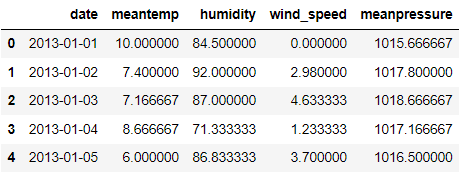
Let’s look at the example time-series data Daily Climate data from Kaggle.

import pandas as pd    train = pd.read_csv('DailyDelhiClimateTrain.csv')  test = pd.read_csv('DailyDelhiClimateTest.csv')    train.head()

Leveraging XGBoost for Time-Series Forecasting

If we look at the dataframe above, every feature is recorded daily. The date column signifies when the data is observed, and each observation is related.

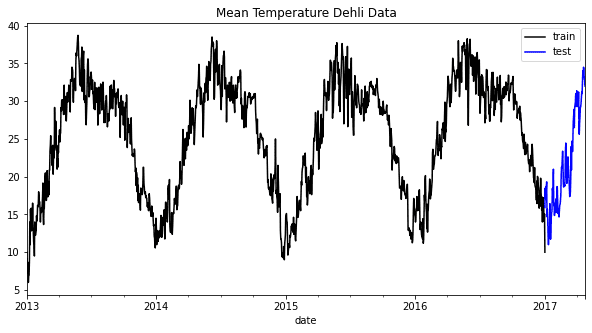
Time-Series forecast often incorporate trend, seasonal, and other patterns from the data to create forecasting. One easy way to look at the pattern is by visualizing them. For example, I would visualize the mean temperature data from our example dataset.

train["date"] = pd.to_datetime(train["date"])  test["date"] = pd.to_datetime(test["date"])    train = train.set_index("date")  test = test.set_index("date")    train["meantemp"].plot(style="k", figsize=(10, 5), label="train")  test["meantemp"].plot(style="b", figsize=(10, 5), label="test")  plt.title("Mean Temperature Dehli Data")  plt.legend()

Leveraging XGBoost for Time-Series Forecasting

It’s easy for us to see in the graph above that each year has a common seasonality pattern. By incorporating this information, we can understand how our data work and decide which model might suit our forecast model.

Typical forecast models include ARIMA, Vector AutoRegression, Exponential Smoothing, and Prophet. However, we can also utilize XGBoost to provide the forecasting.

XGBoost Forecasting

Before preparing to forecast using XGBoost, we must install the package first.

pip install xgboost

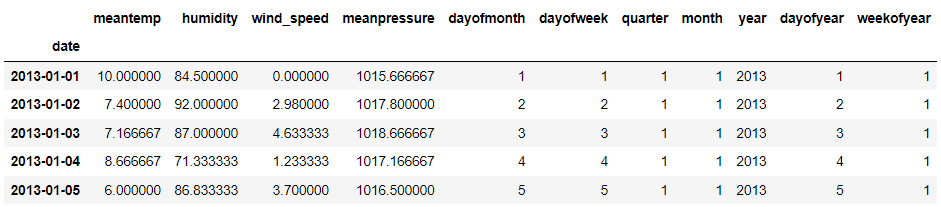
After the installation, we would prepare the data for our model training. In theory, XGBoost Forecasting would implement the Regression model based on the singular or multiple features to predict future numerical values. That is why the data training must also be in the numerical values. Also, to incorporate the motion of time within our XGBoost model, we would transform the time data into multiple numerical features.

Let’s start by creating a function to create the numerical features from the date.

def create_time_feature(df):      df['dayofmonth'] = df['date'].dt.day      df['dayofweek'] = df['date'].dt.dayofweek      df['quarter'] = df['date'].dt.quarter      df['month'] = df['date'].dt.month      df['year'] = df['date'].dt.year      df['dayofyear'] = df['date'].dt.dayofyear      df['weekofyear'] = df['date'].dt.weekofyear      return df

Next, we would apply this function to the training and test data.

train = create_time_feature(train)  test = create_time_feature(test)    train.head()  

Leveraging XGBoost for Time-Series Forecasting

The required information is now all available. Next, we would define what we want to predict. In this example, we would forecast the mean temperature and make the training data based on the data above.

X_train = train.drop('meantemp', axis =1)  y_train = train['meantemp']    X_test = test.drop('meantemp', axis =1)  y_test = test['meantemp']

I would still use the other information, such as humidity, to show that XGBoost can also forecast values using multivariate approaches. However, in practice, we only incorporate data that we know exists when we try to forecast.

Let’s start the training process by fitting the data into the model. For the current example, we would not do much hyperparameter optimization other than the number of trees.

import xgboost as xgb    reg = xgb.XGBRegressor(n_estimators=1000)  reg.fit(X_train, y_train, verbose = False)

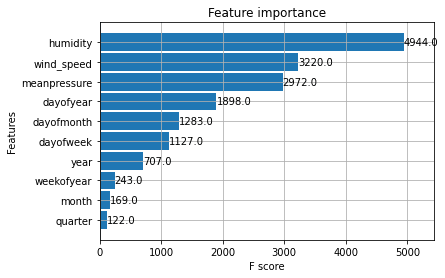
After the training process, let’s see the feature importance of the model.

xgb.plot_importance(reg)

Leveraging XGBoost for Time-Series Forecasting

The three initial features are not surprisingly helpful for forecasting, but the time features also contribute to the prediction. Let’s try to have the prediction on the test data and visualize them.

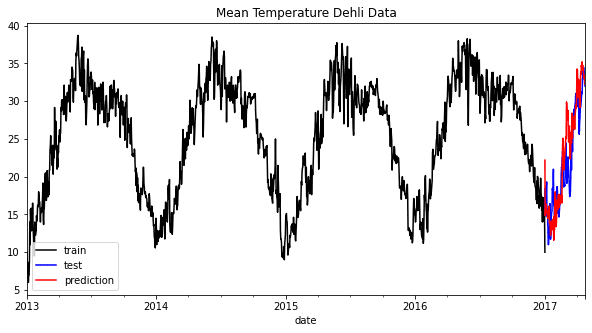
test['meantemp_Prediction'] = reg.predict(X_test)    train['meantemp'].plot(style='k', figsize=(10,5), label = 'train')  test['meantemp'].plot(style='b', figsize=(10,5), label = 'test')  test['meantemp_Prediction'].plot(style='r', figsize=(10,5), label = 'prediction')  plt.title('Mean Temperature Dehli Data')  plt.legend()

Leveraging XGBoost for Time-Series Forecasting

As we can see from the graph above, the prediction might seem slightly off but still follow the overall trend. Let’s try to evaluate the model based on the error metrics.

from sklearn.metrics import mean_squared_error, mean_absolute_error, mean_absolute_percentage_error    print('RMSE: ', round(mean_squared_error(y_true=test['meantemp'],y_pred=test['meantemp_Prediction']),3))  print('MAE: ', round(mean_absolute_error(y_true=test['meantemp'],y_pred=test['meantemp_Prediction']),3))  print('MAPE: ', round(mean_absolute_percentage_error(y_true=test['meantemp'],y_pred=test['meantemp_Prediction']),3))

RMSE: 11.514

MAE: 2.655

MAPE: 0.133

The result shows that our prediction may have an error of around 13%, and the RMSE also shows a slight error in the forecast. The model can be improved using hyperparameter optimization, but we have learned how XGBoost can be used for the forecast.

Conclusion

XGBoost is an open-source algorithm often used for many data science cases and in the Kaggle competition. Often the use cases are common classification cases such as fraud detection or regression cases such as house price prediction, but XGBoost can also be extended into time-series forecasting. By using the XGBoost Regressor, we can create a model that can predict future numerical values.
Cornellius Yudha Wijaya is a data science assistant manager and data writer. While working full-time at Allianz Indonesia, he loves to share Python and Data tips via social media and writing media.

More On This Topic

  • Multiple Time Series Forecasting with PyCaret
  • Avoid These Mistakes with Time Series Forecasting
  • Time Series Forecasting with statsmodels and Prophet
  • Want To Get Good At Time Series Forecasting? Predict The Weather
  • Time Series Forecasting with PyCaret Regression Module
  • Time Series Forecasting with Ploomber, Arima, Python, and Slurm

How to use Stable Doodle AI to transform your doodles into artwork

AI images with Stable Doodle AI

We all like to doodle, even though we know our sketches probably aren't going to win any art awards. But now a new online artificial intelligence (AI) tool can turn your doodles into legitimate artwork.

Using Stable Doodle AI, you can draw a doodle using your finger, a stylus, or a mouse, depending on whether or not you're using a touchscreen device. You can then describe the type of image you want and pick a style, such as photographic, fantasy, comic book, anime, or line art.

How to use: Midjourney | Bing Image Creator | Craiyon | Stable Diffusion

In response, Stable Doodle generates an image based on your doodle, description, and style. By default, the AI creates three images. Choose the one you like the best, and you can modify and download it.

Offered by open-source generative AI company Stability AI via the Stable Diffusion XL model, Stable Doodle is available in both free and paid versions. The freebie version watermarks your artwork and limits you to a certain number of images and modifications per day. You'll want to sign up for a free account to get the maximum number of allowed images and edits.

Also: How to use ChatGPT: Everything you need to know

Priced at $9 per month on a monthly basis, or $7 per month on an annual basis, the Pro edition skips the watermark, supports 1,500 images per day, and offers an unlimited number of edits.

Stable Doodle is accessible as a website and as a mobile app. Here's how it works.

Disclaimer: Using AI-generated images could lead to copyright violations, so people should be cautious if they're using the images for commercial purposes.

More how-tos

DeepMind Wants to Take Humans Out of RLHF

DeepMind Wants to Take Humans Out of RLHF

DeepMind, the king of reinforcement learning, has introduced the Reinforced Self-Training (ReST) algorithm, a technique poised to redefine the landscape of large language models (LLMs). ReST emerges as a formidable innovation in the realm of reinforcement learning from human feedback (RLHF), aiming to remove the humans from the loop and drive self-learning agents.

Click here to read the paper.

Central to the ReST approach is the novel decoupling of two distinct stages—Grow and Improve—which together usher in data efficiency and stability. The algorithm toggles between generating synthetic training data in the Grow step and optimising policies using filtered data in the Improve step. This break from the traditional online RL process proves instrumental in refining the model’s output quality.

According to the researchers, ReST offers a safeguard against “reward hacking,” a scenario where models exploit vulnerabilities in learned reward models.

Ok this is awesome, Reinforced Self Training, new RL finetuning method. 1 more step towards fully autonomous machines and the beginning of the end of manual finetuning (1 yr tops)
https://t.co/uuaUnSivBM pic.twitter.com/MKjkYDZ9hD

— Far El (@far__el) August 21, 2023

Starting from an initial LLM policy, ReST operates by creating a dataset through the generation of samples based on the base policy. These samples are subsequently harnessed to enhance the LLM policy via offline RL algorithms. The distinct advantage of ReST over conventional online RLHF techniques is its heightened efficiency attributed to offline dataset production, permitting the recycling of data.

Although ReST offers a versatile solution for various generative learning scenarios, the primary focus lies in its application within the context of machine translation.

Unlike conventional approaches that solely maximise ‘likelihood’, ReST employs human preferences to bring about an alignment between model outputs and human desires. By doing so, it overcomes limitations intrinsic to online RLHF methods, like the computationally expensive requirement of continual new samples during training.

Evaluation methods

ReST’s efficacy was put to the test on the challenging task of machine translation, where the goal is to convert input sequences into target output sequences. The ReST algorithm was formulated as a Markov Decision Process (MDP), leveraging well-established metrics such as BLEU, BLEURT, and Metric X for scoring translation quality.

Notably, benchmarking on renowned translation quality benchmarks including IWSLT 2014, WMT 2020, and Web Domain, ReST demonstrated its prowess by outperforming the conventional online Proximal Policy Optimization (PPO) RL with an equivalent amount of data.

Underlying ReST’s remarkable results is its unique decoupling strategy, which serves a trifecta of benefits. First, the periodic generation of new data during the Grow phase enhances data efficiency, enabling iterative policy refinements. Second, real-time monitoring during Grow facilitates the identification of alignment issues and potential reward hacking. Lastly, the adoption of offline RL losses minimizes the risk of reward hacking compared to continuous online optimization methods.

The paper highlights that the best results were achieved with a simple supervised training loss for ReST. This underscores the complexity of offline RL in extensive discrete action spaces, emphasizing the need for further exploration into more effective offline RL algorithms for language tasks.

Despite its achievements, ReST does expose a discrepancy between automated metrics and human evaluations, indicating that learned reward models still fall short of fully representing human judgment. This misalignment underscores the continuing importance of integrating human preferences into the algorithm through annotation data.

Last month, Google DeepMind had also introduced RT-2, the first ever vision-language-action (VLA) model that is more efficient in robot control than any model before. Aptly named “robotics transformer” or RT, this advancement is set to change the way robots interact with their environment and execute tasks with precision.

RT-2 is a learning wizard. The model can grow smarter as time goes by and easily understand both words and pictures. The problem-solving model can tackle tricky challenges it has never faced before or been trained on.

The post DeepMind Wants to Take Humans Out of RLHF appeared first on Analytics India Magazine.

How Specialised AI Solutions Offer Complete Solution for Enterprises  

According to recent trends, Enterprise AI is shifting towards specialised solutions rather than a single generalised model.

Recent reports have highlighted that an overwhelming majority (96%) of global executives are actively engaging in discussions about generative AI within their organisations. However, despite the potential benefits, publicly available large models of generative AI pose substantial challenges for businesses. These models often lack alignment with practical business needs, exhibit limited controllability, carry data and privacy risks, and present difficulties in implementation and scalability.

Generative AI adoption should be achieved in a manner that prioritises safety, security, and control, while also tailoring the technology to align seamlessly with the unique realities of their businesses.

Central to this transformation is also the role of enterprise software vendors, which are actively integrating generative AI capabilities into their offerings.

Specialised Models for Specific Tasks

Salesforce, for instance, has introduced Einstein Studio, aiming to empower enterprises to train and operate generative AI solutions using customer data stored in its Data Cloud. Einstein Studio connects Salesforce data to AI models like Llama 2 and OpenAI’s GPT-4, boosting AI app development. It uses zero-ETL for data, saving time and costs, simplifies data, and offers real-time updates for training.

The tool lets enterprises monitor and serve models and link to AI solutions on platforms like Amazon SageMaker and Google’s Vertex AI. It includes a control panel for data exposure management. The launch of Einstein Studio addresses users who create custom solutions and those refining existing ones using Salesforce data, streamlining AI development in enterprises.

ServiceNow’s offering Now Assist, a virtual assistant, that is integrating generative AI features, facilitates processes through text-to-code functionality and streamlines interactions with clients using AI-generated case summaries. Powered by ServiceNow’s proprietary LLMs, it aims to reduce repetitive tasks and enhance productivity across various workflow offerings.

Oracle’s generative AI initiatives encompass hardware enhancements, cloud services, and integration with applications like Oracle Fusion Cloud Human Capital Management, offering assistance with content creation, summarization, and recommendations. These capabilities are embedded within existing HR processes to enhance business value, improve productivity, streamline HR tasks, and enhance the employee and candidate experience.

Similarly, Splunk is leveraging generative AI to enhance its observability tools through the use of Google’s T5 text-to-text transfer transformer model. The aim is to improve security and observability features in identifying threats using generative AI. Robert Pizzari, VP of Security at Splunk, discussed cybersecurity challenges and trends in the current landscape. He highlighted the rise of ransomware attacks, cloud security breaches, and supply chain attacks.

These developments collectively underscore the integration of generative AI to enhance various aspects of data analysis, user engagement, and automation within diverse industry contexts.

Why AI Caution is Necessary

Nevertheless, while enterprise software vendors are fervently driving generative AI innovation, CIOs are proceeding with caution. CIOs are carefully assessing how to effectively deploy generative AI within their organisations, with a strong emphasis on establishing robust safeguards.

“These models will be trained on local data, my data, and it can decide on my network or my cloud or my hardware. That is the point where of course you need something which is residing in your own network. And we believe we are on that side of the story, and believe that AI has to be specialised to solve a specific problem.” Atul Rai, CEO and co-founder, Staqu, said.

The implementation of generative AI can sometimes occur through unstructured individual or departmental initiatives, inadvertently entering the enterprise ecosystem. Moreover, it’s becoming increasingly common for generative AI capabilities to be bundled with existing enterprise applications by vendors, facilitating its adoption within established workflows.

The integration of generative AI capabilities by enterprise software vendors underscores the importance of AI in modern business operations.

Rai also believes that specialised solutions are the future. “The future of course belongs to personalised models. Generalised models can solve a broader range of queries. ……but the problem with generalised space is that you do not get ROI.”

He concurs with the scepticism enterprises have about the safety of APIs and larger models and is of the opinion that localised models are preferred. “Every industry and every human needs a specialised model which can solve a specific problem, and it must be something which adapts to my data and gives insight on that,” he said.

The post How Specialised AI Solutions Offer Complete Solution for Enterprises appeared first on Analytics India Magazine.

Watsonx Code Assistant Adds COBOL-to-Java Translations on IBM Z

IBM COBOL to Java translation.
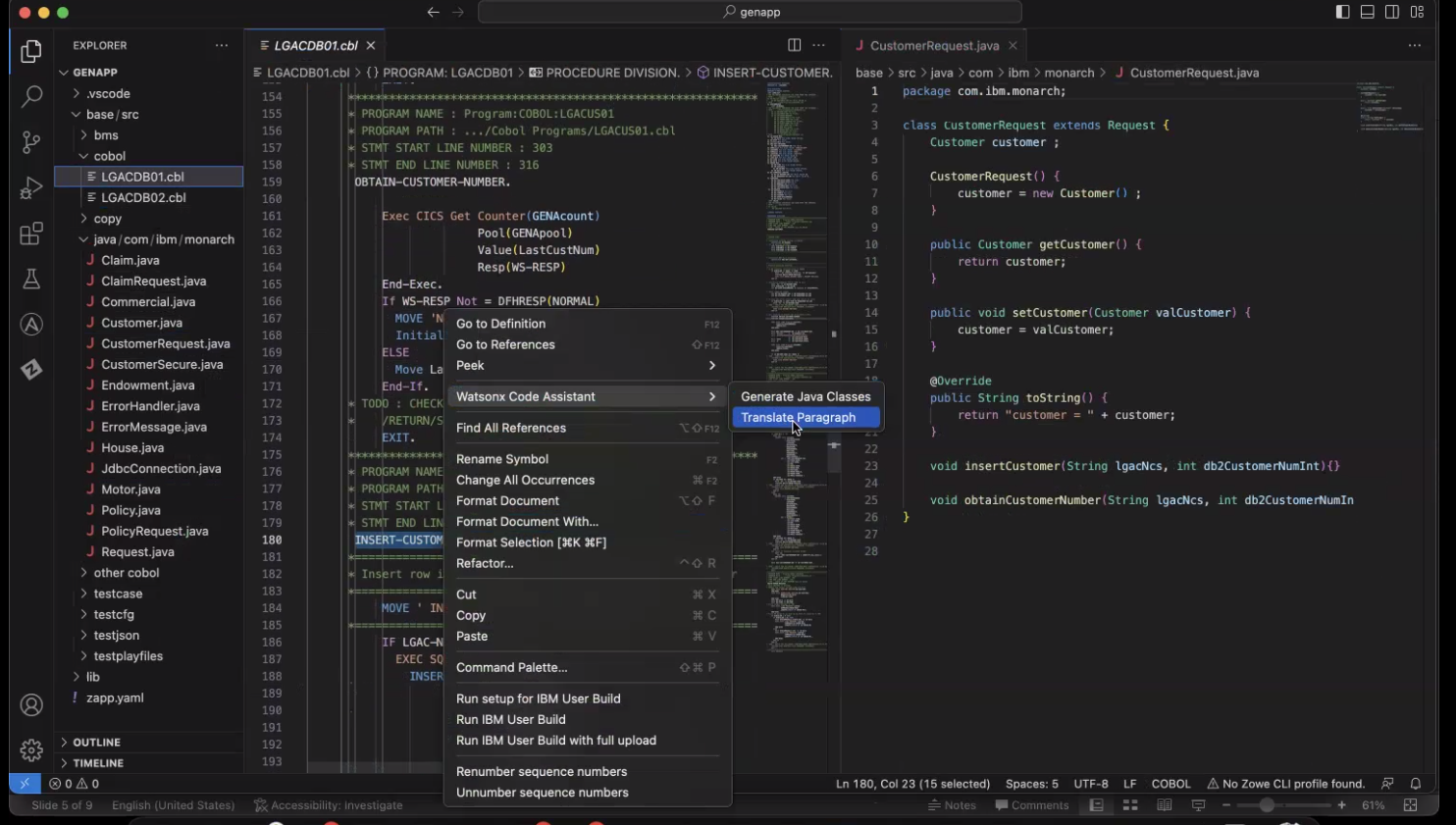
IBM COBOL-to-Java translation. Image: IBM

IBM announced today watsonx Code Assistant for Z, a generative AI-assisted solution for COBOL-to-Java mainframe application modernization. It opens up new use cases for watsonx Code Assistant, in particular transferring and validating COBOL applications on IBM Z.

Watsonx Code Assistant for Z is expected to be available globally as a service in the fourth quarter of 2023. IBM will demonstrate watsonx Code Assistant for Z in September at IBM TechXchange in Las Vegas.

Jump to:

  • Make code migration from COBOL to Java easier
  • Enhance the transition to generative AI
  • How watsonx Code Assistant for Z integrates with VSCode
  • Watsonx Code Assistant for Z’s place within the larger IBM AI ecosystem

Make code migration from COBOL to Java easier

Mainframe computing such as IBM Z has been a backbone of IBM’s business for decades. The IBM Institute for Business Value found that organizations are 12 times more likely to use existing mainframe assets rather than upgrade their application estates to completely new environments in the next two years.

Watsonx Code Assistant for Z is intended to make it easier to upgrade while using existing mainframe assets, with generative AI standing in for potential skill gaps or strained resources. In many instances of application modernization, organizations move all application code to Java or a public cloud; IBM wants to make sure customers don’t lose sight of the original reason they chose IBM Z instead of a public cloud.

Watsonx Code Assistant for Z is meant for use in application modernization, app development, large libraries and data retrieval; in particular, it is designed to make translations from COBOL to Java faster. Other tools that automatically switch COBOL applications to Java exist, but they can produce garbled code that is hard to maintain for developers used to working in Java.

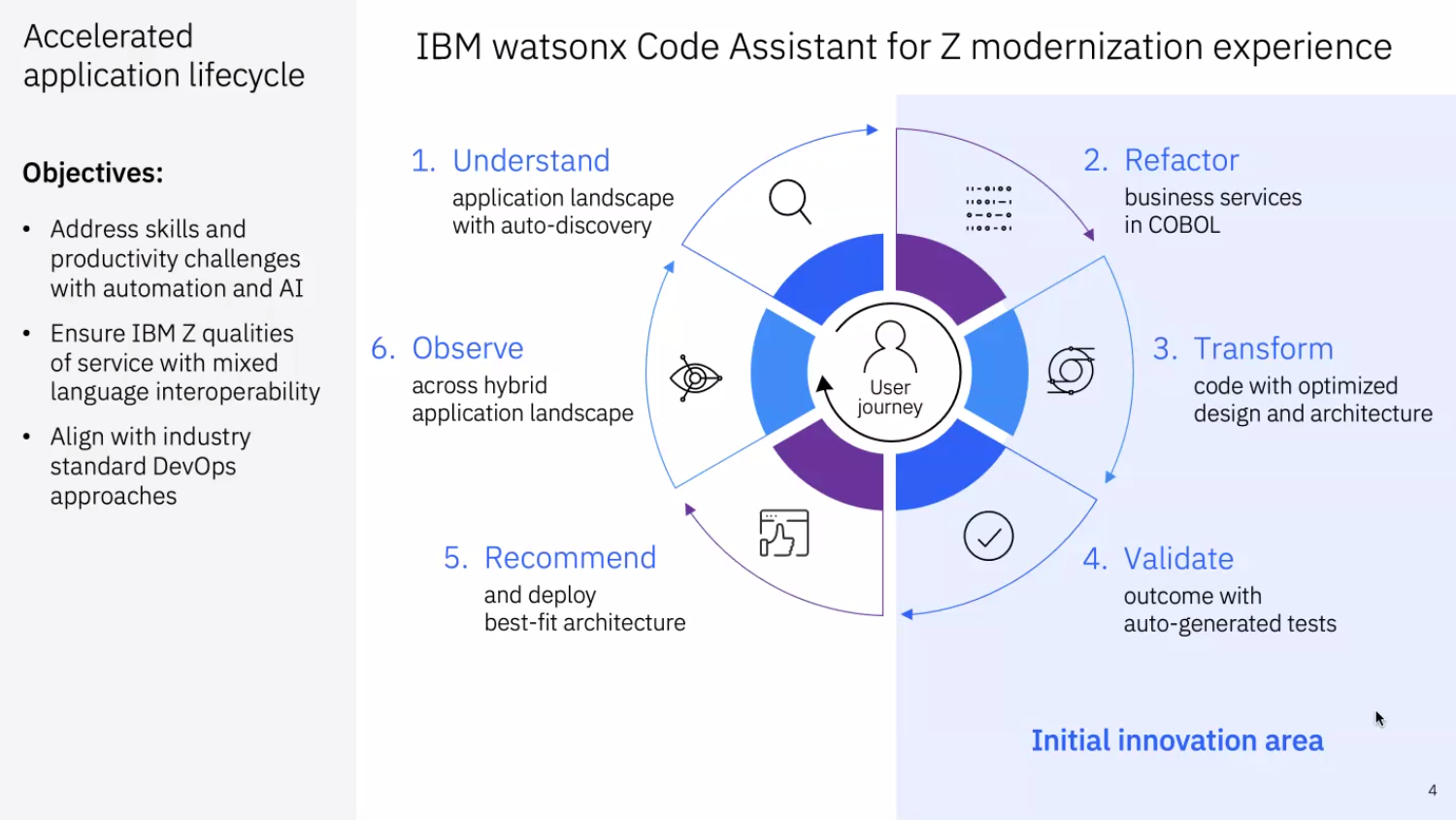
The COBOL data processing language is relatively easy to use, but also increasingly rarely used, and it is a procedural language instead of an object-oriented one. The object-oriented Java has broader functionality, and its complexity can be beneficial. Watsonx Code Assistant for Z can refactor, transform and validate COBOL code during application modernization on IBM Z (Figure A).

Figure A

Modernization with Code Assistant for Z
A diagram of how Code Assistant for IBM Z fits into the modernization life cycle. Image: IBM

Today, applications are often “tangled-up monoliths” that make code migration time-consuming, complicated and risky, said Skyla Loomis, vice president of IBM Z Software, in a pre-briefing for press on August 17.

Enhance the transition to generative AI

Specifically, Code Assistant for Z uses the IBM watsonx.ai foundation model to rewrite, assess, update, validate and test code. The generative code model currently contains 20 billion parameters and was trained on more than 80 code languages and 1.5 trillion tokens of data. IBM claims its Java translation outperformed ChatGPT 88% to 32%.

Some functionality will come from IBM’s Application Discovery and Delivery Intelligence inventory and analysis tool. After using the Application Discovery and Delivery Intelligence tool, customers can use watsonx Code Assistant for Z to:

  • Refactor business services written in COBOL.
  • Transform COBOL code to Java code with an eye toward optimized design.
  • Validate the resulting Java code using automated testing.

One use case might be delivering Ansible Lightspeed — a generative AI service designed to make it easier to deliver Red Hat’s automation tool Ansible — with watsonx Code Assistant, which creates Ansible-tuned models.

How watsonx Code Assistant for Z integrates with VSCode

During the press demonstration, IBM Fellow and CTO for Z Software Kyle Charlet demonstrated extracting COBOL code from an insurance application for refactoring. Watsonx Code Assistant for Z could trace code through associated data structures, extracting the exact code paths needed for that particular application as opposed to the others used in associated tasks.

SEE: IBM is betting on Meta’s Llama 2 in the race to secure territory in the future of generative AI (TechRepublic)

From there, one could export the code paths to Visual Studio Code, within which watsonx Code Assistant for Z could provide feedback and tips.

Watsonx Code Assistant for Z also evaluates that the COBOL code and the Java translation are semantically equivalent and have the same result.

AI model will be trained on open source or attributed code

The AI model used in watsonx Code Assistant for Z was originally trained on CodeNet and is now being tuned on enterprise Z COBOL and COBOL-Java pairs, pointed out Charlet. He noted that the AI model works under an open source license and wouldn’t be directly copying anyone’s original code without their permission.

“Attribution of code will be a key priority. Contributors will know if their code is used to train that model, and they can opt out of that experience,” Charlet said.

Watsonx Code Assistant for Z’s place within the larger IBM AI ecosystem

Watsonx Code Assistant for Z is one of the many branches of IBM’s efforts to add generative AI to its products. It sits within the same AI and data platform category as several other parts of watsonx, including:

  • watsonx.ai, which trains, validates and deploys machine learning AI and foundation models for generative AI.
  • watsonx.data, which allows enterprises to scale AI workloads using their data with a fit-for-purpose data lakehouse for AI workloads.
  • watsonx.governance, which provides data and AI governance for responsible, transparent and explainable workflows.

“Our focus is on a full stack of solutions starting all the way down at the infrastructure which of course includes IBM Z and IBM cloud and goes up to our Center of Excellence for consulting and Client Engineering,” said Keri Olsen, vice president, IBM IT Automation.

“By bringing generative AI capabilities through watsonx to new use cases, we plan to drive real progress for our clients,” said Kareem Yusuf, senior vice president, product management and growth, IBM Software.

Subscribe to the Innovation Insider Newsletter

Catch up on the latest tech innovations that are changing the world, including IoT, 5G, the latest about phones, security, smart cities, AI, robotics, and more.

Delivered Tuesdays and Fridays Sign up today

YouTube touts AI principles to protect music creation

Megaphone with colorful sound waves

YouTube has established broad principles to guide its approach to artificial intelligence (AI), with the aims of embracing AI responsibly and safeguarding the music industry.

The Google-owned video-streaming site said Monday its "first-ever set of AI music principles" would help facilitate creativity while protecting artists on its platform. These principles include the recognition that "AI is here" and should be embraced responsibly by the company alongside its music partners.

Also: How AI helped get my music on all the major streaming services

"Advancements in generative AI are no longer a future promise," YouTube CEO Neal Mohan said in a blog post. "Millions of people already embrace it in their day-to-day lives, from finding useful information to increasing creativity and productivity. YouTube creators in particular have embraced AI to streamline and boost their creative processes."

So far this year, videos related to AI tools on the platform have clocked more than 1.7 billion views.

With AI driving a new era of creative expression, Mohan said it then was necessary to include "appropriate protections" for artists. He noted that YouTube had rolled out various tools in previous years, including its rights management technology Content ID, which helps ensure copyright holders are paid for the use of their content.

Also: Five ways to use AI responsibly

Now, with the emergence of generative AI, new tools must be identified and built that will enable creators to continue making money on the video platform, he said. YouTube will also will need to tap AI to safeguard the music industry against new issues generated by emerging technology.

"Generative AI systems may amplify current challenges like trademark and copyright abuse, misinformation, spam, and more," Mohan said.

"But AI can also be used to identify this sort of content and we'll continue to invest in the AI-powered technology that helps us protect our community of viewers, creators, artists, and songwriters."

These tools include policies and detection and enforcement systems, such as Content ID, which operate in the backend, said Mohan, adding that some of these technologies are already applied to AI-generated content. One of the company's policies, for instance, prohibits the uploading of videos that have been technically manipulated to promote false claims.

Also: The best AI chatbots: ChatGPT and other noteworthy alternatives

The new principles — framed broadly around the need to embrace AI responsibly and develop appropriate tools to protect artists — will play a critical role in YouTube's overall approach to AI.

Mohan revealed that more details will be shared "in the months ahead" on specific technologies, monetization opportunities, and policies. YouTube also hopes to pull in more partners to support its efforts.

For now, the company has inked a partnership with Universal Music Group to launch the AI Music Incubator program. This initiative aims to drive awareness among artists, songwriters, and producers of YouTube's approach to generative AI in music, and to help steer its technological direction.

The partnership brings together "a working group" comprising the music industry's stakeholders to explore and provide feedback on AI-related music tools, Universal Music Group Chairman and CEO Lucian Grainge wrote in a blog post.

Also: Today's AI boom will amplify social problems if we don't act now

"Today's rapid technological advancements have enabled digital manipulation, appropriation, and misattribution of an artist's name, image, likeness, voice and style — the very characteristics that differentiate them as performers with unique vision and expression," Grainge said.

"Given this tension, our challenge and opportunity as an industry is to establish effective tools, incentives, rewards, and rules of the road that enable us to limit AI's potential downside, while promoting its promising upside. If we strike the right balance, I believe AI will amplify human imagination and enrich musical creativity in extraordinary new ways."

Artificial Intelligence

Meta’s 6 Premier Papers Presented at INTERSPEECH 2023

Over the years, Meta has been an avid contributor to the open-source community with their back-to-back impactful research papers. The most cited paper of 2022 was Google Deepmind’s AlphaFold. During that very year, Meta secured the third position with their paper ‘A ConvNet for the 2020s’, a collaborative effort with UC Berkeley, which garnered a remarkable 835 citations.

Taking the legacy ahead, Meta has presented more than 20 brilliant papers at the prestigious conference of the International Speech Communication Association (INTERSPEECH 2023) in Dublin. Let’s take a look at the top six of them.

Read more: OpenAI’s Tiny Army vs Meta-Google’s Dream Team

Multi-head State Space Model for Speech Recognition

The paper introduces a novel approach called the multi-head state space (MH-SSM) architecture, enhanced with specialised gating mechanisms that leverage parallel heads to capture both local and global temporal patterns within sequence data. This MH-SSM model serves as a replacement for multi-head attention in transformer encoders, surpassing the performance of the transformer transducer on the LibriSpeech speech recognition dataset. Moreover, the paper presents the Stateformer, a model incorporating MH-SSM layers into the transformer block. This Stateformer achieves state-of-the-art results on the LibriSpeech task, achieving word error rates of 1.76% and 4.37% on development sets and 1.91% and 4.36% on test sets, all without relying on an external language model.

Read the full paper here.

Modality Confidence Aware Training for Robust End-to-End Spoken Language Understanding

This method employs a single model that combines audio and text data from pre-trained speech recognition models, outperforming traditional SLU systems in real-time on-device scenarios. However, these End-to-end (E2E) spoken language understanding (SLU) systems struggle when faced with poor text representations due to errors in automatic speech recognition (ASR). To address this, Meta proposes a new E2E SLU system that enhances resilience to ASR errors by merging audio and text data based on estimated confidence levels of ASR hypotheses through two new techniques: 1) a method to gauge the quality of ASR hypotheses, and 2) an approach to effectively incorporate them into E2E SLU models. The method demonstrates improved accuracy on the STOP dataset, backed by analysis showcasing its effectiveness.

You can check out the full paper here.

EXPRESSO: A Benchmark and Analysis of Discrete Expressive Speech Resynthesis

Meta has come up with “Expresso,” a dataset with scripted and improvised speech in 26 styles to tackle the use of self-learned low bitrate units for speech synthesis, capturing intricate speech aspects even though there is a lack of expressive datasets. They use the dataset for a benchmark where input is encoded into low-bitrate units and then resynthesized in a target voice while preserving content and style. Resynthesis quality is assessed using self-supervised encoders, considering tradeoffs between quality, bitrate, and style consistency. The dataset, metrics, and models are open source for further research.

Check out this link for further understanding.

Handling the Alignment for Wake Word Detection: A Comparison Between Alignment-Based, Alignment-Free & Hybrid Approaches

The paper discusses wake word detection in smart devices, enabling them to activate efficiently upon hearing specific keywords. It explores alignment’s role in creating a wake-word system for general phrases, comparing three approaches: alignment-based training with frame-wise cross-entropy, alignment-free training using Connectionist Temporal Classification (CTC), and a hybrid approach combining aligned and unaligned data. Results show that the alignment-free system performs better for the target operating point, and the hybrid model, trained with a small portion of data (20%), meets performance criteria effectively.

For more information, read the full paper here.

MuAViC: A Multilingual Audio-Visual Corpus for Robust Speech Recognition and Robust Speech-to-Text Translation

Meta has unveiled a new benchmark called MuAViC (Multilingual Audio-Visual Corpus) that incorporates audio-visual learning to achieve highly accurate speech translation, revamping speech translation. Based on their previous AI models such as AV-HuBERT and RAVen models that use visual information to improve English speech recognition, through MuAViC, Meta AI has trained its AV-HuBERT model to deliver superior speech translation in challenging amid noisy environments. The model can effortlessly handle noise, with the visual modality being relied upon more heavily if the audio modality is distorted. The models were tested in noisy and noise-free environments against a top-performing model for speech recognition and X-En speech translation tasks.

Read the full paper here.

ESPnet-SE++: Speech Enhancement for Robust Speech Recognition, Translation, and Understanding

The paper discusses recent advancements in integrating speech separation and enhancement (SSE) into the ESPnet toolkit. Notable improvements over prior ESPnet-SE work are highlighted, incorporating state-of-the-art speech enhancement models with associated training and evaluation methods. A novel interface has been devised, enabling the flexible combination of speech enhancement with other tasks like automatic speech recognition (ASR), speech translation (ST), and spoken language understanding (SLU). The study includes experiments on specially curated synthetic datasets for tasks involving noisy-reverberant multichannel ST and SLU, serving as reference datasets for future research. Additionally, established datasets CHiME-4 and WSJ0-2Mix are utilized to assess both multi and single-channel SE techniques. Findings emphasize the promising potential of integrating SE front-ends with various tasks beyond ASR, particularly in multi-channel settings. Furthermore, the paper introduces multichannel ST and SLU datasets.

Take a look at the complete paper here.

Read more: Google’s 6 Must-Read Papers Published at INTERSPEECH 2023

The post Meta’s 6 Premier Papers Presented at INTERSPEECH 2023 appeared first on Analytics India Magazine.

Future-Proofing with Google’s Quantum Security

Last week, Google unveiled its first quantum resilient FIDO2 (Fast Identity Online) security key implementation as part of its OpenSK security keys initiative. This optimised implementation of open-source hardware employs an innovative signature scheme called an ECC/Dilithium hybrid schema. This approach leverages the strengths of ECC in defending against conventional attacks while harnessing the quantum resistance of Dilithium against potential quantum threats.

This development has surfaced shortly after Google’s recent announcement that it intends to introduce support for encryption algorithms capable of resisting quantum attacks in Chrome version 116.

Why FIDO2?

Over the last ten years, mathematicians and engineers have worked vigorously to prevent potential cryptographic disaster by introducing PQC (post-quantum cryptography). PQC involves encryption techniques designed to resist attacks from quantum computers

FIDO2’s primary goal is to remove the need for passwords in online contexts. It was designed to establish openly accessible and licence-free standards for secure authentication without passwords on the internet. Through the FIDO2 authentication method, the conventional risks associated with username and password logins are removed and replaced by the FIDO2 standard, which is said to provide defence against prevalent online threats.

The most recognized version of FIDO2 implementation involves a passwordless authentication method called passkeys. As of now, there are no identified methods by which passkeys can be overcome in credential phishing attacks. Numerous websites and services presently offer users the option to log in through passkeys, utilising cryptographic keys stored within security keys, smartphones, and other devices. Big tech companies such as Microsoft and Apple also support FIDO2 security keys.

While quantum attacks are still in the distant future, deploying cryptography at Internet scale is a massive undertaking which is why doing it as early as possible is vital. Google believes that this implementation (or a similar version) will become standardised within the FIDO2 key specification and gain backing from prominent web browsers. This move aims to safeguard users’ credentials from quantum attacks.

Combating Quantum Attacks

Quantum attacks are a type of cyberattacks that leverage the advanced computational capabilities of quantum computers to break certain types of cryptographic systems and algorithms.

Quantum attacks use properties of quantum mechanics, such as superposition and entanglement, to perform calculations that would either be extremely challenging or impossible for classical computers to execute efficiently. Two specific algorithms that quantum computers use to perform these attacks are Shor’s algorithm and Grover’s algorithm. In the former method, the algorithm can factor big numbers into prime parts, possibly weakening the encryption, and in Grover’s algorithm, it focusses on searching unsorted database of times which can weaken the security of symmetric key cryptography by reducing the effective key length needed to resist exhaustive search attacks.

In the upcoming years, established data encryption protocols, including widely used public key cryptography (PKC) standards like RSA, might face vulnerabilities. A recent report by the Hudson Institute, a think tank, said that the financial sector is likely to be a primary target for future quantum attacks as the technology evolves. Furthermore, the quantum cyberattacks targeting the U.S. financial sector could result in a staggering $3.3 trillion economic loss to the U.S. economy.

National Institute of Standards and Technology (NIST), points out that once the critical threshold is surpassed, referring to the point where advanced quantum computers can break current classical encryption methods, the ability to ensure the secrecy of previously stored encrypted data held by adversaries becomes futile. This emphasises the urgency of adopting quantum-resistant encryption measures today. This proactive approach is essential to safeguard data against potential breaches before the anticipated development of these quantum machines. Companies such as Microsoft, Google, and IBM are concerned about the potential security challenges that might arise due to the capabilities of quantum computers.

In Google’s security key implementation, Dilithium used, which is a type of cryptographic algorithm that falls under the category of PQC, solves a variety of problems. For it to be broken, an attacker would have to defeat both the ECDSA (Elliptic Curve Digital Signature Algorithm) encryption and the PQC encryption that underpins its security. Furthermore, the keys it uses are tiny compared to many other PQC algorithms in circulation now.

Source: Google Blog

Google’s current approach shadows on the ‘harvest now, decrypt later’ threat, which is a type of attack strategy that leverages the assumption that current encryption methods might be vulnerable to future advancements in technology, such as quantum computers. In this scenario, attackers collect and store encrypted data intercepted from communication channels or compromised systems, with the intention of decrypting it at a later time when more powerful computational resources become available.

Though Google has been silent with their progress on quantum computing, with this announcement of quantum resilient security key, Google has not yet given up on quantum.

The post Future-Proofing with Google’s Quantum Security appeared first on Analytics India Magazine.