Using AI technologies for effective document processing

document recognition with ai

Ever-growing volumes of unstructured data stored in countless document formats significantly complicate data processing and timely access to relevant information for organizations. Without proper optimization of data management workflows, it’s difficult to talk about business growth and scaling. That is why progressive companies opt for intelligent document processing powered by artificial intelligence.

How AI address the key challenges of document processing

Despite the fact that digitalization has been a top priority for businesses in recent years, companies still spend millions of dollars on manual document processing. According to statistics, about 80% of the data generated by organizations is unstructured. Moreover, this extends to various document formats, including spreadsheets, PDFs, images, etc., which require different approaches to processing this data.

Manual data processing approaches are not only subject to errors but they also could lead to losing important documents, problems with version control, and various legal and regulatory risks. Incorporating AI technologies into the data processing workflow can help to reduce these challenges. AI app development allows for the automation of the classification and extraction of unstructured and semi-structured data with a high level of accuracy.

There are several options for implementing artificial intelligence for document processing that meet different business goals, made possible by AI’s ability to find hidden patterns beyond the reach of the human eye.

Data extraction with Machine Learning OCR

Traditional Optical Character Recognition (OCR) systems that are usually used for automated data extraction are template-based and require extensive supervision. While this is an acceptable option for highly structured documents like spreadsheets, problems arise when it comes to files with high variability like invoices, receipts, etc. The implementation of machine learning algorithms allows you to significantly expand the capabilities of OCR and provide more flexibility.

Any OCR algorithm includes three basic steps: image processing, text detection, and text recognition. The introduction of machine learning for the last two steps allows you to significantly improve the output. The end result of processing a file using machine learning OCR is converting the document into structured data for easy processing in your database. Since the accuracy of results with traditional OCR depends a lot on the quality of the original document, ML models could also help with solving this issue.

For instance, ML could help to increase the quality of images by applying denoising algorithms or binarization of the images and other approaches that will be the most suitable for resolving the problem of low quality images.

With machine learning, you can teach the model to associate various shapes with a specific symbol for greater accuracy. Such OCR systems can effectively process more complex data, for example, if you are dealing with blueprints and engineering drawings recognition. Also, machine learning can provide a more complete analysis, because it can analyze not only a certain part of the document but also the entire context.

Integration and customization of ready-made software such as OpenCV and Tesseract OCR allow you to create a solution that will meet all your specific needs. ML-based OCR systems help companies avoid mistakes that result in the loss of important data points and greatly facilitate the process of data management. Also, it significantly saves human resources because machine learning requires less human intervention over time. But it still is great if the data recognized by AI is validated by humans from time to time in order to highlight problem spots of recognition and retrain models on new updated data.

How to classify and analyze documents more effective with NLP technology

Before going to data extraction we need to understand the kind of data we are working on. That’s where natural language processing (NLP) comes to the rescue. Unlike simple rule-based software that can extract information based on strictly defined keywords or tags, NLP is more flexible and can interpret information based on intent and meaning, and thus properly consider changes and options in documents.

Named entity recognition and classification

One of the basic tasks of NLP is Named Entity Recognition, i.e. identifying named entity mentions within unstructured data and classifying them into predefined categories (names, locations, amounts, etc.). Statistical NER systems usually require a large amount of manually tagged training data, but semi-supervised approaches can reduce this effort. For example, sometimes it’s sufficient to use out-of-the-box NLP packages that include pre-trained machine learning models and don’t require additional data for training. If this is not enough for acceptable results and the business uses specific naming, it will be necessary to label additional entities and retrain the NLP model on the updated dataset.

Text Classification helps to categorize text according to its content. For example, it can be used to classify and assign a set of pre-defined tags or categories to medical reports or insurance claims depending on different criteria. Or you can use classification to prioritize customer requests for a customer support team by ranking them by urgency.

Sentiment analysis

Sentiment Analysis is a way to use natural language processing (NLP) methods to identify and extract people’s opinions, attitudes, and emotions from text. It is a common task in NLP. It allows you to define the thoughts and emotions of customers about your products and services from reviews, survey responses, and social media comments. To determine the opinion, the system is usually guided by keywords. For example, “like’ or “love” signal a positive statement, and “do not”, “not” or “hate” a negative one. However, it’s also worth considering the special types of language constructions, because sometimes “not” and “never ” can have the opposite meaning (for example, “not bad”). Also, difficulties can arise with slang. For example, the word “sick” can have both a negative and a positive connotation. Nowadays, it is completely possible to handle these tasks with more advanced deep learning models that are able to understand context from the written text and identify the emotions with a minimum of mistakes.

The accuracy of document processing with NLP depends on many factors, including variation, style, and complexity of the language used, the quality of training data, document size (sometimes large documents are better because they provide more context), number of classes and types of entity, and many more. Each case is unique and requires a customized solution that can be provided by experienced machine learning consultants.

What you need to implement AI-powered document processing

Deciding to integrate AI-powered document processing into your workflow, you’ll face two options: complete automation and semi-automation with human supervision. The first case is possible if your business processes are logical and repetitive. If there’s any chance of variability that can impact the decision-making, it’s better to opt for semi-automation where the human has the final word.

The creation of an AI product like an intelligent document processing system consists of the following stages:

  1. Identifying a business problem to solve

Different cases require different solutions and the use of AI is not always justified. That is why it’s important to clearly understand exactly what results you want to get from the automation of document processing and to consult with specialists about the means of achieving these goals.

  1. Choose the right technology

Consulting with software developers will help you choose the best tools to implement your idea. It can be both the customization of ready-made platforms and the development of completely new solutions if the specifics of your project require it.

  1. Data preparation

To train models, it is important to have accurate, relevant, and comprehensive data. You can have your own databases or find open-source datasets, as well as use web scraping tools. Then, if necessary, the data is cleaned and processed by removing errors, formatting, and handling missing values.

Once the development team has the data they need, they can build and train the models, as well as improve them. The critical point for business owners in this process is finding a reliable development partner who has the necessary expertise and is able to match business needs with technology capabilities. With real experts on your side, you will be able to implement intelligent document processing without additional complications and personally experience the benefits of using AI to optimize business processes.

NVIDIA Sells GPUs, Not Shovels 

By now, most of you are familiar with the infamous meme doing the rounds on the internet – “When everyone digs for gold, sell shovels.” This very aptly captures the gold rush created by generative AI, depicting NVIDIA selling shovels, while Microsoft, Google, and Meta are busy buying them. Ironically, we wish it was as easy as selling shovels instead of GPUs.

Surprisingly, NVIDIA seems to be optimistic amid all the rumours about GPU crunch, and how GPUs are the new currency.

OpenAI’s Andrej Karpathy said, “who gets how many GPUs’ is the top gossip of the Silicon Valley right now”. Even Elon Musk had once said – “GPUs are at this point considerably harder to get than drugs.”

On multiple occasions, Sam Altman as well had shared similar views, where he said the shortage is delaying OpenAI’s short term plans, including multimodality, fine-tuning, 32K context windows, and others. “We are so short on GPUs, the less people use our products the better,” said Altman, saying that they’d love it users use it less because they don’t have enough GPUs.

Many cloud provider execs have also said that the capability of large scale H100 clusters at small and large cloud providers is running out.

NVIDIA is all Sorted for the Next One Year

Recently, NVIDIA has confidently projected a revenue of $16 billion for the upcoming third quarter of FY23. Looks like it has an unlimited supply of shovels (GPUs, obviously) to cater to the world’s AI needs. The same sentiment was resonated in the recent record-breaking earnings call where its chief financial officer Colette Kress said that it has everything under control. “NVIDIA has developed and qualified additional capacity and suppliers for key steps in the manufacturing process such as co-op packaging,” she added, implying that they expect supply to increase in the coming quarters.

Meanwhile, NVIDIA is set to significantly increase the production of its leading H100 AI processor, aiming to triple it at the very least, as reported by Financial Times. According to sources familiar with NVIDIA’s plans, the company intends to ship between 1.5 million and 2 million H100s in 2024, a substantial surge from the anticipated 500,000 units for this year.

NVIDIA’s DGX Systems’ VP Charlie Boyle believes that GPU shortage is a supply chain problem, and not NVIDIA’s GPUs. “So when people use the word GPU shortage, they’re really talking about a shortage of, or a backlog of, some component on the board, not the GPU itself,” he explained.

Who is Selling Shovels to NVIDIA?

The main suppliers of NVIDIA are South Korea’s SK Hynix, TSMC, Samsung and others.

TSMC plans to double its capacity for CoWoS, an advanced packaging technology needed to make NVIDIA’s H100 processor, but warned the bottleneck would still not be resolved until at least the end of 2024.

Samsung Electronics is currently working with Nvidia on technical verification tasks for the HBM3 for GPUs and advanced packaging services. As soon as the technical verification procedures are completed, Samsung will supply HBM3 to Nvidia and is expected to take charge of the advanced packaging that processes individual GPU chips and HBM3 into a high-performance GPU, the H100.

SK Hynix has also started the verification process for its high-performance HBM3E memory chip with NVIDIA, the world’s top AI chip designer. Earlier this week, the Korean memory chipmaker said it started shipping out samples of its HBM3E, an extended version of the HBM3, to its clients including NVIDIA.
This time, NVIDIA is well-equipped to address any obstacle, thanks to the strong supply chain ecosystem of suppliers to sell its GPUs.

It seems to be ahead of its time already. Recently, NVIDIA introduced a GPU named L40S, which doesn’t require as much packaging used in H100 chips. This difference makes the new chips less susceptible to manufacturing bottlenecks. Huang explained this new chip is purposely built to fine-tune LLMs and not to train them. In other words, the L40S chips might be beneficial for smaller AI startups that are fine-tuning models like Meta’s open-source Llama 2, and not building them from scratch.

The post NVIDIA Sells GPUs, Not Shovels appeared first on Analytics India Magazine.

7 Projects Built with Generative AI

v
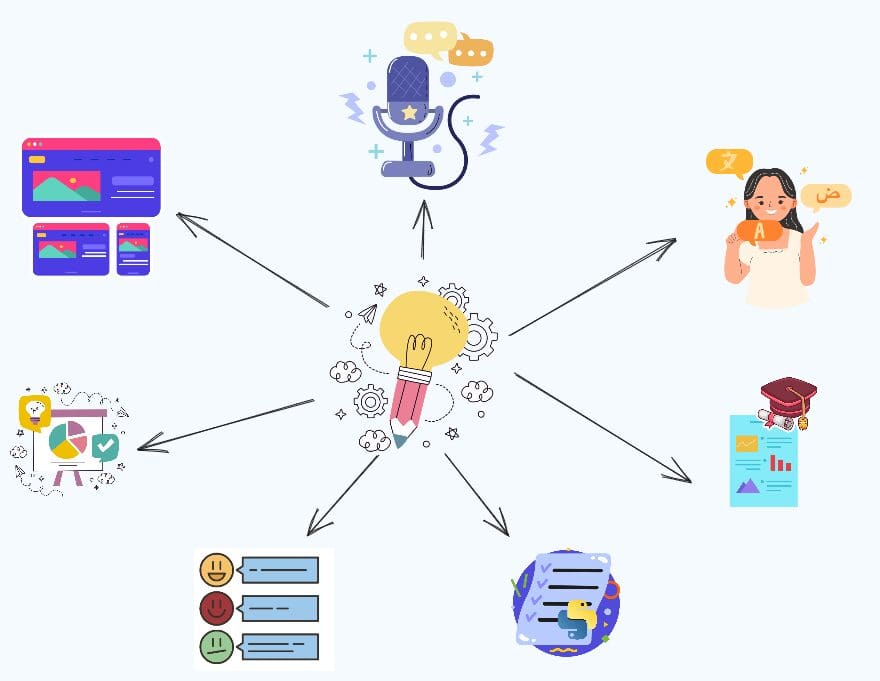
Illustration by Author | Source: Flaticon

To enter the data science job market, it’s a mistake to take for granted that a degree is enough to obtain a job. One of the main suggestions is to build a strong portfolio with personal projects that can play an essential role in standing out from the crowd and impressing the recruiter.

With the advent of generative AI tools, like ChatGPT, a collection of standard projects, like object detection and recommendation systems, are not enough anymore to capture the attention of the company. In the last months, companies are opening positions for people able to build Generative AI solutions.

For these reasons, we are going to explore 7 project ideas that use Large Language Models for solving the task:

  1. Create a Portfolio Website
  2. Personalized Voice Assistant
  3. Build your own AI translator
  4. Analyze research papers
  5. Creating Code documentation
  6. Automate Powerpoint presentations
  7. Sentiment Analysis of Reviews

1. Create a Portfolio Website

There are a lot of tutorials that explain how to build a data science portfolio website, but it can be really intimidating for getting started from scratch without any knowledge of HTML and CSS. I tried personally, and it gives a lot of satisfaction when you reach the goal, but it took me a week between finding the right resources and putting into practice what I have learned.

Now, with the boom of Large Language Models, you don’t need to make an effort anymore. You just need a good idea, ask questions to ChatGPT, which will return the code for your website.You can just begin with a prompt like this:

I decided to build a static website. Can you generate HTML code for building the website? Moreover, I need to have three pages: a page with my name and a short presentation, a page with my data science projects and a page with my work experience. In addition to these pages, I want a vertical navigation menu at the left to move from a page to the other.

Like in other applications, you need to have clear ideas of what you want to generate your Portfolio Website.

Project link: Build a Data Science Portfolio Website With ChatGPT

2. Personalized Voice Assistant

In my personal life, I use Google Assistant to ask to reproduce music of different genres. For example, “Google, I want to listen to rock music” and it instantly reproduces a random song from youtube music. It’s really more rapid than writing the title of the song and it learns your preferences the more it collects your data. Wouldn't it be cool to do it as a personal project? This project can be done easily by using GPT-3 to answer the question and Whisper API to transcribe the audio.

Project link: Personalized Voice Assistant with GPT and Whisper

3. Build your own AI translator

Are you tired of copying and pasting the text into Google Translate? Personally, I have also tried google chrome extensions to translate the text on web pages, but I still struggle when I have to read PDF files in English. A possible alternative is to build your own AI application. Every day, there is a new powerful Large Language Model that amazes us with its incredible results. Why should we exploit one of these models?!

This application can be created using Hugging Face, which provides a lot of models specialised in translations from one language to another. For example, you can pick this model that is targeting Italian translation from English. After you choose the model for the translation, you can concretize this idea by building an application with Streamlit.

Project link: Build your own AI translator

4. Analyze research papers

During my research fellowship, I learned how to read papers rapidly and efficiently. But just reading a paper with a minimum of 30 pages is time-consuming and it’s hard to stay on top of research with this explosion of papers released every day. To boost research productivity, wouldn’t it be better to extract the relevant information from academic papers? These are the following three use cases that can be helpful for your career in the data science field.

Question & Answer over papers

Generating Questions and Answers from documents is one of the coolest applications that bring value. Most tutorials use Chat-GPT to create an automatic Q&A session, but it’s not the only solution. You can also create your personalised bot using LangChain and Sentence Transformers from HuggingFace. There are the following steps:

  1. Load the PDF document using PyPDFLoader
  2. Extract chunks from the text
  3. Extract embeddings using the Sentence Transformer library
  4. Build the bot to answer questions

Project links:

  • Question & Answer over papers with Chat-GPT API
  • Question & Answer with LangChain and Sentence Transformers

Summarize papers

Another common use case is to summarize the paper. Like before, this task can be automated with generative AI tools. A cute web application can be built using GPT-3, LangChain and Streamlit.

Project link: Summarize papers

Query multiple papers

If we summarize multiple papers at the same time, it would be nice to filter to query these summaries based on questions. Wouldn’t it be cool? It can be again very simple by utilizing LangChain and OpenAPI-API.

Project link: Query multiple papers

5. Creating Code documentation

While working as a data scientist in my last experience, I have noticed how it’s important to document the code day by day. If you work by yourself, you don’t care about it. But when you work with a team, it becomes complex to manage tasks without code documentation. In particular, it can happen that a team member leaves the company and was the only person that understood his/her code. Even if documentation is really useful, it’s a very boring task that consumes time. Thanks to the boom of Large Language Models, we can again avoid this hard work by creating Python Docstring with Chat-GPT.

Project link: Creating Code documentation

6. Automate Powerpoint presentations

If you are a data scientist, it surely happened that you had to prepare PowerPoint slides for discussing the results with the client. This is another time-consuming work that can be automatized thanks to Generative AI. You can ask Bing Chat to generate VBA code to create PowerPoint slides by specifying clearly the context and the information for each slide.

Project link: Automate Powerpoint presentations

7. Sentiment Analysis of Reviews

In the world of industry, sentiment analysis of product reviews can help companies to understand if customers are liking or not products, allowing them to improve the service and stay competitive in the market. This is the classic data science project that requires a lot of steps to be solved: text-preprocessing, word embeddings and application of a machine learning model.

The first step is the most laborious task, which requires a good understanding of the language you are analysing. This problem can be managed fastly by using Chat-GPT. In addition to this analysis, it can be possible to generate a list of pros and cons from each review, create a list of possible suggestions to improve the product and so on.

Project link: Sentiment Analysis of Reviews

Final thoughts

That’s it! These are seven Generative AI projects that can help you to boost your resume and improve your efficiency at work. I suggest you try to have fun while working on the projects. Driven by inspiration, everything is possible. If you have an idea, try to make it in practice and voilà, you’ll be satisfied with the final product. Thanks for reading. Have a nice day!
Eugenia Anello is currently a research fellow at the Department of Information Engineering of the University of Padova, Italy. Her research project is focused on Continual Learning combined with Anomaly Detection.

More On This Topic

  • Five Key Facts About Wu Dao 2.0: The Largest Transformer Model Ever Built
  • 4 Machine Learning Concepts I Wish I Knew When I Built My First Model
  • Data storytelling: brains are built for visuals, but hearts turn on stories
  • How I Built A Perfect Model And Got Into Trouble
  • ChatGPT, GPT-4, and More Generative AI News
  • Are Data Scientists Still Needed in the Age of Generative AI?

Can India Surge Ahead of China in Semiconductors?

Both China and India are pushing to become self-reliant in the semiconductor space as they recognise the strategic importance of semiconductor manufacturing for technological advancement as well as economic growth. However, China is way ahead with USD 200 billion in investments in the last 20 years. Hence a comparison between these two countries displays a significant contrast; however, this scenario is poised to undergo a transformation in the near future.

Indian Union Minister Rajeev Chandrasekhar is of the opinion that despite spending billions of dollars in the last 20 years on semiconductors, China has failed. India, with investments of around USD 10 billion, can surge ahead of China in the coming years. “We will be in a position to achieve what even bigger countries—who have spent 10 times more money—have not been able to achieve in over 20 years. We have a big opportunity, at least in semiconductors, to surge ahead of China,” he told TOI.

While the Minister does sound ambitious, the reality is India has a long way to go to catch up with China, but the tide is slowly turning. Despite numerous challenges, and setbacks, India is making progress and hence, it won’t be completely right to write off the minister’s claims altogether as well.

Playing to its strengths

In June 2021, China’s daily chip production reached almost 1 billion units, showcasing its formidable manufacturing capacity. Drawing a manufacturing comparison at this juncture would not be equitable. But, India is on par with China when it comes to chip designing, according to Shashwath TR, chief executive and co-founder of Mindgrove Technologies.

“When it comes to chip designing, India is on par with China in terms of capability and the number of people participating in the ecosystem. However, until recently, the two countries were structurally different in that while several Chinese design houses have their own chip designs, Indian players mainly provide design services. This has begun to change and will change further,” Shashwath told AIM.

India holds a significant position for international semiconductor firms due to its abundant pool of skilled semiconductor design engineers, constituting around 20% of the global workforce engaged in both collaborative global projects and independent work. Chip makers such as Intel, Qualcomm and Micron have already set up R&D hubs in the country, however, as a result, they also retain much of the Intellectual Property (IP) on the designs.

To build an ecosystem required to support the industry, chip designing is a good starting point. A thriving chip ecosystem requires design competency and India already has an edge. Through a Design Linked Incentive (DLI) scheme, the Indian government plans to nurture and facilitate the growth of domestic companies involved in semiconductor design.

As of now, more than 30 semiconductor design startups have been founded in India as part of this initiative, with five of them already benefiting from government support. The increasing number of designs corresponds to a growing pool of IPs attributed to India. Nevertheless, the country must enhance its IP laws to effectively accommodate and foster the research and innovation underway within its borders.

ATPs are important too

Recently, US-based chip manufacturer Micron became the first taker of the Government of India’s Production Linked Incentive (PLI) scheme- a USD 10 billion corpus aimed at promoting and incentivising the manufacturing of semiconductor chips and display fabs within the country. Micron is in the process of setting up an assembly testing and packaging (ATP) facility in Gujarat, India. While the quest to have fabs drags on, Shashwath believes assembly, testing and packaging (ATP) is a field in which India has capability due to our robust electronics manufacturing service (EMS) industry.

“It is also a very valuable part of the supply chain. Establishing ATP facilities in the country will curtail supply delays and give us a significant edge in the delivery of finished products. Several players are setting up ATMP services, which should be encouraged much more. ATMP is also one of the highest job generators in this value chain. Once the ATMP plants are operational and settled, silicon foundries will follow. They are usually the last to get set up because the economics of the foundry are very hard to solve,” he added.

China too started its semiconductor journey by focusing on ATP and Outsourced Semiconductor Assembly and Test (OSAT) facilities. Currently, China accounts for 38% of the global global share in the ATMP/OSAT business. Hence, a focus on ATP/ OSAT could be the right direction for India. Chandrasekhar too believes that once Micron comes, other companies will look at India favourably.

“India’s demographic advantage and expanding domestic market offer lucrative prospects for both local and international semiconductor companies. India’s semiconductor journey is marked by rapid growth, positioning it for a competitive and impactful role alongside China,” Krishna Rangasayee, CEO and Founder, SiMa.ai, told AIM.

Long way to go

While India’s goal isn’t necessarily to directly compete with China but rather to achieve self-reliance, it’s evident that India has a considerable journey ahead to match China’s current position. It’s worth highlighting that China itself isn’t completely self-sufficient and has faced setbacks due to multiple US sanctions. However, for India to surpass China, it must address several challenges that lie ahead.

For instance, “Schemes and strategic investment in this regard would be of utmost help in the case of standards compliance. Given that we are effectively creating a new ecosystem in India, existing regulatory frameworks need to be constantly reviewed and tweaked appropriately to ensure that they do not curtail the growth and competitiveness of the semiconductor ecosystem,” Shashwath said.

Rangasayee too believes China’s investment and commitment to the semiconductor domain through R&D, a robust manufacturing infrastructure and a skilled labour force make them a major global player. The developments in this regard at India’s end have been promising. Besides the DLI scheme, Indian Prime Minister Narendra Modi, while speaking at the Semicon India 2023 event, said that around 300 colleges will start providing semiconductor education to its students.

Hence collaboration, investment in innovation, skill honing, and business-friendly policies are India’s winning cards. “The journey might have its challenges, but with the right moves, we’re looking at a thriving Indian semiconductor landscape that can rival the best,” Rangasayee said.

The post Can India Surge Ahead of China in Semiconductors? appeared first on Analytics India Magazine.

Nirmala Sitharaman Mocks IBM For Being Outside the Realm of AatmaNirbhar Bharat

Nirmala Sitharaman Mocks IBM For Being Outside the Realm of AatmaNirbhar Bharat

Nirmala Sitharaman, finance minister of India, was part of a panel at the B20 Summit where she was put up with a question from Arvind Krishna, CEO of IBM about advising what should companies do to establish a strong presence in India.

“What encouragement or advice would you give those of us who are from multinational companies and wish to have a strong presence in India and from India to serve the world?” asked Krishna. Emphasising that he has been happy with the AatmaNirbhar mission of the government, but talks about free trade opens up many questions.

To this Sitharaman replied, “Comments about free trade should actually encourage you to be in India.” She explains how so much effort has been put in by the commerce minister and his team.

On the question of the Free Trade Agreement (FTA), she said, “I would not be wrong in saying an FTA is very close for a final call with the UK, and I think agreements with Canada are also progressing, and I expect them to come to a conclusion sooner rather than later.” She also said that agreements have already been signed with Australia and UAE.

Interestingly, Sitharaman said that for FTA, you have to be present in India, speaking with Krishna. “You have a government that brought stability in policy. We have a government that shows we are not thirsting for more revenue with some tax rates increased here and there.”

She adds that everyone knows that AatmaNirbhar is already in progress, and “IBM is probably outside of that realm,” and how AatmaNirbhar is not going against globalisation.

Focusing on the growing Indian economy, Sitharaman adds that the country’s economy speaks for itself and investors look for such destinations.

At the B20 Summit, Krishna said that he is excited about AI potential in driving the country’s economy as it can take over cognitive tasks and perform them. AI will help “generate more per capita GDP”, he also added.

In an interview with Bloomberg in May, Krishna had also said that AI has the potential to cut 30% of the jobs.

The post Nirmala Sitharaman Mocks IBM For Being Outside the Realm of AatmaNirbhar Bharat appeared first on Analytics India Magazine.

Why India Has Become a Hotspot for Data Centre Investments 

Sunil Gupta, MD and co-founder at Yotta Data Services, recently unveiled plans for the development of five more data centre projects, expanding its data centre business. With plans to build two data centre parks in Mumbai, one in GIFT City in Gujarat, a multi-building park in Chennai, and a 30MW campus in Dhaka, Bangladesh—in an attempt at exploring global markets beyond India.

In the past few months, there has been a flurry of announcements of investment in data centres across India. Be it Sify’s commitment of upwards of $360 million, Atlassian’s plans to set up data centres across India, or AWS’ plans to invest $12.7 billion to expand their data centres in India. To support all of this, investments are also coming in from entities like Kotak Alternate Assets, which has revealed its plans to invest $800 million to support the development of 5-7 large data centres across the country’s key property markets.

Data localisation and cost efficiency are the main driving factors for data centre demand in India. The push for data localisation, spurred by India’s data protection norms and the proposed data centre policy, has swayed global data majors towards the country.

Sify chief financial officer MP Vjay Kumar, reiterated the same. He said, “There is no point for the content which is consumed in India to get hosted somewhere else where it goes all the way and comes back every time. The data should be localised.”

The need for data localisation was reiterated as the government introduced the concept of “trusted geographies,” which intensified the demand for data centres in India, limiting cross-border data storage to selected nations. This galvanised hyperscalers to mount on the backs of the likes of Sify and their data centres which serve both, hyperscalers like AWS, Microsoft, Google, and Oracle. and enterprise clients.

As businesses migrate to the cloud and segments such as (banking, financial services and insurance) BFSI, and government drive demand, followed by e-commerce, media, manufacturing, and retail, India’s data centre market is booming, attracting investments in hyperscale data centres. Nasscom predicts global investments to hit $200 billion annually by 2025, with India expected to draw around $5 billion annually within two years.

Gauging the trend, Indian conglomerate Adani, in partnership with EdgeConneX has also bid for a piece of the pie. The JV has raised $213 million to advance its ongoing data centre initiatives, collectively encompassing 67 MW in Noida and Chennai. This collaboration aspires to become a leading data centre operator by 2030, augmenting its capacity by 1 GW.

The endeavour entails providing comprehensive data centre solutions across India, including massive hyperscale campuses and slick edge facilities, leveraging EdgeConneX’s global expertise.

Addressing Growing Enterprise Needs

The current surge in data centre development has been brewing for over a decade. Cloud made services universal, and analytics aided data comprehension. Subsequently, AI, IoT, and machine learning, and now generative AI, is accelerating these trends.

Presently, India is witnessing the mainstream adoption of digital technologies, yielding robust use cases and business models. This transition results in a significant influx of data, necessitating its generation, storage, management, and consumption on an extensive scale.

Sydney-based software company Atlassians’ plans to invest in establishing data centres in India is in collaboration with Amazon to implement its products within these Indian data centres—which would address existing customer and new enterprises’ needs.

Atlassian, with its team collaboration and productivity software products like Jira, Confluence, Bitbucket, and Trello has prominent Indian names such as Ola Cabs, Reliance, Walmart Labs, and Flipkart as its customers. Atlassian also emphasises that data remains in the designated location. Co-Founder and Co-CEO Scott Farquhar explained that despite using Amazon’s data centres and infrastructure, Atlassian will put in place the necessary systems for the same. Additionally, Farquhar cited India’s burgeoning economy and talent pool as driving factors behind this strategic move.

More Cloud, More Money

To top it all, there are investments coming in from the likes of Kotak Alternate Assets, which is poised to invest $800 million into the development of five to seven expansive data centres within India and is pivotal.

The central focus of the Kotak Data Centre Fund is directed towards strategic investments in regions such as Mumbai, Chennai, Noida, and Hyderabad. These locales have been experiencing a notable surge in demand for data centre services.

Rahul Shah, the executive director at Kotak Investment Advisors Ltd., articulates the rationale behind this commitment, stating that the data centre industry inherently necessitates substantial capital expenditures for capacity expansion. “We have been studying the data centre industry for the last 3-4 years… The current data centre capacity in India is significantly lower than the fast-growing requirement,” Shah said.

He views this scenario as an opportunity for equity investment to empower partners in the creation of such capacities. The fund’s pivotal role lies in supplying strategic risk capital to partners while concurrently delivering value-added assistance to address this gap.

Investments Galore

The incoming investments are not a new phenomenon, and they follow on the heels of developments from 2022 when India witnessed a surge of significant data centre announcements, shaping its technological landscape.

India possesses numerous attributes that make it an attractive data centre hub. These include a cost advantage, robust legislation, minimal climate risks, a skilled workforce, and enticing governmental incentives. Acknowledging their significance, the government has designated data centres as part of the infrastructure sector, streamlining the process of raising capital. Furthermore, India’s climate poses no significant threats to data centre operations. The convergence of real estate, tech expertise, a thriving enterprise market, a high number of smartphone users, and the government’s reliance on data for governance all contribute to India’s ideal data centre ecosystem.

Sustainable Way Forward

As investors with a long-term perspective explore the capital-intensive data centre landscape, developers and investors find ample opportunities in this sector. Notably, the emphasis on sustainability is growing, driving the adoption of low-carbon and energy-efficient technologies by global operators. Edge data centres emerge as a promising avenue, contributing to sustainable transitions through their smaller footprint and lower energy consumption.

While metro cities remain data centre hubs, Tier-II cities are also gaining traction. Despite currently holding just 3% of India’s total data centre stock, Tier-II cities like Vijayawada, Nagpur, Raipur, Kochi, Patna, and Mangalore are being eyed by key data centre operators for the establishment of edge data centres and disaster recovery sites.

Several patterns emerge as one looks at these developments—data centre capacity growth, hyperlocal data providers providing their facilities to hyperscalers to enhance their cloud offerings for Indian enterprises, and foreign investment driven by local demand. However, as the data centre landscape evolves, India’s potential in this sector remains substantial, heralding an era of robust digital infrastructure, innovation, and resilience.

The post Why India Has Become a Hotspot for Data Centre Investments appeared first on Analytics India Magazine.

World’s first AI safety summit to be held at Bletchley Park, home of WWII codebreakers

Bletchley Park

The rise of generative artificial intelligence (AI) has heralded a new era of innovation — and now world leaders will return to the roots of computing for the world's first AI Summit.

On Thursday, the UK government announced that Bletchley Park, which it referred to as "one of the birthplaces of computer science", will host the UK AI Safety Summit on November 1-2. The summit will include international government officials, AI company leaders, and AI experts.

Also: In a win for humans, federal judge rules that AI-generated artwork can't be copyrighted

Topics that will be discussed are the risks of AI, how these threats can be mitigated at the international level through coordinated action, and the creation of a shared approach to safe technological development.

"With the combined strength of our international partners, thriving AI industry and expert academic community, we can secure the rapid international action we need for the safe and responsible development of AI around the world," said U.K. Prime Minister Rishi Sunak.

The summit's location is noteworthy because it holds historical significance in the area of computer science and innovation, mainly for its role as a codebreaking center in World War Two.

Also: 4 ways to detect generative AI hype from reality

Bletchley Park in Buckinghamshire was home to British Enigma codebreaking, as well as other Nazi code cracking done by the codebreakers during World War Two. The efforts at Bletchley Park ultimately helped the Allies win the war.

"It is fitting that the very spot where leading minds harnessed emerging technologies to influence the successful outcome of World War Two will, once again, be the crucible for international co-ordinated action," said Iain Standen, CEO of the Bletchley Park Trust.

One of the most notable figures to have worked at Bletchley Park is Alan Turing. He was one of the leading developers of the Bombe, which is a machine that was used to help decipher encrypted messages sent by the Enigma machine during the war.

Also: The 'Human or not' game is over: Here's what the latest Turing Test tells us

Turing is also considered a trailblazer in the field of computer science. He was the creator of the Turing Machine, which is considered the first conceptualization of a computer.

Bletchley Park is now a museum that garners over 250,000 visitors a year. It's fitting that the birthplace of computer science will be the location for a summit that will help create a pathway for the responsible development of generative AI.

Artificial Intelligence

Zepto Becomes the First Indian Unicorn of 2023

Zepto Becomes the First Indian Unicorn of 2023

Indian instant grocery delivery startup Zepto, has clinched the title of the first unicorn of 2023 in the country’s entrepreneurial landscape. While many other startups within the same category have faltered or are grappling with challenges, Zepto has successfully raised a staggering $200 million, propelling its valuation to a remarkable $1.4 billion.

Remarkably, this feat follows Zepto’s valuation of $900 million just last year in a funding round unveiled in May. The startup’s journey has been marked by a total capital infusion of approximately $560 million to date. Notably, Zepto Co-founder and CEO Aadit Palicha clarified that there were no secondary transactions involved in this recent funding endeavor.

The Series E funding round that pushed Zepto into unicorn territory was spearheaded by StepStone Group, a prominent Limited Partner (LP) in various venture funds. This investment marks StepStone Group’s inaugural direct foray into the Indian market. Joining the funding initiative were key players including Goodwater Capital, Nexus Venture Partners, Glade Brook Capital, and Lachy Groom, alongside existing backers.

Zepto’s triumph arrives at a time of adversity for many instant delivery startups on a global scale. Industry giants such as Gopuff, Jokr, Getir, Gorillas, and Instacart, who collectively amassed over $10 billion, have experienced significant cutbacks in operations, plummeting private valuations, and even complete shutdowns.

Even within India, the landscape has seen its share of setbacks, with BlinkIt selling for less than its raised capital and Dunzo, backed by Reliance Retail, grappling with employee payment deferrals and layoffs following an ambitious but unsuccessful expansion strategy.

Founded by Aadit Palicha and Kaivalya Vohra while they were just 19 years old, Zepto emerged from stealth mode in November 2021. The startup operates as a comprehensive delivery platform, offering everything from groceries to electronic gadgets, and efficiently processes over 300,000 daily orders across seven Indian cities. Employing a network of strategically located “dark stores” in popular neighborhoods, Zepto has achieved impressive operational efficiency, with the majority of these stores generating positive EBITDA.

In an era where financial discipline is paramount, Zepto has significantly reduced its expenditure and is now aiming for IPO readiness within the next 12 to 15 months, riding on a company-wide positive EBITDA metric. With an annualised revenue run rate exceeding $700 million and a staggering 300% year-on-year sales growth, Zepto has set its sights on reaching $1 billion in annualised sales in the upcoming quarters.

The post Zepto Becomes the First Indian Unicorn of 2023 appeared first on Analytics India Magazine.

Meta Decides to Unplug Messenger Lite, Users Disappointed

For fans of Meta’s Messenger Lite, it’s time to bid adieu to the lightweight platform as the company is shutting down the service on September 18. The report by 9to5 Google stated the app is no longer available in the Play Store for new users, but it can still be downloaded by previous ones. Messenger Lite is an alternative to the main Messenger app that offers core features along with its “less than 10MB to download” unique selling point.

The Zuckerberg-run tech giant confirmed the closure in a statement to TechCrunch. “Starting August 21, people using the Messenger Lite app for Android will be directed to Messenger or FB Lite to send and receive messages on Messenger,” a Meta spokesperson said.

While the original Messenger app offers additional features like extensions, automated messaging, and stories, Messenger Lite has a separate fanbase altogether for its simple, distraction-free design that requires minimal processing power, and storage space. According to analytics firm data.ai, the Lite versions of the app had combined downloads estimated at approximately 760 million globally, with India accounting for the single largest portion and the US ranked 8 by lifetime downloads.

The shutdown announcement arrives on the heels of another big Messenger change for Android. Earlier this month, the company said users will no longer be able to use Messenger as their default SMS app on Android after September 28th. It looks like Meta alongside other tech giants is cutting down on non-critical products. Over the recent past, Google’s expanding graveyard and Amazon’s long, long list of failures have often made it to the headline in the recent past.

While Messenger’s Android version is being shut down next month, the basic straightforward platform was snatched from iOS users in 2020. Earlier this year, in a surprising move, Meta decided to pull the Facebook Messenger app from the Apple Watch leaving the users disappointed. The company refrained from providing any explanation regarding the news. Instead, it pointed users to Messenger on “iPhone, desktop and the web.”

The post Meta Decides to Unplug Messenger Lite, Users Disappointed appeared first on Analytics India Magazine.

India & Japan Join Hands to Build LUPEX, the Successor of Chandrayaan-3

Following the successful touchdown of Chandrayaan-3‘s lander in the south of the moon, the Indian Space Research Organisation (ISRO) and the Japan Aerospace Exploration Agency (JAXA) have made the collaborative decision to jointly launch LUPEX, successor of Chandrayaan-3, in 2026.

LUPEX’s primary objective upon landing at the moon’s South Pole would be to find the presence of water on the surface of the moon and evaluate its potential use for future missions involving astronauts. The information collected during this mission aims to provide valuable insights for engineers, aiding them in determining the necessary amount of water to transport from Earth for future human ventures to the Moon.

The significance of water as a crucial resource for crewed space missions as it can be converted into vital resources such as breathable oxygen and hydrogen for propelling rockets, and act as a barrier against radiation and drinking.

JAXA’s Previous Missions

The merger of Japan’s Institute of Space and Astronautical Science (ISAS), the National Aerospace Laboratory of Japan (NAL), and the National Space Development Agency of Japan (NASDA) on October 1, 2003, formed JAXA as an Independent Administrative Institution under the oversight of the Ministry of Education, Culture, Sports, Science and Technology (MEXT) and the Ministry of Internal Affairs and Communications (MIC).

In December 2022, JAXA achieved a significant milestone by utilising water-based propulsion for its spacecraft. Collaborating with NASA’s Orion spacecraft, Japan’s JAXA successfully employed steam to maneuver the EQUULEUS spacecraft towards its intended orbit around the Earth-Moon Lagrange point 2 (EML2), a stable position beyond the Moon. Lagrangian points, where gravitational and centrifugal forces are balanced, offer stable orbits and are exemplified by NASA’s James Webb Space Telescope positioned at Lagrange Point 2 (LP2).

Read more: Chandrayaan-3 vs Luna-25 : The Satellite Race to Lunar’s South Pole

The post India & Japan Join Hands to Build LUPEX, the Successor of Chandrayaan-3 appeared first on Analytics India Magazine.