Google’s AI-powered search summary now points you to its online sources

Search bar with AI bot

One of the drawbacks with generative AI is that you don't always know which sources the AI used to create the response to your question or query. Now, Google is trying to make it easier for you to see and visit the websites used for AI-powered search summaries.

In a blog post published Wednesday, Hema Budaraju, senior director of product management for Google Search, revealed a change to its Search Generative Experience, or SGE. A current Google Labs experiment, SGE supplements the usual search results with a summary aimed at providing the gist of the topic related to your query.

Also: How to use Google Bard now

Beyond offering the summary, an AI-based search should present its sources clearly, so you know where the information comes from and you can then investigate further by visiting one of the associated websites. With this goal in mind, SGE now lists all its sources to a query as thumbnails in the summary itself.

Clicking the arrow in the thumbnail row shows you each source with a link to its website, so you can quickly check it out:

Even further, clicking a button above the thumbnail row lists the sources within the context of the summary itself. This technique means you can see which specific paragraphs and information came from which sources. And you can still visit each website listed as a source:

Google has received criticism that its AI-generated summaries don't give proper credit or access to the third-party websites that actually provide the information in a search. Highlighting online sources as part of this new feature is one way to counter that criticism, and make sure third-party sites remain prominent in a search.

Google Labs has been the go-to platform for the company to test new AI-based tools and products, and gauge the reaction. Some of the experiments require you to join a waitlist to get approved. But SGE is now available for anyone to try. To dive in, head to the Google Labs SGE webpage and turn on the switch for SGE, generative AI in Search:

Next, fire up Google Chrome and run a Google search. You'll be asked if you want to get an AI-powered overview for your search. Click Generate, and the summary appears with the thumbnailed sources, potential follow-up questions, and the search results below:

Search Labs had only been accessible in the U.S. But this week, Google expanded the feature to India and Japan, the first two countries outside the U.S. People in those two nations can use SGE in their local languages, either by typing or speaking a query.

In India, users will be able to switch back and forth between English and Hindi and listen to the responses. Also, the new thumbnal row of sources is available now in the U.S. and will soon roll out in India and Japan.

Also: The best AI chatbots right now

In his blog post, Budaraju mentioned the feedback and responses that Google has received from its SGE experiment. The highest satisfaction rates have been from 18-to-24 year olds who say they like the ability to ask follow-up questions as part of a conversation.

Users in general are asking longer and more conversational questions in full sentences, prompting them to try queries they may not have thought of before. Further, Budaraju said people appreciate the way the AI summary is integrated into Google Search, so they can still visit related websites.

Artificial Intelligence

AI Drone Beats Humans in Drone Racing For The First Time

Researchers at the University of Zurich have created Swift AI which has beaten expert drones in high speed racing for the very first time. It managed to beat three top-level human pilots, including Alex Vanover, the 2019 Drone Racing League world champion, 60% of the time.

Created by Leonard Bauersfeld and his team, the AI, known as Swift, won 15 out of 25 races, setting a new course record with a half-second lead over the closest human competitor. According to Bauersfeld, previously AI could only outperform human drone racers by relying on an unfair advantage: numerous cameras strategically placed around the racecourse and an external computer providing real-time instructions to the drone. In contrast, Swift works with just a single camera and computer, making it an autonomous system.

“With millimetre precision and really high update rates, like 400 times a second, you know exactly where the drone is located in space and also how it is oriented,” said Bauersfeld in a recent interview.

The model employs deep reinforcement learning to determine the most effective commands to navigate the circuit at high speeds. Given the technique’s reliance on trial and error, the drone crashed several times during its training phase within a simulation.

During an actual race, Swift sends live video from its onboard camera to a neural network designed to identify the racing gates. This visual data is then combined with other information from an inertial sensor to calculate the drone’s precise position, orientation, and velocity. After that a second neural network uses these estimations to determine the optimal commands to send to the drone.

Analysis of the races showed that Swift consistently outperformed human pilots at the race’s beginning point, executing tighter turns and achieving speed. Its fastest lap clocked in at 17.47 seconds, surpassing the fastest human pilot by half a second. Nevertheless, Swift faced challenges, losing 40% of its races against humans and crashing multiple times. It is also sensitive to varying environmental factors such as changes in lighting conditions.

The post AI Drone Beats Humans in Drone Racing For The First Time appeared first on Analytics India Magazine.

Happy 30th Anniversary KDnuggets!

Happy anniversary KDnuggets!

Can you believe it? KDnuggets, this website, is 30 years old!

Do you know the history of KDnuggets? You can read our latest interview with KDnuggets founder Gregory Piatetsky-Shapiro right now to find out, but first have a look at the short video below to get a lay of the anniversary land.

We are going to celebrate all month long, as we get back to basics and back to study.

We have a pair of initiatives for the month that we want to share with you, and we hope you all get excited for both.

It's pretty crazy to think that this website — or any website, for that matter — has been around for 3 decades. I know I'm biased, but this has to stand as evidence of KDnuggets' worth in the community. I am humbled to be a part of such a legacy, and I look forward to 30 more years!

—Matthew Mayo, Editor-in-Chief, KDnuggets

Back To Basics

First, we want to mention our decision to steer our content back toward the basics, with updated content on foundational concepts for beginners. KDnuggets has long been a destination for newcomers looking to learn data science; however, the past 10 months have been dominated by the ChatGPT-accelerated AI revolution. Don't get us wrong, we will still be covering all the latest developments and technologies, by way of news, opinion, and tutorial, but we are making a concerted effort to update our introductory material to make sure it is fresh and current.

Back to Basics

To that end, keep an eye out for the Back To Basics badge that will be appearing on one article per day all month long. We have prepared an introductory data science pathway for our readers to follow should they be interested, and the chapters will be published in order, on a daily basis. By the end of the month, you should have moved from programming beginner to someone who is able to deploy a machine learning project of their own to the cloud. These are real skills, and we are stepping you through them all September long.

30 for 30

The other undertaking worth mentioning is 30 for 30. For 30 days in September, KDnuggets and O'Reilly have teamed up to give away one free O'Reilly ebook title per day — any title, winner's choice! Entering is easy — just subscribe to our newsletter, and then participate in the daily polls on Twitter and LinkedIn. That's it!

30 for 30

You can find all of the details here.

We're thrilled that you're able to celebrate our anniversary with us, and we chope you are looking forward to many more years together like we are.

We thank O'Reilly for their generous participation in this giveaway, and recognize them for being a truly pivotal partner throughout the history of KDnuggets.

Matthew Mayo (@mattmayo13) holds a Master's degree in computer science and a graduate diploma in data mining. As Editor-in-Chief of KDnuggets, Matthew aims to make complex data science concepts accessible. His professional interests include natural language processing, machine learning algorithms, and exploring emerging AI. He is driven by a mission to democratize knowledge in the data science community. Matthew has been coding since he was 6 years old.

More On This Topic

  • KDnuggets 30th Anniversary Interview with Founder Gregory Piatetsky-Shapiro
  • Does Data Science Make You Happy?
  • Top KDnuggets tweets, Dec 2-8: How to do visualization using #Python from…
  • KDnuggets Applied Data Science Survey
  • KDnuggets News, September 14: Free Python for Data Science Course •…
  • KDnuggets News, October 5: Top Free Git GUI Clients for Beginners • A Day…

Zomato Now Introduces AI Buddy for Foodies

Zomato AI

In a move that promises to redefine the way we discover and enjoy food, Zomato Limited has unveiled its latest innovation, Zomato AI. Leveraging the incredible potential of AI, Zomato AI is set to transform the customer experience on the platform, bringing unparalleled convenience, personalisation, and culinary delight to users around the world.

Going beyond the limitations of traditional chatbots, Zomato AI stands as an intelligent and intuitive foodie companion, dedicated to understanding and satisfying users’ ever-changing preferences, dietary requirements, and even their current moods, something that The Whole Truth has been trying with its TruthGPT platform.

This groundbreaking feature is now available to users on the latest version of the Zomato application, for Zomato Gold customers only.

One of the standout features of Zomato AI is its multiple agent framework, which equips it with a diverse range of capabilities to serve customers at any given moment. The framework provides Zomato AI with a variety of prompts for different tasks, essentially granting it multiple superpowers.

For instance, if you’re craving a specific dish, the AI will swiftly present you with a widget listing all the restaurants that serve your desired meal. If you’re uncertain about what to order, Zomato AI can suggest a list of popular dishes or restaurants, eliminating the guesswork from your meal selection.

The responses are almost instant and lag-free, allowing users to send multiple messages and receive real-time feedback. This distinctive feature is a departure from other AI products that limit interactions to one message at a time.

The company promotes Zomato AI as just not about casual dining discussions, but as a powerful tool capable of handling complex queries. Whether you’re wondering what to eat when you’re hungover or seeking high-protein, low-carb options, Zomato AI is designed to be your ultimate foodie friend, offering insightful and satisfying answers to your culinary questions.

In July, Swiggy had also started to make use of generative AI, joining the increasing number of companies seeking to enhance customer experiences through products built on this emerging technology.

The post Zomato Now Introduces AI Buddy for Foodies appeared first on Analytics India Magazine.

KDnuggets 30th Anniversary Interview with Founder Gregory Piatetsky-Shapiro

KDnuggets 30th Anniversary Interview with Gregory Piatetsky-Shapiro

Happy anniversary KDnuggets!

This website — the very one you are reading right now — started life 30 years ago as a modest newsletter, and has since morphed into one of the oldest and longest-enduring data science resources available today. We are celebrating this achievement all month long, starting rather appropriately by sharing our recent discussion with KDnuggets founder Gregory Piatetsky-Shapiro.

Gregory is the mastermind behind KDnuggets, and ran the site for 28+ years, up until very recently. Known for coining the term "knowledge discovery in databases" and founding the KDD conference series, Gregory started the Knowledge Discovery Nuggets (KDnuggets) newsletter in 1993 to connect researchers in the fields of data mining and knowledge discovery. Until his retirement in 2022, KDnuggets grew into an influential publication in data science, machine learning, AI and analytics under Gregory's stewardship.

Though he is enjoying has hard-earned retirement, we managed to coax him back into the fray for a wide-ranging discussion on KDnuggets' history, its current state, the future, and even some reminiscing.

Questions for this interview were posed by KDnuggets editors Matthew Mayo, Abid Ali Awan, and Nisha Arya. The editor posing each question is noted along the way.

KDnuggets: Happy 30th anniversary, Gregory! For the few people out there who may not know who you are, can you give us the 30,000 foot abridged version? (asked by Matthew)

Gregory: Matt, thank you and pleasure to work with you and write for KDnuggets again!

I am probably most known as the founder of KDnuggets — this publication — and a co-founder of KDD Conferences, a leading conference in data science and data mining. I started my scientific career as a researcher in AI and Databases; my Ph.D. thesis in 1984 was on the topic of self-organizing database systems. I then worked for a dozen years at GTE Laboratories in the Boston area, doing research, and building applied systems at the intersection of AI and databases. In 1989 I started the first project in the world called "Knowledge Discovery in Databases". Our project produced interesting applications to healthcare (KEFIR system), fraud detection, churn (customer attrition) prediction, and other areas.

In 1997 the dot-com boom was in the early stages and I left GTE to join a startup which was applying data mining to the financial area. We worked with some of the largest banks and insurance companies in the world, developing models for customer segmentation, attrition, cross-sell, and so on. In 2000 the first startup was bought by a larger startup for $50 million, but before any of us could cash our stock options, the dot com bubble burst and the second start-up went out of business. The value of all the hard-earned stock options was zero.

Gregory Piatetsky-Shapiro coined the term "knowledge discovery in databases" for the first workshop on the same topic (KDD-1989) and this term became more popular in the AI and machine learning communities. However, the term data mining became more popular in the business and press communities. Currently, the terms data mining and knowledge discovery are used interchangeably.
— "Data mining" Wikipedia entry

So, in 2001 I decided to go on my own, publishing KDnuggets and doing consulting.

I have done a large variety of interesting consulting projects, from searching for biomarkers for Alzheimer to detecting counterfeit jewelry on eBay to analyzing software usage. But as KDnuggets became more popular it demanded more time, so I stopped consulting and focused on KDnuggets full time.

With data science and machine learning becoming hot fields around 2012 (as evidenced by the article, among many, titled "Data Scientist – the sexiest job of the 21st century") KDnuggets grew significantly and achieved wide recognition in the industry. KDnuggets was named frequently among the top publications in AI, big data, data science, and machine learning (see here for details).

I was very honored to be named LinkedIn top voice in data science and analytics in 2018.

Of course, whatever success with KDnuggets I have achieved is shared with many other people who helped me and worked with me along the way. I cannot name all, but I want to mention especially Chris Matheus and Michael Beddows who worked with me at GTE on the early KDnuggets website; Usama Fayyad, Sam Uthurusamy, and Won Kim with whom I worked on KDD conferences and organization; and Anmol Rajpurohit for helping with KDnuggets in 2013-15.

Finally, and most importantly, Matthew Mayo who joined the KDnuggets team in 2016 and helped KDnuggets reach its current success, and has taken over when I retired in 2022.

LinkedIn Top Voices 2018: Data Science & Analytics
From LinkedIn Top Voices 2018: Data Science & Analytics

Can you tell us about the inspiration behind starting your publication? (Nisha)

In 1989 I organized the first workshop on Knowledge Discovery in Databases at IJCAI-89. That workshop was repeated in 1991 and 1993, and in July of 1993, to connect researchers working in this area, I started a newsletter which I then called Knowledge Discovery Nuggets. I used the term "knowledge discovery" because the term "data mining" used at that time seemed imprecise — it was not clear what we were mining for. "Nuggets" because we published mainly short but relevant and interesting items. Think "gold nuggets" found in the ore of data.

The workshop became a KDD-95 conference in 1995 (ably organized by Usama Fayyad and Sam Ramaswamy) and KDD conferences have been going strong since as the premier data science conference in the world. I served as chair of ACM KDD organization from 2005 to 2009 and on the KDD executive committee until 2013.

The very first issue of KDnuggets was sent to about 50 researchers who attended KDD-93 workshop. The amount of information in this area was growing, and as the workshop organizer I was well-positioned to assemble and organize it. In 1994, soon after the appearance of the World Wide Web, we started what was then the second site in the world on data mining and knowledge discovery. It was called "Knowledge Discovery Mine" but it resided on GTE Labs domain and is no longer available.

When I left GTE Labs in 1997, I copied the information to a new website called KDnuggets, an abbreviation for Knowledge Discovery Nuggets. This website still exists today… and you are reading it!!!

Do you feel you have achieved your goal with KDnuggets? (Nisha)

The goal is the journey!

But KDnuggets success and longevity have far exceeded my expectations.

My initial goal in creating the KDnuggets newsletter was to connect researchers working in this area more frequently than at a once a year workshop. My goal for the first KDnuggets-connected website, created in 1994 at GTE Labs and called "Knowledge Discovery Mine", was mainly to organize then existing information about data mining, mainly software and datasets, and make it available to all. Those two sections — Software and Datasets — were the most popular sections for many years.

In the 1990s, KDnuggets had a very comprehensive directory of then available software, datasets, meetings, and other relevant information, so it was a very useful resource.

As the field grew, it became impossible to maintain a hand-curated directory of things related to data mining and data science, and KDnuggets refocused on practical and educational content, and more on what was useful to practitioners. We were also fortunate in timing, as the interest in data mining and data science grew dramatically in 2010s and 2020s. As a result, the number of subscribers and website visitors grew significantly.

Do you feel that KDnuggets made a positive impact on the data field along the way? (Abid)

I certainly hope so! In the early days, the KDnuggets newsletter and website were useful resources for connecting the research community, and later it was a useful educational resource for practitioners and data scientists in the beginning stages of their career.

Some of our readers really enjoyed KDnuggets, as demonstrated in this cartoon:

Cartoon: KDnuggets Addiction
From Cartoon: KDnuggets Addiction

What do you feel is the biggest advancement in data science to have come along during your publication career? (Matt)

Clearly, deep learning. Although research in neural networks had been going since the 1960s, the big breakthrough was the deep learning approach, developed mainly by Geoff Hinton, Yann LeCun, and Yoshua Bengio in early 2000s. The first notable success of deep learning is usually dated to October of 2012 when AlexNet, created by Geoff Hinton and his students, won the ImageNet competition in October of 2012 by an unprecedented large margin.

Soon thereafter, many researchers and practitioners began using deep learning and KDnuggets started covering it. Deep learning was already the top KDnuggets news item in December 2012.

Deep learning and all the later technologies derived from it, like ChatGPT, remain among the most popular topics now.

What was important to you while working on KDnuggets (for example: money, experience, or spreading knowledge)? (Abid)

Of course, money was important, since I was self-employed since 2001 and had to support my family and pay the mortgage, but it was not the most important. Probably the main motivation for me when I started KDnuggets was building a community and interacting with smart people. From 1993 to 2000, I ran KDnuggets newsletter and website without any revenue or ads, as a purely volunteer service for the community. Running KDnuggets was a natural complement of helping organize KDD workshops and conferences, and an unpaid but very rewarding volunteer activity.

I think that KDnuggets played a positive role in spreading the knowledge of data mining and data science, as judged by very large numbers of visitors and subscribers.

How did you ensure that KDnuggets stood out in the competitive media landscape? (Nisha)

There is no magic formula. This required, first and foremost, a lot of hard work. But if I were to find some "nuggets" of KDnuggets' enduring success, that would be quality content, synergy, and attention.

First, we tried hard to find or write good quality content. Second, we relied on positive synergy between different channels — emails were helping to bring visitors to the site, and the site was helping to bring more email subscribers. KDnuggets' successful presence on Twitter (now X), LinkedIn, and Facebook were also reinforcing each other.

Finally, attention. I was paying a lot of attention to both the site internal behavior, periodically modifying it to improve important metrics, and to external trends, adapting our content to what was interesting and hot in the field.

Can you share a particularly impactful or memorable story that KDnuggets covered early on, and the effect it had? (Nisha)

One early story from 1990s was that about foster children. One of the useful things KDnuggets did was posting queries from researchers, and one person around 1995 posted a query about his problem working on a foster children payment database. There were a lot of names that were spelled slightly differently and to get payments to the right person you had to unify the different spelling. Another researcher saw that query in KDnuggets and was able to apply their algorithm for name matching to solve the foster children problem. This helped to get payments to more children and improved their lives.

Even though you have stepped away, where would you like to see KDnuggets in the next 10 years? (Nisha)

I hope it will still have some content written by humans and have human readers!

How do you feel about AI eventually taking over content creation? (Abid)

On one hand, I feel very excited that sci-fi stories about AI and robots I was reading as a child are getting close to reality, and in some cases the reality is already exceeding the sci-fi. On the other hand, I feel sad for human content creators.

Social networks have already shown the dangers of optimizing for attention, and AI is extremely good at optimizing. I can imagine in a few years (or even a few months) AI will excel at creating addictive content that many humans would want to watch non-stop.

Perhaps AI is already generating a lot of content on TikTok.

But is it good for the society if so many people will be addicted to a digital drug?

AI's promise and threat is of course much broader than content creation — AI can potentially take over most jobs.

In the short term, I think there will be a period of collaboration, when human + AI can do better in many tasks that human or AI alone. Taking chess as an example, after Deep Blue had defeated world champion Garry Kasparov in 1997, there were tournaments where human + computer teams did better than computers or humans. However, that period was short and now the best chess programs are much, much better than even the world champion.

In the longer term, I am very concerned about AI-caused job losses and increased income inequality, which can destabilize societies and destroy democracies. This will not happen this year, but the current technology trends are pointing towards such scenarios. A possible long-term solution to AI-caused unemployment could be some form of universal basic income, and focusing on developing human creativity.

Such a solution will be hard to adopt and will require political activism and civic engagement, so if you, the reader, are concerned about risks of AI, then learn about it, engage, and vote!

Thanks, Gregory! Your participation in this is appreciated, and celebrating such a milestone for KDnuggets wouldn't be the same without it.

Matthew Mayo (@mattmayo13) holds a Master's degree in computer science and a graduate diploma in data mining. As Editor-in-Chief of KDnuggets, Matthew aims to make complex data science concepts accessible. His professional interests include natural language processing, machine learning algorithms, and exploring emerging AI. He is driven by a mission to democratize knowledge in the data science community. Matthew has been coding since he was 6 years old.

More On This Topic

  • Knowledge Discovery, Data Gravity, and AI: Usama Fayyad & Gregory…
  • 12 Tips: From Data Analyst to Startup Co-Founder
  • Opening Keynote Speaker for Big Data London (21-22 September 2022)…
  • Data Science Interview Guide — Part 2: Interview Resources
  • Interview Kickstart Data Science Interview Course — What Makes It…
  • KDnuggets News, May 4: 9 Free Harvard Courses to Learn Data Science; 15…

Microsoft filed a patent for an AI backpack straight out of a sci-fi movie

backpacks floating on a yellow background

Students and office workers who carry heavy laptops and a plethora of personal items with them every day rely on backpacks to hold their belongings. For those people, there's good news: Microsoft may soon be infusing backpacks with artifical intelligence (AI) to take a backpack's function to a new level.

A patent filed by Microsoft that showcases the concept of the AI backpack was filed on May 2, 2023, and published on August 24, 2023, as spotted by MSPowerUser.

Also: One in four workers fears being considered 'lazy' if they use AI tools

The wearable would be able to do much more than your average smartwatch, with advanced capabilities such as scanning an environment, understanding voice commands, and performing contextual tasks.

To perform these tasks, the backpack would include pressure sensors, a microphone, a camera, a global positioning system (GPS), a compass, a barometer, biometric sensors, a speaker, a display for visual outputs, a processor, and more.

In the patent, Microsoft describes the functions of the potential backpack:

The backpack may receive a contextual voice command from a user. The contextual voice command may include a non-explicit reference to an object in an environment. The backpack may use the sensors to sense the environment, use an artificial intelligence engine to identify the object in the environment and use a digital assistant to perform a contextual task in response to the contextual voice command. The contextual task may relate to the object in the environment. The backpack may output a response to the contextual voice command to the user.

An example in the patent displays a skier who is wearing the AI backpack and asking it a question about the slopes, to which the backpack responds: "No. That direction is out of bounds. Ski to your right to stay inbounds."

If you're wondering whether the backpack is something you should expect at Microsoft's September launch event, the answer is no. There is a long journey between filing a patent and producing the backpack, and that's even if the product makes it to the production point.

Also: The moment I realized ChatGPT Plus was a game-changer for my business

In the past, Microsoft has filed several patents for products that never saw the light of day, including a trifold phone and headphones with a fingerprint sensor.

Although the AI backpack won't make an appearance at the forthcoming event, Yusuf Mehdi, corporate VP & consumer chief marketing officer at Microsoft, confirmed via an X post (formerly Twitter) that Microsoft will be sharing more about its AI innovations.

Artificial Intelligence

AI is Only Talks No Action for Indian Government

UAE recently launched an Arabic language model Jais which is an open source model containing 13 billion parameters that is built on a trove of Arabic and English-language data. With this launch, the UAE has elevated its position in the global AI race. In May, Abu Dhabi’s Technology Innovation Institute (TII) launched UAE’s first large-scale open-source model, Falcon 40B, and it ranked 1st in Hugging Face’s Open LLM leaderboard.

A few days ago, China sprung back in the global race of AI chatbots. Five Chinese tech firms – Baidu (Ernie bot), SenseTime Group, along with AI startups Baichun Intelligent Technology, Zhipu AI and MiniMaz launched their AI chatbots to the public. Considering that it is a tightly regulated market where companies are required to submit security assessments for clearance before launching AI products to the public, the release of these models could be interpreted as a strategic move by the Chinese government to compete globally, particularly against the US.

Considering how it is a strict market and companies need to submit security assessments for clearance to launch AI products to the public, the release of the models can be construed as China government’s push to take on global competition especially the US. Interestingly, within 12 hours of its launch, Ernie bot ranked 1st in popularity in Apple’s app store in China. Baidu also plans to release ‘AI-native’ apps.

Amidst such progress, does a country’s ecosystem facilitate this type of development, and where does India stand globally in such a race?

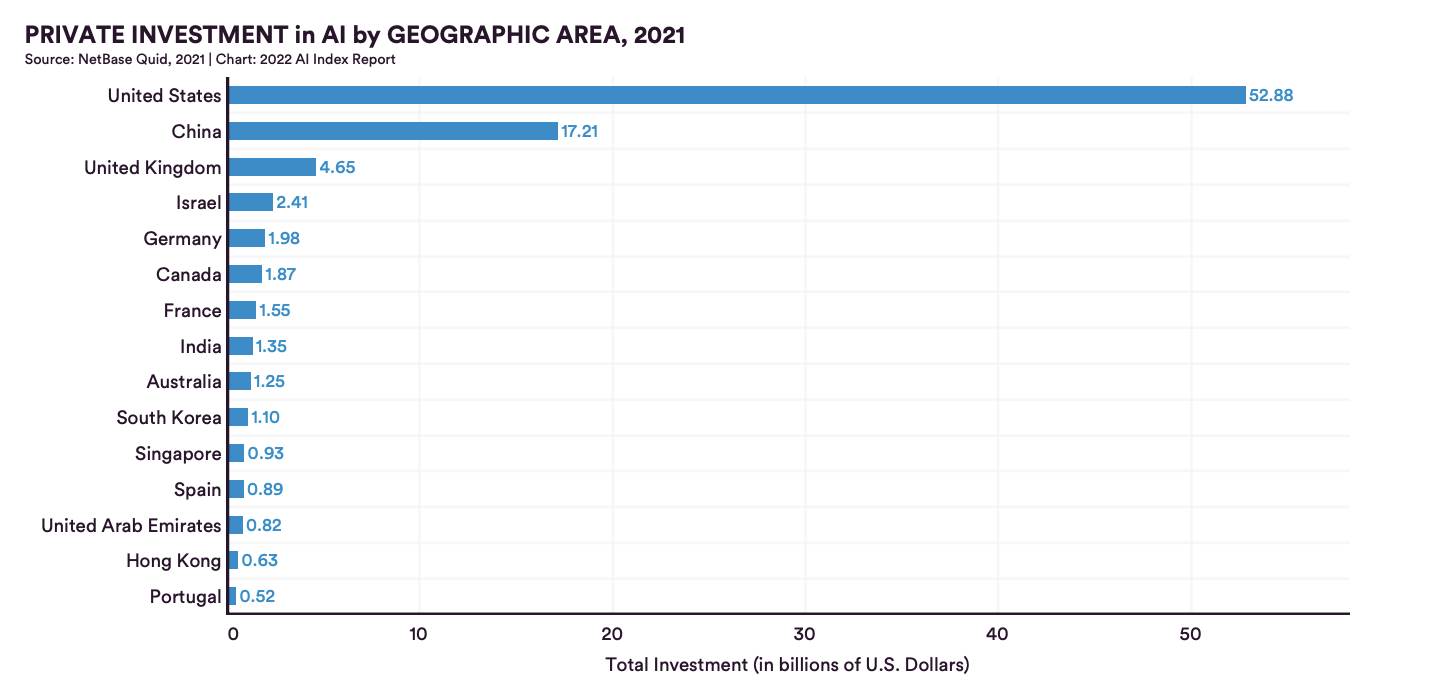
Source: Stanford University AI Index Report

Indian Government Needs to Accelerate AI Investments

While countries are heating up in the global race, India stood at 8th position globally in terms of private investments in AI.

Earlier this year, in the Union Budget 2023, Nirmala Sitharaman announced that three centres of excellence for artificial intelligence will be set up in top educational institutions. Pushing for a vision of ‘Make AI in India’ and ‘Make AI work in India,’ the Finance Minister emphasised on industry players partnering with research for AI solutions. However, there was no budget allocated from the government’s end to facilitate any type of AI development.

Pushing for CoE in educational institutes alone might not lead to immediate development. Research institutes such as AI4Bharat are already doing that, but to have an accelerated pace of development, private players need to be involved. This would also involve setting up AI infrastructure projects, incubators, AI dedicated tech parks, and probably doubling down on AGI research funds.

In the US, there are special exemptions for companies that invest in green and sustainable energy. Thereby inviting a number of big tech leaders investing in the segment. Offering incentives or tax redemptions of any kind to investors that can contribute in the AI space can help. Considering how there are tax exemptions for startups under DPIIT, introducing a niche segment for AI investments can boost growth.

In the recent G20 Summit, Narendra Modi called for a global framework on cryptocurrency, artificial intelligence (AI) and other emerging technologies. Ironically, no government investments on crypto or AI have happened.

Uncertain data regulatory measures in the past had put big tech companies on a cautionary mode, however, with the Digital Bill that was passed recently can help streamline future investments.

The government needs to quickly step up AI investments else it would lead to a missed opportunity. Similar to how we arrived late in capitalising on manufacturing smartphones, semiconductors and GPUs, the same should not be repeated for AI and quantum computing.

While the government needs to step up, efforts are materialising in the private segment.

Atmanirbhar Bharat?

IBM Chairman and CEO Arvind Krishna in his recent visit to India for the B20 summit, said that India should develop its own sovereign capability in AI, and consider establishing a national AI computing center. He even suggested that the government and private companies should be able to leverage computing and data infrastructure in ways that can harness AI for the country’s distinct goals and requirements.

While over-ambitious plans are always in the making, there are obstacles that hinder big tech companies from freely operating or accessing information from the country. In May, Rajeev Chandrashekar, said that the foreign firms like Google have to invest in Indian AI startups in order to access the country’s data set, and that the government’s focus is in supporting intellectual property creation by domestic deep tech startups in AI and semiconductors.

The government has always been clear in promoting development within India. Furthermore, as per a Linkedin report, India has the highest AI skills penetration in the world, which is an indication of the rich talent pool that can be capitalised.

For accelerated growth, an effective collaboration between government and think-tanks or relevant private players might be the way. For instance, the latest Arabic model was launched through a collaborative effort – California-based AI company Cerebras in collaboration with Mohamed Bin Zayed University of Artificial Intelligence, and Abu Dhabi-based technology holding company G42.

Last month, Cerebras Systems had signed a $100million AI supercomputer deal with G42 committing to delivering nine AI supercomputers. Cerebras’ supercomputer Galaxy Condor was used for training Jais.

Such levels of partnerships and support are sprouting in India as well. AI4Bharat, a research lab at IIT Madras, has been on the forefront of building Indic large language models. AI4Bharat is also supported by Microsoft. In collaboration with the big tech, a generative AI-driven chatbot for government assistance called Jugalbandi was launched. The research lab is set to raise $12M funding from Peak XV and Lightspeed Ventures.

Slowly Materialising

Just when we were thinking how Indian tycoons were shying away from generative AI investments, there has been a string of announcements from Indian entrepreneurs and tech leaders in the last couple of weeks.

Tech Mahindra announced Project Indus, an indigenous large language model that would support multiple languages. In the initial phase, the model aims to cover 40 Hindi dialects, and people can contribute to the model by lending their voice via specific prompts.

Mukesh Ambani, recently announced Jio’s plan to develop India-specific AI models that will benefit various sectors including government, business, and consumers. The company also intends to invest in creating 2000MW of AI-ready computing capacity.

While private players are waking up to actively spearhead an AI revolution of sorts, unless the Indian government actively steps in, advancements will only slowly move. With AI estimated to contribute massively to a nation’s economy, India’s AI investment at the right time can push it ahead in the global race – as of now, AI is only talk no action for the Indian government.

The post AI is Only Talks No Action for Indian Government appeared first on Analytics India Magazine.

Will Banks Embrace GPTNEXT Over ChatGPT Enterprise? 

While OpenAI recently unveiled ChatGPT Enterprise, rising anxiety levels of SaaS players, AIM got in touch with BUSINESSNEXT, a hyper SaaS and composable enterprise platform that focuses on banks and financial services globally, to see if there are any concerns.

Sushil Tyagi, the executive director of BUSINESSNEXT, said that they are excited about launching a new product, GPTNEXT, in the coming months, which is built on the top of GPT-3.5 API. He said that it is specially designed for customer relationship managers, and are already working with several banks, deploying the solutions in a phased manner.

“As a leader in customer engagement platforms for banking and insurance domain, BUSINESSNEXT is working with some leading banks on generative AI application – GPTNEXT,” shared Tyagi.

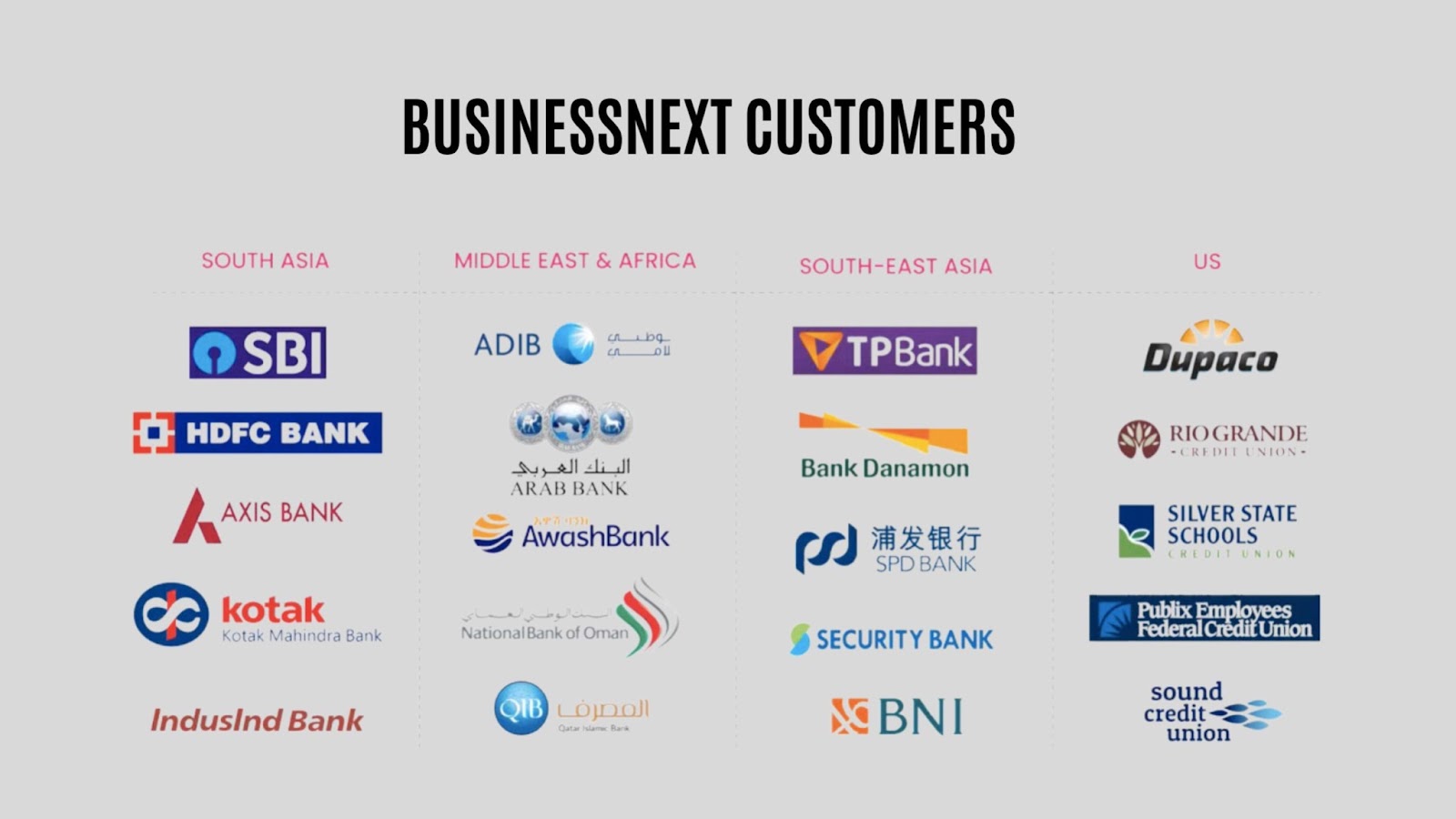
Emphasising on the trust and confidence, he said that it is actively engaged in supporting leading banks such as HDFC in the seamless integration of generative AI services. It’s noteworthy that HDFC has maintained a successful partnership with BUSINESSNEXT for a remarkable fifteen-year period. Some of the other notable customers also include Axis, Kotak Mahindra, SBI, and Indusland, alongside other global banks and financial institutions.

Over the years, BUSINESSNEXT has cultivated a strong sense of trust among its customer base, a feat that might pose a formidable challenge for ChatGPT Enterprise to replicate. In the context of the BFSI sector, it’s safe to say that GPTNEXT holds a distinct advantage over ChatGPT Enterprise. OpenAI lately has realised that in order to stay in business they need enterprises on their side and are trying hard to woo them.

Decoding GPTNEXT

“Relationship managers and bank employees are boggled with spending hours sifting through data, crafting emails in personalised interactions with customers” said product geek and associate consultant at BUSINESSNEXT Samraan Ghouse, talking about struggles of relationship managers in banks.

He said GPTNEXT just does not act as a CRM GPT but is also an ultimate sales and relationship assistant. “With the upcoming development of this technology and our vision of autonomous banking, we see it as a futuristic way to revolutionize customer relationship management for BFSI,” he added.

In simple words, GPTNEXT is a generative AI CRM tool which is based on GPT-3.5 API which will help in smooth lining the process of sales and relationship management for relationship managers by assisting them in various day to day tasks like follow ups, writing emails, sending messages, etc.

When asked about its present implementation, Tyagi said that it is currently in PoC state but has been implemented in ‘bits and pieces’ at various banks. Elaborating further he said its use case depends upon the quality of the data banks have and the product cannot be consumed by every customer in a similar manner.

Zero Learning Curve

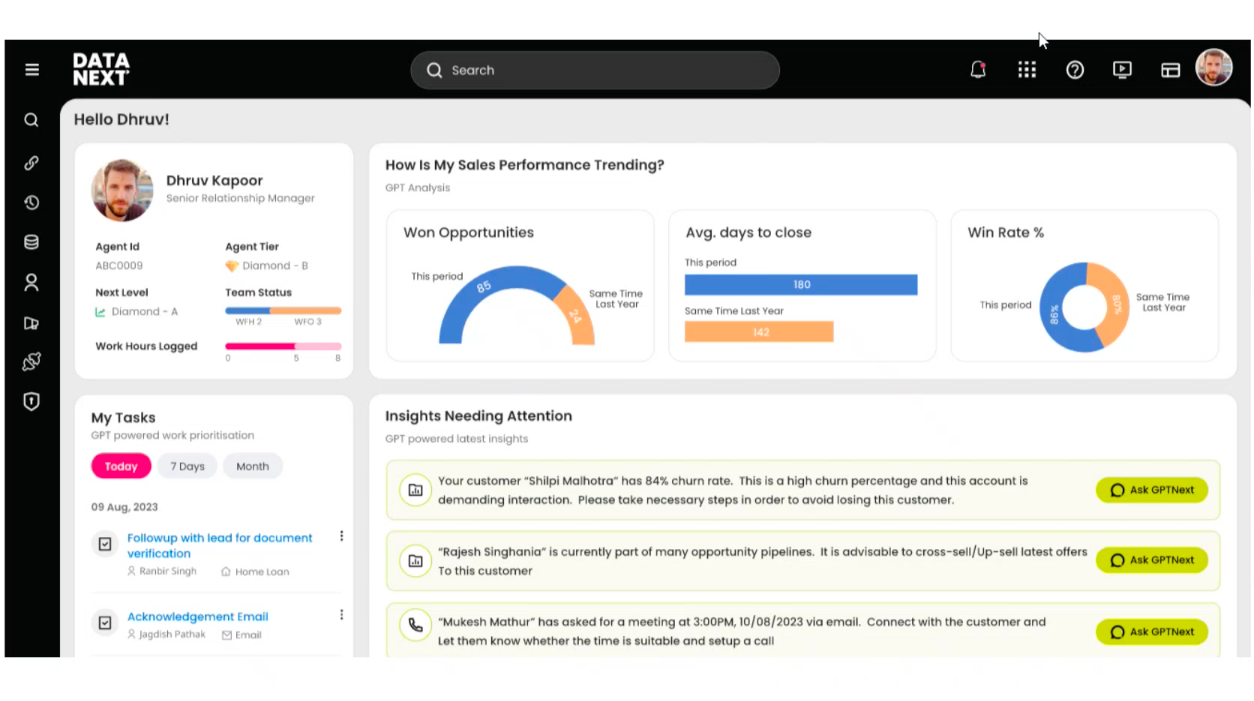
Upon a relationship manager’s login to GPTNEXT, their screen presents the following interface.

As shown below, a user can see sales performance trends, their tasks for the day, insights that require immediate attention mined out by the GPT, notification, a list of top accounts, opportunities that require their attention and performance metrics of their team or colleagues. Additionally, they can track their monthly target accomplishments.

Here’s a fair idea how the relationship manager’s initial screen looks when they login for the day. To our surprise, it can’t get any easier than this – all the user has to do is click a button, review, and submit, and they are done with the task. Plus, the real-time analytics and dashboards to keep track of the performance and closure success.

Say for instance, if a customer qualifies for multiple products (loan, credit card, insurance, etc.) and the relationship manager needs to send a personalised WhatsApp message, email, or SMS, GPTNEXT facilitates this process with a simple click of a button. This feature not only saves time for the manager but also streamlines the task of writing a well-crafted message.

AIM learnt that as per bank’s current priorities and urgencies, GPTNEXT streamlines the task list for the relationship manager, enhancing their daily productivity.

GPTNEXT also aids relationship managers in identifying tasks that require immediate action. Thirdly, the GPTNEXT dashboard displays colleagues’ and teams’ performance metrics, enabling employees to compare their achievements and work towards surpassing targets collectively.

Furthermore, GPTNEXT empowers relationship managers to assess if their customers meet the criteria for various products and are candidates for cross-selling or upselling. GPTNEXT furnishes actionable insights to enhance strategies customized for each individual customer.

But, there are challenges too. Both Tyagi and Ghouse expressed that in an organisation the quality of email writing is dependent on person to person, However, he highlighted that with the assistance of GPTNEXT, even less-experienced employees can excel and effectively promote high end offerings like corporate loans. He added generative AI is creating a similar level of intelligent communication. “We are super excited,” added Tyagi.

Safety & Security

“With our experience and expertise in handling high volumes of sensitive data aligned with regulatory compliances, we are able to create data training models that powers GPTNEXT” said Tyagi.

Expanding on Tyagi’s remarks, Ghouse mentioned that BUSINESSNEXT is working towards developing their own GPT bots in the future. These bots will undergo training using banking-specific data. He explained that OpenAI’s ChatGPT is trained using internet data, which doesn’t encompass the necessary banking sector information.

Ghouse shared that one of their ongoing projects involves integrating a GPT model with a bank’s SQL database. This integration would enable them to train their GPT models using actual banking data, further enhancing their performance and relevance to the industry.

What’s NEXT?

Ghouse mentioned that by utilising the appropriate training data, they aspire to develop and incorporate additional use cases in the future, similar to what they’ve done for sales. In the upcoming period, they are actively exploring the application of GPTNEXT in customer support and marketing domains.
Lastly, when we asked about ChatGPT Enterprise, BUSINESSNEXT seem to care less, and seem to be pretty confident and committed in its approach – making banking autonomous with the total experience.

The post Will Banks Embrace GPTNEXT Over ChatGPT Enterprise? appeared first on Analytics India Magazine.

Scrum is Not Agile Enough

Scrum’s popularity over the last few years has significantly declined. There is a growing dislike among engineers who’ve experienced how inefficient the framework is.

The rigid framework which is executed in short intensive sprints with long meetings after every sprint, is the reason for its unpopularity. Scrum can’t be used for all types of projects and this has given rise to many more agile methodologies like Kanban, XP (Extreme Programming) and Lean Methodology to name a few.

Scrum’s original design caters to small teams, leading to complications when adapting it to larger undertakings. It is only suited for well-defined projects with clear scopes.

Both sides of the argument

There is a lot written about the pros and cons of Scrum, while some swear by it, claiming “If Scrum doesn’t work for you, you’re doing it wrong!” Others point out the fallacy of the argument citing the different flaws of the methodology itself.

The success stories of Scrum acknowledge the clear responsibilities and accountabilities, contributing to better alignment and focus.

Scrum thrives in scenarios where the project’s requirements might evolve or where customer feedback is crucial because of its short sprints. It works well when a team can commit to the roles, ceremonies, and iterative nature of the framework. When there is a need for clear accountability and communication among team members, stakeholders, and customers, Scrum works better than Kanban which works on a less rigid task allocation.

The problem is the scale at which Scrum is used. While there is some consensus on the strengths of the methodology, it is not applicable for all projects. One common situation engineers face is, in teams which build multiple applications, individuals can’t start a new story until all the ongoing stories are complete. The team members who’ve completed remain idle until each of them have finished their story which is entirely inefficient.

Long meetings are another pain point for users, there’s a substantial investment in planning and meetings. Significant time is allocated to discussing stories that sometimes require only 30 minutes for completion. The meetings that concern only two people end up involving the entire team.

Alternative agile methodologies

Kanban is the next most popular Agile methodology used. It is a visual workflow management system that focuses on continuous delivery and flexibility. Work items are represented as cards on a Kanban board, progressing through various stages of development. Unlike Scrum’s fixed-length sprints, Kanban allows for a continuous flow of work with no predefined timeboxes. It’s often used for maintenance tasks, support, and projects with evolving priorities. Unlike Scrum, Kanban doesn’t have fixed roles or ceremonies, making it more adaptable to different scenarios.

Another popular one is Extreme Programming which focuses on engineering practices to enhance software quality. It emphasises practices like test-driven development, pair programming, and frequent releases. XP encourages close collaboration between developers, testers, and customers. Like the name suggests, XP’s primary focus is on the technical aspect of software development, and its practices can be applied within other agile frameworks.

Where Scrum emphasises the division between roles, Feature-Driven Development (FDD) is more specialised with chief programmer, development manager, and others. It’s suitable for projects that can be broken down into well-defined features. FDDcentres around building software incrementally by focusing on features or use cases specific to client needs. It uses a feature list to guide development.

What’s in the future?

Even with all its shortcomings, Scrum remains extremely popular. About 56% of companies use SCRUM as a standalone methodology, and around 83% of them use it as a hybrid model along with XP or Kanban or other Agile methodologies.

Recently, these numbers are shifting. Early this year, Capital One sacked its entire Agile division, merging the roles into existing product managers.

It’s highly possible that the era of Scrum Masters overseeing teams could diminish, while businesses might embrace agile practices within teams or opt for a model similar to what Capital One has implemented.

The post Scrum is Not Agile Enough appeared first on Analytics India Magazine.

Generative AI and Foundation Models Face Inflated Expectations

Vector illustration of a virtual AI chip on a circuit pattern background.
Image: putilov_denis/Adobe Stock

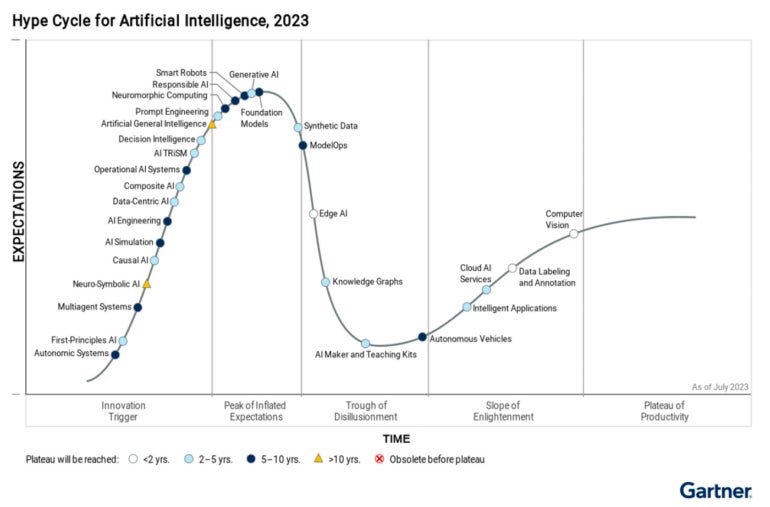
Generative AI and foundation models have reached the Peak of Inflated Expectations in Gartner’s 2023 AI Hype Cycle, which is a global report on the maturity of technologies throughout their life cycles. The Peak of Inflated Expectations is the place for innovations, which have both a lot of success stories and a lot of failures. Some companies act on innovations during the Peak of Inflated Expectations, but most don’t.

Jump to:

  • Inflated expectations are a normal part of the hype cycle
  • Some AI technologies have practical business benefits
  • Other AI technologies are still searching for use cases
  • Up-and-coming AI innovations
  • What to ask before investing in generative AI

Inflated expectations are a normal part of the hype cycle

Generative AI and foundation models may be overhyped; there is more excitement around them than there are use cases, Gartner said. However, the Peak of Inflated Expectations is a normal part of the life cycle of how innovations are brought into the mainstream (Figure A).

Figure A

Gartner rated a wide variety of AI-based innovative technologies on its Hype Cycle framework.
Gartner rated a wide variety of AI-based innovative technologies on its Hype Cycle framework. Image: Gartner

Other notable AI applications are on the peak as well. Smart robots, responsible AI and neuromorphic computing, which uses spiking neural networks instead of deep neural networks to try to replicate the function of a biological brain, are reaching the peak of the hype cycle. That means they’re poised to enter the Trough of Disillusionment, where expectations and investment are cooled before some companies settle on a truly practical and normalized use of the innovation.

Computer vision, data labeling and annotation, cloud AI services and intelligence applications are the most mature technologies in the AI group. Gartner has placed these AI technologies on the Slope of Enlightenment, meaning second and third generations of products have emerged with some bugs worked out, and only more conservative companies remain cautious.

No AI technology has yet reached the Hype Cycle’s Plateau of Productivity, which is the point at which innovation has entered the mainstream and investments have consistently paid off. The hype cycle is meant to demonstrate whether technology buyers should take a risky, moderate or cautious approach to emerging innovations.

SEE: Gartner provided an in-depth look at generative AI in its recent Emerging Technologies Hype Cycle. (TechRepublic)

Some AI technologies have practical business benefits

Gartner found that AI is likely to have some benefit to businesses. Most Hype Cycles have a few emerging technologies that end up being rated low or moderately beneficial; all of the technologies in the AI Hype Cycle were rated high or transformative. The benefit rating ranks how much of a positive impact the innovation could have across industries.

Many of the generative AI-driven technologies in the report need to be combined in order to create practical services, Gartner noted. Data and analytics leaders would be well-served to consider investing first in innovations that have been packaged together as business solutions, such as computer vision, knowledge graphs, smart robots, intelligent applications and AI cloud services. Gartner recommended that data and analytics leaders focus on products that do not require team members to have extensive, specialized engineering or data science skills.

“The focus on generative AI at the moment means that some techniques that will fuel generative AI advancement are receiving more attention now than in previous years,” said report author Afraz Jaffri, director analyst at Gartner.

SEE: Salesforce suggests companies should take practical steps to reduce bias from generative AI. (TechRepublic)

Gartner predicts generative AI and decision intelligence, which involve teaching predictive AI how to affect predicted outcomes, will reach mainstream adoption in two to five years.

“Early adoption of these innovations (generative AI and decision intelligence) will lead to significant competitive advantage and ease the problems associated with utilizing AI models within business processes,” the firm wrote.

Other AI technologies are still searching for use cases

Gartner’s survey shows businesses are becoming disillusioned about ModelOps, edge AI, knowledge graphs, AI maker and teaching kits, and autonomous vehicles. Knowledge graphs, which are machine-readable representations of material assets and how they relate to each other, are moving exceptionally rapidly along the Hype Cycle.

If this rapid movement and the disillusionment seem contradictory, that’s because the Hype Cycle isn’t an ascent from obscure to mainstream. Instead, the Trough of Disillusionment is a low point before technologies enter the upward Slope of Enlightenment.

Knowledge graphs can complement many other AI innovations, such as machine learning, generative AI, search algorithms, smart assistants and recommendation engines.

SEE: Hiring kit: Prompt engineer (TechRepublic Premium)

Up-and-coming AI innovations

The AI innovations that are lowest down in the Innovation Trigger section of the Hype Cycle, meaning they are the least mature, are autonomic or self-managing systems, first-principles or physics-informed AI, multiagent systems and neuro-symbolic AI.

Gartner defines neuro-symbolic AI as a combination of machine learning and symbolic systems such as knowledge graphs in order to give an AI system a more contextual understanding of concepts and reduce hallucinations. Neuro-symbolic AI is estimated to require more than 10 years before it reaches mainstream adoption.

What to ask before investing in generative AI

According to Jaffri, questions that data and analytics leaders should ask themselves before investing in generative AI include:

  • How will the performance, accuracy and associated business value of the application(s) be measured?
  • What is the acceptable threshold of accuracy that can be tolerated?
  • What is the best approach to deployment? Consider choosing between APIs, fine-tuning or retrieval-augmented generation.
  • Is there an off-the-shelf solution that can be used to test the benefits of an AI innovation without having to build a home-grown solution?
  • How can other AI techniques besides generative AI be leveraged to provide business benefits?
  • What assessment framework will you use to determine security and data protection risks?

Subscribe to the Innovation Insider Newsletter

Catch up on the latest tech innovations that are changing the world, including IoT, 5G, the latest about phones, security, smart cities, AI, robotics, and more.

Delivered Tuesdays and Fridays Sign up today