In Microsoft Build’s 2021 conference, Sam Altman introduced ‘OpenAI Startup Fund’ that planned to invest $100 million to fund and support AI startups that will bring a ‘positive impact’ on the world. In May, OpenAI raised $175M for the startup fund.
“We plan to make big early bets on a relatively small number of companies, probably not more than ten,” said Altman. There’s a total of seven startups across industries including robotics, legal, education and others that are supported by the fund. Almost a year since the fund’s launch, how have the startups under the coveted program benefited?
Mapping the Startups
OpenAI Startup Fund has invested in a total of seven companies out of which two of them are available as ChatGPT plugins and two are not yet operational.
Speak
One of the first startups supported by OpenAI’s Fund, is a language-learning mobile app that uses speech recognition methods and AI tutor to teach people to speak English. Founded by Andrew Hsu, the company recently raised $16M in a Series B-2 funding round. With this, the company has raised $63M. The company will look to expand to more markets, including the US. Interestingly, Speak is also available as a ChatGPT plugin.
Descript
Founded by Andrew Mason, the app uses AI to edit audio and video in a simple text editor. OpenAI is said to have led investments of tens of millions of dollars in Descript. The company has raised $100M till date.
Recently, Descript bought remote recording studio SquadCast for an undisclosed amount, pushing Descript to become a one-stop solution for recording, editing and publishing podcasts and videos.
Mem
Founded by Eric Kim, Mem is an AI-powered workspace that can be personalised to organise notes as per one’s needs. OpenAI led a $23.5M investment in November 2022. The company has raised $29.1M till date.
Harvey
Founded by Gabriel Pereyra and Winston Weinberg, Harvey is an AI technology service provider for legal workers. The product provides lawyers with a natural language interface for their existing legal workflow. OpenAI led a $5M round for Harvey and the company has raised a total of $26M.
Earlier this year, one of the world’s largest law firms, Allen & Overy, announced its integration with Harvey which would be used by 3500 lawyers across 43 offices in multiple languages.
Milo
Founded by Avni Patel Thompson, Milo is an AI assistant that helps in organising, planning tasks, messages and other functions within a family. Milo has raised an undisclosed amount of pre-seed and seed capital from OpenAI, Y Combinator and a number of angel investors. The application is yet to be opened to the public. Interestingly, Milo was part of the first set of 12 ChatGPT plugins that were launched in March.
1X
Founded by Bernt Øivind Børnich, 1X formerly known as Halodi Robotics, aims to augment labour through the safe use of advanced technologies in robotics. In March, the company raised $23.5M pushing the total amount raised by 1X to $36.5M.
Charles AI
Classified as an AI company alone, the startup has received a seed of $250K from the OpenAI Startup Fund. However, no other details about company operations are revealed.
While the above seven companies are invested under the wing of OpenAI Startup Fund, Sam Altman has committed to investing in startups in countries such as India, South Korea and others to boost AI development.
The post 7 Game-Changing Startups in OpenAI’s Investment Portfolio appeared first on Analytics India Magazine.
Yes, you read that right. We are increasingly finding ourselves in a situation where the browser has not only become the MVP of our digital lives but is also well on its way to becoming the ultimate operating system. It is increasingly becoming the case that as soon as we open our computers, the first thing we open is the browser, be it Chrome, Firefox, Safari, or Edge.
It is as if the operating system like Windows or Mac has just become a platform where we can just log on to for accessing our browser and accessing all the web applications. The static software on our system that runs locally is not given much attention anyway, it is just about the browser capabilities, not the system itself.
Browser is all you need, for a while
It’s been Chrome-o-clock for a while now. Why is the browser suddenly stealing the spotlight? Well, View Transitions are the secret sauce that makes browser experiences feel more app-like. And hey, if it’s good enough for your smartphone, it’s good enough for your desktop. Soon, webpages will offer the same seamless experience as the apps. So we wouldn’t have to wait for the Java Script to load for a static webpage to appear, but would be like an app-like experience.
On the other hand, users might prefer using the standalone app for FL Studio or Final Cut. After all, it runs like a dream. But what if you could have the best of both worlds? What if you could use these applications from your browser without the hassle of installation and updates? That’s the beauty of the browser-as-OS model.
However, let’s not kid ourselves; the browser isn’t the solution for everything. You’re not going to play your favourite AAA games or apps like FinalCut in a browser. Google tried to do something with Stadia, but it didn’t really work out that well. But on the other hand, products like Canva are easily replacing Photoshop in many use cases. Things might only get better after this.
What sets browser apps apart is the democratisation of technology. As a developer, it’s a dream come true. You don’t have to tweak your web applications in a way that they are able to run natively. And as a user, it’s a breath of fresh air. In all honesty, no one really wants a native application if in the end they are always going to be on the internet.
The browser is more than just a tool; it’s a platform. It’s not just a gateway to the internet; it’s becoming the OS for the internet. You can now do almost everything you used to do with standalone apps, minus the bloat, the clutter, and the headaches. It’s not flashy software that eats up your system memory and is competing for your attention; it’s the stage where all the action unfolds. While it might not be the answer to every digital problem, it’s certainly the solution to many.
App-ocalypse?
Let’s face it, apps are dead, mostly on our computers, and soon on phones too. Apps are not entirely extinct, but they’ve lost their mojo. And with generative AI coming into the picture, things are shifting more towards browser-based systems as well. Browser is the only superapp that we need.
Apps are dead – it will soon be better to think of digital visual surfaces as portals where AI entities manifest themselves
— Kevin Fischer (@KevinAFischer) April 9, 2023
Even on the phones, we were app-happy, intoxicated by the prospect of having an app for everything. Fast forward to today, and most of us are guilty of using the same 20 or so apps from the same five tech giants. The indie app developers are struggling to keep up. With the app stores dominated by a handful of behemoths, it’s nearly impossible for a new app to break through the clutter.
While the situation gets better, it is the norm now that browsers are running most of your apps. It is indeed a multiplatform approach of web apps, allowing you to access your Slack, Gmail, Canva, or any other OS as long as it is able to run a browser. Well, sounds like it is not such a bad deal after all.
So, next time you find yourself mindlessly scrolling through the internet, remember that the browser on your laptop might just be the only software you need. Unless you have 20 tabs open to slow your computer down.
Meanwhile, the apps are starting to look the same — dead, black and white, and dull.
The post Apps are Dead appeared first on Analytics India Magazine.
In part one of this blog, we saw how there is an increasing case for an enterprise chatbot use case.
In part two, we ask the question
Could a consumer chatbot i.e. directly customer facing chatbot be a flawed use case for an LLM?
The consumer (customer facing) chatbot case is a familiar use case and people are attached to it because they are familiar with it from personal experience.
Some companies also see the consumer AI use case as a business model to get rid of staff.
Recently, the National Eating Disorders Association (NEDA) removed its chatbot from its help hotline over concerns that it was providing harmful advice about eating disorders. The chatbot, named Tessa, recommended weight loss, counting calories, and measuring body fat, which could potentially exacerbate eating disorders. NEDA supposedly intended to used the Tessa AI to replace six paid employees and a volunteer staff of about 200 people, who fielded nearly 70,000 calls last year.
Why does generative AI hallucinate?
Recently, Yann LeCun compared generative AI to the game of telephone. Each person whispers the same message to the next – but when they make small mistakes, these mistakes get amplified down the line – leading to a completely different message at the end of the line. From a technical perspective, this problem is hard to fix.
But are we addressing the right problem?
By this I mean, if we get rid of hallucination
we get rid of the creativity, and the potential for ideas
making the agent useless
The grounding of knowledge is useful but there will need to be a tradeoff. if you ground too much – you lose any real real reason to use Gen AI in the first place. you may as well write a SQL query :). Hallucination is a loaded word. People who hallucinate also ideate. Kill hallucination in AI and kill all creativity with it. That’s what makes the entity unique. More broadly, considering the ‘known unknowns’ idea as per Donald Rumsfeld. there is value in addressing the unknown unknowns use case https://lnkd.in/eHn_jA-2
To conclude, its hard to see how we can present generative AI technology can be prevented from hallucinating. For a consumer facing use case, even one mistake is enough to damage the reputation. However, in an enterprise, as an assistant to a human expert, the chatbot use case is already proven.
Learn how to use ChatGPT to benefit your business with this course bundle.
If you've heard the name ChatGPT but don't exactly understand what it is, there's one key thing you should know: It could be a game-changing tool for your business. It's like having an assistant with the knowledge of Google, but with even more creative possibilities.
Interested in learning how to use it? This 2023 ChatGPT for Business Mastery online course bundle can show you the ropes. Get lifetime access now for only $30 (reg. $133).
The ultimate (and free!) business tool
Wondering how an AI chatbot could help you run or improve your business? First, think about which areas you need help in: social media content, managing a budget, or writing effective sales copy, among other things. Then, use these courses to learn how to write effective prompts so you can target those areas and meet goals.
The ChatGPT Master Class: The Complete Guide to Using ChatGPT course may be the best place to start your experience. You'll study how to structure ChatGPT prompts for generating new ideas, solving problems, and improving the quality of responses.
After that, you can move onto another that focuses more closely on your goals. Like Sales: Using ChatGPT and Other AI Tools to Hit Sales Targets for marketing tips, How ChatGPT Can Help Your IT Service Management Performance for IT management, or The Ultimate Guide to ChatGPT for Content Creators for social media content ideas.
Lifetime course access with updates included
This course bundle offers you full lifetime access — take as much time as you need to move through courses and reference any of the lectures or materials for years to come. Also, the Introduction to the Latest Artificial Intelligence Tools course is consistently updated, so you'll always be on top of the hottest AI trends.
Learn how to make AI work for you with the 2023 ChatGPT for Business Mastery 7-course bundle, now only $30 (reg. $133).
Prosecutors in every state push to combat AI child exploitation Amanda Silberling 8 hours
The Attorneys General in all 50 U.S. states, plus 4 territories, signed onto a letter calling for Congress to take action against AI-enabled child sexual abuse material (CSAM).
“While internet crimes against children are already being actively prosecuted, we are concerned that AI is creating a new frontier for abuse that makes such prosecution more difficult,” the letter says.
Indeed, AI makes it easier than ever for bad actors to create deep fake images, which realistically depict people in false scenarios. Sometimes, the results are benign, like when the internet was duped into believing that the Pope had a fashionable Balenciaga coat. But in the worst cases, as the Attorneys General point out, this technology can be been leveraged to facilitate abuse
“Whether the children in the source photographs for deepfakes are physically abused or not, creation and circulation of sexualized images depicting actual children threatens the physical, psychological, and emotional wellbeing of the children who are victimized by it, as well as that of their parents,” the letter reads.
The signatories are pushing for Congress to establish a committee to research solutions to address the risks of AI-generated CSAM, then expand existing laws against CSAM to explicitly cover AI-generated CSAM.
Nonconsensual, sexually exploitative AI deep fakes already proliferate online, but few legal protections exist for the victims of this material. New York, California, Virginia and Georgia have laws that prohibit the dissemination of sexually exploitative AI deepfakes, and in 2019, Texas became the first state to ban the use of AI deepfakes to influence political elections. Although major social platforms prohibit this content, it can slip through the cracks. In March, an app purporting to “swap any face” into suggestive videos ran over 230 ads across Facebook, Instagram and Messenger; Meta removed the ads once notified by NBC News reporter Kat Tenbarge.
Overseas, European lawmakers are aiming to work with other countries to ratify an AI Code of Conduct, but negotiations are still in process.
Deepfakes for all: Uncensored AI art model prompts ethics questions
In a groundbreaking initiative, retail giant Walmart has announced plans to provide 50,000 of its corporate employees with a generative AI assistant. Announced by Donna Morris, Executive VP at Walmart, this move aims to streamline operations, enhance productivity, and improve decision-making across the organization. While many corporations have flirted with the idea of AI integration, Walmart's significant investment in empowering its employees with this technology signals a fundamental shift in corporate culture and strategy.
Beyond Automation to Augmentation
When we think about AI in the corporate setting, the focus often lands on automation—machines taking over routine tasks, thereby making processes more efficient. However, Walmart's deployment of generative AI assistants aims to go beyond mere automation. The goal here is augmentation—amplifying human capabilities by providing real-time information, analysis, and recommendations.
Generative AI models like GPT-4 can generate human-like text based on the data fed into them. These models can be programmed to sift through vast amounts of data to provide insights, summarize reports, or even draft emails. By putting this powerful tool in the hands of its employees, Walmart aims to foster a more innovative, agile, and informed workforce. Employees can make data-driven decisions more quickly and focus on strategic tasks that add value to the company.
Empowering Employees in the Age of AI
By investing in generative AI for its employees, Walmart is also making a significant cultural statement. In a world where AI often generates fears of job loss or reduced human input, Walmart is using the technology to empower its employees. This initiative shows a commitment to equipping its staff with the tools needed for success in a rapidly evolving digital landscape.
The implications are profound. Employees at all levels will need to adapt to this new tool, changing not just how they perform their tasks but also how they think about problem-solving and decision-making in the corporate setting. Moreover, it sets a precedent for other organizations to follow suit, showing that AI can be a tool for human enhancement rather than replacement.
Walmart’s decision has broader implications for how businesses might integrate AI technologies in the future. Other corporations will be closely watching the rollout to see how effective these generative AI assistants are in boosting productivity and streamlining operations. If successful, Walmart's initiative could become a model for companies across various industries, sparking a revolution in how we think about human-AI collaboration in the workplace.
Companies will also have to consider the ethical and security ramifications of such widespread AI use. Data privacy and the potential for AI-generated misinformation are concerns that will need to be addressed as these technologies become more ingrained in our daily work lives.
The effectiveness of this large-scale implementation will undoubtedly be scrutinized and could set the tone for AI's role in corporate settings going forward. One thing is clear: Walmart's bold move brings us closer to a future where AI is not just a tool for automation but a partner in human ingenuity.
Open software provides a multiarchitecture, multivendor solution that addresses the complexities of accelerated HPC and AI computing
The advent of heterogenous computing with accelerators like GPUs has transformed the fields of AI and HPC in commercial and scientific computing environments. Early vendor-specific GPU programming models such as CUDA worked well in jumpstarting GPU computing and in adapting to the rapidly evolving GPU architectures controlled by a single hardware vendor.
Success has bred competition. The availability of GPU accelerators from multiple vendors including Intel (with the Intel® Data Center GPU Max Series), AMD, and NVIDIA has created a combinatorial support problem for software developers. The race to high performance has spurred a rapid evolution in hardware and software architectures as vendors compete to run various workloads more efficiently. Machine learning and AI in particular have driven workload-specific optimizations that can increase performance and efficiency.
The combinatorial explosion issue occurs when a number of possible combinations are created by increasing the number of entities (Source). In support terms, an increasing number of device types in the datacenter can quickly exceed the ability of a programmer to explicitly support all the device combinations encountered by their user base.
CPUs are now entering the AI accelerated fray. New manufacturing technologies give hardware designers the ability to exploit new modular in-package silicon design and manufacturing capabilities. CPUs now incorporate AI-oriented capabilities through in-package accelerators like the Intel® Advanced Matrix Extensions (Intel® AMX) and the Intel® Data Streaming Accelerator (Intel® DSA). [1] These accelerated CPUs can deliver performance competitive with GPUs on some AI workloads. The inclusion of high bandwidth memory (HBM) such as in the Intel(R) Xeon(R) CPU Max Series is also helping to close the CPU vs GPU performance gap for many HPC and AI workloads.[2] [3]
While competition and the many advances in hardware and machine architectures are highly beneficial, from a software perspective these advances resulted in an exponential growth in the number of hardware combinations possible in today’s datacenters. This support problem is only going to get worse as non-Von Neumann hardware devices like FPGAs become more prevalent in the datacenter.
Programmers can no longer rely on the traditional method of targeting specific hardware accelerators with conditional pragmas (e.g., #ifdef) to match the software to the hardware at a particular datacenter or customer site. Humans writing machine-specific code cannot address the exponential increase in possible hardware combinations in the modern multivendor, multiarchitecture computing environment.
Open, heterogeneous software provides support and sustainability path
Based on decades of observation, Joe Curley (vice president and general manager – Intel Software Products and Ecosystem) summarized why vendor-agnostic software is now a necessity, “Intel is fortunate to have great relationships where we supply from core technology to the largest enterprises, cloud vendors, high performance computing centers, and embedded device manufacturers around the world. Our customers bring us issues. We then find ways to aggregate all the issues and solve them.”
He continued, “We found that we need an open, multiarchitecture programming model [e.g., the oneAPI software ecosystem] that sits between diverse hardware and the productive software that lives above it. The programmer wants to write the program in abstraction and benefit from the accelerator beneath it. The developer doesn’t start programming wondering what Intel or any other vendor has to offer. What they really want is to use an FPGA, or a GPU, or a CPU, or perhaps some combination to solve their problem productively.”
To address the need for vendor-agnostic heterogeneity, the open software community devised a twofold solution utilizing a governance model (e.g., for SYCL) and a community model for API and runtime development. This same twofold solution solves the combinatorial problem in supporting applications running in a vendor-agnostic multiarchitecture environment:
Compilers can transparently target specific hardware devices and capabilities through general-purpose language standards specified by an industry representative governing body. Complementary, domain-specific efforts such as JAX, Triton, Mojo, and others can also enable productivity and accelerator access for target workloads such as AI. These just-in-time and ahead-of-time workload optimizations[4] can benefit compilers and general-purpose language standards.
Standardized tools can be developed in accord with a community model that supports all the mainstream hardware vendors. Well-designed library interfaces and runtimes conforming to a separation of concerns give programmers the standardized capabilities they need to express their computations with sufficient generality to run efficiently on many different hardware platforms, while simultaneously giving the library and runtime authors sufficient flexibility to target specific hardware and accelerator capabilities.
In both cases, an open, community-based development model gives all interested parties a voice and lets vendors compete by optimizing those software components that are important to their customers for their particular platforms.
The challenge in developing a multiarchitecture software ecosystem, even one with extensive community support, is that application software development teams cannot be forced to start over. Instead, tools must be provided to help programmers migrate existing single-vendor codebases to the open ecosystem while also enabling multiarchitecture support. One example is discussed in the article, “Heterogeneous Code Performance and Portability Using CUDA to SYCL Migration Tools.”
General-purpose standards and libraries and pathways to transition existing apps
From a compatibility perspective, the transition to heterogenous accelerated computing has wide-ranging implications.
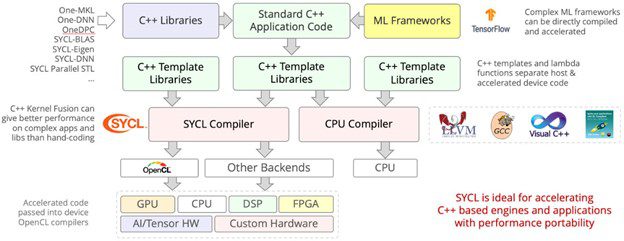
Intel’s x86 architecture CPUs, for example, have maintained a large share of the datacenter market for many years.[5] During the planning phase to introduce in-package CPU accelerators and two GPU product families, Intel proactively addressed this combinatorial software challenge to preserve legacy compatibility while enabling heterogenous runtimes in a supportable fashion. The result was the adoption and active participation by Intel and other industry leaders in the oneAPI community software ecosystem. The oneAPI multiarchitecture, open accelerated ecosystem can support x86, ARM and RISC-V CPUs; multivendor GPUs; in-package accelerators; and non-Von Neumann hardware such as FPGAs (Figure 1).
Application-level heterogeneity is not enough. For many data scientists, TensorFlow and PyTorch provide an all-encompassing worldview of the datacenter, on-premises computing resources and cloud computing. This works nicely for the computationally intensive training of artificial neural networks (ANNs), but the money-maker in AI lies in using the trained ANNs to service customer needs. There is a catch though: vendor optimized libraries can cause vendor lock-in if they are utilized during training. From a business perspective these optimized, vendor-specific libraries become a money maker for the hardware vendor, but they are anathema to portability.
AI benefits HPC
AI and machine learning now play a significant role in HPC, which means AI-accelerated hardware benefits the HPC community as well as the AI community. See the first article in this series, for more information about what experts now describe as the 5th epoch of distributed computing.[6]
For example, ANNs can deliver orders-of-magnitude faster and better models for physics-based simulations. CERN provided a ground-breaking example of AI in high-energy physics (HEP) simulations by training an ANN to replace a computationally expensive Monte Carlo simulation. Not only did the ANNs achieve orders-of-magnitude faster performance, they also created simulated samples that were both realistic (indistinguishable from real data) and robust against missing data. More recently, scientists are now using AI to find an ANN that predicts intrinsic charm in the proton better than any previous model. These are just two examples of scientists incorporating AI in their research. Look to the Argonne Leadership Computing Facility (ALCF) Early Science program for the Aurora exascale supercomputer for additional examples.
Proof that the community model can support vendor-agnostic heterogeneity
The US Department of Energy (DOE) effort was tasked with addressing the combinatorics of supporting leadership supercomputers containing Intel, AMD, and NVIDIA accelerators for production AI and HPC workloads. Performance is mandatory given the number of projects of national and societal importance that are vying for time on systems.
In doing so, the US DOE Exascale Computing Project (ECP) demonstrated the efficacy of the community software development model, which is a cornerstone in creating the library APIs [7] and maturing the compiler technology to support a vendor-agnostic multiarchitecture computing paradigm. Validating the oneAPI programming approach is part of this process.
Curley summarized the value of the community model, “When you’re working in the open, the community starts doing work with you. This openness allows the community to be able to lift problems together rather than counting on Intel or counting on customer company A,B, or C.”
When you’re working in the open, the community starts doing work with you. This openness allows the community to be able to lift problems together rather than counting on Intel or counting on customer company A,B, or C. — Joe Curley
Tying it all together
These important workloads (AI and HPC) make accelerators a natural next step as Joe Curley noted, “When a problem gets big enough or pervasive enough, then accelerate it. With acceleration we can get answers with less power, which requires an appropriate software ecosystem.”
When a problem gets big enough or pervasive enough, then accelerate it. With acceleration we can get answers with less power, which requires an appropriate software ecosystem. – Joe Curley
A language standard for accelerators and heterogenous computing
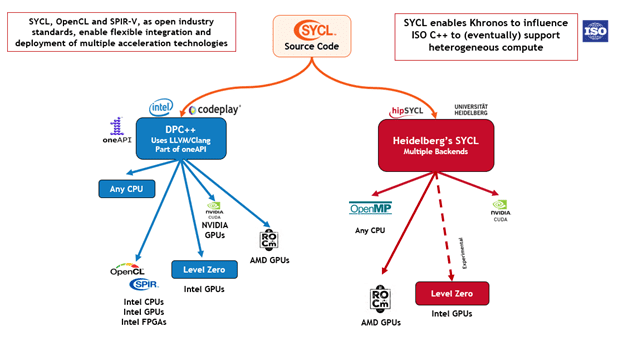
The oneAPI ecosystem is based on SYCL, which is the language component that gives programmers the ability to express the parallelism in their program in a manner that can be mapped to many different types of hardware and accelerators by the compiler developers (Figure 2). The language standard is governed by the Khronos Group standards committee and enjoys wide industry support.[8] A major goal of SYCL is to enable different heterogeneous devices to be used in a single application — for example simultaneous use of CPUs, GPUs, and FPGAs. Curley pointed to the University of Tsukuba paper, “Multi-hetero Acceleration by GPU and FPGA for Astrophysics Simulation on oneAPI Environment” as a working example in the literature.
Figure 2. SYCL enables the use of different heterogeneous devices — even when the programmer wishes to simultaneously use CPUs, GPUs, and FPGAs in a single application.
Languages
SYCL is C++ based. Source-to-source translation from popular GPU languages such as CUDA are possible with the SYCLomatic tool as discussed in “Heterogeneous Code Performance and Portability Using CUDA to SYCL Migration Tools”. SYCLomatic is typically able to migrate about 90%-95% of CUDA source code automatically to SYCL source code, leaving very little for programmers to manually tune.[9]
For legacy HPC applications, Fortran programmers can use one of the two Fortran compilers provided in the latest Intel oneAPI tools release: Ifort which provides full Fortran 2018 support and the Intel Fortran compiler (ifx) which adds OpenMP directive and offload capabilities for Intel GPUs.
Libraries
Intel software teams and the community are working to create compatible library APIs for programmers to use and for source-to-source translation via SYCLomatic. A large number of APIs are already addressed including a number of runtime, math, and neural network libraries.[10] The CUDA API Migration support status can be viewed here.
The ECP project has also been busily porting and validating a number of critical HPC math libraries including PETSc, Hypre, SUNDIALS, and more. These numerical libraries are based on the community development model. [11]
Analysis and debugging
The oneAPI community provides a number of tools to help programmers analyze and debug their oneAPI codes. The ECP, for example, provides TAU, a CPU, GPU, and MPI profiler for all the DOE exascale machines. This includes support for the Intel-based Aurora supercomputer at Argonne National Lab. Intel also provides Intel® VTune™ Profiler and the Intel® Distribution for GDB for analyzing oneAPI codes.
Summary
Transitioning to a multiarchitecture, vendor-agnostic, heterogeneous runtime environment is now a requirement for sustainable, performance portable software. Vigorous competition among hardware vendors benefits users by providing more performant and power-efficient hardware. Only by addressing the combinatorial support problem can users realize the full benefits of these hardware capabilities.
The oneAPI ecosystem focusing on vendor-agnostic heterogeneous programming demonstrates that it is possible to address the exponential combinatorial multiarchitecture support problem via the community model; standards-based compilers, libraries, and runtimes, and compatibility tools. The breadth of these communities also mandates the use of an open community-based development model to create common software components that can deliver performance and portability across multiple types of architectures. Competition, ubiquity, and growth of the global HPC and AI communities demonstrate that a single-vendor software ecosystem is now beyond the reach of any single company.
Rob Farber is a global technology consultant and author with an extensive background in HPC and machine learning technology.
[6] See the video the “Coming of Age in the Fifth Epoch of Distributed Computing”. Tim Mattson, senior principal engineer at Intel believes the sixth generation will happen quickly, and start around 2025 with software defined ‘everything’ that be limited by the speed of light: https://www.youtube.com/watch?v=SdJ-d7m0z1I.
[7] https://arxiv.org/abs/2201.00967
[8] https://www.khronos.org/sycl/
[9] Intel estimates as of March 2023. Based on measurements on a set of 85 HPC benchmarks and samples, with examples like Rodinia, SHOC, PENNANT. Results may vary.
This article was produced as part of Intel’s editorial program, with the goal of highlighting cutting-edge science, research and innovation driven by the HPC and AI communities through advanced technology. The publisher of the content has final editing rights and determines what articles are published.
As generative AI evolves, certain trends are becoming clearer,
In yet another milestone in AI consulting giant McKinsey unveiled its own generative AI tool for employees called lilli
My comments
a) McKinsey launching this agent gives credibility to the domain for enterprise AI assistants
b) On one hand, it’s a familiar copilot strategy – but it also points to a shape of things to come.
I have never been a fan of the end user chatbot use case. However, the AI assistant for the experts within the enterprise is a perfect use case (something that the AI critics consistently miss)
c) The technology is LLM agnostic – LLMs themselves will no longer be a differentiator
This development is likely to fuel a renewed interest in AI automation – potentially completed by technologies like knowledge graphs.
There are some additional improvements to the chatbot technology.
1. Providing Context. combine proprietary knowledge with general knowledge in a useful way.
2. Cost. Reducing the “cost per query” down a hundred-fold between the first pilot and the launch, and down again four-fold since then.
3. Confidentiality. How to keep internal knowledge private
4. Confidence in result. How to show the sources of answers.
I believe that this type of chatbot is the shape of things to come i.e. an agent that complements the employees (and is not customer facing)
In the following part of this post, we will discuss why the consumer use case is not proven.
End-user computing must now account for the millions of workforces that have transitioned to hybrid and remote models. Virtual workspace models such as DaaS and VDI allow users to access virtual desktops to help streamline their workflow and minimize the burden on IT staff. However, companies must consider cost, scalability and management when deploying a virtual workspace, as well as security strategies to ensure workers are protected and able to remain productive. Join the Next-Generation End User Computing summit to discover how to best implement and manage hosted and virtual workspaces including DaaS and VDI.
Managing the supply chain is exceedingly difficult with global conflicts and market ups and downs interfering with companies’ ability to timely deliver and fulfil orders. Tune into the Overcoming Supply Chain Challenges summit to hear leading experts discuss emerging technologies to help protect and streamline supply chain management along with strategies and tools to secure the supply chain against the many cyber threats it faces. Register for free and gain access to live webinars, fireside chats and keynote presentations from the world’s leading supply chain innovators, vendors and evangelists.
Top Stories
16 most interesting AI applications across industries worldwide September 5, 2023 by Tarique Razi Artificial Intelligence has become a compulsive innovation for humankind, that we cannot live without. It has been gaining strength with every passing moment. The impact of AI applications extends beyond improved business results and can be significant in elevating and enriching the human experience.
Generative AI megatrends: Generative AI for enterprise is proven v.s. generative AI for consumer is not – Part One September 5, 2023 by Ajit Jaokar As generative AI evolves, certain trends are becoming clearer, In yet another milestone in AI consulting giant McKinsey unveiled its own generative AI tool for employees called lilli My comments a) McKinsey launching this agent gives credibility to the domain for enterprise AI assistants b) On one hand, it’s a familiar copilot strategy
Integrating GenAI into “Thinking Like a Data Scientist” Methodology – Part III September 2, 2023 by Bill Schmarzo This blog post is not the end of my journey to integrate GenAI with my “Thinking Like a Data Scientist” (TLADS) methodology, but it is the last post on this leg of the journey. And the journey has been fascinating. I can’t wait to get this modified material in front of my students.
In-Depth
Addressing the challenge of software support for multiarchitecture AI accelerated HPC September 5, 2023 by Rob Farber Programmers can no longer rely on the traditional method of targeting specific hardware accelerators with conditional pragmas (e.g., #ifdef) to match the software to the hardware at a particular datacenter or customer site. Humans writing machine-specific code cannot address the exponential increase in possible hardware combinations in the modern multivendor, multiarchitecture computing environment.
Generative AI megatrends: Generative AI for enterprise is proven vs generative AI for consumer is not – Part two September 5, 2023 by Ajit Jaokar In part one of this blog, we saw how there is an increasing case for an enterprise chatbot use case. In part two, we ask the question Could a consumer chatbot i.e. directly customer facing chatbot be a flawed use case for an LLM?
4 data compliance standards to know for 2023 August 31, 2023 by Kevin Donvas Data is crucial in most industries today. As the amount of business information grows, so do the standards for people’s protection of their personal information. With advanced cyberattacks, security compliance frameworks and cybersecurity have become essential fields to ensure data is collected, organized, stored, and managed in a safe way.
How the LDMs in knowledge graphs can complement LLMs August 31, 2023 by Alan Morrison Large language models (LLMs) fit parameters (features in data topography) to a particular dataset, such as text scraped off the web and conformed to a training set. Logical data models (LDMs), by contrast, model what becomes shared within entire systems.
DSC Webinar Series: How to Scale NiFi Deployments to Enable Universal Data Distribution August 29, 2023 by Ben Cole As businesses struggle with more data sources and destinations than ever, they strive to bring governance, security, and efficiency to their data ops. To address these concerns, many companies adopted open-source Apache NiFi as a versatile tool for their data distribution needs.
DSC Weekly 29 August 2023 August 29, 202 by Scott Thompson Read more of the top articles from the Data Science Central community.
Data migration redefined: Leveraging AI trends for smooth workspace transitions August 29, 2023 by Anas Baig In the dynamic landscape of modern business, the art of seamless data migration has evolved into a strategic imperative. As you navigate the intricacies of workspace transformations, you’re met with a complex interplay of technological advancements and operational demands.
The framework aims to facilitate seamless cross-border online trade and make it easier to do business within the region.
Asean member states are working to establish protocols that will ease cross-border digital trade and help to address emerging trends, such as artificial intelligence (AI).
Targeted to be completed by 2025, the Asean Digital Economic Framework Agreement will improve digital rules across key areas, including digital trade, cybersecurity, payments, and data. The framework aims to facilitate seamless cross-border online trade and make it easier to do business within the region, said Singapore's Ministry of Trade and Industry (MTI) in a statement last Sunday.
Also: Everyone wants responsible AI, but few people are doing anything about it
Asean comprises 10 member states, including Indonesia, Thailand, the Philippines, and Malaysia. Ministerial representatives had gathered in Indonesia's capital Jakarta over the weekend for the Asean Economic Community (AEC) Council Meeting.
A "high-quality" Asean digital economy framework has the potential to double the region's digital economy from $1 trillion to $2 trillion by 2030, said MTI, citing research by the Boston Consulting Group (BCG). Commissioned by the Asean member states, the study polled more than 2,000 micro firms and small and midsize businesses (SMBs), and included insights from 60 business leaders at large enterprises.
BCG forecasts Asean's collective GDP will grow by almost 4.6% every year for the rest of the decade, with the trade bloc set to be the world's fourth largest by 2030. With nominal GDP at $3.6 trillion, the region has a total population of 685 million, of which more than two-thirds are of working age.
Also: Five ways to use AI responsibly
At the Asean council meeting, member states underscored the need to boost regional economic integration amid a challenging global economic landscape. The council stressed the importance of "refreshing" existing trade processes and improving their implementation to ensure a robust future for Asean.
Singapore's Minister for Trade and Industry Gan Kim Yong said: "In an increasingly uncertain global trading environment, it is important that Asean remains committed to deeper economic integration, including in the energy sector, to unlock the region's potential.
"Ongoing work on the AEC's post-2025 vision and refreshing the AEC's processes will continue to ensure the region is well positioned to capture opportunities amid greater economic volatility and disruptions," Gan said. He added that the digital economy framework will facilitate closer collaboration and move Asean closer toward "an open, secure, and competitive" regional economy.
The framework will also enable the region to continue to "democratize" access to digital technologies through the cloud, said Annabel Lee, Asean director for public policy at Amazon Web Service, in the MTI statement. "Promoting data free flow with trust, setting high standard digital trade rules, and encouraging consistent regulatory standards across Asean will particularly benefit startups and SMBs," Lee said.
Robert Yap, Executive Chairman of logistic company YCH Group, said: "The Asean Digital Economy Framework Agreement would provide Singapore companies trading and investing in the region with greater transparency and interoperability in cross border e-commerce and digital economy sectors."
Asean companies, including micro firms and SMBs, would benefit from greater data flows and integration of electronic payments, which would boost innovation and economic growth in the region, said Yap, who is also chairman of the Asean Business Advisory Council Singapore.
Five Asean central banks inked a pact last November to boost connectivity and facilitate speedier cross-border payments across their markets, including Singapore and Indonesia. The Regional Payment Connectivity agreement was touted as an important move to drive economic recovery and inclusive growth across the Asean region, with cross-border payment connectivity seen as being key to facilitating trade, investment, tourism, and other economic activities.
Also: 4 ways to increase the usability of AI, according to industry experts
Asean member states have also championed efforts in cybersecurity with pledges to drive further collaboration, including plans to adopt common standards and best practices. The trade bloc has subscribed, in principle, to the United Nations' (UN) 11 voluntary, non-binding norms of responsible state behavior in cyberspace.
Asean states have advocated the need to implement the international cyber-stability framework, stressing the importance of "a rules-based cyberspace" to drive economic progress and improve living standards. Internal laws, voluntary, and non-binding norms of state behavior, as well as practical "confidence-building" measures are essential to ensure the stability of cyberspace, they said.
The Asean Regional Computer Emergency Response Team (CERT) was established in October last year, operating as a virtual center that comprises analysts and incident responders from across member states.