How Apple weaved AI into the iPhone 15 and Apple Watch 9

tim-cook-sep-2023-apple-event-3

While other tech companies like Microsoft and Google put artificial intelligence (AI) at the forefront of their marketing and product strategies, Apple has been quiet about the implementation of the technology. The iPhone maker has refused to confirm rumors of an internal, proprietary ChatGPT-like platform, and has held two events since the boom of generative AI without directly discussing the subject.

Also: How to preorder the iPhone 15 series, Apple Watch Series 9, Apple Watch Ultra 2, and get the best deals

But the truth is that AI was weaved into many functionalities announced during Apple's Wonderlust event, where the company launched the iPhone 15, Apple Watch Series 9, and Apple Watch Ultra 2. All of these products demonstrated the use of AI within the upgrades that Apple touted.

iPhone 15 and AI

Apple just launched the iPhone 15, iPhone 15 Plus, iPhone 15 Pro, and iPhone 15 Pro Max, four new high-end smartphones to succeed the iPhone 14 lineup. During the announcement, Apple touted new capabilities, such as giving the iPhone 15 and 15 Plus some features that had been exclusive to the iPhone 14 Pro and 14 Pro Max, and a new titanium construction for the iPhone 15 Pro and 15 Pro Max.

iPhones have been incorporating AI in different ways that can enhance the user experience, from intelligently recognizing a subject and blurring everything else when the camera is in Portrait mode, to integrating Siri, Apple's virtual assistant, into most apps.

Also: My iPhone 15 Pro Max hands-on: The 5 biggest reasons to upgrade

The iPhone 15 also features an upgraded camera experience, thanks to AI. Now, whenever you open the camera on your iPhone 15, your device will use machine learning to determine if there is a person or a pet in the frame. If there is, it'll automatically switch to Portrait mode.

The iPhone 15 Pro and 15 Pro Max's new A17 Pro chip is a 3nm chip, making these the only smartphones available with such a potent yet efficient processor. Aside from powering day-to-day use and the AI behind the camera array, the chip also powers the AI necessary behind the iPhone 15 Pro and 15 Pro Max's more accurate predictive text.

Apple Watch Series 9 and Ultra 2

The Apple Watch Series 9 and Ultra 2 feature Apple's new S9 SiP, a more powerful processor that makes for faster performance and smoother graphics, enabling the Watch's new double-tap feature. But beyond these upgrades, Apple also improved its AI virtual assistant, Siri.

The 4-core neural engine in the S9 accelerates AI functions, allowing for better performance in machine-learning tasks, such as image and voice recognition.

Also: You can already use the Apple Watch's double-tap feature. Here's how

Siri requests are now processed on-device instead of in the cloud. Since the Apple Watch will now process Siri queries, these requests won't go to the cloud or your phone, resulting in faster responses, unrestrained by a cellular connection. Dictation on the Watch is also 25% more accurate than before, ensuring Siri and your Watch understand you better.

As someone who constantly asks Siri to open the garage, close the curtains, or turn the lights on or off, I look forward to seeing an improved performance for Siri queries.

Apple is also implementing Siri plus Health, an integration between the AI assistant and the Health app that will give you easier access to it. Apple Watch Series 9 and Ultra 2 users will be able to ask the Watch how many hours they slept or tell the Watch when they took their medicine, and they will get more than an "Interesting question" in response from Siri.

Apple

LastMile AI closes $10M seed round to ‘operationalize’ AI models

LastMile AI closes $10M seed round to ‘operationalize’ AI models Kyle Wiggers 7 hours

LastMile AI, a platform designed to help software engineers develop and integrate generative AI models into their apps, has raised $10 million in a seed funding round led by Gradient, Google’s AI-focused venture fund.

AME Cloud Ventures, Vercel’s Guillermo Rauch, 10x Founders and Exceptional Capital also participated in the round, which LastMile co-founder and CEO Sarmad Qadri says will be put toward building out the startup’s products and services and expanding its seven-person team.

“Machine learning, and the broader field of AI, has gone through a few AI winters — oftentimes due to a constraint on computing resources, a constraint on expertise or a constraint on high-quality training data,” Qadri told TechCrunch in an email interview. “We plan to democratize generative AI by streamlining the tooling and disparate workflows and simplifying the need for deep technical expertise.”

Qadri, along with LastMile’s other co-founders, Andrew Hoh and Suyog Sonwalkar, were members of Meta’s product engineering team prior to launching LastMile. While at Meta, they built tooling, including AI model management, experimentation, benchmarking, comparison and monitoring tools, geared toward machine learning engineers and data scientists.

Qadri says that these tools served as the inspiration for LastMile.

“The recent wave of interest and adoption of AI is being driven by software developers and product teams that are using generative AI as a new part of their toolkit. Yet machine learning developer tooling is still mostly geared towards researchers and core machine learning practitioners,” Qadri said. “We want to empower builders by providing a new class of AI developer tools built for software engineers, not machine learning research scientists.”

Qadri has a point. Some companies, faced with the immense logistical challenges of adopting AI from scratch, aren’t clear on how to leverage all that the tech has to offer.

According to a recent S&P Global survey, around half of IT leaders say that their organizations aren’t ready to implement AI — and suggest that it may take five years or more to fully build AI into their company’s workflows. Meanwhile, about a third say that they’re still in the pilot or proof-of-concept stage, outnumbering those who’ve reached “enterprise scale” with an AI project.

At the same time, business leaders aren’t fatalistic about their opportunities to embrace AI. In a 2022 Gartner survey, 80% of executives said that they think automation can be applied to any business decision. Model management was cited a top roadblock — 40% of organizations had “thousands” of models to keep tabs on, respondents said — but they indicated that other factors, including AI talent, weren’t as big an issue as might be assumed.

LastMile allows customers to create generative AI apps leveraging text- and image-generating models from both open- and closed-source model providers. Developers can personalize these models with their proprietary data, and then incorporate them into their new — or existing — apps, products and services.

Using LastMile’s AI Workbooks module, users can experiment with different models from a single pane of glass. The AI Workflows tool, meanwhile, can chain together different models to build more complex workflows, like an app that transcribes audio to text and then translates that text before applying a synthetic voiceover. And the AI Templates module, the last module in LastMile’s AI dev suite, creates reusable development setups that can be shared with team members or the wider LastMile community.

“Our goal with LastMile is to provide a single developer platform that encompasses the entire lifecycle of AI app development,” Qadri said. “Today, the AI developer journey is fragmented and requires stitching together a number of different tools and providers, and nuanced understanding of every step — which increases the barrier to entry. We’re focused on building a platform that non-machine learning software engineers can use to develop AI-powered apps and workflows, from experimentation and prompt engineering to evaluation, deployment and integration.”

Now, LastMile isn’t the only company tackling these challenges in the AI tooling, measurement and deployment space.

When asked who he sees as competitors, Qadri mentioned LlamaIndex, a startup offering a framework to assist developers in leveraging the capabilities of LLMs on top of their personal or organizational data. LangChain is another rival in Qadri’s eyes — the open source toolkit to simplify the creation of apps that use large language models along the lines of GPT-4.

But competition or no, Qadri sees a massive opportunity for New York City-based LastMile, which is pre-revenue, to make waves in a nascent — but fast-growing — space. With the market for AI model operations set to grow to $16.61 billion by 2030, according to one report, he might not be too far off base.

“Enterprises are investigating how to revamp their businesses to incorporate AI in their applications and workflows, but they’re encountering last mile issues that prevent them from getting things into production — for example, how many ChatGPT-based chatbots have you seen incorporated into corporate websites?,” Qadri said. “These blockers can be largely solved by better AI developer tools that enable rapid experimentation and evaluation, provide orchestration infrastructure, and deliver monitoring and observability for confidence in production. LastMile AI provides the tooling and platform to assist businesses in confidently incorporating AI in their applications.”

JFrog Introduces Support for ML Models To Streamline Workflows

Data scientists, ML engineers and DevOps are used to not having a common process for delivering software. The Indian service provider, JForg has introduced ML Model management capabilities to streamline the management and security of these models. The feature on JFrog platform brings AI deliveries in line with an organisation’s existing DevOps and DevSecOPs to accelerate, secure and govern the release of the machine learning components.

The lack of common process amongst teams introduces friction, difficulty in scale, and lacks standards across a portfolio. ML models are incomplete with Python and are often served using Docker containers. Yoav Landman, co-founder and CTO of JFrog looks at this release as a unified software supply chain platform to help developers deliver trusted software at scale.

“It can take time and effort to deploy models into production from start to finish. However, even once in production, users face challenges with model performance, model drift, and bias,” said Jim Mercer, Research Vice President, IDC Research.

According to IDC Research, the AI/ML market, including software, hardware and services, is poised to grow at 19.6%, approximately $500 billion in 2023. However, as more models are being moved to production, the end users often face cost and scaling challenges.

JFrog’s latest management offers a proxy to the popular repository Hugging Face to cache open source AI models, protecting them from deletion or modification. It will also detect and block the use of malicious models. It scans model licences to ensure compliance with policies.

Having a single system of record that can help automate the development, ongoing management, and security of models that get packaged into applications offers a compelling alternative for optimising the process, said Mercer.

Commenting on the release, Yossi Shaul, SVP Product and Engineering, JFrog said, “We’re excited to give customers an easy way to proxy, store, secure, and manage models alongside their other software components to help accelerate their pace of innovation while remaining well-positioned for tomorrow’s demands.”

The post JFrog Introduces Support for ML Models To Streamline Workflows appeared first on Analytics India Magazine.

Hallucinations Are Bothersome But Not That Bad

“Wine can prevent cancer,” says ChatGPT. ‘Hydrobottlecatputalization’, (a term I just made up), will revolutionise transportation, believes Bard. Bing confessed its love to the New York Times writer Kevin Roose in a two hour long conversation.

These statistical AI systems on data steroids are capable of coding in every language to order pizza — but at times they make up stuff. These overconfident models do not distinguish between something that is correct and something that looks correct.

Microsoft’s chief technology officer, Kevin Scott, says this is a part of the learning process referring to Scott’s experience. “The further you try to tease it down a hallucinatory path, the further and further it gets away from grounded reality,” he said. Similarly, for AI researchers the topic of discussion has long haunted them. While some have already declared that a solution to the hallucinating problem does not exist, the rest are still striving to find out how to not let chatbots go off rails.

Coined in the 17th century, the term ‘hallucination’ caught the attention of computer scientists in 2015 when OpenAI’s Andrej Karpathy wrote a blog about how AI systems can “hallucinate”, like making up plausible URLs and mathematical proofs. The term was picked up in a 2018 conference paper by researchers working with Google, “Hallucinations in Neural Machine Translation,” which analysed how automatic translations can produce outputs completely divorced from the inputs.

While the issue of hallucinations has mainly been linked to language models, it also affects audio and visual models. Three researchers from the AI Institute at the University of South Carolina conducted a thorough investigation into these foundational models to identify, clarify, and address hallucinations.

Their study sets up criteria to judge how often hallucinations occur. It also looks at the methods currently used to reduce the problem in these models and talks about where future research could go in solving this problem.

Creative alternate

While the majority of the research community is fed up with being lied to by these models, some researchers offer an alternative philosophy. They argue that these models’ tendency to ‘invent’ facts might not be a bane after all.

Sebastian Berns, a doctoral researcher at Queen Mary University of London, believes so. He suggests that models prone to hallucinations could potentially serve as valuable “co-creative partners.” For instance, if the temperature of ChatGPT is increased, the model comes up with an imaginative narrative instead of a grounded response.

According to Berns view, these models may generate outputs that aren’t entirely accurate but still contain useful threads of ideas to explore. Employing hallucination creatively can get results or combinations of ideas that might not naturally occur to most individuals.

Berns goes on to emphasise that ‘hallucinations’ become problematic when the generated statements are factually incorrect or violate fundamental human, social, or specific cultural values. This is especially true in situations where someone relies on the model to provide an expert’s opinion. However, for creative tasks, the capacity to produce unexpected outputs can be quite valuable. When humans are given an unconventional response, it can trigger surprise and push their thoughts in directions, potentially leading to connections between ideas.

Problematic terminology

AI spewing made up facts is inevitable since it is not a search engine or database but at the end of the day, it’s still a technological revelation. Despite the term prevalence in the media, tech blogs and research papers, ‘hallucination’ is inappropriate many argue.

In its latest edition of the ‘Schizophrenia Bulletin’, Oxford researchers published a piece titled, ‘False Responses From Artificial Intelligence Models Are Not Hallucinations’. They are not the first ones to find the term ‘hallucination’ inappropriate while referring to a piece of technology. Søren Østergaard along with his colleague Kristoffer Nielbo notes two reasons they find the term to be problematic.

As researchers investigate this issue from various angles, most of them are mainly trying to solve the problem of chatbots making things up. However, OpenAI has warned about a potential downside of chatbots getting better at giving accurate information. They say that if chatbots become more trustworthy, people might start trusting them too much.

The paper points out that these “hallucinations” could become more dangerous as the chatbots become more truthful. This is because users might start relying too heavily on the chatbots, especially in their areas of expertise, just because the chatbots consistently provide correct information.

The post Hallucinations Are Bothersome But Not That Bad appeared first on Analytics India Magazine.

Call For Developers to Build the Next-Gen LLM In the ‘oneAPI Hackathon: The LLM Challenge’

Call For Developers to Build the Next-Gen LLM In the ‘oneAPI Hackathon: The LLM Challenge’

2023 has undeniably been the year of GPT. Developers worldwide have been captivated by the limitless possibilities that the next generation of large language models (LLMs) offers. Taking the advancements forward MachineHack, in collaboration with Intel®, is presenting the ‘oneAPI Hackathon: The LLM Challenge’ scheduled from September 14 to October 8, 2023.

All About the Hackathon

While text-based tasks are present everywhere, one of the most compelling objectives is the development of a question-answering system tailored to textual data. Imagine a system capable of sifting through vast datasets, identifying ‘span_start’ and ‘span_end’ positions within the ‘Story’ text, extracting the relevant ‘span_text,’ and generating responses that align perfectly with the provided ‘Answer’ for each question.

This is precisely the challenge that awaits participants in the oneAPI Hackathon: The LLM Challenge. The goal is to use LLMs, leveraging their text understanding and generation capabilities to put up accurate, context-aware answers. Moreover, it needs to be done with a level of accuracy that pushes the boundaries of what language models can do. Beyond just creating a robust LLM, participants will be challenged to build an application that utilises their language model effectively and pen down their insights in a blog post.

Start Date: Sep 14, 2023 6:00 PM(IST)

End Date: Oct 8, 2023 6:00 PM(IST)

Register Now

The contest kicks off on September 14 at 6:00 PM IST, setting the stage for a month-long journey of problem-solving. But wait, there’s more! The competition is divided into two intriguing phases:

Phase #1: Metric-based Evaluation (Sept 14 to Sept 29)

In this phase, participants will put their models to the test, to get the highest level of accuracy in Q&A tasks.

Phase #2: Application Building + GitHub/Blog Writing (Sept 25 to Oct 8)

This phase is where developers will step outside their comfort zones of dealing with algorithms, document their journey in a GitHub repository and write a detailed blog about their insights.

Amid the neck-to-neck competition, participants won’t be left to fend for themselves. Further, on September 21, a workshop on “Intel® AI Software Optimization Using Intel® AI Analytics Toolkit with Demo on Intel® Developer Cloud” will provide guidance, tips, and tricks from experts to refine strategies for the final stretch of the hackathon. (To save your spot, register here.)

NOTE: For accessing and training the model, participants must follow these steps: Intel® Developer Cloud Sign up (Mandatory Prerequisite for the workshop): https://www.intel.com/content/www/us/en/developer/tools/devcloud/services.html
Intel® Developer Cloud Sign-up Guide (Mandatory Prerequisite for the Hands-on Lab): https://github.com/bjodom/idc
Intel® Developer Cloud – Set up Guide (Video):
https://www.youtube.com/watch?v=PhzlMQ8-GE4

The excitement doesn’t end with the submission of entries. Winners and their language models will be lauded in October during India’s biggest AI conference — Cypher 2023. Furthermore, the top performers will be rewarded with the following rewards that recognize their achievements.

  • 1st prize: Apple iPhone 14 512GB
  • 2nd prize: Apple iPad Air 2022 WiFi 256GB
  • 3rd prize: Samsung Galaxy Watch
  • Top 10 runners-up: Amazon Vouchers worth INR 5K

Judging Criteria

The final score will be judged based on:

  1. 40% on #Phase 1
  • Score on MachineHack Leaderboard
  1. 60% on #Phase 2
  • Usage of Intel oneAPI optimizations in the final application
  • Re-usability and ease of deploying the application on Intel® Developer Cloud
  • Structure of Github Repo and ReadMe description
  • A short blog highlighting the features of the application

** NOTE: Participants need to sign up to the Intel DevMesh Discord channel: https://discord.com/invite/ycwqTP6

The oneAPI Hackathon: The LLM Challenge is more than a competition; it’s an opportunity to be at the forefront of the LLM revolution. It’s a chance to push the boundaries of what language models can do. The clock is ticking, and the world is watching. The future of language models is in your hands, and the oneAPI Hackathon is the right place to be at.

For more information and registration details, visit MachineHack.

Note: Upon registration, participants can proceed to download the dataset directly from the MachineHack page and the notebook will be on Intel New Developer Cloud.

Calling all aspiring developers! If you’re ready to take on the exhilarating challenge of cracking the LLM code, register now.

Don’t wait a moment longer – seize the opportunity by registering yourself right here, right now. Unleash your coding prowess and embark on a thrilling journey towards conquering the code!

Start Date: Sep 14, 2023, 6:00 PM(IST)

End Date: Oct 8, 2023, 6:00 PM(IST)

Register Now

The post Call For Developers to Build the Next-Gen LLM In the ‘oneAPI Hackathon: The LLM Challenge’ appeared first on Analytics India Magazine.

Hypothesis Testing and A/B Testing

Hypothesis Testing and A/B Testing
Image by uplykak

In an era where data reigns supreme, businesses and organizations are constantly on the lookout for ways to harness its power.

From the products you’re recommended on Amazon to the content you see on social media, there’s a meticulous method behind the madness.

At the heart of these decisions?

A/B testing and hypothesis testing.

But what are they, and why are they so pivotal in our data-centric world?

Let’s discover it all together!

The Magic Behind Your Screen

One important goal of statistical analysis is to find patterns in data and then apply these patterns in the real world.

And here is where Machine Learning plays a key role!

ML is usually described as the process of finding patterns in data and applying them to data sets. With this new ability, many processes and decisions in the world have become extremely data-driven.

Every time you browse through Amazon and get product recommendations, or when you see tailored content on your social media feed, there’s no sorcery at play.

It’s the result of intricate data analysis and pattern recognition.

Many factors can determine whether one might like to become a purchase. These can include previous searches, user demographics, and even the time of day to the color of the button.

And this is precisely what can be found by analyzing the patterns within data.

Companies like Amazon or Netflix have built sophisticated recommendation systems that analyze patterns in user behavior, such as viewed products, liked items, and purchases.

But with data often being noisy and full of random fluctuations, how do these companies ensure the patterns they’re seeing are genuine?

The answer lies in hypothesis testing.

Hypothesis Testing: Validating Patterns in Data

Hypothesis testing is a statistical method used to determine the likelihood of a given hypothesis to be true.

To put it simply, it’s a way to validate if observed patterns in data are real or just a result of chance.

The process typically involves:

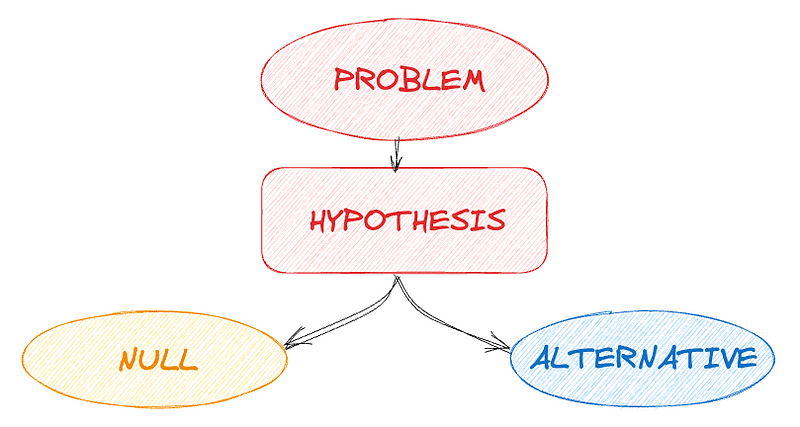
#1. Developing Hypotheses

This involves stating a null hypothesis, which is assumed to be true and it is commonly the fact that observations are the result of chance, and an alternative hypothesis, which is what the researcher aims to prove.
Hypothesis Testing and A/B Testing
Image by Author

#2. Choosing a Test Statistic

This is the method and value which will be used to determine the truth value of the null hypothesis.

#3. Calculating the p-value

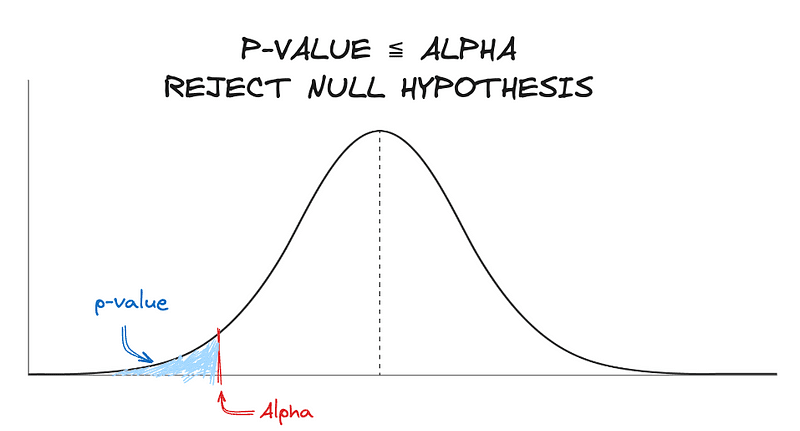
It’s the probability that a test statistic at least as significant as the one observed would be obtained assuming that the null hypothesis was true. To put it simply, it is the probability to the right of the respective test statistic.

The main benefit of the p-value is that it can be tested at any desired level of significance, alpha, by comparing this probability directly with alpha, and this is the final step of hypothesis testing.

Alpha refers to how much confidence is placed in the results. This means that an alpha of 5% means there is a 95% level of confidence. The null hypothesis is only kept when the p-value is less than or equal to alpha.

In general, lower p-values are preferred.
Hypothesis Testing and A/B Testing
Image by Author

#4. Drawing Conclusions

Based on the p-value and a chosen level of significance with alpha, a decision is made to either accept or reject the null hypothesis.

For instance, if a company wants to determine if changing the color of a purchase button affects sales, hypothesis testing can provide a structured approach to make an informed decision.

A/B Testing: The Real-World Application

A/B testing is a practical application of hypothesis testing. It’s a method used to compare two versions of a product or feature to determine which one performs better.

This involves showing two variants to different segments of users simultaneously and then using success and tracking metrics to determine which variant is more successful.

Every piece of content a user sees needs to be fine-tuned to achieve its maximum potential. The process of A/B testing on such platforms mirrors hypothesis testing.

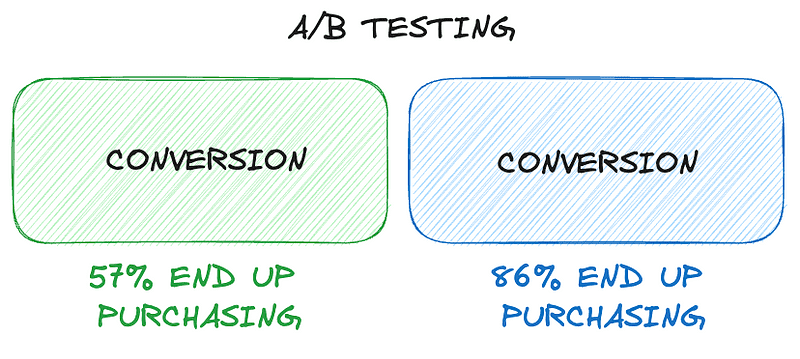
So… let’s imagine we are a social media and we want to understand if our users are more likely to engage when using green or blue buttons.
Hypothesis Testing and A/B Testing
Image by Author
It involves:

  1. Initial Research: Understand the current scenario and determine what feature needs to be tested. In our case, the button color.
  2. Formulating Hypotheses: Without these, the testing campaign would be directionless. When using a blue color, users are more likely to engage.
  3. Random Assignment: Variations of the testing feature are randomly assigned to users. We split our users into two different randomized groups.
  4. Result Collection and Analysis: After the test, results are collected, analyzed, and the successful variant is deployed.

REAL A/B TESTING BUSINESS EXAMPLE

Keeping the idea that we are a social media company, we can try to describe a real case.

Objective: Increase user engagement on the platform.

Metric to Measure: Average time spent on the platform. This could be other relevant metrics like number of posts shared or number of likes.

#Step 1: Identify a Change

The social media company hypothesizes that if they redesign their share button to make it more prominent and easier to find, more users will share posts, leading to increased engagement.

#Step 2: Create Two Versions

  • Version A (Null): The current design of the platform with the share button as it is.
  • Version B (Alternative): The same platform but with a redesigned share button that’s more prominent.

#Step 3: Split Your Audience

The company randomly divides its user base into two groups:

  • 50% of users will see Version A.
  • 50% of users will see Version B.

#Step 4: Run the Test

The company runs the test for a predetermined period, say 30 days. During this time, they collect data on user engagement metrics for both groups.

#Step 5: Analyze the Results

After the testing period, the company analyzes the data:

  • Did the average time spent on the platform increase for the Version B group?

#Step 6: Make a Decision

There are two main options once we have all data collected:

  • If Version B outperformed Version A in terms of engagement, the company decides to roll out the new share button design to all users.
  • If there is no significant difference or if Version A performed better, the company decides to keep the original design and rethink their approach.

#Step 7: Iterate

Always remember that iterating is key!

The company doesn’t stop here. They can now test other elements to continuously optimize for engagement.

It’s essential to ensure that the groups are randomly selected and that the only difference they experience is the change being tested. This ensures that any observed differences in engagement can be attributed to the change and not some other external factor.

Inferential Statistics: Beyond Just Differences

While it might seem straightforward to just compare the performance of two groups, inferential statistics, like hypothesis tests, provide a more structured approach.

For instance, when testing if a new training method improves delivery drivers’ performance, simply comparing performances before and after the training can be misleading due to external factors like weather conditions.

By using A/B testing, these external factors can be isolated, ensuring that the observed differences are truly due to the treatment.

Navigating the Data-Driven Landscape

In today’s world, where decisions are increasingly anchored in data, tools like A/B testing and hypothesis testing are indispensable. They offer a scientific approach to decision-making, ensuring that businesses and organizations don’t rely on mere intuition but on empirical evidence.

As we continue to generate more data and as technology evolves, the significance of these tools will only amplify.

Always remember, in the vast ocean of data, it’s not just about collecting information but also about learning how to deal with it and take advantage.

And with hypothesis and A/B testing, we have the compass to navigate these waters effectively.

Welcome to the fascinating world of data-driven decisions!
Josep Ferrer is an analytics engineer from Barcelona. He graduated in physics engineering and is currently working in the Data Science field applied to human mobility. He is a part-time content creator focused on data science and technology. You can contact him on LinkedIn, Twitter or Medium.

More On This Topic

  • Null Hypothesis Significance Testing is Still Useful
  • Hypothesis Testing Explained
  • Hypothesis Testing in Data Science
  • Why Saying "We Accept the Null Hypothesis" is Wrong: An Intuitive…
  • A/B Testing: 7 Common Questions and Answers in Data Science Interviews,…

  • A/B Testing: 7 Common Questions and Answers in Data Science Interviews,…

Bhashini Will Truly Democratise AI in India 

To truly democratise AI in India, native language accessibility is indispensable. India, the world’s most populous nation with 19,500 languages and dialects, has only 10% English speakers. Hindi, spoken by 43.63% of Indians, is dominant. But a greater section of the population speaks different native languages as their mother tongue.

This is where Bhashini comes in, an innovative AI solution aiming to bridge linguistic disparities. Bhashini leverages AI to break language barriers, enabling underserved communities to access government services seamlessly.

While Large Language Models (LLMs) like the GPT models by OpenAI, which powers ChatGPT excel in English, Bhashini seeks to democratise these technologies by offering them in native languages. One could contend that ChatGPT, with its 100 million users, made AI accessible globally, with India being a significant user base. However, Bhashini, extended to more Indic languages, holds the promise of true AI democratisation.

Bhashini is finding multiple use cases

Launched by Indian Prime Minister Narendra Modi in 2022, Bhashini is already finding use cases on multiple fronts. AskDISHA, a chatbot launched by the Indian Railway Catering and Tourism Corporation (IRCTC), is now leveraging Bhashini’s capabilities. Earlier, passengers were able to book tickets by conversing with the bot through voice and chat interface in English, Hindi, and Hinglish (a mix of English and Hindi). However, now the chatbot can converse in Gujarati and around 10 more languages are expected to be added to the AI-powered e-ticketing platform, Ankush Sabharwal, founder and CEO of CoRover.ai, the company that has developed the AskDISHA bot, told AIM.

Similarly, Ajay Singh Rajawat, manager at Bhashini Division, Ministry of Electronics and Information Technology (MeitY) mentioned that the Nanaji Deshmukh Krishi Sanjivani Prakalp (PoCRA), a pioneering initiative under the Department of Agriculture, Government of Maharashtra is using Bhashini to assist the farmers to have access of schemes, information, documents and programmes in their native language Marathi focused on climate resilience assistance.

From May 2023, onwards, the Department of Administrative Reforms and Public Grievances (DARPG) has also initiated the process of ranking States/UTs on the basis of their performance on the Centralised Public Grievance Redressal and Monitoring System (CPGRAMS) portal. For this, DARPG has integrated Bhashini with the CPGRAMS portal.

“This integration would facilitate the Grievance Redressal Officers (GROs) to translate the regional language grievance texts into English and the complainants will have the option to view the final reply in both English and the translated native language, ensuring better understanding and communication between the citizen and the concerned authorities,” the Ministry of Personnel, Public Grievances & Pensions, said in a statement.

Bhashini’s translation models

Moreover, Bhashini’s translation models such as IndicTrans and IndicTrans2, developed in association with AI4Bharat, an initiative of IIT Madras, have been leveraged by different tech companies, most notably, by KissanAI platform (previously KissanGPT). “We used a self-hosted version of IndicTrans in the early days of KissanAI. At that time, the models were not optimised for production, so when we started getting a lot of queries, we had to move to other models.”

“But now they have IndicTrans2, which is in an upgrade, and Bhasini is also providing API-based access, therefore, we are looking forward to starting using the updated model via API access again,” Pratik Desai, who developed the KissanAI platform told AIM.

Moreover, Desai goes on to add that the Bhashini models are optimised for Indic languages and have better equality results compared to industry standard models such as Whisper and Azure for Indic language translation. So far, Bhashini’s models can do speech translation in 14 languages and text-to-text translation in the 22 official languages of India.

Bhashini could truly democratise AI

India boasts a plethora of government schemes and welfare programmes, each accompanied by its unique set of criteria and prerequisites. Navigating official websites can prove challenging, or even impossible, for those who lack literacy or familiarity with the English or Hindi language.

“With Bhashini, all government reports/materials/communications can be generated in all the official languages. The core idea is to stop language being a barrier for any industry,” Aravinth Bheemaraj, engineering leader, Tarento, told AIM.

Sabharwal too believes an initiative like Bhashini can be hugely beneficial for India Given only 10 percent of the population speaks English and around 50 percent speaks Hindi. “By providing access to digital initiatives and services in local languages, Bhashini empowers citizens who may have limited proficiency in English or other widely used languages. It ensures that language is not a barrier to accessing information and participating in digital platforms,” he said.

Picture this: an unlettered farmer in Uttar Pradesh, well-versed only in Kannauji and unable to read or write in English or Hindi, gaining access to government services and schemes through seamless conversation with a platform in his mother tongue. Bhashini can enable this and we have already started seeing use cases.

Jugalbandi, a chatbot developed in India powered by OpenAI’s GPT models with Bhashini’s translation model is already benefiting people in rural areas. In a blog post, Microsoft said that Vandna, an 18-year-old resident of Biwan, Haryana, tested the chatbot in April. She asked about available scholarships in Hindi, specifying her field of study.

The chatbot provided a list and detailed eligibility criteria. Similarly, Abdullah Khan, a 26-year-old farmer in Biwan, has used Jugalbandi to help fellow farmers find out about government financial assistance programmes. Due to the Bhashini integration, the chatbot is available in 10 of the 22 official Indian languages.

In addition to promoting digital inclusion, Bhashini has the potential to enhance financial inclusion in India. The Reserve Bank of India (RBI) is integrating voice commands into the Unified Payments Interface (UPI), leveraging Bhashini’s capabilities. This initiative will enable users to make payments using a voice interface in both English and Hindi, with more languages planned for future inclusion.

Although smartphone usage is prevalent in rural areas, UPI adoption has been limited, partly due to lower literacy rates. The RBI aims to bridge this gap through the voice interface, with Bhashini playing a pivotal role in this endeavour.

Benefiting tech ecosystem

An initiative like Bhashini is also hugely beneficial for the tech ecosystem, according to Sabharwal. “This technology is free and is incredibly inclusive. This nationwide effort has greatly benefited companies like ours, ensuring that our products are accessible and widely used across the country.”

The alternatives available in the market are expensive and lack accuracy, he added. At the same time, he also expects the accuracy level of the Bhashini models to only get better because it is very much localised. As the number of users increases and the ecosystem evolves, the accuracy will further improve.

However, speaking from a tech company’s perspective, Sabharwal believes more languages and dialects need to be added. Even adding foreign languages will be beneficial to India’s tourism ecosystem. Desai, on the other hand, is of the opinion that Bhashini should provide the capability and guides to fine-tune from a company’s own dataset.“If they are being developed as true open-source projects, documentation and contribution criteria need to be more streamlined like other popular open-source projects,” he said.

The post Bhashini Will Truly Democratise AI in India appeared first on Analytics India Magazine.

Deci Open-Sources Foundational Models, Supasses Meta’s LLaMA & Stable Diffusion

Deci, a deep learning company building AI has launched their generative AI foundation models, which beats Meta’s algorithm by a staggering 15 times. DeciDiffusion, DeciLM 6B and its new inference Software Development Kit (SDK) are setting a new standard for performance and cost efficiency in the realm of generative AI. Unlike closed-source API models, Deci provided unrestricted access to its models that could be self-hosted anywhere.

The computational requirements for training and inference of genAI models, hinder teams from cost-effectively launching and scaling genAI applications. With its latest releases, the Israel based company is directly addressing this gap, making scaling inference efficient, cost-effective, and ready for enterprise-grade integration.

Better and Accurate

AI researchers can reduce their inference compute costs by up to 80% by using Deci’s open-source models and Infery LLM. They can use the already existing and widely available GPUs such as the NVIDIA A10. The Deci models cater to diverse applications, ranging from content and code generation to image creation and chat applications, among many others.

One of their models, ‘DeciDiffusion 1.0,’ is a blazing-fast text-to-image model. It could generate high-quality images in less than a second, outperforming their competitor Stable Diffusion 1.5 model by a factor of three.

DeciLM 6B, with its 5.7 billion parameters, set it apart by its blazing inference speed — 15 times faster than the Meta LLaMA 2 7B. Rounding out the lineup was ‘DeciCoder,’ a 1 billion parameter code generation LLM, which not only delivered exceptional inference speed but also maintained or exceeded accuracy standards.

Yonatan Geifman, Deci’s CEO and co-founder, emphasised the need for mastery over model quality, the inference process, and cost in the world of generative AI.

These models were crafted using Deci’s proprietary Neural Architecture Search (AutoNAC) technology. Alongside its foundation models, Deci introduces Infery LLM – an inference SDK that enables developers to gain a significant performance speed-up on existing LLMs while retaining the desired accuracy.

“With Deci’s solutions, companies receive both enterprise-grade quality and control, as well as the flexibility to customise models and the inference process according to their precise requirements” said Prof. Ran El Yaniv, Chief Scientist and co-founder of Deci.

“DeciLM-6B has set a new gold standard, outperforming Llama 2 7B’s throughput by an astonishing 15 times.This achievement is attributed to Deci’s cutting-edge neural architecture search engine, AutoNAC” said Akshay Pacchar, lead data scientist at TomTom in a tweet.

The post Deci Open-Sources Foundational Models, Supasses Meta’s LLaMA & Stable Diffusion appeared first on Analytics India Magazine.

How Temperature Affects ChatGPT

How Temperature Affects ChatGPT

When we talk about AI, the intersection of temperature and Large Language Models (LLMs) may seem like an unusual pairing at first glance. After all, LLMs such as ChatGPT or Bard and its successors are complex algorithms designed for generating text, while temperature is a term we usually associate with thermodynamics. However, in the context of LLMs, temperature plays a vital role in fine-tuning the behavior of these models.

Temperature, in the context of LLMs, is a hyper-parameter used to modulate the randomness and creativity of generated text. It’s a concept borrowed from statistical physics and is integrated into the functioning of LLMs like GPT. This parameter allows users to adjust the balance between creativity and coherence when generating text.

Higher temperatures introduce more randomness, resulting in creative yet potentially less coherent output. Lower temperatures, on the other hand, yield more deterministic and focused responses, emphasising coherence over creativity.

Hot and cold models

Imagine using a high-temperature setting with an AI model to generate responses to a fictional scenario: “Describe a day in the life of an intelligent octopus.”

With the temperature set high, the AI might generate a response like:

“In a world where aquatic creatures acquired the power of human intellect, Octavia the octopus spent her days engaging in philosophical debates with her fellow marine inhabitants, pondering the mysteries of the deep.”

Here, the high temperature allows for an imaginative narrative, with the octopus taking on a humanoid level of intellect.

Now, let’s switch to a low-temperature setting and revisit the same scenario. With the temperature lowered, the AI generates a more grounded response:

“Octavia, the intelligent octopus, thrived in her underwater habitat. She communicated with precision, using a complex system of signals to coordinate hunting and navigation.”

In this case, the output is more focused and logical, emphasising the coherence of the story and the octopus’s natural behaviour.

It is important to note that adjusting the temperature does not alter the parameters of the original model. As OpenAI explains, “Temperature is a measure of how often the model outputs a less likely token. Higher the temperature, more random (and usually creative) the output. This, however, is not the same as “truthfulness”. For most factual use cases such as data extraction, and truthful Q&A, the temperature of 0 is best.”

Temperature just gives users more control over the creativity and stubbornness of the model’s output, which might be ideal for several different use cases.

How to adjust the temperature on ChatGPT

It is clearly visible that “setting the temperature” for a chatbot might actually be very beneficial for anyone using it. By tweaking the temperature, the model can cater to our specific needs. How do we do it? When it comes to ChatGPT, it is quite easy.

Just after you give a prompt on ChatGPT, and add “Set the temperature to 0.1” for a direct, less creative, and expected answer. Or write, “Set the temperature to 0.8” for a more creative response.

The temperature settings range from 0 to 1, and finding the right balance is the key. For straight answers, just type 0. Or if you want to be a little more creative, let it go till 1 and even beyond.

This begs the question – if one wants to keep an AI model from hallucinating in its responses, shouldn’t the temperature always be set to 0? Well, a user on Reddit explains that it depends on the training data of the model and the model does not get entirely deterministic even if the user sets 0 as the temperature.

Similarly, Bard also allows users to set the temperature range from 0 to 2. Unlike ChatGPT, Bard’s temperature also affects how detailed its responses get. It says, “you can also use the temperature setting to control the length of the text I generate. For example, if you set the temperature to 0.1, I will generate a short and concise response. If you set the temperature to 2, I will generate a longer and more detailed response.”

Can ChatGPT change its own temperature?

What if ChatGPT turns this temperature dial on its own and conjures hallucinatory mayhem? It seems like the times when the model starts hallucinating, it must be that it has decided to tweak the temperature knob itself.

When asked, ChatGPT assured that it’s not the mastermind behind this dial, claiming it lacks the self-awareness to twist it. “Users can specify the temperature they want when interacting with me, but I do not independently change this setting. It is up to the user to adjust the temperature setting to achieve the desired response style.”

Unfortunately, this means setting the temperature is also not the answer to prevent ChatGPT hallucinations.

The post How Temperature Affects ChatGPT appeared first on Analytics India Magazine.

iPhone 15’s Satellite Feature Will Not Be Available in India Anytime Soon

Apple’s newly launched iPhone 15 got a new, additional feature for its SOS satellite service – emergency roadside assistance. India isn’t getting this anytime soon even as the country has this technology ready.

Last year, when Apple introduced iPhone 14 it came up with an emergency SOS via satellite feature, which allows users to send out SOS text messages to emergency operators when they’re off the grid, i.e no cellular or Wi-iFi service. That also was not available in India.

Emergency SOS via satellite

Let’s say, you’ve gone hiking. You’re lost in the middle of nowhere. You have no cellular or Wi-Fi service. You can use your iPhone to contact emergency services by connecting to a satellite.

Apple has invested $450 million and partnered with Globalstar to use 85 percent of its satellite network to power this feature. Globalstar has 24 satellites deployed in Low-earth orbit (roughly 2,000 kms above the earth) which the iPhone can connect to.

The iPhone will ask you to calibrate your phone and point it towards the nearest satellite, as shown in the picture above.

Once you’ve successfully connected to the satellite, it will relay the emergency message to the nearest emergency room or the Apple relay centre who will forward it.

Satellite connectivity in India

In India, Hughes Communications, a joint venture between Hughes Network Systems and Airtel, provides this type of technology, which Apple and other phone companies can take advantage of.

Hughes is the largest satellite operator in India. One of the services it provides is ‘Managed Low Earth Orbit (LEO) Satellite Service’ which is similar to Globalstar’s service in the US.

“We already have satellite connectivity technology available in India. If Apple comes up for clearance on this then we are ready, but they have to tie up with a satellite operator,” said Suneel Kumar Niraniyan, DDG (Satellite), Department of Telecommunications (DoT), speaking to The Hindu.

Hughes launched India’s first high throughput satellite broadband service on Monday with the help of Indian Space Research Organization. This service is directly competing with Elon Musk’s SpaceX Starlink service.

The Bitter Reality

India’s emergency response system still remains fragmented. Each state has its own emergency numbers. For instance, Karnataka has 6 different emergency contact numbers for multiple situations.

Even now, asking people what emergency number to dial for an ambulance, you get a different answer. Furthermore, private hospitals maintain their own emergency numbers which adds to more confusion.

On the other hand, the 911 system in the US is centralised, tested and fail proof. Public-Private collaboration in emergency response is well defined and is synchronised. This is the reason why Apple, along with other companies like Garmin can provide services like Emergency SOS via Satellite.

Another reason is, Apple iPhone’s market share in the Indian market is just 5 percent compared to 52 percent in the United States. Therefore it doesn’t make sense for Apple to invest millions of dollars when there are not enough people to use this feature.

Apple’s India story

Apple is all set to release the iPhone 15 models, assembled in India . This comes as a first as the company is shifting its manufacturing hub from China to India amid geo-politcal tensions. It aims to manufacture 25 percent of all its iPhones in India by 2025. Tim Cook emphasised the need to take advantage of the ‘Make in India’ program by the union government. Apple has also started supporting the NavIC, India’s home-grown navigation system on the iPhone 15 Pro models.

“The satellite connectivity on a phone is at a very early stage. So, we should not be over excited by it, “ said Shivaji Chatterjee, SVP and Business Head of the Enterprise Business Unit at Hughes Communications India.

The post iPhone 15’s Satellite Feature Will Not Be Available in India Anytime Soon appeared first on Analytics India Magazine.