Our lives are busy. When we have limited time available to keep our homes clean and tidy, it isn't long until the clutter builds up and a molehill has turned into a mountain.
This is where modern home appliances shine. Intelligent thermostats can automatically manage our energy consumption and heating requirements; smart lighting can be scheduled, and when it comes to cleaning, robot vacuums can take some of the daily workload off your plate.
Also: Best October Prime Day deals: Live updates
Robot vacuums aren't the holy grail of domestic tasks, of course, but if you purchase the right model, you won't need to worry about keeping your floors swept and mopped. You can schedule them to perform these jobs for you — or to spot clean as and when you need — freeing up a little more time for you to spend how you like. And ahead of Amazon's Prime Big Deal Days sale, which kicks off Tuesday, you can find several discounts on top-rated robot vacuums and mops.
Below are the best deals we could find for Prime Big Deal Days.
Plenful, a startup developing workflow automation tools for healthcare providers, has emerged from stealth with $9 million in a funding round led by Bessemer Venture Partners.
Co-founder and CEO Joy Liu says that the proceeds will be put toward building out Plenful’s platform, growing the company’s 20-person team (particularly on the engineering, product development, sales and operations sides) and scaling Plenful’s customer base, which currently stands at around 20 healthcare companies.
“The pharmacy industry is facing technician burnout and workload overload, contributing to high turnover rates and high labor shortage in the industry,” Liu told TechCrunch in an email interview “Plenful helps save time on menial-tasks by automating administrative work to free up time and allow technicians and care teams to focus on top of license activities.”
Before Plenful, Liu was a health system specialty pharmacy operator with the-now-Walgreens-owned Shields Health Solutions, where she says that she experienced firsthand how manual and time-consuming many of the pharmaceutical workflows were — and how they bogged down her team.
It’s an industry-wide challenge.
According to a survey from health tech company Holon Solutions, 77% of healthcare workers are experiencing burnout, with the top reasons being not enough people to get the work done (including paperwork) and high demands from patients. Per the same poll, 34% of workers are spending more than a third of their time on administrative work while 72% said they’d be “very or extremely” interested in tech that cuts down on this work.
“I was privy to countless conversations with medical staff around burnout and lacking the time to focus on top-of-license tasks,” Liu said. “I could see that meeting the individual, nuanced needs of each health system required a solution that was flexible enough to sit on top of disparate data sources and highly configurable to the organization’s specific requirements.”
Plenful is designed to alleviate some of this burnout by sitting on top of a health system’s existing sources of data, monitoring for — and attempting to prevent — errors by automating manual data entry and data validation. Plenful ingests data in a range of formats, including PDFs and electronic medical records, applying algorithms to yield what Liu describes as “actionable insights” for clinical decision making.
Plenful’s customers are using the platform to automate document data entry for onboarding and referring prescription orders, auditing, and identifying potential areas of savings, Liu says, among other use cases.
“Plenful … allows pharmaceutical technicians to automate manual and administrative workflows so they can focus on the human processes, keeping pharmacies compliant while combating employee burnout,” Liu said. “There are few competitors offering a comparable level of healthcare-centric, no-code and highly configurable workflow automation solutions in the industry.”
Plenful competes with startups like Notable, which makes automation tools to speed up healthcare administration, and Infinitus, which recently raised $21.4 million for its tech that automates the repetitive, regular calls health providers have to place to insurers and other third parties.
But Liu asserts that Plenful is in a position of strength, in part because the platform was architected from the ground up to reduce the implementation and maintenance burden on IT and engineering teams.
“Plenful was founded during the pandemic, imbuing its services with a strong response to the urgent needs arising from COVID,” she said. “The confluence of the industry’s heightened interest in AI, increased healthcare spending and persistent labor shortages has significantly contributed to the company’s rapid growth. With multiple years of runway, Plenful remains focused on scaling through leveraging its proven use-cases and expanding its customer base.”
In the wake of escalating tensions between Israel and Palestine, the Israel’s foreign ministry recently posted on X that “even artificial intelligence is more humane than Hamas terrorists. Hamas terrorists are not human beings. They are evil, barbaric, murderers,” highlighting the ethical impact of AI.
Even artificial intelligence is more humane than Hamas terrorists. Hamas terrorists are not human beings. They are evil, barbaric, murderers. Share. pic.twitter.com/1oMEuD4gb8
— Israel ישראל (@Israel) October 10, 2023
Israel has declared a state of war, after Hamas, a Palestinian militant group which controls Gaza, attacked the border towns of Israel in the early hours of Saturday. Over 100,000 people have been displaced in Gaza as Israel continues to retaliate on Hamas’ attack.
The Israeli Defence Forces are using AI to organise logistics during wartime, reduce the time taken for decision-making and selecting targets. They use a system of AI recommendations which crunches large amounts of data and selects targets for air strikes.
Hamas, operating mainly from the Gaza Strip, fired at least 3,000 rockets on Israel on Saturday. The IDF said that it caused little or no harm as their Iron Dome air defence system intercepted almost 90% of the rockets fired. The casualties could have been significantly higher had the Israel Defense Forces (IDF) not deployed its ‘Iron Dome’ technology, which is protecting the Israeli skies.
What Tech Leaders Think of the Israel Situation
Amidst all these tensions, NVIDIA has decided to cancel its upcoming AI conference in Tel Aviv, which was originally planned for next week, citing safety concerns. The in-person AI summit, featuring a keynote by CEO Jensen Huang, was scheduled for October 15 and 16 in Tel Aviv.
Similarly, several tech leaders have voiced their opinions on social media platforms. Amazon’s chief Andy Jassy took to X and said “that the attacks against civilians in Israel are shocking and painful to watch.”
He further stated that he has been in touch with his teammates there to ensure that they do everything they can to support their families and ensure their safety, assisting in any way possible during this very difficult time.
“We’re also in close contact with our humanitarian relief partners on the ground and will be supporting their efforts. Hoping that peace arrives as soon as possible.” he added.
“Sorry to see what’s happening in Israel,” Tesla chief Musk posted on X. “I hope there can be peace one day.”
Last month, Musk met with Israeli Prime Minister Benjamin Netanyahu in California. During the meeting, they discussed the issue of antisemitism on the social media platform owned by X.
Lex Fridman, who recently interviewed Mark Zuckerberg about the Metaverse, expressed his sympathies for those affected by the escalation of the Israel-Gaza war. He mentioned plans for future discussions on this topic, including one that he has recently recorded and will be released soon. Fridman added, “I hold onto hope for peace .”
Interestingly, Mark Zuckerberg hasn’t made any statement yet. Meanwhile, Google chief Sundar Pichai sent out an internal email to update employees on the current situation. In his message, he stated that the company has begun contacting all its employees working in Israel, where Google operates two offices.
“I’m sure by now you’ve all seen the news of the terrible attacks on civilians in Israel, and the escalated conflict now underway,” Pichai said, as per a recent report.
“Google has two offices and more than 2,000 employees in Israel, and it’s unimaginable what they are experiencing right now. Our priority is making sure that every Googler in the area is accounted for and safe — beyond our employees based locally, we have identified more who were travelling there.” Pichai added.
The risks with AI
Recently, Geoffrey Hinton, often dubbed the “Godfather of Artificial Intelligence,” voiced concerns about the risks associated with AI. He emphasised the need for governments and companies to thoughtfully navigate the path to advancing this technology safely. It’s worth noting that Mr. Hinton retired from Google earlier this year.
“We’re entering a period of great uncertainty where we’re dealing with things we’ve never done before,” he said. “And normally the first time you deal with something totally novel, you get it wrong. And we can’t afford to get it wrong with these things.”
AI has the potential to one day take over from humanity, Mr Hinton warned.
The ongoing conflict between Israel and Hamas serves as a poignant backdrop for the discussion surrounding AI’s role in warfare. As nations grapple with evolving security challenges, the responsible integration of AI into military strategies becomes an imperative, demanding careful ethical and strategic considerations.
The post How Israel-Palestine War Makes AI More Humane appeared first on Analytics India Magazine.
In the contemporary digital landscape, data has emerged as a critical asset for organizations aiming to make informed decisions and foster innovation. Data analytics can unlock a treasure trove of insights, driving competitive advantage and operational excellence by leveraging the vast amounts of data generated every second. As a consequence, the demand for skilled professionals who can navigate this complex data ecosystem has skyrocketed.
Central to this ecosystem are three pivotal roles – Data Analysts, Data Scientists, and Data Engineers. Though often used interchangeably, each of these positions holds a distinct set of responsibilities and requires a unique blend of skills. Data Analysts primarily focus on deriving meaningful insights from data to aid decision-making. On the other hand, Data Scientists not only extract insights but also build advanced analytical models for prediction and optimization. Meanwhile, Data Engineers create and manage the architecture that allows this vast amount of data to be processed efficiently.
Understanding the nuances among these roles is crucial for both aspiring data professionals and organizations striving to build robust data teams. Moreover, it sheds light on the collaborative framework necessary for transforming raw data into actionable intelligence. As we delve deeper into the specifics of each role in the subsequent sections, we will unravel the symbiotic relationship that binds these professions together in the realm of data science and analytics.
Data analyst
The role of a Data Analyst serves as a cornerstone in any data-driven organization. At its core, a Data Analyst is charged with the task of translating numbers into meaningful narratives to guide business strategies. They delve into data to uncover trends, analyze results, and generate actionable insights that inform decision-making across various organizational domains.
Main Responsibilities
Collecting and interpreting data to understand business performance.
Ensure accuracy and reliability of data by cleaning and preparing it for analysis.
Developing and maintaining dashboards and regular reports.
Analyzing trends and patterns to provide recommendations for business improvements.
Collaborating with cross-functional teams to share insights and influence strategy.
Required Skill Set and Tools
The toolkit of a Data Analyst is diverse, encompassing both technical and soft skills.
Technical Proficiency: Profound knowledge in statistical analysis and proficiency in data manipulation using software like Excel, SQL, and data visualization tools such as Tableau or Power BI is crucial.
Analytical Thinking: The capability to think analytically and approach problems systematically is central to the role.
Communication Skills: Equally important are robust communication skills, which enable Data Analysts to effectively convey their findings and recommendations to non-technical stakeholders.
Real-world Example
Consider a retail company facing a decline in sales. A Data Analyst in this scenario would collect and analyze sales data alongside external factors like market trends and consumer behavior. By interpreting this data, they might uncover that sales dip on certain weekdays or during specific seasons. Moreover, they might identify a rising competitor offering similar products at lower prices. Through tools like Tableau, they could visualize these trends and present them to the management, suggesting strategies like adjusting pricing or improving marketing efforts on low-sales days. Their analysis forms the bedrock for strategic decisions aimed at boosting sales and navigating competitive market dynamics.
The role of a Data Analyst is thus fundamental in bridging the gap between raw data and actionable business insights. Their ability to dissect data and unveil trends provides a robust foundation for informed decision-making and strategic planning within an organization.
Data scientist
Diving deeper into the realm of data, we encounter Data Scientists, the professionals responsible for designing and employing complex analytical models to help organizations forecast future occurrences and make well-informed, data-driven decisions. Their role transcends the descriptive analysis carried out by Data Analysts to predictive and prescriptive analysis, offering foresight and solutions based on data.
Main Responsibilities
Collecting, cleaning, and analyzing large datasets to identify trends and patterns.
Developing predictive models and algorithms to forecast future events.
Employing machine learning and statistical methods to derive insights and solutions for business challenges.
Collaborating with different teams to implement models and monitor outcomes.
Communicating findings and offering data-driven recommendations to stakeholders.
Required Skill Set and Tools
Technical Proficiency: Data Scientists require a strong foundation in statistics, programming (using languages like Python or R), and machine learning. Familiarity with big data platforms like Hadoop and Spark is often beneficial.
Analytical and Problem-Solving Skills: The capacity to tackle complex problems and think analytically is crucial.
Business Acumen: Understanding the business context and being able to translate business problems into data-driven solutions is vital.
Real-world Example
Imagine a healthcare provider aiming to reduce patient readmission rates. A Data Scientist might be tasked with developing a predictive model to identify patients at higher risk of readmission. By analyzing historical patient data, they could build a model that predicts readmission risks based on factors like age, previous medical history, and treatment plans. This model could then be used to provide extra support to high-risk patients, ultimately reducing readmission rates and improving patient outcomes.
Education Path
A solid pathway to becoming proficient in this role is through a robust Data Science Course that covers essential topics like statistics, machine learning, data visualization, and programming. Such a course equips aspiring Data Scientists with the necessary theoretical knowledge and practical skills to excel in real-world data challenges. Additionally, it often provides hands-on projects that simulate real-world problems, enabling learners to experience the process of solving data-driven challenges firsthand.
The domain of Data Science is vast and continually evolving, making continuous learning and adaptation vital. Embarking on a structured educational path provides a strong foundation, enabling individuals to stay abreast of emerging tools and techniques in this exhilarating field.
Data engineer
Within the trifecta of data-centric roles, Data Engineers act as the architects and builders of the data environment. They design, construct, and maintain the systems and architecture that allow the vast amounts of data generated by modern activities to be collected, stored and analyzed efficiently and effectively.
Main Responsibilities
Designing and implementing data architectures, databases, and processing systems.
Developing and maintaining scalable data pipelines to ensure data is available, reliable, and accessible for use by Data Scientists and Analysts.
Ensuring data quality and integrity through monitoring, testing, and optimizing performance.
Working with various stakeholders to assist with data-related technical issues and support their data infrastructure needs.
Required Skill Set and Tools
Technical Proficiency: Proficiency in SQL and NoSQL databases, big data technologies like Hadoop and Spark, and data pipeline tools such as Apache Airflow are essential.
Programming Skills: Strong programming skills in languages like Python, Java, or Scala are crucial for developing robust data pipelines and solving complex data problems.
Systems Design Understanding: A comprehensive understanding of how data systems are built and optimized is vital to ensuring data availability and reliability.
Real-world Example
Consider a large e-commerce platform experiencing slow data processing, which hampers real-time analysis and decision-making. A Data Engineer in this scenario would assess the current data systems, identify bottlenecks, and design a more efficient data architecture. They might implement a new data pipeline using Apache Airflow to ensure data flows seamlessly from various sources to the analytics platform. Moreover, they could optimize the database performance to ensure quicker query responses, enabling real-time analytics that could significantly improve business operations.
The role of a Data Engineer is indispensable in ensuring that data is collected, stored, and processed in a manner that supports further analysis and insight generation. Their efforts lay the groundwork upon which Data Scientists and Analysts can perform their analyses, thereby serving as the backbone of any data-driven organization. Through their expertise, they facilitate the seamless flow and accessibility of data, enabling the organization to harness the power of data to drive informed decisions and innovative solutions.
Comparison and Interconnectedness
The distinction among Data Analysts, Data Scientists, and Data Engineers often manifests in their education, skills, responsibilities, and tools used. Below is a comparative snapshot of these three pivotal roles.
Data Architecture, Pipeline Development, Data Optimization
Tools
SQL, Excel, Tableau, Power BI
Python, R, TensorFlow, Sci-kit-learn
Hadoop, Spark, Apache Airflow, Kafka
In a data-driven organization, the symbiotic relationship among these roles is fundamental to achieving a holistic data strategy. Data Engineers lay the foundation by creating robust data pipelines and architectures, ensuring data is clean, reliable, and accessible. This groundwork enables Data Analysts to perform exploratory and descriptive analysis, generating actionable insights that inform tactical business decisions. Concurrently, Data Scientists leverage this data, employing advanced analytical techniques to develop predictive models and algorithms that power strategic decision-making and innovation.
The seamless interaction among these roles creates a conducive environment for data to be transformed from raw figures into meaningful insights and forward-looking solutions. It’s a collaborative framework wherein the expertise of each role is leveraged, creating a robust data ecosystem that drives organizational excellence. By understanding and appreciating the distinct yet complementary nature of these roles, organizations are better positioned to harness the transformative power of data, ultimately achieving a competitive edge in the data-centric business landscape.
Conclusion
The journey through the realms of Data Analysts, Data Scientists, and Data Engineers has unveiled the unique essence and contributions of each role in the data ecosystem. From the meticulous analysis and interpretation by Data Analysts to the predictive modeling by Data Scientists and the structural groundwork laid by Data Engineers, each profession is a pillar supporting data-driven decision-making within organizations.
Understanding the distinctions and the interlinkages among these roles is a linchpin for aspiring data professionals charting their career paths and for employers keen on assembling proficient data teams. It’s this understanding that fosters a conducive environment for collaborative efforts, ensuring the transformation of data into actionable intelligence that propels business forward.
For those captivated by the potential of data and aspiring to delve deeper, embarking on a structured educational path is invaluable. Courses like MIT Applied Data Science provide a robust foundation and a wealth of knowledge, preparing individuals to excel in these data-centric roles. By investing in learning and continually evolving with the rapidly advancing data landscape, individuals and organizations alike unlock the gateway to unbounded innovation and a competitive edge in today’s data-driven world.
In 2016, China launched the world’s first quantum-enabled satellite called Micius. A year later, China completed an over 2,000-kilometre-long optical fibre network for Quantum Key Distribution (QKD) between Beijing and Shanghai.
Not just China, but the US, Germany and a host of other nations are actively investing in quantum technology and related research. India, recognising the potential of quantum technology in modern military applications, has also allocated substantial resources to this area.
“Adopting quantum technologies is not a choice any longer—today, it is a question of getting in at the earliest,” according to Ajay Kumar Sood, principal scientific advisor (PSA) to the Centre. In fact, he noted that in India, QKD link between Sanchar Bhavan and NIC headquarters in Delhi has been live since earlier this year. This enables transmission of data through quantum communications networks over 150-200 kilometres currently, which can be further extended to over 2,000 kilometres in the future.
India’s quest for quantum supremacy
India is forging ahead with the adoption of quantum technology. But the use cases are not just limited to quantum technology. In fact, quantum computers could also play a pivotal role in modernising India’s defence sector. The National Quantum Mission aims to propel India’s quantum endeavours to rival China in the domain of not just quantum computers, but also quantum communication technology.
Earlier this year, the Indian government allocated a budget exceeding INR 6,000 crores to accelerate quantum computing research and construct intermediate quantum computers with 50-1000 qubits within the coming eight years.
Quantum computers could be used by defence planners to conduct large-scale simulations of military deployment. Quantum computing algorithms could be utilised to optimise military logistics, such as route planning, resource allocation, and supply chain management. The ability of quantum computers to handle vast amounts of data and solve complex optimisation problems could enhance military operations.
While the topic of quantum discussion is hot, there are no mature quantum computers in the world yet. “All the quantum computers in the world are in an intermediate state right now. Moreover, quantum computers alone are not used as standalone computers; they are always used in conjunction with a classical computer. Additionally, quantum computers do not address all types of problems; they are specialised for specific sets of issues,” Anshuman Tripathi, member of the National Security Advisory Board (NSAB), told AIM.
A fully mature quantum computer, which can be leveraged for commercial and military use is still far away. “It’s a matter of time. There are still some critical technologies which need to be developed and that will definitely take time,” Tripathi added.
Defence agencies bank on quantum tech
However, quantum technology, which is a subset of quantum computing, is garnering significant attention, especially from our defence agencies. Last year, the Ministry of Defence (MoD) announced that the Indian army has initiated the process of procurement of QKD systems developed by QNu Labs by issuing a commercial Request For Proposal (RFP) and its deployment.
With support from the Defence Excellence (iDEX), Defence Innovation Organisation (DIO), QNu Labs, a deeptech startup in Bengaluru, has made significant strides in overcoming distance limitations through innovative secure communication via QKD systems.
QKD ensures the creation of an unhackable quantum channel, providing an impervious layer of encryption for safeguarding critical data, voice, and video communications between these distant endpoints. It doesn’t only provide secure communication channels for military operations, but is also used to detect any tampering or eavesdropping attempts during communication. QKD can also be integrated with quantum sensors and surveillance systems to enhance military intelligence gathering capabilities.
Moreover, to spearhead research and innovation in the field of quantum, the Indian Army, with support from the National Security Council Secretariat (NSCS), has also established the Quantum Lab at the Military College of Telecommunication Engineering, Mhow (MCTE).
In fact, the use of quantum technology is not just limited to the Indian army. The Indian Navy is exploring the use of the technology. The Raman Research Institute (RRI), an autonomous institute of the Department of Science and Technology (DST), inked a Memorandum of Understanding (MoU) with the Indian Navy’s R&D unit Weapons and Electronics Systems Engineering Establishment (WESEE) to lead the research efforts towards developing QKD techniques that the Indian Navy could leverage in the nation’s efforts towards securing free space communications.
Quantum tech has its limitations
However, even though nations are rushing to build their own QKD capabilities, certain questions about the reliability of the technology remain. Interestingly, the National Security Agency (NSA), a key intelligence agency within the US Department of Defense, currently does not endorse the use of QKD for safeguarding communications within national security systems. They also do not plan to certify or approve any QKD or QC security products unless specific limitations are addressed, the NSA said in a blog post.
The limitations, as cited by the NSA, include a lot of technical limitations such as the requirement of special purpose equipment, increased infrastructure costs and insider threat risks, and increased risk of denial of service.
Besides, the integration of QKD systems with existing communication infrastructure and protocols can prove to be a complex endeavour. Additionally, enhancing the cost-effectiveness of QKD technology, encompassing both hardware and maintenance, is crucial for its widespread deployment.
Hence, addressing these challenges requires ongoing research, development, and collaboration among academia, industry, and government entities. Similar to quantum computing, as advancements are made in QKD technology and its associated challenges are overcome, the wider adoption of QKD for secure communication will increase.
The post Indian Army Banks on Quantum Tech; However Challenges Remain appeared first on Analytics India Magazine.
Infinite iterators, as the name suggests, are special types of iterators that can continue generating values indefinitely. Unlike the in-built iterators like lists, tuples, and dictionaries that eventually reach an end, infinite iterators can produce an unending stream of values. Such iterators are also sometimes referred to as infinite generators or sequences. They find use in various scenarios for solving problems involving simulation, generating sequences, processing real-time data, and more.
The Itertools library in Python provides three in-built infinite iterators.
Count
Cycle
Repeat
1. Count
The count() function generates infinite numbers starting from the specified value and step size. The syntax for the count iterator is as follows:
itertools.count(start=0, step=1)
It has two optional parameters: "start" and "stop," with default values of 0 and 1, respectively. "Start" refers to the initial value of your counting, while "step" represents the increment used to advance the count.
Let us analyze the function with the help of an example. If you need to generate a sequence of numbers with a step size of 3 just like the table of 3, you can use this code:
from itertools import count counter = count(3,3) print("The table of 3 is:") for i in range(10): print(f"3 x {i+1} = {next(counter)}")
Output
The table of 3 is: 3 x 1 = 3 3 x 2 = 6 3 x 3 = 9 3 x 4 = 12 3 x 5 = 15 3 x 6 = 18 3 x 7 = 21 3 x 8 = 24 3 x 9 = 27 3 x 10 = 30
2. Cycle
The cycle() function creates an iterator and repeats all the items of the passed container indefinitely. Here is the syntax for the cycle iterator:
itertools.cycle(iterable)
The "iterable" parameter here can be any iterable data structure in Python, such as lists, tuples, sets, and more. Consider an example of a traffic light controller system that continuously cycles through different lights. No different actions are performed while cycling through the different colored lights. We will use a wait time of 5 seconds to display our results.
from itertools import cycle import time lights = ["red", "green", "yellow"] cycle_iterator = cycle(lights) while True: print(f"Current light is: {next(cycle_iterator)}") time.sleep(5)
Output
Current light is: red Current light is: green Current light is: yellow Current light is: red Current light is: green Current light is: yellow
You will see this output after approximately 25 seconds.
3. Repeat
The repeat() function generates a sequence of the specified number infinitely. It is useful when you need to generate a single value indefinitely. The syntax for the repeat iterator is as follows:
itertools.repeat(value, times=inf)
We have two parameters here: "value" is for the number you want to generate infinitely, while "times" is an optional parameter for how many times you want to generate that number. The default value for "times" is infinity, indicating that it will print endlessly unless you explicitly specify a finite number. For example, if you need to generate the number "9" three times, then the following code can be used:
from itertools import repeat iterator = repeat(9, 3) for value in iterator: print(value)
Output
9 9 9
Conclusion
These infinite iterators are extremely helpful in scenarios when we need to work with streams of data. The “count”, “cycle” and “repeat” iterators provide us the ability to solve problems more efficiently and elegantly. Although using them requires necessary caution as they can lead to infinite loops, when used thoughtfully they can be a valuable resource for solving programming problems. I hope you enjoyed reading this article and if you have anything to share feel free to drop your suggestions in the comment box below. Kanwal Mehreen is an aspiring software developer with a keen interest in data science and applications of AI in medicine. Kanwal was selected as the Google Generation Scholar 2022 for the APAC region. Kanwal loves to share technical knowledge by writing articles on trending topics, and is passionate about improving the representation of women in tech industry.
Kanwal Mehreen is an aspiring software developer with a keen interest in data science and applications of AI in medicine. Kanwal was selected as the Google Generation Scholar 2022 for the APAC region. Kanwal loves to share technical knowledge by writing articles on trending topics, and is passionate about improving the representation of women in tech industry.
More On This Topic
Understanding Iterables vs Iterators in Python
4 Python Itertools Filter Functions You Probably Didn't Know
I’ve been in this industry for over 40 years (yes, I just started in the data and analytics industry when I was 11), and I have NEVER seen anything like Artificial Intelligence (AI) and Generative AI (GenAI) capture the attention of CEOs (and the dystopic fear of everyone else). Is AI a game-changer? Definitely! Will it impact all organizations equally? An unequivocal NO! There will be:
AI Leaders: These organizations are at the forefront of AI adoption and are leveraging AI to create significant value for their stakeholders. They have a clear understanding of how AI can be used to deliver meaningful, relevant, responsible, and ethical outcomes. They foster a culture of curiosity, innovation, collaboration, and experimentation, which enables them to capitalize on AI’s value creation and cultural empowerment capabilities. They have a comprehensive plan to enable all the organization’s value-creation capabilities and exploit the economics of data and analytics.
AI Followers: These organizations have deployed AI in targeted business areas (e.g., fraud detection, credit risk management, campaign optimization, predictive maintenance) and achieved impressive results. However, they lack a holistic plan to enable all the organization’s value-creation capabilities. They struggle with cross-organizational challenges such as misalignment, fragmentation, inconsistency, or inefficiency in institutionalizing the value-creation potential of AI and data. They need to invest in building organizational capabilities to exploit AI fully.
AI Laggards: These organizations are skeptical of AI and lack the management fortitude to invest in and empower the organizational capabilities to exploit AI. They are overwhelmed by the challenges associated with responsible AI deployment, such as data quality, security, personal privacy, confidentiality protection, and ethics. They are unprepared to meet the hard cultural and organizational requirements for deploying AI effectively. Their infatuation with AI will dissipate as they realize the overly grand promises of AI gloss over the challenges associated with its deployment.
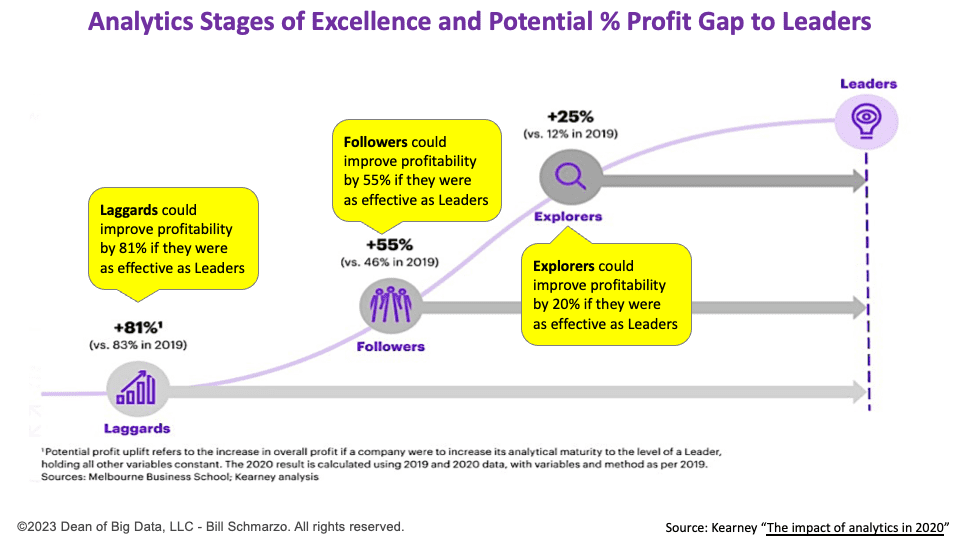
These segments should not be any surprise because we’ve seen this segmentation before from a 2020 study by Kearney that highlighted the profit impact between analytics leaders and the huddled masses (Figure 1).
I loved that this study put a number on the potential cost (profit impact) of being a second (or third or fourth) mover on the analytics opportunity:
Explorers could improve profitability by 20% if they were as effective as Leaders
Followers could improve profitability by 55% if they were as effective as Leaders
Laggards could improve profitability by 81% if they were as effective as Leaders
Yeah, this is not small potatoes in getting AI and analytics right from a business viability and survival perspective!
11 Questions Every CEO Should Be Asking of their AI Strategy
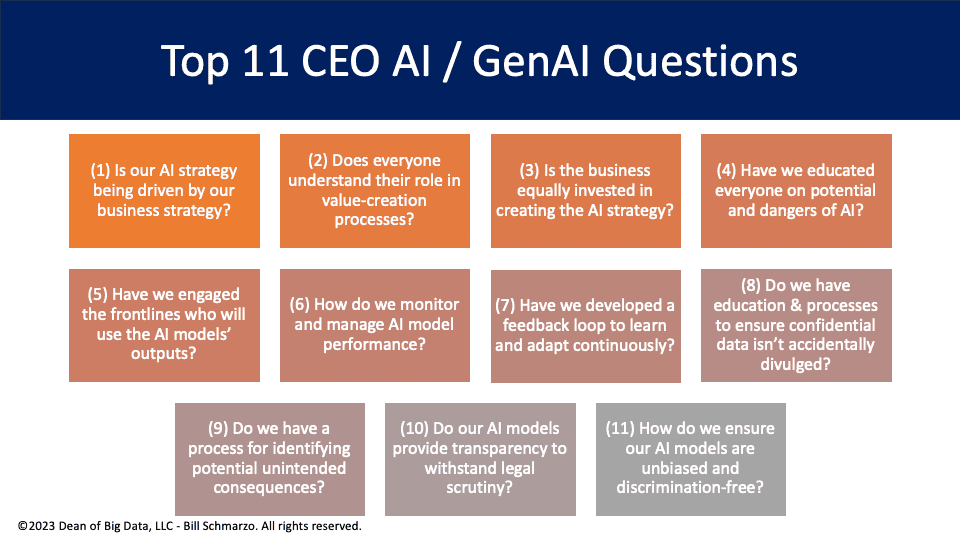
To ensure that your organization is among the AI leaders (and not an AI pretender), your CEO should start by asking the following questions (and because this is critically important to the organization’s survival, we had to dial it up to 11 questions).
1. Lead with Value. Is our AI strategy being driven by and aligned with our business strategy?
Successful organizations start their AI strategies by clearly linking to how they create value. This includes identifying ideal outcomes, capturing key internal and external stakeholder decisions, and identifying a broad range of KPIs and metrics (e.g., financial, operational, customer, employee, partner, community, environmental, and ethical) against which the stakeholders will measure outcomes and decision effectiveness.
Once these (and a few other criteria) are known, the organization is not positioned to create an AI strategy that supports the organization’s value-creation processes. The organization can start envisioning and exploring where and how AI can improve and optimize use case outcomes and decision effectiveness.
2. Organizational Alignment. Does everyone understand their role and responsibilities in supporting the organization’s value-creation processes?
It is essential that all stakeholders have a clear understanding of the organization’s key business initiatives and how their roles and responsibilities align with those business initiatives. That is, leadership needs to ensure that everyone has a clear line of sight from what they do to how that creates value for the organization’s stakeholders.
Establish a clear connection between AI initiatives and the organization’s broader business goals to ensure that AI efforts are aligned with the organization’s objectives.
This requires clear and consistent communications to ensure that each employee understands the KPIs and metrics against which their value creation effectiveness will be measured. If this sounds like OKRs, then you’re heading in the right direction.
3. Business-driven Collaboration. Is the business equally invested in creating and maintaining the AI strategy?
Business stakeholders can’t just be involved at the “requirements definition” stage of the AI journey. The Business stakeholders must be heavily invested throughout the AI journey to ensure that the data science work delivers meaningful, relevant, responsible, and ethical AI outcomes.
This ongoing collaboration is critical throughout the journey, including 1) providing critical details about the targeted business initiative, 2) identifying, validating, valuing, and prioritizing the use cases that support the business initiative, 3) brainstorming the features that might be better predictors of behaviors and performance when building the analytics, and 4) determining when the AI model is “good enough” given the costs associated with making the wrong decisions.
4. AI & Data Literacy. Have we educated everyone on the potential and dangers of AI?
Educate all your employees and constituents about AI’s potential benefits and risks to ensure that they understand how AI can be used effectively and responsibly. This includes basic training in decision-making, foundational training in the different types of analytics, and how to apply basic stats to improve decision-making effectiveness.
Organizations can help prevent unintended consequences such as bias, discrimination, or privacy violations by promoting awareness of ethical considerations and responsible use of AI technologies. Providing training sessions or workshops on AI can help employees develop the skills necessary to work with AI technologies effectively.
5. Empowered Frontlines. Have we engaged the folks who will use the AI models’ outputs to develop the models – the frontlines of customer engagement and operational execution?
Involve your end-users and subject matter experts in the AI model definition, design, development, and ongoing management processes to ensure that the models meet their needs and expectations. Involving subject matter experts throughout the process ensures that the models are designed to address relevant business challenges and will actually be used by the people for whom the analytics were developed.
Also, create a continuous process for gathering user feedback to identify improvement areas and ensure that the models deliver relevant, meaningful, responsible, and ethical outcomes.
6. Assess Performance. How do we monitor and evaluate the performance of our AI models over time?
Establish key performance indicators (KPIs) against which to measure the ongoing effectiveness of AI models. Implement monitoring and observability processes to track model performance, identify anomalies, and trigger corrective actions to ensure that models remain effective and relevant over time.
Additionally, by regularly evaluating model performance, organizations can identify areas for AI model and operational improvement and take corrective actions as needed.
7. Integrated Learning Loop. Have we developed a feedback loop to ensure AI models continuously learn and adapt?
Implement mechanisms to collect model effectiveness feedback and incorporate that feedback into model updates to ensure that the organization is that the AI models continuously learn and adapt. Regularly evaluate model performance and iterate on model and process improvements based on real-world usage to ensure that models remain effective as the operational environment changes.
By the way, by incorporating user feedback into model updates, organizations can help improve user satisfaction with AI technologies.
8. Confidentiality Leakage. Do we have education and processes to ensure our confidential data isn’t accidentally divulged?
Educate employees about data privacy best practices, including handling sensitive information, to prevent accidental disclosure of confidential data. This includes implementing robust security measures such as access controls and encryption, which can help protect confidential data from unauthorized access or disclosure.
Organizations can minimize the risk of data breaches or other security incidents by establishing processes for handling confidential data effectively.
9. Unintended Consequences. Do we have a process for identifying an AI model’s potential unintended consequences?
Conduct thorough risk assessments to identify potential unintended consequences of AI models. This is crucial in preventing unintended negative impacts on business outcomes or stakeholders. This means establishing all-inclusive formal processes for ideating, addressing, and mitigating any identified risks can help prevent unintended consequences from occurring.
Additionally, by regularly reviewing risk assessments and updating protocols as needed, organizations can ensure that they remain prepared for any potential risks associated with their AI initiatives.
10. AI Model Transparency. Do our AI models provide the transparency to withstand legal scrutiny?
Ensure that your AI models are explainable, meaning humans can understand the factors that drove an AI model’s recommendation or decision. Documenting model development processes and preserving documentation for legal compliance can help support transparency in model development.
Also, organizations can minimize legal risks by ensuring that AI models comply with relevant national and local regulations and standards.
11.Mitigate Biases. How do we ensure our AI models are unbiased, discrimination-free, and minimize confirmation bias?
Conduct thorough data assessments to identify potential sources of bias in training datasets. Implement techniques such as data augmentation, adversarial training, and fairness constraints to reduce bias in AI models. Conduct regular reviews for bias and take corrective actions when biases are identified to ensure that models remain unbiased over time.
Figure 2: Top 11 CEO AI /GenAI Questions
Top 11 CEO AI / GenAI Questions Summary
“Toto, I’ve a feeling we’re not in Kansas anymore.” – Dorothy in the “Wizard of Oz”
The AI age is upon us, and things aren’t returning to how they were before. A new type of leadership is required to corral and exploit this “Artificial Intelligence” phenomenon. We need strong, stable, inclusive, and accountable leadership with a clear vision for how the organization can leverage AI to deliver meaningful, relevant, responsible, and ethical business and operational outcomes. That is:
Meaningful: Improves society and people’s lives by reducing poverty, enhancing health, education, and employment opportunities, and protecting the environment.
Relevant: Pertinent to you and me as individuals in providing individualized solutions, recommendations, and insights that match our unique situations and aspirations.
Responsible: Considers the potential ramifications for others, especially those who may be harmed or excluded by AI decisions or actions.
Ethical: Upholds the principles of fairness, justice, and reciprocity by ensuring that AI respects human dignity, diversity, and equality and does not cause harm or discrimination.
It’ll take an empowered organization to uncover, align, and deliver on the value-creation potential of AI. And that transformation starts with the CEO asking hard questions about the organization and enabling culture they are trying to nurture.
Modal Labs lands $16M to abstract away big data workload infrastructure Kyle Wiggers 7 hours
Modal Labs, a platform that provides cloud-based infrastructure to data teams and app developers, particularly those creating generative AI applications, has raised $16 million in a Series A funding round led by Redpoint Ventures with participation from Amplify Partners Lux Capital and Definition Capital.
The cash infusion, which brings Modal’s total raised to $23 million, will be put mainly toward hiring, according to co-founder and CEO Erik Bernhardsson. Modal plans to grow its team of 14 employees to 17 by the end of the year, with a focus on recruiting software engineers.
Bernhardsson started Modal Labs in 2021 after a 15-plus-year career building and leading data teams. While working for Spotify, Bernhardsson was responsible for building the music recommendation system. Later, he became the CTO of fintech firm Better.com.
Learning of Bernhardsson’s Better.com stint gave this reporter pause, frankly, considering Better.com’s history of botched layoffs, poor treatment of current and former employees, financial missteps, and high-profile executive departures. But Bernhardsson claims he left the company “quite a while” before any of that decision making.
Whatever the case, after leaving Better.com in 2021, Bernhardsson came to believe that the current landscape of data engineering tools wasn’t adequate to solve many of the challenges facing large organizations. He began hacking away at a solution, and by early 2022, he’d raised a $7 million seed round and hired a small team.
Modal as it exists today allows data teams and engineers to run code in the cloud without having to configure or set up the necessary infrastructure. Using a custom-built container system coded in Rust, Modal’s platform can scale to hundreds of GPUs in as little as “seconds,” Bernhardsson claims.
Developers express container images (i.e. packages of software containing everything needed to run an app) and hardware specs in code. They pay only for the compute power they use, and get an observability dashboard that shows real-time logs and metrics.
A glimpse at the Modal Labs dashboard, including fine-grained app deployment controls.
“Recent demand driving AI adoption, like deploying generative AI models on GPUs, mean data and AI are becoming an increasingly large part of the software stack,” Bernhardsson said. “Modal Labs’ goal is to continue to build upon this core offering and create an end-to-end tech stack for data teams.”
Modal’s just now moving out of beta into general availability; it’s early days. And it’s not without competitors in the space, namely Google Colab, which recently launched an enterprise tier.
But it’s already been adopted by at least a few notable brands, including Substack and Ramp, which have been leveraging the platform to run big data projects and an AI-powered audio transcription feature, respectively.
A source familiar with the matter tells TechCrunch that Modal’s per-month revenue is in the “six digits” — a healthy place to be for a young startup.
‘The suite of tools that data teams currently rely on are fragmented and tedious to use, requiring stitching together multiple different tools and platforms. This results in a loss of productivity and, ultimately, higher costs,” Bernhardsson said. “Modal serves the startups building applications in this space by allowing them to run code in the cloud, without the hassle of managing their own infrastructure.”
Thanks to the rapid advancements in AI , the demand for collaboration, knowledge exchange, and networking among developers, researchers, and enthusiasts are at an all time high.
So, whether you’re aiming to enhance your skills, seek creative inspiration for your upcoming projects, or just connect with fellow enthusiasts, AI communities step in to cater to the diverse interests and passions. These vibrant and ever-evolving communities have something for everyone.
Here is a list of top AI communities in India with which you can connect to enhance your AI skills and knowledge.
AIM Leaders Council is a unique community meticulously curated for executives excelling in the realm of analytics and data. Its structure promotes open dialogues, knowledge exchange, and mutual learning, allowing leaders to share their insights, discuss common challenges, and explore solutions in a supportive environment.
Membership in the AIM Leadership Council is exclusively offered through invitation and is tailored for distinguished individuals. Prospective candidates seeking to join this esteemed council must adhere to specific criteria. To qualify for the membership, one must meet a minimum of three out of six criteria, which include having a team of at least 50 employees, with a quarter of them specialising in advanced analytics.
Additionally, candidates must possess a minimum of three years of leadership experience and have a client base comprising at least five Fortune 500 companies, spanning across a minimum of three different countries. Furthermore, the unit should demonstrate a revenue of at least $1 million.
Eligible candidates must hold significant positions within their organisations, such as CEO, CXO, co-founder, head of data science, or chief data scientist.
The AI Forum for India facilitates a network of professionals and thinkers involved in various aspects of the AI value chain. The goal is to create an environment where individuals can question, learn, and grow in their respective fields. The forum aims to promote a culture of innovation, learning, and growth within the AI industry.
The AI forum is a go-to source for AI professionals who are seeking relevant content, conversations, and community growth. The members can address the needs of professionals across various stages of their careers. This would include access to a wide range of content, such as articles, podcasts, and webinars, as well as opportunities to engage in conversations with other professionals in the field.
MachineHack is a leading platform for generative AI professionals, supporting career development and fostering professional growth at all levels in the field. With a vibrant community of over 500,000 members, MachineHack offers a variety of resources and opportunities to help generative AI professionals learn new skills, network with other professionals, and advance their careers.
One of the most valuable resources offered by MachineHack is its collection of challenges and competitions. These challenges provide generative AI professionals with the opportunity to test their skills and knowledge on a variety of real-world problems.
By participating in challenges, MachineHack members can gain valuable experience, improve their skills, and benchmark their performance against other professionals in the field.
The Association of Data Scientists (ADaSci) is a premier global professional body of data science and machine learning professionals. ADaSci was founded in 2019 with the mission to lead the development, dissemination, and implementation of knowledge, basic and applied research, and technologies in analytics, decision-making, and management.
ADaSci offers a variety of educational resources, including courses, webinars, and articles on topics related to data science and machine learning. These resources are designed to help members stay up-to-date on the latest trends and technologies in the field.
Moreover, it hosts a variety of events and meetups where members can network with other professionals in the field. These events are a great way to learn from others, share ideas, and collaborate on projects.
Analytics India Magazine’s Telegram channel provides readers with news, analysis, and insights on the latest trends and technologies in the field. Moreover, the channel also gives key insights to readers on job opportunities and career advice in the field of data analytics, data science, machine learning and more.
AIM also hosts a variety of events and conferences, including Cypher, which is one of India’s biggest AI summits.
The post Top 5 AI Communities in India appeared first on Analytics India Magazine.
In August, amidst the GPU shortage in the AI industry, Andrej Karpathy from OpenAI said, “’Who’s getting how many H100s and when’ is the top gossip of the Valley right now.” To this, Stephen Balaban, CEO of Lambda Labs said, “Lambda has a few thousand more H100s coming online before the end of this year — if you need 64 H100s or more, DM me.”
NVIDIA, the H100 provider, has been in discussions with Lambda Labs about financing, though it’s unlikely to partake in the upcoming funding round. The exact reasons for NVIDIA’s decision to stay on the sidelines remain unclear. However, it’s important to note that NVIDIA has already provided substantial funding to CoreWeave in May, which is another of its partners in cloud computing.
Only NVIDIA chips
Lambda Labs and CoreWeave, these companies have become noteworthy figures in the AI realm, garnering attention from NVIDIA. As the demand for NVIDIA’s AI chips continues to soar, these startups have seized the opportunity to flourish.
NVIDIA diverts supply from AWS, Microsoft, and Google Cloud through these two companies. These tech giants are not only customers of servers equipped with NVIDIA chips but also develop their own AI server chips, competing with NVIDIA. OpenAI is also reportedly pursuing the development of its own AI chip.
However, Lambda Labs and CoreWeave differ in that they do not design their own chips. This distinction positions them as less of a threat to NVIDIA, which sees value in diversifying its customer base by supporting these emerging cloud providers. Both these companies are addressing these critical issues in the AI industry, particularly concerning the shortage of AI chips with NVIDIA.
This surge in demand has attracted the interest of investors, and it’s worth noting that a notable investment fund led by billionaire Thomas Tull is poised to contribute a significant portion of funding to Lambda Labs. While the funding round is yet to be finalised, it is expected to value Lambda Labs at a substantial $1.5 billion, factoring in the influx of new capital.
Though investors are just a little cautious, as they fear this demand may be temporary. But that is probably why NVIDIA loves these two companies.
NVIDIA’s love makes future bright
Lambda Labs, founded over a decade ago, has emerged as a formidable competitor to AWS and Google in the realm of server rentals equipped with NVIDIA chips. In recent times, the company has witnessed exponential growth, primarily due to the skyrocketing demand for NVIDIA’s AI chips.
Interestingly, Lambda Labs finds itself priced at a significant discount compared to its larger rival, CoreWeave, which is currently making strides to sell $50 million worth of employee shares. On a related note, SoftBank is reportedly also contemplating an investment in Lambda Labs.
In terms of financial outlook, Lambda Labs is poised for substantial growth. With a projected revenue of $250 million for 2023, the company’s financial performance is expected to more than double compared to the previous year. Looking ahead to the next fiscal year, Lambda Labs anticipates revenue close to an impressive $600 million.
CoreWeave is pursuing a different financial strategy. It is currently attempting to sell employee shares at a valuation of $7 billion, which is a remarkable 14 times its expected revenue of $500 million for the current year. Moreover, CoreWeave’s forward-looking projections indicate revenue expectations of $2.3 billion for the following year, demonstrating its ambitious goals in the AI space.
Many companies are turning to Lambda Labs and CoreWeave for computing capacity instead of relying on larger cloud providers. These cloud providers have struggled to provide GPU servers due to the surging demand. Even major players like Microsoft have become customers of CoreWeave and Lambda Labs, underscoring the significance of these startups in addressing the industry’s pressing needs.
The post NVIDIA Loves Lambda and CoreWeave appeared first on Analytics India Magazine.





 (@Israel) October 10, 2023
 .”
.”