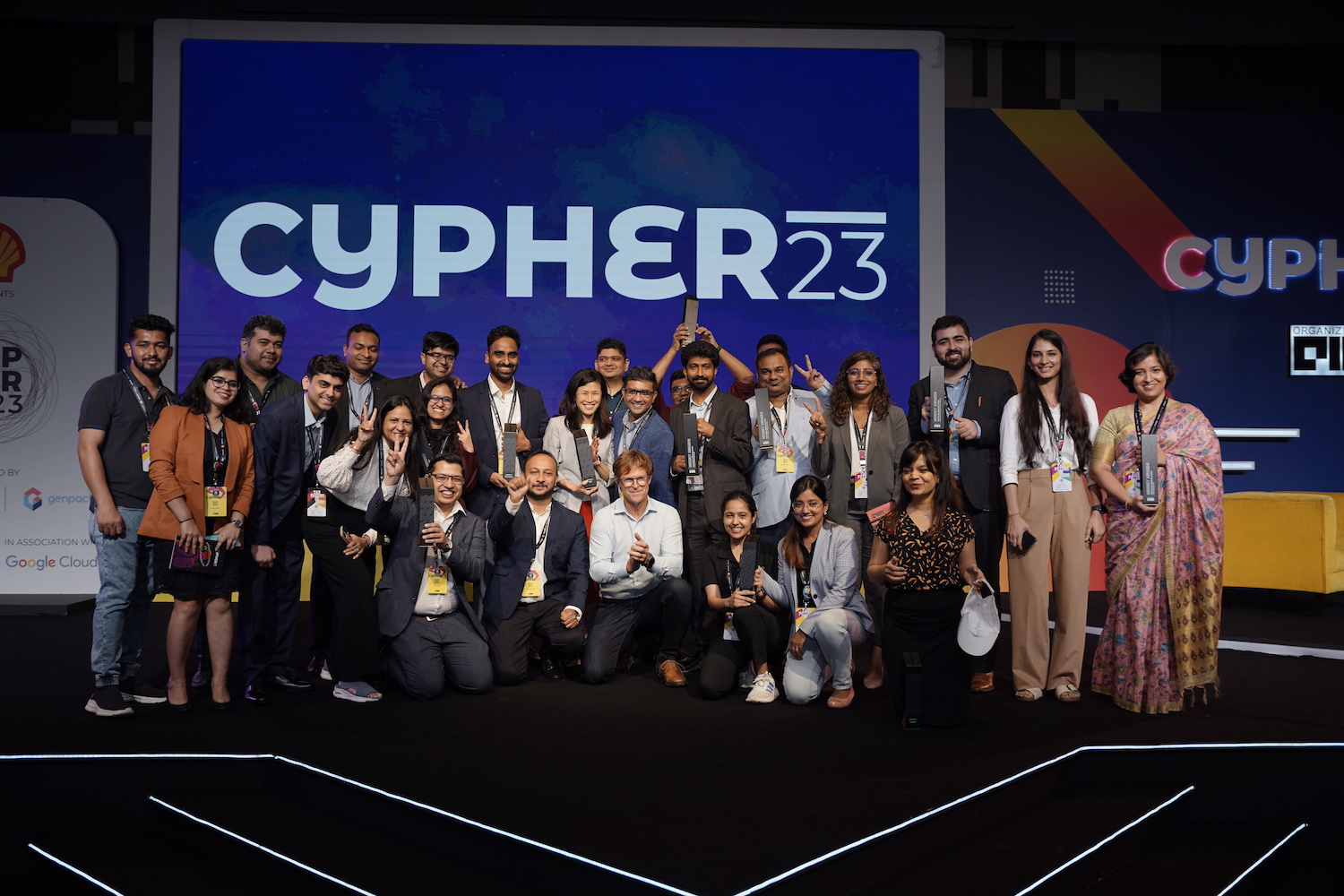
The Minsky Awards for Excellence in AI 2023: A Night of Innovation and Impact

The Minsky Awards for Excellence in AI, presented at Cypher 2023, celebrated its fifth edition this year. The event was a grand affair that brought together the brightest minds in the field of artificial intelligence (AI), machine learning, and robotics. The awards aim to recognize and honor the transformative efforts that organizations and individuals are making in the AI landscape.

A Commitment to Transparency and Fairness

The Minsky Awards stand out for their commitment to transparency and fairness. There are no hidden fees or costs involved, which adds to the integrity and significance of these esteemed honors. The awards are evaluated based on three key criteria:

  1. Innovation: The degree to which the work represents a new idea or approach.
  2. Impact: The significance of the work in its field or for end-users.
  3. Quality of Contribution: The rigor of the methodology and validity of the claims.

Esteemed Panel of Judges

The awards boasted a distinguished panel of judges, including industry luminaries and thought leaders like Faten Abdullatif, Chief Big Data Specialist at Roads and Transport Authority of Dubai, and Dr. Geraldine Wong, Chief Data Officer at GXS Bank. Their collective wisdom ensured the integrity and prestige of the Minsky Awards.

Award Categories

AI for Community Welfare Award

The first award of the night, the “AI for Community Welfare Award,” was presented to LatentView Analytics for their partnership with the International Myeloma Foundation. Their AI-powered platform has significantly impacted healthcare and community support.

AI for Social Impact Award

Code Vipassana, a non-profit program founded by a Googler, won the “AI for Social Impact Award.” The initiative has empowered over 5,000 developers across the country this year, focusing on hands-on learning in developing real-world AI and ML applications using Google Cloud.

AI for Sustainability Award

EY’s Business Consulting Team was honored with the “AI for Sustainability Award” for their innovative work in enterprise risk and sustainable finance. Their product, Supply Chain Cognitive, focuses on monitoring and assessing supply chain emissions.

AI Leadership Award

Shell received the “AI Leadership Award” for their remarkable journey in enterprise AI. Their AI initiatives have led to groundbreaking successes, from real-time failure prediction algorithms to production optimization.

AI-Driven Retail & Supply Chain Excellence by a GCC Award

Target Corporation was honored for their exceptional work in leveraging AI to revolutionize retail and supply chain management. Though the details are confidential, their initiatives are groundbreaking.

AI-Enhanced Data Analytics Excellence Award

Accenture took home the “AI-Enhanced Data Analytics Excellence Award” for their groundbreaking work in optimizing marketing channels and ROI for a global beauty client. Using Deep Neural Networks for predictive Customer Lifetime Value, the project delivered high incremental revenue with an average lift of 65-80% and a Return on Ad Spend of 1.5-2X.

Best AI Implementation by a Service Provider

Tiger Analytics won the “Best AI Implementation by a Service Provider” for their revolutionary AI-driven solution, TA InsightsPro. The platform autonomously generates custom insights and has been implemented across multiple industries, leading to a projected 30% growth in Tiger Analytics’ Generative AI-related revenue.

Best AI Implementation in a GCC/Captive Environment

DBS Technology Services India Private Limited was honored for their comprehensive ATM Analytics solution. This AI-driven platform has significantly reduced ATM cash outs and optimized cash allocation, aligning with the stringent policies set by the Reserve Bank of India.

Best AI-Enabled Business Strategy in an Indian Firm

Colgate-Palmolive won the “Best AI-Enabled Business Strategy in an Indian Firm” for their project “Amazon Ascend: Scaling Product Visibility with LLM’s Keyword Stuffing on Product Pages.” The project improved the organic rank of their Visible White Organic portfolio on Amazon from 25 to 16 within just three months.

Best Industry-Academia Collaboration in AI

Renault Nissan Technology and Business Center India Private Limited (RNTBCI) was honored for their active collaboration with multiple academic institutions like IIT Madras, Great Learning Academy, ICT Academy, SRM University, and VIT.

Breakthrough AI Technology

Tredence Inc was awarded for their groundbreaking ATOM.AI platform, a comprehensive AI accelerator ecosystem that has generated a staggering $400M in revenue impact for a global CPG leader.

Data Engineering Excellence in a GCC/Captive Environment

Rakuten was honored for their Data Observability as a Service (DOaaS), which enhances data quality and tackles challenges like data downtime and latency issues.

Excellence in AI Research by an Indian Firm

Grasim – Pulp & Fibre won for their Automated Visual Inspection System, which has revolutionized the inspection of critical assets in their Spinning production.

Excellence in AI Strategy Consulting

Merkle was awarded for their Unified Marketing Solution, which has cut third-party demographic data costs by 100% and achieved an 80% success rate in show recommendations.

Excellence in AI Talent Development within GCC/Captives

Futurense Technologies was honored for innovatively integrating ChatGPT into their data engineering curriculum, reducing training time by 11%.

GCC AI Visionary Award

JPMorgan was celebrated for being at the forefront of AI and ML solutions, tackling complex banking issues from supplier identification to cloud migration.

Leading AI Service Provider

Genpact was honored for their comprehensive suite of services, from AI/ML advisory and strategy consulting to full-stack implementation.

Leading Domestic Indian Firm in AI Innovation

Max Life Insurance was awarded for embedding intelligence across 80% of their core business processes, leading to a 50% improvement in lead conversion rates.

Leading GCC/Captive for AI Innovation

Chubb was honored for their India-based center of excellence, CBSI, and their standout product, Chubb Studio.

Most Innovative Use of AI in Service Delivery

EXL Service was awarded for their AI product that personalizes cashback rewards in real-time for over 50 million customers.

Outstanding AI Product by a Domestic Indian Firm

HDFC Bank Ltd was honored for their AI platform that’s a game-changer in tackling Non-Performing Assets.

Outstanding AI-Powered Business Transformation in GCC/Captives

HSBC was awarded for their “Mis-sell Detective,” an AI solution that uses machine learning to identify instances of mis-selling with incredible precision.

Rising Star GCC in AI

Jet2 Travel Technologies, based in Pune, was celebrated as a game-changer in the travel industry.

AI-Driven Business Impact Award

Course5 Intelligence Limited was honored for their AI-driven Augmented Analytics platform, Course5 Discovery.

What an incredible evening it’s been, celebrating the best and brightest in the world of AI! We’ve seen some truly groundbreaking work tonight, and it’s clear that the future of AI is in excellent hands. Remember, the Minsky Awards for Excellence in AI 2023 are not just any awards; they are the Oscars of the AI industry!

The post The Minsky Awards for Excellence in AI 2023: A Night of Innovation and Impact appeared first on Analytics India Magazine.

TCS Seeks a Boost in AI Partnership with Microsoft

TCS Seeks a Boost in AI Partnership with Microsoft

According to reports, TCS has decided to strengthen its partnership with Microsoft to develop AI-based software services. The collaboration with Azure OpenAI, formed by Microsoft and OpenAI, involves using the cloud-based AI tool GitHub Copilot.

This tool is being applied to offer various solutions like fraud detection for financial services and personalised customer services for retailers. The goal is to improve profit margins, as mentioned by TCS‘s CEO K Krithivasan in an interview with Bloomberg.

The partnership’s focus is on creating industry-specific solutions for the market. However, the timeline for achieving significant market impact remains uncertain, with estimations suggesting it could take at least a couple of quarters.

TCS is incorporating AI technology into its software offerings, which is proving beneficial in securing substantial business deals. Krithivasan, who took on the role of CEO in June, has also initiated organisational changes to better leverage the expertise of senior executives and enhance client relationships.

As traditional outsourcing faces margin pressures due to economic concerns and geopolitical tensions, Indian IT firms are shifting their focus to technologies such as big data, machine learning, analytics, cloud computing, and AI to help clients revitalise their businesses and remain competitive against agile startups.

TCS’s CEO Krithivasan emphasised the commitment to align more closely with clients’ future investments and enhance capabilities for deeper engagement with these transformations. “We will continue to enhance our capabilities so that we can participate more,” he said.

Similarly, in May, TCS also announced that it is partnering with Google to offer its cloud generative AI services, Vertex AI, for its Model Garden, and offering solutions for its customers.

The post TCS Seeks a Boost in AI Partnership with Microsoft appeared first on Analytics India Magazine.

Why OpenAI Should Acquire Graphcore

OpenAI Graphcore

AI has been a very competitive space since the end of 2022, and OpenAI has been the leader through all of it. Having championed the software side of it, now the Sam Altman led organisation is looking to foray into the hardware industry. There has been a buzz around a report from Reuters that OpenAI is planning to develop its own AI chips.

AIM reached out to OpenAI, but the company did not respond. It is possibly busy with its first ever DevDay conference happening on November 6, 2023.

Amidst the much spoken about chip shortage in the industry, this move by OpenAI is after several companies such as Microsoft, Google, Amazon, and Apple also announced that they are developing their own AI chips. But even with such high demand for AI hardware, apart from NVIDIA, all the other companies are struggling to emerge, one of them is Graphcore.

Graphcore, the startup that signed a deal with Microsoft in 2019 for buying processors, is now desperately in need of funding. The startup that turned into a unicorn in less than four years, had reported a revenue of $2.7 million in 2022, which is a fall from 46% in 2021. Losses have risen 11% to 204.6 million as well, which the company says is “due to lower hardware sales to key strategic customers.”

New customer on the way

One of the “key strategic customers” that Graphcore is speaking of is possibly Microsoft. Ever since Microsoft has backed OpenAI, the company has also been using NVIDIA chips for almost all of the workings, dropping the use of Graphcore chips in its cloud computing system, resulting in a decline of funds for the chipmaker.

Since its last funding round in 2020, Graphcore has been valued at $2.5 billion. Since then the company hasn’t raised any funds. The UK-based company also requested the government to include chipmakers in the recent Brunel AI project, which aims for building a new AI supercomputer with a $1.1 billion fund. But still, the deal hasn’t come through. If the government actually accepts the deal, Graphcore can rise up to its status of being an NVIDIA-rival again.

On the other hand, there is OpenAI. According to a recent report by the Information, Sam Altman has said that the company is generating revenue at a pace of $1.3 billion in a year. Now that the company is planning to make its own AI chips. It might be a great strategic move for the company to realise its ambition of its own AI chips, and actually save Graphcore at the same time.

Potential @OpenAI acquisition of/investment in @graphcoreai will completely shake up the AI chip space. But their own backer (@Microsoft ) dumped graphcores chips already so will prob feel more like a bailout at first.

— DANIΞL ➪ ।|। ❘|❘ (@daniel0x53) October 14, 2023

OpenAI currently has the financial strength, as exemplified by its revenue growth, to make strategic moves in the AI hardware space. It has already contemplated acquiring a chipmaking firm or building its own chips. By making an early investment in Graphcore, OpenAI can not only secure a reliable supply of AI chips but also pave the way for a potentially transformative partnership, and also open up the market for other players.

What about Microsoft?

As mentioned earlier, Microsoft, the major OpenAI backer, is also developing its own AI chips. According to reports, Microsoft and OpenAI’s employees have been testing and trying out the chips in secret since April, which is codenamed Athena.

Furthermore, d-Matrix, an AI chip startup also raised $110 million with a backing from Microsoft. Though the company does not make direct competitors to NVIDIA’s chips, it is still a pocket friendly alternative for Microsoft for the inference portion of AI models.

Anyhow, both of these news hints that the ChatGPT creator companies might be trying to avoid the costs of NVIDIA GPUs for building AI models.

But when it comes to OpenAI’s foray into the hardware market, it seems like the company’s departure from Microsoft, and indeed NVIDIA as well, in certain ways. OpenAI has plans to build its own “iPhone of AI”, and raising funds from SoftBank, according to several reports. Though not a phone, a new product is definitely in the making. An acquisition of Graphcore might just be the right pick for the company to host its own in-house capabilities in the near future.

Meanwhile, almost all the companies are trying to have what NVIDIA already has and are developing their own AI chips, such as AMD, Intel, and Cerebras. There is no guarantee that OpenAI might actually go ahead with the deal since it is also assessing a lot of other targets.

The post Why OpenAI Should Acquire Graphcore appeared first on Analytics India Magazine.

AI’s Kryptonite: Data Quality

Slide1-5

The ability of Generative AI (GenAI) tools to deliver accurate and reliable outputs entirely depends on the accuracy and reliability of the data used to train the Large Language Models (LLMs) that power the GenAI tool. Unfortunately, the Law of GIGO – Garbage In, Garbage Out – threatens the widespread adoption of GenAI. Whether generating management reports or developing machine learning models, our analytical results’ accuracy, quality, and reliability are inherently connected to the accuracy, quality, and reliability of the underlying data.

GenAI tools have unbelievable superpowers, such as generating realistic images, writing engaging texts, composing original music, writing software code, researching operational problems, and more. Unfortunately, just like Superman has a weakness to kryptonite, AI models have a weakness to poor data quality. Poor data quality can degrade AI models’ performance and produce unreliable or harmful outcomes. For example, if an AI model is trained on data that contains biases, errors, or inconsistencies, it will generate outputs that have biases, errors, or inconsistencies. This can lead to severe consequences, such as discrimination, misinformation, or loss of trust.

Data quality is the kryptonite of AI models, and we must put data quality front and center when creating GenAI applications. Otherwise, we might end up with a Superman who is not so super.

And while data quality is a problem for which every industry must contend, nowhere are the ramifications more dire than in healthcare.

Reengineering of Patient Health Data

Researching the following question: “What percentage of Patient Health Records are populated with inaccurate data because nurses, doctors, and administrators have re-engineered the data due to insurance and liability reasons?” yielded some disturbing results.

Studies have suggested that this practice may be more common than expected and can negatively affect patient safety and quality of care. One study from 2018 found that 28% of nurses admitted to altering patient records to avoid blame or litigation, and 31% said they had witnessed their colleagues doing the same. Another study from 2019 reported that 18% of physicians had deliberately manipulated or withheld clinical information in the past year to increase their reimbursement or reduce their liability. These findings indicate that data re-engineering is not a rare phenomenon but a widespread and systemic issue in healthcare.

Data re-engineering can affect the accuracy and completeness of patient health records, leading to errors in diagnosis, treatment, billing, and reporting. For example, if a nurse documents a patient’s vital signs as normal when they are abnormal, this could delay detecting a severe condition or complication. If a physician codes a patient’s diagnosis as more severe than it actually is, this could result in over-treatment, unnecessary tests, or higher charges.

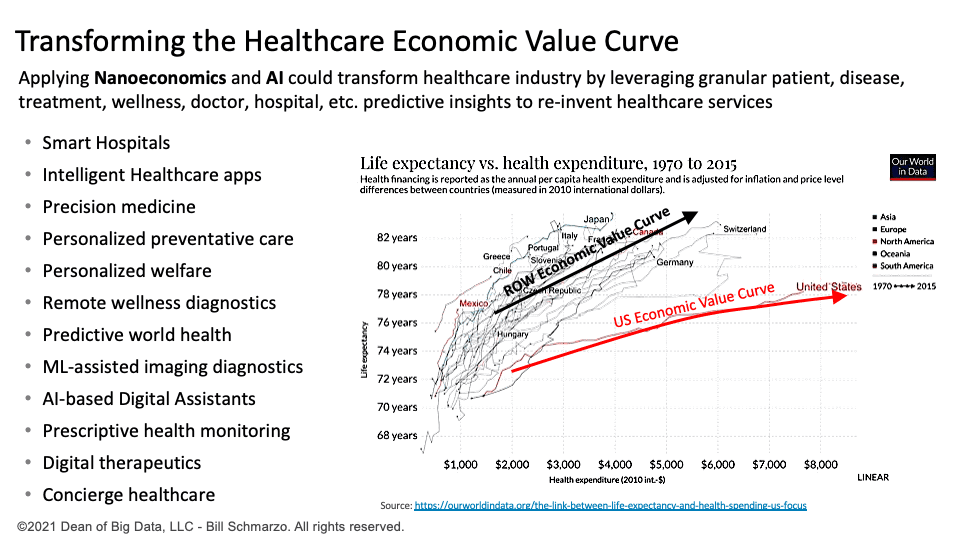
Data re-engineering to avoid insurance payment and legal liability issues can significantly hinder the applicability of leveraging AI to deliver better patient outcomes, more reasonable prices, and an improved health worker environment that can transform the healthcare economic value curve (Figure 1).

Slide2-2

Figure 1: Healthcare Economic Value Curve

And it isn’t just the healthcare systems that must deal with re-engineered and distorted data. Using AI in judicial decisions can yield inaccurate and unreliable outcomes due to distortions in the data introduced by plea bargaining.

Plea bargaining involves defendants pleading guilty to lesser charges or reduced sentences. Plea bargaining can skew the official records of crime, conviction, sentencing patterns, and recidivism rates and significantly impact the AI models’ abilities to deliver meaningful, relevant, responsible, and ethical outcomes.

Fixing the Data Quality Problem

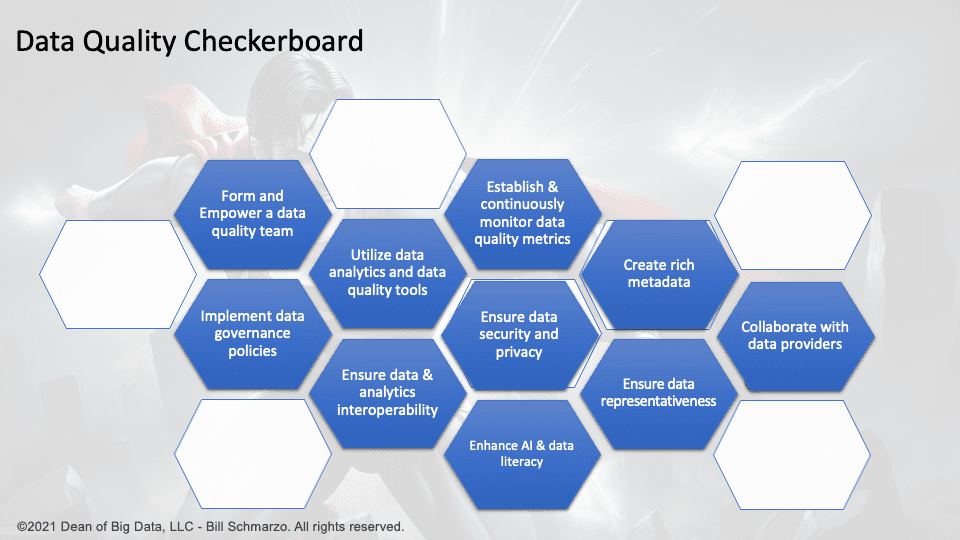
If Data Quality is the kryptonite to our AI aspirations, there are ten actions that an organization can take to address the data quality problems that render AI models inaccurate, unreliable, and powerless:

  1. Implement data governance policies. A robust data governance framework should be in place to define data quality standards, processes, and roles. This helps create a culture of data quality and ensures that data management practices are aligned with organizational goals. Define ownership, accountability, and responsibility for data quality across the organization.
  2. Utilize data analytics and data quality tools. There are many tools available that can help detect, measure, and resolve data quality issues. These tools can automate data cleansing, validation, transformation, and enrichment tasks.
  3. Form and Empower a data quality team. A dedicated team of data quality experts should oversee and execute data quality initiatives. The team should collaborate with other stakeholders, such as data owners, providers, users, and analysts.
  4. Establish and continuously monitor data quality metrics. Data quality metrics should be defined and tracked to measure the performance and impact of data quality efforts. Collect user feedback, conduct audits, apply corrective actions, and use data quality processes and tools to automate data cleaning, validation, enrichment, and monitoring.
  5. Ensure data representativeness. Data diversity and representativeness refer to the extent to which the data reflects the real-world phenomena and populations the AI models aim to capture and serve. They should be ensured by collecting and analyzing data from various sources, domains, and perspectives.
  6. Ensure data security and privacy. Protect the data from unauthorized access, use, modification, tampering, or disclosure. Implement appropriate policies and technologies to encrypt, anonymize, or mask the data as needed. Comply with the relevant laws and regulations regarding data protection and consent.
  7. Ensure data and analytics interoperability. Enable the exchange and integration of data and analytics across different systems. Data and analytics interoperability can facilitate the sharing and collaboration of data and analytics across various stakeholders in identifying and addressing data quality and data inconsistency problems.
  8. Create rich metadata. Provide clear and accurate information about the data sources, definitions, formats, methods, assumptions, limitations, and quality indicators. Use standardized and consistent terminology and formats for the data documentation and metadata.
  9. Collaborate with data providers. Collaborate with critical data and application providers in addressing data quality problems at the source. They should be involved in ensuring data quality by providing clear documentation, metadata, and feedback mechanisms.
  10. Enhance AI & data literacy. Data literacy and education are the skills and knowledge required to effectively understand, use, and communicate with data. They should be enhanced by providing training, guidance, and best practices to all levels of the organization.
Slide3-3

Leveraging AI / ML to Help with Data Quality

One of the most significant data quality opportunities is using AI / ML to automate identifying and resolving data quality problems. This includes:

  • Duplicate detection: ML can identify and remove duplicate records in a dataset, such as customer profiles, product listings, or invoices. For example, an ML model can learn to compare different records based on their attributes, such as name, address, email, phone number, etc., and assign a similarity score to each pair of records. If the score exceeds a certain threshold, the records are considered duplicates and can be merged or deleted.
  • Outlier detection: ML can help detect and correct values significantly different from the rest of the data, such as typos, errors, or anomalies. For example, an ML model can learn to identify the normal range and distribution of values for each attribute in a dataset, such as age, income, temperature, etc., and flag any values that fall outside the expected range or deviate from the pattern. These values can then be verified or replaced with more reasonable ones.
  • Missing value imputation: ML can help fill in the gaps in a dataset where some values are missing or unknown, such as survey responses, sensor readings, or ratings. For example, an ML model can learn to predict the missing values based on the available values and their relationships. This can help improve the completeness and accuracy of the data.
  • Data enrichment: ML can help enhance and augment the data with additional information or features not present in the original dataset, such as geolocation, sentiment, category, or recommendation. For example, an ML model can add relevant information from external sources like web pages, social media, or public databases. This can help increase the richness and usefulness of the data.

!! Important Message to Data Quality Advocates !!

Data quality advocates have a once-in-a-lifetime opportunity to make their data quality message compelling to senior business executives. Given the untold business potential of AI, business leadership is finally willing to listen to a plan that improves data quality and unleashes the economic power of AI.

But if your message is only about data quality, then your message and mission will fail. Instead, make the conversation about value creation and then highlight data quality’s role in delivering value.

Remember, data quality is an end to their value creation means in ensuring that their AI models deliver meaningful, relevant, responsible, and ethical outcomes.

Data Advocates, your day has finally come!

How generative AI is creeping into EV battery development

How generative AI is creeping into EV battery development

Aionics founders say their AI tools are super charging research

Kirsten Korosec 9 hours

Ten billion. That’s how many commercially procurable molecules are available today. Start looking at them in groups of five — the typical combination used to make electrolyte materials in batteries — and it increases to 10 to the 47th power.

For those counting, that’s a lot.

All of those combinations matter in the world of batteries. Find the right mixture of electrolyte materials and you can end up with a faster charging, more energy dense battery for an EV, the grid or even an electric airplane. The downside? Similar to the drug discovery process, it can take more than a decade and thousands of failures to find the right fit.

That’s where founders of startup Aionics say their AI tools can speed things up.

“The problem is there’s too many candidates and not enough time,” Aionics co-founder and CEO Austin Sendek told TechCrunch during the recent Up Summit event in Dallas.

aionics team

Dr. Lenson Pellouchoud, co-founder and CTO; Dr. Austin Sendek, co-founder and CEO and Dr. Venkat Viswanathan, co-founder and chief scientist Image credits: Aionics

Electrolytes, meet AI

Lithium-ion batteries contain three critical building blocks. There are two electrodes, an anode (negative) on one side and a cathode (positive) on the other. An electrolyte typically sits in the middle and acts as the courier to move ions between the electrodes when charging and discharging.

Aionics is focused on the electrolyte and it’s using an AI toolkit to accelerate discovery and ultimately deliver better batteries. Aionics approach to catalyst discovery has also attracted investors. The Palo Alto-based startup, which was founded in 2020, has raised $3.5 million to date, including a $3.2 million seed round from investors that included UP.Partners.

The startup is already working with several companies, including Porsche’s battery manufacturing subsidiary Cellforce. The company has also worked with energy storage firm Form Energy, Japanese materials and chemical maker Showa Denko (now Resonac) and battery tech company Cuberg.

This whole process starts with a company’s wish list — or performance profile — for a battery. Aionics scientists, using AI-accelerated quantum mechanics, can run experiments on an existing database of billions of known molecules. This allows them to consider 10,000 candidates every second, Sendek said. That AI model learns how to predict the outcome of the next simulation and helps select the next molecule candidate. Every time it runs, more data is generated and it gets better at solving the problem.

Enter generative AI

Aionics has taken this a step further, in some cases, by bringing generative AI into the mix. Instead of relying on the billions of known molecules, Aionics started using this year generative AI models trained on existing battery materials data to create or design new molecules targeted at a certain application.

The company is super-charging its effort by using software developed in the Accelerated Computational Electrochemical systems Discovery program at Carnegie Mellon University. Venkat Viswanathan, who was associate professor at CMU and led that program, is co-founder and chief scientist at Aionics.

Aionics has also started using large language models built on GPT 4 from OpenAI to help its scientists winnow down the millions of possible formulations before they even start running them through the database. This chatbot tool, which has been trained on chemistry textbooks and scientific papers selected by Aionics, isn’t used for the actual discovery, but it can be used by scientists to eliminate certain molecules that wouldn’t be useful in a particular application, Sendek explained.

Once trained with those textbooks, LLMs allow the scientist to query the model. “If you can talk to your textbook, what would you ask it?” Sendek said. But he was quick to note that this isn’t doing anything different than a person curating scientific papers. “This is just providing some next level interaction,” he said, adding that everything is verifiable by pointing back to the sources used to train the chatbot.

“I think what is good for our field is that we’re not looking for specific facts, we’re looking for design principles,” he said as he explained the chatbot feature.

Picking a winner

Once the billions of candidates have been screened and narrowed down to just a couple — or designed using the generative AI model — Aionics sends its customer samples for validation.

“If we don’t get on the first round, we iterate and we can run some clinical trials to prove it until we get to the winner,” Sendek said. “And once we find the winner, we work with our manufacturing partners to scale that manufacturing and bring it to market.”

Curiously, this process is even being used in some novel areas like cement. Chement, a startup co-founded by Viswanathan and that is also partnered with Aionics, is working on ways to to use renewable electricity and raw materials to drive chemical reactions to make zero-emissions products like cement.

Cypher 2023: Microsoft Wants Every Enterprise to Build Their Own ChatGPT

Microsoft wants enterprises to have their own models. The tech giant believes that the time for POCs is over, and ChatGPT was one of the biggest and most successful POCs. With new techniques like RAG and fine-tuning, the time is perfect for enterprises to move forward.

Rohini Srivathsa, CTO Microsoft India and South Asia, at Cypher, spoke about how the last year has seen speed and agility in the innovation around artificial intelligence. “If I were to talk about technology trends and implementing AI for businesses, I would have probably said the same things. What has now changed is the context,” she explained.

She addressed the hype around AI and mentioned how this isn’t a new phenomenon at all. “We’ve had AI from analytics, machine learning, deep learning, foundation models, and now generative AI which won’t be the last invention either,” she said.

AI strategy for businesses

To build a strategy around AI it is essential to understand the term itself. She explained that AI has evolved over the years. “Now, you don’t train different models for different purposes. A large language model is able to solve mathematical problems,” she said, giving an example.

AI is no more what happens in the backend, it isn’t machine learning models alone but also an accessible user interface. “ChatGPT is old news now but it is a brilliant business model because millions of people are able to interact with the model.”

The models are now trained on so much data now they’ve gained something known as ‘emergent capabilities’. “Yes, the language model works on billions of parameters but what it does look like is reasoning. It takes a text and analyses the information and then succinctly gives it responds to the prompt,” she demonstrated with an example.

These emergent capabilities or multimodalities of this wonderful technology she says can be harnessed by every business if only they have the right approach from the start. “It isn’t new for companies to adopt AI but only a portion of them are able to scale and the reason is that we’re not thinking of business first.” Dr. Srivathsa explained.

First she says pick a use-case. Elaborating the most popular ones of AI are content generation, summarisation, code generation, semantic search etc. From here build a niche. “Summarisation can be used in the legal or medical field, for example. There is a major opportunity in these fields which has a dearth of AI tools,” she explained.

It is essential to be very clear about the business problem AI needs to solve. This problem and solution needs to be measured. “‘What gets measured gets done,’ is a wise rule to go by. And have a portfolio approach,” Dr. Srivathsa said. A portfolio approach means knowing that not one program or product will meet all the business needs, and that the company’s needs and goals might change over time.

The technology strategy that most companies are looking at falls in two categories, building custom models or fine-tuning existing ones. Gartner’s analysis suggests that over 80 percent of companies are engaged in building pre-trained models. “What determines this is thinking about the company’s data estate,” she explained. According to Dr. Srivathsa, the scale of the organisation, the kind of security and the amount of data are the key deciding factors on the kind of approach a company should consider.

AI and Microsoft

According to Dr. Rohini Srivathsa, CTO of Microsoft India and South Asia Microsoft is betting heavily on Copilot. They’re integrating Copilot to every possible product. Microsoft has already integrated it to all their applications on the Microsoft Office suite. Further, Bing is evolving to be a more effective search engine. The chatbot is now designed to give out contextual information with links according to Dr. Srivathsa.

Talking about their flagship search engine, “Microsoft Bing is changing how we search for information, by also providing context and being more conversational, users can rely on Bing which also provides indices and sources.”

“This has been a long journey at Microsoft with the company examining existing laws and building policies around security of the users data. Microsoft Research is dedicated to AI responsibility, along with engineering these systems,” she concluded.

The post Cypher 2023: Microsoft Wants Every Enterprise to Build Their Own ChatGPT appeared first on Analytics India Magazine.

Google promises to back generative AI users against copyright claims

pink umbrella in a rain shower, conceptually photographed

Let's say you're a graphic designer and decide to use Duet AI to generate images when you're creating an eye-catching presentation for a client. Later on, an illustrator claims one of the images on the slide is eerily similar to one they've created and decides to sue you for copyright infringement. Google is now promising to have your back.

Google just announced it will defend Google Cloud and Workspace users against intellectual property lawsuits related to the use of generative AI.

Also: Google finally adds AI text-to-image generation, but it's not where you think

Copyright infringement in the use of generative AI is a controversial topic right now. To this end, Microsoft and other tech companies have also made similar commitments as Google is making now.

Just last month, Microsoft announced its Copilot Copyright Commitment, promising to assume responsibility for legal risks associated with copyright claims made on AI-generated output created using Microsoft Copilot services.

Also: The ethics of generative AI: How we can harness this powerful technology

Google Cloud and Workspace customers will enjoy indemnity for third-party copyright claims related to training data and generated output. These users are protected against claims that Google's use of training data or the content they create using generative AI services infringes on a third party's intellectual property.

Google grants this indemnity to users who follow its responsible use of AI guidelines by not intentionally infringing on someone else's intellectual property. If a user tries to create an image with AI by asking for a specific piece of artwork or uploading copyrighted content, Google will not own responsibility for copyright infringement.

Also: Implementing AI into software engineering? Here's everything you need to know

This is an effort to emphasize the partnership between Google and its customers, but it's sure to also give some respite to generative AI users. The respite for the artists whose works have been used to train many large language models behind some generative AI tools is yet to come.

Artificial Intelligence

Ripcord, the Steve Wozniak-backed file scanning startup, is raising new cash

Ripcord, the Steve Wozniak-backed file scanning startup, is raising new cash Kyle Wiggers 8 hours

Ripcord, a startup developing robots that can automatically digitize paper records, is hoping to raise $20 million to $25 million in a new funding round that would value the company at $110 million pre-money, according to a source familiar with the matter and a pitch deck viewed by TechCrunch.

Alphabet’s GV, Lux Capital and MUFG are in talks to participate in the round. GV and Lux previously invested in Ripcord; MUFG, a Japanese bank chain, appears to be a new backer.

We reached out to Ripcord’s marketing director, Molly Vernarecci, via LinkedIn for comment. She didn’t respond by publication time.

The round, if successful, would bring Ripcord’s total raised to around $150 million — the bulk of which came from previous investors Kleiner Perkins, Silicon Valley Bank, Tyche Partners, Icon Ventures and Baidu. Notably, Steve Wozniak, the Apple co-founder, participated in Ripcord’s series A.

The new round would also be significantly smaller than Ripcord’s last tranche, a Series B, which closed at $45 million. The reason wasn’t immediately clear — nor was the reason for the relatively lengthy gap, three years, between Ripcord’s outside infusions.

Ripcord has found itself at the center of controversy before, which could have something to do with it.

In 2018, former Ripcord employee Perry Coneybeer alleged improper behavior by then-CEO Alex Fielding and several other unnamed employees. In a Medium post, Coneybeer claimed that Fielding told graphic, sexually-tinged stories and made crude remarks about her breast milk pumping — and that she was retaliated against for reporting an employee’s inappropriate sexual behavior to HR.

In response to the allegations, Ripcord said that its board of directors would investigate and “take appropriate action.” Three years later, Fielding became the director of the board — a position he retained for two and a half years before leaving Ripcord to found space startup Privateer.

In the pitch deck shared with TechCrunch, Ripcord claims to have secured a “pivotal deal” with the IRS for tax document processing worth over $4 million and an expanded deal with the U.S. Air Force. MUFG is a customer in addition to being an investor, the pitch deck reveals, with an annual contract value of $5 million. And Ripcord says it’s in the final stages of a large deal with Wells Fargo.

Ripcord

Image Credits: Ripcord

In 2020, Ripcord claimed to be processing over 1 billion pages per year for customers like Coca-Cola, BP, Chevron, UCLA, Cantium and a number of Fortune 100 companies — including three of the top five financial services companies and three of the top five insurance carriers. Coca-Cola remains a customer, according to the pitch deck. But the status of several of the others is unclear.

Nevertheless, Ripcord’s revenue was $11.8 million in 2022, up from $5.9 million in 2021, per the pitch deck. The company, which isn’t currently profitable, expects to end 2023 with $22.5 million in revenue — and reach $49.2 million in revenue by Q4 2024.

Ripcord was founded by three entrepreneurs, Fielding (a former Apple engineer), Kim Lembo (a NASA veteran) and Kevin Hall. The company develops physical robots that autonomously scan documents, even removing staples. Through partnerships with logistics firms, Ripcord transports files containing barcoded labels with metadata to its facilities, where it scans them and either stores them to meet compliance requirements or shreds and recycles them.

Ripcord makes most of its money by charging for document scans, about $0.08 to $0.25 per image.

Employing computer vision, lifting and positioning arms, and RGB cameras, Ripcord’s robots are able to handle a range of document formats while classifying and extracting data. On the software side, the company’s platform, which integrates with a range of third-party business intelligence and data processing software, uploads documents to the cloud and converts them to searchable PDFs.

To fuel its next phase of growth, Ripcord — fresh off of an integration partnership with OpenAI — is developing a generative AI tool that the startup had intended to launch in September, according to the pitch deck. Called Docufai, the freemium tool is designed for document discovery, providing a way for customers to ask questions about scanned documents and get answers.

The pitch deck shows Ripcord’s proposed product roadmap for Docufai, which includes a future document translation feature, a capability to find related documents and sharing features including a collaborative notebook. Ripcord aims to onboard 1,000 users to Docufai by the end of Q3 2023 and release a paid tier — followed by teams and enterprise tiers — at some point in 2024.

Adobe’s new generative AI tool is a game-changer for video editing

Generative Fill video announcement

Adobe's editing applications, such as Photoshop, Lightroom, and Premiere, have been the cornerstone of many creatives' everyday workflows. Since the rise of generative AI, Adobe has been developing ways to optimize those workflows, and this one will be a huge help for video editors.

At Adobe MAX, the company's annual creative conference, the company teased Project Fast Fill for video, which will allow users to enter simple text prompts to edit their video.

Also: Adobe unveils three new generative AI models, including the next generation of Firefly

Specifically, users will be able to remove or add an object, or change background elements in seconds with a quick text prompt, tasks that would typically take intense editing to do.

The company shares that Project Fast Fill harnesses its popular Generative Fill to bring generative AI into its video editing applications.

The demos the company presented at the event showcased different potential uses. In the first example, the presenter, Adobe research engineer Gabriel Huang, cleanly removes people from the background of a video, as seen below.

In the second example, Huang adds a tie to a man who is walking towards the camera by simply inputting the text prompt "tie" into Generative Fill after selecting the area of the collar.

In both instances, Generative Fill generated four different video results, which Huang got to choose from to develop the final product.

Also: How Adobe is leveraging generative AI in customer experience upgrades

Even though the edit is only being done on one frame of the video, much like you would with a photo, the tool is automatically applied to all of the frames of the video and automatically adjusts for lighting changes, shadows, the object moving, and more.

Since it was only a sneak peek, there are no details on when Project Fast Fill will be available, with Adobe saying that the sneak peeks are "cutting-edge, experimental technologies that could someday become features in Adobe products."

Founders, are events useful?

Founders, are events useful? Haje Jan Kamps 8 hours

Welcome to Startups Weekly. Sign up here to get it in your inbox every Friday.

A few months ago, Alexis Ohanian, the co-founder of Reddit, tweeted that if he could go back in time and do one thing differently when he was building Reddit, he would have spent significantly less time attending events. Personally I have a different experience — I always regret getting on a plane (or in an Uber, for that matter) to go to an event. However, as I’m traveling back, I’ve never regretted it: There’s always something magical that comes out of going to an event, in my experience.

Our TC+ team is not interested in anecdotes, however: neither mine nor Alexis’. So, like the data-driven journalists they are, they surveyed more than 50 founders, trying to figure out whether attending events still makes sense in 2023.

Spoiler alert: There isn’t a real consensus, but there are some really good pros and cons. The article is well worth a read, to figure out in which circumstances you can expect a decent return on investment on your event-going antics.

Today’s newsletter is going to be a bit more to the point than usual: I’m laid up at home with pneumonia (yes, I really am an 86-year-old grandmother. Surprise!), so forgive the antibiotics-addled ramblings this week. I hope I’ll be back with non-pharmaceutically-enhanced ramblings next week.

Artificial intelligence: Y’all just can’t get enough

Captcha, I am not a robot on laptop screen.

Image Credits: Oleksandr Hruts / Getty Images

Our most-read stories consistently continue to be about AI. No big surprise, perhaps, the AI hype cycle continues apace. This week there’s been a bunch of stories about the seedy underbelly of AI, including how humans are part of the problem, continuing to trick AI systems into generating boobs and 9/11 memes. Oh, humans. We spoke with investors to figure out whether the future of AI has hope for us beyond daft memes. (Spoiler alert: Yes.)

Rumors are swilling that OpenAI may be considering developing its own AI chips. That’s going to get interesting, especially if you’ll recall that Nvidia’s ongoing stock market rally is likely driven by the current boom in AI. The company’s ChatGPT’s mobile app hit a record $4.6 million in revenue last month, but growth is slowing. Oh, and there’s no need to shed tears for Nvidia quite yet; Brian’s piece breaking down how Nvidia became a major player in robotics is super interesting.

Adobe has doubled down on its Firefly generative AI models. This week, Frederic covered how the software can now generate more realistic images and can help artists create vector graphics in Illustrator. Neato.

More on the AI front

If AI can’t go to the mountain, the mountain will come to AI: Dutch startup Tidalflow exits stealth with backing from Google’s Gradient Ventures. It is aiming to help any software play nice with ChatGPT and other LLM ecosystems.

What big eyes you have: Adobe continues to push for easier image editing, showing off its Project Stardust as a sneak preview of its next-gen AI photo editing engine.

Holding back the tide: Creatives across industries are strategizing in a campaign that targets potential corporate abuse of AI technology. The conglomeration is realistic about the ways that musicians and some other creatives could benefit on an individual level from automating parts of their work. The goal is that AI tools “become ways for individual humans to make more money, work less, and compete with the corporations that exploit them.”

Tech you can touch

Google PIxel 8 Pro in white being held, showing the back

Image Credits: Darrell Etherington

A while back I argued that Apple’s new AR headset is a game-changer for startups. It seems that’s likely the case at the high end. But more in the realm of affordability, Meta Quest 3 takes a step closer to mainstream AR/VR, Brian reports.

Not Sonos fast there: Audio company Sonos scored a big $32.5 million win against Google a while back. Now it transpires that the company’s patents were deemed unenforceable and invalid. Whoops. A federal judge threw out the $32.5 million win this week.

When it clicks, it really clicks: We took a deep look at Pixel 8, and our team discovered that it delivers solid performance and design upgrades. The camera got a particularly enthusiastic shout-out, with Darrell declaring that Google’s Pixel 8 Pro camera is the new mobile photography champ, and Brian waxing lyrical about the phone’s picture-snapper in “The camera’s still the thing.”

Who needs computers anyway?: It seems like all our mobile devices may be starting to cannibalize sales of personal computers — Ron reports that PC shipments decline slows in Q3 2023 and that Apple’s sales plunge over 23%.

Let’s get together

VidCon

Image Credits: VidCon

Reddit’s API-powered chaos continues, but it appears that things are starting to resolve a little. Third-party Reddit app Narwhal says it hopes to survive Reddit’s app purge with a subscription plan.

Apropos “getting together,” Amanda reports that VidCon is still kickin’. For the first time, the conference hosted an industry leadership summit, where creator economy experts and creators could hash out their grievances with the state of the business and share ideas to make the job of a creator more sustainable. That makes sense, unlike creators raising venture capital: It’s so eye-wateringly hard to make money as a creator, I’d love to see the pitch that convinces a VC to cut a check to a creator, with a realistic expectation of a venture-scale return.

Maybe they were hiding behind the sofa?: Sarah reports that Mastodon actually has 407K+ more monthly users than it thought — and it seems like Twitter has a lot more traffic than Musk said. Still, the peak now is about the same as it was a decade ago, and it’s unclear what the social platform can do to encourage more growth.

A social social network network: Lauren reports that a former TikTok employee is building a social app for content creators to network and “spill the tea,” so creators can help each other out making better, more engaging content.

X may go ad-free?: It appears that X (formerly Twitter) is testing three tiers of its Premium service, its CEO says. Under the hood, code shows one tier may be ad-free. If it’s also troll free, please take my money right now.

Top reads on TechCrunch this week

A lot of amazing news on the site this week, but if we go by the raw numbers, here are the most popular stories — the ones that I didn’t already cover above, that is.

Passwords? We don’t need no steenkin’ passwords: Passkeys are a phishing-resistant alternative to passwords that allow users to sign in to accounts using the same biometrics or PINs they use to unlock their devices or with a physical security key. Google is now making it the default sign-in method for all users.

2 sec, let me text you some cash: When questioned about Mastercard’s prospects in emerging markets such as India, Mastercard’s CFO Sachin Mehra praised UPI for helping with digitization but voiced reservations about its commercial sustainability, saying it is an “incredibly painful experience” for ecosystem participants.

Bravely browsing — or searching — for a new job . . . : Brave Software, the maker of Brave Browser and Search, confirmed that it has laid off 9% of its workforce across departments.