YouTube gets new AI-powered ads that let brands target special cultural moments

YouTube gets new AI-powered ads that let brands target special cultural moments Sarah Perez @sarahintampa / 7 hours

YouTube is putting Google AI to use for advertisers, the company announced this morning with the introduction of a new advertising package called “Spotlight Moments.” The idea here is to leverage AI to automatically identify the most popular YouTube videos related to a specific cultural moment — like Halloween, a major awards show, such as the Oscars, or a sporting event, for example. The advertiser would then be able to serve ads across video referencing the topic or event across a branded YouTube channel where videos are curated into dynamically updated playlists.

Marketing agency GroupM is already on board with the new AI-powered offering, becoming the first to offer its advertising clients access to Spotlight Moments.

Image Credits: YouTube

Though consumers may interact with Google’s various AI developments through products like its chatbot Bard or integrated AI search experience, SGE, AI is quietly powering a number of other consumer-facing products, including which ads they’re seeing, where and why. The Spotlight Moments product is only one of several AI-powered advances launched by YouTube, joining other AI campaigns like Video Reach and Video View campaigns, which also leverage Google AI.

The company says that advertisers using Video Reach Campaigns with in-stream, in-feed and YouTube Shorts saw their campaigns deliver 54% more reach at a lower 42% CPM compared with in-stream only. Video View campaigns, which launched last month, delivered 40% more views and a 30% lower cost-per-view than in-stream only during tests. Video Reach Campaigns will launch in November, meanwhile.

AI is not new to the world of advertising, where machine learning technology and algorithms have regularly been employed over the years to serve ads and target audiences. But Google has been looking towards a “new era” where generative AI advancements will help to transform how the company sells and places ads. In May, for instance, it introduced a new natural, language conversational experience in Google Ads that helps brands start their campaign creation to make using Search ads easier and allow them to ask AI for suggestions, the way you could ask a colleague.

It’s also using generative AI to automatically create assets for Search ads, which use content from the brand’s home page and their existing ads to craft new headlines and descriptions for their ads. In Performance Max AI campaigns, Google AI can learn about the brand from its website and then populate a campaign with text and relevant assets, including generated images. And it’s integrating ads into its Search Generative Experience, SGE, which offers a conversational way to query Google’s search engine.

OpenAI Aims for a Bolder Presence in the Developer Arena

OpenAI, a major player in the artificial intelligence sphere, is gearing up to introduce significant updates aimed at enhancing the developer experience. Sources from Reuters have hinted that these changes will not only simplify the development process but also make it more cost-effective for developers to craft and market AI-driven applications using OpenAI's suite of technologies.

Stateful API: A Game-Changer in Cost Efficiency

Among the anticipated innovations is the Stateful API, a feature designed to retain request histories using added memory. This implies that documents input into the system wouldn't need to undergo expensive reprocessing with every new interaction. Insiders suggest that such an advancement could potentially reduce the operational costs of certain applications by a factor of up to 20. However, the exact savings are expected to vary depending on the application's nature.

Introducing the Vision API

OpenAI is not just stopping at chat interactions. Another significant rollout on the horizon is the Vision API. This tool will empower developers to conceive scalable solutions geared towards image analysis and elucidation. The introduction of the Vision API is seen as a stepping stone towards fostering a range of multimodal applications encompassing image, audio, and the exciting realm of video processing and creation.

Awaited Announcements at OpenAI's Upcoming Event

All eyes are now on OpenAI's forthcoming first developer conference, where the firm is set to showcase its latest offerings. While OpenAI CEO, Sam Altman, has teased the unveiling of “some great things”, he has also clarified that these announcements won't be as groundbreaking as a GPT-4.5 or GPT-5 release. OpenAI has chosen to remain tight-lipped when questioned about the details shared by Reuters.

OpenAI's Competitive Landscape

While OpenAI holds a prominent position in the commercial AI market, it faces stiff competition in the developer platform domain. Tech giants like Microsoft, Google, and Amazon have an edge with their vast cloud ecosystems, offering a broader range of features and models. OpenAI's challenge lies in maintaining its competitive edge while managing its exclusive ecosystem. Furthermore, Microsoft's extended access to GPT models presents an added layer of competition.

The balance OpenAI needs to strike is intricate. As more app developers roll out AI applications utilizing models from OpenAI and other providers, the market share for individual platforms may shrink. This scenario mandates OpenAI to pull in substantial revenue to bankroll the creation of innovative models, all while fending off competition from industry juggernauts like Google and emerging open-source ventures.

OpenAI's move to introduce cost-efficient development tools like the Stateful API and the Vision API reflects a strategic shift to diversify its business model and stay relevant in a rapidly evolving AI landscape. As the company gears up for its much-anticipated event, the developer community and AI enthusiasts alike wait with bated breath for what's next in OpenAI's innovation pipeline.

Bollywood Goes Gaga Over Generative AI

Taking a cue from Hollywood, Indian actor Anil Kapoor recently safeguarded his digital persona. The Delhi High Court made a historic decision, safeguarding his ‘personality rights’ and acknowledging the misuse of AI tools to create deep fakes and explicit videos.

​​The court ordered that 16 entities that were using his name and image without his permission will be “restrained from in any manner utilising Anil Kapoor’s name, likeness, image, voice or any other aspect of his persona to create any merchandise, ringtones … either for monetary gain or otherwise.”

While the move by Anil Kapoor is appreciable, it raises the question whether the Indian film industry will resist the adoption of generative AI and deep fakes to create new stories and content similar to Hollywood.

Navigating their way

Amrit Thomas, the chief data officer at Zee Entertainment, shared his insights at Cypher 2023 about Zee’s rapid adoption of generative AI to create innovative and ethically sound content, aiming to enhance the audience experience.

“We are training our models on our own IP” he said clarifying that Zee is being careful to only use content that belongs to them, staying within their own creative boundaries.

Moreover, Thomas believes it’s essential to involve humans when creating content with generative AI. “It’s like a new canvas to paint, a platform to write your story. That’s why I have an issue with the term ‘fully AI generated’,” he said, emphasising that there will never be a completely AI-generated film; humans will always play a role in the creative process.

“I’m using AI to enhance my creativity and intuition. What happens in day to day work is I get so bogged down in getting that story out and trying to sell it that I don’t have time for my creativity to do work. The role of AI is to allow you as a screenwriter, to really explore your audience and that needs space. AI gives you that space.”

On similar lines, The Rabbit Hole, a brand film agency that produced the ‘Brand Film for the ICC World Cup 2023,’ recently revealed in an exclusive interview with AIM that the company has integrated generative AI tools such as Dall-e and Midjourney to enhance its video creation process. “These tools are particularly valuable during the initial stages of storyboarding and pre-visualization, helping us generate visual concepts,” the company said.

Biren Ghose, country head, India & global excom member, Technicolor Creative Studios during Cypher explained that in the future how IP works is going to be changed. He said that famous personalities will have an IP for both their digital and physical avatars. “You may have a manager, managing your physical avatar, and then that person will license your avatar for a particular ad commercial or a movie or for an advertisement,” he said.

Addressing the strikes and the challenge that the actors in the west are facing, he said that Technicolor Creative Studios will make sure that your avatar is scanned and that you are now a digital virtual person. Moreover, he explained that the usage of someone else’s IP would be subject to specific applications outlined in contractual agreements, ensuring a regulated and ethical framework.

He gave an example of a recent commercial which Technicolor Creative Studios created for Mastercard where it used the AI based neural rendering in order to create Messi’s image rendering an entirely new visual effects method using no CGI. In this case he explained that the company got the necessary permissions from that personality to produce the commercial.

Also, Bollywood legend Amitabh Bachchan recently partnered with Ikonz Studios to explore generative AI. This venture aims to merge cultural icons and iconic intellectual properties into interactive mediums using AI technology.

What separates India from the West

The SAG-AFTRA strike has persisted for over 3 months, and recently, negotiations between Hollywood actors and studios have tragically collapsed, extinguishing hopes of ending the performers’ strike.

“Unlike the Western world, in the eastern part, our areas are far more collaborative and collectivist,” said Thomas, comparing the situation with Hollywood and explaining that it is time to bring this collaborative culture into the AI domain as a force for good.

Thomas further said that as a community, we need to be AI evangelists. The leverage of the technology should be for good. In the end, humans created AI. “I’m an optimist. I believe in humanity and human beings’ ability, the right to overcome every hurdle along the way.”

Comparing the strategies employed by both industries, it’s evident that Bollywood has shown maturity in embracing generative AI. Unlike Hollywood, India hasn’t witnessed strikes related to AI usage; instead, numerous instances highlight their willingness to integrate this innovative technology into content creation.

The post Bollywood Goes Gaga Over Generative AI appeared first on Analytics India Magazine.

[Exclusive] Sridhar Vembu Calls AI a Bubble

Calm and composed, donning a traditional attire of white mundu (veshti) with Zoho coloured stripes, and a blue shirt bearing the logo of the company, Sridhar Vembu, is no more than ordinary. He currently works from a small town in Tenkasi, one of the significant spiritual places in South Tamil Nadu.

“Every time I visit Kottarakara (in Kerala), I munch on the unniyappam prasadam from the Ganapathi temple there,” said a humble Vembu, on the sidelines of Zoholics India conference, the company’s annual user conference, in Bengaluru. AIM got in touch with Vembu last week.

Vembu’s vision of taking opportunities closer to where the talent is, has been one of Zoho’s goals. As a social entrepreneur, building capabilities and retaining talent in rural India has been Vembu’s focus.

He spoke about a small town Kottarakara, in Kerala, where you can easily set up 50% of R&D centres, something Zoho is working on. “I have to look at how to positively create jobs, moving skills and capabilities, and ensuring that we retain our talent, because there is a lot of pressure in rural areas for talent to migrate away,” said Vembu, “I live in rural India, I know my neighbours and I know the region well. I cannot live there and not care about the people around me.”

Zoho recently became the first bootstrapped company to cross 100 million users, an organisation that has been thriving for over 25+ years, becoming one of the leading B2B SaaS companies in the world, without any form of external funding.

“When there was a big bubble, it was hard to stand out, but because we were bootstrapped, our long-term strategy started to pay off. The customers could see the deep value of our profit portfolio, which led to an acceleration of user/customer acquisition,” said Vembu.

Today, Zoho competes with some of the biggest players such as Salesforce and Microsoft, and has even witnessed big customer migrations from their competitor platforms. “I am bullish on growth, but against the global backdrop, that itself is challenging,” said Vembu. Zoho has been continuously growing and witnessed a 37% growth in revenue in 2022.

Zoho Corp. India’s Revenue Growth

Though optimistic on Zoho’s growth, Vembu refers to the uncertainty of the global economy, as living in an earthquake zone. “We’ve built a resilient house with a strong foundation, but you will still face scraps because of the earthquake.”

Recently, Vembu even tweeted about the economy taking a turn for the worse, which implies a direct effect on the SaaS market as well. Vembu even expects a further dip in stock valuations in the current market. “Some SaaS vendors are trading at 2-3x, which used to be thought of as very low, but is happening,” he added.

However, in the economic backdrop, he expects a number of companies to switch to affordable product solutions such as those offered by Zoho. “Existing businesses seeking more value will switch from companies like Salesforce which is a positive,” he said. The market will be “more subdued, but more rational.”

Calls Out the AI Hype

Pulling parallels to how everything becomes a bubble such as crypto, or even SaaS which has been crashing, Vembu believes that there is an AI bubble as well. Equating AI usage to a marketing buzz, he also said that the initial excitement surrounding it has come down in the last few months. “There are still challenges from a business point of view,” he said.

Vembu highlighted ‘hallucinations’ and AI neural network’s capability to memorise and regurgitate what it memorises, as the two challenges that need to be solved for commercial product use.

“We have to be cautious. I don’t want to overhype it, oversell it, but we have invested in the technology, so that all the capabilities are realised and the problems are kept at least.”

Consolidation Amid Competition

Speaking about the highly competitive and overcrowded space that SaaS companies operate in, he believes consolidation will be the way forward, which will be “inevitable.”

Vembu mentioned that companies ought to become profitable, as VC funding dries up. With SaaS companies, end customers will not want to deal with 600 vendors, and that’s why he believes consolidation will become inevitable, something he has been saying for years. According to Vembu, consolidation can be market-driven, customer-driven and valuation-driven, and an example of the latter being Slack.“Salesforce overpaid $27 billion for Slack, and I’m sure they won’t pay that today.”

While partnerships with OpenAI, Anthropic, and other AI companies will continue as “these companies are open to partners, as that is how their market is made,” Zoho is also investing in its own models that are domain-specific, and will be watchful of how things will materialise in the future. “We have to see how this shapes up in the next few years.”

Talking about forward-looking investments in such companies, Vembu was clear in his approach. “I generally only invest when the hype dies. I won’t invest in end valuations.”

Zoho for the People

In the backdrop of companies integrating AI applications on their platform, and cutting on costs and resources, Vembu is clear on the directive he has for Zoho.

While he believes that software development can be made more productive, even achieving a ten-fold development leap with AI, which will have implications for jobs in the future, the employees will be repurposed towards customer, engineering and other roles. “We will caution our employees on the technology, but we will not resort to layoffs. We will internally repurpose,” said Vembu.

The post [Exclusive] Sridhar Vembu Calls AI a Bubble appeared first on Analytics India Magazine.

5 Free Books to Master Data Science

5 Free Books to Master Data Science
Illustration by Author

When you break into data science, you have a huge variety of resources at your fingertips, like Udemy courses, YouTube videos, and articles. But you need to give yourself a clear structure of what you should study to avoid feeling overwhelmed and losing motivation.

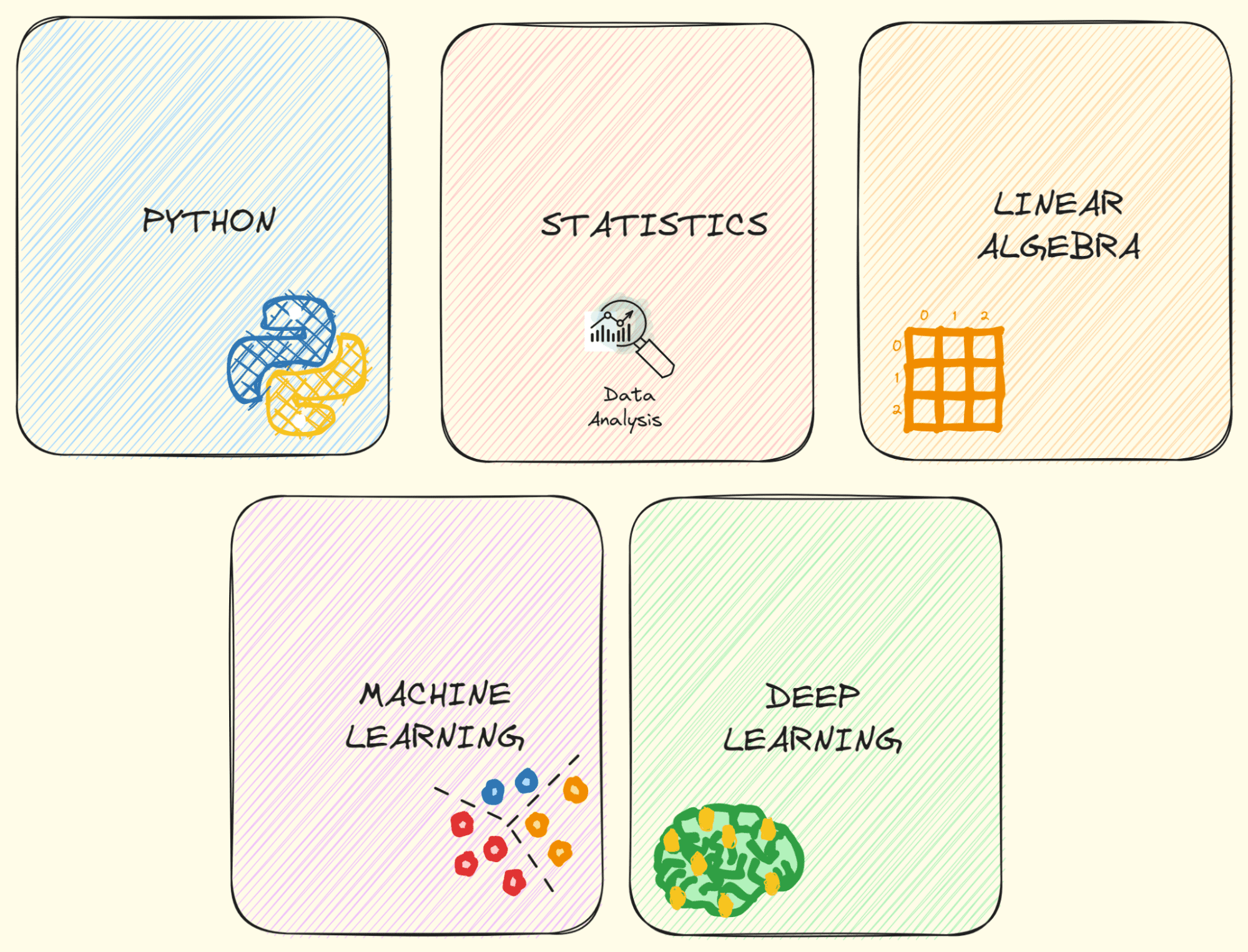
This article will explore five books that will cover the basic concepts you should learn within the data science journey. Each of these books helps to learn:

  • Python
  • Statistics
  • Linear Algebra
  • Machine Learning
  • Deep Learning

A Whirlwind Tour of Python

Book link: A Whildwind Tour of Python

If you are interested in starting to learn Python without taking too much time, this book can be a good match for you. It gives a very short overview of Python’s basic concepts. Together with the 100-page book, there is also a GitHub repository with exercises.

In particular, you can quickly learn the principal data types of Python: integers, floating-point numbers, strings, Booleans, lists, tuples, dictionaries and sets. At the end of the book, there is a brief overview of Python libraries, NumPy, Pandas, Matplotlib, Scipy.

It covers the following content:

  • Basic Syntax
  • Variables
  • Operators
  • Principal Data Types
  • For Loop
  • While loop
  • Functions
  • If-elif-else
  • Fast overview of Python libraries

Think Stats: Probability and Statistics for Programmers

Book link: Think Stats: Probability and Statistics

It can be hard to acquire a good knowledge of probability and statistics without putting into practice what you study. The beauty of this book is that it’s focused on a few basic concepts and doesn’t only show theory, but there are also practical exercises written with Python.

The book covers:

  • Summary Statistics
  • Data Distribution
  • Probability Distributions
  • Bayes’s Theorem
  • Central limit theorem
  • Hypothesis testing
  • Estimation

Introduction to Linear Algebra for Applied Machine Learning with Python

Book link: Introduction to Linear Algebra for Applied Machine Learning

When you study Linear Algebra in university, most of the time the professors explain all the theory without any practical application. So, you end up taking the exam, and forget every concept once you are done, because in your head it’s too abstract.

Luckily, I have found this amazing book that gives you a good introduction of linear algebra’s fundamentals that you’ll meet when you study machine learning models. Every theoretical concept is followed by a practical example written with NumPy, a well-known Python library for scientific computing.

These are the main topics covered:

  • Vectors
  • Matrices
  • Projections
  • Determinant
  • Eigenvectors and Eigenvalues
  • Singular Value Decomposition

Introduction to Machine Learning with Python

Book link: Introduction to Machine Learning with Python

After studying Python, Statistics and Linear Algebra, it’s time to finally learn everything about Machine Learning models to solve real-world problems. The book is suggested for people getting started and uses scikit-learn for the machine learning applications.

These are the main machine learning models explained:

  • Linear Regression
  • Naïve Bayes
  • Decision Trees
  • Ensembles of Decision Trees
  • Support Vector Machines
  • Principal Component Analysis
  • t-SNE
  • K-Means Clustering
  • DBSCAN

Deep Learning with Python

Book link: Deep Learning with Python

This fifth and last book was conceived for people that already have Python programming knowledge and no prior experience with machine learning is required. The author of this book is Francois Chollet, a software engineer and AI researcher at Google, famous for creating Keras, a deep learning library released in 2015. These are the most important notions:

  • Neural Networks
  • Convolutional Neural Networks
  • Recurrent Neural Networks
  • LSTM
  • Generative Adversarial Networks

Final thoughts

These suggestions are all great for beginners that want to break into the data science field. Moreover, they can be useful for data scientists and researchers that are aware of having a lack of knowledge on some concepts and need to strengthen their understanding. I hope that you have appreciated this list of books. Do you know other helpful books about Data Science? Drop them in the comments if you have insightful suggestions.

Eugenia Anello is currently a research fellow at the Department of Information Engineering of the University of Padova, Italy. Her research project is focused on Continual Learning combined with Anomaly Detection.

More On This Topic

  • 5 Free Books to Help You Master Python
  • Top 15 Books to Master Data Strategy
  • KDnuggets News, June 22: Primary Supervised Learning Algorithms Used in…
  • 5 Free Data Science Books You Must Read in 2023
  • KDnuggets News, November 2: The Current State of Data Science Careers • 15…
  • 5 Free Julia Books For Data Science

Creative Force, now with $8.9M, gives e-commerce workflows an AI treatment

Creative Force, now with $8.9M, gives e-commerce workflows an AI treatment Christine Hall 7 hours

Creative Force, providing an AI-powered content operations workflow for large e-commerce retailers and brands, secured $8.9 million in Series A funding, on a post-money valuation of $56 million, from Export and Investment Fund of Denmark and Hearst Ventures.

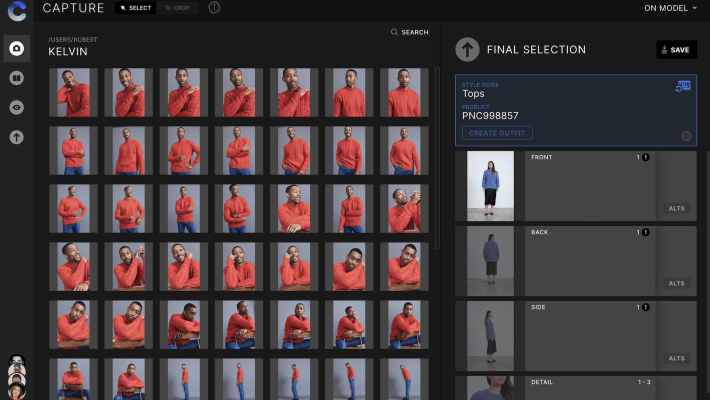
The Denmark-based company, founded in 2019, helps retailers and brands create content for marketing campaigns and online merchandising. Its platform enables production of the content at scale, increasing efficiency by up to 30% so that the company can focus on other things, Thomas Kragelund, co-founder and CEO of Creative Force, said in an email interview.

Kragelund went on to explain that unlike other companies that focus on single pain points, Creative Force was developed to be an end to end solution. It also works with enterprise-level companies where content creation has become too complex — think conducting multiple photo shoots, video production, booking models, editorial, post-productions and approvals — to handle with just project management software and spreadsheets.

“The need for content has exploded with social media and fast data connection speeds that enable more rich content,” Kragelund said. “Uniting creativity and operations together in one platform is an interesting intersection because creativity is about making something new that hasn’t been seen before, and operations is the ability to repeat a process over and over again.”

The company focused initially on the fashion and apparel market. However, since its seed round in 2022, the company saw a 170% year over year growth in other verticals, including home improvement, furniture, jewelry and groceries. As such, Creative Force nearly doubled its development team and created a dedicated AI team, Kragelund said. In addition, Juliana Vail also recently joined the company to be managing director of the company’s AI incubator, dreem.ai.

The concept has caught on. In the past year, Creative Force has managed over 10 million digital creative assets, including video, copy and photos. It is working with brands, including Columbia Sportswear, OTTO, ALDO, David Yurman and Tommy Bahama.

The new investment brings its total funding to $17.9 million and will enable the company to continue integrating generative artificial intelligence into its platform, expand its Denmark headquarters and establish a new U.S. office in Boston.

In terms of technology development, Creative Force is investing in AI tools for 2D and 3D images and models, product images without needing another photoshoot and virtual models. Kragelund referred to another as a “co-pilot” tool, that for example, will write first drafts of product descriptions after which a human copywriter can quickly review, edit and finalize.

“We believe AI will be a game-changer in terms of producing content at scale, and we are in a unique position to bring generative AI into e-commerce content production,” he added. “Heading into 2024, the primary objective of our sales and other go-to-market teams is to establish Creative Force as the leading content creation platform in the U.S., similar to what we’ve done in Europe. This funding round gives us the resources we need in order to do that successfully.”

Meanwhile, technology that moves with the way work flows is one of the reasons why Megumi Ikeda, managing director at Hearst Ventures, was interested in Creative Force. Ikeda, via email, said that e-commerce hasn’t typically been the beneficiary of that workflow innovation.

“The Creative Force platform caters to its customer’s daily work patterns,” Ikeda said. “Customers find it intuitive and easy to use. New users can use it right away. Key third-party software, such as Capture One and Adobe Photoshop are integrated into Creative Force to create a seamless end-to-end workflow tool. Adding new modules and adapting the flow of work and parties involved does not require weeks of waiting for software updates, unlike other competitors in the market.”

How well are SaaS, e-commerce, fintech and health tech startups doing in 2023?

Architecting for the Future: A Deep Dive into Modern Data Architecture

Architecting for the Future: A Deep Dive into Modern Data Architecture

In today’s data-centric world, crafting a modern data architecture is no longer a choice but a strategic necessity. Traditional data storage and processing methods are no longer sufficient to meet the demands of escalating data volumes, evolving analytical requirements, and rapid technological advancements. A forward-thinking data architecture must deftly balance the aspects of centralization and decentralization while integrating cutting-edge concepts like Data Fabric, Data Mesh, Data Virtualization, Meta Data Management, Master Data Management, Data Marketplace, the API Economy, and the emerging concept of Data Lake House. In this exploration, we delve into the intricacies of modern data architecture, keeping a keen eye on the technical and strategic implications.

Foundations of Modern Data Architecture: At the heart of modern data architecture is a fundamental shift in perspective. Data takes centre stage, transitioning from being a mere byproduct of operations to the central asset around which the entire framework revolves. This paradigm shift informs every facet of modern data architecture.

Agility and Organizational Style: Agility is paramount, especially in a landscape marked by constant change. Modern architecture empowers organizations to rapidly ingest, process, and analyze data from diverse sources, enabling real-time decision-making and adaptability in response to shifting market dynamics. This agility is complemented by a balance between decentralized data access for customized needs and centralized governance to uphold data quality and compliance standards. Data-Ops and Dev-Ops play a pivotal role in achieving it.

Democratization of Data: Modern data architecture aims to democratize data access, fostering a culture where data is accessible and understandable by all stakeholders, irrespective of their technical expertise. This shift is brought to life through self-service analytics tools, ensuring that insights can be derived across the organization. Data Mesh principles promote decentralized ownership and access, empowering business users with self-service analytics tools. Meta Data Management ensures data is discoverable and understandable across the organization, fostering a data-driven culture

Security and Compliance: Ensuring the security and compliance of data remains paramount, regardless of the chosen organizational style. Robust data architecture incorporates encryption measures during data transmission and at rest, fortified by finely-tuned access controls. This guarantees that data remains secure while remaining accessible to authorized users, thus ensuring compliance with regulatory standards. AI/ML can enhance security by identifying anomalies and potential security threats in real time.

Modularity and Data Lake House: Modern data architectures are founded on a modular approach, featuring components like data lakes, data warehouses, and the Data Lake House, which unifies structured and semi-structured data. This modularity affords flexibility, cost-effectiveness, and adaptability to address evolving data requirements.

Advanced Techniques and Integration: Modern data architecture is further enriched by advanced techniques, including AI and ML, which can empower the architecture with predictive analytics, automation, and deeper insights. Additionally, concepts like Data Fabric and Data Mesh enable more distributed, scalable, and efficient data management.

Advanced AI/ML-powered Meta Data Management: AI/ML techniques can be applied to automate and enhance Meta Data Management. Machine learning algorithms can analyze metadata to discover relationships between data assets, automatically tag and classify data, and even suggest data quality improvements. Natural language processing (NLP) can assist in making metadata more accessible and understandable.

Advanced AI/ML-Powered Master Data Management: AI/ML can revolutionize Master Data Management by improving data matching, entity resolution, and data quality. Machine learning models can learn from historical data to identify and merge duplicate records, ensuring a single, accurate view of master data. Predictive analytics can assist in maintaining data consistency and completeness.

Data Marketplace and the API Economy: These components empower organizations to treat data as a valuable asset. A Data Marketplace facilitates data sharing and monetization, while the API Economy streamlines data access and integration, fostering innovation and collaboration.

Dev-Ops, Data-Ops, and ML-Ops: These practices are integrated seamlessly into modern data architecture, ensuring that data, development, and machine learning operations are agile, efficient, and automated, thereby enabling rapid deployment and scaling of data-driven applications

In summary, a modern data architecture strategy represents more than just a technical evolution; it is a fundamental shift in how organizations perceive and leverage data. It is a dynamic blueprint for harnessing the power of data to drive innovation, enhance decision-making, and achieve sustainable growth. Whether an organization leans more towards centralization or decentralization, the future belongs to those who can effectively harness the potential of their data while aligning with their preferred organizational style and integrating the latest data management techniques, including Data Marketplace, the API Economy, and the operational excellence of Dev-Ops, Data-Ops, and ML-Ops.

Data Engineering with Course5 Intelligence

Course5’s Data Engineering solution offers a comprehensive data platform that empowers businesses to build data-centric applications, extract valuable insights, conduct data analysis, and support AI models for achieving their business goals. Key features include easy access to various data types, ETL capabilities for data integration, real-time streaming analytics, accelerated time-to-market with pre-built tools, high customizability, and actionable insights with advanced analytics. Moreover, the platform prioritizes data privacy, security, and regulatory compliance. Course5 serves as an implementation partner for prominent tech providers such as Cloudera, Snowflake, AWS, Azure, Informatica, Talend, Vertica, Teradata, and Oracle, ensuring a robust and versatile solution.

The post Architecting for the Future: A Deep Dive into Modern Data Architecture appeared first on Analytics India Magazine.

Infosys Unveils Development Center to Bolster Local Talent in Cloud, AI, & Digital Solutions

Infosys-AI-and-analytics-play

Infosys has unveiled its latest development centre in Visakhapatnam, Andhra Pradesh, to bolster local employment and promote sustainability. The 83,750-square-foot facility is designed to offer employees more flexible working arrangements.

“This centre will further our approach towards creating hybrid workplaces and also offer new opportunities to the local talent pool,” Nilanjan Roy, CFO at Infosys, said.

However, Infosys had come under fire earlier this year when it had mandated 5 days of work from office for its employees in the US and Canada.

It is poised to become a hub for fostering and developing local talent by offering them exposure to cutting-edge technologies such as Cloud computing, Artificial Intelligence, and Digital solutions—which seems to be the need of the hour with the increasing popularity of Gen AI tools like LLMs.

It paves the way for Infosys to attract and engage in a comprehensive process of upskilling and reskilling local professionals. The Visakhapatnam DC is also expected to accommodate around 1,000 employees and is constructed with an emphasis on energy and water efficiency.

The significance of this endeavour lies in its potential to bridge the gap between regional talent and global opportunities. Infosys enables them to participate in a rapidly evolving digital landscape by training and equipping local talent with expertise in these next-generation technologies. This, in turn, enhances the city’s attractiveness as a potential investment destination for global corporations looking to harness these technological advancements.

Andhra CM Jagan Mohan Reddy at the launch, stated that, “The inauguration of Infosys’ Visakhapatnam DC is a landmark moment in the city’s growth story. We acknowledge the support of Infosys in boosting the city’s IT landscape and developing its overall ecosystem through community building.”

Moreover, Infosys’ commitment to environmental sustainability aligns with global trends toward greener and more responsible business practices.

With the news of the Indian government’s considerations of a 25k GPU cluster, facilities like these would add value to India’s push in the latest tech ecosystem.

The post Infosys Unveils Development Center to Bolster Local Talent in Cloud, AI, & Digital Solutions appeared first on Analytics India Magazine.

How To Fine-Tune ChatGPT 3.5 Turbo

How To Fine-Tune ChatGPT 3.5 Turbo
Image by Editor

In case you hadn’t already heard it, OpenAI recently announced that fine-tuning for GPT-3.5 Turbo is available. Furthermore, fine-tuning for GPT-4.0 is expected to be released later in the fall as well. For developers in particular, this has been most welcome news.

But why precisely was this such an important announcement? In short, it’s because fine-tuning a GPT-3.5 Turbo model offers several important benefits. While we’ll explore what these benefits are later in this article, in essence, fine-tuning enables developers to more effectively manage their projects and shorten their prompts (sometimes by up to 90%) by having instructions embedded into the model itself.

With a fine-tuned version of GPT-3.5 Turbo, it’s possible to exceed the base Chat GPT-3.5 capabilities for certain tasks. Let’s explore how you can fine-tune your GPT-3.5 Turbo models in greater depth.

Preparing Data for Fine-tuning

The first step to fine-tuning your data for GPT-3.5 Turbo is to format it into the correct structure in JSONL format. Each line in your JSONL file will have a message key with three different kinds of messages:

  • Your input message (also called the user message)
  • The context of the message (also called the system message)
  • The model response (also called the assistant message)

Here is an example with all three of these types of messages:

{    "messages": [      { "role": "system", "content": "You are an experienced JavaScript developer adept at correcting mistakes" },      { "role": "user", "content": "Find the issues in the following code." },      { "role": "assistant", "content": "The provided code has several aspects that could be improved upon." }    ]  }

You’ll then need to save your JSON object file once your data has been prepared.

Uploading Files for Fine-tuning

Once you have created and saved your data set like in the above, it’s time to upload the files so you can fine-tune them.

Here is an example of how you can do this via a Python script provided by OpenAI:

curl https://api.openai.com/v1/files     -H "Authorization: Bearer $OPENAI_API_KEY"     -F "purpose=fine-tune"     -F "file=@path_to_your_file" 

Creating a Fine-tuning Job

Now the time has come to finally execute the fine-tuning. Again, OpenAI provides an example of how you can do this:

curl https://api.openai.com/v1/fine_tuning/jobs   -H "Content-Type: application/json"   -H "Authorization: Bearer $OPENAI_API_KEY"   -d '{    "training_file": "TRAINING_FILE_ID",    "model": "gpt-3.5-turbo-0613"  }'

As the above example shows, you’ll need to use an openai.file.create for sending the request to upload the file. Remember to save the file ID, as you will need it for future steps.

Utilizing the Fine-tuned Model

Now the time has come to deploy and interact with the fine-tuned model. You can do this within the OpenAI playground.

Note the OpenAI example below:

curl https://api.openai.com/v1/chat/completions   -H "Content-Type: application/json"   -H "Authorization: Bearer $OPENAI_API_KEY"   -d '{    "model": "ft:gpt-3.5-turbo:org_id",    "messages": [      {        "role": "system",        "content": "You are an experienced JavaScript developer adept at correcting mistakes"      },      {        "role": "user",        "content": "Hello! Can you review this code I wrote?"      }    ]  }'

This is also a good opportunity for comparing the new fine-tuned model with the original GPT-3.5 Turbo model.

Advantages of Fine-tuning

FIne-tuning your GPT-3.5 Turbo prompts offer three primary advantages for improving model quality and performance.

Improved Steerability

This is another way of saying that fine-tuning permits developers to ensure their customized models follow specific instructions better. For example, if you’d like your model to be completed in a different language (such as Italian or Spanish), fine-tuning your models enables you to do that.

The same goes for if you need your model to make your outputs shorter or have the model respond in a certain way. Speaking of outputs…

More Reliable Output Formatting

Thanks to fine-tuning, a model can improve its ability to format responses in a consistent way. This is very important for any applications that require a specific format, such as coding. Specifically, developers can fine-tune their models so that user prompts are converted into JSON snippets, which can then be incorporated into larger data modules later on.

Customized Tone

If any businesses need to ensure that the output generated by their AI models are completed with a specific tone, fine-tuning is the most efficient way to ensure that. Many businesses need to ensure their content and marketing materials match their brand voice or have a certain tone as a means to better connect with customers.

If any business has a recognizable brand voice, they can fine-tune their GPT-3.5 Turbo models when preparing their data for fine-tuning. Specifically, this will be done in the ‘user message’ and ‘system message’ message types as discussed above. When done properly, this will result in all messages being created with the company’s brand voice in mind, while also significantly reducing the time needed to edit everything from social media copy to whitepapers.

Future Enhancements

As noted above, OpenAI is also expected to soon release fine-tuning for GPT-4.0. Beyond that, the company is expected to release upcoming features such as offering support for function calling and the ability to fine-tune via the UI. The latter will make fine-tuning more accessible for novice users.

These developments with fine-tuning are not just important for developers but for businesses as well. For instance, many of the most promising startups in the tech and developer space, such as Sweep or SeekOut, are reliant on using AI for completing their services. Businesses such as these will find good use in the ability to fine-tune their GPT data models.

Conclusion

Thanks to this new ability to fine-tune GPT-3.5 Turbo, businesses and developers alike can now more effectively supervise their models to ensure that they perform in a manner that is more congruent to their applications.

Nahla Davies is a software developer and tech writer. Before devoting her work full time to technical writing, she managed—among other intriguing things—to serve as a lead programmer at an Inc. 5,000 experiential branding organization whose clients include Samsung, Time Warner, Netflix, and Sony.

More On This Topic

  • How to Fine-Tune BERT Transformer with spaCy 3
  • Bayesian Hyperparameter Optimization with tune-sklearn in PyCaret
  • Fast AutoML with FLAML + Ray Tune
  • Fine-Tuning Transformer Model for Invoice Recognition
  • Analyzing Scientific Articles with fine-tuned SciBERT NER Model and Neo4j
  • Fine-Tuning BERT for Tweets Classification with HuggingFace

Singapore and US sync up on AI governance and set up joint group

Brain in the shape of wheels

Singapore and the US have synced up their respective artificial intelligence (AI) frameworks to ease compliance and will continue to work together to drive "safe, trustworthy, and responsible" AI innovation.

Singapore's Infocomm Media Development Authority (IMDA) and the US National Institute of Standards and Technology (NIST) completed the joint mapping exercise between IMDA's AI Verify and NIST's AI RMF. The alignment aims to harmonize international AI governance frameworks and reduce the cost of meeting multiple requirements.

Also: Implementing AI into software engineering? Here's everything you need to know

Singapore's AI Verify is a testing framework and toolkit designed to help organizations demonstrate their deployment of responsible AI through standardized tests. AI RMF is a resource for companies to help them mitigate risks of using and deploying AI systems, and to ensure the responsible development and adoption of AI.

A crosswalk has been published, mapping the two AI governance frameworks.

"[It] will provide companies with greater clarity to meet the requirements within both frameworks, reduce compliance costs, and foster a more conducive environment for AI deployment and innovation," said Singapore's Ministry of Foreign Affairs in a statement Friday.

Also: Five ways to use AI responsibly

Plans are also in place to establish a bilateral AI governance group to "advance shared principles" and exchange information on "safe, trustworthy, and responsible" AI innovation, the ministry said.

The ministry said the two countries will consult on the development of international AI security, safety, trust, and standards, while attempting to move forward with "responsible innovation". Their collaboration will also encompass research between the US National Science Foundation and AI Singapore, with the focus on AI safety and security, as well as enhancing workforce development initiatives.

The bilateral efforts were announced at the inaugural US-Singapore Critical and Emerging Technology Dialog held in Washington this week, where talks went beyond AI and included other key areas, including digital economy and data governance, critical infrastructure and technology supply chains, and quantum technology.

Among the initiatives that emerged from the dialog are plans to develop a bilateral roadmap for digital economic cooperation, which will carve out common principles on issues such as data governance, digital standards, and consumer protection. The US Department of Treasury and the Monetary Authority of Singapore also will explore ways to strengthen bilateral cooperation on digital payments.

Also: 4 ways to increase the usability of AI, according to industry experts

In addition, the US Department of Defense's Defense Innovation Unit and Singapore's Ministry of Defence (MINDEF) will look to formalize a partnership to drive the use of commercial and dual-use technologies, such as AI, to solve operational challenges for their militaries.

Plans also are in the works for further information exchange on post-quantum cryptography migration between the NIST and US Department of Homeland Security, alongside Singapore's National Quantum Office and Ministry of Communications and Information.

"As the US and Singapore continue to lead in the technologies of the future, we will advance close consultations on our respective measures to build a robust innovation ecosystem, [that] ensure emerging technologies work for — and not against — our shared security and prosperity," said Singapore's Ministry of Foreign Affairs.

Artificial Intelligence