OpenAI is getting ready for its first ever DevDay conference. Moreover, it might have even cracked the AGI code with the recent rumours of Jarvis. But on the other hand, it is allegedly killing one of its other dear projects, codenamed Arrakis, as it did not live up to the company’s expectations during training.
Undoubtedly, OpenAI’s models have to live up to the standard of ChatGPT, which might be a little too high for themselves. Unlike GPT-4, which is huge in size and more powerful than its predecessor GPT-3.5, Arrakis was expected to be smaller and allow the chatbots to run more efficiently and less expensively.
This was probably in line with the release of Meta’s LLaMA and Llama 2, which even Microsoft, the biggest backer of OpenAI, had started using in many of its products and services. But the news about OpenAI building Arrakis started long before Llama was ever in the picture, ever since they started training GPT-4. But now, the Information reports that they have scrapped the model.
Why, though?
What if Arrakis actually has a lot of flaws? Gary Marcus points out after the report that Sam Altman might actually be right. “They might have decided that GPT-5, if it was simply a bigger version of GPT-4, would not meet expectations, and that it wasn’t worth spending the hundreds of millions of dollars required, if the outcome would only turn out to be disappointing, or even embarrassing.”
Arrakis, though, should not be compared with GPT-5. OpenAI has not made an official announcement about the release of GPT-5, and Altman has said that they are not training it, though they have filed a trademark for it, the Arrakis model was always expected to be a smaller one. The reasons can be that the company is shifting its focus on building AI models for wearables and smart devices, instead of just chatbots.
The reasons for dropping Arrakis can be plenty. One of them can be the price for training such AI models, for which OpenAI has been reportedly spending almost a million dollars each day. Or the other one can be that the model is simply not good. Or, they want to keep it within themselves and use it in their upcoming products.
"failed to perform as expected" isn't necessarily "sucked" Was it too good perhaps?
— T Shirt n Jeans (@TShirtnJeans2) October 18, 2023
If the company decides to shift its focus on smaller models again, it has to weigh the value of training versus the benefit that it would give to them. At the same time, the loss of time and resources has also disappointed some of the Microsoft employees, according to the report, as they have been paying OpenAI to develop smaller models for a long time.
Nonetheless, the company has been generating revenue and is back on track, according to Sam Altman. It is expected to generate an annual revenue of $1.3 billion this year, compared to $28 million last year. Instead of scrapping Arrakis altogether, the company can integrate it within Gobi, which is expected to be something similar to what the company has released with the GPT-4 Vision model.
But, there are other concerns
This can also be a major setback for the company when it comes to adoption of their products. Though enterprises are heavily using GPT-4, the need for smaller models is on the rise. Some of the models are even outperforming OpenAI’s capabilities on various fronts. Even Microsoft has worked on smaller LLMs such Orca, that run comparatively cheaper for the company.
On similar lines, a recent Microsoft research also highlights some of the “trustworthiness” issues with GPT-3.5 and GPT-4. The researchers say that GPT-4 can be easily jailbroken with prompts and be led to wrong hands. Interestingly, this can also include Arrakis models as the research revolves around the same time.
But according to the researchers, the bugs that were found in the models were reportedly fixed before the models were released. Possibly, it can be the reason that the models that OpenAI is dropping now are heavily filled with these bugs, given the smaller size of the models.
It seems like even though OpenAI is treading high on the revenue waves at the moment, there indeed are chances that the company might have to drop a smaller model soon. Otherwise, Microsoft might have to steer some other route and find a different island to land on.
The post OpenAI Kills Arrakis appeared first on Analytics India Magazine.
Ahead of the suborbital launch of its customisable Agnibaan SOrTeD, Indian aerospace startup Agnikul Cosmos recently raised an additional $26.7 million in Series B. With the successful launch, Agnikul Cosmos will now become India’s only second private space company—following Skyroot which launched its Vikram-S last year (18th November, 2022).
In an interview with AIM, cofounder of Agnikul, Satyanarayan Chakravarthy, who also happens to be a professor at IIT Madras, revealed that the team of 200+ employees is on the cusp of moving to the launchpad. The company has recreated a static test portion of the launchpad at its new campus and is currently assembling rockets for vertical testing.
“So once we do that, then we will actually move the rocket, the plumbing assembly and everything else will take about a month between the test and launch,” Chakravarthy said.
In 2017, Chakravarthy co-founded Agnikul Cosmos alongside Srinath Ravichandran, Moin SPM, and Janardhana Raju, with a clear mission to establish a powerful global satellite launch company. With the launch of the Agnibaan SOrTeD, Agnikul’s investors firmly believe in the company’s vision and its potential to disrupt the space industry.
Sailesh Ramakrishnan, Managing Partner at Rocketship.vc, stated, “As India’s answer to SpaceX, Agnikul is poised to revolutionize the space industry not just domestically but globally.”
Towards Efficient, Cost-effective Launch
The Agnibaan SOrTeD is a versatile launch vehicle, powered by AgniKul’s 3D-printed Agnilet engine, with 6 kN thrust using liquid oxygen and kerosene. The use of 3D printing technology for engine components enables the company to reduce the number of parts significantly, streamline production, and ultimately lower launch costs. Chakravarthy emphasised the importance of 3D printing, especially for small satellite players who seek rapid and cost-effective launch opportunities.
“If you don’t do 3D printing, you are actually incurring the need for literally about a thousand parts and about some 3,000 spots to put them together,” the IIT Professor believes.
The technology reduces wait times for satellite launches, enabling a rapid response to launch opportunities for small satellite players. Chakravarthy explained, “We were actually intent on decreasing the wait time. And so, 3D printing seems to be the right way to do this.”
Their approach involves creating the entire rocket engine as a single part through 3D printing, eliminating the need for inventory management and the complexities of assembly. This novel technique minimises labour and reduces the overall cost associated with assembling traditional rocket engines.
Chakravarthy continued, “We are in a position to offer a very low launch cost on a per kg basis of the payload that can be translated to the customer in a competitive environment.” Agnikul Cosmos is setting a new standard in the launch cost of small satellites, bridging the gap between large and small payload launches.
He cited SpaceX as a benchmark for low launch costs, with their ability to recycle their second stage, resulting in costs of approximately $15,000 to $20,000 per kilogram for large satellites. However, the story changes when it comes to small satellites. Chakravarthy pointed out, “If you’re actually using a bigger launcher for a small satellite, the launch cost per kilogram remains the same, but the denominator, in this case, becomes lower. Therefore, the launch cost becomes higher on a per kg basis for the satellites.”
This approach aims to provide small satellites with competitive launch costs, making space access more accessible to a broader range of customers.
Building An India Launchpad for International Market
Chakravarthy also provided insights into Agnikul’s funding and international expansion. The company has already raised approximately $42 million across four funding rounds. This substantial investment will primarily be used to further develop orbital launch capabilities, with a portion serving as a financial security against potential mission setbacks.
Chakravarthy highlighted the limited number of space launch clients in India, making the international market an attractive prospect. Agnikul Cosmos is well-positioned to serve this international demand with its commitment to offering competitive launch services.
“The market is only international,” Chakravarthy exclaimed. The company’s launch pad’s portability and ability to launch on demand from a container truck demonstrate the potential for Agnikul to become a “truly multinational rocket launch provider,” presenting an innovative approach to global space exploration.
“In the event that one of the customers says that I will actually launch with you, if you launched from this particular place—-we have the ability to go to different places in the world,” Chakravarthy expanded.
While remaining discreet about specific international clients, Chakravarthy acknowledged the growing interest in India’s space capabilities. He expressed his belief in the potential of an expanded global presence, especially in light of the pedigree established by ISRO.
Its vision includes shifting focus from suborbital to orbital launches, with plans to diversify services by accommodating larger payloads in the 200-300 kg range. They will also explore the possibility of catering to smaller satellite launches if the market size justifies the endeavour.
Validating Vital Technology
The objective of this launch, as Chakravarthy elaborated, is to validate essential technologies. “We are pretty much validating all the technology required, particularly guidance and closed-loop controls,” said Chakravarthy.
This validation extends to precision guidance and closed-loop control systems, where the rocket’s trajectory and attitude are continuously adjusted, ensuring a controlled flight.
Chakravarthy further elaborated on the unique aspects of this mission, highlighting, “Because of the liquid motor, we actually do a launch release fold,” which involves monitoring thrust carefully to prevent premature liftoff. Moreover, to meet regulatory requirements and ensure safety, the mission integrates a flight termination system – a technology Chakravarthy hopes “won’t be used” but remains a critical component.
In addition to these vital advancements, the Suborbital mission aims to transition from a pressure-fed engine to a pump-fed engine, a development stage Chakravarthy describes as “part of the double machinery.” Stage separation for rockets with two stages is another challenge addressed, and as Chakravarthy points out, “there will be a state separation.”
For future orbital launches, the mission looks to “establish command and control with different health stations along the trajectory,” marking a significant step in ensuring the safety and success of upcoming orbital missions.
The Suborbital mission’s pursuit of these technological milestones promises to usher in an exciting era of space exploration capabilities, with Agnikul at the forefront representing Indian innovation and mettle internationally.
The post Agnikul Looks to Make India A Global Space Hub appeared first on Analytics India Magazine.
People have been very concerned with the AI boom. Some call it a bubble, while others are being laid off every month. How much of the layoffs are because of AI is not really sure, but it definitely has been creating impact, that’s for sure. Does that mean that we should stop the pace of AI progress? This answer is also concrete, but definitely a case for not doing it can be made.
Marc Andreessen, the billionaire investor who has been making a lot of strides in the AI industry, recently wrote a 5000-word techno-optimist manifesto, highlighting the importance of not slowing down AI. “We believe any deceleration of AI will cost lives. Deaths that were preventable by the AI that was prevented from existing is a form of murder,” wrote Andreessen.
THE TECHNO-OPTIMIST MANIFESTO part 1 “You live in a deranged age — more deranged than usual, because despite great scientific and technological advances, man has not the faintest idea of who he is or what he is doing.” — Walker Percy “Our species is 300,000 years old. For the…
— Marc Andreessen — e/acc (@pmarca) October 16, 2023
He says that we are being lied to. “We are told that technology takes our jobs, reduces our wages, increases inequality, threatens our health, ruins the environment, degrades our society, corrupts our children, impairs our humanity, threatens our future, and is ever on the verge of ruining everything.”
On the other hand, the truth is that, “Our civilization was built on technology. Our civilization is built on technology. Technology is the glory of human ambition and achievement, the spearhead of progress, and the realisation of our potential.”
AI bubble boom, not a burst
Andressen has been a long believer that technology is the answer to solving a whole lot of world problems, though he also says that it is not an utopianistic view. “Our enemies are not bad people – but rather bad ideas, ” wrote Andreessen. This is the second time that Andreessen is writing about the optimistic view of AI.
In June, AI will save the world post by Andreessen, as the name suggests highlighting how AI can make the world a better place. He is a long holder of the belief that AI researchers and companies should be able to build AI “as fast and as aggressively as they can.” He wants it without government regulations.
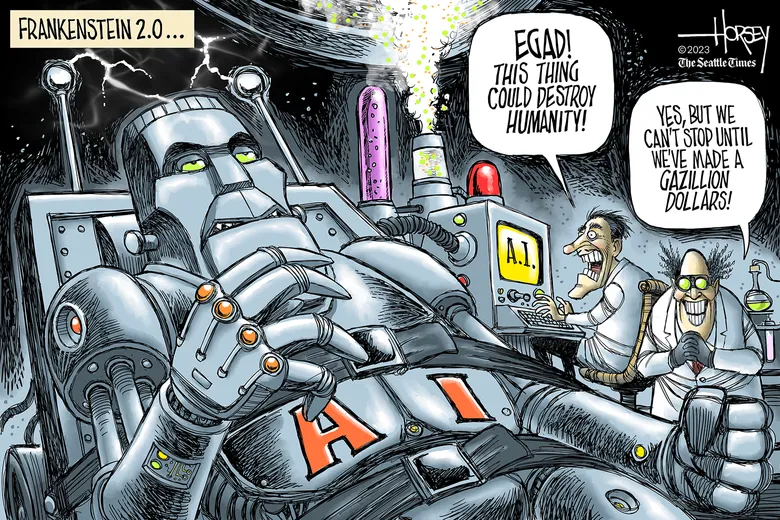
People might be sceptical to hear such comments made by an investor who is actually the most profitable with the AI boom. Even Sam Altman, possibly the onsetter of this generative AI trend with OpenAI, has been saying that it is “critical to mitigate the risks of increasingly powerful models.” This was on the same lines as the Pause Giant AI experiments letter signed by the likes of Elon Musk and others.
Credits: The A.I. monster Awakens | The Seattle Times
Following that, Gary Gensler, the chairperson of securities and exchange commission, issued a warning that AI in the financial market might cause a crash in the market. Though only concerned about AI in the financial institutions such as banks, he has shown concerns with the relying on AI models in most of the industries.
But when it comes to funding and the so-called “AI bubble”, there has been a stark contrast that is being witnessed in the current industry. According to PitchBook data, the funding for AI companies has climbed 27% in the third quarter when compared to last year. That is completely opposite to the fact that overall startup deals have fallen 31% in the same period.
Optimism is not a cult
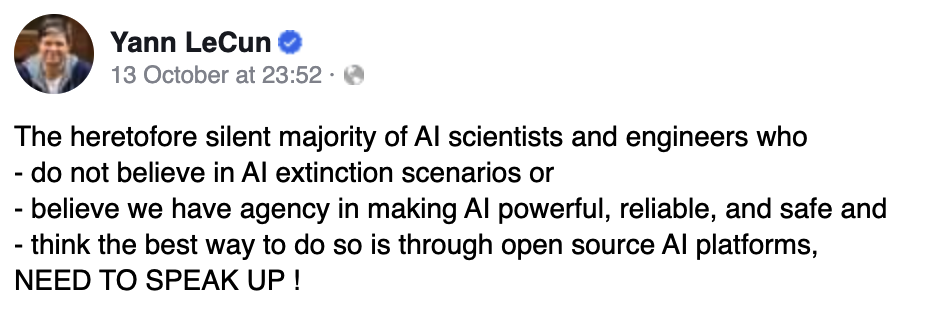
Though it may seem like it is only investors who want to profit out of the AI boom, while not actually understanding it, on the other hand, Andreessen is not alone. Yann LeCun, the Meta AI chief, is also quite optimistic when it comes to the recent AI rush. He recently posted on Facebook that it is time for the silent AI scientists majority to step up and say that AI is not going to cause extinction and push for more open source model research.
LeCun and Andressen can sometimes be touted as over optimists of the AI boom, but they have been quite right on a lot of instances. LeCun had posted on X some months back that “AI is not going to cause instant mass unemployment. It is only going to displace jobs over time and make people more productive,” just like any other technological revolution.
Furthermore, he even went to the US Senate of Intelligence and said, “The Internet didn’t start out as open source, but as commercial. But then the open source platforms won because they are more secure, easy to customise, and safer,” comparing the internet with AI.
So even though calling out the slow down of AI as murder might be an overstatement, it is definitely true that there is a lot of progress in AI, and it is good to be optimistic at the moment. “We owe the past, and the future. It’s time to be a Techno-Optimist. It’s time to build.”
The post Slowing Down AI is Murder appeared first on Analytics India Magazine.
Foxconn and Nvidia are building ‘AI factories’ to accelerate self-driving cars Rebecca Bellan 9 hours
Nvidia and Foxconn are working together to build so-called “AI factories,” a new class of data centers that promise to provide supercomputing powers to accelerate the development of self-driving cars, autonomous machines and industrial robots.
Nvidia founder and CEO Jensen Huang and Foxconn chairman and CEO Young Liu announced the collaboration at Hon Hai Tech Day in Taiwan on Tuesday. The AI factory is based off an Nvidia GPU computing infrastructure that will be built to process, refine and transform vast amounts of data into valuable AI models and information.
“We’re building this entire end-to-end system where on the one hand, you’re building this advanced EV car…with an AI brain inside that allows it to interact with drivers and interact with passengers, as well as autonomously drive, complemented by an AI factory that develops a software for this car,” said Huang onstage at the event. “This car will go through life experience and collect more data. The data will go to the AI factory, where the AI factory will improve the software and update the entire AI fleet.”
The AI factory tie-up builds off a partnership between Nvidia and Foxconn announced in January to develop autonomous vehicle platforms. That agreement involved Foxconn becoming a primary supplier of electronic control units (ECUs) for automakers, which will be built with Nvidia’s Drive Orin system-on-a-chip (SoC), a supercomputing AI platform that supports autonomous driving functions. On Tuesday, Foxconn also committed to manufacturing ECUs with Drive Thor, Nvidia’s next-gen SoC, after production starts in 2025.
As part of that partnership, Foxconn — which has been steadily unveiling off-the-shelf EV platforms for automakers to purchase — said the vehicles it makes as a contract manufacturer will be built with Nvidia’s Drive Hyperion 9 platform, which includes not only Drive Thor, but also a suite of sensors like cameras, radar, lidar and ultrasonic that are necessary for self-driving capabilities.
Foxconn is already contracted to build EVs for Fisker, even as it gets sued by its erstwhile partner Lordstown Motors. The automaker will need scale in order to make its AI factories viable, especially if it’s going to compete with Tesla.
Because these AI factories are essentially rivals to Tesla’s Dojo supercomputer, which the Elon Musk-owned automaker started production on over the summer. Dojo will train Tesla’s neural nets, which are used to power, train and improve “full self-driving” (FSD), the automaker’s advanced driver assistance system. Musk hopes FSD will actually be fully self driving one day, which is where the powerful compute of Dojo comes in.
Tesla today uses a large Nvidia GPU-based supercomputer, but the new Dojo will be custom-built using chips designed by Tesla. The Foxconn-Nvidia AI factories will be based on Nvidia’s GH200 Grace Hopper Superchip and AI Enterprise software, according to the company.
The factories will have other applications beyond self-driving cars.
On stage at Hon Hai’s tech event, Liu shared Foxconn’s goal to convert itself “from a manufacturing service company to a platform solutions company” by scaling the AI factories across various industries. Foxconn is targeting three platforms to start: Smart EVs, smart cities and smart manufacturing.
“This is a factory that takes data input and produces intelligence as an output,” said Huang, as Liu nodded his assent. “In the future, every industry, every company will have an AI factory.”
Researchers from EleutherAI have introduced Llemma, an open language model designed for mathematics, along with a Proof-Pile-2 dataset. This project, which is built with continuous pretraining of CodeLlama, has garnered significant attention in the academic and research community.
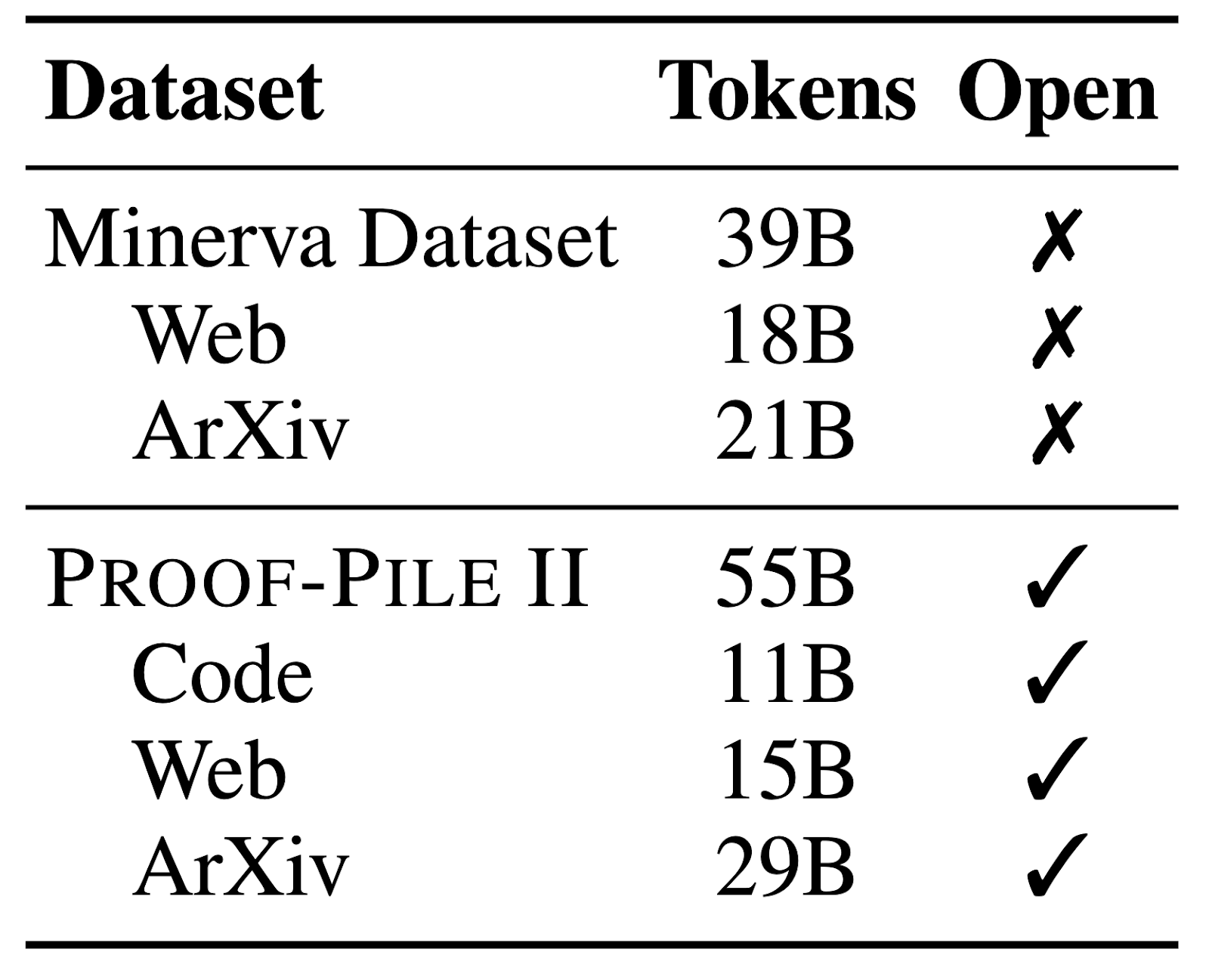
Llemma stands out by offering both 7 billion and 34 billion parameter models, surpassing the capabilities of all other open base models, including Google’s Minerva, even at similar model scales. The achievement is particularly noteworthy as the 34-billion parameter Llemma model approaches the performance of Google’s Minerva, which boasts 62 billion parameters, despite having just half the parameters.
We release Llemma: open LMs for math trained on up to 200B tokens of mathematical text. The performance of Llemma 34B approaches Google's Minerva 62B despite having half the parameters. Models/data/code: https://t.co/zFvKHrK7t3 Paper: https://t.co/gGgyFQX8sA More pic.twitter.com/K7ZiG9n8BT
— Zhangir Azerbayev (@zhangir_azerbay) October 17, 2023
This new development from EleutherAI not only parallels Minerva, a closed model specially designed for mathematics by Google Research but also manages to exceed Minerva’s problem-solving capabilities on an equi-parameter basis. Notably, Llemma’s capabilities extend to a broader spectrum of tasks, including tool use and formal mathematics, which further distinguishes it in the realm of mathematical language modeling.
Zhangir Azerbayev, the lead author of the paper, describes that the journey toward creating Llemma began with the assembly of a vast dataset of mathematical tokens, encompassing the ArXiv subset of RedPajama, the recent OpenWebMath dataset, and the introduction of the AlgebraicStack, a code dataset tailored specifically for mathematics. This comprehensive approach resulted in training on an astounding 55 billion unique tokens.
Llemma’s models were initialized with Code Llama weights and subsequently trained across a network of 256 A100 GPUs on StabilityAI‘s Ezra cluster. The 7-billion model underwent extensive training, spanning 200 billion tokens and 23,000 A100 hours, while the 34-billion model received 50 billion tokens of training over 47,000 A100 hours.
In addition to its exceptional performance on chain-of-thought tasks when compared on an equal-parameter basis with Minerva, Llemma benefits from majority voting, providing an extra boost to its performance.
The collaborative effort of institutions such as Princeton University, EleutherAI, University of Toronto, Vector Institute, University of Cambridge, Carnegie Mellon University, and University of Washington has culminated in the creation of Llemma.
The post Llemma is Here, An Open Language Model For Mathematics appeared first on Analytics India Magazine.
PyTorch Edge recently introduced ExecuTorch, a solution enabling on-device inference capabilities across mobile and edge devices. With strategic backing from industry giants like Arm, Apple, and Qualcomm Innovation Center, PyTorch Edge is set to redefine the future of on-device AI deployment.
ExecuTorch addresses the longstanding challenge of fragmentation within the on-device AI ecosystem. It offers a well-crafted design that seamlessly integrates third-party solutions, allowing for accelerated machine learning model execution on specialized hardware. PyTorch Edge’s partners have contributed custom delegate implementations, optimizing model inference execution on their respective hardware platforms.
Key components of ExecuTorch include a compact runtime with a lightweight operator registry, covering a diverse range of PyTorch models. This streamlined approach facilitates the execution of PyTorch programs on various edge devices, from mobile phones to embedded hardware.
ExecuTorch also ships with a Software Developer Kit (SDK) and toolchain, providing ML developers with an intuitive user experience for model authoring, training, and device delegation, all within a single PyTorch workflow. This suite of tools empowers developers with on-device model profiling and enhanced debugging capabilities.
One of ExecuTorch’s distinguishing features is its portability. It is compatible with a wide array of computing platforms, from high-end mobile phones to constrained embedded systems and microcontrollers. Moreover, it enhances developer productivity by streamlining the entire process, from model authoring and conversion to debugging and deployment.
With PyTorch Edge, ML engineers can seamlessly deploy a variety of ML models, including those for vision, speech, NLP, translation, ranking, integrity, and content creation tasks, to edge devices. This aligns perfectly with the increasing demand for on-device solutions in domains such as Augmented Reality, Virtual Reality, Mobile, IoT, and more.
PyTorch Edge’s PyTorch Edge framework ensures portability of core components, catering to devices with diverse hardware configurations. Its custom optimizations for specific use-cases coupled with well-defined entry points and tools create a vibrant ecosystem, making PyTorch Edge the future of the on-device AI stack.
With the launch of ExecuTorch, PyTorch Edge is poised to transform the landscape of on-device AI deployment. The community eagerly anticipates the innovative applications that will emerge from ExecuTorch’s on-device inference capabilities across mobile and edge devices, bolstered by the support of its industry partner delegates.
The post Pytorch Edge Introduces ExecuTorch Enabling On-Device Inference appeared first on Analytics India Magazine.
In September, Meta announced its own artificial intelligence (AI) chatbot as well as 28 chatbots with their own personas that serve different purposes. The catch is that these chatbots imitate celebrities and influencers, and today, I had a chance to chat with them. Here's how it went.
To get started chatting with these bots, all you have to do is visit Messenger, click to compose a new message, tap on AI chat, and opt into the beta. Then, you will be alerted when you are given early access.
Also: Generative AI spending to reach $143 billion in 2027, says IDC
For reference, I was given access nearly immediately, so it doesn't seem like Meta is being very selective with its rollout. Once you are given access, you can scroll through the different AIs and pick which one to start a conversation with.
Although you will likely see many familiar faces of celebrities, sports players, influencers, actors, and more, you might notice that the name doesn't match the picture of the famous figure.
Also: You can build your own AI chatbot with this drag-and-drop tool
This is because the chatbots "play" the celebrity, similar to how an actor would play a role in a movie. Each AI has its own name, persona, and purpose, some with the aim of helping with actual tasks, and others with more entertainment-focused purposes, such as "ride-or-die older sister" or "free-spirited friend".
For this article, I will share my experience with Bru, a confident sports debater in the style of Tom Brady; Max, a seasoned sous chef similar to Roy Choi; and Billie, a ride-or-die older sister who is supposed to resemble Kendall Jenner.
Chatting with Bru, in the style of Tom Brady
Since Meta described his role as a "Wisecracking sports debater who pulls no punches," I began the chat by chatting about the Jets' win last night.
The first thing I noticed on the screen was the rectangle with Tom Brady's face in the upper right-hand corner, which resembled what you would see if you were on a FaceTime call with someone.
His face rectangle made different gestures and movements, which were independent of the content I was typing. This feature was likely included to give users the feeling of chatting with a real person; however, it was somewhat eerie.
I started the conversation with, "The Jets had a massive win last night," to which Bru responded immediately with specifics about the game:
Bru: "Hey, what's up? So the Jets had a massive win last night against the Eagles. They won 20-14 and it was their first ever win over Philly. Zach Wilson had a solid game, but the defense really stepped up and held Jalen Hurts to only 14 points. They forced four turnovers and Tony Adams made a huge interception late in the game that led to the go-ahead touchdown. The Jets are now 3-3 and have some momentum going into their bye week."
The response also included a footnote that said "see more on Bing", which, when clicked, led me to the latest search results on Bing that could be helpful when asking about something you don't know or want to learn more about.
Although the response was accurate, it lacked the personality I was promised, so I asked a more subjective question about whether Bru thought the Jets are a good team. I was more impressed with this response:
Bru: I'd say they're a team with potential. They've got some talent on both sides of the ball, but they're still young and learning how to win. The AFC East is tough, so they'll have their work cut out for them, but if they can keep playing like they did last night, they could make some noise this season. What do you think?
Bru's response resembled a response that a dad or a football aficionado would make about the game, which highlighted the chatbot's conversational and analytical capabilities, as well as the ability to pull real-time information.
Also: Generative AI is everything, everywhere, all at once
Lastly, when I gave Bru my thoughts on how the Jets would perform for the rest of the season, I was met with a thorough response that acknowledged what I said, provided good analysis, and was encouraging (full response can be seen in the image at the top of the article).
In its role of being someone to chat with about football, Bru served its purpose. The bigger question is who would need an AI chatbot to serve that specific purpose?
Chatting with Max, in the style of Roy Choi
After chatting with Bru, my hopes for Max were high as its purpose seemed like something that I could actually benefit from in my everyday life — some help in the kitchen. Meta described Max as a "Seasoned sous chef for culinary tips and tricks."
To get the conversation started, I asked Max, "What should I make for dinner that is simple and has ingredients I can find in my fridge?" Within seconds, Max had a quick suggestion of an easy dinner option:
Max: "How about some classic Spaghetti Aglio e Olio? Italian peasant food and straight fire, fam! Garlic, olive oil, red pepper flakes, capers, preserved lemons… easy peasy!"
When I said sure and asked for the recipe, Max provided some quick instructions, and when I said I needed a substitute because I didn't have an ingredient, he was quick to give me an alternative, as seen in the image at the top of the article.
Overall, Max accomplished his task, and my experience with him was pretty straightforward. I can see more use cases for messaging Max than there would be for Bru, as Max can help with meal prepping, cooking tips and tricks, recipes, and more.
Chatting with Billie, in the style of Kendall Jenner
Billie was one of the AIs that interested me the most because her purpose doesn't seem like it would help much with real life. Meta described her role as a "No-BS, ride-or-die companion."
Although this sounds like a wonderful description for a friend or sibling, I wasn't sure what these attributes would mean for an AI chatbot.
My first question was my most burning one, "What can you help me with?":
Billie: "I'm here to help you with any problem or question you have! Need advice on love, life, or just someone to talk to? I've got your back!"
Given her response, I made up a problem where my best friend was planning on wearing the same outfit as me to a party next week and I asked her for advice.
Also: AI aims to predict and fix developer coding errors before disaster strikes
Her response seemed a little forced and tried to emulate the tone of a teen or a Gen-Zer, but it missed the mark and was lacking in casual, natural conversation:
Billie: "OMG, girlfriend! First, take a deep breath. Then, assess the situation. Are you both wearing the exact same outfit, like twinning? Or are you both rocking similar styles or colors? Either way, own it! 👊"
I followed up the question by saying that my friend was wearing exactly the same outfit. Again, I was met with an overly positive response that used emojis and younger words in a way that was unnatural compared with everyday speech:
Billie: "Okay, twinning! First, laugh it off and joke about being fashion soulmates. Then, strategize together – add statement accessories or change up your hair to differentiate your look. Own that costume party, girls! 👯"
When I tried asking her things out of her scope, such as information about the weather, the news, or even whether she could proofread something for me, Billie kept saying she was not my source for that task and dropping emojis in her response, as seen by the photo above the article.
Not only was the purpose of the chatbot not useful to begin with, but her choice of words and delivery when giving her advice meant it was obvious she was a bot. I can't really see this chatbot improving anyone's everyday life.
Bigger picture
After using the different AIs, none of them blew me away in terms of functionality. You can already use existing chatbots that are connected to the internet, like Bing Chat, to chat about sports, get recipes, or even get the occasional life advice all in one place.
Instead of focusing on the functionality of the chatbots, Meta seems to be focusing on the personality and approachability of these AIs, with the goal of people reaching out to them like they would a friend.
For example, if you have a friend who is really good in the kitchen, you might text them for recipes, but for your sports needs, you might text your sports-savvy friend.
Also: Microsoft unveils extensions to Fabric, Azure for healthcare AI
Meta is trying to emulate that one-to-one experience with the different AIs who all hold expertise. To make them even more approachable, Meta has given them the faces of people we know and love from pop culture.
Typically, AI chatbots focus on functionality, but this approach represents a different purpose for generative AI chatbots: companionship. Other companies, such as Snapchat, have attempted this approach before, but perhaps Meta has the better fanbase to herald a new chapter and purpose for chatbots.
A report from The Alan Turing Institute has highlighted the stark gender imbalance in artificial intelligence funding in the U.K., revealing that companies founded by women secured just 0.3% of the £69.5 billion ($85.1 billion) of venture capital raised by U.K. AI startups over the past decade. The research was conducted by The Alan Turing Institute’s Women in Data Science and AI team using data from capital markets firm PitchBook.
Jump to:
By the numbers: Gender imbalance in AI funding in the U.K.
Women under-represented in senior investor roles
Potential harm resulting from lack of gender diversity in AI
‘Embedded industry cultures’ are challenging progress for female entrepreneurs
Tips for curbing this gender imbalance in AI and VC
By the numbers: Gender imbalance in AI funding in the U.K.
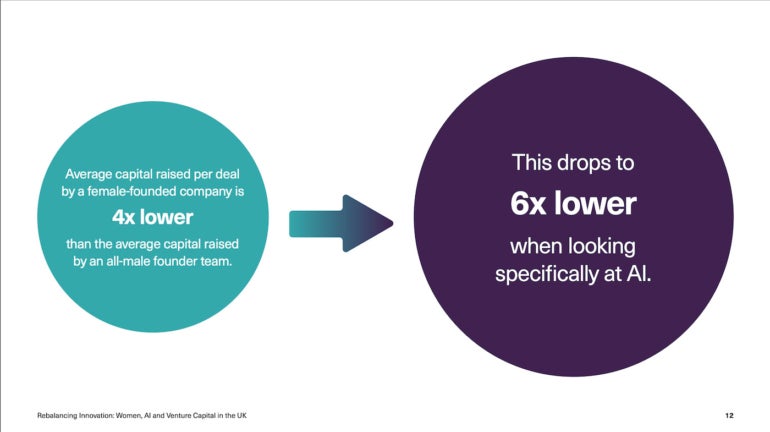
The report, Rebalancing Innovation: Women, AI and Venture Capital in the UK, found that the average deal capital raised by a female-founded AI company in the U.K. between 2012 and 2022 was £1.3 million ($1.6 million) – six times lower than the £8.6 million ($10.5 million) raised by all-male founder teams over the same period (Figure A).
Figure A
Female-founded companies raise 4x less capital than all-male teams; this gap widens to 6x in AI. Image: The Alan Turing Institute
It also found that, within the same period, startups with all-female founder teams accounted for just 2.1% of all funding deals. In contrast, 79.6% of deals were with AI companies founded by men, which managed to secure 79.3% (£55.1 billion/ $67.3 billion) of the total capital invested in the sector.
The researchers highlighted the urgency of addressing gender imbalances in AI funding in tackling the wider underrepresentation of women in the industry and in shaping responsible AI design in the context of the industry’s recent rapid growth.
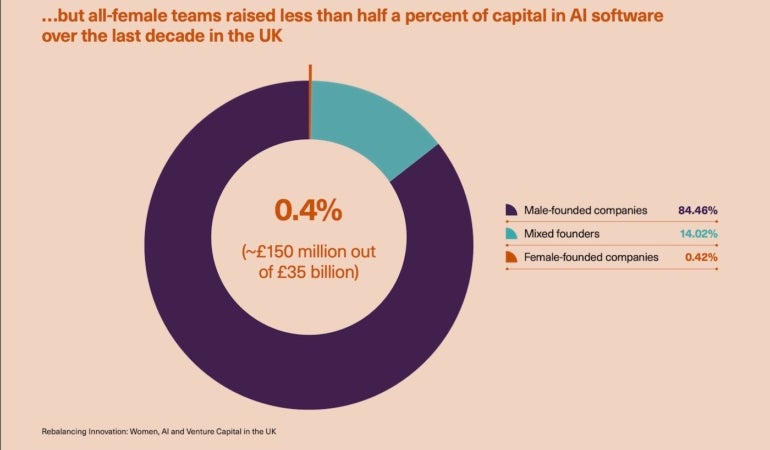
While AI software is booming globally, the report found that all-female teams raised less than half a percent – or £150 million ($183 million) – of the £35 billion ($42.8 billion) invested in AI software in the U.K. over the past decade (Figure B).
Figure B
In the U.K., all-female teams raised just 0.4% of capital in Al software over the last decade. Image: The Alan Turing Institute
“With the explosion of generative AI (such as ChatGPT), the need to ensure that women and marginalized groups have an equal place in the VC ecosystem and tech entrepreneurship more widely is urgent,” the report said. “VC investors have a disproportionate impact on the culture, products and services of the companies in which they invest. At a time when AI development is exponential, this has never been more important.”
Women under-represented in senior investor roles
According to 2021 data from CrunchBase cited in the report, the U.K. is the largest venture capital market in Europe and ranks third globally. Despite the number of female-founded AI companies in the U.K. doubling between 2018 and 2022, the report found that just 11% of VC funding went to startups with at least one female founder in 2022, while 77% went to companies founded entirely by men.
Women are also massively under-represented in the VC industry, with the report revealing that women comprise 20% of investment roles in the U.K.’s VC labor force and just 12% of senior investor roles.
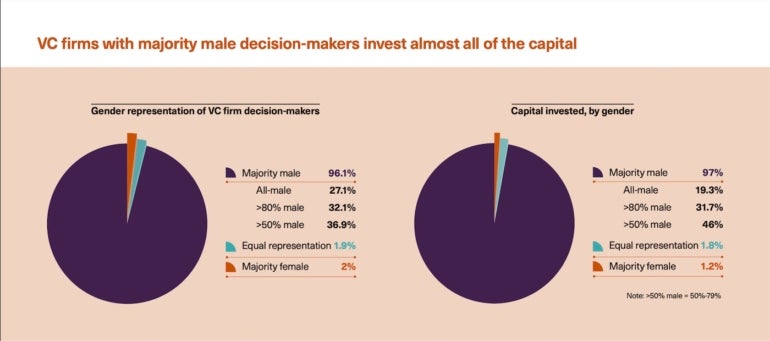
In the U.K., firms with equal or majority representation of women at the decision-maker level constitute just 4.5% of all VC firms, the report found (Figure C).
Figure C
Men make up the majority of decision-making roles at 97% of VC firms in the UK. Image: The Alan Turing Institute
This is mirrored in investment trends, with the data showing that VC firms in which women had equal or majority representation at the decision-making level accounted for just 3% of total capital invested in AI. These firms participated in just 3.9% of all investment deals from 2012 to 2022.
Potential harm resulting from lack of gender diversity in AI
Dr. Erin Young, research fellow at The Alan Turing Institute and project co-lead, noted that equal representation and participation in both AI development and funding are important for preventing harmful biases in AI systems and ensuring designs are safe, responsible and equitable.
“It’s crucial to consider what’s happening in the whole AI ecosystem when thinking about designing and implementing safe and responsible AI systems. This includes the data being used to train models and the design of algorithms – but this also obviously includes who is funding and building these technologies, bringing their own priorities and value systems,” Dr. Young told TechRepublic via email.
“The lack of diversity in the AI and VC industries, including the under-representation of women, can result in potentially harmful feedback loops of biases being built into machine learning systems. Indeed, VC investors have a huge impact on the business models and growth trajectories, as well as culture, products and services of the AI companies in which they invest.”
‘Embedded industry cultures’ are challenging progress for female entrepreneurs
The U.K. government has invested substantially in AI and data science technologies in recent years, with both of the country’s main political parties viewing AI as a critical tool for boosting private sector investment as well as for modernizing aging public systems like the U.K.’s National Health Service.
While there are a number of ongoing initiatives to boost female entrepreneurship and promote equality and diversity in this space, the report found that work focusing specifically on AI investment was lacking when compared to the U.S., where “a focus on diversity in innovation is developing.”
“For example, California is on the verge of passing legislation that would require VC firms to disclose the gender and race of the founders in which they invest,” said Dr. Young.
In the U.K., initiatives like the Rose Review and Investing in Women Code have been established to identify barriers faced by women in the entrepreneurial space and promote more equal access to financial products and services, including early-stage funding.
However, Dr. Young noted that the biggest obstacles to reducing gender disparities in VC funding were structural and reflected “embedded industry cultures.”
She added: “Pipeline problems are also at play: having an entrepreneurship background is desirable for working in VC, but as our research found, fewer women entrepreneurs are being funded, which may create a feedback loop.”
Tips for curbing this gender imbalance in AI and VC
The report highlighted several recommendations for curbing the gender imbalance in AI and VC companies, including improving recruitment and promotion processes and monitoring investment practices to ensure equal opportunities for women in leadership and decision-making partner roles.
Dr. Young said VC firms could also revisit how they monitored their investments so they could identify any disparities in funding allocations. Gender lens investing, an investment strategy that considers the gender impact of investments, could also help minimize biases in investment decisions and ensure a more equal AI and tech landscape, the report noted.
“Finally, firms can build and strengthen relationships with broader tech and entrepreneurial communities to widen access to both investor and founder talent,” said Dr. Young.
“A committed focus on supporting women investors and founders in AI, including targeted interventions and access to mentorship and networks, may begin to mitigate these challenges.”
Subscribe to the TechRepublic UK Newsletter
Catch up on the week’s essential technology news, must-read posts, and discussions that would be of interest to IT pros working in the UK and Europe.
There's concern that widespread use of artifical intelligence (AI) will result in a job cull, including for IT professionals, but tech leaders are saying that might actually be an advantage.
Rajeswari Koppala, senior manager of DevOps at United Airlines, says automation presents new opportunities for everyone, including the staff in her department.
"I am an evangelist of automation," she says. "I think if you use it properly, you can do wonders. There's a lot of scope where we can use AI tools and machine learning to optimize what we're doing."
In the case of United, Koppala is already introducing automation through the Harness software development platform, which uses AI to simplify DevOps processes and support continuous integration and continuous delivery (CI/CD).
The technology has helped to accelerate software deployment cycles by 75% and reduced the build process from 22 minutes to just five, allowing IT professionals to focus on higher-value tasks, such as creating new services that meet business requirements.
Also: How to use ChatGPT to write code
Rather than spending hours provisioning infrastructure and dealing with repetitive operations requests, United IT staff can get on with what they do best — developing and deploying applications.
Other companies are taking a similar approach, with research from Stonebranch suggesting that increased use of AI and automation across the IT profession is a common trend. More than four-fifths (81%) of organizations plan to grow their automation program in 2023 and 86% plan to replace or add a new automation platform.
That's certainly the case at foreign exchange specialist Travelex, where assistant vice president Mayank Goswami is overseeing the use of a CI/CD platform from technology specialist CircleCI to automate software deployment processes across multiple environments.
The platform allows Travelex to roll out standardized development templates quickly, rather than having to set up new infrastructure in every location around the globe.
Goswami says the implementation of the CircleCI platform is part of a broader shift towards Agile and DevOps in the business, and IT professionals shouldn't be concerned by the ever-increasing use of automation as part of the development process.
"Change is inevitable," he says. "Technology changes at least every two or three years and maybe quicker. You can't stick to what you know. You have to learn. If you consider change as an opportunity, that's how you will be able to survive in the IT industry."
The end result of increased automation, says Goswami, is bigger efficiencies and better working practices for everyone.
"When people work together and they're focusing on the larger business objective, and doing everything to achieve that incrementally through automation and using DevOps practices and tools, I think that's where the real benefits come through," he says.
Koppala also believes that IT professionals shouldn't be overly concerned about the rise of automation. New technologies bring fresh opportunities for operational efficiencies. She gives the example of automating deployment pipelines.
"If you have learned something from the work that you have done — and create models that can use the knowledge that is already in the system — that can bring big benefits."
However, it's important to recognize that, while automation can boost efficiency and reduce the number of repetitive tasks in an IT department, there are limits to what can be achieved.
Koppala says building automation into software development and deployment processes is a great first step, yet it's just one stage in a much longer journey.
"Over the years, automation has been a continuous struggle in the organization because any DevOps or platform engineering team tends to create automation for the use cases they know at that point of time," she says.
Going beyond that level — and adding intelligence into automation, so that manual intervention can be reduced when use cases change — is where United wants to go next.
Research suggests many companies are already embracing emerging technology. Business solutions company Freshworks' recently released State of Workplace Technology report says IT professionals are using AI to automate workflows and boost efficiency.
The survey says as many as 86% of IT professionals globally report their organizations are already using AI.
Koppala says increasing the amount of intelligence in the software development process is one of her team's major objectives for the next two years. And she expects AI to play a big role.
"When the use case changes, automation doesn't work — and the team needs to step in and do the manual work. So, how do you build intelligent automation that takes care of the use cases that you don't know about yet? That's the space where you can make use of AI and ML models and I am actually very optimistic about their role in the future."
Like Koppala, Goswami also expects to start seeing increasing amounts of automation in the DevOps environment.
He says it's early days for Travelex when it comes to forays into AI, particularly for generative tools, such as ChatGPT.
Also: Generative AI is coming for your job. Here are 4 reasons to get excited
However, Goswami and his colleagues are wise enough to keep a watchful eye on fast-moving developments in AI.
"All these emerging technologies are on our radar to look into whether there's something that delivers business value from the point of view of our customers."
Back at United, Koppala also recognizes that it's early days for using generative AI tools such as ChatGPT in the coding process.
Research suggests that's a sensible stance — MIT Sloan Management Review and Boston Consulting Group recently found that while more than three-quarters (78%) of organizations are using third-party AI tools, 55% of AI-related failures stem from using these tools. What's more, 20% of organizations failed to evaluate the substantial risks that AI tools can pose.
Also: AI is great at coding, but there are some massive caveats
United is being very careful before it starts thinking about how to use ChatGPT-like technologies for production-level code.
Like many other developers, Koppala has personally explored how ChatGPT might help to cut the bind associated with repetitive tasks, but not in terms of using the technology to refine enterprise systems on a day-to-day basis.
"There is a lot of hesitation around using it within an organization like United without licenses," she says. "Basically, I tried to generate pipelines using ChatGPT. It does the basic-level job. But I don't think you can use the pipelines that you're getting out of ChatGPT in production yet. It's nowhere near that level."
However, while the use of generative AI in the technology organization is still at a nascent stage, that's not to say that other forms of AI can't be used to boost the development process.
Koppala says her team is already investigating a feature in the Harness platform called Continuous Verification, which uses real-time, semi-supervised machine learning (ML) to model and predict service behavior.
Also: The impact of generative AI on software team productivity is… complicated
She says the aim is to integrate the deployment pipeline with monitoring capability. Then, if problems occur when a new service is rolled out, the ML-led technology can intervene automatically, which means business-critical applications keep running.
"For example, say I'm doing a deployment today, it goes live, and it all looks good," she says. "But what happens if, after two days of the deployment, the performance of the service starts to degrade and no one notices straightaway?"
Koppala says that's where Continuous Verification fills a gap — the technology continuously monitors service performance and automatically takes proactive action.
"As soon as services performance is degraded, this deployment pipeline gets triggered to roll back to the previous version, which was working fine," she says. "So, that's kind of self-healing — that's an intelligence-led tool that provides benefits for everyone."
Those kinds of plus points mean Koppala and her senior management colleagues at United are keen to look at how AI might help boost a wider range of software development and deployment processes.
She recognizes that the introduction of other AI tools is "a bigger journey altogether." But, once again, some significant progress is being made, including the evaluation of an AI-based tool that shows the impact of infrastructure changes before they're pushed live.
"We're not there yet, we're still working on that," says Koppala, who reiterates that emerging technology will continue to play an ever-increasing role in the working lives of United's IT and development professionals.
"That's our objective for the next two years," she says. "We want to close that space and take advantage of the right tools."
Get your approach and the benefits of automation are clear: Freshworks' survey reports that IT staff believe AI frees up time otherwise spent on repetitive tasks (49%), and allows them to do more complex, meaningful work (45%).
In total, IT professionals estimate they could save more than five hours a week by using AI to complete repetitive tasks.
For other IT professionals and business leaders who are looking at AI as part of the development process, Koppala has the following advice — find a tool like Harness that provides a platform for automation and a pathway to longer-term developments in emerging technology.
"I think that's in progress already. We want to use Harness as a software delivery platform beyond CI/CD. This is a fantastic tool with a lot of out-of-the-box integrations," she says.
"The benefits are related to engineering efficiency. It's all about faster times and we can do the task in a way that you can reduce the manual hours — we're saving lots of manual hours."
Long before passengers sit back, relax, and enjoy their flight, data has played a critical role in getting them to their seats. It has been a cornerstone of the aviation industry since the early days of air travel.
Indeed, from the early 20th century, data was collected through manual processes such as pilots logging information about weather conditions, navigation, and aircraft performance, and design engineers using this information to improve aircraft design and maintenance procedures. The entire network of manufacturers, large and small, pilots, planners, and investors have relied on data to design, build, and operate aircraft in a safe and efficient way.
Fast-forward to 2023, and many processes are fully automated. Data from fuel sensors is used to develop more efficient engines, airlines use data to improve their customer experience, and researchers use data to develop new ways of reducing aircraft emissions.
Data has been powering aviation since the industry’s inception, and it’s only going to increase in importance.
Using big data to strive for operational perfection
Data is critical for the improvement of airlines and airports’ operations. On-time performance, for example, is a key performance indicator that aviation leaders pay close attention to, to see how well their organisation is operating and performing against competitors.
This isn’t just a performance ranking of airlines and airports. This one metric serves as a valuable tool for self-improvement and a wake-up call to staff within an airline or airport.
Jet fuel prices are typically the most expensive cost item for airlines — and they are increasing, at the time of writing. Even in times of inexpensive fuel, airlines are keen to measure fuel consumption and corresponding GHG emissions. Analysing datasets on weather conditions, air traffic, and aircraft performance helps airlines develop more efficient flight plans and potentially save millions in fuel costs.
A final example to draw on is optimising crew scheduling. Data analysis on crew availability, passenger demand, and flight schedules can create more efficient crew schedules that reduce costs and improve on-time performance.
How is big data currently used in aviation?
The use of data in aviation is widespread and is used to complete routine tasks as well as the highly advanced.
For example, data is used to personalise passenger experiences, such as tailoring in-flight entertainment, or providing real-time information about their flight and destination.
On a more advanced level, airlines and aircraft manufacturers use data to develop predictive maintenance plans, using sensors to determine when maintenance on an aircraft is needed, and before a problem arises. This has positive impacts on cost and aircraft safety and reliability.
One of the principal uses of data in aviation is to manage the flow of real-time air traffic. Air traffic controllers use information about aircraft positions, altitudes, and headings to route aircraft safely and efficiently, and minimise delays. Industry experts have even suggested using data to manage airport arrivals and departures, scheduling aircraft to optimal wind conditions en route — holding back some flights briefly in favour of others with the ultimate goal of an efficient system.
Using data to power advanced aviation analytics
With new technologies such as AI and machine learning emerging at speed, the aviation industry will benefit from new, innovative ways of collecting and analysing data. (And, I might add that Cirium has long been hard at work harnessing these technologies to bring improvements to the industry.)
One area where advanced data collection and analysis will have a major impact is sustainability. Data can be used to improve the fuel efficiency of aircraft and operations and can be used to reduce the environmental impact of aviation, such as noise pollution and CO2 emissions.
Data is also critical in providing executives with the business intelligence they need to make informed decisions. If you have the right systems in place to capture and analyse a wide pool of data from different departments, it gives decision makers a broader view of key internal and external opportunities and challenges.
Big data is critical for effective cost management and operational efficiency in most industries and, in aviation, it has a far reaching, positive impact if it is processed and analysed correctly.
Yes, there are time and cost saving benefits from robust data analytics, but it can also help to improve safety protocols on aircraft, security in airports, and even the carbon footprint of organisations.
With emerging predictive technologies entering many industries, aviation is no exception, and it will be fascinating to see how it is used to improve the processes, functions, and flight plan of the industry.
For more information about Cirium and aviation analytics, visit: www.cirium.com






 pic.twitter.com/K7ZiG9n8BT